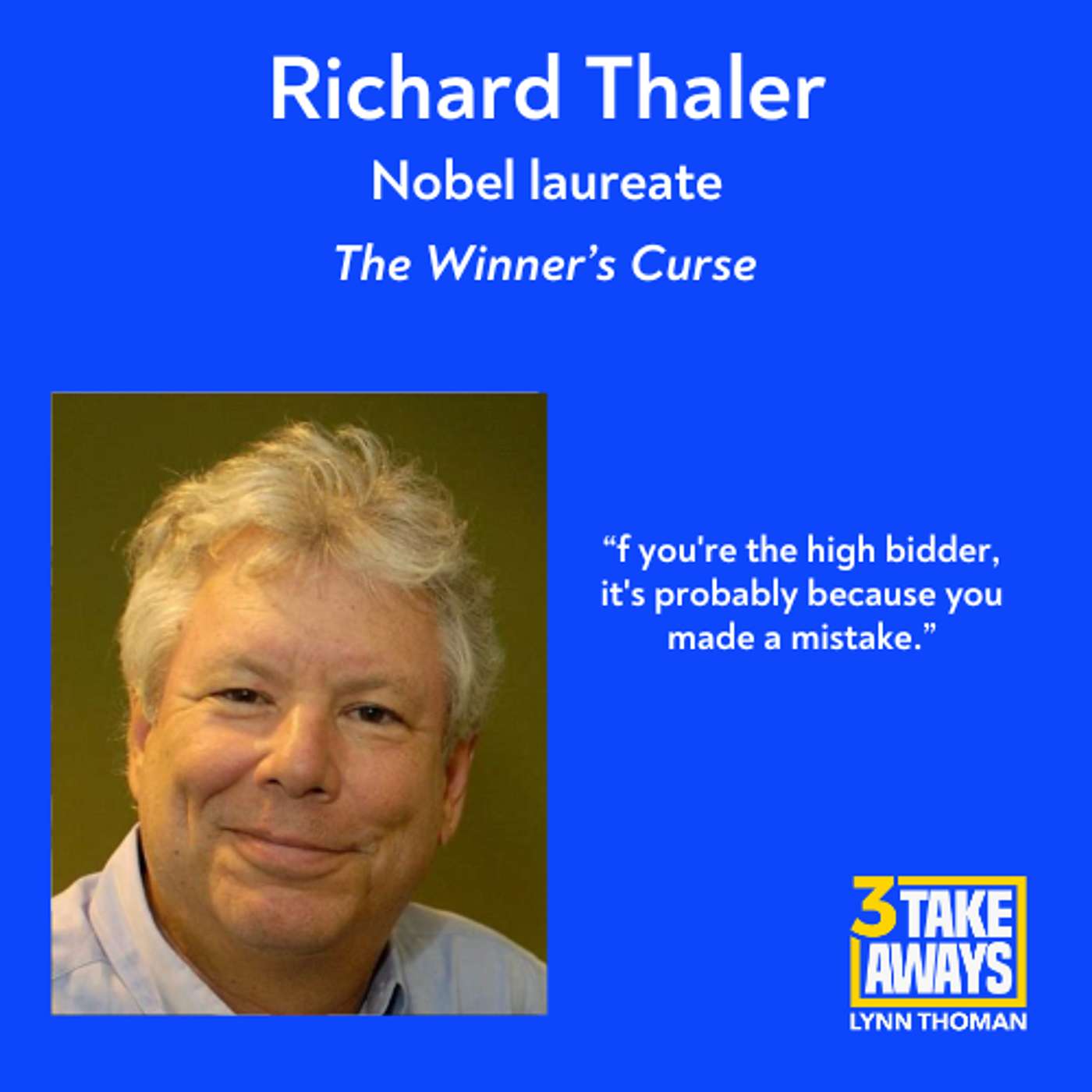
The Winner’s Curse: Why “Winning” Often Means You Just Lost with Nobel Laureate Richard Thaler (#288)
We all love the thrill of winning - the house, the promotion, the deal. But as Nobel laureate Richard Thaler explains, some of our biggest “wins” are actually the moments we set ourselves up to lose. Thaler breaks down why we overbid, overpay, and talk ourselves into choices we regret. And he shares simple tricks to help you catch yourself before you make a mistake you can’t undo.
2026-02-10
22 min
Transcript
Available Results
Generated results are saved to the knowledge database for reuse and search.
No generated results are available for this episode yet.
Extract Knowledge
Pick what you want extracted first. Model, scope, and chapter options appear after a template is selected.
Generated results for public episodes are saved to the knowledge database so they can be reused and searched later.
Transcript
3 Takeaways
Podcast Transcript
Lynn Thoman
(
https://www.3takeaways.com/
)
Ep 288:
The Winner’s Curse: Why “Winning” Often Means You Just Lost with Nobel Laureate Richard Thaler
This transcript was auto-generated. Please forgive any errors
Lynn Thoman:
We all love to win. The promotion, the deal, the auction, the house. But sometimes winning turns out to be the biggest mistake.
Imagine celebrating a victory only to realize you've paid too much, promised too much, or believed too much. That's the winner's curse. And it doesn't just happen in business.
It happens in everyday life. Why do smart people, even Nobel Prize winners, fall for it? And more importantly, how can we stop ourselves from doing things that make absolutely no sense?
Hi, everyone. I'm Lynn Thoman, and this is 3 Takeaways. On 3 Takeaways, I talk with some of the world's best thinkers, business leaders, writers, politicians, newsmakers, and scientists. Each episode ends with three key takeaways to help us understand the world, and maybe even ourselves, a little better.
Lynn Thoman:
Today, I'm excited to be with Richard Thaler. Richard won the Nobel Prize in Economics, but not for solving some abstract mathematical puzzle.
He won it for noticing something that others had missed. People are irrational, predictably irrational. We overpay at auctions. We save too little for retirement. We make the same mistakes over and over, not randomly, but predictably.
And here's the thing. Once you see the patterns, you can change them.
Richard's ideas have reshaped how governments design policy, how companies make decisions, and how millions of people save for retirement. His books, Nudge, Misbehaving, and The Winner's Curse, have changed how we think about money, choices, and human nature.
He's a professor at the University of Chicago, but more importantly, he's shown us that winning can sometimes be the biggest loss, that we're all a little irrational, and that we can make smarter and happier decisions once we understand how we actually think.
Welcome, Richard, and thanks so much for joining 3 Takeaways today.
Richard Thaler:
It's a pleasure. Thanks for having me.
Lynn Thoman:
It is my pleasure. Richard, you seem to have almost an obsession for what you call anomalies. What are they, and why are you so fascinated by them?
Richard Thaler:
Anomalies are what's unusual. I love Escher paintings, you know, those paintings that have impossible staircases. So I love anomalies generally, and I love them as a way of learning about economics, because they tell us where the weaknesses are.
Yao Ming is an anomaly, but not of theoretical interest. Somebody has to be tall, but the anomalies that I study tell us something about people, and tell us something about economics. And economics needs to be able to incorporate what real people do, or they're going to have theories about fictional creatures.
Lynn Thoman:
Richard, you kept a list of things that people did that made absolutely no economic sense. Can you give a couple of examples from that list?
Richard Thaler:
Here's one example from my time in grad school. One of my professors, the chairman of the department, was a big wine lover. He used to have bottles of wine that he had purchased 20 years earlier that had appreciated greatly in value.
So say he had bought a bottle for $10, it was now [worth] $300. And he would drink one of those bottles occasionally, but he would never buy a bottle at that price, nor would he sell one. Now, why is that an anomaly?
Well, what does it cost him to drink one of those bottles? It costs $300, because he could sell it to his retailer for $300. But that's not the way people think about it.
So we have an anomaly. And here’s another example. This one from the business world. There's something that's called the winner's curse.
There's something that's called the winner's curse. This phenomenon was discovered not by economists or psychologists, it was discovered by engineers at Atlantic Richfield Oil Company, who learned that over time, that the auctions they won for oil leases, there was less oil than they expected. And then they finally figured out that's because the auctions that they win are not a random sample of their bids, it's the ones they made high bids.
And the general rule is, the more bidders there are, the more cautious you need to be.
Lynn Thoman:
Because if you're the high bidder, you may have the price wrong?
Richard Thaler:
Yeah, if you’re the high bidder, it's probably because you made a mistake. So here's the winner's curse, the way that we demonstrate it to students.
We fill up a jar with coins or jelly beans. If it's jelly beans, we say they're worth 25 cents each, and we auction off the jar. The winning bidder gets the amount of money, 25 cents times the number of jelly beans is worth. What happens if we do that experiment?
The average student bids less.
Let's suppose that there's $50 in the jar. The average student bids less than $50. Maybe they're conservative or risk averse or what have you.
But the winning bidder always bids more than the value of the jar. Typically, it's a guy. So the winner of the auction is cursed in the sense that he or she has paid more than what the object is worth.
I ended up later writing a paper with a former student of mine about a similar behavior in the National Football League. Every year, the NFL has a draft of new players where the worst team last year, gets the first pick. So they can pick any of the incoming players.
And what we found is that those early picks turn out to be not as good as people expect. And there's an active trading of the picks, which is a little bizarre. But you can trade the first pick for the seventh and eighth picks or for five picks in the second round or what have you.
And what we found is those high picks are overvalued. You'd always be better off trading down. That's because of the winner's curse.
The team that pays the most to go up and get that first pick is the one that's most optimistic about whatever player they're tying to get. They think they're going to get the next Tom Brady and somehow they've forgotten that Tom Brady himself, the real Tom Brady, was taken with the 199th pick, not the first pick.
Lynn Thoman:
That's great. I did not realize Tom Brady was the 199th pick.
Where else do we see the winner's curse?
Do we see that when people bid to buy houses or when companies bid to purchase other companies?
Richard Thaler:
Certainly if you're shopping for a house and all of a sudden there's an auction, it's a good time to go back looking. Because it's one thing to be the only person that wants to buy this house or there's one other. But if there are 10 people bidding, the lesson from auctions is you want to ask yourself, if I win this auction, am I going to be happy?
And if there are a lot of bidders, chances are you're not going to be happy.
And the same can happen for bidding for construction projects, where the low bidder gets the contract. And if there are lots of firms bidding, then often the low bidder is the one who forgot something important or forgot that everything ends up costing more than you expect.
So you see the winner's curse in lots of situations.
Lynn Thoman:
So interesting. What other anomalies do you see?
Richard Thaler:
I'm particularly interested in what I call mental accounting. The story of my professor and his wine is an interesting example of mental accounting. What does he think he's spending when he drinks one of those old bottles?
I actually did a survey of some serious wine lovers once and we asked them a question. You buy a bottle and you don't plan to drink it for 20 years. What does it feel like you're doing?
Are you spending money or investing? And they say, oh, I'm investing because I'm not going to drink that for 20 years. Then we say, all right, now you go and drink one of those bottles that you bought 20 years ago.
What does it feel like you're doing? Are you spending or drinking? And they say, oh, I'm not spending.
I paid for that 20 years ago. It's free. So that's kind of funny mental accounting.
They don't feel like they're spending when they buy it. They don't feel like they're spending when they drink it. This is a good deal if you're the seller, if you can get people to think this way.
And one thing that comes up with mental accounting is something that economists call the sunk cost fallacy, S-U-N-K. And the idea is you paid for something. You and your partner bought tickets to a very nice concert for tonight.
And you get a phone call that an old friend is stuck at the airport and has to spend the night in your town and is free for dinner. Would you like to go see the friend? But you have these expensive concert tickets.
And let's stipulate that on any night, you would rather go see this friend than that concert. But you paid all that money for those concert tickets. People are going to struggle with, should I waste the money I spent on those concert tickets?
Or should I do the thing that I would really like to do, which is go see my old friend? So economists say, ignore sunk costs. You paid for it.
Going to the concert doesn't get that money back. That's gone. It's sunk.
But people have a lot of trouble with that. So let sunk costs sink is my advice.
Lynn Thoman:
So what else was on your list of anomalies?
Richard Thaler:
The ultimatum game. The ultimatum game was devised to try to illustrate how people feel about fairness. And here's the way it works.
You and I get to play this game. I get $100 and I'm told I have to share it with Lynn. I make you an offer of some share of the $100.
Say I have 100 one dollar bills, so I can give you some number of those. And you get to say yes or no. And if you say yes, you get what I offered you and I get the rest.
If you say no, we both get nothing. Now, what does economic theory say will happen? Well, I'm an economist, so I assume that you think more money is better than less money.
$1 is more than $0. So if I offer Lynn $1, I mean $1 is better than $0, I'll offer her $1. If we were playing that game and I offered you $1, would you accept it?
Lynn Thoman:
Absolutely not. But I thought what you were going to say is most of the students would say they would bid $50, half, to be fair. But that's not where you're going at all.
Richard Thaler:
No, I haven't told you what happens yet. Remember, my job is to make fun of economists. An economist will think that Lynn will take $1, and so will predict that the first players will offer $1.
You're right that the most common offer is 50%. And offers of less than 20% are rejected. So yes, it's $20, and you can actually buy something with $20.
But you are probably thinking, well, that's not fair that he gets 80 and I get 20. So the profit-maximizing offer in that game is about 40. Most people offer 50.
40 is a little greedy, but most people will accept it.
Lynn Thoman:
Richard, you've talked about a number of anomalies and behaviors. Are these necessarily dumb?
Richard Thaler:
No, I resist the word rational or irrational. My take on this is it's not that people are dumb, it's that the world is hard. And things like mental accounting, it makes sense for people to have budgets.
If you have a kid in high school that's going to be going off on their own or graduating from college, there's nothing more value you could teach them than how to have a budget. That part is smart, but whether you should be willing to spend more money if it's from this pot of money than that one, that's not so smart. So it's complicated and interesting, but not necessarily stupid.
Lynn Thoman:
How can we stop ourselves from doing some of these things that make absolutely no economic sense?
Richard Thaler:
I think you can become aware. I'll tell you a funny story. When my daughter Maggie was in junior high school, we were living in Ithaca, New York.
Friday nights, there was afterschool skiing. And one night she says, oh, I'm not going to go skiing this Friday. There's a dance at school. I'm going to go.
Oh, okay, great.
And the next week she says, I'm not going skiing this week. My friend is having a party.
So I said, Maggie, we paid a lot of money for those ski trips. And she says, sunk cost.
So this is the daughter of a behavioral economist. You know, I think if you're aware, then you can catch yourselves and make fewer of the mistakes.
Lynn Thoman:
That's an amazing story that your daughter caught you up on a classic behavioral mistake. And you, the famed Nobel laureate.
Richard Thaler:
I've created a monster.
Lynn Thoman:
You and Cass Sunstein introduced the world to nudges. Can you explain what a nudge is and give a couple of examples of nudges?
Richard Thaler:
We had a philosophy, and we give it a brilliant name, called libertarian paternalism. The idea of libertarian paternalism is you want to help people, but not force anybody to do anything. How can you do that?
So that's the idea of a nudge. You do something that influences their behavior, but doesn't mandate it. A place where I've done a lot of research and where these ideas have come into play is devising retirement savings plans.
Certainly in my parents' generation, pensions were like social security. They just depended on how much you made. You had no choices to make.
And when they were getting started, lots of people weren't even joining. Now, this is really dumb. Because at most companies, there's a match.
So they'll match your saving dollar for dollar, even 50 cents on the dollar. If you turn that down, that's throwing money away. So how can we help?
Well, it used to be that at almost all companies, to join, you had to fill out some form and say, yes, I want to join, and I want to invest my money in the following funds. Filling out one form isn't really that big of a deal. But it was enough of a deal that at one company, only half the workers had joined within their first year of employment, costing themselves thousands of dollars.
What did we suggest? Let's change the default. So we'll make it that unless you fill out a form, we're going to enroll you at a certain saving rate and into a certain fund.
One of my then colleagues, Bridget Madrian, studied a firm that made this switch. And enrollment within the first year went from 50% to 90%, just by making it automatic. That left a problem that the default saving rate was too low.
So another one of my students, Slomo Benarzi, and I came up with a plan to fix that, that we called Save More Tomorrow. What we offered people was, you can increase your saving rate next year when you get a raise. People say, oh, next year, fine.
And it's from the raise, right? So there's no loss. We're just reducing the gain.
We tripled saving rates in that company. I recently looked this up. There's something like $9 trillion in 401k plans.
Those two ingredients are part of how we got there. The third was creating a sensible default investment. In the early 2000s, the Labor Department had said, the only thing you can put people in without them choosing is a savings account or a money market account.
And a bunch of us lobbied to get what are now called target date funds, a more diversified investment, which starts out young people, mostly in stocks, and then ramps it [equities] down as they reach retirement. So those three ingredients, automatic enrollment, automatic escalation, and good default investments are now part of most plans. And we wouldn't have $9 trillion in 401ks without those.
Lynn Thoman:
So what you're essentially saying is that people excel at doing nothing. So defaults are great nudges?
Richard Thaler:
Yes.
Lynn Thoman:
So interesting. What are the three takeaways you'd like to leave the audience with today?
Richard Thaler:
One is people aren't dumb. The world is hard.
Number two, to improve life and people's lives, I have a three word answer to how to do that.
Make it easy. That's all you have to do. Make the good choice easy to do.
The last I would say is anytime you ask somebody, why do we do that that way? And they say, well, that's because we've always done it that way. Make them start over and tell them about status quo bias.
Anytime anybody gives me that answer, I give them an F and say, no. Why do we still do it that way? Isn't there a better way?
Lynn Thoman:
Richard, thank you for joining 3 Takeaways. It's been a pleasure. I very much enjoyed all three of your books, The Winner's Curse, Nudge, and Misbehaving.
And of course, congratulations on winning the Nobel Prize.
Richard Thaler:
Thanks, Lynn.
OUTRO:
If you’re enjoying the podcast, and I really hope you are, please review us on
Apple Podcasts
or
Spotify
or wherever you listen. It really helps get the word out. If you’re interested, you can also sign up for the 3 Takeaways newsletter at
3takeaways.com
where you can also listen to previous episodes.
You can also follow us on
LinkedIn
,
X
,
Instagram
and
Facebook
.
I’m Lynn Thoman and this is
3 Takeaways
. Thanks for listening.
This transcript was auto-generated. Please forgive any errors.
Chapters
No chapters available.