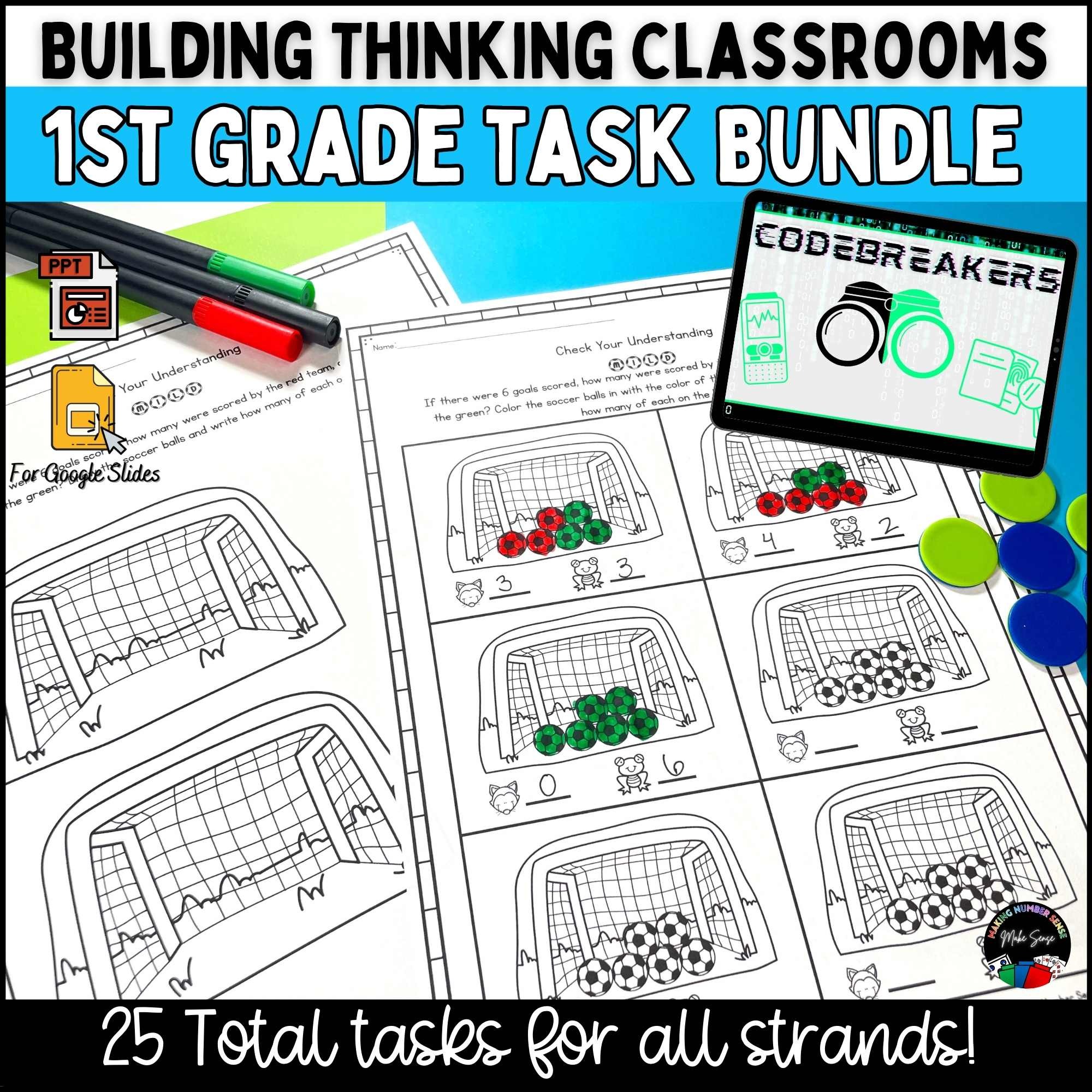
Ep 43: 1st Grade Tasks for Building a Thinking Classroom!
Making Number Sense Make Sense: A Math Podcast for Early Elementary Teachers
Today, we’re diving into something that every early elementary teacher has faced: coming up with the perfect math task—especially for those curious First Graders. Sometimes, it feels like the hardest part, right?
Well, no worries, because we’ve got some exciting, hands-on ideas to spark engagement and build math confidence in your students! We’ll talk about:
📖 Story-Based Problems that bring math to life with fun narratives.
🔢 FREE 100 Chart Mysteries where your students will outsmart the 100 Chart Thief.
🍕 Pizza Fractions at the Dough-licious Pizzeria.
📏 Nonstandard Measurement Adventures with the Cube Queen and Popsicle Stick King.
🎡 Data and Graphing at the Laugh-A-Lot Carnival.
🔺Composing Shapes with pattern blocks
⭐Save ⏱️ and 💸 on the 1st Grade Task Bundle!⭐
Have a topic you want me to discuss? Fill out the Google Form!
Let's Connect!
Available Results
Generated results are saved to the knowledge database for reuse and search.
Extract Knowledge
Pick what you want extracted first. Model, scope, and chapter options appear after a template is selected.
Transcript
1
00:00:00,000 --> 00:00:04,560
Last week we were talking all about tasks to hit kindergarten standards.

2
00:00:04,560 --> 00:00:07,440
Today we're talking about tasks to hit some first grade standards.

3
00:00:14,240 --> 00:00:19,680
Hello and welcome to Making Number Sense Make Sense, a podcast for elementary teachers,

4
00:00:19,680 --> 00:00:24,800
specifically early elementary teachers, looking to really make an impact in the number sense of

5
00:00:24,800 --> 00:00:31,040
their students. I never thought I would say but I was really enjoying creating tasks for first grade

6
00:00:31,040 --> 00:00:36,320
because in kindergarten of course I want stories, I want them to get immersed in what's happening,

7
00:00:36,320 --> 00:00:41,520
but also they're in kindergarten so they do need a lot of practice with counting, number writing,

8
00:00:41,520 --> 00:00:46,400
counting sequence, things like that. But I feel like in first grade they have a better handle on

9
00:00:46,400 --> 00:00:51,600
it so you can get a little bit deeper and do a little more stories because they have a foundation

10
00:00:51,600 --> 00:00:56,560
for the math that they'll be need to be doing or the ways that they might express themselves

11
00:00:56,560 --> 00:01:02,720
both verbally and written down to show all of the great thinking that they're doing. So today I'm

12
00:01:02,720 --> 00:01:08,080
going to share some tasks for first grade that you might want to try with your students. I find

13
00:01:08,080 --> 00:01:14,000
addition, subtraction, traditional problem solving, there's a lot of tasks out there. I've created a

14
00:01:14,000 --> 00:01:19,760
lot myself and those are really great especially when you can dip your toes into a story but also

15
00:01:19,760 --> 00:01:24,000
have them exposed and practicing all of the different problem types. Today I'm going to share

16
00:01:24,000 --> 00:01:28,720
some tasks that are four standards that sometimes might get overlooked but sometimes you just kind

17
00:01:28,720 --> 00:01:35,680
of need a break from addition and subtraction. So the first one is for graphing and so in this one

18
00:01:35,680 --> 00:01:40,880
the kids go to a carnival called the Laugh-A-Lot Carnival and at this carnival there is so many

19
00:01:40,880 --> 00:01:47,200
things to do. So your students voted on rides, snacks, and games they wanted to play at the

20
00:01:47,200 --> 00:01:53,920
carnival and in the task they are kind of organizing the data about the rides, the snacks,

21
00:01:53,920 --> 00:02:00,480
and the games that the kids wanted to play. So they have three different data sets for rides,

22
00:02:00,480 --> 00:02:06,000
games, and snacks and the kids have to organize it so they have to figure out how many were in each

23
00:02:06,000 --> 00:02:13,600
category and answer questions and create a graph to represent the data that they collected. And this

24
00:02:13,600 --> 00:02:19,600
and this kind of builds on itself by starting with just two options moving to three and then four

25
00:02:19,600 --> 00:02:24,320
and students making a graph for each of these data sets which is the thin slicing part. The

26
00:02:24,320 --> 00:02:29,680
check your understanding is that they've also kind of wanted to play games and see what kind of prizes

27
00:02:29,680 --> 00:02:35,120
might be available. They can choose if they want two categories in their data three or four to

28
00:02:35,120 --> 00:02:40,400
reinforce the skills that they had been working on. The next task I'm going to share is a measuring

29
00:02:40,400 --> 00:02:48,080
task. So this task involves two characters the cube queen and the popsicle stick king. So these two

30
00:02:48,080 --> 00:02:53,440
are remodeling a room in their castle and they need your students help to measure the various

31
00:02:53,440 --> 00:02:58,720
things that they want to put into this room that they are remodeling in their castle. So your

32
00:02:58,720 --> 00:03:03,680
students have a list of classroom items that they will measure and so on day one they're going to

33
00:03:03,680 --> 00:03:09,040
measure these things with cubes to figure out how long or short these things are and on day two

34
00:03:09,040 --> 00:03:13,440
they're going to be measuring these things with popsicle sticks. So the first one is the queen's

35
00:03:13,440 --> 00:03:19,760
measurement, the second one is the popsicle stick king's measurement. The thin slicing is the variety

36
00:03:19,760 --> 00:03:25,760
of things that they can measure and at the end instead of a check your understanding task this

37
00:03:25,760 --> 00:03:31,440
will be more of a reflection on when it's best to measure with certain items. So they're going to

38
00:03:32,000 --> 00:03:37,120
answer some questions and fill in the blank about when it might be best to measure with sticks

39
00:03:37,120 --> 00:03:46,000
versus cubes and why that might make a difference. This next task is a fraction task and in this task

40
00:03:46,000 --> 00:03:51,280
your students are helping the delicious pizzeria. If you couldn't tell I love a good pun I also

41
00:03:51,280 --> 00:03:57,760
think it adds a little more fun to the task that you're doing. So at the delicious pizzeria they

42
00:03:57,760 --> 00:04:03,520
have orders that they are trying to fill but these orders are either between two sharers or four

43
00:04:03,520 --> 00:04:08,800
sharers. So on the recording sheet they have basically order slips and it either shows a

44
00:04:08,800 --> 00:04:15,120
circle pizza like a circular pizza that the clients want or a rectangular pizza and how many

45
00:04:15,120 --> 00:04:19,520
sharers they want it partitioned into. So on the recording sheet they're either going to partition

46
00:04:19,520 --> 00:04:24,560
between two and four sharers and once they get to the check your understanding they might even have

47
00:04:25,280 --> 00:04:31,360
a pizza with three sharers for a little extra challenge. Keeping on brand with the story theme

48
00:04:31,360 --> 00:04:38,000
the next task is called the hundreds chart thief. So there is a thief that has stolen numbers

49
00:04:38,000 --> 00:04:43,040
off of the hundreds chart and your students need to use their number recognition and pattern

50
00:04:43,040 --> 00:04:48,400
recognition in a hundreds chart to figure out which items have been stolen or which numbers have been

51
00:04:48,400 --> 00:04:54,080
stolen by the hundreds chart thief. And similarly their recording sheet or their thin slicing is

52
00:04:54,080 --> 00:04:58,400
other sections of the hundreds chart that have been messed with that your kids need to figure out

53
00:04:58,400 --> 00:05:05,120
which numbers are missing. Kind of my first category of tasks do tend to be more story related

54
00:05:05,120 --> 00:05:09,840
that they can really get immersed into but at the same time that doesn't work for everything

55
00:05:09,840 --> 00:05:14,960
and there might be other things that might engage your students as well and variety is a spice of

56
00:05:14,960 --> 00:05:19,920
life right we like to switch it up. So the next two tasks I'm going to talk about are for composing

57
00:05:19,920 --> 00:05:26,160
shapes and skip counting but it's not necessarily a story it's more visual and task based or

58
00:05:26,160 --> 00:05:32,640
challenge based. So for skip counting by fives your kids will get different images of dice faces

59
00:05:32,640 --> 00:05:38,640
and different arrangements that all show five. So this is a really great opportunity for you to see

60
00:05:38,640 --> 00:05:44,240
if your kids are just skip counting five ten fifteen twenty or if they are starting to group

61
00:05:44,240 --> 00:05:48,800
maybe they prefer to work in groups of tens or groups of twenty. So you can see kind of the way

62
00:05:48,800 --> 00:05:53,280
that they're starting to think about numbers and grouping smaller numbers to bigger ones with a

63
00:05:53,280 --> 00:05:59,920
variety of images dice images that they have to work with in both the fin slicing and also the

64
00:05:59,920 --> 00:06:06,800
check your understanding piece. And the bonus last but not least for today is a composing shapes task

65
00:06:06,800 --> 00:06:11,600
which is similar to the kindergarten one but these shapes are a little bit more complex and require a

66
00:06:11,600 --> 00:06:17,760
little more thought for your students to be able to do. So they have four different shape challenges

67
00:06:17,760 --> 00:06:23,440
that they'll work on and then again in the check your understanding piece they have challenges that

68
00:06:23,440 --> 00:06:28,800
are a little bit tougher or if they're feeling crazy with it they really enjoy it they can try

69
00:06:28,800 --> 00:06:35,040
all of them at the same time. Let me know if you have any questions about these tasks if you're

70
00:06:35,040 --> 00:06:40,800
going to try them and you can check out the blog post to see images of what these tasks look like

71
00:06:40,800 --> 00:06:45,760
and get a better idea if they will work for you in your classroom. The hundredth day of school is

72
00:06:45,760 --> 00:06:51,360
approaching and their hundreds chart thief is a perfect task to do on the hundredth day of school

73
00:06:51,360 --> 00:06:56,560
and if you would like to give it a try you can get it absolutely free in the show notes there is a

74
00:06:56,560 --> 00:07:16,400
link where I will send it to you for free and you can give it a try and let me know what your students think.