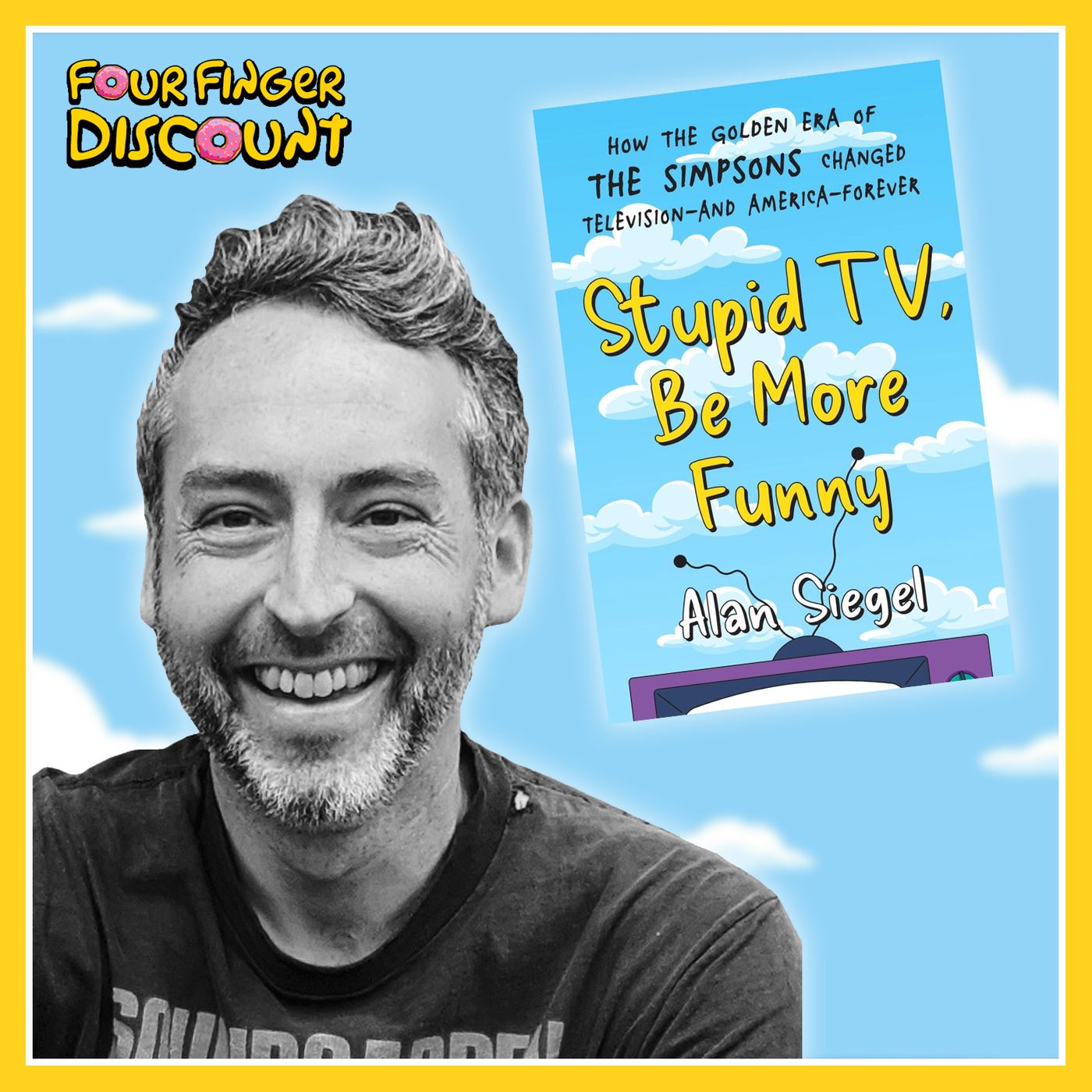
How To Write A Simpsons Book (with Alan Siegel, author of "Stupid TV: Be More Funny – How The Golden Era of The Simpsons Changed Television
Stupid podcast, be more funny! Well one way to ensure hilarity is to chat with The Ringer's own Alan Siegel, author of the new Simpsons book titled Stupid TV: Be More Funny – How The Golden Era of The Simpsons Changed Television and America Forever.
We discuss The Simpsons impact on TV comedy, how he fell in love with the show, the book-writing process and more.
If you enjoy this review, please consider supporting us on Patreon for as little as $1 per month at patreon.com/fourfingerdiscount
Listen on Spotify - spoti.fi/4fDcSY0
Listen on Apple Podcasts - apple.co/4dgpW3Z
CHECK OUT OUR OTHER PODCASTS:
Goin' Down To South Park - spreaker.com/show/goin-down-to-south-park
The Movie Guide with Maltin & Davis - themovieguidepodcast.com
The One About Friends - spreaker.com/show/the-one-about-friends-podcast
Talking Seinfeld - spreaker.com/show/talking-seinfeld
SpeaKing Of The Hill - spreaker.com/show/speaking-of-the-hill-a-king-of-the-hill-
The Office Talk - spreaker.com/show/the-office-talk-podcast
Become a supporter of this podcast: https://www.spreaker.com/podcast/four-finger-discount-simpsons-podcast--5828977/support.
We discuss The Simpsons impact on TV comedy, how he fell in love with the show, the book-writing process and more.
If you enjoy this review, please consider supporting us on Patreon for as little as $1 per month at patreon.com/fourfingerdiscount
Listen on Spotify - spoti.fi/4fDcSY0
Listen on Apple Podcasts - apple.co/4dgpW3Z
CHECK OUT OUR OTHER PODCASTS:
Goin' Down To South Park - spreaker.com/show/goin-down-to-south-park
The Movie Guide with Maltin & Davis - themovieguidepodcast.com
The One About Friends - spreaker.com/show/the-one-about-friends-podcast
Talking Seinfeld - spreaker.com/show/talking-seinfeld
SpeaKing Of The Hill - spreaker.com/show/speaking-of-the-hill-a-king-of-the-hill-
The Office Talk - spreaker.com/show/the-office-talk-podcast
Become a supporter of this podcast: https://www.spreaker.com/podcast/four-finger-discount-simpsons-podcast--5828977/support.
2025-09-18
57 min
Transcript
Available Results
Generated results are saved to the knowledge database for reuse and search.
No generated results are available for this episode yet.
Extract Knowledge
Pick what you want extracted first. Model, scope, and chapter options appear after a template is selected.
Generated results for public episodes are saved to the knowledge database so they can be reused and searched later.
Transcript
<v Speaker 1>Four Finger Discount.
<v Speaker 2>Dude, Hey, everybody, welcome to four Finger Discount. I am
<v Speaker 2>Brendandana joined it now by Guy Davis. Hello everybody, and
<v Speaker 2>we are lucky to be joined today by the man
<v Speaker 2>who has just written the best Simpsons book ever. Apparently
<v Speaker 2>it's Alan Siegel. Hey doing Allen.
<v Speaker 1>I'm great, Thanks for having me, guys.
<v Speaker 2>And I say, apparently it is. I just read it
<v Speaker 2>this morning, a lot of it this morning, and yeah,
<v Speaker 2>it's fantastic. It doves into a lot of the Simpsons
<v Speaker 2>issue that we've touched on many times in the past.
<v Speaker 2>But I feel like you've found a way to find
<v Speaker 2>new information, which is great.
<v Speaker 1>Yeah, it's funny.
<v Speaker 3>I've wanted to write a book about the Simpsons for
<v Speaker 3>like ten years now, and I could never quite figure
<v Speaker 3>out the angle, you know, like because the show is
<v Speaker 3>like an institution, especially in the States, really all over
<v Speaker 3>the world, and it just was too big.
<v Speaker 1>It was like too big to try to off.
<v Speaker 3>But just focusing on the nineties is what I really
<v Speaker 3>settled on because I sort of was like, this is
<v Speaker 3>what we talk about, it's what we quote. It's really
<v Speaker 3>like what the show, what the greatness of the show
<v Speaker 3>and the joy of it is, and so that's really
<v Speaker 3>what I wanted to focus on.
<v Speaker 4>It's also I really give us an insight into the
<v Speaker 4>people who I guess shaped the show and shaped its
<v Speaker 4>voice very early on. I mean I really came away
<v Speaker 4>from Radiant with a greater knowledge and even more of
<v Speaker 4>a greater appreciation of guys like Meyer and Swartzwel and
<v Speaker 4>Sam Simon, all those people. I mean, yeah, you really
<v Speaker 4>capture their personalities very very vividly.
<v Speaker 1>I think, thanks.
<v Speaker 3>Yeah, I feel like I could have written a whole
<v Speaker 3>book on Meyer and sports Wealth every I had so
<v Speaker 3>much material on them.
<v Speaker 1>Like my editor at one point was like, why is
<v Speaker 1>this in here?
<v Speaker 3>I mean I had like a whole long digression about
<v Speaker 3>the script that George Meyer wrote for David Letterman, and
<v Speaker 3>it was like a James Bond parody and the Simpsons
<v Speaker 3>writers would like steal jokes from it, and you know,
<v Speaker 3>and Meyer basically said like, oh it was funny, but
<v Speaker 3>you know, Austin Powers did it better. Like this is
<v Speaker 3>stuff that's like catnip for me, but yeah, it's hard
<v Speaker 3>to like excize. You know, it's killer darlings, right, And
<v Speaker 3>so there's just so much there.
<v Speaker 2>Was your editor a big Simpsons fan like yourself.
<v Speaker 3>So funny enough, My two editors were amazing, and they
<v Speaker 3>were not the biggest Simpsons fans.
<v Speaker 1>They were I would say moderate.
<v Speaker 3>But what that helped me do was like calibrate the
<v Speaker 3>book for like an audience that might not know the
<v Speaker 3>show so so ideally when you're reading it, it's sort
<v Speaker 3>of for for new new fans of the show, it's
<v Speaker 3>sort of like an explanation of why it was so influential,
<v Speaker 3>and then I think for the hardcore fans it's like
<v Speaker 3>it gets into like how it was so influential, and
<v Speaker 3>like those two things I think appealed to both groups.
<v Speaker 4>It's a real why to walk, isn't it. I mean, yeah,
<v Speaker 4>you want to you're sort of preaching the convert in
<v Speaker 4>a lot of ways. I mean, I think Simpsons fans
<v Speaker 4>are the ones who are more likely to pick up
<v Speaker 4>a book called Stupid TV being more funny. But at
<v Speaker 4>the same time, yeah, you gonna want to introduce more
<v Speaker 4>people to the fold. Yeah, and those little nuggets that
<v Speaker 4>you're talking about, I mean, there were so many that
<v Speaker 4>I enjoyed in it, just little tip bits of information.
<v Speaker 4>You're right in saying that that's catnip I mean the
<v Speaker 4>way you talked about I never knew that Phil Hoptman's
<v Speaker 4>nickname on SNOL was Glue for example. I mean, we
<v Speaker 4>all love Phil and we get the feeling, oh, I
<v Speaker 4>get the film that's the kind of guy he would
<v Speaker 4>be like, but to actually learn that he was, Yeah,
<v Speaker 4>he's the kind of guy who bons people together all that.
<v Speaker 3>You know.
<v Speaker 4>Uh, Dan Caslotta had to give up the Walton Mathow
<v Speaker 4>voice because it was just too much of austray. It's like,
<v Speaker 4>that's something I didn't know, and that's you know, that's
<v Speaker 4>worth the price of admission as far as I'm concerned.
<v Speaker 3>Well, thank you, And I think that is one interesting
<v Speaker 3>thing that I learned. Basically that obviously, like these are
<v Speaker 3>some of the smartest, funniest comedy writers in the history
<v Speaker 3>of TV, but so much of this stuff was not planned.
<v Speaker 3>Like you know, John Vitty, the writer talking about just like, yeah,
<v Speaker 3>Homer needs friends, so Lenny and Carl and that's it.
<v Speaker 3>Like he didn't expect there to be Lenny and Carl
<v Speaker 3>action figures, you know, and limited edition action figures.
<v Speaker 1>Like forty years thirty years later.
<v Speaker 3>So there just was a lot that they threw against
<v Speaker 3>the wall and like it was like a combination of
<v Speaker 3>sort of them taking chances and also.
<v Speaker 1>Their brains that really made it work.
<v Speaker 4>It leads into something I wanted to watch because, I mean,
<v Speaker 4>something I loved about the book and love about the
<v Speaker 4>early writers of the show who really shaped the show.
<v Speaker 4>They were shaped themselves by, you know, growing up watching
<v Speaker 4>TV in all its fats. It's I mean, they didn't
<v Speaker 4>have unlimited choice. They had what was on the four
<v Speaker 4>channels or the three channels or whatever. So they got
<v Speaker 4>the good, the bad, the weird, the dull, and they
<v Speaker 4>knew what they liked, but they knew what they didn't like,
<v Speaker 4>they knew what they didn't want to be, and The
<v Speaker 4>Simpsons becomes the Simpsons as a result of that. I mean,
<v Speaker 4>I think there's a line from swartswear really talking about
<v Speaker 4>his target. Audiens said, well, I picture a smart kid
<v Speaker 4>watching some he's talking about himself and he's talking about
<v Speaker 4>the other guys.
<v Speaker 2>Right.
<v Speaker 3>Yeah, I mean I think that I've said before, and
<v Speaker 3>I truly like believe this is that it's sort of
<v Speaker 3>the good side of watching too much TV. It's like
<v Speaker 3>you had these really really smart people watching, as you said,
<v Speaker 3>the good, the bad, the ugly, everything in between, and
<v Speaker 3>they like somehow manage to process that in their brains
<v Speaker 3>like through a machine and spit it out into this
<v Speaker 3>thing that transcended everything that came before it.
<v Speaker 1>I mean a.
<v Speaker 3>Detail that I am obsessed with that people have mentioned
<v Speaker 3>to me is like their love of the original Batman
<v Speaker 3>TV show. I mean when I was a kid, I
<v Speaker 3>didn't I didn't understand that it was supposed to work
<v Speaker 3>on two levels. And they clearly picked up on that
<v Speaker 3>a long time before I would have, and like, you know,
<v Speaker 3>to them that that was sort of the basis of
<v Speaker 3>the show. It's like you have like silliness, tongue in cheek,
<v Speaker 3>you know, jokes and like sort of anti authority, kind
<v Speaker 3>of light anti authority stance, and then you mix that
<v Speaker 3>with action and then you throw in like seventies influences
<v Speaker 3>like All in the Family, Mary Tyler Moore, and that's
<v Speaker 3>basically the DNA of the Simpsons.
<v Speaker 2>Yeah, now you live through the initial crist You were
<v Speaker 2>right in the target market as well when the show
<v Speaker 2>first launched. Now we got the show a little bit later,
<v Speaker 2>so we never truly experienced Batman. And now I was
<v Speaker 2>still a little bit too young, So take us back
<v Speaker 2>what was like to be a child during by when
<v Speaker 2>it was originally happening.
<v Speaker 1>So bart Mania is what led me to watch the show.
<v Speaker 3>Like I sort of vaguely recall The Simpsons Rostik on
<v Speaker 3>an open fire, like the very first episode sort of
<v Speaker 3>being advertised just incessantly in the fall.
<v Speaker 1>Of nineteen eighty nine, but it wasn't.
<v Speaker 3>Until school, like in early nineteen ninety I think I
<v Speaker 3>was in first or second grade. Just every kid had
<v Speaker 3>shirts like Bart shirts, like ten different varieties of Bart shirts.
<v Speaker 3>I'm from the Boston area, so they had all these
<v Speaker 3>bootleg like Boston Red Sox, Boston Bruins, Boston Celtus is
<v Speaker 3>Bart on them. So yeah, I mean there were there
<v Speaker 3>are all sorts of inappropriate that were like pro Gulf
<v Speaker 3>War bar I mean you've probably seen them on ebed, right, yeah,
<v Speaker 3>I mean, but so that got me interested, and then
<v Speaker 3>like my friends at school were into it.
<v Speaker 1>And so the first episode I saw.
<v Speaker 3>Was Homer's Night Out, which is where Homer, you know,
<v Speaker 3>is canoodling with Princess Kashmir the belly Dancer, and my
<v Speaker 3>parents watched it and they were like, you can see
<v Speaker 3>a little of this, like it's it's inappropriate. And they
<v Speaker 3>kind of banned the show from that, like they were like,
<v Speaker 3>you can't watch anymore. And I don't know what it was,
<v Speaker 3>because like they're not you know, they're not very strict
<v Speaker 3>with that stuff, or they weren't, and they kind of
<v Speaker 3>just like let the groundswell like overtake them, and they
<v Speaker 3>were like, all right, you can watch now. So I
<v Speaker 3>would say, yeah, like nineteen ninety is when I really
<v Speaker 3>got into it. I probably understood like thirty percent of
<v Speaker 3>the jokes, which is like a lot of a lot
<v Speaker 3>of kids my age at the time, but I eventually
<v Speaker 3>like it's funny.
<v Speaker 1>When I really started appreciating it.
<v Speaker 3>Appreciating it was probably like fourth and fifth grade, so
<v Speaker 3>that's like the you know, the gene In Rece years
<v Speaker 3>and into the David Murkin years, and that's when I
<v Speaker 3>was like really into it.
<v Speaker 2>You said in the book that your parents understood the
<v Speaker 2>greatness of that episode and how they touched on the
<v Speaker 2>adult things of Homo really having in a fair but
<v Speaker 2>March was jealous and whatnot. But then they still banned you. Anyway,
<v Speaker 2>My mum banned me for watching The Simpsons when I
<v Speaker 2>was four or three or four because it was treous
<v Speaker 2>of horror One Bad dream House and they all go
<v Speaker 2>into the kitchen get knives and whatnot, and Maggie got
<v Speaker 2>a knife out, so little Brendan Dana went into the kitchen,
<v Speaker 2>got a knife out of the drawer and that was it.
<v Speaker 2>Simpsons was finished.
<v Speaker 3>Wow, that talk about art imitator, like imitating art, right,
<v Speaker 3>that that is wild. I mean that episode I remember,
<v Speaker 3>like when Marge comes out to give her a little
<v Speaker 3>speech about you know, if you have sensitive children, like
<v Speaker 3>put them to bed like that scared the shit out
<v Speaker 3>of me. Like that was that was absolutely terrifying, and.
<v Speaker 1>It was scary.
<v Speaker 3>I think that's what people don't realize, Like, you know,
<v Speaker 3>the raven is the raven. It's like you know, from
<v Speaker 3>the nineteenth century, right, so it's a little more antiquated.
<v Speaker 3>It doesn't feel as visceral as some of the other
<v Speaker 3>you know, like the Twilights don't parody like it's it's
<v Speaker 3>pretty intense.
<v Speaker 4>It's still pretty disconcerting. Absolutely, even if it's not explicitly
<v Speaker 4>sort of scary, it's it makes a skin.
<v Speaker 2>Crawl a little bit.
<v Speaker 4>Yeah, yeah, we might be skipping over the timelines and
<v Speaker 4>ears a little bit here, but right now you're You're
<v Speaker 4>a senior staff writer at The Ringer, which is, you know,
<v Speaker 4>one of the current epicenters of pop culture commentary. And
<v Speaker 4>I'm wondering if the show was kind of if The
<v Speaker 4>Simpsons has kind of created a common language or shorthand
<v Speaker 4>for editors and contributors at a place like The Ringer.
<v Speaker 4>I mean either obviously in terms of like one liners
<v Speaker 4>or bits that you might drop or do, or just
<v Speaker 4>in terms of a general sense of humor.
<v Speaker 3>Yeah, I mean, I've said this before, but I think
<v Speaker 3>there are like two kinds of TV shows. Like you
<v Speaker 3>have water cooler shows, shows that you watch and then
<v Speaker 3>the next day you talk about them at work, like
<v Speaker 3>you think of Sopranos, Breaking Bad, all these sort of
<v Speaker 3>quote unquote prestige TV shows from the last ten or
<v Speaker 3>fifteen years. And then you have like secret handshake shows,
<v Speaker 3>And that, to me is what The Simpsons is. And
<v Speaker 3>it's like you bond, like someone tells a joke or
<v Speaker 3>references something and like the Shinning or something like that.
<v Speaker 3>I remember a friend of mine, like our eyes lit
<v Speaker 3>up at college and we heard that and you start
<v Speaker 3>to bond and it's funny. Like Sean Fantasy was my
<v Speaker 3>first editor at the ringer, and I was trying to
<v Speaker 3>pitch him some stories.
<v Speaker 1>And I didn't know what to pitch him.
<v Speaker 3>I had tried a few things that didn't quite work,
<v Speaker 3>and so I had I just googled, like Sean Fantasy Simpsons.
<v Speaker 1>And he was a.
<v Speaker 3>Music reviewer at one point, and he referenced the show
<v Speaker 3>in a music review and Spin magazine in a review
<v Speaker 3>of Little Way of Lil Wayne, and I was like, Okay,
<v Speaker 3>I know what to do.
<v Speaker 1>So I pitched an article.
<v Speaker 3>This was like twenty sixteen about Hank Scorpio, The Hank
<v Speaker 3>Scorpio You Only Move Twice episode sort of about how
<v Speaker 3>the show predicted like this benevolent tech dictator right that
<v Speaker 3>you know we know all too well now and it's
<v Speaker 3>a lot less funny now than it was. And the
<v Speaker 3>art for that story has him driving a Tesla and
<v Speaker 3>it's really bizarre. And this was twenty sixteen, so like,
<v Speaker 3>that is what the show does.
<v Speaker 1>It creates connections.
<v Speaker 4>Yeah, well, you're right in the book that nineties kids
<v Speaker 4>have become tastemakers and power brokers. How persuasive and influential
<v Speaker 4>do you think The Simpsons is on pop culture right now?
<v Speaker 4>In twenty twenty five, in terms of like inspiration or
<v Speaker 4>even just plain imitation, and does does it still hold strong?
<v Speaker 2>Do you think?
<v Speaker 1>Yeah?
<v Speaker 3>I mean there's like sort of obvious and subtle answers
<v Speaker 3>to that question. I mean, just look at the dozens
<v Speaker 3>of good animated adult television there is, I mean, not
<v Speaker 3>everyone is good, but BoJack Horseman King of the Hill,
<v Speaker 3>which the reboot is great.
<v Speaker 1>I don't know if you guys have seen it.
<v Speaker 2>It's we're doing a King of the Hill podcast and
<v Speaker 2>we're doing in chronlogical order, and we had never seen
<v Speaker 2>King of the Hill before, so do we want to
<v Speaker 2>spoil the show for ourselves.
<v Speaker 3>It's very specific and grounded and like slower in a
<v Speaker 3>good way than The Simpsons, which which all this to say,
<v Speaker 3>it's like, if you look at the shows that the
<v Speaker 3>Simpsons influenced, that is a good example of it because
<v Speaker 3>it's so different and so so you have that and
<v Speaker 3>you have like just the comedic style of packing jokes
<v Speaker 3>and site gags that you see like thirty Rock is
<v Speaker 3>a great example, although that show came out twenty years ago.
<v Speaker 3>But I mean if you look at the influence, to me,
<v Speaker 3>like I think it created a worldview in people, like
<v Speaker 3>a big criticism of The Simpsons in later years is
<v Speaker 3>that it was sort of nihilistic, right, It was sort
<v Speaker 3>of like everything sucks, and like institutions are broken, especially
<v Speaker 3>in America, like the bureaucracy, the grifting, and that's one
<v Speaker 3>way to look at it. But also like I'm sort
<v Speaker 3>of cribbing something George Meyer said, which was you know
<v Speaker 3>there the writer's point of view was basically like the
<v Speaker 3>world is a punishing, unforgiving place, but it's still worth living.
<v Speaker 3>And I think that really informs a lot of people.
<v Speaker 3>And one thing I must say is like The Simpsons
<v Speaker 3>is so good that there are people who watch that
<v Speaker 3>don't seem to get it and still love it. Like,
<v Speaker 3>you know Ted Cruz, Republican Senator, Like you hear him
<v Speaker 3>talk about The Simpsons and he.
<v Speaker 1>Is obsessed with it.
<v Speaker 3>Yet you're like, did he watch the same show that
<v Speaker 3>we did, because it seems to sort of be inn
<v Speaker 3>opposition of everything he does.
<v Speaker 2>Do you think there will come a time where The
<v Speaker 2>Simpsons won't become irrelevant, will have just become sort of
<v Speaker 2>forgotten to an extent because I feel like maybe my generation,
<v Speaker 2>maybe the generation just after, were the last ones that
<v Speaker 2>truly watched the Simpsons relentlessly. I've got two kids now,
<v Speaker 2>who was seven and four, and if I didn't introduce
<v Speaker 2>them to The Simpsons, they would have no idea what
<v Speaker 2>the Simpsons is, whether it exists that kind of thing.
<v Speaker 2>Do you think there will come a time where people go,
<v Speaker 2>what's the Simpsons?
<v Speaker 1>I think absolutely.
<v Speaker 3>And here's the thing, though, what will live on are
<v Speaker 3>like the way we speak quotes from the show that
<v Speaker 3>people don't even know are from the Simpsons. I was
<v Speaker 3>doing an interview about my book and about The Simpsons
<v Speaker 3>and someone made a reference to a Krusty the Clown quote,
<v Speaker 3>which is, you know, he oops, I said the quiet
<v Speaker 3>part loud in the lab part quiet, and I stopped
<v Speaker 3>the guy, who's a very smart interviewer, and I was like,
<v Speaker 3>do you know where that's from?
<v Speaker 1>And he's like, no, I don't know. And I was like,
<v Speaker 1>that is a Simpsons And there are things.
<v Speaker 3>That I'm sure that I have forgotten or from the show,
<v Speaker 3>And I mean, like, how many shows can you guys
<v Speaker 3>say it sort of Actually it's like inception or like
<v Speaker 3>in our subconscious like the Simpsons. And I think maybe
<v Speaker 3>that's why it's somehow underrated, because people don't realize how
<v Speaker 3>sort of its seeped into our brains.
<v Speaker 4>It's kind of a knee jerk reaction very much. I
<v Speaker 4>mean I've said many times that you know, I'll go
<v Speaker 4>to the supermarket, parking lot or whatever, and I may
<v Speaker 4>be parked a little awkwardly, but I'll sort of look
<v Speaker 4>outside the door and say, I'm in the lines. You
<v Speaker 4>don't like it, go tell your mama. It just happens,
<v Speaker 4>but it leads into something I want to talk about.
<v Speaker 4>There's a line that I always use about pop culture
<v Speaker 4>that it can be as dumb as you like and
<v Speaker 4>as smart as you need. That's the best pop culture.
<v Speaker 4>And that strikes me as really appropriate when we're talking
<v Speaker 4>about the Simpsons, and particularly the right of the Simpsons,
<v Speaker 4>who seemed like energized by folding deep emotional or psychological
<v Speaker 4>or philosophical ideas into the show and punctuating with jokes
<v Speaker 4>that are just playing dumb, yeah, and walking that balance.
<v Speaker 4>I mean, when you meet guys like George Maya, for instance,
<v Speaker 4>I mean, do they seem like a breed of pod
<v Speaker 4>Do they seem like all these guys operating on a
<v Speaker 4>whole different level, or are they just like some guy.
<v Speaker 3>George, especially you talk to him, and it's like everything
<v Speaker 3>he says.
<v Speaker 1>I may even mention this sort of in the acknowledgments
<v Speaker 1>of the book.
<v Speaker 3>It's like everything he says either makes you laugh or
<v Speaker 3>makes you think, and like, there are not a lot
<v Speaker 3>of people in this world that are like that. And Swartzwelder,
<v Speaker 3>who you know, he's a little bit reclusive.
<v Speaker 1>He's not giving interviews.
<v Speaker 3>Like the thing I heard about him was that he
<v Speaker 3>liked to look at The Simpsons as a drama done
<v Speaker 3>by stupid people, and like it takes a very smart
<v Speaker 3>person to do that. And again, like, and a thing
<v Speaker 3>that I love sort of hearing about was these rules
<v Speaker 3>that the writers would make and then just break, you
<v Speaker 3>know what I mean. Like the joke that I loved
<v Speaker 3>hearing about was, you know, Homer imagining winning the lottery right,
<v Speaker 3>and he becomes like jewel encrusted and he's he all
<v Speaker 3>of a sudden grows taller and taller and tolerting and
<v Speaker 3>he's a giant.
<v Speaker 1>And John Vitty, the writer was like, sorry, I.
<v Speaker 3>Don't know why I'm clarifying on your pod, Like people
<v Speaker 3>don't know who John Vitty is. But John Vitty's like,
<v Speaker 3>I don't get it. Why would winning the lottery make
<v Speaker 3>you grow taller.
<v Speaker 1>It doesn't make any sense.
<v Speaker 3>But what that did was it caused the writers to
<v Speaker 3>be like, we want to top that with our own
<v Speaker 3>version of a joke. And you know, with Meyer people,
<v Speaker 3>it was sort of like the class looking at Bart
<v Speaker 3>and being like, do the line?
<v Speaker 1>Bart? Say the line?
<v Speaker 3>Because like he would, things would escalate and escalate and escalate.
<v Speaker 3>And it was always Meyer who would have the best
<v Speaker 3>like topper to the joke.
<v Speaker 1>And I mean he may not have had his name.
<v Speaker 3>On a lot of episodes, but he might have written
<v Speaker 3>the funniest joke in like one hundred episodes.
<v Speaker 2>People consider that the first nine seasons to be that
<v Speaker 2>golden era, and my was a show running had Oakley
<v Speaker 2>and Weinstein? What is your era? What do you say
<v Speaker 2>as because my ear is Oakley Winstein. That's what I
<v Speaker 2>was relentlessly watching The Simpsons when now in new episodes,
<v Speaker 2>that's what I was finding that to watch the Simpsons.
<v Speaker 2>But honest think that that's when the Simpsons looked its best,
<v Speaker 2>at was its best it's best formula. I think when
<v Speaker 2>Bill and Josh were running the show.
<v Speaker 3>Yeah, I think they they had the maybe not an advantage,
<v Speaker 3>but what was interesting about them was that they were
<v Speaker 3>the first show runners who were true Simpson's fans, Like
<v Speaker 3>they came in maybe ninety one ninety two, and you know,
<v Speaker 3>the show had sort of started, but they like loved
<v Speaker 3>the show, right, so that gave them this reverence, but
<v Speaker 3>also like the desire to really push it forward with
<v Speaker 3>things like you know, twenty two short films about Springfield,
<v Speaker 3>Like they knew that they couldn't do the same stuff
<v Speaker 3>over and over. And I'm digressing big time. But my era,
<v Speaker 3>I would say, is like half a season two through
<v Speaker 3>season nine.
<v Speaker 1>Like I think season nine has some really good episodes.
<v Speaker 3>Yeah, it kind of gets unfairly I think maligned a
<v Speaker 3>little bit. I mean I was really really loving it
<v Speaker 3>probably until season ten through season ten, which is like
<v Speaker 3>my high school years, and I continued to watch through
<v Speaker 3>maybe fifteen, and then I've come back and I've started
<v Speaker 3>to enjoy it.
<v Speaker 1>I think like a time away has helped.
<v Speaker 2>Yeah, we' we're up the season twenty of the podcast now,
<v Speaker 2>and honestly, I can count on my hand how many
<v Speaker 2>episodes I genuinely just don't like, even because I always
<v Speaker 2>say The Simpsons, even at seventy percent is better than
<v Speaker 2>most shows on TV, and we're.
<v Speaker 4>Definitely trying to accentuate the positive as well in terms
<v Speaker 4>of like everyone's sledging on these later seasons. But there
<v Speaker 4>are jokes in here that would slot imperfectly to a
<v Speaker 4>season eight, a season nine. Not all winners, but there
<v Speaker 4>are so Yeah, to use our term djure, there are
<v Speaker 4>nuggets in there.
<v Speaker 2>There are little gold nuggets in there. And it's interesting
<v Speaker 2>because a lot of the people because the Simpsons lives
<v Speaker 2>on through meme culture now the Facebook groups and whatnot,
<v Speaker 2>and a lot of people on there always go on
<v Speaker 2>the Simpsons died after season ten. I want to hear
<v Speaker 2>about Simpsons after season ten. That's what they say. That's
<v Speaker 2>their spiel. But I don't think many of them realize
<v Speaker 2>just how many memes came from after season nine, like
<v Speaker 2>the stupid sexy Flanders and that kind of thing. The
<v Speaker 2>what is the quote about? The why can't I have
<v Speaker 2>no kids in free money? Things like that get meaned
<v Speaker 2>all the time, but they're not in the golden near it.
<v Speaker 3>No, the one with it's like mister burns, like the
<v Speaker 3>germs coming through the door. Yeah, Like that's why he
<v Speaker 3>can stay not he doesn't get sick because the germs
<v Speaker 3>are fighting to get through that. I think that was
<v Speaker 3>maybe ten or eleven, I admit I don't remember, but yeah,
<v Speaker 3>it's there's definitely like an adherence to that golden era
<v Speaker 3>in terms of like what people want to talk about.
<v Speaker 3>They kind of won't admit that maybe there's some good
<v Speaker 3>stuff later. I mean, and again, like if you look
<v Speaker 3>at early message boards, I'm talking like nineteen ninety two,
<v Speaker 3>people were saying the show was going down the toilet then,
<v Speaker 3>and that was like, inarguably the best stretch of TV
<v Speaker 3>in the history of the media.
<v Speaker 2>Well, Bill and Josh always talk about how that would
<v Speaker 2>constantly go onto those forums and just see what people
<v Speaker 2>are talking about, and you can kind of say that
<v Speaker 2>maybe they cared too much about what people thought. But
<v Speaker 2>then it's got to a point where they went, you know,
<v Speaker 2>what is going to make the show that we think
<v Speaker 2>is the best, and who cares what they think?
<v Speaker 1>Yeah.
<v Speaker 3>I love George Meyer's sort of line about like, well,
<v Speaker 3>I never had respect for the audience what they think.
<v Speaker 1>I mean, it's very you know, it's easy for him.
<v Speaker 3>To say because he's so brilliant and the writers are
<v Speaker 3>so brilliant, But I do believe like that kind of
<v Speaker 3>becomes a cliche in comedy, right where it's like, oh,
<v Speaker 3>we were just making our friends laugh, like that's what
<v Speaker 3>we wanted to do. But if you think about The Simpsons,
<v Speaker 3>like that's what made it great is that it was
<v Speaker 3>this little hermetically sealed comedy bubble and there were no
<v Speaker 3>outside influences really, and that's that was extremely rare for
<v Speaker 3>the time.
<v Speaker 2>This show is brought to you by the four Finger
<v Speaker 2>Discount Patreon, where you'll find over one hundred hours of
<v Speaker 2>bonus podcasts, including exclusive Simpsons reviews and commentaries, as well
<v Speaker 2>as exclusive episodes of Going Down to South Park, Tales
<v Speaker 2>of Futurama, Bob's Pods, Speaking of the Hill, Talking Seefeld,
<v Speaker 2>the One About Friends, and so much more. So go
<v Speaker 2>ahead and join the family today at patreon dot com
<v Speaker 2>slash four finger Discount.
<v Speaker 4>Yeah, it's a real sort of interesting comedy ecosystem, and
<v Speaker 4>I'm a real sucker for stories of like those creative
<v Speaker 4>incubator sort of environments. I want to talk about the
<v Speaker 4>way that you focus on the I guess the founding
<v Speaker 4>fathers of the show in Matt Groening, amesel Brooks, and
<v Speaker 4>Sam Simon. I love how much credit everybody gives Sam Simon.
<v Speaker 4>Everyone agrees he knew the rules and structure of making TV,
<v Speaker 4>but he was able to think outside the box and
<v Speaker 4>had this great ability to recognize in mold talent. Yeah.
<v Speaker 4>I mean the sensence really strikes him as of this
<v Speaker 4>perfect storm of a willingness to take risks but also
<v Speaker 4>color inside the lines, like you need rule makers, but
<v Speaker 4>you need rule breakers as well.
<v Speaker 3>Yeah, I think I want to steal that line rule
<v Speaker 3>makers and rule breakers. But it really was like this
<v Speaker 3>first that rather this perfect sort of alchemy or chemistry,
<v Speaker 3>like you had the architect in graining creating this world
<v Speaker 3>that was you know, both irreverent and grounded and real
<v Speaker 3>and pretty diverse really, you know, like Springfield, his ideal
<v Speaker 3>Springfield was full of like lots of different types of people.
<v Speaker 1>You had James L.
<v Speaker 3>Brooks as sort of like the Godfather, Like you hear
<v Speaker 3>the writers talk about him and it's like, you know,
<v Speaker 3>God walking through the door. You know, he was this
<v Speaker 3>romantic comedy guru who always knew how to sort of
<v Speaker 3>insert emotion into the show when the writers were like,
<v Speaker 3>we're gonna go crazy and do all sorts of zany
<v Speaker 3>stuff and Simon was not only was he like Jeff Martin,
<v Speaker 3>the writer was like, you know, he just was really
<v Speaker 3>good at TV.
<v Speaker 1>He was really good at TV.
<v Speaker 3>And he also had a chip on his shoulder and everything.
<v Speaker 3>Everything was a fight, right. So Simon was just convinced
<v Speaker 3>because he was so jaded by TV. He's like, oh,
<v Speaker 3>we're gonna do these thirteen episodes that was the first
<v Speaker 3>order of the show and be done. And so he
<v Speaker 3>just told his writers like, yeah, just try stuff. Every
<v Speaker 3>episode should be different than the last. And the writers
<v Speaker 3>like took it to heart and they like, he was
<v Speaker 3>like the best coach, right. I mean he could be like,
<v Speaker 3>you know, he could have an acid tongue, but they
<v Speaker 3>wanted to please him so badly and that worked.
<v Speaker 2>Yeah.
<v Speaker 4>The other thing is, i mean, you guys are relative
<v Speaker 4>spring chickens. I'm an age of Generation X stops and
<v Speaker 4>I'm we tend to romanticize the eighties and the nineties
<v Speaker 4>and yeah, but when we do that, I think we're
<v Speaker 4>looking at maybe three or four shows that run take
<v Speaker 4>me because there was a lot of garbage. Yeah, I
<v Speaker 4>mean it's great that The Simpsons was a response to
<v Speaker 4>that and a push back against that.
<v Speaker 3>In so many ways, yeah, and I mean it's funny
<v Speaker 3>because yeah, like you said, like Cheers is one of
<v Speaker 3>the best shows in the history of television.
<v Speaker 1>Like it was incredible.
<v Speaker 3>I mean, and you know Bill Cosby obviously, like when
<v Speaker 3>things came out about him, it showed of changes the
<v Speaker 3>tenor of thinking about this sort of wholesome show.
<v Speaker 1>But that was a very funny show.
<v Speaker 2>Oh, I mean, it was huge.
<v Speaker 3>But the thing with the Simpsons is like the writers
<v Speaker 3>are really obsessed with kind of pushing the form forward.
<v Speaker 3>Like I kept hearing these writers be like, you know,
<v Speaker 3>TV was so stage bound. It was like, you know,
<v Speaker 3>I'm not sure this made it into the book, but
<v Speaker 3>George Meyer like talked about going to a sitcom set
<v Speaker 3>and noticing like, oh, that's why there's no ceiling on
<v Speaker 3>you know, there's no ceiling because there's lights up there.
<v Speaker 1>Like it felt so confined to him.
<v Speaker 3>And they were like, let's do some stuff that you
<v Speaker 3>can't do on family ties or family matters or whatever,
<v Speaker 3>like let's have Homer jump the Springfield Gorge like that
<v Speaker 3>that's just something you couldn't do on any TV show.
<v Speaker 4>Well, that's the origin of tree House of Horror as well,
<v Speaker 4>isn't it. I mean they've sort of had We've yeah,
<v Speaker 4>we've got this creative within this format. Yeah, let's go
<v Speaker 4>crazy Broadway style essentially.
<v Speaker 3>Yeah, it's like there would be no other show doing
<v Speaker 3>and a full adaptation of an ed Ground Poe poem.
<v Speaker 3>Right like that just seems like like I'm imagining now,
<v Speaker 3>like you know, even like a like a Netflix executive
<v Speaker 3>being like, I don't think this is for Quadron.
<v Speaker 1>I don't think this is gonna work.
<v Speaker 2>But and also a k to that success too. I
<v Speaker 2>don't know whether you can actually do all these things
<v Speaker 2>without the famous James L. Brooks no notes element to
<v Speaker 2>the contract. Now you've mentioned that people have misunderstood this
<v Speaker 2>thing over the over the years. Why have we misunderstood it?
<v Speaker 1>So?
<v Speaker 3>I think I misunderstood it. I basically thought, you know
<v Speaker 3>that because James L. Brooks basically negotiated Maybe I don't
<v Speaker 3>know if it was in his contract, but it was
<v Speaker 3>sort of known that the executives at Fox, the creatives execs,
<v Speaker 3>would not interfere with the Simpsons at all. No notes,
<v Speaker 3>no comments, nothing, And you know the cliche is that
<v Speaker 3>you know the notes were horrible, right, like the executives
<v Speaker 3>didn't know what they were talking about But Jeff Martin
<v Speaker 3>was really smart and he said to me, this writer
<v Speaker 3>like he's like, you know, I'd like to flatter myself
<v Speaker 3>and think that none of the notes I ever got
<v Speaker 3>on in my TV career were good. But he said
<v Speaker 3>it was not that there were good notes and there
<v Speaker 3>are bad notes, but the no notes rule what made
<v Speaker 3>it so important was that it it saved them time.
<v Speaker 3>So any note, good or bad was a time suck
<v Speaker 3>and they would have to be a back and forth
<v Speaker 3>with the executives to try to address it. And so
<v Speaker 3>without that kind of meddling good or bad, it just
<v Speaker 3>allowed the Simpsons writers to focus on the show and
<v Speaker 3>like like they could spend twelve hours, thirteen fourteen hours
<v Speaker 3>just like working on one joke, and they didn't have
<v Speaker 3>to worry about, you know, executives being like, you know,
<v Speaker 3>how come this character, you know, like Marge needs more
<v Speaker 3>friends or Bart needs you know, Bart needs to like
<v Speaker 3>let's letting up Bart a little bit.
<v Speaker 1>He's too too reverent. You know, they didn't need to
<v Speaker 1>deal with that.
<v Speaker 4>I'm glad you mentioned the work that went into the show,
<v Speaker 4>particularly in these early years. I mean reading about it
<v Speaker 4>in your book, I was reminded of the movie Whiplash,
<v Speaker 4>just this sort of relentless the cost of the relentless
<v Speaker 4>pursuit of greatness. And there's that great quote that from
<v Speaker 4>Kennan O'Brien. I think that opens one of the chapters
<v Speaker 4>where he's talking about, oh, yeah, you remember the magical
<v Speaker 4>time of making the Simpsons, and really it was full
<v Speaker 4>of fried food and crabby computers and fear and loneliness
<v Speaker 4>and second guessing. Now everything's great in hindsight, I mean
<v Speaker 4>twenty twenty. Hindsight is twenty twenty, of course, But I
<v Speaker 4>mean the writers that you spoke to and the people
<v Speaker 4>you spoke to about the show, how do they feel
<v Speaker 4>about that grind in retrospect? Do they kind of like, yeah,
<v Speaker 4>it was worth it.
<v Speaker 3>I think they think it was worth it, but it
<v Speaker 3>was sort of the best experience they'll never want to
<v Speaker 3>have again.
<v Speaker 2>Yeah.
<v Speaker 1>I mean.
<v Speaker 3>Bill Oakley had a really good line that there were
<v Speaker 3>times when he and Josh are running the show where
<v Speaker 3>he just wanted to do anything else because it's sort
<v Speaker 3>of like the anxiety of expectation, Like you're running this
<v Speaker 3>behemoth of television and you don't want to grew it
<v Speaker 3>up right, and Rich Moore, who's an amazing, amazing animation
<v Speaker 3>director who like went on to make Zutopia, these big movies.
<v Speaker 3>He's like, the Simpsons took years off my life, Like
<v Speaker 3>it was like a total joke.
<v Speaker 1>But he's like, that was our Vietnam.
<v Speaker 3>It was like there were times when people sort of
<v Speaker 3>ask about that time and it would feel like fuzzy
<v Speaker 3>in his mind because just so so much work went
<v Speaker 3>into it.
<v Speaker 4>Yeah, But at the same time, I Rickole is in
<v Speaker 4>the book where you know, so why'd you do it?
<v Speaker 4>Because I loved it?
<v Speaker 3>It was awesome, Right, they were so proud of their work,
<v Speaker 3>and like we're still talking about it today, which is
<v Speaker 3>not something that you can say about a lot of
<v Speaker 3>creative work.
<v Speaker 2>And who doesn't want to have the Simpsons on their resume.
<v Speaker 3>I mean, I I writing a book about it. It's
<v Speaker 3>you know, even tangentially. It's like I've said this before,
<v Speaker 3>but it's like I think I'm spoiled because if I
<v Speaker 3>ever write a second book, I don't think I'm going
<v Speaker 3>to be able to find a topic that is beloved
<v Speaker 3>and that this like that I love so much.
<v Speaker 4>Yeah, I just wanted to say it is in the
<v Speaker 4>straining as well. I don't know whether to be hot broken.
<v Speaker 4>I'm proud that the term that really drilling down on
<v Speaker 4>the jug until it texted that you know, ten or
<v Speaker 4>eleven hours to actually get it rot is called a gallipoli.
<v Speaker 1>Oh my god, that story was incredible.
<v Speaker 3>So yeah, Greg Daniels told me this story that he,
<v Speaker 3>you know, he's like a genius TV guy who's made
<v Speaker 3>like Parks and rec and King Hill and the American
<v Speaker 3>Office that you know, a he had a term for
<v Speaker 3>these like little tiny jokes that felt like a waste
<v Speaker 3>because in the nineties, you know, like people didn't see
<v Speaker 3>all these cutaway gags and psch gags because you had
<v Speaker 3>to pause the television and if you didn't tape it,
<v Speaker 3>then you couldn't see it. And he called it a gallipoli,
<v Speaker 3>which is basically like a battle not worth fighting, and
<v Speaker 3>it's it's you know, and you know the Peter Weir movie, right, am?
<v Speaker 1>I right about that? He was the one who directed it, Yes,
<v Speaker 1>And and it's sort of true. It's like it's funny.
<v Speaker 3>I don't think these writers thought that there would be
<v Speaker 3>like sites like Frenkiak where you could like go and
<v Speaker 3>pull screenshots of any episode at any time. Like they
<v Speaker 3>just thought they were making funny stuff for themselves, and
<v Speaker 3>the fact that an audience got to enjoy it thirty
<v Speaker 3>years later is like not what they expected.
<v Speaker 4>It's kind of the origin of that acronym of iyk
<v Speaker 4>yk or was it? If you know? You know, yeah,
<v Speaker 4>because I mean there's a great sense of very nerdish pride. Yeah,
<v Speaker 4>maybe watching the show for the first time, or watching
<v Speaker 4>an episode for the first time and recognizing I think
<v Speaker 4>that might be a lift from Citizen Kane. I think
<v Speaker 4>that's oh yeah, just getting some really esoteric reference. I
<v Speaker 4>mean you just feel this weird sense of prisee like, eh,
<v Speaker 4>did you get that? Do you know about that?
<v Speaker 1>Of course?
<v Speaker 4>I mean it makes people hate you as well.
<v Speaker 3>But yeah, right, I mean there are references that I
<v Speaker 3>put this in the book because I was almost embarrassed.
<v Speaker 3>Like in Mister Plow, there is a reference to a
<v Speaker 3>movie called Sorcerer from nineteen seventy seven William freaking got
<v Speaker 3>buried by Star Wars. It's an incredible action movie, and
<v Speaker 3>there's like a for shot parody of Mister Plow that
<v Speaker 3>like totally does not need to be in there. And
<v Speaker 3>like in nineteen ninety two, No One knew that movie.
<v Speaker 3>No one was watching that movie, but it's it's you know,
<v Speaker 3>rich more. I think called it like a one percenter.
<v Speaker 3>It's like for one percent of the audience. I didn't
<v Speaker 3>see Sorcerer until I was thirty nine years old, and
<v Speaker 3>then I rewatched mister Plow when I was working on
<v Speaker 3>the book, and I was like, holy shit, yes, exactly.
<v Speaker 4>I imagine fantasy at the Ring I made you it was
<v Speaker 4>kind of an induction process.
<v Speaker 3>Yes, it was definitely an on board joining a frat.
<v Speaker 3>You know, if you're a certain male of a certain age,
<v Speaker 3>you need to watch Sorcerer.
<v Speaker 2>Are you the Simpsons guy at the Ringer?
<v Speaker 1>I am? Yeah that.
<v Speaker 3>Like when I first started there, I wrote a lot
<v Speaker 3>about the show and then I sort of branched out
<v Speaker 3>a lot more, but I was sort of the Simpsons
<v Speaker 3>guy at the beginning. It's just like so much to mine,
<v Speaker 3>you know, it's endless, and I think like in a
<v Speaker 3>way that helped me get the job.
<v Speaker 2>What have you learned working for the Ringer? What? I
<v Speaker 2>mean some of the best takeaways from being a seniorata
<v Speaker 2>at the ring.
<v Speaker 3>People love nostalgia, people love looking back on things, and
<v Speaker 3>I think a lot of people sort of do nostalgia coverage.
<v Speaker 3>They look back at movies, music, TV, but you kind
<v Speaker 3>of have to do it in a way that pushes
<v Speaker 3>the story forward, Like I I My Cup of Tea
<v Speaker 3>is sort of learning the stories behind the story, right,
<v Speaker 3>like learning how these things were made and helping people
<v Speaker 3>appreciate movies and music and TV in a way that
<v Speaker 3>they hadn't before. And I think that that is what
<v Speaker 3>I hope it.
<v Speaker 1>Will be my niche forever, right. I mean, we have
<v Speaker 1>whole podcasts like the Rewatchables.
<v Speaker 3>Of people you know, rewatching the movies and like reliving
<v Speaker 3>it and it's funny. We did a Simpsons like Fantasy
<v Speaker 3>draft for Noah with Fantasy and Mina Kaimes and Charles Holmes,
<v Speaker 3>and it's so funny because I vowed when I went
<v Speaker 3>into that, I was like, I am not just going
<v Speaker 3>to quote the show, not just gonna do Simpsons quotes.
<v Speaker 3>Everybody does that. And then as the thing went on,
<v Speaker 3>everyone was quoting the Simpsons. Everyone was laughing, and it
<v Speaker 3>is like impossible not to do that, and that is
<v Speaker 3>what people love, and that is a sign of how
<v Speaker 3>damn good the show is that that is what people want.
<v Speaker 3>They don't necessarily want my behind the scenes anecdotes, which
<v Speaker 3>I love, which I wrote a whole book about. But
<v Speaker 3>it's like, yeah, they want like quoting Lionel Huts and
<v Speaker 3>Krusty and Marge, and it's like it's infectious and like
<v Speaker 3>that that was a good lesson for which is.
<v Speaker 1>Given what they want. Oh and I should do that
<v Speaker 1>more now.
<v Speaker 4>And you're clearly well versed in the Simpsons, you know,
<v Speaker 4>not just the show but also what goes on behind
<v Speaker 4>the scenes. But I mean, what do you say would
<v Speaker 4>be maybe your favorite discovery in either researching the book
<v Speaker 4>or conducting interviews. And we talked about while some of
<v Speaker 4>my favorites earlier, but yeah, what sort of leapt out
<v Speaker 4>of you is like I didn't know that. I'm so
<v Speaker 4>glad I do now.
<v Speaker 3>So this is a very small one, but I will
<v Speaker 3>go with Conan. So I had written a story about
<v Speaker 3>the mono rail episode, and Conan O'Brien said that he
<v Speaker 3>got the idea for the monorail episode from looking up
<v Speaker 3>at a billboard, yeah and seeing like a monorail train
<v Speaker 3>and it just said monoail and he thought it was
<v Speaker 3>very funny. What I didn't know was that LA in
<v Speaker 3>the late eighties excuse me. In the early nineties had
<v Speaker 3>a true mono rail PR campaign. They wanted to build
<v Speaker 3>a monorail and it was insane how sort of similar
<v Speaker 3>it the paralleled the show, Like there was this big
<v Speaker 3>PR push for it and then it died on the vine.
<v Speaker 3>Of course they didn't build it, but I love that.
<v Speaker 3>It was sort of like that episode was based on
<v Speaker 3>something real and that's like my favorite. Yeah, I'm gonna
<v Speaker 3>say nugget again. I mean those my favorite nugget of
<v Speaker 3>the book.
<v Speaker 2>May be wrong, but was Georgia Kaive supposed to be
<v Speaker 2>a guest on that episode because he was he had
<v Speaker 2>something to do with the montoarails. I don't want to
<v Speaker 2>bad math monorails or something. Yeah.
<v Speaker 3>He he apparently had like a PR deal with the
<v Speaker 3>San Francisco Board of Transportation. He didn't want to bash
<v Speaker 3>public transportation. And he had been on you know, he
<v Speaker 3>had been in an episode as a Kira the sushi
<v Speaker 3>chef before and then they got Leonard Nimoy and so
<v Speaker 3>it was like so much better. He outranked you know,
<v Speaker 3>Spock outranks Zulu like we need him.
<v Speaker 4>Yeah, Ellen, you're right. In the book, unlike a lot
<v Speaker 4>of dumbed down sitcoms. The Simpsons trusted us to be curious.
<v Speaker 4>It's a great line. It's one that I really like
<v Speaker 4>today in popular culture. I'm sorry, oh Man, shakespeastic cloud.
<v Speaker 4>That's the kids say that everything seems kind of algorithm driven,
<v Speaker 4>kind of pre programmed, data driven. You might say, I mean,
<v Speaker 4>do you think that we currently have the kind of
<v Speaker 4>creative slash comedy ecosystem that would enable a show like
<v Speaker 4>The Simpsons to to be born and to thrive.
<v Speaker 3>So one thing I think that's not talked about to
<v Speaker 3>answer your question is like what the Simpsons had going
<v Speaker 3>for it was just in an enormous audience, like thirty
<v Speaker 3>three million, thirty million, twenty five million people were watching
<v Speaker 3>The Simpsons in its heyday, So you had this like
<v Speaker 3>thing that was spread across the entire country or world.
<v Speaker 3>Right that now the audience is so fractured that even
<v Speaker 3>the the very best TV, animated or otherwise is just
<v Speaker 3>viewed by such a small audience. Like a show that
<v Speaker 3>I love, I think you should leave right, Like, we
<v Speaker 3>don't really know. I don't know if you guys watch
<v Speaker 3>that show, but it's a very funny sketch show, and
<v Speaker 3>I just assume the audience is a fraction of what
<v Speaker 3>the Simpsons audience was.
<v Speaker 1>And I quote that now.
<v Speaker 3>As much as I do the Simpsons, but it's just
<v Speaker 3>not as shared a language as the Simpsons. And I
<v Speaker 3>think like maybe maybe it's less about like sort of
<v Speaker 3>the lack of creativity and the algorithmic drive of a
<v Speaker 3>lot of pop culture, and more like we don't have
<v Speaker 3>the same wide like monoculture. You know that's a cliche,
<v Speaker 3>but it's it is gone.
<v Speaker 4>You know, it's funny that you're talking about. I think
<v Speaker 4>you should leave. I mean, I've only seen one or
<v Speaker 4>two episodes, and I've not seen this specific episode, but
<v Speaker 4>I can tell you exactly what is meant by Tim
<v Speaker 4>Robinson in the Hot Dog. So he's saying, we're all
<v Speaker 4>looking to the guy who did this. You know, I
<v Speaker 4>know what that means now because of meme culture, but
<v Speaker 4>you know, I don't necessarily know what it means in
<v Speaker 4>the wider context of the show. So yeah, it's really interesting,
<v Speaker 4>isn't it.
<v Speaker 1>Yeah.
<v Speaker 3>I think that's sort of the genius of a show
<v Speaker 3>like that or The Simpsons, is like you can take
<v Speaker 3>images from it or jokes from it and put them
<v Speaker 3>in a completely neutral context and people will know what
<v Speaker 3>it is without any other background, and that is really impressive.
<v Speaker 2>Getting back to the no notes deally we're discussing earlier,
<v Speaker 2>did you ask does that deal still existes that still
<v Speaker 2>in the contract?
<v Speaker 3>I think that it still does in some form. I
<v Speaker 3>think again, like the Fox was not Fox is not
<v Speaker 3>like this scrappy underdog anymore. So I think that The
<v Speaker 3>Simpsons doesn't quite have the leverage that it did in
<v Speaker 3>nineteen eighty nine, nineteen ninety, nineteen ninety one. But yeah,
<v Speaker 3>I think that they operate on their own independently.
<v Speaker 1>Still.
<v Speaker 2>Yeah, do you see the future of The Simpsons being
<v Speaker 2>a Disney Plus exclusive series? Do you think it will
<v Speaker 2>remain on TV or it will make that migration to
<v Speaker 2>streaming because at the moment, they're starting to do shorter
<v Speaker 2>seasons and some Disney Plus exclusive episodes, which I think
<v Speaker 2>is their way of just testing the waters see where
<v Speaker 2>people will respond to it. I think it will eventually
<v Speaker 2>end up being a Disney Plus exclusive. Where do you
<v Speaker 2>see the future of The Simpsons.
<v Speaker 3>I see it staying on Fox at least for the
<v Speaker 3>time being. Again, it is impressive that they've kept these
<v Speaker 3>really long seasons for the people that make the show.
<v Speaker 1>It gives them more work. It's more lucrative. But I
<v Speaker 1>don't know.
<v Speaker 3>I mean, it's interesting when you watch the show now,
<v Speaker 3>like the voice actors are aging.
<v Speaker 1>Like you hear Julie Kavner.
<v Speaker 3>It's this brilliant actress and she kind of sounds like
<v Speaker 3>when she was playing Marge's mom in the nineties, and
<v Speaker 3>it makes it it's bittersweet, right, Like I think, Okay,
<v Speaker 3>here's one thing I've been thinking about. It's like we
<v Speaker 3>want our athletes to retire on top, right, like the
<v Speaker 3>winning championships. Like we don't want to see the aging athletes,
<v Speaker 3>you know, you know, on the field like as a
<v Speaker 3>shell of what they used to be. But you know what,
<v Speaker 3>with the Simpsons, I don't even care. They should be
<v Speaker 3>able to go out on their own terms. And I
<v Speaker 3>hope that happens, you know, God forbid. I if somebody
<v Speaker 3>passes away, if one of the main cast passes away
<v Speaker 3>or wants to retire, I think that's when you have
<v Speaker 3>to end it.
<v Speaker 1>I just don't know if it's actually gonna happen.
<v Speaker 3>I mean, you hear stories about AI and sort of
<v Speaker 3>licensing voice rights and stuff like that. I have no
<v Speaker 3>insight into that, but I hope it doesn't get to
<v Speaker 3>that level.
<v Speaker 2>So you wouldn't be for the AI of the voices
<v Speaker 2>if they were to pass on, if they gave their
<v Speaker 2>thumbs up for it. I think if they agree for
<v Speaker 2>it to be allowed to happen, I'd be okay with it.
<v Speaker 2>I think as a Simpsons fan, ensuring that the Simpsons
<v Speaker 2>can go on, I don't think I want a replacement.
<v Speaker 2>I think it's either Dan's voice or it's nobody's voice.
<v Speaker 1>Right, or it's done.
<v Speaker 3>I mean, I admit AI part of it kind of
<v Speaker 3>creeps me out because the whole thing about The Simpsons
<v Speaker 3>is it's humanity, right, Like, you want the depth of
<v Speaker 3>that voice, even if it can be recreated with a computer.
<v Speaker 1>I just I don't want to see that happen, but
<v Speaker 1>we'll see.
<v Speaker 2>I wonder if you could get an actor to act
<v Speaker 2>the scenes but then just change their voice to dance. Well,
<v Speaker 2>that's it's it's getting creepy. But I don't know, It's
<v Speaker 2>just it's a weird thing. It's gonna have to happen eventually.
<v Speaker 2>The decision is going to have to be made at
<v Speaker 2>some point.
<v Speaker 4>And it's interesting when you talk about voice acting, because yeah,
<v Speaker 4>you primarily think of those Oh, it's just the voice,
<v Speaker 4>but no, it's acting as well. It's not just the
<v Speaker 4>sound that that Dan or Julie are inbuing with the show.
<v Speaker 4>It's the creativity of their thought processes that their acting
<v Speaker 4>agility as well, which yeah, I might be able to
<v Speaker 4>quite un quite replicate, but yeah.
<v Speaker 2>But legendary voice actor Jess Haa, now he has said
<v Speaker 2>that voice acting is lower case V capital A. It's
<v Speaker 2>all about the acting, and that's what people tend to forget. Yeah,
<v Speaker 2>good point.
<v Speaker 1>Yardley Smith, who's you know Lisa.
<v Speaker 3>She told me this great story about recording for Lisa's substitute.
<v Speaker 3>She's like a classic emotional episode and she's like the
<v Speaker 3>tears were real, like you know, she got into that
<v Speaker 3>character and with her it's interesting because her voice is
<v Speaker 3>Lisa's voice, so there is like a singularity there that's
<v Speaker 3>maybe different than some of the other characters.
<v Speaker 1>But she is not holding back.
<v Speaker 2>Not at all, and that's the that's Dustin Hoffman. Is
<v Speaker 2>that samitic for me? Personally? I really liked that episode,
<v Speaker 2>but I don't love it as much as others.
<v Speaker 4>Guy.
<v Speaker 2>He's example of that is Cape Fear. He's just not
<v Speaker 2>huge on the right gag. Are there any gags of
<v Speaker 2>the Simpsons from that original era, the Golden era that
<v Speaker 2>everyone seems to love that you just don't quite get
<v Speaker 2>it on that level.
<v Speaker 3>I am not the biggest Ralph Wigham fan. I think
<v Speaker 3>he is so one note. I think he's made me laugh,
<v Speaker 3>but like the next time I hear like Super Nintendo Chalmers, like,
<v Speaker 3>I just don't. I don't find it that that funny,
<v Speaker 3>Like he is kind of easy to rely on in
<v Speaker 3>a way that other characters maybe aren't. Although you know
<v Speaker 3>the Valentine's Day episode I Chew You Choose You like
<v Speaker 3>that that is a very classic episode, and like when
<v Speaker 3>they use him correctly, he can be funny.
<v Speaker 1>But I would say he's maybe my least favorite character.
<v Speaker 2>I think that's why it's disappointing when you see what
<v Speaker 2>they turned him into, because we've seen what you can
<v Speaker 2>do with the character with I love Lisa.
<v Speaker 3>Yeah, I mean he he again is like such easy
<v Speaker 3>comic relief, which I sort of get, like it's it's
<v Speaker 3>you know, not not every character is as nuanced as
<v Speaker 3>it's like Krusty the Clown or Sycho Bob, like it's
<v Speaker 3>gonna you know, you need a Ralph Wigham.
<v Speaker 4>True, but the same could be said for Homer as well.
<v Speaker 4>I mean, you know, initially he's this sort of gruff
<v Speaker 4>family man the writers send to realize we like it
<v Speaker 4>when he's dumb, but then I also like intercutting that
<v Speaker 4>with occasional moments of like sophistication or intellect, where like
<v Speaker 4>I won't stand by that vassa bashing young lady or
<v Speaker 4>something like that, which is just marvelous and the last
<v Speaker 4>thing we expect coming out of Homer's mouth. But it
<v Speaker 4>does seem like in yeah, late season, certainly that's like, now,
<v Speaker 4>let's just really dumb down on the on the stupidity,
<v Speaker 4>not just in terms of inla but also emotionally as well.
<v Speaker 4>And it kind of I think Daniel and I about
<v Speaker 4>that it a bit bit off footing was jarring.
<v Speaker 1>Yeah, yeah, it's like the what do they call it?
<v Speaker 3>The jerk ass Homer where it's like where I think
<v Speaker 3>they've dialed back on that. But there definitely was a
<v Speaker 3>moment like a story that I love. I think it
<v Speaker 3>was like on a on a round table with Codin
<v Speaker 3>O'Brien once where he talked about, you know, there's like
<v Speaker 3>a joke where Homer like is like by a rendering plant,
<v Speaker 3>and the joke is that, like it's Homer, not the
<v Speaker 3>rendering plant that smells bad, and like George Meyer, I
<v Speaker 3>guess was walking by and is like, I guess Homer
<v Speaker 3>smells now, and it's like just like truly making him
<v Speaker 3>a pig, you know, And it could be really funny,
<v Speaker 3>but but that sort of sets like a a precedent
<v Speaker 3>that moved in a direction that like, wasn't that great.
<v Speaker 4>There's nothing wrong with a blunt falced trauma kind of joke,
<v Speaker 4>but eventually at least a concussion, right.
<v Speaker 2>This show is brought to you by the four Fingered
<v Speaker 2>Discount Patreon. Well, you'll find over one hundred hours of
<v Speaker 2>bonus podcasts, including exclusive Simpsons reviews and commentaries, as well
<v Speaker 2>as exclusive episodes of Going Down to South Park, tales
<v Speaker 2>of Futurama, Bob's Pods, Speaking of the Hill, Talking Seiefeld,
<v Speaker 2>the One About Friends, and so much more. So go
<v Speaker 2>ahead and join the family today at patreon dot com
<v Speaker 2>slash four finger Discount. I think for us too, watching it,
<v Speaker 2>you can see that there were always repercussions for Homer's
<v Speaker 2>actions in the original era, where if he did something
<v Speaker 2>wrong he'd eventually learned his lesson by the end in
<v Speaker 2>maybe i'd say about season fourteen onwards, when that joke
<v Speaker 2>ass Homer era really starts. He's doing all this really
<v Speaker 2>bad shit and margin are just not holding him cannibal
<v Speaker 2>for it anymore. And that's where it gets annoying.
<v Speaker 3>It's kind of like the writers like threw up their
<v Speaker 3>hands and they're like, Oh, this is Homer now, and
<v Speaker 3>we're just gonna like, we're just gonna lean on that.
<v Speaker 3>I mean, the Homer's Enemy the Frank Rhymes episode is
<v Speaker 3>a really interesting I don't know if it's a turning
<v Speaker 3>point or an example where it's like, oh, this is
<v Speaker 3>what Homer, this is what reacting to Homer would really
<v Speaker 3>be like like in real life. And the end, you know,
<v Speaker 3>Frank Rhymes he dies and Homer just.
<v Speaker 1>Like doesn't give a shit and you lough at that.
<v Speaker 3>And it's funny, and I mean it's sort of an
<v Speaker 3>evolution of you know, things that you saw in early seasons.
<v Speaker 3>Like a good example of that is like it's like
<v Speaker 3>when Homer eats the poison blowfish, right, I think it's
<v Speaker 3>it's season two, and he has this like tour through
<v Speaker 3>his life where he's like both making amends and spending
<v Speaker 3>quality time with everybody in his family, and it's like
<v Speaker 3>you think he has a new lease on life, and
<v Speaker 3>then the next day he's eating pork rimes on their couch,
<v Speaker 3>and it's like that was so relatable, right, It's like
<v Speaker 3>you forget so fast, But in later seasons it's sort
<v Speaker 3>of less charming.
<v Speaker 2>Yeah.
<v Speaker 4>Well, I'm reminded of the Gimes O Brooks line where
<v Speaker 4>he talks about this is the the American family in
<v Speaker 4>all its horror. Yeah, and I think it means like
<v Speaker 4>quite in a complimentary sense, because I mean the sacred
<v Speaker 4>source of the sentience, recognizing the good and bad, add
<v Speaker 4>the light and frustration that can all coexist under one roof.
<v Speaker 4>In fact, they can they do.
<v Speaker 3>Yeah, And I mean the show like it is a
<v Speaker 3>like I don't know how much Johnny Carson you two
<v Speaker 3>have watched in your days, but I mean, hi, Carson,
<v Speaker 3>Carson said, you know, like the Simpsons seems like a
<v Speaker 3>more realistic family than the Cosby's, Like this was a
<v Speaker 3>true typical American family, which is like basically live paycheck
<v Speaker 3>to paycheck. You know, it's kind of miserable. You're always
<v Speaker 3>trying to make ends meet. And of course you know
<v Speaker 3>back then you could afford a house, but I don't.
<v Speaker 1>Know if you could do that anymore in America now.
<v Speaker 3>On Homer's salary, it's like Greg Daniel said, it's like
<v Speaker 3>it's like the episode where they go to India and
<v Speaker 3>Greg Daniels like, wait a second, We've established that Homer
<v Speaker 3>makes two hundred and forty dollars a week, Like like,
<v Speaker 3>why yeah, how can he do that? It doesn't make
<v Speaker 3>it doesn't make any sense. I mean again, Brooks wanted
<v Speaker 3>to show a family and its struggles and also like
<v Speaker 3>the humor.
<v Speaker 1>In that, and I think like that was again, like
<v Speaker 1>you said, the secrets.
<v Speaker 2>Do you think it's still is relatable the family dynamic
<v Speaker 2>in twenty twenty five of The Simpsons, because you'll say
<v Speaker 2>that's one of the chims go people hoopd on the
<v Speaker 2>show was it's just like watching us on TV. Do
<v Speaker 2>you think people still get that vibe when they watch
<v Speaker 2>it in twenty twenty five do they? Does it still
<v Speaker 2>come across as relatable or is it aspirational? Man?
<v Speaker 3>I think it's not quite as relatable just because it's
<v Speaker 3>almost as if the Simpsons became celebrities, like so the
<v Speaker 3>guest star quotient like went skyrocketed, like you have like
<v Speaker 3>Lady Gaga and episodes like I'm not saying that's necessarily
<v Speaker 3>a bad thing, but the show is so famous, the
<v Speaker 3>characters are so famous that they like sort of ceased
<v Speaker 3>to be like a normal family anymore, even though, like
<v Speaker 3>there are episodes now that that really have tackled, tried
<v Speaker 3>to tackle like modern issues, like Lisa. There's an episode
<v Speaker 3>where Lisa has anxiety and it's it's very touching in
<v Speaker 3>a way that that is relatable. But also you know,
<v Speaker 3>in another episode it's like, oh, the Rolling Stones are
<v Speaker 3>here or whatever. Any any kind of any celebrity now
<v Speaker 3>it means you've made it if you've been on The Simpsons.
<v Speaker 2>Sure, a lot of the time the guest stars when'tre
<v Speaker 2>in that original run, a lot of the guest stars
<v Speaker 2>were voicing characters, right, and then it got to the
<v Speaker 2>point where the guest stars were just the guest stars.
<v Speaker 2>Hey it's Britney Spears. Hey it's so and so.
<v Speaker 1>Yeah, Like my favorite random ones are like I love tennis.
<v Speaker 1>It's like Pete.
<v Speaker 3>Sampras and Andre Agassi, like Serena Williams. I mean it's
<v Speaker 3>like it's a little weird. I mean, like Meryl Street
<v Speaker 3>played Bart's girlfriend, Like imagine that today, it's like the
<v Speaker 3>most famous actress on the planet actually, like isn't playing herself.
<v Speaker 2>What are your favorite memories of just watching The Simpsons.
<v Speaker 2>We touched on Home as Enemy before, and one of
<v Speaker 2>my favorite memories of watching as a kid is my dad,
<v Speaker 2>who we know we have good relationship, but I've never
<v Speaker 2>really heard my dad laugh out loud all that often.
<v Speaker 2>But that end scene where he says change the channel March,
<v Speaker 2>my dad was just uproarioushly laughing, and I remember looking
<v Speaker 2>at him and smiling and feel like connection that the
<v Speaker 2>Simpsons brought us. But we were able to watch the
<v Speaker 2>show together. So that's one of my favorite memories of
<v Speaker 2>watching the show, seeing my dad laugh at that moment.
<v Speaker 2>What are some of yours?
<v Speaker 3>I remember Lisa the Vegetarian, like, you know, you don't
<v Speaker 3>make friends with salad. Like when they were singing that song,
<v Speaker 3>I was, I think I was in seventh grade.
<v Speaker 1>I was like crying with laughter.
<v Speaker 3>There was that that episode Homer's Phobia, which is another
<v Speaker 3>one that was like really ahead of its time with
<v Speaker 3>John Waters. You know the steel mill scene, which maybe
<v Speaker 3>in eighth grade, I there might have been some latent
<v Speaker 3>homophobia sort of mixed in a little bit, which I'm
<v Speaker 3>not proud of. But that episode is so brilliant and
<v Speaker 3>like very you know, progressive in a lot of ways,
<v Speaker 3>and that killed me at the time.
<v Speaker 1>And also like it's not really a watching the show.
<v Speaker 3>But when the episode guide came out, you know, I
<v Speaker 3>think it was ninety eight, we at summer camp. We
<v Speaker 3>would read from it and just like go around in
<v Speaker 3>a circle and read jokes, and we were like the
<v Speaker 3>show wasn't even we didn't have a TV at summer camp,
<v Speaker 3>but it's what like we were in hysterics, which again
<v Speaker 3>is a sign of how good the show was. Like
<v Speaker 3>we didn't even see a lot of those on rerun yet.
<v Speaker 2>That Things You Miss section on the side of every
<v Speaker 2>episode was like, ah, loved it. It's like catnet for me.
<v Speaker 2>And my son is just turned seven. He's just learned
<v Speaker 2>to properly read, like read chapter books and whatnot, and
<v Speaker 2>he's just properly started watching The Simpsons as well, because
<v Speaker 2>I sort of how back a bit because I know
<v Speaker 2>I wasn't ao to watch it till I was six,
<v Speaker 2>and I look at it, and I go, this is
<v Speaker 2>genius scratchy cartoons pretty full. Bought my kid watching it.
<v Speaker 2>So he's just started watching the Simpsons now, so he
<v Speaker 2>now sits there with this episode guy, and he goes,
<v Speaker 2>I want to watch this one, you know, And it's
<v Speaker 2>just I'm watching that's the actual book I had when
<v Speaker 2>I was a kid, and now you're reading it and
<v Speaker 2>you're discovering this show that I've loved, you know. It's
<v Speaker 2>just it's amazing that the show can bring us all together.
<v Speaker 3>Yeah, there's like a weird flattening of it that Disney
<v Speaker 3>Plus has, which is not a bad thing or a
<v Speaker 3>good thing. Like my best friend has an eleven year
<v Speaker 3>old and he finds the same enjoyment out of episodes
<v Speaker 3>from twenty twenty one as he does from an episode
<v Speaker 3>from nineteen ninety one.
<v Speaker 4>Great.
<v Speaker 3>I think that's just it just like a product of
<v Speaker 3>having it all at your fingertips, which I think has
<v Speaker 3>its The discovery process is a lot easier, but it's
<v Speaker 3>still joyful.
<v Speaker 2>What Disney Plus, I say, is probably the best thing
<v Speaker 2>to happen to The Simpsons in a long time. For
<v Speaker 2>that reason, because The Simpsons was so hard to find,
<v Speaker 2>particularly new episodes. You didn't know what channel was going
<v Speaker 2>to be on, what time it was going to be
<v Speaker 2>airing in Australia anyway, and it just it just sort
<v Speaker 2>of got lost in the shuffle. And now we know
<v Speaker 2>every Wednesday after it's and in the States we're getting
<v Speaker 2>it two days later. It's great.
<v Speaker 4>I'm trying to recall. Forgive me, you might fail me
<v Speaker 4>out with this the expert here, but you know, one
<v Speaker 4>of my favorite gags is very throwaway gag of Homer
<v Speaker 4>same may I played Devil's advocate for a moment and
<v Speaker 4>then cutting to him playing the Devil's advocate Pinball. I
<v Speaker 4>don't know what an episode that it actually it's a
<v Speaker 4>teen ear and when it came out, but I I
<v Speaker 4>just recall, well, first of all, that just makes me
<v Speaker 4>laugh to this day. But it was also the thing
<v Speaker 4>of like, wait a minute, you can do that. It's
<v Speaker 4>like with pulp fiction. You know, when during the opening
<v Speaker 4>credits the they changed the song on the radio and
<v Speaker 4>the song changes minstream. It's like, wait a minute, you're
<v Speaker 4>allowed to do that in the movie.
<v Speaker 1>And yeah, it's like this weird mix of diegetic sound.
<v Speaker 4>Yeah, and even then in the Simpsons, like I'm telling
<v Speaker 4>a gag cut away to this other gag wait a minute,
<v Speaker 4>and it turns out to be the funniest thing I've
<v Speaker 4>ever seen. So I love that rule breaking aspect of it.
<v Speaker 1>Yeah, like the Monarel episode with that starts with the
<v Speaker 1>Flintstones parody rate of you know, Homer leaving the plant
<v Speaker 1>and driving into a chestnut tree, Like there was no
<v Speaker 1>reason for that to be in the episode, but it
<v Speaker 1>was funny.
<v Speaker 2>Yeah, there are so many things. That's why twenty two
<v Speaker 2>Short Films was born. Obviously, as you talk about in
<v Speaker 2>the book where they had the Flanders little cutaway bit
<v Speaker 2>at the end of was it Homer and a Pooh?
<v Speaker 2>Or what was on an early episode of The Simpsons,
<v Speaker 2>And then Bill and Josh said, let's make a full
<v Speaker 2>episode where it's just short bits. And that's my favorite
<v Speaker 2>episode because I think that it captures a day in
<v Speaker 2>the life of Springfield. And I love the episodes that
<v Speaker 2>truly incorporate as many of the side characters as possible.
<v Speaker 2>But what about what's a What do you look for
<v Speaker 2>in a great Simpsons episode? Do you want as many
<v Speaker 2>towns people? Do you want emotion? What are you looking for?
<v Speaker 3>So I want like a combo of all those things,
<v Speaker 3>and and I would say a good example. I'm sort
<v Speaker 3>of wasting my material for later maybe, but mister mister
<v Speaker 3>plowed to me is a great example of this. So
<v Speaker 3>it's like something you couldn't do on a live action
<v Speaker 3>TV show, which is like Homer and Barney, you know,
<v Speaker 3>rival plow drivers. There are all sorts of weird pop
<v Speaker 3>culture references. Linda Ronstadt is a guest, you know, Adam
<v Speaker 3>West is a guest, right, and then at the end,
<v Speaker 3>you have this really emotional bond between two friends that
<v Speaker 3>like is sort of the heart of the show. And
<v Speaker 3>you also have like Homer sort of this profundity that
<v Speaker 3>he shouldn't have, Like he's like, you know, if two
<v Speaker 3>friends put their heads together, like even God can't stop
<v Speaker 3>us or something like that. And it's like that is
<v Speaker 3>a good combo of everything. And yeah, that's what I
<v Speaker 3>would say, is like the quintessential episode.
<v Speaker 2>Now, we usually ask our guests, I've sent you the email.
<v Speaker 2>We always ask our guests for their marathon. So it's
<v Speaker 2>it's nineteen ninety eight. Fox have asked you, Allen put
<v Speaker 2>together a Simpsons marathon on a Friday night, five episodes.
<v Speaker 2>What are you putting on.
<v Speaker 3>Okay, So I think you have to start with Lisa's Substitute,
<v Speaker 3>which is a very good example, an early example of
<v Speaker 3>the show. It's sort of its emotional best and it
<v Speaker 3>has great Lisa Homer bonding, which to me is the
<v Speaker 3>most interesting relationship in the show. It's an amazing contrast
<v Speaker 3>of like the OAF and the genius, right, and they
<v Speaker 3>they oddly like have these really sweet moments in a
<v Speaker 3>lot of episodes, and so, okay, so I start with that,
<v Speaker 3>and I think I would go to Itchy and Scratchy
<v Speaker 3>and Marge, which is, you know, these are these are
<v Speaker 3>episodes in the first two seasons, and that's the episode
<v Speaker 3>where you know, itch and Scratchy is basically canceled for
<v Speaker 3>being too violent and Marge goes in this campaign against it.
<v Speaker 3>I like it because it's sort of an early example
<v Speaker 3>of like really sharp social commentary, right, and again that
<v Speaker 3>that sort of represents like the Sam Simon era. So
<v Speaker 3>then I would do Mister Plow, which is all the
<v Speaker 3>things I just explained. It's sort of the quintessential you know,
<v Speaker 3>you can't do this on live action TV, and it's
<v Speaker 3>sort of again one sign of the show's growth in
<v Speaker 3>you know, with Mike Reese and Algen as the showrunners.
<v Speaker 1>Then after that it's really tough. So I think you
<v Speaker 1>move into the David Murkin era and I think you
<v Speaker 1>do Deep Space.
<v Speaker 3>Homer, which was kind of a controversial episode because Homer
<v Speaker 3>becomes an astronaut with Barney or they train, you know,
<v Speaker 3>like the right stuff, and Homer becomes an astronaut, which
<v Speaker 3>is completely ridiculous and is not an idea that they
<v Speaker 3>would have done in season two or three. But it's
<v Speaker 3>so funny and it works, and it's a great example
<v Speaker 3>of Murkin, who had this knack for sort of cinematic
<v Speaker 3>touches like the two thousand and one parody. Right like
<v Speaker 3>he wrote the episode, he was the showrunner. Amazing episode.
<v Speaker 3>And then I would finish so is that is that four?
<v Speaker 3>And I would finish with the Itchy and Scratchy and
<v Speaker 3>Pucci Show because to me, I think it would make
<v Speaker 3>for a perfect series finale of The Simpsons. Right. So
<v Speaker 3>it's an exploration of the fans response to the show,
<v Speaker 3>and it's sort of a look at like, you know,
<v Speaker 3>like who does a show belong to?
<v Speaker 1>Like who does pop culture belong to?
<v Speaker 3>Is it the fans? Is it the writers? Is it
<v Speaker 3>something in between? And it really, sadly was like a
<v Speaker 3>sign of things to come with fan interaction with pop culture,
<v Speaker 3>like just people sort of acting not psychotic, but like
<v Speaker 3>crazy about the pop culture they love and like thinking
<v Speaker 3>that they own.
<v Speaker 1>These things and like they needed to go their way.
<v Speaker 3>And again it was a good sign of like like
<v Speaker 3>The Simpsons was aware of these things happening a long
<v Speaker 3>time before other shows weren't.
<v Speaker 2>Yeah, I'm voting on rotten tomatos before you've actually seen
<v Speaker 2>the product.
<v Speaker 4>Who is the who got riped into doing the ask
<v Speaker 4>me anything with the with the fans and he's like, okay,
<v Speaker 4>but yeah, there are certain questions that I just win answer.
<v Speaker 4>And the first question is what make is Lisa' sex boys?
<v Speaker 4>That's the shit I'm not.
<v Speaker 2>Answering it was.
<v Speaker 1>It was, Yeah, it was. It was Mike Scully, that's right,
<v Speaker 1>is a great dude and really funny.
<v Speaker 3>And so he took over season nine and that was
<v Speaker 3>tough because again like all these writers had left, and
<v Speaker 3>he again so he agreed to do a Q and
<v Speaker 3>A with with this site, and he basically was like,
<v Speaker 3>can you screen the questions, because like I really want
<v Speaker 3>to get I do really want to get into how
<v Speaker 3>do I make the show?
<v Speaker 1>How how is this show made?
<v Speaker 3>But I can't do the minutia because it's just exhausting,
<v Speaker 3>like and it's fine for fans to talk about it,
<v Speaker 3>but it's not. It doesn't make for fun conversation, not
<v Speaker 3>at all.
<v Speaker 2>Well, thank you so much for your time. Allan's been
<v Speaker 2>absolute pleasure to talk to you and make sure you
<v Speaker 2>get Allen's new books, Stupid TV being more funny. And
<v Speaker 2>if you do like Simpson's books, they want to get
<v Speaker 2>al Simpson's book that came out a easy ago, Haven's
<v Speaker 2>Honesty and the biggest Simpson's God.
<v Speaker 4>Daniel's being very generous when he says he calls it Alice.
<v Speaker 4>This was actually kind of and by the former girl
<v Speaker 4>host of four Finger Discount. I'm not going to take
<v Speaker 4>credit where credit.
<v Speaker 2>Is not due, but yeah, stupid TV be more funny.
<v Speaker 2>It's been called the best things this book of all time.
<v Speaker 2>It's true and not just by Alan s No. But
<v Speaker 2>thank you again, Alan for your time. It's been been great.
<v Speaker 1>Thank you so much.
<v Speaker 3>I really appreciate And I wanted to end with my
<v Speaker 3>favorite Simpsons quote of late which changes all the time,
<v Speaker 3>which is doctor Nick and it's the most rewarding part
<v Speaker 3>was what he gave me, my money.
Chapters
No chapters available.