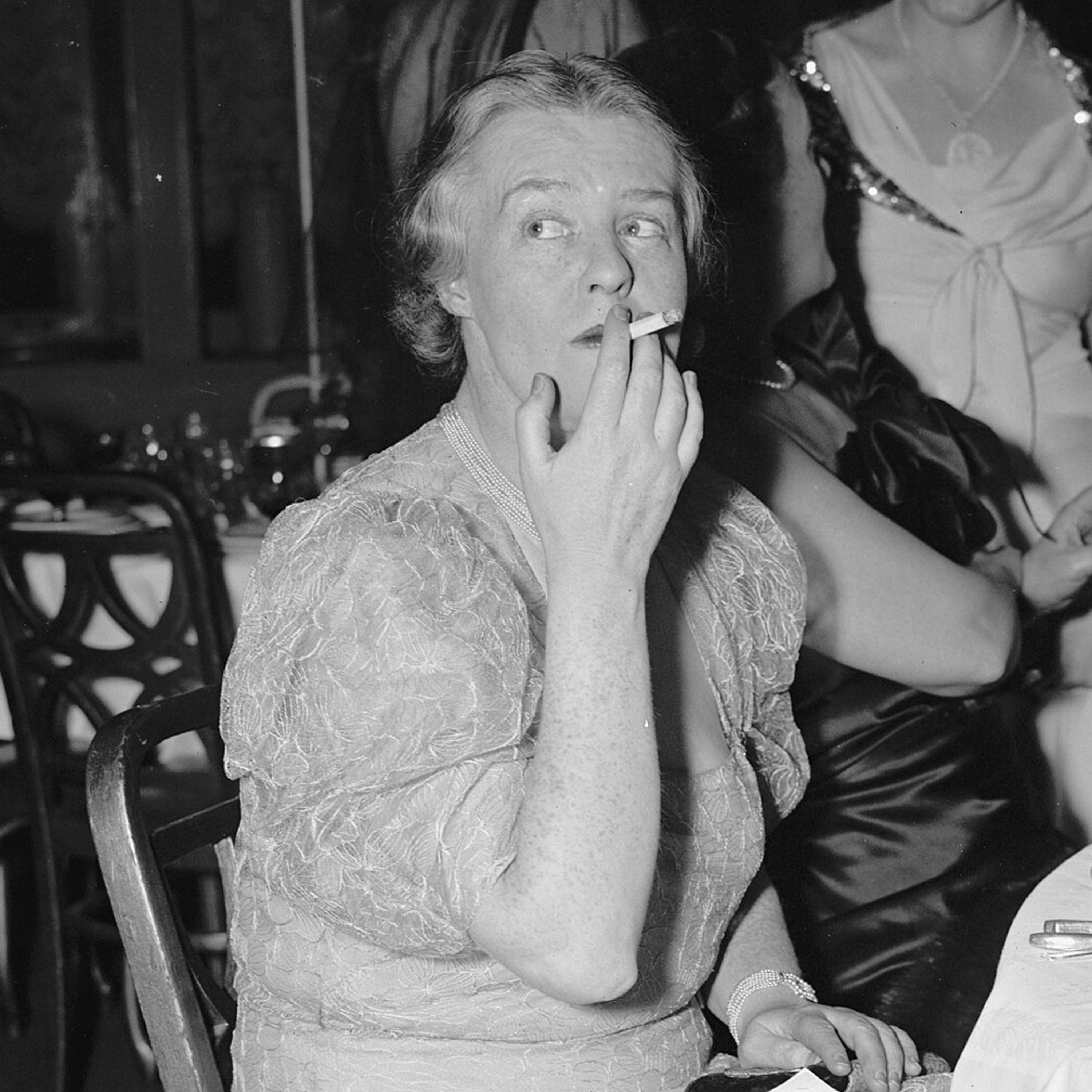
Hitler’s Olympics, Part 1: The Blue-Eyed Tornado
In the early 1930s, Adolf Hitler granted a rare interview to the American journalist Dorothy Thompson. When Hitler later came to power, and prepared to stage the 1936 Berlin Olympics, Thompson’s warning about the man she’d met would frame the central debate over the games: Should we go?
See omnystudio.com/listener for privacy information.
2024-06-27
35 min
Transcript
Available Results
Generated results are saved to the knowledge database for reuse and search.
No generated results are available for this episode yet.
Extract Knowledge
Pick what you want extracted first. Model, scope, and chapter options appear after a template is selected.
Generated results for public episodes are saved to the knowledge database so they can be reused and searched later.
Transcript
00:00:08
Speaker 1: Pushkin, I think that Hitler is appreciably nearer shooting us, and therefore I think we're appreciably nearer replying.

00:00:26
Speaker 2: It's the beginning of the Sycamore War. Just before the United States joins the fight. The journalist named Dorothy Thompson is speaking to a British television crew. She's standing behind a dark wood table, wearing a nipped way suit and blouse, one hand perched in her pocket, perfect posture, shoulder length hair with a strand of premature white. You can see her thinking while she's talking.

00:00:52
Speaker 1: We're very much interested in the part East, We're interested in the Pacific, and we're interested in the Atlantic.

00:00:58
Speaker 2: Thompson was a foreign cars despondent in the nineteen twenties Vienna, Berlin, Dublin, Paris. This is the heyday of newspapers. Every paper of consequence across the Western world had somewhere in Europe, and they all knew each other, drank together, descended on war zones together, and Dorothy Thompson was the star.

00:01:19
Speaker 1: And as this war becomes more and more becomes more and more clear that this war is going to be a world war, we come nearer to being actively involved.

00:01:29
Speaker 2: Because these were different times. There was always discussion of Thompson's physical beauty, the flawless skin, her radiance. One of her nicknames was the blue eyed Tornado. She was brilliant, indefatigable, unshakably self assured, and that voice.

00:01:46
Speaker 1: But after all, the ideological basis of this war was very well set by mister Nevill Chamberlain at the very beginning of it when he said, if I remember correctly, if I should think that one man and one nation should wish to dominate the world, I should think he ought to be stopped. That's the way America feels about.

00:02:02
Speaker 3: It, too.

00:02:04
Speaker 2: Remember that voice. Over the course of the next eight episodes, you're going to hear the voices of a lot of people from that same era, the long years before the Second World War, some more powerful than Dorothy Thompson, more self important, more strident, but none who saw the world so clearly. Dorothy Thompson is our north star. One of my strongest childhood memories was the nineteen seventy six Olympics in Montreal, my homeland's first Olympic Games. I was a kid. My family didn't have a television, but we rented one just for the occasion two rabbit ears on top of a grainy black and white set. We put the TV in the fireplace because there was no other place for it, and I watched everything. The Romanian Nadya Komenitch bewitching the world. In gymnastics, my running hero John Walker powering away around the final curve to win the men's fifteen hundred meters. I still get nervous thinking about that race, Lassie Van's improbable double in the five thousand meters and the ten thousand meters. Alberto want to rena Cornelia ender don Qurey on the women's forby one hundred freestyle relay, maybe the greatest swimming race ever. I was a little kid and I fell in love with the Olympics, and I've been in love ever since. This summer in Paris, I will be glued to my television again, and this thing that I love and that so many millions of people around the world love, would not exist if the Olympics had not been held in nineteen thirty six in Adolf Hitler's Germany. The modern Olympics started in eighteen ninety six, and if you've gone to any of those early games, you'd think you were at some kind of side show. They never really took off. Forty six countries showed up for the nineteen twenty eight Games, Thirty seven showed up with the next Games. Only one country applied to hosts the nineteen thirty two Games. No one else wanted it. The Olympic dream was fading, but then came Berlin. It was the Nazis who gave us the Olympics we have today. They were really really good at putting on a big show. Berlin was the first Olympics to be televised, the first to have a torch relay at the opening ceremony, the first to create a genuine international star Jesse Owens, the first to understand that the Games were a spectacle.

00:04:45
Speaker 4: At first, Hitler himself was opposed to the Olympics.

00:04:49
Speaker 2: The historian David Walachinski.

00:04:51
Speaker 4: It didn't interest in him. It was an international event people from all over. But Joseph Gerbels said, no, we can use this. This will be good propaganda for us, and so they began promoting the Olympics.

00:05:07
Speaker 2: Hitler used the Games to demonstrate his theories of Aryan supremacy, to rally the German people to give legitimacy to the band of thugs he had gathered about him to make the case that Germany was a true world power, and the United States went along with all of it. Why that's the story of Hitler's Olympics. H I'm Malcolm Gladwell. You're listening to Revisionist History, my podcast about things overlooked and misunderstood. Welcome to Hitler's Olympics, the story of how we ended up with the Nazi Olympics. Over the next eight weeks, my colleague bend At A. F. Haffrey and I will tell the story of the games behind the greatest of all Olympic Games. Not who won what, not what's stirring? Come from behind, burst of effort led to an improbable victory. Instead, I want to talk about the furious machinations leading up to the Olympics and the genuinely difficult moral questions that surrounded the Berlin Games, questions that I think we're still trying to make sense of. And along the way, we're going to introduce you to an oddcast of characters, people who tried and largely failed to resolve those questions. Heroes and villains, the clear eyed and the deluded, the forgotten, and the misunderstood. But we have to begin with the person who may have seen the problem of nineteen thirty six more clearly than anyone else. Dorothy Thompson. Thompson was born in western New York in eighteen ninety three, just outside of Buffalo. Her mother died when she was Her father was a Methodist minister, but a bad one who drifted from church to church. Her childhood was hand in mouth. She hated her stepmother. Somehow, she ended up at Syracuse University at a time when not a lot of women were going to college. After graduation, she threw herself into the women's suffrage movement, the great social cause of progressives of that generation.

00:07:21
Speaker 3: She was committed, passionate advocate of women getting the vote, and when they got the vote in nineteen twenty, soon afterwards she wanted to pursue a career as a journalist.

00:07:30
Speaker 2: The historian Sarah church Well, she sailed for Europe, didn't have anything lined up in advance. She just packed up her bags one day and left.

00:07:38
Speaker 3: Suddenly, here she is exposed to this whole host of international and global projects and initiatives.

00:07:45
Speaker 2: She makes her mark right away, goes to Ireland, tracks down a leader of the Irish independence movement and gets the last interview with him before he dies of a hunger strike. Next, she goes to Vienna, where she convinces the Philadelphia Public Ledger to highire her as a correspondent. Dorothy learns German gets promoted to Berlin bureau chief. Then comes another step, and another step, and by the end of the nineteen thirties, Thompson's column was read by eight to ten million people a day, at a time when the population of the United States was one hundred and thirty million. She was a fixture on the radio, too, toured the country the way rock bands to today. During one week in nineteen thirty seven, she turned down seven hundred speaking requests seven hundred.

00:08:31
Speaker 3: She was so famous that Catherine Hepburn played her in the effectively in the first movie that Hepburn made with Spencer Tracy, called Woman of the Year is basically the story of a Hollywood version of Dorothy Thompson.

00:08:44
Speaker 2: Dorothy Thompson became such a public figure that quips about her were part of the culture. She snips her nails with indignation. She's discovered the secret of perpetual emotion, and most famously this from Alice Roosevelt Longworth, Ted Bell's daughter, who said that Thompson is quote the only woman in history who has had her menopause in public and made it pay, a line, incidentally that Dorothy Thompson found hilarious. This is my favorite Dorothy Thompson's story. One night in nineteen twenty six, She's coming back from the opera in Vienna when she hears there's been a coup in Poland, there's a knight trained to warsaw, and the whole foreign correspondent crew is racing niked on it. Dorothy doesn't have time to get back to her apartment, so she has her secretary fetch her typewriter and a traveling bag. The bigger problem is she doesn't have any money for the journey and the banks are closed. So who does she call, Remember, it's Vienna in nineteen twenty six. Sigmund Freud. Of course, he's a good friend. And by the way, everyone who is anyone was friends with Dorothy Thompson. So Freud pulls a stack of cash out of his safe and sends his driver to the train station. Dorothy jumps on the train biqu She's made it.

00:10:00
Speaker 3: Oh.

00:10:00
Speaker 2: They crossed the border into Poland and the train tracks are blown out. Dorothy jumps out, Hell's a big damler. The driver demands a king's ransom, so Dorothy jumps in a ford. The second driver refuses to enter Warsaw when he hears the gunfire. Meanwhile, the driver of the first car, the Damler, runs into heavy gunfire. His car is riddled with bullets. The other correspondents witness the attack and they're inconsolable. Dorothy's dead. They wire her obituary back to Vienna, but Dorothy is not dead. She's left the ford behind and is walking the final few miles into Warsaw, still in her ball gown and slippers, and legend has it swearing like a sailor. Dorothy had everyone's attention. And what was she talking and riding about? Over and over again? In the nineteen thirties Adolf Hitler. Long before the world became obsessed with Hitler, Dorothy Thompson was obsessed with Hitler.

00:11:01
Speaker 3: So yeah, she always saw that Hitler was a thing and that he was the one to watch, and that you needed to understand where that was going is. She read a lot of history, She read a lot of politics. She interviewed everybody to try to get a sense of what it was that was going on, and so she got to the heart of it in a way that few, if any, of her of her contemporaries did.

00:11:21
Speaker 2: A journalist once calculated that by the spring of nineteen forty she had written a total of two hundred and thirty eight thousand words for her column in the Herald Tribune, and one hundred and forty seven thousand of those were about Hitler. If I ever divorced Dorothy, her husband, once said, I'll name Adolf Hitler as correspondent. Hitler Hitler, Hitler. She had to meet the man coming up, the first of what will be many meetings with Hitler over the course of this series. Before we go any further, I want to present an idea that will be useful over the next nine episodes. It's one of the most famous psychological theories of the twentieth century, Leon Festinger's cognitive dissonance. We've talked about it before in the show. It's a psychological state of discomfort that occurs when a person holds two or more conflicting thoughts, beliefs, or behaviors. Chocolate cake is bad for me. I desperately want a piece of chocolate cake. That's cognitive dissonance. It's a contradiction between what I believe and how I behave infesting and believed that cognitive dissonance makes us so uncomfortable that we are compelled to resolve it. So you change your behavior to align with your belief You say, I'm just not going to eat the cake, or I'm going to take just one bite, or I'm going to go to the gym afterwards, or you change your beliefs to align with your behavior. You tell yourself I read somewhere that chocolate cake isn't that fattening. Or maybe you try and make the world change its mind so they can't judge you. You stand up and say, this looks like cake, but it's not actually cake. It's cocopatter and sweetener and whipped low calorie cream cheese. If you go online, you could find a ton of old, black and white videos of psychologists working through the implications of Festinger's idea.

00:13:23
Speaker 5: Psychological story of decision making doesn't end, however, when a decision has been made.

00:13:28
Speaker 2: That's Philip Simbardo, one of the many psychologists inspired by Festinger's.

00:13:32
Speaker 5: Work, the act of making a decision can trigger a flood of other prophecies. According to psychologists Leon Festinger, whenever we choose to do something that conflicts with our prior beliefs, feelings, or values, a state of cognitive dissonance is created in us attention. You change what we think and what we do.

00:13:53
Speaker 2: The Berlin Olympics created cognitive dissonance on a grand geopolitical scale. Were an ideal, pure competition, unencumbered by politics, high minded, an event created for cross cultural understanding, young men and women in perfect physical condition coming together from around the world. The founder of the modern Olympic movement was Pierre de Coubertin, who would always say, the important thing in life is not the triumph of the struggle. The essential thing is not to have conquered, but to have fought well. That was the belief. But in nineteen thirty six, what was the action to participate in the Berlin Games meant? Going to Germany, competing in a stadium built by Nazi architects, being fodder for Hitler's propaganda chief Joseph Goebels, and helping to legitimize a regime that had already started on the long anti Semitic path that would end in the Holocaust. The Berlin Olympics were brutally dissonant, and in each of these episodes, Ben and I will follow how a a different person resolved the contradiction, starting with someone who pretty much said, if there's a problem with the cake, then don't eat the cake. Dorothy Thompson. As early as nineteen twenty three, Dorothy Thompson had her sight set on an interview with Hitler. This was a decade before he'd come to power. Early days in Munich after the so called beerhal Putsch, when the young Hitler tried to launch a coup against the German government. When that failed, he escaped to a hideaway in the Bavarian Alps. Thompson followed him there, arriving only two hours after Hitler did, but he had already moved on. For the next seven years, she pursued him to no avail, but then Hitler's party started gaining traction his movement grew. He set up office in the Kaiserhaf Hotel in Berlin, right across the street from the Reich Chancellery. The state of power in Germany. All the top Nazis hung out at the Kaiseraff with his grand awning wrought iron balconies. They ate in the three story dining room under its great glass ceiling. It was luxurious, It felt like power. Hitler could look out his window at the Reich Chancellery and dream. Hitler had a press officer named Ernst Hampstengel. Everyone called him Putsy, which meant little fellow, though it translates literally as cute. Putsy was half German, half American. His mother was a Sedgewick, one of the grand old New England families. He grew up in Germany, but went to Harvard, where he was classmates with T. S. Eliot and with Theodore Roosevelt's son. One day, Putsy ran into Hitler in a bar in Munich, holding the crowd's spellbound, and he fell in love. Putsy was a great musician, and whenever Hitler got a little lonesome, he would have Putsy bang out some Wagner on the piano or some other little diddy that he'd written. Many years after the war, Putsy wrote his memoirs, which I would wholeheartedly recommend, in law part because of passages like this. By the time he and Adolf were over to Friend's house. They're so good that we had to reenact them.

00:17:09
Speaker 6: I started playing some of the football marches I had picked up at Harvard. I explained to Hitler all the business about the cheerleaders and college songs and the deliberate whipping up of hysterical.

00:17:21
Speaker 2: Enthusiasms sound familiar.

00:17:24
Speaker 6: I told him about the thousands of spectators being made to raw Harvard Harvard, Harvard rah rah rah in unison, and the hypnotic effect of this sort of thing. I played him some of the Sousa marches and my own falorah to show how it could be done by adapting German tunes, gave them all that buoyant beat so characteristic of American brass band music. I had Hitler fairly shouting with enthusiasm, that's it, Hanstenger, that is what we need for the movement, and he pranced up and down the room like a drum major. After that he had the SA band practicing the same thing. Rah rah rah became z hien z Hei. That is the origin of it. And I suppose I must take my share of the blame.

00:18:16
Speaker 2: Putsy ends the war as an adviser to Franklin Roosevelt, making him the only person to serve the leadership of both sides of the Second World War. But I digress so Putsy convinces Hitler that he needs to have more of an international profile, so he starts inviting people to come and meet Herr Hitler at the kaiser Hoff, the New York Times, an Italian journalist, a Japanese journalist, a legendary foreign correspondent with the memorable name Hubert Renfro Knickerbocker, and finally, Dorothy Thompson. Is she prepared for the interview? Of course, she's Dorothy Thompson. When he was in prison in nineteen twenty four, years before the kaiser Hoff, Hitler had written his men off Testo Mine Kamf. It was a best seller in Germany, and trust me, Dorothy Thompson had read Mine Kamf in the German all seven hundred nutty pages of it, including passages like with Satanic joy in his face, the black haired Jewish youth lurks in wait for the unsuspecting girl, whom he defiles with his blood, thus stealing her from her people. There's a lot of stuff like this in Mine comp it was, and it is Jews who bring the Negroes into the Rhineland, always with the same secret thought and clear aim of ruining the hated white race by the necessarily resulting bastardization, throwing it down from its cultural em political height, and himself rising to be its master. Dorothy Thompson knows just who she's going to meet when she walks into the Kaiserhof. She walks through the marble lobby, waits and puts his's office. She would say later that there was a lot of fussiness of the final preper for the interview. She was limited to three questions, which she had to submit twenty four hours in advance. Hitler did not like thinking on his feet. Before the interview, she spots Hitler going to his rooms, accompanied by someone who she says, looks like al Capone. She waits for an hour. Finally she's ushered in. She would say later, I was a little nervous. I considered taking smelling salts. Understand that's a joke. Dorothy Thompson wasn't afraid of anyone. This was the woman who marched into Warsaw wearing her ball room slippers. We don't have a recording of the interview, but I want you to imagine it. Her voice, her presence, those piercing blue eyes, Hitler's never met her before. And Hitler, to put it nicely, did not exactly have relationships of any real meaning with women, unless you count photo opportunities with little German girls. So maybe he's the nervous one because he just starts babbling. Thompson would later write up the interview in an essay called I Saw Hitler. He is formless, almost faceless, a man whose countenance is a caricature, a man whose framework seems cartilaginous without bones. He is inconsequent and voluble, ill poised, insecure. He is the very prototype of the little man ouch. A lock of lank hair falls over an insignificant and slightly retreating forehead. The backhead is shallow, the face is broad in the cheekbones. The nose is large, but badly shaped and without character. His movements are awkward, almost undignified, and most unmartial. There is in his face no trace of any inner conflict or self discipline. I mean, how good, how true, how vicious is this? And then she backhands him, And yet he is not without a certain charm, but it is the soft, almost feminine charm of the Austrian. The eyes alone are notable, dark gray and hyperthyroid. They have the peculiar shine which often distinguishes geniuses, alcoholics, and hysterics. When Hitler becomes Chancellor of Germany a year later, one of the first things he does is kick Dorothy Thompson out of the country because he's been humiliated by a woman. I think the thing that really sticks in his craw is the line that follows that little bit about geniuses, alcoholics and hysterics. There is something irritatingly refined about him. I bet he crooks his little finger when he drinks a cup of tea. Is adolf with aspirations of being a badass dictator, and Dorothy Thompson has him drinking tea like your grandmother. Now you might say it's not surprising she looks at Hitler this way. He's Hitler. But the truth is that lots and lots of people who go to see him in those years don't see the real Hitler. Like the Canadian Prime Minister William Lyon Mackenzie King. Here is his diary entry after meeting Hitler. My sizing up of the man as I sat and talked with him, was that he is really one who truly loves his fellow man and his country, and would make any sacrifice for their good. That he feels himself to be a deliverer of his people from tyranny. It gets worse. His face is much more prepossessing than his pictures would give the impression of It's not that of a fiery, overstrained nature, but of a calm, passive man, deeply and thoughtfully in earnest. His eyes impressed me most of all. There was a liquid quality about them which indicate keen perception and profound sympathy. Dorothy Thompson saw the particular sheen of geniuses, alcoholics and hysterics. King saw keen perspective and profound sympathy. I'm sorry, I can't resist. Here's a little more from the diary entry. As I talked to him, I could not but think of Joan of Arc. Joan of Arc I would point out that Mackenzie King was the longest serving Prime minister in Canadian history. He did as much to shape twentieth century Canada as anyone. He's not some naive, but he sits down next to Hitler for an hour and a half and totally loses his marbles. He is particularly strong on beauty, love's flowers, and will spend more of the money of the state on gardens and flowers than on most other things. It was really, really easy to be sed by Adolf Hitler. The German people were seduced by Adolf Hitler. Even Neville Chamberlain, the British Prime Minister, would be seduced by him.

00:25:08
Speaker 1: This morning.

00:25:10
Speaker 7: I had another talk with the German Chancellor Hey Hitler.

00:25:16
Speaker 2: In nineteen thirty eight, when everyone was worried that Hitler was going to invade Czechoslovakia. Hitler looked Neville Chamberlain in the eye and said, I'm not going to invade anyone anymore, and Chamberlain, a politician of more than twenty years at that point, believed him.

00:25:31
Speaker 7: We regard the agreement signed last night and the Anglo German naval agreement a symbolic of the desire of our two peoples never to go to war with one another again.

00:25:46
Speaker 2: But who isn't seduced by Hitler? Dorothy Thompson.

00:25:50
Speaker 3: I mean, look, let's just not underestimate just how smart she was.

00:25:53
Speaker 2: Sarah church well again.

00:25:54
Speaker 3: But her intelligence was emotional intelligence as well, and I think she saw earlier than anybody else I've read. She understood that Hitler was an emotional movement. She was very alert to when she was being emotionally manipulated. We may want to trace that back to her childhood being raised by, as you said, you know, a kind of ineffective preacher, a bad preacher. She was onto it. You know, she knew when people were trying to manipulate her, and she was allergic to it.

00:26:23
Speaker 2: This makes me think there should be a kind of a you know how people. This is a weird analogy, but there's all this kind of literature about the particular ways in which children of alcoholics make sense of their childhood there growing up with someone who was emotionally unpredictable. I think there's a parallel thing with Preacher's kids. You grew up with someone whose job it is on a weekly basis to reach out and connect to an intimate group of people, and you're sitting in the church observing that every Sunday. For it's like a It's a really interesting education for a child to see your father up.

00:26:58
Speaker 3: There, right, It's like, yeah, the Wizard of Oz. Right, you constantly see the man behind the curtain, and so yeah, I think that you are. Yeah, you're onto them, She writes in and I saw Hitler, that she could see that it was starting to become a religion, that he functioned like a religious leader.

00:27:18
Speaker 2: Now, if you are Mackenzie King and you go and see Hitler and see a man who just wants to plant lots of flowers, then of course you're going to send a team of athletes to the Nazi Olympics. You change your beliefs to make them consistent with your actions. You stand up and say this looks like cake. It's not actually cake. It's coco patter and sweetener and whipped localorie cream cheese. But if you're honest with yourself, you can't do that. If you're Dorothy Thompson, you say, there's a conflict here between the kind of things the Olympics stood for and what the Nazi Party stood for, and for her, the correct path to resolving that conflict is to change our behavior. When she writes up her interview with Hitler, Thompson has a crucial paragraph at the end and.

00:28:03
Speaker 3: So yeah, so she says, take the Jews out of his program and it collapses. She says, it's based entirely on a hatred of the Jewish people. And she says, and the argument is simple, and she sees straight to the heart of it, which is the Jews are responsible for everything.

00:28:21
Speaker 2: She read that passage in Mankomff about black haired Jewish youth raping German girls, and she doesn't explain it away or ignore it or creates some elaborate rationalization about how he doesn't really believe that anymore, that he was young and those were different times, blah blah blah. No. Dorothy Thompson says that Minkomf is exactly what Hitler stands for, and we have to watch out because the German public are starting to agree.

00:28:49
Speaker 3: She says, you know right. In that same section, she says that the reason for his appeal is that the people listening to him have somebody to blame. They have an outlet for their resentment and their frustration.

00:29:02
Speaker 2: It's nineteen thirty two. Hitler isn't even in power yet, and one of the most famous journalists in America is laying it all out. There's a monster lurking on the ground floor of the KAISERHF and he has a dangerous obsession with the Jews. We can't sign up for his propaganda show, we can't go to the Olympics, and what happens we go. I'd never heard of Dorothy Thompson before we started this project, but midway through, like everyone else, I fell in love with her. And I think my favorite of the many things she wrote is an article in Harper's magazine in nineteen forty one, a few months before Pearl Harbor It begins. It is an interesting and somewhat acar parlor game to play at a large gathering of one acquaintances, to speculate who, in a showdown would go Nazi. Going Nazi, of course, is the easiest way to resolve the cognitive dissonance of the Berlin Games. I have come to know the types the born Nazis, the Nazis whom democracy itself has created, the certain to be fellow travelers, And so she lays out the types. Here is her, mister b a man of his own class, graduate of the same preparatory school and university, rich, a sportsman, owner of a famous racing stable, vice president of a bank, married to a well known society belle. He is a good fellow and extremely popular. But if America were going Nazi, he would certainly join up and early. Why mister B has risen beyond his real abilities by virtue of health, good looks, and being a good mixer. He married for money, and he has done lots of other things for money. His code is not his own, It is that of his class, no worse, no better. He fits easily into whatever pattern is successful. That is his sole measure of value. Success. Nazism as a minority movement would not attract him as a movement likely to attain power. It would. We're going to meet a real mister B, and another Thompson type too, a mister C, who she describes like this. Mister C is not a born Nazi. He is the product of a democracy hypocritically preaching social equality and practicing a carelessly brutal snobbery. He is a sensitive, gifted man who has been humiliated into nihilism. He would laugh to see heads roll. We're going to meet the perfect mister C, as well A lot of people in that brief window before the Olympics and before the war that would engulf the world went Nazi. How did that happen? That's the real story of the Games, Behind the Games. Welcome to Hitler's Olympics. Over the next eight episodes, we'll meet all kinds of people from the lead up to the nineteen thirty six Games. We'll talk about Charles Cheryl, diplomatic athlete, internationalist, man of parts, the ranking American member of the International Olympic Committee. Ben, Is it not safe to say that we became obsessed with Charles Cheryl? Is this project?

00:32:35
Speaker 1: Ben?

00:32:36
Speaker 2: I believe the only two people in the history of mankind to maintain a Charles Cheryl text chain.

00:32:41
Speaker 8: Certainly technologically and circumstantially, that's got to be true.

00:32:46
Speaker 2: We'll spend some time with Avery Brundage, a champion athlete, a self made millionaire who saw in the nineteen thirty six Games a chance to expel his personal demons and seize control of the entire Olympic movement.

00:33:00
Speaker 8: Rarely encountered someone so single minded and who also has such a profound lack of self awareness.

00:33:08
Speaker 2: Then there's Jesse Owens, winner of four gold medals, the African American star of the nineteen thirty six Games.

00:33:15
Speaker 3: That was the beginning to the end of a very long dream.

00:33:19
Speaker 2: I'm sure you've heard of Jesse Owens, but we're going to tell you a story about Owens but you haven't heard. And then the strange tale of a very proper German law student named Heinrich Krieger who embarked on an epic fact finding mission to Arkansas. This is almost a comic notion to someone's coming from this, from the cradle of European civilization to Fadville in the early nineteen thirties. I mean, it's like, I don't know how he ended up there. I truly don't. Billy Garland a real estate tycoon with a grand vision, lots of counts and barons and assorted European aristocrats who in the nineteen thirties used the Olympic movement to cling to their past glory the way a toddler clings to a teddy bear. Not to mention side trips to a small town in Alabama, a lesson from a legendary triple jumper, and a seminar on a crucial but all but forgotten Supreme Court case called Giles v. Harris. But in the next episode, we start with a man who claims, among other things, to have invented the crouching start. Charles Hitchcock. Cheryl are mister b.

00:34:32
Speaker 6: I have led the happiest life of anybody you ever met in your life.

00:34:46
Speaker 2: Religionous History is produced by Ben n Daph Haffrey, Tolly Emlin, and Nina Bird Lawrence. Our editor is Sarah Nix. Fact checking by Arthur Gomperts and Jail Goldfein, Original scoring by Luis Garra, mastering by Flaw Williams, Sarah Buger and Jake Gorsky. Engineering by Nina Bird Lawrence. Our executive producer is Jacob Smith. Special thanks to Karen Chakerji, special thanks to rufus Wright for reading us our putsy in this episode, and a big thank you to Jacob Goldstein for introducing us to Dorothy Thompson. I'm Malcolm Gladwell.
Chapters
No chapters available.