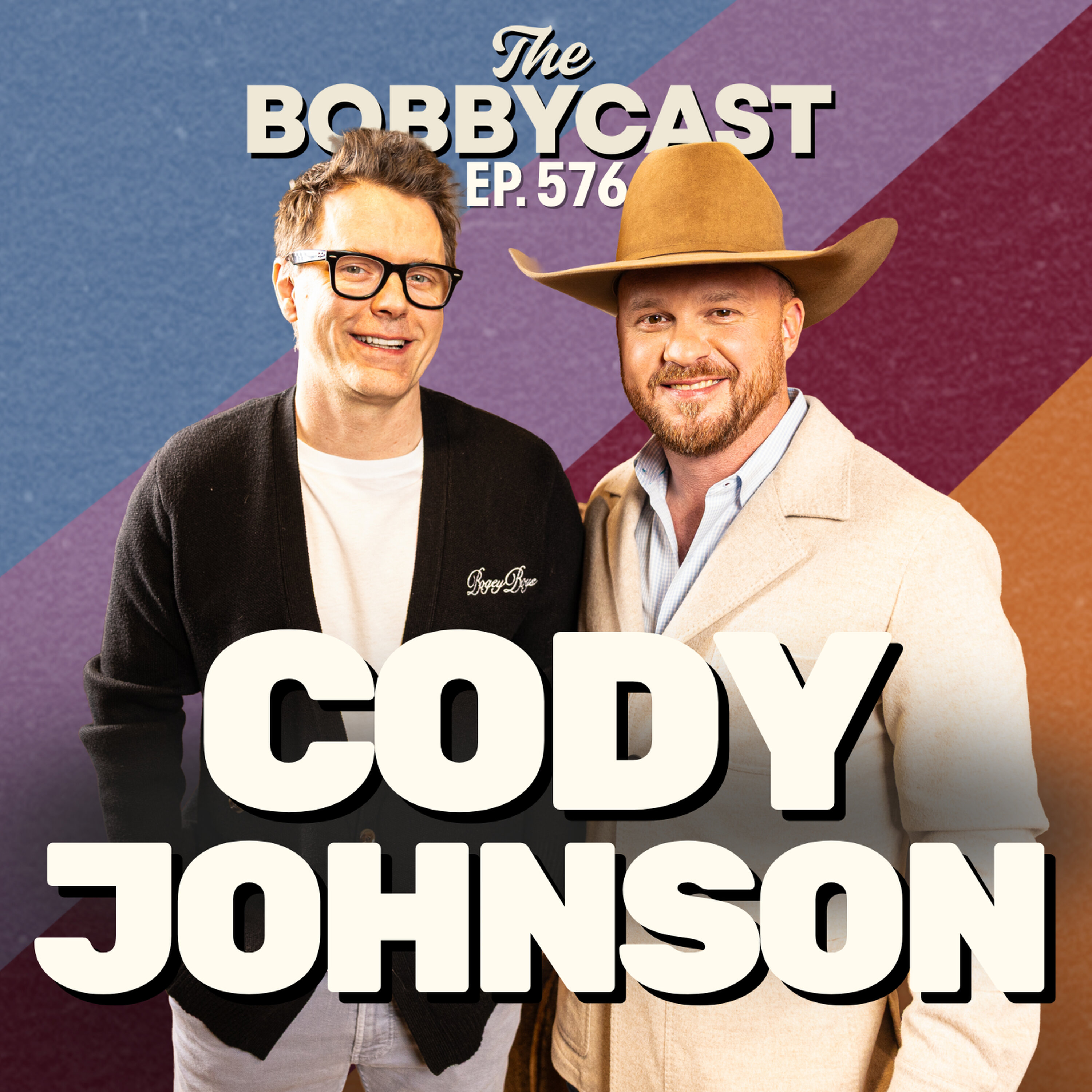
#576 - Cody Johnson on Ear Injury Recovery, Rodeo Life & What Prison Is Really Like
Cody Johnson stops by to talk about the scariest kind of setback for a singer: damaging his ear and wondering if his voice would ever feel the same again. He walks Bobby through the surgery, the unexpected upside of vocal rest, and what it’s like recording a new album after that kind of fear. Then it gets real-life Cody growing up near Huntsville, Texas, sneaking into bars at 14 to sing, and the no-plan-B moment that pushed him to chase music for real. Bobby also digs into Cody’s unique perspective from being around the prison world through his dad’s job, including what people get wrong about it and what actually happens day to day. Plus: the rodeo lifestyle, building his ranch, the Houston Rodeo break, riding out on a horse, and why entertaining a crowd still feels like a drug.
The BobbyCast is now streaming full episodes on Netflix!
Follow on Instagram: @TheBobbyCast
Follow on TikTok: @TheBobbyCast
See omnystudio.com/listener for privacy information.
Available Results
Generated results are saved to the knowledge database for reuse and search.
Extract Knowledge
Pick what you want extracted first. Model, scope, and chapter options appear after a template is selected.
Transcript
00:00:07
Speaker 1: Cody. Good to see buddy. You too, man, You just had a boy?

00:00:10
Speaker 2: Did Yeah?

00:00:11
Speaker 1: He had two girls? You want a boy, were you?

00:00:15
Speaker 2: I mean, like I think every dad wants a boy. I mean I did. But then like eleven years ago, we had Clara and that was the coolest thing in the world, you know, having daddy's little girl. And then like two years later we had Corey, and so I've been a girl dad like this whole time. And so when we found out that Brandy was pregnant, it was one of those in the back of your mind, You're like, what if I get my little boy? And I actually got the test results to give to her.

00:00:40
Speaker 1: How did you get those?

00:00:41
Speaker 2: We did that blood test thing and it went into my email and I'm sitting there just in suspense, and everything turns blue.

00:00:48
Speaker 1: Wait did you open it? Before she was even around.

00:00:51
Speaker 2: She was sitting across from me in the living ro.

00:00:52
Speaker 1: Oh, she wanted you to You didn't just get it?

00:00:54
Speaker 2: And no, I was like, I want to be the one. And it turned blue and I went, oh, my gosh, I'm getting my boy. But even then I was like, it's still probably gonna wind up being a girl. It was just the test was wrong.

00:01:05
Speaker 1: But that's great. My wife's about to have a baby.

00:01:09
Speaker 2: Congratulations, thank you.

00:01:11
Speaker 1: Like what do I need to prepare for, like day of like when it happens? Do you have any good day of stories?

00:01:16
Speaker 2: Okay? So with the girls, it was a little different because I was brand new, like I'm a new dad, So it was like scary. Everything freaked me out, you know, even getting to the hospital. Why are y'all doing this? Why are you not doing this?

00:01:28
Speaker 1: I am right now?

00:01:28
Speaker 2: Okay, Well, you don't have to be that way. With jac when he was born, she walked into the other room and hollered a few words we won't say on Netflix. And I come running into the room and she said, my water broke, And I said, are you sure? The reason I said are you sure? Is because with Corey, she thought her water broke and she'd actually just peed on herself. So I was making sure that we didn't have another accident. No where water broke, and I very calmly got everything together and figured out that her Cadillac Diecil Escalade tops out at one twenty four, three o'clock in the morning. Well, there's nobody on the highway, and so we just zoomed over and you can make it as stressful as you want it to be. But man, just my only advice is like, just have faith in God that everything's going to be good and just be there for her, Like is this really not about us as dads. It's about them. It can be about us later, But I think the more calm you are, the more calm she is. Like, get a good playlist, like saw.

00:02:28
Speaker 1: I was already doing that and I was building in. I was doing like some Counting Crows and she was like, this is not your music.

00:02:34
Speaker 2: Yeah yeah, her input went be good on it.

00:02:39
Speaker 1: Yeah, well, man, congratulations, thank that's great. How's your voice good?

00:02:43
Speaker 2: I've actually, you know, I know you're probably gonna get into this at some point in this interview, but blew my ear drum last year, and it's scary. You know, whenever you make a living with your your throat and your ears, that's a really sensitive subject. You know, any vocal trouble at all, you're like, oh gosh, any ear trouble at all. But everything happens for a reason.

00:03:03
Speaker 1: Man.

00:03:03
Speaker 2: I was home for when my son was born, which I probably wouldn't have been, so I was very thankful for that. I've had a lot of time off to really just kind of get back to center, get back to getting ready for a huge year. And having that time off, I was able to really rest, really hone in back on my diet, on my workout program, you know, like mentally getting really focused and honed in on what's to come, and you know, really in all reality, the vocal rest was amazing. I just did a week in the studio doing final vocals on my album that's going to be coming out this year, and I was locked in. I was like, yeah, maybe that three months was like the best thing that ever happened to me.

00:03:43
Speaker 1: So what happened to your ear? Exactly?

00:03:45
Speaker 2: So they call it a diver's burst because I had water in my ear. It didn't take much Like it's more of a suction thing, less impact like they've It's a lot of what divers do when they get water in their ears and they're trying to come out of the water too quick, it'll just burst. And so I blew like forty percent of it. And what made matters worse was I had been up in the mountains and wyoming elk hunting back and forth, going from tinsleep Wyoming to Florida from tin Sleep, Wyoming to Nebraska and back home to Texas, and I had like the worst severe upper respiratory and sinus infection. So like my surgeon was like, yeah, there's so much drainage in here. It's a wonder it didn't just burst on its own. Like you were kind of on the line of you could have just woke up one morning and it did this. Like they drained She said during surgery, they drained so much sinus stuff out of my head.

00:04:33
Speaker 1: So what did that feel like when it happened.

00:04:35
Speaker 2: It's just weird. It's just like a pop and then I can't hear anything out of that ear for a minute, and then you know, you start to wonder how bad is it? And so that's when I went to my surgeon. He's like, it's not as bad. She's like, I've seen them blown a hundred percent and still heal themselves without surgery. But given that you know your occupation, you should probably go ahead and speed the process up a little bit.

00:04:56
Speaker 1: Did you try to sing it all with, even just at home with your ear messed up, to try to see if you could sing? Because years are obviously so important.

00:05:04
Speaker 2: I waited till kind of like after the surgery, for like a week, there was like some vertigo, you know, like it was just kind of weird. There was still a lot of packing in the in the you know, the incision, like there's there's stuff that's going to dissolve over time. And so I didn't push it at first, and then after a while when I started to feel better, I would like go by myself, getting the ranch truck and drive around and check cows and sing. And I'm like one day I was singing and I just happened to accidentally just it just came out. I was singing along with the song on the radio. My brother in law, who's my ranch manager, goes, I think you're gonna be fine, bud.

00:05:35
Speaker 1: Wa worried that you may not be?

00:05:36
Speaker 2: Was that ever? I thought, there's always that thought, man, And you know, it's kind of like back to what I said about, you know, like child birth, and you can worry things into a problem, you really can. I've got faith in my God given ability. I've got faith in my work ethic and you know, realistically, like I told myself, what if they just said you're never going to hear out of your left ear? Again, are you going to stop singing and you're gonna stop playing music? No, so get over it. Be patient, which is the hardest thing in the world for me, very impatient when it comes to stuff like this. And uh, the longer I've waited, the more I followed the doctor's orders, the better it's gotten to where, like I said, last week or week before last, when I did all my vocals, I felt amazing, and it, you know, it's there, I will say, like I'm more susceptible to like sign us pressure. I feel it more on that side. Now it was just kind of weird.

00:06:27
Speaker 1: But which side is it?

00:06:28
Speaker 2: Assuming this set here?

00:06:29
Speaker 1: Yeah, I can tell that here is huge. It's it's like coming out of the hat. The wrestlers like ring Steiner just got the massive ear. Did you watch wrestling.

00:06:38
Speaker 2: As a kid, No, I didn't.

00:06:39
Speaker 1: You weren't a wrestling watcher. No, I say that I was.

00:06:42
Speaker 2: I was bull riders, man, I was riding bulls.

00:06:45
Speaker 1: How the heck did you start singing then? Because usually singers and rodeo bull anything tough usually don't matter. Like I wanted to sing because I wasn't that tough. You got both going.

00:06:56
Speaker 2: Man, I you know I think that like everybody on my family, like everybody on both sides of my family, I should say, oh my mom and dads. Everybody sang, everybody played some instrument and so like I still like I don't read music. I don't. I can't read like Nashville number charts and I don't read any of that. It's all just ear and just kind of natural ability. But like singing and performing, man, it was, it's just something about it's in my DNA, Like it's very much a drug for me that I'm very addicted to. It's like I it's just in my veins. It's something that I have to get out. I have to. I love performing in front of a crowd and giving them a piece of myself every night for what they give back to me.

00:07:39
Speaker 1: Where did you do it first?

00:07:40
Speaker 2: Church?

00:07:41
Speaker 1: How old?

00:07:42
Speaker 2: Oh? Man? Like four or five? Don't yeah, Like I don't even remember, Like.

00:07:45
Speaker 1: I would sing in the choir at church? Is that what you did at first? When did you start doing solos? Like?

00:07:50
Speaker 2: Okay, so my parents made me learn all the harmony parts before they would let me sing the lead part. Wow as a.

00:07:58
Speaker 1: Kid, Yeah, you had to learn how to sing harmon?

00:08:00
Speaker 2: Was doing it like yeah, like my ear though. It was one of those things that once you figured out how to be in this part and stay in your lane, and be in this part and stay in your lane, They're like, okay, well we'll let you sing lead. And that was kind of the turning point of I'm the lead singer.

00:08:14
Speaker 1: Do you still have that talent to find harmonies?

00:08:16
Speaker 2: Yeah? I love singing harmonies.

00:08:17
Speaker 1: It's like if I went, yeah, you say, could you find the harmony of that?

00:08:21
Speaker 3: Oh?

00:08:21
Speaker 2: Yeah? Well who vinsl like what you're I mean, so let me let me say this. Okay, there are yes, I'm really good at it. Okay, but there are people in this town, Nashville, that's all they do. And I'll go in and cut my own background vocals on something and be like, man, that's really good, and then hear them do it, and I'm like, Okay, you're You're a lot better than I am. I think I've kind of gotten into the I've really honed in on the lead character enough that so.

00:08:47
Speaker 1: You don't want to chase my bad, my bad lead with a harmony. That's why you say.

00:08:51
Speaker 2: Didn't say that. I didn't say that. You just didn't specify what part.

00:08:54
Speaker 1: That's okay, that's okay. So you enjoy singing in church, that's the first like real fulfilment you find from performing. When does that start to go? I think I want to do this more than just church.

00:09:05
Speaker 2: The night I snuck out of my parents' house to a bar, how old I think? I was fourteen and I snuck out and hopped in a truck with a buddy that was sixteen, and we went down to the bar and there was like one hundred people at this little honky talk and the band let me jump up and play with them, and they said, we're going to take a break, why don't you play. I was playing by myself and looked in the back of the bar and my dad was standing there. I got whipped pretty good for that. You know, you play in these bars, it's going to lead to a life of destruction and you're going to want it, become a drug addict and an alcoholic. But it to me. But I found that you could move people in a bar just like you could church. Like when you're singing in church, your purpose is to lead people to Christ. Right, Well, when you're playing in a bar, it could be to row people up. It could be able to make the couples cry about their long lost lover. It could be to make maybe help somebody find their new lover. So I found that very intriguing and that was when I really it hit me, like I love to entertain.

00:10:07
Speaker 1: How did you dad find you?

00:10:09
Speaker 2: I think he kind of knew I was wanting to do. I don't really know. I never asked, hey.

00:10:14
Speaker 1: Look can you remember it? Like can you visualize that? Oh?

00:10:16
Speaker 2: Yeah?

00:10:17
Speaker 1: And how many songs do you think you got out before you?

00:10:20
Speaker 2: I had three? And after I got my whipping, he said, you actually sounded really good. Just so you know, I'm like, okay, what'd you say? What kind of like can't even remember? One of them was like an original? It was horrible, horrible song I'd written.

00:10:33
Speaker 1: I'm assuming you just got their guitar.

00:10:35
Speaker 2: No, I wrote my own.

00:10:35
Speaker 1: Oh so you snuck out took your guitar? Oh yeah, through the bar.

00:10:40
Speaker 2: But then like, okay, so you leave from that period where my ag teacher, Larry Fortenberry, and my English teacher who was also the theater arts director at the school I went to, they would allow me to bring my guitar to school and like sometimes they let me play for the class, you know, and both of them were like, look, you really have a future. We should you know, we should try to hone in on that. And they have what they call FFA Talent Team, and we formed a band and went to State and I just I'll never forget that crowd because it's State convention, so there's probably I would say sixty thousand kids maybe, and the roar of that crowd, it was like something in my brain just snapped and it was like, that's what I have to do for the rest of my life, Like that's what I want.

00:11:23
Speaker 1: It's so cool that your ag teacher saw something in you that wasn't exactly agriculture. Yeah, and said, hey, I want to, you know, push you to pursue this. And I know a few people that were on FFA performance they were in that. That's also a really cool thing that again, it's not what you think of for someone that does FFA, that you create a band and you play and so did were you the lead singer?

00:11:46
Speaker 2: Yeah? Yeah, no more harmonies from me.

00:11:48
Speaker 4: Man.

00:11:48
Speaker 2: I was like, you got you. I want to be the guy.

00:11:50
Speaker 1: How old were you then? Seventeen?

00:11:52
Speaker 2: I was like, I think that did it? Yeah, sixteen seventeen years old.

00:11:56
Speaker 1: So then, what did you want to be when you grew up in high school? Because you've done all these things, what did you want to be when you were in that age of having decided what you wanted to be?

00:12:03
Speaker 2: And I had no clue what I wanted to be when I grew up, because you know, you got to go to college, you got to go to college. Well, man, we didn't have the money for college, and I didn't have any scholarships. And I tried, and I just wasn't a very academic person. Like even like I always tell my kids, like learn math, learn math, because I'm horrible at math now when it comes to finances, investments and how to make one dollar into ten, like that I wrapped my mind around very well. But as far as like just math, I was horrible. And I was kind of a lazy student, like I would just as soon be sweet on a girl and cheat off of her tests and get through the day. Then I had actually studied for the test, because most of the time I was at home playing my guitar. And you know, I think growing up, if I'd have grown up in West Virginia, I'd have probably been a coal miner because my dad was a coal miner and his dad was a coal miner. But I grew up near Huntsville, Texas, and we have the large concentration of correctional facilities in the state, and so my dad was a correctional officer. And it was always kind of taught to me, like, this is a guaranteed job. You have benefits, you have a potential for housing, there's retirement, and that's like as far as I looked like, I didn't look any further than that. But I still met my first roommate, Nathan, and we formed a band and we started playing bars on the weekends and we were just a three piece.

00:13:26
Speaker 1: While you're working, while I'm working.

00:13:28
Speaker 2: And eventually it kind of faded over into my work ethic at work, calling in a lot, especially on Mondays because we had just played Sunday night, showing to work, maybe a little showing up to work, maybe a little hungover, and you know, just kind of strung out from playing three solid gigs. And these were four and five hour gigs. Man, It's not like I'm playing ninety minutes in an arena. And it was a bar life, and it was, you know, my warden Tom Pierce sat me down and said, look, man, you're going to regret it for the rest of your life if you don't go pursue this. You can always come back to work here. This is always going to be here. You should go try this. You should at least pursue it and find out whether or not you you know you were going to be successful or not. So I did with no plan B and never looked back.

00:14:13
Speaker 1: That's the second person that wasn't in music, that had no relationships with anyone in music, that was telling you you need to go do music. That's a really rare thing to find, like somebody who's not who doesn't understand it but still tells you. I know, i'd understand it, but I understand that you have it. You need to not do what you're doing now.

00:14:31
Speaker 2: Well, And I think that came from like a lack of arrogance on my part, Like I wasn't the guy playing, like look at me, I'm the baddest dude ever. I just wanted to play. But then once I started singing and play, and everybody around me was like, dude, you're freaking knocking it out of the park, Like this is insane, Like do you not hear.

00:14:50
Speaker 1: Did you not feel like you were knocking out of the park.

00:14:52
Speaker 2: I think it was just new. It was a newness of you know, it took me a lot of years to be the guy now that whenever I walk off my bus and I walk up to the stage, I'm it's like it's like Connor McGregor walk into the ring. Give them to me. You'all better watch out because here I come. That guy I'm thirty eight years old, has been doing this a long time. But I don't think you have that when you start. I think if you have that when you start, you're probably destined to fail in a lot of ways, you know, because this industry can eat you alive if you let it.

00:15:23
Speaker 1: I just watched this show called The Night Of and it came out back in twenty sixteen. So if this is not a new show best about a guy goes to prison, it's about what happens in prison. You worked in prison. What happens in prison? Like has a prison guard? Are you scared all the time? Do you make buddies with these guys?

00:15:40
Speaker 2: No? And no, you it's just a different culture. It's a different lifestyle.

00:15:46
Speaker 1: I mean, you know where you're gonna get shanked at some point by yeah.

00:15:48
Speaker 2: I mean yeah, but I mean I kind of grew up around that environment too, like and my dad, you know, working there, my uncle worked there. I think that's a lot of like where my security mind is stays today because of that experience, you know. And it's not like you go to work every day and you're knocking heads and it's a constant riot and fight like they kind of.

00:16:08
Speaker 1: That's what I feel like nice on TV, like you go in and you're like, here we go, it's Tuesday.

00:16:12
Speaker 2: No, it can be very monotonous because these guys are just trying to get through their day too, you know, like they don't want to have that because then it's going to mess up everybody's day, you know. So I mean, yes, I've been through some some things that you know, I've seen a lot of things, but it wasn't just like hell week every week, you know. But it did teach me a lot about life, about discernment, about walking into a room and reading a room really quickly and picking out potential threats in a room. And I still have that. I put on a persona on stage of being a very nice guy, but you know, at my core. I know that I have that too. I'm not the guy you could back into the corner.

00:16:50
Speaker 1: You're probably pretty intimidated when I'm around then, Huh yeah, I expect that hard.

00:16:55
Speaker 2: Yeah, the aspiring musician who finally gets an interview with Bobby Bona. That's not intimidating at all.

00:17:00
Speaker 1: I have a lot of family it's been in prison, Like pretty much all my family's been in prison. And what would be crazy to me is when I like.

00:17:07
Speaker 2: Like in prison, oh yeah, yeah, me too.

00:17:09
Speaker 1: Oh yeah, like the not worked like I always made the joke.

00:17:12
Speaker 2: Half of them work there, living.

00:17:14
Speaker 1: There and so and there's one doing life right now. There's another that just got out pretty recently. A lot of family members have been in and out quickly. But it would always be crazy to me how there would just be a phone from a like a call from a phone from somebody in jail, and how they would just have freaking cell phones.

00:17:33
Speaker 2: In prison, dirty bosses, man.

00:17:36
Speaker 1: So it's either they snuck it into their butt or somebody did.

00:17:39
Speaker 2: Somebody did or like a mouth to it, yeah.

00:17:43
Speaker 1: Or a guard or somebody took it in like and it's just you just know somebody it's.

00:17:47
Speaker 2: Home culture like inside the prison does not beat to the drone of the outside world. Like they're not watching the news and caring about what protests or what riots or what you know, COVID or anything like that. It's just it's there. They're in their own subculture, and you know, a lot of it's pretty amazing actually to see the ingenuity of some of these people and the talent, the sheer raw talent that is locked up and you're like, man, what a waste.

00:18:11
Speaker 1: You know, Like a guy makes a full DVD player out of a piece of bologney and a hanger, and you're like, dude, if you use this out.

00:18:16
Speaker 2: Here, he'd be a Millionaireboys.

00:18:20
Speaker 3: Yeah, we interrupt this interview to bring you a message from our sponsor, and we're back on the Bobby Cast.

00:18:36
Speaker 1: When were you able to pay your bills by doing music?

00:18:40
Speaker 2: Man? So I took off on a wing and a prayer. I actually still owned the truck that I bought. It was the first truck I'd ever bought new and paid off. It was a quad cab GMC and six guys in a in a truck with a trailer and very minimal gear and went and played anywhere and everywhere. They would let us play for three hours for one hundred dollars a man, and we counted the truck as one of the band members, so we'd have gas.

00:19:05
Speaker 1: And that man's got to eat too, that man that man ate a lot.

00:19:09
Speaker 2: I still have the truck. I put a flat bed on it with a hay forks and we call it the ranch truck, and I'd drive it most of the time, just because I spent so many hours in it. But my wife, Brandy, she was my fiance at the time. She was going to school doing online classes and some classes at a junior college. And she quit going to school and took two really crappy jobs. Well, I went out and played bars and stayed gone for a month. And I have no clue how she stayed married to me, but she did. And eventually it was the It was the first year we were gonna headline what we call the Big Tent in Steamboat Springs, Colorado at music Fest. And I told her before I left, I said, I want you to quit your job. And she's like, are you serious, And I said, yeah, I want you to go with me to Steamboat quit your job, Like I'm making enough now to where we can afford to pay bills. But that's all we were made, was just enough to pay our bills. So it was kind of another leap of faith. And you know, really it wasn't until about twenty fourteen, twenty fifteen to where like, okay, we're getting pretty stable. You know, we're growing our band, we're growing our crew. In twenty seventeen, when I played Houston Rodeo for the first time, that's when the gasoline kind of got thrown on the fire.

00:20:23
Speaker 1: That had to be awesome. Oh yeah, like really a career high, like the first Still, I'm sure it's awesome you're doing it again. You're doing it again because that's such a massive show. But also it's kind of like what you're about, Yeah, and to be able to headline that massive show. Tell me about the first time you headline and you played the Houston Radio.

00:20:42
Speaker 2: Well, it was u it was the day after or it was two days after, like the worst day of my life. Like I'm not going to go into it very deeply, just out of respect, but my brother was in a very precarious situ and you know, I'm sure you can probably relate after hearing some you know, your perspective on some of your family members and uh, really bad spot. And I was in San Antonio trying to, you know, kind of beg and plead of please change you know, your life, and you know this is not going to work, and you know I'm begging you, please let me help you. And it didn't turn out the way that I wanted it to, and looking back for him, he probably not the way he wanted it to either. So I'm in my truck and I'm just in tears driving home and Howie Edelman, my manager, calls and says, hey, we just got the call to replace Old Dominion because they had to bow out for I think the family member had gotten sick or passed away or something. And I wanted to know if he's like, here's what they offered us to headline Houston, and I'm again I'm in my heart's broken for the situation I have going on with my family, and I'm crying and I'm like, yeah, it sounds good, and he's like, I'm going to counter off him, and I remember having the phone and I went like, why would you counter offer? He's cause I think you're worth more. And they took the counter offer and I said, how many days do we have to get ready? He said two days? And we sold sixty eight thousand tickets in two days. Wow. And I think that was the moment where I went bring it on, like that was the let's go, Yeah, let's go. And I remember talking to my band that night before we went on stage, and I said, tonight is the night where we all prove that we are worthy of being here. We proved tonight this is not a gig, this is not a show. Tonight is proof to the world that me and my band deserve to be on a stage of this caliber. And it was electric. I mean I rode that horse out at the end. That was back when they had the circle stage. Now it's this big star with the elevated points and all this, and there's so much wire, you know, cables and stuff you can't ride around. But back then it was just open arena. And I kicked that horse and both of my feet came out of the stirrups and he and I just remember thinking, I'm not bucking off now, I'm not bucking off ever, like, let's go, and I just started kicking him in the faster and faster we went, you know, all the way around this thing, and I rode out and I didn't even have my feet in the stirrups, And I thought, you, that's a pretty good metaphor for looking back for the way things have been ever since.

00:23:13
Speaker 1: These guys in your band, who's been with you a long time?

00:23:16
Speaker 2: Man, you know, Jody is my longest standing band member who plays fiddling, guitars, sings harmonies. I think he's going on sixteen years. Nooe, he's outside, the guy with the big beard, about the same amount of time. Joey, my bass player, about the same amount of time. Miles came along my drummer after that, working on like fifteen years. Jake's been here for over I think he's close to twelve years my guitar player, and Harrison's getting close to ten years, my steel player. And Seth was actually selling merch for us before we moved him to piano because this asshole didn't tell me how good he was on the piano. And yeah, I'm like, dude, you're gonna make a way better salary and it's a lot cooler than slinging cotton at the merch booth. You know, how did you find out he could play well, we recorded The Painter and we were overseas opening for Luke Combs on our Australia and New Zealand tour, and I was like, man, there's just so much piano in the Painter, like we've got we've got to find a piano player. And he just nonchalantly says, I played piano. I'm like, what do you mean you play piano. He's like, well, I don't like play, but I can. I can play it. I'm like, show me. And so we go to Luke's keys player and get his keyboard and he starts playing and I'm like, when were you going to bring this up? He's like I was just trying not to be too intrusive, you know, but I overheard you. And two nights later he was on stage with us so and he's been he's one of the baddest cats in town.

00:24:43
Speaker 1: That's a cool story. I remember when Luke Combs announced that tour. How did it feel? Because again, you're a guy who can do like you said sixty eight thousand, You're playing all these big shows and then it's like, hey, come out and be main support. Was that I don't know, was that you had to swallow a little bit to do that.

00:24:57
Speaker 2: No, no, no, man, I I have nothing but respect for Luke. And I've been opening for Luke Colmbs since he was playing tennis courts and like, what do you mean by that? Like he played a tennis court. Where was South Carolina? He played a tennis court and it was like six thousand people, Like it wasn't a huge show. And of course he was blowing up at the time. But I think real respects real. And whenever I saw Luke for the first time, I went, that's that's real. The way he handles his camp, the way he handles his finances, the way he records his records, the content that he's putting out. I had a lot of respect, and so you just tip your hat and say, I can get with that, buddy. And he's opened a lot of doors for me. Like I said, we went from opening from him or opening for him, from tennis courts and pavilions to stadiums. You know. And I'm not a coketail writer, but whenever a good friend of that many years says, hey, do you want to go be direct support for me overseas? You say, hell, yes I do. And what did I do? The very next year I went back, or two years later, I went back in headline my own tour and sold everything out but Auckland, New Zealand. But Luke didn't sell out Auckland, New Zealand either.

00:26:03
Speaker 1: So I feel like whenever you were playing the shows with Luke overseas, and did you you did some football stadiums here too, right with them? Yeah, I feel like you also gave him credibility. I can see that, Like, because I love Luke and I's known Luke for a long time. But whenever he's like, hey, Cody Johnson's coming out with me, I went, oh, Cody's playing with Luke. If Cody thinks Luke is legit, then I for sure know I already knew, but I for sure knew that Luke was legit.

00:26:28
Speaker 2: But like, there's two perspectives. So like, and I've told Luke this, I've told this to a lot of people. My job as the opener is to not be seen or heard, get on the stage, do your job to the tee, and get out of the way.

00:26:40
Speaker 1: Because you aren't the opener. I think it's unfair to say opener.

00:26:43
Speaker 2: But on the same coin, if you flip it over my job as the opener is to try to kick your ass.

00:26:47
Speaker 1: Yeah, but I used to he weren't the opener, you were main support right before him.

00:26:50
Speaker 2: But what you said about Luke matches what I just said. At first, he knows, yeah, I'm coming out yeah to try to mop the floor, and all it did was elevate their game. And there he's like, dude, I love having you open because it just pushes us to a different level of knowing, Hey, if we're going to follow that, we better gear it up. And I'm like, that's a that's a very high compliment from from him.

00:27:10
Speaker 1: I remember when Kenny did some shows and put Zack Brown right before him. This is the last It's like, you're gonna put Zach Brown in front of you and he's like, yeah, I think it made me, makes me better. And so that also, it just says a lot about both of you guys that he would do that and that you would also do that. I think it shows that both of you respect each other, because I remember when you were on the show and I was like, dang, I Cody Johnson respects Luke like he's not going to respect Luke Combs. If Cody Johnson's like going, that's the dude right there.

00:27:38
Speaker 2: That's cool. What else do you.

00:27:39
Speaker 1: Look at as a live performing You go respect, man.

00:27:43
Speaker 2: I'll never forget the first time uh we played the played the Gorge and Washington say yeah, and it was like Zach Brown Band, and then it was Brothers Osbourne and then us and I sat and watched Zach Brown Band, and then I'm watching brother Osbourne and I like, I pulled my whole band into a room. It was like, did anybody else catch all that tonight will either be the best show you've ever played or the last show we've ever played. Like it's it's life or death tonight and we lit it on fire. But it's like you have that when you see that, you're like when I say out to kick your ass, it's not what it's about. It's about what you said. It's about respect. But you're always trying to one up, And I think what it really boils down to is trying to one up yourself knowing that I can step on that stage after that great of performance and still make that crowd melt in your hand. You know. Yeah.

00:28:36
Speaker 1: One of the best concepts I've ever been to is Zach Brown Band, one of the best bands I've ever seen plays Frank your brothers Osborne, I agree like both of them in their own ways. Are they light the place on fire?

00:28:49
Speaker 2: Yes? And it's like this not tangible thing that's floating around in the air. It just gives you this energy. You're like, Wow, this is we're watching magic. Yeah.

00:28:58
Speaker 1: What's the best concert you think you've ever been to? Like one that you think back to and it either lit you up in a way to go that's inspiring for what I do, or just something that you were able to take in and go. Man, I can appreciate this so much because of you know what I do every day.

00:29:14
Speaker 2: One of the first concerts I ever witnessed was Billy Joe Shaver played in Huntsville, Texas, and I walked in and he screamed, Uh, if you don't love Jesus, you can go to Hell. And I thought that was funny because we're in this barroom, you know, And he kicked off into Georgia on a fast train. I'll Brandon George on Honey, I wasn't bawn over yesterday. And he's good Christian reason and he's doing all this and this barroom is just lit up man, and it is just like there's beer cans flying in the air and it's I was like, this is really quick. I just watched this old man at the time throw gasoline on this fire in this barroom and this place was just electric. And I mean, I'm like it influenced me. This is something interesting that I've never really told anybody that you might find interesting. I never saw tapes of Chris Lado growing up. I always listened to his music. Being a rodeo guy, that was kind of what we listened to going down the road. I never saw performances of him and about I guess it was four or five years ago. Ned Ludue, his son who's become a good friend over the years, says I want you to watch something, and he pulls out his phone. He said, this is Dad playing it wherever and he pushes play and I'm watching it and I go, oh, and I'm watching myself. And he said, did you watch Dad growing up? I said no. He said that blows my mind. He said, because every time I've watched you perform, I see little bits of my dad on stage with you. And maybe it was because Garth Brooks. I don't want to say tried to copycat Chris, but he took a lot from Chris. And I saw Garth and somehow made it my own, but my mannerisms on stage leaned more towards Chris LDO. And I just always thought that was interesting, the fact that I know ever saw it, but it just emphatically comes out every night.

00:31:03
Speaker 1: You know, did you listen to Garth much as a kid?

00:31:05
Speaker 2: Oh? Yeah, And I listened to everything. Like I was very eclectic growing up. Everything from rock to rap to R and B to blues to gospel and country was kind of my main thing. Like I tried. I really wanted to sound like Glenn Campbell. I wanted to write songs like Merle Haggard. I wanted to be a cowboy like George Strait, but I wanted to fly in from the rafters like Garth Brooks. And you know, it was there was all these different influential people that kind of I found myself through all of them. Figure out what, Like where's where's Cody in this? You know, where does Cody fit? Yes? I can hang with boys to men and I can sing that style of music, but like where does that relate? I can sing like a rocker, But where does that relate to what I am? And I think that through my records, especially this record that I'm working on right now. You hear that, you're like, oh my god, that was that was Motown right there, or that was straight Southern gospel, or like, whoa, that note right there sounded like it stepped out of an ac DC song, you know. But like I'm starting to, I think the older I'm getting in, the more wisdom I'm attaining in the studio and on the road with my band, I'm just finding myself more and more every year.

00:32:11
Speaker 1: It's got to be hard whenever you're touring so much from eighteen nineteen, twenty three, twenty five to go to shows, because you've been spending probably every Thursday, Friday, Saturday night for the most part, doing it, not seeing it so much. Did you ever go to a Garth show?

00:32:27
Speaker 2: But I remember being a kid when he played live in Central Park and I was twelve inches from the TV, just eyes wide open, watching this concert and couldn't believe it. There were people watching a screen on the other side of the Yeah, there were.

00:32:43
Speaker 1: People there, people saw the stage. Yeah, over a million people there.

00:32:46
Speaker 2: And I was like, that moment in time changed something for me.

00:32:51
Speaker 1: I saw him once, now I've seen him multiple times. I opened form at a football stadium once. It was the craziest thing, and he was so cool that he plays in the round and we were I was main support for Garth and I was just doing my comedy music. But he was like, come open. Played Razorback Stadium in Arkansas. It was one hundred and ten thousand people, so it's crazy, Like, yeah, I do stand up in theaters, I don't do football stadium. So that whole thing was crazy and yeah, and Garth before we were sound checking, he came out and he said hey, he said, used the whole stage because that was an opener and main support, Like, you said, right, they don't want you to have access to what they have because they wanted to be bigger.

00:33:30
Speaker 2: And best permission to use the thrust yes.

00:33:33
Speaker 1: So he was like, you're not limited, and he gave us I think thirty five minutes. It's a lot. And then he said this, he said, if you're feeling it, keep going, and I said I'm not going to feel it. He goes, no, no, no, if you're feeling it, keep going, use the whole stage. And then he walked off in Tricia youar what is? His wife goes, Hey, don't feel it. I said, don't worry. I'm not going to fail.

00:33:53
Speaker 2: What a nice guy, because I'm like, hey, even if you're feeling it, you're up at nine o'clock.

00:33:57
Speaker 1: Yeah, he was like. And then he waited to put us on until it got completely dark because he wanted us to be under the lights totally, and so we did the whole stage. I didn't feel it. I got off at thirty four to forty eight. I wanted to be super respectful, and I watched him, but I watched him control of the crowd, and he sang sometimes late at night, if tomorrow never comes, yes, and he's singing that, except he never sang a word. He went.

00:34:28
Speaker 2: He didn't have to he did.

00:34:29
Speaker 1: He just did the beat on his chest and they sang every word of the song and then cheered at the end like he had sang. It was unbelieved. I've never seen anything like that before, and I've seen everything. I'm so jaded. It was unbelievable. I would compare that to a moment and I hope you take us the right way. I was watching you perform it was in Austin, Texas. It was in an arena, and it almost felt like you had him by the hair of the head because it felt like church a little bit.

00:34:58
Speaker 2: I liked that.

00:34:59
Speaker 1: Yeah, and I hope this is a compliment.

00:35:01
Speaker 2: It is.

00:35:02
Speaker 1: You were talking to them and they were with every single word you were saying, and it was in between songs. But you had a second and I remember I was the people I was with that. I was like, man, that's what he's about. Because you obviously you're so good vocally, so no one's going to question that you have to have that in order to be as good as you are. But you talk about that thing, that that the Jena se Quhah, you had it, and like how you were talking to the crowd, So I gotta imagine that's a big part of your shows, a connection.

00:35:29
Speaker 2: Like my daughters. So both my daughters sing incredibly well, but I haven't pushed that on them yet, Like I tell them, oh my god, you sing so beautiful. You know, your voice is so incredible. And I'm always about showering and stilling confidence in my young ladies, you know, and letting them know that Dad's behind you hund percent. But I haven't been like you should become a musician and sing, because you know, it doesn't always turn out as nice as this. Yeah weird. Yeah, they've they've asked like, why isn't why isn't this person playing shows like you? You know, I'm like, I agree, they're very talented, but there's a there's an there's an it factor, and off stage, I'm not that it. I'm a cowboy and i'm a husband, I'm a father, I'm a normal guy, and I like making fart jokes, you know. I mean, it's just like I'm just a guy. But for some reason, whenever I get on stage that whatever that it is, it takes over and it is the it's the most fun. I mean, it's the most fun you can ever have because once it takes over, it's like here we.

00:36:34
Speaker 1: Go the gate everywhere you were saying, I mean, they were just hooked into everything you were saying. You were crushing it, but it was when you were talking, It's like everybody just paid attention.

00:36:44
Speaker 2: I think it's an authenticity thing though, so like if that was fake, Like I don't rehearse what I say a lot of times it just comes out. And I think that that back to real. Recognize is real, like when you're when you're truly authentic with a crowd and you're just pouring your soul into them. They're really authentic back, and they're really invested. They feel like that they are as much a part of the show as I am. And I love that. I mean, I love that atmosphere of knowing that they're just as important as my craft and what I'm doing, because without them, we're just a bunch of dudes playing in an empty room.

00:37:18
Speaker 1: Yeah, and that doesn't pay as well.

00:37:19
Speaker 2: I've heard it does not. I've done it. I've done it. I would rather do this. Hang tight.

00:37:25
Speaker 4: The Bobby Cast will be right back. Welcome back to the Bobby Cast. When you talk about rodeo, what exactly do you do? So, what are your skills?

00:37:44
Speaker 2: So when I was in high school, I rode bulls till after I graduated it.

00:37:48
Speaker 1: You know, you roade bulls like eight seconds?

00:37:51
Speaker 2: Yeah, yeah, and it doesn't you know, when you're a kid with gold buckle dreams, you think you're going to ride bulls and be the best in the world and you're going to be a millionaire. And the best bull riders in the world still didn't become millionaires without proper business handling and guidance. I just love I love the cowboy way. I love the western whale life. I love going out and feeding cows and raising horses and taking care of my land and being a good steward of it and raising my kids. Uh, in that atmosphere where they don't see what's on the news, Like they have no idea anything bad in the world exists because we live on our ranch and it's just a beautiful existence. You know. We're teaching them.

00:38:32
Speaker 1: Where do you ride your first bull? Though?

00:38:34
Speaker 2: Like?

00:38:34
Speaker 1: Where do you?

00:38:34
Speaker 2: Just I was in somebody's backyard. They had a was at Mike King's house. He had a little backyard bull riding deal and it's basically a dare. And uh, the adrenaline is what hooked me. And the adrenaline I felt that fear mixed with adrenaline mixed with excitement, and I just instantly was like just hooked.

00:38:55
Speaker 1: Did he have a shoot?

00:38:57
Speaker 2: Yeah, full backyard, like just a full riding arena.

00:39:01
Speaker 1: In the backyard.

00:39:01
Speaker 2: Yeah, I have a full proteo arena in my backyard.

00:39:05
Speaker 1: And now you're rich though, yeah you should be now. But like we would.

00:39:09
Speaker 2: Just get on like it was very like like stripped down, like no bullfighters, you know, just kind of just doing it. And eventually, you know, gave up bull riding, and why I wanted to. I just wasn't good enough. Man. It's a lot of broken bones. You're broke.

00:39:24
Speaker 1: Did you get hurt?

00:39:25
Speaker 2: Oh? Yeah, Like I've broken, uh, both the bones in this right leg, three surgeries on the tendons and the ligaments in that ankle. I've broken my right clavicle, dislocated my right shoulder. I've broken two ribs in my on my back like in my left side, had to have sinus reconstructive.

00:39:42
Speaker 1: Surgery, all from bull riding.

00:39:44
Speaker 2: Yeah, and then I had to get my neck fixed because apparently my neck was broken for like a long time, and I just put up with the pain and finally the pain got too bad and they were like, yeah, you have you ever done anything physically like active in your life, like play football or rugby? And I was like riding bulls.

00:40:00
Speaker 1: They're like, yeah, that's out of it.

00:40:02
Speaker 2: Line, that's the one right there.

00:40:03
Speaker 1: Well, then, in the most pragmatic way ever, my question is, did you have bull riding insurance?

00:40:08
Speaker 3: No?

00:40:08
Speaker 1: Do you have insurance?

00:40:09
Speaker 2: At all. No, you pay to do this, That's what I'm saying.

00:40:11
Speaker 1: No, that's a lot of hospital bills, I hear.

00:40:14
Speaker 2: Yeah, yeah, my parents were kind enough to let me pay that off slowly.

00:40:17
Speaker 1: So did you graduate to anything else from bull riding?

00:40:23
Speaker 2: So obviously being a bull rider, I ride really well as far as the center of gravity and not being scared of something really big and powerful underneath you with its own mind. So I'd rope some I'd rode cutting horses. Cutting horses, meaning if there's a herd of cavs, you pick one out, and it's the horse that you know moves with the cow the best and keeps it away from the herd for so long, and it's it's more like a horse show event. But end of twenty twenty early twenty twenty one, that's when my wife and I decided that we were going to buy this wrench that well on now.

00:41:00
Speaker 1: Was that awesome? Yeah? That this is crazy, like we're gonna buy a rent the ranch.

00:41:04
Speaker 2: Well, we just said, we're getting Houston is creeping slowly towards our place. Now we can get way more for it than we ever thought we would. But we had to sit down and talk about like this is going to be a lifestyle change, Like this is gonna be if we're going to do it. We're going to become cattle ranchers and we're going to raise horses, and we're going to rope and own performance horses, and I'm going to compete. And now I just it's the most fun thing in the world. I've got a barn full of incredible horses. My brother in law does an incredible job of keeping them, you know, legged up for me whenever I get to go home. And now I have my own team roping event every year, the Kojo Championship event, where the best team ropers in the world come rope and earned a lot of street cred and respect in that aspect from those guys of not only putting on a rope in a team roping, but one of the best team ropings in America, including women's breakaway and women's only team roping in a junior's day for all the kids, and numbered ropings for guys that are numbers mean like your golf handicap, maybe aren't the best in the world, but still having a rope and where the best in the world can come rope for a truck and trailer and a pile of money and buckles and saddles and all the things. So it's funny. I always thought that bull riding was going to make me a cowboy, and now being a country music star and owning a cattle wrench, I do more cowboy stuff every day than I ever did riding bulls.

00:42:28
Speaker 1: I always wanted to be a bearll racer.

00:42:30
Speaker 2: I don't tell you that cut that part out. We're cutting that part out.

00:42:34
Speaker 1: We don't want to because I go to a bunch of roadios growing up, and I was like, that's the only thing that looks like.

00:42:37
Speaker 2: It doesn't hurt to hit your knee on a barrel.

00:42:39
Speaker 1: Yeah, maybe so. And I never saw a dude do it. Did he have a dude ball racers?

00:42:44
Speaker 2: No?

00:42:44
Speaker 1: Yeah, I never saw a dude do it, But I still thought that's the only thing I could do.

00:42:47
Speaker 2: As he got on the horse, and like, I think I've seen one, and he's like one of the best horse trainers in the Like, yeah he rides, but I'm like, I can't do that.

00:42:54
Speaker 1: That's more my style.

00:42:55
Speaker 2: Yeah, maybe hear a barrel horse, you change your mind. It's like racing horses, they're all just nuts.

00:43:01
Speaker 1: Why just never saw anybody get thrown off because we'd go to the rodeo and you know, every year or sometimes twice a year when they'd come through Arkansas.

00:43:06
Speaker 2: Somebody's getting hurt in every other event.

00:43:08
Speaker 1: Always they'd always have to stop it or but it was like a double because there'd be rodeo one night and the next day would be crashed up derby.

00:43:15
Speaker 2: Yeah.

00:43:16
Speaker 1: Like, and my friends don't know what that is. I don't even know what the official name of it is, but everybody, you know, you have these cars and you smash them in each other when you're doing derby demolition derby, and you break the stick and that's when you I'm out. That was crazy. Once I they said, okay, if you want to, you know, win a prize, whatever, come out, we'll release them the sheep and our whole church group went climb the fence. It's like thirteen, that's still one of the oldest kids out there. And they let the sheep go and I went and I tackled, and I was riding that thing's supposed to get the ribbon off of it.

00:43:48
Speaker 2: Not right. I was gonna ask, why are you.

00:43:52
Speaker 1: Like the bull rider?

00:43:54
Speaker 2: We need videos of this few Netflix you.

00:43:56
Speaker 1: No, it was a it was a little, a little pre video there. I ask a few of the art We've asked few of the artists the same questions. I'm gonna ask you the question I asked Kenny and Blake. From one to five, give me your best five songs according to you.

00:44:14
Speaker 2: Mmmm, that's very hard.

00:44:18
Speaker 1: Yeah, it should be. It's a hard to tough one. But I'll make you a one first.

00:44:21
Speaker 2: I mean, I think the one song that has impacted my career the most would be Till You Can't, not just because it's I think it's like six or seven times platinum at this point, not because it's my highest streaming dollars and all that, but because of the people that have come to me at meet and greets and told me their stories about how this song changed their lives in very, very impactful ways. I think that's bigger than money. That's bigger than fame. That's bigger than points on a board, like that's bigger than accolades. Like to know that I went in the studio and created a track that kept somebody from divorcing or committing suicide, or going back and getting in touch with their family or apologizing to somebody like that's it means a lot because I think at the basis of it, yes, we like to make a comfortable living for our family, but knowing that you impacted somebody like that, that means a lot. So that being said, I would probably choose Deer Rodeo for the second one because it was the most personal thing that I'd ever written. Wrote that with Dan Couch and it was literally my letter to the sport of rodeo because I was so depressed because I thought, I don't even know if I'm gonna make it in the music business, Like let alone go back and chase those dreams that I had when I was a kid. So that's probably the most like vulnerable thing I'd ever put on paper to that point three would probably be dirt Cheap, just because of how impressive it is that Josh Phillips wrote that song by himself and it's related to so many people and it I mean, I had a friend of mine that he works all across the world and he was in Uganda pushing a grocery cart and he texted me and I don't remember what time of the night it was for me in Texas, but Dirt Cheap was on the radio and Uganda, I'm like, how cool is that? Man? Like I don't know number four and number five. I could easily go with, you know, number one hits.

00:46:20
Speaker 1: I'm not gonna let you out of it, though, you gotta give me a four and five.

00:46:27
Speaker 2: Number four for me would probably be h by your grace. Again, a very very very vulnerable me on paper wrote that one hundred percent myself and admitting like openly, like the first lines are like I'm aware of everything that's wrong with me, but still you accept me anyway. And it's like, well that we forget that so much that we all kind of get in this rut of like we're not good enough for God because well I smoke or I drink, or I cuss or I do Like, dude, read the Bible about the people he hung out with. They were all like murders and thieves, and he turned them into apostles like there's hope for us, you know, Like we forget that and it's all because of the grace. Like you can't give someone grace unless they're screwing up right, So it's like God's grace, it's not his love, it's his grace, for the forgiving us and for me. When I wrote that song, it was more for me, like I was writing it for me to remind myself of like, hey, just day by day, man, just keep it up, like just try to be better today than where were yesterday. And it really gave me a new perspective on life. Number five I really don't know. I really don't know. I could pick something off this new project I'm doing, but I couldn't tell you cop out, cop out.

00:47:45
Speaker 1: We don't know it yet. We don't know it yet.

00:47:48
Speaker 2: Wyon't you pick my number five?

00:47:52
Speaker 1: I mean that you and Carrie like that's cool.

00:47:56
Speaker 2: I will, yes, okay, I will say I'm gonna love you. Maybe would be number four instead of number five. It's just in that spot of like I always wanted to sing with Carrie Underwood. I mean, like who wouldn't. But the way that song came about would be the better story of I had it. And then they said, no, Travis Dinning is going to use it on his record, So it goes back to Travis. It didn't wind up on his record, and so they pitched it to Carry. Carrie loved it but said, and I didn't know this Carrie said, I love it, but it doesn't fit my project. So it goes back into the abyss until I said, I want that song, but I want Carrie on it. And I had no idea that she'd already had it, and so that's why she said yes. She's like, this is the second time the song's come into my life. So I mean, that's kind of it meant to be scenario, you know. And she was so graceful, I mean gracious to like even down to like volunteering that, do you want me to do some video for your video wall for when you play this live?

00:48:49
Speaker 1: And we're like, yeah, oh, that's what you do. He played her on the video wall.

00:48:52
Speaker 2: It's the only track we run. I mean it's because obviously Cary's there, you know. But I mean she was so awesome to work with, like really down to earth, Like I think people have their vision of rock stars being this big ego, but like, there's there's no ego. She's just a freaking workhorse man.

00:49:10
Speaker 1: When you wanted the CMAS, that's pretty cool, yeah, because I feel like you came up a different way. You don't live here. I feel like possibly Nashville culture, whatever that is, didn't embrace you. You didn't embrace it at first. This is me saying story, So if I'm wrong, you let me know. No, you're right that you came here your own way, signed your own deal, your own way. He's independent for so long, so you get to set the terms. And it was a respect not through coming up the traditional way, but a respect that you can't really deny it anymore as non traditional as it was, Like, I feel like that's your relationship with Nashville. You don't live here. Then I feel like when you won, that's everybody just kind of giving up and going, yeah, he's good. Never mind, Well you have to admit he's good. Did you feel that way at all?

00:49:59
Speaker 2: Yeah? I mean, but I've had a lot of those moments over the years, the last probably three or four years, of really walking into the room and everyone in the room goes, there he is, and you're like, you kind of noticed the change in vernacular a little bit. You're like, Okay, we are the guys that I'm the guy that just walked in the room and everybody went.

00:50:18
Speaker 1: He's here for whatever reason, right, Yeah.

00:50:21
Speaker 2: And I don't know when that changed. I never one of the greatest pieces of advice I ever got was from Corey Morrow. He's an artist done in Texas.

00:50:30
Speaker 1: Texas huge. I live in Texas a long time. I wasn't introduced quite till I moved to Texas and now was baptizing to Kawi mar.

00:50:36
Speaker 2: Corey Moore, a barefoot Texan man. He used to have those T shirts that said Nashville Sucks. And like you know, at the time, I would turn on the radio and I hated what was coming a lot of what was coming on the radio because I'm like, studn't sounds it sounds industrialized. It sounds like we're out to make a dollar, not out to make good country music. And so I had a Nashville Sucks T shirt. And as I started get bigger in Texas and started to really kind of branch out, Corey pulled me aside one night and he said, Hey, I'm gonna give you a piece of advice. Don't ever say Nashville sucks. He's like, you have the ability to cross this bridge and to leave it open for others. Be the guy who builds that bridge between Texas and Nashville, and don't ever look back. And I was like, I kind of made it my mission then, you know, and i'd like to think I had. I had a little bit of a part in building that bridge, you know, for people like Parker McCollum to come skating right across and not be a Texas artist, because that's what I got. You're a Texas artist. You're nothing but a Texas artist. You're just a Texas artist. We're not signing any Texas acts.

00:51:43
Speaker 1: They'll let you it here.

00:51:44
Speaker 2: Oh yeah. And so you have two choices there, Bobby. You can either become resentful, and resentment is poison. It's poisoned to your soul, it's poison to your brain. Or you can say, all right, y'all, sit back and watch, because I'm just gonna do it without you. And for years broke and on my last leg that's what I did, was I'm going to do this with or without you. And then finally when we had the long argument with Warner of what do we have to do to sign you, here's my terms, and we've been together ever since, and it was like, now we have to tackle the industry. To prove to the industry, I'm here, I'm not going anywhere. I'm going to continue to play if Eric Church cannot have a radio single, and however many years and still sell out stadiums and arenas. That says a lot to me, and so I just pushed and pushed and pushed until finally, Yeah, when you win Album of the Year, you're like, we did that. We made a whole album that was recognized by this industry. And then Male Vocalist of the Year. I was like, yeah, you do feel that love and acceptance, and it gives me the opportunity to look at other young artists that maybe even watch this special right now to it may not be your time, it may be ten years from now. Like, don't get buried in resentment and what you think that right now is going to fix for you. If you really love this, keep doing it no matter how many people say no, just keep doing it. And I'm living proof that sometimes it works out pretty well.

00:53:10
Speaker 1: Before you came in, we were talking about you going back out on the road. You had a little break. Obviously by the time this STA Areas, you'll have done a couple of shows, so we hope don't I don't want jinx it. Yeah yeah, so yeah, like what's happening on the road, Like, I'm sure you have a ton of stuff plan like new stuff or I don't know, you just haven't done it in a minute because you'd your ear like what's up?

00:53:31
Speaker 2: Well, so pre ear rupture. When we found out that Brandy was pregnant, I just started working my tail off. I was like, I want to try to get as much done in prep for him coming, this baby boy to be born, so that if I needed to, I can shut it off. But you should probably do that too. But yeah, prep, I mean so much stuff, so much material in the can. Like we had Travel and Soldier recorded for almost a year before we put it out, because it just hold it in the can. I have all this stuff stored up. Go ahead, and let's approve next year's stage plots, and let's approve next year's gear upgrade. And yes we are gonna move to one more semi truck, and yes we're gonna hire these people to do this on video and on this we're gonna need one more bus and get all the logistics out of the way. So tonight, literally after we get through with this cast, I'm gonna go over to the rehearsal hall and I'm gonna sit down with my band leader. I'm gonna sit down with my production manager, my ear monitor engineer. We're gonna go through all this stuff in preparations for tomorrow. Is a big I call it rehearse at your leisure. Maybe we played four or five songs and take a break. Maybe we play for an hour and take a break. Let's go through setlists, Let's dissect every everything that we're gonna do. Let's let's what are you going if we do this? What are you gonna do on the lights right there? If I queue the crowd like this, how's that video go? All gonna make this match? Because all this new staging is so big. There's no pyro, there's no smoke, there's no confetti bombs. It's just a big, old, beefy, huge, masculine, jagged stage that looks like whoa, we haven't seen that from Cody yet. Just a little bit of candy, nothing crazy, but it's enough to say this is a new me in twenty twenty six, and we're here to take it. We're here to take what's ours and it's you know. And also gearing up obviously, I'm I've told you I'm in the studio right now. I'm almost finished with a new record. It will be out this year. Don't really have a date on it. I hate setting a date. I hate setting a date and working backwards. So we also have all this new material that we're going to start trying to dig into so that whenever our grat tracks hit and a new single hits after the Fall hopefully goes number one, we can have all this new materials sitting in the tank. And so for me, I'm excited, Like I'm excited I get to go back to work and do this thing that I love after being off for three months. Yes, I've enjoyed being home. Yes I'm thankful I was there. I need to go play, like it's time for me to go hit the stage and please some crowds. And enjoyed making music with my bros. Man like it, just making music with the dudes, just like we did when we were thirteen and fourteen in the garage and our parents all.

00:56:01
Speaker 1: Man, that's awesome. I'm so happy you came by me too. I obviously really like you even outside of this. You know, we got lights and camera and stuff, but you know, I think we spend a little time together outside of lights and camera where I just like you as a person.

00:56:12
Speaker 2: So thank you.

00:56:13
Speaker 1: Glad you're healthy. Glad you're healthy. Yeah, I can't wait to see the show. Are you coming to you? Coming here? It all?

00:56:21
Speaker 2: I know we're playing Bridgestone, but it's a private event.

00:56:23
Speaker 1: You have a private at Bridgetone. That's how you know you're making it when you're doing a private Bridgetone.

00:56:29
Speaker 2: Yeah.

00:56:29
Speaker 1: Things pretty good, pretty good.

00:56:30
Speaker 2: Deal with tractors.

00:56:32
Speaker 1: That's awesome. Congratulations, thanks for coming in man.

00:56:34
Speaker 2: Thanks.

00:56:35
Speaker 1: This has been a Bobby cast production.