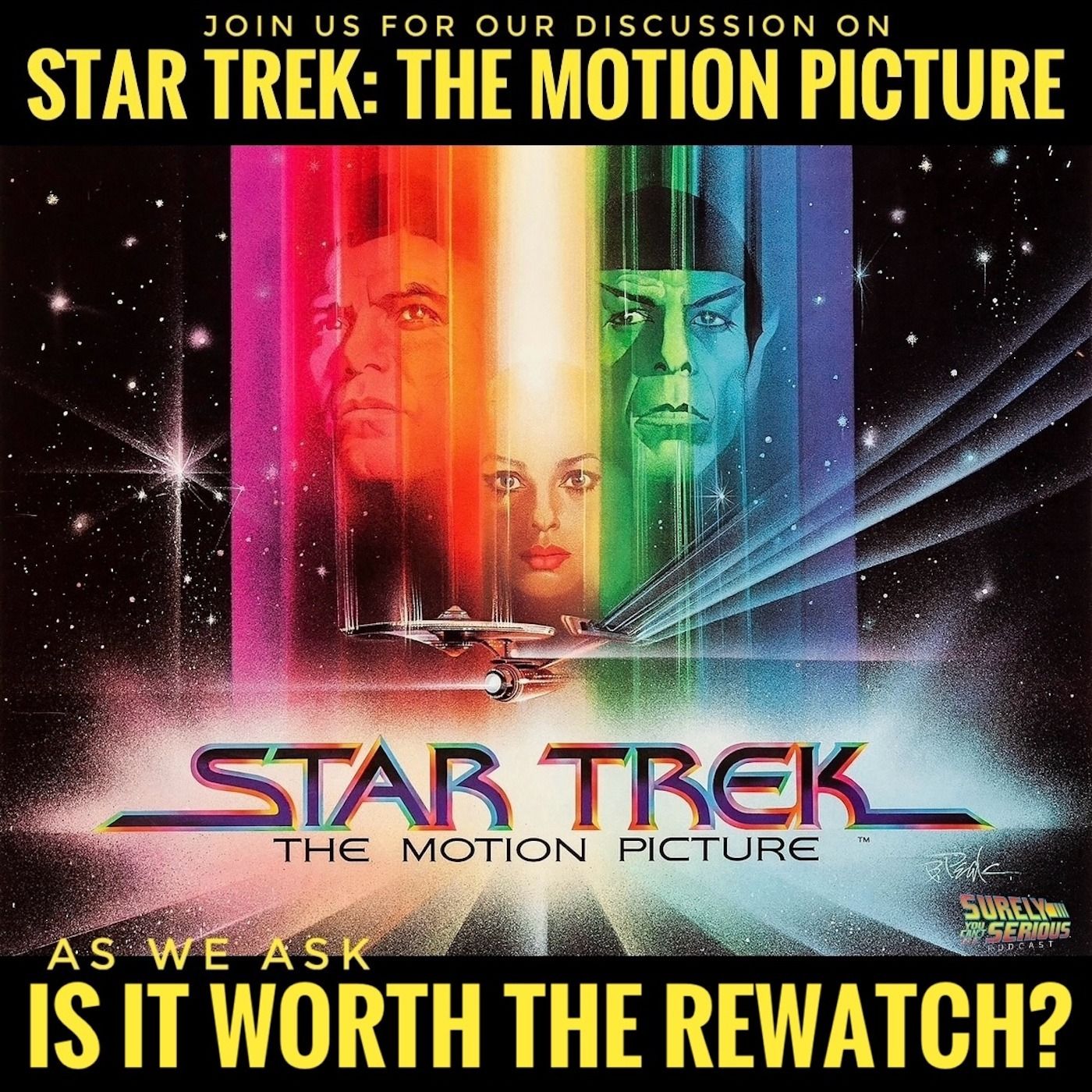
Star Trek: The Motion Picture (1979): Is It Worth A Rewatch?
Boldly go where no podcast has gone before with hosts Jason and Dee from the "Surely You Can't Be Serious" podcast, joined by special guest Jeff Johnson from the "A Film By" podcast and Star Trek expert Chuck Bryan. In this stellar episode, they embark on an in-depth exploration of the 1979 classic, "Star Trek: The Motion Picture".Join the crew as they delve into the intricate details of this iconic film, examining its place in the Star Trek universe and its impact on science fiction cinema. With their signature blend of humor and keen analysis, they discuss the film's strengths and weaknesses, from the groundbreaking special effects and ambitious storyline to the pacing issues and philosophical undertones that left audiences divided.But the ultimate question looms: Is "Star Trek: The Motion Picture" worth the rewatch? Jason, Dee, Jeff, and Chuck debate this pressing issue, providing unique perspectives and insights that will intrigue die-hard Trekkies and casual viewers alike. They explore whether the film's vision and execution hold up against today's standards and how it compares to other entries in the Star Trek franchise.Prepare for a warp-speed journey through cinematic history as they break down the film's plot, characters, and themes, all while sharing plenty of laughs and engaging anecdotes. Whether you're a seasoned Starfleet officer or a newbie to the final frontier, this episode promises to be an entertaining and enlightening discussion that will leave you eager to revisit the movie with fresh eyes.So, grab your phasers and set a course for nostalgia with "Surely You Can't Be Serious: Star Trek - The Motion Picture Revisited". Engage!
2024-06-04
67 min
Transcript
Available Results
Generated results are saved to the knowledge database for reuse and search.
No generated results are available for this episode yet.
Extract Knowledge
Pick what you want extracted first. Model, scope, and chapter options appear after a template is selected.
Generated results for public episodes are saved to the knowledge database so they can be reused and searched later.
Transcript
<v Speaker 1>Hey guys, Bill Benton, Jason Massik here from the All
<v Speaker 1>Eighties Movies Podcast. When we're cruising into Ming's Palace on
<v Speaker 1>our Hawkman rocket cycles, we turned down the Queen and
<v Speaker 1>turn up the Shirley You Can't Be Serious Podcast. Long
<v Speaker 1>live Jason and d They'll save every one of us.
<v Speaker 2>Hello everybody, and welcome back to the Shirley you Can't
<v Speaker 2>Be Serious Podcast. We are here for another special episode.
<v Speaker 2>This one is a little different. We kind of approached
<v Speaker 2>this as a what the heck happened, but we decided
<v Speaker 2>to take it in a different way. We're dealing with
<v Speaker 2>a couple of movies today. The question is is it
<v Speaker 2>worth the rewatch? So we're not gonna boldly go where
<v Speaker 2>no man has on before. We're deciding whether to go
<v Speaker 2>back where we've already been and see if it's a
<v Speaker 2>better experience the second time around.
<v Speaker 3>So we're comparing Star Trek Demotion picture from nineteen seventy nine,
<v Speaker 3>which is reaching its forty fifth anniversary this year, against
<v Speaker 3>Star Wars The Phantom Menace which came out ninety nine,
<v Speaker 3>which is reaching its twenty fifth anniversary this year.
<v Speaker 4>Hard to believe, And.
<v Speaker 3>We're going to compare these two, we're gonna ask the
<v Speaker 3>question are they rewatchable? We're also going to say, you know,
<v Speaker 3>what works, what doesn't, how do we change it?
<v Speaker 4>How would we improve it?
<v Speaker 3>And so today we've also invited a couple of friends
<v Speaker 3>to come on and talk about Star Trek demotion picture.
<v Speaker 3>We've got our old stand by Jeff Johnson of the
<v Speaker 3>filmed By podcast and the Star Trek podcast Phasers Set
<v Speaker 3>for Stunt.
<v Speaker 4>Jeff, how you doing man? Jason?
<v Speaker 5>I am doing great, And like Kirk, my orders are
<v Speaker 5>to intercept, investigate, and take whatever action is necessary or possible.
<v Speaker 2>Today.
<v Speaker 3>Nice, Hey, before we introduce Chuck, tell us a little
<v Speaker 3>bit about Phaser Set for Stun.
<v Speaker 5>So a couple of years ago on the film By podcast,
<v Speaker 5>we started doing some recaps and a couple of the
<v Speaker 5>guys are huge Star Trek fans, and we recap couple
<v Speaker 5>shows and it got wildly popular, so much that we
<v Speaker 5>just we realized, like, hey, we can't just recap Star
<v Speaker 5>Trek shows.
<v Speaker 4>We got to have a Star Trek pod going.
<v Speaker 5>So Phaser's Set to stun has been up and going
<v Speaker 5>for the past year now, and every Wednesday, you know,
<v Speaker 5>film buy us Every Tuesday, Phaser set to stun. Every
<v Speaker 5>Wednesday you can hear Wayne Whited, David Burns, and Scott
<v Speaker 5>Hoffman talk all things.
<v Speaker 3>Trek, and we've got mister Chuck Bryan who has come
<v Speaker 3>on to bring expertise on Star Trek the Motion Picture.
<v Speaker 4>Chuck, how you doing man?
<v Speaker 6>Hey guys, I am doing well, and I would like
<v Speaker 6>to make it plain that my oath of celibacy is
<v Speaker 6>on record. But thank thanks for having me on, Jason
<v Speaker 6>and d and nice to meet you, Jeff.
<v Speaker 4>Absolutely, Chuck, it's a pleasure.
<v Speaker 2>So so. Chuck has been a fan for a little while,
<v Speaker 2>and after our Beverly Hills Cop three episode, he sent
<v Speaker 2>us an email entitled the Motion Picture versus the Phantom Menace. Bye.
<v Speaker 2>By the way, the mere fact that this is Star
<v Speaker 2>Wars and Star Trek causes me to stumble over my
<v Speaker 2>words enough, but the fact that the abbreviations for the
<v Speaker 2>two movies are TMP and TPM makes it even harder.
<v Speaker 2>But Check sends me this email about these two contenders,
<v Speaker 2>if you will, and his opening line is, oh, you
<v Speaker 2>guys are going to step on my toes with this one.
<v Speaker 4>He tells it.
<v Speaker 2>He goes on to say that we're not wrong about
<v Speaker 2>the Phantom Menace, but he is a strong advocate not
<v Speaker 2>just for Star Trek the Motion Picture, but specifically the
<v Speaker 2>new cut that was done in twenty twenty two as.
<v Speaker 5>Rust as a head necessary take us out.
<v Speaker 6>Star Trek the Motion Picture for me, has been one
<v Speaker 6>of those films that kind of the older I get
<v Speaker 6>and the more I watch it, the more it begins
<v Speaker 6>to mean a little something different for me. On Facebook,
<v Speaker 6>there is a group called the Star Trek the Motion
<v Speaker 6>Picture Appreciation Society. It's a private group and if you
<v Speaker 6>ever sign up for it, you're gonna get to meet
<v Speaker 6>a lot of the people who actually worked on the
<v Speaker 6>films and on the twenty two remastering, David Fine, Mike Mathesino,
<v Speaker 6>Jin because I'm saying her name's totally wrong, but these
<v Speaker 6>are all guys who had worked with Bob Wise in
<v Speaker 6>two thousand and one when he had the opportunity to
<v Speaker 6>go back and finally complete his vision of what Star
<v Speaker 6>Trek the Motion Picture was supposed to be. And so
<v Speaker 6>the twenty two version came out a couple of summers ago.
<v Speaker 6>One of the main goals of getting this version of
<v Speaker 6>the film was to actually get it back on film stock.
<v Speaker 6>A negative that could be printed and could be projected.
<v Speaker 6>The two thousand and one version was just DVD video
<v Speaker 6>only and could not be upscaled, And so Star Trek
<v Speaker 6>Demotion Picture got yet another release, and it was glorious
<v Speaker 6>to see it once again in the movie theaters.
<v Speaker 2>One of the key features as you're watching the new movie,
<v Speaker 2>the one that came out in twent two, which is
<v Speaker 2>available streaming on Max right now for everybody listening, is
<v Speaker 2>there are lines that are kind of the key point
<v Speaker 2>of the whole idea behind the whole movie that got
<v Speaker 2>cut from the original theatrical release. And so if you
<v Speaker 2>watch that original theatrical release and you were bored or
<v Speaker 2>you said, well, I don't really understand what the point
<v Speaker 2>of all of that was. The good news is that
<v Speaker 2>people who were asking the same questions, who were in
<v Speaker 2>the know, took this film and made it what it
<v Speaker 2>was supposed to be. And you can see that now.
<v Speaker 2>Now the question is given the new cut, is it
<v Speaker 2>worth the rewatch, which we'll address at the end of
<v Speaker 2>our show.
<v Speaker 7>This simple feeling is beyond features comprehension.
<v Speaker 2>Okay, guys, I've got a story to tell you. I
<v Speaker 2>dare to say movie worthy on its own if you
<v Speaker 2>will indulge me for just a second before we get
<v Speaker 2>into star trek, can I talk to you about a constellation?
<v Speaker 4>Oh my gosh, please do.
<v Speaker 2>Okay, if Chuck knows this story, I won't be surprised. Jason,
<v Speaker 2>if you and Jeff know this story, you will I
<v Speaker 2>will bow at your feet. Okay, eat my shoes? Yes, okay.
<v Speaker 2>So are you guys familiar with the Lockheed l DASH
<v Speaker 2>zero four nine constellation? Okay? The thing is, it is
<v Speaker 2>not a group of stars. It is a plane. And
<v Speaker 2>in nineteen forty seven June, to be exact, that plane
<v Speaker 2>took off. The captain of the plane was named Captain Short.
<v Speaker 2>There was a first officer named McCoy. There was a
<v Speaker 2>third officer named Wesley. Not making this up, This is
<v Speaker 2>all true story. And they left at about three point
<v Speaker 2>thirty from Karachi on the first leg of a trip
<v Speaker 2>back to New York City. The third officer was just
<v Speaker 2>there as a deadhead. But then about five hours into
<v Speaker 2>the trip, Captain Short was a little tired. Third officer
<v Speaker 2>comes up and gives him relief by taking the yoke
<v Speaker 2>for a little while. And while he's flying the plane,
<v Speaker 2>engine number one goes out, so of course, Captain Short
<v Speaker 2>comes back up. He takes the yoke back again. He decides,
<v Speaker 2>the other engines, I think will get us to where
<v Speaker 2>we're going, and so he makes the decision to keep
<v Speaker 2>on going. This was the wrong decision because what happens
<v Speaker 2>is those other engines were using so much power that
<v Speaker 2>they overheated, they caught on fire, and one of the
<v Speaker 2>engines fell off, which means the plane was no longer airworthy.
<v Speaker 2>At that point, they knew they were going to crash,
<v Speaker 2>and it was just a matter of when the third
<v Speaker 2>officer leaves the cockpit, goes back and assures the passengers
<v Speaker 2>that everything is under control. He orders the flight attendants
<v Speaker 2>to get in their seats and say seated. He goes
<v Speaker 2>to the back plane. He takes his seat. As he's
<v Speaker 2>sitting there, a woman starts screaming because she's so scared,
<v Speaker 2>and so he gets up and he goes to comfort
<v Speaker 2>her just before the plane crashes. So as the plane
<v Speaker 2>hits the ground, he is not buckled in. He breaks
<v Speaker 2>three of his ribs. The plane is torn in two
<v Speaker 2>seven of the crew are killed, eight of the passengers
<v Speaker 2>are killed, and they're in the middle of the day.
<v Speaker 2>He leaves the plane and begins as now the lead officer.
<v Speaker 2>Since both the captain and McCoy are both dead, he
<v Speaker 2>begins rescue efforts to get all of the surviving passengers
<v Speaker 2>off the plane. The plane is on fire, he makes
<v Speaker 2>the decision, I'm going to get one last person and
<v Speaker 2>takes them off as the plane is engulfed in flames.
<v Speaker 2>That person that he thought he was saving ended up
<v Speaker 2>dying because it was such a treacherous situation. Now they're
<v Speaker 2>in a plane that's in the middle of the desert,
<v Speaker 2>in the middle of the nights. Three in the morning,
<v Speaker 2>he's taking control and trying to do everything he can.
<v Speaker 2>He sets up the inflatable slide as shelter for people.
<v Speaker 2>He begins looking around, and then nomads in the desert come.
<v Speaker 2>He has to convince them to only rob the dead
<v Speaker 2>people instead of robbing the living. By the time the
<v Speaker 2>sun comes up, he has to make a journey to
<v Speaker 2>try to see if he can see any signs of life.
<v Speaker 2>He sees some telegraph wires, so as he's headed back, though,
<v Speaker 2>another group of rotters comes by and actually robs the living,
<v Speaker 2>but they don't kill anybody. He sends two groups out
<v Speaker 2>to follow the telegraph lines in either direction. One of
<v Speaker 2>those groups sees that it's connected to the city. He
<v Speaker 2>makes his way to the city, calls in the plane crash,
<v Speaker 2>and eventually everyone is rescued. After this, six months later,
<v Speaker 2>he's absolved of any wrongdoing and is credited as a
<v Speaker 2>hero for this crash and how he treated it. But
<v Speaker 2>he decides, based on this and some other issues he's
<v Speaker 2>had with flying in the past, including his time in
<v Speaker 2>World War Two, I don't want to fly anymore. And
<v Speaker 2>he decides, I'm going to do what my dad did,
<v Speaker 2>and so he joins the LAPD. I said his name
<v Speaker 2>was Officer Wesley. It was Officer Eugene Wesley Roddenberry, whose dad,
<v Speaker 2>Officer Roddenberry, was a member of the LAPD. So this
<v Speaker 2>hero is now a traffic cop. But he's a good writer,
<v Speaker 2>and so he becomes a speech writer for the Chief
<v Speaker 2>of police. That leads him to participating in a new
<v Speaker 2>TV S series based on real life is dramas called Dragnets,
<v Speaker 2>which leads him to write episodes for that series, which
<v Speaker 2>leads him to create series that we now know as
<v Speaker 2>Star Trek.
<v Speaker 4>Brilliant.
<v Speaker 2>That was unbelievable that I'm putting microphone down and I'm
<v Speaker 2>gonna be quiet for the rest of the podcast, indulging
<v Speaker 2>me for that crazy but.
<v Speaker 4>That is awesome.
<v Speaker 5>Hey, I have been around long enough to know that
<v Speaker 5>when d starts one of these intense stories, it's we're
<v Speaker 5>going to go down a rabbit hole and somehow he's
<v Speaker 5>going to tie it into what we're talking about.
<v Speaker 4>I was like, what, how is this? Where are we going?
<v Speaker 5>That was fantastic, and yeah, you're right, I'm ready to
<v Speaker 5>watch this movie now.
<v Speaker 4>Fascinating. Yeah, fascinating, Okay, go ahead.
<v Speaker 6>I kind of wonder though, you know, you think about
<v Speaker 6>everything that that Roddenberry went through. He obviously he has
<v Speaker 6>a definite philosophy of life. He has a philosophy for
<v Speaker 6>how he wants to see the few sure, and it's
<v Speaker 6>a future where we as a human race have gotten
<v Speaker 6>past the things that are holding us down now, the
<v Speaker 6>way in which we go to war with each other
<v Speaker 6>and all, and it sets up this bigger, brighter future.
<v Speaker 6>And I just I wonder how much of that was
<v Speaker 6>influenced by that story you told.
<v Speaker 2>Right there, I heard him talking. He was talking about
<v Speaker 2>why he decided to develop a sci fi program. He said,
<v Speaker 2>you know, I had things that I wanted to say,
<v Speaker 2>and I had to figure out a way to say them.
<v Speaker 2>He said, you know, I'm not trying to compare myself
<v Speaker 2>to Jonathan Swift, But Jonathan Swift had things to say
<v Speaker 2>about London, and so he decided to write Gulliver's Travels.
<v Speaker 2>He goes, I have things to say about a lot
<v Speaker 2>of things, Vietnam War, for example. It seemed to me
<v Speaker 2>that space travel was an opportunity to be able to
<v Speaker 2>say what I wanted to say in a television format. Beautiful.
<v Speaker 3>Yeah, okay, So before we start, do you remember when
<v Speaker 3>you saw Star Trek the most picture for the first time.
<v Speaker 4>The spock Every minute brings that object closer to Earth.
<v Speaker 2>I meet you.
<v Speaker 7>I am convinced we are inside a living machine. Shall
<v Speaker 7>I go to battle space and sent insatiable, curiosity, spuck.
<v Speaker 8>You haven't changed a bit. You're just as warm and
<v Speaker 8>sociable as ever. I hope we got this one off
<v Speaker 8>to a good start. I hope so too.
<v Speaker 2>Yeah. It was I mean, I I'd seen all of
<v Speaker 2>the others, had Wrath of Khan was the first one
<v Speaker 2>that I saw. You know, I was born in seventy five,
<v Speaker 2>and so when this came out in seventy nine. It's
<v Speaker 2>possible that I saw it and I have no memory
<v Speaker 2>of it. I did, but my first time that I
<v Speaker 2>remember watching it, I was like, I should go back
<v Speaker 2>and watch that original and I was a teenager and
<v Speaker 2>I was bored. I was I was way bored.
<v Speaker 4>Right right.
<v Speaker 3>What about you, Chuck, When was the first time you
<v Speaker 3>saw this?
<v Speaker 2>Yeah?
<v Speaker 6>I saw it actually on the original release. I can
<v Speaker 6>tell you the name of the theater that I saw at,
<v Speaker 6>and I can tell you the name of the auditorium
<v Speaker 6>that I saw it in. And I can tell you
<v Speaker 6>that a few years later, as when I was in college,
<v Speaker 6>that same theater was where I went and went and
<v Speaker 6>worked my part time job while I was working through college.
<v Speaker 6>And that's how I kind of remember a lot of things.
<v Speaker 6>I think someone once said, I don't remember birthdays and
<v Speaker 6>wedding anniversaries and stuff like that, but I can tell
<v Speaker 6>you when a movie was released, and I relate everything
<v Speaker 6>kind of back to that. So yeah, I definitely remember
<v Speaker 6>seeing it for the first time.
<v Speaker 4>All right, Jeff, what about you?
<v Speaker 5>My story would probably echo D's. I remember a friend
<v Speaker 5>in my youth, A friend was using Wrath of Khan
<v Speaker 5>to show me that star Trek could be as.
<v Speaker 4>Entertaining as Star Wars.
<v Speaker 5>Loved Wratha Khan was ready to for more, and I
<v Speaker 5>wasn't old enough to respect the canon at that time,
<v Speaker 5>so I felt really bored with the motion picture.
<v Speaker 3>Okay, So I saw it in the theater just like Chuck,
<v Speaker 3>except I'm a few years younger. I was born in
<v Speaker 3>nineteen seventy three, so I'm six, and I remember my
<v Speaker 3>uncle was like, you know, hey, we're gonna go see
<v Speaker 3>this movie. I'm like, great, what are we seeing. It's
<v Speaker 3>Star Trek. I'm like, what is that. He's like, well,
<v Speaker 3>it's kind of like Star Wars. So when I went
<v Speaker 3>to the theater, I'm expecting laser battles and lightsabers, and
<v Speaker 3>what I got was a lot of you know, looking
<v Speaker 3>and thinking. So I was bored initially too. Now that
<v Speaker 3>movie was not made for a six year old, you know,
<v Speaker 3>it was made for a forty five or fifty year old.
<v Speaker 3>And now I'm forty five and fifty, so my perspective
<v Speaker 3>has changed a little bit. But at the time, I
<v Speaker 3>was like, this is not Star Wars. Okay, So let's
<v Speaker 3>talk a little bit about the history, not so much
<v Speaker 3>of Star Trek, but of Star Trek the Motion Picture.
<v Speaker 8>Buck, you haven't changed a bit. You're just as warm
<v Speaker 8>and sociable as ever.
<v Speaker 7>No have you, Doctor, as your continued bred election for
<v Speaker 7>irrelevancy demonstrates.
<v Speaker 3>As early as nineteen sixty eight, Geene Roddenberry addresses a
<v Speaker 3>crowd in Oakland at a convention and says, hey, guys,
<v Speaker 3>I think we're gonna do a motion picture of Star Trek.
<v Speaker 3>And people are like, heck, yeah, let's see this at
<v Speaker 3>the movies. Well, in nineteen sixty nine they cancel the series, right,
<v Speaker 3>and so at that point everything's kind of dead. But
<v Speaker 3>as early as nineteen seventy five, Paramount comes to him
<v Speaker 3>they start to kind of dream up the idea of
<v Speaker 3>a Star Trek movie, and so he begins to work
<v Speaker 3>on it. Well, as we all know, in nineteen seventy seven,
<v Speaker 3>Star Wars completely changes the game. So Paramount ramps up
<v Speaker 3>their efforts at that point and says, what sci fi
<v Speaker 3>action franchise do we have in our closet that we
<v Speaker 3>can ramp up to be with Star Wars? And actually
<v Speaker 3>I found it interesting. Close Encounters was a kind of
<v Speaker 3>catalyst for Star Trek the Motion Picture, because people viewed
<v Speaker 3>Star Wars as a fluke, and Close Encounters proved that
<v Speaker 3>it wasn't a fluke and that science fiction could be
<v Speaker 3>a viable money maker. And so at that point they
<v Speaker 3>go back to Gene Rodenberry and that's when we start
<v Speaker 3>in Earnest or Star Trek the motion picture.
<v Speaker 4>That's a great point.
<v Speaker 5>You got to remember sci fi had a good life
<v Speaker 5>two thousand, you know, Kubrick's two thousand and one, and
<v Speaker 5>I think it's like nineteen sixty eight, Logan's run in
<v Speaker 5>seventy six.
<v Speaker 4>It's bankable.
<v Speaker 5>So it's a great time to bring this this franchise back.
<v Speaker 5>What I find fascinating is that after several failed attempts
<v Speaker 5>with the scripts and directors, they said, you know what,
<v Speaker 5>let's just do TV and Star Trek Phase two was
<v Speaker 5>supposed to happen, and then that got canceled. You know,
<v Speaker 5>in pre production they're like, no, let's we got to
<v Speaker 5>have the movie. Let's let's go let's go big.
<v Speaker 2>Yeah.
<v Speaker 3>So the interesting thing about Star Trek Phase two, as
<v Speaker 3>I understand it, check you can help me with this,
<v Speaker 3>but that's where the Decker and Ailiah character kind of
<v Speaker 3>are born.
<v Speaker 4>Is Star Trek Phase two.
<v Speaker 6>Yeah, you have you have the Decker and Alia characters.
<v Speaker 6>I'm not one hundred percent sure if they had the
<v Speaker 6>same kind of relationship. But they were also missing one
<v Speaker 6>particular character who they weren't going to get back. They
<v Speaker 6>had no mister Spock. Leonard Nimoy was not going to
<v Speaker 6>sign up for another series. Not only that, he was
<v Speaker 6>a little bit, I don't know, angry about the way
<v Speaker 6>the merchandising agreements had worked. So after Star Trek went
<v Speaker 6>off the air, the residuals that he and the other
<v Speaker 6>actors were getting basically after a year, they were done,
<v Speaker 6>but Paramount was still making a lot of money selling
<v Speaker 6>the likeness of their faces, their images, you know, just
<v Speaker 6>in the characters of Spock and Kirk. And he was
<v Speaker 6>a little more than upset about that, and that was
<v Speaker 6>between the series, and it kind of felt he was
<v Speaker 6>taking advantage of a little bit he wasn't too keen
<v Speaker 6>to jump back on. So they had to get another
<v Speaker 6>science officer on board, and they came up with the
<v Speaker 6>character of Zoon, and Zon was a fully vulcan science
<v Speaker 6>officer who was maybe twenty ish or so. Ended up
<v Speaker 6>being cast by by rodden Berry and Company by an
<v Speaker 6>actor named David Gutreaux, I believe is how you pronounce
<v Speaker 6>his name, and David. He walks into Gene Rodden's office
<v Speaker 6>and he says, congratulations, David, you are our zone. And
<v Speaker 6>at the time, this is in one of those times
<v Speaker 6>when is it going to be a TV show? Is
<v Speaker 6>it going to be a movie, But at this point
<v Speaker 6>it was looking more like it was going to be
<v Speaker 6>a motion picture at that point, and I believe that
<v Speaker 6>may have been around August of seventy seven. At that point,
<v Speaker 6>I think is when Michael Eisner, you know, the guy
<v Speaker 6>who went on to be mister Disney, he was actually
<v Speaker 6>head a Paramount at that time. And this was around
<v Speaker 6>the time when they said, what do we have in
<v Speaker 6>our arsenal of shows that we could make? And they
<v Speaker 6>looked at Star Trek and they were beginning to think
<v Speaker 6>of that more as a motion picture at that point.
<v Speaker 3>So let's talk a little bit about Leonard Nimoy, because
<v Speaker 3>Paramount got down on their hands and knees and begged
<v Speaker 3>him to come back.
<v Speaker 6>Yeah, definitely.
<v Speaker 3>Somebody's daughter said, you can't have Star Trek without Spock.
<v Speaker 2>I saw him. I saw Leonard Nimoy talking about it specifically,
<v Speaker 2>and that was what he said. He said, if I
<v Speaker 2>was watching the movie, I wouldn't want to watch it
<v Speaker 2>without Spock, and I wouldn't want anyone else to play Spock.
<v Speaker 2>And so if you know the movie's going to get made,
<v Speaker 2>what other choice do you have in that situation? Right?
<v Speaker 6>Yeah, Once they brought Robert Wise on, he was told
<v Speaker 6>by his wife, by his family, they said, you cannot
<v Speaker 6>have Star Trek without mister Spock. They were able to
<v Speaker 6>get the licensing resolve to everybody's satisfaction.
<v Speaker 4>And then they wrote a check to Leonard Neimoy.
<v Speaker 6>They wrote a check.
<v Speaker 2>I feel like William Shatner was maybe less difficult to
<v Speaker 2>convince from what I understand, talking about how badly their
<v Speaker 2>contracts were with the TV show. After the cancelation of
<v Speaker 2>the TV show, within a year, Shatner was homeless, like
<v Speaker 2>he lost his house. He was and actually was living
<v Speaker 2>in a truck, and by nineteen seventy he was living
<v Speaker 2>in a truck. Wow. He watched the launch of one
<v Speaker 2>of the space programs. I don't remember what it was,
<v Speaker 2>but he was just saying to himself, It's just so
<v Speaker 2>crazy that a year ago I was in space and
<v Speaker 2>now I'm in a truck watching this space stuff happen,
<v Speaker 2>and he didn't I mean he didn't do He did
<v Speaker 2>just a handful of movies and TV spots in between
<v Speaker 2>the Star Trek series and this one, including one of
<v Speaker 2>Jason's favorite horror.
<v Speaker 4>Movies, Kingdom of the Spiders.
<v Speaker 2>Yeah, if you want to go back and look at
<v Speaker 2>our best horror movies of the seventies, Jason pulled out
<v Speaker 2>Kingdom of the Spiders. He had done some work with
<v Speaker 2>Roger Korman, who's not you know who's fantastic. God rest
<v Speaker 2>his sole he just passed, but also not known for
<v Speaker 2>high paying his actors either, so he was in a
<v Speaker 2>tough spot for that ten years.
<v Speaker 3>Wow, let's talk about Robert Wise for a second. Listen
<v Speaker 3>to the list of films that Robert Wise directed before
<v Speaker 3>Star Trek, The Motion Picture Okay, The Davier Stood Still,
<v Speaker 3>The Haunting West Side Story, The Sound of Music, The
<v Speaker 3>Sound of Music, The News Yes, and then he also
<v Speaker 3>directed kind of I think, an underappreciated seventies sci fi
<v Speaker 3>movie called The Andromeda Strain, which was by Michael Crichton.
<v Speaker 2>When I was looking at the IMDb on this that
<v Speaker 2>one popped up, and the trailer, the preview for it
<v Speaker 2>popped up and I was like, oh, dang, this looks
<v Speaker 2>like a great story. Like suddenly, like a whole town
<v Speaker 2>of people just drop dead in the middle of whatever
<v Speaker 2>they're doing that day, and it all kind of seems
<v Speaker 2>to get traced back to some sort of organism that
<v Speaker 2>has come from the space rocks that they brought back.
<v Speaker 3>I saw somebody say that the Andromeda Strain and Star
<v Speaker 3>Trek the motion picture are very similar because you spend
<v Speaker 3>two and a half hours for people to go in
<v Speaker 3>look at something accurate. But they land Robert Wise, the
<v Speaker 3>guy who directed Sound of Music and The Day There
<v Speaker 3>Stood Still and West Side Story. He's old Hollywood. He's
<v Speaker 3>not familiar with Star Trek, or at least not super
<v Speaker 3>familiar with Star Trek, but he ends up kind of
<v Speaker 3>being the anchor on this movie. He's the guy that
<v Speaker 3>kind of holds everything together. He's also one of the
<v Speaker 3>reasons why they were behind schedule because he wouldn't shoot
<v Speaker 3>over twelve hours per day. He was like, Nope, not
<v Speaker 3>going to do it, not gonna work that hard. Chuck
<v Speaker 3>what he got for us on Robert Wise.
<v Speaker 6>One of my favorite Robert Wise movies. And if you've
<v Speaker 6>never seen this one, go back and watch it. It's
<v Speaker 6>Run Silent, Run Deep. It's a little bit older World
<v Speaker 6>War two submarine movie. Excellent film. But before he was
<v Speaker 6>a director, he was an editor. And one of the
<v Speaker 6>things that I was listening to David Fine, who is
<v Speaker 6>the producer of the Director's Edition, listen to him when
<v Speaker 6>he was talking about how when Robert Wise was editing
<v Speaker 6>the de back in two thousand and one, he said
<v Speaker 6>he would you'd see him kind of conducting with his
<v Speaker 6>hands the beats of what was going on, and then
<v Speaker 6>he knew right where to cut a film, and he
<v Speaker 6>had incredible instinct about pacing and what it was that
<v Speaker 6>made a good setup and a good scene.
<v Speaker 3>Okay, before we get into we're gonna talk about what works,
<v Speaker 3>what doesn't work, what will we change, Let's just talk
<v Speaker 3>briefly about what this movie is about. So, Jeff, you
<v Speaker 3>want to give us breakdown on what the plot is
<v Speaker 3>of this movie.
<v Speaker 5>Jason, and my most IMDb styled answer, I would I
<v Speaker 5>would say it's when an alien spacecraft of enormous power
<v Speaker 5>is spotted approaching Earth, Admiral James T. Kirk resumes command
<v Speaker 5>of the overhauled USS Enterprise in order to intercept it.
<v Speaker 8>Spock. This child is about to wipe out every living
<v Speaker 8>thing on Earth. Now, what do you suggest we do, Spanky.
<v Speaker 2>The massive spacecraft, whatever it might be, is also destroying
<v Speaker 2>things as they come into its path, including including a
<v Speaker 2>Klingon vessel, which we see at the very beginning of
<v Speaker 2>the movie. And this is the first time that we
<v Speaker 2>see Klingons with their trademark head bunk whatever that stuff
<v Speaker 2>is called. And I was listening to it was one
<v Speaker 2>of those nineteen seventies Trekky conventions. And what's the actor
<v Speaker 2>that plays Scotty, what's his name is Mouhan. So he's
<v Speaker 2>talking to the crowd and he's mentioning He's like, they've
<v Speaker 2>got these things on their head that look like warts,
<v Speaker 2>which they've never had before. But what I attribute to
<v Speaker 2>Scotty sending them a herd of troubles nice only dorky
<v Speaker 2>trekky people.
<v Speaker 7>Job.
<v Speaker 4>Yes, that's right, all right? What do we think works
<v Speaker 4>with this movie?
<v Speaker 6>So?
<v Speaker 2>I think that the I think the storyline on this
<v Speaker 2>is very strong. Like, as I am watching this for
<v Speaker 2>the second time, I'm thinking to myself, this is actually
<v Speaker 2>a compelling thing, Like you've got this ominous death cloud
<v Speaker 2>moving at amazing speed toward the planet. What are you
<v Speaker 2>going to do? And the answer is, we're going to
<v Speaker 2>go meet it before it gets here, and we're going
<v Speaker 2>to try to figure out what it is and how
<v Speaker 2>to stop it. That's a great That is a great
<v Speaker 2>storyline if it sounds really exciting, and so if it was,
<v Speaker 2>you know, handled in a different way, there might have
<v Speaker 2>been more exciting features to it. But the other part
<v Speaker 2>that I think that works for this is they take
<v Speaker 2>time to appreciate the special effects in this movie. I
<v Speaker 2>feel like, especially in twenty first century movies, we have
<v Speaker 2>so many special effects that are absolutely crammed down our
<v Speaker 2>throats in every scene of big action movies that you
<v Speaker 2>don't have time to even notice most of it, let
<v Speaker 2>alone like soak it in and kind of go, oh,
<v Speaker 2>you know, they did a good job with this this one.
<v Speaker 2>This movie might take it a little bit to the extreme,
<v Speaker 2>but I actually was. I was pleased to have them go, Okay,
<v Speaker 2>let's watch the spacecraft move through space. Let's see how
<v Speaker 2>friggin' big the enterprise really is. I mean, I don't
<v Speaker 2>think that's something that people really truly appreciated from the
<v Speaker 2>television series. But he addresses the crew before they get
<v Speaker 2>started and you're like, oh, dang, this is a huge
<v Speaker 2>this is a huge group of people. There's a whole
<v Speaker 2>army of people that are involved with running this ship.
<v Speaker 2>And then you get this outside shot to go, oh, wow,
<v Speaker 2>this thing is gigantic, which of course it would have
<v Speaker 2>to be. You'd have to have a giant ship just
<v Speaker 2>to be able to sustain life for that travel through space.
<v Speaker 2>So those are the things that I think worked. And
<v Speaker 2>then I just I mean, I love that they got
<v Speaker 2>the original cast members back and that they were all
<v Speaker 2>I mean, they weren't as characters where they were when
<v Speaker 2>we left them, but they were still James T. Kirk,
<v Speaker 2>mister Spock, and McCoy. I love it all.
<v Speaker 4>Right, Jack, what works for you in this one?
<v Speaker 6>Well, I'm going to start where Dee left off, and
<v Speaker 6>that's with getting the characters back in all the original actors.
<v Speaker 2>That was.
<v Speaker 6>I mean, if they could not have, if they didn't
<v Speaker 6>get Leonard nimoy, would it just would not have been
<v Speaker 6>the same movie. But I think what I really like
<v Speaker 6>how they introduced, how they brought everyone in one by one.
<v Speaker 6>He's introduced with Spock and he's he's going through the
<v Speaker 6>final stages of the coolinar ritual, and then it introduces Kirk,
<v Speaker 6>and Kirk is now going back to the Enterprise and
<v Speaker 6>he's he. The next character that they introduced is the Enterprise,
<v Speaker 6>because the Enterprise is a character of the show. And
<v Speaker 6>then they bring back McCoy, you know, and McCoy honestly
<v Speaker 6>does not need to be in this movie, but Kirk
<v Speaker 6>needs him. Kirk needs him to be Kirk.
<v Speaker 7>Mc bones, I need you.
<v Speaker 2>Badly.
<v Speaker 6>And then finally, once they're on their way, the Enterprise
<v Speaker 6>isn't working because it's still missing spot. And then once
<v Speaker 6>Spock comes on board, the Enterprise is happy at that
<v Speaker 6>point and everything begins to work and they're able to
<v Speaker 6>go on their mission. So I thought the characters all worked.
<v Speaker 6>I think the other thing that really worked is Jerry
<v Speaker 6>Goldsmith's score. I can't begin to tell you the number
<v Speaker 6>of times I have bought this score. It was the
<v Speaker 6>first LP album that I had ever owned in my life,
<v Speaker 6>and I still have it, and I have it on
<v Speaker 6>various CDs and other digital platforms for it, and it's
<v Speaker 6>just an amazing score. I don't know if you notice.
<v Speaker 6>They call it the blaster Beam. So every time they
<v Speaker 6>would show Vjure you'd hear this. Wow, that's an instrument
<v Speaker 6>that they created for this particular recording, and I think
<v Speaker 6>it gives that whole gravitas towards to the voice of
<v Speaker 6>VDRE and it's just really good. And of course the
<v Speaker 6>effects are amazing. And since you guys did watch it
<v Speaker 6>on Max, could you tell whenever they were using the
<v Speaker 6>Digital Enterprise versus the Model Enterprise? Because there were, But
<v Speaker 6>like I mean, you ever like today you watch movies
<v Speaker 6>and you kind of go, okay, I know, I'm kind
<v Speaker 6>of looking at CGI. When they did this, their use
<v Speaker 6>of it was so subtle, and a lot of times
<v Speaker 6>it was there to fix problems that may have been
<v Speaker 6>in the original negative or maybe in the compositions. But
<v Speaker 6>there's different areas, especially later on when you were saying,
<v Speaker 6>d how big the enterprise is, right, and they set
<v Speaker 6>so much time up at the beginning about how big
<v Speaker 6>the enterprise is, and then you see how much bigger
<v Speaker 6>VGRE is, like Vger engulfs it to where the enterprise
<v Speaker 6>is just this little speck, and that sense of scale
<v Speaker 6>was just I just it blew me away.
<v Speaker 4>Jeff, what about you, Ben Well?
<v Speaker 5>I think Chuck and de have done a lot of
<v Speaker 5>the heavy lifting there for me, because I'll i'll have
<v Speaker 5>to talk about, obviously the story Harold Livingston, who was
<v Speaker 5>a fame TV writer. It blows my mind that this
<v Speaker 5>guy mostly known for Six Million Dollar Man and Mission Impossible,
<v Speaker 5>he wrote Star Trek the motion picture. What a way
<v Speaker 5>to make your mark. I think it does a great
<v Speaker 5>job of giving the movie a lot of tension. It
<v Speaker 5>almost gives it in the same way like a movie
<v Speaker 5>like Wargames does, where you're up against something that you
<v Speaker 5>cannot possibly defeat, so our protagonists have to rely on
<v Speaker 5>their wits if they're going to save the day. And
<v Speaker 5>that's one thing maybe my youth I didn't really appreciate,
<v Speaker 5>But as an adult, the story here is just it's
<v Speaker 5>one of the most intelligent Star Trek stories I think
<v Speaker 5>has been out there.
<v Speaker 4>As far as the visual effects night and day. When
<v Speaker 4>we're talking about the.
<v Speaker 5>Director's cut and it's gorgeous, you know, can't you can't
<v Speaker 5>talk about these effects without talking about Douglas Trumbull. I
<v Speaker 5>always think about the scene where Scotty and Kirk are
<v Speaker 5>taxiing over to the Enterprise and it's just this long
<v Speaker 5>drawn out moment where there's no dialogue and that's that's
<v Speaker 5>something that Trumbull took straight from Kubrick and was like,
<v Speaker 5>let's just get in the enterprise. Let's admire the enterprise
<v Speaker 5>and see it for all it's grandeur. You know the
<v Speaker 5>idea that this is. You know, Trumble's the first pick.
<v Speaker 5>Obviously he turns him down because he wants to be
<v Speaker 5>a director and he's committed to close encounters of the
<v Speaker 5>third kind. And they had so much they had so
<v Speaker 5>many problems with the visual effects team that they were
<v Speaker 5>working on that they I think they spent like five
<v Speaker 5>million dollars and went nowhere with what they had maybe
<v Speaker 5>like one shot.
<v Speaker 4>Zero working shots. Yeah, yeah, zero working shots.
<v Speaker 6>Yeah, first of all. And it was Robert Abele and associates.
<v Speaker 6>Go and look at the commercials that they did in
<v Speaker 6>the seventies. They used a lot of that same slit
<v Speaker 6>scan techniques that Trumbull did with the Stargate in two
<v Speaker 6>thousand and one. It's just really really slick commercials, very
<v Speaker 6>very famous. But yeah, they got they spent like I
<v Speaker 6>thought the number was more like a million, but I mean,
<v Speaker 6>what's a million or five million when your total budget
<v Speaker 6>is forty And they had been working on it for
<v Speaker 6>a year they had finished principal photography, like in January
<v Speaker 6>seventy nine, Bob Wise goes and says, okay, I want
<v Speaker 6>to see what you got, you know, show me something,
<v Speaker 6>and they showed him maybe thirty seconds of some of
<v Speaker 6>the work that they were doing on the probe scene
<v Speaker 6>when it was on the bridge, and that was it.
<v Speaker 6>Bob left that particular meeting. He said, I never want
<v Speaker 6>to see that guy again. He's out of here. And
<v Speaker 6>luckily at that point Trumbull was free, and Trumbull brought
<v Speaker 6>in another person, John Dykstra, who worked on a little
<v Speaker 6>show called Battlestar Galactica, but before that he cut his
<v Speaker 6>teeth on this other movie, Star Wars. Yeah. Yeah, he
<v Speaker 6>was the guy who did the dystra for all those
<v Speaker 6>motion control cameras and everything.
<v Speaker 2>So he also did the motion control for the Gopher
<v Speaker 2>on caddy Shack.
<v Speaker 4>There.
<v Speaker 2>Check out the Caddyshack episode.
<v Speaker 6>But they had more visual effect shots than Star Wars
<v Speaker 6>and Close Encounters combined.
<v Speaker 4>That's hard to believe. Okay, that's amazing.
<v Speaker 6>Well, well, also remember this is January February of seventy nine.
<v Speaker 6>This picture has to release on December seventh, deadline. Yeah,
<v Speaker 6>that was a big deal, right, Yeah, they had contracts
<v Speaker 6>with theaters. They were going to clear the slate for
<v Speaker 6>December so that they could get this movie in And
<v Speaker 6>this is going to be the next blockbuster, right, And
<v Speaker 6>so there's like a thirty five million dollar guarantee the
<v Speaker 6>film studio is going to get from the distribution of
<v Speaker 6>this film. However, if they don't make it, it's not
<v Speaker 6>only that thirty five million, but they got to pay
<v Speaker 6>thirty five million out, so they stand to lose quite
<v Speaker 6>a bit of money in penalties and lawsuits and other
<v Speaker 6>such things.
<v Speaker 3>I heard Michael Eisner actually said if we have to
<v Speaker 3>release it with the black thing, that says effect here
<v Speaker 3>we're releasing.
<v Speaker 6>They got the teams to work three eight hour shifts
<v Speaker 6>to get it going.
<v Speaker 2>Jeff, you're talking about the writing on this one, I mean,
<v Speaker 2>which is fantastic and I've already put it on my
<v Speaker 2>good list as far as things that are of high
<v Speaker 2>quality about this movie. But I was just thinking about,
<v Speaker 2>you know, the characters. You start with Spock on his
<v Speaker 2>home planet with long hair, going through this ceremony to
<v Speaker 2>rid himself of the what's left of his humanity. You
<v Speaker 2>start with Kirk and he has lost the Enterprise and
<v Speaker 2>now is trying to take it back basically by force.
<v Speaker 2>And you're like, wow, okay, these you know, we're starting
<v Speaker 2>with adventure at the beginning, and then with McCoy, he's
<v Speaker 2>like involuntarily, you know, brought into the shanghaied, he was drafted.
<v Speaker 2>I mean, he shows up like he just came out
<v Speaker 2>of the Star Trek disco with his full beard. And
<v Speaker 2>so finally with McCoy, we understand why he's angry all
<v Speaker 2>the time, you know, like I didn't understand in the series.
<v Speaker 2>Now I know he never wanted to be here in
<v Speaker 2>the first place. That's why McCoy is always angry.
<v Speaker 3>McCoy looks like he's been living in Thailand. He's smoking potties,
<v Speaker 3>hanging out with ladies on the street all the time.
<v Speaker 6>But you've got this, McCoy had become a veterinarian after
<v Speaker 6>he left Starfleet, so he didn't want to operate on
<v Speaker 6>people anymore. Now that wasn't the original stories.
<v Speaker 2>That's fantastic, Well, that was what I was going to say.
<v Speaker 2>You've got a fantastic first act, You've got a fantastic
<v Speaker 2>plot point. But you chuck. You said the script was
<v Speaker 2>actually missing the third act, like they didn't know what
<v Speaker 2>they were going to do with it.
<v Speaker 6>That was and that was that was. That was one
<v Speaker 6>of the big problems even with Bob Wise, you know,
<v Speaker 6>Bob Is used to like, hey, we've got everything laid out,
<v Speaker 6>we know what we're doing, and they didn't have the
<v Speaker 6>third act for it, and they had brought in everybody
<v Speaker 6>to try to pitch ideas. They even got to William
<v Speaker 6>Shatner and Leonard Nimoy pitching some of their ideas. And
<v Speaker 6>it was one of the producers are he worked with
<v Speaker 6>Roddenberry John Povel, who came up with this idea that
<v Speaker 6>Veegre has grown as much as he's going to be
<v Speaker 6>able to grow, and he must evolve to the next level.
<v Speaker 6>And then that's where the concept of joining with the
<v Speaker 6>Creator came into being.
<v Speaker 7>What Veja needs in order to evolve is a human quality,
<v Speaker 7>our capacity to leap beyond logic.
<v Speaker 6>And so that's how that whole ending came about.
<v Speaker 3>Jason works for you man, Well, okay, so I just
<v Speaker 3>kind of what you guys have already said. Number one,
<v Speaker 3>I give this movie a lot of credit for getting
<v Speaker 3>the gang back together, right. This gave us the rest
<v Speaker 3>of the Star Trek movies and TV series that we
<v Speaker 3>have basically because it got us kicked off with Kirk's
<v Speaker 3>bach McCoy, you know, Scotty. It introduced me to Star Trek,
<v Speaker 3>So thank you for that. I think the special effects
<v Speaker 3>and score are amazing. The sense of wonder and discovery
<v Speaker 3>with this movie, I think are very strong. I think
<v Speaker 3>the director did a great job. I think the fact
<v Speaker 3>that Veigre spoilers Beijer is Voyager.
<v Speaker 4>Six sent from Earth.
<v Speaker 3>Like when I first realized what that was, I was like, oh,
<v Speaker 3>this is so cool. Right, this is our own creation
<v Speaker 3>that is seeking us out to talk to the creator.
<v Speaker 2>Right.
<v Speaker 3>Okay, let's talk about what doesn't work.
<v Speaker 2>Well, balls, do the.
<v Speaker 4>New medical facilities meet with your approval?
<v Speaker 7>They do not.
<v Speaker 6>It's like working in a damn computer center.
<v Speaker 4>D you're up?
<v Speaker 2>Okay? So I noticed something you got, you know, text
<v Speaker 2>thread that we had when we started, you know, when
<v Speaker 2>we decided we're going to do this. I love the
<v Speaker 2>text threads because it's like, oh, hey, did you guys
<v Speaker 2>hear about this? Oh hey, check this thing out. And
<v Speaker 2>so in one of them, somebody sent the poster because
<v Speaker 2>the poster is by the same artist who did the
<v Speaker 2>poster for Apocalypse.
<v Speaker 6>Now, I think it's Bob peak.
<v Speaker 2>So in that poster, I noticed it because just because
<v Speaker 2>we're looking at the poster and it's for the very
<v Speaker 2>first time that it says there is no comparison, like
<v Speaker 2>that's on the poster, and I was asking myself, well,
<v Speaker 2>what does that mean? What are they what are they
<v Speaker 2>talking about that they're saying there is no comparison because
<v Speaker 2>it doesn't really have anything to do with the plot
<v Speaker 2>of the movie. So then that begs the question is, well,
<v Speaker 2>if it's not the movie that they're talking about, what
<v Speaker 2>are they talking about? Well, does it mean that there's
<v Speaker 2>no comparison to Star Wars.
<v Speaker 4>That's what I think they mean.
<v Speaker 2>Is that what we're talking about.
<v Speaker 5>Oh, that's a clever way to take a jab at
<v Speaker 5>the at Lucas.
<v Speaker 4>Yeah.
<v Speaker 2>So my thought is then, I mean, they're right, there
<v Speaker 2>is no comparison to Star Wars. It is a completely
<v Speaker 2>different kind of movie. But I'm not going to I'm
<v Speaker 2>not going to say that, well, I am going to
<v Speaker 2>say Star Wars at Star Wars A New Hope is
<v Speaker 2>a better movie than this movie.
<v Speaker 4>But you're having a limb right there.
<v Speaker 2>But they're different kinds of movies, and one of the
<v Speaker 2>things we've talked about it already is the fact that
<v Speaker 2>Kuber had come out in sixty eight or sixty nine,
<v Speaker 2>whenever it was. With two thousand and one A Space Odyssey.
<v Speaker 2>If I was saying to myself, did they try to
<v Speaker 2>emulate Star Wars or did they try to emulate another movie?
<v Speaker 2>I would say it was another movie, and it was
<v Speaker 2>two thousand and one of Space obyssly because Cooper took
<v Speaker 2>so much time doing the exact same things where he
<v Speaker 2>lets you soak in the special effects and listen to
<v Speaker 2>some awesome music, and so to me me, I probably
<v Speaker 2>wouldn't have done that as much, because, quite frankly, the
<v Speaker 2>special effects in this movie were not as good as
<v Speaker 2>they were in two thousand and one A Space Odyssey,
<v Speaker 2>even though it's ten years later and they should have
<v Speaker 2>been significantly better at that point. They were good, but
<v Speaker 2>they weren't Space Odyssey good. They weren't Star Wars good,
<v Speaker 2>and so if you're going to make that decision, you
<v Speaker 2>got to come stronger with your special effects somehow. What
<v Speaker 2>also didn't work for me is that none of the
<v Speaker 2>uniforms had cot pieces and all kinds of beans and
<v Speaker 2>Franks up there that I was just not excited to see.
<v Speaker 2>I heard Shatner drop weight. Oh wait, speaking of that,
<v Speaker 2>speaking of the text thread, I have to read what
<v Speaker 2>happened right before we started recording. Jeff Johnson is like, hey,
<v Speaker 2>is there an invite? And Jason says, still still setting
<v Speaker 2>up Hank tight guys, And then he said, also the
<v Speaker 2>Star Trek podcast the search for Dee Graves because I
<v Speaker 2>had not yet gotten here. Jeff says it is illogical
<v Speaker 2>to proceed without d Graves, and then Jason says, the
<v Speaker 2>Graves unit is almost here, and then Chuck says, why
<v Speaker 2>doesn't the creator respond? And I said, if you think
<v Speaker 2>I'm using the transporter after what happened to that first
<v Speaker 2>group in the movie, you're out of your vulcan mind.
<v Speaker 6>Yeah. Can I say something about the transporter accident?
<v Speaker 2>Yeah? Yeah, yeah, yeah?
<v Speaker 6>Was that not the most horrific thing ever? Yes?
<v Speaker 4>In a G movie?
<v Speaker 6>Yeah, in a G movie. Yeah. And that one always
<v Speaker 6>gets me. And someone made a comment.
<v Speaker 9>About think about that, You're in the most agony that
<v Speaker 9>you've ever been in and your mouth hasn't yet materialized
<v Speaker 9>for you to scream, and.
<v Speaker 6>Then you get that it comes in and then they
<v Speaker 6>try to put enterprise.
<v Speaker 2>What we got back didn't live long. Fortunately. Yeah, I
<v Speaker 2>when I'm watching the series, I'm just thinking, Okay, well,
<v Speaker 2>this technology is so sound that it's never concern. And
<v Speaker 2>then they yanked the rug right out from underneath this
<v Speaker 2>on the very first transporter trip of the movie, and
<v Speaker 2>you're like, oh, so every time this happens, and it
<v Speaker 2>happens all the time, you're at risk of becoming a
<v Speaker 2>pile of carbon goo. Yeah, that's terrifying.
<v Speaker 5>It was terrifying when we thought the worst thing that
<v Speaker 5>could happen was what we saw President scrub deal with
<v Speaker 5>his asse was on backwards. This this movie movie shows
<v Speaker 5>us more of like David Crodenberg's The Fly, where things
<v Speaker 5>can go wrong. And I totally understand McCoy's disinterest in
<v Speaker 5>ever wanting to beam after seeing Star.
<v Speaker 4>Trek the motion picture.
<v Speaker 5>Hey, before we get too far away from Bob Peek,
<v Speaker 5>a little tidbit about Bob Peek.
<v Speaker 4>Yeah, the poster's gorgeous, it is, And.
<v Speaker 5>I just realized, I just realized I've got his artwork
<v Speaker 5>hanging on my wall. He also did the one sheet
<v Speaker 5>for Superman the movie, the famous You'll Believe a Man
<v Speaker 5>can fly. Oh really, yeah, I mean I know when
<v Speaker 5>you talk great poster work. You know, Drew Strewsy is
<v Speaker 5>the first name out of most people's mouths, but Bob Peek,
<v Speaker 5>he does gorgeous art.
<v Speaker 4>Aside from Star Trek and Superman.
<v Speaker 5>You know, he did The Dark Crystal, he did The
<v Speaker 5>Spy Who Loved Me and uh, you know you mentioned
<v Speaker 5>Apocalypse now, but uh, we'd be we'd be remiss.
<v Speaker 4>If we didn't mention he also did the.
<v Speaker 5>The dart work for any which way you can, Hey,
<v Speaker 5>little little little throwback to.
<v Speaker 3>Yeah nice, okay, Jack, what did not work for you
<v Speaker 3>in this movie?
<v Speaker 6>Wow?
<v Speaker 7>Anything?
<v Speaker 6>Pardon? Well, you know I'm a homer for it. So
<v Speaker 6>it's uh, it's kind of gotten to the point. But
<v Speaker 6>I I would say, if if there's anything, I still
<v Speaker 6>feel that there are some sequences that could have been trimmed,
<v Speaker 6>or you know, even some of the relationships could have
<v Speaker 6>been explored a little bit more. One of the things
<v Speaker 6>that I think a lot of a lot of folks
<v Speaker 6>had complaints about it when it first came out, and
<v Speaker 6>it's still there, but just because it's not in the story,
<v Speaker 6>is that the major characters have a lot to do
<v Speaker 6>or they have stuff to do, but Hohura really doesn't
<v Speaker 6>have much to do in it. Sulu, most of his
<v Speaker 6>interesting lines got cut in in the director's edition. And
<v Speaker 6>you know, check Off and Scottie, they they they're very
<v Speaker 6>relegated to what they do. There's not a lot of interaction.
<v Speaker 6>This is a this is a travel movie. I think
<v Speaker 6>those are my only things that I would have loved
<v Speaker 6>to have seen as a fan.
<v Speaker 3>All right, Jeff, you're up what doesn't work.
<v Speaker 5>I will agree with Chuck that there are some serious
<v Speaker 5>pacing issues in this film, and I understand long drawn
<v Speaker 5>out shots to show off the visual effects.
<v Speaker 4>However, I would have loved to see them trimmed more so.
<v Speaker 5>We could have made better use of of George Takai
<v Speaker 5>and Walter Koenig and Michelle Nichols who kind of just
<v Speaker 5>showed up for like glorified cameos. So that that's a
<v Speaker 5>problem for me. De mentioned the uniforms. I gotta say
<v Speaker 5>these are the worst Star Trek uniforms for me. In
<v Speaker 5>Star Trek, they just they felt more casual. I absolutely
<v Speaker 5>don't like that. The colors signifying the rare Yeah, they're.
<v Speaker 4>Practically non existent.
<v Speaker 5>You know, if you you have to you kind of
<v Speaker 5>have to queue into the delta on everyone's chest to
<v Speaker 5>see like the color behind it, to find out like
<v Speaker 5>who who's a science officer, Who's who's engineering? So I
<v Speaker 5>really didn't I really didn't care for that.
<v Speaker 6>Would you agree, Jeff that those that have.
<v Speaker 5>Been very comfortable, Well yeah, I mean they're it's like
<v Speaker 5>they're walking around wearing pajamas a lot of the times.
<v Speaker 5>Until you get to Ilia at the end when she
<v Speaker 5>comes back as the probe and what do we got for?
<v Speaker 5>Can she just wear a guy's dress shirt? Because that's
<v Speaker 5>that's all we got in the budget, you know. Yeah,
<v Speaker 5>we spent eighteen million dollars on the on the Phase
<v Speaker 5>two television show that we're adding into this budget.
<v Speaker 4>So we just grab a guy's shirt. That's so it.
<v Speaker 2>Please please add that to my what I like about
<v Speaker 2>this movie category? Please. I forgot to mention that. And
<v Speaker 2>then before John, I'll let you talk Jason, but before
<v Speaker 2>before we go, I have to mention one other thing
<v Speaker 2>that I didn't like. It didn't make any sense to me.
<v Speaker 2>The other troubling thing is when they're at warp speed
<v Speaker 2>they number one. When when things are going wrong, everybody
<v Speaker 2>gets all fuzzy in dream sequency, right, That's that's problem
<v Speaker 2>number one. But then problem number two. You know, it's
<v Speaker 2>it's grabbing from Star Wars. We could, you know, end
<v Speaker 2>up in the middle of an asteroid feel traveling through
<v Speaker 2>space isn't But but then that actually happens in this one,
<v Speaker 2>and they're like, oh, let's put an asteroid, but the
<v Speaker 2>asteroid is there with them, Like, how's the asteroid traveling
<v Speaker 2>at warp speed so that we are seeing the asteroid
<v Speaker 2>in real time instead of as a blur or whatever the.
<v Speaker 4>Wormhole effects that the wormholes ses. I'm not going down.
<v Speaker 2>A wormhole after the asteroid, but it's in front of them. Still,
<v Speaker 2>it didn't it didn't make any sense, and as far
<v Speaker 2>as I can tell, nothing to do with the plot
<v Speaker 2>like it didn't wasn't necessary. It was just a let's
<v Speaker 2>put an asteroid in front of them and forget all
<v Speaker 2>physics that are involved in this science really really science.
<v Speaker 2>I mean, they want to do great explanation on some
<v Speaker 2>stuff that I was just like, okay, if you say so,
<v Speaker 2>but I couldn't tell if it was real science or
<v Speaker 2>made up science or what. But they gave these stupid
<v Speaker 2>science details and then they absolutely just go, oh, well,
<v Speaker 2>let's put a rock in the way.
<v Speaker 4>A rock like a video game.
<v Speaker 3>It looks like it looked like battle Zone, it looked
<v Speaker 3>like a giant a flying potato, look like a great
<v Speaker 3>white shark coming closer to you.
<v Speaker 4>I'll tell you, Jason, the last thing.
<v Speaker 5>For you, for you before you talk about what doesn't work.
<v Speaker 5>And I'm sure you're gonna you're gonna highlight this. There's
<v Speaker 5>there's a significant lack of action. And that's not just me,
<v Speaker 5>that's pretty much everyone in nineteen seventy nine. But I
<v Speaker 5>think you've got a good fix, and I'll kick that
<v Speaker 5>down the road so you can talk about it.
<v Speaker 2>Thank you, Thank you.
<v Speaker 3>Okay, you know, Jeff and I have already talked about
<v Speaker 3>things I would do to change this movie, and I'm
<v Speaker 3>anxious to talk about that. So I'm not offering problems
<v Speaker 3>without solutions here, but I do have some issues. I
<v Speaker 3>don't think I'm really covering any new ground. There is
<v Speaker 3>not very much action in this movie. There is is
<v Speaker 3>almost no humor. There is not a lot of fun
<v Speaker 3>to be had, right, and one of the biggest things
<v Speaker 3>that's glaringly absent is the romance between Iliah and Decker.
<v Speaker 3>If we could have had a little bit more of that,
<v Speaker 3>that's what I We'll talk about that here in a minute,
<v Speaker 3>when I will discuss what I would fix. But and
<v Speaker 3>I think there are just some shots that were too long,
<v Speaker 3>including the two minutes of flying space at the beginning
<v Speaker 3>of the movie for no reason, before the paramount emblem is.
<v Speaker 4>Even on the tee.
<v Speaker 3>Just tighten things up, Let's trim it up a little bit.
<v Speaker 3>I appreciate the beauty and the care and the style,
<v Speaker 3>but it's just too long, and they need to beef
<v Speaker 3>up the action a little bit.
<v Speaker 5>You know. You mentioned a lack of humor. I think
<v Speaker 5>this movie has one of the more comedic moments in a.
<v Speaker 4>Star Trek film.
<v Speaker 5>I got I gotta point I gotta point out the insign,
<v Speaker 5>the pure seventies insign with his mustache.
<v Speaker 4>Who Spot does the neck pinch on he.
<v Speaker 5>Does the greatest to the overacting award goes to this guy.
<v Speaker 4>He milks it for always always worth it.
<v Speaker 5>He just slowly like we've seen Spot do that like
<v Speaker 5>a thousand times, and these guys drop like bags of dirt.
<v Speaker 4>He's in the war. Who you know. I love it.
<v Speaker 5>Every time I watched this, I love that guy's facial expression,
<v Speaker 5>so he's fantastic.
<v Speaker 4>Shout out to that guy. I don't even know who
<v Speaker 4>he is, but I texted you guys last night.
<v Speaker 3>I told you the spot in the movie where the
<v Speaker 3>probe comes on board and starts zapp and Iileiah and
<v Speaker 3>she keeps playing freeze tag and her face is making
<v Speaker 3>those contorted That makes me laugh every time, and I
<v Speaker 3>know I'm not supposed to laugh at that moment.
<v Speaker 6>So no real quickly about about that particular scene in general.
<v Speaker 6>So when they did the director's edition, the amount of
<v Speaker 6>original film negative that had not been comped or anything
<v Speaker 6>that they were able to get is the reason why
<v Speaker 6>that movie looks so good today, because they were able
<v Speaker 6>to go in and redo things properly because they didn't
<v Speaker 6>have the time in seventy nine to do it that way,
<v Speaker 6>and even in two thousand and one they did not
<v Speaker 6>have the original negative. So the angels of Paramount's Archives
<v Speaker 6>were very gracious in giving them what they needed. The
<v Speaker 6>one thing that they wanted to fix that they did
<v Speaker 6>not have the negative for was that scene right there.
<v Speaker 6>And if you go back and watch the original version
<v Speaker 6>of it and then compare it to this you'll see
<v Speaker 6>that the amount of cleanup and how it looks, it's
<v Speaker 6>amazing what they were able to do. But I get
<v Speaker 6>what you're saying about the contortions of her face. She
<v Speaker 6>has that Oh crap, it's over boom.
<v Speaker 4>All right, d how did you fix this picture?
<v Speaker 2>Let me talk about what they did in the twenty
<v Speaker 2>twenty two edition that absolutely worked to make this a
<v Speaker 2>much better movie. I mentioned it before, is that the
<v Speaker 2>a key aspect of this was that they had cut out,
<v Speaker 2>like a long part of monologue. After he has had
<v Speaker 2>his face to face experience with Veegure, right, he goes rogue,
<v Speaker 2>He goes out on his own to confront Veger, and
<v Speaker 2>he identifies with it on a deeper level and arrives
<v Speaker 2>back at the ship, and a large part of that
<v Speaker 2>dialogue got cut or that monologue got cut at when
<v Speaker 2>they did the first release, but they bring it back
<v Speaker 2>in this one, and he is tied to Veguer, like
<v Speaker 2>his story and Veger's story are tied together, and that
<v Speaker 2>is the story of why do we have humanity? Why
<v Speaker 2>is it important that we have humanity? Because at the
<v Speaker 2>beginning of this, he's ready to give his humanity up
<v Speaker 2>to become a completely logical being because he feels like
<v Speaker 2>that the emotions are unnecessary. But then he's called aboard
<v Speaker 2>the ship. He feels like he needs to go on
<v Speaker 2>this final journey and he confronts a being that is
<v Speaker 2>completely logical, that lacks all emotion, and he appreciates the
<v Speaker 2>danger and the coldness and the lack of something that
<v Speaker 2>he realizes is truly important. And that's how he moves
<v Speaker 2>from being the guy who's ready to give up to
<v Speaker 2>his humanity to the guy who is embracing his humanity.
<v Speaker 2>And so that whole why am I here? Is this
<v Speaker 2>all there is? That's a question that Spock has at
<v Speaker 2>the beginning that his experience with Veger helps him answer.
<v Speaker 2>And so I got to give them credit for that
<v Speaker 2>to go number one, terrible idea to cut it out
<v Speaker 2>in the first place, but way to go on grabbing
<v Speaker 2>that and bringing it back because that was gold.
<v Speaker 5>Yeah, Spock weeping in that moment is when he it
<v Speaker 5>makes the movie for me.
<v Speaker 2>And then short answer because it went on so long
<v Speaker 2>on that one on something I would fix in the
<v Speaker 2>movie I until I rewatched it. This time, I thought
<v Speaker 2>that the voyager was the voyager one, not a voyager
<v Speaker 2>six that came out. You know, that's not a real
<v Speaker 2>thing totally.
<v Speaker 4>I'm down for that, the.
<v Speaker 2>Idea that that thing that we sent out, that we
<v Speaker 2>had that experience with. You know, that the Voyager going
<v Speaker 2>out was a big deal, even you know, for a
<v Speaker 2>little kid like me, that was an impressive thing. And
<v Speaker 2>so so, you know, I understand that they didn't know
<v Speaker 2>what was going to happen with the Voyager and there
<v Speaker 2>was a lot of question in the air, and they
<v Speaker 2>didn't want to screw that up. So okay, we'll make
<v Speaker 2>one that got sent out, you know, as Voyager number
<v Speaker 2>six twenty years later. But what's ironic about us recording
<v Speaker 2>this and the timeline of things is that that original
<v Speaker 2>Voyager one has kept on trucking on for the last
<v Speaker 2>forty seven years until middle November last year, and for
<v Speaker 2>the very first time, it sent back a message that
<v Speaker 2>didn't make any sense. So the Voyager one is sending
<v Speaker 2>back ones and zeros that mean different things, just like
<v Speaker 2>all of the computerized digital systems that we still have
<v Speaker 2>today in twenty twenty four. But what happens is after
<v Speaker 2>forty seven years, it's it's out of our solar system
<v Speaker 2>and it just starts sending one zero one zero, one zero,
<v Speaker 2>one zero, Like it's a repeat it doesn't make any sense,
<v Speaker 2>it doesn't tell us anything. It's not a code that
<v Speaker 2>we don't understand. It's just a repeating code. And because
<v Speaker 2>the technology is forty seven years old, like the lady
<v Speaker 2>who runs the program literally said, there's more technology in
<v Speaker 2>the remote you use to open your car than there
<v Speaker 2>is in the voyager one right, wow. And so so
<v Speaker 2>this is what's what's really going on, is they and
<v Speaker 2>they have to wait like nearly two solid days, like
<v Speaker 2>it's like a twenty two hours to send a message,
<v Speaker 2>twenty two hours to get a message back, and so
<v Speaker 2>it's a very long process that they're trying to fix
<v Speaker 2>this archaic piece of machinery and they can't even tell
<v Speaker 2>really what's wrong with it. And then just a few
<v Speaker 2>months ago, it sends something else. It sends something other
<v Speaker 2>than one zero one zero, one zero. It's not anything
<v Speaker 2>that makes sense, but there's like hope that maybe we
<v Speaker 2>finally have figured out what's wrong and this thing can
<v Speaker 2>keep going. It's unlikely that it's going to make it
<v Speaker 2>to fifty years, but my gosh, that little story right
<v Speaker 2>there is enough for me to go well, maybe some
<v Speaker 2>other life form had an interaction with this thing, and
<v Speaker 2>maybe they were like, well, these are all ones and zeros.
<v Speaker 2>What if we just repeat the ones in zeros. Well, okay,
<v Speaker 2>that's upsetting them. Let's send them a mixed code and
<v Speaker 2>see if that helped. Like, there could be life out
<v Speaker 2>there communicating with Voyager and then using that as a
<v Speaker 2>way to communicate with us. What if that was the possibility. Well,
<v Speaker 2>these guys saw that as a possibility back in nineteen
<v Speaker 2>seventy eight and said, what if some sentient computer took
<v Speaker 2>control of one of the Voyagers and made its quest
<v Speaker 2>to gain all knowledge in the universe? That should have
<v Speaker 2>happened with Voyager one. It could have happened. It could
<v Speaker 2>be happening. So there you go.
<v Speaker 6>You know they translated that right, the most recent code.
<v Speaker 2>Did they get it? Yeah? What is it?
<v Speaker 6>It says I went to the colonar ritual alongike opposis
<v Speaker 6>lousey necklace.
<v Speaker 4>Yes, feeling right at all?
<v Speaker 2>Job?
<v Speaker 7>Yeah?
<v Speaker 4>Good one?
<v Speaker 3>Judge, All right, Chuck, is there anything you would change
<v Speaker 3>about this movie?
<v Speaker 6>I'm looking at what would have made the movie we
<v Speaker 6>got in seventy nine better, and I would have moved
<v Speaker 6>a release date from Christmas to Easter. I would have
<v Speaker 6>had them do screenings of it so they could get
<v Speaker 6>it in front of test audiences and they could look
<v Speaker 6>at what the issues were as far as we're pacing was,
<v Speaker 6>and then let Bob Wise go back and address those
<v Speaker 6>issues back then. It would have given the effects team
<v Speaker 6>time to get in and to actually really go through
<v Speaker 6>and do a proper finish up some of their shots.
<v Speaker 6>It would have allowed for a proper sound mix. Something
<v Speaker 6>that you guys don't hear in the twenty two version
<v Speaker 6>is a bad sound mix. The sound mix in that
<v Speaker 6>is incredible in Dolby atmost. The sound mix we got
<v Speaker 6>in the original version is very horrible. The color grading.
<v Speaker 6>They did color grading on that movie in four days.
<v Speaker 6>It usually takes a month or so to do an
<v Speaker 6>entire film on that. And so basically everything they said
<v Speaker 6>is when in doubt, just go dark on it. And
<v Speaker 6>so if you watch the theatrical cut, you'll see that
<v Speaker 6>it's it. It looks blurry in some areas. It's it's
<v Speaker 6>just it's just really flat looking, and it's it's it's lacking.
<v Speaker 6>That time, I think that Bob Wise needed to really
<v Speaker 6>get out test the film see or what didn't. As
<v Speaker 6>it was, they were putting that film together up until
<v Speaker 6>the last second. They had rented a stage in MGM
<v Speaker 6>Studios where they had all the canisters, and they were
<v Speaker 6>as they were developing the reels, they were putting them
<v Speaker 6>in and you know they're in there, they're wet. And
<v Speaker 6>then they got to get over to Washington, d C.
<v Speaker 6>For the premiere on December sixth, and they basically given
<v Speaker 6>Bob Wise the film and he's bringing it over on
<v Speaker 6>the plane while the other planes are now going out
<v Speaker 6>to distribute the films to the theaters for the following for
<v Speaker 6>the December seventh premiere. They they had no time and
<v Speaker 6>if I could go back and change one thing about it,
<v Speaker 6>I would have them slip that date.
<v Speaker 4>All right, Jeff, what would you change if it please?
<v Speaker 5>Starfleet, I'd like to see my time answering this question
<v Speaker 5>in lieu of what the Covin cut will be. I'm
<v Speaker 5>excited about about the Covin cut.
<v Speaker 4>Well, thank you, well, thank you.
<v Speaker 2>Okay.
<v Speaker 3>So I am a red shirt.
<v Speaker 4>I'm not a trekky.
<v Speaker 3>I was brought up on Indiana Jones and James Bond
<v Speaker 3>and so Jeff and I were talking today and my
<v Speaker 3>thought is if you would just start this movie in
<v Speaker 3>an act three of a different adventure where you have
<v Speaker 3>Decker as the hero of the Enterprise. He is completing
<v Speaker 3>some awesome mission where he has defeated the Romulins or whatever,
<v Speaker 3>and he's the hero. Even if you said five years
<v Speaker 3>earlier and you kind of set that up. I think
<v Speaker 3>it would be great if you had a romance with him,
<v Speaker 3>and I Leiah at that point. I told Jeff James
<v Speaker 3>Bond that whole thing put her in bed with him.
<v Speaker 3>They're in love, right, but she has to stop him
<v Speaker 3>because of this celibacy thing that she's got.
<v Speaker 6>My oath of celibacy is Captain He's.
<v Speaker 2>Got to stop because he's got to go save the ship.
<v Speaker 2>There you go, and then he loses his opportunity because
<v Speaker 2>of the valve of celibacy.
<v Speaker 4>There you go, There you go.
<v Speaker 2>Love this idea, keep going, please.
<v Speaker 3>I love the idea of him being the hero of
<v Speaker 3>the enterprise so that the audience loves Decker. We really
<v Speaker 3>have no reason to like Decker at all in this movie.
<v Speaker 3>And so when Captain Kirk shows up, you're like, yeah, Decker,
<v Speaker 3>get out of here.
<v Speaker 4>This is Kirkship.
<v Speaker 3>But I'd like the idea of being conflicted about who
<v Speaker 3>does the Enterprise belong to? Is it the old guy,
<v Speaker 3>is that the new guy? You know they're both good.
<v Speaker 3>And then I even told Jeff, like for me, pursus
<v Speaker 3>Kabata had to shave her head for this movie because
<v Speaker 3>they wanted her to stand out and look different on whatever.
<v Speaker 3>If they could have built that in as somehow part
<v Speaker 3>of her celibacy ritual in some way, I think that
<v Speaker 3>that would have been really cool. You could have seen
<v Speaker 3>her quote unquote beautiful and then sacrifice and then later
<v Speaker 3>she and Decker come together. I think that that would
<v Speaker 3>have made that storyline a bit more satisfying.
<v Speaker 2>I just want this to be a whole other movie.
<v Speaker 2>I just wanted to be a prequel to the movie.
<v Speaker 6>Jim, I want this as much as you wanted The Enterprise.
<v Speaker 5>I want this Seeing Decker as a as a number
<v Speaker 5>one and then promote up and get his first first
<v Speaker 5>command as.
<v Speaker 4>Captain of the Enterprise.
<v Speaker 5>That would have been so much more fulfilling at the
<v Speaker 5>beginning of this movie than the two or five minutes
<v Speaker 5>of just Stars that we got. And Jason's absolutely right,
<v Speaker 5>like we would have cared about Decker and it would
<v Speaker 5>have created this Crimson tide effect. Where are we with
<v Speaker 5>Decker or are we with Kirk? Like who's who's really
<v Speaker 5>right here? Because Decker makes some really solid points. When
<v Speaker 5>when he you know, permission to speak freely, he he
<v Speaker 5>kind of tells Kirk like it is I'm still like, well, sorry,
<v Speaker 5>we don't care about you.
<v Speaker 4>You're not Kirk, Thank you, thank you? All right? D
<v Speaker 4>is this movie rewatchable?
<v Speaker 2>Feature expects an answer? Okay, So I just want to say,
<v Speaker 2>after William Shatner saw this movie for the first time,
<v Speaker 2>William Shatner, star of the movie, saw this movie for
<v Speaker 2>the first time, he said, well, that's it. We gave
<v Speaker 2>it a rest shot. It wasn't good and it will
<v Speaker 2>never happen again. Thinkingness, he was wrong, he was, he
<v Speaker 2>was wrong. But I understand his perspective because they didn't
<v Speaker 2>mess up the theatrical cut. They took out some important
<v Speaker 2>pieces and they were going on the heels of Star
<v Speaker 2>Wars and it was anything but that. And so yes,
<v Speaker 2>I understand. But fifteen years later he said, JOSHU, what
<v Speaker 2>I know? And after the revisit number one, revisiting the
<v Speaker 2>initial story, I was very impressed being able to watch
<v Speaker 2>what's streaming on Max now this new edition. I'm definitely
<v Speaker 2>two thumbs up. Go watch this movie. If you're under
<v Speaker 2>the age of eighteen, probably not. This is probably going
<v Speaker 2>to be not your pace of a movie. And unless
<v Speaker 2>you're a special kid, you don't. You're just not gonna
<v Speaker 2>get it. But if you're a grown person who's you know,
<v Speaker 2>watched movies like Schindler's List, you can watch this movie
<v Speaker 2>and go, wow, this is actually a very good movie.
<v Speaker 2>So yes, worth of rewatch all.
<v Speaker 3>Right, Chuck, do we even need aska rewatchable?
<v Speaker 6>Definitely, one hundred percent. The even number films are always
<v Speaker 6>the cursed films. But for me, I really love Star
<v Speaker 6>Trek three a lot. And then right after that is
<v Speaker 6>Star Trek the Motion Picture. One of the things that's
<v Speaker 6>neat about Star Trek the Motion Picture is that it
<v Speaker 6>is a product of seventies sci fi. It's not Star Wars.
<v Speaker 6>Star Wars is more space opera. It's a different beast.
<v Speaker 6>As we've talked about, it has a certain look in
<v Speaker 6>terms of, you know, the uniforms, like it looks very
<v Speaker 6>similar to Space nineteen ninety nine vibe. Some of the
<v Speaker 6>ways that the ship looks. If you ever go to
<v Speaker 6>Space Mountain in Orlando. The same look and feel is
<v Speaker 6>in there. That's that's a very definite seventies feel to it.
<v Speaker 6>For me. There's just something very nice about having one
<v Speaker 6>of these movies that is different from the others, and
<v Speaker 6>it's just very special. It's like a bottle up so
<v Speaker 6>and then we get all the fun ones after that. So, yes,
<v Speaker 6>very watchable.
<v Speaker 5>Okay, Jeff, I'm gonna have to say absolutely, it's rewatchable.
<v Speaker 5>But kind of like where d was going with it,
<v Speaker 5>I think a younger person might not be their cup
<v Speaker 5>of tea or their cup of Earl Gray if they're
<v Speaker 5>young Patrick Stewart, I kind of feel like, if you're
<v Speaker 5>introducing someone to Star Trek, I wouldn't start them out
<v Speaker 5>on the motion picture. I would go with something more popular,
<v Speaker 5>something better, better paced.
<v Speaker 4>And if you say, okay, if you like it, if.
<v Speaker 5>You're really getting into it now, now go back and
<v Speaker 5>see how it all began.
<v Speaker 2>All right.
<v Speaker 3>So I guess as to me, is this movie rewatchable?
<v Speaker 3>Yes it is?
<v Speaker 4>Is it even good?
<v Speaker 3>Yes it's good, but it's not what I'm going to
<v Speaker 3>revisit all the time. I'm going to watch Ratacon Search,
<v Speaker 3>Respock Voyage, home three times for every one time I
<v Speaker 3>watch this one.
<v Speaker 4>This is long. It's a bit slow. Yes, if you
<v Speaker 4>haven't seen it in forty years, should you watch it?
<v Speaker 2>Yeah? You should.
<v Speaker 3>All right, Well, that is going to do it for
<v Speaker 3>Star Trek the Motion Picture. Next week we're going to
<v Speaker 3>talk about Star Wars The Phantom Menace and find out
<v Speaker 3>if that one is rewatchable.
<v Speaker 4>So come back here, Chuck. Thank you for being with us.
<v Speaker 3>We enjoyed having you on and thanks for bringing your
<v Speaker 3>expertise on all things Star Trek man.
<v Speaker 6>Thanks thanks for having me on. It's a great time.
<v Speaker 3>Jeff, thanks for being on. What we got coming up
<v Speaker 3>from you? Man Well Jackson.
<v Speaker 5>Outside of our normal normal formatted show on Tuesday, we
<v Speaker 5>are continuing on Fridays with our film at forty five
<v Speaker 5>limited series and our nineteen ninety six limited series. I
<v Speaker 5>mentioned at the beginning of the show, we have We've
<v Speaker 5>got our phaser set of Stun Star Trek podcast that
<v Speaker 5>happens on Wednesdays now, and.
<v Speaker 4>It's it's a little bit down the road, but I'm
<v Speaker 4>gonna go ahead and tell you.
<v Speaker 5>Just like Veigre and the the Carbon Units needing to
<v Speaker 5>become one, our phaser sets of Stun series and our
<v Speaker 5>film at forty five series are in fact going to
<v Speaker 5>become one when we crossover and we cover Star Trek
<v Speaker 5>the Motion Picture on Friday December sixth, which is actually
<v Speaker 5>the forty fifth, the true forty.
<v Speaker 4>Fifth anniversary of the film's release.
<v Speaker 2>It's awesome. I thought you were going to say you're
<v Speaker 2>going to have an AI host or something.
<v Speaker 5>I'm working on it. You know, we'll see you know,
<v Speaker 5>I might get one in there.
<v Speaker 4>All right, everybody, thanks for being here. We will see
<v Speaker 4>you next week.
<v Speaker 2>So ninth, December thirty first, nineteen ninety six, I am
<v Speaker 2>two days into a three day party in the Auxtrian Alps. Okay,
<v Speaker 2>I'm with a bunch of people who speak German. We've
<v Speaker 2>been partying and partying, and me and this major party
<v Speaker 2>animal are finally having a little bit of quiet time
<v Speaker 2>out on the balcony of this lodge that we're at,
<v Speaker 2>and his English is only slightly better than my German.
<v Speaker 2>And he says to me, D D this name? What
<v Speaker 2>is this D? And I was like, well, it's my
<v Speaker 2>middle name. My first name is James. Actually He's like, oh, oh,
<v Speaker 2>James D. James Kirk, and so yeah, it is the
<v Speaker 2>universal language.
<v Speaker 6>It turns out, did you ever hear the story that
<v Speaker 6>Shatner told about the Vietnam veteran? Okay, so the story
<v Speaker 6>was he was on his way to that premiere in DC, right,
<v Speaker 6>and so the limo driver who was driving him, I
<v Speaker 6>just said, you know, he, mister Shatner, I really wanted
<v Speaker 6>to be the one who drove you because I wanted
<v Speaker 6>to tell you this. He said, I was in the
<v Speaker 6>Vietnam War and I was captured. And then he proceeds
<v Speaker 6>to describe the ways in which he was tortured, when
<v Speaker 6>he was when he was captured, and then when they
<v Speaker 6>would take him out of the box or whatever they
<v Speaker 6>were doing, and he was there in a in a
<v Speaker 6>room with ten other guys. They were all the other
<v Speaker 6>guys who were in the same situation, and they only
<v Speaker 6>thing that they could really talk about. They realized the
<v Speaker 6>way that they kept their sanity was that they started
<v Speaker 6>to retell Star Trek episodes to each other, and so
<v Speaker 6>they would like, one person would be Kirk, one person
<v Speaker 6>would be Spock, and they would you know, mess it
<v Speaker 6>all up in all that because they wouldn't remember how
<v Speaker 6>something goes. But Shatner has told that story about about
<v Speaker 6>trek He's and how much that it has meant to them,
<v Speaker 6>even you know, in the worst of times.
<v Speaker 2>It's a great story.
<v Speaker 5>Yeah, I'll tell you what I think is fascinating about
<v Speaker 5>Shatner is a couple of weeks ago he announced that
<v Speaker 5>given the right story, he would come back and play
<v Speaker 5>Kirk again, whether it's a TV show or a movie.
<v Speaker 5>And I think a lot of people are quick to
<v Speaker 5>dismiss that because they know he's ninety three years old.
<v Speaker 5>But I'll tell you, when we met him last year,
<v Speaker 5>he first off, he does not look ninety three. He
<v Speaker 5>looks maybe like he's sixty three, and he sounds like
<v Speaker 5>he's fifty three.
<v Speaker 4>He is, He's Kirk. He's still Kirk.
<v Speaker 5>And if they brought him back for even if it
<v Speaker 5>was a guest spot on like you know, Strange New
<v Speaker 5>Worlds or something like that, I would be all for
<v Speaker 5>it because the guy can still do it.
<v Speaker 4>He's incredible.
<v Speaker 6>One of the things that I really like though, just
<v Speaker 6>thinking about like friendships and stuff like that. You know,
<v Speaker 6>I've got a great bunch of guys that I've been
<v Speaker 6>friends with since high school. We still get together. I'm
<v Speaker 6>originally from South Carolina. We still get together talk about this.
<v Speaker 6>And one night I'm out for a run and I
<v Speaker 6>get a call or something from one of my friends
<v Speaker 6>and he says, you know, I was just listening to
<v Speaker 6>the Shirley you Can't Be Serious podcasts and I heard
<v Speaker 6>you do an introduction.
<v Speaker 4>Really, and I'm like, what, you actually listen to.
<v Speaker 3>This show?
<v Speaker 5>I got.
<v Speaker 6>So there's a bunch of guys there that are yeah, yeah, hey, yeah,
<v Speaker 6>I just want to say hi to my to Alan Green,
<v Speaker 6>I know you're going to be listening to this. Thank
<v Speaker 6>you for encouraging me to come on and do this,
<v Speaker 6>and yeah, so love your brother.
<v Speaker 4>That's cool.
<v Speaker 2>That was fantastic beat. Thanks thanks Alan. Yeah,
Chapters
No chapters available.