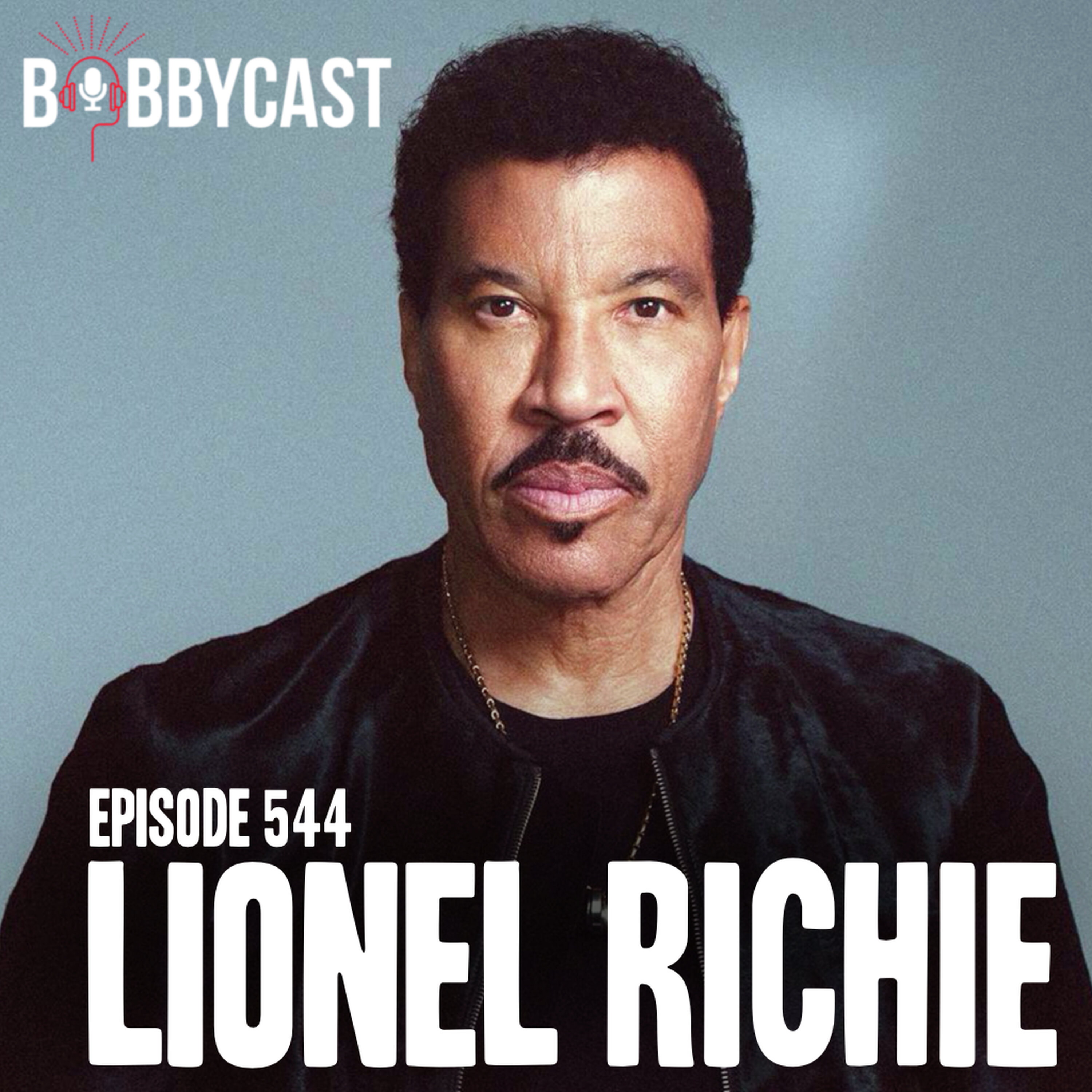
#544 - Lionel Richie on Writing “Hello” and “All Night Long” + What Michael Jackson Was Like + Meeting the Commodores and Not Wanting to Go Solo + What “We Are the World” Still Means to Him
On this episode of the BobbyCast, Bobby sits down with music icon, Lionel Richie at the State Theater in Austin, Texas to have a one-hour candid conversation about Lionel's new memoir titled 'Truly'. Lionel opens up like never before — taking us from his childhood in Tuskegee, Alabama, to the global stages that made him a household name. He shares how his grandmother’s wisdom shaped his outlook on life, the humor that helped him navigate the Jim Crow South, and the moment music truly became his purpose. Lionel looks back on the Commodores forming while in college, what it was like opening for the Jackson Five, and the stories behind timeless hits like “Hello,” “Lady,” and “All Night Long.” He also reflects on the magic of “We Are the World,” the sacrifices behind success, and why family still anchors everything he does.It’s a warm, inspiring conversation filled with laughter, lessons, and a few unforgettable stories from one of music’s most enduring legends.
Check out Lionel's memoir titled Truly HERE: He tells stories about his early life in Tuskegee, Alabama, being super shy as a kid, joining The Commodores, struggles, loss, faith and more.
Follow on Instagram: @TheBobbyCast
Follow on TikTok: @TheBobbyCast
Watch this Episode on Youtube
See omnystudio.com/listener for privacy information.
Available Results
Generated results are saved to the knowledge database for reuse and search.
Extract Knowledge
Pick what you want extracted first. Model, scope, and chapter options appear after a template is selected.
Transcript
00:00:06
Speaker 1: I found enough guts in my heart to bend over and kiss that girl on the front row. There was such a scream in this huge arena that the problem the Commodore has had from that point on was Lionel quit kissing the girls and sing the damn song.

00:00:25
Speaker 2: Wow. Welcome to episode five point forty four with Lionel Ritchie. We did this in a theater in Austin, Texas. Lionel started in the band the Commodores. He was a saxophone player. Originally didn't really want to sing or especially be the lead singer, so and then he ended up kind of becoming that, but still not fully. But that's where he started. He graduated from Tuskegee University. That's where he met the original Commodores, and we talked about in this you know, how he ended up going solo a little different than you know other stories of lead singers going solo. And this was all because he's doing a book. He's got a book out called Truly That It's really great. Hope you check it out. You can go to Linel Richie dot com slash book. He at one point headlined the Super Bowl halftime show nineteen eighty nine. I did not know that. He also performed at the nineteen eighty four Olympics closing ceremony, singing all night long to a crowd of two point six billion TV viewers worldwide. That's when everybody watched the same channel. Michael Jackson and Lionel Co wrote We Are the World. They did the whole documentary on it. He sold over one hundred and twenty five million records worldwide. He's won multiple Grammy's, Golden Globe and Oscar. This was a fun one and I encourage if you know you like this, you go watch the video because we shot the whole thing multi camera. It's over on the Bobby Cast YouTube page, which is at Bobby Bone's channel. We can see that over there. He's still a judge on American Idol. He's got a residency in Vegas and let's go now here. He is the great Lionel Richie. I'm very fortunate that we've known each other for a long time and you wrote all this about your life. What did you remember? Because you're having to dig deep, what did you remember? And go, oh my goodness, and it moved you emotionally.

00:02:14
Speaker 1: That's very nice, mister Bones. You started right with the straight to the gut. I thought the book was going to be all the fun things that happened to me along the way. We are going to talk about the Commodores, We're talking about Tuskegee. We're going to talk about the peak. We won this, we won that. And then they said, well, what was the most exciting thing that ever happened to you? I said, well, I was. I was in the Commodores, but before that, I was a cup scout, and I was a boy scout, got all my Merriat badges, and then I uh, and the guy said, this is a pitiful book. And then I met the Commodores in school, and I knew I was on the right road because my grandmother and my mother and my father came to me and said, who the hell are these guys? I said, you mean you don't like them? They said, well they you know, are they going to be doctors and lawyers? And I said, I don't think so them. And that's when I realized I was on the right road, because no one at Tuskegee could understand creative people.

00:03:46
Speaker 2: You understand that seemed to be a theme with your life though, because Tuskegee, the album when it came out. They also told you that was not going to work. And you talk about in the book how you would know when things were going to be successful by the pushback at times that it would get.

00:03:59
Speaker 1: When I knew I was on the right road, it was and I realized that no one could ever imagine me doing it, including me. And I'm going to give you a hint of what this story that you're reading or about to read really happened. How it happened. And that was the person I discovered after writing this book was me. I had no idea that I could do something like this in my life. I was the shyest guy in school, painfully shy. If you asked me to do a Easter speech, I had five people on the front road going, you could do it, you can do it, Come on. It was painful. And so it's a reluctant story about a kid who had absolutely no idea that this evening was going to happen, full of stories and ups and downs and the craziness. And if you said to me, how did you do it, the answer is, I don't know. Tell me about your mom and dad, my mom. Well, let's start with mom and dad. Were the co parents. The real power in the house was Grandma Foster. Now, if you know anything about your grandparents, they rule whatever your parents were thinking, and they can overrule whatever your parents are thinking. So Grandma Foster Am Foster, who was a I get this now. She was a classical pianist. She taught classical piano and in nineteen thirty something she decided she was going to make a career. In nineteen teen thirty or something, she was going to be a classical pianist when she grew up. Now, you think being a commodore and being famous around the world was ridiculous, being a concert pianist black in Nashville, Tennessee was almost virtually impossible. So that's my grandmother. My father was a systems analyst, was in the military when he first did the army, and he was a part of that wonderful squadron of Army and Air Force black guys called the Tuskegee Airman. My mom, I don't know how my dad talked my mom and to marry him. Why, because he was the funniest guy I'd ever met in my life. He was the only guy in the world that would take my mother's refine aka Miss Tuskegee. My mother was Miss Tuskegee. Can you imagine? All right? So she would take all of that and say yes to my father. And for the life of me, I kept thinking, what did he say to get my mother? And finally one day I asked her mom, what did he say? And her answer was he made me laugh. We are now at that point where my dad taught me something, and my mom was the verifier of that. Mom was by the book the rules, here's the etiquette, here's the proper way to say things, the proper way to do things. My dad taught me. He says, your mother's going to teach you how to speak. Well, your mother's going to teach you how to walk into a room and act like you got some sense. I'm going to teach you how to survive. And that's exactly what he did. Now, you would think that course would be a very long course. It was not a long course. My dad's line was very clear, if you don't have a sense of humor, they got you. And I realized at that point how he survived, and my mother survived, and my grandmother survived. There was nothing good about being black in the South Jim Crow with all the degrees you could possibly ever get and feel good about yourself. But for some weird reason, the Tuskygee Airman my dad's squadron, not in the Air Force, but in the army division of that my grandmother who wanted to be the classical pianist. They didn't let us know that that was the pressure. I heard laughter every day on that campus in my house, and I never knew that there was that much pressure on them. But they were under a lot of pressure. But they raised us with the possibility, just the possibility of hope, the possibility.

00:10:00
Speaker 2: You talk about how back then there wasn't a lot of diagnosis for ADD or ADHD and you were just different. Do you think that ended up being a.

00:10:10
Speaker 1: Superpower of yours?

00:10:11
Speaker 2: More so because it obviously in ways because it was it was kind of unexplainable at the time.

00:10:16
Speaker 1: You were just a different kid.

00:10:17
Speaker 2: But do you think that allowed you to get to places creatively that maybe you wouldn't have been able to get to?

00:10:22
Speaker 1: That was so nicely said. When I was growing up, I was labeled as strange. Why we didn't know what add was or ADHD or they just said, can you read can you write? And can you just sit still in your chair and not move? So they added one more to it, hyper sensitive. Now, if you know anything about being on a university campus, they have more doctors and more people to analyze your ass and I was the one they were trying to analyze. And the most important part about this was I started believing that there was something wrong with me, and so I went through life thinking, well, maybe I'm having a situation here where maybe I can't track things properly. So then I tried to read music and I know the notes, I'm looking right at the notes, but I'm going that that that's not working. And then I tried to read a passage from the thing and it goes and the man walked into the room. He went to the park lionel and I froze. But then I took a speed reading course and passed with honors. But they didn't give me credit for getting the comprehension of the page. They gave me credit for not They gave me the credit of not being able to say word for word. So I had a problem. The next thing was Bobby, this is first grade, second grade, fifth grade, high school, college, to the point where they would say, mister Richie, would you like to join the rest of the class, And the answer was I was not present. I was on the other side, somewhere in my imaginary place, creating something. I'm on an academic campus, get this, trying to create ate something when all I had to do was read the damn thing out the book and I can get a A. But I liked what I was doing on the other side.

00:13:10
Speaker 2: And that allowed you to do things to such a bigger level on the other side.

00:13:15
Speaker 1: I didn't know that at one point. I think it got you there, right, you know, and it got me there. But the story is so amazing because what I want people to read from this book is not that I made it, is how the hell did I make it? Because there were so many things stacked against against my conscious mind that I had to forget about what is the proper thing to do? And so everything was going well until I couldn't quite deal with it. I got to I got to my university. Now I'm going to Tuskegee University for college. But I met these guys. I met these wonderful guys, and you know what I liked about him? They didn't grow up with me, you know who the hell I was. They only asked one question. Did you bring your horn to school? I said, I sure did. He said, would you like to join a band? I said I sure would. I didn't tell him I could read or write music, and they didn't ask me. The second thing was, i can play the piano by ear, and i can play the saxophone by ear. But I've never been in a band before, and I've never been a lead singer. I didn't tell him any of that, but I wanted to be in this band. You got it, and I thought, as a backup, I might just be a priest. What see, y'all didn't believe it even and neither did I. But I thought most of the people that actually talked to me all day long were people of the clergy. I'm an episcopalia. I would love to God bless us. And by the way, we don't get that loud in church. So you understand, church was basically standard operating procedure of worshiping while being silent. There was no emoting whatsoever. Here is there a ta in emoting anyway? A strong one. So I am now faced with my backup is priesthood. And then I decided, Okay, I like these commodoes so much. We're going to go to the We're going to do clubs, We're going to hang out. I've never been in the club before in my life. I don't know what the club is right, and don't have a clue as to what this is going to be, but boy is it exciting. The greatest thing that ever happened in my educational world was some lady on the front row said say it, baby, say it baby, And I went back to Father Caution and Bishop Murray Vernon Jones looked across the desk and said, I don't think I'm going to be priest material. I have discovered something that I don't want to let go. I touched somebody. Now wait a minute, now you have to understand this is a guy that never I was invisible. Invisible, somebody screamed. And then from there we went on to stand in front of a stage and people were chasing me and talking to me. And I had one problem though we didn't have a record deal, and I'm in my junior year in college and the Jackson five out of the Cliblu Sky our manager at the time. We had a guy in New York City. Every year we go to New York, but every year we go to New York summer. And this time, not knowing that, Benny had a lady named a friend of his named Suzanne de Paz, who said, I've got a new job, Uncle Benny. I'm going to take this new group called the Jackson Five out on their first tour across America. I'm looking for a front act, an opening act. And Benny said, they're upstairs, under my table and on my sofa and in my refrigerator in my apartment. And we walked out on stage and we were the opening act. And I don't know what happened at that point, but the opening act for our first show was Madison Square Gardens. Madison Square Gardens, which means we missed the Childlen circuit and went straight to Madison Square Gardens.

00:18:33
Speaker 2: You talk about Michael Jackson, and he was a bit younger than you, but being surprised that and he said, we have sold this out.

00:18:42
Speaker 1: You got that. Yeah, okay, Michael was about that tall. But to this day I would have loved to have done a DNA test to find out just how old this kid was. This was a full grown man. And he was doing stuff that I it was just stupid. And we're backstage and he peeks around the curtain and I peek around the curtain. He says, Lionel, Lionel, we sold out Madison Square Guards And I said, you sold out Madisine's great guy, I'm hanging with you. But what did I learn backstage? What I learned was there was there was limos everywhere, but the Jackson's only had one. So I'm thinking to myself, Okay, let me figure out who these other people are. First limo was the trucking company, the people who owned the trucking companies. Second one was the lighting company, sound company, the publishers, the writers, the record presidents, mister Gordy. I realized at that point there's a business here. So je in case. By the way, I'm still the horn holder at this time. Because I had no idea I could write a song. I had two songs to sing in the show, and one of them was little Green Apples. There is nothing, no, no, no, there is nothing sexy about little green apples at Madison Square Gardens. So I went out on stage and we had to learn how to perform, and by midway of the tour. We killed it from that point on. From that point on, it became now clear to me this is where I wanted to be.

00:21:00
Speaker 3: Let's take a quick pause for a message from our sponsor, and we're back on the Bobby cast.

00:21:14
Speaker 2: On this tour, you guys had gotten so dynamic. You guys had had gotten so good. The newspapers were also complimenting you guys, and they'd.

00:21:24
Speaker 1: Be the jack to five. They were good.

00:21:25
Speaker 2: But holy crap, the commodores so much so that I feel like there was maybe resentment from Michael's dad.

00:21:33
Speaker 1: You read the book, boy, Are you doing all right? I like that? All right? So what happens is that every thing that went it on at that time, you have to understand it was all about protecting the Jacksons. We were just trying to make sure we killed every night and every time they schooled them on what you properly should do. We will listening. If you have a song that's going to be the highlight song of the night, play that first. Don't wait till the end because the crowd won't be there. Now we're playing top forty. We have no hit record, so we get to pick any record we want. Well, we hit them with sly Stone. We hit them with the Tempted, but we were killing it and they were little boys, and we didn't have any respect for them.

00:22:29
Speaker 4: That should good TMZ guard right right, okay, until they walked out on stage, and those little boys turned it into a machine that would scare you to death to this day.

00:22:43
Speaker 1: Don't let anybody fool you. They came out to slay everything. And at that point I realized, we are the luckiest guys in the world to be in front of this little school of preschoolers. And whatever I had to do to tolerate the abuse for a year, I will take it, because this is my ticket to somewhere. And finally we ended up in the Hollywood buld in Hollywood, California, and those little kids walked us right into Motown Records.

00:23:29
Speaker 2: One of the interesting things about your story of going solo wasn't you going I Am going to go solo. It was the awkward predicament of them saying to you and your band, you guys are now just going to follow Lionel, and it put you in a very weird.

00:23:44
Speaker 1: Place, ladies and gentlemen. I was perfectly happy being a member of the Commodores and had no thought in my life to leave this band. In fact, I wrote, I think somewhere in the book, thank God for the comic because without them, I would never have been Lionel Richie. That is a true story. These guys, It's not a band now. This is a group of brothers I never had before. A group of brothers that didn't grow up on a university campus. These brothers grew up in real life. Milon Williams Mississippi, Clyde the Drummer, and Tommy that's Florida. I'm not talking about the ritzy side of Florida. I'm talking about Florida, Okay. And so when I tell you William King, Birmingham, Alabama. They taught me more stuff that I had no idea what survival was until I heard their story. But more importantly, they taught me that I can be me. I heard terrifying words from these guys, Lionel, bend over on the stage and kiss that girl on the front row. And I said to them, in my grandmother, mother and father's training, I don't know the girl on the front row. And they said, fool, will you just bend over and kiss that damn girl on the front row, and so finally I found enough guts in my heart to bend over and kiss that girl on the front row. There was such a scream in this huge arena that the problem the Commodore has had from that point on was Lionel quit kissing the girls and sing the damn song. I had this discovered sexy, you understand, So everybody thinks for a moment, the Lionel broke out being the lover he was when he was growing up and decided he's gonna go solo. I did not want to go solo. I had the band, I had everything I needed. All I needed to do is just stay in the band. By this time, I discovered I could write. By this time, I didn't have to play the saxophone too long because I had to be able to sing more than I could play the sacks. This is good news. Now came the problem reviews. Everything was fine until Lady. Now they know me as the writer, and they don't know the rest of the guys, but they know Lionel Riches and the Commodores, and he wrote lady. So now you go back to the band to do interviews on behalf of the band, and here are the questions. So Lionel, tell us when you started the Commodoes, tell us how you did it? Well, I didn't start the book. I mean we started with the com Lionel, how does it feel being the front man? This is not good? And then finally the ultimate Madison Square Gardens, and then finally Lionel Richie set down to the piano and played his songs. Here's the line that stabbed everybody in the in the chest. What's the guy like Lionel Richie doing in the funk band like the Commodorees. Now try to go back to rehearsal after that, and that is not where you want to be. So from that point on, I felt this okay, And no matter what I tried to do, no matter how I tried to do it, no matter if I stay on the road longer. But also was coming at the same time was after three times a Lady, after Ceylon, after Oh got it, and then Lady came out, The checks were coming in. You know what keeps a band together The word equal. It was not equal, and so it became And I believe me, I'm telling you I knew what was happening. I just was in denial. But it was the hardest thing, and I knew eventually that something had to happen, and it did. I had to leave the Commodore's.

00:28:56
Speaker 2: I want to talk about songs specifically, and let's bounce around through some songs and lay. He is so interesting to me because I love Kenny Rodgers. Yep, that's It's like I got to know him a little bit before he passed away a few years. Loved him. And you know, he's known for that song that you wrote, but it really wasn't lady. You had it as like baby and you and he was just telling you a story and you're like, yep, it's a lady.

00:29:19
Speaker 1: No, everybody, you have to understand something. You want to be embarrassed and you want to get mad. Every guy in the Commodos would bring in ten songs for the album, and each one of us thought that their ten songs was the ten that should be on the album. So you do you don't need to finish the song totally, because all you had to do is play and here's the first song. Nope, all right, here's my second song to them. You know, so you don't write, you don't f crap, You just hit the head of it. Go to the verse, go to the hook. Then I get great. Kenny Rogers said, called me on the phone one day and said, I want one of those ballads. You got one? And I said, yeah, I got one, and he said I want you. How fast can you get me the song? I said, well, I got a problem. I'm on my way on tour. We are just finishing up the album. And now, of course I had a song called Baby for the Commodore's album and they said to me when I walked in, we don't want another love song. And I said, okay, that's pretty clear. So I decided to write a gospel song and I wrote, Jesus is Love? Now all right? I got Jesus Love. I am not going to be able to do this with Kenny because we're going on tour. I said, when I get back off a tour, ton Kenny, I'll call you. And we got it, no problem. Two weeks later, we're about to go on tour. The drummer Clyde why he bought a motorcycle, I'll never know his hope drummers and motorcycles. I'll never figure fell off of his motorcycle and now has to be off the road for a month and a half, maybe two months. Tours canceled and pushback. I called Kenny on the phone and said, you want that song, he says, I do. I said, I'm available, because that's Kenny Rogers. You returned his phone call, you see, And so he said, meet me in Vegas. I get to bake, I guess. And there he is in the dressing room, bigger than life, and he starts telling me this story. He says, you know, I just got married. I said, congratulations, I heard that. He says, you know I'm married a lady. I mean, I'm from Houston, Texas. And I don't know why on earth that. I mean, Maryanne is so refined. I have no business being with a lady. This lady is so amazing, linel she does things that I would have never has taste I've never seen. He went on this lady, this lady. He said, By the way, what's the name of the song you wrote for me? I said, lady, he ain't stupid. The brother ain't stupid, baby, lady, same damn thing. Right now, he's excited because it's right on the story. He wants to talk about it all right now, let me hear it.

00:33:10
Speaker 5: Wow.

00:33:11
Speaker 1: Now this is commodore pitching one oh one. Lady, I'm your nine and shining Ama, and I love you. You have made me when I am I am.

00:33:27
Speaker 5: Your should have should have charged more money.

00:33:43
Speaker 1: It's all right, it's all right. It was just that quiet. And Kenny said, what's next? And I said, you like it? He says, I think it's brilliant. What comes next? I said, what If you like it, I'll finish it. And that's the beginning of lady.

00:34:18
Speaker 2: The places that songs come from could be purposeful or could be rare.

00:34:22
Speaker 1: Can we take up a collection something that happened? That's all right. The more you sing, the more. Yeah. Yeah, if I got it? Hey hey hey hey hey hey hey hey hey.

00:34:33
Speaker 2: Nothing felt as random to me as hello. How that song came to be?

00:34:41
Speaker 1: There are things what I love most about writing. It's got to be simple. If it ain't simple, you won't remember it, and neither will I. And when you have a d D you need it simple. All right. Now. I was playing around with my co producer, James Anthony Carmichael, and he was late, and when he walked in, I said, hello, is it me you're looking for? We need more money man. We got to give my money anyway, He said, the damnedest thing I'd ever heard in life. Finished that song and I said, wait, wait, wait, wait wait, I said, James, that's the corniest line I've ever heard in my life. Hello, Is it me you're looking for? Can't be a song? He says, I'm telling you. Finish the song, brother Richie, you got something. And I went back and reluctantly I put some chords to it, wrote the damn song. He said, let's record it. I said, James, I'll be laughed out of the business with Hello, is it me you're looking for? He said, let's record it all right. We record the song, Lush, lush, lush strings. It was just it was just amazing. And then I loved it and he hated it. Why it's too heavy? It's too heavy. So I went off somewhere and wrote a song to kick ladies ass. Excuse me, Hello's ass, and wrote Truly. Now now wait now it gets it gets, it gets scared before it gets good. Now I'm sitting there and I have Truly, And we threw some more songs off the record. Do I throw off Hello and replace it with Truly? Or do I keep Hello and put it out. At the same time, we threw another song off because it was just too risque, call All Night Long. I ain't gonna sing that. It takes too long, but the point was to show you the insanity was I was trying. You know. My whole concept was, how do I get people's attention. You have to do something crazy. I ain't taking off my clothes, so I gotta shock you with something that you ain't ready for. And so I wrote this Calypso song and it's got the feeling and that thought. Okay, it was just too long and it was too much stuff, and it had too many layers. So we threw this off. I'm walking down this hall one day at the studio. This music is playing in the second thing. Oh my god, it's just kicking and the thing is happening. And I decided just to make sure I have that uptempo song covered. I wrote Running with the Knight to cover in case we don't need All Night Long. Okay, to make a long story short, Truly was the first single. Truly was also my first Grammy Hello. We threw off the album the very last minute. We put All Night Long on and Running with the night, and that was the national anthem of my life story. Hello, all night long, Running with the night, Get out of town.

00:38:57
Speaker 2: You mentioned a Grammy, and we look at you, Lionel, the guy that's had it all, has done it all, has never lost. However, that is a bit revisionist history, because you had a tough run at first, in.

00:39:10
Speaker 1: The midst of all of this, and he won and he's doing this and Lionel and everything and he's this, and Okay, the real life was things were falling apart. The real thing was. What they don't teach you about success, but they don't teach you about growth is outgrowing. They don't teach you that. They don't teach you that your close friends, your family, your wife, your kids, your community, they don't teach you that. You come home one day and nothing makes sense because didn't have that flash. Nobody did anything wrong it. You came home one day and Uncle Bill ain't famous and Uncle Bill is not funny anymore. And so Tuskegee, we got to get out of town. We got to go to LA because it's the studios right down the street and all the people I need to meet and know in the radio, television, movie business. They live out there. They don't live next door to me in Tuskegee. Now, when you commit yourself to that, hang on to your seat. When I first went to Los Angeles, California, I made a promise with my first wife, Brenda, we are not going to be like those idiots that I out here and they get married and divorced, and then they do another movie. They get married and divorced. Get that's some LA stuff. We are not going to do that. That's exactly what we did. I found out the secret to LA. They don't come after the artists. They come after your family. They honor your mother, they honor your father. Guess who's showing up singing lady. They honor your kids, They honor your friends. And on top of honoring your friends, your new friends in the community, they put a charity behind it and raise money on your friends. I'm not used to that. So the things that were happening was things were growing and things were falling apart. Things that I was trying to experience that I thought was amazing. I couldn't fully enjoy it because I'm losing stuff. Things are falling apart. And what you saw during the most amazing period of my life was I lost the Commodorees lost, I lost Tuskegee, I lost my friends, I lost things that made sense to me. And of course I knew something was wrong when I decided that I Brenda and I are going to break up. And I called Father Jones where you saw that acolyte picture of me as an altar boy? And I called Father Jones on the phone and I said, I think I think Brenda and I are going to get a divorce. I'd like some counseling from you. And Father Jones said, I can't help you. And I said, I've never heard of such a thing in my whole life. You're the minister. You supposed to be able to counsel me on this moment in my life. Why can't you counsel me? He said, because in the history of Saint Andrew's Church, no one in the congregation has ever had a divorce that was Tuskegee. Your mom and dad were your mom and dad forever. In fact, everybody else's mother in town was called Mama. Everybody else's dad in town was called Dad. The idea that mister Boone and missus Boone were not together that's unthinkable. I grew up like that in California. They leave every five minutes roll me. So I was a drift, and on top of that, not only a drift but completely. I never understood the word lonely, but more than that, lonely and confused, because you go back to Tuskege to tell folks about your problems, and the answer was, now how much money you make? Boy, you ain't supposed to have no problems. The answer is money, power and fame does not change you. It only magnifies you. So if you got a big problem, if you got a little problem, put money to that. And you got a big problem, you in pain. You confuse Add money to that. It ain't the same. And where's that village that raised me? There is no village in Hollywood, California. There's Westwood Village where you can go to c UCLA, but there is no village of people to help figure out your thing. And you read it in the book one of my dear friends, just to show you the casualness of it. Didn't mean any harm. God bless Quincy Jones. But I went to Quincy and I said, Quincy, I got her marriage problem. He said, line, how long? How many times have you been married? And I said, this is my first marriage all live. We got plenty more, plenty more. And that's when I realized you can fall in love. You can't afford to fall in love, not the second time, Ladies and gentlemen, The first time is the hardest. The second time you get a lawyer to cover in case that doesn't work out. Am I talking to you down here? I need an amen? I need amen, give her a kiss? I need no no, no no no no no no no no no. See y'all, what's your bobby? You mess him up? Now you're messing see. Let me just explain to you, when you're twenty three years old, you can bend over there to kiss. When you're ninety six, just a squad alone. But anyway, I'm saying to you, I had to get a lawyer. Now have you ever tried to tell the person you're marrying? I need to get a lawyer before we could do this. What made me paranoid of this thing called marriage? I got suspicious because I was in divorce court and I said, but God said, and the man said, let me remind you, mister Richie. God has no voice in my courtroom, I said, So, let me get this straight. It took one country preacher to get me in it and four Beverly Hills lawyers to get me out of it. Wait, half of my estate. I won't talk about that too much more. But Bobby, I got a listen. Here, I am being this love songwriter. Here I am people going Lilah's just the greatest lover of all times? How in the world could I be paranoid of love?

00:47:30
Speaker 6: The Bobby cast will be right back. This is the Bobby Cast.

00:47:45
Speaker 2: So I want to know because I love the documentary on Netflix. I thought it came together wonderfully. It made me feel good. I thought you guys produced it. Well, the song's amazing. We Are the World like it lives?

00:47:55
Speaker 1: It lives. What story didn't.

00:47:59
Speaker 2: Get it told in that documentary, like a good one that we didn't see that. You're like, oh man, that's a good one.

00:48:08
Speaker 1: Well, We Are the World had so many twists and turns and things that you don't understand. But I will tell you a backstory, and God bless them when I tell you this story. Now understand what I'm saying to you. We loved Algiero. Algio is one of the most talented singers in the world. And we touched on it just a little bit in the documentary, but we didn't go deep. So here's the answer. Al wanted to celebrate the song We Are the World before we recorded a damn thing. So Al started drinking about nine o'clock. By the time we got the one o'clock, Al was ready to celebrate. And so what you didn't know was it came down to his part in the show. And we got around and it's Dion Willie Nelson and and it comes into Al and Al now opens his mouth, and what we heard from Al is why why why? Why? I was mh, holy shit. Okay, oh no. So I look over at Quincy, and Quincy looks over at me, and Diall is about to kill him because she's got to harmonize with with Al. So Quincy said, let's take a break, let's figure this out. So I go over to coincident. He says, okay, what's the problem. I said, he's getting some alcohol from somewhere. We don't have any alcohol in the room. So I went out in the hall and there in the hallway, his wife did not bring a bottle. She brought the damn case and he was on the second bottle. Okay, so we went back when we did, we out the world and took every take we could find to get his part right. It's not in sync exactly, but we found one. It was the early part of Bottle one. But you will never hear that story except on Bobby Boone's podcast. But the truth of the matter was he was a sweetheart, a sweetheart and talented as hell. But the point was that particular night we didn't need any more surprises, and he was the biggest surprise of that evening.

00:51:13
Speaker 2: My final question, you wrote so much about your life and the book from the beginning up until basically now, I want to know what you enjoy now, what you love right now this version of Lionel Ritchie.

00:51:28
Speaker 1: I wasn't ready for that one. That's good. You know what, there's a there's a moment in time. There's a moment in time when you're so busy. Let me tell you about this business. When the light turns green, it's like a supermarket thing to give you a basket and how much can you put in that basket before the light turns red? So you've for sake anything you know of any kind of common sense, and you just work right, work right, work right, work right, as fast as you can before the red light comes on. The red light didn't come on. The songs stayed around. You can't guarantee that. Up until this book. There's a word that I've been constantly holding on to. It's called fear. Did I enjoy the ride? You better believe I enjoyed the ride? But what was my companion? Fear? It wasn't I got this. It was what am I going to do in case the thing turns red? Not reeling lizing it's been forty years since the light turned green. And so what this book did was it forced me to look over my shoulder behind me. I discovered Lionel Richie. I discovered that all the people that you are laughing at right now and waving at and expecting to sing all night long and we ain't gonna say all right out. But I mean, in other words, it's almost like the imposter syndrome. And what I want you all to understand, I didn't write this book to tell you about the success. I wrote this book to tell you about the fear and then not trusting myself and hopefully finding a way to make this work because somebody just may find out I can't play the saxophone. They just might find out I can't play from notes on the keyboard. I gotta make sure no, no, no. I was trying to keep everything in front looking real good, and then I started talking about this book. I made it, I actually made it, but even better than making it, I lived through it. I lost. I lost Luther Vandros, I lost Whitney, I lost Michael Rick James, I lost Sammy, I lost my men, just lost Quincy. I would have loved for them to be here with me to experience this crazy stuff, and then I could tell you all a lot more because they wouldn't suit my ass. But the truth is what comes with success a sacrifices. If I had known it was going to end up like this, I'd have spend more time with my family. If I knew it was going to be the end result like this, and then I realized they can't have both. What they give you is that moment in time when your mother's dying. Here's the dilemma. Do I cancel the World tour to go home to check on my mother? By the way, the World Tour was the all night long tour. Now do I cancel that tour or do I stay on the phone to see how mom's doing? And of course, thank god she lived through the entire tour. But the point was your first concern is I gotta go home. I didn't. And then you have friends that call you on the phone, Lionel, I need to talk to you. Is very important that we get on the phone and I go, I'll call you. I'll call you what Okay, I'll call you back. And then you get home and you decide I'm going to return the phone call. Seven months later and I said, let me speak to William, Lionel. William died about six months ago, I said, die. From what he said, well, he was trying to get in touch with you to tell you that he had cancer, and that's why he was calling. Okay, I'm here. I'm on stage, worried to death that I may not be able to How do I write a duet with Diana Ross when I've never written a do it? I was definitely under pressure, and I was so busy being under pressure. I let go of a lot of things that I wish I could have been there for. But it's either or it's never both. And so tonight, what I want you all to know about that book, it's not the success. It's the things I had to overcome to get there, the commitment, the doubt, the fear, the worry to get on this stage. And I want every kid and every person to understand, everyone to understand, we're all scared to death. As my dad say, what is the similarity between a hero and a coward? They were both scared to death? Is just one step forward and one step back in all of my fear, Thank you, In all of my fear, I just kept hearing my father. Are you scared of death? Yes? Step forward? Are you scared of death? Yes? Step forward? Are you in doubt? Yes? Step forward? Do you believe it? Kind of step forward? Do you know who you are? No, sir, step forward. In other words, step forward.

00:58:45
Speaker 3: Let's take a quick pause for a message from our sponsor, and we're back on the Bobby Cast.

00:59:00
Speaker 2: We've got three audience questions. These will be quick hitting questions. So tell the story of Stuck on You? This is from Barr, But can you tell the story of stuck on You? It's the one that goes stuck on you?

00:59:13
Speaker 1: Thank you, thank you, thank you, you know and by the way you all are laughing. I wrote stuck on You. There are moments on stage. Well, I'll start singing stuck on You, and for the life of me, I can't think of stuck on You. I can't think of it because it's that moment. Stuck on You was interesting. I wrote the song for Kenny Rodgers. I wrote Truly for Barbara Streisan, Truly. I wrote three Times a Lady for Frank Sinatra. All right, so you have to understand. James Carmichael found out that I had a stash, so after every group meeting he'd always go, Brad, MITCHI, now let's go back to your house and play the songs you wrote for somebody else. And I played him stuck on You, and the song is very clear. I like, you don't have to ask the question, what's the song about? I'm stuck on you. Now, I'll tell you something funny about while we're talking about stuff. There's no other story that goes along with that. But I didn't realize how special simplicity would be. I'm playing China. I'm playing China, and the Minister of Education came backstage to me and said, and I couldn't figure out I'm doing China Idol. And I walk out on stage and they know every word, the kids, they know every word. And get this. Now you're ready for a number three hundred and sixty one million people watching live. That's China Idol. And they are going to do a medley. Excuse me, I'm going to do a medley of all of my songs at the end. They gave me this award. And then I learned what they called me. I thought they called me Lionel Richie, Teacher, teacher, teacher, teacher, And I said, what the hell are they? I know a little Chinese, but what's teacher? And they said teacher teacher. Okay, why do they call me teacher because we teach English in China. On your songs, easy like Sunday Morning, stuck on you? Hello? Is it me you're looking for? All right?

01:02:11
Speaker 2: Two left Renee from Houston said, if you could sing one song, and only one of your songs the rest of your life, what would it be?

01:02:18
Speaker 1: Oh god, well no, no, no, no, no, no no no, Now what would you all think? What would it? Will? You?

01:02:26
Speaker 5: All?

01:02:26
Speaker 1: Right? God? You said? Zoom? Oh yeah, yeah, all right, so it would be easy like Sunday morning. Yeah for me. It said everything it said. I walked into a room one day. I wanted to be famous, and we're now famous. The Commodos are famous. And the beauty of this was it brought us a book with three hundred and sixty six pages in it, and from one to three sixty it told us where we were going to be for the next year, every day for that year, because we're going to play a world tour. And I remember writing down, why would anybody put chains on me? I paid my dues to make it. Everybody wants me to be what they want me to be. I'm not happy when I have to fake it or try to fake it. Leave me alone. And I said, that doesn't sound like a hit record. So I went back, took a break, and came back and said, I just want to be easy. I just want to take it easy. I'm easy. Easy, Like what it took me three days to figure out what you just said in five seconds. So what I want you to understand, don't let anybody fool you about this word called genius. It's called hard work and asking God in the universe as many times as you can think about it. God, I know you're busy, but you made me famous and they're looking for easy like what what is it? And in my midst of craziness, like Sunday Morning came out and that is everything I was feeling. And I'll tell you that you said another song, which is wait if you listen to Zoom. And I said this in the book. I may be just a foolish dreamer, but I don't care. Of course, I know my happiness is out there somewhere. I'm searching for that silver lining horizons that I've never seen. Oh, I'd like to take just a moment and dream my dream Zoom. And what has happened to me in this book and what has happened in my life is that God was listening and it happened to me.

01:05:21
Speaker 2: I think we end it right there, Ladies and gentlemen.

01:05:24
Speaker 6: Lionel Richie, Bobby Bones, thanks for listening to a Bobby Cast production.