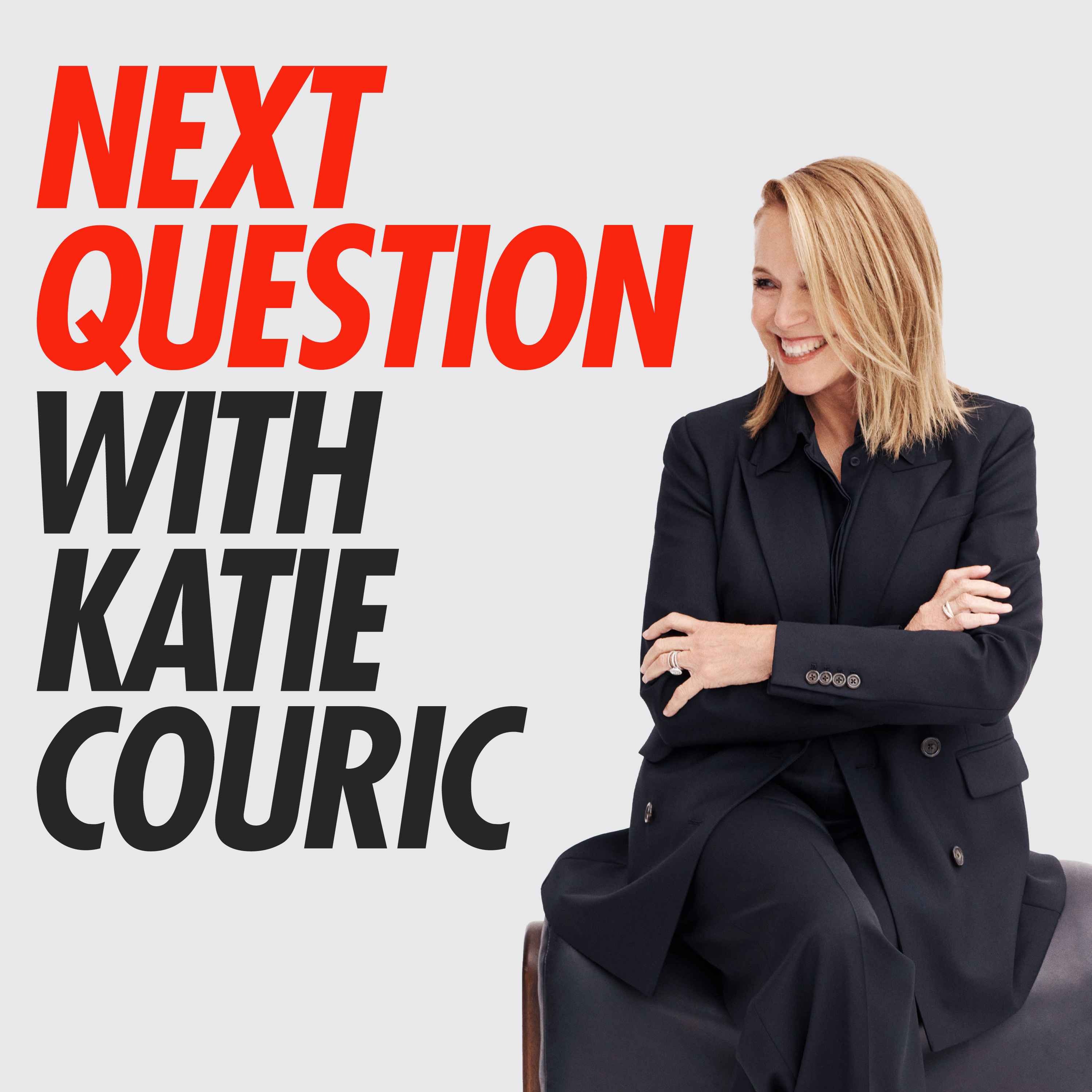
Katie’s memoir is out! Here’s a behind-the-scenes listen at the making of ‘Going There’
It’s finally here! To celebrate the release of Katie Couric’s memoir “Going There,” Next Question with Katie Couric is releasing the first of two very exciting, podcast exclusive, behind the book episodes! This week, part 1 of the making of “Going There.” Katie introduces you to her “Going There” team — Lucy Kaylin and Adriana Fazio — two incredibly thoughtful people so perfectly suited to this project, it’s almost weird. The three talk about how they all met, the writing and research process, holing up in Katie’s house during the pandemic and how some of the most personal (and controversial) moments of the book came to be.
You can buy “Going There,” by Katie Couric, on Amazon, your local bookstore or wherever you like to buy books. You can also find out where Katie is stopping on her book tour and how to get tickets by going to Ticketmaster.com/goingthere. Happy reading!
Learn more about your ad-choices at https://www.iheartpodcastnetwork.com
Hosted on Acast. See acast.com/privacy for more information.
Available Results
Generated results are saved to the knowledge database for reuse and search.
Extract Knowledge
Pick what you want extracted first. Model, scope, and chapter options appear after a template is selected.
Transcript
00:00:00
Speaker 1: Hi everyone, I'm Katie Curic and this is Next Question, and this is an incredibly exciting week for me. My memoir Going There is finally out. People can read what's actually in it. I can't believe it. And now that it's out, I wanted to pull back the curtain for my next question listeners and talk about how this project really came together. It was a big endeavor. It's been three years in the making, hundreds of files and memorabilia boxes to sort through, and thousands of pages written and refine, not to mention a hell of a lot of googling. Frankly, I needed some help doing all of this, and I got the best of it. Two incredibly thoughtful people I've grown to love, so perfectly suited to this project. It's almost weird. Not so long ago, the three of us settled into my living room and talked about how we all met, the writing process and how some of the juicier and more personal moments from the book came to be. So without further ado from roll, please, here's me and my Going their team, Lucy Kalin and Adriana Fassio. Enjoy Hello everyone, and welcome to my home. I feel like a PBS host or MPR host and I'm going to talk about sweaty balls pretty soon, but I won't because I'm here with two of my favorite people who you know are a little sensitive kidding. This is Lucy Kalin and Atrana Fasio. We are the Troyka behind going there, and so we thought it would be fun to give you guys a little behind the scenes sense of what it took to put together this five page blass memoir that hopefully that you all are reading and enjoying or getting ready to read. You can go to Amazon and any other place that can you go to AMA. You can Amazon or anywhere where you prefer to buy. Yes, exactly, support your local bookstore by the way, just f y I. Anyway, we're gonna basically introduce ourselves. I'm Katie Curic. You probably knew that by now. Lucy, why don't you introduce yourself and how you got involved. We'll first introduce yourself and then we'll talk about how you got involved in this project. I'm Lucy Calin. Give us a little more, um sure, I mean, I you know, I am thrilled to be here. This is one of the best things I've ever been engaged in. We'll get into that more, I'm sure. But UM, long time magazine person, writer, editor, most recently the editor in chief of Oprah Magazine and I'm currently VP of Print Content at Hurst, been at gCube and at Vogue and at Mary Claire. Um. Love words, love great stories, and that's what finds me here. And miss Fossio, would you like to introduce yourself? Yes, my name is Adriana Fossio. I'm twenty four and this is my first job, twenty four going on forty two. Um, Adriana is a an old soul. Why don't you talk, Adriana real quickly about how you and I met because it's such a funny story. So I went to Notre Dame and I was a double major in American Studies and film, and for one of my film classes, we had to write about the most impactful media experience we ever had, and I wrote about the Today Show and then it turned into a senior thesis about Katie, and through a friend of a friend, someone connected me to Katie and then I interviewed her from my thesis, which was called Katie Kerrik's Career and Shifting Perceptions of Femininity and broadcast journalism, and why don't you tell us a little bit about why you were so captivated when you were a young lass watching the Today That's a very good question. Um So in my thesis, I detail every single day with out fail the Today Show was on in my household, and I would have my little Catholic school jumper on and I would sit eating my ego buffles watching Katie on the Today Show. Good morning, and a little more than twenty four hours, the United States will witness its forty second peaceful transfer of power. Recently, I had the rare opportunities to sit down with Supreme Court Justice Sandra Day O'Connor. Earlier this morning, I spoke with Queen Ronne of Jordan's and asked her if she believed those potential problems had been underestimated. And I wanted to be Katie. I wanted to be host the Today Show. I wanted to go to broadcast journalism. And I realized at a very young age that that that was just what I wanted to do. You ended up, Adrian, I, just to finish the story of the thesis, you ended up getting in touch with me through that friend of a friend. You came over to my apartment. You interviewed me. You were so funny. She was nervous and you're or I didn't notice you were ready, and uh, but you asked me all these questions, and that's when I said, Hey, I'm thinking about writing a book. Maybe you'd like to help me research it, because you know more about me than I know about me, because she had done this exhausted research. So that's how you ended up sitting on my sofa, living with me through the pandemic and basically tying my shoes every morning. We called Atrian and my companion, which we think is funny as if I'm ninety five, where you know I'm getting there? And sometimes I'll say we're in there, and you're going there. I'll say where are we, Adriana, and she'll say, we're in East Hampton, Katie. Anyway, all right, so Lucy, let's talk about how we became thick as thieves. Um. We were put together to work on this book because I needed someone to help me shape it and make sense of this crazy life of mine. And one of the best things that has ever happened to me is someone said, why don't you work with Lucy Kalin and you had never really you'd written books yourself, but you had never really been in this kind of situation. Tell us about the books you wrote first. Sure, Um, I wrote a book about um American nuns, and I grew up without any religion at all. And I was very, very deeply curious about the women who still did this work because or responded to this call, because I knew that the numbers were declining rapidly, So I thought it was an interesting story for women, about women and subcultures and all the rest. And funnily enough, I got the opportunity to plug my book on the Today Show and you interviewed me, and um and Lucy, that was you were funny telling me about it, because you said you were super nervous, right, and you were so good You had never in a million years guess that you were nervous. Well, that's that's great. But I will say, Um, and this is you know, this is comletely true. I was. I was bowled over by your skill as an interviewer and as a person who for for whom you know, would benefits the show if obviously, if the interviewee is not a nervous wreck, and you were just so masterful at like just just calming me down and making sure we'd get the best we could for me. And and I remember that feeling, and it was you know, it was live and the whole thing television is terrifying, the biggest and the cameras everywhere, and you know, biggest show on television. And I just remember this feeling of like being in your hands and um, and just feeling so like comfortable and and relieved. And then you interviewed me years later on the occasion of Brad Pitt and Jennifer Aniston breaking up in a movie that he was doing, written a piece about it exactly for g Q, and UM, that was another wonderful opportunity to be in your strong and safe hands. Um. And But but back to what got me to the position and with perhaps doing work like this was as I anticipated whatever my next chapters would be. I it just sort of occurred to me that it might be sort of interesting to collaborate with people of an interesting story to tell, because it's a lot of what I did. Um, certainly through long stretch of my career at GQ Magazine, where I did a ton of the cover stories, a lot of profiles a lot of interviews, and there was always a sense in which, you know, my job was to find a story, like make a story out of something, and then of course write it well and all of that, but you know, lots of interviewing and lots of like finding the themes of people's lives and helping them connect the dots and have things make a certain kind of sense. So it's not just a sort of a road sort of Q and A about your life. UM. And I think I was talking to a friend at um, you know, at at your agency, wm E, and we were just kind of actually it was, and we were talking about, you know, what we might like to do someday when this chapter of our careers is, you know, winding down, and I kind of mentioned that in complete small talk fashion and UM. Strangely enough, then, of course, Susan Gluck, your agent, was talking to her colleague Jennifer and who were going to get for the Katie project? And I think Jennifer was like, you know, why not Lucy Kylen And Susanne said, well, that's ridiculous. Lucy's got a very busy day job. She's editor of Oprah magazine. She's like, I think you should you know, reach out And that's how it That's how it began. And I think there are a lot of reasons why Lucy was such a perfect partner for me in this endeavor. And Lucy, one of the reasons, I think is I'm a little older than you are, but not too much older, and uh, and you and I both came of age in media really about the same time. And I also think we have weirdly similar love affairs with our father will not really love affairs, but you know, it wasn't an in sutuous situation. Don't worry every one, but we really deeply admired our fathers and and they were really kind of behind us in terms are of our professional um accomplishments. Yeah, they I mean they were both um lovers of words and lovers of news and story and all that stuff, and they were crazy about their little girls. Were both younger as I'm a younger, you're a young guest, And we spent a lot of time with those guys, and they had a lot of um interest in what we would do and become, and we both badly wanted to make them proud. But another thing that I would say about, you know, to your point about when women like like us were coming along in male dominated fields in the eighties. Um, you know, it's just unbelievably vivid to me. When I was fairly junior at g Q magazine and I had a tiny little studio and I would, um, you know, couldn't There was no such thing as an espress, so I couldn't afford a coffee press, whatever those things were called. And I would have a cup of Sanka in the morning. You are really dating and instant coffee. Yeah, instant coffee. I had a Bhuton on Nineteenth Street, and I had a TV with rab of ears and every weekday morning, of course, it was tuned to the Today Show. And I'd already been noticing you as Pentagon correspondent, and you know, you were kind of getting you were you were appearing more on the show. Good morning, Welcome to Today on this Monday morning, and this Monday the first of several days, so we're gonna be welcoming. Katie kirk Our National corresponded, good to be here. Busy day, busy week, busy month. It's a busy one, right. I did not, as a rule, relate to the women who typically were in that sort of like sidekick to the alpha male role on those shows. I just wasn't and I I spied you, as millions of young women did, and I'm like, well, well that interests me. And I'll never forget that Sanco Morning where when you were like on the couch because you were truly like filling in as co anchor and they were. Of course you learn in the book that you know it's it's just a wonderful rise to the top. But that was such a big moment from NBC News. This is Today with Brian Gumbel, Katherine and Joel Garagiola. Good morning, and welcome to Today on a Friday morning, into a new chapter of Today. How did its own? Sounded good? And I still can't decide whether I'm Katherine or Katie. Alex Ree Rackett for us one more time, Alex Catherine, thank you very much. In case you haven't gotten the message. Katie is now a permanent fixture up here, a member of our family. And I was like, good on NBC, they're doing it. They're making the right move with that one that I like. And it's just incredibly important to me and personally professionally, you know, and to so many women of you know, our vintage just couldn't be more formative. Such a huge thing to to have you model for us what it could be. What's interesting because I was probably more relatable than most of the people who had been in that role. I had, you know, this short kind of you know, Dorothy Hamiley, dark haircut, which I don't understand how my hair turned blonde as I got older, but you know, and I think that I was I was just cut from a different cloth. And and I remember when I got that job, I thought about looking at tapes of Jane Paully, and then I realized to myself, just instinctively, I think, to be successful in this job, you can't put on airs. You have to be yourself. You have to be authentic. And this was before the word authentic kind of had had crept into the lexicon. And so as a result, I think, you know, people like you who were, you know, stumbling out of bed and drinking your sanka, like Adriana who was eating her corn checks so oh her eggo waffles. Um, you know, I think there it made for a very sort of almost intangible connection with viewers. And and it was also I mean just definitely your your look was relatable for a lot of us, which was great. It didn't have to be that Barbie thing, which was very alienating for a lot of us women, We women who wanted to be taken seriously in these male dominated offices. Um. But the other thing was you lead with your personality, and you lead with your intelligence and your emotional intelligence and your wit and all of that stuff. And that felt new, you know, because a lot of times it seemed to me the women that were relegated to the Barbie roll weren't really supposed to do that right, and they were also quite um subservient to their male counterparts. And you know, one of the things we talked about when I got that job, which was pretty ballsy for thirty four year old woman, was I insisted on an equal partnership with Bryant Gumbel because I thought it was so important, you know. I realized, I think, from from my own childhood and how my perspectives were shaped by good housekeeping and ladies own journals and these magazines that I'd go to my next door neighbor, Mrs Geidals, and I'd read them in her sunroom because she got them all really weird right that I did that, but um, you know how much popular culture and the images you're surrounded by. I was very cognizant that they really shaped your view of the world and your role in it. And I thought there were very subtle, almost nuanced things that people could watch on a show like that and pick up on that would make them appreciate the fact that women were as capable as men and that they should have equal opportunities as men. And I wondered if you picked up on that at all. Adrian is a little girl watching it, because honestly, when I asked for that, I asked for it for little girls like Adrian at at the time. First of all, time wise, Lucy and I are two generations of Katie fans, and she remembers when you had your first day on the sofa, and I remember crying, being nine years old, standing in my kitchen when you said you were going to leave the show. I wanted to tell all of you out there who have watched the show for the past fifteen years that after listening to my heart and my gut, two things that have served me pretty well in the past, I've decided I'll be leaving today. At the end of May. It was really a very difficult decision. But also I feel like Lucy's experience being your contemporary is being like, wait a second, we don't have to be this way, And my experience of you being my role model is assuming it always was that way, and so reliving this with both of you makes me so grateful that you did do it that way so that I don't have to do it the old way. So I don't know if I realized it at the time, but I wonder if your mom did, because it sounds like she was very keyed in on on making sure that you reached your potential and that you satisfy kind of this intellectual curiosity you exhibited at a very early age. It's fun. My mom is very independent, very headstrong, very lots of things. I adore her, But she is the same age as you two, and she had a very different experience. She never really had a career. She worked until she had kids, and then she became a stay at home mom, and then she um I went back to school and became a teacher, which is great, and she's great at what she does. But it's just to generate. There is a generational divide among your generation. And I think, I know, if she could do it again, she would have had the career that I am having at twenty four. And I'm sure, whether subconsciously or intentionally, she made sure that I was exposed to things that made me realize that the sky is the limit. And you made me realize that. It's interesting that, of course your daughters are really sort of the same age as my daughter, just a couple of years older, and the same age as Adriana. And I know that it's very alive in us, um seeing this generation of women who are like, no freaking joke, They're so talented and small art and ambitious and just capable, and and I feel not sort of struggling with some of the things we simply had to because of, you know, the time that it was. It's it does feel like a victory, you know, it feels like such a victory to see you guys being you. It's like, yeah, some things do change for the better. We'll be right back with more behind the scenes moments from my memoir that's right after this. One of the reasons why I really enjoyed writing this book. And I think from the get go, we wanted to use the backdrop of history and the backdrop of really four decades, primarily for for my story to illustrate some of the huge societal changes that have taken place during the last four decades. And I think sometimes we forget, Lucy that our generation was really the first to be full throttle into the workforce. My mom never worked, and I talked about that pretty poignantly, I think um in the part of her book after she she dies. But you know, I think we I think it was like almost fifty fifty. And I don't know statistically if that's absolutely correct, but a lot of women are generation or some were choosing to get married and raised their families and drop out of the workforce if they entered it at all. And then there were people like us who didn't watch us a job. As we talk about in the book, we wanted careers. And I think one of the things that motivated me is I really wanted to be financially independent. I did not. I could not tolerate the feeling of relying on someone else. And maybe that's because of my fear, our rejection to can I lie down I'm kidding, but you know, because I didn't want to be married, have have a man be the primary breadwinner, and have him like dump me for a younger model and be left out in the cole thinking, holy ship, what am I going to do? I have these kids and you know, and um, so it was really important to me, plus with the encouragement of both my mom and dad to get out there and work. But I just think it's so interesting because I think we forget how we were kind of the first wave of career women. Of course, there were people before us, and you hear about, you know, Lyddy Dole and Ruth Vader Ginsburg and people from my mom's generation. And as we talk about my friend Christine Hughes's mom who was a doctor, but all my friends, I think almost you know, all of them had stay at home moms, that's right. And by the time we were doing our thing. I think the thing that that you know, we obviously talked about it in the in the book, is you know, we were like, you know, soldiers in the Mommy Wars, right and Mommy Wars. I don't even think you hear that term so much anymore. Yeah, I think you don't. I mean, it was there, really was. I think we remember it vividly that sense of you know, there were at least two camps, and there was definitely that sense in which the choices that you made might be some sort of indictment or perceived as an indictment of the choice of somebody else made. And you know, it was so vivid to me when I was you know, I had my first kid at and my second in two thousand and I remember so vividly going to you know, the preschool, and you know, I'm in my like my hard shoes and my jacket and mothers and by that because I'm going to go at drop off, I'm going to go to the office. And then there were those women who had a yoga mat, you know, in the back of their in their thing and you know, not the briefcase or what have you. And it was all very symbolic. It's like the ways that we were, you know, doing our lives, where it was even just the optics of it were sort of dramatic and and you wrestled with it. And I totally didn't get to do the cupcake thing a lot of times, and I didn't get to do the pick important because you were on assignment in a in another state. I mean I remember when you know, my son Owen, you know, taking him to school and you know you're supposed to wear something that you know brings something that was your assigned letter of the day. He was a little kid, and he it was G Day for him, and I'm like, you know, shit, I mean like I completely forgot to get him a thing for G Day. And then I saw that he was wearing a gap shirt and I'm like, honey, you've got a gaptured on. There's your G for G Day. I mean it was like that. It was very catch as catch can, and you know, we just did the best we could. And I was always missing the memo on those those kinds of fun, sweet little things. But I also was defiant as you certainly were um about, you know, I'm going to have a career, I'm gonna do this thing. And we were you know, I mean, we're talking about a group of women and a certain socioeconomic level who were really privileged enough to be able to make that choice, you know, which is something that I'm always mindful of as well. You know that when it came to the mommy Wars and any kind of you know, criticism of working mothers. You know, there were a lot of women who didn't have the choice. I do think it's really interesting in the book how incredibly intentional you were about, you know, your career, but also I'm gonna be married, I'm gonna have kids. You know that. You really like that Cassie mac in moment like, I am totally going to do this. It's not going to be easy, but you know, very very intentional about the kind of life you wanted to live in the nineties. I just read an article this morning that said single, unmarried women are the happiest, which I thought was interesting. It's me, you're twenty so, but yes, I mean, I think while I was hyper focused on my career, Um, Cassie mack and who you mentioned, who was the Capitol health correspondent for ABC News when I was a desk assistant who had come from the Baltimore Sun. This you know, beautiful tall, you know, statuesque blonde who almost glided into the newsroom. I think we described her that way. Um died of cancer in her early forties, and I remember her unmarried, yeah, unmarried, and all her Paul bears, while they were really impressive, I think Teddy Kennedy was one of them. Ralph Tessam I remember as a cameraman went on a date with him, got a lobster and didn't kiss some good night, and he was pissed. But that's another story. Um. But but I remember seeing that and thinking, you know, I don't want to just be focused on my career. I want to have a family, I want to be married, I want to have children. Um, And so I did kind of want it all. Yeah, you became like a very prominent sort of emblem of all that, and we all followed along very carefully. More from the three of us right after this, Well, let's let's talk a little bit about the process of writing this book, because I think people might be interested on how we work together and kind of how we were able to take sixty four years and condense them into a single book. Um. You know, it's funny because when we first started writing, uh, the book was way way, way way over and in length, in length and in deadlines. Yes, And I remember John saying, who do you think you are? Winston? Sure, chill, what do you want like several volumes? And I was like, yeah, what's wrong with that? But we realized maybe maybe no one else was interested in me as much as I was, so we had to cut down a lot of the book. But um, you know, do you want to kind of just help people understand because I think they might see the three of us and think, well, wait, how did this work? And I would say that we really had very few rough patches, if any. I think it just took us a little bit of time to um. I think it's actually just an incredible story that we all like and care about each other as much as we do. I would even go so far to say love, but I think it did. There was a bit of an adjustment period, but not much. Can you talk about that, Lucy and kind of what you experienced, because we haven't really even talked about that. Sure, Well, I mean I was very you know, I didn't exactly know what I was getting myself into, but because it was Katie, because it was you and your story, I was I was all in, like, whatever this is, I'm doing it because I want to help tell this story. It matters that much to me. So, you know, again, kind of calling on the work I've done um throughout other parts of my career, certainly at g Q, but also the books that I wrote. We did do some interviewing and we you know, you talked into a tape recorder, which was useful to me. I had some transcript to kind of play with when we sort of zeroed in on a section. But also, of course there's a lot of great material that I could find myself. I could look up a lot of your interviews, and I could, you know, look up a lot of articles about stuff that was going on, so like I I could kind of piece together some stuff that was an attempt at, you know, telling the story of a certain chapter of your life. And then we started a process of like kicking things back and forth, which was really great. And then there were times when you know, you would do some stuff out of whole cloth, just like, take a look at this. I don't know if it's good, but this is what was happening when I was making this documentary and this crazy thing happened. And then I would and then I would help you bang it into shape, and I would try something out of whole cloth and give it to you, and then that kind of and then I would sort of play with it and say no, or you know, it doesn't sound like sometimes yeah, exactly, or it didn't really as you said, happened that way or you know, and and and a lot of times, you know, I really wanted to make sure this was my voice and from my perspective, and I think where Lucy was most helpful was kind of putting giving a sort of a more macro cosmic perspective of kind of what was going on in the culture. And you know, we wrote extensively about Anita Hill, and we ended up not being able to use it and what it was like with my first experience really covering sexual harassment, you know, and interestingly enough, how I mean, we do talk about it in short form, but we had something really long about it and and what that was like. And I think because we are contemporaries and you remembered those hearing so well, we could kind of share what impact that was having on society and how Anita Hill represented something that women knew and understood but really hadn't put a name to it exactly. You know, it's started crazy when you think sexual harassment. Even though I experienced it and you experienced it early in our career, that was the first time that someone had really put a name and a face and actions to the term. I think another thing that was really interesting for us is, um, you know, there were times when you you would say, like, oh, go look at this interview. We should probably do something on this, you know. Of course, I you know, did these interviews with the you know, Reginald Denny from the horrific Rodney King Aftermath and you know, um, you know, Matt Matthew Shepard and things like that, and these really important interviews that you did, and I would look at them and realize, you know, that a lot of time had gone by, and for instance, there was a way that you know, discovering that your child was gay was talked about back then that would never be talked about, you know now. And the same thing with Reginald Denny, who, of course terrible things happened to him as he was, you know, beaten at the intersection of Florence and Normandy. But it was a very like, very much about the white victim and all of the stuff that would get surfaced in the Black Lives Matter summer Black Lives Matter. It was just like nobody even thought about even know how to talk about it. And you so interestingly when I kind of prodded you to take a look let's take another look at these interviews that you did, and you were like, wow, I would never say that. I would never you know, your heart was all in it and you did a beautiful job on them. But it was a different time and that became part of the book. So I think it would be very awesome to talk about where we were at when we realized we needed help with this book. We were writing away, we were having a great time. We were passing stuff back and forth, we were interviewing also had had had given the proposal. We were kind of rolling along, um, but you know, it was it became clear that this was going to be a massive undertaking and it was going to be you know, hundreds upon hundreds of pages, and it was gonna be a lot of research. Is it's gonna be a lot of everything. And let's just say, neither you nor I are like super super genius with tech. We're not super te not not super techy. So like a vision in the night, like an angel coming down from the sky, Adriana comes into our lives, and what was the it was really, I mean, we had we had been working on the book for how long, Probably no need to work on the proposal, which took me month. I know exactly when it was, about a month before I interviewed Katie because I have since found an emails Katie emailing Lucy saying, Lucy, this young woman just came to my apartment and interviewed me. I'm going to ask her to help. I think she could go to her Yeah, so so what what did you find? So? Um? It's June nineteen. I had just graduated from college, just moved to New York, and well, first of all, I was really nervous to meet Lucy because I really liked Katie and Katie and I seemed to get along from like the hour and a half I had spent with her. But I thought, oh god, Lucy could be and I could have no part in this and be cast to the shadows. But no, Lucy is amazing and could not be more inclusive and not only willing but eager to hear my perspective and my take on things, which I very very much appreciated as a twenty two year old. The time, She's crazy, isn't it. But I mean, I think, honestly, um, and I think Lucy, you would agree with this. It was super helpful as I alluded to earlier, to have someone of Adriana's generation, uh, kind of wane in on some of the things that we were discussing, you know, these big serious media issues. And you know, more than once Adriana would say we'll wait a second, um or hey, uh, you know you all sound like your ancient You wouldn't say that, but but you know you would, you would pipe in. And Adriana is extremely um. You know, I appreciated how vocal she was. You know, I think a lot of people would be intimidated honestly working with two old broads like us and uh. And I think Adriana her her willingness to speak up and give her opinion and kind of say, I don't know if you want to frame it this way, was was super helpful. Not only uh sort of on on on in a bigger way, but also just Adriana did so much research and we'd have to find articles or I'd say, gosh, I know someone wrote about my Bob Dole interview when he got mad at me, and we couldn't even include that in the book, by the way. Um, and uh, you know, finding so many old pieces and all I have to say is thank God for the Internet. I mean, I curse it on a daily basis when I read a mean tweet. But everything was so available to us, and we have to kind of give a shout out to the archivist, especially at NBC, who were unbelievably helpful. ABC in my Homeboy. Yeah also ABC was CBS not quite as much, but you can say that, yeah so, but but it was an incredibly time consuming and thank God that, you know, we were able to find stuff online and then they were able to dig through their libraries and send us stuff, even CNN and and and the local stations, which were hilarious. One of our favorite pieces that I did back in the day was when I was at w t v J and I did it a story about homeless people in in the Miami area, and um, it was in the era of reporter involvement journalism, and I dressed up like a homeless woman and it's it's absolutely it's the opposite of woke. Yeah, it is so mortifying and so horrendously bad that, um, I'm just going to let people read the book and god forbid google the story. Well the well, the other really important part of how we put this thing together is Katie is a pack rat and she has basically her own archive of sorts in her basements of this house, and she saved everything which thank god, she did, speeches, articles, magazines, huge research notebooks full of stuff like if I was going to Cuba, or if I was doing a piece on remember teens and sex that I did with my friends Sophia Fescionis, who was a great producer at NBC. Um. You know, I still have these huge notebooks or from election letter file cars and letters and speeches, um, which proved invaluable. And you know the letters that there. I treasured them. Not only do I have letters from really famous people congratulating me when I got different jobs, but also letters from people who wrote to the girls when Jay died. So these letters that I have, uh, you know, I've always said if I if this house caught on fire, those would be the first thing I would grab if I could find them, because who knows where they are? Because I'm a I'm a hot mess that tornado is. John would say, um, but but I think that's true. Like just having those even I saved the worst tabloid stories about me. I remember when you and I started and the banker's boxes would be everywhere, and I'm like, oh, I don't realize this is gonna be part of the job. And I'm like going through these like just just so much paper, so many stories in the basement here in your house with the scrap books and always and I'm like, scrap. I'm like, this is not going to get done. Like I don't know what's going to happen here, because we gotta pile up some pages. We've gonna do some writing and among many, many many things. When Adriana came into our lives and started making sense of all of that and started finding everything, and it was, you know, just a godsend And I think it was just the you know, you wish I wish for anybody watching this um when when you're doing a project you can just have a team like this, where not only did we have our respective you know, gifts and strengths and weaknesses and all of that stuff, but we had so much fun and you know, we were just supporting each other all the time. And you know, you really, as we always say, the third leg of our stool. It was amazing when you came along, and so much fun to be with. I think we all really enjoyed each other's company, which is I mean, just amazing, because we spent a lot of time together around a dining room table here and in the city, and um, you know, it was a very intense experience. But the fact that you know, we we not only survived, but we thrived and and really enjoyed each other, I think is actually a miracle. And I want to give props to my parents because my mom and dad kept these scrap books during the course of my career. Interestingly, sort of kept stop keeping them when I went to CBS because I think maybe the articles were all too mean to say, but you know, we always made fun of my mom and dad. It was so so sweet and so tender that they would cut out these articles and put them in a scrap book for me. And I think by the time you know, I've done at the Today Show, I had four or five scrap books. We started calling them, we started calling them, we started calling them son of scrap Book and son of scrap book too. And so, I mean, I'm so grateful to my parents, and in many ways, this this book is a love letter to my mom and dad and to my family. Next week, on next Question More with Lucy and Adriana and behind the scenes moments from the making of my new memoir Going There. We get into the hard stuff like processing the downfall of Matt Lower, what the hell was going on, and the death of my husband Jay. It was so close to the bone and to my very being not to mention writing all this during a pandemic. We were going to come out for a weekend to quote unquote ride this thing out. Also, my husband John Muhlner makes a surprise appearance. That's all happening next Thursday on Next Question. And I'm embarking on a nine city book tour. I'm super excited. I have an incredible roster of guests, So please come in. Let's get together. Yeah yeah, yeah, Let's be in community, feel inspired, hopefully and connect. It's been a while, hasn't it. All you have to do is go to ticketmaster dot com slash Going There. Next Question with Katie Kurik is a production of My Heart Media and Katie Kurik Media. The executive producers Army, Katie Couric, and Courtney Litz. The supervising producer is Lauren Hansen. Associate producers Dary Clements Adriana Fasio and Emily Pinto. The show is edited and mixed by Derrick Clements. For more information about today's episode, or to sign up for my morning newsletter, wake Up Call, go to Katie currect dot com. You can also find me at Katie Currect on Instagram and all my social media channels. For more podcasts from I Heart Radio, visit the I Heart Radio app, Apple Podcast, or wherever you listen to your favorite shows,