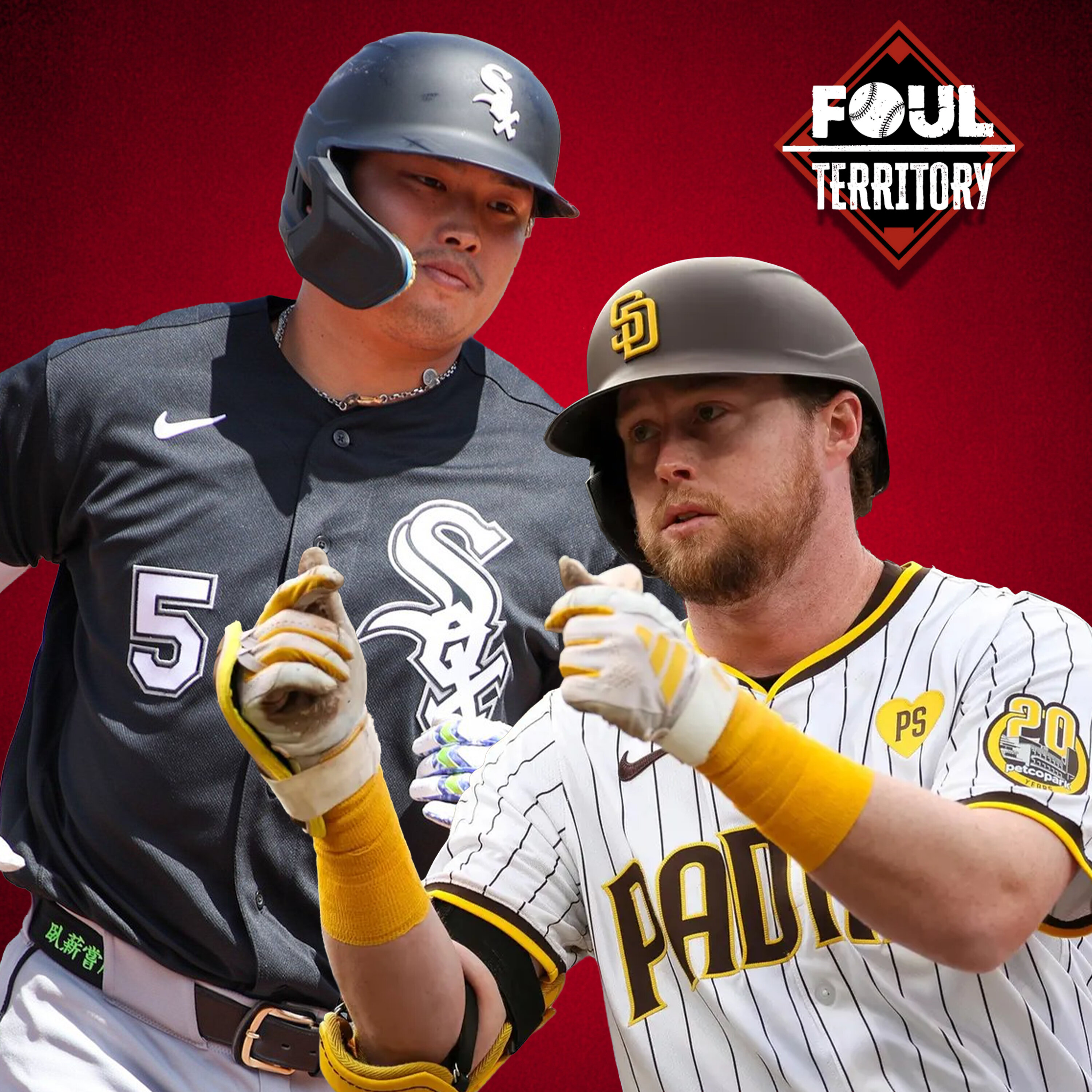
Bob Nightengale’s Murakami report + Magic Johnson’s profitable tweet, Royals new ballpark announcement, Two-strike approach debate
FT Insider Bob Nightengale elaborates on his Munetaka Murakami and if his massive start will lead to a sweet payday down the line. Plus, Bob weighs in on the teams off to slow starts and whether any of them need to make a move asap.
(8:56) The Royals have secured a $2 billion private investment to build a new ballpark in downtown Kansas City.
(16:44) The franchise value for the Dodgers has grown A LOT since 2012. Magic Johnson chimed in.
Get up to $200 off Square hardware when you sign up at square.com/go/FOUL #squarepod
(19:39) Jake Cronenworth was on Friar Territory and reacted to Joe Musgrove saying Jake can be a manager one day.
(22:28) Scott and Kip react to Mike Petriello discussing a two-strike approach.
Hosts: Kipnis, Braun, Kratz
Use our code for 10% off your next SeatGeek order* seatgeek.onelink.me/RrnK/TERRITORY10 Sponsored by SeatGeek. *Restrictions apply. Max $20 discount
See omnystudio.com/listener for privacy information.
Available Results
Generated results are saved to the knowledge database for reuse and search.
Extract Knowledge
Pick what you want extracted first. Model, scope, and chapter options appear after a template is selected.
Transcript
00:00:09
Speaker 1: Bob.

00:00:09
Speaker 2: Moving on to some other topics. You wrote about Murakami this week in a column.

00:00:14
Speaker 3: Tell us what you.

00:00:14
Speaker 2: Wrote about and how much it looks like the rest of the league miscalculated for now.

00:00:20
Speaker 3: I know things can change, the league can adjust, but for now, he is hitting a lot of home runs.

00:00:26
Speaker 4: Yeah, I mean he's hit home runs and four straight games now, four homers last six games.

00:00:32
Speaker 5: It's it's he's on fire, and he's been taking a lot of walks.

00:00:36
Speaker 4: He's still striking out. It just like everybody in Vision. But for just two years at thirty four million dollars, who couldn't use this guy? You know, like he says, guy, it's early, but you know his numbers, you know, very summer till guy like Kyles forbar Uh, he's, you.

00:00:50
Speaker 5: Know, everything the White Sox couldn't imagine.

00:00:53
Speaker 4: And talking to those young White Sox players, he's kind of rubbing off on him and just the diligence, his preparation.

00:01:00
Speaker 5: They're watching everything he's doing.

00:01:02
Speaker 4: So if he can hit you know, over forty home runs, even if he hits you know, two ten gets on base, you know thirty seven, you know, forty percent of the time it's going to be a steal. Uh, you know, he should be easily to you know, price have it mentioned. I would think at some point too, the WEISC will start selling some tickets and the ATTENSI will go up just to watch this guy if he's in the home run race all year.

00:01:27
Speaker 6: Is there is there a feeling around the league through this first month watching him hit that hey, we were right, but he's just hitting homers right now because the league was saying he can't hit, he can't hit velocity over ninety five miles an hour. Will he hit a homer to center over the batter's eye on a pitch that was ninety eight point one, so he kind of dispelled that. But his other homers are all below ninety four miles per hour or off speed pitches.

00:01:55
Speaker 1: No.

00:01:55
Speaker 4: I mean, I think teams are kicking themselves right now, saying wouldn't have meant now we could have had this guy, but that for that cheap only a two year deal. Uh, that's a that's a steal. So I think they're saying, no, what he's making the adjustment pretty quickly. Uh, you know, we'll see what he does with the high velocity. But he's you know, they thought that he'd have trouble against a tough breaking pitches too. And I don't think you ever imagine that he would, you know, had this many walks, particularly early.

00:02:19
Speaker 5: The guy can run a little bit too.

00:02:21
Speaker 1: Uh.

00:02:22
Speaker 4: You know, well, Venable, their manager was just seeing saying yesterday like, uh, he wants to steal some bases, and they're kind of calling him down the bases like you hold off here, but you know, beat out an infield hit last night. He's showing some speed too, and uh, he's really adjusted well in that clubhouse. You know, guys, guys love hanging out with him already.

00:02:42
Speaker 7: I mean, if you're saying guys love hanging out with him and he's proving to be a big bat, how long do you think the White Sox wait before maybe extending him or adding a couple of years onto this contract, or at least starting those negotiations.

00:02:53
Speaker 4: I think they wait to least till next year early, at least in the winter, see how it goes. But if you Murakami said, okay, you know, how can I get I'm sure he was disappointed in the amount of money he got. A Remember at the beginning when he hit free agency, people are talking about over one hundred million dollars, and I think there is stune to see that. Nobody in the industry thought he'd be that superstar player. So he has the year everybody imagines or envision. Then I think you will see some contract talks in the off season saying, okay, what will end to keep you here? But also in the flip end, he may be saying, you know what, there'd be a whole lot of teams are gonna be bidding for me in two years from now.

00:03:31
Speaker 7: That's why I was just gonna you kind of just cut to my point right there. If he becomes an unrestricted free agent in twenty eight after the two year deal for someone who feels like they were slighted during the free agency process, do you think he'll even consider the negotiations from the White Sox or he's got his eyes already on that free agency again if it stays this way that he's proven himself to be a certifiable hitter, Yeah.

00:03:52
Speaker 5: Maybe too.

00:03:53
Speaker 4: As far as how he dos that team him, is it coming on? I mean, they're making improvements here, the guys a nice young uh you know, they're playing some nice defense, so a VC is that okay? You know, this team can maybe be a possible contender in a week division a year from now.

00:04:11
Speaker 5: Maybe I want to be part of this.

00:04:12
Speaker 4: But the flip in it's like, hey, why not let you know, thirty teams been on me and see what you can get. You know, not gonna be a not getting restrictions on him. He's still got twenty six years old, just coming into his own and you know, who won't want a guy to you know, hit fifty some home runs a year. And if he's doing that, he's gonna be a nice attraction at the gate.

00:04:37
Speaker 6: Can you compare his starts to other Japanese sluggers that have come over, not even just the last ten years, but the history of Japanese sluggers coming over and hitting homers like he's been doing.

00:04:51
Speaker 4: Yeah, right now, it's historic. So, you know, nine homers in twenty three games, It's never been done. I think Otani had five home runs, maybe six Saya Suzuki, you know, he had a handful, but a uh you know, but nobody's had this kind of start. So for him to do that and uh, you know, do it so quickly and how acclimated he is, He's getting more and more comfortable, you know, according to his teammates a quote amenable that why not. But what he's doing has never been done. I mean even the nine home runs and what twenty one walks has never been done by any major league player in their first twenty three games.

00:05:32
Speaker 5: So he's on president territory.

00:05:35
Speaker 2: Bob Let's finish with the Misery Loves Company group. There are quite a few that have a top twelve payroll and a very slow start. But we'll spend some time on the Mets, the Phillies, anywhere else you want to go. But your thoughts on the slow start for teams like this, and do you think that any moves will be made? I mean, really, the only thing you can do this time of year is make a manager change.

00:05:59
Speaker 4: Yeah. I thought the Blue Jays were be in trouble, but just you know, saw them in the Phoenix. They you know, won a big game on Sunday. Then when the first two in Anaheim, I think they're gonna be all right. I can't believe the Phillies will keep playing this bad. It's going to help with Zach Wheeler go in that rotation. Uh, you know, we'll see what happens with Taiwan Walker, but I can't believe these guys are going to hit you know, keep hitting one seventy as lefties all year. I used think it's got too much talent. I think Rob Thompson, you know, is safe. Uh it would be different if Alex Corra was out there, but he's still employed by the Boston Red Sox, and uh, well, I don't think they want to fire, you know, Carlos Mendoza with the Mets. But this goes on, you know, through the Twins series, then I think you're going to have no choice. But hey, we got to make a move. I think Mendoza would understand that. It's like, you know what, you know, when you lose a uh this many games in a row.

00:06:53
Speaker 5: I deserve to take the poll.

00:06:56
Speaker 1: Who would who would they? I mean, who could they move to?

00:06:59
Speaker 6: You said, if Alice Korra was out there, do they bring a manager that's not on the staff in because if you just bring an interim manager and essentially you made the coach, you made the manager change all his coaches, and so you're just bringing in somebody that was already there watching the exact same thing night in and night out.

00:07:18
Speaker 1: I'm not scoring.

00:07:20
Speaker 4: Yeah, I mean Carlos Belt runs a natural choice, be interesting, and you've got the Hall of Fame stuff that summer. You know they'd be missing, you know, at least three games in July to be at the Hall of Fame while the team's playing.

00:07:34
Speaker 5: There's guys out there. I don't know if you'd be considering.

00:07:36
Speaker 4: Ah, you know a David Martinez who never even got a phone call this winter. I've been let go Brandon. The hide is still out there. So but yeah, I'm not sure you stay on the staff. You know it could be a Belt run, but outside him, I'm not sure you're picking another guy on that coaching staff.

00:07:56
Speaker 2: Support for today's episode comes from Square, and they've got big news during Score whereas bi annual releases event, they launched a wave of innovative new tools to help local businesses run faster, smarter, and more profitably.

00:08:07
Speaker 3: Square is awesome. Around Orlando, where AJ and I live.

00:08:10
Speaker 2: We go to the farmers' markets around town. I go to the one near Lake Iola. It's awesome. I use Square to pay with my phone. I get the receipt right away.

00:08:17
Speaker 3: It's great.

00:08:18
Speaker 8: And so many businesses, not just small businesses, uses, so many restaurants and businesses I walk into, not only in Orlando, but all over the country have these and you just use your credit card, pops out a receipt, emails.

00:08:30
Speaker 1: It right to you.

00:08:30
Speaker 8: It's so fast, it's so efficient, it's so hassle free. It's one of the great things that you have going.

00:08:35
Speaker 2: Square launched its most powerful tools yet, designed to give local businesses a competitive edge without the complexity. If you're ready to sell smarter, run faster, and stress less, right now, you can get up to two hundred dollars off Square hardware at Square dot com slash Go slash foul. That's Square dot com slash Go slash foul. Run your business smarter with Square. Get started today. Hey, let's start with news that broke today regarding the Royals Ballpark and our former Royal Eric Kratz might be able to help us out. I didn't get to find out all of the details here yet Kratz, but they've secured a two billion dollar private investment to build a new ballpark in downtown Kansas City. The announcement made by the team, I mean it sounds awesome. Eighty five acre Crown Center project. They want to create more of the buzz all around the park. I know that there was the whole debate of, hey, you've got this land all to itself, the easiest parking in the entire world. There's endless parking out there for chiefs and for royals, but they're going to be more in the mix, so it should be more of a fun experience. I can't comment a ton since I don't live there. Have been there a bunch for covering the team, But what can you tell us Kratz is someone who lived there temporarily? Do you like all of this? And the one question I think you won't be able to answer unless you know, is the private funding doing all of the funding for this. I know they did the vote with the public funding that got voted down, so I don't know the nitty gritty details, but it sounded like the public was like, nah, I think somebody else should pay for this.

00:10:08
Speaker 6: I mean, clearly voted it down. Even a former former royal voted it down. Who was who was in the politics? All I gotta say, don't screw it up. Don't screw it up. I feel like I feel like Casey. I feel like Kaufman is a stadium. Now we'll have to talk about it was a stadium that was very sneaky. One of my more favorite stadiums to go and visit and to play it as a home home player. Kip, you played there a lot, but it's one of those things that like it's it's very unique.

00:10:40
Speaker 1: I hope when they do.

00:10:41
Speaker 6: This and they go to the new model of everything around it, which I think will be great. I think that's an awesome part of it, that you have a whole experience. It's more money in the owner's pockets. All that stuff is good, but there's some kind of there's a quaint uniqueness to Kaufman.

00:11:01
Speaker 1: The water fountains, the fact that you.

00:11:04
Speaker 6: Know it still has that it has that older, older just behind home plate, down the lines type of seating, and then they have some seating and center field. It just gives you a different gives you a different view than a lot of stadiums that we now have with the massive scoreboard. I have an affinity for it, but I also have an affinity for what you said, Scott. I grew up in Philly and the Vet Veterans Stadium and all the surrounding stadiums were all in one parking lot, just a massive expanse of parking lots now in Philly, Citizens Bank Park, Lincoln Financial Wells Fargo are the three stadiums. They're all still in those same parking lots. And I get it. Team owners can't make a lot of money. They can't, but there is a there is a beauty of fans being able to get to the field park, usually at an exuberant price, and walk into the stadium. But they lose that when they go down to the Power and Light District or the Crown Center down in Kansas City. They lose that part of it, and it just I'm afraid sometimes it pulls fans away from being like, no, I'm not going from Overland Park where I lived, into Kansas City because it's just not as easy. The traffic around there, the streets aren't great. Where when you go to Kaufman Bang you have Arrowhead right there, you have the Chiefs training facility right there, and you have Kaufman right there in it. It loses some of that for.

00:12:38
Speaker 7: Me, it does, but I think you can gain it back a little bit. I hope they pay homage to Kaufman a little bit. I hope they keep the fountains somewhere in there in the new one. I was going to ask if it was by power light and all that stuff. It's follow the money, I think, but I think they can make it right. I think some of these new stadiums are beautiful and very well done, and I think they have a lot more for fans. So what fans you say might be lost to the travel might be brought back in by some of the stuff where you see it, like the battery in Atlanta, or stuff where they have stuff for kids. They have sports bars there to come early and play games, and like be around the stadium. Where around the Kaufman there was just the parking lot, so there really wasn't anything to do. And also, if you want to talk traffic, it wasn't Kaufman like it was just the one road in and out, wasn't.

00:13:27
Speaker 1: It It was? But it was.

00:13:31
Speaker 7: It was massive, but it could get backed up too. I think with driving downtown, at least there's gonna be more directions to go in and out of having at least more options. But no, I think it's it's It was a beautiful stadium. I had a blast playing there all the time. I'm with you. I thought it was one of the better ones as well.

00:13:48
Speaker 9: I loved it.

00:13:49
Speaker 7: I thought it was loud too, and I really liked the little sections in the outfield before the fountains. So there was a lot of unique stuff about it that I think the players and fans enjoyed. So I think rather I hope they pay homage to it or keep some of that stuff in the new one.

00:14:07
Speaker 1: Power light is a little bit farther north of where so.

00:14:11
Speaker 9: Is it power light?

00:14:13
Speaker 7: Is it by that or is it by where maybe the team visiting uh visiting t hotels were.

00:14:18
Speaker 9: That was more the crowd puzzle.

00:14:20
Speaker 6: Either the the I think that was the Omni or I forget what that hotel was that was near the that's in a different area.

00:14:28
Speaker 9: That's called crowd.

00:14:32
Speaker 6: The one place had the one place had peanut butter and jelly pie.

00:14:36
Speaker 9: Oh man, I was so delicious. I love that you're remembering places by the dessert.

00:14:42
Speaker 6: By the dessert. Yeah, it's it's by the dessert. That was That was me. I mean, yeah, Alex Gordon never ate dessert. And we said, look, we're gonna we're gonna eat it when we win the World Series.

00:14:53
Speaker 1: We're gonna eat it.

00:14:54
Speaker 6: Well, they fired me before we won the World Series, but I'm sure he had a piece.

00:14:58
Speaker 9: Yeah you are Superman.

00:15:02
Speaker 3: Mm hmm.

00:15:03
Speaker 2: Yeah, you need to follow up and ask him if he had the dessert. I think it's time, crats, it's been long enough. I think we all need to know if you had the dessert. And yes, Kip specifically separates it by pies, not just desserts.

00:15:15
Speaker 9: Yeah, I like that.

00:15:17
Speaker 7: I love the the the stadiums that are in the middle of downtown areas, though I thoroughly enjoy that just because I love the backdrop. I love the commotion around it. Like granted it's from a player's perspective, we don't really have to deal with the traffic. We'll be on a bus with a cop brigade in front of us clearing the past.

00:15:37
Speaker 9: So it's it's it's a bias thing to say it like that.

00:15:41
Speaker 7: But even going down to like Charlotte in Triple A, I think I love the backdrop of that stadium.

00:15:47
Speaker 9: That's what that's gorgeous.

00:15:48
Speaker 7: Pittsburgh Wrigley Field is right in the middle of their town, So it's like I I do really enjoy in the middle of cities because I think it really brings in the neighborhoods around there.

00:15:57
Speaker 9: Uh, and and builds up a fandom even more so.

00:16:02
Speaker 2: Yeah, and I know there's people that probably live a quiet life downtown that are like, ugh, this is gonna take over for eighty some days.

00:16:11
Speaker 7: Ye.

00:16:12
Speaker 6: Well, the area that it's going to is if you remember, I mean people don't remember the parade, but the parade for the Royals, it ended in like a big open area, like I think there's some kind of monument down there. So it's like right off the side of it. It's a little bit south of the city. It's south of that area, So I think it's a cool area, especially that they get eighty five acres.

00:16:34
Speaker 1: I think that's.

00:16:35
Speaker 6: Yeah, it'll be it'll it will definitely be great for downtown Kansas City.

00:16:41
Speaker 2: Okay, I love to hear that. Here's a tweet from a partial owner of the Dodgers to celebrate how Richie has gotten from owning a team. He already has plenty of money, but I just thought it was fun to point to this little note from Magic Johnson. It's a linked to MLB team values soaring, and he said, since we acquired the Dodgers in twenty twelve for two point one five billion dollars. The franchise has grown three hundred and eighteen percent and is now valued at nine billion dollars. And then he pointed out the success of the team over that time period and leading MLB in attendance and all of that. Right, Also keep in mind Forbes again going by I think harder numbers, guarantee you if the Dodgers actually were for sale, they'd probably go for like eleven billion dollars exactly. I'll take the over on nine. What did the Lakers just go for like tennish? Was the valuation? Was it ten or twelve? Whatever it was? It was double digits.

00:17:45
Speaker 7: Congrats Magic, everyone's really happy for you. Coreculate are very wealthy.

00:17:52
Speaker 3: Good job.

00:17:54
Speaker 1: Well is Magic drunk when he texted this?

00:17:56
Speaker 6: Because I'm sure there's some people in Major League Baseball that, like Rob Manford's office that's like, or here's my conspiracy theory for the day.

00:18:10
Speaker 1: Is this their whole goal?

00:18:12
Speaker 6: Is this Major League Baseball's whole goal to make sure one team makes it completely unfair to get fans completely off the true topic of what needs to be discussed in the CBA. And they're like, Dodgers keep on spending Hey, Magic, don't forget put out that tweet that really fires all the fans up and shows how we need a salary cap because or major League Baseball's shooting Magic at texts and being like, hey, Magic, let's stop because we just had a team that is technically a small market that just sold for way more than their valuation. So Forbes is going to start to really understand how much our teams are worth here, and that's not what we're looking for when we're going into a negotiation. We're trying to show how, what was it biblical the losses were in twenty twenty.

00:19:09
Speaker 1: I think that's where Ricketts said that is correct.

00:19:13
Speaker 3: I love a good conspiracy theory.

00:19:16
Speaker 2: I think there was very little communication between Magic and Anyboddy baseball wise.

00:19:21
Speaker 3: I don't think he gets a shit. He's like, yeah, I don't care what you guys say.

00:19:26
Speaker 2: I'm Magic friggin Johnson and one of the best basketball players ever on rich Azelle, and I don't.

00:19:30
Speaker 3: Care what you guys are doing.

00:19:31
Speaker 2: But yes, I'm sure there are a lot of comments today after seeing that tweet, some thinking great, I'm glad you put that out there, and some like quiet on that team the Padres, which we mentioned at the top of the show. We did have Drake Jake Croninworth on Friar Territory yesterday. So let's run a little piece.

00:19:50
Speaker 10: We asked Joe, since now you have a former teammate who has become a big league manager, your big league manager, what do you think could be next when you look around the clubhouse?

00:19:59
Speaker 5: Who do you think?

00:19:59
Speaker 10: Joe Musk have said he could see being a major league manager someday somewhere down the road when he's playing days are over.

00:20:07
Speaker 9: Oh, I don't know.

00:20:14
Speaker 10: I'll give you a hint. It rhymes with Jake Cronenworth.

00:20:21
Speaker 5: I appreciate Joe put in my name in there.

00:20:25
Speaker 10: I mean, I don't know have you ever considered it? I mean, you're in the middle of your career, so I'm not trying to shave off the pastor here, please understand. But I just I was like, hey, we've got to Askince Muscrow thought, you know, somewhere down the road, this could be a situation you go for.

00:20:39
Speaker 5: I don't want to. I mean, I don't want to think about that right now.

00:20:41
Speaker 11: At this point in my career has got quite a bit of time left, and but no I mean, I think the way that I view the game and kind of how the game's going and things that I look at and how I prepare I think is a lot of things, kind of like how a manager does not to say it's something that I would want to do in the future. I'm never gonna I'm all cross that bridge when we get there.

00:21:06
Speaker 3: Nice.

00:21:07
Speaker 2: It also rhymes with Rake cronin Worth, the player they were talking about. Yes, yes, Jake cronin Worth is Yeah, definitely one of those gamer high Baseball IQ guys. So if you want to hear more from that conversation, he's on Friar Territory. You can click away podcasts, YouTube the whole deal.

00:21:27
Speaker 7: But thoughts I could see it. I got to I'm buddies with him. I got to hit with him for a couple off seasons when he was here. He used to live here in Chicago for the winners because I think that's where he met his now wife. But great dude, very savvy, business savvy in that sense too, and he is wired that way. I think he likes to know the ins and outs of what he's doing on and off the field. But like I said, with the business or baseball so I could definitely see that.

00:21:57
Speaker 5: For sure.

00:21:57
Speaker 1: I played with him in twenty nineteen. Yes, you can. You can manage anywhere, but you can't manage in the crone zone. But he's done.

00:22:06
Speaker 12: He stop bringing that kind of stuff up. My guy's not even I don't think he's halfway through his contract yet. Like that's the kind of stuff that they would bring up to me at the same age that Crony is right now, Like because I sucked, he's good.

00:22:20
Speaker 1: Like do you want to manage one day? I don't know. I'll figure it out when I'm done.

00:22:25
Speaker 2: There are more than seventy thousand events listed on the sea Geek app. So if you're looking to do basically anything this spring or summer, there's one place to go.

00:22:34
Speaker 1: Yeah.

00:22:35
Speaker 8: Seek has all the concerts, baseball games, World Cup tickets, whatever you need is on Seke. Trust me, I'm gonna be hitting some concerts and some festivals this summer. I'm gonna be looking for Seek.

00:22:46
Speaker 2: I can't wait to see Aj adding the best tickets he can for concerts and festivals.

00:22:52
Speaker 3: We'll get plenty of pictures there.

00:22:53
Speaker 2: But also when he's looking what he does is he looks for when he's going to say an arena for a concert a green dot meaning he's got a good deal in a good spot. That's where sea Geek helps you out. With over thirty five million download see Geek is the number one rated ticketing app. And of course we have the code for the FT network Territory ten for ten percent off your next set of tickets at sea Geek. That's ten percent off any tickets with the promo code Territory one zero. Make sure you click the link in the description to download the app and have the code automatically added to your account so you can use it later. Props to see Geek. Hey, let's hit data dish with Kip. All right, Kip, so you're gonna be on the hot seat here and this one, you know, might make your brain melt a little bit. But a friend of the show, Mike Petriello, was talking about two strike approaches, and let's show the tweet reacting to what he was talking about here and some of the numbers behind it. So we tried to cut up as much as possible, and this is in regards to hitters cutting down their swings on two strikes. Of course, you have, you know, a heavy crowd that believes that it is ultimately a bad thing. So off, here's a fan saying, first thing I did when batspeed data came out too, and everyone comes to the same conclusion. What's interesting is a two strike approach does improve all the things, all the things you think it will more in play foul balls, but the contact is so much worse. That is a worse strategy. And Petriello, who works for the league and does a ton of stat cast status and me too, everyone who has looked into.

00:24:28
Speaker 3: This found it, and no one wants to hear it.

00:24:31
Speaker 2: Okay, So now let's flash forward to how he wrote about how it's fascinating to look at what hitters are doing with two strikes against them, and he shows with less than two strikes, average batspeed is seventy two miles an hour. Two strike approach goes to seventy point four fast swing rate, which means over seventy five miles an hour twenty five point six percent, it goes down to sixteen point six p So it is pointing to how there are many players who have a two strike approach, but you can show and again, Kip, I hope you're you're hanging with me. Here we can show you how the analytical crowd believes that the quality of contact that often is coming from this is not worth the squeeze. Let's get your thoughts here first, as we show this potentially complicated chart no strikes, one strike, two strikes, chose count, It shows swing rate, and it shows what that swing rate looks like versus the average.

00:25:37
Speaker 9: Okay, let me.

00:25:39
Speaker 7: Trying to add a couple of things. Here, are you really having no? No, it was on screen. There was My first reaction to that is like a no, shit, like a duh like that people that there's people swing harder or faster with less than two strikes. There, that's your your normal swing, and I think you take off. You're not taking off. Rather, that's not even the right way to say. You're trying to be more precise. So instead of like absolutely going at it that, you're like, okay, we're being being more direct with two strikes. So it's like, yeah, it's going to be a mile or two because you're making sure you're shortening up so you're not coming from a further distance. You're now coming from a shorter distance. You're shorting up on the bats so you're not getting the long whip effect speed. So now it's just more direct. So it's kind of like a no duh on swing speed. But he's saying go back to the first page where you're saying it's a slower swing and it creates more foul balls and contact, but then it creates less contact. That part I need to hear again.

00:26:44
Speaker 3: No more contact, more foul balls.

00:26:46
Speaker 2: But they don't like the contact that's coming out of the swings. And of course again I mean when you have a two strike approach, how many times does that turn into a little dunk and dunk into right field?

00:26:55
Speaker 9: Is that part who doesn't like the contact?

00:27:00
Speaker 3: The quality of content? Yeah, the data.

00:27:05
Speaker 9: Again, I'm gonna repeat my answer from my thing.

00:27:09
Speaker 7: No shit, Like, it's not about the quality contact with two strikes. You want quality contact that's before two strikes. I want contact with two strikes. I want to just put the ball in play, because good things happen when you put the ball in play. If I can find a hole, if I could find a misstep from an infield or stuff, instead of just spending the full dollar on a swing and striking out and missing, more stuff can happen. Good things can happen when you put the ball in play, So it's not going to be if I'm choking up and trying to hit the ball the other way with two strikes, yeah, I'm probably not gonna blast it off the right center field wall. It can happen, though, stuff like that does happen. But if I'm still taking a three to one hack monster hack with two strikes, I'm not as precise because I'm still nothing as much contact. You're trying to hit the ball the whole time, every pitch, no matter what. But it's just the emphasis becomes more on making sure the middle of my barrel is on the middle of that baseball instead of just all of the barrel to all of the baseball. So it's kind of a no brainer data to me. I'm if I'm still hearing it, but that makes me also believe that I'm not still hearing what they're trying to say. I guess so, or am I answering this correctly?

00:28:23
Speaker 2: No, I think you are, And I'll keep adding to it too, because yeah, I mean some of this is coming from I guess there's some some saber conversations recently or some type of meetup. So this is just like the online chatter and you happen to be the one on with us for the last ten minutes of the show, So it's all you bibit. But yeah, I mean you get I'm just reading some fan reactions here too. Yes, one fence that did we remove elite power hitters from the sample, middling and contact first players. Sub Segmentation matters, for example, how does Bellinger fair versus judge does go back to wade box as his approach never makes sense? That doesn't make sense right, Like situation matters, for example, percentage of runs in from third less than two outs extra innings with a runner on second right. There's so many different situations to point to this versus just saying in a vacuum, don't slow your swing down with two strikes. It's not worth it because you will hit less homers. To me, that is just too basic in terms of the data. And I think that's where you do have a disconnect right where it's easy. And again I consider myself in between, like I love numbers. I use those for a lot of my points. I did not play the game. But at the same time, sometimes you look at something and you just say, well, the data shows is this so this is what we have to do, and then you know, you end up with the New York mass loution twelve.

00:29:41
Speaker 9: In a row again.

00:29:44
Speaker 7: I just I think with the shorting of the swing, like I'm just picturing, it's not people hear that and they think maybe choking up and all that stuff I'm thinking of. Instead of this big picture of golf swing, base will sing whatever you want said this big motion.

00:30:01
Speaker 9: Now.

00:30:01
Speaker 7: Instead of started back here, I'm going to start it from rate here. It's less time to create the momentum, so it's less time to create the speed. I'm still getting it up to as full speed as I can, but I think that full speed is just not reaching the high same data as maybe the original full swing. But pitchers are nasty now. It's it's nasty er now than they've ever been in the in the league, so it's harder to make better contact. I don't think you're I think you have to. You can't take a full wide league wide data without some context because there are certain hitters that just shouldn't be doing full as hard as they can swings. There are certain hitters that like Aaron Judge and Luis Arayaz have two different swings. One is more focused on power and one is more focused on contact. So it's like, it's what works for you up there. So I just I don't know what the data is even being used for. I don't think people are like going for two strikes where this is the normal swing, and then it's like, oh, I'll slow it down with two strikes. Like nobody's doing that, even if it's a mile or two different.

00:31:06
Speaker 9: You're not.

00:31:07
Speaker 7: I think they're just getting full think about it. So we're like, oh oh and they waved it at it, so it's like they got full too. You're adding that in as a two strike is into your data. So let's again, there's just not enough context for me with all this that's hypothetical.

00:31:21
Speaker 3: Let's just put it to you. Okay.

00:31:22
Speaker 2: Let's say you're, you know, playing right now, and you're for the most part changing your swing with two strikes or changing your approach whatever it is, or everything right, and it's not your a swing and a team comes to you and says, hey, we need you to give us your a swing for every single swing that you take.

00:31:40
Speaker 3: What would you say back.

00:31:43
Speaker 7: I'm offended because I thought I was giving you your my a swing on everything.

00:31:47
Speaker 9: You know, it's just not realistic.

00:31:51
Speaker 1: I don't know.

00:31:51
Speaker 7: I guess if my a swing A swing I'm guessing is when two oh three to one you think of fastball's coming, that's would you say that would be in a swing You're.

00:32:01
Speaker 2: Like, I think you have the top end bat speed there you swing at it. I mean, you're not uncontrolled, but you it's your a swing, it's your home run swing.

00:32:09
Speaker 9: Right.

00:32:09
Speaker 7: That's where my mentally, I can anticipate where I think I know what pitch is coming and where it's coming. Fastball in the zone because they need to throw a strike here. So that's why I think that's going to get my a swing. If I'm fooled earlier in the bat and I let's say it's left on left now and I have to see a curveball up instead of already anticipating, there is no anticipating. I have to read the pitch, So now I can't. I'm not as geared up already because now I'm more in a little defensive mode. I'm more trying to find the ball out of his hand instead of just knowing or anticipating it'll be right in the zone. Now I'm like Okay, where is it there? It is instead of I've lost that geared up momentum, the kinetic energy, if you will, where it's just stored up and ready to go. Now it's more of a read the pitch and find it. So yes, by by that, I think the swing will be a mile or two slower. And if I'm fooled where I was like, oh, and I flare out at something, that's not going to be as fast as my two zero geared up swing either. So that data is like right where it should be. I guess in my mind if I again, if I'm answered it correctly.

00:33:14
Speaker 2: Yeah, yeah, the data is where it should be. It's just the overlying topic is what gets debated. You know, a kid looks at this and says, Okay, now, I'm not going to have a two strike approach in little league anymore.

00:33:28
Speaker 3: I'm just going to give my home on every pitch.

00:33:32
Speaker 1: Yeah.

00:33:32
Speaker 2: That's where the debate gets really fiery, and I get a little bit pissed off because I'm like, I don't want every kid learning baseball that way or and but I don't want to say this. I want you to say if that's right or wrong.

00:33:44
Speaker 7: It's been it's been happening for a while now, and that data has already been out, and I looked in a different form. It has been in the different form of teams calling up guys who have better power numbers but a lower average and aren't playing winning baseball, but they have more home runs. And I was like, okay, so you want a player who's not playing winning baseball. So let's say me and another guy are down there. I'm gon just say I'm the one playing winning baseball right now, hypothetical, and I move a guy over, but a guy doesn't get him in because with two strikes, he's swinging out of his you know what, trying to hit a home run, and it works maybe one of.

00:34:21
Speaker 9: The five at bats.

00:34:22
Speaker 7: But I've had four productive abs, whether two liners the other way, and two got the guy over on a guy on second, But because he hit a home run, his stats are his power numbers, his ops might be higher, he gets called up. That is the way the game has been going and then being rewarded to the point where it has not taught winning baseball. So winning baseball has not been in the Major League, has not been a focus for minor league teams or for minor league players. Rather, they want to be seen and they know they can be seen by the major league team with highlights and a home run and stuff instead of the stuff that doesn't show up in the highlight or the box score.

00:35:01
Speaker 2: Rather, right, because the certain things get you paid and others don't. So if you're going to get recognized and certain things get you promoted and others don't, it does trickle down, right, it does trickle down.

00:35:13
Speaker 7: I hate to bring up your shirt right now. Those guys have gotten paid and they're not winning games. The other stuff is so swinging out of your butt or swinging for the fence. I'm just saying where it's like, yeah, it can get you to get paid and get recognized in your face on TV, but it's like are you Are you promoting winning baseball?

00:35:34
Speaker 9: And you're not.

00:35:34
Speaker 7: And it's not just them, it's across the league a lot of ways. But I think I always gravitated towards the guys who play winning baseball. And you get a guy over and I like we'd always preach in Cleveland. It's like you get the job done, You're coming back to a full team giving you high fives, like way to go, good, job, and it's like I love that stuff.

00:35:53
Speaker 9: Not the guy who's just like, great.

00:35:55
Speaker 7: Home great, you're one for ten, but you hit a five hundred foot home run, You're like, like, unless it's a one zero game, great.

00:36:03
Speaker 9: I don't know. That's how I've always been wired.

00:36:05
Speaker 2: So and you do see that even still with Cleveland, and every player you talk to always says nowadays that it comes through Jose Ramirez and the way that he plays because he's a superstar, and yet he does those things pretty frequently, right, he does come up with those team plays that aren't just the superstar plays, and sometimes you don't see that from a superstar. I mean, we had Reee Hoskins on the other day. He's been in a league for a while, He's played with plenty of stars. He like could not wait to talk about Jose Ramirez for five seven minutes to start the interview.

00:36:36
Speaker 7: Jose Ramirez does everything superstars do. He hits home runs, he fills the box scores. Jose Ramirez also does everything a winning baseball player does. He does the little things. He takes the ball in the dirt and gets to second base. He does like he leads by example and like in the box score. So if your best player does the little things, the rest of the lineup going to fall in soon, and the rest of the team's going to fall in suit and do the little things too.

00:37:03
Speaker 9: That's how a lot of times it works.

00:37:05
Speaker 7: That's why you want your best players leading by example, and Jose Ramirez is the perfect person to do that because he does the little things well as well as the big things.