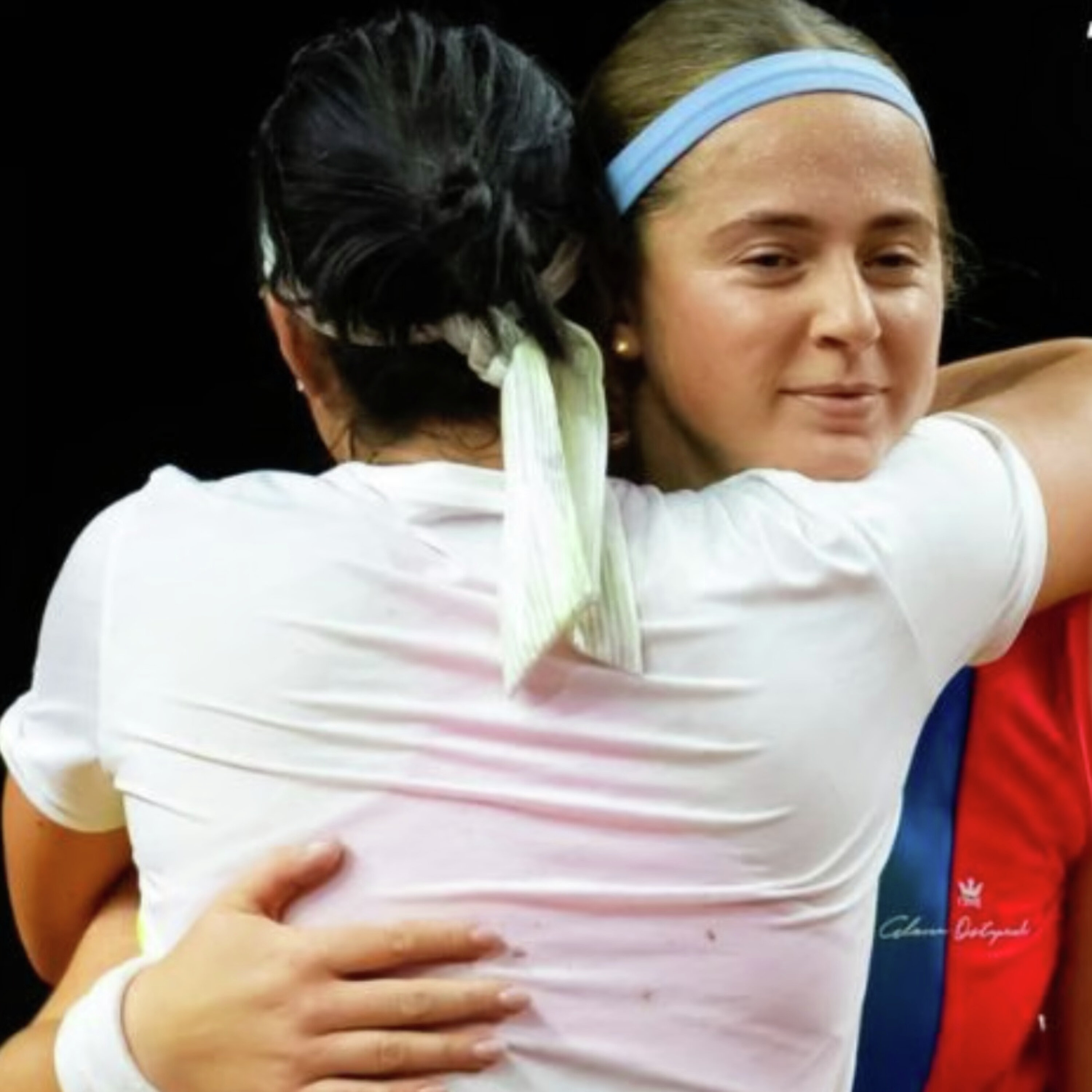
Power Moves and Replacement Hosts
Is this Caitlin's last episode as co-host? It is if Jane012345 has anything to say about it. We dissect the forced submission move by Ons Jabeur to turn an Aljona Ostapenko handshake into an embrace (or was it a hug initiated by the Latvian locker-room favorite?) as well as review the new Boris Becker documentary by Alex Gibney and a recap of the clay season in all its glory!
Hosted on Acast. See acast.com/privacy for more information.
See omnystudio.com/listener for privacy information.
2023-04-25
49 min
Transcript
Available Results
Generated results are saved to the knowledge database for reuse and search.
No generated results are available for this episode yet.
Extract Knowledge
Pick what you want extracted first. Model, scope, and chapter options appear after a template is selected.
Generated results for public episodes are saved to the knowledge database so they can be reused and searched later.
Transcript
00:00:12
Speaker 1: Book are you talking about? Oh? No? One? From Ninth Street Women by Mary Gabriel.

00:00:18
Speaker 2: It's so good.

00:00:20
Speaker 1: You know, one of the things I appreciate the most about you is your desire to expand your mind and your engagement with art. I've learned a lot about art through you, because I don't really like art or care about it. What's this book about. It's about these women in these village. Yeah, it's incredible. It's actually really really, really really well done.

00:00:38
Speaker 2: It is the women who basically lived in the East Village who changed ot, Lee Krasna, Landa Kunig, Grace hard Again, John Mitchell, and Helen Frankenthal. I mean, it's so good. It's actually really good because the thing that I enjoy about it is that you're learning all these great things about these women artists, and you know the men that they were with obviously Polic to Kunig, and and and how especially Lee Krasner, who I got to give a shout out to. Billy jan King owns a Lee Krasner painting in her apartment. And they were I mean, especially Lee. She was such a stalwart in the art world back in the day. And you learn a lot about actual history and how the Nazis, you know, trying to take over Europe, and one of the things they wanted was to control the art in Paris. And it's just it's really, really well written, and I'm very much enjoying it, but it is the size of my head. And I took it to Mexico and I was thinking, yeah, I'm going to read my book, and I did. I read it quite a bit, but oh my god, Like, what the fuck are and I buy a kindle.

00:01:41
Speaker 1: Yeah, it's like carrying a brick clearer only by his electronic books. And I think it's stupid and limb until we go on.

00:01:49
Speaker 2: A trip and then you're like, hey, Claire, can I borrow your kindle? Yeah?

00:01:53
Speaker 1: She's like, fuck ah, Well, you know this is I don't like reading on a screen.

00:02:00
Speaker 2: I agree, but this is the one book that I wish anyway Ninth Street women get it if you if you're into art, or you love history, or you love anything about art history. It's a terrific read, especially for US feminists. Women don't get their due in the art world or any place place in the world.

00:02:19
Speaker 1: Ye. Anyway, as it turns out, I want to give you a shout out because the first time I had heard of Lee Krasner, again not being somebody who is particularly into art, it was when we went into Billy Jean King's apartment and.

00:02:28
Speaker 2: You sat, you were like, and the great story behind that, But maybe we'll get that from Billy next time we have her on the show. Billy come back on the show too, because it's actually an amazing story of why and how she got the Lee Krasner painting. Let's it's just typical Billy being just an awesome person and then she ended up reaping a lot of benefits for it unbeknownst to her in a lot of ways.

00:02:54
Speaker 1: That's such a fun Billy story. She's sort of like Forrest Gump in that way where she's like, and then I was living in an office next to stay in them, and then there I was, and Mick Jagger was there, you know, reading her book and obviously having spoken to her a little bit on the podcast, you know her a lot better than I do. But the only thing, the only problem with Billy Jing King is when you start interviewing her, you kind of can't stop, and she just kind of tells you whatever she's going to tell you.

00:03:15
Speaker 2: Billy's ten times worse than you and me as far as tangents, Like she's just telling a story and then all of a sudden she goes left, and you're like, wait, where's this going. One of the funniest things about interviewing her for TV, for example, is, uh, you know Live TV. You got a minute too, actually, like you got to get to a.

00:03:32
Speaker 3: Break because that's what pays the bills, etc.

00:03:36
Speaker 2: And you know, I'm not quite sure that Billy's going to go and you want to ask her ten questions, but you know you're only really technically probably going to get to because she just will tell these great stories and go on different tangents. But having said that, we love.

00:03:49
Speaker 1: You, Billy, well, that's sort of a segue into something that I wanted to ask you about because Billy jan King used to be a tennis commentator and one of the networks Billy jan King tennis commentated for was HBO. And the reason I was thinking about this is because HBO used to be in the tennis broadcast game. Now, you and I talk a lot of shit on this podcast, we deservedly, I think about some of the shortcomings in the tennis broadcast experience. It's coming from the place of we think this sport is amazing. There's always amazing stuff to watch in the sport, and you can almost never find it in the way that you would like to. And we are people who are determined to find it and happy.

00:04:27
Speaker 2: To pay for it. Oh, I saw your tweet this morning.

00:04:30
Speaker 1: Without going into yet another critique of how difficult this sport in this country is to find it, was a reminder watching the new Apple Plus documentary Boom Boom, the Case against Boris becker On with all of that amazing archival footage of HBO's Wimbledon because the people used to have the rights to Wimbledon. Billi Jing King was a commentator, Mary Krollo was a commentator, Arthur Ashe was a commentator, and I just was thinking to myself, I have I liked the documentary in Hall, I have some like thoughts about it. They'd love to talk to you about. But one of my main takeaways was just look how much footage this is. Well, couldn't we just get in there? Oh my god.

00:05:11
Speaker 2: I interviewed him on my show and I just told him how much I enjoyed it. And also I was like, oh my god, I could not get enough of the old footage.

00:05:19
Speaker 3: It was so cool and even the story.

00:05:21
Speaker 2: And I don't want if you haven't seen the documentary and you don't want me to spoil it for you.

00:05:26
Speaker 1: I mean, but one of the things that I it's a documentary, though it's not.

00:05:30
Speaker 2: I know it's a documentary, but I didn't know some of the stuff about the history of some of these stories. For example, when Boris twisted his ankle and he said, if I think it was Tim Mayott, right, if Tim Mayott had been close to the net against me in that match as he walked, I saw him walk towards the net like he was going to shake hands.

00:05:50
Speaker 1: Yeah, he was about to default my mask back.

00:05:52
Speaker 2: There, turning around and like trying to concentrate and getting balls for his serve. And if the dude had walked anywhere near the service line on that court, which we've all done, by the way, when I've heard somebody against me and they're looking like they're injured and they.

00:06:05
Speaker 3: Start walking towards the umpire, you start walking towards it to shake my hand, you know what I mean. You're not feeling good. How's the movement?

00:06:13
Speaker 2: He's like back on the baseline and if he had walked anywhere close to the net, Boris would have shook his hand and the match would have been over.

00:06:19
Speaker 3: He said that. He admitted that.

00:06:20
Speaker 2: He said, oh, I was done well and left.

00:06:23
Speaker 3: From my coach.

00:06:23
Speaker 2: Is like call the trainer called the track. But meanwhile, can you believe it, like what three or four matches later when the whence Wimbledon and changes his whole life.

00:06:32
Speaker 1: Yeah, he could have defaulted a match and his courag give him a second.

00:06:36
Speaker 3: That blew my mind.

00:06:38
Speaker 2: Was in the finals when Boris Becker lost to John McEnroe. He walked off the court. He didn't even stayed for the presentation. I'm like, first of all, A, I know he's a superstar at the time, but how do you not make him come back on the court.

00:06:52
Speaker 3: First of all, I thought that was a real dick move.

00:06:54
Speaker 1: It was from beyond idol. Did not come back to the court.

00:06:58
Speaker 2: Took a photo with him at Wimbledon and was therectually shaking because I couldn't believe I was meeting my idol and he's just I don't know something about Boris Becca that's about beyond borg.

00:07:06
Speaker 3: That is just iconic to me.

00:07:08
Speaker 2: But I couldn't believe he wasn't made to go back on the court. He was just like, you know what last I'm retiring.

00:07:12
Speaker 1: See yeah, I've never even heard of that in the history of tennis, and happened to other place Sartina Hingistri, Remember Martina Hingkers didn't want to go come back down and wrangle her like a horse.

00:07:21
Speaker 2: Her mom made a come back on the court. Steffie graff in the last Grand slammed Steffie one when she won. That was that ninety nine, Remember yeah, when when she was pissed off about the line call.

00:07:31
Speaker 1: Yeah, yeah, she walked around the net. You don't walk around the.

00:07:34
Speaker 2: Net freaking lost her mind. And I have to tell you Steffie told me because I spoke to Steffie. You meet almost immediately after she won that match, and She's like I was done, Like I was done. And then she walks around the net and I'm like, what are you doing? You? Yeah, you dumb, dumb And that kind of pissed Steffie off and also pissed the crowd off, and then it just districted her.

00:07:52
Speaker 1: Then it becomes a different match.

00:07:53
Speaker 3: Done and dusted.

00:07:54
Speaker 2: She retired like what four weeks five weeks later, and she was like, what is she doing so that? So Martina Hingers didn't want to come back, and her mom basically walked her back and sat with her while she sat for the trophy trophy celebration. And then, trust me, nobody likes that. There's not one time I've lost in a final where I'm like, hey, guys, happy to be here.

00:08:15
Speaker 1: I can't wait to sit up here and get the winner's trophy.

00:08:18
Speaker 2: Watch my opponents just like smile and grin and yeah, tell me how great it was and how great hey, congrats and getting to the final. I want to be like my middle finger up at them. So that's the one thing about tennis that's so unique. But you know, you don't see World Series or NBA or they're.

00:08:34
Speaker 1: Not having.

00:08:36
Speaker 2: Watching them trophy.

00:08:38
Speaker 1: No, but the Becker documentary had a number. It had so many amazing things in it, which I think speaks really well for it's really a must watch, like you should watch it. I had, from a storytelling perspective, a lot of.

00:08:50
Speaker 3: Issues with it. I don't I don't think it was I thought it was well.

00:08:53
Speaker 1: I think I think pragmatically it was a product of two different people who had sort of two different ideas about the documentary, and both of them could have been great ideas about the documentary, but together as like a Frankenstein documentary, it was not always very clear, Like I'm not sure it needed to be two almost two hour long episodes.

00:09:12
Speaker 3: It was more than two.

00:09:13
Speaker 2: Oh yeah, it was about two hours y so totally four hours.

00:09:16
Speaker 1: Listen, nobody wants to see archival beautiful old tennis footage of Boris Becker playing with stephie Graff, like just amazing stuff.

00:09:22
Speaker 2: So you're saying you there was a there was the tennis part of it, and then there was the dramatic part of his life, and you wanted to have them separated a little bit more.

00:09:32
Speaker 1: No, I think if you're going to do a documentary, you have to you have to set out very clearly with the story that you're trying to tell and have discipline. I think Alex s. Gibney didn't have enough time to work on This is what I think I think he's using.

00:09:44
Speaker 2: Well, I wish I'd known this, I would have asked him this question. I like, I think it was he was coming from a perspective of being an absolute tennis fan, obviously, because he told me that and I think he probably he wanted to tell the story from the start of his career to the end of his career, which I love, which were there were so many unbelievable storylines, like and I grew up Boris is what five six years older than me, so he was really a superstar when I was just starting to be quite a good junior. So he was like iconic to us because we were like, what was I twelve? And he was winning wimbled and I was like, wait, what he just won Wimbledon And I'm like, what am I doing with my life kind of thing, you know. So I think there was that whole storyline about how good he was from such a young age and he was such a little hot head on the court blah blah blah, and then you have to talk about the stresses of being such a superstar such a young age. So I think he intertwined that I thought for me as a lame and you're a little bit more critical because you look at things a little differently to me. But I kind of liked that we learned so much about him being such a little shyster as well as being a little bit crazy slash man.

00:10:51
Speaker 3: He had a lot of pressure on his shoulders, and then he had all.

00:10:53
Speaker 2: These hangers on her around him. He was like, listen, I'm happy to like drop all this if you come back to me.

00:11:00
Speaker 1: You know, he's terrible advisors. I mean, listen, when you're an athlete and you trust somebody with your money, that can really go one of two ways, can it?

00:11:07
Speaker 2: Like?

00:11:07
Speaker 1: I mean, Tirek was the one that should have just Iantiiac was kind of the hero of this documentary was Barbara Becker. Barbara Becker was awesome. I was like, well, this woman's a goddess, Boris. The tragedy of this film is that Boris Becker fucked it up with Barbara Becker. Yeah, he's not going to do better than that. She's just amazing and I.

00:11:25
Speaker 3: Actually met her a couple of times.

00:11:26
Speaker 2: She's terrific.

00:11:27
Speaker 1: Yes, but no, I really loved it. I think for me, the part that I didn't love is just you foreground the trial. It becomes like sort of a true crime story, and the true crime is not that bad.

00:11:37
Speaker 3: You want you want to take over that house in my Yoka?

00:11:40
Speaker 1: I know you do? Oh sure. I remember at the time we were thinking about doing a store a racket piece about the squatters who took over his Maerica house. I just turned into like it was just bananas. So yeah, so much great material. I'm not you know, I don't hate it. I don't think it's bad. I'm a big fan of Skibney, Taxi to the Dark Side, Jigsaw like you know, blah blah blah. I just think the documentary was not like, it was not the most disciplined, sharp version of what I wanted to see. That said, Tennis doesn't have a lot of documentaries good, bad, or mediocre, and so just please keep them coming. And to me, the greatest achievement was that Alex Gibney managed to do this and, to Boris Becker's credit, managed to both be as honest as I think he was capable of being.

00:12:19
Speaker 3: I tell Bober didn't think so sure.

00:12:22
Speaker 1: But also people who are sort of narcissists.

00:12:25
Speaker 3: Tend to tend to tell some tales of the.

00:12:28
Speaker 1: They disassemble and see the world in their way that because they have to. But I do think it was really a credit to everyone involved that he didn't insist on being an executive producer. Yeah, because when you get the athlete as executive producer Disasta. It's just it becomes a kid glove exercise and then what are we doing? You want me to watch a commercial for somebody?

00:12:46
Speaker 2: No, I want to watch.

00:12:47
Speaker 1: Don't bother making it if you're not going to make it good. And I think anybody who really has integrity knows that even if it doesn't make them look great, it will make them look real. And I think there's value in that. And I think Boris Becker trusted Alex Give to make him look like a real human. He looked like a real human, and I had more admiration for him than when I started, which was saying a lot, because you know, I'm a massive Portsbager fan.

00:13:08
Speaker 2: Yes you are so, And I'd love that you posted the photo of you a Wimbledon that I took. Can you took? I took a great photo, but you happen to close your eyes?

00:13:17
Speaker 1: I don't know my definition that's a great photo.

00:13:19
Speaker 2: Well it is because it was he was He looked fantastic, and you were like so cheesed cheesy that you were like you had your eyes closed, and you probably said something like that, like so, and then I took the photo.

00:13:33
Speaker 3: So it's kind of your fault, so sorry.

00:13:35
Speaker 2: Anyway, I loved the docco So for those of you that listen to our podcast, it's no surprise that Caitlin I differ on our opinion of it.

00:13:44
Speaker 1: I think we both feel like it's a must watch though.

00:13:46
Speaker 3: Yeah, no, there's there's no question about it.

00:13:49
Speaker 2: And Alex Gibney, what does he say is that documentaries kind of can't be objective.

00:13:54
Speaker 1: No, they can't. There the they're the viewpoint of the filmmaker. My favorite document filmmaker, Werner Herzog, believes that documentaries can't always be true, but they can always get at an ecstatic truth, something that sort of is closer to the truth because it's a little bit of like subjective. And I, without subjecting you to more than film criticism, what I would say is, you know, there were moments in this documentary that were really brilliant that I absolutely loved. Yeah, I do want to say having had a two episode run where we kind of just really get into the meat and potatoes of some of the stuff. That is frustrating is we've gotten a ton of feedback from listeners, actually tweets, d MS comments on our Apple reviews. I kind of forget our Apple reviews exist, although you should totally talk about the one woman.

00:14:43
Speaker 2: The list not thank you because she loved me, but you don't really like the old CT and she.

00:14:52
Speaker 1: Was like, why does this lady need to be on here? Why can't this just be talking all the time? And I would say to you, it can be. Everyone who's given us feedback. A lot of people in the industry have written to say thank you for saying this. This is so frustrating. We wish this would be better, and I really do want this to be both a place that speaks truth to power, because as I noted in our last episode, this is an independent operation. We are not owned and therefore not necessarily beholden to any employer. And then the other thing I would say is we want it to be better. That's the whole point of we do. We want it to be better. And I want the people who maybe casually come in because they watched the Boris Becker documentary or they've seen Breakpoint on Netflix. They're excited about who comes after Serena Williams or Roger Fetter and they are now into tennis, but we have made it so impossible for them to take their next step that's really the point of us. If we were in Europe watching this on Sky, on the BBC, etc. This would be on every bar as we walk by, This would be on on every main channel, and so just basic stuff like this. Like I was in Spain for a week, tennis was constantly on the television, and not because there was this tournament in Spain, but because tennis is seen as popular as the end and there's always a game to be to be had in season, you know. So I just I really want the powers that be to be focused on this sort of stuff and not being like Vishi Frands selling out to other non sports entities. So I just want to It's Jane Underscore two hundred and five to one zero zer a one via Apple Podcasts.

00:16:20
Speaker 2: Do you want me to read the whole thing?

00:16:21
Speaker 1: I mean, sure, go ahead.

00:16:23
Speaker 2: In general, this podcast is great and I understand that it's affiliation with Racket Magazine is why Caitlyn Thompson is a part of it.

00:16:32
Speaker 1: Gone, No, you.

00:16:33
Speaker 2: Just know, you get to do it just you know. The one word in it that was highlighted and made large was alone renee. So Jane, here's the thing. It's really hard to talk on a podcast by yourself. So as much as I like to hear my voice, it's it's a lot more fun to do it with Caitlin because she's painted ouse.

00:16:55
Speaker 1: I'm just here any breathing, sentient human would do, So you want to come and be a gas on the show. Caitlin does all the editing and all the hard work, so I really just set her. Actually, I was like, you know what, maybe now is a good time to take my retirement. I think I think your response to me when I sent you.

00:17:12
Speaker 3: That was fine.

00:17:15
Speaker 2: Yeah, I've had a rough couple of weeks anyway, So let's get to the tennis. Let's get to.

00:17:23
Speaker 1: Yes, I want to get to Stuttgart. I'm so excited to talk about it.

00:17:26
Speaker 3: Stuttgart was fantastic.

00:17:28
Speaker 2: There was one really horror story that came out of it, and that is, once again, the injury to a subber who was starting to look really, really good.

00:17:37
Speaker 3: You know, we know that she came back a little.

00:17:39
Speaker 2: Bit too early in Miami and Indian Wells, and she talked about that, but then Bang wins the tournament and Charleston and you're like, Okay, she needed a couple of weeks, she needed more preparation in matches. Okay, she's back on clay where she's a freaking nightmare because you got to run down her drop shots and she can toy with you and all the things right, and then all of a sudden she moves through and when's the tournament and you're like, you know, how happy is everybody? I mean literally, there's not a person on to her that that doesn't like her.

00:18:05
Speaker 1: I think there's not a person who follows tennis that doesn't like.

00:18:07
Speaker 2: I can prove to you why. I know that she's one player that is literally liked by everybody. How think about this, Think about a match she played a studtgut where she was down a set and heavily in the second set to Osta.

00:18:22
Speaker 1: Panko, everyone's favorite favorite.

00:18:25
Speaker 2: But we all know that a luna is a bit of a luna when it comes to not wanting to be super gracious with the handshakes. We know that she's been a little bit of a person that's become a bit of a meme with her handshakes, or her lack of.

00:18:41
Speaker 1: Or not a locker room favorite, her.

00:18:44
Speaker 2: Bitching about a call every on every third shot, I would say.

00:18:49
Speaker 1: I'm sure the chairs are also liked.

00:18:52
Speaker 2: They must get her matches and just be like, thank god we have electronic line calling on suba and literally Ons is like puts her hand out and Ons hugs everybody by the way, and Onz puts her hand out shake hand, knowing that Alona, I hope I get a handshake, you know, because that was a bad loss. She should have won that match, and she puts her arms out because she wants a hug from Oms.

00:19:15
Speaker 1: That's not the version of events that I saw, but I love your interpreting.

00:19:18
Speaker 2: What did you see?

00:19:19
Speaker 1: I saw Ons insisting on hugging and just going past that hand and bringing her in like a bear.

00:19:24
Speaker 2: Hud.

00:19:24
Speaker 3: Nope, look at it again. Os will have to literally had her hand to shake hand.

00:19:29
Speaker 1: You're saying it was Alona ust Picker's idea.

00:19:31
Speaker 2: To one thousand percent. She puts her arms out together and kind of looks at Ons like, oh, I'm not gonna get a hug, and On is like, oh, it's so uncomfortable, and then Ons goes in and hugs her, and then it's very nice.

00:19:46
Speaker 3: But there is no doubt.

00:19:48
Speaker 2: Watch it in slow mo one hundred times, and I've actually watched it so many times to make sure that I was right.

00:19:53
Speaker 1: I thought it was a power movie.

00:19:56
Speaker 3: Going in with a.

00:19:57
Speaker 2: Nice handshake and probably the tap on the shoulder and a lot and guys in there with the two arms out like, oh, now you're not going to hug.

00:20:06
Speaker 1: Yeah, you're going to do.

00:20:08
Speaker 2: So. So that just proves to me that Ons is literally the nicest person on tour. But man three love in the first set against I was so looking forward to this match against Eager.

00:20:17
Speaker 1: Yeah, me too, A repeat of the US Open final, a very very anticipated on clay where they both love to bring their best tennis yep.

00:20:27
Speaker 2: I think Ons is for sure a better all court player than Eager at this point, as far as we know that Eager is still going to struggle a little bit on grass and on a really super fast court, although she won.

00:20:39
Speaker 3: The US Open last year.

00:20:40
Speaker 2: But I was so looking forward to it because there was going to be another litmus test for both of them in a lot of ways. Right, Where was O's really at playing the best clay cutter in the world. Where is Eager against a player that can play on all surfaces, particularly a faster indoor court with her variety bringing on into the court into the net made where she's not overly comfortable. I was pumped about it and then bang that happens and it is no joke and injury you cannot play half tear doesn't feel no, and it's a tear, it's not a it's not a strain. Yeah, I was hoping for but it came back with a little bit of a tear.

00:21:16
Speaker 3: So that's a disaster.

00:21:17
Speaker 2: And I actually texted on and I said, mate, listen, just one thing that you cannot come back too early on that has to be healed one hundred percent, yause, calf muscles.

00:21:25
Speaker 3: Are a bitch and if they come back they can be really really bad.

00:21:28
Speaker 1: That's a bummer because obviously she was defending the title at Madrid, and for me, her chances at Roland Goros were good, were good, very good, really good. She was playing in deform as you said, and really, you know, looking dangerous after that Charleston run. So yeah, I'm pretty bummed, very bummed that we didn't get I hope do you think friendship And.

00:21:53
Speaker 2: I honestly likely right, Listen, I'm no doctor and I didn't stay on holiday doctor. But I will go on a limb and say I will be shocked if we see her in rolling garrish because only because it is such a I mean now, normally a tear is at least two weeks of no activity.

00:22:14
Speaker 3: I tore my quad.

00:22:16
Speaker 2: I had a Grade one tear, and I don't know what her grade is, but I think it might be sort of something like a grade one. I had to do two weeks of absolutely nothing on my quad, and it's the same with the cuff.

00:22:28
Speaker 1: For me.

00:22:28
Speaker 2: You've got to be really careful. So I'd say she's doing nothing for two weeks, then she has to do at least a week or two of getting back slowly. I know Simona Halletp for example, she did her culf muscle as well, and it was a nightmare for them for a long time. And then you've got to build it up slowly, and then you've got to get strong again, and then you've got to get back into moving at one hundred percent. That's gonna be weeks and that's not weeks. And Caitline, you have to remember she's got finals of Wimbledon. I think she want to lead up tournament going to wimbled last year if not, she did very well and then finals the US Open. All her points points already coming off one thousand in Madrid, but the rest of her majority of massive points are coming off Wimbledon US Open, So she's got to be very smart about how she goes forward in knowing that Wimbledon might be the more important tournament for her at this stage, because she didn't do that great at the French Open last year.

00:23:23
Speaker 3: Oh I think she lost first round.

00:23:24
Speaker 2: Remember she came in out Madrid and it was like She's gonna win the tournament and blah blah blah, bah an eager and then book she lost first round. So that is a massive help for her in some ways. But at the same time she could have made up a lot of points there as well. So I'm she's obviously, as I said, one of the great people on the tour assets I mean, and she's just fun. She's such an asset. She so fun, She sells tickets, she brings the people together. She's on the prison my mother in law cares about. You know, this leader is in watch tennis. Yep, she wants to watch the Tunisian Minister of happiness though, you know what I mean.

00:23:55
Speaker 1: She brings the people together. But having said that, we had a final, a final it was not as close as the score would indic keep. No, Saballenka was not really in that final No, And.

00:24:14
Speaker 2: Even in the second set, like there was opportunities for Eager to go up another break and then it was nice to see Saballenca fight, you know in those service games. But and then ons I have to say Eager had to sorry. Eager had a couple of break points against her, like Sabolenka had an opportunity maybe early in the second enough she lost that early break in the second set to get back on score on I think it was Love thirty at one. Love could have won that game, maybe righted the ship a little bit. But this was more litmus test for me for Eager in a lot of ways, because you know, indoors is a whole different story, right Even on clay, Sablenka is a better indoor player. I would say, you know, she doesn't have the the wind or the sun or she can just bang down a big serve, bang down a couple of big groundies.

00:25:04
Speaker 3: And you know, Eager's so good on clay because she can defend so as well.

00:25:07
Speaker 2: And on that court insteodguard, it's quite slippery, it's faster than a normal clay.

00:25:12
Speaker 1: We've seen a lot of terrible injuries traditionally intrude core right.

00:25:16
Speaker 2: That doesn't necessarily help a really great mover, for example, because you know, even for them, it's tough to defend on a court that's quite slippery. So I just thought, Okay, this is a time for Sabolenka to actually beat Eager on clay, and so for me, for Eager to win in straight sets, that's a great sign for her and a terrible terrible one for everybody on tour because I don't see her losing outdoors on clay. Madrid's never been a good hunting ground for her. She's to the final because the altitude really helps a big server and a big hitter, although he one Madrid a couple of years ago. So for me, that was a big win for Eager because I think if she had lost to sable Anka on clay, and if it was indoors, I think she would have been like, man, this is not going so great.

00:26:04
Speaker 1: I'm going to say something a little bit controversial, which is somebody was making the comparison on Twitter. I think it was Miles David. Is you guess Fiantech this generation is Justine Hannah and Justin Hannah was my favorite player of all time. And I would say the difference is that Hannah was fun to watch, and I don't think he has had fun to watch. She's okay, it's okay, okay.

00:26:30
Speaker 3: So I'll disagree with you on that.

00:26:31
Speaker 2: And I think one of the reasons why you loved Justine is because she had the one handed back end and there was that whole like sort of you know, it's funny, is that everybody loved her one handed back end. I never really loved it. I mean, it was great because I was a one hander and I loved that we had this beautiful like player ripping out one handers and slices. But I thought her backhand was very It was like a caniption fit, you know, you know, in her head would it's comparative to Meliam a Resmo's backhand and uh Suarez Navarro's backhand. Beautiful backhands like Favrinka's backhand. It's just that flowing, gorgeous like movement like Federer, whereas Justine's was violent. It was a violent one.

00:27:14
Speaker 3: Hand, you know what I mean, Like, seriously, take a look at it. It was a pretty one.

00:27:20
Speaker 2: It was very effective, though. I think you liked it because she was kind of an aw court player, like to come into the net, whereas Ega is a little bit more of your traditional baseliner. But I don't know. I've been on the practice court with her so many times, so I can admire her ball striking and her intensitye's to admire. She's the closest person I've seen to someone like Steffie on the court where everything is fast. Her warm up is fast, her like little foot action before she goes to shake hand, like you know, toss the coin and running back, and she's just like, you know, like a little crazy person.

00:27:55
Speaker 3: That's how Steffi was.

00:27:56
Speaker 2: You know, just everything was fast. Everything warm up was fast, the feet were fast. So I disagree with you in a little way because I kind of like to watch her play because I'm like, what the hell is she going to hit here? Yeah? And her sliding and her.

00:28:08
Speaker 1: No it's it's very competent and it's obviously very very very effective.

00:28:12
Speaker 2: What she was thinking when she ran into the noil on that one bowl though, and then Sabilenka.

00:28:15
Speaker 1: Tried to take her that's something else where you're kind of like there's a little bit of sportsmanship with her with the frog where she was sort of waving the hands while somebody was hitting a put away volley, and.

00:28:23
Speaker 2: Then this one place is her mind for a second, I.

00:28:25
Speaker 1: Think it's juniors. I think that's a junior's move if you go in and your opponent has a sitter and you're going to try to distract them. And the thing with Sablenka is you have to be fucking crazy to run towards her teeing up on a ball, and people were noting on the internet that she very very very nearly got hit and if she had, it would have one thousand percent been her fault. Sebling is not looking to peg her, just as a The one thing I will add is just as a veteran of junior tennis and college tennis, there's some elements to game that are like that, and it works, but it's not. It doesn't. It doesn't serve to endear you to people like is he gon a locker room favorite?

00:29:08
Speaker 2: Does she do people like so shy? I obviously know her very well. We've had a lot of nice conversations and I like her a lot. She's a really, really, really nice kid. Very very shy, very shy. Doesn't speak to a lot of people only because she thinks that they don't want to talk to her. It's not nothing to do with her being a bitch at all.

00:29:30
Speaker 3: But that move, I was like, what was that?

00:29:32
Speaker 2: But what was interesting to me is that Mark Petchy who was doing that, he was doing the commontye tree by himself.

00:29:39
Speaker 1: On that match, a woman's final, even that was a final.

00:29:43
Speaker 2: Don't get me started. Was really kind of pissed off at Sables, like I can't believe you know what, what are you talking about?

00:29:51
Speaker 3: Like, if anything, you should have been like, what the hell was that was?

00:29:55
Speaker 2: It was eager thinking running into the net like that, And frankly, I think it was a good.

00:30:00
Speaker 3: Move for Sabalanca to be like what are you doing?

00:30:02
Speaker 2: Like, yeah, listen, I'm I was a good sport on court, but if you'd ran at me like that, I'd take your head off as well. For sure, you're trying to distract.

00:30:10
Speaker 1: Me, that's what you're trying.

00:30:11
Speaker 3: Take your head off. So I thought that was a very interesting take from Petchy.

00:30:16
Speaker 2: Conversation I'll have with him when I'd bump into him, I'm like, really, didn't you think that there was more Eager being just a ding dong.

00:30:22
Speaker 1: Yeah, it was a ding dong move for sure, for sure, and.

00:30:25
Speaker 2: Everyone was like, oh, I'm like, why would you run into the net?

00:30:29
Speaker 1: Honestly, that's the dumbest thing I haven't given death.

00:30:31
Speaker 2: I mean, it's one thing when it's curios trying to be a ding dong like and running in, you know, trying to put his racket up against his face, right like we've all seen players do that. It's kind of a bit of a joke. But Eager is not a joker. No, So that was Yeah, that was and I love you Eager, but that was.

00:30:46
Speaker 1: What is that? Yeah, there's a bit of a cringe thing with her.

00:30:50
Speaker 3: I did like the driver the car driving.

00:30:53
Speaker 1: Yeah, after the it's like a.

00:30:54
Speaker 2: Maniac men, what about it?

00:30:57
Speaker 1: Vander Schlip Vendors, Sender, Sloop, vander Denslop. The match points in that trainer really really big time choking. Yeah, honestly, I mean, Rune is great and he's clearly clearly down and out in the third deserves he's like to be at the top of the game, which is where he finds himself.

00:31:19
Speaker 2: But but why is Rene looking like he's been shot in every single match that he plays these days, like he's got a cramp or he's got something wrong with this, and he's calling the trainer out here, and he's calling the trainer out there, and it's just like, oh my god, you're carrying on like the hell, like stop talking garn on like a pork chop. But you know your reputation now is preceding you, right, And so he's not. He's turning into like the new shall.

00:31:41
Speaker 1: We say it, yeah, no vak Jock Novako.

00:31:44
Speaker 2: Where he's like gonna be this kid's gonna be great. Yeah, he's gonna be great. But he's like not starting out on a good footing with the public and with the players in this respect, and like, what are you doing? I can't.

00:31:59
Speaker 1: I mean, I just want to say I because the other men's final was between two of my favorite players, yes Stefanas and Carlos, And I will say I think tit Bus gets a lot of shit, yeah for carrying on like a pork chap, But not remotely does he carry on like a rune.

00:32:16
Speaker 2: No he doesn't, No, no he no sits a pass a ship has come from having seen dad, the dad who is insane and I'll say it, and I'll say it again, And how many times have I said it on the podcast?

00:32:27
Speaker 1: Numerous?

00:32:28
Speaker 2: He will never win a Grand Slam with his dad coach, Yeah, sure, or in his box. I just sorry, it's just.

00:32:33
Speaker 3: Not gonna happen.

00:32:34
Speaker 1: You could say that to sixty between them is palpable and it's obvious to see, and it's holding him back because he should have probably at least one Grand Slam right now.

00:32:43
Speaker 3: Well, yeah, for sure. So anyway, Alcoraz was too good.

00:32:48
Speaker 2: But going back to Rune, back to Rune, yeah, I mean he just carries on and Botek has just got lose in his mind. But dude, when he had seen finally got back to six ' five serving for it up forty fifteen, he looked over at his box and it was like he'd seen a ghost. And I don't know what it is. I don't have a lot of emotional intelligence, caitline, Is that true? But I do when it comes to watching tennis, and I can pinpoint someone shitting their pants in a three a second and I could.

00:33:23
Speaker 3: Tell his breathing got short.

00:33:25
Speaker 2: Yeah, he looked at his box and I was like, oh my god, if he doesn't win this match right here, right now, it's over.

00:33:30
Speaker 3: I could tell and.

00:33:32
Speaker 2: Runa hits back kind of an okay shot to the middle of the court, and I swear to guy looked like Boti couldn't move. It was like it was like Cement went around his legs and he couldn't even get out of the way of the ball and he missed the ball by like, no twenty feet and I went, oh my god, it's over. So Rene can literally hit the ball in the court and make this guy have to hit a winner. And I'm thinking to myself, this guy has to hit a winner because there's no way that he's winning this match unless he hits a winner, because Renee's not going to miss now because he's just looked down the other end. The guy just as in his legs, even though apparently Rene was also struggling with whatever this one time. I was like, it's over. And then gets the tiebreak and he just looks over his crew and he just starts shaking his head. I was like, this is so done.

00:34:15
Speaker 1: It was brutal to It was brutal to watch. It was brutal to watch because you knew what was happening and there was nothing anybody could do. Most importantly him.

00:34:22
Speaker 3: He should have served all on both points.

00:34:25
Speaker 2: Just get pane it up and get a knowing that you're shitting yourself like that and the point quickly, just go for it, go for a big surf, try and hope that the guy returns the ball down the middle of the court, which often, particularly on the back and side, most do because they're trying to get the ball back deep.

00:34:40
Speaker 1: Report not necessarily used to.

00:34:42
Speaker 2: Serve and volley on the biggest points because she knew her opponents were going to hit the ball through the and she could just hit that little inside out back and volley how many points?

00:34:51
Speaker 3: So yeah, that was some serious choking Brune.

00:34:54
Speaker 2: Hey, he is making a mark. I'm a little worried about Sinner. He keeps getting these.

00:35:00
Speaker 1: I know this is really I feel like his time to shine.

00:35:04
Speaker 2: I think he's played enough tennis that he's going to be a real threat. Obviously going forward we'll see how. I think he's going to be a real threat here in Madrid because his game suits this surface and the altitude a little bit more, because he can smack the shit out of the ball. Yeah, and I think he'll get rewarded for that a little bit more so, it'll be interesting to see how he plays here in Madrid. We stay here because we're watching it because there's actually tennis.

00:35:26
Speaker 1: It's finally on the TV. Okay, So looking forward, we obviously have still a few weeks left to go before the next Slam. For me, this is the most exciting time of the year. I love Madrid, I love Barcelona, I love Rome is going to be coming up. It's just it's like an embarrassment of riches. The courts just esthetically look so good. We get great points, people like Alejandro Davits Folkina all of a sudden become like relevant again, which I love. You know, I'd love to see him do really well a year round, you know what I'm saying. Just it's such a special time of the year that I'm really excited about. Now.

00:36:00
Speaker 2: You love the clay, I do.

00:36:01
Speaker 1: I love the clay.

00:36:02
Speaker 3: I love the clay too. I find it really fun to watch matches. I like the grind. Yeah, I would like if the Men's French Open was best of three.

00:36:12
Speaker 1: I think we'd probably have a better winner. The last thing I'll ask you about, and this concerns both Spaniards, both with some interesting injury contexts. Obviously, I think the favorite for any really, especially given his history. You know, Novak Joke, which typically does not play very well at the beginning of the clay season, and then all of a sudden becomes like a very big threat at Rolandgaros because he's obviously optimizing and places like Monte Carlo and Barcelona and Madrid are.

00:36:41
Speaker 2: Not exactly to his liking.

00:36:44
Speaker 1: I would say Rafa Nadal obviously has our sort of favorite, and then there's Carlitos, which is looking good. Carlitos is looking great. I hope he stays injury free, and Rafa's maybe not gonna play.

00:36:59
Speaker 3: I don't know, what do you think this is? Yeah, I don't know.

00:37:06
Speaker 2: I mean Rafa's injury is ongoing. Obviously, he's not wear it back or where he wants to be and needs to be, and it's a pretty bad injury that he had. Talk about tears, Yeah, as I'm saying about, you know, someone like Ohn's, you can't just a tear doesn't just repair itself in a week, you know what I mean. It takes time to get the fibers back together, to make the muscles strong, and then you've got to work around all the muscles around it that have been basically atrophying around that injury. So for Rafa it's a concern in a huge way.

00:37:37
Speaker 3: So I don't know.

00:37:39
Speaker 2: I mean, obviously, if he doesn't play Rome, that's a huge tell. And he knows he has to go best of five at the French Open against these great players. And look, you know he went through his struggles last year to win his fourteenth French Open. I'm really saying to say, but yeah, it's a very big concern. I think al Karez hopefully fingers crossed to touch wood that he's back at one hundred percent and we'll see how he does hear in Madrid as well physically, And yeah, it's a it's a it's a bit of a it's a bit of a mind scratcher when it comes to rougha and.

00:38:10
Speaker 3: It's a bit of a bummer.

00:38:11
Speaker 2: Whereas Novak, as you said, he will find his form. He'll be there, don't worry, Grand Slam soon find his best, So be there. He knows that these guys have to beat him in five sets, best of five sets.

00:38:20
Speaker 1: And he knows that they know. Yeah, that's the thing about him. He gets more powerful the further behind in a match.

00:38:28
Speaker 2: Yes, that's what he said.

00:38:29
Speaker 1: It's most dangerous. Yeah, you know, I mean ask Stephanis to get about all about that.

00:38:33
Speaker 2: Yeah, exactly exactly Lajovich. Yeah one in Sia beating shout out to him taking the title.

00:38:40
Speaker 1: Cool way to go. Bro never had a victory against Novak, and then at his home event.

00:38:46
Speaker 2: I know, had no support against Novak, was rooting for Novak. And then he goes on to win the tournament, great players, including Rublev in the final, who was you know, obviously on fire. So that was an awesome effort. I love to see that. And you know, at a two fifty, it's a small tournament, but still that's huge for him for sure.

00:39:04
Speaker 1: Speaking of two fifties, Okay, this is the last note that I think we should go out on, because we can't leave without a little bit more complaining, which I know what you're going to say, and I agree with you already.

00:39:13
Speaker 2: What about the WTA apparently taking no top thirty players allowed to play in two fifties?

00:39:19
Speaker 1: Explain what that means for our audience and in a more granularther way for people who don't maybe follow the tour as closely as possible.

00:39:25
Speaker 2: So the WTA have rules when it comes to certain tournaments and how big they are. Two fifty is the smallest WTA sanctioned event. We have one twenty fives, but they're in the challenger level. Two fifty, five hundred and one thousands. Those are the three categories on the WTA Tour.

00:39:41
Speaker 1: And then obviously they're slams which is not mendated by it, which are not put on by the tour.

00:39:46
Speaker 2: Just to imagine, the ATP and WTA one thousands events are the biggest ones. They get a thousand points to win the tournament. That's this easier way to put it. They went too fifty to win a two fifty, they win five hundred points to win a five hundred, and at a Grand Slam it's three thousand, so it's three times the amount of a MASSES or w TA one thousand, which is why it's so important to win those big tournaments because that's where the points really lie and obviously their prize money. So the WTA taking in upon themselves apparently in the future that they're not going to allow top thirty players to play in the two fifty events. Now, I think one of the reasons is they want to make sure, for example, if there's a five hundred and a two fifty on at the same time or overlapping or whatever, they want the players to be more condensed, the top players into the five hundreds, which I get in some way that you want to support the tournaments that are putting up more money and more risk and.

00:40:37
Speaker 3: Et cetera, et cetera, et cetera.

00:40:39
Speaker 2: But to say to a player, look, you can't play the two fifty, particularly if it's in your own city, for example Tunisia, you know, and you're telling Ozrewber she can't play there, and.

00:40:49
Speaker 1: She's going to have to go play a two thousand in China instead of her home event that was exists because of her, yeah.

00:40:54
Speaker 2: And brings tennis to her part of the world. Or if you're a check player, you want to play a two fifty at your tournament in Prague and how many top thirty check players do we have?

00:41:05
Speaker 1: Yeah, many twenty.

00:41:06
Speaker 2: They're not going to be allowed to play that tournament now. Instead they're going to have to go and play a five hundred somewhere else.

00:41:11
Speaker 1: But the thing that I'm why did they make this rule?

00:41:14
Speaker 2: I don't know Caitlin, I really don't know. I think it's, as I said, maybe to support the tournaments that they are putting on, bigger tournaments, more money.

00:41:22
Speaker 1: To say, hey, to make sure they get the star to make sure they get the.

00:41:25
Speaker 2: Stars and not the smaller tournaments. I'm assuming that's one of the reasons. But keep in mind there was also a rule that you can only have x amount of top thirty players aut A two fifty, so you can't have ten, you can only have like, say two. I don't know what the exact roess is. So stupid maigured that out. This is so stupid, decided to talk about this.

00:41:45
Speaker 1: No. But the reason I think they're doing it, I think is probably what you said, which is to preserve the value of those big tournaments so that they guarantee that all the stars come and they're not just vulturing points by going and playing down essentially in a smaller event when they should be at the agreement. But also I think the real issue is there's not enough tournaments. There's both. There's both too many tournaments in my macro re envisioning of tennis, but there's not enough tournaments. So somehow, when we had the first week of clay season, we had one tournament for women YEP and three tournaments for men YEP. That is not the only week or two week period on the calendar where that happens. It's a stark, stark amount of inequality.

00:42:27
Speaker 2: Yeah, I mean I had conversations with tournament directors at certain tournaments that we're putting on A two fifty for example, and I remember he said to me, yeah, but I'm not gonna They're not gonna allow me to have a top thirty player play in this tournament now, which is crazy because and he in this person one put on a bigger tournament, but he wasn't allowed to put on a bigger tournament because there was a tournament that was a little bit bigger than his at another place. And it's like, what are you trying to grow the sport? Are you trying to like stifle it? Because at this point, for example, I'm just gonna give you an example. Right this week alone, the twenty fourth of April, correct, is that the date today? Yes, in on the ATP Challenger and WTA one twenty five, so they're the same. This week, there is an ATP tournament in Seoul. There is an ATP tournament in Ostrava in the Czech Republic. There is a ATP challenger in Rome, there is an ATP challenger in Savannah, Georgia, and there is an ATP challenger in Buenos Aires.

00:43:30
Speaker 3: Do you know what there is on the WTA Tour nondka nothing data.

00:43:36
Speaker 1: Yeah, brutal, brutal.

00:43:38
Speaker 2: Zero zee okay, not one.

00:43:42
Speaker 3: So the men have five challenges, the women have zero.

00:43:46
Speaker 1: So if you were like, hey, I'm Rene Stubbs, I am going to put on a women's two fifty this week in the East Village just for fun, you couldn't. They wouldn't let you, and you shouldn't. You couldn't get any as you can call up your friends and say, hey, come play my fun tournament. It's gonna be fun.

00:44:03
Speaker 2: It's in New York this and it's the same next week, Caitlin. It happens.

00:44:08
Speaker 1: It happens on every level of the tour.

00:44:10
Speaker 3: For the men, Houston, Marrakesh.

00:44:13
Speaker 2: That'd be nice.

00:44:13
Speaker 1: I'd love to be America.

00:44:15
Speaker 2: Yeah, Monte Carlo, Yeah, this is this was last week.

00:44:21
Speaker 1: This was the week we were talking about.

00:44:22
Speaker 2: Yet last week it was Houston, Marrakesh, Esterole, Monte Calo, was the one thousand. Barcelona was the next week, so there was three four and there was zero one of the women's.

00:44:32
Speaker 1: So whenever we make a complaint, I like to think that we are able to offer a solution. And for me, I don't know that we can fix the challenger circuit, which is the level before sort of the pros But I think one thing is becoming increasingly clear to me that we have to have a outside body, not one of the seven governing bodies, but an outside body reassess what the tour is. Is it ten really great events in really great cities with really great support advertisers, TV deals guarantees to see the biggest number of entrants, with organization where everybody knows what the experience is going to be like. That is what I would love to see us do. I'd like to see it be like Formula one. There's not a race for eleven months of the year. There's only a race during the season, but each one is incredible.

00:45:28
Speaker 2: Everybody does.

00:45:29
Speaker 1: Each one in each of the cities in which there's a race is an incredible event. I know there's a lot of losers in that equation, but for me, having fewer more important tournaments, taking some of the points away from the slams, making those not the only emphasis of the tournaments, which I think is to everybody's detriment, honestly, and making there a little bit more parody so that it's a actual tour where everyone's not just scattered to the wind, scrambling and striving and flying every which way logistically and probably extending their seasons too long, getting hurt, you know, flying across time zones that don't make any sense. Like I would like for somebody to just sit down and be like, Okay, you know what, we're going to shorten the season, but actually beef up what exists and make it logical. That doesn't address a lot of all of this, but to me, that's the obvious solution that tennis has to go towards.

00:46:20
Speaker 2: Yeah, I mean, listen, I'm not throwing anything out like solution wise, I'm just here to I'm just I play the angry lady and you play the solutions lady.

00:46:31
Speaker 1: What is going to do when she comes and gets on this podcast? You're gonna have solutions?

00:46:35
Speaker 2: What do I do in this situation?

00:46:36
Speaker 1: No?

00:46:36
Speaker 2: But seriously, like my frustration is, Okay, if you're gonna if you're going to do things like this, like again transparency. Why.

00:46:44
Speaker 1: Yeah, we didn't get an answer why.

00:46:47
Speaker 3: That's a good point, announced I guess, but I want to know why.

00:46:51
Speaker 2: And I also want answers to those questions that I'm asking again. Are people wanting to put on two fifties? Are people wanting to put on one twenty five's around the country? And are they stopped because of it? Are we not? Why are we not finding the sponsors? I don't know anyway, That's an ongoing story that is going to continue. But I think I did send you a you know, screenshot of the week.

00:47:15
Speaker 1: No, it's nuts, And I was just like, this is why women don't get an equal pay, because there's not enough tournaments, and the tournaments that do exist on it always pedim equally, and because we're clinging to old formats. So blow it all up, I say, blow it all up, Blow it all up? Can we end on that note?

00:47:33
Speaker 2: We can end on that note? You're so angry still. I've come back from Carbo.

00:47:45
Speaker 3: I'm relaxed.

00:47:46
Speaker 2: I had a great time in Mexico. I'm all good, although my flight back was a nightmare.

00:47:51
Speaker 1: Sure, and it just really we cannot. You cannot be one of those people who complains about You can complain about flights on Twitter, can complain about it on this podcast.

00:47:58
Speaker 2: It was it was for my own safety. We had really bad weather here bok on the day that I was coming back. But anyway, yeah, send us your ideas.

00:48:06
Speaker 1: Actually, yeah, we will turn this time constructive criticism.

00:48:09
Speaker 2: Yeah. I mean even if they blast Caitlin and love on me, I'm good with.

00:48:14
Speaker 1: She loves it. Only send them if you are going to compliment Renee.

00:48:16
Speaker 2: I think it's my accent, probably department.

00:48:19
Speaker 1: All right, thank you for listening.

00:48:21
Speaker 2: Yeah, thanks guys for listening. And we're going to keep an eye on everything Madrid for you, and we're going to get you ramped up for Rome and because Rome, to me is the real indicator of who's going to play well at the French.

00:48:32
Speaker 1: It's also cool and it's.

00:48:34
Speaker 2: Cool and maybe should we pop over for the weekend.

00:48:37
Speaker 1: Yeah, I haven't been a Roman a long time.

00:48:39
Speaker 2: We have a friend.

00:48:40
Speaker 1: I have a friend esther perdigis who her friend, the sculptor who's won the rom Prize. She's currently there with her family. She keeps saying, come with it.

00:48:46
Speaker 2: Does she have a big house.

00:48:47
Speaker 1: She's staying in a subsidized art housing.

00:48:50
Speaker 3: Oh okay, well we'll go yeah.

00:48:52
Speaker 2: Oh housing.

00:48:54
Speaker 1: We hear housing and it doesn't sound confidence inspiring. I don't think it's like a five star hotel, but I think they have I.

00:49:00
Speaker 3: Think I look up at my own Airbnb.

00:49:01
Speaker 2: Anyway, everyone, thanks for joining us today. Stay tuned. We'll be back next week to wrap up everything from Madrid, etcetera. Complain about some more drama and you know it's not Craig complaints like Craig Shapiro, but it's what is all right. Guys, We love you.

00:49:18
Speaker 3: Thanks for joining us today. Babe, Babe,
Chapters
No chapters available.