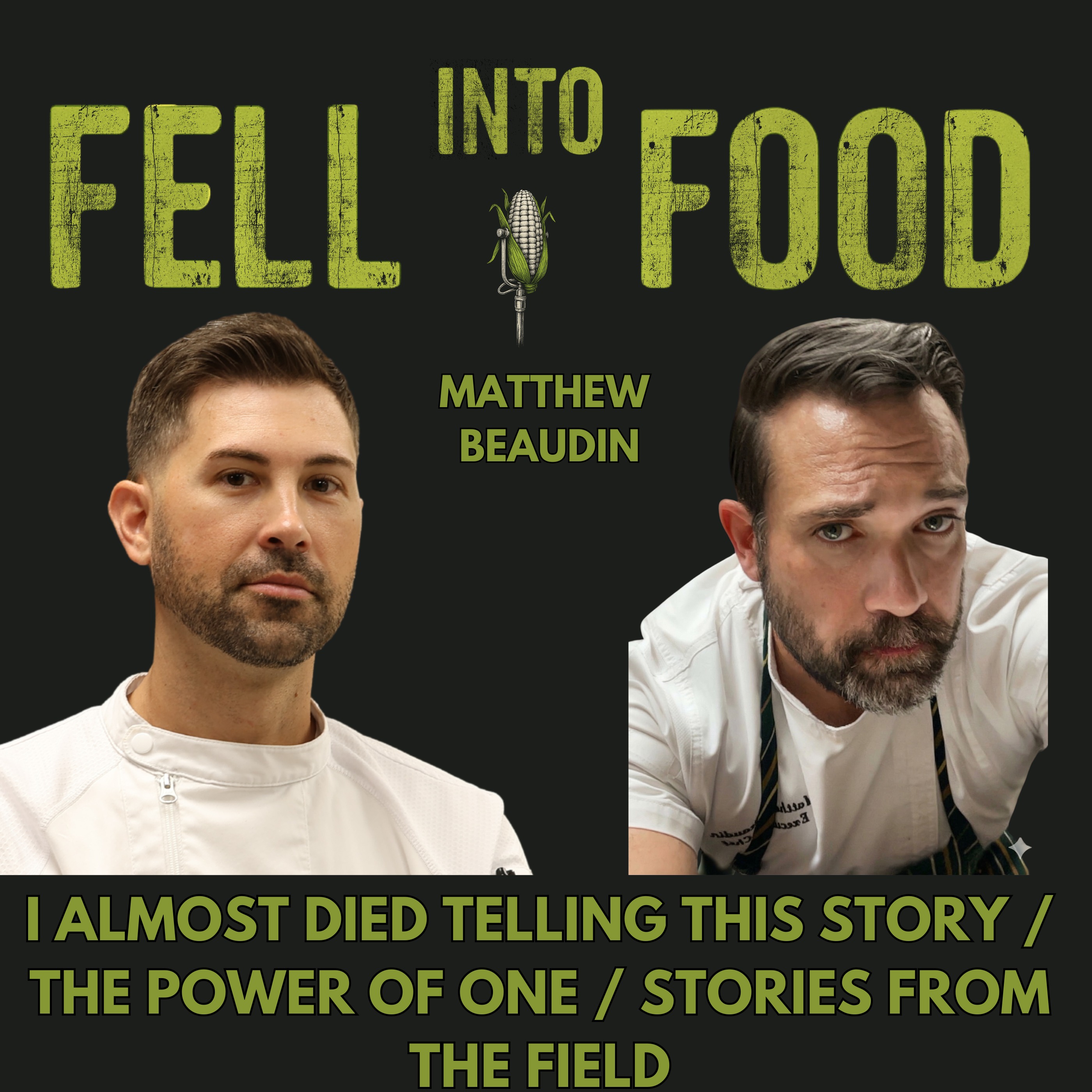
MATTHEW BEAUDIN: I ALMOST DIED TELLING THIS STORY / THE POWER OF ONE / STORIES FROM THE FIELD
Most people talk about sustainability from a conference stage. Chef Matthew Beaudin talks about it from a trash beach in Ghana where someone just threatened to stab him.
Matthew is a VP of Culinary for Higher Education, and he's spent the last decade logging 250 to 280 days a year on the road — Vietnam, Ghana, the Mekong Delta, a barbecue joint in Texas where he got the last two sandwiches because he happened to be wearing his chef coat. He didn't set out to become a food journalist or a culinary advocate. He set out to see it for himself. And somewhere between going blind in a hotel room in Vietnam, coughing up blood, and making a connecting flight through South Korea while running a full-body infection — he decided that's exactly where he belongs.
This conversation goes everywhere. We talk about why he went all-in on higher ed dining, what a room full of CIA chef students taught him about Gen Z, and why sustainability isn't expensive — your restaurant is just greedy. We also get into the Cocoa Research Institute in Ghana, the first one ever built, and what it means that a group of scientists are racing to preserve the integrity of cocoa before we engineer it into something unrecognizable — the same way we did with corn and tomatoes.
Two small-town kids who had the same itch to get out. This one goes deep.
Socials
Matthew Beaudin Linkedin: https://www.linkedin.com/in/matthew-beaudin-83424b14/
Time Stamps
0:00 — Intro: Why Matthew Beaudin's Work Hits Different
0:47 — Two Small Town Kids: Kansas, IL and Lincoln, NH
2:52 — VP Culinary Higher Ed — Why Now
7:10 — The CIA Speech He Thought Was Bombing (It Wasn't)
10:05 — Why Gen Z Actually Wants to Make a Difference
13:35 — How to Inject Real Change Through Contract Management
16:53 — Surge, Red Dye #40, and What We Actually Ate Growing Up
18:47 — The Last Brisket Sandwich in Texas
19:35 — LinkedIn and the Art of Sharing Real Moments
22:42 — AI Saturation and Betting on Being Real
24:31 — The Mekong Delta Boat That Almost Capsized
26:43 — Going Blind and Coughing Blood in a Vietnam Hotel at 3AM
28:12 — The Trash Beach in Ghana and Nearly Getting Stabbed
32:08 — Why He Uses His Platform for Voices That Can't Get Out
32:42 — "There's Something Broken in Me"
37:29 — Inside Ghana's Cocoa Research Institute with Cho Chocolate
42:09 — Sustainability Isn't Expensive — Your Restaurant Is Just Greedy
43:10 — Jeff's University Beef Program: What Actually Worked
45:32 — How Do You Actually Tell the Story to Diners?
48:15 — Fear of Doing Nothing
50:42 — What Matthew Eats When No One's Watching
52:40 — Advice for the Next Generation: Believe in the Power of One
54:19 — Where to Find Chef Matthew Beaudin
Listen to the full episode and more! It would mean the world to me if you could leave a 5 star review on your listening platform to help grow and expand the Podcast.
YouTube - https://lnkd.in/gQM3S5mr
Spotify - https://lnkd.in/g_5kFXie
Apple Podcast - https://apple.co/41RoTm4
Pandora - https://lnkd.in/gS-wu_YJ
YouTube: https://youtube.com/@FellIntoFood
Linkedin: linkedin.com/company/fell-into-food
Instagram: http://instagram.com/fell_into_food
Facebook: https://facebook.com/fellintofood
Advertising Inquiries: https://redcircle.com/brands
Privacy & Opt-Out: https://redcircle.com/privacy
Available Results
Generated results are saved to the knowledge database for reuse and search.
Extract Knowledge
Pick what you want extracted first. Model, scope, and chapter options appear after a template is selected.
Transcript
[SPEAKER_00]: This could very well be the story I don't get to tell because I died telling you.
[SPEAKER_00]: He said, oh, they said they're going to kick your ass where if they were to stab you, then you would have to pay them.
[SPEAKER_00]: So, well, that doesn't sound like I'm fine right now.
[SPEAKER_00]: It's unblind and both eyes.
[SPEAKER_00]: No, I don't understand what's happening right now.
[SPEAKER_00]: And so, I start coughing and I look in the sink and I'm coughing up blood.
[SPEAKER_00]: Like this industry eats people up.
[SPEAKER_00]: Literally, I watch my 37 year old friend die of cirrhosis.
[SPEAKER_00]: and I'll be damned if I just sit back and wait for it.
[SPEAKER_03]: Shop big big thanks.
[SPEAKER_03]: I follow you on LinkedIn religiously.
[SPEAKER_03]: To me, you're more than just a chef.
[SPEAKER_03]: You're a food journalist, you're a culinary advocate, a lover of food, man.
[SPEAKER_03]: Like everything you write is so fucking inspiring because I see it and I see what you've done.
[SPEAKER_03]: And it's more than just a mission trip of like, hey, look at me.
[SPEAKER_03]: I'm out in the field.
[SPEAKER_03]: And I've gone to this forest.
[SPEAKER_03]: I've gone to that mountain.
[SPEAKER_03]: You do it because you have a cause and a love of it.
[SPEAKER_03]: And I just have to applaud you first.
[SPEAKER_03]: First and foremost, I had to get that out of the way before we even have pretty much anything else.
[SPEAKER_00]: So, thank you.
[SPEAKER_03]: So, man, I want to start with just tiny bit.
[SPEAKER_03]: I heard on another podcast you talked about you grew up in a small town.
[SPEAKER_03]: I didn't know it was possible for anyone to grow in a grow up in a smaller town than I did, because I grew up in my class was 16 including me.
[SPEAKER_03]: Okay.
[SPEAKER_03]: And
[SPEAKER_03]: The entire K-12 was in one building in a big U, and at the end it was like 700, 700 people.
[SPEAKER_03]: So when I heard that I was like, there is no way somebody else.
[SPEAKER_03]: Were you in Lincoln to Hampshire also?
[SPEAKER_03]: No, I was in a tiny little town called Kansas Illinois.
[SPEAKER_03]: That's where I was hiding out.
[SPEAKER_00]: You know, Kansas Illinois.
[SPEAKER_03]: Yeah, I know.
[SPEAKER_03]: People were you from, I said, Kansas, and then you got to give him the whole rig a mortem of, no, not the state, the little town.
[SPEAKER_03]: But did you ever feel like when you were growing up in such a small town that you were going to be stuck in tiny town USA for the rest of your life?
[SPEAKER_00]: Did I did it?
[SPEAKER_00]: And I'll be honest, but when I was a kid, like, I'll never forget the fear, living in Lincoln, New Hampshire, Plymouth, New Hampshire was a close thing.
[SPEAKER_00]: Like, that's where, like,
[SPEAKER_00]: The grocery store was the big one.
[SPEAKER_00]: Like if you wanted to knock it ripped off in town, go to Plymouth.
[SPEAKER_00]: And I remember it's like, it was 18 miles.
[SPEAKER_00]: And so it took a 30 minutes to get there through the White Mountains in New Hampshire.
[SPEAKER_00]: And I'll never forget, I was like 14 years old, driving with my mom.
[SPEAKER_00]: And I was like, how am I going to get here by myself?
[SPEAKER_00]: like this is this is too far away.
[SPEAKER_00]: I'm not going to remember how to get in the only way to get there is to get on the highway and get off the highway.
[SPEAKER_00]: There's no other terms.
[SPEAKER_00]: There's no exits.
[SPEAKER_00]: It's literally one highway that goes from the top of New Hampshire to the bottom of the Hampshire and every exit off it.
[SPEAKER_00]: There's no roundabout.
[SPEAKER_00]: There's no no interchange.
[SPEAKER_00]: I'm never going to be able to find my way to plymoth.
[SPEAKER_00]: And so to go from how the hell am I going to get 18 miles and remember to now.
[SPEAKER_00]: Bro, when we started talking, I couldn't even remember what state I was in just now.
[SPEAKER_00]: It took me a minute to tell you Texas.
[SPEAKER_00]: And so, to now know that is home, home, small town America turns into every small town in America's home.
[SPEAKER_00]: I am where I am.
[SPEAKER_00]: This is my home right now.
[SPEAKER_00]: I'm in Texas, Texas.
[SPEAKER_00]: My home today.
[SPEAKER_03]: Yeah.
[SPEAKER_03]: That's fantastic.
[SPEAKER_03]: And now, you know, you're serving just recently and congrats a VP culinary higher ed.
[SPEAKER_03]: Why, why now?
[SPEAKER_00]: Why did you choose to go higher ed?
[SPEAKER_01]: And I was super, super comfortable, and my life was really easy.
[SPEAKER_01]: I think that was the problem, a 41.
[SPEAKER_00]: And I was like, man, I can't, I can't, I can't you do in this, 11 years, went by in the blink of an eye.
[SPEAKER_00]: average 250 to 280 days a year in the road right now.
[SPEAKER_00]: I have for the past nine years and so all you got to do is blink again in 11 more years ago on on 52.
[SPEAKER_00]: Call it a midlife crisis.
[SPEAKER_00]: I just had this moment of, if I don't do this now, there's going to be a problem.
[SPEAKER_00]: And so,
[SPEAKER_00]: looking at this next generation.
[SPEAKER_00]: This and if I spend the next 20 years talking to you and talking to me.
[SPEAKER_00]: Worst crew, bro.
[SPEAKER_00]: We're going to be six.
[SPEAKER_00]: We're going to be 60 like it's over.
[SPEAKER_00]: What are you going to do?
[SPEAKER_00]: 60 years old.
[SPEAKER_00]: You're going to be in the grocery store.
[SPEAKER_00]: Like, hey, just so you know, you should be buying like it's a waste.
[SPEAKER_00]: It's done.
[SPEAKER_00]: If you don't already believe it, it's going to be real hard for me to get you to believe it.
[SPEAKER_00]: But I can engage with this next generation
[SPEAKER_00]: and get them to understand, and the craziest part is, do they're asking for it?
[SPEAKER_00]: When I was a chef, do 20 years ago, sustainability was, I don't want to offend anybody, but like people, I mean, you're just a hippie, like get out of my face, like it wasn't a thing.
[SPEAKER_00]: And so now it's this movement, right?
[SPEAKER_00]: This, this, this, this renaissance of people that are like, we've broke it.
[SPEAKER_00]: And I think it's got to do with everything else being broken right now.
[SPEAKER_00]: It's just a shit show from top to bottom.
[SPEAKER_00]: And so now it's like, well, how can we, how can I affect my life?
[SPEAKER_00]: And my life is, I can eat better.
[SPEAKER_00]: I can take care of myself.
[SPEAKER_00]: I know what's going in my body.
[SPEAKER_00]: I know where it came from.
[SPEAKER_00]: And like, to me, you coming up is chefs like food network was just coming out.
[SPEAKER_00]: Right, we, we have people think like, oh, you had a cool because chefs got cool when we started, but at the same time, it was hard because everyone thinks they're a chef, right?
[SPEAKER_00]: They all think they know, I watch a food network last night, so I know how to make that or block down, like, ah, okay, so, so, you know, there's this, there's this whole generation of people now do that just, they think they're, they're educated.
[SPEAKER_00]: And so,
[SPEAKER_00]: taking a stand and saying, I'm going to educate people in a way that is meaningful, and I'm going to take this 10 years of experience I have in a genre bro that I don't belong in.
[SPEAKER_00]: I don't belong.
[SPEAKER_00]: I'm doing sustainability and conservation dude in a white coat.
[SPEAKER_00]: It's not me.
[SPEAKER_00]: I don't belong here.
[SPEAKER_00]: I was the bottom of my class.
[SPEAKER_00]: I was the dropout.
[SPEAKER_00]: Like I was, this is not my story.
[SPEAKER_00]: But I'm making a story.
[SPEAKER_01]: Yeah.
[SPEAKER_03]: I education as a obviously special place for me.
[SPEAKER_03]: I was in it for 10 years.
[SPEAKER_03]: I ran universities, you know, for a great chunk of my career.
[SPEAKER_03]: I got in the contract management very early in my food career.
[SPEAKER_03]: And so all I knew was about that stuff.
[SPEAKER_03]: But I want to know like what the difference now.
[SPEAKER_03]: Because now looking back, I mean, it's been a hot sentence since I've been in that space to your point and things change rapidly.
[SPEAKER_03]: Just as that, I know food, things usually go a little bit slower than the rest of the world.
[SPEAKER_03]: But things are changing.
[SPEAKER_03]: And when I was in it,
[SPEAKER_03]: you could see that there was a need request ask for more transparency in food, but nothing like from what I read about today, because I'm not living it, right?
[SPEAKER_03]: I'm not in those those spaces right now, like literally talking to college students anymore.
[SPEAKER_03]: So do students actually want like the truth of what's going on with the global supply chain, what's actually out there, or is it still a buzzword?
[SPEAKER_03]: And they say they want sustainability,
[SPEAKER_00]: But in reality, whatever gets to put out the agency, I think they they've really truly believe in it That's why I chose now.
[SPEAKER_00]: So kind of the the precipice for me to get into this world that I'm in where I'm I'm trying to affect the the collegiate dining scene Is as at the colonel Institute of America in high park and I was doing a speech in
[SPEAKER_00]: Dude, I don't care how many speeches I get in my life.
[SPEAKER_00]: I'm always nervous.
[SPEAKER_00]: It doesn't matter if people look like, oh, you're great.
[SPEAKER_00]: So easy, like, no, dude, it is the scariest, most mortifying thing I've ever done.
[SPEAKER_00]: Sweaty palms, like, it is every time, every time I'm like, don't pass out, dude, just don't pass out.
[SPEAKER_00]: And so I'm standing in front of this class of 22 students at the CIA and they're all in Chef Coates.
[SPEAKER_00]: And keep mind, I went there, but I didn't feel like I belong there ever.
[SPEAKER_00]: And so I sure as hell,
[SPEAKER_00]: And so I'm talking to them about seafood and about a mangrove, black tiger shrimp and a project that we're going to Vietnam.
[SPEAKER_00]: And they're like, I see him talking to each other and they just make it fun to me the whole time.
[SPEAKER_00]: Like, no, they're bagging on me right now.
[SPEAKER_00]: And so they're staring off, couple of masks and like kind of smart ask questions.
[SPEAKER_00]: Well, not everyone's good for Vietnam.
[SPEAKER_00]: What do we do if we can't get trips like you?
[SPEAKER_00]: We don't all have opportunities like you.
[SPEAKER_00]: What do we do if we don't have the opportunity you had?
[SPEAKER_00]: My man, these guys aren't getting it.
[SPEAKER_01]: I was at the front of the room in more than half the class state, and we probably spoke for another 45 minutes, and it was this moment of like I thought they weren't listening.
[SPEAKER_00]: I thought they were bagging on me, I thought it was a lost cause, I thought it was talking to a wall.
[SPEAKER_00]: But they were talking about all the stuff I was talking about.
[SPEAKER_00]: They were so excited.
[SPEAKER_00]: They couldn't wait till the end.
[SPEAKER_00]: They were so engaged.
[SPEAKER_00]: They couldn't sit still.
[SPEAKER_00]: They wanted to ask questions.
[SPEAKER_00]: And I realized that like, this is the time.
[SPEAKER_00]: This is the generation.
[SPEAKER_00]: They want it more than ever.
[SPEAKER_00]: Like, they are going to be the ones that are talking shit to us later.
[SPEAKER_00]: Like, what are you doing?
[SPEAKER_00]: Are you still eating that garbage shrimp?
[SPEAKER_00]: Or are you still using plastic?
[SPEAKER_00]: Are you still not engaging with sustainability and conservation in a meaningful way in everyday life?
[SPEAKER_00]: Like, it's not always about like seafood.
[SPEAKER_00]: And so to your point, yeah, bro, I think they're more engaged now than they ever have it.
[SPEAKER_03]: And what do you like what is it at the core that wants to make these changes and in to your point and like maybe dig in like is it sustainability is it regenerative agriculture like what is it that they want to do because there's so many pieces to the food supply chain and obviously you can only change so much but what is it what were the students saying what were they what was it that was making them drive and want to make changes and have these conversations.
[SPEAKER_00]: The ability to make change.
[SPEAKER_00]: And I think that is the differential, right?
[SPEAKER_00]: Like when we grew up, you know, for me, like I didn't think I could make a difference, dude.
[SPEAKER_00]: Like I didn't, we didn't have platforms.
[SPEAKER_00]: And there's a podcast didn't exist when I was a kid, bro.
[SPEAKER_00]: Like you listen to the radio.
[SPEAKER_00]: Like I tinfoiled my radio, bro.
[SPEAKER_00]: Like I, you know, like we didn't have the opportunity to have a voice.
[SPEAKER_00]: like this generation does, their voice carries.
[SPEAKER_00]: You can get 15, 16, 17-year-old kids with one million followers on social media, pro-they have a voice.
[SPEAKER_00]: They have a voice.
[SPEAKER_00]: It's not like I wanna go save the ocean is driving it.
[SPEAKER_00]: It's not that I see the Pacific garbage patch and I realize it's a problem.
[SPEAKER_00]: All that stuff's excessive forever.
[SPEAKER_01]: This generation goes, if I want to, I can make a difference.
[SPEAKER_01]: We never had that.
[SPEAKER_00]: Nobody ever said, it's Jeff, and Matt, if you guys go on the radio, someone's gonna listen.
[SPEAKER_00]: Nobody.
[SPEAKER_00]: And if somebody would've been like, if you started a website, you could have a million followers one day and you could make a change.
[SPEAKER_00]: Like these kids get on there and ticked talk and Instagram and Facebook, they make a difference, dude.
[SPEAKER_01]: And so the answer I think is because they can,
[SPEAKER_00]: People around them, the same age, making change.
[SPEAKER_00]: And they hear people like you, and people like me, listening, and going, hey, these guys want it.
[SPEAKER_00]: We're hearing what they're saying.
[SPEAKER_00]: And they're going to listen to this and go, they heard us.
[SPEAKER_00]: Someone will listen to this.
[SPEAKER_00]: Someone's going to listen to this podcast and go, I've been talking about that forever.
[SPEAKER_00]: These old dudes are listening.
[SPEAKER_00]: Like, it's going to happen.
[SPEAKER_00]: So I just
[SPEAKER_00]: It is, it is, the world is alive in listening and there's this opportunity to literally be the drop of water that starts the whole wave.
[SPEAKER_03]: Yeah, it's hard to see.
[SPEAKER_03]: It's crazy to think that we are the old guys, even though it's for right there at that 40, you know what I mean, it just, it's like, I've always viewed myself as the young guy and the vibrant up and coming, whatever, you know, again, I didn't go find dining route, but like just up and coming and now you look back and you're like,
[SPEAKER_03]: No, I'm not the world, but we're on that precipice of going over and so now It's it's a storm or not the young bucks anymore.
[SPEAKER_03]: Yeah.
[SPEAKER_00]: Yeah, yeah, we have to hand the torch man I don't want to wait till I'm 60 to hand the torch now saying like I want to hand it now Ignite the fire in this next generation so that I can sit back at 15 go man
[SPEAKER_00]: That was a lifeball lived, made an impact, and look at these guys go.
[SPEAKER_00]: They're gonna look at us and go, man.
[SPEAKER_00]: They listened, it'd be nice to look at them and go.
[SPEAKER_00]: Hey, actually, let's, we always had the drunk uncle, right?
[SPEAKER_00]: He's always saying, oh man, don't do this and don't do that and I would have done this.
[SPEAKER_00]: I wanna get this stuff out before I'm drunk uncle, age.
[SPEAKER_00]: You know what I'm saying?
[SPEAKER_00]: Before they stop listening, we still relate to this age.
[SPEAKER_00]: They look at us and go, like, oh, I can see myself.
[SPEAKER_00]: doing what you're doing.
[SPEAKER_00]: I can see myself as your age.
[SPEAKER_00]: I hope.
[SPEAKER_00]: I think they think that.
[SPEAKER_03]: Yeah, what's your plan to change the higher ed food scene?
[SPEAKER_03]: I know at an operator's level, right?
[SPEAKER_03]: When you run the university, you have some control because usually you're really close with your partner, the university, and so you can kind of push some agenda change.
[SPEAKER_03]: But when you start
[SPEAKER_03]: I hate to say it red tape gets evolved a lot.
[SPEAKER_03]: There are a lot of corporate politics that come in that space having been in it.
[SPEAKER_03]: So how are you going to make those changes or what's the plan?
[SPEAKER_03]: How do you actually inflict from all the experience that you've taken over all these past 11 years?
[SPEAKER_03]: How do you actually inject that into this scene through contract management?
[SPEAKER_00]: I think the biggest piece I've realized in overall, whether it's cultural attractions or education.
[SPEAKER_00]: it's telling a story.
[SPEAKER_00]: Like, if there's no red tape and telling stories, I can explain it all day long.
[SPEAKER_00]: I can build momentum.
[SPEAKER_00]: I can build desire and need and in people to ask for this stuff.
[SPEAKER_00]: Sure, when you when you come up with these ideas that I left field, it's real hard to to justify like why it's worth it, right?
[SPEAKER_00]: It's real hard to say you need to engage in sustainability because I think so.
[SPEAKER_00]: Sure.
[SPEAKER_00]: But where at a stage where it's not about me, I'm the tool for the students to use, I'm the tool for the clients, I'm the tool for the company I work with, where I can sit back and go, let me engage in these storytelling opportunities for you.
[SPEAKER_00]: Let me get this word out there, like, you know, serving seafood watch, green best choice
[SPEAKER_00]: or serving fresh, never frozen beef, right?
[SPEAKER_00]: There's these things where the stories just need to be told.
[SPEAKER_00]: Walking into some of these cafes, and like, they're eating Smash burgers.
[SPEAKER_00]: Like literally the beast balled up, they're crushed them on the grill, like the fries are hand-cut, blanched, fry again.
[SPEAKER_00]: There is this like, it's happened, the pickles are house made, like it just reads hamburger.
[SPEAKER_00]: It's like wait a second.
[SPEAKER_00]: We're not telling the story.
[SPEAKER_00]: We're doing a work.
[SPEAKER_00]: People don't even know how lucky they are.
[SPEAKER_00]: When I was in college, I was burger real time.
[SPEAKER_00]: You know what I'm saying?
[SPEAKER_00]: You're eating off a burger real.
[SPEAKER_00]: It was a silver question mark is what came out on your tray?
[SPEAKER_00]: Like what's it going to be in there when I open it today, we're all in.
[SPEAKER_00]: It is a different world now.
[SPEAKER_00]: I think a lot of these students are making decisions on where they're going to go to school, based on the dining programs, based on the meal program, it's either all you can eat or it's a swipe fee or people spend their entire, like, teen years in college, man.
[SPEAKER_00]: It's the, you don't want to spend it eaten junk.
[SPEAKER_00]: And that's the other part.
[SPEAKER_00]: Bro, we popped hearts and, you know, ramen noodles and every treat owes and fluorescent this and bright orange that and bright red this and yellow and green and every,
[SPEAKER_00]: color with a number after it broke our parents didn't care and I didn't your vibe of my didn't you got what you got that was bro surge for real surge oh my god I'm going to dark broke on we drank it these these guys are engaging with a food you know in a way that we didn't are the reading labels
[SPEAKER_00]: They're asking questions like, if I, why is there petroleum in my food?
[SPEAKER_00]: Bro, that doesn't make sense.
[SPEAKER_00]: Why is the number one ingredient, something I can't pronounce?
[SPEAKER_00]: Doesn't make sense, right?
[SPEAKER_00]: Like, I just, it's a hell of a time to be in food service.
[SPEAKER_00]: And it's a hell of a time to be working with this generation.
[SPEAKER_00]: I, in like you, I don't look at myself as the old guy, you know, I, I, I say I'm the old guy to ground myself and remind myself that I'm not that young anymore, but I, I also, I want to engage with these guys because they, they're fun and they're cool and, and they, they want to understand it and they keep me young, you know, like, they keep me asking questions, like, you get to set in your ways at a certain age and you start, you can't teach an old dog
[SPEAKER_00]: You know, I'm learning every single day, and that's been kind of my mantra this past couple of years.
[SPEAKER_00]: I'm going to reach out to everyone.
[SPEAKER_00]: And I'm going to ask questions to anyone that'll listen, you know, and whether it's the commissioner of the maritime for the United States or the head of seafood watch or it doesn't matter.
[SPEAKER_00]: I just want to know why.
[SPEAKER_00]: You get by a car tomorrow, you know, just enjoy it.
[SPEAKER_00]: I literally just came down, have been running around all day.
[SPEAKER_00]: And I stopped at a barbecue place because I drove by, and I'm with another guy, and I was like, dude, there's a line outside that barbecue spot.
[SPEAKER_00]: Probably 80 people deep.
[SPEAKER_00]: I said, I've never seen that in my life.
[SPEAKER_00]: And so we turned around, got in line.
[SPEAKER_00]: And as we're walking up, there's a piece of butcher paper hanging on the door.
[SPEAKER_00]: And the lady at the front keeps coming out and writing, sold out, sold out, like, like, like, bro's gonna be nothing left, like it there.
[SPEAKER_00]: And so, like, as I'm getting closer, he's left.
[SPEAKER_00]: Seven pounds of brisket left, three pounds of brisket left, one pound, I said, oh, come on!
[SPEAKER_00]: And like, who people out?
[SPEAKER_00]: And I get up in the lady in front of me, she goes, I'm sorry, guys.
[SPEAKER_00]: I'll take whatever brisket you have left.
[SPEAKER_00]: I said, bro, you're for real?
[SPEAKER_00]: And so I happened to remember my chef coat, which was my only saving grace because they got in the back was a chef and he looked at me and he goes I got you so she went and he goes I got to let that's it and he hooked me up but I literally got the last image, but it was like I'm just enjoying where I'm at and being in the moment and like just going with it man like you never know what tomorrow is going to hold you know and so I just like dive in to anything anywhere.
[SPEAKER_03]: And you can see that through your writing, you know, LinkedIn is how I consume what you have to offer and I again, I truly believe that you are a part chef part journalist part culinary advocate from from the way that you convey your message, you know, when you're writing those posts, you know, who's your audience like what are you thinking about when you're taking a picture from wherever it is and sometimes it's.
[SPEAKER_03]: The simplest of pictures and then other times your needy god damn in a freaking jungle in Ghana But the messages are so clear and and come through so well, so I guess the question you know who's your idea like what do you who are you writing to it and how does that inspiration come just so naturally
[SPEAKER_00]: Yeah, I would say the moments I share, I try and share the most real moments.
[SPEAKER_00]: And so I think that's the difference.
[SPEAKER_00]: You'd be hard pressed to go on my LinkedIn and find a staged moment.
[SPEAKER_00]: Because while the pictures are there, if I'm really uncomfortable, I'm like, hey man, do me a favor to take a picture right now.
[SPEAKER_00]: Because I'm like either super nervous, super anxious, super uncomfortable, super out of my comfort zone lost.
[SPEAKER_00]: You know what I mean?
[SPEAKER_00]: Like I was eating crawfish at 10.30 last night in Shreeport right after I landed.
[SPEAKER_00]: And I'm like sweating, my fingers are dirty, my mother, and I sent it to my mom.
[SPEAKER_00]: And she goes, that is the most unattractive thing I've ever seen in my life.
[SPEAKER_00]: And I said, I know, I said, that's the point.
[SPEAKER_00]: And you're never going to get to see no one sense the unattractive stuff.
[SPEAKER_00]: Everyone's like, here, looking me, I'm peeling a croffek.
[SPEAKER_00]: But your fingers aren't clean when you're peeling a croffek.
[SPEAKER_00]: That's not, that's not what happens.
[SPEAKER_00]: You're not not sweating when you're eating boot-in.
[SPEAKER_00]: Like, is making your eyes sweat and you're like, okay, I can probably make it back to the house because you've got the meat sweats.
[SPEAKER_00]: Your guts are in a absolute bind.
[SPEAKER_00]: I'm eating something called swamp sauce, bro.
[SPEAKER_00]: Come on.
[SPEAKER_00]: That ends one way.
[SPEAKER_00]: That literally ends one way.
[SPEAKER_00]: So I share the moments that are real, and I think that that's what helps me relate to people is I'm writing to the people who want real, who want to read something that's not AI that's not just tailored to fit that doesn't belong in a magazine, you know, and like the one thing that might my goal was to do a bunch of podcasts this year and engage on a different level and be myself more, you know, because for the best.
[SPEAKER_00]: I don't know, eight years, I do these podcasts and it's like, very set.
[SPEAKER_00]: Yes, here's what I do, and this is sustainability, and this is, and so I engage on all answers to the same questions.
[SPEAKER_00]: If you could go listen to any podcast I did, and that will probably hit the same cadence, the same thing, answer the questions the same way, but this year I've committed to be in real.
[SPEAKER_00]: This is me.
[SPEAKER_00]: You like it.
[SPEAKER_00]: You don't like it.
[SPEAKER_00]: I'm going to be me, you know, and I feel like
[SPEAKER_00]: people want that dude.
[SPEAKER_00]: I'm all about it.
[SPEAKER_00]: We need it in food.
[SPEAKER_00]: It's going to be cool.
[SPEAKER_00]: Robots not taking my job at any time soon.
[SPEAKER_00]: But there's going to become a moment when we've been so over saturated.
[SPEAKER_00]: We're just done.
[SPEAKER_00]: I want to talk to a real person.
[SPEAKER_00]: I want to sit in a room with you.
[SPEAKER_00]: I want to shake your hand.
[SPEAKER_00]: I want a hug.
[SPEAKER_00]: Like I want real.
[SPEAKER_00]: And I think we're gonna get there faster than people realize.
[SPEAKER_00]: And so I've bet on being a voice of real in a space that is crowded with absolute trash.
[SPEAKER_03]: That's a lot to digest.
[SPEAKER_03]: And I absolutely appreciate that fact because that's what I've been trying, I think I've been trying to do with this podcast is be real, be authentic.
[SPEAKER_03]: And a lot of guests will go, what questions are you gonna ask?
[SPEAKER_03]: I have kind of a baseline of like what I kind of want to touch on and like dude you should see my random section of some shit that I'm going to ask you that is like all over the damn board because of who you are, but I don't want to have a fully staged conversation that sounds like every other conversation that's out there because what's the point to your just what you said it's the same questions it's the same cadence.
[SPEAKER_03]: People pick up on that.
[SPEAKER_03]: It's not a real conversation like what we're having.
[SPEAKER_03]: This is a real conversation.
[SPEAKER_03]: This is two chefs shooting the shit I've got some questions that like literally I was I've been looking forward to this conversation for quite some time because of the way that you
[SPEAKER_03]: Just your writing everything that you've done.
[SPEAKER_03]: It's something that I can look up to because I can learn from it I learned from the things that you post not just oh cool He's doing this today and he's he's here and man I wish I could do that.
[SPEAKER_03]: No, it's like he has the balls to actually go out and do the stuff that everyone talks about and says that they want to do and they're I'm gonna be for the environment, but they don't actually go and do it they hide behind
[SPEAKER_03]: the wall, they sent the computer and they hope somebody else goes out and does it and nobody does.
[SPEAKER_03]: So they're trying to make a change without actually knowing what the hell's going on in the real world.
[SPEAKER_00]: I'm so glad you just said that.
[SPEAKER_00]: So to your earlier question of who am I talking to, you literally just hit it on the head.
[SPEAKER_00]: I have said before, I want to be in the places people are afraid to go.
[SPEAKER_00]: And everyone's like, oh, you have the coolest life, man, you get to go to all these epic places and grow.
[SPEAKER_00]: That's not how it works.
[SPEAKER_00]: Like that's, it's not all epic places.
[SPEAKER_00]: I have an amazing video of me going down the May Kong Delta on like these waves and I got my hat on and where my avid is my Ray Bands and I'm laid back, bro.
[SPEAKER_00]: But the video, I took for me because what nobody sees in the video is I had taken my boots and I had untied them
[SPEAKER_00]: And I had the the laces off as much as I could because I was 100% sure we were going into the may come because the river was so choppy, they couldn't turn around because they tried to turn around when they did the boat stalled.
[SPEAKER_00]: They got it going again and got us going in the right direction, but we were going to capsize.
[SPEAKER_00]: and it was a boat that literally was like three quarters covered.
[SPEAKER_00]: So I moved to the very back so that if it flipped, I would have a better chance of living.
[SPEAKER_00]: And it's like, it's great.
[SPEAKER_00]: It's great to like see the stories after them.
[SPEAKER_00]: They call, yeah, I got to go on the makeup and I was working, sure.
[SPEAKER_00]: But I was 100% sure I was gonna die.
[SPEAKER_00]: But I went to Vietnam.
[SPEAKER_00]: Three times, on the last time I went, I had spent one night in Bangkok, which is a whole other story.
[SPEAKER_00]: And I came back from Bangkok, went to Vietnam, stayed in a hotel, and I could start feeling down that night.
[SPEAKER_00]: I'd be around, I got a flat tomorrow morning, and I had to be in Switzerland in two days.
[SPEAKER_00]: And so I went to bed, I woke up at like three in the morning to use a restroom, and I'm like, got out of bed, I'm like, oh, I can't see, and I'm doing this.
[SPEAKER_00]: I got to hell, I can't see,
[SPEAKER_00]: Wait, I really can't see him, and I go on the bathroom, I literally can't see lights come on, everything's foggy.
[SPEAKER_00]: I'm like, what, so I hold my eyes open, trying to wipe stuff out of my eyes, I'm blind in both eyes.
[SPEAKER_00]: Now I do it, I don't understand what's happening right now.
[SPEAKER_00]: And so I start coughing, and I look into thinking, I'm coughing up blood.
[SPEAKER_01]: Shit.
[SPEAKER_00]: And so I'm like, oh, okay, well, now I'm freaking out like, like, this is insanity.
[SPEAKER_00]: So I had to wake up in two hours and go to the airport.
[SPEAKER_00]: Meanwhile, I'm stopping over in South Korea, which is like, if you've been there, they've built the mometer in the ceiling that are like, light-arring your head to make sure that you don't have a fever, like, don't get in the stop of South Korea.
[SPEAKER_00]: This is where it all ends, I'm gonna die.
[SPEAKER_00]: So I get finally to South Korea.
[SPEAKER_00]: I go there with a farm.
[SPEAKER_00]: And like, you have something for my eyes?
[SPEAKER_00]: It goes, oh, pink eye.
[SPEAKER_00]: And it gives me this little bottle.
[SPEAKER_00]: And I was like, sure, this is for like my eyes.
[SPEAKER_00]: He's a guy.
[SPEAKER_00]: So then I was like, I want something for my eyes.
[SPEAKER_00]: And so I make it back to the U.S. And I go to my doctor and I'm like, hey, bro, I'm going to be in Switzerland literally the day after tomorrow.
[SPEAKER_00]: I think I'm dying, can I come in?
[SPEAKER_00]: You're the chore.
[SPEAKER_00]: Turns out I caught some virus, and it was an infection in my chest and in my head.
[SPEAKER_00]: And my nose and my sinus was so backed up, it was pushing the snott out of my tear ducts.
[SPEAKER_00]: And so my eyes were filled with not my chest was inflamed.
[SPEAKER_00]: The blood was everything was just inflamed.
[SPEAKER_00]: I was coughing in my chest and he's like, if you're going anywhere, but twitching on that tell you, don't go, but they've got good medical.
[SPEAKER_00]: So you're good.
[SPEAKER_00]: Give me a couple shots, put me on some antibiotics and set me over.
[SPEAKER_00]: Um, then Dell's lost my bag and I didn't have my antibiotics and that was a whole different story.
[SPEAKER_00]: But, um, yeah, I mean, the stories are great, right?
[SPEAKER_00]: But like you said, I go, and it's, it's real, like, these are real things, dude.
[SPEAKER_00]: Like, this is really happening.
[SPEAKER_00]: And I, nine times out of ten when I'm there, I am like, I shouldn't be here.
[SPEAKER_00]: I shouldn't be doing this like this could very well be the story.
[SPEAKER_00]: I don't get to tell because I die telling it.
[SPEAKER_00]: I'm in these situations like you said because I believe it dude, we're with a Ghana.
[SPEAKER_00]: And I wanted to go see this beach.
[SPEAKER_00]: So in Ghana, there's a village, a shanty village, fishermen village.
[SPEAKER_00]: And they pull all the big wooden boats in.
[SPEAKER_00]: It's incredible.
[SPEAKER_00]: And you go down in the boats, have names from the Bible like Psalms on the side.
[SPEAKER_00]: And it's literally like 10 guys out in a big wooden boat, fishing and nets.
[SPEAKER_00]: And but the village comes at the top of the hill.
[SPEAKER_00]: And all the trash gets thrown on the back of the village.
[SPEAKER_00]: And so the entire hill is trash.
[SPEAKER_00]: And at the bottom of the hill is the ocean.
[SPEAKER_00]: in the fishing boats, in the fish.
[SPEAKER_01]: And I was like, I need to see it.
[SPEAKER_01]: And my driver's a guy you shouldn't go there.
[SPEAKER_01]: So I understand.
[SPEAKER_01]: I said, but I need to see it.
[SPEAKER_01]: He's a guy, but it's not safe.
[SPEAKER_00]: As it can you bring me?
[SPEAKER_00]: He said, I'm not going to bring you, but I know somebody who can.
[SPEAKER_00]: OK, that sounds safe.
[SPEAKER_00]: So I'm needed to buddy down there.
[SPEAKER_00]: And we go down into the village.
[SPEAKER_00]: and as we're getting down, you're like, you need to pay us if you wanna go down farther.
[SPEAKER_00]: It's not happening.
[SPEAKER_00]: So the guy in a go-shay, it's when we get down, we get down, and I'm walking around and I take a picture of this trap.
[SPEAKER_00]: I mean, literally it's trash to my neck.
[SPEAKER_00]: And people sleeping on the ground, sleeping on the trash, his dead sharks literally just like in the trash, like just crazy.
[SPEAKER_00]: And I turn around and there's a commotion behind me.
[SPEAKER_00]: And the guy who brought me down is arguing with one gentleman is done with huge dreads, massive if you've been being definitely kick my ass.
[SPEAKER_00]: And I'm like, what's going on?
[SPEAKER_00]: He's like, no, don't you find your fine.
[SPEAKER_00]: I said, what's happening?
[SPEAKER_00]: Is it your fine?
[SPEAKER_00]: OK, I turn around.
[SPEAKER_00]: There's like three more guys that are all around him now yelling.
[SPEAKER_00]: So I walked over and I said, what is the problem?
[SPEAKER_00]: He's at your fine.
[SPEAKER_00]: I said, can you explain to me, just translate for me, please?
[SPEAKER_00]: He said, oh, they said they're going to kick your ass where if they were to stab you, then you would have to pay them.
[SPEAKER_00]: I said, well, that doesn't sound like I'm fine right now.
[SPEAKER_00]: I said, I said, what is the, what is the ask right now?
[SPEAKER_00]: He said, well, they, they want beers.
[SPEAKER_00]: They want you to buy beers for everybody.
[SPEAKER_00]: I said, for what?
[SPEAKER_00]: He said, for coming to the beach.
[SPEAKER_00]: I said, I'd be more inclined to buy beers for everyone if they cleaned up the beach in our help.
[SPEAKER_00]: And so we sat down and talked for probably 10 minutes.
[SPEAKER_00]: I asked a bunch of questions, and then they walked me to the car, literally threatening me the entire way through my translator.
[SPEAKER_00]: And I did not give them a, and it was this moment of like, I, I, it could have been then, right?
[SPEAKER_00]: Nobody would have known if Matt Bowden got stabbed in the neck by a broken beer bottle on a beach covered in trash and Ghana.
[SPEAKER_00]: It wouldn't, nobody would know.
[SPEAKER_00]: It would have just been a story I didn't get to tell, but it sees these moments of like what was that for I'm telling that story now and that's what it was for.
[SPEAKER_00]: There was for people to realize that those beaches exist and that trashions up here and those people have no options and that is the only option they have and they need help and there is.
[SPEAKER_00]: These places in the world that.
[SPEAKER_00]: to your first question, like do you ever feel like you're going to get out of that small town?
[SPEAKER_00]: Like they have no hope of getting out of that small town.
[SPEAKER_00]: And so they're drowning in trash in the world to fail them.
[SPEAKER_00]: And so from my small town where I got out, I feel like it's my job to use my platform to tell the stories of these people who no matter how hard they fight will never ever get the platform that I have.
[SPEAKER_00]: And so it would be selfish of me to use it for myself.
[SPEAKER_00]: And so that's why I go to these places.
[SPEAKER_00]: Because there's stories that need to be told, there's people who need to be heard.
[SPEAKER_00]: There's voices that will never, ever, ever make it out if I don't take them with me.
[SPEAKER_03]: Where did that initial itch come from?
[SPEAKER_03]: The going to these places and someone tells you, hey, there's, you know, it's where the trash is and then there's just instills a new that says, I need to see it for myself.
[SPEAKER_03]: Where do you think that itch and going all the way back in all these different stories?
[SPEAKER_03]: Where did that come from?
[SPEAKER_00]: I think there's something broken in me, Jeff.
[SPEAKER_01]: I think I seek out broken.
[SPEAKER_01]: broken people or broken places, I feel more comfortable there than I do in a fancy place.
[SPEAKER_01]: I feel more at home when I am fighting to not get beat up on a beach in Ghana than I do
[SPEAKER_00]: You know, but my happy place is in the middle of nowhere in Shreveport at a restaurant that closes in 20 minutes, ordering three pounds of crawfish, sitting in a corner where the light didn't work, but everybody going, are you crazy?
[SPEAKER_01]: What are you doing here?
[SPEAKER_01]: It's not the thrill of it, it's the comfort of it.
[SPEAKER_00]: And once those systems have a way of accepting you or rejecting you.
[SPEAKER_00]: And I say those systems of life were things are real.
[SPEAKER_00]: There is a realness to poverty.
[SPEAKER_00]: There's a realness to despair.
[SPEAKER_01]: There's a realness to violence.
[SPEAKER_01]: hope that you don't get anywhere else, but in the most desolate places, and it's the need to survive.
[SPEAKER_03]: feel like there's a connection with like both of our bringing up in a small town because you're sheltered you you have this life of you know what it is and it is and everybody knows everybody and if something happens 8 a.m. everyone in the town knows it by 3 p.m. or even noon depending on yeah on your town and what the news is and I felt the same way when I had this itch when I said my mid 20s and I was like I have to get out of here like there's something inside
[SPEAKER_03]: And again, why food, you know, I'm glad for a punishment food network came out.
[SPEAKER_03]: Oh, this is great.
[SPEAKER_03]: I like to cook blah blah and went down that path, but even after that point, it's been like, I've felt like a nomad within a Chicago geographical area, but it's been like move from here to here.
[SPEAKER_03]: I need the next thing and the next thing.
[SPEAKER_03]: And I've just never satisfied with the one thing because I feel like I'm going to get so comfortable.
[SPEAKER_03]: What you brought up earlier that I'm never going to leave and I'm going to be stuck doing the same thing for the rest of my life and I feel like I'm going to miss out on everything that there is has to offer in this world and now I'm trying to like get that back and try and really go out as much as I can you know it's a little harder with with with kids but.
[SPEAKER_03]: When I get a chance when somebody's like, Hey, we've not opportunity for this here.
[SPEAKER_03]: Yes, I want to go.
[SPEAKER_03]: I need to see what is out in this world.
[SPEAKER_03]: I don't know.
[SPEAKER_03]: I feel like there's some sort of connection there too that maybe that that small town had a play in both of our lives of wanting to explore this this massive world.
[SPEAKER_00]: Dude, you're absolutely right.
[SPEAKER_00]: I mean, that's that's why I've called Monterey home for the last 11 years, right?
[SPEAKER_00]: I'm going back there this weekend.
[SPEAKER_00]: right I've been on the road for a couple weeks and I finally get to go home and I'm going to get in the fields.
[SPEAKER_00]: I literally called one of the guys who runs a produce company as a kid and I come hang out in the fields all weekend and do what I said I said work.
[SPEAKER_00]: I just I wanted to feel it.
[SPEAKER_00]: I don't it's that small town feel but like the the Monterey
[SPEAKER_00]: what you're talking about.
[SPEAKER_00]: Like you can, you can scratch the edge of like, man, I want to feel like I'm somewhere else.
[SPEAKER_00]: And I can get in the field.
[SPEAKER_00]: And I cannot speak a word of English the entire day.
[SPEAKER_00]: And I can feel like I am so far away from where I really am.
[SPEAKER_00]: And I could sit on a cart in eat lunch with everybody.
[SPEAKER_00]: And I can use the port of potty.
[SPEAKER_00]: And I can get back out
[SPEAKER_00]: You're right.
[SPEAKER_00]: It's that that I want to be home, but I want to feel like I'm not there too.
[SPEAKER_00]: You know, and I think that's what's kept me grounded in that area for man for the last and decade plus, you know, it's probably will keep me there forever.
[SPEAKER_03]: Man so much.
[SPEAKER_03]: I've got a hit.
[SPEAKER_03]: I'm looking at these list of other questions that I'm like, I need to pick his brain on go.
[SPEAKER_03]: So, so let's go.
[SPEAKER_03]: Okay.
[SPEAKER_03]: I want to talk about chocolate because it's a hot topic in what's going on now.
[SPEAKER_03]: You went to Ghana.
[SPEAKER_03]: You literally picked the damn cocoa roast it.
[SPEAKER_03]: You did the whole nine yards, right?
[SPEAKER_03]: So if you want to hear about that, listen to a previous episode with somebody.
[SPEAKER_03]: I know if you talk about going to Ghana and doing the chocolate thing, but
[SPEAKER_03]: You know, is there a point where chocolate stops becoming chocolate?
[SPEAKER_03]: You know, how do we keep the integrity with what's going on in that space?
[SPEAKER_03]: You know, because people are using less cocoa and cacao and they're using palm oil and fillers, like just general thoughts on that as a whole being someone who's actually been ground zero and had to pick the stuff.
[SPEAKER_00]: Okay, first off, that's, that's why I went, because exactly what you just said, I need the real, nothing's real.
[SPEAKER_00]: And so, this is not a plug, anybody.
[SPEAKER_00]: I've worked with show chocolate for a while, right?
[SPEAKER_00]: And the reason I work with those dudes is because they're like you and me.
[SPEAKER_00]: There's no bullshit.
[SPEAKER_00]: They are real and they are going to provide you with real.
[SPEAKER_00]: And so, when I asked and I said, I want to go see it, I want to understand it.
[SPEAKER_00]: Chef Brad Kinzer, he's a Chief Chocolate Theory, he said, listen, bro.
[SPEAKER_00]: I'll take you to Cree, which is the Cocoa Research Institute.
[SPEAKER_00]: First, whenever in the world was based in Ghana.
[SPEAKER_00]: I said, sure, cool, man, let's do it.
[SPEAKER_00]: Three days in a car to get there in the middle of the jungle.
[SPEAKER_00]: And we're sitting in this room.
[SPEAKER_00]: And it's like doctors, bro.
[SPEAKER_00]: It's like doctors from Japan.
[SPEAKER_00]: Chef Brad from Berkeley.
[SPEAKER_00]: All these people, oh god, that don't belong in this room.
[SPEAKER_00]: It's like literally like breaking down chocolate and tasting it like the bean.
[SPEAKER_00]: Not sugar, not what you think chocolate is.
[SPEAKER_00]: Roasting the bean.
[SPEAKER_00]: Grinding the bean and trying it is the most bitter,
[SPEAKER_00]: And they're like, oh, it's like wine to me, like the wine class.
[SPEAKER_00]: I remember back at the CIA, I failed it twice.
[SPEAKER_00]: And um, he was like, like, people be like, I smell, smell cat piss and dirt and I get a little bit of mold.
[SPEAKER_00]: And then you drank it, and then you drank it.
[SPEAKER_00]: What are you doing?
[SPEAKER_01]: And he's like, you taste, you taste cat piss and you drink it.
[SPEAKER_00]: Why?
[SPEAKER_00]: So it was a lot of that, but, but the whole point of them doing it is they are trying to isolate the future of Coco.
[SPEAKER_00]: These folks are trying to make sure the integrity is there, so you don't end up with.
[SPEAKER_00]: the corn we have now, that is 90% sugar.
[SPEAKER_00]: We've gone so far from what corn used to be, tomatoes now, like, but you can't eat fruit anymore without spiking and everyone goes, well, how is fruit not good for you?
[SPEAKER_00]: We've engineered fruit to be all sugar.
[SPEAKER_00]: That's why, well, sugar in fruit isn't bad.
[SPEAKER_00]: Like, well, you're right, but the amount of sugar now in fruit is bad.
[SPEAKER_00]: And so they are looking at how to maintain the integrity of cocoa for the world.
[SPEAKER_00]: Like, I'm sitting in this room and I'm like, bro, I can't even measure the gravity of this situation.
[SPEAKER_00]: I'm sitting here watching the people that are making them, they're like, what did, what did you taste?
[SPEAKER_00]: I was like, don't ask me, I don't know.
[SPEAKER_00]: You don't want to bet the next 100 years on my taste of this chocolate, it cat piss.
[SPEAKER_00]: I just, I, I just, I just, I just, I just, I just, I just, I just, I just, I just, I just, I just, I just, I just, I just, I just, I just, I just, I just, I just, I just, I just, I just, I just, I just, I just, I just, I just, I just, I just, I just, I just, I just, I just, I just, I just, I just, I just, I just, I just, I just, I just, I just
[SPEAKER_00]: There are people out there doing the good work, you know, and that's why I went there in the first place because these partnerships, like an into your point, I do it because I care.
[SPEAKER_00]: I partnered with show, not because I needed a media box check.
[SPEAKER_00]: It was like, hey, what do we do together?
[SPEAKER_00]: I think I always sell chocolate.
[SPEAKER_00]: Like, nah, then it gonna work for me.
[SPEAKER_00]: Is it, well, what do you wanna do?
[SPEAKER_00]: How's that?
[SPEAKER_00]: Maybe we could make a chocolate bar and the chef's like, yeah, let's do it.
[SPEAKER_00]: Even if they're done, that let's do it.
[SPEAKER_00]: He's like, what do you want to put in it?
[SPEAKER_00]: Like, I don't know, bro.
[SPEAKER_00]: We looked at everything from putting a corn powder with, by the, you meet the most interesting humans.
[SPEAKER_00]: You will ever meet in your life when you try and find a corn powder flour in California.
[SPEAKER_00]: It is like, yeah, bro.
[SPEAKER_00]: It's something like they're out there.
[SPEAKER_00]: They're out there.
[SPEAKER_00]: I don't even know if I can put that inkworm powder in anything, because I don't trust that it's just a inkworm powder, man.
[SPEAKER_00]: But the adventure has been so cool.
[SPEAKER_00]: And so to now take that and say, how do I carry that into what I'm doing now?
[SPEAKER_00]: How do I tell that story here?
[SPEAKER_00]: You know, the gentleman, Ms. Nomer, dude, is like sustainability costs a lot more.
[SPEAKER_00]: It doesn't.
[SPEAKER_00]: The shrimp I got in Vietnam, it costs the same as shrimp here.
[SPEAKER_00]: The chocolate from Chau, it costs the same as the competitor, right?
[SPEAKER_00]: Like it doesn't cost more to do the right thing.
[SPEAKER_00]: What happens is people sell it for a lot more.
[SPEAKER_00]: So you go to a restaurant and someone goes, well, this shrimp is sustainable.
[SPEAKER_00]: We're going to call it sustainable.
[SPEAKER_00]: We're going to charge $48 for it.
[SPEAKER_00]: Now shrimp was still $9 a pound.
[SPEAKER_00]: You could have got away with $36.
[SPEAKER_00]: but you sold it from work as you were greedy.
[SPEAKER_00]: And so now, the guess thinks, my sustainability is just expensive.
[SPEAKER_00]: Like no, the restaurant you went to is greedy.
[SPEAKER_00]: The grocery store is charging too much.
[SPEAKER_00]: Bility is not expensive.
[SPEAKER_00]: Where you spend your money is the problem.
[SPEAKER_03]: Yeah, when you can find the happy medium balance, I know that's something I did in my career in the education space as we Especially in my last university, we brought in local regenerative farm and we were doing beef.
[SPEAKER_03]: We had to find a happy medium, right?
[SPEAKER_03]: I couldn't do every product under the sun.
[SPEAKER_03]: It just wasn't feasibly possible, but we started with burgers.
[SPEAKER_03]: Then we went to whole muscle beef.
[SPEAKER_03]: Then we went to full muscle pork.
[SPEAKER_03]: Then we tried to push it a little further and add in like Turkey and we start to look at the numbers and we can't do it like it's just going to break us because now we can't We can't hit the numbers that we need to hit but at the same time we weren't optimizing for the mox max amount of profit but what the buy product was is more student reading participation rates were up more kids were buying why because it's it's good quality food and so now sales are going up it's offsetting the cost of yes it was a little bit more
[SPEAKER_03]: nothing egregious like you it's at you know where yeah it was double triple the price it was the farm was very responsible and they're pricing it's all vertically integrated and it was like yeah we can make that happen so that was our piece of doing it and and allowed us to do something to know the story but you have to tell the story because if you just charge more and say it's sustainable it means nothing
[SPEAKER_00]: If you and I on a restaurant together, and we charge more for shrimp, and we say, this shrimp comes from Vietnam, is from a mangrove down on the Macong Delta.
[SPEAKER_00]: There's no feed, there's no chemicals, there's no destruction to the mangroves that immediately makes it better 99% of the shrimp out there, and your money, the socioeconomic impact that it is having in Vietnam is massive.
[SPEAKER_00]: There's now a bridge that goes across the towns that gets people to school, and they can use for the hospital.
[SPEAKER_00]: there's people who died because they couldn't get across the bridge because there wasn't any way to get them across in a wheelchair and so they died at home.
[SPEAKER_00]: You're shrimp that you're buying has a difference.
[SPEAKER_00]: You need to tell that story.
[SPEAKER_03]: Or it's just a restaurant, how does a restaurant tell that story, though, right?
[SPEAKER_03]: You have, you put up a flyer, you do whatever, when people or diners are there, how does a restaurant tour, this is like practical shit, actually tell that story in a way that makes someone go, I'm going to choose this dish, or I'm going to choose this restaurant because of some of their practices.
[SPEAKER_00]: That is the biggest challenge, right, you and I both know.
[SPEAKER_00]: and it remains the challenge of this day if you and I could figure it out today.
[SPEAKER_00]: By God, we'd be not working tomorrow.
[SPEAKER_00]: And so I think it's, you know, you have seconds, right?
[SPEAKER_00]: If you're in a cafe in a quick service line, at a cultural attraction in you have five kids, you're like, I think one of those, one of those, a mouth, I don't care about your story.
[SPEAKER_00]: I wanna sit down.
[SPEAKER_00]: And so it's in a lot of things.
[SPEAKER_00]: It's completing an entire,
[SPEAKER_00]: global picture for your operation, right?
[SPEAKER_00]: Yes, it's on the menu.
[SPEAKER_00]: Yes, your servers are talking about it.
[SPEAKER_00]: Yes, your chef is coming out and asking people how it was.
[SPEAKER_00]: Yes, you're doing podcasts.
[SPEAKER_00]: Yes, you're doing social media.
[SPEAKER_00]: It's you're investing in the time to go check these things out to work and Vietnam, to do whatever it takes.
[SPEAKER_00]: Like, I just don't buy the fact that people can't do it.
[SPEAKER_00]: Like, I'm not financially well off, bro.
[SPEAKER_00]: I'm not independently wealthy by any means, too.
[SPEAKER_00]: I invest this time to do these things because I believe in it, you know, I believe that what I'm doing is going to make a difference.
[SPEAKER_00]: And then other people believe in it too, right?
[SPEAKER_00]: Like this conversation is happening because you take the chances, I take the chances, right?
[SPEAKER_00]: You're doing a podcast.
[SPEAKER_00]: Or you're a chef.
[SPEAKER_00]: What are you doing doing a podcast?
[SPEAKER_00]: Like it doesn't make sense.
[SPEAKER_00]: Right?
[SPEAKER_00]: That's the people, probably tell you you're stupid, same people tell me I'm stupid for standing in the mud and Vietnam.
[SPEAKER_00]: Oh, what are you doing?
[SPEAKER_00]: That's dumb.
[SPEAKER_00]: Like, to you, but I think I can change your world.
[SPEAKER_00]: I honestly believe it.
[SPEAKER_00]: I know I can.
[SPEAKER_00]: It's the same reason you're doing what you're doing.
[SPEAKER_00]: Because you believe people want to listen to you.
[SPEAKER_00]: That's a thing.
[SPEAKER_00]: And you believe it's important to get stories out to people.
[SPEAKER_00]: If you didn't believe what you didn't believe and I didn't believe what I believe, then they win.
[SPEAKER_00]: But those same people are listening to us, you know, they're just mad.
[SPEAKER_03]: Yeah, I mean, yeah, yeah, exactly.
[SPEAKER_03]: And they don't, I don't know, they get pissed when they don't do something with their life and they are 80 years old and they look back and like, man, I wish I would have the regret that sets in and that's one of my biggest, I don't have a lot of fears.
[SPEAKER_03]: I don't think like my kids always ask me like, yeah, what do you afraid of?
[SPEAKER_03]: I'm like, I'm really, I don't know, like, not afraid of dying.
[SPEAKER_03]: I'm not afraid of spiders, not afraid of snakes, not afraid of like all that.
[SPEAKER_03]: But I am definitely afraid of regret because of what could have been if I just tried.
[SPEAKER_03]: Even if I failed, at least I tried and said, I tried it.
[SPEAKER_03]: It didn't work.
[SPEAKER_03]: Oh, well, like that was it.
[SPEAKER_03]: It wasn't my destiny to to be a top podcast or a top media type person.
[SPEAKER_03]: Maybe it's it's going back to a kitchen or back to the environment that I went.
[SPEAKER_03]: But at least I gave a shot.
[SPEAKER_00]: You know, yeah, 100% dude fear of doing nothing is my biggest fear like you You can't do nothing
[SPEAKER_00]: right dude and you you've been in this industry your whole life right how many people have you watched die like I'm 41 years old you know many friends I've seen die and dude I watched my 37 year old friend die of cirrhosis he thankfully got a liver he died twice on an operating table he literally called me all as a work he's a gay man I'm all done this is it they're telling me I'm not gonna live through this I have cirrhosis 37 bro
[SPEAKER_00]: This industry eats people up, literally.
[SPEAKER_00]: I've left friends who've lost body parts.
[SPEAKER_00]: I've had friends who have gotten in car accidents on the way home late in night after working 16 hours.
[SPEAKER_00]: And I've seen this industry literally take people's life from them, it's not going to take my.
[SPEAKER_00]: And I'll be damned if I just sit back and wait for it.
[SPEAKER_00]: My biggest fear is the same as yours, which is doing nothing.
[SPEAKER_00]: And I run, and I go to the place as a nobody else wants to go.
[SPEAKER_00]: And they wonder, like, is it really like that?
[SPEAKER_00]: Like, gas, you're like that.
[SPEAKER_00]: I probably love to when everything's done in the Middle East, go to Iran and show people the food, and show people that people are real.
[SPEAKER_00]: The shit you're seeing on TV is one thing, but we're all people.
[SPEAKER_00]: We all, right, we all, we all have to drink.
[SPEAKER_00]: We all have to sit around a table in the conversations
[SPEAKER_00]: Pretty shitty around their table, right?
[SPEAKER_00]: But I'd love to show people that table to see that like, they're no different than you and me.
[SPEAKER_00]: And so I think that food has been that vehicle for me due to like show people, to people are real.
[SPEAKER_00]: And whether it's sitting on a front porch or somebody on their hut and Vietnam or working in Rwanda and in a mud hut, there's more mud huts in the world
[SPEAKER_00]: You know, but for us, we think everybody lives like us, but think everybody gets water out of a bottle, and everybody flushes a toilet, and everybody turns the light out for they go to bed.
[SPEAKER_00]: And that doesn't happen for most of the world.
[SPEAKER_01]: Those are all question marks.
[SPEAKER_01]: Man.
[SPEAKER_03]: This conversation has been just mind blowing like I could probably sit here and ask you I have I have like 30 questions that I'm not even going to get to there's no way.
[SPEAKER_03]: All right, I got we we there's always another day there there has to be but I want to end on on two to final questions.
[SPEAKER_01]: What do you eat when no one's watching and there's no mission attached.
[SPEAKER_01]: I eat.
[SPEAKER_01]: Well.
[SPEAKER_01]: That's a good question.
[SPEAKER_01]: It depends on a day.
[SPEAKER_00]: I eat mostly boring stuff to be honest with you.
[SPEAKER_00]: I fast until noon and I usually just am on a protein diet because travel in 280 days a year.
[SPEAKER_00]: Bro, I can get fat quit.
[SPEAKER_00]: I can get back, Wick.
[SPEAKER_00]: Nobody puts on a way like me, I'm telling you.
[SPEAKER_00]: I got to look at a filetifish sandwich, bro, is over.
[SPEAKER_00]: Like it's done.
[SPEAKER_00]: Ask me where I go eat, because I eat out more than I eat in.
[SPEAKER_00]: I eat at the most grimy, full and wall, hard to find places that all the locals are at.
[SPEAKER_00]: You know?
[SPEAKER_00]: Well, like I said today, like I did, I went to that barbecue spot.
[SPEAKER_00]: Nobody's watching.
[SPEAKER_00]: I literally got the last two sandwiches.
[SPEAKER_00]: I was like, Chef, who could have like, I know don't don't pretend like you don't have that whole board to scrape right now.
[SPEAKER_00]: You scumbags scrape it and put it on a bun for me and I'll still pay you, but do it because I noticed what you're going to eat.
[SPEAKER_00]: So look me up.
[SPEAKER_00]: So it's I want to find the places do that are.
[SPEAKER_00]: that are real.
[SPEAKER_00]: I seek out real in everything I do.
[SPEAKER_01]: Like I am constantly chasing reality as we are to say, oh, I'm constantly chasing reality.
[SPEAKER_01]: All right, last one, what advice you got for the next generation of culinary arts?
[SPEAKER_01]: I think my advice would be to believe in the power of
[SPEAKER_01]: And this isn't some tagline, this isn't some hype video.
[SPEAKER_01]: This isn't my story, right?
[SPEAKER_01]: You need to know your worth, know your power, and know that you can be to drop a water that starts the wave.
[SPEAKER_00]: In Jeff, whether it's a Jeff with turns
[SPEAKER_00]: and gives platforms and becomes a voice for millions of people.
[SPEAKER_00]: Or a chef who's talking about save a fish or a chef in the picture behind you, who used their voice to change the world.
[SPEAKER_00]: Your voice is the most powerful thing you have.
[SPEAKER_00]: and when you think they're not, that's usually when they're paying attention to most.
[SPEAKER_01]: So speak up and speak out and speak loud.
[SPEAKER_01]: Man, that is the perfect way to end this.
[SPEAKER_03]: Chef, everyone watching to see all the fantastic, I call again, I call a journalism, work that you do, where can they go to to see, you know, and keep track of what's going on?
[SPEAKER_00]: Yeah, I do LinkedIn and LinkedIn only.
[SPEAKER_00]: You know, I'm a firm believer that it's turned into a platform that is educational.
[SPEAKER_00]: I love being on there because I can share my raw thoughts.
[SPEAKER_00]: That is the best place to find me, best place to keep in contact with me.
[SPEAKER_00]: You can reach out to me through LinkedIn, always willing to have a conversation, always willing to talk about all things food.
[SPEAKER_00]: And I would welcome a conversation with Ashley anybody.
[SPEAKER_03]: Love it from one small town boy to another.
[SPEAKER_03]: I can't thank you enough for this conversation.
[SPEAKER_03]: We will have a part two.
[SPEAKER_03]: Like you have no idea how many more things I wanted to touch on that.
[SPEAKER_03]: We're just not going to have time to today, but we're going to get a part to, you know, whenever, you know, again, whether it's in a hotel room or whatever, you're, I know you and you're down to do it wherever.
[SPEAKER_03]: It's fancy, it's fancy right here, bro.
[SPEAKER_03]: Love it.
[SPEAKER_03]: I absolutely love it.
[SPEAKER_03]: Yeah, all right.
[SPEAKER_03]: We wish we all could say the rich chef.
[SPEAKER_03]: Thank you again so much everyone listening I will drop obviously the LinkedIn and you must must follow and read what Chef Matt has to say it is inspiring.
[SPEAKER_03]: It's powerful There are some things that just when I read it it just
[SPEAKER_03]: It gives my gears going and sometimes keeps me grounded on the reality of the world that we live in because he's doing the dirty work that a lot of us are unwilling to do in this food space.
[SPEAKER_03]: So again, Chef, thank you and until next time, until next time, we'll catch you on the sunny side.