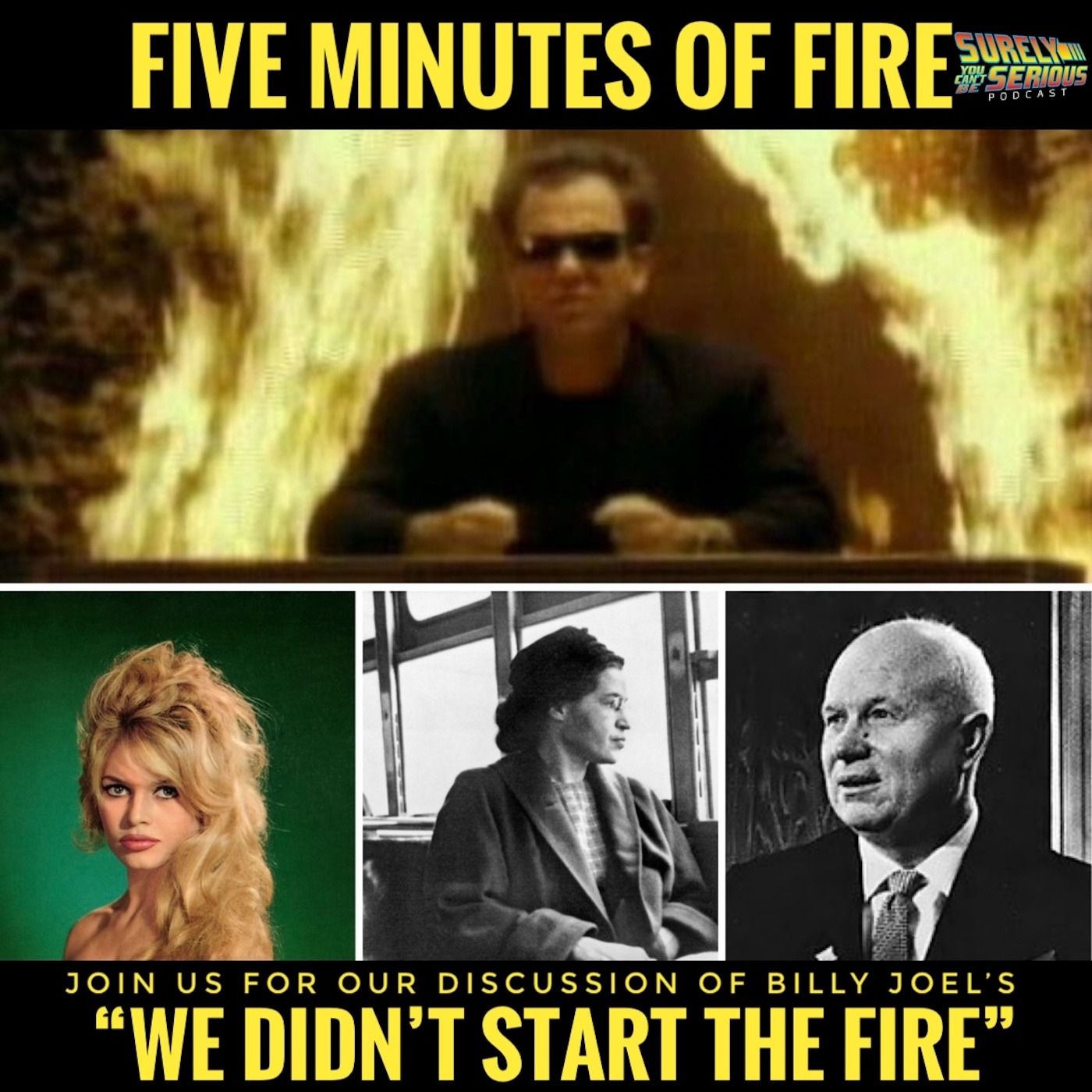
"Five Minutes of Fire": Bardot, Budapest, Alabama, Khrushchev
Embark on a journey through history with "Five Minutes of Fire," the podcast series that delves into the rich tapestry of Billy Joel's "We Didn't Start the Fire." Join us twice a day for a quick exploration of the historical names and events that have left an indelible mark on the 20th century.In today's episode, the flames of history blaze brightly with the cinematic allure of Brigitte Bardot, the iconic French actress and symbol of 1950s and 1960s glamour. We then transition to the tumultuous Hungarian Uprising in Budapest, a pivotal moment in the struggle for freedom and independence. The narrative takes a turn to the civil rights movement as we revisit Rosa Parks and her courageous stand in Montgomery, Alabama. Finally, we confront the geopolitical tension of the Cold War with the presence of Nikita Khrushchev, the Soviet leader who left a lasting impact on global affairs.In just five minutes, we'll guide you through these historical vignettes, providing context, anecdotes, and a deeper understanding of the individuals and events that defined their times. Whether you're a dedicated Billy Joel fan or someone eager to explore the stories behind the lyrics, "Five Minutes of Fire" is your daily dose of historical enlightenment.Subscribe now to join us as we unravel the verses of "We Didn't Start the Fire," offering insights that bring the past to life. "Five Minutes of Fire" - where history unfolds swiftly and vibrantly, twice a day. Don't miss your daily spark of historical exploration!
2024-01-08
5 min
Transcript
Available Results
Generated results are saved to the knowledge database for reuse and search.
No generated results are available for this episode yet.
Extract Knowledge
Pick what you want extracted first. Model, scope, and chapter options appear after a template is selected.
Generated results for public episodes are saved to the knowledge database so they can be reused and searched later.
Transcript
<v Speaker 1>I'm Jason Colvin, I'm d Graves.
<v Speaker 2>Give us five minutes and we will give you the fire.
<v Speaker 1>Hello everybody, and welcome back to the Surely You Can't
<v Speaker 1>Be Serious Podcast Special Edition five Minutes of Fire. We
<v Speaker 1>are here talking about the lyrics of We Didn't Start
<v Speaker 1>the Fire by Billy Joel. We're covering only five minutes
<v Speaker 1>at a time, which is about to link with the song,
<v Speaker 1>so it works out kind of nicely. So please join
<v Speaker 1>us as we dive into some new lyrics today.
<v Speaker 2>All right, guys, So here are the topics that we're
<v Speaker 2>going to be covering today.
<v Speaker 1>Bardeau, Budapest, Alabama.
<v Speaker 2>Kruz Chef. All right, Dee, what can you tell me
<v Speaker 2>about bardew.
<v Speaker 1>Okay, so this has to be Bridgitte Bardeaux, which is
<v Speaker 1>the first one that we've come across who is still alive.
<v Speaker 1>She was born almost ninety years ago, nineteen thirty four.
<v Speaker 1>She studied ballet, was planning on becoming a dancer. Then
<v Speaker 1>at the age of fifteen, she appeared on the cover
<v Speaker 1>of Elle magazine there in France, and it was a
<v Speaker 1>monumental moment for French fashion. She became a new it girl.
<v Speaker 1>The way that clean cut Christine Girls should look. She
<v Speaker 1>did multiple modeling gigs after that. Then movie directors started
<v Speaker 1>looking at her, and one of those movie directors sent
<v Speaker 1>his assistant director, whose name was Roger Vadim, to go
<v Speaker 1>see if she might be in a movie. She turned
<v Speaker 1>down the movie, but did not turn down Roger Vadim.
<v Speaker 1>The problem was is that he was six years older
<v Speaker 1>than her, which if you're in your twenties, not such
<v Speaker 1>a big deal. If you're a teenager, much bigger deal.
<v Speaker 1>And so her parents forbid her to date this guy,
<v Speaker 1>and so she said, Okay, I'm just going to kill myself.
<v Speaker 1>Then like maybe even had an attempt, and so they
<v Speaker 1>finally kind of gave up. Seventeen years old, she marries
<v Speaker 1>Roger Vadim and that was nineteen fifty two, and then
<v Speaker 1>just four years later, nineteen fifty six, he cast her
<v Speaker 1>in his new movie called and God Created Woman, and
<v Speaker 1>she becomes a sex icon. They even dubbed her a
<v Speaker 1>sex kitten, one of the first times that that phrase
<v Speaker 1>is used to describe Somebody called her the first and
<v Speaker 1>most liberated woman of post war France. She was in
<v Speaker 1>multiple movies, usually as a liberated and sexually free woman
<v Speaker 1>ushered in the sexual Revolution. Then in nineteen seventy three
<v Speaker 1>she said I'm done. But because of the iconic status
<v Speaker 1>that she had reached over that roughly twenty year time period,
<v Speaker 1>she is still remembered today as a monumental sex That's
<v Speaker 1>some incredible wow. Okay, Jason, tell me about Budapest.
<v Speaker 2>Okay, so let's talk about the Hungarian Revolution of nineteen
<v Speaker 2>fifty six. This revolution lasted from October twenty third, nineteen
<v Speaker 2>fifty six to November fourth of nineteen fifty six. It
<v Speaker 2>was an attempted countrywide revolution against the government of the
<v Speaker 2>Hungarian People's Republic and the policies of the government's submission
<v Speaker 2>to the USSR. The revolution started when university students showed
<v Speaker 2>up but the Hungarian Parliament building to protest. They take
<v Speaker 2>over the building with the party radio. They broadcast sixteen
<v Speaker 2>demands in order to back down from this revolution. One
<v Speaker 2>of these demands is the evacuation of all Soviet troops.
<v Speaker 2>Guess what the Soviets say. They say no, the revolution
<v Speaker 2>is repressed on November fourth, nineteen fifty six, when the
<v Speaker 2>Soviets rolled tanks in and troops kill twenty five hundred
<v Speaker 2>Hungarians and lose seven hundred Soviets and caused seven hundred
<v Speaker 2>thousand people to seek political refuge abroad. All right, d
<v Speaker 2>what can you tell me about Alabama?
<v Speaker 1>Well, it's a state in the United States, but we
<v Speaker 1>need to know what happened in nineteen fifty five. What
<v Speaker 1>happened in Montgomery, to be specific Montgomery, Alabama in nineteen
<v Speaker 1>fifty five was they had a law that was a
<v Speaker 1>segregation law on the buses and if the white section
<v Speaker 1>filled up, that meant that the sign that separated the
<v Speaker 1>sections got moved back, the African American section got smaller
<v Speaker 1>so that the more white people could fit on. Well,
<v Speaker 1>what happened was that Rosa Parks had had a long
<v Speaker 1>day at work. She came and sat down in the
<v Speaker 1>non white section. The white section filled up, and when
<v Speaker 1>it did, somebody said you got to move, and she said, no,
<v Speaker 1>my feet retired. And because this was in violation of
<v Speaker 1>the law at that time, she was arrested for this
<v Speaker 1>act of civil disobedience. The arrest resulted in demonstrations and
<v Speaker 1>a boycott of the Montgomery buses by African Americans that
<v Speaker 1>lasted until December of nineteen fifty six. Since the boycott
<v Speaker 1>was costing the stores money and the white business's money.
<v Speaker 1>Negotiations were made to stop the action, but it took
<v Speaker 1>a Supreme Court ruling in November nineteen fifty six that
<v Speaker 1>segregation on transportation is unconstitutional to finally integrate the buses.
<v Speaker 1>This event was also the starting point for the civil
<v Speaker 1>rights movement of Martin Luther King. Hey, Jason, tell me
<v Speaker 1>about Krushchef.
<v Speaker 2>Nikita Krushchev succeeded Malinkoff, who we talked about in an
<v Speaker 2>earlier episode. He was the first Secretary of the Communist
<v Speaker 2>Party of the Soviet Union nineteen fifty three to nineteen
<v Speaker 2>sixty four. That means he's the most powerful person in
<v Speaker 2>the US. He's responsible for crushing the Hungarian Revolution, the
<v Speaker 2>process of de stalinization in the Soviet Union, which actually
<v Speaker 2>made it less repressive in the Soviet Union. He's known
<v Speaker 2>for colorful speeches. He actually took off and shook his
<v Speaker 2>shoe at the UN one time in a.
<v Speaker 1>Speech we will bury you.
<v Speaker 2>He ousted Malankov, He approved the construction of the Berlin Wall,
<v Speaker 2>and he is responsible for positioning missiles in Cuba.
<v Speaker 1>Sounds like a heck of a guy.
<v Speaker 2>Forced to resign in nineteen sixty four due to a
<v Speaker 2>breakup with China and food shortages in the USSR finished
<v Speaker 2>his life quietly, dying of a heart attack in nineteen
<v Speaker 2>seventy one. This is one of the guys that the
<v Speaker 2>US feared most in the sixties.
<v Speaker 1>Okay, guys, that does it for today's episode. Join us
<v Speaker 1>next time for five minutes of fire.
Chapters
No chapters available.