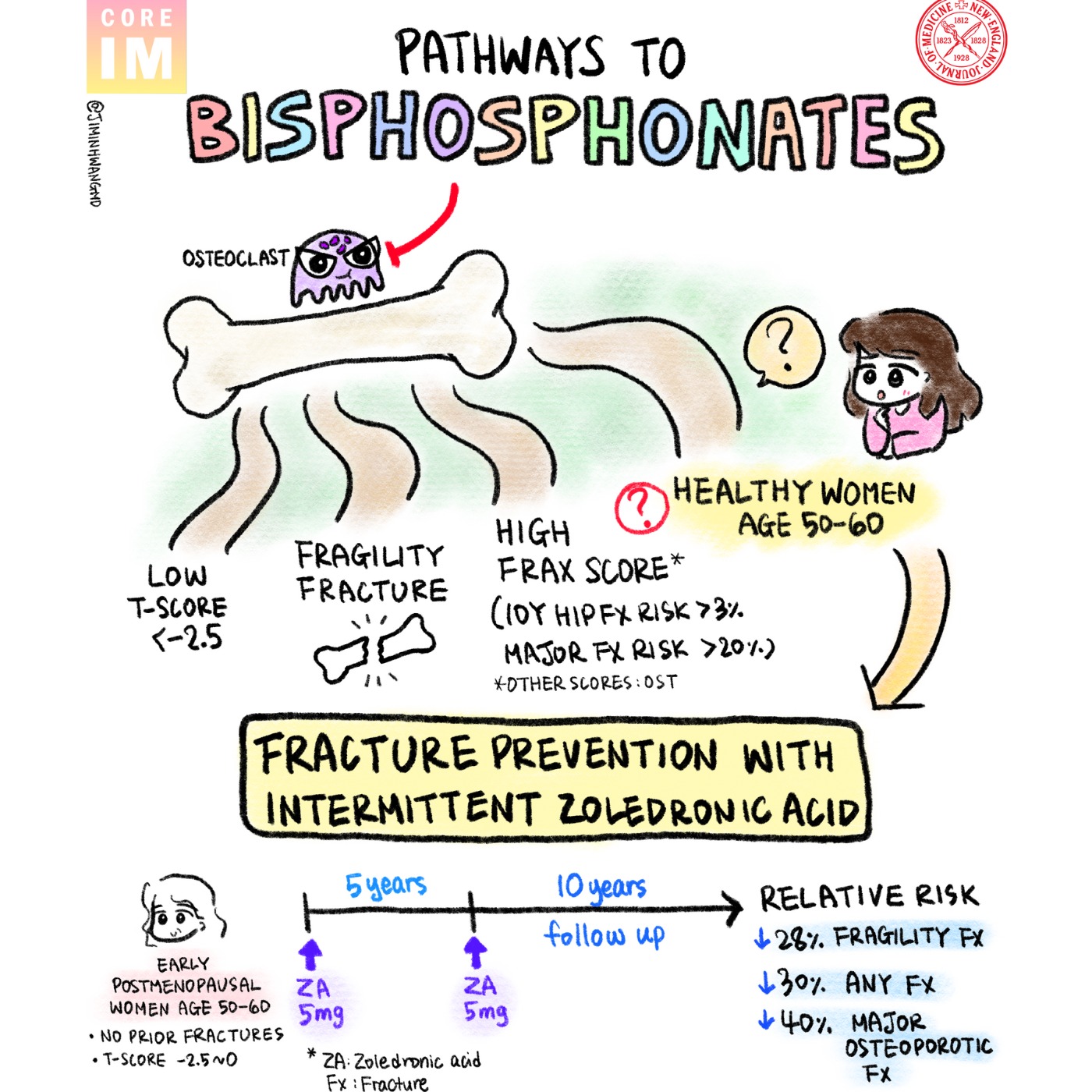
#189 Bisphosphonates and Fracture Prevention Trial: Beyond Journal Club with NEJM Group
Who’s really at risk for fractures, and how should we be treating them?
Most fragility fractures occur in patients without osteoporosis. Should we rethink who gets treated? And could just one or two IV infusions (spread years apart) of zoledronate prevent fractures for years? Have the concerns about bisphosphonates been overblown?
Find out all the nuances on this episode of Beyond Journal Club, a series brought to you by Core IM in collaboration with NEJM Group.
🔹 Sponsor: Oakstone CME
Use the code "CORE25" for 25% off: https://www.coreimpodcast.com/MKSAP
Timestamps:
(00:59) | Diagnosing Osteoporosis and Hidden Fracture Risk
(05:38) | Evolution of Bisphosphonate Use in Osteoporosis Treatment
(07:51) | Current Use of Bisphosphonates: Benefits, Risks, and Side Effects
(10:31) | Exploring Non-Bisphosphonate Options for Fracture Prevention
(11:44) | Teriparatide and Alternative Osteoporosis Medications
(14:53) | Inside the Latest Bisphosphonate Clinical Trial
(18:07) | Key Findings from the Zoledronate Fracture Prevention Study
(22:38) | Public Health Impact of Fracture Prevention Strategies
(24:24) | Final Takeaways and Expert Perspectives on Osteoporosis Care
Tags: CoreIM, Internal Medicine, Primary Care, Medical Education, IMCore, Physician Assistant, Nurse Practitioner, Medical Student, Osteoporosis, Fragility Fractures, Zoledronate, Bone Health
Find the best disability insurance for you: https://www.patternlife.com/disability-insurance?campid=497840
Our Sponsors:
* Check out FIGS: https://wearfigs.com
* Click for 15% off Premium Starter Kit at Branch Basics: https://branchbasics.com/COREIM
Advertising Inquiries: https://redcircle.com/brands
Privacy & Opt-Out: https://redcircle.com/privacy
Available Results
Generated results are saved to the knowledge database for reuse and search.
Extract Knowledge
Pick what you want extracted first. Model, scope, and chapter options appear after a template is selected.
Transcript
[SPEAKER_01]: Welcome to Beyond Journal Club, a collaboration patient core M and any jam group.
[SPEAKER_04]: The goal of Beyond Journal Club is to take landmark clinical trials and put them into context, telling the story of how we got to where we are, what it means for our patients and how we take care of them.
[SPEAKER_01]: I'm Dr. Shri Chavetti, an internist at Bethesio de Guinness Medical Center.
[SPEAKER_05]: I'm Dr. Greg Katz, cardiologist at NYU.
[SPEAKER_05]: Dr. Femley, Edmet Pete's hospitalist in Boston, and I guess editor at AJM.
[SPEAKER_02]: Hello, Dr. Sarigori, a previous editorial fellow at the New England Journal of Medicine and the Geriatric Medicine Fellow at Beth Israel de Caness Medical Center.
[SPEAKER_05]: Today, we're diving into the world of bone health, and we're going to be talking about how well-tuped phosphomates prevent fractures.
[SPEAKER_02]: We'll be looking at a recent trial by Bowland at Al, of infrequent Zalendrona Caribbean patients with aid-astereporosis to prevent fractures, which was published in the New England Journal of Medicine in January 2025.
[SPEAKER_05]: And before you'll jump on me, asking me this question, yes, I am very bummed that there's no cool acronym for this trial.
[SPEAKER_01]: Too bad, so sad.
[SPEAKER_01]: That's what my five-year-old would say.
[SPEAKER_01]: Too bad, so sad.
[SPEAKER_04]: And so moving on, before we get into the study itself, we'll discuss first how to make a diagnosis of osteoporosis and talk about why just making that diagnosis doesn't actually tell us everything you need to know about who should be treated with preventive medicines to reduce fracture risk.
[SPEAKER_02]: Then we'll go over what drugs we actually have in our toolkit for fracture prevention and more importantly, what is missing and why this new bisphosphine trial was so compelling.
[SPEAKER_04]: And finally, we'll bring it home to discuss if this changes our practice and how we prevent fractures in our patients.
[SPEAKER_02]: We all know that osteoporosis is characterized by decreased bone mineral density and increased risk of fractures, especially at the hip, the spine, humerus and wrist.
[SPEAKER_02]: We are talking about mostly post-manipausal women, but another risk factor that we commonly see in osteoporosis is patients with chronic steroid use.
[SPEAKER_01]: Yeah, I think we've all heard that scary stat back in med school and after hip fracture patients are looking at like a one-year mortality as high as 28%, and I guess if the main risk factor is osteoporosis, the thought would be that if we can get really good at diagnosed the osteoporosis, hopefully we can prevent some of these fractures, right?
[SPEAKER_02]: You would hope that Traia, but I actually have some disappointing news about her diagnostic tools.
[SPEAKER_02]: It turns out that more than half of fragility fractures, occurring patients who wouldn't have met diagnostic criteria for osteoporosis before their fracture.
[SPEAKER_01]: Wait.
[SPEAKER_01]: What?
[SPEAKER_04]: And that even may be underestimate.
[SPEAKER_04]: I mean, some of the data suggests that three out of four patients with fragility fractures either had normal bone density or osteopeenia at the time of the fracture.
[SPEAKER_01]: that is wild Greg.
[SPEAKER_04]: And because of that, it's likely they wouldn't have really been considered candidates for preventive therapy because they didn't have that diagnosis of osteoporosis prior to having a fracture.
[SPEAKER_02]: It's such an important truth to get out there, like it's really unfortunate fact, but it's so important because this is why study we will be discussing is so relevant.
[SPEAKER_01]: Yeah, I guess just second, like I said, with us a little better, can you remind me what are the diagnostic tools we do have for osteoporosis?
[SPEAKER_04]: So, radiologically, you look at the deficit scan.
[SPEAKER_04]: You get that x-ray measurement of the wrist and hip, and we look at the T-score, which is a measure of how dense bone is compared to that of a young healthy person.
[SPEAKER_04]: Basically, we look at the number of standard deviations from the mean.
[SPEAKER_04]: Osteoprocysis defined as a T-score less than negative 2.5, and osteopeenia is a T-score between negative one and negative 2.5.
[SPEAKER_04]: Anything higher than negative one is considered normal healthy bone.
[SPEAKER_05]: And there is another way of getting the deducting theosis of osteoprocyst.
[SPEAKER_05]: And that is, if you had a fragility fracture,
[SPEAKER_02]: And a fragility fracture is a fracture due to a minor trauma, such as a fall from a standing height.
[SPEAKER_05]: Yeah, if you get one of those, then you automatically earn a diagnosis of osteoporosis, regardless of what your bone density, T-score measures.
[SPEAKER_02]: And a third way where you might get treated for osteoporosis is even if you've never had a dexoscan, people might use the frac score, which is a clinical score where you plug in people's risk factors for osteoporosis, and it gives you an estimation of their 10-year risk of a fracture.
[SPEAKER_02]: So someone could have a really high 10-year risk for major fractures, even if your t-score on dexoscan was not in the osteoporotic range.
[SPEAKER_05]: So we have these various methods.
[SPEAKER_05]: We have a T-score, less negative 2.5 on a Texas scan, or a Virginia legal structure that can buy you a diagnosis of osteoporosis, or even a high frox, or could be an indication for treatment.
[SPEAKER_02]: So, to recap, fractures can be absolutely devastating for patients, and while people with osteoporosis are at the highest risk, the unfortunate reality is, the majority of fractures occur in patients who don't actually have a diagnosis of osteoporosis.
[SPEAKER_02]: So, there's a significant on-met need to figure out who is actually at risk for fractures, and then an on-met therapeutic need to reduce this fracture risk.
[SPEAKER_01]: that makes me so sad and I think selfishly as someone who will probably at risk it in the future for osteoporosis.
[SPEAKER_01]: And I would say, you know, we did talk to a bunch of endocrinologists, colleagues in prepping for this episode and they did point out, yes, we have these validated risk factor prediction tools and we have come
[SPEAKER_01]: so far in the last few decades in that these prediction tools are helping us pick up those at greatest risk.
[SPEAKER_01]: But it sounds like similar to most things in medicine, right?
[SPEAKER_01]: You still have more to do and really have this unmet diagnostic need.
[SPEAKER_05]: We try a whole bunch of that thought.
[SPEAKER_05]: Let's put a pin on that unmet diagnostic need and look through the meds we actually have to prevent fractures.
[SPEAKER_05]: Right, promise we're going to circle back if we even need a diagnosed osteoporosis in the first place.
[SPEAKER_05]: So the story of treating osteoporosis actually starts to then 1940s when estrogen treatment was shown to improve markers of bone density and post-menopausal women.
[SPEAKER_05]: But then hormone replacement therapy or HRT, it came kind of controversial, so investigators look for other targets.
[SPEAKER_01]: And then the Biz Fossens story really starts with a fracture intervention trial, aka Fit, Clim, I think that's a good acronym, hopefully I looked through a great I agree.
[SPEAKER_01]: Thank you.
[SPEAKER_01]: So the Fit trials were published in JAMA and Lancet in the late 1990s, Best Decade.
[SPEAKER_01]: But basically the headline here was that there was a significant reduction in fracture with a London therapy in one of the studies that looked at women with low bone density, and
[SPEAKER_05]: The challenge with a lendronet is that it's tough to actually go through the mechanics of taking this truck.
[SPEAKER_05]: You have to take it once a week, which is tough to remember, and then you need to take it on an empty stomach since food reduces its bio-buildability, and then you need to take it with a full glass of water and sit up for 30 minutes after taking it to reduce the likelihood of suffocitis.
[SPEAKER_04]: But there are two additional problems with extrapolating these study results.
[SPEAKER_04]: One is that many of the fractures that were prevented were just incidental fractures seen on imaging.
[SPEAKER_04]: They weren't necessarily symptomatic.
[SPEAKER_04]: And two, there was this concern that arose in the early 2000s about these rare side effects.
[SPEAKER_04]: Jaw, osteonocrosis, a typical frontal fractures.
[SPEAKER_04]: These are really rare, but if they happen, they're totally devastating in the press that they got disuaded a lot of people from taking besphosphinate therapy.
[SPEAKER_05]: And so let's summarize so far.
[SPEAKER_05]: Elendronate reduces fracture risk, at least as measured on x-rays, but it's tough to take, and it isn't as effective at reducing clinically symptomatic fractures, which is what most of our patients care about.
[SPEAKER_02]: Luckily, that wasn't the end of the business fast on its story.
[SPEAKER_02]: The fit trials at the stage for Horizon, which was the first big Zalandronic acid study, which showed huge 70% reduction in the risk of retuber fractures over three years in women taking once yearly Zalandronic acid.
[SPEAKER_02]: What was really important with this study is that it was IV Zalandronic acid and it reduced kheneki significant fractures.
[SPEAKER_01]: So that was the thickness.
[SPEAKER_01]: A once a year drug that reduces the type of fractures
[SPEAKER_02]: And some of that benefit persisted for six years in the Horizon Extension study, even in patients who had stopped getting Zalendronic acid after three years.
[SPEAKER_05]: And that long-term benefit is because this phosphomates have a long half-life so they have long treatment effects, but this also means you do a surveillance long-term for those really rare side effects.
[SPEAKER_04]: and the complexity of those risks and those benefits makes the discussion with the individual patient really important.
[SPEAKER_04]: I mean, on one hand, the risk of a typical femoral factor, or jaws, you know, of course this is really low, by most estimates, like 0.1%, but then, on the other hand, if you have one of those effects, it's totally devastating.
[SPEAKER_02]: Yeah, and on top of that, the hard part about a typical fractures is that you have to have a really high index of suspicion for them clinically.
[SPEAKER_02]: They won't always present with trauma, and sometimes patients are just complaining of hip or leg pain.
[SPEAKER_01]: That's really frustrating, just like some hip or leg pain and they have an atoccal fracture.
[SPEAKER_02]: Yeah, and the thing with a typical fractures are they're more distill and transverse.
[SPEAKER_02]: So you need a femur x right not just a hip x to make the diagnosis.
[SPEAKER_02]: Also, about a third of these can be bilateral, so you need to image both sides.
[SPEAKER_01]: Wow, that sucks.
[SPEAKER_01]: And I think the big thing that kept coming up when we talked to endocrinologists was actually how rare these side effects are compared to how much attention it often gets.
[SPEAKER_03]: I'm OP Hammandvick.
[SPEAKER_03]: I'm an endocrinologist at Brighman Women's Hospital in Boston, where I'm also an associate professor medicine at Howard Medical School.
[SPEAKER_03]: And I am the education editor for NHM Group.
[SPEAKER_03]: The cruisers of the draw and that it will feel in practice are real side effects.
[SPEAKER_03]: The studies find it fairly consistently, but they're so extremely rare.
[SPEAKER_03]: And that is the take-home to me, and I looked up at some point the likelihood of someone being struck by lightning or the likelihood of someone knowing someone who has been struck by lightning.
[SPEAKER_03]: And it is in the same order magnitude as your likelihood of having on a typical femur fracture, or us and our crosses of the jaw as a result of treatment with these agents, at least at the doses that we use in autoprocess treatment.
[SPEAKER_03]: I think the story is different when you start to talk about the higher doses that we use for oncologic indications.
[SPEAKER_03]: So just like any medication has side effects, so do these, but at a so rare that it shouldn't preclude their use to prevent these adverse outcomes.
[SPEAKER_02]: And one promising thing about these hypothetical femoral fractures is that the risk is proportional to the duration and also the frequency of treatment and the risk decreases back to baseline when you stop the drug.
[SPEAKER_01]: And that risk being proportional to the frequency of treatment will come up really nicely in the study we'll talk about in a second.
[SPEAKER_01]: But say your patient is still concerned about the side effects of this phosphates.
[SPEAKER_01]: There are a few other agents you might see your patients on and we're going to highlight three of the major ones.
[SPEAKER_04]: But first one is denosimab, or as my patients call it, Prolias, which is a rank-all inhibitor that decreases bone breakdown.
[SPEAKER_04]: In the Freedom trial, Prolias was really impressive.
[SPEAKER_04]: 40% reduction in head fractures, 70% reduction in fractures overall, when compared to placebo, and women with osteoporosis.
[SPEAKER_05]: In the advantage of denosimab is that it's subcutaneous, and it's only given every six months, and it doesn't stick around the bone for years.
[SPEAKER_02]: However, unfortunately, in the follow-up of the Freedom trial, we learned that even though the Nostumab maintained bone mineral density, up five years, investigators had identified eight cases of osteinocrosis of the jaw and two-way typical femoral fractures, among the 4,550 women that were treated.
[SPEAKER_01]: All right, so now we know that the rare side effect of, you know, John or Crosse's e-tiple of manufacturers aren't just specific to business phosphonates, and I think my brain just wants to like compare the two right was at 0.1% for a business phosphonates.
[SPEAKER_01]: It looks like, you know, the width of numbers you gave, it's 0.2% with the no-submap development.
[SPEAKER_01]: Austin or Crosse is the jaw, and 0.04% e-tiple of all factors that did us mad.
[SPEAKER_02]: Exactly.
[SPEAKER_02]: And with longer term follow-up, studies, and why do use another important limitation of denosimab became apparent?
[SPEAKER_02]: That is, once you stop using it, your bone mineral density begins to drop.
[SPEAKER_02]: So if you stop the drug, you have to switch to something else, usually at this fastenet.
[SPEAKER_01]: I think the scenario is just a reinforces that thing in right, but like treatment with osteoporosis, like many things that are current diseases, it's a long-run marathon.
[SPEAKER_05]: And the next osteoporosis treatment option that we have is remasosimab, or asropation spacolic eventity.
[SPEAKER_05]: This is a subcutaneous once a month drug that works upstream of osteoblast to increase bone formation and to a lesser extent inhibit bone resorption.
[SPEAKER_02]: In the frame trial, remasosimab reduced both vertebral fractures and non-variable fractures, and that was included in the secondary endpoint.
[SPEAKER_04]: Unfortunately, a vanity comes with this black box warning about increased cardiovascular risk because of this signal-only arch trial where there was two fold increase in major adverse cardiovascular events in post-menopausal women.
[SPEAKER_04]: And so I can't tell you how many patients I've seen asking for cardiac clearance before they start a vanity for their osteoporosis, almost like if they're wishing we had a crystal ball to see who's going to have these cardiovascular events.
[SPEAKER_01]: gosh it's a tough life for those cardiologists.
[SPEAKER_01]: I think geriatricians have a harder job.
[SPEAKER_01]: And maybe arguably the most important job, I am.
[SPEAKER_01]: It's such a gerifame.
[SPEAKER_02]: Thanks, my group.
[SPEAKER_02]: Okay, let's round out our tour of the non-Busphosphani treatments that reduce fracture risk in osteoporosis.
[SPEAKER_02]: We have Terry Paritite, which is a Paritirate hormone analogue that also reduces fracture risk and increases bone mineral density in patients with osteoporosis.
[SPEAKER_01]: Yeah, the unfortunate thing about teraparitide, it's a daily injection, and it's an antibiotic hormone, so patients can't take it indefinitely.
[SPEAKER_01]: It's recommended to take only for two years and after that switch to either genocid lab or dysphosphory.
[SPEAKER_02]: Okay, so to recap, we have four classes of drugs that are used in patients of osteoporosis, dysphosphonates, genocimab, remasismab, and teraparitide.
[SPEAKER_02]: Each has some care evidence that they lower fracture risk, but each also have individual risk benefit
[SPEAKER_01]: Yes, so with this phosphonates and genosmab, we get the worry of the atypical femoral fractures.
[SPEAKER_01]: With the thinnity, there's an increased cardiac risk, both with teraparitan, genosmab, it's a short duration of therapy and then switching over to another treatment is required.
[SPEAKER_04]: So we talked about the diagnosis and treatment, and my big concern here is that the metrics we use decide on treating osteoporosis to prevent fracture, aren't all that useful for any given person, their population based.
[SPEAKER_04]: And so even though an individual with osteoporosis is at higher individual risk, I'm still struck by the fact that the vast majority of fragility factors are current people who don't meet that diagnostic criteria for osteoporosis, and even if you use osteopenia plus a risk
[SPEAKER_05]: Yeah, it's really unfortunate, everything we have, which includes T scores, the Fracks score, and even fancy bone turnover markers for people who are sending those, all those things are imperfect, and then on top of that, we're not able to predict who is going to have a bad complication once they start treatment.
[SPEAKER_02]: Yeah, that is the gap.
[SPEAKER_02]: We have these good drugs that we juice fracture risk, but we just are not great at figuring it who should be treated and when.
[SPEAKER_02]: And this brings us to our newest study, which is called fracture prevention with infrequent salendronate in women 50 to 60 years of age by Bolandadal, which was published in the New England Journal of Medicine in January 2025.
[SPEAKER_02]: Whew, that was a marathon.
[SPEAKER_05]: Or definitely gonna need a macro to them for that.
[SPEAKER_05]: Greg, can I task you as a cardiologist
[SPEAKER_04]: Climb, I thought you were the acronym kind of sore, but what if we go with Thiz, Fractor Prevention, within Frequency Entryney?
[SPEAKER_01]: I love it.
[SPEAKER_01]: I love it.
[SPEAKER_01]: From Thith to Thiz.
[SPEAKER_02]: So, the investigators of this new study asked a pretty simple question.
[SPEAKER_02]: What if we just treat some post-maniposal women with intermittent bisphosphonates instead of waiting until they develop osteoporosis to start treatment?
[SPEAKER_01]: I think that's a great question, right?
[SPEAKER_01]: If our current predictive models aren't good at figuring out who is actually going to get these fractures, then this is a pretty compelling trial from a public health perspective of a public health intervention, right?
[SPEAKER_01]: Maybe everyone will be prevent factors.
[SPEAKER_05]: Yeah, so what the researchers did here is that they sent letters to invite 53,000 women, age 50 to 60, who are registered to vote in New Zealand to participate in the trial.
[SPEAKER_05]: They eventually enrolled 154 patients and followed them for 10 years.
[SPEAKER_02]: It's important to say that none of these women had a diagnosis of osteoporosis.
[SPEAKER_02]: Their T-scores were not less than negative 2.5, and they were randomized equally into three groups.
[SPEAKER_01]: And so, who were these three groups?
[SPEAKER_01]: One group received the laundry at the start of the study and then again at five years and just to make it easier, we're gonna call this the Zilundrinate Zilundrin group.
[SPEAKER_01]: The second group received Zilundrinate at the start and then a placebo, five years later, so we're gonna call this the Zilundrinate placebo group.
[SPEAKER_01]: And then the third and last group received placebo at both time points and we'll call that a placebo placebo group.
[SPEAKER_04]: And overall, this was a pretty healthy group who only had a slightly low bone mineral density.
[SPEAKER_04]: The average age was 56, or than 80% or of European ancestry.
[SPEAKER_04]: The average BMI was 27, the average T-Score was negative 0.5, basically none of the patients smoked.
[SPEAKER_01]: Yeah, then they also had a decent amount of physical activity, not a ton of carbohydrates.
[SPEAKER_01]: This is exactly the population.
[SPEAKER_01]: We want to study.
[SPEAKER_01]: Let's see.
[SPEAKER_01]: Can we prevent a lot of fractures?
[SPEAKER_05]: and to avoid confounders to participants were excluded in the basis of things that could either substantially raise or lower their fracture risk.
[SPEAKER_05]: For example, they weren't allowed to have taken up a spasinate hormone replacement therapy or glucocorticoids.
[SPEAKER_01]: And that primer endpoint was a new virtue of fracture a scene on X-ray, but the investigators also let it all fractures our agility fractures and quote-unquote major osteoporotic fractures, which means any fracture at the risk, the spine, the shoulder, hip, or pelvis.
[SPEAKER_02]: I thought the tracking for this study was pretty onerous.
[SPEAKER_02]: The study participants had to fill out questionnaires every six months on fractures, adverse events, and any changes in their medication.
[SPEAKER_02]: They had formal clinical assessments, and they had x-rays done at time zero, then at five years, and then again at 10 years.
[SPEAKER_02]: And 95% of these participants completed the follow-up, so it was a really motivated group who did their homework twice a year for 10 years.
[SPEAKER_05]: And I also give the radiologists in A-plus because the radiologists assessing these fractures on these images use a semi-quantitative scale to actually cover a spectrum of bone issues from deformity and loss of vertebral height to different severity of fractures.
[SPEAKER_05]: So it really wasn't just a binary yes or no.
[SPEAKER_05]: They assess fractures on my continuum.
[SPEAKER_01]: It sounds like it's an impressive trial protocol, long-term evaluation, some sophisticated assessments, to answer the question at hand.
[SPEAKER_01]: Do business classmates prevent factors even in people who aren't at elevated factor risk with their current scores?
[SPEAKER_04]: So now that we've gone through those methods, Sarah, do you want to have to the honor of telling everyone the results?
[SPEAKER_02]: Sure.
[SPEAKER_02]: I looked at this design trial, and I was pretty skeptical to be honest.
[SPEAKER_02]: I was thinking, these results are going to be neutral.
[SPEAKER_02]: It's a low-risk healthy population, and we all know how hard it is to show benefit in a primary prevention trial.
[SPEAKER_02]: But I was pleasantly surprised.
[SPEAKER_02]: Both of this ledgerate cylinder 8 and cylinder 8 placebo groups had a lower risk of retable fracture compared to the placebo placebo group.
[SPEAKER_05]: Yeah, and the absolute risk reduction for a vertebral factors was actually pretty impressive.
[SPEAKER_05]: About 5% absolute reduction in both salendent groups compared to placebo.
[SPEAKER_05]: That means we could prevent one vertebral fracture just by treating 20 fairly low risk women.
[SPEAKER_04]: And all of those secondary implants were positive too.
[SPEAKER_04]: Fewer fragility factors made your osteoporotic factors fractures of all kinds.
[SPEAKER_04]: And there was a pretty consistent reduction between 30 and 40% across all of those secondary implants.
[SPEAKER_01]: This all sounds great, but Sarah, you've lived in Bride, this research really brought this to the writer's page.
[SPEAKER_01]: I encourage anything else that's stood out for you.
[SPEAKER_02]: What really hits me Shray about this is just how many fractures there were.
[SPEAKER_02]: So the investigators predicted that this group of pretty low-risk women, without osteoporosis, would have on average a 9% risk of fracture over the 10 years.
[SPEAKER_02]: But by the end of the trial, a whopping 20% of patients had had a major osteoporotic fracture.
[SPEAKER_02]: So instead of nine in 100 women having a fracture, it's 20 in 100 women having a fracture.
[SPEAKER_02]: It's a huge increase.
[SPEAKER_05]: I think that just reinforces the fact that even people who look low risk on paper still have fracture risk, and that's why our predictions are so hard to make.
[SPEAKER_02]: Right.
[SPEAKER_02]: Another thing that's today to me, if we just look at the placebo group, one out of three patients who didn't get anislandernite at all had at least one fracture by the end of the 10-year study.
[SPEAKER_01]: What, a third of healthy male age women who were engaged not to respond to a letter in the mail, forgetting factors?
[SPEAKER_01]: That just seems really unfair.
[SPEAKER_04]: Yeah, to emphasize that point, people who self-select to join a study may also be the ones who are taking vitamins and exercising and taking good care of themselves.
[SPEAKER_04]: But that's making assumptions because these are people who responded to an invitation in the mail to enroll in a study.
[SPEAKER_04]: But it does speak to a certain level of diligence and engagement and the fact that this is probably not the least healthy living group that you'll see.
[SPEAKER_01]: I need to switch the conversation now to side effects, right?
[SPEAKER_01]: I feel like once you've seen a typical femoral fracture or genre crisis, you're so kind of borrowing by that, and we've talked about it before some curious, did we see any in this trial?
[SPEAKER_02]: So I was really relieved when I looked in this supplementary appendix, that there actually weren't any of either of those events in either design genetic groups.
[SPEAKER_02]: Yes, I suppose the study only had a size in patients, so it's rather to be small, but it's still a reassuring piece of information.
[SPEAKER_05]: You know, something that come I eye in the supplementary appendix is that I see that there are six deaths in the delendginate group and three in the delendginate placebo group.
[SPEAKER_05]: I don't know.
[SPEAKER_05]: What do you guys make of that?
[SPEAKER_04]: The confusing thing about that stat to me is, what did these people die from?
[SPEAKER_04]: There may be a small signal with four cases of melanoma and this will injunates a legendary group, but not for other cancers.
[SPEAKER_04]: And the theoretical mechanism I would worry about here would be cardiovascular death.
[SPEAKER_04]: But there are no cardiovascular events.
[SPEAKER_04]: And so, there's this tiny number of bad events.
[SPEAKER_04]: I think it's really tough to draw any conclusions about that rather than just chalking it up to chance.
[SPEAKER_02]: So, to recap, infrequent and undenate, in this study, either a one-time dose, or two doses over a 10-year period, reduced to vertebral fractures, major osteoporotic fractures, fragility fractures, and actually fractures of all kinds, in a fairly healthy group of women in their 50s.
[SPEAKER_02]: So overall, it was a pretty impressive result for the bisphosphonates.
[SPEAKER_01]: Yeah, and the fact that these people didn't get an e-tibical femurofactor, or genocrosis, was also good news.
[SPEAKER_01]: Now, I think, onto the most important part of Beyond Girl Club.
[SPEAKER_01]: What should we take away from this study in terms of how we think about how we take care of patients?
[SPEAKER_02]: For me, what was really impressive about this trial is that primary prevention is really hard to show a benefit in, and this trial pushes us to facilitate into the primary prevention space, which is a whole new idea.
[SPEAKER_02]: Like the idea of giving the drug before the patient is even diagnosed with osteoporosis.
[SPEAKER_05]: Yeah, but we were prepping for this podcast, there were a couple of ongoing themes we kept coming back to.
[SPEAKER_05]: And the first was that the bar to treat in primary prevention is different than the bar for secondary prevention treatment.
[SPEAKER_05]: We're talking about an intervention for an asymptomatic person who is just at risk of a bad outcome.
[SPEAKER_05]: There should be a different threshold before we start to medicalize a person and turn them into a patient.
[SPEAKER_01]: But didn't we clear that far?
[SPEAKER_01]: Look at what happened to the placebo group.
[SPEAKER_01]: One in three women had a fracture over 10-year period who didn't get any treatment, right?
[SPEAKER_04]: That fracture instance is such a good point.
[SPEAKER_04]: If you told a relatively healthy 55-year old woman, we have to talk about starting medicines to prevent fractures.
[SPEAKER_04]: And by the way, I just checked your T-score.
[SPEAKER_04]: It's normal.
[SPEAKER_04]: I think that patient would look at me like I'm crazy.
[SPEAKER_04]: But low in behold, look at what happened in the placebo arm in this trial, one out of three women had a fracture over 10 years.
[SPEAKER_02]: Yes, so the most optimistic read of this evidence is that you should just treat every post-maniposal woman with at least one dose of the landinate.
[SPEAKER_02]: That's kind of what the editorial accompanying this trial said.
[SPEAKER_02]: It would be a small individual benefit, but a huge population benefit.
[SPEAKER_04]: And that comes to the second idea we kept coming back to, which is that public health officials are going to look at a question like primary prevention of fractures very differently than a doctor who takes care of individual patients.
[SPEAKER_05]: Yeah, public health officials might see a huge public health impact with this, because hip factors cost about 30 billion dollars every year in the US, whereas one dose of ziliteronic acid is less than a hundred dollars.
[SPEAKER_05]: So I kind of wonder if it's going to make it into like the USPSCF or the endocrine's sci-idi guidelines.
[SPEAKER_04]: And so you can see that signal for low numbers of those alarming side effects, and it's really great news.
[SPEAKER_04]: But how confident are we that that signal is going to remain the same?
[SPEAKER_04]: If this type of study makes its way into the USPSTF guidelines, and we really expand the use of this phosphonate therapy for primary prevention?
[SPEAKER_04]: Do we really know what will happen with high degree of certainty if we start giving this phosphonate to millions of women across the United States?
[SPEAKER_02]: I do want to point out that the jaws tune of crosses on the typical femoral fractures are a dose and duration dependent risks.
[SPEAKER_02]: So I wonder whether giving this Q5 year in frequent dosing schedule that we saw in this trial would reduce that risk.
[SPEAKER_02]: Since the frequency is not the same as would normally be in other trials.
[SPEAKER_05]: Yeah, that's a good point.
[SPEAKER_05]: I mean, I think if the risk of the side effects is proportional to how often you're getting a drug, then I say, let's just offer one time shot.
[SPEAKER_05]: Because then the chance of having a bad event with one single dose is probably very low.
[SPEAKER_04]: So to me, this is such an attractive strategy.
[SPEAKER_04]: We can give you a shot at 50 and your fracturists reduces by 30% over the next 10 years.
[SPEAKER_04]: And so you're telling me, my mom can go for her flu shot, be hooked up to Ivy's legendary for 30 minutes, and then her fracturist is lower, even though she doesn't do anything else
[SPEAKER_01]: So let's see what some of our other experts and people who live in breathe osteoporosis would do and whether they would give this drug to their mom.
[SPEAKER_00]: Hi, my name's Dr. Anne Garment.
[SPEAKER_00]: I am the Chief of General Internal and Hospital Medicine at Bellevue Hospital here in New York City.
[SPEAKER_00]: So I'm on team yes, we should do this in an ideal world.
[SPEAKER_00]: I think for me, the kicker is not my concern about the medication in and of itself.
[SPEAKER_00]: I actually have great confidence in this phosphonates and very little fear.
[SPEAKER_00]: Let me just the fact that it's an infusion.
[SPEAKER_00]: I think that's going to be what is going to make it logistically really challenging to roll the seven and these sort of population, wide level.
[SPEAKER_00]: But if you said to me that there was this same trial with a pill, I would say, with the same side effect profile and outcomes of what not, I would say no concerns for me.
[SPEAKER_00]: I would absolutely encourage my mom to do this.
[SPEAKER_01]: OK, it sounds like we have a strong two-themed up from Dr. Annie Garment.
[SPEAKER_03]: for my patients.
[SPEAKER_03]: Now, I am not quite ready to say that a patient with a normal bone density who is in this age group whose postmenopausal should receive one or several doses of Zalodronic acid.
[SPEAKER_03]: I like to see the data out there for a little bit longer.
[SPEAKER_03]: See the reactions of the community.
[SPEAKER_03]: See guidelines get updated potentially.
[SPEAKER_03]: And I think it probably will in the next several years as the results have so a chance to deepen to our consciousness and experts discuss and take present there take on it.
[SPEAKER_03]: So I think I probably will be considering these results.
[SPEAKER_03]: I think it's always
[SPEAKER_03]: difficult to tell a patient who feels well who has normal numbers on the measurement that you need to take a medication.
[SPEAKER_03]: It's the same for our patients with diabetes who have called normal cholesterol or LDL numbers, but we don't want it to be just normal.
[SPEAKER_03]: We wanted to be extra normal so they should take a statin.
[SPEAKER_03]: It's a little bit that same thinking of you have a totally normal bone density, but we know that you're at risk of fracturing and therefore we're still going to recommend a treatment while that is true.
[SPEAKER_03]: I think it's going to be a challenge to have those conversations with patients, especially due to some of the concerns that patients may have read about when it comes to the disfossionates.
[SPEAKER_00]: And this is one of them where the potential benefits are so huge, the prevalence of falls as we get older and osteoporotic fractures is so high and the risk of these ages is incredibly low and I think that with all medicines, most people are more afraid of the side effects than they are afraid of what's going to happen if I don't take the medicine.
[SPEAKER_00]: And that's not specific to primary prevention, right?
[SPEAKER_00]: But you think of all the conversations you have in your clinic exam room where patients say I'm worried that XYZ side effects, even though those are so much less likely to happen than the bad things that could happen if you don't take the medicine.
[SPEAKER_00]: But that's just human nature, right?
[SPEAKER_00]: You have confidence in the future until you don't.
[SPEAKER_00]: And so I think that I can understand why the instinct is quite literally if it ain't broke, don't fix it.
[SPEAKER_01]: Um, and if it ain't, we're all don't fix it.
[SPEAKER_01]: It's so humbling just to think about this topic as a whole.
[SPEAKER_01]: Let all in the men, I think there's just so many parts of it that are under-appreciated, misunderstood, not just by patients, but also all clinicians.
[SPEAKER_04]: going into the pre-work for this episode, I'm not sure that we were all thinking about it correctly.
[SPEAKER_04]: And I've come around to the idea that it's probably not the right way to think about this to ask, does this person have osteoporosis?
[SPEAKER_04]: But instead, I think it makes sense to ask, is this person at risk for a fragility factor?
[SPEAKER_04]: Because the fragility factor is the outcome that people care about.
[SPEAKER_04]: They don't really care about what their T-scores, the care they have a broken boner not.
[SPEAKER_01]: That actually reminds me of the conversation I had with one of our endocrinologists colleagues like maybe which seems to like reframe all of this and maybe instead of calling it a fragility factor, we make it like a more of a layman's from who's calling a bone attack right similar to a heart attack.
[SPEAKER_04]: Oh, I love that it's a brilliant analogy.
[SPEAKER_04]: And calling a fragility fracture, a bone attack is going to introduce an urgency to the issue and really make a step up our prevention game.
[SPEAKER_04]: And, you know, there are some similarities between a bone attack and a heart attack, like this underlying disease, just like afterosclerosis.
[SPEAKER_04]: osteoporosis is a slowly progressive chronic disease that shows signs on imaging long before it causes a problem, and then all of a sudden boom, you have this urgent, almost catastrophic event in people's lives that totally can change their course, and just like with afterosclerosis, just like with heart attacks, we have treatments to prevent fragility-faction to prevent bone attacks, and I'm excited to teach more people about the opportunity to use them.
[SPEAKER_01]: Yeah, I'm excited to also see what our listeners think, right?
[SPEAKER_01]: Like, how can we move the needle on the multiple areas?
[SPEAKER_01]: We need to make headway on, you know, is reframing it like a bone attack, kind of taking notes from the county hall to the world?
[SPEAKER_01]: Is that good idea?
[SPEAKER_01]: Maybe there's some other good ideas out there and welcome any thoughts, and please write in.
[SPEAKER_04]: And with that, it's a wrap for today.
[SPEAKER_04]: If you found this episode helpful, please share with your team and colleagues and give us a rating on Apple Podcasts or whatever podcast that you use, it really does help people find us.
[SPEAKER_01]: and thank you to Dr. German Wong for the helping graphic and also to nurse Katherine Gala for the audio editing.
[SPEAKER_05]: If you have any feedback, please email us at HelloAtCoreiamparkcast.com.
[SPEAKER_02]: Opinions Express are our own and do not represent the opinions of any affiliated institutions.