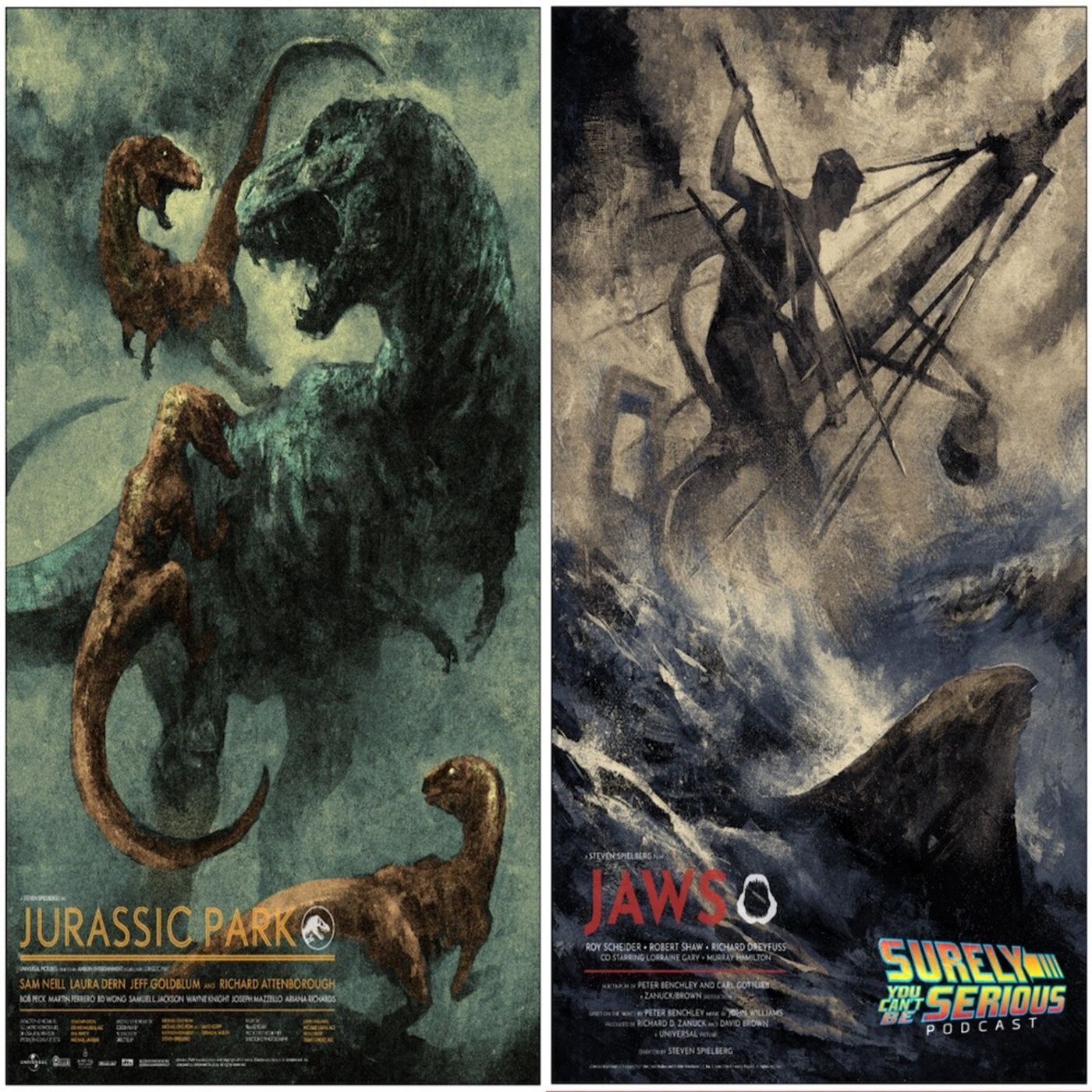
Jaws (1975) vs. Jurassic Park (1993): Part 3
John Williams, The USS Indianapolis, and Final Judgment! We have saved the best for last in our 3rd and final discussion about Jaws and Jurassic Park. Join us and find out what we have coming up next week! Please don't forget to subscribe!
(Alternative Posters by Karl Fitzgerald)
(Alternative Posters by Karl Fitzgerald)
2020-07-14
70 min
Transcript
Available Results
Generated results are saved to the knowledge database for reuse and search.
No generated results are available for this episode yet.
Extract Knowledge
Pick what you want extracted first. Model, scope, and chapter options appear after a template is selected.
Generated results for public episodes are saved to the knowledge database so they can be reused and searched later.
Transcript
<v Speaker 1>All right, everybody, welcome back to episode three of Jaws
<v Speaker 1>versus Jurassic Park. This is gonna be the Kapper. This
<v Speaker 1>is where we're gonna give our final judgment on these
<v Speaker 1>two great films.
<v Speaker 2>I'm super excited to talk about Quin's speech and the
<v Speaker 2>composer for both of these movies, who is an icon.
<v Speaker 2>But I am not quite as excited as I am
<v Speaker 2>about what's coming up next week, which is Guns N'
<v Speaker 2>Roses Appetite for Destruction versus AC DC, Back and Black.
<v Speaker 2>And the first one that we tackle is Appetite for
<v Speaker 2>Destruction and it's gonna get released on the thirty third
<v Speaker 2>anniversary of the release of the album. How awesome is that?
<v Speaker 2>So you guys, be sure and whatever app you're using
<v Speaker 2>right now, be sure and subscribe or follow or do
<v Speaker 2>whatever you need to do to automatically download so that
<v Speaker 2>you don't miss that episode next week. And without further ado.
<v Speaker 3>Hello everybody, and welcome to the Surely You Can't Be
<v Speaker 3>Serious Podcast, discussing and debating the iconic and the forgotten
<v Speaker 3>of eighties and nineties pop culture with your co hosts
<v Speaker 3>James D.
<v Speaker 2>Graves and Jason Colibn. Welcome back, everybody, to these, surely
<v Speaker 2>you can't be serious podcasts. We are on part three
<v Speaker 2>of our Jaws Versus Jurassic Park episode. We are going
<v Speaker 2>to dive right in forgive the pun there. So both
<v Speaker 2>of the movies start off with a death scene. Right
<v Speaker 2>in Jaws, you have Chrissy being attacked by an unseen
<v Speaker 2>monster underneath the water, and that sets the impetus for
<v Speaker 2>the whole first portion act one of the movie, if
<v Speaker 2>you will, same thing happens in Jurassic Park. We start
<v Speaker 2>off with a death scene. Despite you know, amazing scientific abilities,
<v Speaker 2>for some reason, they can't get cage that just locks
<v Speaker 2>in place, and so guy falls in, and you have
<v Speaker 2>the Muldoon character who's doing everything he can close upon
<v Speaker 2>his teeth closer, closer, one of his teeth. I kind
<v Speaker 2>of want to see.
<v Speaker 1>The cavity the Here's the other thing about that scene
<v Speaker 1>that drives me insane. Okay, whatever they're shooting the velasciraptor
<v Speaker 1>with is not working, okay, right, Okay, the little zappers,
<v Speaker 1>the bug zappers pull out the shotguns. Okay, yeah, shoot
<v Speaker 1>hard with the bazooka.
<v Speaker 2>So both of those set the story going for the
<v Speaker 2>first act of the movie. So with Jaws. You get
<v Speaker 2>this idea that there's a shark out there, maybe we
<v Speaker 2>should shut things down, and then you begin the power
<v Speaker 2>struggle to determine whether the beach gets shut down or
<v Speaker 2>whether it doesn't get shut down. If we switch over
<v Speaker 2>to Jurassic Park, the death is the impetus behind the
<v Speaker 2>lawyer going to the park and putting together the team
<v Speaker 2>of people to establish whether this park is really safe
<v Speaker 2>or not. Do you have the very strange scene where
<v Speaker 2>there's a kid out on an archaeological dig that gets
<v Speaker 2>threatened by doctor Grant.
<v Speaker 1>That's not very scary.
<v Speaker 2>You know, these are incredibly well done movies, but they're
<v Speaker 2>definitely parts that I was just like, why did we
<v Speaker 2>choose to do it this way? Why is there a
<v Speaker 2>kid out there in the middle of this, and why
<v Speaker 2>is he like a smart alecky, little snot nosed brat
<v Speaker 2>kid of all things?
<v Speaker 1>Yeah, somebody's dad needs to whoop him for talking back
<v Speaker 1>to doctor Grant.
<v Speaker 2>Is And they're all around the computer like I mean,
<v Speaker 2>they're hovering. They're hovering over the computer where we established
<v Speaker 2>this idea that doctor Grant doesn't like computer seeing the
<v Speaker 2>machines don't get along, right, So it's that whole man
<v Speaker 2>versus technology thing. And then this kid, who three feet
<v Speaker 2>back from the entire crowd is able to look at
<v Speaker 2>the screen and go that scary. So the impetus is
<v Speaker 2>said in place so that these experts are called in
<v Speaker 2>to establish whether the park is safe or not. And
<v Speaker 2>of of course the lawyer, whose job it is to
<v Speaker 2>come in and really scrutinize this for the investors, once
<v Speaker 2>he sees the dinosaurs, with everybody else, he becomes full on,
<v Speaker 2>let's forget about safety. We're going to make millions and
<v Speaker 2>millions of dollars, which is of course what this is
<v Speaker 2>the big issue in this movie. It's all about money
<v Speaker 2>versus how safe is it.
<v Speaker 1>We're going to make a fortune with this place.
<v Speaker 2>And then, of course the lawyer, the bloodsucking lawyer who's
<v Speaker 2>the only one that's agreeing with John Hammond, is also
<v Speaker 2>the first one to die, and appropriately so toiletting on
<v Speaker 2>top of a toilet.
<v Speaker 1>The toilet, Yeah, thanks to Jeff Goldblum's character, who wouldn't
<v Speaker 1>stay in the car.
<v Speaker 2>Well, no, no, no.
<v Speaker 1>He leaves the team rex to the toilet.
<v Speaker 2>Oh yeah he does. That's right, Yeah, yeah, that's right.
<v Speaker 2>So let me ask you this to the toilet. Yes,
<v Speaker 2>what was your thought whenever you the scene didn't go
<v Speaker 2>the way that originally it wasn't written that way. It
<v Speaker 2>was Jeff Goldbloom's suggestion that he also grab atorch and
<v Speaker 2>try to distract the t Rex. And so you have
<v Speaker 2>this great moment where doctor Grant distracts the t Rex
<v Speaker 2>from the kids. He throws the flare into the park.
<v Speaker 2>The dinosaur looks and makes a motion to follow the flare,
<v Speaker 2>only to be distracted again by another flare. Ian Malcolm,
<v Speaker 2>we're waving another flare who then brings him back, which
<v Speaker 2>I mean, you see the look on doctor Grant's face,
<v Speaker 2>and it's absolutely appropriate. It's like everybody's he is the
<v Speaker 2>audience at that point, Like what the f are you doing?
<v Speaker 1>Supposedly to heroically get the kids, you know, but he
<v Speaker 1>the t Rex right back to him, goes off to
<v Speaker 1>the toilet, gets the lawyer killed and breaks his leg
<v Speaker 1>in the process. Not very heroic in my opinion, but
<v Speaker 1>it was better than the runaway that he was originally
<v Speaker 1>gonna do.
<v Speaker 2>So we've talked before, our Chief Brody was every man right,
<v Speaker 2>He's supposed to be the audience, right, So one of
<v Speaker 2>the big ideas with Jaws, and I mentioned this in
<v Speaker 2>our last episode, is this idea of the power struggle, right,
<v Speaker 2>it's the pissing contest, and it's almost exclusively man and
<v Speaker 2>nature and man and man that's involved. Here we got
<v Speaker 2>Brody versus the mayor and he's the new guy. And
<v Speaker 2>here's a big idea that kind of gets lost in
<v Speaker 2>the movie, but it's there is this idea of an
<v Speaker 2>islander and a non islander, like you know, the kid
<v Speaker 2>at the beginning he talks about, you know, are you
<v Speaker 2>you know, from the island, and he's like, oh, I
<v Speaker 2>live this other place, he says, but I was born here,
<v Speaker 2>which makes him an islander. And then later on the
<v Speaker 2>woman is you know, Brody's wife is like, well, one
<v Speaker 2>am I an island? And she's like, Ellen, you'll never
<v Speaker 2>be an islander. You weren't born here. You'll never it
<v Speaker 2>doesn't matter how long you're here.
<v Speaker 1>Right.
<v Speaker 2>So it's this insider versus outsider thing that goes along
<v Speaker 2>with the power struggle that's going on between Brody and
<v Speaker 2>the mayor, right right. And then you have, of course,
<v Speaker 2>you know the probably the biggest pissing contest is between
<v Speaker 2>Quin and.
<v Speaker 1>Hooper, right, Yes, yes, for sure.
<v Speaker 2>And but before you even get there, even the mayor
<v Speaker 2>and Hooper have their little power struggle as well. You know,
<v Speaker 2>you'd like to prove that would and you get your
<v Speaker 2>name in one of those national geographic magazines or whatever
<v Speaker 2>it is.
<v Speaker 1>He says, right, I'm not talking to a man who's
<v Speaker 1>lining up to be a hot lunch, right, right.
<v Speaker 2>And then you also have this kind of weird dynamic
<v Speaker 2>when they're all on the boat together of Quintin Hooper,
<v Speaker 2>who even though they're warring with each other, they have
<v Speaker 2>a power struggle with Brody. They're not letting Brody do anything.
<v Speaker 2>I mean, We'll get the freaking chief of police on
<v Speaker 2>the boat and he's like subservient to everything that they're saying.
<v Speaker 2>You know, I gets yelled at from messing with the tanks,
<v Speaker 2>and then Shaw he's like, it's okay, you just ask
<v Speaker 2>me like a condescending little It's this neat power dynamic,
<v Speaker 2>and they do a great job both in the script
<v Speaker 2>writing and the acting of without overtly saying it, establishing
<v Speaker 2>that power contest. Right.
<v Speaker 1>Ye.
<v Speaker 2>So back to my original idea, Brody, we see him
<v Speaker 2>and we know from the beginning that he's a protector. Right,
<v Speaker 2>he's talking to the kids, don't swing on the swing.
<v Speaker 2>It's broken, right, And he's willing to admit that he's
<v Speaker 2>wrong when he's made mistakes, specifically not closing the beaches
<v Speaker 2>and letting Alex die is wrong and he's not your fault.
<v Speaker 2>Yes it was. She's wrong, that's what we said. She's wrong. No,
<v Speaker 2>she's not. And so you see this character development of
<v Speaker 2>Brody going through this process, you know, and he has
<v Speaker 2>to he's already kind of left his known spot and
<v Speaker 2>come into this little island that he's not familiar with,
<v Speaker 2>and then he really has to go into the unknown
<v Speaker 2>of the water because we learned at the beginning he
<v Speaker 2>hates the water. Don't know why he moved to be
<v Speaker 2>the chief of police of an island town when he
<v Speaker 2>hates the water.
<v Speaker 1>But yeah, and we don't really get a sense of
<v Speaker 1>why he hates the water, do we. I don't think
<v Speaker 1>that's ever really mentioned. No, huh.
<v Speaker 2>Hooper tells his story in a little bit. We can
<v Speaker 2>talk about Quinn and his story, so we understand why
<v Speaker 2>they don't. But the most we get is, you know,
<v Speaker 2>they call it that fear. What's it called? And he
<v Speaker 2>goes drowning, right, drowning not so good. So Brody goes
<v Speaker 2>through this entire you know, we get to the second
<v Speaker 2>death and then he has to go through this entire
<v Speaker 2>process where he moves from being the guy that everybody's
<v Speaker 2>picking on or condescending to and who he can't have
<v Speaker 2>a voice for. So he's the last guy left. And
<v Speaker 2>where is he. He's in the middle of the water
<v Speaker 2>on a sinking ship. He is facing his biggest fear.
<v Speaker 2>We talked about it with Indiana Jones. We talked about
<v Speaker 2>it with Marty McFly. Chief Brody is stuck in his
<v Speaker 2>biggest fear and what is that. He's in the water sinking,
<v Speaker 2>but he has grown. We watched Chief Brody grow up
<v Speaker 2>and become a man so that he is able to
<v Speaker 2>save everyone else, even and he thinks probably sacrificing his
<v Speaker 2>own life so that everyone else can be said.
<v Speaker 1>Yeah, it's good. When they were filming these types of
<v Speaker 1>scenes out at sea, Spielberg really wanted to make sure
<v Speaker 1>you could not ever see land, because they wanted them
<v Speaker 1>to be isolated. And there was this thought process that
<v Speaker 1>if you could see land, then if they got in trouble,
<v Speaker 1>they just take the boat back. You know, we'll get
<v Speaker 1>them tomorrow, you know. So I wanted them to feel isolated,
<v Speaker 1>and I thought it was funny. This is of course
<v Speaker 1>before digital removing anything. Right. So they would be out
<v Speaker 1>at sea and there would be a sailboat that would
<v Speaker 1>come into like the right edge of the frame, and
<v Speaker 1>they had to wait and wait and wait for that
<v Speaker 1>sailboat to completely cross across all the way from the
<v Speaker 1>right side to the left side, and they had to
<v Speaker 1>pray that there was not another sailboat on the right
<v Speaker 1>side of the screen.
<v Speaker 2>Right. I mean, this was all because Steven Spielberg was like,
<v Speaker 2>we have to shoot this on the real ocean, right right,
<v Speaker 2>that's right. Had they been on a lake, had they
<v Speaker 2>been in a back lot, none of this would have
<v Speaker 2>been a problem. But we also if you look at
<v Speaker 2>this movie, this movie has a reality that I will
<v Speaker 2>go ahead and say our other movie, even though they
<v Speaker 2>were filming in an actual place, it doesn't seem to
<v Speaker 2>have to be like the other movie has a cartoon
<v Speaker 2>quality about it. I don't know what. I don't know
<v Speaker 2>how to describe it exactly, but there is a reality
<v Speaker 2>that I get with Jaws that is missing in Jurassic Park.
<v Speaker 1>What do you think I agree with you that the
<v Speaker 1>elements of Jaws are just as life threatening as the shark.
<v Speaker 1>Whereas the jungle. You know, doctor Grant and the kids
<v Speaker 1>they go to sleep in the jungle, they're sleeping with
<v Speaker 1>giant dino cows, you know what I mean. So it's
<v Speaker 1>just not as threatening as deep ocean.
<v Speaker 2>To that, to Jurassic Park. Our main character, of course,
<v Speaker 2>is doctor Grant, and we learn from the beginning, not
<v Speaker 2>only does he scare the crap out of the little
<v Speaker 2>kid by basically threatening to disembowel him, he doesn't want kids, right,
<v Speaker 2>they smell, yeah, and they're loud, you know it's but
<v Speaker 2>he doesn't like kids. The relationship that he has with
<v Speaker 2>Sadler is so so subtle. I don't know that I
<v Speaker 2>even noticed that they were actually romantically involved for the
<v Speaker 2>first several times I watched it. I mean, what do
<v Speaker 2>they hug? Maybe half a second in the movie. There's
<v Speaker 2>no romance.
<v Speaker 1>I don't think there really is. I think we're supposed
<v Speaker 1>to believe that there is, but I don't see any
<v Speaker 1>kind of chemistry romantically between them at all. Really, No
<v Speaker 1>huh do they kiss?
<v Speaker 2>No, no hug?
<v Speaker 1>Do they hold hands?
<v Speaker 2>I kind of think that maybe Ian Malcolm touches her
<v Speaker 2>more than doctor Grant.
<v Speaker 1>I think you're right.
<v Speaker 2>So doctor Grant doesn't like children, but then is thrown
<v Speaker 2>into this situation again where he has to protect it.
<v Speaker 2>And it's one of my favorite parts in the movie
<v Speaker 2>when Lex screams, he left us, he left us, and
<v Speaker 2>he says, yes, but I'm not going to At that moment,
<v Speaker 2>he becomes responsible for the lives of others, and so
<v Speaker 2>he starts with He starts as this guy who is
<v Speaker 2>interested only in dead old things and doesn't want to
<v Speaker 2>be involved with kids, and ends up with a guy
<v Speaker 2>who hates the dinosaurs and loves the kids. He grows
<v Speaker 2>to be their protector over the course of the movie.
<v Speaker 1>Yeah, I think that's interesting. One of the things that
<v Speaker 1>I did want to talk about is I mean, you
<v Speaker 1>talk about this tension between Quinn and Hooper back to Jaws. Yeah,
<v Speaker 1>there was a tension between Robert Shaw and Richard Dreyfus.
<v Speaker 2>Oh yeah, and it's rather famous. You know, Shaw had
<v Speaker 2>been acting for much of his life at that point.
<v Speaker 2>He's in his late forties. He started acting when he
<v Speaker 2>was in his early twenties, and so he's been around
<v Speaker 2>a while now. Richard Dreyfuss had been in a few
<v Speaker 2>small things, but it hadn't been very much years before
<v Speaker 2>that that he had really gotten his first major film experiences.
<v Speaker 2>He had a couple, he had like two lines in
<v Speaker 2>the Graduate, and then he gets he gets this part
<v Speaker 2>in American Graffiti, right, yep, and that one's a decent
<v Speaker 2>that's a decent supporting role for him. And then he
<v Speaker 2>gets his first starring role that we talked about last episode, in.
<v Speaker 1>The Apprenticeship of Duddy Kravitz, right, And.
<v Speaker 2>So he is he's a young guy. I mean, he's
<v Speaker 2>a young and relatively speaking, inexperienced guy. And so Robert
<v Speaker 2>Shaw would have this this power dynamic put with him
<v Speaker 2>that he said, you know, he was the nicest guy
<v Speaker 2>in the world to me when we weren't on set,
<v Speaker 2>and then once we got on set, it became this
<v Speaker 2>condescending make fun of him, you know, do whatever you
<v Speaker 2>can to go to him for the entire production. And
<v Speaker 2>I have heard this that during the production of this movie,
<v Speaker 2>you know, they're in a beach, right, and so tourists
<v Speaker 2>come in and they're a lot of them are young
<v Speaker 2>girls in bathing suits, and the crew was pretty familiar,
<v Speaker 2>but everybody said that Richard Dreyfus was the man with
<v Speaker 2>regard to the young ladies who might be taking their
<v Speaker 2>vacation in Martha's vineyard.
<v Speaker 1>Yeah, movie crews in general when they come to your
<v Speaker 1>town are pretty popular guys, and Richard Dreyfus and some
<v Speaker 1>of his buddies tried to enjoy as much of the
<v Speaker 1>benefits of being a movie star as they possibly could.
<v Speaker 2>Right, So there may have he Obviously, Richard Dreyfus probably
<v Speaker 2>has a little bit of confidence as he's coming in
<v Speaker 2>and Robert Shaw is trying to put that in place.
<v Speaker 1>Yep.
<v Speaker 2>On the flip side of that, Robert Shaw has a drinking.
<v Speaker 1>Problem, for sure, Absolutely he does.
<v Speaker 2>Now there are a certain contingent of British actors who
<v Speaker 2>are just known for being heavy drinkers. We talked about
<v Speaker 2>Oliver Reed when we had our Gladiator episode and how
<v Speaker 2>he hung with Peter O'Toole and some of those guys,
<v Speaker 2>and it sounds like Robert Shaw probably would have fit
<v Speaker 2>in very well with those folks. Yep, for sure, and
<v Speaker 2>he was willing to admit it. Apparently. I've heard a
<v Speaker 2>couple of different versions of this story, and one version
<v Speaker 2>goes Robert Shaw was, you know, trying to move along
<v Speaker 2>the boat and had to use two hands to do something,
<v Speaker 2>but he had a drink in one hand, and he
<v Speaker 2>says to Richard Dreyfus, can you help me out with this?
<v Speaker 2>And Richard Dreyfus says, you want me to help you
<v Speaker 2>out with it? He says yeah, and the hands in
<v Speaker 2>the glass and Richard Dreyfus immediately just chunks it into
<v Speaker 2>the ocean. And then the other version was I've got
<v Speaker 2>a drinking problem? Can anybody help me? And it's at
<v Speaker 2>that point that Richard Dreyfus takes his drink and throws
<v Speaker 2>it into the ocean. Either way, it's funny. It's a
<v Speaker 2>funny response to the heckling that he's been getting from
<v Speaker 2>this actor all the while that they're on stage.
<v Speaker 1>It was the funny, but the entire crew was like, uh, oh,
<v Speaker 1>we might have a blow up here.
<v Speaker 2>Yeah, I mean, and we don't want to give Shaw
<v Speaker 2>too much credit credit I mean he was He was like,
<v Speaker 2>you're such a pandemic. I bet you won't even climb
<v Speaker 2>to the top of the mast on the ship, right,
<v Speaker 2>And he keeps offering him more and more money to
<v Speaker 2>do it, and finally Spielberg is like, you're not allowed.
<v Speaker 2>I am saying, as the director of this movie, you
<v Speaker 2>are forbidden to climb to the top of that mast
<v Speaker 2>because it looked like Gryfus was about to go do
<v Speaker 2>it right, right, And it's the same power struggle that
<v Speaker 2>you see going on on film.
<v Speaker 1>All right, Well, let's talk about the scene that they
<v Speaker 1>discussed the Indianapolis. I thought this was brilliant.
<v Speaker 2>So that part was not in the book at all.
<v Speaker 2>It was Howard Sackler's idea. He said, hey, you should
<v Speaker 2>have him have been on the USS Indianapolis. And Spielberg
<v Speaker 2>didn't know what it was. I mean, I didn't know
<v Speaker 2>what it was until I saw the movie. It's not
<v Speaker 2>you know now that this movie, being forty five years old,
<v Speaker 2>it's something that everybody knows. But even back in nineteen
<v Speaker 2>seventy five, it wasn't common knowledge. You didn't know about
<v Speaker 2>the event unless you were related to somebody or you
<v Speaker 2>were somebody that was on that ship, right.
<v Speaker 1>Right, right. They needed something for the character to hate sharks.
<v Speaker 1>Why does he hate sharks so much? Why is he
<v Speaker 1>dead set on getting this shark?
<v Speaker 2>Right?
<v Speaker 1>The Indianapolis gives us the reason.
<v Speaker 2>Right, and so Howard Sackler had come up with the idea.
<v Speaker 2>And then I mentioned before John Millius had been involved
<v Speaker 2>with the script and was a good friend of Steven Spielberg.
<v Speaker 2>He was one of the guys there with Spielberg and
<v Speaker 2>Lucas when they came in and broke the Shark, and
<v Speaker 2>he took it upon himself to develop that particular monologue,
<v Speaker 2>that scene, and he wrote a ten page monologue for this,
<v Speaker 2>which is too much. I mean, you got to figure
<v Speaker 2>there's approximately one minute for each page. Somebody talking for
<v Speaker 2>ten solid minutes is too much. And so they had
<v Speaker 2>the scene, they couldn't figure out exactly how to whittle
<v Speaker 2>it down. And it was Robert Shaw who said, can
<v Speaker 2>I take a stab at it? Can I take can?
<v Speaker 2>Will you give it to me and let me work
<v Speaker 2>on it a little bit? And he took it home
<v Speaker 2>and he worked on it, or he took it back
<v Speaker 2>and he worked on it overnight and came back with
<v Speaker 2>roughly a five page script, and Spielberg looked at it
<v Speaker 2>and said this is perfect.
<v Speaker 1>Yes, that's exactly right. And then on the day of filming,
<v Speaker 1>Robert Shaw said, hey, before I do this, I think
<v Speaker 1>I'm gonna have a few drinks and Spielberg is like,
<v Speaker 1>all right, you know, method actor, Sure, go for it,
<v Speaker 1>all right, And he got hammered. He got hammered, he
<v Speaker 1>got hammer headed, and I mean he was slashed and
<v Speaker 1>he couldn't do it. The next day he came back
<v Speaker 1>and said, how bad did I embarrass myself? Spielberg said, well,
<v Speaker 1>I don't really know if we can use much of that. Well,
<v Speaker 1>I'd like another shot at it. Can I have another shot?
<v Speaker 1>And then he came back and he nailed it.
<v Speaker 2>He didn't just nail it, he changed the entire perception
<v Speaker 2>of the movie in one take. He made everyone in
<v Speaker 2>the crew that Steven Spielberg, everyone in the cast, suddenly go,
<v Speaker 2>this is a movie that might be a success. Because
<v Speaker 2>up until that point they had dealt with the shark,
<v Speaker 2>they had dealt with the script problems, they had dealt
<v Speaker 2>with the problems of filming in the ocean, and Steven
<v Speaker 2>Spielberg thought he was going to get fired every single day.
<v Speaker 2>He almost went and quit the production. And then in
<v Speaker 2>a moment, everyone's perception changed.
<v Speaker 1>Yep, that's exactly right. You know, you talk about Steven
<v Speaker 1>Spielberg thinking every day he is going to be fired.
<v Speaker 1>He used to sleep with Celery under his pillow because
<v Speaker 1>it was considered good luck. But you're exactly right. That
<v Speaker 1>scene gave them that sort of emotional connection between the
<v Speaker 1>characters where they thought, Okay, this is more than just
<v Speaker 1>a silly shark movie. We got some here.
<v Speaker 2>Yeah, and it's still watching it. Every time that I
<v Speaker 2>see that scene, I am entranced. I know exactly what
<v Speaker 2>he's going to say. I can almost quote it for
<v Speaker 2>you word for word, and I just sit there and
<v Speaker 2>am totally engrossed in it. And it's at the it's
<v Speaker 2>just after that moment that the shark comes back.
<v Speaker 1>The scars that they're showing, like the scar scene, Yeah,
<v Speaker 1>it's funny, and I think one of them is an
<v Speaker 1>actual scar. Richard Dreyff shows it.
<v Speaker 2>So yeah, so they're comparing scars and it's it is
<v Speaker 2>wonderful because this is the way it is with men. Right.
<v Speaker 2>You know, you you fight and then you become best friends. Right,
<v Speaker 2>you antagonize an antagony. It's like being on a sports team. Right,
<v Speaker 2>It's you are constantly giving the other guy crap, you're
<v Speaker 2>trash talking, and then something happens that brings you guys
<v Speaker 2>together and suddenly you're the best of friends, right, yes,
<v Speaker 2>And so that's what happens when they start talking about
<v Speaker 2>the scars, that somebody points out a scar. What happened
<v Speaker 2>to you? What happened to me? You know? And they're
<v Speaker 2>showing scars of where they were attacked by eels or
<v Speaker 2>attacked by sharks, and suddenly Quin and Hooper have found
<v Speaker 2>their common ground. And Brody has this wonderful little moment
<v Speaker 2>where he lifts up his shirt and looks at an
<v Speaker 2>appendix scar to try to decide whether he should mention
<v Speaker 2>it or and then decides not to mention it. And
<v Speaker 2>that scar, as it turns out, is actually Roy Scheider
<v Speaker 2>actually had an appendectomy. It was a real scar. Wait wait, wait,
<v Speaker 2>let me guess mother. Okay, So with both of these movies,
<v Speaker 2>you have this idea of man versus nature, intellect versus ignorance, right, okay,
<v Speaker 2>So you know, the the intellect for Jaws is obviously
<v Speaker 2>the Hooper and Quint and a little bit of Brodie,
<v Speaker 2>and then the intellect for Jurassic Park is all of
<v Speaker 2>the archaeologists and doctor Ian Malcolm. And then you have
<v Speaker 2>what you believe to be the ignorant animals, right, the
<v Speaker 2>ignorant shark or the ignorant dinosaurs. But what makes these
<v Speaker 2>things truly scary is they don't seem to be that
<v Speaker 2>ignorant for sure.
<v Speaker 1>That's right.
<v Speaker 2>Right, So this it turns from intellect versus ignorance to
<v Speaker 2>intellect versus something almost supernatural, because not only is this
<v Speaker 2>thing gigantic and powerful and deadly, it also appears that
<v Speaker 2>it's smart.
<v Speaker 1>That's right. The scene where the shark goes underneath the boat,
<v Speaker 1>really he's taken by surprise. Now use the audience. You're thinking, man,
<v Speaker 1>this guy's in charge, and he knows exactly what's going
<v Speaker 1>on until now, and now he's like, whoa right?
<v Speaker 2>And that's when, Yeah, that's that's when Quint and Hooper's
<v Speaker 2>power struggle suddenly takes a turn, right, because with them
<v Speaker 2>you had Hooper's intellect versus Quint's know how and experience
<v Speaker 2>and the working class kind of idea, and he Quin
<v Speaker 2>has done nothing but belittle Hooper's fancy gadgets and stuff
<v Speaker 2>until the point that he realizes that the shark is
<v Speaker 2>smart too. And it's at that point that he says,
<v Speaker 2>what exactly can you do with these things of yours?
<v Speaker 1>Yep, that's really cool? Hey, there is something about that
<v Speaker 1>right around that moment that I want to mention. There
<v Speaker 1>is a scene where Chief Brody is loading his revolver
<v Speaker 1>and it's sort of set at dusk, and you see
<v Speaker 1>a massive shooting star. Did you notice this.
<v Speaker 2>When you watch the movie every time?
<v Speaker 1>That is not an optical effect. They just happen to
<v Speaker 1>catch that shooting star at that moment, and it looks
<v Speaker 1>super cool.
<v Speaker 2>Dumb luck to find the movie right, They got so
<v Speaker 2>many it's InCred So we have the Leviathan versus man
<v Speaker 2>in both scenarios, which goes to the idea of super
<v Speaker 2>much supernatural power versus mankind. You've got mythic, unemotional, almost
<v Speaker 2>demonic and unbeatable with intellect with but both with intellect.
<v Speaker 2>Shark and dinosaurs, and I love I love Iam Malcolm's
<v Speaker 2>lines and all of this. He is the guy who's
<v Speaker 2>trying to he's he's mocking, but he is absolutely right
<v Speaker 2>in everything that he says. Right, life will not be contained.
<v Speaker 2>Life finds a way. He says what you call I
<v Speaker 2>call discovery, I call the rape of the natural world.
<v Speaker 2>He realizes that they are just hurtling headlong into this
<v Speaker 2>idea without taking the time to think about it. You're
<v Speaker 2>so preoccup you're so preoccupied with whether they could, they
<v Speaker 2>never stopped to think of what whether they should.
<v Speaker 1>He actually even says the line, boy do I hate
<v Speaker 1>being right all the time. Okay, I've got a couple
<v Speaker 1>of little tidbits that I want to throw at you.
<v Speaker 1>I think you're going to be amazed. I really will
<v Speaker 1>be surprised if you heard this stuff. All right, Okay,
<v Speaker 1>So the shark in Jaws doesn't show up until one
<v Speaker 1>hour and two minutes into the film. Okay, yes, in
<v Speaker 1>Jurassic Park, the full view of the adult Veloci raptor
<v Speaker 1>doesn't show up until one forty three into the movie.
<v Speaker 1>Almost two hours into the movie. You don't get the
<v Speaker 1>full view of the raptor. Here is my tidbit. Okay,
<v Speaker 1>you know the scene where the local fishermen put like
<v Speaker 1>a brisket on a hook and they throw it and
<v Speaker 1>they're sitting on that rickety old doc that's just barely
<v Speaker 1>hanging on by three nails. Sure enough, boom, shark hits it.
<v Speaker 1>The chain starts to go and they're like, well look
<v Speaker 1>at that, Charlie, and the doc falls. He drags it
<v Speaker 1>out to see that's a really tense scene, right, drags
<v Speaker 1>that guy on the dock out to the you know,
<v Speaker 1>one hundred yards off shore, and the dock turns around,
<v Speaker 1>starts to come back, and the guy's going to swim,
<v Speaker 1>Charlie swim.
<v Speaker 2>Yeah, So first is the first point that you suddenly
<v Speaker 2>go this shark is not just a mindless man eater. Yep,
<v Speaker 2>he's coming back. Yep, he's just turned around.
<v Speaker 1>Yeah, he's gonna make Charlie pay for this decision. But
<v Speaker 1>there was a young filmmaker on set that day who
<v Speaker 1>was just stopping by to see how things were going,
<v Speaker 1>and they're like, all right, you, hey, come over here,
<v Speaker 1>grab a hammer and nails and help us put together
<v Speaker 1>this rickety old doc. Do you know who that filmmaker.
<v Speaker 2>Was, No, Jason, I don't know who that is. Can
<v Speaker 2>you tell me.
<v Speaker 1>The young filmmaker on set that day that built that
<v Speaker 1>crappy little doc none other than John Landis, director of
<v Speaker 1>Coming to America Trading Places American werel from London Animal House.
<v Speaker 2>That's awesome, good, has a great tidbit. We're going to
<v Speaker 2>put that one on the trivia card.
<v Speaker 1>Okay. A couple of little tidbits also for you that
<v Speaker 1>I thought were interesting. The voice on the radio on
<v Speaker 1>Quince's boat when Missus Brodie tries to contact her husband
<v Speaker 1>is actually Steven Spielberg's Ye, Peter Benchley has a cameo
<v Speaker 1>as a news reporter on the beaches, yes, which is
<v Speaker 1>kind of cool. Okay, here's another tidbit for you. Quinn's
<v Speaker 1>boat is called the Orca in real life, the Orca whale,
<v Speaker 1>which we typically called the killer whale.
<v Speaker 2>Yes, is the only known.
<v Speaker 1>Predator of the great white shark.
<v Speaker 2>Yep.
<v Speaker 1>Pretty cool, huh yeah. And then finally I thought this
<v Speaker 1>was interesting. Nobody else may find it interesting. But the
<v Speaker 1>sound editor, the sound editor who had to find sound
<v Speaker 1>effects for everything in the movie. When the shark comes
<v Speaker 1>out of the water and onto Quint's boat, yes, the
<v Speaker 1>sound effect that he used right there is a fizzy
<v Speaker 1>bottle of coke poured out on the concrete.
<v Speaker 2>It goes got random.
<v Speaker 1>He jumps out, and it's like, that'd be.
<v Speaker 2>Fun job to have sound editor to just go, this
<v Speaker 2>is a cool sound. Let's see what I can put
<v Speaker 2>this with.
<v Speaker 1>I would love to do fully, artist, you got to need
<v Speaker 1>a bigger potion.
<v Speaker 2>And so then, of course, once they finished filming and
<v Speaker 2>we talked about how they did the editing process and
<v Speaker 2>at Vernon Fields Pool they poured milk in the water
<v Speaker 2>so that they could shoot that scare scene. And I
<v Speaker 2>just to touch on Vernon Fields. She was somebody who
<v Speaker 2>had done like TV editing and wasn't particularly big in Hollywood,
<v Speaker 2>but you know, knew her way around. She started teaching
<v Speaker 2>at USC and a couple of people that happened to
<v Speaker 2>be in her classes were George Lucas and Steven Spielberg.
<v Speaker 1>Who are they?
<v Speaker 2>And so so she had such a great mind that
<v Speaker 2>really hadn't been appreciated at that point. But when George
<v Speaker 2>Lucas like, need I need an editor, I'm gonna go
<v Speaker 2>call Vernie. She was smart as whip. I like Vernon yep,
<v Speaker 2>And so she gets involved there. She gets involved with
<v Speaker 2>Steven Spielberg because she actually worked with him, I think
<v Speaker 2>on Sugarland Express as well. When she was teaching. She
<v Speaker 2>actually hired This is crazy, She hired George Lucas before
<v Speaker 2>he hired her, when he was still just in at USC.
<v Speaker 2>She hired him and also hired a lady named Marcia
<v Speaker 2>Griffin who ended up being his future wife and is
<v Speaker 2>also an editor. And who you know because you were
<v Speaker 2>the one that sent me the video on how Star
<v Speaker 2>Wars was saved by the editing. It was because of
<v Speaker 2>Marcia Griffin that Star Wars probably was the success that
<v Speaker 2>it was instead of a dismal failure.
<v Speaker 1>It's absolutely correct. Yeah, that video is really cool. If
<v Speaker 1>you haven't seen it, you needed to check it out.
<v Speaker 1>But yeah, Marshall Lucas cut Star Wars to get rid
<v Speaker 1>of all the confusing crap and streamlined it to the
<v Speaker 1>to the movie that we know and love today.
<v Speaker 2>Yeah. On first showing, everybody hated it.
<v Speaker 1>This crap. I don't understand any of it.
<v Speaker 2>Yeah, and so as Marsha Griffin that came in and
<v Speaker 2>said it, who had been introduced to George Lucas by
<v Speaker 2>Verna Fields. Verna Fields then gets called by Steven Spielberg
<v Speaker 2>to edit Sugarland Express and they start to call her
<v Speaker 2>the mother cutter. Nice nice, yes, right, and just just
<v Speaker 2>to talk about her amazing abilities. She developed this. She
<v Speaker 2>pioneered a technique called wipe by cut, where the cut
<v Speaker 2>takes place as like a figure crosses between the camera
<v Speaker 2>and the character, which so you're at a distant shot.
<v Speaker 2>Somebody walks in front of the camera and suddenly you're
<v Speaker 2>at a close up shot because you do the cut
<v Speaker 2>right as the person crossed in front of the camera,
<v Speaker 2>and so you were having what would normally be called
<v Speaker 2>a jump cut, where you've got a staggering thing into
<v Speaker 2>something that you don't even notice that it happens. Because
<v Speaker 2>of this wipe by cut type of procedure that verna
<v Speaker 2>Field's pioneered. After editing those movies and Jaws, she was
<v Speaker 2>nominated for the Oscar and she won. She goes on
<v Speaker 2>to be a Hollywood executive. At that point, she moves
<v Speaker 2>from the lady editing TV shows to the lady who's
<v Speaker 2>now ordering people around at major Hollywood studios. And then
<v Speaker 2>once they're done with the editing process, the last thing
<v Speaker 2>left to do put in the soundtrack.
<v Speaker 1>Before we do that, I just want to mention one thing. Yeah,
<v Speaker 1>on Jaws, they were scheduled for fifty five days of
<v Speaker 1>shooting right May first to June twenty eighth, nineteen seventy four.
<v Speaker 1>They actually finished in one hundred and fifty nine days.
<v Speaker 1>That's three times what they were scheduled for. This is
<v Speaker 1>late September when they wrapped Flash Forward nineteen ninety three.
<v Speaker 1>Principal photography was wrapped on November twelfth, nineteen ninety two.
<v Speaker 1>That's twelve days ahead of schedule and on budget. Spielberg
<v Speaker 1>learned a great deal from Jaws, and he applied that
<v Speaker 1>to later movies.
<v Speaker 2>Okay, so onto soundtrack in both of these movies, the
<v Speaker 2>composer is the same. You may have heard of this guy.
<v Speaker 2>His name is John Williams.
<v Speaker 1>The soundtrack for My Youth is John Williams music.
<v Speaker 2>You cannot have watched movies in the eighties and not
<v Speaker 2>heard a soundtrack by John Williams. It's the greatest of
<v Speaker 2>the soundtracks. Like if you put soundtrack greatest hits of
<v Speaker 2>the eighties, it's all John Williams.
<v Speaker 1>Absolutely is.
<v Speaker 2>Yeah.
<v Speaker 1>And if you I don't care who you are, you've
<v Speaker 1>been living in a forest in the entire time for
<v Speaker 1>the past forty years. You've heard the Star Wars theme.
<v Speaker 2>Yeah, anybody, if I come up to you, it's like
<v Speaker 2>it's like the Watch on Bad If I come to you,
<v Speaker 2>come up you and I go, dud. You know exactly
<v Speaker 2>what I'm gonna do. Right. That's two notes, two notes
<v Speaker 2>that he made into something amazing. I'll tell you the
<v Speaker 2>story of John Williams. Okay, yeah, I did So John
<v Speaker 2>was born to John and so most people call John
<v Speaker 2>Williams Johnny because that was his name growing up. His
<v Speaker 2>dad was also a music guy who worked in music
<v Speaker 2>for films. They ended up moving out to la where
<v Speaker 2>he went to high school with his future wife. They
<v Speaker 2>didn't actually date while they were in high school, but
<v Speaker 2>Barbara Ruick met her there. She went on to become
<v Speaker 2>an actress and was in several movies and films and
<v Speaker 2>TV shows in the fifties and was a singer as well.
<v Speaker 2>Had a musical background. And there's this really cool here's
<v Speaker 2>here's my interesting tie in for this particular episode. Right,
<v Speaker 2>So I saw this picture of Barbara Ruick dancing with
<v Speaker 2>Bob Fosse and a couple of other folks w Olds
<v Speaker 2>and somebody else on the affairs of Adobie Gillis. Bob
<v Speaker 2>Fosse went on to direct a semi autobiographical picture about
<v Speaker 2>himself called All That Jazz, which starred Rus Schider. Very good.
<v Speaker 2>He had all ties in, right.
<v Speaker 1>And de Wie Relds is mother of Princess Leah.
<v Speaker 2>Very good, very good. All ties In scored by Johnny Williams.
<v Speaker 2>And so John Williams gets drafted. He does his military
<v Speaker 2>service as a musician does pretty well. Ends up. He
<v Speaker 2>themes his first like a promotional video for the Navy
<v Speaker 2>while he's in the Navy, and then he comes back
<v Speaker 2>and has to decide do I want to go to
<v Speaker 2>Juilliard or do I want to go arrange and compose music.
<v Speaker 2>He is pianist. He plays several instruments, but he is
<v Speaker 2>best at piano, and he says, Okay, I'm gonna go
<v Speaker 2>to Juilliard. So he goes to Juilliard to become a
<v Speaker 2>concert pianist. And after a while there he starts to
<v Speaker 2>look at all of the other pns who are there
<v Speaker 2>and he's like, I'm not as good as these guys.
<v Speaker 2>This is not this is maybe not what I should do,
<v Speaker 2>and that it's crazy. At that moment, he changes movie
<v Speaker 2>history because he decides I'll go back and I'll start
<v Speaker 2>arranging and composing. And that's what he does. He goes
<v Speaker 2>back to la and he before Jaws. He composes dozens
<v Speaker 2>of movies and hundreds of TV show episodes and so
<v Speaker 2>he's getting his ten thousand hours in and through that
<v Speaker 2>process he decides to start conducting because he doesn't want
<v Speaker 2>to leave it to lesser conductors to get the conducting
<v Speaker 2>right as well. And one of the movies that he
<v Speaker 2>happens to write the score for is a movie called
<v Speaker 2>The Reavers starring Steve McQueen, and I was to the
<v Speaker 2>soundtrack and it's very It starts off very folky like
<v Speaker 2>if you listen to the theme, it's got this kind
<v Speaker 2>of folky guitar going and Southern style to it, and
<v Speaker 2>then it moves into the orchestra and you're like, there,
<v Speaker 2>I could see that's John Williams. You're familiar. You get
<v Speaker 2>that John Williams familiarity. And so, of course that movie
<v Speaker 2>came out in sixty nine, right about the same time
<v Speaker 2>that Steven Spielberg is becoming a director of TV shows,
<v Speaker 2>having to write scripts, waiting for his big break, which
<v Speaker 2>is going to be Sugarland Express. And what he does,
<v Speaker 2>because he's the son of a musician, is he goes
<v Speaker 2>and buys soundtracks and listens to them while he writes
<v Speaker 2>his scripts. And I identify with this. I've done this
<v Speaker 2>exact same thing many many times. You just listen. You'll
<v Speaker 2>listen to classical music or you listen to soundtracks and
<v Speaker 2>it inspires you to make a story out of it,
<v Speaker 2>and so that's what he's doing. And so he's at
<v Speaker 2>the album store. He's flipping through the albums and he
<v Speaker 2>sees this album for a soundtrack from the reverse, takes
<v Speaker 2>it home, listening to it, writing a script, writes a
<v Speaker 2>wonderful script, and thinks to himself, Man, this guy is good.
<v Speaker 2>If I ever get a chance to direct a feature film,
<v Speaker 2>I want this guy to be the guy that composes
<v Speaker 2>the soundtrack.
<v Speaker 1>Nice.
<v Speaker 2>And so, just as it happens, a few years later,
<v Speaker 2>he gets the opportunity at a Sugarland Express and he says,
<v Speaker 2>I want John Williams. And so John Williams, who at
<v Speaker 2>this point he's in his early forties. Now, he's been
<v Speaker 2>the young guy most of his life, right, he has been.
<v Speaker 2>The directors have all been older than he is, and
<v Speaker 2>he's been the young guy who's learning the ropes. But
<v Speaker 2>then with Spielberg, I mean, Spielberg's in his early twenties.
<v Speaker 2>He's a young young man, right he's And John Williams says,
<v Speaker 2>he looked like he was eighteen when I went to
<v Speaker 2>go talk to him. And he says, but just within
<v Speaker 2>the first five minutes of talking to him, I realized
<v Speaker 2>that Spielberg knew more about soundtracks of history than I did,
<v Speaker 2>which is as a that's a big statement for John Williams.
<v Speaker 2>Yeah really, and so he's like, I just I'm thinking
<v Speaker 2>this kid's going to be listening to rock and roll music.
<v Speaker 2>But apparently he rebelled against his parents who played classical
<v Speaker 2>music by listening to soundtracks and not listening to led
<v Speaker 2>Zeppelin or whatever. And so they do the Sugarland Express
<v Speaker 2>and he still has that same style. He still has.
<v Speaker 2>You've got this kind of folky guitar, it's very similar
<v Speaker 2>to the Reavers. And then it moves into something that
<v Speaker 2>you can say, yeah, I feel John Williams in this.
<v Speaker 2>I've got the orchestra. I've got the same orchestration going on.
<v Speaker 2>I feel it. But Jaws is different. John Williams talks
<v Speaker 2>about this. He says there's a point in his life
<v Speaker 2>where he lose to somebody very important to him, and
<v Speaker 2>it was his wife, Barbara, when he was young man,
<v Speaker 2>younger than we are right now, early forties. Barbara suddenly
<v Speaker 2>had a brain aneurysm died suddenly and John was left
<v Speaker 2>as the father of three teenage children. But he says
<v Speaker 2>that point in his life it was almost like a
<v Speaker 2>gift where he realized how he needed to do things.
<v Speaker 2>And I can say with certainty if you listen to
<v Speaker 2>his soundtracks before Jaws and then listen to Jaws, you
<v Speaker 2>can hear a difference. And he lost his wife in
<v Speaker 2>March of nineteen seventy four, and he wrote the soundtrack
<v Speaker 2>for Jaws in March of nineteen seventy five.
<v Speaker 1>Dang, let's talk about his meeting with Spielberg. Okay, okay,
<v Speaker 1>So Spielberg is working on the movie and he meets
<v Speaker 1>with John Williams and says, all right, let's hear what
<v Speaker 1>you got. And John Williams goes to the piano and says,
<v Speaker 1>all right, here's what I think the soundtrack for Jaws
<v Speaker 1>is going to be. Ready, dun Bill, why's like that's good,
<v Speaker 1>that's really good. I no, seriously, He's like, no, seriously,
<v Speaker 1>that's it. Two notes become the most recognizable soundtrack of
<v Speaker 1>all time.
<v Speaker 2>And it's perfect. It is perfect because it's frightening. It's frightening,
<v Speaker 2>and with two notes, he he is able to give
<v Speaker 2>you not only here's the shark, but here's how far
<v Speaker 2>the shark is away from you.
<v Speaker 1>Oh, it's so good. How he manipulates the audience with
<v Speaker 1>this theme.
<v Speaker 2>Right, If it's that's too, that's far away, you've got
<v Speaker 2>a long space and poop, he's around, but he's not.
<v Speaker 2>If it's duh, dump dump dump dump dump dump dump
<v Speaker 2>dot dump dump, you're about to get your legs bitten off, right, right,
<v Speaker 2>So I listened to this and thought about it carefully.
<v Speaker 2>When he was still a young man, he worked under
<v Speaker 2>a composer named Bernard Hermann, who you may not know,
<v Speaker 2>but that's the composer of Psycho.
<v Speaker 1>Yeah, I didn't know that.
<v Speaker 2>And so I look back and I listened to specifically
<v Speaker 2>the shower scene. So I listened to the shower scene. Right,
<v Speaker 2>it is almost the reverse of Jaws, and I can
<v Speaker 2>we'll play both of them for you here, and you
<v Speaker 2>can kind of hear out how it's the reverse. But
<v Speaker 2>whereas Psycho starts with and then it goes u uh uh,
<v Speaker 2>it's the reverse. It is the reverse of Jaws, which
<v Speaker 2>is bu It's incredible.
<v Speaker 1>Psycho goes und done done instead of done dune.
<v Speaker 2>So yeah, okay, yeah cool. And just for the for
<v Speaker 2>the musicians out there, he does a fantastic John Williams
<v Speaker 2>does a fantastic thing with the other part of the
<v Speaker 2>melody in this where you've got the and then you
<v Speaker 2>go no, no, you know you've got this other part
<v Speaker 2>to it. But whereas the underlying part is in e,
<v Speaker 2>the higher pitched melodic part is in E flat, which
<v Speaker 2>means they're right next to each other on the keyboard.
<v Speaker 2>Most notes, you've got spaces between the notes for them
<v Speaker 2>to sound good. When you played notes that are a
<v Speaker 2>half step apart, they don't sound right together. They don't
<v Speaker 2>go together, and that creates the discomfort that you feel
<v Speaker 2>whenever you hear those notes that don't belong together. He's
<v Speaker 2>playing notes that don't belong together, and it makes you
<v Speaker 2>on edge. It puts you at the edge of your seat,
<v Speaker 2>in fear of whatever it is that's going on.
<v Speaker 1>The brilliant Well, let's talk about what he did for
<v Speaker 1>Jurassic Park.
<v Speaker 2>All right. So Jurassic Park you have dinosaurs eating people right.
<v Speaker 1>Yes, scary scenes, yes.
<v Speaker 2>But whereas with Jaws you have tension and fear, John
<v Speaker 2>Williams does something completely different with Jurassic Park. With Jurassic
<v Speaker 2>Park you have awe and reference. It is like you
<v Speaker 2>were walking into a cathedral.
<v Speaker 1>Yeah it is. It's fascination and wonder and amazement and
<v Speaker 1>beauty rather than the mindless eating machine that the shark.
<v Speaker 2>Is, right, because Steven Spielberg didn't want this to be
<v Speaker 2>a horror movie, right. He wanted to approach it from
<v Speaker 2>the perception of a little kid. And little kids aren't
<v Speaker 2>scared of dinosaurs. They're in awe of dinosaurs. And so
<v Speaker 2>that was the idea that he conveyed to Williams. And
<v Speaker 2>that's why Williams composed a score that was majestic and
<v Speaker 2>awe inspiring, as opposed to having this discontinent sound of
<v Speaker 2>notes that don't belong together that puts you in fear
<v Speaker 2>and tension.
<v Speaker 1>The scene in Jurassic Park when John Hammond brings doctor
<v Speaker 1>Grant and doctor Sadler and they see the brachiosaur eating
<v Speaker 1>from the trees and the swell of the music and
<v Speaker 1>doctor Grant is about to faint and John Hammond is like,
<v Speaker 1>doctor Grant, my dear doctor Sadler, welcome to Jurassic Park.
<v Speaker 1>That scene I've seen a thousand times. And when that
<v Speaker 1>goes with what I'm seeing on the screen and the
<v Speaker 1>emotion of the music, it's emotional. I mean I get
<v Speaker 1>choked up sometimes when I watch it, it's amazing.
<v Speaker 2>Yeah's incredible. So I want to go back just real quick,
<v Speaker 2>because there is this moment in Jaws. You've got all
<v Speaker 2>of this tension music that gives you fear and trepidation,
<v Speaker 2>but there's this moment when the chase is on. Right,
<v Speaker 2>did you listen?
<v Speaker 1>Did?
<v Speaker 2>Did you get a chance?
<v Speaker 1>Yep?
<v Speaker 2>And suddenly, in the midst of all of this scary,
<v Speaker 2>intense music, suddenly it turns into a swashbuckling adventure. It's
<v Speaker 2>amazing because every time I see it, it just the
<v Speaker 2>whole mood of the movie changes in a moment. And
<v Speaker 2>Steven Spielberg said this. He said that Jaws would only
<v Speaker 2>have been half as successful as it was without John Williams.
<v Speaker 2>And so you look at this and you go, wow,
<v Speaker 2>if if I don't hear the shark, I don't know
<v Speaker 2>what's going on. The shark is invisible because, as we noted,
<v Speaker 2>there were production problems which made them make decisions about this.
<v Speaker 2>But even though you can't see it.
<v Speaker 1>You hear it right right, that's right.
<v Speaker 2>You fear it, you have you understand how near or
<v Speaker 2>far away it is. And then in just a moment,
<v Speaker 2>he switches, he switches gears on you, and suddenly you're
<v Speaker 2>no longer following the shark. You're following the three adventurers
<v Speaker 2>on their quest to conquer the shark, and you think
<v Speaker 2>to yourself, we're going to win. We're going to win.
<v Speaker 2>This is this is the this is where the sailors win,
<v Speaker 2>they take over, they win, and it's this wonderful, exciting,
<v Speaker 2>exhilarating music, which then when it twists again and everything
<v Speaker 2>goes badly, makes it that much more effective.
<v Speaker 1>When John Williams won the Best Score for Jobs, he
<v Speaker 1>was conducting the orchestra at the Academy Awards and when
<v Speaker 1>they announced his name, he had to leave the orchestra,
<v Speaker 1>run up there except his award, and then hustle back
<v Speaker 1>to continue directing the orchestra. Here's a couple of tidbits
<v Speaker 1>I want to throw at you about Jurassic Park that
<v Speaker 1>I thought were pretty cool. Right. One of the things
<v Speaker 1>that Steven Spielberg takes a sort of creative license on
<v Speaker 1>is the height of the velociraptors. Lost raptors are kind
<v Speaker 1>of known archaeologically to be only about six feet tall, right,
<v Speaker 1>six foot turkey ish, but he makes them ten feet tall.
<v Speaker 1>That he just decides they're going to be scarier that way. Well,
<v Speaker 1>during filming, paleontologists uncovered a ten foot tall specimen of
<v Speaker 1>raptor called the Utah Raptors. Pretty cool. They were super
<v Speaker 1>excited when they discovered that while they were filling that's awesome.
<v Speaker 2>I'm going to throw in a tidbit between you dibits here, okay,
<v Speaker 2>because of it. It also involves a discovery three years ago.
<v Speaker 2>On August nineteenth, two thousand and seven, teen forty two
<v Speaker 2>years after the movie Jaws brought the story of the
<v Speaker 2>USS Indianapolis to the world at large, a co founder
<v Speaker 2>of Microsoft named Paul Allen located the wreck of the
<v Speaker 2>USS Indianapolis in the Philippine Sea at a depth of
<v Speaker 2>over eighteen thousand feet.
<v Speaker 1>That is awesome. Love that a couple of tidbits for you.
<v Speaker 1>At Jurassic Park, when Dennis nedri is first introduced, he
<v Speaker 1>is watching Jaws on his computer screen.
<v Speaker 2>Nu.
<v Speaker 1>Huh, Yes, how did I miss that? He is watching
<v Speaker 1>freaking Jaws?
<v Speaker 3>What? Yes?
<v Speaker 2>Scrap Now I got to go look at it again.
<v Speaker 2>Did we already talk about his clothes and his wardrobe change?
<v Speaker 1>No, let's talk about that, okay.
<v Speaker 2>So Dennis Nedri. Wayne Knight has several different outfits that
<v Speaker 2>he wears during the course of this movie. One of
<v Speaker 2>them is a Hawaiian shirt, the other one is like
<v Speaker 2>a member's only jackets, gray jacket as it turns out,
<v Speaker 2>and his yellow raincoat. Yes, the yellow raincoat, right, this
<v Speaker 2>is what the kids each one of the kids, Sean Aston,
<v Speaker 2>Corey Feldman.
<v Speaker 1>And and Chunk Jeff Cohen.
<v Speaker 2>That is the costumes that they are wearing in the movie.
<v Speaker 1>Uneyes, Oh that's incredible man. The yellow raincoat is what
<v Speaker 1>Mikey is wearing. The Hawaiian shirt is what Chunk is
<v Speaker 1>wearing when he does the truffle shuffle. And members only
<v Speaker 1>jacket is what Corey Feldman is wearing over his purple
<v Speaker 1>rain shirt in the Goonies. Really purple rain Okay, a
<v Speaker 1>couple more tidbits if you go back and watch the movie.
<v Speaker 1>When the Dela posaurus is spitting venom at Dennis Nedri, okay, yeah,
<v Speaker 1>the first shot that he spits, he goes and it
<v Speaker 1>hits him kind of in the chest. He actually, if
<v Speaker 1>you watch closely, the actor Wayne Knight has a big
<v Speaker 1>blob of it in his hand and he takes it
<v Speaker 1>and wipes it on his chest to sort of help
<v Speaker 1>the help the effect a little bit of a blooper
<v Speaker 1>that you can see he goes from having a little
<v Speaker 1>bit on his chest to having a whole lot because
<v Speaker 1>he just took a big scoop of it and rubbed
<v Speaker 1>it on himself from his hand. And then finally, one
<v Speaker 1>of the things that a lot of people were kind
<v Speaker 1>of interested in, and it's never really covered, it's kind
<v Speaker 1>of mentioned and then dropped, is is what's wrong with
<v Speaker 1>the triceratops? Why is the triceratops sick? And it's this
<v Speaker 1>sort of mini mystery. In the middle of the movie,
<v Speaker 1>by the way, the big gigantic pile of triceratops dung
<v Speaker 1>that she's digging through to check for lilac berries made
<v Speaker 1>of clay and straw, and they poured honey on it
<v Speaker 1>to draw flies. So it really wasn't that smully, It
<v Speaker 1>wasn't really that big of a deal. But when Lauren
<v Speaker 1>Duran's character is sifting through the poop looking for lilac berries,
<v Speaker 1>she doesn't find any. But the answer to the mystery
<v Speaker 1>is the scene that was kind of cut out was
<v Speaker 1>that the triceratops would swallow stones to help grind up
<v Speaker 1>for digestive purposes, and it had thrown up the stones
<v Speaker 1>after they had rounded out and were no longer of use,
<v Speaker 1>and that's where the lilac barriers were, and that's what
<v Speaker 1>was making the triceratops sick. All right, let's talk about
<v Speaker 1>the reception of these movies.
<v Speaker 2>Okay. So we've mentioned before that Jaws was the first blockbuster, right,
<v Speaker 2>and blockbuster is a word that existed since World War Two.
<v Speaker 2>It's actually where it came out. They would drop bombs
<v Speaker 2>during the Blitz, which our friend John Hammond, you know,
<v Speaker 2>the actor Richard Attenborough, lived through drop bombs that would
<v Speaker 2>take out a whole block. They would call those blockbusters,
<v Speaker 2>and so that there was a little bit of an
<v Speaker 2>idea that you know, hey, a movie can you know,
<v Speaker 2>have a bigger impact. That's what the blockbuster came from.
<v Speaker 2>But it wasn't until nineteen seventy five that the word
<v Speaker 2>became associated with movies that were major hits during the summer,
<v Speaker 2>because in nineteen before nineteen seventy five, summer was considered
<v Speaker 2>a dead period for movies. People were on vacation, they
<v Speaker 2>weren't going, they weren't school, they were doing other things,
<v Speaker 2>and so people did not go and watch movies during
<v Speaker 2>the summer until nineteen seventy five. And you mentioned to
<v Speaker 2>me this movie was originally supposed to be released in December.
<v Speaker 2>That's right, But because of that, because of going long
<v Speaker 2>on the production, it didn't get released until midsummer June
<v Speaker 2>of nineteen seventy five.
<v Speaker 1>But what happened, Yeah, so the release date was pushed
<v Speaker 1>back to the summer of nineteen seventy five. In May,
<v Speaker 1>And keep in mind, at this point, Steven Spielberg and
<v Speaker 1>his crew are still wondering if audio are going to
<v Speaker 1>accept a giant rubber shark as the threat.
<v Speaker 2>They may not. They they didn't know how the public
<v Speaker 2>at large was going to feel about this. But they
<v Speaker 2>had done some screenings, and there is a point in
<v Speaker 2>the movie Steven Spielberg is watching one of the original
<v Speaker 2>screenings that they do for the test audiences. So there's
<v Speaker 2>this scene where Alex Kittner is getting eaten by the
<v Speaker 2>shark and the blood literally shoots up out of the water.
<v Speaker 2>You know, they had to it was it was an
<v Speaker 2>amazingly grotesque scene given that this is a little kid,
<v Speaker 2>and so at this point in the pre screening, someone
<v Speaker 2>jumps out of their chair and runs out of the theater,
<v Speaker 2>and Steven Spielberg thinks, oh no, I went too far.
<v Speaker 2>And he watches this guy and he goes out of
<v Speaker 2>the theater and he sees him throw up in the
<v Speaker 2>trash can. He sees him vomit into the trash can.
<v Speaker 2>He's like, oh God, I've made it too bad. It's
<v Speaker 2>not going to work. Oh no, what's going to happen.
<v Speaker 2>And and the guy, after he gets done throwing up,
<v Speaker 2>turns around and goes back in and watches the rest
<v Speaker 2>of the movie, and he's like, holy cow, this might work.
<v Speaker 1>Yeah. You know. It was tested in Dallas because it
<v Speaker 1>was far from the ocean. He wanted to know if
<v Speaker 1>a shark was scary to people who are landlocked, and
<v Speaker 1>the answer.
<v Speaker 2>Was yep, yes it is. Bat Yes it is.
<v Speaker 1>People were scared to go swimming and swimming pools. After
<v Speaker 1>this movie came out, this was the first movie to
<v Speaker 1>gross over one hundred million dollars at the box office.
<v Speaker 1>That was something that nobody had ever achieved before.
<v Speaker 2>So another thing that had never that did not happen before.
<v Speaker 2>This was a mass release all on the same day,
<v Speaker 2>so they took an entirely different tack with this movie.
<v Speaker 2>When they saw their final product, when they saw how
<v Speaker 2>test the audiences reacted, they thought, wow, we may actually
<v Speaker 2>have a real hit on our hands. And so they
<v Speaker 2>did a marketing campaign where they had all of the
<v Speaker 2>actors come and do all of these TV spots promoting
<v Speaker 2>the movie. And it's it's incredible because if you watch
<v Speaker 2>some of the stuff that Richard Dreyfus did, he's not
<v Speaker 2>he's not complimentary. He's like, if this movie fails, it's
<v Speaker 2>not Steven Spielberg's fault, it's the it's the production company's fault.
<v Speaker 2>I mean, he doesn't look favorably upon it.
<v Speaker 1>He is actually defending the movie before the release, like
<v Speaker 1>he's like, I know people are gonna hate it, and
<v Speaker 1>you know, it's just not going and it's not Spielberg's
<v Speaker 1>fault that this movie is gonna fail.
<v Speaker 2>Right, But they do these promotions the other not everybody
<v Speaker 2>else is as critical as Richard Dreyfus is. They're doing
<v Speaker 2>their promotion and then they do something unprecedented. They release
<v Speaker 2>it in over four hundreds all on the same day. Now,
<v Speaker 2>people listening to this or brother are gonna be like,
<v Speaker 2>why Is that unprecedented? What happens all the time? Yeah,
<v Speaker 2>it didn't before this time. It used to be that
<v Speaker 2>a movie would come out in a few theaters and
<v Speaker 2>then a few more, and it was something that was
<v Speaker 2>a trickle out effect. But with jaw, as they said,
<v Speaker 2>we wanted to all hit all at the same time
<v Speaker 2>so that everyone is talking about it at once, and
<v Speaker 2>it changed. Forgive me for saying this again, it changed
<v Speaker 2>the paradigm. It was a shift, and from that moment on,
<v Speaker 2>every major motion picture would have a gigantic release. I
<v Speaker 2>mean a standard for today is twenty five hundred theaters
<v Speaker 2>on release day. Yep.
<v Speaker 1>The marketing campaign was genius on this deal too. It
<v Speaker 1>included shark related messages like, if you happen to see
<v Speaker 1>a great white here's how you deal with it. This
<v Speaker 1>is part of the marketing, right. Awesome. There was a
<v Speaker 1>great white shark on the cover of Time magazine, and
<v Speaker 1>it also created a boom in tourism at Martha's Vineyard, which.
<v Speaker 2>Oh yeah, it's great. At the time that they filmed this,
<v Speaker 2>the population of Martha's Vineyard was five thousand people. Within
<v Speaker 2>just a few years it had increased to fifteen thousand people.
<v Speaker 1>So let's talk about the reception of Jurassic Park. Okay, So,
<v Speaker 1>Jurassic Park was released June eleventh, nineteen ninety three. The
<v Speaker 1>studio's biggest concern in competition the summer of ninety three
<v Speaker 1>was The Last Action Hero, which also happens to be
<v Speaker 1>the last movie that I walked out of it because
<v Speaker 1>it sucks over.
<v Speaker 2>That's interesting. The first movie I walked out of it
<v Speaker 2>was Jaws three. The last movies you walked out it
<v Speaker 2>was Last Action Hero.
<v Speaker 1>The movie and book generated so much interest in dinosaurs
<v Speaker 1>and paleontology that universities had a record increase in students.
<v Speaker 1>I'm sorry, I get ahead of myself. Jurassic Park was
<v Speaker 1>released on Friday, June eleven, nineteen ninety three, and it
<v Speaker 1>broke box office records its first weekend with forty seven
<v Speaker 1>million dollars on the.
<v Speaker 2>First weekend, first weekend.
<v Speaker 1>Yes, it eventually went to make more than nine hundred
<v Speaker 1>million worldwide. Compared that to what we just discussed with Jaws.
<v Speaker 1>One hundred million, right, nine hundred million. David Kep, who
<v Speaker 1>is the screenwriter, remembers the day it opened. I was
<v Speaker 1>in New York and I walked to the theater that
<v Speaker 1>he was watching, and the guy comes out and announces
<v Speaker 1>this to the giant line ladies and gentlemen. The seven
<v Speaker 1>o'clock show of Jurassic Park is sold out and people
<v Speaker 1>go oh, and he goes. Also, the ten o'clock show
<v Speaker 1>is sold out, and they went oh. Also, Saturday Night
<v Speaker 1>seven and ten o'clock show are sold out. And David
<v Speaker 1>Kep's like, I'm not an expert, but that seems like
<v Speaker 1>it's doing pretty good.
<v Speaker 2>Yeah. Yeah, it's a good sign.
<v Speaker 1>This movie was very well received. It made tons of money.
<v Speaker 1>I thought this was interesting. Spielberg received two hundred and
<v Speaker 1>fifty million dollars from the movie gross and profit participations,
<v Speaker 1>which is the largest sum ever for a director.
<v Speaker 2>Can I just say something about Steven Spielberg and the
<v Speaker 2>finishing up of this movie. We talked about the soundtrack
<v Speaker 2>and what happens with it, but Spielberg, at this time,
<v Speaker 2>I mean, while while Jurassic Park is being finalized, before
<v Speaker 2>it has the soundtrack finished, he's already filming Schindler's List.
<v Speaker 2>It's astounding that he's doing both of these movies almost
<v Speaker 2>at the same time. I mean, he's finishing one as
<v Speaker 2>he's in the midst of directing the other. But what
<v Speaker 2>would happen is he would be directing in Poland. He
<v Speaker 2>would have the weekends off. On the weekends, he would
<v Speaker 2>fly to Paris. Someone from the US would take tapes
<v Speaker 2>of what John Williams had been composing for Jurassic Park,
<v Speaker 2>fly them over to Paris. They would sit and listen
<v Speaker 2>to the tapes and watch the film. At the same time,
<v Speaker 2>Steven Spielberg would give his notes. The guy would fly
<v Speaker 2>back give them to John Williams. Steven Spielberg would fly
<v Speaker 2>over to watch to continue directing Schindler's List, and then
<v Speaker 2>he within the span of two years, he makes two
<v Speaker 2>of his biggest movies of all time as they overlap.
<v Speaker 2>It's astounder.
<v Speaker 1>It is, it really is. Laura Dern when she saw
<v Speaker 1>the dinosaur CGI on screen for the first time, she cried,
<v Speaker 1>people don't appreciate it now because it's so commonplace. But
<v Speaker 1>at that time, when when you looked on the screen
<v Speaker 1>and you saw a freakin dinosaur, it was like nothing
<v Speaker 1>you'd ever seen. Like we were used to giant rubber sharks.
<v Speaker 2>Holy how did they do that?
<v Speaker 1>That's right, all right, so let's get final judgment.
<v Speaker 2>Indeed, Okay, where Are you all right? These are two
<v Speaker 2>iconic movies. Yes, they changed the paradigm in different ways,
<v Speaker 2>nearly twenty years apart from each other. Okay, we've talked
<v Speaker 2>about for two and a half episodes. We've talked about
<v Speaker 2>what they did. Looking back, I just have to say
<v Speaker 2>to myself, Okay, I'm just gonna look and watch these
<v Speaker 2>two movies. As I look and watch these two movies, now,
<v Speaker 2>it's been forty five years since Jaws came out, it
<v Speaker 2>has been twenty seven years since Jurassic Park came out.
<v Speaker 2>They're both old movies at this point. And so I
<v Speaker 2>just looked and I said, okay, what problems do I have?
<v Speaker 2>And how have these movies aged over time? Right? Okay,
<v Speaker 2>I look at Jaws, and it's impressive. As the mechanical
<v Speaker 2>shark comes out of the water and onto the boat,
<v Speaker 2>I'm not thinking to myself, Oh, there's the mechanical shark
<v Speaker 2>coming out of the water. I'm thinking, holy crap, that
<v Speaker 2>guy is gonna eat one of those guys. And sure enough,
<v Speaker 2>that's what happens. As I see the shark's jaws chomped
<v Speaker 2>down on quin and him screaming for mercy, I am
<v Speaker 2>I am not thinking about the production of this movie.
<v Speaker 1>It's great se at all, great scene.
<v Speaker 2>It is a movie that, despite the fact that it
<v Speaker 2>is forty five years old, in its technology, I am
<v Speaker 2>not distracted Jurassic Park. I loved it when it came out.
<v Speaker 2>When I watched it and I saw the dinosaur for
<v Speaker 2>the first time, I was just like everybody else in like,
<v Speaker 2>holy crap, how did they do that? That is astounding.
<v Speaker 2>It changed the way the movies were made. Looking at
<v Speaker 2>back at it twenty seven years later, it's still amazing.
<v Speaker 2>But there are features that I kind of go that
<v Speaker 2>did an age as well as I had hoped it would.
<v Speaker 2>And it's not just me. I watched this with my
<v Speaker 2>children and the first scene that was so amazing back
<v Speaker 2>in nineteen ninety three of the Bracyosaurus when you see
<v Speaker 2>it for the first time, my kids went, that doesn't
<v Speaker 2>appeal and I kind of went, guys, I mean, remember,
<v Speaker 2>this was the first time that this had ever been done,
<v Speaker 2>but it hasn't aged as well. Then i look at
<v Speaker 2>the first scene with doctor Grant and the kid, and
<v Speaker 2>I'm going, why is this kid here? And why is
<v Speaker 2>doctor Grant so mean to him? And then I'm looking
<v Speaker 2>at the scene where the car is falling through the
<v Speaker 2>tree as they're trying to escape and trying to escape,
<v Speaker 2>and I'm thinking, why don't they just go to the
<v Speaker 2>other side of the tree. And so as amazing as
<v Speaker 2>Jurassic Park is, there are problems with it from my perspective,
<v Speaker 2>and I can't say that it is as timeless as
<v Speaker 2>Jaws is. And so that is why I say Jaws
<v Speaker 2>wins the contest between Jurassic Park and Jows.
<v Speaker 1>Okay, your way off base. Here's what we're looking at here,
<v Speaker 1>all right. Yes, these movies are old. Yes, when you
<v Speaker 1>look at them from twenty twenty, there are things that
<v Speaker 1>are not as favorable. I mean, the shark that we
<v Speaker 1>only see for about twenty seconds of Jaws would have
<v Speaker 1>a lot more problems if we got a good look
<v Speaker 1>at it. These two movies are amusement park rides. Think
<v Speaker 1>of the greatest roller coaster, like I'm thinking the Titan
<v Speaker 1>at six Flags over Texas. Okay, that's Jaws. Super high,
<v Speaker 1>super straight drop, exciting thrill ride, still fun today no
<v Speaker 1>matter what. Jurassic Park is like that same ride, except
<v Speaker 1>you have ten loop to loops. So it takes something
<v Speaker 1>that's awesome and it makes it even more awesome. Okay, Now,
<v Speaker 1>do you have Jurassic Park without Jaws? Probably not. Jaws
<v Speaker 1>is the granddaddy of Jurassic Park, and it owes a
<v Speaker 1>lot to Jaws. But I do think it steps up.
<v Speaker 1>Instead of having one threat, you've got two raptors and
<v Speaker 1>a t Rex instead of one shark. You also have
<v Speaker 1>a poison spitting de laphosaurs running around, so you have
<v Speaker 1>more things to be scared of. I do think the
<v Speaker 1>water element makes it more scary, but I know when
<v Speaker 1>I watch these two, the more entertaining movie for me
<v Speaker 1>is Jurassic Park. Do I love them both? Absolutely? Do
<v Speaker 1>we owe a lot to what they've contributed to the
<v Speaker 1>movie culture. Absolutely, Jaws changed everything. But from my perspective,
<v Speaker 1>the most entertaining of these two movies is Jurassic Park.
<v Speaker 2>Okay, I'm gonna give a quick rebuttal argument, ok because
<v Speaker 2>there there's an idea that I wanted to touch on,
<v Speaker 2>and I'll just as as kudos to Jurassic Park. The
<v Speaker 2>same kids who are like, yeah, that doesn't look real
<v Speaker 2>when it when it came to the velociraptors chasing the
<v Speaker 2>children through the kitchen or the t Rex like attacking
<v Speaker 2>people in the land Rovers, they were burying their head
<v Speaker 2>in my shoulder and saying, tell me when it's over right.
<v Speaker 2>I mean they may have been unimpressed initially, but with
<v Speaker 2>Jurassic Park, from t Rex moment on, except for that
<v Speaker 2>car falling scene, it is intense and frightening. But I
<v Speaker 2>talked in our very first episode on this on these
<v Speaker 2>two movies about how the criticism of sugar Land Express
<v Speaker 2>was even though they had these fantastic car chase scenes,
<v Speaker 2>there wasn't any character development. In Jurassic Park. I feel
<v Speaker 2>like he falls back into that same trap. I think
<v Speaker 2>that the character development is minimal. It's there, it's there's
<v Speaker 2>something there, but you do not, from my perspective, emotionally
<v Speaker 2>connect with doctor Graham Sattler. Maybe no, not even Ian Malcolm.
<v Speaker 2>You don't really have the connection with them that you
<v Speaker 2>do with the characters in Jaws. And we talked about
<v Speaker 2>how the movie was about the shark and the movie
<v Speaker 2>was about the dinosaurs, so they weren't as much worried
<v Speaker 2>about the actors. But I just think that Jaws brings
<v Speaker 2>a higher caliber of actor and especially that scene that
<v Speaker 2>we talked about earlier today, the USS Indianapolis, the drunk
<v Speaker 2>talk the comparing of Scars. I can see why that
<v Speaker 2>moment changed everyone's perception about this movie, because it was
<v Speaker 2>that moment that you made a heart to heart connection
<v Speaker 2>with all of the characters, the Holy Trinity that was
<v Speaker 2>fighting against the demonic Shark. You made that connection at
<v Speaker 2>that moment, and I just never had that moment in
<v Speaker 2>Jurassic Park.
<v Speaker 1>No, you're exactly right. I will not argue I don't
<v Speaker 1>really care about the characters in Jurassic Park. The one
<v Speaker 1>character that I do care about the biggest emotional impact
<v Speaker 1>for me character wise is when the raptors are fighting
<v Speaker 1>the t Rex. I want the t Rex to win. Yeah,
<v Speaker 1>everybody else, I'm just like, Oh, who's gonna get it next?
<v Speaker 1>I don't really care, right Les the Hacker.
<v Speaker 2>Eh So, so you felt when you watch Jurassic Park.
<v Speaker 2>You felt the same way Steven Spielberg when he read
<v Speaker 2>the book of the of Jaws. At the end, you
<v Speaker 2>wanted the shark to win. You wanted the t Rex
<v Speaker 2>to win.
<v Speaker 1>I want the t Rex to win.
<v Speaker 2>So they did that. I mean, at least for that,
<v Speaker 2>you can say they did that perfectly because the t
<v Speaker 2>Rex wins and the people still survive.
<v Speaker 1>Right. Yeah, that's well, we sure want to hear from
<v Speaker 1>you guys. Are we way off base? De took Jaws,
<v Speaker 1>I'm taking Jurassic Park. Where are you? Hit us up
<v Speaker 1>on Facebook, hit us up on Twitter, email us. You
<v Speaker 1>might even get a shout out on the next podcast.
<v Speaker 2>We'll see you guys next week.
Chapters
No chapters available.