Tectonic City
If the ads are a bummer, keep in mind all episodes of the Crime Pays podcast are available Ad-Free on the Patreon at : www.patreon.com/c/crimepaysbutbotanydoesnt
Codi Lazar is a Professory of Geology at California State University San Bernardino and a passionate and utterly hilarious geologist. In this episode, we get into the weeds talking about a wide variety of topics such as how limestone forms, why some plants might be restricted to it, what "serpentinite" is, what's in story for the state of Nevada in the next few dozen million years, how related the granite that's beneath Joshua Tree National Park might be to the granite in the Sierra Nevadas (very), the former love affair between the African continent, Scottland, Newfoundland and Appalachia, and much more.
Codi Lazar is a Professory of Geology at California State University San Bernardino and a passionate and utterly hilarious geologist. In this episode, we get into the weeds talking about a wide variety of topics such as how limestone forms, why some plants might be restricted to it, what "serpentinite" is, what's in story for the state of Nevada in the next few dozen million years, how related the granite that's beneath Joshua Tree National Park might be to the granite in the Sierra Nevadas (very), the former love affair between the African continent, Scottland, Newfoundland and Appalachia, and much more.
2024-11-16
155 min
Transcript
Available Results
Generated results are saved to the knowledge database for reuse and search.
No generated results are available for this episode yet.
Extract Knowledge
Pick what you want extracted first. Model, scope, and chapter options appear after a template is selected.
Generated results for public episodes are saved to the knowledge database so they can be reused and searched later.
Transcript
<v Speaker 1>Okay, here we go. Okay, welcome to the crime page.
<v Speaker 1>But Bodany doesn't podcast. I'm here with Professor Cody Lazar,
<v Speaker 1>who is a professor of geology at California State University
<v Speaker 1>at Santa Barbara. Did I get that right? Or did
<v Speaker 1>I mess? I messed something up? I know I did.
<v Speaker 2>It's Sam Bernardino.
<v Speaker 1>Oh, Sam Bernardino right, Santa Barbara said, you know, it's
<v Speaker 1>been so long since I lived in California, I always
<v Speaker 1>confused it to definitely Commando.
<v Speaker 2>San Burdu.
<v Speaker 1>Sam Burdeu's got a better flavor to it than Santa Barbara.
<v Speaker 1>Santa Barbara's like the kind of place I'd get yelled
<v Speaker 1>at for just, you know, walking down the street with
<v Speaker 1>a dog off leaders. Okay, anyway from San Burdu. So, uh, Cody,
<v Speaker 1>I've been following you for uh been following you on
<v Speaker 1>social media for like two or three years. Your your
<v Speaker 1>Instagram page Tectonic City is fucking hilarious. And yeah, I
<v Speaker 1>mean I just especially you're based out of southern California,
<v Speaker 1>that's such a great spot for geology because as you
<v Speaker 1>start going east from away from Los Angeles County, you're
<v Speaker 1>just you're it's just naked geology all around. It's the desert,
<v Speaker 1>so there's not a lot of not a lot of
<v Speaker 1>that pesky plant life that I'm obsessed with covering the
<v Speaker 1>rocks up. So and you're in a state with just
<v Speaker 1>I mean, some of the most diverse geology in the
<v Speaker 1>lower forty eight. So, uh, thanks for coming on the podcast.
<v Speaker 1>And I guess I don't know where where should we start?
<v Speaker 2>Where do you?
<v Speaker 1>Where do you want to start at?
<v Speaker 2>Wherever you want to go? It's it's Saturday in the day,
<v Speaker 2>is young?
<v Speaker 1>Okay? Man? Well, I guess I want this. Yeah, I
<v Speaker 1>wanted I want the conversation to just be some that
<v Speaker 1>the lay people can can get get something out of you,
<v Speaker 1>like I didn't know that. I didn't uh, you know whatever.
<v Speaker 1>Some I want to cover all the interesting topics. But
<v Speaker 1>first off, I want to I want to say when
<v Speaker 1>I learned with the geologic timescale, was I kind of was?
<v Speaker 1>I got angry almost at how I hadn't been taught
<v Speaker 1>this before, Like why was I just learned earning this
<v Speaker 1>and in like a community college course I decided to
<v Speaker 1>take when I got a wild hair up my ass
<v Speaker 1>and just wanted to because I went to school. I
<v Speaker 1>just wanted to learn about geology. I don't want to
<v Speaker 1>get a degree. I was just like I saw these
<v Speaker 1>cool rocks when I was travel around the country. I
<v Speaker 1>want to know how to form Do you think, uh,
<v Speaker 1>do you think geologic timescale and and you know, play
<v Speaker 1>tectonics should be taught in great school? Doesn't that sound
<v Speaker 1>like a good idea?
<v Speaker 2>I mean it, it is a good idea, and they
<v Speaker 2>get it. Like, you know, I've got three kids, and
<v Speaker 2>every once in a while, look come to me and
<v Speaker 2>they'll say they learned something about geology, and it's this
<v Speaker 2>sort of top piece meal here and there, and uh,
<v Speaker 2>there's never like a you know, like a major. Well
<v Speaker 2>I don't want to use the word major. That sounds
<v Speaker 2>like college. There's never like a significant union on geology, right,
<v Speaker 2>It's just sort of like, yeah, here's a volcanic rock,
<v Speaker 2>and maybe they'll do like a little exercise on the
<v Speaker 2>three rock types igneus, metamorphic, and sedimentary where they'll play
<v Speaker 2>with plato or something. But that that's about it. So
<v Speaker 2>it's not it's not a big not a huge topic,
<v Speaker 2>but which is unfortunate because kids love rocks and minerals, right,
<v Speaker 2>they you know, like you know, There's there's two ages
<v Speaker 2>where when most people get into rocks, they're either seven
<v Speaker 2>years old or there's seventy. Right, there's like old guys
<v Speaker 2>in the desert, they're retired or their kids and they
<v Speaker 2>pick up a rock and they and they love it.
<v Speaker 2>So those are those are two of our geologies pig
<v Speaker 2>fan bases, and so yeah, I think they should get
<v Speaker 2>a little bit more. Uh, you know, geology in school
<v Speaker 2>for sure. You know, geology has long suffered from being
<v Speaker 2>sort of like the little sister of all the sciences.
<v Speaker 2>There's there's no Nobel Prize for geology, right, they have
<v Speaker 2>chemistry and physics Nobel Prizes. There's a Nobel Prize for medicine,
<v Speaker 2>which basically covers biology. And of course we revere doctors
<v Speaker 2>and and uh and the medical profession and most of
<v Speaker 2>those people will major in biology. But geology is kind
<v Speaker 2>of sort of tucked away a little bit. And uh,
<v Speaker 2>that's a little a little unfortunate. You know, I have
<v Speaker 2>mixed feelings about it. I mean, let's give the physicists
<v Speaker 2>they're due, right, I mean, these are amazing scientists and
<v Speaker 2>they do great stuff. But I think you're right, I
<v Speaker 2>think we should have a little more geology.
<v Speaker 1>I mean, I think what to me, what's most fascinating
<v Speaker 1>about it is that it's I mean, yeah, you know,
<v Speaker 1>for a career path, it's like, what do you do
<v Speaker 1>if your geologist? You can go work for an oil company? Maybe,
<v Speaker 1>I mean that's like the old that's kind of such
<v Speaker 1>a cliche. But just having an innate fascination with with
<v Speaker 1>the skin of the earth is I mean, just knowledge
<v Speaker 1>for knowledge's sake. Just to know how things formed, to
<v Speaker 1>know how the ground beneath you formed is fascinating. I
<v Speaker 1>always call plants the living skin of the earth, but man,
<v Speaker 1>you know, plants are the living skin of the earth.
<v Speaker 1>But the actual skin of the earth is all all
<v Speaker 1>the rocks, I mean, And it blows my mind how
<v Speaker 1>many people just don't even know like the three basic
<v Speaker 1>rock types. And it's fascinating shit to learn about too.
<v Speaker 2>I mean, it is. And you know, it's funny you
<v Speaker 2>mentioned plants, because you know, if people are into hiking
<v Speaker 2>and nature, you know, you go out and you're surrounded
<v Speaker 2>by rocks and plants, as you say, and you know,
<v Speaker 2>maybe you'll see like a marmot or a squirrel or
<v Speaker 2>something everywhere, a bird, you know, But what's always there
<v Speaker 2>and what can't run away from you is plants and rocks.
<v Speaker 2>And so if you're into nature, why wouldn't you want
<v Speaker 2>to learn more about plants and rocks Because they're really
<v Speaker 2>easy to observe and they're easy to see. And and
<v Speaker 2>as you say, like, once you start learning, you know,
<v Speaker 2>the geology is everywhere, right, So you know, we're lucky
<v Speaker 2>in California, we've got amazing geology. But you know, I
<v Speaker 2>grew up in Florida, and you know, you wouldn't think
<v Speaker 2>Florida has geology, but I promise you around every corner
<v Speaker 2>there's something geological, right, even the whole state, Like it's
<v Speaker 2>it's mostly flat, but there's a reason it's flat, right.
<v Speaker 2>And so if you understand geology, you can, you know,
<v Speaker 2>the whole world of observations opens up to you and
<v Speaker 2>you can really appreciate your surroundings in a in a
<v Speaker 2>new fundamental way that that makes that makes you know,
<v Speaker 2>hiking and backpacking and camping or just or just going
<v Speaker 2>on a you know, walking the woods that much more interesting,
<v Speaker 2>just like the plants totally.
<v Speaker 1>And I think well especially though too, I mean, like
<v Speaker 1>the fucking time that's implied, like the massive amounts of
<v Speaker 1>time that dwarfs a human life span and further dwarfs
<v Speaker 1>all of human civilization, not to mention our existence as
<v Speaker 1>a species, which is what like two million years we've
<v Speaker 1>been more or less you know, in this model of
<v Speaker 1>primate right. I mean that, like that's what really did
<v Speaker 1>it for me. When I learned about the geologic timescale.
<v Speaker 1>I'm like, God, man, you know, you could give or
<v Speaker 1>take religion whatever I'm not not. I mean, you know,
<v Speaker 1>I've got my own sense of spirituality. I don't care
<v Speaker 1>if someone's religious as long as they don't talk to
<v Speaker 1>me about it. But but in terms of like an
<v Speaker 1>actual origin story, this stuff is. I mean, you know
<v Speaker 1>what I learned this. I was like, man, this is
<v Speaker 1>this is the real origin story. This is how life evolved,
<v Speaker 1>and how the rocks beneath someone's feet evolved, and how
<v Speaker 1>mountains are made, you know, like that kind of thing.
<v Speaker 1>Like it's it's just such a yeah, it's all around you.
<v Speaker 1>It's it's part of the phys cool world. I found
<v Speaker 1>it so fucking wild to think about. I mean, yeah,
<v Speaker 1>what do you take from that? Like there's so many
<v Speaker 1>people that don't understand that, Like, mountains are the product
<v Speaker 1>of earthquakes, you.
<v Speaker 2>Know, right, right, and you know, I wish you know, well,
<v Speaker 2>you know, some people take classes in college, of course,
<v Speaker 2>and they learn a little bit and you know, so
<v Speaker 2>there's a little bit of education that goes on. But
<v Speaker 2>most of those people, I mean, let's be honest, they're
<v Speaker 2>taking geology in college because they want to get their
<v Speaker 2>science credit with something that doesn't have a lot of masks.
<v Speaker 2>So and that is true. So so how much do
<v Speaker 2>they retain I don't know. Usually people, It's like with
<v Speaker 2>anything in education, you know, the people to get the
<v Speaker 2>most out are the ones that want to know it.
<v Speaker 2>And you know, maybe we need to do a better
<v Speaker 2>job of explain of motivating people for why they might
<v Speaker 2>want to know about, you know, how a mountain informed.
<v Speaker 2>They think that the mountains are pretty, of course, because
<v Speaker 2>they go on Instagram with their sun dresses and take
<v Speaker 2>fiction in front of them, and so like, can we
<v Speaker 2>take a step further and be like, how did that?
<v Speaker 2>Why is it so pretty in this? Like, ah, it
<v Speaker 2>was carved by glaciers out of carbonate rocks during the
<v Speaker 2>last ice Age, and you know, isn't that interesting? You know?
<v Speaker 1>So yeah, you know, I want to think people because
<v Speaker 1>I'm everywhere I go, I'm just looking at the world
<v Speaker 1>and I'm like, man, what the fuck? Like how like,
<v Speaker 1>what is this? It's so cool? And I want to
<v Speaker 1>think like a lot of people are doing that too.
<v Speaker 1>But I mean, when I actually think about it, I
<v Speaker 1>realized a lot probably aren't, like you know, they're probably
<v Speaker 1>thinking about whatever minutia in people's personal life. But but
<v Speaker 1>I think.
<v Speaker 2>Well, I mean, let's you know, people that do have
<v Speaker 2>different interests. I want to sort of hold space for that. Yeah,
<v Speaker 2>there's a lot of things that I'm not interested in
<v Speaker 2>that other people are really like, For example, you know,
<v Speaker 2>you know, video games, Like I don't play video games,
<v Speaker 2>and there are people that spend their entire lives playing
<v Speaker 2>video games. Or ballet. I've tried to like ballet, but
<v Speaker 2>I just I'm just not like, Hey, it's Sunday, what
<v Speaker 2>do I want to do? I want to go to
<v Speaker 2>the Ballet's Ever in my mind, you know, I.
<v Speaker 1>Never thought about putting on his shoes and going to
<v Speaker 1>take a spinner on a hardwood.
<v Speaker 2>Floor side, right, it's not it's not it's not my bag, baby.
<v Speaker 1>But still but still, like I'm not into cars. I
<v Speaker 1>still want i'd be cool to know how a car works,
<v Speaker 1>you know, or I know that that's true fucking microwaivers,
<v Speaker 1>you know what I mean. But but anyway, but yeah,
<v Speaker 1>I'm not knocking people. I just I always just wish
<v Speaker 1>there's you know, I like the ponderers. I like, I
<v Speaker 1>like those people you meet who are you know, they've
<v Speaker 1>still got that element of like a really excited six
<v Speaker 1>year old in the backyard looking at roly polleys and
<v Speaker 1>rocks and shit. And my daughter is always picking up rocks.
<v Speaker 1>She's always like the stuff I find in her pockets
<v Speaker 1>when I'm doing laundry. Man, I'm like, man, what do
<v Speaker 1>you what you like worse than me? You know, It's
<v Speaker 1>like me, I've got seeds, she's got rocks.
<v Speaker 2>So you know, I'm I'm with you that I I
<v Speaker 2>enjoy being around the curious ponderers as well. I mean,
<v Speaker 2>that's much more. That's much more interesting to me than
<v Speaker 2>being around the consumers, so to speak. You know, I like,
<v Speaker 2>you know, producers of knowledge or you know, as opposed
<v Speaker 2>to somebody people that just sit around and yeah and consumed.
<v Speaker 2>I'm using the word consume in a generic term, but
<v Speaker 2>I know what you mean.
<v Speaker 1>Society produces it though, I think the society that you're in,
<v Speaker 1>the dominant society, kind of produces one or the other.
<v Speaker 1>I mean, it comes up Nashal, but you know it's
<v Speaker 1>it certainly accentuates and encourages one or the other sometimes.
<v Speaker 1>But but but anyway, I want to, Okay, straight to
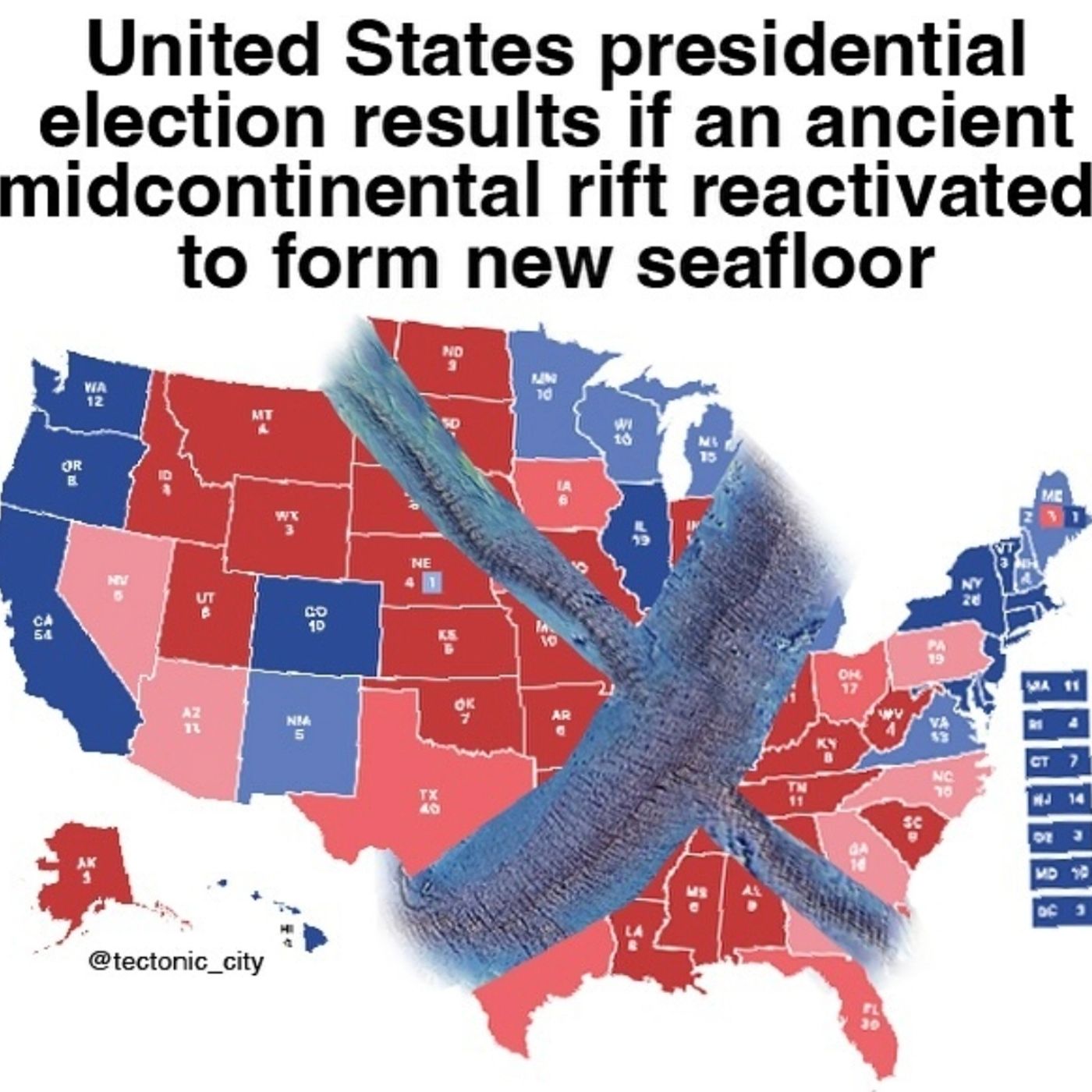
<v Speaker 1>the chase. One of my favorite posts of yours recently was, uh,
<v Speaker 1>it's supposed to says United States presidential It's got an
<v Speaker 1>election map with the red and the blue states, and
<v Speaker 1>it says United States presidential election results. If an ancient
<v Speaker 1>mid continental rift reactivated to form New Seafloor, can we
<v Speaker 1>talk about this? Is that? Is that rift the one
<v Speaker 1>that was beneath New Madrid, Missouri that you were referring to.
<v Speaker 2>Yes, that's right. Yes, it's a little it's a little
<v Speaker 2>known fact. I mean, I'm sure people in the boot
<v Speaker 2>heel of Missouri in that area know all about it.
<v Speaker 2>But there is a a very dangerous seismic zone in
<v Speaker 2>southeastern Missouri along sort of the Misissippi River valley. In
<v Speaker 2>there it erupted. I don't have the details. Like back
<v Speaker 2>in the late nineteenth century it was a huge earthquake.
<v Speaker 2>I don't remember them. I'm going to say magnitude seven
<v Speaker 2>just for it could be even bigger.
<v Speaker 1>Norma, the river flowed the Mississippi River flowed backwards.
<v Speaker 2>For a while. Wow, amazing.
<v Speaker 1>Supposedly, supposedly that's how the lore goes. It was a
<v Speaker 1>big ripper, right, yeah, it was.
<v Speaker 2>It was in a Mark Twain piece or something.
<v Speaker 1>But but this is a big So, this is a
<v Speaker 1>big So to explain to everybody what is a what
<v Speaker 1>is a new rift center or what would a rift
<v Speaker 1>center be? Explained that because a lot of people don't
<v Speaker 1>even know.
<v Speaker 2>I'm plate right right, So okay, so big picture of
<v Speaker 2>the Earth. Most people know about that the Earth is
<v Speaker 2>divided into plates, some kind of plates that move around
<v Speaker 2>very slowly. You know, most people have at least heard
<v Speaker 2>of that, you know. As a side note, it's not
<v Speaker 2>like that was something we've quote known forever. That was
<v Speaker 2>a theory that was only developed fifty years ago. So
<v Speaker 2>this is all kind of fresh scientifically speaking. But you know,
<v Speaker 2>Earth just divided into plates. And the plate that we
<v Speaker 2>live on is very creatively called the North American plate.
<v Speaker 2>And back in the Cambrian period, which was let's just say,
<v Speaker 2>about six hundred million years ago, the North American plate
<v Speaker 2>tried to split in half and it failed. I don't
<v Speaker 2>I really, this is a little bit out of my league.
<v Speaker 2>We could get experts on this that could talk in
<v Speaker 2>depth about it, but the basic idea is that it
<v Speaker 2>tried to split into two and it somehow didn't for
<v Speaker 2>whatever reason. Then maybe there was another plate boundary that
<v Speaker 2>prevented it to the west or the east or whatever.
<v Speaker 2>But it left this scar, this area of weakness. And
<v Speaker 2>the word we use for the splitting of plates is
<v Speaker 2>called a rift. It's called a continental rift. And the
<v Speaker 2>word that geologists use to describe what's going on under
<v Speaker 2>New Madrid, Missouri, is we call it a failed rift.
<v Speaker 2>And it gets a very nerdy word called a lockagen
<v Speaker 2>if people want to look that up au la cog.
<v Speaker 2>And it just means that there was, you know, the
<v Speaker 2>plate tried to break, it didn't. It left behind the scar.
<v Speaker 2>And when I say scar physically, what that means is
<v Speaker 2>there's there's these old faults that are under the you know,
<v Speaker 2>in the subsurface underground beneath that region, and they get
<v Speaker 2>activated every now and then. And the reason they're activated
<v Speaker 2>is because far away from that area are is an
<v Speaker 2>actual plate boundary. Right, So the San Andreas Fault, which
<v Speaker 2>is you know, what's probably two thousand and maybe fifteen
<v Speaker 2>hundred miles to the west. You know, there's an active
<v Speaker 2>plate boundary, so the plates are still moving and churning,
<v Speaker 2>and sometimes there are forces from the edge of the
<v Speaker 2>plate that get propagated to the middle of the plate
<v Speaker 2>and are released by these horrific earthquakes in the middle
<v Speaker 2>of the country. And what makes us weird, by the way,
<v Speaker 2>is that, you know, one of the things you learn
<v Speaker 2>in geology is that most earthquakes and volcanoes and all
<v Speaker 2>these catastrophic geologic events, they occur along plate boundaries. And
<v Speaker 2>you know, which would be the west coast of America.
<v Speaker 2>That's where the edge of the of the North American
<v Speaker 2>plate is. But New Madrid is very very far from
<v Speaker 2>a plate boundary. In fact, it's like smack dab in
<v Speaker 2>the middle of the plate. So we would call it
<v Speaker 2>intraplate intraplate earthquakes, and and so it's just very unusual
<v Speaker 2>to have that, and there's not a lot of it.
<v Speaker 2>There's a so there's if you if you were to
<v Speaker 2>google earthquake hazard map of the United States, you'd get
<v Speaker 2>this map and there'd be a you know, big hot
<v Speaker 2>spots on the west coast where everybody knows the earthquakes are.
<v Speaker 2>But you'll see this big hot spot right in the
<v Speaker 2>middle of the country, right around New Madrid. And there's
<v Speaker 2>a couple other weird ones, like there's one in North Carolina.
<v Speaker 2>They had a horrible or squick there that's far from
<v Speaker 2>a plate boundary in Charleston, South Carolina. And again in
<v Speaker 2>the in the nineteen hundreds. I don't know what's going on.
<v Speaker 1>I think you're safe. You think you're safe living in
<v Speaker 1>a place like Missouri, But little do you know, you
<v Speaker 1>know right right.
<v Speaker 2>And you know, I mean the truth is earth little
<v Speaker 2>earthquakes happen all over the place, like even in Florida.
<v Speaker 2>There in the Florida Panhandle. I remember like ten years
<v Speaker 2>ago there was like a magnitude four earthquake, like some
<v Speaker 2>sad little clump of mud settled or something in the
<v Speaker 2>Gulf of Mexico and that propagated some some motion that
<v Speaker 2>caused a little bit of an earthquake that would just
<v Speaker 2>kind of feel like maybe a truck going by. But
<v Speaker 2>in New Madrid, I mean that will that'll take down
<v Speaker 2>a concrete block building.
<v Speaker 1>So what does so there's an old rift. It's crazy
<v Speaker 1>to think, I mean something that happened six or a
<v Speaker 1>million years ago. So a rift center like kind of
<v Speaker 1>analogous to a seafloor spreading center or yeah, a rift.
<v Speaker 1>So it's where new magmas coming up and you know,
<v Speaker 1>if you imagine it, like uh fuck, I don't know
<v Speaker 1>what's the best way. A conveyor belt where one belt
<v Speaker 1>goes to the west, one belt goes to the east,
<v Speaker 1>and that's new magma coming up and then it goes
<v Speaker 1>back down gets recycled at a subduction zone. That kind
<v Speaker 1>of it's like a rift is what's going on, you
<v Speaker 1>know between the Arabian plate and the African plate correct
<v Speaker 1>like the same same thing, but in the case of
<v Speaker 1>New Madrid, it got halted. Maybe the gears got jammed
<v Speaker 1>up down there in the mantle, who knows, but it
<v Speaker 1>didn't follow through. But it's still there. So you've got
<v Speaker 1>so it's like a zone of weakness. And so where
<v Speaker 1>is the movement coming from that's causing it. It's coming
<v Speaker 1>from the outside like far away basically right, but it's pushing.
<v Speaker 2>That's what I think. I mean, I think that the
<v Speaker 2>what what causes the earthquakes is like large scale tectonic
<v Speaker 2>motions of the entire plate, and somehow that that. You know,
<v Speaker 2>you're going to build up tension in a plate through
<v Speaker 2>tectonic activity, and it's going to be released in earthquakes.
<v Speaker 2>Usually that tension is released on the boundaries, but every
<v Speaker 2>once in a while for physics reasons that I don't
<v Speaker 2>think I could explain very well. You know, there's some
<v Speaker 2>static forces that get released in the inside of the plate,
<v Speaker 2>and so that's basically what's happening.
<v Speaker 1>Yeah, it's man, it's wild. You know. That's the place
<v Speaker 1>I always say, that's the real map that matters, is
<v Speaker 1>the tectonic map, you know, because when you look at that,
<v Speaker 1>you're like, oh, I get it. I get why South
<v Speaker 1>America fits so perfectly into that little nook of Africa,
<v Speaker 1>you know. And then I didn't know this. Did you
<v Speaker 1>know that? I didn't know this. You probably knew this
<v Speaker 1>even though you're on the west coast. But Africa, you know,
<v Speaker 1>rammed into North America back in the day. Africa and Scotland,
<v Speaker 1>right or I guess Spain, like western Europe and northwestern
<v Speaker 1>Africa rammed into the eastern coast of North America. That's
<v Speaker 1>what caused the eurogyeny of the Appalachian mountains, and then
<v Speaker 1>they later spread apart. Again is that correct? Or am
<v Speaker 1>I messing that up?
<v Speaker 2>Yeah? That's that's that's basically the story. Yeah, we had
<v Speaker 2>the Appalachian orogeny, and there's all these there's the Akkadians.
<v Speaker 2>So the word orogeny is, first of all, it's a joke.
<v Speaker 2>It sounds like orogenos.
<v Speaker 1>Yeah, we're not saying not e R O G. This
<v Speaker 1>is not a filthy I'm not there yet. You know,
<v Speaker 1>maybe one day I'll get faith to read adult novels,
<v Speaker 1>but not now.
<v Speaker 2>This is orogen is O R O, not R. But
<v Speaker 2>the word orogeny is just nerds speak for a mountain
<v Speaker 2>building episode. And so there there are all these you know,
<v Speaker 2>these old mountains on the East coast that that resulted
<v Speaker 2>from a continental collision a long long time ago. And uh,
<v Speaker 2>and there were several of these events that happened. And
<v Speaker 2>then later on, uh, they the plate. So they came
<v Speaker 2>together to form a big plate, a giant super plate
<v Speaker 2>that we call Pangaea, perhaps you've heard of. And then
<v Speaker 2>at some point a continental rift formed, just like what
<v Speaker 2>Earth tried to do in New Madrid. But this one
<v Speaker 2>was successful and it split apart the plate of the
<v Speaker 2>Pangaea Plate into the all the plates that we have today,
<v Speaker 2>which would be the North American plates, South American plate
<v Speaker 2>on the west and then the Eurasian played African plates
<v Speaker 2>on the east. And so you know what's neat is
<v Speaker 2>that you can find the same rocks in Scotland that
<v Speaker 2>you can find and say, you know, Newfoundland or up
<v Speaker 2>in the you know, the Canadian the Canadian maritime provinces.
<v Speaker 2>The rocks are all the same, but they're separated by
<v Speaker 2>an ocean thanks to continental rifting.
<v Speaker 1>Right, So as with well Witchie together, well Witchie of fossils,
<v Speaker 1>there's well Witchy of fossils. You know that really, you know,
<v Speaker 1>well witchy a right weird Oh yeah, you know, the
<v Speaker 1>weirdest fucking plants. And there's well.
<v Speaker 2>Watched David Attenborough document right.
<v Speaker 1>Right, see today it's it's only alive and then Namibian
<v Speaker 1>fog deserts. But there's fossils from eastern Brazil because obviously
<v Speaker 1>they were a lot closer at one point. Yeah, it's
<v Speaker 1>why it's wild man, it's I remember reading a paper
<v Speaker 1>on it, I think last year, but.
<v Speaker 2>That this is this is sort of what's I think
<v Speaker 2>more interesting. Well, what's even more interesting about that to
<v Speaker 2>me is that you know, well, witchy grows in an
<v Speaker 2>arid climate, you know, which is you know, when you
<v Speaker 2>look at atmospheric circulation patterns, they tend to happen at
<v Speaker 2>thirty degrees latitudes sixty degrees latitude. And if the well
<v Speaker 2>witchi of fossils were in Brazil, then it would have
<v Speaker 2>been arid at that time. But there's a lot of
<v Speaker 2>continental motions. I thought that it would have been, you know,
<v Speaker 2>maybe more tropical or something, but maybe so somehow that
<v Speaker 2>arid climate was the same back then. So that's interesting.
<v Speaker 2>So that that's what's you know, play tectonics changes the
<v Speaker 2>climate of of whatever rock happens to be in a
<v Speaker 2>certain part of the globe, you know, like you can
<v Speaker 2>find tropical fossils and Antarctica. Yeah, because when they originally form.
<v Speaker 2>So I'm just I'm just sort of well, this little
<v Speaker 2>it's a brain tangent of mine.
<v Speaker 1>It's it's well, all this stuff's connected. Yeah, I mean
<v Speaker 1>bio biogeography I got into when I was realizing that
<v Speaker 1>certain lineages of plants were restricted to certain continents or
<v Speaker 1>certain hemispheres, and I was like, why is that? And
<v Speaker 1>then I started realizing it, Oh wow, it had a
<v Speaker 1>lot to do with plate tectonics and also with you know,
<v Speaker 1>how ocean currents shift according to where the continents are, like,
<v Speaker 1>you know, part of what helped as you know, part
<v Speaker 1>of what helped that Artica freeze over was when the
<v Speaker 1>continents moved further away from it and it got that
<v Speaker 1>circumpolar current that cut it off from the warmer ocean
<v Speaker 1>currents to the north, you know, from the equator. There's
<v Speaker 1>there's so much, Yeah, there's so much to think about here.
<v Speaker 1>And then I wonder too, I mean, I guess it's possible,
<v Speaker 1>well WICHI and maybe could have the one that's extant
<v Speaker 1>today could have evolved, you know, to survive in aridity.
<v Speaker 1>But probably yeah, probably not. I mean it was much
<v Speaker 1>more likely given the looking at the morphology of the
<v Speaker 1>fossils too that yeah, that part of Brazil was arid
<v Speaker 1>back then as well, which then makes you wonder what
<v Speaker 1>the hell like, why how did that happen? Like what
<v Speaker 1>was what were the ocean currents doing, you know, conveyor
<v Speaker 1>belts heat, what were the conton like? And then also
<v Speaker 1>what other weird shit was you know, alive at that
<v Speaker 1>time that we don't know about.
<v Speaker 2>Or is it maybe the well WITCHI was adapted to
<v Speaker 2>live in a different climate, and it's one of the
<v Speaker 2>most successfully adapted plants, at least the most able. You know,
<v Speaker 2>it's very able to change the climate that it's adapted to,
<v Speaker 2>you know what I mean. So maybe it was a
<v Speaker 2>different climate. I don't know.
<v Speaker 1>Yeah, it's weird.
<v Speaker 2>That's a body question.
<v Speaker 1>Okay, Well, let's talk about before because I want to
<v Speaker 1>get to this. This is like my main jam here
<v Speaker 1>was let's talk about serpentine. Because you're in California. Serpentine's
<v Speaker 1>the state rock. Some you know, some nanny state do
<v Speaker 1>good or tried to change that in the nineties. Is
<v Speaker 1>that correct? They tried to like eradicate serpentine because they
<v Speaker 1>found out it has had asbestos in it.
<v Speaker 2>Is that I didn't know. I'm not sure what you're
<v Speaker 2>talking about. What I mean, let me rephrase that. I've
<v Speaker 2>never heard of who you're talking about trying to eradicate
<v Speaker 2>serpent team. But it is correct that it does form
<v Speaker 2>it does form asbestos. So ill Floyd.
<v Speaker 1>To retic right right, right? I mean, what do you
<v Speaker 1>mean by that, well, there was a thing. There was
<v Speaker 1>a uh this is a well known case. I wish
<v Speaker 1>I hadn't pulled up already. But there was some congressman
<v Speaker 1>who learned or some political uh state political representative who
<v Speaker 1>learned that the state rock of California had asbestos in
<v Speaker 1>it and was, you know, clutching their pearls about it.
<v Speaker 1>Was very offended that this, you know, this carcinogenic rock,
<v Speaker 1>you know, precursor to mesothelioma, uh, was the state rock
<v Speaker 1>and tried to change that, like tried to like denominate it.
<v Speaker 2>Yeah, I see, like in their in their minds, it
<v Speaker 2>would be the equivalent of having tobacco be the official
<v Speaker 2>state plant.
<v Speaker 1>Carolina, right, right right. And all these geologists got pissed
<v Speaker 1>up when I learned about serpentine. Uh. God. It must
<v Speaker 1>have been fifteen twenty years ago, and it was before
<v Speaker 1>I was even into plants. I remember the geology teacher
<v Speaker 1>telling me this. I had two geology teachers. One really
<v Speaker 1>sweet woman, spoke like she was on pills, was like
<v Speaker 1>a sleep at the wheel. You could tell she just
<v Speaker 1>had lost the she'd lost the feeling, she'd lost the chemistry,
<v Speaker 1>you know. But the other one was really spicy and salty,
<v Speaker 1>and you know the first day was like, I don't
<v Speaker 1>care if people think I'm a bitch. I just want
<v Speaker 1>you to learn this stuff. And she was a great
<v Speaker 1>fucking teacher. She was awesome, and she told us that story.
<v Speaker 1>She's like, they tried to change the state rock or
<v Speaker 1>someone did not they someone, you know, some state representatives
<v Speaker 1>tried to change the state rock and pissed off this
<v Speaker 1>whole swath of geologists and luckily it got struck down.
<v Speaker 1>But it's such a great rock to be the state
<v Speaker 1>rock because it's one of the largest. I mean, the
<v Speaker 1>serpentine exposures in California are huge. And then when I
<v Speaker 1>learned that they literally caused new plant species to evolve,
<v Speaker 1>that was. That was it. I mean I was in love,
<v Speaker 1>you know, that was And so then I started traveling.
<v Speaker 1>You know, I saw serpentine in New Caledonia, seen in
<v Speaker 1>the Dominican Republic on the East coast. It's not as
<v Speaker 1>impressive on the East coast, like a lot of things,
<v Speaker 1>no offense, but regardless, you know, I was teaching this,
<v Speaker 1>I teach in general Bonni this semester, just covering for
<v Speaker 1>somebody else, and I showed the students a serpentine presentation
<v Speaker 1>on serpentine endemism and plants and had to get into
<v Speaker 1>subduction zones to explain it and all that stuff. It's
<v Speaker 1>crazy that, you know, so many people don't know what
<v Speaker 1>this rock is because when you go to these landscapes.
<v Speaker 1>I know, you don't get too much in southern California,
<v Speaker 1>but when you go to these landscapes, they are otherworldly. Man,
<v Speaker 1>It's like being on the surface of Mars.
<v Speaker 2>I agree. And you know, for the record, they can
<v Speaker 2>cry our State rock out of my cold dead hands
<v Speaker 2>because serpentine is the shit. So you're talking to the
<v Speaker 2>right person, because that's probably my specialty. So I've almost
<v Speaker 2>every paper I published has been on serpentine.
<v Speaker 1>I had no idea, man. I love that we're turning
<v Speaker 1>this into like this paranoid conspiracy theory too of like
<v Speaker 1>this this you know, this non existent threat like this
<v Speaker 1>sound like angry boomers. H But but anyway, So, okay,
<v Speaker 1>I did not know serpentine was your main jam. So okay,
<v Speaker 1>tell me about serpentine. Tell everybody about serpentine.
<v Speaker 2>All right, Well, let's see. I'll start. I'll start with
<v Speaker 2>with the money shot, which is that a lot of
<v Speaker 2>people think serpentinites were the hosts of the origin of
<v Speaker 2>life itself, so which I can get in, We can
<v Speaker 2>unpeel those layers. It's been said. I think it was
<v Speaker 2>my my own PhD advisor, Craig Manning who said that serpententization,
<v Speaker 2>that's the process that makes serpentines, uh, is the most
<v Speaker 2>important reaction in the solar system. So it's it's it's
<v Speaker 2>a big deal. You know about it, Jesus, Oh yeah, yeah,
<v Speaker 2>you know, it's it's good stuff. You know. The basic
<v Speaker 2>geology of a serpentinite. First of all, it's a metamorphic rock,
<v Speaker 2>which means that you take one rock and you change
<v Speaker 2>the conditions and it makes a new rock. So serpentinite
<v Speaker 2>is the name of the rock that contains the mineral serpentine.
<v Speaker 2>So I'll probably use the words serpentinite not to confuse
<v Speaker 2>the listeners or you or anybody about it. It just
<v Speaker 2>means that serpentine is a mineral, and rocks are made
<v Speaker 2>of minerals, and the rock made of serpentine is called
<v Speaker 2>a serpententite.
<v Speaker 1>Okay, perfect, perfect night and peridotite two. We got to
<v Speaker 1>talk about that later, but.
<v Speaker 2>Sorry, go on, Well, but that's that's an integral part
<v Speaker 2>of the story. So when you talk about a metamorphic rock,
<v Speaker 2>you want to know the rock that it formed from,
<v Speaker 2>and that rock is called the In general terms, every
<v Speaker 2>metamorphic rock has a proto lysth which is the rock
<v Speaker 2>that it formed from. Proto means early and lyft means rock.
<v Speaker 2>So it's just like the early rock what it was
<v Speaker 2>before it became a metamorphic rock. The protolysth or the
<v Speaker 2>rock before serpentinite is a peridotite, and those are rocks
<v Speaker 2>that are rich in the mineral olivine, and gem collectors
<v Speaker 2>know olivine as the gemstone pyridote, and olivine is a
<v Speaker 2>beautiful green mineral and it forms in you know, a
<v Speaker 2>variety of places, but the most commonplace where you get
<v Speaker 2>it on Earth is in the mantle. So Earth has
<v Speaker 2>these layers to it. Right, there's the crust, which is
<v Speaker 2>the outer thin layer, and then beneath the crust is
<v Speaker 2>this really thick layer called the mantle. And you know,
<v Speaker 2>we don't really get to go to the mantle because
<v Speaker 2>it's so deep. We can't it's hard to drill to it,
<v Speaker 2>like you have to even you know, the easiest way
<v Speaker 2>to drill is on the bottom of the ocean because
<v Speaker 2>that's where the crust is really thin. But you have
<v Speaker 2>to be on a ship. And I think the Japanese
<v Speaker 2>did it a few years ago for the first time.
<v Speaker 2>Russians have done it once. I mean we're talking like
<v Speaker 2>drill cores that are like eight, nine, ten kilometers deep.
<v Speaker 2>It's really an engineering problem to do that. So it's
<v Speaker 2>we can't go to the mantle. The only way the mantle.
<v Speaker 2>We can see the mantle is if it comes to us.
<v Speaker 2>So so it's this mysterious layer of earth. It comes
<v Speaker 2>to us like little chunks of it will sometimes come
<v Speaker 2>up in volcanoes. But another way it comes is through
<v Speaker 2>faulting on the seafloor, and it'll the mantle will be
<v Speaker 2>exposed on the seafloor or in California sometimes that that
<v Speaker 2>seafloor stuff gets pushed up on land. So in order
<v Speaker 2>to get the mantle on to a place where a
<v Speaker 2>geologist can walk on it, you know, Earth has to
<v Speaker 2>jump through some pretty major hoops to do it. So
<v Speaker 2>so let's start there, right. So first of all, a
<v Speaker 2>sir pentonite is metamorphosed from from mostly mantle rocks, which
<v Speaker 2>ordinarily we don't get to see, right, So the fact
<v Speaker 2>we can see serpentinites at all is a is a
<v Speaker 2>tectonic miracle, really, and and and so that's the basic stage.
<v Speaker 2>And sir pentonite forms when you take mantle rock that
<v Speaker 2>has a lot of oliven in it, and you add
<v Speaker 2>water to it at sort of slightly elevated temperatures maybe
<v Speaker 2>you know, three hundred well any any anywhere to say
<v Speaker 2>four hundred degrees celsius. That might seem pretty hot. I mean,
<v Speaker 2>that's like a pizza oven. But for the Earth, that's
<v Speaker 2>not that hot. So you take water plus peridotite and
<v Speaker 2>that gives you serpentinite. So that's the basic geology. And
<v Speaker 2>the main place is where you get that. You get
<v Speaker 2>that in subduction zones, as you say, and you get
<v Speaker 2>a lot of it on the sea floor. So that's
<v Speaker 2>the that's the basic contour.
<v Speaker 1>So I get when you say add water to it,
<v Speaker 1>so it's hydrated, but there's not because that might throw
<v Speaker 1>people off. They think add water to it, they're going
<v Speaker 1>to think that it's like wet. Can you explain that?
<v Speaker 1>Because like gypsum is like hydrated calcium sulfate, right, what
<v Speaker 1>does it mean? So what does it mean to be
<v Speaker 1>to have water in it? But be a dry mineral?
<v Speaker 2>Right? So, some minerals have water in them, as you say,
<v Speaker 2>like gypsum has water in it. Now it doesn't mean
<v Speaker 2>they're wet. What it means is that you have a mineral. Well,
<v Speaker 2>let's take a step back. What is a mineral?
<v Speaker 1>Right?
<v Speaker 2>So a mineral is a soft it's a natural solid,
<v Speaker 2>and it has a crystalline atomic structure, and that's that
<v Speaker 2>jargon means that it has a bunch of atoms in
<v Speaker 2>it that are very carefully arranged in a in a
<v Speaker 2>three dimensional pattern, and that that pattern contains elements, contains atoms.
<v Speaker 2>Sometimes those those atomic patterns contain hydrogens and oxygens, and
<v Speaker 2>the hydrogen is hydrogens and oxygens basically come from water
<v Speaker 2>that's added to minerals that don't have water. So olivine,
<v Speaker 2>this mineral and pertotite does not have H two O
<v Speaker 2>in its formula. Its formula is it's got magnesium, silicon, oxygen,
<v Speaker 2>little iron, but no H two oh. There's no hydrogen it.
<v Speaker 2>But if you take that olivine and you add H
<v Speaker 2>two O, then you get the formula for serpentine which
<v Speaker 2>has magnesium, silicon, iron, oxygen, and hydrogen in it, and
<v Speaker 2>so that hydrogen it's not like it's it's not wet
<v Speaker 2>like you say, because that's a good point, because a
<v Speaker 2>lot of people hear that they think it must be
<v Speaker 2>a wet rocks. That's not what we're talking about. What
<v Speaker 2>it means is that those hydrogens are in that atomic
<v Speaker 2>structure at certain locations in that crystalline pattern of atoms.
<v Speaker 2>So that's what it means. But to get the water
<v Speaker 2>in there, you have to have water somewhere in a rock.
<v Speaker 2>So how do you get the water into a peridotite,
<v Speaker 2>And there's several ways you do that. On the sea floor,
<v Speaker 2>it's pretty straightforward because you have mantle rocks exposed on
<v Speaker 2>the bottom of an ocean, and the water just comes
<v Speaker 2>from ocean ocean water that percolates down through faults and
<v Speaker 2>into the mantle rocks where the olivine is, so olivine
<v Speaker 2>gets in contact with water along faults on the sea floor.
<v Speaker 2>In subduction zones, the water comes from the plate that's
<v Speaker 2>being the down gooing plate that's being sucked down into
<v Speaker 2>the earth that releases water that then rises up and
<v Speaker 2>comes in contact with olivine above the plate in an
<v Speaker 2>area that we call the mantle wed and that's where
<v Speaker 2>serpententization occurs. That's where we get olivine plus water makes
<v Speaker 2>a serpentinite in a subduction zone. So so so that's
<v Speaker 2>the way to think about that is that you just
<v Speaker 2>got to think of any any way you can get
<v Speaker 2>H two O and olivine to play together at the
<v Speaker 2>right temperature, you're gonna make serpentine minerals in a serpentinite rock.
<v Speaker 1>So this zone, this subduction zone, you know, which is
<v Speaker 1>again the opposite of a rift zone, opposite of like
<v Speaker 1>a spreading center. This zone kind of acts like a
<v Speaker 1>like an easy bake oven for serpentine. It's it's there's
<v Speaker 1>a lot of pressure, there's a lot of heat, and
<v Speaker 1>there's water present, and it's it's being added to this peridotite,
<v Speaker 1>this this olivine, and that's what's creating serpentinite. Is that
<v Speaker 1>more or less what's going on?
<v Speaker 2>Yeah? I mean that, I mean, I mean, of course,
<v Speaker 2>we can get as complicated as you want, but I'm
<v Speaker 2>I'm fine with easy bake oven. I like that.
<v Speaker 1>Let's get a little more complicated because I think this
<v Speaker 1>stuff is fascinating. I love I love surprentonite.
<v Speaker 2>So okay, sure, so let's let's see what layer can
<v Speaker 2>we peel back here. First of all, technically speaking, geologists
<v Speaker 2>consider subduction zones to be cold, which is a weird concept.
<v Speaker 2>That's because the plate that's being pulled down into the mantle,
<v Speaker 2>that subducting plate, has a lower temperature than the rocks
<v Speaker 2>that are around it. And so if you know, imagine
<v Speaker 2>you know this plate, these plates on the seafloor have
<v Speaker 2>been sitting around on the sea floor cooling off like
<v Speaker 2>they formed. They formed at mid ocean ridges from volcanoes, right,
<v Speaker 2>and then they're spreading away from those mid ocean ridges
<v Speaker 2>and they get they're cooling off. The further they get
<v Speaker 2>away from that that mid ocean ridge spreading center, and
<v Speaker 2>you know, give it one hundred million years, they become
<v Speaker 2>much cooler. And that's part of the reason they sink
<v Speaker 2>back into the mantle, is because they get cold. And
<v Speaker 2>when things get cold, they get denser and they're gonna
<v Speaker 2>want to sink, so they sink back. These cold plates
<v Speaker 2>are sinking back into the earth. And so the thing
<v Speaker 2>about serpentine minerals is that they are stable at these
<v Speaker 2>so called colder temperatures. So you can say it's an
<v Speaker 2>easy bake oven. But I think a better analogy to
<v Speaker 2>use food, which I like because I like food, is
<v Speaker 2>it's more like a crock pot. It's like a slow cooker. Right.
<v Speaker 2>So if whoever doesn't you know any if you ever
<v Speaker 2>made like carnitas or like a you know, or you know,
<v Speaker 2>braised lambshanks, something like that, you know you're cooking at
<v Speaker 2>a very low slow tetanomic getting hundred smoked. You know,
<v Speaker 2>if you smoke a brisket. Where are you? You're in Texas?
<v Speaker 1>Right, yeah, I'm in Yeah, I'm in West Texas right now.
<v Speaker 2>Yeah, you're in West Texas. Okay, So I can use
<v Speaker 2>I can use brisket imagery. I know that's kind of pandering,
<v Speaker 2>but I don't care.
<v Speaker 1>We don't have any serpentine out here. It's like all
<v Speaker 1>limestone and Miocene volcanics.
<v Speaker 2>Right right. I wonder where the closest serpentine is to you.
<v Speaker 2>That's a good question.
<v Speaker 1>We've got little exposures. There's a small exposure in like
<v Speaker 1>Central Texas, but it's it seems like it's you know,
<v Speaker 1>relatively recent that it's been exposed. And it's certainly not
<v Speaker 1>large enough to cause any kind of you know, plant endemism.
<v Speaker 2>So okay, yeah, yeah, the plant animism is interesting because
<v Speaker 2>you know, I too have been to serpentine. You know,
<v Speaker 2>by the way, when you're talking about plants, we'll use
<v Speaker 2>the word serpentine. That's the jargon serpentine. Barrens is the word, right.
<v Speaker 2>You probably read about that, right, Yeah.
<v Speaker 1>Like ultra ultramaphic rocks, does that.
<v Speaker 2>Work too, ultramafic? Yeah, So ultra mafic is a compositional
<v Speaker 2>word that we we just that's a word we used
<v Speaker 2>to mean the chemical composition of a rock, and we
<v Speaker 2>use the word ultra mafic to describe the composition of
<v Speaker 2>of serpentonites. And that basically means very rich in magnesium
<v Speaker 2>and iron, very poor in potassium and sodium. And I
<v Speaker 2>think that combination is really weird for plants, right, because
<v Speaker 2>plants like especially like potassium right.
<v Speaker 1>Low nictam too, yeah, heavy metal very low nitrogen high
<v Speaker 1>and heavy metals high.
<v Speaker 2>In heavy metal's a lot chromium, there's a lot of nickel,
<v Speaker 2>and I don't think plants like either of those things.
<v Speaker 2>So so yeah, you get really bizarre, uh really strange plants.
<v Speaker 2>I mean, there's a whole have you been to I
<v Speaker 2>assume you've been to Kalmiopsis Wilderness up in Oregon, right,
<v Speaker 2>are you've heard of it?
<v Speaker 1>Yeah? Yeah, in San Benito County. And yeah, you know,
<v Speaker 1>I mean once once a plant devolves tolerance to serpentine,
<v Speaker 1>it's you can't really go back to normal soils because
<v Speaker 1>you'll just get out competed. You know, the same the
<v Speaker 1>same traits that make you able to withstand the serpentine
<v Speaker 1>make their maladaptive on like a normal soil, you'll just
<v Speaker 1>get smothered and now competed by other plants.
<v Speaker 2>Right exactly, exactly. So you've been to San Benito. That's
<v Speaker 2>a place called New Indria. So you've you've been there.
<v Speaker 1>Oh yeah, yeah, it's a nice, super fun site they've
<v Speaker 1>got there. Yeah. There used to be this guy that
<v Speaker 1>would run you off whenever you came like, uh looking
<v Speaker 1>at the old factory, the mining stuff, you know, and
<v Speaker 1>even get out of just you know, it's like, hey,
<v Speaker 1>we're on the road, buddy, you know, leave us alone.
<v Speaker 2>But you know what you're talking about? The ghost town.
<v Speaker 1>Yeah, yeah, the gohoes on itself. But I mean, the
<v Speaker 1>whole the whole area is just fascinating. There's a number
<v Speaker 1>and there's like tons of endemic plants there, like really cool,
<v Speaker 1>weird you know, Lily's and there was a plant called
<v Speaker 1>fertile area falcata. That falcata that was and I was
<v Speaker 1>obsessed with for a while. That only grows in serpentine talus,
<v Speaker 1>Like it's not enough to just grow in serpentine and
<v Speaker 1>occupies this really weird ecological niche of how the talus accumulates,
<v Speaker 1>you know, because the way it certain serpentine exposures fracture,
<v Speaker 1>it fractures into like these maybe thumb sized bits of
<v Speaker 1>talus that's generally soft. R.
<v Speaker 2>Wow. So it's not just a serpentine planet. It's an
<v Speaker 2>opportunistic serpentine planet. Yeah.
<v Speaker 1>Yeah, it's wild.
<v Speaker 2>It's such a crtically heroic.
<v Speaker 1>Yeah, it's pretty cool. And it's like this, it's like
<v Speaker 1>fucking lily, Like it's like this really beautiful plant with
<v Speaker 1>blue leaves and yeah, just cool stuff. Man.
<v Speaker 2>That's that's neat, you know. That's I'm working on projects
<v Speaker 2>at nu Indria, so that's that's one of my favorite
<v Speaker 2>places on Earth.
<v Speaker 1>Yeah, it's those barons, man are just fascinating you know,
<v Speaker 1>it's just really cool. And I've seen serpentine in the
<v Speaker 1>Baja Desert too, in Baja California, Sir. And there's a
<v Speaker 1>whole host of endemic plants down there too that's crazy,
<v Speaker 1>like Rus Lentii and Ariogonum preclarum wild stuff.
<v Speaker 2>Yeah, and yeah, it's it's it's a lot of fun
<v Speaker 2>for the botanist for sure.
<v Speaker 1>So okay, so this where what is is peroxine? Does
<v Speaker 1>that have any role in any of this? Or am
<v Speaker 1>I not remembering that correct? Yeah?
<v Speaker 2>They pronounced it. We pronounce it pyroxceine pyrexcene. The the
<v Speaker 2>people in Commonwealth countries call it pyroxene. If I find it,
<v Speaker 2>that's about as annoying as people that say aluminium. Uh.
<v Speaker 2>But pyroxine is is in peridotites, So it is an
<v Speaker 2>important It's the second most important mantle mineral. I would say,
<v Speaker 2>very abundant in some actually in some mantle rocks there's
<v Speaker 2>more pyroxcene than all of these. So there might be
<v Speaker 2>a pyroxceine enthusiast that may quibble with me saying that
<v Speaker 2>it's less important than all of them, but I don't care.
<v Speaker 2>And uh, it is in mantle rocks, and there are
<v Speaker 2>serpent uh, there are metamorphic reactions involving pyroxine plus olivine
<v Speaker 2>that will make serpentine. So it's an important part of
<v Speaker 2>UH of serpentonite formation, absolutely all right.
<v Speaker 1>And so but peridotite is an intrusive igneous rock. Right,
<v Speaker 1>It's like h on the spectrum of composition, you'd have
<v Speaker 1>granted at one end and peridotite at the other. Correct.
<v Speaker 2>Correct, Yeah, you're referring to the sort of the geology
<v Speaker 2>one o one chemical composition framework, which is correct. I'm
<v Speaker 2>not saying it's just because it's geology one on one
<v Speaker 2>that's not correct. That on one end we have the
<v Speaker 2>felt what we call felsic rocks, which are rich in silicon,
<v Speaker 2>rich in sodium and potassium, and we call those felsic.
<v Speaker 2>And on the other end of the spectrum we have
<v Speaker 2>the silica pore rocks, which are rich in magnesium and
<v Speaker 2>iron and relatively poor in the sodium and potassium. So,
<v Speaker 2>and the most of those are the ultramafic rocks. Absolutely
<v Speaker 2>so there gabro.
<v Speaker 1>Gabro is like the equivalent of basalt, kind of but intrust.
<v Speaker 2>Correct, that's right. And we call those MEFI. They're not
<v Speaker 2>ultra mafic.
<v Speaker 1>Right, may fix not a okay, correct, I've been pronouncing
<v Speaker 1>it mapic for like the I'll probably still do that.
<v Speaker 1>I'll forget, but I'll try to remember mafix. So do
<v Speaker 1>you ever see how often do you see gabro gabro
<v Speaker 1>exposed on a surface? I know there was a there's
<v Speaker 1>another there's a cypress species takat cypress that I always
<v Speaker 1>see on gabro soils. Yeah, but it weathers to red.
<v Speaker 1>I mean, I assume when it comes out of the ground,
<v Speaker 1>it's generally like a blackish darker color, but then it
<v Speaker 1>ends up weathering to red once the iron in it oxidizes.
<v Speaker 2>That's absolutely correct. Yep, that's right. They're rich in the
<v Speaker 2>mafic rocks have a lot of iron as ultra mafic rocks,
<v Speaker 2>and so when they weather, they'll tend Those rocks are
<v Speaker 2>gona tend tend to be read and uh, you know
<v Speaker 2>gabros are They form in a variety of ways, but
<v Speaker 2>they definitely form in magmatic systems, meaning from molten rock
<v Speaker 2>underneath volcanoes. Uh, and the ones that we see on
<v Speaker 2>the West coast. There's probably two main ways we get them.
<v Speaker 2>The most common one would be that these are magna
<v Speaker 2>chambers that were beneath mid ocean ridges, which are these
<v Speaker 2>these sea floor volcanoes. You get a lot of gabros
<v Speaker 2>that that freeze underneath the volcanoes. Uh and they never
<v Speaker 2>you know, they're they're stuck in the subsurface and then
<v Speaker 2>tectonics pushes them up on land for us to see
<v Speaker 2>them and walk on them and sample them. In southern
<v Speaker 2>California we have a fair amount of gabros as well.
<v Speaker 2>Those are not sea floor gabros. Those are magna chambers
<v Speaker 2>that are associated with a subduct zone that used to
<v Speaker 2>be here one hundred million years or so ago. In
<v Speaker 2>a cough, I'm a quick coffee hang on, okay, So yeah,
<v Speaker 2>So we have gabros in southern California that are like that,
<v Speaker 2>and then we have the other ones more in northern
<v Speaker 2>California that come from the sea floor.
<v Speaker 1>Because I always it's crazy, I didn't know so it's
<v Speaker 1>a it's a remnant of an old volcano. I always
<v Speaker 1>thought it was like a you know, as a as
<v Speaker 1>a subducting plate is going down, a little bit is
<v Speaker 1>getting scraped off like some putty and just being accreted
<v Speaker 1>to the continent. But that's not what's going on with
<v Speaker 1>the gabro in southern California.
<v Speaker 2>Huh yeah, So in in in sort of central and
<v Speaker 2>northern California, most of the gabros that are there all
<v Speaker 2>on the coast anyways, those are uh, those are pushed
<v Speaker 2>up on land from the seafloor. They're old oceanic plates
<v Speaker 2>that have been been pushed up. We tend to call
<v Speaker 2>those a special kind of rock called Ophia lighte, and
<v Speaker 2>that is just a rock that's been It's a sea floor, seafloor,
<v Speaker 2>sea oceanic excuse me, oceanic crust that's been pushed up
<v Speaker 2>on land. And in southern California we don't have that
<v Speaker 2>in the same way. There's little pockets of that. But
<v Speaker 2>most of the gabbros that are down here are associated
<v Speaker 2>with stratovolcanoes, and bigger, bigger stratovolcanos are like the Mount Fujis,
<v Speaker 2>the Mount Shastas, the Mount Saint Helen's, these big volcanoes
<v Speaker 2>on land, and those are more associated with with those
<v Speaker 2>kinds of volcanoes which form in subduction zones.
<v Speaker 1>Oh wow, okay, but those are more I mean generally
<v Speaker 1>felsic rocks though right, like it's the magma is more viscus,
<v Speaker 1>it's not as fluid.
<v Speaker 2>Or what correct, correct, but not all of it is.
<v Speaker 2>So the you know, it turns out that these these systems,
<v Speaker 2>these stratovolcanoes are complex. They have they can have really
<v Speaker 2>felsic lavas up to rhyolites, which you have a lot
<v Speaker 2>in West Texas. And you can get granites which are
<v Speaker 2>felsic intrusives. But you can also get basalts that come
<v Speaker 2>out of these volcanoes, which means you can get gabbros,
<v Speaker 2>which are the intrusive version of fasalt cool in the subsurface.
<v Speaker 2>So so I know that like the the sort of
<v Speaker 2>the intro view of subduction zoned volcanoes is that they
<v Speaker 2>tend to be more silica rich, which is true compared
<v Speaker 2>to volcano seaflow sea floor volcanics, but they're much more
<v Speaker 2>diverse than that. They have a lot of like you
<v Speaker 2>can go to the top of a of a giant
<v Speaker 2>stratovolcano and find basaltic flows sometimes, you know, So it's
<v Speaker 2>not like it's not this is more more variable.
<v Speaker 1>It's not black and white, there's no one so how
<v Speaker 1>do you when you're explaining to students, because I run
<v Speaker 1>into this all the time when I'm explaining like extrusive
<v Speaker 1>or intrusive igneous rocks to people, which is dependent just
<v Speaker 1>on grain size. I mean that's the easiest identifying factor.
<v Speaker 1>How do you explain grain size to people who are
<v Speaker 1>completely new to the idea.
<v Speaker 2>Yeah, the basic idea that we teach in an intro
<v Speaker 2>class would be that when something cools very quickly, the
<v Speaker 2>crystals don't have time to form, so you get very
<v Speaker 2>very tiny crystals when something cool. And and by the way,
<v Speaker 2>when is when is something cool quickly? When it's erupted. Right,
<v Speaker 2>So when you take a hot magma in the subsurface,
<v Speaker 2>and you know, a basaltic magma, by the way, is
<v Speaker 2>going to be like at least a thousand degrees celsius
<v Speaker 2>and maybe as high as fourteen hundred degrees celsius, and
<v Speaker 2>convert that to fahrenheit, I mean that burns your house
<v Speaker 2>down instantly, right.
<v Speaker 1>It just touches it and it's entire Yeah.
<v Speaker 2>Now imagine you're taking this really hot magma and you're
<v Speaker 2>erupting it at the Earth's surface to you know, I
<v Speaker 2>don't care if you're in the middle of the Sahara
<v Speaker 2>Desert and it's the hottest day ever recorded. That's going
<v Speaker 2>to be forty degrees celsius, right, So it's it'd be
<v Speaker 2>it'd be the equivalent of you know, you know, taking
<v Speaker 2>a you know, a pork roast and putting it in
<v Speaker 2>your freezer. You know, I like to use food, I said.
<v Speaker 2>So it basically like, as far as far as the
<v Speaker 2>magna is concerned, you're rupping it onto an ice sheet
<v Speaker 2>and it freezes immediately, and it doesn't have time to
<v Speaker 2>form crystals, So it doesn't form a lot of crystals,
<v Speaker 2>and the ones that it does are really it forms
<v Speaker 2>many small crystals, if at all. Sometimes it doesn't even
<v Speaker 2>have time to form crystals. It becomes what we call
<v Speaker 2>a glass with no crystals. Now, on the other hand,
<v Speaker 2>if something is cooling and that and that's what we call,
<v Speaker 2>by the way, the one with no crystals, we call
<v Speaker 2>that volcanic rock or extrusive rock. Right, So quick cooling
<v Speaker 2>very few let me phrase that, quick cooling many tiny crystals.
<v Speaker 2>And the opposite of that is intrusive or what we
<v Speaker 2>call plutonic, which is cooling in the subsurface. And when
<v Speaker 2>that happens rocks have millions of years to cool, and
<v Speaker 2>that gives a lot of time for crystals to grow,
<v Speaker 2>and so what you get is you get fewer crystals,
<v Speaker 2>but they're much bigger. And so that's the basic You know,
<v Speaker 2>if you're walking through a national park and you pick
<v Speaker 2>up a rock and it's an igneous rock, if the
<v Speaker 2>crystals are big, it's probably cooled underground as a plutonic
<v Speaker 2>or intrusive rock. And if the crystals are tiny, then
<v Speaker 2>it was probably a volcanic rock.
<v Speaker 1>So a good way to think about this, and I
<v Speaker 1>guess it would be like Joshua Tree National Park right
<v Speaker 1>iconic park, that most of the granite there is generally
<v Speaker 1>all the same age, and it probably and it's all
<v Speaker 1>the same mass, generally speaking, the same body, and it
<v Speaker 1>probably took a million or two million years to cool
<v Speaker 1>very slowly. How deep in? How deep underground do you think?
<v Speaker 2>Well, Joshua Tree. I love to teach about Joshua Tree
<v Speaker 2>because Joshua Tree is part of a very long system
<v Speaker 2>that's actually related to the Sierra Nevadas, and it's related
<v Speaker 2>to similar rocks all the way down in Baja. What
<v Speaker 2>Joshua Tree is those rocks out there are granites. They're
<v Speaker 2>technically we call them monzo granites, just a nerdy word
<v Speaker 2>for granite. Let's just call them granite. They're intrusive rocks.
<v Speaker 2>They're very large crystals in them. You can see them
<v Speaker 2>with the naked eye. You don't need any additional tools,
<v Speaker 2>no microscopes or handlenses. They cool underground. They're plutonic rocks.
<v Speaker 2>And what they're what they are is they formed inside
<v Speaker 2>an ancient volcano chain. And so the entire Sierra Nevadas,
<v Speaker 2>all those rocks out in the desert in Joshua Tree,
<v Speaker 2>they are the fossilized guts of an ancient subduction zone
<v Speaker 2>of volcano chain.
<v Speaker 1>Oh okay, that makes sense. Holy shit. So San Pedro
<v Speaker 1>Martyr down in Baja, same thing.
<v Speaker 2>Same thing that down there. We call it the Peninsular range,
<v Speaker 2>which is that's we call those rocks down in San
<v Speaker 2>Diego and down in Baja. It's called the Peninsular range.
<v Speaker 2>And but it's all the sort of the same. They're
<v Speaker 2>all roughly the same age as the Sierra Nevadas because
<v Speaker 2>in the Cretaceous period, the entire western margin, the western
<v Speaker 2>edge of the North North American Plate was just a
<v Speaker 2>huge subduction zone like we have in the modern in
<v Speaker 2>in the Andes.
<v Speaker 1>And stuff of Marilana, right, all right, is it?
<v Speaker 2>Right? That's it?
<v Speaker 1>And so that's so that's why you had all those
<v Speaker 1>because wherever you have a subduction zone, you've got a
<v Speaker 1>volcanic chain inland. So that's why all that stuff was there.
<v Speaker 1>That is just that, but it was deeper and then
<v Speaker 1>it got uplifted.
<v Speaker 2>Huh well, so yeah, so let me let me dive
<v Speaker 2>into that a little bit. So beneath every beneath every
<v Speaker 2>big volcano like Mount Fuji or Mount Saint Helens, you know,
<v Speaker 2>we see, we see all these lavas on the surface,
<v Speaker 2>but beneath it is even more molten rock that never
<v Speaker 2>got asked to make it to the surface, right, so
<v Speaker 2>it froze on its way to the surface. And so
<v Speaker 2>what happens is that that volcano, you give it one
<v Speaker 2>hundred million years, the volcano is mostly eroded away and
<v Speaker 2>that exposes these frozen you know, innards of the old volcanoes.
<v Speaker 2>And so that's that's the really that's the relationship between them.
<v Speaker 2>Did I answer your question?
<v Speaker 1>Yeah, But I mean there's they had to have been
<v Speaker 1>some uplift though, too, right, Like with Joshua. So, what's
<v Speaker 1>what's causing that uplift?
<v Speaker 2>Then, well, that is those are technonic forces on the
<v Speaker 2>uh you know, on the on the west coast there
<v Speaker 2>there's a lot of I think you know this. I'm
<v Speaker 2>not quite sure what the model is right now, but
<v Speaker 2>I think there is uplift from the when you when
<v Speaker 2>you get a when you get a subduction zone, right
<v Speaker 2>when the plate bends, there's a little bit of uplift there,
<v Speaker 2>a little bit upwarping of the plate, and I think
<v Speaker 2>that's helping to push some of those rocks up. And
<v Speaker 2>there's also compleated tectonic forces around the San Andreas Fault
<v Speaker 2>and the basin and range to the east where the
<v Speaker 2>crust is being pulled apart. UH. And and also you know,
<v Speaker 2>just erosional forces. You know, one of the main things
<v Speaker 2>that's exposing and is just erosion. But you're correct, there
<v Speaker 2>has to be uplift accompanying the erosion. And so I
<v Speaker 2>don't feel like I'm answering that question very well. I
<v Speaker 2>need you to look up.
<v Speaker 1>Yeah, well, I mean, well, I guess it's just important
<v Speaker 1>to know. Yeah, it was uplifted too, there's uplift, there's relief,
<v Speaker 1>but then there's uplift. Could it be? I mean, what
<v Speaker 1>is it? What is it? Litho spheric rebound when it's
<v Speaker 1>taking some off and then it kind of bounces back up.
<v Speaker 1>I guess, I mean, I guess that can do it too.
<v Speaker 1>It doesn't matter. I'm just thinking about it. But that
<v Speaker 1>brings me go ahead, let me.
<v Speaker 2>Just let me just I'll just let me. Let me
<v Speaker 2>just say, for the record, off the top of my head,
<v Speaker 2>I can't say exactly what the forces that's causing you uplift,
<v Speaker 2>but but in general you are correct. When you have
<v Speaker 2>a mountain range like that, you need to geologists puzzle
<v Speaker 2>over how uplift happened, because in order to get erosion,
<v Speaker 2>you need to have uplift. So like, contrast that with say, uh,
<v Speaker 2>you know Houston, right, Houston is in a coastal plaine,
<v Speaker 2>very flat down there in east.
<v Speaker 1>Pretty soon it's going to be in the ocean. So well,
<v Speaker 1>that's a whole other story. But the reason you don't
<v Speaker 1>get a lot of erosion in Houston like you do
<v Speaker 1>in California is because there's no uplift there. There's no
<v Speaker 1>mechanism to push the earth up because it's on a
<v Speaker 1>quiet part of the plate.
<v Speaker 2>But in California. In California, we have an active plate boundary,
<v Speaker 2>so all kinds of crazy stuff is happening to push
<v Speaker 2>things up. We have a the plate boundary gives you
<v Speaker 2>a variety of mechanisms to push land up, which is
<v Speaker 2>how you make a mountain range. So we'll just leave
<v Speaker 2>it at that.
<v Speaker 1>That okay, Okay, No, that's good dude. So but if
<v Speaker 1>you could radiometrically date like that rock and Joshua tree
<v Speaker 1>that granted, how old would it be most likely? When
<v Speaker 1>did it like Cretaceous? You said, so eighty million years
<v Speaker 1>ago or what?
<v Speaker 2>Yes, eighty I think I think the nominal age for
<v Speaker 2>a lot of these rock is one hundred million years old.
<v Speaker 2>And now someone might correct me on that, but that's fine, okay.
<v Speaker 1>But either way, it's important to know there was a
<v Speaker 1>subduction zone there before the san Andres existed. It was
<v Speaker 1>diving back into the mantle and as it does that,
<v Speaker 1>it goes. You know, it's at an angle, so inland
<v Speaker 1>a little bit like a forty five degree angle, just
<v Speaker 1>say throw it out there. That's where you get the magma,
<v Speaker 1>you know, volcano chains forming magma rising back to the surface,
<v Speaker 1>and so that's where. That's why that that whole you know,
<v Speaker 1>granitic chain is there from the Sierra Nevada down to
<v Speaker 1>San Pedro Martyr through Joshua Tree, et cetera.
<v Speaker 2>Correct. And maybe just to put a little bow on that,
<v Speaker 2>what did that look like a hundred million years ago?
<v Speaker 2>It looked something like the Cascades up in Washington State? Right,
<v Speaker 2>So you had these big volcanoes Mount Rainier, Mount Baker,
<v Speaker 2>Mount Saint Helens. That's what that. In one hundred million years,
<v Speaker 2>all those volcanoes will be eroded to expose the Joshua
<v Speaker 2>Tree style granites that were formed beneath the volcano.
<v Speaker 1>So the ryo light up top getting puked out with
<v Speaker 1>maybe a little hint of basalt of the volcanoes and
<v Speaker 1>then the granites down below.
<v Speaker 2>Correct.
<v Speaker 1>Yeah, okay, cool that Yeah, that definitely helps clarify things. Okay,
<v Speaker 1>so let's talk about the Farallon plate because this is
<v Speaker 1>you know, the San Andreas is a famous How old
<v Speaker 1>is the San Andreas? Roughly thirty million years something like that.
<v Speaker 1>That's right, right, But it wasn't It wasn't always there, correct. Yeah,
<v Speaker 1>there used to be the Farallon plate, which was you know,
<v Speaker 1>analogous to the Nasca Plate in South America. That's the
<v Speaker 1>one that's west of Chile, diving beneath all of South America.
<v Speaker 1>So the Farallon Plate was huge and it broke up
<v Speaker 1>when it fully subducted like a little piece. Is that
<v Speaker 1>the Wanda Fuca plate.
<v Speaker 2>Now, Yeah, the way to think about the Wanda Fuca
<v Speaker 2>is it is it is. Technically it's like the last
<v Speaker 2>gas of the Farallon Plate and it's been It's like,
<v Speaker 2>you know, most of the Farolan plate's been subducted, and
<v Speaker 2>there's a little tiny bits, a bit's an pieces that
<v Speaker 2>are still exposed at the surface and they'll they'll be
<v Speaker 2>gone soon.
<v Speaker 1>But when this thing, I mean, this was a subduction
<v Speaker 1>zone for how long you think a hundred million years?
<v Speaker 1>Two hundred million years? I mean how long was it there?
<v Speaker 1>It's a good question. I'm not sure when it started.
<v Speaker 1>We're revisiting the life and times of the Pharallom playground.
<v Speaker 2>It's a farewell our friend.
<v Speaker 1>Because it gets blamed, well, it gets blamed for a
<v Speaker 1>lot of different mountain uplifts, like I've heard it being
<v Speaker 1>blamed for the Sierra Madre Oriental and and you know
<v Speaker 1>near where I am like south of where I'm am
<v Speaker 1>like the.
<v Speaker 2>And I think it's related to Lara mine erogeny, which
<v Speaker 2>is most of the rockies in Colorado. I mean, so
<v Speaker 2>there's a whole whole host of things. I mean, it's
<v Speaker 2>a it's a mess out here, and I think a
<v Speaker 2>lot of it is due to that subduction zone.
<v Speaker 1>So this because I became interested in the Sierra Madre Oriental,
<v Speaker 1>which is, you know, near Mountterrey, Mexico, in the way
<v Speaker 1>of Leone, because it's just it's fucking wild. I mean,
<v Speaker 1>do you know much about the structure geology of that thing?
<v Speaker 1>Because it looks insane. I mean you can see it,
<v Speaker 1>you know, if you put in if you put like
<v Speaker 1>Google Maps into terrain layer, it looks like, you know,
<v Speaker 1>a rug was pushed up on a hardwood floor, like
<v Speaker 1>pushed from one side, hit a door jam on the other,
<v Speaker 1>and then just started bunching up like an accordion.
<v Speaker 2>A lot of folding.
<v Speaker 1>Yeah, why why is that? Do you know? Do you
<v Speaker 1>know much about that? Or you could you throw something
<v Speaker 1>out there, like even a theory or something or what.
<v Speaker 2>I'm happy to throw something out there. I'm I'm not sure,
<v Speaker 2>not completely sure, but I think you're probably right that
<v Speaker 2>it has to do with the you know, the the convergence,
<v Speaker 2>meaning the moving together of the farrel On plate with
<v Speaker 2>the North American Plate, probably happened, you know, related to
<v Speaker 2>you know, the related to the subduction zone. It may
<v Speaker 2>be related somehow to the breakup pan of Pangaea even
<v Speaker 2>which is which has to do you know, why did
<v Speaker 2>Pangea break up? Probably because the initiation of subduction on
<v Speaker 2>the west side of the North American Plate. That's complete speculation.
<v Speaker 2>So you know, and remember that this folding, this is
<v Speaker 2>something I talked about briefly with the you know, the
<v Speaker 2>idea of the Joshua tree forming those those those granites
<v Speaker 2>and Joshua Tree forming underground and later being exposed. Remember
<v Speaker 2>that all those folds, those folded mountains probably also formed
<v Speaker 2>deep in the subsurface when rocks were bent where rocks
<v Speaker 2>are hotter and they're more plastic, more bendable, and then
<v Speaker 2>they get uplifted and exposed as mountains. So that probably formed, right,
<v Speaker 2>So those that probably formed say ten twenty thirty kilometers
<v Speaker 2>beneath the surface and then got up uplifted due to
<v Speaker 2>the Pharallne plate deuction somehow.
<v Speaker 1>But I think. I mean, obviously it's you know, it's
<v Speaker 1>it's limestone there. It's all cretaceous limestone. I think maybe
<v Speaker 1>it's a little older. But if that had been a
<v Speaker 1>granite there or something instead, would they they probably wouldn't
<v Speaker 1>have done what they did, right, because some of these,
<v Speaker 1>you know, you could see the betting plane. The limestone
<v Speaker 1>was laid down horizontally, of course, and now it's it
<v Speaker 1>damn near like an eighty degree angle, and it's created
<v Speaker 1>some spectacular cathedral like mountains and some incredible plant habitat.
<v Speaker 1>I mean, the amount of fucking plants that grow straight
<v Speaker 1>out of limestone rock walls there is just insane and
<v Speaker 1>a number of endemics. A gave elbow pilosa that's really
<v Speaker 1>bizarre looking, a gave that only grows out of limestone
<v Speaker 1>cracks in the rock. Do you think the limestone, I mean,
<v Speaker 1>the structure of the limestone, you know, as opposed to
<v Speaker 1>something like a granite, obviously dictated why they look like
<v Speaker 1>that too. Do you think or what do you think
<v Speaker 1>about that?
<v Speaker 2>That's absolutely what we know that we're talking about sedimentary
<v Speaker 2>rocks now, right. So limestones are laid, they're laid in
<v Speaker 2>flat layers in quiet oceans, right, and so granites don't
<v Speaker 2>form like that. They're just kind of like blobs in
<v Speaker 2>a lava lamp. Right, So if you know, if granites
<v Speaker 2>were caught up in there, there's no layers that could
<v Speaker 2>be folded, you know what I mean. It's it would
<v Speaker 2>be like this is a dumb food analogy. Maybe it isn't,
<v Speaker 2>but it'd be like, let's let's say that you you
<v Speaker 2>have a rug, right, and and then a dog takes
<v Speaker 2>a big dump on the rug.
<v Speaker 1>Right, Okay, like where this is going? Right, I can.
<v Speaker 2>Relay food analogy that's not food.
<v Speaker 1>Like my dog. My dog is puked on the rug.
<v Speaker 1>He's old. He's puked on my rug like five times
<v Speaker 1>in the last month.
<v Speaker 2>You know, when I said food analogy, I was thinking
<v Speaker 2>of My first thought was jello on a tablecloth, But
<v Speaker 2>all of a sudden it went to dog shit on
<v Speaker 2>a rug.
<v Speaker 1>That's great, So this is that's philosophically more won do
<v Speaker 1>you want? That's philosophically more in tune with the times?
<v Speaker 1>Dog shit on a rug?
<v Speaker 2>Let's go with that.
<v Speaker 1>Great.
<v Speaker 2>Okay, dog sit on a rug. So when you fold,
<v Speaker 2>so the dog shit is just a blob, right, that's
<v Speaker 2>what granted looks like and but I'm thinking of like
<v Speaker 2>a little bit of runny dog shit here by the way,
<v Speaker 2>and or cat barf. And uh so when you when
<v Speaker 2>that rock, it's when when I'm sorry, when the rug
<v Speaker 2>gets bunched up, you're going to see the folds in
<v Speaker 2>the rug. But then what happens to the duc shit,
<v Speaker 2>It's just going to be kind of blobbed out. It's
<v Speaker 2>not You're not going to see folds in that right, Yeah,
<v Speaker 2>it's just gonna sort of it's just it crumbles everywhere.
<v Speaker 2>It's a big mess. So that's that's what would happened
<v Speaker 2>with with a blob of granite. It's not going to
<v Speaker 2>get folded. It's just going to get sort of you know,
<v Speaker 2>you know, blobbed up and jumbled around. You're not going
<v Speaker 2>to see those layers. So that's why you know, sedimentary
<v Speaker 2>rocks are useful in that way because you can they
<v Speaker 2>actually do record. They're they're better at recording large scale
<v Speaker 2>you know, structural transformations of the rocks than than than
<v Speaker 2>a granite one.
<v Speaker 1>I guess the thing that's weird too about the the
<v Speaker 1>Sierra Madre too is it's it's a fold thrust belt
<v Speaker 1>so it's it's not technic. There's a more going on there,
<v Speaker 1>and it helps to look at there's a good YouTube
<v Speaker 1>page called the Geo Models that really helps envision is.
<v Speaker 1>But it's not just you know like, oh, it just
<v Speaker 1>crumples up and that's it. It's you know, it'll crumple up
<v Speaker 1>to a point, you know, doing that accordion thing, and
<v Speaker 1>then there'll be a break, a slippage and that and
<v Speaker 1>one one mass of that according will then start to
<v Speaker 1>slide over or under the other one. Is that kind
<v Speaker 1>of what's that? I mean? Is that right? That's what
<v Speaker 1>a full thrust belt is.
<v Speaker 2>Yeah, this is a little bit. Yeah, we're a little
<v Speaker 2>bit out of my expertise. I'm more of a more
<v Speaker 2>of a sort of on the chemistry side of things.
<v Speaker 2>But I'm happy to speak extemporaneously and admit that I
<v Speaker 2>might not get this right. But so yeah, So when
<v Speaker 2>at some point when you start to fold rocks, they'll
<v Speaker 2>reach a critical point where they can't depending on the temperature,
<v Speaker 2>depending on the depth, depending on the rock type, there's
<v Speaker 2>some rocks that won't be able to sustain the folding anymore,
<v Speaker 2>and then they will they'll they fault, and so you'll
<v Speaker 2>get you know, failure of the rocks in what we
<v Speaker 2>call brittle deformation, that means cracking. Basically, they'll behave brittally
<v Speaker 2>and you get these and and and depending on the
<v Speaker 2>tectonic situation, you know, in this kind of fold thrust
<v Speaker 2>belt that you're talking about, you get you know, these
<v Speaker 2>large scale faults that will push these folded rocks up
<v Speaker 2>on each other into sort of a complex, you know,
<v Speaker 2>folded accordion type of structure that probably looks very beautiful
<v Speaker 2>you see them, that's probably probably really cool looking. Yeah,
<v Speaker 2>those large scale faults are called thrust faults, where a
<v Speaker 2>rock will get pushed up at a low angle onto
<v Speaker 2>another rock. And so I can imagine that that happening
<v Speaker 2>with with highly folded limestones or sedimentar your eyes for sure.
<v Speaker 1>So this could have so this is basically it's a
<v Speaker 1>convergent force to cause this, and it could have quite
<v Speaker 1>correct easily could have been the Perollon plate.
<v Speaker 2>Then I guess, huh, yeah, I mean I would think
<v Speaker 2>of the Ferrollon plate is being subducted. But there are
<v Speaker 2>forces in every subduction zone. There are forces that move
<v Speaker 2>the the subducted plate towards the overriding plate, and the
<v Speaker 2>overwriting plate is moving towards the subductive plate. Let me
<v Speaker 2>let me let me back up a second. So, I
<v Speaker 2>think when we think of subduction zones, people think the
<v Speaker 2>only force is the down gooing plate. It's just being
<v Speaker 2>sucked down, right, But that's sucking of the down gooing
<v Speaker 2>plate actually pulls in the overriding plate. So so not
<v Speaker 2>only is the subduction plate going down, but the overriding
<v Speaker 2>plate is being also being sucked towards this towards the trench,
<v Speaker 2>towards that that plate boundary. And so there's there's convergent
<v Speaker 2>forces that are operating there that can be very complex.
<v Speaker 2>So and I'll leave it there because again, as I said,
<v Speaker 2>it's a little bit out of my expertise, these large
<v Speaker 2>scale tectonic strikes.
<v Speaker 1>I I appreciate you being down to you know, get
<v Speaker 1>your toes with it, because it's it's fun to fine about.
<v Speaker 1>But but but okay, so what are you gonna say
<v Speaker 1>I'm wrong?
<v Speaker 2>I'm just saying I'm wrong all the time, and you know,
<v Speaker 2>but that's never stopping before.
<v Speaker 1>It's okay, we could we can all be loose with that.
<v Speaker 1>It's just the goal is just to get people thinking
<v Speaker 1>about this on these you know how these land masses
<v Speaker 1>move on these huge scales. So the Farallone plate is
<v Speaker 1>being subducted roughly one hundred million years ago. At a
<v Speaker 1>certain point it gets fully subducted, and then because it's
<v Speaker 1>got an odd shape to it, and then it breaks
<v Speaker 1>off to the wand the Fuca plate as well. And
<v Speaker 1>then how does the San Andreas open up? Because when
<v Speaker 1>the Phara line plate's fully subducted, that's when you get
<v Speaker 1>the San Andreas occurring.
<v Speaker 2>Correct, correct, So what happened? This is what the tectonics
<v Speaker 2>of California are very interesting in this way. So the
<v Speaker 2>Fara line plate is being subducted, but to the west
<v Speaker 2>of the Pharallon plate. So let's set the stage. The
<v Speaker 2>Para line plate is being subducted. To the east is
<v Speaker 2>North America, and to the west of the Pharallon plate
<v Speaker 2>is a mid ocean ridge system which we call the
<v Speaker 2>East Pacific Rise. That's a spreading center right where the
<v Speaker 2>plates are moving apart. And so as the Farallon plate
<v Speaker 2>is being subducted, this specific rise also gets subducted. So
<v Speaker 2>it's it's a very strange situation where where we're subducting
<v Speaker 2>a mid ocean ridge system.
<v Speaker 1>Yeah, okay, and it's counterintuitive, man, it's weird to think about.
<v Speaker 2>Yeah, it's it's very weird, and it has a lot
<v Speaker 2>of interesting geologic hor implications. And if you've you know,
<v Speaker 2>you've looked at a map of a mid ocean ridge system, right,
<v Speaker 2>it's kind of got that stair step pattern too, it is,
<v Speaker 2>that's so familiar.
<v Speaker 1>Yeah, yeah, there's many transform faults in between those.
<v Speaker 2>Correct. The good the transform faults, that's where the plates
<v Speaker 2>are sliding past each other. And so what happens if
<v Speaker 2>you subduct a mid ocean ridge system, then you're subducting
<v Speaker 2>transform faults, and that's basically that transform fault that's being
<v Speaker 2>subducted has propagated into the modern day Sandrean's.
<v Speaker 1>Fault, which is like exponentially longer than any ex.
<v Speaker 2>Ntionally longer any other transform fault. Correct, I'm sure people
<v Speaker 2>have written papers about this. That's probably because the transform
<v Speaker 2>fault that got subducted was in oceanic crust, really thin
<v Speaker 2>oceanic crust, and when that gets subducted beneath the continent,
<v Speaker 2>the continent of course is no more coherent and we
<v Speaker 2>lose the spreading center, those those go away, and so
<v Speaker 2>the whole thing just evolves into this big transform fault.
<v Speaker 1>And so does the transform fault. It runs beneath the
<v Speaker 1>Sea of Cortes, right, that big inland body of water,
<v Speaker 1>not inland, but body of water on the east side
<v Speaker 1>of Baja, California. Is that is that? When? That's?
<v Speaker 2>When?
<v Speaker 1>Is that? When did I'm confusing this now? When did
<v Speaker 1>Baja start moving away from the mainland like five six
<v Speaker 1>million years ago?
<v Speaker 2>Right? I'm not sure, but I bet that's about right,
<v Speaker 2>because well, what happens is the San Andreas Fault actually
<v Speaker 2>kind of poops out and ends around the salt and
<v Speaker 2>sea near near the beautiful village of Bombay Beach. Have
<v Speaker 2>you ever been there? Oh yeah, oh yeah, I love
<v Speaker 2>Bombay Beach.
<v Speaker 1>Yeah. The whole area is just man, it is something else.
<v Speaker 1>It's like pest this like petrochemical agriculture myth, but also
<v Speaker 1>some beautiful rocks.
<v Speaker 2>It's glorious.
<v Speaker 1>Yeah.
<v Speaker 2>And don't forget this the mountain, the folk art mountain
<v Speaker 2>where the guy paints God is love. And then there's
<v Speaker 2>city where the people squat on an old arm. It's
<v Speaker 2>just great. The best of California. Yeah, man, So the
<v Speaker 2>San Andreas fault, you know, it ends around right there,
<v Speaker 2>and what happens in that area it becomes it converts
<v Speaker 2>into it from the Saltan Sea to the Sea of Cortez.
<v Speaker 2>Sea of Cortes, we're converting back into a min ocean
<v Speaker 2>ridge system.
<v Speaker 1>I didn't even realize that. Oh no, ship okay, yeah, right.
<v Speaker 2>Yeah, yeah. So the salt the salt and sea is
<v Speaker 2>is a is a. I mean that's why there's a
<v Speaker 2>sea there by the way, there's a low lying area.
<v Speaker 2>That's because the crust is spreading apart there, like in
<v Speaker 2>Death Valley.
<v Speaker 1>Right, So there's new magma coming up from below right
<v Speaker 1>beneath the Sultan.
<v Speaker 2>Well, it wants beneath the Salton sea. I mean, oh,
<v Speaker 2>in Sea of Cortez. Yes, there's a spreading center there
<v Speaker 2>and and that will propagate northward into the salt and
<v Speaker 2>sea area. Let's give it five million years. That'll open
<v Speaker 2>up into a new sea, a continental risk, right that
<v Speaker 2>this one's not going to be failed. And there's there's
<v Speaker 2>spreading centers and transform faults in a whole mid ocean
<v Speaker 2>ridge system that is going down the Sea of Cortez
<v Speaker 2>that connects with the specific rise that's the modern eat
<v Speaker 2>specific rides.
<v Speaker 1>Wow wow, So what this for anybody listening who's you know,
<v Speaker 1>made it this far through the podcast? That is not
<v Speaker 1>interesting geology? This is why, Okay, this is this is
<v Speaker 1>fucking coolo, because this is how you know, bah California
<v Speaker 1>has a ton of endemic plants, plants that only grow
<v Speaker 1>in Baja and are restricted to that peninsula, because that's
<v Speaker 1>what is required for speciation is isolation. What creates that
<v Speaker 1>isolation the fucking seafloor spreading center beneath you know the
<v Speaker 1>fact that the sea floor spreading center beneath the Sea
<v Speaker 1>of Cortez, which is causing Baja California to move away
<v Speaker 1>from mainland Mexico. So once again we see the intersection
<v Speaker 1>of evolution, botany, and geology.
<v Speaker 2>So okay, absolutely, So what is.
<v Speaker 1>In the forecast for the San Andreas fault? I mean
<v Speaker 1>this is that is that just going to keep propagating
<v Speaker 1>new spreading centers and separation from the North American continent
<v Speaker 1>or what.
<v Speaker 2>Let's see, you know, I'm trying to what are the
<v Speaker 2>models for the San Andreas. I think eventually what's going
<v Speaker 2>to happen is that the Sea of Cortes and the spreading,
<v Speaker 2>the rifting that's going on there is going to propagate
<v Speaker 2>northward into deep into the Mojave Desert, deep into Nava
<v Speaker 2>because that whole area is spreading apart. That's a region
<v Speaker 2>of that's that's the region of It's the region of
<v Speaker 2>North America that we call the basin.
<v Speaker 1>Right yeah, right in, Salt Lake City and Reno are
<v Speaker 1>moving away from each.
<v Speaker 2>Other, absolutely, and so what's going to happen is that
<v Speaker 2>that sea is going to eventually make its way into
<v Speaker 2>you know, central Nevada, and we're going to have a
<v Speaker 2>brand new ocean. I'd give that now, let's give it
<v Speaker 2>fifteen twenty million years.
<v Speaker 1>Wow. I didn't, man, I didn't realize it because I
<v Speaker 1>was going to ask it at at some point too.
<v Speaker 1>I said, you know, the basin and range thin crust.
<v Speaker 1>That's why there's all those hot springs, and it's thin crust.
<v Speaker 1>Because Reno and Salt Lake are moving away from each other.
<v Speaker 1>And so what, Yeah, I was going to ask you,
<v Speaker 1>what's eventually going to happen? I mean, because that that
<v Speaker 1>is basically a very very young baby rift zone right
<v Speaker 1>there or.
<v Speaker 2>What Yes, yes, absolutely, And that has to do with
<v Speaker 2>the complex tectonics of the complex tectonic forces on the
<v Speaker 2>west coast of them America related to the subduction of
<v Speaker 2>the Pharaalm plate and the subduction of the East Pacific
<v Speaker 2>rise to form the San Andres fault, and the just
<v Speaker 2>the weird forces that are going on when you subduct
<v Speaker 2>a mid ocean ridge. So again I can't get more
<v Speaker 2>much more detailed than that, but but it's yeah, it's
<v Speaker 2>kind of and also there's a there's a force, you know,
<v Speaker 2>the San Andres Sanadre's fault, the west side of it
<v Speaker 2>is moving, is moving to the north. That's why we
<v Speaker 2>say that you know, La will be a suburb of
<v Speaker 2>San Francisco in twenty five million years. And so there's
<v Speaker 2>a there's a force that's sort of like we call
<v Speaker 2>it a transitentional force, which means it's a force that's
<v Speaker 2>that's sort of like sliding past each other. But while
<v Speaker 2>it's sliding past each other, that the friction there is
<v Speaker 2>aiding AI d I NG aiding the pool apart on
<v Speaker 2>the in the Nevada side. So it's like this big
<v Speaker 2>friction force Sander's faults moving by, but as it's moving
<v Speaker 2>it by, it's cooling apart the crust in the Vada
<v Speaker 2>and Arizona and the Mahabi.
<v Speaker 1>Yeah, it's you know, what I always thought was cool
<v Speaker 1>was when you look at it, like a geologic map
<v Speaker 1>of California. And I used to have like one of
<v Speaker 1>those seven foot tall ones you know you could buy from.
<v Speaker 1>I think I got it in Sacramento at the USGS there.
<v Speaker 1>But you know, you follow the San Andreas and you
<v Speaker 1>can literally connect And this was I learned this in
<v Speaker 1>the geology class I took, which was, you know, such
<v Speaker 1>a cool thing to be able to see. But you
<v Speaker 1>look at the where the fault is on the map,
<v Speaker 1>and you you know, the rocks are all color coded
<v Speaker 1>and you can see like, oh, the the granites in
<v Speaker 1>Point Reas and the granites in the Santa Cruz Mountains
<v Speaker 1>literally came from down way down south and you can
<v Speaker 1>see like a breadcrumb trail of where you know, where
<v Speaker 1>they connect to the same color, but like two hundred
<v Speaker 1>miles south.
<v Speaker 2>Yeah. The one of the one of the one of
<v Speaker 2>those situations that we like to teach in southern California
<v Speaker 2>is that you've probably been to Pinnacles National Park, Yes,
<v Speaker 2>and yeah, it's a cool place people like to rock climb.
<v Speaker 2>A lot of rhyolites are there. That's about, let's say,
<v Speaker 2>a couple hours south of San Francisco, and those are
<v Speaker 2>rhyolites that are there, and it's a fun place to go,
<v Speaker 2>very hot in the summer. But that exactly that rock,
<v Speaker 2>the rhyolites that are in that rock, those volcanic rocks
<v Speaker 2>are identical to rocks down in southern California, near a
<v Speaker 2>town called Lancaster, And we call those the Kneeknock volcanics
<v Speaker 2>N E, N A c H volcanics, these little mountains
<v Speaker 2>that are there, but they're exactly the same and so
<v Speaker 2>they they're they're the same rock type, they're the same age.
<v Speaker 2>And so it's little things like that that are really
<v Speaker 2>strong evidence for the whole entire theory of plate tectonics.
<v Speaker 2>You know, So those are those are neat little things,
<v Speaker 2>and how do you how else could you explain identical
<v Speaker 2>rock types? You know, two hundred and fifty miles away,
<v Speaker 2>not just identical rock types, but I actual identical rocks.
<v Speaker 2>An outcrop that's been split into and part of it
<v Speaker 2>moved north to a national park, and you know, the
<v Speaker 2>other park got left behind in south of California, so
<v Speaker 2>those are those are neat things. So you're making those
<v Speaker 2>exact same observations that all just have been making to support.
<v Speaker 2>It's so cool. It's so cool.
<v Speaker 1>Then you think about how much time it must have
<v Speaker 1>taken for that to occur, because you know there most
<v Speaker 1>plates are moving at what roughly the speed your fingernails grow,
<v Speaker 1>that's right, And so thinking about okay, well if that's
<v Speaker 1>two hundred miles away, like Jesus, right, that's a long
<v Speaker 1>that's a really long amount of time. Like what was
<v Speaker 1>what was going on back back then? It's it's so.
<v Speaker 2>Yeah, the time scale, you know. And I've been doing
<v Speaker 2>this for a while, and but you when I stopped
<v Speaker 2>to think about it, it still hurts my head just think
<v Speaker 2>about geologic time scales. Like here's a little exercise I
<v Speaker 2>tell to interest students. Imagine, let's estimate how much how
<v Speaker 2>much dust builds up in your room in a year
<v Speaker 2>if you didn't dust, if you were like a total
<v Speaker 2>slob and you didn't dust, and you know, how much
<v Speaker 2>would would build up in your room. You know, I'll
<v Speaker 2>just throw out a millimeter, right, Maybe that's a little,
<v Speaker 2>maybe that's a lot. I don't know, but maybe not.
<v Speaker 2>I mean, dust gets you know, dust can build up
<v Speaker 2>or maybe if you've got pass you got pets, right,
<v Speaker 2>or maybe dust on your car or something. Right, Let's
<v Speaker 2>just say a millimeter a year right now, that doesn't
<v Speaker 2>feel like a lot. But if you multiply that by
<v Speaker 2>a million years, right, which isn't a long time geologically speaking,
<v Speaker 2>you end up with like a kilometer of sediment. Right.
<v Speaker 2>So like if it's a lot, right, if you go
<v Speaker 2>on to ten million years, you get like ten kilometers.
<v Speaker 2>I might be getting the mass a little bit off,
<v Speaker 2>but you get the idea, right. So things that you
<v Speaker 2>think aren't a lot when you know, you know, things
<v Speaker 2>that you a rate that you think isn't very much
<v Speaker 2>like your fingernail growing, if you extend that over a
<v Speaker 2>reasonable geologic uh, you know, time frame become enormous like
<v Speaker 2>your you know, your fingernails, you know, give it a
<v Speaker 2>billion years, your fingernails go to the moon or something right, Right,
<v Speaker 2>But once you start, once you start thinking about things
<v Speaker 2>like that, you're like, dang, anything is possible.
<v Speaker 1>Well, I think too, and then you just but then
<v Speaker 1>you're actually able to picture how the land around you forms,
<v Speaker 1>and you know, same thing with same thing with evolution.
<v Speaker 1>I mean, you know, people will say, how does a
<v Speaker 1>cact just know how to look like a rack? You're thinking,
<v Speaker 1>you're thinking too short, You're thinking like a human right,
<v Speaker 1>You're thinking on the span of a human lifespan. You know,
<v Speaker 1>think of how how think of how an environment can
<v Speaker 1>select for these traits over long amounts of time, you know.
<v Speaker 1>And it's and it doesn't just go from like a
<v Speaker 1>music habitat to a desert instantaneously. It takes a while.
<v Speaker 1>You know.
<v Speaker 2>It's and it's not like it's also this is this
<v Speaker 2>is you know, I'm glad you brought that up. It's
<v Speaker 2>a common misconception about adaptation. But the plant doesn't decide
<v Speaker 2>to change, right. The environment forces the plant to die
<v Speaker 2>or live. And whoever lives is the one that you
<v Speaker 2>see today. It's not like you know what I mean.
<v Speaker 1>I love all. That's what I love too, man, because
<v Speaker 1>I love when you see these little bits on social
<v Speaker 1>media about how evolution works or how someone today that's like, oh,
<v Speaker 1>the moon is just the right distance from the Sun
<v Speaker 1>so that you know, it's the diameter that we see
<v Speaker 1>it at just perfectly fills up the Sun's diameter so
<v Speaker 1>we can view an eclipse, and there's always someone being like, wow,
<v Speaker 1>it's proof of a god. It's like, well, not saying
<v Speaker 1>God doesn't exist, but that's not the proof of it.
<v Speaker 1>You're thinking. You literally have the freaking rational skills of
<v Speaker 1>a nine year old no offense, you know. But the
<v Speaker 1>way that these things work, I mean you have to
<v Speaker 1>zoom out, you know. That's the beauty of thinking on
<v Speaker 1>this grandiose timescale and starting to piece things together, and
<v Speaker 1>also just being able to think far beyond what you
<v Speaker 1>already know, like your mind, your worldview is not just
<v Speaker 1>restricted to the tiny, you know, windowless room of your
<v Speaker 1>own mind. Now you're able to kind of zoom out
<v Speaker 1>and get more of like a drone's eye view of
<v Speaker 1>the world around you. And that's one of the most
<v Speaker 1>beautiful things about being human to me is you know,
<v Speaker 1>looking watching this ape, start to kind of like get
<v Speaker 1>an understanding and kind of get the hint that like, wow,
<v Speaker 1>there's a lot more going on here, and then what's
<v Speaker 1>directly in front of me?
<v Speaker 2>Amen?
<v Speaker 1>But anyway, sorry, I went there. Okay, let's talk about
<v Speaker 1>you got time to talk about sedimentary rocks here for me? Okay,
<v Speaker 1>let's talk I want to talk about limestone, because where
<v Speaker 1>I am there's a lot of limestone. It's all it's
<v Speaker 1>all limestone, and just like serpentine, but not as pronounced,
<v Speaker 1>you get a lot of limestone endemic plants, which is
<v Speaker 1>such a cool phenomenon. I mean, fucking pot peyote is
<v Speaker 1>a limestone endemic plant, or at least calcareous soils. So
<v Speaker 1>and also what I've learned, what I've started to pay
<v Speaker 1>attention to since living in a limestone area is how
<v Speaker 1>it weathers, not just mechanically but chemically. There's literally a reaction.
<v Speaker 1>I mean, you can be on the rocks out here
<v Speaker 1>in the desert and you see this dimpling pattern and
<v Speaker 1>you're like, what the fuck? You're an extreme example that
<v Speaker 1>might be dog tooth karst right, like I saw in
<v Speaker 1>Dominican Republic, where you've got a tropical environment, you know,
<v Speaker 1>heavy rainfall literally eating away at these you know, old
<v Speaker 1>coral reefs that have been uplifted. How do you start
<v Speaker 1>to explain to students, one how does limestone form? And
<v Speaker 1>two how does it weather and form soils? Which is
<v Speaker 1>seemingly pretty quickly relatively speaking, how fastly it weather's compared
<v Speaker 1>to other rocks.
<v Speaker 2>Yeah, so okay, So how does limestone form limestone? You know,
<v Speaker 2>most limestone forms actually the same way we get minerals
<v Speaker 2>precipitated in our pipes at home, right, So, limestone is
<v Speaker 2>made of a mineral, most mostly calcite, sometimes dolemite. Let's
<v Speaker 2>just stick with the calcite. Calcite has a chemical composition
<v Speaker 2>calcium carbonate. And so what you need is you need
<v Speaker 2>water that has a lot of calcium and it has
<v Speaker 2>a lot of carbonate ions in it, and then what
<v Speaker 2>happens is is that'll become saturated and you'll get carbonate.
<v Speaker 2>Calcium carbonate crystals will rain out of the solution onto
<v Speaker 2>the bottom of the ocean, or little animals will pull
<v Speaker 2>the calcium carbonate to make the shells and then they
<v Speaker 2>die and the shells fall to the bottom of the ocean.
<v Speaker 2>But it's basically all the process is the same essentially,
<v Speaker 2>which is that the calcium carbonate, the calcite minerals are
<v Speaker 2>precipitated from solution and that's what happens in our pipes. Right,
<v Speaker 2>So we have calcium and especially if you live in
<v Speaker 2>a place with hard water like Florida or West Texas.
<v Speaker 1>Oh yeah, leaky toilet syndrome, you got leaky toilets that run,
<v Speaker 1>you got to go in there and clean the mineral
<v Speaker 1>accumulates off of it.
<v Speaker 2>Correct the mineral. You're basically making limestone in your toilets.
<v Speaker 2>So it's calcium carbonate that's coming out of the water
<v Speaker 2>and forming mineralizations in your toilet or wherever, or it
<v Speaker 2>clogs your pipes, all these things, and so we call
<v Speaker 2>that a chemical sedimentary rock. So sedimentary rocks form in
<v Speaker 2>a variety of ways. Sandstones formed by accumulation of sand
<v Speaker 2>like at a beach or something. A mudstone forms wherever
<v Speaker 2>you get mud, but it's all stuff that kind of
<v Speaker 2>falls down onto the ground and gets hard over and
<v Speaker 2>over time. And calcium and a limestone is a chemical
<v Speaker 2>sedimentary rock where it minerals precipitate out according to the
<v Speaker 2>laws of chemistry, and they form rockal areas like that.
<v Speaker 2>So that's how the limestone forms. And so that tells
<v Speaker 2>us something about geologic history. It tells us that wherever
<v Speaker 2>you find limestone, you had some sort of an ocean,
<v Speaker 2>usually some sort of an ocean, usually a warm ocean,
<v Speaker 2>where calcium carbonate falls out of out of the water
<v Speaker 2>and onto the onto the onto the sea floor, usually
<v Speaker 2>it's a shallow ocean, a shallow marine environment. And so
<v Speaker 2>the fact that you see all these reefs in West Texas,
<v Speaker 2>you know, what's what's that McKittrick Canyon and Mountains National Part.
<v Speaker 1>Yeah, yeah, McKittrick. Yeah. But but I'm so, I'm it's
<v Speaker 1>not just biogenic calcite. It's not just you know, calcium
<v Speaker 1>carbonate forming from uh cocoa, lithophores and form inifer. It's
<v Speaker 1>also just kind of in there. Maybe it was washed.
<v Speaker 1>There's just calcium carbonate floating around in the ocean in general,
<v Speaker 1>generally being washed off of land.
<v Speaker 2>Well, no, it's what it's. It's you have calcium and
<v Speaker 2>carbonate ions that are in the ocean water and some
<v Speaker 2>and sometimes they will just precipitate directly out of the
<v Speaker 2>solution without any biological process exactly exactly analogous to why
<v Speaker 2>you're getting leaky toilets syndrome. Right, So there's no there's
<v Speaker 2>no coral reef in your pipes in West Texas that's
<v Speaker 2>cooling calcium carbonate out of the water. It just comes
<v Speaker 2>out because it could becomes saturated in the solution, like
<v Speaker 2>like here, here's the way, here's a way to think
<v Speaker 2>about it. Uh, let's see. You imagine that you you
<v Speaker 2>dissolve a bunch of salt and water, right, like on
<v Speaker 2>the stove you're making you're cooking some pasta, right, you
<v Speaker 2>make a spaghetti, spaghetti, spaghetti carbon r or something you're putting.
<v Speaker 2>You're making your You know they say your pasta water
<v Speaker 2>should taste like the Adriatic. Right, So you add a
<v Speaker 2>lot of pasta water. You add a lot of salt
<v Speaker 2>to your pasta water. Now you can imagine if you
<v Speaker 2>took if you took that salty water and you left
<v Speaker 2>it on your calendar, the water will evaporate and little crystals. Eventually,
<v Speaker 2>once enough water evaporates, little salty crystals will start to
<v Speaker 2>precipitate in your in your bowl.
<v Speaker 1>Right, the solution reaches a tipping point.
<v Speaker 2>The solution, right, we call that saturation, which is a
<v Speaker 2>saturation point. So now I'm giving you an analogy using salt.
<v Speaker 2>It's not quite a perfect analogy, but it's very similar
<v Speaker 2>to what goes on in a pipe or in an ocean,
<v Speaker 2>where you have enough calcium carbonate in solution that it
<v Speaker 2>will reach saturation and you just sort of get solid
<v Speaker 2>particles of calcium carbonate that precipitate on on the sea floor.
<v Speaker 1>Okay, okay, so but it's not it's not all coke lithophores,
<v Speaker 1>but there's a lot of coco lithophors in there.
<v Speaker 2>Sure, I mean form aniferra what you need it.
<v Speaker 1>But they're they're they're getting the calcium carbonate to build
<v Speaker 1>their shells from the same place that the non biogenic
<v Speaker 1>calcarious who is getting it from? Its just dissolved in seawater.
<v Speaker 2>Correct, that's right. And the reason probably the reason that
<v Speaker 2>these these little critters with with calcareous shells are able
<v Speaker 2>to live is because there's so much calcium and carbonate
<v Speaker 2>in the seawater. It's it's pretty easy for them to
<v Speaker 2>extract it and build a shell, right, So you need
<v Speaker 2>to have something. It helps if you're a critter and
<v Speaker 2>you make your home from taking that out of seawater.
<v Speaker 2>It helps to be close to saturation, it's much easier
<v Speaker 2>to extract it.
<v Speaker 1>But either way, this stuff is sinking down to the
<v Speaker 1>bottom and forming this calcium carbonate rich mud. Right is that?
<v Speaker 2>Yes, that's that's right. And the mud sometimes sometimes limestones
<v Speaker 2>are fossiliferous, which have the fossils in it. Sometimes We
<v Speaker 2>call them mecritic, which is it's a it's a nerd
<v Speaker 2>word that just means, you know, mud, A lot of
<v Speaker 2>it formed from inorganic precipitation of fossils, I mean, not fossils.
<v Speaker 2>Excuse me, I just contradict myself inorganic precipitation of calcium
<v Speaker 2>carbonate crystals, you know. So there's a variety of ways,
<v Speaker 2>so you know, but I guess I'm trying to steer
<v Speaker 2>you to the first order interpretation is that all calcium
<v Speaker 2>carbonate comes out of the ocean water, whether or not
<v Speaker 2>it's an animal taking it out, or whether or not
<v Speaker 2>it's just like chemical precipitation without an animal.
<v Speaker 1>Either way, we know this. There was an ocean here
<v Speaker 1>at some point.
<v Speaker 2>Yeah, and I think the best evidence is is, I mean,
<v Speaker 2>the calcium carbonate itself is good evidence for that.
<v Speaker 1>So yeah, and do you know on that note, because
<v Speaker 1>I want to move on to silica too, But on
<v Speaker 1>that note, really clearly why some limestone is really really
<v Speaker 1>abrasive they call you know, I've heard it referred to
<v Speaker 1>as tear pants limestone. See a lot of that in
<v Speaker 1>the Mohave Desert, like sandpaper. And then other limestone is
<v Speaker 1>very move in kind of powdery, like something you'd see
<v Speaker 1>and like Ernst Naha and big Ben National Park or something.
<v Speaker 1>Do you know what the reason for that is? Is
<v Speaker 1>there for made form differently different chemical constituents? What's that?
<v Speaker 1>What's up?
<v Speaker 2>What was that word you used?
<v Speaker 1>The tear pants limestone terra pants, tear terror pants because
<v Speaker 1>it'll tear your pants. Oh, I've just heard it. Like
<v Speaker 1>someone just told me. I was like, why is a limestone?
<v Speaker 1>It was a she was, she was a geologist in Arizona.
<v Speaker 1>She's like, Oh, they call it tear pants limestone? What
<v Speaker 1>the fuck?
<v Speaker 2>What? What? Oh?
<v Speaker 1>Okay? Literally terror pants?
<v Speaker 2>Yeah, So I think what's going on? Is it discusts
<v Speaker 2>back to a question you had that I hadn't answered yet,
<v Speaker 2>which is the dissolution of limestone and how rainwater dissolves limestone.
<v Speaker 2>So rainwater is, believe it or not, is acidic. Maybe
<v Speaker 2>you probably knew that already. It has a PhD about
<v Speaker 2>five point five. And the reason it's a cidic is
<v Speaker 2>because it dissolves CO two from the atmosphere into the
<v Speaker 2>water and that creates carbonic acid in rain water, and
<v Speaker 2>that when that rainwater hits limestone, limestone is very soluble
<v Speaker 2>in acid, and over millions of years, that rain water
<v Speaker 2>will drip on the limestone and start to dissolve it.
<v Speaker 2>And sometimes that process, which we call chemical weathering or
<v Speaker 2>the dissolution, the dissolving of the limestone will create a
<v Speaker 2>rough surface, and it could be sometimes the rough surfaces
<v Speaker 2>are you know, I can imagine in a desert, by
<v Speaker 2>the way, you don't get a lot of rain, right,
<v Speaker 2>so you just get a few drops hit here and there,
<v Speaker 2>and that may that may preserve jagged edges, whereas if
<v Speaker 2>you go to Texas you get a lot more rain,
<v Speaker 2>maybe like or in Florida, we have exposures of limestone. Yeah,
<v Speaker 2>I don't think. I don't think they're ever terra pants.
<v Speaker 2>They're always pretty smooths because there's just so much darn
<v Speaker 2>rain that if you get any jagged edge form from dissolution,
<v Speaker 2>it's going to get eaten away by rain anyways. So
<v Speaker 2>I think it could be a it could be a
<v Speaker 2>feature of weathering and arid environments of limestone.
<v Speaker 1>Yeah, yeah, yeah, I think.
<v Speaker 2>And also sometimes you can get resistant fossils that are
<v Speaker 2>in the limestone that have silica in them and that
<v Speaker 2>doesn't erode in rain water and so those can sometimes
<v Speaker 2>stick up, so that can also create a little bit
<v Speaker 2>of a rough a rough edge. You can get chirt
<v Speaker 2>beds that sometimes will do that. But I suspect the
<v Speaker 2>main thing that you're talking about, it's just the the
<v Speaker 2>intrinsic weathering pattern of having just a little bit of
<v Speaker 2>acidic rainwater in a desert and that, let's that creates
<v Speaker 2>kind of a more of a rough textured weathering.
<v Speaker 1>I suspect that's what's going on. Yeah, and there's well,
<v Speaker 1>there's less rain tutive to further, Yeah, there's there's less uh,
<v Speaker 1>there's weathering to an extent maybe, and then yet so
<v Speaker 1>it creates like this knife edge, and then the knife
<v Speaker 1>edge isn't worn down as easily.
<v Speaker 2>Yeah, exactly. That's that's a great way to think about it.
<v Speaker 2>A good analogy would be I learned this in a
<v Speaker 2>geography class once, you know, I was a geography major
<v Speaker 2>in college by the way, not a geology major. But
<v Speaker 2>you know, if you go to like the bad bad
<v Speaker 2>Lands National Park, I assume you've been there, you've been everywhere, right, yeah, yeah,
<v Speaker 2>So bad Lands has these beautiful spires, right, these really steep,
<v Speaker 2>dramatic erosional features, and that the reason you get those there?
<v Speaker 2>I mean they're they're they're eroding in clay deposits. Basically,
<v Speaker 2>clay deposits are everywhere, right, there's clay deposits. There's red
<v Speaker 2>clay in Georgia, there's clays in East Texas, there's clays
<v Speaker 2>all over the place. So why is it at bad
<v Speaker 2>Lands National Park that they're so pretty? We made a
<v Speaker 2>national park out of it? Right? Why are they so
<v Speaker 2>jagged there? It's it's less it's uh, it's but they're
<v Speaker 2>they're more jagged there than they are in the desert. Right.
<v Speaker 2>So the reason is is because there's just enough rainfall.
<v Speaker 2>It's actually because it's semi arid. There's just enough rainfall
<v Speaker 2>to create a lot of erosion. But there's also not
<v Speaker 2>enough rainfall to create a lot of plants to cover everything,
<v Speaker 2>so the landscapes are a little bit more irrodible.
<v Speaker 1>There's a window, it's like a perfect it's like a fine,
<v Speaker 1>cold window exactly.
<v Speaker 2>You get you get if that happened in a desert,
<v Speaker 2>it would still be cool looking, but it wouldn't be
<v Speaker 2>as dramatic because there's not quite enough rain to make
<v Speaker 2>it that dramatic. But you would also never get it
<v Speaker 2>in you know, to the east, in say the Midwest,
<v Speaker 2>because there's too there's so much rain, it'll erode the
<v Speaker 2>knife edges away. So it's sort of like a sweet spot.
<v Speaker 2>And so that that's why, you know, that's why. And
<v Speaker 2>there's probably a sweet spot. When we're talking about a
<v Speaker 2>different idea of the terra pants, let me use that
<v Speaker 2>the terra pants in the desert, there's probably a sweet spot.
<v Speaker 2>Like if you go to the Sahara Desert where there's
<v Speaker 2>really no water, you're probably not going to get any
<v Speaker 2>there's probably going to be very little weathering at all,
<v Speaker 2>you know. So but somehow in the Mohavei sometimes you
<v Speaker 2>get these monsoon rains that come up in the summer,
<v Speaker 2>so you do be a little bit of rains.
<v Speaker 1>It's it's great, it's really could be that tearpants is
<v Speaker 1>really good for walking on, especially when it's like a
<v Speaker 1>you know, a bed of rock that's been uplifted at
<v Speaker 1>like sixty degrees and you're trying to get to the
<v Speaker 1>top of it. You don't have to worry about slipping
<v Speaker 1>and breaking your asses easily. Yes, you know, really good.
<v Speaker 1>So it really tears, it really does tear the shit
<v Speaker 1>out of your shoes and you're it's hilarious, but you
<v Speaker 1>get a ton of rocks, do you know? Again? But
<v Speaker 1>I want to move on to silica, but I don't
<v Speaker 1>want to forget this either. Why regarding limestone endemism, because
<v Speaker 1>you don't really get that with volcanic rocks, Like I
<v Speaker 1>don't know of any rhyolite endemics, But with limestone, there's
<v Speaker 1>a ton of plants that seem to have evolved a tolerance.
<v Speaker 1>Same kind of phenomenon with serpentine. It's like they need it,
<v Speaker 1>but they've evolved a tolerance to limestone and they have not.
<v Speaker 1>You know, whatever makes them able to tolerate limestone is
<v Speaker 1>not adaptive to them growing on volcanic soil. There's plenty
<v Speaker 1>of plants that grow on both, like okatillo, but there
<v Speaker 1>are plenty of plants that are really truly limestone endemics.
<v Speaker 1>Is that a chemical thing?
<v Speaker 2>Is it? Just?
<v Speaker 1>Is it? Calcium is hard for plant? What is it? Yeah?
<v Speaker 2>I'm gonna, I'm gonna. I'm gonna suggest a couple of things.
<v Speaker 2>So I'm not a I'm not a soil scientist, but
<v Speaker 2>but I can definitely tell you that the composition of
<v Speaker 2>a volcanic rock is much more complicated and diverse than
<v Speaker 2>the composition of a limestone. Limestone really is is ninety
<v Speaker 2>at least ninety five percent calcium carbonate. So again, if
<v Speaker 2>a plant needs potassium, there's gonna be a little bit
<v Speaker 2>of potassium in there. If it needs sodium, it's probably
<v Speaker 2>a little bit. But if it needs other things, there's
<v Speaker 2>not much else there. It's pretty Yeah, it's a it's
<v Speaker 2>sort of a you know, a very simple chemical rock.
<v Speaker 2>Volcanic rock has whatever a plant needs, its gonna have potassium, sodium,
<v Speaker 2>you know, whatever else it needs. And so I think
<v Speaker 2>that's one of the reasons volcanic soils are so rich
<v Speaker 2>compared to compared to a limestone. The other the other
<v Speaker 2>thing that would stress a plan out, in addition to
<v Speaker 2>it not having a lot of you know, chemical diversity,
<v Speaker 2>is that the limestone things tend to produce alkaline pH conditions,
<v Speaker 2>so high pH soils, and so you probably need a
<v Speaker 2>very special plant that can tolerate high calcium and high
<v Speaker 2>pH in their soil. And that you know that that
<v Speaker 2>takes a special kind of plant.
<v Speaker 1>That takes a little bit of tweaking of natural selection
<v Speaker 1>and evolution. Yeah, sat I mean again, I don't think
<v Speaker 1>anyone's actually studied this. I've looked for papers on this
<v Speaker 1>before I have not found any. But you know, spitballing works.
<v Speaker 1>I mean, you're a geologist, you know the chemistry. It's
<v Speaker 1>I mean, yeah, and you know you seem to know
<v Speaker 1>about a dapic endemism. So I'll take that. That's good.
<v Speaker 1>That's a good answer.
<v Speaker 2>But you know, here, I'll tell you something. When I'm
<v Speaker 2>in college, you know, I had to take like everybody,
<v Speaker 2>well not like everybody, but at University of Florida where
<v Speaker 2>I went, you had to take a biological two biological
<v Speaker 2>science classes. I took one on food science I don't
<v Speaker 2>know if you can tell, and the other one I
<v Speaker 2>took because I didn't want to take a biology class.
<v Speaker 2>I just wanted to take cool stuff that sounded fun
<v Speaker 2>and you could get your biology credit through food science.
<v Speaker 2>And then I also took one called Local Flora and
<v Speaker 2>so that was one of my favorite classes ever, where
<v Speaker 2>we hopped in a van on a Saturday, and this
<v Speaker 2>sort of eccentric old botany professor would take us out
<v Speaker 2>in the Florida Woods, the North Florida Woods, and we
<v Speaker 2>every every Saturday we'd learn like twenty, you know, twenty plants,
<v Speaker 2>and he took us a variety of different habitats and
<v Speaker 2>you know, so it's just that one little class.
<v Speaker 1>Yeah, that sounds great.
<v Speaker 2>It was really awesome. And then we'd have every week
<v Speaker 2>we'd have a quiz on the plants we learned. We'd
<v Speaker 2>collect plants and make like little plant collections and wax
<v Speaker 2>paper and learn all these plants. And I still remember,
<v Speaker 2>you know, polypodium polypo, the resurrection fern, and what was
<v Speaker 2>the toothache tree, xantox and clava hercules.
<v Speaker 1>Yeah. I got a friend who's that she's a botanist
<v Speaker 1>in North Florida, and I've she's taken me out a
<v Speaker 1>couple of times. There's a wealth of plant diversity and
<v Speaker 1>a ton of endemics in that habitat too.
<v Speaker 2>It's oh yeah, and it's a lot of it's limestone bedrocks,
<v Speaker 2>so you know, there's a lot of weird stuff in there.
<v Speaker 2>But maybe I'm just trying to I might just be
<v Speaker 2>trying to impress you by rattling up.
<v Speaker 1>Well it's worked, sir, you impressed me a long time ago. Okay,
<v Speaker 1>all right, so ready to talk about silica rocks? About
<v Speaker 1>silica rich sedimentary rocks. So you know, there's radiolarian shirt,
<v Speaker 1>which is radiolaria. It's kind of the same principle as cocoa,
<v Speaker 1>lithophores and limestone. Right, these single celled organisms that these
<v Speaker 1>free floating plankton that build their shells out of silica
<v Speaker 1>because there's silica dissolved in ocean water as well, and
<v Speaker 1>they can form radiolarian shirt like you'll see, you know
<v Speaker 1>in the Franciscan Complex rocks up in the Bay Area.
<v Speaker 1>That's like typical Bay Area geology class one on one.
<v Speaker 1>But there's a lot of silica silica silica rich sedimentary
<v Speaker 1>rocks that were formed in oceans as well. Right, what
<v Speaker 1>exactly is going on there? And how does that what's
<v Speaker 1>causing that?
<v Speaker 2>Yeah, so at the on the ocean floor, the model
<v Speaker 2>is that layers of silica are yeah, the accumulated skeletons
<v Speaker 2>of of as you say, radularia, I think dietoms as well.
<v Speaker 2>Are those delicious? Yeah yeah, yeah, and uh yeah, and
<v Speaker 2>they extract SO two from ocean water, which is really
<v Speaker 2>weird because you know, we don't think of s IO
<v Speaker 2>two being particularly soluble in water. Right, If you were
<v Speaker 2>to take quartz sand, for example, which is SOO two uh,
<v Speaker 2>and you put it in a cup on your on
<v Speaker 2>your desk. That sand is going to stay there for
<v Speaker 2>the rest of your life. In the water, right, it's.
<v Speaker 1>Certainly not as soluble as limestone, yes, nowhere, But those
<v Speaker 1>rocks are weathering, like if you've got a big mountain
<v Speaker 1>of granite uplifted their weathering, right, it's not just mechanical weather.
<v Speaker 1>There's actual like hydrolysis going on there.
<v Speaker 2>Too or what absolutely oh yeah, yeah yeah. And in fact,
<v Speaker 2>that's where you know, this is a fun concept in
<v Speaker 2>geology geology for me, which is, you know, the ocean
<v Speaker 2>is not pure water, so therefore where does all the
<v Speaker 2>chemistry of the ocean come from? And as you say,
<v Speaker 2>it all comes from the weathering of rocks and all
<v Speaker 2>that chemistry that's brought in through rivers into the ocean.
<v Speaker 2>And so that's s O two And in the ocean
<v Speaker 2>most likely came from from weathering of granite or something.
<v Speaker 1>So the ocean, the ocean's like literally a stone soup
<v Speaker 1>in a way.
<v Speaker 2>There you go, yeah, absolutely.
<v Speaker 1>So with limestone it would be its carbonation. Then like
<v Speaker 1>when limestone is being chemically weathered it's carbonation and then
<v Speaker 1>that's being washed into the oceans.
<v Speaker 2>Or what carbonation means you're in the geology world, carbonation
<v Speaker 2>means we're adding CO two to a rock so to
<v Speaker 2>make limestone. So's it would actually the opposite that we
<v Speaker 2>would carbon limestone becomes decarbonated and it sends some of
<v Speaker 2>the CO two actually goes into the atmosphere. When you
<v Speaker 2>dissolve limestone and the sea, the calcium goes into the
<v Speaker 2>into the oceans.
<v Speaker 1>Okay, but there's there's carbon going into the oceans though, too, right,
<v Speaker 1>I mean you get the whole absolutely carbon silica cycle.
<v Speaker 2>Yeah, okay, yeah, I mean that where's that that carbon
<v Speaker 2>is coming from. Some of it's dissolved and of course
<v Speaker 2>you know water and rain water, some of it comes
<v Speaker 2>from the atmosphere, right, so CO two will dissolve directly
<v Speaker 2>into the into the ocean from the atmosphere it comes.
<v Speaker 2>This carbon also comes from organic material, dead plants that
<v Speaker 2>get washed into the ocean. You know. Now we're talking
<v Speaker 2>about the carbon cycle. That's a very complicated, right, right,
<v Speaker 2>that's a complicated process.
<v Speaker 1>But there's bicarbonate going into the ocean. Is is any
<v Speaker 1>of that by carbonates coming from the limestone rock as well.
<v Speaker 2>Yeah, oh yeah, absolutely absolutely.
<v Speaker 1>Okay, Okay, I sorry to get distracted. Let's go back
<v Speaker 1>to silica.
<v Speaker 2>Then, so okay, so silica, So the silica is in
<v Speaker 2>solution in the ocean, h and yeah, you have these
<v Speaker 2>animals that are able to extract that silica somehow through
<v Speaker 2>the miracle of biology and make a skeleton out of it.
<v Speaker 2>And once it does that, that SiO two is going
<v Speaker 2>to be awfully insoluble in the ocean, and so it's
<v Speaker 2>going to be there forever and it settles down to
<v Speaker 2>the seafloor and forms these layers. And you know you
<v Speaker 2>mentioned earlier about calcium, the carbonate compensation depth, the c
<v Speaker 2>CD as they call it, which means that below a
<v Speaker 2>certain depth, calcite and carbonate minerals actually become soluble. And
<v Speaker 2>in that region of the ocean, and that that's of
<v Speaker 2>the ocean, you're going to get more solicious layers, these
<v Speaker 2>silica layers, because a lot of the carbonates can't precipitate
<v Speaker 2>as they dissolve. So that's that's part of why you
<v Speaker 2>get these shirt layers, shirt being a solicit rock layer
<v Speaker 2>at the bottom of the ocean.
<v Speaker 1>So but when you see those. You know, if you
<v Speaker 1>know it's a marine rack, a marine sedimentary rack, and
<v Speaker 1>it's true, you could generally assume it's a deeper ocean
<v Speaker 1>rock or what like, it was formed in a deeper
<v Speaker 1>environment than like is that why we say limestone generally
<v Speaker 1>forms in shallow seas and shirt is a is a
<v Speaker 1>deeper rock or what?
<v Speaker 2>Correct? That's that's the basic idea. And you know there'll
<v Speaker 2>be you know, you'll have carbonate geologists in Texas that
<v Speaker 2>know a lot more about this than me. But but
<v Speaker 2>but the basic idea is carbonate rocks tend to form
<v Speaker 2>in shallow areas. The churt beds tend to be deeper,
<v Speaker 2>deeper parts of the ocean, like you know, two kilometers deep,
<v Speaker 2>those kinds of things. Carbonates form on continental shelves like
<v Speaker 2>the Bahamas right the modern day. The classic example of
<v Speaker 2>a carbonate platform is the Bahamas and the Florida Keys.
<v Speaker 2>Those are all pretty shallow. When I say shallow, I
<v Speaker 2>mean like up to you know, a few hundred uh
<v Speaker 2>you know, meters and and that and where calcite can
<v Speaker 2>actually potate. Calcite is you know, well, once you get it,
<v Speaker 2>it will precipitate it won't dissolve again. But in the
<v Speaker 2>deep ocean below the carbonate compensation depth, it's harder to
<v Speaker 2>participitate these carbonate minerals. So often what happens is the
<v Speaker 2>silicate MUDs will dominate down there, like the shirts and
<v Speaker 2>also just like you know, shales and things like that,
<v Speaker 2>which are also silicate materials.
<v Speaker 1>But the prince, I mean, the principle is the same.
<v Speaker 1>It's just this stuff raining down consistently over long amounts
<v Speaker 1>of time, in forming this deep mud that later then lithified.
<v Speaker 1>How does it end up how does it end up lithifying?
<v Speaker 1>I mean, it's just just the pressure or is there
<v Speaker 1>temperature involved too, or what?
<v Speaker 2>Yeah? Well both so you know, you know, remember going
<v Speaker 2>back to the analogy of thinking of dust building up
<v Speaker 2>on your car and your room. You know, let's let's
<v Speaker 2>give it like a millimeter a year, right, and then
<v Speaker 2>let's extrapolate that over one hundred million years, you're going
<v Speaker 2>to get you know, ten twenty kilometer thicks elements that
<v Speaker 2>are forming down at the bottom of the ocean. And
<v Speaker 2>the thing is, when you start to get these layers,
<v Speaker 2>they the depth at the bottom of those layers it increases.
<v Speaker 2>And anytime you do that that's going to increase the temperature,
<v Speaker 2>so we're getting the earth those lower layers. Lower layers
<v Speaker 2>will warm up a little bit. They're going to become pressurized.
<v Speaker 2>And one thing about adding pressure is that makes most
<v Speaker 2>minerals a little They're going to sort of dissolve and
<v Speaker 2>kind of glue themselves together a little bit better. They're
<v Speaker 2>going to be hotter, so you know they're going to
<v Speaker 2>also glue themselves together. All the sediments will become lithified
<v Speaker 2>or glued together at the higher pressure in temperatures for sure.
<v Speaker 1>And so when you see those lines like in limestone,
<v Speaker 1>like indicating the betting plane, what is the change? What
<v Speaker 1>causes those change up in lines? Times it's just suddenly
<v Speaker 1>a different depositional environment or a different chemistry or what
<v Speaker 1>causes yea, what makes those visible bedding planes?
<v Speaker 2>So like oh, you mean, like, so you're standing in
<v Speaker 2>front of an outcrop of limestones and you see one
<v Speaker 2>layer that's say a meter thick, and then another one
<v Speaker 2>that's thinner.
<v Speaker 1>And yeah, yeah, exactly, yeah, and one might be red
<v Speaker 1>you know, like it's got iron in it. Like what's
<v Speaker 1>going on there?
<v Speaker 2>Well, any number of things, so you know, anything you
<v Speaker 2>can imagine that, like like you could get a change
<v Speaker 2>in you know, the composition of the oceans. Maybe there's
<v Speaker 2>maybe there's uplift of mountains nearby that's emptying a little
<v Speaker 2>bit more iron into the water or something, or or
<v Speaker 2>more rivers become more active because of uplift and they're
<v Speaker 2>emptying more organic material that makes the rocks a little darker.
<v Speaker 2>You could get global climate change that could make things warmer,
<v Speaker 2>and different species in a reef could form all kinds
<v Speaker 2>of things.
<v Speaker 1>All this stuff is recorded in a fucking road cut.
<v Speaker 1>It's amazing. John McPhee said, road cuts are church. The
<v Speaker 1>geologist the wasn't He wasn't lying. So do you think
<v Speaker 1>I mean, because I've heard before too that there was
<v Speaker 1>a theory for a while that, you know, around the
<v Speaker 1>Oligas scene Miocene, like thirty million years ago, the planet
<v Speaker 1>started to cool compared to what it had been because
<v Speaker 1>there was more CO two being sequestered and removed from
<v Speaker 1>the atmosphere. And I've heard theories that based that on
<v Speaker 1>the uplift of the Himalayas, because you have all this
<v Speaker 1>rock being uplifted and chemically weathering and more carbon then
<v Speaker 1>being locked up in oceans. Do you buy that at all,
<v Speaker 1>or what do you do you think that may have
<v Speaker 1>had a rollin in or what.
<v Speaker 2>I don't know how much debate there is over that
<v Speaker 2>kind of a theory, but I love those kinds of things,
<v Speaker 2>right because we're these are like global effects based on
<v Speaker 2>plate tectonic motions, and I imagine what happened in the Himalayas.
<v Speaker 2>There's a lot of you know, as we talked about before,
<v Speaker 2>when you have tectonic activity, you're uplifting rocks to the surface,
<v Speaker 2>and you need tectonic activities for that to happen. And
<v Speaker 2>what you're doing is you're bringing rocks to the surface
<v Speaker 2>that are not stable at the surface. Right, So like
<v Speaker 2>a lot of peridotites, for example, you know, and if
<v Speaker 2>if I happen to know there is a fair amount
<v Speaker 2>of serpentinites in the Himalayas, if you bring a peridotite
<v Speaker 2>to the surface, it's going to be unstable. It's gonna
<v Speaker 2>absorb water, and it's also gonna absorb CO two. So
<v Speaker 2>there's a lot of carbon sequestration, carbon capture research that's
<v Speaker 2>been done recently on serpentinites and their ability to absorb
<v Speaker 2>CO two. So if you bring all these peridotypes and
<v Speaker 2>serpentinite to the surface. In a mountain building episode, you're
<v Speaker 2>gonna have this giant CO two sponge that just got absorbed,
<v Speaker 2>and yeah, maybe maybe that could happen.
<v Speaker 1>How did wait, how does peridotite in serpentinite absorb ZEO two?
<v Speaker 2>That's crazy, Well, sir pentinite, if you add CO two
<v Speaker 2>to serpentinite, it reacts to form the mineral. I believe
<v Speaker 2>it forms talc and in the are called magnus site,
<v Speaker 2>and magnusite is a magnesum carbonate mineral. So the carbonate
<v Speaker 2>the CO two gets sucked into sir pentonite, it metamorphoses
<v Speaker 2>into talc plus a new carbonate mineral called mendusite.
<v Speaker 1>And then literally is locked the way in a rock.
<v Speaker 2>And it's locked the way in a rock. That's right
<v Speaker 2>until you dissolve it again in rain water. Okay, it's
<v Speaker 2>not forever.
<v Speaker 1>Nothing is forever. Not even diamonds are forever.
<v Speaker 2>Not even diamonds.
<v Speaker 1>Okay, So we talked to go back to sir pentanide
<v Speaker 1>for a minute, and then I want to move on
<v Speaker 1>to gypsum and then we can start to wrap this up.
<v Speaker 1>But sirpentanite has this asbestos in it, right, it's got
<v Speaker 1>You could see that kind of like shearing. It looks
<v Speaker 1>like the rock was compressed and then you know kind
<v Speaker 1>of like you held it in between your hands and
<v Speaker 1>you know, made that like you're a you know that
<v Speaker 1>motion like you're you're about to spin a fire with
<v Speaker 1>your hands, right and imagine it's correct me if I'm wrong,
<v Speaker 1>But you got a rock in there or a bunch
<v Speaker 1>of mass in there, and you press it, you know,
<v Speaker 1>but with exponential force and then shear it, you know,
<v Speaker 1>like that one hand goes towards your chest, the other
<v Speaker 1>goes out. Is that kind I mean? Is that what's
<v Speaker 1>happening to sir pentonite when it's formed? And is that
<v Speaker 1>what causes that kind of chrisotile asbestos formation or what?
<v Speaker 1>What is that?
<v Speaker 2>Yeah? So serpentonites often have all these these shearing forces
<v Speaker 2>associated with them, and they don't they're not very good
<v Speaker 2>at resisting shearing sharing. Is that motion you're talking about,
<v Speaker 2>like when your hands slide past each other, right?
<v Speaker 1>Yeah?
<v Speaker 2>Uh, they tend to crumble up when you do that,
<v Speaker 2>and so that that's a good It's an important and
<v Speaker 2>common characteristic of serpentinite outcrops is that they're highly sheared,
<v Speaker 2>highly broken up. The asbestos what you're talking about there,
<v Speaker 2>there's a mineral called chrysotile, and it forms asbestos in veins.
<v Speaker 2>So veins are like these cracks in rocks to get
<v Speaker 2>filled up with minerals.
<v Speaker 1>Right, So that's another mispronunciation of mine. Okay, you know
<v Speaker 1>the crisis tile stuff over there.
<v Speaker 2>You keep your pronunciation, thank you.
<v Speaker 1>But I've seen it. I mean I've seen like on
<v Speaker 1>the fucking beach in Big Sur where there's an entire
<v Speaker 1>hillside composed of like the most beautiful color green asbestos,
<v Speaker 1>like right on the ocean. It's fucking hilarious, but it's sorry,
<v Speaker 1>go on, So what's how does this form? Yeah?
<v Speaker 2>So yeah, So when we say the mineral serpentine, that's
<v Speaker 2>actually that's a generalization. There's actually several different types of
<v Speaker 2>serpentine minerals. It's actually a family of minerals. There's one
<v Speaker 2>called lizardite, which is sort of this massive stuff that
<v Speaker 2>doesn't make asbestos. There's one called antigerite, which is a
<v Speaker 2>very high temperature form that forms like in a subduction zone.
<v Speaker 2>And then there's this one called chrysotel and chrysotile tends
<v Speaker 2>to form in these veins, and that's where the asbestos
<v Speaker 2>comes from. And it should be said, by the way,
<v Speaker 2>that it's not the most dangerous form of asbestos. Now
<v Speaker 2>I'm not a medical doctor, so I'm not saying anyone
<v Speaker 2>should breathe.
<v Speaker 1>Don't go doing lines of it, don't go don't short lines.
<v Speaker 2>Like you should. You should avoid it, don't like you know,
<v Speaker 2>it's still it's still dangerous. But the really bad stuff
<v Speaker 2>is it comes from a mineral called amphibol. That's the
<v Speaker 2>stuff that really causes the most severe forms of mesothelium
<v Speaker 2>or that's the really bad stuff. But that said, you
<v Speaker 2>know again, please no listener, you know, don't don't don't
<v Speaker 2>feel like you can build your house with chrysotile asbestos.
<v Speaker 2>Please don't do that. But but chrystotil forms in these
<v Speaker 2>tends to form in veins. So if you go to
<v Speaker 2>a serpentinite outcrop, you'll see these like white lines or
<v Speaker 2>green lines that penetrate the sir pentonite. Those are probably
<v Speaker 2>crystotile asbestos veins, and not always it doesn't have to be,
<v Speaker 2>but that's most the most common way, and chrysotile, the
<v Speaker 2>mineral crystotile forms these little. What it is is it
<v Speaker 2>actually forms these layers of silica and magnesium and they
<v Speaker 2>curl up and they curl up into these these microscopic fibers.
<v Speaker 2>And that's what asbestos is, is these curled up layers
<v Speaker 2>of magnesium and silicon and crys otil will do that
<v Speaker 2>because of the way that the mineral forms. We don't
<v Speaker 2>need to go into that in any more detail than that.
<v Speaker 1>But so what happens when you when you breathe a
<v Speaker 1>bunch of this stuff in it gets lodged in your
<v Speaker 1>lung and then your lung kind of nodulates around that.
<v Speaker 2>Or what I imagine that's what it is. I don't
<v Speaker 2>quite know the you know, the physiology, but but I
<v Speaker 2>imagine that it gets lodged in your lung and you're
<v Speaker 2>and it's insoluble, it's not once it's there, it's not
<v Speaker 2>going anywhere, and it's microscopic, right, so so you probably
<v Speaker 2>can't even see it and how do you even get
<v Speaker 2>it out? And it's really bad news. And so your
<v Speaker 2>your your lungs are going to respond very poorly to that.
<v Speaker 2>They're just gonna get stuck in there. That's not that's
<v Speaker 2>not good.
<v Speaker 1>So what what's so what's up with silicosis? Then, like
<v Speaker 1>if you're because I say, the people horticulture lists that
<v Speaker 1>get big bags of pearlide or something, that's another concern
<v Speaker 1>they have to worry about it.
<v Speaker 2>Yeah, so you don't, you don't need you know, if
<v Speaker 2>you breathe in something, it doesn't have to be asbestos
<v Speaker 2>to get lodging your lung and cause problems. You can
<v Speaker 2>just have ground up rock dust and if that stuff
<v Speaker 2>gets in your lungs, right, then that's not that's actually
<v Speaker 2>actually a hazard. I've been starting to think a little
<v Speaker 2>bit more about I go cut rocks. You know, I've
<v Speaker 2>cut a lot of rocks in my day, and you
<v Speaker 2>should probably wear when anytime you cut a rock, you
<v Speaker 2>should wear a face mask to prevent particulates from you know.
<v Speaker 2>It's it's more, it's like most medical things. It's like
<v Speaker 2>it's about long term exposure rates. Right, So yeah, one
<v Speaker 2>time it's probably okay, But if you're breathing in rock
<v Speaker 2>dust for years on end, schlepping you know, bags of
<v Speaker 2>pear light at a horridic culture shop, that could be
<v Speaker 2>a hazard. You know.
<v Speaker 1>Oh god, yeah, so you mentioned so you mentioned cutting rocks,
<v Speaker 1>So what are you doing there are you looking? Are
<v Speaker 1>you producing those nice images of all the different minerals.
<v Speaker 1>It looks like a mosaic, like some sort of piece
<v Speaker 1>of abstract arc when you do that, like you cut
<v Speaker 1>these things up and then you look at the microscopically,
<v Speaker 1>what's going on?
<v Speaker 2>Yeah, all kinds of things. I mean, we cut rocks
<v Speaker 2>to make what we call thin sections, which are these
<v Speaker 2>little microscopic slides. They're there. If you cut a rock
<v Speaker 2>really really thin to about you know, any you know, ten,
<v Speaker 2>a few tens of microns thin, you can actually see
<v Speaker 2>through it. It's so thin, like that's the thickness of
<v Speaker 2>a human hair. And when you do that, you can
<v Speaker 2>put it under a special kind of microscope called a
<v Speaker 2>polarizing microscope, and you can see all kinds of things
<v Speaker 2>in the rock. It's it's a it's a lot of
<v Speaker 2>fun and uh and you can learn what minerals are there.
<v Speaker 2>You can look at how the minerals are interacting with
<v Speaker 2>each other. You can get a lot of information microscopically.
<v Speaker 2>We also cut rocks to make polished sections that we
<v Speaker 2>put in a scanning electron microscope that helps us identify
<v Speaker 2>features in the rock. Sometimes we just cut rocks up
<v Speaker 2>to to make small chips to send off the laboratories
<v Speaker 2>so they can be dissolved and they can analyze it
<v Speaker 2>for chemistry. There's all kinds of reasons we'd want to
<v Speaker 2>cut rocks, but there's it's just it's also very fun
<v Speaker 2>and it's very satisfying.
<v Speaker 1>But there's but there's I mean, regard there's a lot
<v Speaker 1>of information you can get when you slice these things
<v Speaker 1>up and start looking at them. Mineral constituents. Because I
<v Speaker 1>have a friend, a friend in Perth who's a geologist,
<v Speaker 1>and he's always posting these images of the really beautiful
<v Speaker 1>I mean, they could be like Walart, you know, of
<v Speaker 1>what I presume are just yeah, the same thing, just
<v Speaker 1>cross sections of a rock and then you know, just magnified.
<v Speaker 1>Yeah yeah, yeah, yeah.
<v Speaker 2>Yeah, yeah, that's right. He posts these beautiful sections. He
<v Speaker 2>posts the sections. He posts what we call reflected light sections,
<v Speaker 2>which are that's when light doesn't pass through but it
<v Speaker 2>reflects back. And so yeah, he does a great job
<v Speaker 2>doing this.
<v Speaker 1>Yeah, he's cool. We got Peacha together once in Perth
<v Speaker 1>like five years ago and hung out. We were walking
<v Speaker 1>around downtown and he's like explaining the geology of these
<v Speaker 1>you know, the facades of these skyscrapers because they use
<v Speaker 1>you know, like sections of granite for like the lower
<v Speaker 1>facade of these fancy skyscrapers. He was like, tell me
<v Speaker 1>how this stuff is formed. I'm like, holy shit, man,
<v Speaker 1>we're just like we're like after hours in this downtown
<v Speaker 1>business district. And he was stall and like rabid with
<v Speaker 1>like fascination and excitement that it was really fun.
<v Speaker 2>Yeah. I dm with him periodically. He'll send me you know,
<v Speaker 2>he likes to challenge people who identify minerals, but he'll
<v Speaker 2>look like these these ridiculously obscure minerals that no one
<v Speaker 2>can identify, and especially from a picture, right, So this
<v Speaker 2>is like it's all email. I was like, dude, you're
<v Speaker 2>just trolling us. There's no way to get so.
<v Speaker 1>How is he doing that? Like what magnification is that?
<v Speaker 1>That's just a sliced rock magnified? How how many times
<v Speaker 1>roughly on can you tell?
<v Speaker 2>Yeah, that's it's probably going to be magnetized, like you know, magnified.
<v Speaker 2>You know, probably you're looking at pictures that are probably
<v Speaker 2>like five millimeters across something like that depends on you know,
<v Speaker 2>it's a microscope, so you can change the magnification, but
<v Speaker 2>most of them are probably in low magnification on a microscope,
<v Speaker 2>which means like the images you see on Instagram are
<v Speaker 2>probably a few millimeters across.
<v Speaker 1>Let's do it like that. Yeah, yeah, okay, cool? All right,
<v Speaker 1>Well I want to I want to talk about rylight
<v Speaker 1>a little bit more too. I've noticed, you know, like
<v Speaker 1>it plays like the chiracawas in southern Arizona or especially
<v Speaker 1>out here by Fort Davis in West Texas. You know,
<v Speaker 1>it's a lot of rhyolite. It's a lot of you know,
<v Speaker 1>thirty million year old roughly thirty million year old volcanism,
<v Speaker 1>and it forms these hoodoo formations. Right, Why does it
<v Speaker 1>do that? I mean they're phenomenal. They look really cool.
<v Speaker 1>There's all these nooks and crannies you can get up in.
<v Speaker 1>Must have been a great place to hide, you know,
<v Speaker 1>during some of the wars with the Native Americans and
<v Speaker 1>you know US cavalry back in the day. What causes
<v Speaker 1>rhyolite to do that?
<v Speaker 2>Well, I mean they are beautiful, and that's why we
<v Speaker 2>make national parks and monuments out of them, right, So,
<v Speaker 2>you know, Cheercowa National Monument, Bandalier National Line is another one.
<v Speaker 2>So the reason they do that is again there's sort
<v Speaker 2>of rhyelites seem to have the sweet spot between being irrodable,
<v Speaker 2>yet they hold together well. Right, So therefore when you
<v Speaker 2>get you know, water and wind and you know, and
<v Speaker 2>things like that weather and eroad the surface, the whole
<v Speaker 2>thing doesn't just crumble away. It actually has enough coherence
<v Speaker 2>to stay a cliff even though you can carve out
<v Speaker 2>these these deep cracks and caves in the side. They
<v Speaker 2>have a very unique way of weathering because of that.
<v Speaker 2>So that's that's that's I think that's it's sort of like,
<v Speaker 2>you know, we're talking about the sweet spot for bad
<v Speaker 2>Lands National Park, right, it's another one of these sweet
<v Speaker 2>spot kind of things. And it's because of that they
<v Speaker 2>have a very distinctive, distinctive weathering. I mean, I can
<v Speaker 2>not always the case, but it's it's fairly common. If
<v Speaker 2>someone shows me a picture of a rock, I'll be like,
<v Speaker 2>that looks like rhyolite just from the way that it's weathering.
<v Speaker 1>Right, right, But how does this stuff form though? I mean,
<v Speaker 1>like in the you know that was what is it
<v Speaker 1>Turkey Creek? I must want to say Turkey Neck, the
<v Speaker 1>Turkey Creek volcanic event in in southern Arizona thirty million
<v Speaker 1>years ago? Is that so? Is that all that rhyolite
<v Speaker 1>like those fours of this year of Cowas? Is that all?
<v Speaker 1>Is that rock all the same age? Like it's in
<v Speaker 1>other words, it's not like limestone where it's it's you know,
<v Speaker 1>older on the bottom, younger on top, but it's all
<v Speaker 1>the same age. It's more like a you know, like
<v Speaker 1>the granite pluton that became the rock beneath Joshua Tree,
<v Speaker 1>Like it's all the same age.
<v Speaker 2>I mean, there could be there could be some minor
<v Speaker 2>amount of layering because you know, imagine a giant volcan
<v Speaker 2>like let's let's think about Yellowstone. So Yellowstone is a
<v Speaker 2>good modern rhyolite eruption, right, And if you look at
<v Speaker 2>a geologic map, you'll see, you know, a variety of
<v Speaker 2>volcanic flows that formed in the last save five million years.
<v Speaker 2>So it could be that these things at the bottom
<v Speaker 2>do have earlier flows from the same volcano. So, but
<v Speaker 2>the difference in age is going to be much shorter
<v Speaker 2>than say, you know, limestone beds in West Texas where
<v Speaker 2>you know, you had fifty million years to form or whatever,
<v Speaker 2>right or or like the Appalachian Plateau where you preserve
<v Speaker 2>you know, a couple hundred million years or whatever. You know.
<v Speaker 2>Rhyolite volcano, as with all volcanoes, tend to be relatively
<v Speaker 2>short lived, although they can have multiple flows within it.
<v Speaker 1>So but you might get like a forty foot section
<v Speaker 1>that's all the same age, like all that whole thing
<v Speaker 1>just and how does it It's just magma that just
<v Speaker 1>was puked out of this volcanic vent. I mean, I'm
<v Speaker 1>trying to think, like in the case of that eruption
<v Speaker 1>that caused that Shirakawa's Like, that was a massive eruption.
<v Speaker 1>From what I understand, what would it have looked like?
<v Speaker 1>I mean, just lava and ash falling down for a
<v Speaker 1>few days.
<v Speaker 2>It would have been terrifying. Yeah, So these are so
<v Speaker 2>the rylite volcanoes, the explosive ryolite volcanoes, that is, they
<v Speaker 2>tend to be the most violent eruptions. And you know
<v Speaker 2>the reason for that is because highlight it has two
<v Speaker 2>things going for it. Number one is it is very viscous,
<v Speaker 2>means it's very resistant to flowing. So it's sort of
<v Speaker 2>like it holds in pressure pretty well, but it still flows, right,
<v Speaker 2>So it's sort of like a you know, it's like
<v Speaker 2>a like the worst the worst cold you've ever had, right, yeah,
<v Speaker 2>big giant boogers in your nose. Right, So it's think
<v Speaker 2>of it like that, sort of like rhyolite will plug up,
<v Speaker 2>it will plug itself up, and that will allow a
<v Speaker 2>lot of pressure to build up. And the second thing
<v Speaker 2>about rhyolite, they tend to be pretty rich in water,
<v Speaker 2>and that water is going to is going to build
<v Speaker 2>up a lot of pressure. So it sort of holds
<v Speaker 2>its own pressure well, and then it has a lot
<v Speaker 2>of pressure forming from the water underneath it. So so
<v Speaker 2>it tends to form these really really extremely violent volcanic
<v Speaker 2>eruptions that that are that that are also high in volume, right,
<v Speaker 2>so you get a huge eruption and you can get
<v Speaker 2>you know, as you said, one eruption can can give
<v Speaker 2>you many meters thick volcanic flow and it's violent all
<v Speaker 2>the way down.
<v Speaker 1>Right. But and like compare with basalt, which I mean,
<v Speaker 1>if you've seen those videos of like the Hawaiian volcanoes
<v Speaker 1>Thurwing interruption, that basalt is moving like it is looks
<v Speaker 1>like a river of lava literally, So most so maybe
<v Speaker 1>most could you could say in the cinematic universe, most
<v Speaker 1>volcanoes are probably basalt, like in like a Star Wars whatever,
<v Speaker 1>the one where Anakin' is a fucking teenager or whatever
<v Speaker 1>right where he dies in a forgive me for using
<v Speaker 1>pop culture references, or like or like Mario Brothers. The
<v Speaker 1>lava and Mario Brothers is certainly basalt. It's not rhyolite, right, absolutely, absolutely,
<v Speaker 1>because it's actually flowing like a liquid, whereas it's so
<v Speaker 1>like I guess the smooth analogy I wanted to use,
<v Speaker 1>like if you make a shitty smooth you don't put
<v Speaker 1>enough water and liquid in there, it doesn't flow that well,
<v Speaker 1>it's chunky, whereas if you make it just perfectly right,
<v Speaker 1>it'll flow out when you pour it into the cup
<v Speaker 1>perfectly and.
<v Speaker 2>You're you're good with your food analogy.
<v Speaker 1>I've learned from a pro here. So, But and that's
<v Speaker 1>basically am I right in thinking that's mostly due to
<v Speaker 1>the silica content, right, like the basalt flow as well,
<v Speaker 1>because there's not as much silica as rhyolite.
<v Speaker 2>Correct so, And on a microscopic or a nanoscopic scale,
<v Speaker 2>what that means is the silica actually will form these polymers,
<v Speaker 2>these silica polymers in the in the lava flow, and
<v Speaker 2>the polymers are not as long in a basaltic flow
<v Speaker 2>as they are in rhyolite flow.
<v Speaker 1>Okay, okay, so that may Yeah, that makes sense. So
<v Speaker 1>like lava tubes, that's probably basalt too, when you get
<v Speaker 1>a lava cave.
<v Speaker 2>Yeah. Absolutely. Now there's an exception of this that you know.
<v Speaker 2>There's a thing called a lava dome, and those are
<v Speaker 2>rhyolitic ryolytic volcanic eruptions, but they're very slow and and
<v Speaker 2>those are there's one there's a lava dome forming in
<v Speaker 2>the creator of Mount Saint Helens right now. I went
<v Speaker 2>to I saw one in Japan this last where I
<v Speaker 2>got to go there and there was a lava dome.
<v Speaker 2>We were maybe maybe five hundred yards from it watching
<v Speaker 2>it just sit there and smoke. So that's rhyolite. It's
<v Speaker 2>very slow and goofy, but it's not violent. So not
<v Speaker 2>all rhyolite is violent, but the biggest, most violent eruptions.
<v Speaker 1>Are rhyolites hashtag not all rhyolite. What so, what what's
<v Speaker 1>up with andesite then? Because andesites intermediate between basalt and
<v Speaker 1>rhyolite how can you even tell it sandysite, like just
<v Speaker 1>looking at the texture and how does it behave?
<v Speaker 2>Sure, so it is. It's an intermediate between the basalt
<v Speaker 2>and the rhyolite, absolutely, and they andecites tend to only
<v Speaker 2>form on those big stratovolcanoes. The maltfujis the Mount Saint
<v Speaker 2>Helen's And if you were to see them, the best
<v Speaker 2>way I can say to describe them, the andsites they
<v Speaker 2>tend to be. They're usually a little bit less dark
<v Speaker 2>than a basalt. They're a little bit lighter color, but
<v Speaker 2>they're still like a like a medium gray. But they're
<v Speaker 2>usually going to be filled with a lot of uh
<v Speaker 2>plagy e clays feldtz bar. That's a mineral that forms
<v Speaker 2>these little elongate white crystals to kind of you know,
<v Speaker 2>look like little white sticks or something in the magma.
<v Speaker 2>So you want to look for that. But also anti
<v Speaker 2>sites are going to have probably going to have things
<v Speaker 2>like dark minerals like buy titan hornblend in them. So
<v Speaker 2>I'm getting a little get a little more detailed than
<v Speaker 2>you need.
<v Speaker 1>No, that's good, that's good for the record, I want
<v Speaker 1>to Yeah. But regarding basalt though, I mean, you know,
<v Speaker 1>you go to places like Amboy in the Mojave Desert, right,
<v Speaker 1>like famous, that's like a basalt the crater really cool,
<v Speaker 1>the black rock, it's got little pores in it. You know,
<v Speaker 1>it's hard to go there and not take a fucking
<v Speaker 1>couple of rocks home with you, which I do all
<v Speaker 1>the time. I mean when I moved, like half the
<v Speaker 1>trailer was filled with rocks. But so with stuff like
<v Speaker 1>with that, like why would you get in the middle
<v Speaker 1>of the Mojave Desert and a mostly rhyolitic Well, well,
<v Speaker 1>the actually Amboy's younger too, there's like ten thousand young,
<v Speaker 1>that's right, very young. Where does that come from? Because
<v Speaker 1>it's it's was that not a subduction zone? Associate? Like
<v Speaker 1>was it not caused by subduction? Like what caused Amboy?
<v Speaker 1>And then on another note, you know one thousand miles
<v Speaker 1>to the north, the Columbia Gorge in Oregon, that's all right,
<v Speaker 1>where you've got a layer of basalt presumably all the
<v Speaker 1>same age, there's like three hundred feet thick. I'm just
<v Speaker 1>trying to imagine that. Like, let's start with Amboy, Like
<v Speaker 1>what what caused that to pop up? And it was
<v Speaker 1>pretty short lived I assume too.
<v Speaker 2>Yeah, yeah, these are we call those monogenetic, which means
<v Speaker 2>one one mono meaning one genetic meaning formation. So that
<v Speaker 2>means that they're a single eruption. And it's done. It's
<v Speaker 2>one and done, and it's all throughout the Mohave Desert.
<v Speaker 2>There are all these monogenetic basaltic eruptions all over the
<v Speaker 2>place and they're all one and done. And the reason
<v Speaker 2>that you get them there is because as the crust
<v Speaker 2>in that part of the country, which is called the
<v Speaker 2>basin and range we talked about, is being pulled apart,
<v Speaker 2>and it's a continental rift, it's an incipient continental rift basically, right,
<v Speaker 2>So the crust is being pulled apart. That's why, as
<v Speaker 2>you say, Reno and Salt Lake are being separated. Now,
<v Speaker 2>when you pull the crust apart deep in the mantle,
<v Speaker 2>what that does is it lowers the pressure. Because you know,
<v Speaker 2>part of the reason we have pressure in the mantle,
<v Speaker 2>it's because of all the overlying rock layers, right, So
<v Speaker 2>if you start to pull those layers apart on the top,
<v Speaker 2>that puts a little bit less weight on the mantle below,
<v Speaker 2>and you get a drop in pressure and we call
<v Speaker 2>that decompression. Wow, all right, you're following me.
<v Speaker 1>I see, I see what's going on. So this stuff
<v Speaker 1>is becoming more buoyant, and.
<v Speaker 2>Well, what actually happens, Well, it's becoming right, it's going
<v Speaker 2>to be easier for it to rise because there's less
<v Speaker 2>weight pushing down. But what actually happens, and this is
<v Speaker 2>this is you know, we'll stop here at this level
<v Speaker 2>of detail, but when you decompress, when you lower the
<v Speaker 2>pressure on the mantle, it will melt.
<v Speaker 1>Oh right, okay, you get so you're are you lowering
<v Speaker 1>the melting point?
<v Speaker 2>Then correct, You're lowering the melting point by decompressing the
<v Speaker 2>magma and so, and the decompression comes because the plates
<v Speaker 2>are being pulled apart and there's less weight on the mantle,
<v Speaker 2>so you lower, so the pressure goes down and the
<v Speaker 2>rocks will melt. Wow. So in every place on Earth
<v Speaker 2>where the crust is being pulled apart, you're going to
<v Speaker 2>get these little volcanoes pop up because of what we
<v Speaker 2>call decompression melting down in the mantlet.
<v Speaker 1>No, God, that's your blowing my mind. Fuck, because I've
<v Speaker 1>seen this in northeastern California too. There was a spot
<v Speaker 1>in Modoc County, which is also I guess tthnically the
<v Speaker 1>basin and range where there was a there's a rare
<v Speaker 1>cypress that grows at this spot called Timbered Crater, and
<v Speaker 1>I used to go there repeatedly and it was all
<v Speaker 1>basaltic magma and there were huge cracks in the ground
<v Speaker 1>and lava caves everywhere, and it looks pretty easily like
<v Speaker 1>ten thirty thousand years old.
<v Speaker 2>Yeah, I think, I think, what's going I have to
<v Speaker 2>go review the literature on that, but I think that
<v Speaker 2>is also decompression melting in what we call a back arc,
<v Speaker 2>which is the area behind the arc that's more subduction related.
<v Speaker 2>But it's sort of like a it's a hybrid but
<v Speaker 2>but yeah, but the same kind of a thing. That's
<v Speaker 2>that's more detail.
<v Speaker 1>Yeah, well, it's like you know, yeah, I guess it
<v Speaker 1>is close to the h to the Cascades, to something that's.
<v Speaker 2>Right, it's right behind it. So when you get a
<v Speaker 2>when you get a subduction zone, you have the arc volcanoes,
<v Speaker 2>the main arc chain, but behind it you can actually
<v Speaker 2>get some spreading, which we call the back arc when
<v Speaker 2>you get some volcanoes back there.
<v Speaker 1>Okay, so moving up north for a little bit further
<v Speaker 1>north now to the Columbia River course, what's going on there?
<v Speaker 1>Because for anyone who's not seen that, I mean, it's
<v Speaker 1>it's beautiful number one, I mean number two. It's like
<v Speaker 1>literally this huge, like three hundred four hundred foot thick
<v Speaker 1>chunk of basalt, this layer of basalt that extends for many,
<v Speaker 1>many miles.
<v Speaker 2>Yeah, those are called the Columbia River flood basalts. So
<v Speaker 2>it's it's called a they're called flood basalts. And the
<v Speaker 2>reason their name that is because these are these eruptions
<v Speaker 2>that are so big and voluminous that they create, you know,
<v Speaker 2>mile thick eruptions, like super super thick. And so the
<v Speaker 2>reason we get those is because beneath the crust there's
<v Speaker 2>a giant rising blob of hot mantle rock, which we
<v Speaker 2>call a mantle plume. So you've probably heard of mantle
<v Speaker 2>plumes before. Yeah, yeah, okay, So a mantle plume. People
<v Speaker 2>imagine this to be magma, like a liquid thing. It's
<v Speaker 2>actually not. It's a hot it's just hot rock and
<v Speaker 2>it rises up from very deep and it takes like
<v Speaker 2>a billion years. Right, So somewhere deep in the mantle
<v Speaker 2>there's a hotter part of the mantle that makes that
<v Speaker 2>hotter part of the mantle has a lower density, so
<v Speaker 2>it's going to rise up through the surrounding rock. It's
<v Speaker 2>all rock, right. It takes a long time for this
<v Speaker 2>to happen, and eventually that hot rock, that hot mantle plume,
<v Speaker 2>just like a blob in a lava lamp. It's going
<v Speaker 2>to rise up and it's going to get close to
<v Speaker 2>the surface. When it gets close to the surface, it's
<v Speaker 2>going to melt and it's going to create volcanoes. But
<v Speaker 2>the mantle plume is so big that the melting creates
<v Speaker 2>these just absolutely enormous volcanic eruptions, and they're basaltic and
<v Speaker 2>they come out of the ground in a very short
<v Speaker 2>period of time. So we're talking like several kilometers of
<v Speaker 2>basaltic magma produced in like a few million years. And
<v Speaker 2>this has happened all over the world in different spots.
<v Speaker 2>There's a flood basalts in called the Siberian Traps. In Russia,
<v Speaker 2>there's the Decan Plateau. Yeah, exactly exactly, So these are
<v Speaker 2>that's right. People have linked these two extinctions because there's
<v Speaker 2>so much magma that comes out that it affects the
<v Speaker 2>atmosphere and so so that's like this this big head
<v Speaker 2>of a mantle plume, and it's it's a single event
<v Speaker 2>that happens, and and what's kind of neat about it
<v Speaker 2>is that that you get this big burst of lava
<v Speaker 2>at the beginning, but it still keeps going after that.
<v Speaker 2>There's like a trickle that comes after after that, and
<v Speaker 2>that trickle is what is becomes a hotspot volcano chain
<v Speaker 2>like Hawaii. Right, So Hawaii is the little chain of
<v Speaker 2>volcanoes and that's sort of like the tail end of
<v Speaker 2>a mantle plume after the big event of this flood basalt,
<v Speaker 2>and the hotspot trail goes all the way to Yellowstone today.
<v Speaker 2>So you can actually track the volcanoes from the Columbia
<v Speaker 2>River flood basalt all the way to where Yellowstone is today.
<v Speaker 2>And it's all related to the same mantle taxes.
<v Speaker 1>Okay, cool, Yeah, because I've seen that same model. You
<v Speaker 1>know where there's like a candle they hold a candle
<v Speaker 1>over a piece of paper. Yeah, and the candle stays put,
<v Speaker 1>but the piece of paper slowly moves and creating a
<v Speaker 1>trail of you know, burned not not Yeah, the paper
<v Speaker 1>is not close enough to burn it, but it's you know,
<v Speaker 1>it's blackened. But so that's the same. So that's basically
<v Speaker 1>the hot spot, the Yellowstone hotspot caused. That is the
<v Speaker 1>same mantle plume that caused the Columbia River Gorge.
<v Speaker 2>Correct, Correct, except the only difference, the main difference is
<v Speaker 2>that it's sort of like the tail end of it,
<v Speaker 2>the last gasp.
<v Speaker 1>Right, So Yellowstone hotspot is that? I mean that gets
<v Speaker 1>played up all the time. I feel like for media,
<v Speaker 1>you know, for clickbait, is that really something to worry about?
<v Speaker 1>Do you think?
<v Speaker 2>I mean, what timescale do you want to worry about? It? On?
<v Speaker 1>It? Right? Like it's going to happen this century? And
<v Speaker 1>just why? I mean, it's you know, I can't, I mean,
<v Speaker 1>what would that have? Would it be any worse than
<v Speaker 1>what created Columbia River Gorge?
<v Speaker 2>Oh? Way worse? Because the Columbia River Gorge is just
<v Speaker 2>a bunch of piddley basalts, right, they may be sick, right,
<v Speaker 2>thick stuff, and it would you know, they would you know,
<v Speaker 2>I'm not I don't want to belittle what would happen
<v Speaker 2>if you know, let's say, if a flood basalt erupted
<v Speaker 2>in Texas, most of Texas would be uninhabitable in a
<v Speaker 2>million years.
<v Speaker 1>Right, it's amazing.
<v Speaker 2>But but it's not going to affect like global climate,
<v Speaker 2>or it's not going to send ash right three thousand
<v Speaker 2>miles away. You know, like when Krakatoa erupted, you know
<v Speaker 2>there was like a volcanic winter or something, right, and
<v Speaker 2>you know that was not even a volcanic. That was
<v Speaker 2>small potatoes compared to a Yellowstone eruption, like when Yellowstone erupted,
<v Speaker 2>it's last eruption. Uh the you know the you know,
<v Speaker 2>when you go visit the National Park, you'll see signs
<v Speaker 2>that tell you that, you know, there was four inches
<v Speaker 2>of ash deposited in Iowa. You know that's like a
<v Speaker 2>thousand and fifteen hundred miles away. So you know, Yellowstone, Yellowstone.
<v Speaker 2>When Yellowstone erupts, it will blanket most of North America
<v Speaker 2>with ash, Like our roofs will cave in, right, It'll
<v Speaker 2>it'll block the sun for years. It'll be a problem.
<v Speaker 1>So this will be this will be like analogous to
<v Speaker 1>like the Decan traps.
<v Speaker 2>Yeah, oh yeah, for sure. It'll be like a Cormack
<v Speaker 2>McCarthy bug.
<v Speaker 1>Shit. Wow, I should wow. Okay, so this is like
<v Speaker 1>this is actually a pretty big deal, but who knows
<v Speaker 1>when it could. It may not happen for fifty thousand years.
<v Speaker 1>When did it last happen?
<v Speaker 2>You know, I believe it was seven hundred million years ago. No, No,
<v Speaker 2>that's the Long Valley one. You know, I can't the last.
<v Speaker 2>So there's another. There's another one of these big ones
<v Speaker 2>in eastern California called the Long Valley called There, which
<v Speaker 2>is like Yellowstone's dangerous.
<v Speaker 1>I heard where's that?
<v Speaker 2>That's that's kind of near Oh you know, you know
<v Speaker 2>where Mono Lake is, like it's the society. Yeah, eastern
<v Speaker 2>eastern it's kind of New year smite, but on the eastern.
<v Speaker 1>Side of this year, right, yeah, yeah, Yeah, that's a
<v Speaker 1>great area.
<v Speaker 2>Man.
<v Speaker 1>That's yeah, Long Valley called there.
<v Speaker 2>Yeah, it's wonderful.
<v Speaker 1>When did Yellowstone last the reupt I can look this up.
<v Speaker 2>Yeah, six years ago? Yeah, forty.
<v Speaker 1>I was gonna say seven hundred million. That's that's like
<v Speaker 1>long it's you know, but six hundred and forty thousand. Yeah,
<v Speaker 1>that seems okay. Yeah, I'll get that.
<v Speaker 2>You know.
<v Speaker 1>I think I read about this. Yeah, that layer of
<v Speaker 1>ash in Iowa and probably took out a few species
<v Speaker 1>of megafauna.
<v Speaker 2>Probably did. Yeah, yeah, I mean that that will be bad.
<v Speaker 2>But I have I have a feeling that in order
<v Speaker 2>for something that big to erupt, we'll have like decades
<v Speaker 2>of warning, Like there's gonna be like all kinds of
<v Speaker 2>stuff happening, Like there'll be uplift on the land. The
<v Speaker 2>land will be will uplift and sort of booy up.
<v Speaker 2>There'll be a lot of earthquakes. There might even be
<v Speaker 2>the probably be more hot spring activity. Like you're not
<v Speaker 2>gonna be able to I's not something that big is
<v Speaker 2>not going to be like you know, oh I woke
<v Speaker 2>up and read the news today. It looks like Yellowstone.
<v Speaker 2>Now we have no power.
<v Speaker 1>You know, there'll be signs. So what causes these these
<v Speaker 1>huge mantle I mean it's just a massive lava slowly
<v Speaker 1>reaching the surface. And then I mean the Columbia River
<v Speaker 1>Gorge was tiny compared to any of these flood these
<v Speaker 1>like massive hot spot eruptions.
<v Speaker 2>Right, what you're talking you're comparing that to the Yellowstone eruption.
<v Speaker 1>Yeah, like the flood, the basalt flow that created Columbia
<v Speaker 1>River Gorge was not really a mass. It wasn't a
<v Speaker 1>massive eruption. It was the same you know, it was Yellowstone,
<v Speaker 1>that body of magma that mapa plume, but it wasn't.
<v Speaker 2>Actually actually yellowstone. The actual surface expression of Yellowstone smaller
<v Speaker 2>than the surface expression of the Columbia River basalts. So
<v Speaker 2>those things cover you know, like the half the area
<v Speaker 2>of of you know, Oregon and Washington is covered by
<v Speaker 2>these flood basalts. It's a big area. But the difference
<v Speaker 2>is is that those volcanoes they are basalts more like Hawaii,
<v Speaker 2>so they're they're not these hugely explosive things that are
<v Speaker 2>going to send ash into the stratosphere like the Yellowstone eruption.
<v Speaker 1>That's right, less dangerous magma, whereas yellowstone would be rhyolite primarily.
<v Speaker 2>Yeah, right, it's a rhyolitic eruption. It produces what we
<v Speaker 2>call a plinyun eruption p L I N I A N,
<v Speaker 2>which is the most dangerous explosive kind of volcanic eruption
<v Speaker 2>that has a huge, like like a mushroom cloud of
<v Speaker 2>ash and smoke that goes into the air and huge
<v Speaker 2>pyroclastic flows and just a really major global event. The
<v Speaker 2>reason that the Columbia River basalts are believed to be
<v Speaker 2>a major global event, it's not because an individual eruption
<v Speaker 2>was explosive, but because there was so much lava sustained
<v Speaker 2>over you know, over a few million years, that over
<v Speaker 2>time that would affect the atmosphere, like the Yellowstone would
<v Speaker 2>have affected the atmosphere in an instant. The Columbia River
<v Speaker 2>would have taken, you know, probably a few hundred thousand
<v Speaker 2>years for all the CO two or whatever that came
<v Speaker 2>out of there to build up and affect global climate.
<v Speaker 1>Yeah. I mean, it's when you see them. I mean,
<v Speaker 1>when you see that rock and you realize it's everywhere.
<v Speaker 1>It's just it's such a massive amount of rock, you know,
<v Speaker 1>that the flood basalts in the Columbia River. I mean
<v Speaker 1>it's you know, and you yeah, just standing on that
<v Speaker 1>gorge and looking at the like Jesus Christ, it's like
<v Speaker 1>four hundred feet thick, and it goes for miles and
<v Speaker 1>it presumably goes, you know, God knows how far into
<v Speaker 1>the how many miles into the the land over there
<v Speaker 1>that I can't see on the other side of where
<v Speaker 1>it's been carved out from the water. You know.
<v Speaker 2>Yeah, it's it's incredible. I've just been a little bit
<v Speaker 2>to the south of it. I've never I've never been
<v Speaker 2>in the Club River Gorge. That's something that needs to change.
<v Speaker 1>So anyway, I really appreciate you being down to do this.
<v Speaker 1>How did you how did you get into geology to
<v Speaker 1>begin with? Like, what what spurred your interest to Just
<v Speaker 1>because you've gone down a wormhole here, I mean, I
<v Speaker 1>can tell it's not just a job to you really
<v Speaker 1>love it. What got you into it?
<v Speaker 2>You know? I think? I mean, I think, like a
<v Speaker 2>lot of people, I just enjoyed the outdoors and uh,
<v Speaker 2>I just I couldn't tolerate going on a hike and
<v Speaker 2>not knowing what I was seeing, right, So that just
<v Speaker 2>sort of led to that kind of nerdy curiosity and uh,
<v Speaker 2>you know, in college, actually the first class I ever
<v Speaker 2>walked into was an intro physical geology class taught by
<v Speaker 2>a guy named Mike Purfeitt, who I'm still friends with today,
<v Speaker 2>who was a a very well known, uh sea floor geologist.
<v Speaker 2>He goes down and it looks at erupting volcanoes and submarines,
<v Speaker 2>that kind of a guy, And it was like it
<v Speaker 2>was a good you know, it was a great class.
<v Speaker 2>I really enjoyed the topic. I didn't change my major
<v Speaker 2>at the time. I still majored in geography because I
<v Speaker 2>really like maps, and also I just was more interested
<v Speaker 2>in in in you know, being a hipster scenister and
<v Speaker 2>playing in bands and and you know, being a music
<v Speaker 2>guy at the time. So but at some point I I,
<v Speaker 2>you know, I graduated, got my degree, and I realized
<v Speaker 2>I wasn't going to make a career out of music.
<v Speaker 2>So I was like, you know, I think I'd like
<v Speaker 2>go to grad school and scratch that geology itch, that
<v Speaker 2>sort of nature itch, and and here we are.
<v Speaker 1>But the itch got there from being able to see
<v Speaker 1>these things and getting exposure to them, to be you know,
<v Speaker 1>being able to go take a fucking hike up against
<v Speaker 1>a cool looking mountain and just having questions. I mean
<v Speaker 1>that curiosity. It's kind of the same thing that got
<v Speaker 1>out of plants, you know.
<v Speaker 2>I was just I mean, I remember I remember this vividly.
<v Speaker 2>There was a this is more botanical, you'll appreciate. It
<v Speaker 2>was probably a freshman in college, and my friends and
<v Speaker 2>I we went went on a backpacking trip in the
<v Speaker 2>Okaala National Forests. Have you heard of it? Yeah, And
<v Speaker 2>we went to this place called Hopkins Prairie, which is
<v Speaker 2>I think one of two federally designated wilderness areas in
<v Speaker 2>the in the forest and we're just sort of hanging out.
<v Speaker 2>And I remember wandering out by myself to this little
<v Speaker 2>wetland and just sitting down and I just started staring
<v Speaker 2>at all the plants. I noticed that, like, there was
<v Speaker 2>this one group of plants in this one spot, but
<v Speaker 2>then if you walk over, like, you know, ten feet,
<v Speaker 2>there'd be a totally different plant community, right, and something
<v Speaker 2>you see all the time, right, and so you know,
<v Speaker 2>and it just sort of hit me all these like
<v Speaker 2>natural variations that were surrounded by all the time. You know,
<v Speaker 2>I might have been a little high too, but you know,
<v Speaker 2>it helps.
<v Speaker 1>It certainly helps to envision this stuff.
<v Speaker 2>And you know, I you know, and that's that's an
<v Speaker 2>interesting area because there's a lot of plant life and
<v Speaker 2>it's a wetland in Florida, you know, it's that's that's
<v Speaker 2>what we do in Florida. We do wetlands really well.
<v Speaker 2>So it was just, you know, it just struck me
<v Speaker 2>as very very interesting and and uh and and then
<v Speaker 2>you know, I had I had a girlfriend in college.
<v Speaker 2>We would go do a lot of camping trips. We
<v Speaker 2>go to Big Bend and actually a couple of different
<v Speaker 2>girlfriends we would do that kind of stuff. So we
<v Speaker 2>did a lot of nature traveling all over and you know,
<v Speaker 2>just sort of built up and I was just like,
<v Speaker 2>you know, I like, I want to learn more about
<v Speaker 2>this stuff, and so so I did.
<v Speaker 1>Yeah, that was I remember if the one of the
<v Speaker 1>things that it's all about zooming out, and you know,
<v Speaker 1>literally like you have to think of it like zooming
<v Speaker 1>out like you're looking at a satellite map. You're just
<v Speaker 1>looking at your house. You zoom out a level, Suddenly
<v Speaker 1>you can see the town, zoom out a level you
<v Speaker 1>could see the general region, including the mountain range nearby,
<v Speaker 1>and then zoom further out and getting a bigger picture
<v Speaker 1>of how everything works around you. And for me it
<v Speaker 1>was I remember I was in Needles, California, and we
<v Speaker 1>were we were in this train yard. We were just
<v Speaker 1>getting hammered and we were like on the edge of
<v Speaker 1>this train yard. We would go and like draw on
<v Speaker 1>the cars with these little oil sticks when it came in.
<v Speaker 1>And I remember after, you know, we'd go do that.
<v Speaker 1>It was like fucking nine o'clock, ten o'clock at night,
<v Speaker 1>and I went, after drawing on these things, I went,
<v Speaker 1>I saw a van roll up and it was just
<v Speaker 1>a crew van dropping off the crew to get on
<v Speaker 1>the get on the train, and so but I freaked
<v Speaker 1>out and I ran. I might have been on mushrooms
<v Speaker 1>a little bit too, and I ran into this little
<v Speaker 1>like draw at the edge of a train yard because
<v Speaker 1>it's Needles, California is the fucking desert, and there was
<v Speaker 1>it was basically an arroyo that had been carved out,
<v Speaker 1>and so I was up against this wall and then
<v Speaker 1>I looked at the rock wall. It was a you know,
<v Speaker 1>natural rock wall, and it was composed of just layer
<v Speaker 1>after layer of alluvial deposits, you know, with these rounded
<v Speaker 1>pebbles in them. You know, probably each pebble sourced from
<v Speaker 1>a different mountain range thirty miles away, five miles away wherever.
<v Speaker 1>And I just started to realize that and picture everything,
<v Speaker 1>you know, I'm like, man, what the this is crazy?
<v Speaker 1>Like this rock I can see and I started thinking
<v Speaker 1>about the flash floods, that flash floods are just gradual
<v Speaker 1>event whatever that you know, layered these rocks there before
<v Speaker 1>it was carved out to ingraded to put a railroad
<v Speaker 1>yard in the middle. And it really started this is
<v Speaker 1>probably like fifteen years ago, and it started really hitting me,
<v Speaker 1>and I was like, oh, this is I'm kind of
<v Speaker 1>starting to see it. This is pretty cool. This is
<v Speaker 1>I want more of this, you know. I think the
<v Speaker 1>more you learn, the more hooked you get.
<v Speaker 2>You know. Yeah, and you know again, it's just about
<v Speaker 2>being aware of your surroundings and how what a rich,
<v Speaker 2>what a rich world we live in. You know. You
<v Speaker 2>know one thing that I'm I tell students like this,
<v Speaker 2>there's geology everywhere, right so, and this is true for
<v Speaker 2>plants too, And once you recognize that, there is no
<v Speaker 2>boring vacation destination, right so, like I don't care you
<v Speaker 2>put me anywhere on the planet. I'll know what the
<v Speaker 2>geology is. I'm going to look for the rocks. I'm
<v Speaker 2>going to look for the I'll look for the plants.
<v Speaker 2>And I want to know like what's what's what's the
<v Speaker 2>what's the climate there, what's the the atmospheric conditions? And
<v Speaker 2>you know, like you know, I think like someone would say,
<v Speaker 2>like I don't want to go to Kansas or something, right,
<v Speaker 2>I'm like, you don't want to go to Kansas? Yeah,
<v Speaker 2>there's cool stuff in Kansas, prairie grasses, the the you know,
<v Speaker 2>the geology there has this particular history and there's there's
<v Speaker 2>a you.
<v Speaker 1>Know, go to the Limestone in Kansas. Man, Holy yeah, absolutely,
<v Speaker 1>have a great time.
<v Speaker 2>You know, and and you know or like like you
<v Speaker 2>know Louisiana, like, oh, Louisiana is so flat, Like well,
<v Speaker 2>you know, there's a reason it's so flat, God damn it,
<v Speaker 2>because there's a friggin river depositing floodplains. You know, you
<v Speaker 2>go to the Mississippi Delta, the Yazi River plain, I mean,
<v Speaker 2>it's flat and it's just you know, it's boring and like, no,
<v Speaker 2>it isn't.
<v Speaker 1>It's crazy to think about, man, that the Mississippi River
<v Speaker 1>is like a hole. I was in. I was in
<v Speaker 1>eastern Missouri a few months ago, filming this sand plain
<v Speaker 1>that there's like, you know, every time you go to
<v Speaker 1>like a sand area that's surrounded by a lot of
<v Speaker 1>areas that are not sandy, you find completely different cast
<v Speaker 1>of plant species. And I was looking at it, and
<v Speaker 1>I was I looked at a topographic map, same thing,
<v Speaker 1>zoomed out on Google Maps, looked at a topographic map,
<v Speaker 1>and I was like, what, there's a fucking mesa here?
<v Speaker 2>How?
<v Speaker 1>And then I realized, Oh, that's not a mesa. That's
<v Speaker 1>like a old that's you know, been carved out. That's
<v Speaker 1>the just the regular bedrock that's been carved out by
<v Speaker 1>the Mississippi River six million years ago. And today the
<v Speaker 1>Mississippi River is like ten miles away to the east,
<v Speaker 1>but you could see the old channel where it came
<v Speaker 1>through this.
<v Speaker 2>Were you at Crowley Ridge?
<v Speaker 1>Uh No, I was at the Sand Plains conservation area.
<v Speaker 1>I forget where it was. And then I looked at
<v Speaker 1>the sand and the sand was it wasn't like beach sand.
<v Speaker 1>It was like river sand, like relatively large grain. There's
<v Speaker 1>pebbles in there that have been turned. It looks just
<v Speaker 1>like the sand you'd see on the banks of the
<v Speaker 1>present day Mississippi River, you know, if you were like
<v Speaker 1>fishing in you know, fucking southern Illinois or something right right,
<v Speaker 1>And it was I just thought about it, like God,
<v Speaker 1>the sand was put here probably a few million years ago,
<v Speaker 1>because today the river's ten miles to the east. But
<v Speaker 1>that's just you know, thinking about that itself. I mean,
<v Speaker 1>the more you learn about geology and botany and whatever,
<v Speaker 1>it's just it gives you more tools to read the
<v Speaker 1>landscape around you, and you're so much better equipped, you know,
<v Speaker 1>to take it all in and go to a new place,
<v Speaker 1>and you automatically have more data about it because you
<v Speaker 1>know what you.
<v Speaker 2>Look, you get a lot more out of it. And
<v Speaker 2>also you can like be attuned when things are really unusual,
<v Speaker 2>you know, or something like that.
<v Speaker 1>So you know you're.
<v Speaker 2>You're actually sending me back when you're talking about sand.
<v Speaker 2>I'm remembering a very formative experience I have when I
<v Speaker 2>was a kid. You know, I grew up in Jacksonville, Florida,
<v Speaker 2>right and there's not there's no mountains. I didn't see
<v Speaker 2>a mounta until I was eight when we moved to
<v Speaker 2>North care when we did a trip to North Carolina.
<v Speaker 2>But when I was like when I was around that age,
<v Speaker 2>elementary school, they took us to the beach to this
<v Speaker 2>place called the Marine Science Center, which was like this little,
<v Speaker 2>you know, government school thing where you they kids would
<v Speaker 2>go for the day and learn about ocean stuff, mostly
<v Speaker 2>for biology. But one of the things they did that
<v Speaker 2>was really that I'll never forget is they took a
<v Speaker 2>sample of the beach sand at Jacksonville Beach and put
<v Speaker 2>it under a microscope, and so we looked at what
<v Speaker 2>the sand looked like. And you know, when you're you know,
<v Speaker 2>when you're at the beach, you just see the sand
<v Speaker 2>this kind of like tan stuff, right, But when you
<v Speaker 2>put under a microscope, it was just like a kaleidoscope
<v Speaker 2>of all these different minerals that were you know, they
<v Speaker 2>explained there was garn it in there, you know, as
<v Speaker 2>a kid, you know, because kids like gems. I was
<v Speaker 2>very excited by that. There was garn it, There was quartz,
<v Speaker 2>there was magnetite, There was probably horn blend, and all
<v Speaker 2>kinds of things. You know that now that I know
<v Speaker 2>geology a lot better, I understand what I was looking at,
<v Speaker 2>which is these are all sands that are eroded from
<v Speaker 2>the Appalachian Mountains.
<v Speaker 1>That's crazy, Like where did that come from? The journey
<v Speaker 1>of that sand grain?
<v Speaker 2>Well, the journey is amazing.
<v Speaker 1>Right.
<v Speaker 2>First you had to have a mountain building episode, right,
<v Speaker 2>which we talked about earlier, the Appalachian erogeny, And then
<v Speaker 2>you had to have all these plutons, these granites formed
<v Speaker 2>beneath an old arch volcanic chain had to be uplifted
<v Speaker 2>somehow so that all that stuff gets eroded. Then it
<v Speaker 2>gets transported by rivers down to the coast and it
<v Speaker 2>gets you know, beaten up and turned into these sand grains,
<v Speaker 2>and those sand grains, through long, short drifts, will get
<v Speaker 2>transported down the coast down to a place where there's
<v Speaker 2>no granite. There's no there's no garnets at the surf
<v Speaker 2>us at all. And now some kid in Florida goes
<v Speaker 2>and collects little garnient sand grains on the beach and
<v Speaker 2>looks at it in a microscope and it's just it's magical.
<v Speaker 2>It's a magical little moment that you know. Those are
<v Speaker 2>these little things like the grand stories of geology are
<v Speaker 2>just a lot of fun. I think, I think those
<v Speaker 2>are good ways to teach people about it.
<v Speaker 1>It's it's it's well, it's one, it's fascinating into just
<v Speaker 1>I think what it does for people philosophically, you know,
<v Speaker 1>when they can get that that bigger story, you know,
<v Speaker 1>it's it's it's oddly soothing in a way. So I
<v Speaker 1>always tell people like, you know, you need some some
<v Speaker 1>good coping mechanisms, learn the geologic timescale, you know. So anyway, well, Cody,
<v Speaker 1>thanks so much for doing this. Man, what tectonic city
<v Speaker 1>is your Instagram? And then is there do you have
<v Speaker 1>a website or anything or anything else you want to
<v Speaker 1>put out there.
<v Speaker 2>No, I just let's see. I do Tectonic City and Instagram.
<v Speaker 2>I have a YouTube show called What's My Rock, which
<v Speaker 2>is in its infancy. It's still growing. The main problem
<v Speaker 2>is that it's really hard for me to edit, so
<v Speaker 2>it takes forever and so only I think I have
<v Speaker 2>like nine episodes up. I've got like so the purpose
<v Speaker 2>of the show, by the way I think you'll appreciate this,
<v Speaker 2>is I interview people about the rocks they bring in
<v Speaker 2>to have identified. So it's basically like interviews, Like it's
<v Speaker 2>interactions with the public about what their rock is. And
<v Speaker 2>you know, it's an It's It's common for geology professors
<v Speaker 2>all over the world where someone will call them up
<v Speaker 2>and say, hey, you want to identify my rock? And
<v Speaker 2>I used to do it when I started, but I
<v Speaker 2>stopped doing it for a while because I realized that
<v Speaker 2>people all they want to know is if they're going
<v Speaker 2>to be rich or not. And I don't care if
<v Speaker 2>they're going to be you know what I mean, Like
<v Speaker 2>you don't have you don't have a meteorite, right.
<v Speaker 1>I'm there's not like a deeper curiosity and passion.
<v Speaker 2>I mean, if it were like a mom and a kid. Sure,
<v Speaker 2>I'd do it, you know what I mean. But most
<v Speaker 2>people just want their meteaorites certified so that they can
<v Speaker 2>go sell it on eBay or something. And that's fine,
<v Speaker 2>it's good for them, good luck, have fun. Great. But
<v Speaker 2>I but I'm not interested in doing it. But then
<v Speaker 2>it hit me one day, Wait a second, what I
<v Speaker 2>should do is I should start interviewing them on camera
<v Speaker 2>because the people that would come in and remember we're
<v Speaker 2>at San Bernardino is like the gateway to the Mahabi desert,
<v Speaker 2>so we get some characters come in, right. So, like
<v Speaker 2>I had a guy. One guy came in, he had
<v Speaker 2>a handguns and it's satchel because he had to you know,
<v Speaker 2>he was there to make sure that the government agent
<v Speaker 2>me wasn't going to steal his rock and make money
<v Speaker 2>off of one. One guy brought in like a six six,
<v Speaker 2>three hundred and fifty pounds guy to be as muscle
<v Speaker 2>to make sure I wasn't gonna, you know, steal his rock.
<v Speaker 2>And there, you know, just a lot of characters and
<v Speaker 2>really interesting people. And I was like, I like to
<v Speaker 2>I'd like to film this, and so I started filming
<v Speaker 2>these interactions and it's been really fun. I really have
<v Speaker 2>enjoyed it, and so that anyways, that's that's not as
<v Speaker 2>popular as Tectonic City, but I think that's that's going
<v Speaker 2>to grow. So it's it's called what's my Rocket's on
<v Speaker 2>my YouTube channel for Tectonic City. These are fine.
<v Speaker 1>Tecitanic City is fucking great. It's hilarious and it's just yeah, man,
<v Speaker 1>there's a lot of good info in there too. But really,
<v Speaker 1>I mean the fucking Halloween costumes of like parental Titan
<v Speaker 1>It's like, yeah, it's it's pretty on point for anyone,
<v Speaker 1>I guess, for anyone who's not a geologist and not
<v Speaker 1>going to school for this but would like to learn
<v Speaker 1>a little bit more, what would you.
<v Speaker 2>Suggest, Oh, I mean if they don't want to take
<v Speaker 2>a class, you know, actually a great series of books
<v Speaker 2>to read of the Roadside Geology books from Mountain Press.
<v Speaker 2>I'm sure you've seen those. It's a really fun those
<v Speaker 2>are well written, and they're good for an intro audience,
<v Speaker 2>you know, if they don't want to read, do people
<v Speaker 2>even read anymore?
<v Speaker 1>So, I know it doesn't seem like it too much.
<v Speaker 2>So, but you know, there's so many there's so many
<v Speaker 2>good YouTube channels, a lot of people are doing some
<v Speaker 2>really good stuff there that are that are where they
<v Speaker 2>want to educate, right, they're trying to educate the I mean,
<v Speaker 2>you know my stuff. I'll be on it's just between
<v Speaker 2>you and me. I'm just trying to get people to
<v Speaker 2>laugh and have a good time. So if I educate them,
<v Speaker 2>that's fine, But I really mostly it's a it's a
<v Speaker 2>performative comedy show. Although it's all although it's accurate, you know,
<v Speaker 2>I'm not going to say it's not accurate scientifically, but
<v Speaker 2>but if it's not funny, I'm just not as interested
<v Speaker 2>and I want to try to make jokes. But there
<v Speaker 2>are a lot of people that their main purpose is
<v Speaker 2>to educate, and so there's so many you know, tiktoks
<v Speaker 2>and YouTube stuff about that that would be good. But
<v Speaker 2>you know, yeah, I guess if they're interested.
<v Speaker 1>I always tell people just like learn the three main
<v Speaker 1>rock types, learn you know about igneous rocks, and like
<v Speaker 1>the two sub types, and learn plate like read about
<v Speaker 1>plate tectonics, and with fucking AI like even if someone
<v Speaker 1>doesn't want to read, you can literally ask the Internet
<v Speaker 1>questions and it will answer them. Like you don't have
<v Speaker 1>to search for something and then parse through papers anymore,
<v Speaker 1>or you know, find the little you know gem, you know,
<v Speaker 1>separate the chaff from the the certain bit of information
<v Speaker 1>that you're looking for.
<v Speaker 2>So, I mean, the one, the one thing that really
<v Speaker 2>helps to go to school for is the actual identifying
<v Speaker 2>of rocks, right, So that's something that's really hard to
<v Speaker 2>do from books. That just takes experience and it really
<v Speaker 2>helps someone there to help you know what to look for.
<v Speaker 2>And that's one thing that that I think, you know,
<v Speaker 2>people do take a class that that you know, you
<v Speaker 2>could join a rock club. There's a lot of rock
<v Speaker 2>counting clubs everywhere, and all those guys are very knowledgeable.
<v Speaker 2>That's right, that's right, that's right. Make a friend and
<v Speaker 2>but they know a lot of those guys know their stuff,
<v Speaker 2>so they're they're you know, they're solid. Some of them don't,
<v Speaker 2>but that's okay.
<v Speaker 1>Yeah. I love the other memeing you got the learning
<v Speaker 1>mineral identification techniques with with Elmo, just you know, doing
<v Speaker 1>lines off of Google images, just fucking like it's like,
<v Speaker 1>what people, how do you tell you look at the
<v Speaker 1>color like that? When I was first getting into jolity
<v Speaker 1>was like, oh, just look at the color just like well,
<v Speaker 1>it's there's a lot more than just color of a rock.
<v Speaker 1>You know.
<v Speaker 2>I'm editing what's my rock video right now? Where on
<v Speaker 2>screen I assume a mineral was something because it was pink,
<v Speaker 2>and it turns out it wasn't after further analysis, I
<v Speaker 2>made that same air myself, so it's a common error.
<v Speaker 1>Yeah, well man, thanks so much for being down to
<v Speaker 1>do this. I appreciate it, and I hope everybody goes
<v Speaker 1>and checks out your page because it's a fucking hilarious
<v Speaker 1>Tectonic city on Instagram, so.
<v Speaker 2>Doc And also if they want some geology music, I
<v Speaker 2>got an album on called Campfire Songs for Geologists on
<v Speaker 2>streaming everywhere.
<v Speaker 1>I'll check that out right on. Okay, all right, thank
<v Speaker 1>you so much. Everybody else, have aggrace to day. Go
<v Speaker 1>fuck your somebody.
Chapters
No chapters available.