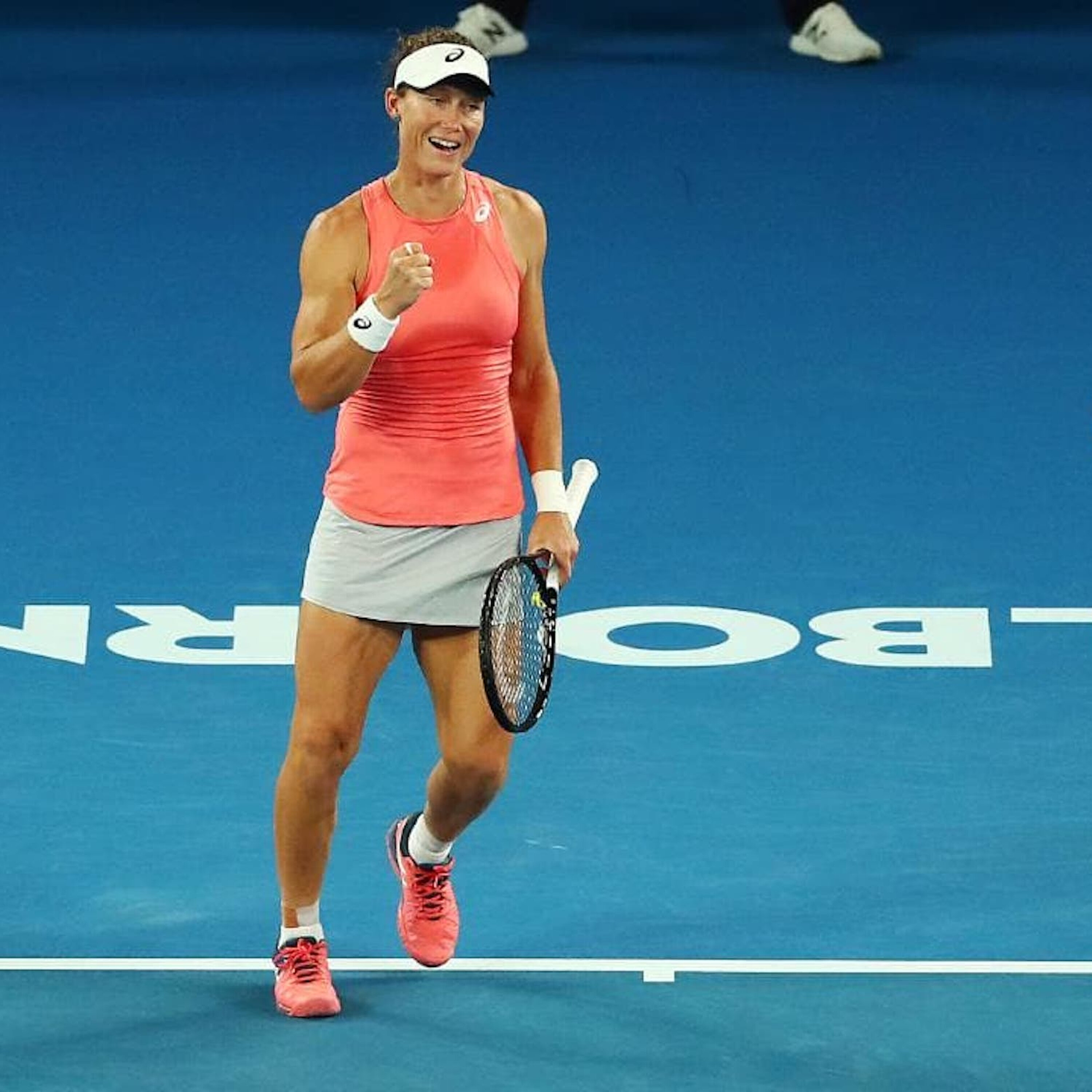
Sam Stosur
Aussie stalwart Samantha Stosur joins the podcast to talk about her illustrious career in singles and doubles, her memorable Grand Slam appearances at the French Open and her notable victory against Serena Williams at the US Open.
Hosted on Acast. See acast.com/privacy for more information.
See omnystudio.com/listener for privacy information.
2019-06-14
55 min
Transcript
Available Results
Generated results are saved to the knowledge database for reuse and search.
No generated results are available for this episode yet.
Extract Knowledge
Pick what you want extracted first. Model, scope, and chapter options appear after a template is selected.
Generated results for public episodes are saved to the knowledge database so they can be reused and searched later.
Transcript
00:00:00
Speaker 1: And I said to them, I'm going to be a party prooper tomorrow.

00:00:27
Speaker 2: All right, Okay, so, ladies and gentlemen, I would like to introduce not only a great person, but a really good friend of mine. And I'm really happy to have another Aussie on the Racket Magazine podcast Samantha Stozer, and sam Before you say anything, I just want people to know we're actually in Miami and we're doing this interview here and you're going to be playing another doubles final tomorrow. So this has been a great week for you. And also it is your birthday today. You are thirty five years of ay, so happy birthday, and thank you for joining me on the Recommencine podcast.

00:01:04
Speaker 3: Thanks Dugsy.

00:01:05
Speaker 2: Yeah. So, you know a lot of people request certain people, and a lot of people requested you on this podcast. So and I think one of the glad I can give the people what they want. Give the people what they want, Sammy. But you know a lot of people A lot of things I like to get across on the Record Magazine podcast is people's real personalities are really who they are. And I think people would not know a lot about you because you're pretty laid back but how well, how did tennis come into your life? Basically kind of by chance?

00:01:35
Speaker 1: When I was about eight years old and next or a but gave me a racket for Christmas. And I've got an older brother who's eight years older than me, Daniel, And fortunately for me and for my younger brother, Daniel looked after us a lot after school because mom and dad ran a cafe, so he'd pick us up after school on our bikes and we'd ride home. And then I got given this tennis racket and we'd go down to the park that was a few houses down and there was five tennis court there and we just play every afternoon pretty much and wait for mom and dad to come home. And kind of went from there, and I eventually got a tennis lesson at Memorial Drive in Adelaide.

00:02:10
Speaker 2: Yeah, or the original Brisbane tournaments played. Yeah, did you play on grass or are you playing on the hard courts there? And I'm not old?

00:02:18
Speaker 1: Yeah? And I had my little group lesson eventually, and then got a private lesson. I remember after the first group lesson, Mum and Dad have reminded me of this. The coach was like, who belongs to this girl? And you know, what has she done? She's done something wrong here, she's going to get in trouble. And the coach, Bruce Wren his name was, said she should probably get some private lessons.

00:02:43
Speaker 2: Mum and dad were like, oh, he's just trying to get more money is why would they even say that?

00:02:50
Speaker 1: And so yeah, then I just got some private lessons and played fixtures on the weekends as you do, and yeah, just kept playing it. Absolutely loved it.

00:03:00
Speaker 3: Okay.

00:03:00
Speaker 2: So one of the things that people are obsessed when it comes to you is the biceps. And I get asked this question all the time, you know, what the hell does she do? And I said, I think it's pretty natural. Will you always like a little bit of a rock as a kid, or did you like? Yeah?

00:03:13
Speaker 1: I think I was always, I guess looked athletic and pretty fit, even if maybe I wasn't back in the day, but I probably was naturally like that. And both of my brothers can gain muscle super quick.

00:03:26
Speaker 2: So are your biceps bigger than your brother?

00:03:29
Speaker 3: No?

00:03:29
Speaker 2: No, no, no, really.

00:03:31
Speaker 1: No sure, I think might a phase there in my younger brother especially, or go through stages of like trying to get a bit bigger and then he'll have competitions with his mates about who can put on more weight and then lose it quicker, and which is just ridiculous. He's obviously got a very quick metabolism, so he can just choose what he wants to do for periods. Yeah, and but yeah, they don't really go running or and they go out and have a hit every now, and they don't do what you do.

00:03:56
Speaker 3: No, they certainly don't do what I do.

00:03:57
Speaker 1: And actually Christmas Day all three of us got out on the court and had a little hit together for the first time in I don't know how many years, and that was actually pretty fun.

00:04:06
Speaker 2: Did you have a good laugh there?

00:04:07
Speaker 3: We did.

00:04:09
Speaker 2: When you think about like growing up in Australia and all that sort of stuff, were the people that you looked up to from Australia or you know, were you? I know who your idol is? Who can tell us that? But did you think that it was even remotely possible that you could be really good? Well, I mean when does that hit?

00:04:28
Speaker 1: Probably like a twelve ish I would say I was starting to think, oh, I want to be a professional tennis player. But at the age of twelve I had no idea what that meant what a life on tour was going to be, or if there even was a tour, because I just would watch from the old tournament on TV.

00:04:48
Speaker 3: Like the Aussie Open, and that was it.

00:04:50
Speaker 1: And like when I was in ninety it was ninety three, so I must have been nine. Mum and Dad flew all all of us, my brothers and them to Melbourne for the women's final of the Aussie Open when we were still living in Adelaide, and I watched Monica and Stephie play, who were my two favorites, and I wore my outfit to the match.

00:05:13
Speaker 2: I had Stephanie's shirt.

00:05:15
Speaker 1: I probably took my racket to who knows, and yeah, I remember being there and watching that final, and so.

00:05:22
Speaker 2: Stephie was your idol.

00:05:23
Speaker 1: Yeah, but I loved Monica as well, both of them, and that was just the best day ever. And we had this weekend in Melbourne just like our family, and that was it. And then we flew home and then that was it. So even from a really young age, like that's what I kind of looked at and thought, oh, that'd be pretty cool. And then as you get older and you go to junior tournaments and you start playing more everything just kind of goes the way.

00:05:47
Speaker 3: You don't know any other way that it should be.

00:05:49
Speaker 1: But everything kind of fell into place for me, So I guess I was fortunate that one I kept playing, because a lot of my peers in my age group all stopped after juniors or very soon after.

00:05:59
Speaker 2: Why is that? You think? It's just.

00:06:02
Speaker 1: I think sometimes people just don't enjoy the lifestyle. Maybe things get a bit harder, And I mean there were certainly times through junior trips. My first junior trip to Europe, I was fifteen in the eighteenth team.

00:06:13
Speaker 2: I was way out of my depth.

00:06:14
Speaker 1: I'd never been on a clay cup before, and the first five weeks were on clay.

00:06:18
Speaker 3: The week we're on grass, and.

00:06:21
Speaker 1: I did not win a match. I didn't win a set on the clay. I didn't win a match until junior win wouldn't And it's.

00:06:29
Speaker 2: Kind of funny I laugh about that now in my head mentally, because I think you would run from a grass court and you were so happy on a clay court totally. But I didn't know what I was doing.

00:06:38
Speaker 1: I was so young, but I just was in the yeah, in that team in the upper age group, and that was really hard. I remember calling home probably two three times a day in tears and I want to come home, and got really homesick and just wasn't enjoying it, but stuck it out.

00:06:52
Speaker 2: I did the whole ten weeks, like ten week trip a long time. It's pretty hard.

00:06:58
Speaker 1: But I actually think looking back now, maybe wasn't as bad as what it felt like at the time. Yeah, but it also probably taught me a lot about rezialience and sticking it out and probably was Yeah, obviously a really good thing for my career.

00:07:10
Speaker 3: And then we did that.

00:07:11
Speaker 1: I did that another year after and did a bit better, but I didn't want to match at Roland Garros for five years through juniors or like qualifying anything.

00:07:22
Speaker 2: Oh my god, Well we'll get to Roland Garros, right, Okay quite.

00:07:25
Speaker 1: Now, when I look back, I'm like, geez, wow, what to turn around? But I just had never seen a clay cup before.

00:07:31
Speaker 2: Yeah, so we'll get We'll get to that part of your career and that part of your life in a second. But one of the things that that I remember, because obviously I know you pretty well, it was the first time I saw you played fed cup and I hadn't really seen I don't know if i'd seen you play very much at all, if anything, And you were on the team with me and you played your first singles match, I had a little I went to your room the night before your first round because I remember when I first played my first fed Cup match singles. I remember a feeling like I had an I was having an outer body experience because it's such a different thing to play for your country. And I remember thought, you know, I don't want to tell Sam how to play, but I thought I might want to give you a little bit of a heads up on how you're going to feel when you walk on the court. And I said, you know, this is a very different circumstance when you play for your country, and you're going to feel like you're a little bit not yourself. I don't know if it was true or not, but one of the things I remember was the first three to four games, I thought, holy shit, this girl is so good. You were so composed. You probably didn't feel it, you're probably shitting yourself, but I felt like me watching you. I thought, oh, this kid's going to be good one day, really good. Because of the way you handled that moment. Do you remember that moment I played Zuluwaga. There you go, Combi, Yeah, how did you feel? How was that?

00:08:47
Speaker 1: I was definitely nerve wracking. You lost, but I lost six four and the third. But the way I played and my composure and what I did, I think that, I mean, I remember it, so it was obviously an important time looking back in my career that, Oh, even in these big moments, I've got what it takes to handle it, and obviously sometimes you handle it better than others. But in a moment like that, playing for your country and you've got your team on the side, and I mean all of you, you, Pratty and Alisha were all far more experience than I was, and I get the chance to play. There's a bit of pressure there as well, to you know, come up with the goods I guess or not, you prove your worth in the team. So I think that was great because I do remember that and it was an amazing experience. And I've obviously played many faed Cups since then, and yeah, been able to handle that really well.

00:09:40
Speaker 2: Yeah, you were definitely one of the best fed Cup players I've been around had seen play because you were always great under pressure and it started at a very young age, which made me think you can handle the big time. So cut to you know, you're sort of dealing with some injuries then right in your early twenties and trying to make your way onto the tour. What was the change in particular when you started thinking that you should be better than what your results were showing, Like, what was a period of time where you thought, all right, I really can I should be much better than I am, and I don't want to also forget that you also had great success in doubles at that point with Lisa Raymond, when a couple of Grand slams or was it three with Lisa? Was it two with Lisa?

00:10:23
Speaker 3: Two?

00:10:24
Speaker 2: And two finals, two finals, one with a match point which you made up for recently. But so how much did that help you, that experience being around Lisa and winning slams? And then how did that translate into singles?

00:10:36
Speaker 1: Well, I mean playing with Lisa was massive because I was young when she asked me to play, and now I think.

00:10:42
Speaker 2: She dumped me for you. She did, and I could have so subject but we won't get her.

00:10:47
Speaker 1: But I thought, geez, wow, what a what a privilege to play with someone like that, she's dump for me.

00:10:54
Speaker 2: I've got a nutscrew this up.

00:10:55
Speaker 3: I like, sorry, Studsy, but I'm taking this.

00:10:57
Speaker 1: And I had to stop playing with my partner too, because I was playing with a really good friend of Brion Stewart and we just had our best result. We made Semmis a Wimbledon, and we'd been doing pretty we won Sydney that year, and we'd been doing pretty well and we were both at koreahigh rankings in the top twenty. And then all of a sudden, this you know, legend of the game asked me to play.

00:11:18
Speaker 2: I was like, what do I do? Do I go there because I.

00:11:21
Speaker 1: Think what an opportunity, or do I keep playing my friend and we're doing really well and see where that goes. And that was really hard, this choice and decision to have to make, and I ended up playing with Lisa, and Brown was definitely a little bit upset about it at the time.

00:11:36
Speaker 2: Yes, I was fair enough, and I totally get it. We've got patched it. We were all great friends.

00:11:44
Speaker 1: But yeah, the first four three four tournaments Lisa and I played, we'd lost first round and I felt lots of pressure playing with her, and you know, am I good enough to keep playing with her. And I remember we were in Sandy, I Go. We'd played, we'd lost leading into the US Open, and she broached the subject of stopping playing with me. And I remember sitting on a little grass, little mound in San Diego.

00:12:11
Speaker 2: Yeah, I'm sure she gave you one tournament to prove yourself. We played two, Yeah, Diego, and I was like, no, just stick it out tournaments.

00:12:22
Speaker 3: Probably.

00:12:23
Speaker 1: I was like, no, let's just go a little bit longer, Let's just see how we go. And thank God, because then we played the US Open and we won it. And then it was like where did that come from? And we were playing Panetta and Dementiev in the final, and I was as nervous as what you could ever imagine.

00:12:40
Speaker 2: But I do remember we one of whatever it was.

00:12:44
Speaker 1: We're going into the third set, and I remember sitting on that changeover and I said to Lisa, I've got it now I'm going to start playing better.

00:12:52
Speaker 2: I'm not I'm not going to be as nervous now, I'm going to play better. Did you lose the second set? Did you?

00:12:57
Speaker 3: We must have lost a second set.

00:12:59
Speaker 1: I'm thinking we won the first and then maybe got kind of close and you got a bit nervous or whatever, and I was like, no, I'm going to be good now. And then we won the third set. It was like, oh my god, I've just won a Grand Slam. I'd won Mixed it Oi Open that year, so I kind of had a bit of an experience like that, but this was, I mean, even bigger, and you're away and you know Arthur ashe so that moment actually was big for me, even playing who knows maybe years later playing the singles final there, because.

00:13:28
Speaker 3: I've been in a big occasion and I.

00:13:30
Speaker 2: Was you Why was it so big that moment? Were you? I think because I distinctly remember.

00:13:34
Speaker 1: Well, it was the biggest thing I'd ever won, obviously, and you're on the biggest stage. And again I'm playing with someone who I admired and tons of respect for and admired and wanted again to not let the team down because if it always like if we were going to lose, it was going to be on me, and I didn't want that to be the case. And I really stepped up in that moment and we both played great and yeah, remember it and.

00:14:00
Speaker 3: It was incredible.

00:14:02
Speaker 1: So we didn't start out too well, but then you foung that Matt from that tournament.

00:14:06
Speaker 2: Sorry, I think.

00:14:07
Speaker 1: Then we won like our next three or four events and beat you in a couple of those. I got you once, and then we had a great career career together. And then I got lime disease.

00:14:20
Speaker 2: Yeah, hold on, hold on. So I want to tell this story because it's kind of funny, but not funny. It's sexually kind of terrible, but it's a little bit funnyt the start. So I'm playing against you at Wimbledon, and you know, we're great mates and obviously very good friends. Lisa and and we beat you in Eastbourne the week before Kara and I Kara Black, Oh no, it was. It was Coveta passion at that time. And I see you in the locker room at Wimbledon and I go to give you, I don't know, a handshake or something, and then I noticed that you had this lump on your neck, and I remember thinking, what the hell is that? And you go, I know, right, what is it? And I'm seeing the doctor know what's going on. And then and then I ended up playing you. I think the next day we played in the third round. Yeah, I don't know, it was the third or fourth round, and I went, you beat us, and I went to shake your hand, and then I sort of looked at it, and you went, I don't know if I want to do because you had covered in this rash and everything. It was so weird and you were kind of freaking out a little bit, which is understandable. And then cut to So that's Wimbledon July, and then US Open rolls around, and.

00:15:25
Speaker 1: I'd been home after wimbled and I didn't play until US Open because I went home and tried to work out what was wrong was wrong with me because I'd had a bunch of different tests done at Wimwood and nobody could work it out.

00:15:36
Speaker 3: But I was getting all these.

00:15:37
Speaker 1: Different symptoms and things happening and injuries.

00:15:41
Speaker 3: Just wasn't good.

00:15:42
Speaker 1: And so I went home and they told that doctors then thought I had rebella, and then I just thought, okay, well that's happened.

00:15:50
Speaker 2: That's what you and then I were living in Florida at the time, so going home was not normal for you.

00:15:55
Speaker 1: No, I went back to Australia. But then I thought, okay, we'll stuff it. I'll go play US Open even though I'm underprepared, and I just need to get fit again.

00:16:03
Speaker 3: I've lost all my conditioning and that's what.

00:16:06
Speaker 2: It doesn't take long to do that.

00:16:07
Speaker 1: No, And I played singles there against Elise Corne and I remember after three games I had no chance of winning the match.

00:16:15
Speaker 3: I was done.

00:16:16
Speaker 1: I was exhausted, couldn't move, couldn't do anything. Lost that and then stayed around and was training with my coach and he was like, we just got to get fit again, blah blah blah. And so we practiced a little bit and then like, go on the bike, try and run. Did that for like I don't know, a week or so, still at the courts, and then.

00:16:37
Speaker 3: We went out.

00:16:40
Speaker 2: Well so you lost the doubles, yea. And then I was out of the doubles at that time. And we hit the town in New York City, because it's normal after Grand Slam you go out have a couple of drinks with your friends, but after the US SO Open it tends to be maybe sometimes a bit bigger because it's the last a long year. It's been a long year. So we hit the town, We go out. I was at the bar, we were ordering a lot of drinks. We got a little unk, you know, being honest, and we'll leave the bar. And you kept complaining the whole night, Oh a rib, I'm a rib. And I was like, ah, you're fine, Sam, you just got a rib out or something. My chest was a bit, chest was sore, you're all you know, all the shop and I of course thought I was a physio that night, or a doctor would have you know. I didn't even stay in a holiday And anyway, I decide I'm going to give you a bit of a back crack, right remember, and I've got heels on, and you're like, you know again couplestone streets in New York. Anyway, as we go back from me trying to crack you back, you end up falling down. And I'm attached to you if you can everybody time, because you can't imagine.

00:17:36
Speaker 3: We're standing back to back, back to back.

00:17:38
Speaker 2: With our arms into blocked and you go stand back, which normally you let go of my arms, but you didn't let go of my arms. You just kept going flat down and you went flat down on your face, and I remember thinking, oh my god, I think you've just broken your nose. You're going to have no teeth. I rolled off your back and I looked at you, and you looked at me, and you go, you go, Did I hurt my chin? And meanwhile you've got this big gash out of your chin, which I thought was actually pretty good. I thought your teeth were all going to be gone. So then you're not feeling good all of a sudden. You went to the yes.

00:18:06
Speaker 1: Didn't really want to look at us because they thought we were just drunk, and so we left and then woke up the physio and then explained to her, and I think she just thought we were all a bit silly.

00:18:15
Speaker 3: And anyway, went.

00:18:17
Speaker 1: Back to hospital and then they did a couple of tests and couldn't really come up with anything. So we left, went back to the hotel, and ended up going to somewhere else later.

00:18:31
Speaker 2: It was like three days in the hospital, and yeah, not knowing what was wrong. And I stayed in New York for another couple of days, and then you flew down to Tampa.

00:18:39
Speaker 1: Flew to Tampa, and on that flight started getting the worst headache I could remember ever having, and got home and then that night just kept getting worse and worse. Well, actually, I picked up from the airport and we took you to You came home to my place in Tampa and had dinner at my place, and you kept complaining about your head, and I said, take couple al yeah, you know, And then all of a sudden, at six am in the morning, you called me, which was very inconvenient at six am, and I thought, why the hell is Sam calling at six am? Anyway, you said to me your words exact were stubsy my head.

00:19:14
Speaker 2: I feel like it's going to explode. You have to take me to the er. And I thought, bloody hell must be back, because you were as tough as anyone I've ever been around, as far as injuries concerned. So we whip you off to the er and the guy says, oh, nah, it's nothing, You've just got a sinus infection or something. I said to him, are you sure, because I was getting advice from some doctors as well and friends of mine and physios and saying you should you should see if she's got viral meningitis. I don't even know who brought that up. And anyway, they end up giving you drugs. You went back to my place and you took the drugs, and every time you took a drug you were just throwing up.

00:19:45
Speaker 3: And then when I was allergic to that. As it turns out, oh, I didn't know that.

00:19:48
Speaker 2: I thought I didn't know that at the time though, So then cut to end up having to take into another hospital about ten o'clock at night, and then about I remember at twelve thirty at nights, sitting there and they said we're going to have to do spinal tap and I thought, oh my god, and they did, and then they said they came back and said you've got viral meningitis. And that's when I said, okay, mate, I'm going home. I left you in the hospital by yourself, you poor feet. You told me you were going to be there no matter what, and then they told me that you're like, okay, see, let know. Well, what I did was I went back and got your tooth and to change your clothes and came back then came visited me and cooked for you for a week and anyway, but it was an incredible period of time for you because how scared were you that you were this was really bad?

00:20:31
Speaker 1: Well, no, because I'd never had that or obviously I didn't know what that kind of meant, and how long it was going to take to recover, and all of it like, I'm in Florida and you know I'm there by myself. Thankfully you're only a couple of minute drive away, but you.

00:20:47
Speaker 2: Know it's still scary. Yeah, it's absolutely scary.

00:20:50
Speaker 1: And I didn't walk out of my front door for eight days, I remember, because I just couldn't sit up right for more than like a couple of minutes. And getting up and thinking, okay, I'm going to go have a shit are now was just like a rush to I'm going to get up, get my clothes, and I'm laid back down again before the headache starts, and they quickly have a shower, laid back down, and thankfully then my dad ended up coming over as quickly as he could.

00:21:14
Speaker 3: To be with me, and then I went and saw some other once I got over that, then went and.

00:21:18
Speaker 1: Saw infectious disease doctors and took them a couple of weeks to I guess diagnose me with line disease. And then they pieced everything together, did a whole bunch of tests, and they were like, yeah, well, viral men and gitis is kind of going through.

00:21:33
Speaker 3: Their phases and the stages of Lime's disease.

00:21:36
Speaker 2: So what did they tell you when you got lime disease. How that was going to affect you for the rest of your life.

00:21:42
Speaker 1: Well, they said, you've got to be super careful when you do recover because it can you can easily relapse and it can come back if you're not smart about what you're doing. I mean, probably going to be more prone to utritis and possibly injury.

00:21:56
Speaker 3: So I mean, doing what we do, you're going to be prone to that.

00:22:00
Speaker 2: And I didn't put that up. It's probably not ideal.

00:22:05
Speaker 1: And yeah, just being really run down for a long time, and I mean, as it turns out, I didn't play for ten months.

00:22:12
Speaker 2: It was ten months till my next event. And did it worry you or scare you? Because also, you know, we sort of have a little thing in Australia with someone like Alicia Mulloch who was top ten in the world, and you know, I really felt like Alicia could win a Grand Slam, she had the game to do it, she was playing so well, and she got the middle air infection which really derailed her career. Did you feel like, I mean, I know you weren't really specifically thinking about someone like Alicia, but we're thinking like, shit, it's just gonna happen to me as well, like and you'd gone through a lot of injuries shoulder problems.

00:22:42
Speaker 1: Yeah, I mean I think because maybe because I had didn't know, I'd never heard of it before.

00:22:49
Speaker 3: Yeah, so I think maybe not knowing anything until then.

00:22:53
Speaker 1: I got diagnosed with it, and then you start reading about it and you learn more, and now I know lots about it. But I think that maybe kind of helped because it was like I didn't freak you out, Yeah exactly, which is let's go naivety kind of probably helped with all that. And but the I know in myself, I've really followed what the doctors, what everyone, the physios and everyone.

00:23:17
Speaker 2: Prescribed me to do. When I could start doing things.

00:23:20
Speaker 1: Again, I didn't do one minute more than what they said because they drummed it into me, especially the doctor that's yeah, about what you can and cannot do, and how slow I had to come back, and I'm talking starting with a twenty minute walk trying to keep my heart rate under one twenty and that.

00:23:39
Speaker 2: Was so hard to stay at a slow pace to keep.

00:23:43
Speaker 1: Under one twenty. And I go for a walk now and it would probably not even be eighty. So yeah, yeah, a massive difference, and that's what I stuck to it, like you would not believe.

00:23:55
Speaker 2: And then is that your nature anyone.

00:23:58
Speaker 3: I'm pretty good at following direction.

00:24:01
Speaker 2: Yeah, Like it's a good lesson for people though at home, or tennis players juniors who I feel go and start too early, you know, interestingly here playing right now in front of us, So the Brian brothers, you know, and Bob has said that, you know, he probably came back a little bit early with the hip injury. But but sometimes, you know, with injuries it's a little bit different because you have to trust the body again, and he's like, look, he's bloody six million dollar man with a you know, with a fake hit. So it's a little different. But I feel that tennis players often try to go too early. For sure.

00:24:34
Speaker 1: It's a good lesson, yeah, but I think also with the illness too, it's almost a bit more scary than than any injury.

00:24:41
Speaker 2: Yeah.

00:24:41
Speaker 1: And I mean I went when I first played. I remember flying back to the States for my first event, and I went nearly a week early.

00:24:48
Speaker 3: And I would never go a week. I might go three or four days early, but I went even earlier to get kind of time.

00:24:53
Speaker 1: To acclimatize, get over the jet leg first, slowly ease into it.

00:24:57
Speaker 2: Did it help you mentally after that injury, like, because at that point you were a very good singles player top thirty I believe, yeah, top thirty, obviously doing very well in doubles. Did it mentally help you to go, all right, this is I had my career almost taken away from it, really taken away from me. Did it make you appreciate it more and make you you always worked hard, but make you work even harder and mentally be better? Because that was sort of the problem was you didn't really trust you. I don't think you thought. I think you lacked the self belief when it really came down to it.

00:25:30
Speaker 3: Yeah.

00:25:30
Speaker 1: Probably, And I think having that happen again quite I was quite young in your career to think, oh jeez, could I is this all going to be finished?

00:25:39
Speaker 3: And what am I going to do? Because this is all I ever what I doing?

00:25:42
Speaker 2: What would get to that later?

00:25:43
Speaker 1: But I think it really did make me stop and be like, Okay, am I doing everything I possibly can? Not that I was taking shortcuts, but there's always just that little bit more?

00:25:53
Speaker 2: Should I? Yeah?

00:25:54
Speaker 3: I probably could?

00:25:55
Speaker 1: Or making the right decision to go play a different schedule or something like that. And I mean, unfortunately for Lisa and myself that she kind of wore the brunt of that because then I thought, Okay, I'm doing great, but I really think I can be a better singles player.

00:26:09
Speaker 2: So when did that change for you? Like, when did the moment come where you where the singles really you went, well, I really can I could be good and maybe when I slam.

00:26:18
Speaker 1: Well when I first started again, because that was the absolute priority was to get my singles career on track and doubles it because I never set out to be a great doubles player. It just happened and I love it and I wouldn't change it for anything, but having to start again, I was like, no, I need to almost kind of put later and put all my eggs in one basket and start really doing everything I can for singles. And that's what I did, because I thought I could be better than thirty in the world, which is what I was kind of hovering around.

00:26:50
Speaker 2: For a while.

00:26:51
Speaker 1: And yeah, and so that was kind of what helped change that. So even though it was a complete disaster and something I'd never want to go through, if I did it, and I don't know, maybe I wouldn't have made that decision when I did, and then who knows what could have happened.

00:27:04
Speaker 2: So take me through those French Open runs in particular, like the first run to You had a great start that year, remember because ironically we were playing doubles at that period of time, because you were like, I can still play a little bit of doubles here and there, and you maybe being a token helping me out. But but you made the Semis of Miami the tournament were out right now, which was a great win, and you beat dinarosfi and I remember that she was ranked number one in the world at the time, and semi finals of Miami is a big tournament. And then the run to the Semis and the French that year, and I think that's when things started changing with you, like shit, like I can really do damage in these tournaments. Yeah, that tournament in the French that was nine.

00:27:47
Speaker 1: Yeah, that was kind of like okay, yeah, I can play with the best and I know I can beat them too.

00:28:00
Speaker 2: I spoke to you the day after the final women's final that year, and it was Dnarosfina Kuznetsova and I remember we were texting back and forth and you said to me, because we were sharing an apartment as well during the French and you said to me, I feel worse today after that final than I did when I lost. And I said, yeah, don't ever let it happen again, because I think that you didn't think that you were worthy enough to win a Slam, or maybe good enough, and you were. And I don't think you ever lost to chuz Netzeva after that.

00:28:30
Speaker 3: If I did late years later, but not for a while.

00:28:35
Speaker 2: Yeah, but I do remember for her to break serve in the third set on me.

00:28:39
Speaker 1: She hit an amazing backhand down the line winner off one of my kickers out wide, and she broke me. I think to go up three to one, and I ended up losing it six to three. And I don't feel like I did anything probably wrong looking back, but maybe there was just that little bit of lack of belief which then didn't obviously put you in the point quite enough. Yeah, I didn't play stupid or bad, but it was just a little bit lacking because.

00:29:04
Speaker 2: To leave it mentally, the difference between you and Causanessa at that stage was that you subconsciously didn't think you were good enough to win a slam, and she knew she was d done it once before exactly and that was the difference. I think that won her that match in particular. So then cut to the next year. You played a phenomenal French Open, you believe it or not, Serena, Hennan and Yankovic, which to people at home at that time of their careers was phenomenal to beat those three, and then you play Skivone in the final. You'd beaten in the first round of the French the year before, I believe it or not, and you pretty much scored Skivony. But what did you learn from that loss that then translated to the US Open victory.

00:29:50
Speaker 1: Well, it took me probably the best part of a year to get over that match or both. I mean not I could not watch it. I never watched and then I don't think it was until the French Open the next year.

00:30:02
Speaker 3: I was sitting in the cafe.

00:30:04
Speaker 1: Before and they just had it on replay and I'm kind of no matter where I looked, it was on all the TV, and I was to see it and it was brutal because I was the favorite going into that match with my ranking who I'd beaten all the round so many times, and unfortunately, Yeah, she played it great. She played amazing, and she played much better than what she had against me. She obviously thought going into the match, if I don't do something different and I don't take these risks, I'm not going to win. And she did and on that day, in the biggest moment, she stepped up and she executed it, and she deserved to win, whereas I was still probably a little bit scared, and then she was playing really.

00:30:46
Speaker 2: Well, and I was aggressive to yeah a bit, Oh what's happening here? What am I doing?

00:30:50
Speaker 3: Where do I go? And it was kind of one of those matches.

00:30:53
Speaker 1: So again, once I could watch it and see what actually happened and see for what it was, not what I felt it was, it allowed me to move on from that and probably think, all right, I'm not going to let that happen again.

00:31:08
Speaker 2: So the US Open rolls around. You've beaten Serena a couple of times, you're almost also in Sydney, so you technically that point you'd had two wins against her, two wings and one in Sydney. Why was it about going into that match that you really believe that you could win. That helped you so much, because you know, I look, Serena played a really late night match two nights before, you'd played one really great tennis going into the final year.

00:31:34
Speaker 1: My schedule was screwed during that whole tournament as well, so there was a whole heap of stuff going on in the background that nobody at home.

00:31:42
Speaker 3: Well, there was rain delays back to back matches.

00:31:45
Speaker 2: I had.

00:31:47
Speaker 1: The match I played with I think it was Kirilenko. We were meant to be on center court, I think got moved to grandstand last minute, but had to then be held for like another hour, and then it was all about it. I think Andy Roddick was playing maybe, and they were like, no, that's going to go on, and then we're not going to put you on there.

00:32:05
Speaker 2: It's just a whole bunch of stuff and yeah, rain delays and whatever. So it was as difficult for you.

00:32:13
Speaker 3: It was hard.

00:32:14
Speaker 1: So we played on grandstand a little bit earlier in the afternoon and going into Serena's match starting, they told us that there was going to be a bunch of fireworks happening and they're like, no, no, it's not going to disrupt your match all of a sudden, there's.

00:32:25
Speaker 2: Fireworks going off and all this stuff.

00:32:27
Speaker 1: Anyway, So I finished beat Kerber. Yes, Serena finished late, but for whatever reason, I had no doubt in my mind that I could win that match. The following day and I remember getting out of the van, myself and all my team that were there, and we rocked up to our hotel and we were getting out and got all that stuff out of the back, and we're all kind of standing there deciding, right dinner, what are we.

00:32:55
Speaker 3: Doing the night? Like you're playing a final tomorrow? What are we doing?

00:32:59
Speaker 1: And I turned and I said to them, I'm going to be a party pooper tomorrow. And I don't know, I would never normally outwardly say something.

00:33:09
Speaker 2: Like that to be Oh, you're going to be like you were going to party pooper? Yeah?

00:33:14
Speaker 1: For yeah, because I mean, she's American playing us, soaperen it was kind of this dream comeback of hers. It was the tenth anniversary of nine to eleven, like it was a massive day and I was not expected. It was all about It was all about Serena to win the event, and even watching on TV the whole tournament, every day you'd watch it. It was all about nobody else was going to win the tournament except Serena, and I just said, I'm going to be a party pooper tomorrow. And I went to bed and obviously played great, but played as soon as I was in the final, I just really believed I could win.

00:33:54
Speaker 2: Okay, So take us through that match, because you know, obviously everybody remembers the situation the Naomi and Serena the US Open last year, but you were, well, actually, no, Kim Kim. Seren's had her issues at the US and listen, I'm prins with straight. I love her and I love her crazy. But Kim had the situation. And then you also had a situation where the umpire called Hindrance. Yes, take me through that exact moment.

00:34:20
Speaker 3: Oh yes.

00:34:22
Speaker 1: So we played the point and I heard her yell and whatever, Yeah, I said, come on, she said come on, and because.

00:34:31
Speaker 2: She was with a hit a winner, and I had no chance of getting it.

00:34:35
Speaker 1: And then the umpire called Hindrance and gave me the point, and I was a bit see, I was a bit confused about what was going on, and that was a game point then, so we were changing ends.

00:34:49
Speaker 3: But I was like, am I getting the point?

00:34:50
Speaker 2: Is that the rule? I'm not really sure.

00:34:53
Speaker 1: And then I remember looking up to my box and my manager was standing up and he's like, chang change hands, and like motioning change hands, and I was like, I.

00:35:04
Speaker 2: Don't want to do Yeah, I don't know what to do.

00:35:08
Speaker 1: And so I walked to the chair and went back, Yeah, sat down, and then we all know what happened, and she I actually couldn't hear anything she was saying because it was so loud in there, which is probably a good thing.

00:35:21
Speaker 2: So I just sat there and focused and then won that first set.

00:35:25
Speaker 3: And I remember.

00:35:28
Speaker 2: How the crowd must have been. I mean it was last year, was ten times possibly five times worse than you, maybe twice as bad as you, but it was pretty bad. Yeah, did you feel like digging a hole?

00:35:41
Speaker 1: The thing was because I mean they were obviously pro Serena, which was totally expected and absolutely fine by me. But because I was playing well, I hadn't given her really a chance to get into the match. So for the crowd to want someone to win, there wasn't a lot going on for them to keep cheering and be super enthused about what was going on up until that point, and then when that happened, she obviously got angry, and then the crowd got behind her, and I don't think they weren't against me, but they wanted to see this contest.

00:36:11
Speaker 2: And the worst part about it is you didn't have your glasses on so you could hide the whole because it was nighttime match.

00:36:19
Speaker 3: And so yeah, it was. It was just a massive turnaround. And then yeah, I.

00:36:24
Speaker 1: After I won that first set, if a microphone was anywhere near me, it would have picked up my heart beat because it was pumping out of my chest because I was like, oh my god, I'm a setup on Serena in the final of the US Open, and.

00:36:36
Speaker 3: The people and all these people don't want me to read.

00:36:40
Speaker 2: And what do you tell yourself? It was just what do you tell yourself to calm down? What did you tell yourself?

00:36:46
Speaker 1: I guess I just went to thinking about what I had to do to play the points. It went total ta tactical mode.

00:36:53
Speaker 3: That was it.

00:36:54
Speaker 2: So you get to match.

00:36:56
Speaker 1: Point and you've got well, actually, firstly, let me sit. This is actually kind of yeah. I don't know if I've really told this story much. But so then when the crowd started going against me. There was a really important couple of games, and she almost started running away with the second set early on. And then we had this point and we were both at the net reflex volleys. There was two or three or four volleys back and forth, and I hit a back end cross court volley winner past her. As I was turning around to go back to the baseline, I saw at the corner of my eye her clap the point on her racket, and for some reason that settled me.

00:37:32
Speaker 2: Oh, that's so, this is why we loved the podcast. Yeah, because that is an amazing thing to know.

00:37:39
Speaker 1: I saw that and I thought, I'm all right, she's not pissed at me. I don't know why that would even matter, but that was kind of what.

00:37:47
Speaker 2: That tells you a lot about the respect level for every single player, including Beaten, yet her twice has for her. Yeah, that you saw out the corner, you're like her, going, okay, she clapped that. Wow, Okay, she's not mad at me. Okay, relax. Yeah, and you didn't care what the crowd thought. No, you actually cared about what she thought. Yeah, that's so interesting.

00:38:09
Speaker 1: So then turned around play the next point, held broke whatever was going on and mart great went from one hundred and eighty two maybe a bit normal again and then I want to set six three and but wait match was over.

00:38:21
Speaker 2: But wait, so match point, match point. When you get match point and she misses that first serve, yeap, I know the shot you hit.

00:38:29
Speaker 1: Obviously she'd had a match point before and we'd had a longer rally and she hit a smash for a winner, and then we played juice point.

00:38:36
Speaker 2: I won that and you get that forehand and what do you tell yourself? And what did you tell yourself after?

00:38:41
Speaker 1: It was like, well, when she missed that first serve, I was like, okay, this is good. I knew that I was going to hit a foehand on the return. I just there was no chance I wasn't going to hit a foehand and there was no chance it wasn't going to go off because I hit it.

00:38:57
Speaker 3: Yeah, I'd hit a ton of winners.

00:38:59
Speaker 2: That and I was just hitting it great, and so it was just were you shaking?

00:39:04
Speaker 3: Oh probably, yeah, yeah, no doubt.

00:39:06
Speaker 1: I definitely was the first match point, and probably the second one.

00:39:09
Speaker 3: I was a little bit better, but definitely had the jelly legs.

00:39:13
Speaker 1: I loved.

00:39:13
Speaker 3: I loved your reaction.

00:39:14
Speaker 2: It was just a reaction of I can't believe this just happened.

00:39:17
Speaker 1: Yeah, it was incredible, and going back like and then I went up into the box and did all that, but I kind of it felt so surreal and almost like out of body.

00:39:30
Speaker 3: I wish I could almost.

00:39:32
Speaker 1: Go back into that and really experience it to almost kind of not enjoy it more, but just almost like more.

00:39:40
Speaker 3: Yeah, because it was just so.

00:39:43
Speaker 2: Like crazy wow. And also with what happened with the crowd and everything, You're just like, oh my god, this is just did you party that night? Ah? Yeah, well we found well nobody had organized anything of course, because it was I mean it was even though you said you're going to be a party pooper, yeah exactly. So we actually.

00:40:03
Speaker 1: Killer who my manager he must have gone out a couple of nights during the weekend.

00:40:08
Speaker 2: That's a real shocker.

00:40:09
Speaker 1: And anyway, I knew of this bar just a couple of blocks away, and he's like, let's just go there, and I was like, yeah, that's cool, whatever, that's fine. And I remember he went down the street and got some like takeaway pizzas from one of those corners.

00:40:23
Speaker 2: So class like you just wont like two million bucks, but let's go get some two dollar pizzas and sat out the back of this bar. But it was perfect, Like it was actually perfect for you. It was perfect.

00:40:34
Speaker 1: I didn't want to I actually because when we got back to the hotel, we were like, okay, let's try and find a restaurant.

00:40:39
Speaker 3: We'll do something, and I was like, nah, I.

00:40:40
Speaker 2: Don't want to full sit down formal meal. Let's sassy, classy.

00:40:45
Speaker 3: It was just like, let's just enjoy and have like a bit of a pa Yeah.

00:40:48
Speaker 2: Let's pretend we're at home in the backyard, Yeah, having a beer, some pizza.

00:40:52
Speaker 1: And I went to say, I don't know, like three or four or something, and was up at seven to do all the baba.

00:40:58
Speaker 3: Yeah.

00:40:58
Speaker 2: How you know how much pressure then? You know, you go back to Australia. You know, we know the sort of having to play in Australia and it's always been your dream to do well there. But it's also difficult because there was so much pressure on you after that. You know, it's.

00:41:13
Speaker 1: Difficult because when you're playing back in Australia anyway, and I'd always found it hard to play my best there for a multiple different amount of reasons.

00:41:22
Speaker 2: But then you just won the US Open, the last Grand Slam that anyone remembers watching, so they just think, oh, well, you're going to do it again.

00:41:30
Speaker 3: Like why why wouldn't you? That's just what you do and it's not that simple.

00:41:35
Speaker 1: And actually that's why this year, watching Naomi go back to back and play well also in Japan only a couple of weeks after the US Open was even probably more impressive because it's not Yeah, it's not a given that one Grand Slam and then you just go on and win, you know more.

00:41:56
Speaker 3: Yeah.

00:41:57
Speaker 2: I was going to say, does that make you special? But that kind of makes you say, like she's just fat. You're impressed by what she did. Yeah. Yeah. The difficulties for you over the last you know, three or four years with the singles has been a little bit up and down, and the pressure that you still feel to do well and you work so hard. You still work as hard as anybody I know on the court off the court, and you're pretty sensitive person. Like people don't see that about you. Yeah, you know, you like because you went yeah, well, I will say, I mean, you know, I like to tell these stories because you and I are good friends and I've been with you through a bunch of random stuff. And I do remember I was with you in Asia a couple of years ago and you came off the court in Hong Kong. Oh god, and it was such a hard period of your career because you really were struggling. And I remember you walked off the court and a match that you should have won, you know, against somebody that you should be And I remember when you came off the court and you're usually it'll be right, I'm okay, you know, played okay, You're always looking, You're always somebody that's always spoken impressed about it's fine, I'll be fine. And you know, some of us all was like, Sam, it's not fine. Just admit it. I'll bounce back, Sam. But you know what, also, when I think about it, bloody hell. Good for you to be able to do that as a tennis player. But I remember you come off the court and you sat there and you just cried. Yeah, And I think I might have cried with you, because I don't think I've ever seen you like that, and you just said I just I can't remember the words that you said, but I remember thinking, bloody hell, like these are the things that people don't see as all the back stuff, you know, all the days where you cry by yourself. You've probably done that a lot of times. The people don't know about it. Sure you know, and you've hidden behind your glasses in matches and I will tell your funny story talking to I think Andrew Peckett, which a couple of weeks ago. And you know, when Sam's a glasses on, it's so much harder to play it because you just don't know what's going on, you know. But when you see you with the hit I sometimes you think, oh, she's a bit worried, and I go I feel the same way when I played her in doubles or it used to drive me crazy. I'm like, is she pissed? Is she upset? What's going on?

00:43:57
Speaker 3: You know?

00:43:57
Speaker 2: So the glasses kind of have helped over the years, but you know, those are things that people don't realize, and you've had to dig yourself out of those holes. How much did it mean to you after? I know, and you know how much I'm protective of you as a friend. But you know, people on Twitter and wins Sei, I'm going to retire and this is a joke and losing an embarrassment. Oh, these are the things that people say. No, I know, you know what they say.

00:44:20
Speaker 1: I've banned a few people, yeah, blocked a few people, banned a few people.

00:44:25
Speaker 2: How satisfying was that Australian Open doubles victory for you?

00:44:28
Speaker 3: Oh yeah, that was amazing because.

00:44:33
Speaker 2: It just kind of to be back, be honest, No, no, it was incredible and you just wanted a middle finger everybody, come on.

00:44:41
Speaker 1: Well, the great thing was I actually was a bit surprised how many people really took notice of me winning it.

00:44:48
Speaker 2: And obviously you're in Australia so it's a bit more probably easy to know.

00:44:52
Speaker 1: But even the week later, I was up in Sydney walking through Bond Day Junction shopping center trying to.

00:44:58
Speaker 2: Find some sheets for my bed, and quite a few people just see me and come.

00:45:05
Speaker 1: Up and be like that was amazing. I'm so oh my god, that was fantastic. Thank you so much for what you do, and like were really proud of me, and I was like, wow, far.

00:45:15
Speaker 2: Out like when you were open and nobody knew who I was.

00:45:20
Speaker 1: But it was really nice actually, and I think to be home and I didn't have to rush off and go to another event, so I could actually stay home, enjoy it with my family that were there, my friends, and just achieved something that I hadn't achieved for such a long time.

00:45:36
Speaker 2: And you and prefaced years and years before, you and Lisa Raymond had a match point to win the Australia excuse me to match points to win the austrain oput. Yeah, and you didn't when so I remember Lisa tweeted way to get the title. Yeah, And I randomly gave the trophy out there, which was asked to be like halfway through the match, which was funny because I know that you were kind of looking at me in the President's box through match because I was like, why would she leave now? That is so bizarre. Well, and you asked me for a ticket, so I was like, well, why would she ask me.

00:46:06
Speaker 1: For a ticket if she's sitting in the present because she leaves the president.

00:46:11
Speaker 2: The president Jane Herdleka had asked me if I wanted to come and watch in the President's box. At the last minute, thought shit, I don't even need a ticket from Sam. I'm going to get the best seat in the house. I was sitting right behind the court and you didn't know that did you know that? I didn't know that, And then all a sudden you looked up and you saw me, which was good because we're mates and obviously, you know, sometimes it's nice to have a random person in the crowd that you can do. It actually really was because our team were down the other road, down the other end, so you would look at me, and I was like, you know, as long as I could be a positive influence on you in some way nodding my head or good job, Sam, I couldn't really be vocal because I was sitting in the president's box. Maybe a good thing. Maybe, Yeah, you're funny, fucking funny cut too. At some point the career is going to be over. Have you thought about what you're going to do? Because I think it's one of the most difficult things, and what not is not spoken about enough, is what are you going to do when your transit? Look, you probably don't have to work ever again in your life. You've got enough money to at least better to do something you want to know? But what have you thought about what you would like to do? Yeah, because I think it's important for your post get retiring knowing what you kind of want to do afterwards. Oh yes.

00:47:20
Speaker 1: And if there was my coach who I had for a couple of years last year and the year before, Josh Eagle, if there was one thing he really drummed home to me, it was just start thinking about what you want to do after He's like, may not happen for two years. I think it is whatever, however long, I think it helps you in your career. Yeah, but he was like, honestly from himself. His wife was Barbaschett, who was a player and everything. He's like, I'm telling you, it's harder than you think, and just start thinking about things and having some ideas and oh my, you know, ask this person this, or kind of find out what's going on over there, and just start growing a bit of a list.

00:48:04
Speaker 3: Of things that you may want to try that I know is important.

00:48:11
Speaker 1: And I think we've all seen enough tennis players and sports people go from their career and get pretty lost.

00:48:16
Speaker 2: And not know what to do.

00:48:18
Speaker 1: And it is a really hard transition, which I'm not sure is going to be really hard for me as well.

00:48:23
Speaker 2: It has nothing to do with your set monetarily, it's the fact that for your entire life. I know this myself. You are structured. You have an idea every day you wake up. What your plan is, Yeah, to work out, play tennis is to get better. Yeah, and then all of a sudden, book that's gone and you Most people retire sixty five and seventy, you're retiring at thirty five forty. It's a lot of life left.

00:48:48
Speaker 1: And like I said, I'm very good at following directions. If I don't have direction, oh my god, what the hell am I going to do?

00:48:54
Speaker 2: Yeah? So what are you going to do? Well? I'm kidding, No, I mean, I think I would love to stay in tennis.

00:49:02
Speaker 3: I've mean, it's been my life. I've loved it.

00:49:06
Speaker 1: There's been some obviously hard moments, but it's I could not imagine putting down my rackets and not competing and be like, nah, I'm done with it.

00:49:14
Speaker 3: Don't want anything like that.

00:49:17
Speaker 2: Well, I might do like one of those adventure course things.

00:49:19
Speaker 3: I think that I actually love.

00:49:22
Speaker 2: Favorite thing to do outside of tennis. I love going to the beach and yeah, I've really gotten into hiking, camping, slapping it in the old two man tent. No, and it's surprised not showering for five days. I have like four a day normally, so you're usually sweating. That's whine, all right, But anyway.

00:49:44
Speaker 1: Yeah, I know that I've got to do it, but I would definitely stay in tennis. I know that one hundred percent.

00:49:50
Speaker 2: We're going to do little quick questions most difficult like what that I've ever had? Most difficult day that you can remember?

00:49:56
Speaker 1: Oh, probably a day after losing a mat so that I thought I should win, and then questioning do I want to keep playing because it's really hard the French Open Oh no, no, no, not French Open, but just probably more recent few years, and then struggling with different things, and it's like, oh, do I want to keep putting myself on the line to go through this? Because if I'm not playing well, I don't have to feel this bad. But then when you win and you do something great, that's incredible, and you know that that's not going to be easy to achieve either.

00:50:26
Speaker 2: So I think it's it's just.

00:50:27
Speaker 1: A yeah, those little moments where you kind of have that bit of doubt maybe and question do I want to keep going putting myself out there?

00:50:36
Speaker 2: Yeah? And for scrutiny as well, because you're pretty as I said, you're a sensitive person. So you're probably like, well, what are people saying?

00:50:42
Speaker 1: Oh well, I mean, you know as well when you're playing as a tennis player, I think, especially because it's an individual sport. So at the end of the day, you're out there and it's on you whether you win, lose, play well, play bad, do whatever. Everyone has an opinion and whether or not they weren't having an opinion or not, it's okay. It seems okay to like scrutinize an athlete that.

00:51:06
Speaker 2: You don't even know, that you don't even know, but yet.

00:51:08
Speaker 1: Like we don't scrutinize someone who you know writes a bad article or tracks the shopping badly or you.

00:51:16
Speaker 2: Know, like you know the shop, I don't do anything that you might get you get the chicken in there before with the bananas.

00:51:23
Speaker 1: It's terrible, but like things that we're always on the line and we get told what we do really well.

00:51:31
Speaker 2: But it's like people who want to be your friends. Yeah, but just as much like when you mess up a shot or whatever and the whole crack goes, you're like, if we want to stop and go, okay, let me just say something, guys, I'm really trying, Okay, So just guys.

00:51:45
Speaker 3: I mean that's a natural thing. I do that too when I watch matches.

00:51:48
Speaker 1: But you know what I'm saying, Like, you're always on the line and under the scrutiny possibly of others and others your coach, because your coach doesn't always tell you what you're doing well.

00:51:58
Speaker 2: But I think as a.

00:52:00
Speaker 1: Player, I've been pretty good at being able to handle those hard conversations with my coaches people around me to make me better because I know it's being honest and I respect that, and they care about me and they only want to see me do better. And I think that has always been part of why I've been able to bounce back, because all right, but I don't want to tell you something bad and see you know, tearing up and what was easy, it was pretty hard.

00:52:26
Speaker 3: So I know they're only doing that to make me better.

00:52:29
Speaker 1: And that's why I think I've been able to constantly think, Yep, I can get better and do this.

00:52:34
Speaker 2: Other than winning the Years Open, because I know that's got to be the highlight of you life. Funniest, funniest thing that happened to be on the court. Do you remember anything skirt broke? You know, I know one thing that I want to talk about with you, the bloody lip gloss thing. I mean, nobody has lip glossed their lips more than you, and that people protection people take a look at Sam every time she plays every single is it every single change up? No?

00:53:01
Speaker 1: No, no, I've had to cut back because I'm pretty sure it's not really good for you.

00:53:05
Speaker 2: Yeah, probably not, probably not. Anyway, it depends on the climate. We're in Indian worlds.

00:53:12
Speaker 3: It comes out a lot more than Miami.

00:53:14
Speaker 2: Dubai essentially the desert, yeah, the dry places I don't like. All right, how do you want to finish your career? And what do you what do you want? What do you want?

00:53:23
Speaker 3: People?

00:53:24
Speaker 2: And FYI, you should have won the Karen krane Ski Award once in your career. Just I'm just putting that out there, okay, because I think it's nothing against Petro, who's won it like thirty eight times. Share it around, Share it around, okay, Petro put put a vote in for Sam. Okay, seriously, because is that the most important thing for you when you finish your career? Is that ultimately in the end, well, what is.

00:53:44
Speaker 1: The most Yeah, I mean i'd like to be I guess remembered as a person who just gave it their best and tried every time they went out of court to play well, be respectful, give it your best. And I've never heard a get a grudge against someone who's beaten me. Whether I think they beat me or I beat myself. Whatever, it's kind of shake hands and whatever, move on with the next day, and just yeah, I've been a pretty good player. I've won some amazing events. I've had a great life out of it. But yeah, just someone who tried their best.

00:54:17
Speaker 2: Well, I'm putting a voat in for the Karen Kransky Award for this year, and if you don't get I'm gonna be really pissed. Okay, So everybody out there, okay, vote for Sam for the Karen Crancy. And it's funny because we just watched ash Party win in Miami and she reminds me so much of you. But you live, you grew up about an hour away from each other, you grew up in the Gold Coast, you grew up a nipseyitch. Yeah, so I think it's also part of that DNA of just being super relaxed. And I think you've you've brought these young players, someone like of course Ash to believe that she can do what she did today because of what you've done ten years prior to her and throughout the career. So yeah, and you're you're a good You're. What people don't realize about you is that you're a great conversationalist, except you don't seem like a you quiet Yeah when you want to want buyet. You are great conversationalists, and you know you love the game.

00:55:05
Speaker 3: And I can have a lot to say.

00:55:07
Speaker 2: I don't really We could be here for bloody hours. I mean, everyone thinks I'm a shadow box. I think you're worse than me. Should we go out for your birthday?

00:55:15
Speaker 1: Yeah?

00:55:16
Speaker 2: Why not? Let's do it. Should we have a drink to tomorrow?

00:55:19
Speaker 3: I'll have a drink tomorrow.

00:55:20
Speaker 2: I'll have drinks for you. Thanks for having me, Thanks for coming on the show.

00:55:24
Speaker 4: Thank alright, and that's it for this episode of the Racket Magazine podcast. Thanks for listening. Our host is Renee Stubbs. Our co host and producer is me Caitlin Thompson. Music by internationally renowned DJ Stretch Armstrong. Thanks to tim Or Jerry and then the team at ACAST. Find us at racketmag dot com, slash podcast, and subscribe to us at any of your favorite podcatchers.
Chapters
No chapters available.