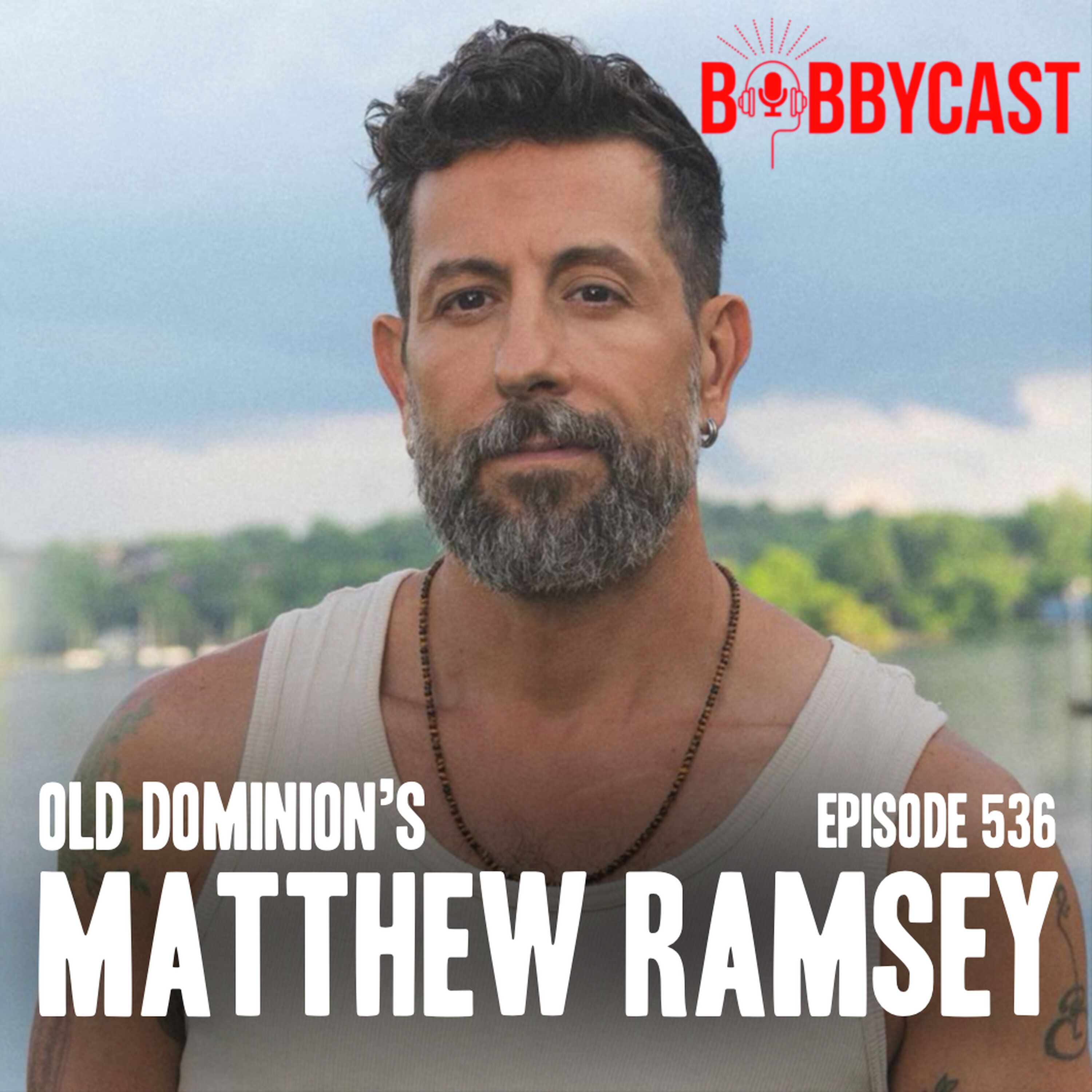
#536 - Matthew Ramsey on the Origin of Old Dominion & Why a Band Member is Left Out of Photos + Turning Down a Chance to Play with Taylor Swift - Twice! + Meeting His Hero Bruce Springsteen + Locking Eyes with Tim McGraw in the Bathroom + His Favorite Old Dominion Song Ever
In this episode of the BobbyCast, Bobby sits down with lead singer of Old Dominion, Matthew Ramsey. Matthew tells Bobby the origin story behind the band and why one of their band members gets left out of pictures. Plus, he tells the story of being offered to play guitar for Taylor Swift twice but turned it down because he moved to Nashville to write songs and didn't want to defer from that. The guys also talked about the night Matthew met his hero Bruce Springsteen while sitting next to one of Bobby's idols, Adam Duritz. Matthew then went on to tell the story about the time he locked eyes with Tim McGraw in the bathroom during warmups, and what his favorite Old Dominion song of all-time is!
Follow on Instagram: @TheBobbyCast
Follow on TikTok: @TheBobbyCast
Watch this Episode on Youtube
See omnystudio.com/listener for privacy information.
Available Results
Generated results are saved to the knowledge database for reuse and search.
Extract Knowledge
Pick what you want extracted first. Model, scope, and chapter options appear after a template is selected.
Transcript
00:00:06
Speaker 1: I was offered playing twice to play for Taylor Swift. They needed an acoustic guitar player and a background vocalist, and I was super broke and needed the money, but ultimately decided that's not why I moved here.

00:00:23
Speaker 2: Hello everybody, Welcome to episode five thirty six with Matthew Ramsey, lead singer of Old Dominion.

00:00:29
Speaker 1: Really artsy guy.

00:00:31
Speaker 2: Second time we've been able to sit with him for an extended period of time, and I know him from random coming.

00:00:36
Speaker 1: On the show.

00:00:38
Speaker 2: We've been out on some of the same music festivals, like we'd play some shows they were playing, so I got to know him a little bit. But it's always fun to sit with somebody because you learn different things about them when you just sit with them for an hour.

00:00:49
Speaker 1: So really cool guy.

00:00:50
Speaker 2: You know the fact that he went to college and studied illustration, like he draws, like paints. He's that kind of artist as well, so he went he studied the illustration at Virginia Commonwealth University before pursuing music full time. Thought he'd do that, thought he'd paint. Be an illustrator. He's done a lot of the band's early heart artwork, piano, guitar, all that kind of stuff, and we do reference his health later on in the episode. In twenty twenty one, he had a bad ATV accident, broke his pelvis, played shows.

00:01:18
Speaker 1: On a like iess a throne, remember that? Yeah?

00:01:20
Speaker 2: Yeah, so really like him, really like them as a band. They have a new record called Barbara that came out August twenty second. They are out on tour right now on the How Good is That World Tour? You go to we Areoldominion dot com. They've won seven consecutive Cmas for Vocal Group of the Year I think eight total. They're crushing it. Check out we are Oldominion dot com. And here is the episode with the lead singer of Old Dominion, Matthew Ramsey. Hey, I'd like to start this with little something I've I've started recently called pre show chit chat. Well, we don't have anything to talk about. We just kind of chit chat and sure did a little small talk.

00:01:54
Speaker 1: How you been I've been good? I like that. Let's let's let's force some small talk. Yeah yeah, I'm real bad at small talk A little bit is this is an exercise for me to get better at being a human. I actually just saw us a whole thing about small talk and how quickly it's how beneficial it is at first, but how quickly it wears out and it's useless. It makes people like you quicker, it's if you're good at it. So that's a really strong first impression.

00:02:24
Speaker 2: Sure, like my friend Eddie excellent at small talk if he's a Tom Brady of it, right, Like, it doesn't matter who you are, warm, smiley, how about that weather?

00:02:35
Speaker 1: How is traffic? And you're like, wow, this guy he's really listening. Yeah, And I think that this person was saying, like the art to it is to move beyond the superficial as quickly as you can, so like, you know, nice place, Oh thanks, and then to go into like are you happy here? Do you do you like? Turn? That's quite the turn. Yeah, I like you? Do you like living here? Are you sad? Are you just as sad in this new place as you were the other place? Yeah? Oh well that was chit chat. Well there we go. Yeah, that was fun. Everything's been good. Yeah, man, I mean I.

00:03:11
Speaker 2: Watch on social media, so I have a bad interpretation of how you've been doing.

00:03:15
Speaker 1: You look good, thank you, thank you. I mean, yeah, that's the only interpretation you get is what we choose to show. But yeah, it's good, it's extremely busy. Let me ask a question. I don't think it's uncomfortable, and I can cut it if it is uncomfortable. How come you guys do photos without wit Wit is? Yeah. I've known Witt my whole life and he's always been the same. He has of crippling social anxiety.

00:03:43
Speaker 2: Really, yes, he doesn't come to the studio sometimes as well.

00:03:47
Speaker 1: Yeah, no, he I mean just to get into the weeds a little bit with it. And I don't think he would mind me saying this. We had to come up with a new agreement within the band with him so that he could not he could opt out of that stuff because it makes him super uncomfortable. And of course, if you're the person that is anxious and doesn't like to talk, it shines a light on you a little bit, and people want to make him talk. And then when people want to make him talk, he's just like, I don't want to do it. It really freaks him out, so he really doesn't. He it's beneficial to us all that he's not there, because you know, there's that there's band dynamics. So when it was really coming to a head for him. We were sitting there going, man, why are you being such an asshole? And he's like, I can't take this. And he finally came to us and was like, I can't do that part of it anymore. It really freaks me out, and so we kind of came up with a new agreement where he doesn't have to do that stuff. Is he still like drumming? Yeah, yeah, yeah, I mean he's still he's in the band one hundred percent. So he's still in the everything's still in the band.

00:04:56
Speaker 2: You guys for understanding and allowing, because that is I would say, a very non traditional thing to happen in a band where everybody's a member of the band.

00:05:03
Speaker 1: Fully, Yeah, yeah, it's a mental health thing, totally, totally so, and we realized pretty quickly once he finally kind of voiced his struggles with it, that it was going to be better for us all if we just kind of so basically, the agreement is anything anything that involves playing music, he's there or pretending to play music, like a music video or something like that he's there, or or like a real promo shot to promote an album or something. He's there for that but other than that, man, he's he's on his own, which he agotiates. I like that.

00:05:41
Speaker 2: I'm glad to hear he's still in the BANDA glad to hear that it wasn't like a concrete we all have to do the exact same thing because everybodys needs are different totally, and I'm not sure the dynamic within the band, even in a leadership role, but I have learned that every personality needs to be led differently, absolutely, and that has taken a lot of leadership and also a lot of not being the leader to learn that, because I have a couple of different groups that I manage.

00:06:09
Speaker 1: But if I just go to like my radio show podcast crew, they.

00:06:11
Speaker 2: Are like nine people there, right, And if I did a blanket on and treated everybody exactly the same, that would not be good for the order.

00:06:17
Speaker 1: It wouldn't work. Yeah. Yeah, and for us too. I think it's taken us really to this point, you know, within the last years so to even or at least me to realize too, Like within this group of guys that I've known from practically my whole life, it's fine for us to have different experiences, Like you know, I can come off stage going that was the best show in my life, and another guy going, that's the worst show in my life. And I'm like, what, you're crazy? That was amazing and they're going not for me. And it took that used to really bother me because I wanted everybody to have the same experience. But I had to learn now we can all have different experiences.

00:06:51
Speaker 2: Something else I've learned because I've been married now four years, is that two things can be true at once.

00:06:55
Speaker 1: Absolutely. I'm like you.

00:06:57
Speaker 2: I was like, it must be universal either as you know, verse Lord didn't happen right, Like, if it's not, my wife has taught me that multiple things can be true.

00:07:05
Speaker 1: It's definitely true. Man.

00:07:06
Speaker 2: We can have different feelings about things and that same thing could have happened so totally.

00:07:11
Speaker 1: And you know, there's different you know, there's obviously different roles in a band, So you know, my job is different than brads or wits, or Trevor's or Jeff's, you know, so my focus is on something completely different than their's. Half the time, I feel like the pressure on the lead singer, well, it's yeah, you get the spoils, but also the difficulty of you have to stay healthy more so than everybody else because your voice for sure. Yeah, yeah, it's like me again.

00:07:38
Speaker 2: I'll just compare it to like the radio show, is that everybody else, any of them can are replaceable for a day, right, it can go on.

00:07:47
Speaker 1: If I'm out, the whole thing shuts down.

00:07:49
Speaker 2: So it's my responsibility, because I care about those people, to make sure I'm doing all the extra things so that i can be healthy. Yeah, it's definitely. I'm not a huge I have to get, you know, more sleep, and you know, if my voice is not there, then imagine if you were twenty two in this successful and famous do it'd be whole different new You'd be out totally living it up.

00:08:08
Speaker 1: Yeah, totally, it would be. I'm thankful every day that we did not succeed at a young age like that. What were you doing at twenty two? Twenty two? I was still living in Virginia. I was working, I think at that point I was working at a stained glass factory. Basically, were you able.

00:08:29
Speaker 2: To have art in your life in a way that you could make any money at that point?

00:08:37
Speaker 1: That was as close as I could get at that point in time. You know, I have an illustration degree, and so my goal was to have art be a job in some way, shape or form, whether it be visual or music. And that was as close as I could get to having like a job that was that had some sort of sembilance of art to it. What were you doing? I started off painting, So there's if you if you look in and hold like church windows and you see like the Jesus looks like a painting in the stained glass window. That's a whole process. And I was painting those windows and then they fire them in a kilnt, and then they put them in the window, and then a trance I kind of developed into designing some stained glass windows for a couple of churches. Did you almost do that? Was that almost a path? Could you have done that on a bigger level? I could have stayed at that job. It was a family business and I liked the people there. It ultimately actually is what led me here. I met some people that led me to Nashville. But I don't think I could have done that forever now. That would have driven me crazy. I need to something has to be different every day for me to be happy. And if I had some sort of job where I just showed up every at a desk, sat there at a computer would drive me absolutely.

00:10:03
Speaker 2: Say do you ever have though the part where it's like you wish it was something a little more consistent?

00:10:06
Speaker 1: Though at times I think, uh, yeah, I think that's a struggle that I have within myself is wanting that quote unquote normalcy, but quickly realize how unhappy I would be. But I wish more so, I wish I was the type of person that was was cool with that.

00:10:26
Speaker 2: I was talking to my therapists about that yesterday, where it was I was talking to him because I feel like I at times have an unhealthy appetite to prove myself right, or to prove others wrong, or just to prove different. Sure, and they're slightly different, And I was like, man, I wish I just had a little less tenacity, so I just stopped sometimes Sure it would just be easier on my body, on my mind, I wish I was just I don't want to say settle, because I don't think that's fair to people. I wish my goals were different. Yeah, I get what you're saying is I never meet them. It's I can't meet how I set them, I can't meet them. Yeah, which leaves me in a perpetual state.

00:11:04
Speaker 1: There's always more, there's always another level, there's always.

00:11:06
Speaker 2: And I don't like that about me, but I also understand why that's important and the success that it's brought me.

00:11:10
Speaker 1: Yeah, it's also gotten you a lot.

00:11:12
Speaker 2: So but double edged Sword sure never fulfilled, but have way more than I thought I would totally. And so yeah, I do have that issue sometimes, and I'm like, man, I wish I just like it was like some of my friends and like had a job that I knew what I was doing and when I went home, I didn't never think about it anymore.

00:11:28
Speaker 1: Yeah, I used to kind of struggle with you know, like I'm from an extremely small town and I used to kind of struggle with some of my friends from there talking about how brave I was for moving to Nashville and chasing after this. And in my head, I'm sitting here going you're the brave one for staying here and doing that and working a job. Like to me, this is an easy path out, like you know, to go just run down whatever road I was there. That was to me the easy choice, that the brave choice was to settle down at twenty and get a job and work that job for the rest of your life. That to me took so much more bravery than what I chose.

00:12:13
Speaker 2: I was driving over here after work and I saw the billboard for Barbara and is that a character?

00:12:19
Speaker 1: Yeah?

00:12:20
Speaker 2: Okay, isn't I saw a picture on your Instagram with her, Yeah, And I didn't know if that was really somebody, like it was like your aunt, Like, who's Barbara?

00:12:29
Speaker 1: Where did this come from? Yeah? You know, we always are. We have a running list of album titles always, and most of them are unusable. They're jokes, you know, would just make ourselves laugh. And Barbara came up one day, probably a year or two ago, just laughing at the idea of naming it after a person, and you know, picking a name that was not common anymore. You don't know. I don't know a lot of Barber's. I don't know what if I do, they're older. And Barbara came out and we've laughed at that. And it was down to the wire, honestly, to pick the album title. We were gonna name it after one of the one of the songs, and then at the last minute we were like, man, let's just do something funny, like we did on our first album, which was called Meat and Candy, and you know, the label was like, what are you guys doing? And once once they kind of figured out who we are, they got so excited that we pivoted and called it Barbara, and then the character kind of came out of that. As soon as we agreed, all right, let's call it Barbara. Then this character just appeared in all of our brains and we were spitballing what she looked like and what kind of person she was. And so we found this amazing model who we just found out, like this social media clip you just saw of her at the show, we found out at that show. This is her first job as a model. She's never she'd never done anything like this before. Is she older or younger? Playing older? She's older? Yeah, she's. I mean she plays it up obviously for that for that photo, but yeah, she's she's an older lady and she's beautiful, and her family, I think and friends were telling her how beautiful she wasn't that she should try modeling. So she put her head shot out there, and three months later we picked her. And now she's signing on a grass when she walks through the hotel.

00:14:19
Speaker 2: I thought it would be a concept album at first too, when I saw that was based around a person. It's not that, no, No, it's just we're just not gonna name after a song.

00:14:28
Speaker 1: Yeah, we just wanted something interesting, something to entertain ourselves.

00:14:32
Speaker 2: Really well, it definitely made me think, or made me take a few seconds ago, I wonder what that's about. I mean I quickly forgot because we're in a world of being overstimulated, right, But I thought, next time I see Matthew mask them.

00:14:40
Speaker 1: Yeah, at least makes people stop for a second.

00:14:42
Speaker 2: Yeah, you know, yeah, you have a song. You don't have any songs about Barbara though, right? Does her name come up on the record at all?

00:14:48
Speaker 1: Not at all? No, that's just it. You didn't like Taylor Swift Easter. It was just our baby, you know, our This is our baby, and we named her Barbara when you came to town.

00:15:00
Speaker 2: Did you have any gigs playing as a side person for anybody else for a while.

00:15:04
Speaker 1: No, I got offered. I was offered playing twice to play for Taylor Swift at the beginning of her career. First guitar. Yeah, if they need an acoustic guitar player and a background vocalist, and you know, this was I don't even know if she had a hit yet. You know, she might have had Tim McGraw, but I knew her drummer. And and he called me and asked me to do that, and I turned it down the first time because the first gig was on the due date of my first child, and I was like, I can't guarantee that I'm not going to leave me hanging, so I can't do it. And it was just for a couple of gigs. And then later he circled back around and asked me again, and I was super broken, needed the money, but ultimately decide that's not why I moved here. I didn't move here to do that. If if I'm out on the road with another artist, then then I'm going to lose focus on writing, which is the whole point of me being here.

00:16:12
Speaker 3: Let's take a quick pause for a message from our sponsor, and we're back on the Bobby Cast.

00:16:27
Speaker 1: And when you moved here, was it I'm going to commit to writing? Yeah, that was the goal. I didn't I didn't really want to be in a band. I was just wanted to be a songwriter. You know, I think shakes out. I know I met well I met to Scott Daryl Scott at a at like a there was a public radio program called Mountain Stage and it was a lot of like bluegrass and folk music, and I used to really love listening to that. And they had like a festival and I met him, and he's written, you know, he wrote A Great Day to Be Live and a couple of the early Dixie Chick's songs and a bunch of other stuff. And he's an incredible player. And I moved I saw him. I got the chance to go to like a little workshop at this festival, and I asked him what he thought about moving to Nashville, and he said, if you if you're moving there to be a star, then don't do it. But if you're moving there to, you know, surround yourself with the best songwriters in the world and the best players in the world and learn how to get better than by all means, you should go. Why do you think he said, don't move if you want to be a star. He's an interesting person. I don't know him very well, but he's kind of the he's not the typical he's pretty. He's pretty. Uh, I'm wanted. The only word I can think of is like reclusive, but you know, he's a pretty sullen, quiet dude and extremely talented and extremely successful. And I'm grateful for that advice, but I think, you know, you can get caught up in the wrong thing, in the wrong goals, and if you're chasing fame, and there are people that do chase fame and it works out for them, but I think that's ultimately not going to be fulfilling. So I think he was just looking out for his fellow songwriters and saying, man, it's a disappointing road to go down there and chase after stardom, but if you take the time to dig in and learn, then then it'll be a much more fulfilling journey. What would you say to somebody asking you now that same question. I tell them that story a lot, and I tell them there's no shortcuts, and there's you just have to as cliche as it is, you just have to do your thing and chase after what's what's exciting you and what's in your heart, and don't worry about what you hear on the radio or what you see on TikTok or what if don't worry about any of that stuff. We all get caught up and chasing after that. We still do, but ultimately you have to have to focus on what's making you excited and pull the industry to you rather than chase after it, which is extremely hard to do, but it is something with longevity.

00:19:25
Speaker 2: Yeah, I think you know, there are a lot of artists who and I think creative predictive text is difficult because if you're chasing, or if you're trying to predict how you're going to fit into the current sound.

00:19:38
Speaker 1: It takes a while to have your work fully manufactured out totally. By the time it's done, your years behind it could have been shifted, it could have been gone. The sound that you're chasing, you could be behind it. Yeah, And I think it's easier to fit.

00:19:56
Speaker 2: But long term, and now I've been round here for thirteen fourteen years, like I've seen the cycles now go through a few times, right, where as much as everything changes, it's the same thing over and over again, right. And if you're guessing and jumping in the middle of a guess, you might be there for a second, but it's going to be gone.

00:20:12
Speaker 1: Yeah, And it's going to be ultimately frustrating for you because you're you're going to hear what you're creating that sounds very similar to what's on the radio, and you're gonna be like, why is nobody paying any attention to me? We had to go through that. I went through that as a writer and as a band. You know, we went through that whole thing of going like, why is no one this sounds just like everything else? Why is no one paying any attention? And it's because they were looking at what was next? Like I just I was just listening to there's this guy. You probably have heard of him, but well, you know the New Beaver record, you know, Daisy's huge record produced by McGhee and Scott McGee and Dijon. I think is how you say his name? Super creative team that is now producing all this super popular pop stuff, But for years they were this underground thing eating something completely new that was Now people are knowing what that sound is, but it was created years ago.

00:21:06
Speaker 2: I think there are artists who that we can look at and go, man, they pulled the highway to them. They didn't jump on a highway of car even in our time. Here what you heard you move here? Two thousand and two? Okay, so I was here a few years after you, but have been here a while, but like somebody like Sam, right, even Kenny back before that, right when Kenny went beach, Kenny kind of sure, yeah, different, Yeah, that he.

00:21:30
Speaker 1: Finally was like, this is who I am. Yes, I mean, I think there's real power in getting no's when you're being authentic to who you are, because if you get no's when you're not being you, you're like, God, I just got told no, and I was being fake to begin with. It's like two losses, right, yeah, yeah, totally, whether you know that or not. But and we got those no's, you know, so many times. We were just telling this story. Yeah, we got turned down by every record label in this town multiple times. But at that point we were fine with that because we were just having fun and we were enjoying ourselves and our and our manager at the time, he would kind of assemble us at a lunch after we got rejected and be like, Okay, guys, it's another no. What do you want to do? And we were like, it's fine if if it's not for them, that's fine. We're having a good time. So we just kind of kept going. Now it helped that we were having success as songwriters at that point, but you could eat, Yeah, we could. We could at least do that. So what was the idea behind you guys getting together as a band. Initially, it just kind of randomly organically happened because I knew what since I was in seventh grade. And then he when he went to college, he was in a band with Jeff and Brad was in that at that same college, and they were all playing together and I was coming up and opening shows for them, and you know, we were friends. Then I moved to Nashville and I started writing with Trevor. We were having all these songs I couldn't afford. You know, I grew up in bands, and even though I wasn't here to make it as an artist, I still like playing my songs out, like playing bars, and you know, I wanted to play. I wanted to play these songs that I was writing, and so I had buddies who would do it for free, and they were good, and they were my favorite people and they were my favorite musicians, and so they were like, yeah, sure, we'll come play, and so we just started playing. And then we realized, oh, well we could if we wanted to, we could get in my van and drive to the next state and make a little bit of money. And we needed that at the time, so yeah, sure, let's hop in the band and in the van and go play a couple of shows. So it really was just for fun and to make a little bit of money and to showcase the songs that we were writing for other people. And then it just kind of grew. It wasn't until we wrote break Up with Them. That's the first song that we held back from anyone, first song that we went wait a minute, there's something really different here. Dang, did that feel risky?

00:24:07
Speaker 3: Yeah?

00:24:07
Speaker 1: It did. It felt kind of It was every It was going against everything that we had for the past decade been trying to do was just right and put everything out to the world to try to get people to record them. And then that one came along, and it was also the first one that the five of us had written together as a band, so there was something kind of special about that that we were like, Okay, don't play this for anybody. There's something going on here.

00:24:31
Speaker 2: You're also committing to be in a band a little more when you do that, Yeah, because that's money you could be making somewhere else. If somebody cuts it, puts it out as a single, right, but you're going we're going to punt on making money with this, that's cements.

00:24:45
Speaker 1: Hey, we're actually trying a band. Yeah, we're gonna make a run for this. And I know it used to frustrate some other people, some other artists that were kind of on our same level, because we on the surface didn't seem to care if it worked or not. And there was a big part of us that didn't care if it worked or not that we were just truly enjoying ourselves. Of course, whenever something good would happen, we would get excited, you know, but then we would quickly tell ourselves this is never going to work. There's no way this is going to work.

00:25:17
Speaker 2: You think a little bit of that is because you guys, you weren't twenty five, but so you'd been through a lot of rejection. Sure, this business is natural for rejection. Yeah, it doesn't even mean you're not good, So it don't take that in that way totally. If you're here long enough, you're rejected a thousand times, Yeah, you have to get rejected. Do you think a little bit is because you guys had been rejected a bunch for sure that you're like, we don't want to get too excited because we've been down this road.

00:25:35
Speaker 1: Yeah, there's some self preservation there for sure. So I mean it took us until recently to be like, Okay, I think we're I think we're good, you know, but yeah, a lot of that self preservation that goes into that mindset for sure.

00:25:50
Speaker 2: Were you guys different minded on who's serious about it and how serious about it?

00:25:54
Speaker 1: At first, Like some of you guys were got really in and some were just middle Not really, I think we were pretty unified. I think I think one of the early kind of I don't even want to call it a struggle, it was just a mindset shift was once we did have a hit and h and maybe two, we were still going, this is temporary. This is there's no way this lasts any longer than this. So you guys have seen it be temporary for so many so well, most of the time, if it works, it's very temporary. So we had all we had laid so much groundwork in the songwriting community and in that world. We didn't want to let go of that. So it then became a balance, a weird balancing act of like, okay, what songs do we hold back and do we or do we still hold back any or do we do we push it all in here and cut off that faucet and everything is for old dominion. Now that was a hard switch to flip. It's a version of burn the boats, like we don't want to weigh out, so we.

00:27:00
Speaker 2: Got to burn the boats so we can't go sail back to our country, right, I mean whenever I was because I started in Austin and I did a show in one city and I would buy these little two thousand dollars equipment racks, and I had to learn how to syndicate myself and my company.

00:27:13
Speaker 1: They never said no, but they were like, okay, you're in Austin, Texas. What are you going to do? How are you going to syndicate it?

00:27:19
Speaker 2: So I started and I had all these we were running at an intern that was an engineer. We made that job up and I was on in like eleven cities and then the company was like whoa, whoa, whoa, this is kind of bigger than we thought. And it ended up me going to Nashville. But I had to burn all the boats every market that I had. When I was doing pop and hip hop. Yeah, it all had to go away for me to go and do this, and I couldn't go back. That's terrifying because all the stations that I left Elvis drand was going on these other shows.

00:27:47
Speaker 1: So once I committed, I was burning the boats. Yah. Yeah, And it is a different level of I'm now freaking committed. Yeah. And so I can see when you say that, that's what that would feel like, because you have to you have to commit. Yeah, it took us probably too long. I mean, it's still you know, it's still a question that's in our head all the time, you know, because we write all the time. So and especially if if I, like if I'm a writer on a song with two outside writers, it's a little bit harder to get it into the old dominion world than it is if the other guys are on it. And that goes for everybody. But it's still do I pitch that song? Or do I do I try to sell these guys on this one. It's a it's a weird game to play. I was talking earlier today about meeting heroes and.

00:28:38
Speaker 2: Forever it was I want to meet them, and then it was I don't want to meet them because I'm all be disappointed.

00:28:42
Speaker 1: Now, I'm kind of like, let's just give it a run. Sure, let's just see what happens. Yeah, why not, because some of them we're gonna be awesome and some aren't.

00:28:49
Speaker 2: And in the end, again, I think I now I have the luxury of knowing that it doesn't matter how high up you are in the fame ladder, you're still a person.

00:28:57
Speaker 1: You're still an insecure person. Yeah, wildly insecure, or you wouldn't do this job totally. Like, this is a job where.

00:29:05
Speaker 2: People are being creative. For the most part, they're searching for something, some love, some fulfillment. You have to have a screw loose to do it.

00:29:11
Speaker 1: Yeah, isn't that It's funny too, Like I think I think that's still shocking in this day and age. It's still shocking for fans to find out that their favorite artists are just broken, insecure people.

00:29:22
Speaker 2: But that's also what makes them their favorite artists. Like, you wouldn't have the ability to write, draw, create, see things differently if you didn't feel things different.

00:29:30
Speaker 1: Yeah.

00:29:30
Speaker 2: So for me, it's always been like do I want to be my heroes? And I was talking about it because one of my heroes from when I.

00:29:37
Speaker 1: Was kids coming to town and I'm like, do I even go and be like, ah, I'm an adult man. Who is it? Can you say? Yeah? It's an athlete. His name is Mark Grace. He played first base with the Cubs. Yeah, I'm forty five. Do I walk up and I'm a dude? I loved you when I was twelve. Yeah. Yeah, So we were kind of having that debate.

00:29:53
Speaker 2: And there's like four people on my list of folks that I have never got to interview or spend time with that I love, And that's Mark Grey's Sting, the wrestler, David Letterman, who is my hero and my whole life of Steve Martin, who is not so much for his acting all the has been great, but his comedy is like magic.

00:30:10
Speaker 1: He's got my favorite book ever. That book is it Born? This incredible book? My favorite book. Yeah. So it's those are that and I haven't met any of them. When you moved to town, did you ever have those moments where it's like, I don't know, do I want to meet my heroes? Did you meet any of your musical heroes? I have now met some musical heroes. When I moved to town, I was and Phil Vasser was was instrumental in getting me to move to town. So I and he was a songwriter that went on to have an artist career too, and that I was excited to meet him and kind of he sort of was a mentor to me a big time and we're still close. So I met him right off the bat. But other than that, I didn't really meet anybody. I remember actually there was there was this club on Eighth Avenue that's called the Sutler, which is I don't know if it's there any there's a restaurant I think for a while called the Sutler, but but it was this dirty little club that I used to play at all the time. And I remember setting up to play one afternoon and Kenny was sitting at the table doing an interview. And you know, I couldn't have known that at that point in time that I was going to meet him and become friends with him. But yeah, I stopped myself from saying anything there. But who now have you met? And it doesn't have to be in music? Yeah, Well I got to I'm huge Bruce Springsteen fan and I got to meet him, which was crazy. Were you able to be yourself as much as possible. Yeah, this is a funny story because I went. So I'm such a huge nerd for his music. He did this Broadway play one Man Show thing, which you know was on Netflix too. Yeah, and I wanted to go, and I wanted to go by myself. I didn't want anybody to know that I was going because I didn't want anybody sitting next to me talking through the whole thing. I just wanted to focus on it. So I decided to go by myself. And I never do this, but I messaged our manager and I was like, hey, man, I've never asked you to pull any strings, but if you can pull some strings and I could get to meet Springsteen, that would be incredible. And so he's like, I'll see what I can come up with. And he wound up getting in touch with them and the and the and his tour manager and and they texted me and said, Hey, it's up to Bruce whether or not he wants to meet you. It's either going to before or after the show. I but just let us know when you're here. So I got there like two hours early, and I was like, I'm here then, and he was like, all right, Bruce says he'll meet you after the show. So so I go in and I take my seat and it's a beautiful seat, and seat next to me is empty, and finally they fill in and I hear this guy. He says, a beautiful seat. Yeah, I mean beautiful, all right, seat was so plush, but so I can recognize this guy's voice next to me. I was like, who is this? And I kind of put it together. Finally I was like, oh, that's Adam Durtz from my favorite singer of all time. So also huge, huge influence. So I'm all excited, huge, We'll go there in a minute. So so I'm sitting there going, okay, I gotta waiting to break in this conversation to introduce myself. And so the conversation lulls and I turned to him and he turns to me and he goes, you're an old dominion, are you? And I was like, holy shit, like you know, I was not expecting him to recognize me. And so then we were just fanboying. I'm sitting there fanboying with Adam Durtz over Bruce, and they come and they take me and him backstage afterwards, and we were just hanging out in the dressing room and he used you know, Springsteen, treating us like peers, just asking us how our tour is going, and it was just total shop talk. So he made it easy to just be yourself. That's a great story. It was amazing. Had Adam met Bruce. He had met him one time before, I think, but they weren't friends, so he was also Yeah, he was also geeking out.

00:34:07
Speaker 2: You know, I don't know if I could have enjoyed the show the same knowing that I was probably going to go back and meet him after.

00:34:12
Speaker 1: It was. It was hard, but I don't know. It was beautiful seat. He had a beautiful seat. It was if you would have felt the cushions, it would have put you at ease. That's pretty cool. It was. It was pretty rad.

00:34:24
Speaker 4: The Bobby Cast will be right back. This is the Bobby Cast.

00:34:38
Speaker 1: Did you tell anybody afterwards that you went to the show? Oh? Yeah, I told him, Like why didn't you tell us? Well, it was funny because we were playing like we were playing a private show in New York the night before that, and so I told them after like like that day, I was like, I'm not flying home with you, guys, I'm going to this Springsteen show. And they were fine, that's cool. You like musicals. I love musicals. Yeah, I've kind of become a musical guy. I didn't think I would be. Yeah, I've always loved them. I've always loved them. They all make me cry. I cry at the end of every one of them. I love them.

00:35:10
Speaker 2: Wasn't exposed to them growing up in a small town in Arkansas, and so I was kind of like, I.

00:35:13
Speaker 1: Don't want to hear people singing.

00:35:14
Speaker 2: But man, you go to one or two yeah, and you're like, oh, this is a different level of talent, and it's a different type of performer.

00:35:22
Speaker 1: And the fact that they do eight shows in a week, it's wild. I don't know how they do that. That's a grind. And NBA players like, we're doing home and back back to back games. Bro, you see these Broadway performers, they're doing two a day and some day, I mean that's their entire life. Yeah, it's crazy. What's the best one you've ever seen? Oh? Gosh, probably The Color Purple was really good. The first ones I went to, I was in high school and I was on the yearbook and I got my first trip to New York City through the like yearbook, we tagged along with another school and every night we would go. So I got to see the Who's Tommy, which was incredible. How to succeed in business without really trying and miss Saigon all of them bloom. You got to go to like the major leagues, to the first games or a Yankee Stadium. Yeah, it was incredible. Yeah, that's and I was immediately like, whoa, this is wild. And now I've seen uh, you know, obviously I've been to Hamilton, and you know, i'd say it every I say, they all make me cry. I went to SpongeBob at tea pack and it made me cry at the end. Hamilton.

00:36:32
Speaker 2: I went to see Hamilton and I didn't know what I was getting into and that I go in and I called my agent and it was when the show was popping hard.

00:36:39
Speaker 1: So I was just like, hey, can you get me in? I just want to go. I'm here.

00:36:42
Speaker 2: I think I'm up there working and I was like, I'm here, Is there any way you can get me a ticket? So I went to that show by myself and like two hours before and she was like got it.

00:36:51
Speaker 1: You know. At the time, I was in sah like we have some seat, there have these seats and I go and they start and they're like, so here we are happened, and I'm like, man, I can't wait to catch up. When they start talking, like when they start actually doing dialogue that's not rapping.

00:37:04
Speaker 2: I was like, I'm gonna catch up and because I and then I realized about a third the way through the whole thing is that. And then I got in and loved you.

00:37:10
Speaker 1: Yeah, you have to relax. You have to be like what am I missing? You're like, it's okay, there's there's enough. There's going to give me enough information. I really was like I'm lost, So I'm just gonna wait until they talk. And they never talked, and it was at that point I was like, okay, they're never going to talk. Take it in. Yeah, And then then it was amazing, like I really liked it, but I did not know what I was getting myself into.

00:37:33
Speaker 2: I saw Kiki Boots, thought that was really good. I've seen Wicked twice and I don't even like watching movie twice.

00:37:41
Speaker 1: Dude. That's it's that's it's amazing. I've never got to see that. It's amazing on Broadway. I've not seen it on Disney. Plus, Mike, you watched the movie. Yeah, movie is good. Yeah, movie, that's good. I've not seen the movie.

00:37:53
Speaker 2: I loved the Broadway production, and then I watched it when it came here off Broadway.

00:37:59
Speaker 1: It was it was great eight and so that was good. And then Book Mormon hilarious. Yeah, that's great, love Book Mormon. Well wicked that I'm terrible at actors' names, and she's giant Christian Chenowith. But the girl who played cyndiaoo, yes, oh the movie, Yeah, the movie got it. She was when I said, the best one I saw was Color Purple. She was the lead in the Color and I cried because of her talent. I was just like, I can't believe I'm in the same room as this person right now doing what she's doing. She was that good, it was wild.

00:38:36
Speaker 2: I've spent time with her, but I was on American Idol for four years and she came in as a guest judge, and so I spent a whole day with her.

00:38:42
Speaker 1: She was as nice as could be. Yeah, but she never sang right, and everybody can sing like, I'm sure she's good. Yeah, but it's different. Huh, yeah, it's wild. It was. It was really incrediblely a small theater too, so you could just feel everything. It was really I'm sad it's not there anymore. It's great. Do you ever do musical theater? No? I never did. But it's funny, like we just had this conversation talking about with again. We had this conversation kind of similar to what we're talking about just this past winter, about musicals and how much I like them, and he was like, I'm understanding you so much now hearing this, and he was he was like, man, I get what you're trying to do with the show now, I get what you're after. And I hadn't even put it together that there was probably some theatrical musical thing that I was feeling and channeling a little bit. He was like, Okay, well whatever, whenever i'm fighting you on this stuff, just don't listen to me.

00:39:44
Speaker 2: And I was like, I don't, but you know, you mentioned Adam Duritz. That's one of he was on the list of people that I hadn't met. Yeah, and a couple of times, and he brought this up the last time we were together. He said, I remember the first time that I heard your name. They were like, hey, Bobby Bones was going to come back and meet you, and you didn't show up. And I was like, yeah, I don't want to meet you, That's what I said.

00:40:08
Speaker 1: Scar.

00:40:09
Speaker 2: I said, I don't want to not like you because it's my favorite band of all time.

00:40:13
Speaker 1: And he was like, I get it, because he's neurotic hit.

00:40:16
Speaker 2: I think we all have a form of neurosis, and he has definitely has a form that I understand and in a way relate to. And he was like, oh, I get it. There are people that I don't want to ruin that image of. And then he was going to come over to the house and then COVID hit right Mike and so it got shut down. So then he came to the studio and he had a reputation of because I was a big fan, and so his reputation was he doesn't give a lot in interviews. Not because he doesn't want to give a lot, that's just not his personality to be mister interview.

00:40:47
Speaker 1: He was awesome. Now yeah, he's he's all over the place talking now, it's pretty Yeah, it was so great.

00:40:53
Speaker 2: And then they were coming back through town and he was like, hey, I'm coming by and I'll come play. I would never have asked him to play because they're on that level of I don't want to bother them.

00:41:02
Speaker 1: Sure yeah, And he was like, no, we'll play. He will play whatever you want. And I was like, are you kidding? That's awesome? Yeah, it was awesome because I'm such a fan.

00:41:08
Speaker 2: The only time I've had that experience as well, like being in a room going I cannot believe this is actually happening.

00:41:12
Speaker 1: Is I love Ben Folds? Oh yeah? And those the Ben diagrams have been Folds and Adam or think they cross over in a lot of Sure love Ben Folds. And he played and was like, hey, I'll play. He's like, hey, I got an hour, I'll play whatever you want. And I'm like, are you kidding? That enters into that musical theater type of world too. Yeah, so cool.

00:41:32
Speaker 2: I thought it was so cool to be able to have something that I love my whole life and be able to semi dictate. Yeah, what I want is sure you ever get in a room with it, because again, your peers are creators. Yeah, and even like Bruce Springston, do they have a piano back there? Like who who have you been playing around or had they've been playing around you? And you're like, Man, if I could have told myself that I'm in this room with people just dicking around, but it's people that I love that myself fifteen years.

00:41:56
Speaker 1: Ago to have freaked out man, trying even like a writer's room.

00:42:01
Speaker 2: Yeah, I mean we get jaded sometimes or all the stuff that we do that we forget sometimes.

00:42:05
Speaker 1: Yeah, these are big These are big dudes, These are big deals. There's a funny story. This isn't like that. But the first thing that came to mind was when it was backstage at an award show. Walked into the bathroom and Tim McGraw was warming up for his study Youth Mision. Yeah, he was warming up singing. He was warming up for his for his performance, and there was no way to get to the urinal without running into him. And he was just a full voice back there, singing that's how you talk to a woman. And he locks eyes with me and he's just singing. And I looked at him and I was like, for sure he's gonna stop at some point and break. He didn't. He just kept going and I looked at him in the face and I was like, this is the most surreal moment of my entire life right now. That didn't break him. He just kept on going and then walked out of the of the bathroom, And I was like, what the that's does? Have you spent much time around Tim? No? No, super cerebral guy, very well read, Yeah, like consumes books. Yeah. And the crazy thing to me about Tim mcgroth, how high he still sings His voice is crazy crazy because yeah, you see and you know the hits, but whenever he sings in person, he sings so high. It's it's a very difficult place to sing. Yeah, you don't, and he lives in it. You don't visually it doesn't match up. You're like, any I mean, he's got a pretty good range too. He can he doesn't always showcase how high he can sing, but man, yeah he gets so good he gets after it. Well, what did you listen to growing up? Bruce Springston? Obviously later once was like appreciating, Yeah, Bruce Springsteen came in like probably college before that. I was full in nineties grunge. That was huge, Soundgarden, Pearl Jam, Nirvana, all those guys. But I also was I was exposed to a lot of different music. My dad is a huge music fan. He's not a musician, but had a pretty eclectic record collection and he would just sit there and play DJ and you know, he would pull the record out, put one song on, and while that was playing, he was finding another one. And it was everything from old school country to the Temptations and stuff like that. So I just was from an early age exposed to all different types of music and loved it all. So my friends would be would make fun of me for, you know, taking out the Nirvana City and putting in the Temptations and listening to that and being just as happy with it. So I kind of listened to everything.

00:44:46
Speaker 2: I used to say that country music was about where I was from and that's why it was prominent in my life. But like the alternative stuff was like how I felt, yeah, because I was like an angsty team.

00:44:56
Speaker 1: I'm so sad the first time. I the first time when we went to Seattle, I was like, oh, I was like walking around in my seventeen year old head, like, you know, like, look at this place. What was your first concert? Huey Lewis in the news. Was my first concert? I was probably eleven, so a parent wanted to go No, I was that was back to the future time power love. So I loved Huey Lewis, and I was young enough for those tickets to show up in my Easter basket. Oh that's cool. Who went with you? My mom like yeah, yeah, so that was That was also the moment too where I was like looking around this arena watching people lose their minds, going how do I do this for a living? How do I affect people like this? This is crazy best.

00:45:47
Speaker 2: Huey Lewis songs so power Love awesome because it's back to the future, right, It's that's back to the.

00:45:52
Speaker 1: Future, righteah. Hip to B square kind of the jam back in the day. There's so many good ones because it's hip to be square. If this is it? Oh, this is it?

00:46:01
Speaker 2: Oh?

00:46:01
Speaker 1: That was so good because I kind of like a do wop thing in the eighties. It had like the sonically sound like an eighties instrumentation, yeah, but still had the this is it prob Oh man, that's a good one. So we and we actually on this record, we've kind of ripped off he Lewis as close as we could. We definitely went it. There's one song in particularly where we were like, let's just make a huge Lewis track. Let's just do all Hugh Lewis. Let's go full Huey Lewis and see what happens, and it's awesome. I was talking to Dirk's and he was talking about his song called She Hates Me, and.

00:46:34
Speaker 2: They were like, well, it has the same title as the Puddle of Mud song. It kind of sounds like it. So if we don't get ahead of this, we know what's going to get it. Sure.

00:46:41
Speaker 1: Yeah, anyway, he was like, some writers. That's all we did. We added writers on it. Has that ever happened to you, guys? No, No, thankfully that hasn't happened, because I think there's probably a couple of times where it could have, but so far it hasn't.

00:46:56
Speaker 2: Ever had the thing happen where you don't even realize you're doing it, but then you're like, oh, I think I might have been affected by this.

00:47:00
Speaker 1: Sure, yeah, Trevor's actually gotten into a situation with that too, was just completely random coincidence. What about the other way around? And we've been called before, We've been called by some writers before and so we weren't added to it. But you know, there are friends and you know, and some of these other artists and they've called us and been like, hey, we didn't realize this when we wrote this, but it sounds an awful like like one of your songs, and we just want to talk to you about it. And we were just like, hey, you're good. What are your feelings on that?

00:47:33
Speaker 2: Because there are are only so many chord progressions and chords and yeah, and I guess limitless melodies.

00:47:39
Speaker 1: But even then you're going to step on something, right, you're going to So it's a gray area for sure. I mean, do you ever hear a song go that's for sure our song? And they just need to tell us. No, there's definitely some there's been some where I've been like, oh, it's definitely at least stylistically sounds familiar. But I don't think anybody's ever trying to. I try to think better of people, but I mean you may do it not even trying. Yeah, because for you know, this year, not at all. But before I shot my comedy special, I had to shut off anything funny, sure, because I wouldn't mean to, but if somebody says something funny, it got stored and maybe I found it and the next thing you know, I'm like, oh god, it's a great like comparison, because comedy is the same way. Man, Like, there's only so many things you can talk about. We're all experiencing the same things. I remember, like for a while there, when you know, self checkouts became a thing at the grocery store, that's what That's all any comedian talked about. Was like, whoa, I don't want to roll about to do my job for me, you know. It was like, it's so it's it's out there. You're gonna have to make it your own in some way. So it's the same with songwriting. There's only so many things you can write about, talk about so many melodies, twelve notes. You know you're going to land somewhere familiar at some point. Do you ever accidentally rewrite an old song? Mmmmm, No, I don't think I have. I don't think I have.

00:49:02
Speaker 2: Or how about a song that you wrote a long time ago that never got cut and you're like, man, I don't know, it just wasn't there then. But what if we try to rewrite something like that.

00:49:11
Speaker 1: I suck at that. I'm not good at that. I wish I was better at that because I do know there's ideas out there that I've missed on, but the idea is there. But typically I'm just I usually am like now, missed it onto the next I don't don't look back through stuff that often. How often do you write now? Now, I've never been an everyday writer. Some of the guys in the band, Trevor could write every He could write five songs a day, and Brad can write a lot too. I probably when I'm at my highest, it's probably three times a week at the most. But I typically will hit it hard for a couple of weeks and then a couple of weeks nothing, and then you know, I'm always writing ideas and and you know, concepts down, but to actually sit down and write a song, it's not that often.

00:50:10
Speaker 3: Let's take a quick pause for a message from our sponsor, and we're back on the Bobby Cast.

00:50:24
Speaker 1: Extremely vague question, what's Old Dominion's best song? Whoosh best song? From a writing standpoint, there there are no parameters. Yeah, okay, let's do parameters. From a writing standpoint, man, I really love the song of ours called My Heart is a Bar. That one is one of my favorites. I think We kind of captured something there that is not talked about much, but it's kind of hidden a little bit in the It's kind of like a Irish barroom kind of song, but there's some heartbreaking lines in there that that I really like. I also would say Written in the Sand is a song of ours that we nailed and and became a big hit, and I feel like that one is pretty perfect. What's the best song that you guys play live? I would say Memory Lane, probably because that one is a moment where we first of all, you can hear the crowd singing that song louder than anything that we play all night, you know, and especially when the band is full volume and you've got your in ears in and you typically can't hear that much crowd, you can hear them singing louder than the entire set. So I love that feeling and and we've kind of extended it from in a live form. We just rock it out and it's a It's a cool moment for us as a band to feel like a band and to be a band on stage, and there's so much energy in the room around it. It's it's a high point for me. How did you guys. Opening for people affect how you treat your openers now tremendously, because I mean and honestly, we opened for Kenny for so long and they treated us so well. We just thought that's how it was until we went out on some other tours and we're like, oh, I'm not welcome here, you know. So so we we knew pretty pretty quickly how we like to be treated, and so we try to we try to take everything we learned from Kenny into that into that realm. What's Kenny like, He's such a great dude, man, He's a he's a great friend man. He's he's you know, just like the rest of us artists, like we talked about, weird and self conscious and also confident and completely knows Yeah.

00:53:08
Speaker 2: The reality of being an artist because you have to have irrational confidence, yeah, yet the most insecure.

00:53:16
Speaker 1: Yeah. You have to balance this total belief in yourself and total self doubt at the same time and hopefully land more towards the belief. And if it doesn't do drugs. Yeah, that's what always said to young kids, come in, yeahrug do drugs? Kids do this record?

00:53:35
Speaker 2: And I feel like any body of work that comes out now, the goals are so different now than even three to five years ago.

00:53:41
Speaker 1: Like, what's best case scenario with this record anymore? Man? Best case scenario is our fans love it, you know, and we get we get a whole new crop of songs to put into our set. We're super fortunate, man, that we have built this fan base in this culture where we don't have to worry too much outside of that. You know. We we know, we have our people, and there's a real vibe when they show up and when we're all together. So I just hope they like it, and I hope that they can use it in some way, shape or form, whether that be to help them through something or you know, make the party better. Uh that's to me, is we're already successful, man, Like, Yeah, that was my question. Is I feel like the pressure is different now. You don't need you don't have to have three number ones or it's not a success. Yeah, I mean, and it's the industry's changed so much, so you know, you've got several artists that are just parked at the top number one all the time. You're never gonna you're never going to pop above them. We aren't, you know, So we don't really think about that too much. Yes, a hit would be awesome, you know, that allows us to keep doing this. But a hit, the definition of a hit is changing daily, so you know, what does that even mean anymore? So is there like forty one ways to have a hit now? Yeah? Yeah, it's just getting eyeballs and earballs. Yeah, like that's a hit. Yeah, and if people are singing it at the shows, I'm happy.

00:55:08
Speaker 2: Did you feel ever or did you worry about if you got successful it would kill your drive?

00:55:15
Speaker 1: And I don't never thought about that.

00:55:16
Speaker 4: No.

00:55:19
Speaker 1: I think I spent so much time not being successful and convincing myself that even after success that I probably wasn't successful as successful as I probably was. But the drive really was was creativity based more than anything. You know, I just wanted to I just want to keep creating, keep writing, and keep making stuff and have this job that allows me to do that. It's such a cool thing. It's such a fun, magical little job.

00:55:53
Speaker 2: Do you ever end up in your life now in a place where this is like, oh this is from Matthew plays music and you grab a guitar and you can still like shock the crap.

00:55:59
Speaker 1: Out of people.

00:56:00
Speaker 4: I never do that.

00:56:01
Speaker 1: I would never well, like someone, I would be like no, no, no, no, no, get that guitar away from me. Like if you go to a wedding that like they expect you to get up and sing no, no, no, everyone, I'm on the I'm the guy in the corner for sure. I'm not. Uh, I'm not one. I've never been one to perform at parties or anything like that, even if you're godd like, come on, man, never, No, I wouldn't do it. You don't want to do it? No, it's that's terrifying. Is it more awkward with less eyeballs? Yes, a wedding would be. I've sung it a couple of weddings, and that's the only time I've ever been shaking nervous. Why do you think that is? I feel so important, you know, it feels so important in that moment, I think, I don't want to screw it up. What'd you sing at a wedding? I'm trying to remember. I remember I played at one of my friend's weddings. I played an Alman Brothers song. I can't quite remember which one it was. That's a weird to ask for a friend, because I when we got married.

00:57:03
Speaker 2: A lot of our friends are artists, and there's this weird land of if I don't ask them, they might be insulted. If I do ask them, I don't want to ask them because I don't want them to think I'm their friend for that reason.

00:57:16
Speaker 1: Sure, and.

00:57:19
Speaker 2: We got married and we had it at our house and it was excellent because we had a couple friends that jumped up and said, hey, we want to sing, so like Dan and Shay sang our first dance song, which was from Full House. It was Forever Jesse and the Rippers, but it was a beach boy song. Brian went and sunk. So once they did that, I know for a fact I had a couple of friends that were going to get insulted if I didn't ask them. And it was and I want everybody to have a good time. We had, but it was a weird thing like going because I knew some of them. Maybe I didn't want to ask because I knew they wouldn't want to do it, but I wasn't sure if they'd be insulted if I didn't.

00:57:56
Speaker 1: It's it was a weird Yeah, it's funny because on the if it was me in that situation, I would be my natural instinct, like your natural instinct is I don't want to bother them, never when it's when, it's probably not going to bother them. You know, that's what they do for a living. It's probably not going to bother them. And for me, if I was asked, my natural instinct would be I don't want to make this about me. I don't this is your night. I don't want to make this about me, when in reality I should probably just be like, of course it's not about me. Of course this is a gift for them. And you know, why would I be so egotistical to think like, oh, it's going to be about me. And I never want to bother anybody.

00:58:39
Speaker 2: I know, I feel guilty having people have to come to the studio do interviews. Yeah, I'm like, I don't want to come up here, when in reality it's very much a symbiotic relationship.

00:58:47
Speaker 1: Yeah yeah, but I'm like, I don't know.

00:58:49
Speaker 2: I don't think they want to come, so let's not let's let's not make them get up er.

00:58:53
Speaker 1: I think that's probably like in our career too, Like I think that's probably stopped us from you know, because we don't do a lot of collaborations and stuff like that, and I think that's basically why. It's because we've been like, I don't know, I don't want to put them in a position where they have to say no.

00:59:10
Speaker 2: And I always feel like a boy. Two other things, One, how are you taking compliments terrible? I wouldn't have thought of that question, but hearing you talk, if you feel like you'd be terrible at taking.

00:59:20
Speaker 1: Compliment, terrible at it. I've worked on it over the past few years, and same thing like i've it is someone explained to me, like, you know, my instinct would be to be self deprecating when receiving a compliment, but that's a little bit. It's been described to me as if someone's handing you a gift and you slap it out of their hand. It's pretty rude. So I'm I've had to learn to, you know, relax my jaw. And it's uncomfortable take that compliment in because it's really tough. And you know, when I give someone a compliment, because I don't do implements well at all, right, I don't either, But.

01:00:02
Speaker 2: When I give someone one and they like kick it off, I'm like, oh man, I wish they would have accepted that. Yeah, yet I don't do that to myself, which isn't fair. It isn't fair, and I try to do the same thing. Yeah, I want.

01:00:12
Speaker 1: I'm going to allow this to be a precious moment. Thank you. It's hard, though, It's so hard because they don't feel like I deserve it.

01:00:20
Speaker 2: Yeah.

01:00:20
Speaker 1: I think there's well, there's the nagging part of you that knows who you are that you think no one else knows you know or you know you're You're trying to hide whatever, that part of you that you don't like from the world, and allowing someone to see you at all is you're in danger of them seeing that part of you too. I'm a big I need to control the narrative. So I don't want anyone saying nice things about me or bad things about me, because I'm going to say both. I'm going to do both. I got plenty of bad I got plenty of bad things, but I'm also going to tell you what's good. But I don't want you saying anything good or but I don't have control of that. It is hard to be a human man. Yeah, it is how you Physically, I'm good, I'm good, better than I have been in years. Filled from all the accident, yueled up and you know, I've got a trainer now. I haven't worked out in a couple of weeks now, but just because I'm completely exhausted. But uh, but yeah, man, I feel really good. Feel Does anything hurt? When it weather changes? Everything hurts all the time. I have a new sort of Your baseline is different. My baseline is different. You know. Once you've once you've been through a few of the injuries that I've had, your baseline changes. But yeah, you know I can't sleep in one position all night long. Once it starts hurting, I roll over and I'm good. Drugs, man, I tell you what I tell the kids, More drugs. Drugs do hell, but you sleep more drugs. Okay. One last thing about the tour.

01:01:48
Speaker 2: When you guys go, because I was looking, you guys are doing a bunch of UK shows, Europe shows.

01:01:53
Speaker 1: I don't know, do you have to go? Okay? The crowds are gonna be a little smaller or in a little different. Is that a thing? Yeah?

01:01:58
Speaker 2: Yeah, for sure, Like brace yourselves cause it's going to feel different, and don't be insulted.

01:02:01
Speaker 1: Yeah, I don't care. About the small part. You know, that's natural. We can go to you know, Alabama and the crowd is going to be smaller than it is in the Northeast for us, you know, so that's natural, and especially overseas, there's no way we would expect it to be as big. But we do have to sort of adjust our show a little bit. And it's a different audience for sure. You know. I think in America it's as much about the party as it is about the music sometimes, and over there it's more about the music, and they want to hear more talking and more stories. And I remember the first la. Yeah, the first time we went out there. We came out for the party and trying to throw the party, and we're like, these people aren't partying again, They're just staring at us and listening very intently to every thing we're doing. So then like next she'll be like, Okay, let's just let's just take a step back and engage with them and talk to them a little bit more. And that tends to work. Well. Is that European running because you never get to go home? Is that a little harder on you? Yeah? This time we were a little bit smarter about it because usually when we wind up in Europe, it's usually at the end of the US tour and we're exhausted, and then you go over there and you have to adjust the time. So this time we blocked a couple of weeks off before we go over there, so we're going to have like two weeks to just chill and then we go over there and we're going to have a couple of days before the first show. First time we were going over there, we'd land stage half asleep. Yeah, yeah, I was. They had to wake us up. The first time we went over there. I was asleep on like four barstools that I'd pushed together, and there was a towel that I was using as a pillow, and I'm laying across these bar stools and they come and like shake me, wake me up, Hey dude, it's time. And I went on stage with like the towel print on my base. Gad to like tell the audience like, this is not a burn scar, this is a towel. I was asleep two minutes ago. Final Final, final question. A favorite country that's not America that you've been in. I really really like Scotland. We haven't got to spend a whole lot of time. Also Portugal. I would say, go to Portugal if you get a chance. Uh. We got to spend a few days off in Lisbon, which is beautiful. Absolutely love it over there. I haven't been to Portugal we were doing this. Austria is my favorite. I've never been there. It's awesome. Yeah, but I think you know, it's we're only there for a day.

01:04:47
Speaker 2: It's like going to an away football game, like if that if that small part of the way that that crowd is nice to you, you're like, well, it's a great fan base. But if like one idiot's like I hate Texas, you know, and it's really just who you.

01:04:57
Speaker 1: Were with at that time. Sure, Austria was pretty fantastic. We were in. We were in when we went to Lisbon. We didn't have a show. We just we had like three days off and we were like, let's go to Lisbon. So that was fun to just kind of see the culture. Scotland. We've been to enough. I say that because we've been there enough times now that it's become sort of familiar. Just like any other city that we've been to eight or nine times, we know where the coffee shop is in the restaurant in the bar that we like, and you know, we can land and just be there and kind of appreciate it for what it is a little bit more than the other ones. That's awesome. Well, congrats on the record. Thank you very much. The record is Barbara and the Tour.

01:05:40
Speaker 2: And you're not going to go to any like I don't know, maybe some Copenhagen listeners out there, but maybe, but you still have some American dates left up here. But you guys can go to we areoldominion dot com. Appreciate the time. Always like spending time with you.

01:05:51
Speaker 1: Yeah, man, thank you.

01:05:52
Speaker 2: It's it's very much ship's passing then. I always in this town, I know, so to get an hour to sit, really enjoyed it. I appreciate the time. Yeah, thank you for having me.

01:06:00
Speaker 4: Thanks for listening to a Bobby Cast production.