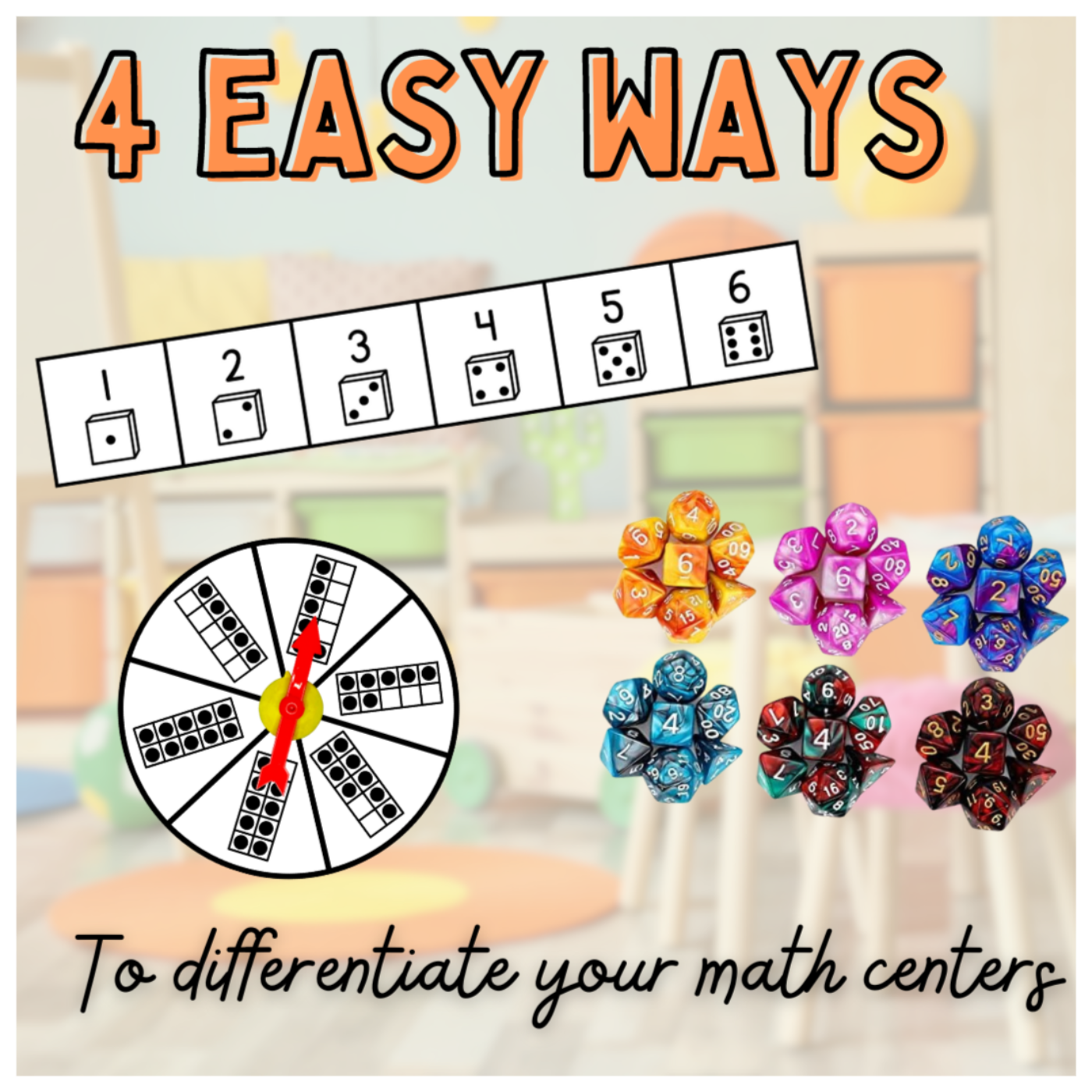
Ep 34: 4 Easy Ways to Differentiate Your Math Centers
Making Number Sense Make Sense: A Math Podcast for Early Elementary Teachers
We know that differentiation is good for kids…but who has the time? These differentiation methods are quick and easy to implement in the classroom! You can see all of these ideas and differentiated centers on the blog!
Are there any podcast episodes you want me to make?
Let me know in this Google Form!
Helpful Links
Pick Build and Cover 10 Frames
Number Rack, Rekenrek Differentiated Centers
Pattern Block Roll, Count, and Cover
Let's Connect!
2024-04-01
7 min
Transcript
Available Results
Generated results are saved to the knowledge database for reuse and search.
No generated results are available for this episode yet.
Extract Knowledge
Pick what you want extracted first. Model, scope, and chapter options appear after a template is selected.
Generated results for public episodes are saved to the knowledge database so they can be reused and searched later.
Transcript
1
00:00:00,000 --> 00:00:04,560
Today we are talking about four easy ways to differentiate your math centers.

2
00:00:04,560 --> 00:00:10,040
Hello and welcome to Making Number Sense Make Sense, a podcast for elementary teachers,

3
00:00:10,040 --> 00:00:14,920
specifically early elementary teachers, looking to really make an impact in the number sense

4
00:00:14,920 --> 00:00:17,080
of their students.

5
00:00:17,080 --> 00:00:22,080
We've heard time and time again that differentiation is so important for our students to be able

6
00:00:22,080 --> 00:00:25,900
to meet them where they are and help them succeed and grow.

7
00:00:25,900 --> 00:00:31,940
But let's be honest, differentiation takes time and time is one thing that us as teachers

8
00:00:31,940 --> 00:00:33,720
do not have.

9
00:00:33,720 --> 00:00:38,940
Today I'm going to share with you some easy ways to differentiate your centers in no time.

10
00:00:38,940 --> 00:00:43,220
The first is to use number tracks with visual support.

11
00:00:43,220 --> 00:00:49,720
If you're not familiar with a number track, it's basically one long line of squares that

12
00:00:49,720 --> 00:00:54,800
kind of looks like a ladder but filled in and they have a number inside.

13
00:00:54,800 --> 00:00:56,120
So one, two, three.

14
00:00:56,120 --> 00:01:03,480
And why number tracks are helpful is kind of a precursor to a number line and more concrete.

15
00:01:03,480 --> 00:01:08,460
They can see all of the actual spaces that they're counting and that can be really helpful

16
00:01:08,460 --> 00:01:13,100
for students who are just learning to count or having trouble with one-to-one correspondence.

17
00:01:13,100 --> 00:01:18,640
And inside those number tracks, you can put a number as well as an image that shows the

18
00:01:18,640 --> 00:01:19,640
quantity.

19
00:01:19,640 --> 00:01:25,440
You can use dice, the die with one pip, two pips, three pips, and so on, ten frames, all

20
00:01:25,440 --> 00:01:30,940
of that so that kids start to associate a numeral with a value but are also starting

21
00:01:30,940 --> 00:01:35,760
to learn about one-to-one correspondence.

22
00:01:35,760 --> 00:01:38,460
And number tracks are really, really versatile.

23
00:01:38,460 --> 00:01:41,200
They are easy to make, easy to use.

24
00:01:41,200 --> 00:01:46,660
You can get one for free in the show notes and you can get to the show notes or to the

25
00:01:46,660 --> 00:01:53,500
description by going to the episode and then scrolling down, you'll see kind of a write-up

26
00:01:53,500 --> 00:01:55,560
of things that are in the episode.

27
00:01:55,560 --> 00:02:00,260
That's where all of the links are and you can find those there as well as a link to

28
00:02:00,260 --> 00:02:03,660
a blog post that has all of this written out so you can look at it later.

29
00:02:03,660 --> 00:02:08,660
Number tracks can support any center that you're doing that has dice or has numbers

30
00:02:08,660 --> 00:02:11,680
or ten frames if students aren't quite there with it yet.

31
00:02:11,680 --> 00:02:18,780
They can match the dice faces or the ten frame faces together so that you can make centers

32
00:02:18,780 --> 00:02:22,540
that were a little bit less accessible, more accessible to your students.

33
00:02:22,540 --> 00:02:27,040
The next easy way to differentiate your centers is to use more dice.

34
00:02:27,040 --> 00:02:33,660
What I mean by that, there are so many different dice that you can use and they're so versatile

35
00:02:33,660 --> 00:02:39,620
and it makes any worksheet more interactive if they're doing something along with practicing

36
00:02:39,620 --> 00:02:43,580
their numbers or finding a sum or subtracting.

37
00:02:43,580 --> 00:02:49,580
Whatever you're working on, using different dice can make a station more challenging or

38
00:02:49,580 --> 00:02:50,660
less challenging.

39
00:02:50,660 --> 00:02:55,100
You can start with the simple traditional six face die.

40
00:02:55,100 --> 00:03:00,700
You can also cover them up with little stickers and make it a zero to two dice, zero to three

41
00:03:00,700 --> 00:03:06,920
die if kids need that support, but also give a student two dice instead of just one and

42
00:03:06,920 --> 00:03:09,700
now they're working with numbers to 12.

43
00:03:09,700 --> 00:03:11,320
They're doing simple addition.

44
00:03:11,320 --> 00:03:17,900
You can use ten frame dice that have five frames, ten frames, 20 frames on them.

45
00:03:17,900 --> 00:03:22,920
Again, increasing that challenge because they're seeing higher numbers.

46
00:03:22,920 --> 00:03:26,780
And one of my favorites is really inexpensive on Amazon.

47
00:03:26,780 --> 00:03:31,900
You can get the Dungeons and Dragons dice and I like those for a lot of reasons.

48
00:03:31,900 --> 00:03:34,900
First of all, they have numerals on them instead of just the dots.

49
00:03:34,900 --> 00:03:37,940
So if you're working with numerals, you can see them there.

50
00:03:37,940 --> 00:03:43,640
They have the traditional die, but they also have eight sided dice, 12 sided, 20 sided.

51
00:03:43,640 --> 00:03:46,940
They have die that have only the tens on them.

52
00:03:46,940 --> 00:03:49,400
All available for usually pretty inexpensive.

53
00:03:49,400 --> 00:03:53,300
I can put a link down in the show notes as well to some of those die.

54
00:03:53,300 --> 00:03:58,100
And the thing that's super fun about those is a lot of times they come in different colors.

55
00:03:58,100 --> 00:04:03,420
At first I was a little concerned about kindergartners or first graders using a die with that many

56
00:04:03,420 --> 00:04:05,660
sides like would they get confused?

57
00:04:05,660 --> 00:04:09,580
And I don't think I've ever had a student who got confused about which number they were

58
00:04:09,580 --> 00:04:13,660
supposed to write down or which number they rolled.

59
00:04:13,660 --> 00:04:17,160
Even with the 20 sided dice, they realized the number that was on top was the number

60
00:04:17,160 --> 00:04:19,060
that they rolled and just moved on.

61
00:04:19,060 --> 00:04:21,940
So if you're concerned about that, I wouldn't be.

62
00:04:21,940 --> 00:04:26,060
Of my over 500 students that I've had at this point, I've never had a student who had trouble

63
00:04:26,060 --> 00:04:27,060
with that.

64
00:04:27,060 --> 00:04:28,740
They have sparkles.

65
00:04:28,740 --> 00:04:32,700
Anything that's new and different can just increase engagement and that is really easy

66
00:04:32,700 --> 00:04:33,700
to differentiate.

67
00:04:33,700 --> 00:04:37,420
Just give students die that are appropriate for the numbers that they're working on.

68
00:04:37,420 --> 00:04:39,820
Differentiation, easy peasy and you're good to go.

69
00:04:39,820 --> 00:04:44,660
In the show notes, I will also have a link to a dice game sampler freebie.

70
00:04:44,660 --> 00:04:50,060
So a lot of those games that I have linked, you can get one of each level, so to speak,

71
00:04:50,060 --> 00:04:51,900
that you can try out for free.

72
00:04:51,900 --> 00:04:56,860
Kind of along the same vein as being flexible are different kinds of spinners.

73
00:04:56,860 --> 00:04:59,420
Spinners are very easy to make.

74
00:04:59,420 --> 00:05:03,920
You can you can just hand draw the circle and put different numbers in it.

75
00:05:03,920 --> 00:05:07,660
You can make them on the computer or just print off blank ones and then write in the

76
00:05:07,660 --> 00:05:12,820
numbers that you need and works the same way as the dice, but instead with a spinner.

77
00:05:12,820 --> 00:05:17,540
And you can be very intentional about the numbers that you have on there even more so

78
00:05:17,540 --> 00:05:20,760
than you can be with the dice because you might be creating them yourself.

79
00:05:20,760 --> 00:05:27,540
Another easy way to differentiate your math centers is using five frame, 10 frame or 20

80
00:05:27,540 --> 00:05:28,540
frame.

81
00:05:28,540 --> 00:05:33,900
This automatically increases, decreases the range of numbers that students are working

82
00:05:33,900 --> 00:05:34,900
on.

83
00:05:34,900 --> 00:05:40,620
If you'd like some ideas of some 10 frame activities, head to episode 31 or 32, I believe,

84
00:05:40,620 --> 00:05:45,380
and I give you 10 plus 10 frame activities that you can use right away.

85
00:05:45,380 --> 00:05:52,820
So recap of my four ways is use numeral tracks, use more dice, spinners and 10 frames.

86
00:05:52,820 --> 00:05:58,500
Quick ways to differentiate any counting math center that you can use for students as appropriate

87
00:05:58,500 --> 00:06:00,020
you can also switch them out.

88
00:06:00,020 --> 00:06:03,740
So maybe your students start with five frames, but you see if they're ready, it's easy to

89
00:06:03,740 --> 00:06:08,580
move them on to 10 frames or 20 frames as they see fit.

90
00:06:08,580 --> 00:06:13,140
You can also let students choose if you feel like they would choose something appropriate.

91
00:06:13,140 --> 00:06:17,300
More often than not, they will try and choose something that works for them.

92
00:06:17,300 --> 00:06:20,820
They might start off with a number that's too high, but they'll realize that that might

93
00:06:20,820 --> 00:06:22,920
not be the number that's best for them.

94
00:06:22,920 --> 00:06:27,380
And you could give them the option of switching to a different one, which is good for them

95
00:06:27,380 --> 00:06:32,100
as well to know kind of what they're working on or what they're working towards.

96
00:06:32,100 --> 00:06:35,200
It can be helpful for students to have a goal to work towards.

97
00:06:35,200 --> 00:06:38,780
So maybe right now they're working with five frames, but you can have a conversation with

98
00:06:38,780 --> 00:06:43,940
students about maybe moving to a 10 frame or you're working towards that 10 frame and

99
00:06:43,940 --> 00:06:46,860
it's motivating for them having a goal to work towards.

100
00:06:46,860 --> 00:06:51,300
It's also helpful for them to hear that you believe in them, that you know that they will

101
00:06:51,300 --> 00:06:56,740
be able to get to the larger numbers with practice.

102
00:06:56,740 --> 00:07:00,620
Sometimes kids can get into negative self-talk, I can't do this.

103
00:07:00,620 --> 00:07:06,620
So hearing you say you actually can do this, I believe that you can, can be really helpful

104
00:07:06,620 --> 00:07:08,080
for students.

105
00:07:08,080 --> 00:07:09,740
So those were my tips.

106
00:07:09,740 --> 00:07:14,820
If you're looking for games that are already differentiated, I'll have a link to some of

107
00:07:14,820 --> 00:07:20,580
those below that use dice, 10 frames, spinners, and also rec and recs, which I didn't mention

108
00:07:20,580 --> 00:07:23,220
too much because those are a little bit trickier to differentiate.

109
00:07:23,220 --> 00:07:28,660
But again, you can work with only one rack of a number racks instead of having the 20

110
00:07:28,660 --> 00:07:32,180
beads you only have 10 and work up to 20.

111
00:07:32,180 --> 00:07:37,680
Let me know which differentiation strategy you're going to try first.

112
00:07:37,680 --> 00:07:40,940
And if you're enjoying the podcast, I would love it if you left a review.

113
00:07:40,940 --> 00:07:53,740
And until then, I'll catch you next time.
Chapters
No chapters available.