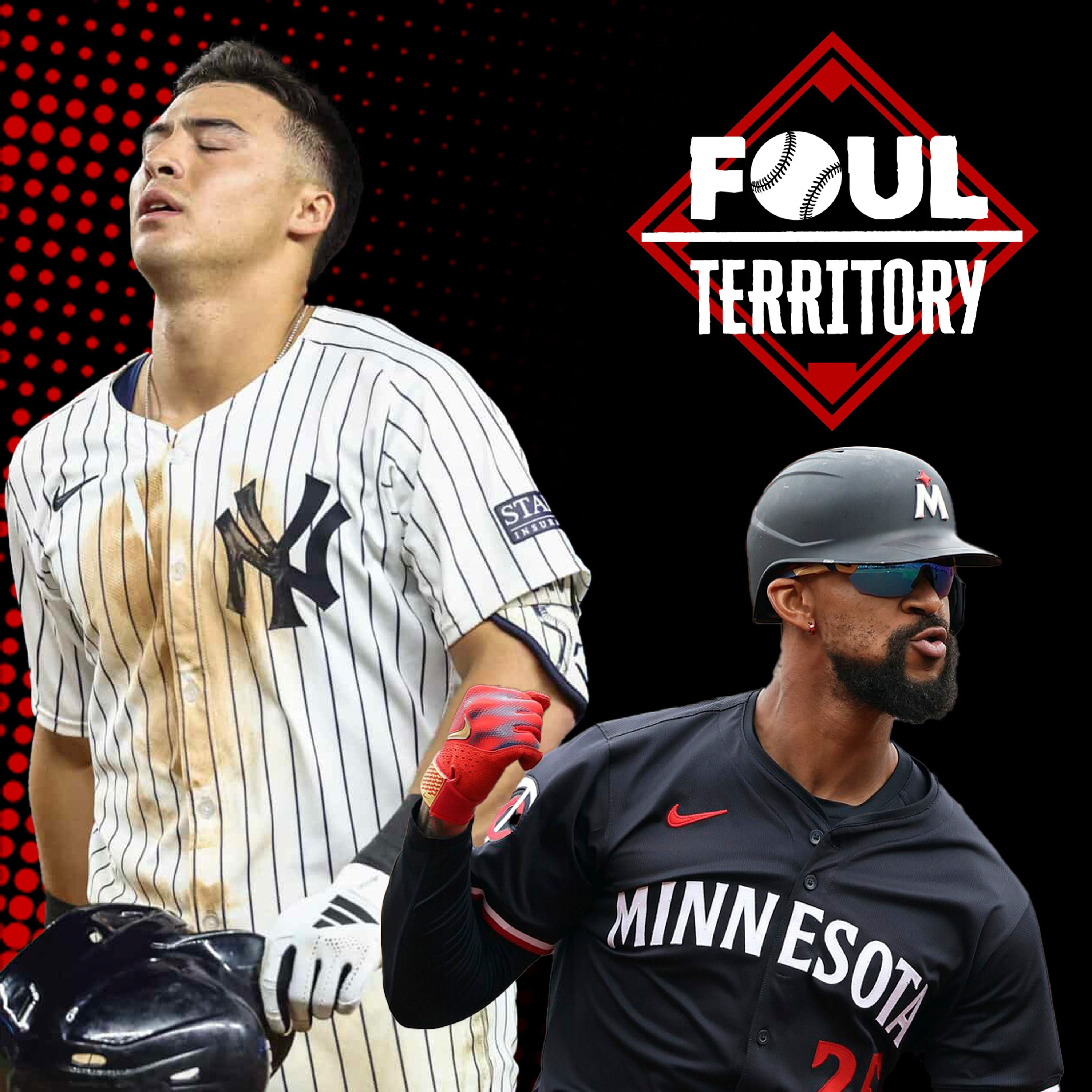
Jim Bowden on Anthony’s bargain deal + What if Buxton moved? + Fangraph playoff projections
FT Resident GM Jim Bowden reacts to Roman Anthony’s extension and shares how much the Red Sox won with this deal.
We also ask if Jed Hoyer should still deal with the Nationals after Mike Soroka’s injury and how a change of scenery can help players thrive. Plus, Jim answers if the Yankees will make the playoffs or not.
Go to GreenChef.com/50TERRITORY and use code 50TERRITORY to get 50% off your first month, then 20% off for two months with free shipping.
(21:41) Anthony Volpe is struggling on defense this year. Former infielder Jason Kip offers his thoughts on the situation.
(23:03) What if Byron Buxton ended up on the Mets, the Braves or other clubs? The hosts examine his comments about wanting to remain in Minneapolis and wonder why he ultimately stayed put.
Earn points on rent and around your neighborhood, wherever you call home, by going to joinbilt.com/FOUL.
(31:53) Fangraphs writer Davy Andrews joins FT to discuss his latest article on playoff percentages, including how the process works, what statistics stood out to him, and what could be wrong with them. He also does a deep dive into a more interesting AL playoff picture.
Hosts: Jason Kipnis, AJ Pierzynski, Scott Braun
See omnystudio.com/listener for privacy information.
Available Results
Generated results are saved to the knowledge database for reuse and search.
Extract Knowledge
Pick what you want extracted first. Model, scope, and chapter options appear after a template is selected.
Transcript
00:00:09
Speaker 1: Front off sunfiltered time resident GM, Jim Bowden joining us right now, and we have business right at the top. JB. Roman Anthony and the Red Sox get it done on the extension. I'm sure you're pleased with this one. Your instant reaction.

00:00:24
Speaker 2: I cannot believe Roman Anthony left that much money on the table. I'm actually in a state of shock. I don't understand how you can sit there and watch Ronal Kunya Junior and watch Vladimir Gerro junior and see the difference between the two, right, I mean, right now in the bank, Vladimir Guro Junior is guaranteed five hundred and seventy million, eight hundred thousand earnings. Ronaldikunya Junior, similar talent, should be paid similarly, has one hundred million dollars. So there's a difference of four hundred and seventy million between the two. And Roman Anthony just signed a Ronda Cunya deal. Ronal Kunya got eight years one hundred Roman Anthony's doing eight years, one hundred and thirty. I don't get it, I really don't now. Matt Rodriguez negotiated the deal for Frontline Athlete Management and I understand, if you're twenty one years old, I understand it's really hard to turn down one hundred and thirty million. I also understand that he'll be a free agent to get at age twenty nine, and he'll have a chance to get that seven hundred and eight hundred million dollar deal by then. I get that. I get the thinking behind it, but not when there's that much money on the table. The last two years of this deal alone, he left at least one hundred million on the table, one hundred million, which is almost exactly what he's signing for a one thirty. So, you know, kudos to Craig Breslo and to John Henry and theo Epstein and Tom Warner and everyone else that was able to do this, because it's going to really help you down the road. I love that Alexanthopolis did it with Akunya. I love it from the club side. A boy, can you imagine what Scott Boris is thinking right now? My goodness, scud Bars doesn't have him.

00:02:07
Speaker 3: Skud Bars doesn't have him. Jim, So, what was your job before you became a before Well you would tell but that's a different story. But there's there's a long list of guys that didn't sign that extension with Boris and didn't make the money either, so you can go both ways. Here's my question for a Jim. Since you have the sport coat over the hoodie, which is an informal formal look, which I kind of dig. I'm not gonna lie because I'm jealous. But before you were a TV star in a radio star, what was your job in Major League Baseball?

00:02:35
Speaker 2: Well, I was a cenior vice president general manager of Major League Baseball.

00:02:40
Speaker 3: So if you would have gone to a player that you weres on your team and said, I can lock this guy up and take money.

00:02:46
Speaker 4: From him that he might might earn down the road, would.

00:02:50
Speaker 3: You be happy with that or would you say, no, no, Roman, don't sign this because I'm the GM and I just watch the best for you.

00:02:58
Speaker 2: Aj you know the answer. I was so happy.

00:03:03
Speaker 4: On the table.

00:03:04
Speaker 2: Of course, I would have liked to have signed Anthony for ninety million instead of one hundred and thirty. And I would have tried everything to do that because that was the hat or the sports jacket I was wearing at the time. Yeah, it's the job. I get it. At the same time, you know, I like what Atlanta did with Acuna on the club side, I didn't like what it does for Acunya. I get it. I mean now I'm in a neutral spot right now. I'll just tell you the way it is. And Anthony left too much money on the table he did. I'm happy for the Red Sox. This was a huge This is the best move Craig Breslo has made since he got the job, to be honest.

00:03:39
Speaker 1: And the Red Sox in general have been locking up some of their youngsters. I mean, this is the guy that they're most excited about from a prospect perspective, no doubt, and now you're seeing it in the big leagues. I'm going to take a different turn on this one with JB because you're neutral now and you know everything about obviously how these deals get done because you did it for a long period of time. Can you put your agency hat on and tell me what you would say to Roman Anthony to try and prevent him from taking on a deal like this, because the agent's job is to communicate any offer that's on the table, And for the Red Sox they're probably like, okay, Corbyn, Kyle, that was one eleven. We got to blow pass that let's get to one thirty. What's the line where we tell a twenty one year old one hundred and thirty million dollars and he takes it. It's it's tough for a twenty one year old to turn down that kind of money, even if he can make hundreds of millions more.

00:04:26
Speaker 2: Yeah, I think I would show him the algorithm and the amount of position star young position players that got injured and career ended, which is a very very small number. The odds are very very thin. And then I would show him how much money he'll make through the salary arbitration process, right, and a contract like this, he's going to be at the top end of the three class, the four class, the five class. But then I would show him what he's giving up right in years seven and eight in this deal, I would show him what Guerrero just signed for. I would show him that Guerrero next year will make forty million and ron Lkun is going to make seventeen. That's just a fact. And they're both equal talent. They should both be paid very similarly, and they're not, so I would I would go through that process, and then I would remind him that, you know, Soto just got seven hundred and sixty five in the open market. And then I would show him that Guerrero got five hundred million on the open market, and I would tell him that you're going to profile better than Guerrero. I can't put you with Sodo yet. I think you have the potential of being Soda or better. But I'll put you between the two. And so I'm gonna show you that sure you're getting one hundred and thirty million, but you're leading at least one hundred million years seven and eight. And if you want to do this, I get it. But what is the risk if you go through the system? Soto turned down four hundred and fifty million from the Washington Nationals, turned it down, They traded him. Okay, what did he end up with? So I just think for a position player, in particular, an outfielder, when we look at the last thirty years, the odds of him having an Albert Bell, you know, hip injury the end of career is very small. And you know, I would tell him, hey, let's try to do a six year deal without giving up free agency. I'm more than happy to do that, but let's not give up those free agent years, or if we give them up, we gotta get forty to fifty million a year, because Guerrero's forty is gonna be fifty by the time he gets there, right, I don't want to give that up. I can't, and so that'll be my pitch to him at the end of the day and then we'll see what the Red Sox say. But you know, I really have a problem year seven and eight. I'm not giving it up. If I'm the agent representing a superstar player like Roman Anthony. There's other players I would do it with, but not a player of this stature. FT fan.

00:06:53
Speaker 1: We often talk about Hello Fresh, but we also talk about Green Chef for your wellness journey, or if you're a little annoying like me and you need the gluten free, or you've got a friend that's plant based, or you're like I'm going with the protein heavy approach. They've got it all on Green Chef.

00:07:08
Speaker 5: Listen the weekly meals they come with all the time. It's different, it's satisfying, and it's something you really want to do. I'm a guy that needs something healthy as I move forward. Can't be the chicken tenders and fries all the time. It's got to be those healthy meals that I need as I'm getting older.

00:07:23
Speaker 1: Fresh organic seasonal produce one hundred percent responsibly sourced proteins to help you feel your best. Make this summer your healthiest yet. With green Chef. Go to green chef dot com slash fifty territory and use code five zero territory. Get fifty percent off your first month, then twenty percent off for two months with free shipping. That's code fifty territory at green chef dot com slash five zero te r R I R Y fifty territory.

00:07:52
Speaker 3: Last thing on this before you let you go. Does the impending labor strife possibility affect this in anyway? Because the owners keep saying we want a salary cap, right, the players keep saying we're not gonna get a salary cap now. If they're somehow there becomes something in the middle, whether it's a harder cap that what we technically have now, players' earnings might not be unlimited like they were with Sodo and Guerrero. Do you think you look at it from that standpoint and say, well, if this happens, we might not be able to get to five hundred plus million.

00:08:25
Speaker 2: Yeah, No, I definitely don't look at it that way. And I respect the players' union and the people that are involved. They're not gonna allow a system that's gonna stop the star players from getting paid. They're not gonna allow what has happened with the draft happened, and I can't imagine with a strong player leadership that's there, I can't imagine them allowing a system. Look, we have a parody issue in this game that has to be fixed. We need the smaller markets to be able to spend more money to be more competitive. I get it, but you can't. The players are not gonna allow. The union is not gonna allow all all of a sudden, the players not make what they deserve and get paid. I mean, remember the percentage that players get is a lot less than it was seven years ago and ten years ago. They're not even getting their their fifty percent share or more whatever you want to argue they deserve. So I just, you know, again, I don't think it's a factor. Aj, I understand where you're coming from. I just don't have fear of those kind of things. Every time we have a labor you know, disagreement or it's coming up everyone's going to talk about work stoppages. You know, since Rob Manford's been there, there hasn't been any work stoppage. And those of us that lived through ninety four ninety five, we're not doing that again. They're not gonna do it again. They can talk about it. You know. It's just like in the NFL with Micah Parson saying he wants to trade. He doesn't want to trade, he wants his contract. He wants to be the highest paid non quarterback in football, and all this dialogue. It happens. The Bryce Harper rob Banford thing. That's just negotiations. We're gonna have a deal that works. Clubs aren't going to get what they want. Players are gonna hopefully work hard to get the minimum up and hopefully work hard to get the smaller markets to be more competitive, and maybe work a little bit harder on revenue sharing. And maybe we we you know, toughen the soft cap a little bit, but not to the extent where it's gonna affect star players from making the money they deserve. My opinion, I got.

00:10:21
Speaker 6: A question for you. We're not letting you go just yet. You can let your agent hack go off, but have you put your GM hat back on.

00:10:27
Speaker 2: All right?

00:10:27
Speaker 6: If you're if you're Jed Hoyer, are you dealing with the Nats anymore? Do you just get a sense of this kind of bad faith with the Soroka dealer? What is your take on all this?

00:10:35
Speaker 2: All right? So my take is clear and concise on this. Okay, I go by the rulebook. It's up to the asany club to do their homework on the medicals. It's their fault. That's not the club. What the clubs do, and this is this is and look, I got under similar criticism when I traded Gary Macjeski to the Cincinnati Reds back in the day, and people accuse me because he got over there and he had issues. This is what I do. Let the doctors talk to each other, share all the medical information, let the other side exactly know what's going on with every single player, and then it's up to the team trading for the player to make that call. Now, anyone that's watched Soroka's career knows his shoulder issues. I've never gone away. Anyone that watched his last few starts are the velocity has gone down. He didn't look right, and the Cubs decided to do it. Anyway, that's on Jed Hoyer. That was a risk he took, which was you know, he took it, okay, whatever I mean. I thought it was kind of I thought they needed to go bigger, but they Jed got the contract before the deadline, which okay, I got security. I don't want to trade all my kids now. I would have waited if I was an owner and signed Jed after the trade deadline, because I want you to go for it. I want you to make a bigger move than Mike Soroka, please. So anyway, it's all on Jed, though, one hundred percent on Jed, and he's owning it and he needs to fair.

00:11:57
Speaker 3: Enough, Jim, how many times did you trade for or pick up a guy that you thought was underperforming? And I'm gonna use Andrew Vaughan as an example, like how much does a change of scenery really do for a player? And to front offices look at that and say, man, if we could just get this guy out of wherever they're at and put him in a more positive culture with a winning culture, that they actually performed Because since Andrew Vaughn's been with the Brewers, he's been the MVP of baseball.

00:12:24
Speaker 2: Yeah, he has been. That's a great, great point. So we spend a lot of time in front offices concentrating on players that we feel are underperforming with other teams, and we get with the evaluators, the scouts, the development people, the analytic people, and you get everybody together to say, how do you fix this guy? If we trade it for this guy, can we fix it? You know? And the other thing is complicated. You know, we're not talking about players. We're talking about human beings. Right, Is a human being going to do better with a change of scenery? Do we think if he came into our environment he would be able to go to the next level? And then vice versa. You have to be concerned, you know, Jake Bird goes from the last place Rockies to the Yankees. Pitching for a last place team is a lot difer than pitching in New York City for the New York Yankees. The pressure is different, the vibe is different, the lifestyle is different, you know, And you got to calculate that when Kacuci was traded Toronto to Houston, Dana Brown, the GM of the Astros, and his data room, they knew exactly what they wanted to do to Kacuci, and they thought they could fix him. They did. He went over there last year after the deadline and was like five and one with like a two era. They made quick adjustments with his repertoire, his pitch sequencing, and immediately paid dividends. We used to get guys and say, hey, if we changed the grip, or if we do this with his delivery, if we put him on the other side of the rubber, I think we can do this. Or you know, there's also the guys in the middle. Like I remember when I brought in Benito Santiago and Tony Fernandez. I didn't know how that was. It was in ninety five. I didn't know that was going to fit in the clubhouse. So you know, I went to Barry Larkin, who was one of the team leaders, and Lenny Harris, and I said, you guys, think about these two guys because baseball wise, they fit right sitting up there in the GM suite. Fernandez can be goal glove third base right if I put him there. Santiago upgrades are catching, but I'm not sure how it's gonna fit in the room. What do you guys think, will they fit in the room, and if they don't, can we handle it? And when they bought in, then okay, I'll go forward and make those moves. So it's complicated because we're talking about human element and then we're talking about how can I fix a guy? And then sometimes you got to be concerned. I remember when I worked for the Yankees, there was always the big issue. Loop Panela and Gen Michael kept pounding with me. You know, you gotta be careful because there's not a lot of guys that can handle New York. And you've got to really study the player because you can have a pitcher that's pitching great for the Angels or Padres, but you bring them over to New York and they can't handle it. So you have to really study it both ways to see. But change the scenery can certainly help. It can also backfire.

00:14:59
Speaker 1: Yeah, thanks are dealing with a little bit of that right now with a reliever or two, which is a whole other topic. But JB, I want to ask you about the trade deadline. We see the grades, we see the super libs, the whole deal, the trade deadline passed. This is what I love. The few days after the trade deadline and it's still happening, right. There's still articles this morning about it, the conversations that went down, the what ifs, right, stuff that didn't happen, or players blocking deal. So I'll give you dealer's choice on this one from Ken Rosenthal reporting about how the Padres landed Mason Miller and some of the other teams, you know, turning down Miller because they didn't want to give up some of those top prospects, right, Phillies, I think Mets were on that list, et cetera. Byron Buxton saying no to potentially being moved because he wants some to stay with Minnesota or any others that you saw those what ifs? Which one stood out to you?

00:15:47
Speaker 2: Yeah? I mean I think the Mason Miller deal I loved a lot, only just as a former GM, just understanding the people that made the deal. Right. Aj Preller sitting there trying to win now, never been afraid to trade, trade Turner or James Wood or C. J. Abrams, Rickenzie Gore, never afraid. Has built a core that isn't going away, and he's got a window to win a World Series and there's not a prospect he won't trade, and it was fascinating to me because what did he do. He traded him to the athletics where, although he's not in the limelight anymore, behind the scenes, one of the owners named Billy Bean, had a long record. Remember the Addison Russell trade for Jeff Samargia, Like he did the exact same thing. That's why I text Billy Bean afterwards to tell him, Yeah, you're fraid of Prince all over this one, Billy. But to me, that was such such a great deal because you know, AJ can call him and say, you know, look, I traded Trade Turner, I traded James Wood, I traded for Fernando Tatis Junior. I'm going to do the same thing for you. I'm going to give you an all star shortstop. He's a teenager and he'll be ready for Vegas. But I need to win now and I need Mason Miller, so I need your best asset. But I'll give you my best future asset and for you three years from now, you're gonna be really happy because everyone's gonna be asking me, how could you trade James Wood and Devrees? But what he's trying to do is win a championship. That's what AJ's trying to do right now, I'd have made that deal too. Now if I'm the Athletics, i'd have made the trade, right. I mean, you got a chance to get your future face of the franchise. Of course you're gonna make that trade. So that was the most intriguing, And the one on Buxton was kind of funny because I remember when he was a young kid over in spring training. I went over to Fort Myers and was talking to him. He had the Minnesota Twins' logo tattooed on his back, and I said, Byron, how do you know you're going to spend your curer in Minnesota? You know this game, you know this turnover. He said, no, I'm gonna spend my career here. I said, you don't know that. You could be a free agent. You could get traded Byron. Buxton has the tattoo, and he honestly's gonna finish his whole career. He is. He got the no trade and he literally, no matter how bad they get, he wants to stay there. So I got a big out of so many teams trying to trade for him and him just saying, no, I'm not going anywhere. So if you give up someone and no trade. You gotta live up.

00:18:08
Speaker 6: To it, all right.

00:18:10
Speaker 3: I got so many things off the answer you just gave one. You gotta call him Preller because AJ is on this show. Okay, the real one. Okay, Preler and Hinch Okay, Jim. So if you're gonna keep coming on here, this is AJ. They're Preler and Hinch.

00:18:22
Speaker 2: All right, Okay, I'll call him. I'm gonna call him King Preller. Then I got it.

00:18:26
Speaker 4: That's fine. Do you call him whatever you want as long as it's not AJ. Okay. And then, second of all, Eric Milton.

00:18:31
Speaker 3: Eric Milton once had a Yankees tattoo on his left shoulder, and then he got traded to the Twins and he's like, now what do I do?

00:18:36
Speaker 4: And we're like, yeah, he shouldn't have probably caught that tattoo, So yeah.

00:18:39
Speaker 3: I fier bucks and has the no trade clause. Milton got it before and then he got traded to the Twins.

00:18:44
Speaker 4: All right, But then.

00:18:46
Speaker 3: For real, I just I just want to know. This is it last question for me? Will the Yankees make the playoffs this year? With the way they're currently constructed because.

00:18:54
Speaker 4: They can't make any more moves?

00:18:55
Speaker 2: Will they make the playoffs, I'm gonna go no, and I'm gonna go no because I'm gonna go no just because I really love the al Wes three teams right now. I just do. I mean, I think what Seattle did at the deadline, I think they can get to the World Series now. And I still all I've been on Texas's bandwagon. I thought they would hit more with their pitching has been really good. And Houston's not going away. So if I put those three teams there, Detroit and then Boston and Toronto may finish ahead of the New York Yankees. So you know, I don't know. There's just the vibe in New York's not great. They're not playing well. You know, it's not a great defensive team. And I'm worried about Aaron Judge. I've been clear about that because the way the Yankees announced his injury, they said there was no acute injury to the older collaterallignment. Then they said there's a PRP injection. So that means there's a tear in the older collateralligment. That's what it means. It may be a slight tear, but there's a tear. It's intact is what they said, right, and acute injury and it's intact all that can be true. But this is the same as Garrett Cole. So there's a tear. That's why you don't shoot the PRP in there. If you're not trying to strengthen the liga then and you're not trying to strengthen the ligaments if it's completely strong. And I just worry about that, you know, because if you lose air and judge, this team can't win if their MVP isn't in that lineup, And I'm worried about the bullpen, you know, and I'm worried about Vulpi. I don't understand the gold Glover why he's struggling like he is. So yeah, I wouldn't be surprised if they miss out.

00:20:27
Speaker 1: Yeah, this is an avalanche of issues and it's surprising, but here we are, and there are a few teams coming after him. JB. Great stuff. This was a good little catch up post deadline. Appreciate the time and we'll catch you soon.

00:20:40
Speaker 2: Thanks guys, appreciate it. Thanks Jan.

00:20:44
Speaker 6: Krats.

00:20:44
Speaker 1: There are a lot of people out there that pay rent and they don't get anything for it.

00:20:48
Speaker 4: Might as well change that.

00:20:49
Speaker 6: You can get some rewards for flights, hotels, tons of stuff.

00:20:53
Speaker 1: With Built, you can earn flexible points that can be redeemed towards airlines, hotel, a future rent payment, your next lift ride, and much more. It doesn't stop there. Built is about making your entire neighborhood more rewarding. You can dine out at your favorite local restaurants and enjoy experiences just for Built members. Every month, they're turning a monthly expense into an opportunity to earn rewards and discover the best that your neighborhood has to offer. Your rent is finally working for you. Earn points on rent and around your neighborhood wherever you call home by going to join Built dot com slash foul. That's j O I N B I l T dot com slash fo u L. Make sure to use our URL so they know we sent you. Join Built dot com slash foul. Go for it. Hey, well, we've got our little middle infielder with us KIT. What are your thoughts on what Anthony Volpi is going through? I mean, it's a gold gloves shortstop who has had significant throwing issues that seem mental heat does not seem like he has his confidence defensively.

00:21:58
Speaker 6: Yeah, I mean we've seen him be a fantastic defender, so we know it's in there. I think he just kind of needs to make up his mind. Hey, I'm going to attack everything. I think that takes the kind of guesswork out of it. I think when you're you're indecisive or indifferent on what to do in the ball or how much time to take, just say, hey, listen, I'm going to attack every single thing and attack all these throws. So my mind's made up on how I'm going to approach the ball, how I'm going to approach his throw. There's no guesswork in it, there's no second guessing, And I think it just kind of simplifies things because I think right now is his wheels are turning a little bit too much because it's an AJ can attest to this too. Can't play trying not to screw up. You have to attack the game. You have to play to make the plays. You can't play like when you're when you swing to like just not strike out. It's not your normal swing, So you're going to strike out. When you try not to throw an air, you're gonna like, oh, I gotta get it there. You're gonna drop the armslot and then here goes to throw into the stand. So it's like you just have to attack the game and like it'll start to come back to you real fast then, I think. But he he just looks like those wheels are turning real fast right now.

00:23:03
Speaker 1: What if Byron Buxton ended up on the New York Mets or the Atlanta Braves. I'm not just saying this out of the blue. Dan Hayes has done great work. I think he's working with Ken Rosenthal behind the scenes on this as well, both of them writing for The Athletic. This one from Hayes. Byron Buxton told inquiring teams no, and then he put some other notes in that article as well. But let's focus on Byron Buxton a couple quotes here to start. So first off, he said, where I came from, your word means everything. My track record of how I'm still here and how I got here is different. You've got to have a lot of people behind you, not just the family, but everybody Minnesota did that. That's home. He really started his campaign for him staying in Minneapolis at the All Star Game. He received a number of questions about if he could be on the trade block, and he's like, I could not because I have a no trade class, and I say no. So they didn't even entertain anything except for the phone calls that came through to Byron Buxton's agency. I'm saying the Twins didn't entertain anything. Byron bucks agency got a number of calls from teams who clearly were interested, and he told them the same thing, don't waste your time. He's not going to wave the no trade clause. Now here comes the social media storm.

00:24:11
Speaker 2: Kip.

00:24:11
Speaker 1: You do have fans that say the Twins just sold half their team away. They're going to be sold. There are some good pieces there, but why does he want to stay if he has an opportunity to join a contender and not the Braves. The Braves aren't good this year. He's from Georgia. There were some connections there, but some other teams were interested as well. There were a number of teams that called. But for example, fans are like, why wouldn't Buckston want to join the Mets when they're in a playoff race and the Twins are not.

00:24:36
Speaker 6: I yeah, I can appreciate his loyalty. I can appreciate a man of his word. I can appreciate that he wants to finish what he started or build there because they gave him the chance. All that stuff. That's great stuff, and I know the front office appreciates that and loves that. But you look around that clubhouse, almost everyone's gone. Your team is, your ownership is kind of not gone for it when you have had good teams recently, so they aren't really about winning as much as you'd like him to be. If you just said he's from Georgia. Let's say Atlanta was good this year. Every one in your starting lineup is pretty much gone. Atlanta is great this year, let's say hypothetically, and they're trying to trade for you so you can go home play for a hometown team in a playoff race, and you're still gonna hold strong of that. No, I don't get it. I guess I'd like to think there are circumstances that should happen where an answer should change. You would think as a player, you would want to experience that experience. The playoff runs, the deep playoff runs, because that's what we're all trying to do anyways. So I don't know. I appreciate the loyalty, but I also don't understand why staying there when they're rebuilding it makes sense just or that doesn't make sense to me, I guess.

00:25:57
Speaker 3: I mean Jim Boden said it. He has a touch to the Twins logo on his back. He's not going anywhere, and it's his right.

00:26:03
Speaker 4: So listen.

00:26:04
Speaker 3: As much as I don't know if I could be able to be as strong as Byron Bucks and say I'm staying with the Twins, there is something cool about being with one team, your whole career in one organization. So I can't fault a guy. Listen, he got the no trade clause and he wants to stick by it. I mean, if you're a Twins fan, you have to respect that. If you're a person in general, you have to respect that. So could he move on to a different place. He could, but he's comfortable. His family's comfortable there. He might have a place in Four Myers, he might have a place in Minnesota. He goes from four Myers to Minnesota, his wife and his kids and his family is comfortable with that. So I can't fault a guy for that. As much as people to say, oh, he doesn't want to win. Oh he doesn't want this, he doesn't want that, you know what, it's his choice.

00:26:45
Speaker 4: I'm sure there's people out there.

00:26:46
Speaker 3: In regular world that if that work at a company and another company comes and offers him a little bit something better, and they're like, you know what, I'm gonna stick with the company I'm with because I'm comfortable. And I have to give that guy credit, because listen, if I could have played for one team my whole career, would have loved to have done it. But you know what, I wasn't that fortunate. If you're fortunate enough to do it, good for you. Byron Buxton.

00:27:05
Speaker 1: And clearly he likes the way they're treating him too, guys. I mean he's happy with you know, the front office is usually you know, I mean talked about very highly right, Derek Fabian company over there in Minnesota, Thad Levin who was there for a while. He was just on our show the other day, known as one of the nicer guys in the sport. So it's not like he's in one of those disaster scenarios and we all know they exist.

00:27:24
Speaker 6: No, I'm saying I appreciate, I I can appreciate absolutely everything that he's doing insane. I I do love it, and he's earned the right to make that decision for himself. I think he needs to get is it hobby hobby bias that has the MLB logo tattoo on the back of his neck? Ye, the way he's covered for any team that he goes to. So he just gets the MLB logo.

00:27:44
Speaker 1: Yeah, unless you end up playing in a different league. Right if you're in the Mexican League and NPV and.

00:27:48
Speaker 6: Run out, Yeah, run out of ideas.

00:27:50
Speaker 4: Did you play with anybody?

00:27:52
Speaker 3: Because I played with some guys in the minor leagues that got that tattoo and I was like, what if you.

00:27:56
Speaker 4: Don't make it?

00:27:56
Speaker 3: And they're like, oh Megan, they didn't make it, And I'm like, uh, do you cover that thing with so molts?

00:28:01
Speaker 6: He had it before he was up with the big leagues. But I think he was on his way.

00:28:04
Speaker 3: Yeah, he was a first rounder. I think he was gonna be okay. This guy was like not, these guys.

00:28:09
Speaker 1: Are not rounds.

00:28:11
Speaker 4: They were not.

00:28:11
Speaker 3: There's a guy headed on his arm. There was a guy who they had on his neck. I was like, what if you don't make it?

00:28:16
Speaker 1: It's good motivation because it's like I have to make it.

00:28:18
Speaker 6: I have to. Yeah, I got the tacks like the team.

00:28:22
Speaker 4: It's like the team is like, oh, he has a tattoo, we need to send him to the big leagues.

00:28:26
Speaker 6: What about this guy he's tatted up with the love by the.

00:28:30
Speaker 1: Way, these two players, this guy hasn't tack.

00:28:35
Speaker 4: By the way.

00:28:35
Speaker 3: I just want to say this for the record. So Jim Boden told the story of Byron Bucks and Eric Milton had New York Yankee logo on his left arm. I played with a guy I think his name was Greg Hanson. Hanson, I think that was right. And he had every he played for like nine teams so down his leg. It started with the first team, and so he had to keep getting the tattoos all the way down his legs. So he ended up playing for like eight or nine teams, so he.

00:28:57
Speaker 6: Had them all all the way done his leg.

00:29:03
Speaker 3: He'll get a tattoo if you're not one hundred percent sure, guys, Okay, just saying, especially of a team in baseball, because guess what they can do.

00:29:09
Speaker 4: They can get rid of your really fastly. You have one kip.

00:29:13
Speaker 6: No, no, I do not have a team logo. There you go, Hey, one more questions and they can get rid of you real fast.

00:29:20
Speaker 1: Right, one more question on this, because there's a guy who's really is a legend in our sport, is going to be a Hall of Famer, but the back half of his career has not played out the way he's wanted it to. What do you think about the Mike Trout example, for Byron Buckston, who's already cracked open his early thirties here and you just don't get too many cracks at a World Series title. Does any of that factor in here? Or you just have to have that that goal that you want to win with the team that you're with and you've got the new trade cause you've got to overcome you know what the desire is from outside?

00:29:52
Speaker 2: Right.

00:29:52
Speaker 1: I'm sure Trout's thought about it too. It's been talked about sometimes in the offseason. It doesn't sound like he's ever pushed the team though, So I wonder if that's in Byron's headed off because you just don't know, right, I mean, and he's had problems staying on the field. It's like, you're thriving this year. There's teams that want you, that can tend you want to say no to Atlanta, go for it, they're not in the playoffs this year, but you want to say no to the three or four other teams that were interested.

00:30:16
Speaker 6: It's I'm interested to see when It's like a player can always tell kind of when they're nearing the end. So if when the two of them maybe have like two years left, three years left, maybe uh, and then there's just no light at the end of the tunnel for the organization, I'm wondering if you'll start to see maybe he starts more a trout, just to give it a give it a chance.

00:30:40
Speaker 1: Okay, okay, But also, like Aj.

00:30:43
Speaker 6: Said that you're you're at you're on the you're at the home finish of playing your whole career for one team, which is really cool.

00:30:49
Speaker 1: Yeah, it's just the ring desire, right, I mean, everybody wants every Scott.

00:30:55
Speaker 3: Not everybody wins a ring. Kip didn't win a ring. I was fortunate enough to win one, right, not everybody wins one. But listen, Joe Mallard didn't win one. He's in the Hall of Fame because he stayed with one team his whole career, right, I.

00:31:06
Speaker 4: Mean, it's kind of cool. Right to know this, Mike Trout's probably gonna stay with the Angels entire career. Pretty cool.

00:31:12
Speaker 1: Basic Matt though, is that if you're on a non contender right now and they sold out their team away and then they're going through an ownership change and they might be good eventually, right Like, he's got a shot at winning with this new group, But percentage chance, I mean, you've got a better chance joining a contender now and rolling that way. It's just it is what it is. But it's the choice that he made. That's all just presenting both sides. I actually kind of been in the middle on this one because I would be more critical if I felt like the player was on like an absolute disaster scenario team and he only had a couple of years left. Fyron Buxton should have, you know, hopefully five or six years left in his career, and the Twins will definitely be able to bounce back from where they are. They were in the playoffs two years ago and they're going to have a new owners, So I'm okay with it. Davey Andrews joining us right now from Fangrafts for the first time on FT. Daved, great to have you on the show here and perfect timing because past the trade deadline and now people want to know playoff percentage chances for their ball club. So how you doing.

00:32:06
Speaker 7: I'm good, Thank you for having me. It's fun to be on. I see you guys background and I do not have the same house as major leaguers as what I'm doing.

00:32:15
Speaker 1: Well, I don't either. I'm in a little apartment. But you can fake it till you make it all day. Okay, Davey, tell me about playoff percentages that you wrote about in fangrafts, how they vary, what goes into them, and what has stood out to you at the recent look at who could you know, crack the playoffs that could surprise us or who could miss out that could surprise us?

00:32:35
Speaker 7: Right, Well, so I would start first, which is how they work. I mean, the biggest thing is they take your record, and then they look at your strength of schedule for the rest of the season, and then they look at your projections. So we're talking about how good the projections think your team is, and so based on all of that, they spit out a number the percentage chance that you make the playoffs. So like the Dodgers are at the top with ninety nine point six percent chance because they're in first Iceland, because they're the Dodgers with a really good team, and then there are plenty of teams at the bottom with zero. So the reason I wrote about it yesterday is that I was looking at the numbers and I realized that this is kind of the most stratified that the numbers have been in a long time. Like in the National League, the Reds have a thirteen point six percent chance of making the playoffs, and then above them today is the Mets at eighty nine point one percent, So they basically the numbers think the National League is one hundred percent settled right now. Obviously I'm doing some rounding here, but but I was looking at it. I was like, Man, the numbers say this is the most boring postseasons or stretch run since we started keeping track of them.

00:33:40
Speaker 1: Wow, that's crazy. So I will bring up what some will say, including Reds fans, remember last year the Detroit Tigers, what was their percentage chance of making the playoffs at this point.

00:33:53
Speaker 7: Zero point two percent? And you can buy a T shirt with the Fangrafts graph that goes down, down, down, down down, all the way up at the very end. And you could also look at the twenty nineteen Indians Guardians to bring it close to home here, I'm sorry that who a week from this point in the season, we're at ninety six percent above ninety six percent and didn't make it. So it happens all the time, you know. I think when when you hear a number like this and you hear it's like a ninety percent chance, you think, well, that means it's a done deal. But what it means is one out of ten times the opposite thing is going to happen.

00:34:26
Speaker 4: Whoa, whoa, whoa? Was Kip on that team? Kip? Were you on that twenty nineteen choke job team?

00:34:31
Speaker 6: What I thought we did make the playoffs?

00:34:37
Speaker 7: All right, Well then I feel less bad bringing it up.

00:34:40
Speaker 4: Okay, all right, well that's amazing.

00:34:44
Speaker 3: Well so then this is just a percent like everything has to go right or wrong for a team to make the playoffs.

00:34:50
Speaker 4: Because if you.

00:34:51
Speaker 3: Look at it right now, the Brewers are what ninety nine point one percent, They have a nice small lead on the Cubs. The Cubs are ninety six percent. But like kind of what Scott said, the Reds team is looking at like, hey, we're hot right now, We're playing really well. We made some nice acquisitions. This is more like if something crazy doesn't happen, right, this is just more of like textbook things just continue as they've gone for the first four and a half months.

00:35:16
Speaker 7: Right, So you can in my article, I kind of broke down the pros and the cons for the Reds and like you're saying, there's a lot of pros here, like they're gonna get Hunter green back, and they've got Ellie day La Cruz who looks like he can just carry a team, and if the additions they made at the deadline work out, if Cabrian Hayes looks out at the short fence in the Cincinnati and things, oh maybe I should start lifting the ball a little to hit it over like all of a sudden they're going to start rolling. And they could absolutely do it. But they also have I think the second toughest schedule the rest of the way, and they've had an easy schedule to this point. So some of the numbers that you're looking at may be a little rosier than the real picture says, and just the projections, like I mean, like what the Phillies and did a lot, and the Padres a lot, and so all of a sudden, these other teams added to and added more, and so it's just it's a tough road. So it's they're trying to factor in everything. Obviously baseball is going to baseball. There's no way to predict everything. But this year did stand out just because the numbers are so stratified.

00:36:20
Speaker 4: Davy, who's your team?

00:36:23
Speaker 7: I mean, I'm a national skuy first and foremost, so they've been at zero for a long time.

00:36:28
Speaker 3: Now that's fine. I mean, I'm a white sex guy. They were at zero before the year started, so I get it.

00:36:32
Speaker 4: I get it.

00:36:33
Speaker 3: But they did win a World Series in twenty nineteen. My question is the Yankees. Where were the Yankees at six weeks ago? And now were they at? Because the American League has kind of shifted, right, the Yankees were dominating and were like, oh, Yankees are close to ninety percent whatever they were, and now what's their number compared to with like the Mariners, the Rangers, all these teams that have kind of jumped in front of them.

00:36:53
Speaker 7: Right, I would say the Yankees are one of those teams who have seemed to defy gravity. Right now, they're at seventy eight point eight, which is is down a little bit. You know, they have been really struggling. But the numbers, the projections, are a big part of this, where they're looking at individual players and expecting them to contribute. And so if Aaron Judge comes back healthy, then all of a sudden that lineup is terrifying. If he doesn't, the projections can't really tell you that. So if Aaron Judge isn't there and hitting like Aaron Judge, then like, throw this number in the garbage. Basically, you know, all of this stuff depends on health and luck and short sample sizes, all things that can go either way at the drop of a hat. So so far, the numbers have really liked the Yankees. But when we're watching it with our eyes, it looks a lot scarier.

00:37:39
Speaker 1: So let's transition over to the al What are you seeing from the playoff projection numbers there?

00:37:46
Speaker 7: Well, so, I mean the Tigers still are in first. The Tigers look genuinely scary, and you know, I think once you get into the playoffs they look even more scary. You know, with the way they rolled in the postseason last year where just Scoogle was unhittable, and they kind of scraped enough together. They're bullpen isn't looking quite as good, but I mean they're at ninety eight percent right now. They've pretty much got the central locked up, and then below them, it's a little bit of a mix. You know, the Ale East is going to be a real battle regardless of who ends up making the playoffs and doesn't. I think the Al East will be really fun. The Red Sox are on a run right now, the Blue Jays have been on a run, and the Yankees have the pieces where if they all put it together, those could be three really good teams down the stretch and it should be really fun.

00:38:34
Speaker 1: Cap. We got to ask about your boys, because no one's talking about them, but they're actually only, what is it, a game and a half away from a playoff spot right now. I don't know if the projections love them, but.

00:38:46
Speaker 2: To present, it never loves them.

00:38:47
Speaker 6: It never loves them because it's not like there's never been an besides Jose, there's never been huge home run hitters that can really like switch it that the statistical side, the analytical side loves to like kind of go off that.

00:38:59
Speaker 7: And we shouldn't know that the projections tend to regress heavily on defense, which means when you're a good defensive club, they don't trust you as much because they sort of expect defense to balance out, and so for a team like the Guardians who have some premium defenders like that is a reason to look at the numbers with a little more suspicion and a little more hope.

00:39:20
Speaker 6: I appreciate you saying a nice thing about the Guardians there.

00:39:23
Speaker 7: I love the Guardians. I'd end up writing about them all the time just because they always have fun people.

00:39:30
Speaker 6: I think. I'm trying to think of aj would you actually you might be the wrong person answer as this question, but because okay, because I already know your answer, I think, would you ever look at something like this and give it any stock and if you were a player playing?

00:39:44
Speaker 4: No? Absolutely not.

00:39:47
Speaker 3: Actually no, actually that's all right, because I would be like, oh, we're only projected to win seventy two games through them. I'm gonna try and win one hundred games and be like, yeah, fan Grafts, you don't know what you're talking about.

00:39:58
Speaker 6: Fair enough. I like it, though, No every play like, okay, well, good thing, it's settled in between the White Lions like, it's fine, we got this then, So I think that's you're right, that's the best way to use it. Pen if it's not telling you already end.

00:40:09
Speaker 1: We've heard it brought up as bulletin board material before, Davy. I'm sure you know and can talk about it.

00:40:14
Speaker 7: More, especially from the Guardians for this very reason that you know, like they've had a lot of premium defenders in the past and so the numbers have not trusted them and they've just gone on some really fun and probable runs. So yeah, I mean, I think if you're a player, I can't imagine looking at this for anything other than, you know, bulletin board material.

00:40:33
Speaker 2: Yeah.

00:40:33
Speaker 6: I don't know if you're talking about me with premium defenders in the past. Maybe my other guys in the infield, I thought, But you.

00:40:40
Speaker 7: Have the pop, the projections love pop.

00:40:42
Speaker 2: Thank you.

00:40:43
Speaker 6: Yeah.

00:40:43
Speaker 1: Andre Samenez had the glove there recently for Cleveland. Yeah, he was. He was probably the best defensive second basement for a year or two there. My question to you, Davy is where do you think it's wrong?

00:40:55
Speaker 5: Right?

00:40:55
Speaker 1: Where are you looking where either other numbers that you like tell you you otherwise, or just the eye test tells you otherwise, And I'll stay on American League because, like you said, I'm with you. It's gonna be hard to convince anyone that there's a better top six. And they've got like this real clean cut top six in the National League, but it's not quite the case.

00:41:12
Speaker 4: In the AL.

00:41:13
Speaker 1: So how do you see the AL playing out these next couple months?

00:41:17
Speaker 4: Right?

00:41:17
Speaker 7: I mean the big thing is is the Rangers, Like right now, they're at forty percent, and so that's a decent chance, but they'd have to be thrown either, you know, like the Mariners, Astros, the Red Sox, the Yankees. You know, there are a lot of teams in the mix here, and I think the Rangers just look really dangerous right now. They have so many hitters who could get into shape, and so many pitchers who could really put together dominant stretches like you saw Ivaldi last night, just completely shoving. I think the Rangers could really not only like close strong, but like look like a team that nobody wants to face.

00:41:52
Speaker 3: Would you want to face Evaldi and de Grom in the postseason if you had to go one two in a short series, in a three game series in your first two starters, you get de Grom and Evaldi that it sounds like it wouldn't be a lot of fun. David, I know you're a nats man, so you get the Strasbourg Ureser comparisons.

00:42:07
Speaker 7: There, right, absolutely? Yeah, I mean I don't think anybody wants to face the gram ever.

00:42:12
Speaker 3: Yeah, true, especially when he's healthy. All right, So I have two quick questions for you. When was the last time the Braves were zero percent? Our producer lady at Claudia, she's like she's a huge Braves homer, so she's like crying about the Braves. So when was the last time the Braves were zero percent?

00:42:26
Speaker 7: Oh my god, I'd have to look it up. I mean, it's this is such a weird year and and even now, like you look at that team and I mean, obviously it's different with the Kuna Goan, but it has been a while. I would guess it's been five or six years.

00:42:40
Speaker 4: Okay, since I was there in twenty sixteen.

00:42:42
Speaker 3: I get it.

00:42:42
Speaker 6: It's what I was looking because thanks for.

00:42:44
Speaker 4: Rubbing it in. I appreciate it, Thank you, love it.

00:42:47
Speaker 7: I did before I came on at the years you were there and.

00:42:50
Speaker 4: That, Yeah, I was looking there were zero.

00:42:52
Speaker 3: They were zero from the time we took the field and spring training, So I get it. No, no big deal. The gnats were good then, So I'm all right. So before we let you go, I have to ask you this. You have your soundboard up there, looks like on your door. I know you played guitar, right, you play guitar and some bands. M what's what's cooler playing guitar in front of a live crowd or writing an article like just did a million people look at and read and trust that your numbers are correct?

00:43:19
Speaker 4: Well?

00:43:19
Speaker 7: I think playing I don't know. I'm dell with playing guitar. Here's why, because I didn't come up with these numbers.

00:43:25
Speaker 2: I am not.

00:43:27
Speaker 7: There are a lot of smart people at Fangrafts, and I am not part of that club. I can put the words down, but as far as the math behind and behind them and explaining all of it, they're much smarter people than I am. So I gotta go with the guitar.

00:43:42
Speaker 1: Like he did his homework.

00:43:46
Speaker 4: This was his chance to pump his bands, and he didn't do it.

00:43:49
Speaker 7: So you guys, you guys have had Petriello on we play in a band together, So.

00:43:54
Speaker 1: Oh no way, I didn't know that the band. That's really cool. Okay, what's the band name?

00:44:00
Speaker 7: Where the Subway goes? We got a show next week, so if anybody is, you know, around in New York, check us out.

00:44:06
Speaker 1: Okay, well yeah, look them up. Subway Ghost. I love that. Davey is a is a multi whatever you want to call multi entertainment threat, dual threat. Very cool, baby, this was awesome. Thank you for joining us. Really appreciate the look into those playoff projections, as many people will look at them like these guys do and use it as bulletin board material whatever else. So we appreciate the entertainment and the info from fangrafts all the.

00:44:31
Speaker 7: Time, my pleasure. They are there for people to shout about.

00:44:35
Speaker 1: Yes, exactly right. Criticism welcome, bring it, bring it, Davy, thank you so much. Appreciate it again.

00:44:42
Speaker 7: All right, thanks, have a good one, guys,