Our universe is humming with gravitational waves
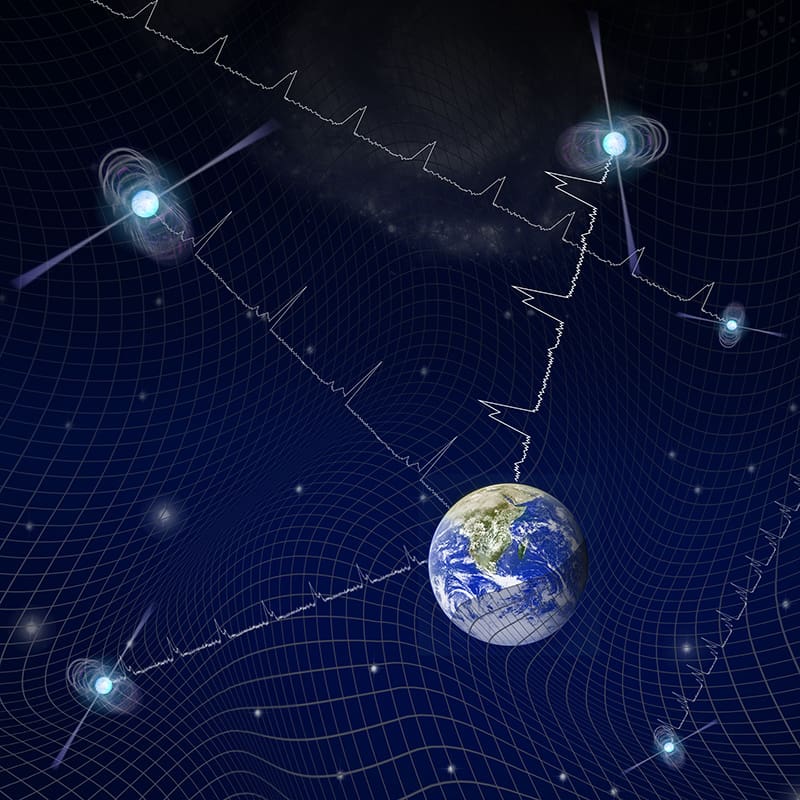
In recent weeks the astrophysics community has been buzzing following the discovery that the universe appears to be filled with a background hum of gravitational waves. Using radio telescopes in the Africa, Asia, Australia, Europe and the US, several teams have noted the same thing: that gravitational waves leave a faint fingerprint in the signals received from pulsars within our galaxy. The discovery is another exciting breakthrough within multimessenger astronomy.
In this episode of the Physics World Stories podcast, Andrew Glester explores the implications of the new gravitational wave discovery, announced on June 28 by the NANOGrav collaboration in the US. He is joined by Cherry Ng, an astronomer at the Laboratory of the Physics and Chemistry of the Environment and Space, part of the French National Centre for Scientific Research (CNRS). In the podcast, you will hear about what this gravitational wave signals can reveal about the massive objects triggering them, most likely the merger of supermassive black holes.
Available Results
Generated results are saved to the knowledge database for reuse and search.
Extract Knowledge
Pick what you want extracted first. Model, scope, and chapter options appear after a template is selected.
Transcript
1
00:00:04,790 --> 00:00:05,530
Physics.

2
00:00:05,530 --> 00:00:08,480
World. Hello and welcome to the
Physics World Stories Podcast.

3
00:00:09,180 --> 00:00:10,120
I'm Andre Glasser,

4
00:00:10,140 --> 00:00:14,160
and although last month I did promise
you that we'd be looking at the

5
00:00:14,160 --> 00:00:17,760
international Year of basic
sciences for sustainability.

6
00:00:17,830 --> 00:00:20,280
Something has happened
in the world of physics,

7
00:00:20,770 --> 00:00:25,240
which has shifted that down the schedule
a bit. We will bring you that podcast.

8
00:00:26,180 --> 00:00:29,240
But on June the 29th, 2023,

9
00:00:29,780 --> 00:00:33,280
the North American Nano Hertz
Observatory for gravitational waves,

10
00:00:33,350 --> 00:00:35,000
otherwise known as Nano Graph,

11
00:00:35,550 --> 00:00:40,320
made a major announcement during a
live streamed event from the National

12
00:00:40,320 --> 00:00:41,320
Science Foundation.

13
00:00:41,740 --> 00:00:45,960
The official press release reads
astrophysicists using large radio

14
00:00:46,130 --> 00:00:50,920
telescopes to observe a collection
of cosmic clocks in our galaxy have

15
00:00:50,920 --> 00:00:55,800
found evidence for gravitational waves
that oscillate with periods of years

16
00:00:56,300 --> 00:00:57,133
to decades,

17
00:00:57,270 --> 00:01:01,640
according to a set of papers published
in the Astrophysical Journal.

18
00:01:01,640 --> 00:01:05,200
Letters from the press
conference. Here's Dr. Sean Jones,

19
00:01:05,740 --> 00:01:10,280
the assistant director for the Director
of Mathematical and Physical Sciences

20
00:01:10,540 --> 00:01:12,160
at the National Science Foundation.

21
00:01:13,220 --> 00:01:17,560
In 1995, the Hubble Space Telescope
revealed the Hubble Deep Field,

22
00:01:18,160 --> 00:01:23,000
a tiny sliver of the night sky brimming
with a veritable zoo of galaxies in

23
00:01:23,000 --> 00:01:26,880
various stages of evolution. In 2022,

24
00:01:27,140 --> 00:01:31,960
the James Webb Space Telescope refined
and deepened that image fantastically

25
00:01:31,970 --> 00:01:35,720
displaying galaxies more than 13
billion light years away from earth.

26
00:01:36,810 --> 00:01:40,800
Aided by the state-of-the-art optical
and infrared telescopes and decades of

27
00:01:40,800 --> 00:01:43,280
advancement and instrumentation
and data processing,

28
00:01:43,700 --> 00:01:47,240
we perceive a static
image of distant galaxies.

29
00:01:48,110 --> 00:01:52,920
Today's announcement
shatters that perception of a
static universe through the

30
00:01:52,920 --> 00:01:57,880
direct observation of gigantic
gravitational waves washing across our

31
00:01:57,930 --> 00:02:02,840
Milky Way galaxy, spawned by
cataclysmic events, including some,

32
00:02:03,030 --> 00:02:05,880
some from the most distant
regions of the cosmos.

33
00:02:06,650 --> 00:02:08,720
These observations reveal a rolling,

34
00:02:09,530 --> 00:02:14,160
noisy universe alive with a
cosmic symphony of gravitational

35
00:02:14,210 --> 00:02:14,940
waves.

36
00:02:14,940 --> 00:02:16,000
In the recent announcement,

37
00:02:16,020 --> 00:02:20,880
the nano graph team announced
the detection of shockwaves
from what they believe

38
00:02:21,010 --> 00:02:24,160
could be the merger of
super massive black holes.

39
00:02:25,220 --> 00:02:27,000
You may be thinking, hang on,

40
00:02:27,820 --> 00:02:32,440
didn't they already detect gravitational
waves at the Ligo Virgo observatories a

41
00:02:32,440 --> 00:02:37,200
few years ago? And if you've been
listening to this podcast for a few years,

42
00:02:37,670 --> 00:02:39,800
then you'll know that
they sounded like this.

43
00:02:42,420 --> 00:02:44,880
The difference here is that
rather than one-off events,

44
00:02:45,590 --> 00:02:50,520
nano graph has detected a consistent
hum triggered by gravitational

45
00:02:50,690 --> 00:02:51,523
waves.

46
00:02:51,860 --> 00:02:56,480
It could be the first direct
evidence of the stretching and

47
00:02:56,760 --> 00:02:59,330
squeezing of space time
due to black holes,

48
00:02:59,950 --> 00:03:04,630
and it opens a new window on
the universe speaking to physics

49
00:03:04,680 --> 00:03:08,150
world, his Ben Steppers from
the University of Manchester.

50
00:03:08,890 --> 00:03:10,390
The gravitational wave, um,

51
00:03:10,490 --> 00:03:13,590
is often referred to as
being a ripple in space time.

52
00:03:14,130 --> 00:03:17,990
So it's something which is
generated when, uh, well,

53
00:03:18,030 --> 00:03:21,590
it's most easily detected when you
have massive objects, for example,

54
00:03:21,630 --> 00:03:24,470
orbiting each other. And
so that generates a, a,

55
00:03:24,590 --> 00:03:28,270
a so-called ripple in space time. But
like if I throw a stone into a, uh,

56
00:03:28,460 --> 00:03:32,230
into a pond and you see the water ripples,
um, we have the equivalent of, uh,

57
00:03:32,230 --> 00:03:34,870
of what gravity does to a space time.

58
00:03:35,460 --> 00:03:39,950
Nano graphs started as a group of
about a dozen scientists back in

59
00:03:39,950 --> 00:03:43,110
2007. It's now grown to 194 members,

60
00:03:43,380 --> 00:03:47,550
including 77 graduate students
at over 80 institutions,

61
00:03:48,050 --> 00:03:50,470
not only in the US but around the world.

62
00:03:50,730 --> 00:03:54,830
Cherry Young was involved
in the early stages of nano.

63
00:03:55,870 --> 00:03:58,750
I am a radio astronomer,

64
00:03:59,290 --> 00:04:03,950
and my research interest is
in everything transient things

65
00:04:04,100 --> 00:04:06,190
that, um, uh,

66
00:04:06,340 --> 00:04:10,590
like explosions and fast
time scales or things like

67
00:04:11,270 --> 00:04:16,190
pulsars that we can
detect their, um, posters,

68
00:04:16,200 --> 00:04:20,830
radio posters very well using
radio telescope facilities. Uh,

69
00:04:20,830 --> 00:04:21,663
during my PhD,

70
00:04:21,860 --> 00:04:26,390
I've worked on a pulsar all
Skye blind search using the

71
00:04:26,400 --> 00:04:28,350
Australian Parks radio telescope,

72
00:04:28,810 --> 00:04:33,470
and then I moved to Canada
where I spent eight years, um,

73
00:04:34,650 --> 00:04:38,870
of my time on the Chime
radio telescope, uh,

74
00:04:38,870 --> 00:04:41,390
helping to commission this new facilities,

75
00:04:41,390 --> 00:04:45,350
which has led to a large
number of fast radio burst

76
00:04:46,530 --> 00:04:47,363
discoveries.

77
00:04:47,790 --> 00:04:52,450
And it is also involved
in Pulsar research. Uh,

78
00:04:52,560 --> 00:04:57,170
very recently moved to
France where I took up a

79
00:04:57,530 --> 00:05:02,490
permanent astronomer position
at the C N R S National Research

80
00:05:02,520 --> 00:05:03,353
Institute.

81
00:05:04,230 --> 00:05:08,770
And so I'm hoping to continue my
work on Pulsar Fast Radio Burst and

82
00:05:09,550 --> 00:05:12,170
set, as well as my
other research interest.

83
00:05:12,610 --> 00:05:13,970
I think we're need to
talk about those things,

84
00:05:13,990 --> 00:05:16,890
but maybe we'll talk about
them later because, um,

85
00:05:17,040 --> 00:05:19,210
there's a particular
topic for this podcast.

86
00:05:19,630 --> 00:05:20,890
The Pulsar Community.

87
00:05:21,030 --> 00:05:25,530
We are very excited to share with
the public the discovery wave of

88
00:05:25,890 --> 00:05:30,570
evidence of gravitational waves
from the Pulsar Timing experiment,

89
00:05:30,840 --> 00:05:32,490
basically using, uh,

90
00:05:32,510 --> 00:05:37,410
the fastest spinning millisecond pulsar
in a pulsar timing array experiment to

91
00:05:37,410 --> 00:05:41,370
detect gravitational waves. And
this is a really long time effort.

92
00:05:41,430 --> 00:05:44,290
We have been doing this
experiment for over a decade now.

93
00:05:44,830 --> 00:05:49,650
The idea is to observe an ensemble
of these millisecond pulsars,

94
00:05:50,070 --> 00:05:53,970
and they have extreme
rotational stability.

95
00:05:54,190 --> 00:05:59,160
We can pre predict the arrival
time of their pulses to a extremely

96
00:05:59,160 --> 00:06:02,880
high precision. Normally the pulses, um,

97
00:06:04,300 --> 00:06:06,760
stably ticking away that,

98
00:06:06,780 --> 00:06:10,000
but the idea is if there
is a gravitational wave,

99
00:06:10,310 --> 00:06:14,360
some distortion of the space time
in the background, we will see,

100
00:06:15,540 --> 00:06:20,440
uh, the arrival time of the pulsars
from a certain region of the sky.

101
00:06:20,890 --> 00:06:24,280
We'll see the pulses arriving
a bit earlier and maybe the,

102
00:06:24,300 --> 00:06:28,920
and the another direction of the sky
might be a bit later due to the passing of

103
00:06:28,920 --> 00:06:30,440
this gravitational wave
from the background.

104
00:06:31,340 --> 00:06:35,840
So the idea is to use
these pulsar pulsar pulses

105
00:06:36,300 --> 00:06:40,640
to, to work backwards to detect
the underlying gravitational waves.

106
00:06:41,020 --> 00:06:44,400
And after over a decade of analysis,

107
00:06:44,420 --> 00:06:49,360
we think we have finally reached the
significance threshold to say that we have

108
00:06:49,360 --> 00:06:51,640
seen the first evidence of these waves.

109
00:06:52,680 --> 00:06:57,240
Pulsars were first detected in
1967 by Northern Irish physicist

110
00:06:57,350 --> 00:06:58,183
Jocelyn Bell.

111
00:06:58,700 --> 00:07:03,680
You are probably familiar if you've been
listening to this podcast recently with

112
00:07:03,680 --> 00:07:07,880
the story of how she was
overlooked in the 1974 Nobel Prize,

113
00:07:08,150 --> 00:07:09,480
celebrating that discovery,

114
00:07:09,930 --> 00:07:14,840
which was shared by her supervisor
Anthony Hewish and the radio

115
00:07:15,240 --> 00:07:18,680
astronomer Martin Ryle.
That podcast, by the way,

116
00:07:19,100 --> 00:07:22,200
was the Physics World Stories
Podcast from back in May,

117
00:07:22,460 --> 00:07:26,600
in which we look at the impacts of the
Belbin El Graduate Scholarship Fund

118
00:07:26,980 --> 00:07:31,400
funded by money generously
donated by Jocelyn from prizes.

119
00:07:31,420 --> 00:07:36,000
She has subsequently won. I asked
Cherry to remind me what pulsars are.

120
00:07:36,500 --> 00:07:40,560
Uh, basically pulsars are
rapidly spinning neutron stars,

121
00:07:42,420 --> 00:07:46,800
and they, they are extremely
dense. Um, and they,

122
00:07:46,830 --> 00:07:49,560
they have a size of, um,

123
00:07:50,360 --> 00:07:55,240
a city like London, probab probably,
I would say the, the diameter,

124
00:07:55,900 --> 00:08:00,320
um, of a pulsar could
be the size of London,

125
00:08:00,940 --> 00:08:04,840
but it has the mass of mod,

126
00:08:04,910 --> 00:08:09,840
like one and a half times
our sun all squeezed into the

127
00:08:09,840 --> 00:08:12,200
size of London. So it's really dense.

128
00:08:12,980 --> 00:08:17,290
And this is what contributes to the very

129
00:08:17,720 --> 00:08:21,690
extreme rotational
stability. These pulsars, um,

130
00:08:21,920 --> 00:08:24,610
have emission coming from the two poles.

131
00:08:25,190 --> 00:08:29,570
And an interesting fact is that
the rotational axis and the

132
00:08:30,050 --> 00:08:31,850
emission axis are misaligned,

133
00:08:32,600 --> 00:08:36,970
just like how it is in a lighthouse,
if you know what that is.

134
00:08:37,510 --> 00:08:39,810
So as the pollar spins, we,

135
00:08:39,830 --> 00:08:43,650
we see a pulse when the emission
passes our line of sight.

136
00:08:44,230 --> 00:08:47,850
So this is what causes the, um,

137
00:08:48,490 --> 00:08:52,730
apparent pulsation. It doesn't mean the
side is pulsating, it's just rotating.

138
00:08:52,910 --> 00:08:57,760
And we see, um, the signal and
whenever it comes to us, us.

139
00:08:58,250 --> 00:09:01,200
Using pulsars for the detection
of gravitational waves,

140
00:09:01,200 --> 00:09:04,320
where's this fit in the
history of the hunt for them.

141
00:09:04,820 --> 00:09:07,920
The idea of gravitational
waves first brought up,

142
00:09:07,980 --> 00:09:12,160
it was by Einstein in 1916, right?
So that was really a long time ago.

143
00:09:12,940 --> 00:09:16,720
And although there has
been some proofs, um,

144
00:09:16,820 --> 00:09:20,080
so some evidence of
gravitational waves in the past,

145
00:09:21,200 --> 00:09:26,090
they were not the same as what
we have seen now with the postal

146
00:09:26,090 --> 00:09:30,570
timing wave. The first
proof of gravitational waves
was about 60 years after

147
00:09:31,370 --> 00:09:32,730
Einstein first talked about it.

148
00:09:33,070 --> 00:09:36,930
And that was from one
pulsar binary system.

149
00:09:37,790 --> 00:09:42,610
The astronomers realized that there is
a pulsar that is in a binary system with

150
00:09:42,610 --> 00:09:46,370
a white dwa and, uh, the, the fact
that they are operating each other,

151
00:09:46,790 --> 00:09:51,370
but as time goes by, they are getting
closer and closer to them, to each other,

152
00:09:52,150 --> 00:09:55,290
uh, at a rate predicted
by general relativity.

153
00:09:56,070 --> 00:10:01,010
If they are radiating gravitational
waves losing energy as they

154
00:10:01,110 --> 00:10:04,730
get closer to, to each
other. So this was, uh,

155
00:10:05,070 --> 00:10:06,610
an evidence of gravitational wave,

156
00:10:06,630 --> 00:10:10,970
but only indirectly because we could
only say on dance maybe the waves because

157
00:10:11,230 --> 00:10:14,370
the, the two objects are
getting closer to each other.

158
00:10:14,990 --> 00:10:19,930
It was however very exciting
and this analysis won

159
00:10:20,170 --> 00:10:22,450
a Nobel prize, um, as well.

160
00:10:23,230 --> 00:10:27,010
And then the next breakthrough
was from li g o, um,

161
00:10:27,110 --> 00:10:31,370
was also quite recent in the
last few, 2015 I believe,

162
00:10:31,390 --> 00:10:36,370
was when LIGO first detected gravitational
waves by two colliding still a mass

163
00:10:36,380 --> 00:10:39,650
black hole. How now, um,

164
00:10:39,760 --> 00:10:44,750
fast forward into 2023
posts are timing array

165
00:10:45,010 --> 00:10:49,670
has now contributed to yet and other
evidence of gravitational waste.

166
00:10:49,690 --> 00:10:51,350
But this time from, um,

167
00:10:51,570 --> 00:10:56,470
the pre-merger of super massive
black hole. So these are even more,

168
00:10:56,930 --> 00:10:57,763
um,

169
00:10:58,300 --> 00:11:01,950
much more massive objects
compared to what LIGO has seen.

170
00:11:02,000 --> 00:11:06,390
Super massive black hole as is named,
such as its name suggests, uh, really,

171
00:11:06,390 --> 00:11:09,710
really massive black holes. And, um,

172
00:11:10,040 --> 00:11:14,710
let's say they are sort of
millions to even billion times, um,

173
00:11:15,290 --> 00:11:16,750
the size of our sun.

174
00:11:18,130 --> 00:11:22,070
And we believe that in
the center of most galaxy,

175
00:11:22,070 --> 00:11:25,870
there should be a black hole and
throughout the cosmic history,

176
00:11:26,630 --> 00:11:31,590
galaxies merge and the black hole
in the center collide to form

177
00:11:31,810 --> 00:11:34,430
bigger galaxies and bigger black holes.

178
00:11:34,530 --> 00:11:38,910
And eventually we'll get to these
super massive monster black,

179
00:11:38,910 --> 00:11:43,430
black holes and they should
eventually merge as well. And the,

180
00:11:43,970 --> 00:11:48,750
the signals we are detecting from the
Pulsar timing array experiment is actually

181
00:11:48,890 --> 00:11:53,880
not from individual merger
because these events are

182
00:11:54,030 --> 00:11:55,760
from so far away.

183
00:11:56,660 --> 00:12:00,240
The amplitude of it is
really, really tiny.

184
00:12:00,700 --> 00:12:05,680
And what pulsar timing array we currently
has the ability to detect with belief

185
00:12:05,780 --> 00:12:10,000
at least is the, um,
background of these waves.

186
00:12:10,630 --> 00:12:15,200
That is the distortion
in space time caused by

187
00:12:15,670 --> 00:12:20,000
many of these supermassive
black hole pre-merger,

188
00:12:20,780 --> 00:12:24,400
all through the cosmic
history and the, yeah,

189
00:12:24,460 --> 00:12:28,800
the signal of them combining
adding together is what,

190
00:12:29,640 --> 00:12:32,060
um, led to this little distortion,

191
00:12:32,100 --> 00:12:35,260
a little humming in the
signal in the, in the,

192
00:12:35,320 --> 00:12:38,900
in the deviation of the pulsar
arrival time that we see.

193
00:12:39,280 --> 00:12:43,900
Why do we think that it is specifically
those mergers over time that's caused

194
00:12:43,900 --> 00:12:45,660
this hum? What's, what tells us that.

195
00:12:45,760 --> 00:12:50,180
In fact we are not a hundred
percent sure what we are detecting

196
00:12:51,040 --> 00:12:53,260
is from super massive black hole.

197
00:12:53,360 --> 00:12:57,940
It is however the very most likely reason

198
00:12:58,170 --> 00:12:58,770
because.

199
00:12:58,770 --> 00:13:02,660
It's sort of so big that it has to be
something that catastrophic if you.

200
00:13:02,730 --> 00:13:05,180
Well, I think it's smart that, you know,

201
00:13:05,210 --> 00:13:09,980
from Einstein has predicted when
massive objects come together,

202
00:13:10,170 --> 00:13:13,780
they will lead to the emission
of gravitational wave.

203
00:13:13,840 --> 00:13:18,660
So we think super massive black hole
merger will definitely cause this.

204
00:13:18,760 --> 00:13:20,820
And from simulation we under,

205
00:13:20,970 --> 00:13:25,060
well we have some idea of how many of
these events might have happened during

206
00:13:25,120 --> 00:13:29,540
the cosmic time and if we,
if they emit in this way,

207
00:13:30,040 --> 00:13:34,820
we see that they would add up to such a
kind of signal that Tulsa timing array

208
00:13:35,110 --> 00:13:37,820
would have detect something
by now. And we did,

209
00:13:37,920 --> 00:13:42,340
we indeed detect features in our
data that is consistent with this,

210
00:13:42,550 --> 00:13:43,660
these predictions.

211
00:13:44,930 --> 00:13:49,780
This is why we think supermarket black
hole merge pre-merger is the best

212
00:13:49,780 --> 00:13:50,980
explanation. However,

213
00:13:51,430 --> 00:13:55,660
there are other possible
courses for these background

214
00:13:55,770 --> 00:14:00,650
gravitational waves that could
lead to this humming that we see

215
00:14:00,650 --> 00:14:04,770
now data including dark matter axion,

216
00:14:04,940 --> 00:14:08,370
black holes left from the
beginning of the universe,

217
00:14:08,430 --> 00:14:12,730
the so-called primo black holes
and even cosmic strains. So

218
00:14:14,660 --> 00:14:18,990
it's not a, yeah, it's not a, it's not
a done deal yet. We are still, we will,

219
00:14:19,050 --> 00:14:21,070
we will need to improve the, um,

220
00:14:21,630 --> 00:14:26,550
sensitivity of the postal timing array
experiment to really pinpoint, um,

221
00:14:26,810 --> 00:14:29,790
the exact, uh, origin of these signals.

222
00:14:30,210 --> 00:14:34,510
And I think we will be able to achieve
that in the next years because,

223
00:14:35,810 --> 00:14:40,710
um, so the, the recent discoveries is
published by diff individual different,

224
00:14:41,290 --> 00:14:43,470
um, postal timing communities.

225
00:14:43,760 --> 00:14:48,190
There are a number of collaborations
that have been working on this postal

226
00:14:48,190 --> 00:14:49,550
timing array experiments.

227
00:14:49,970 --> 00:14:53,760
So there's a large North American
collaboration called nanogram.

228
00:14:53,760 --> 00:14:56,000
There is the European Timing Array,

229
00:14:56,250 --> 00:14:59,280
there is the Australian
Pulsar Timing Array.

230
00:14:59,280 --> 00:15:04,040
There is a group in India and there's
a group in China and they have all

231
00:15:04,190 --> 00:15:06,640
sort of seen the same signals now.

232
00:15:07,180 --> 00:15:11,640
But the next step is really to combine
data from all these individual groups

233
00:15:12,310 --> 00:15:15,760
that this is what we're called the
International Postal Timing Array,

234
00:15:15,760 --> 00:15:18,640
and which will have the
most sensitive detection,

235
00:15:19,100 --> 00:15:21,320
the best sensitivity of all,

236
00:15:21,500 --> 00:15:24,240
and hopefully we'll be able to
answer some of these questions. So.

237
00:15:24,240 --> 00:15:26,120
Are there particular pulse
cells that you're looking at?

238
00:15:26,150 --> 00:15:27,400
Yeah, personally, uh,

239
00:15:27,540 --> 00:15:31,320
my role in the Pulsar timing array
experiment is that I have, um,

240
00:15:32,470 --> 00:15:36,920
conducted many of the
nanogram pulsar observations

241
00:15:37,170 --> 00:15:41,760
using the R receivable and the
green bank telescope. Um, uh,

242
00:15:41,880 --> 00:15:43,040
a nanogram for example,

243
00:15:43,100 --> 00:15:47,040
we have about 80 millisecond
pulsars that we monitor

244
00:15:47,630 --> 00:15:51,960
regularly. Uh, well our receivable
has been decommissioned, uh,

245
00:15:52,140 --> 00:15:57,040
two years ago, I think now it's
been two years. Um, but uh, with,

246
00:15:57,620 --> 00:15:57,890
uh,

247
00:15:57,890 --> 00:16:02,640
green Bank we get these regular
scheduled time to monitor the pulsar

248
00:16:03,940 --> 00:16:08,680
in the array experiment. I also
use the chime radio telescope,

249
00:16:08,860 --> 00:16:12,840
the, um, one in Canada that
I mentioned earlier. Um,

250
00:16:13,050 --> 00:16:18,000
chime gets to see, um,
the sky every single day.

251
00:16:18,420 --> 00:16:23,200
So we have really high
cadence observations of all of

252
00:16:23,520 --> 00:16:27,000
these 80 pulsar, some of
them every single day,

253
00:16:27,030 --> 00:16:30,200
some of them every few days. So, um,

254
00:16:31,080 --> 00:16:35,840
we analyze all these data and
add them to the pulsar timing

255
00:16:36,290 --> 00:16:37,280
every experiment.

256
00:16:37,780 --> 00:16:42,000
So something quite probably
colliding super massive black holes

257
00:16:42,700 --> 00:16:47,480
is sending out gravitational waves
across space and disturbing the

258
00:16:47,720 --> 00:16:51,000
pulsars and our reading of
them back here on Earth.

259
00:16:51,380 --> 00:16:55,000
But how significant is that? What
can we use that discovery for?

260
00:16:55,130 --> 00:17:00,000
These objects that ate
gravitational waves such as super

261
00:17:00,000 --> 00:17:04,560
massive black hole? It's, they
are, they are invisible to most,

262
00:17:04,820 --> 00:17:09,040
uh, electromagnetic waves
because they do not, um,

263
00:17:09,140 --> 00:17:13,400
we cannot detect them in another
way. So using reputational waves,

264
00:17:13,400 --> 00:17:18,000
it really opens up a new window to
study these sources that we cannot

265
00:17:18,610 --> 00:17:19,680
probe otherwise.

266
00:17:21,100 --> 00:17:26,000
The reason is that gravitate
gravitational waves interacts very weakly

267
00:17:26,150 --> 00:17:30,720
with matter, so they
basically pass through, uh,

268
00:17:31,060 --> 00:17:34,600
the cosmic history untouched.

269
00:17:35,910 --> 00:17:39,490
And so studying the, studying
these gravitational waves,

270
00:17:39,510 --> 00:17:44,250
we can really learn about these objects
that emitted them from the first place.

271
00:17:44,630 --> 00:17:49,170
We are also hoping to get
a better understanding of
these merger of supermassive

272
00:17:49,490 --> 00:17:51,640
hole, of how, um,

273
00:17:51,990 --> 00:17:56,880
they merge together forming the
bigger galaxy and how, um, these

274
00:17:58,490 --> 00:18:03,210
hierarchical merging events lead to
the universe as we know it today.

275
00:18:03,600 --> 00:18:04,433
Okay.

276
00:18:04,490 --> 00:18:06,570
Brilliant. How can we use those pul sars?

277
00:18:06,640 --> 00:18:09,170
They act as almost like a cosmic clock.

278
00:18:10,330 --> 00:18:13,190
We know exactly when the
next pulse is going to come.

279
00:18:14,010 --> 00:18:18,830
And so by studying the arrival
time of these pulses and

280
00:18:18,970 --> 00:18:19,410
to,

281
00:18:19,410 --> 00:18:24,390
and by paying attention to whether there's
any deviations from what we expect,

282
00:18:24,970 --> 00:18:27,430
we can work backward to see, ah,

283
00:18:27,540 --> 00:18:32,420
what might have caused these
distortion in the arrival time or

284
00:18:32,520 --> 00:18:35,900
why are these pulses coming
earlier? And some are the later,

285
00:18:36,170 --> 00:18:39,580
some other ones later. And this
is exactly what we have done.

286
00:18:39,630 --> 00:18:42,940
We've studied many pulsers in
different part of the skies,

287
00:18:42,960 --> 00:18:47,660
and by realizing that some
of these pulses comes earlier

288
00:18:47,800 --> 00:18:49,660
and some of these pulses come later,

289
00:18:50,080 --> 00:18:54,060
we figured out that there must have
been a gravitational waves that has

290
00:18:54,060 --> 00:18:58,660
distorted the space time between
the earth and these pulsars.

291
00:18:58,680 --> 00:19:02,580
That's brilliant. So you were involved
in this fairly early on. Does it,

292
00:19:02,760 --> 00:19:06,420
is it something that you've been
desperately waiting to hear the news?

293
00:19:06,530 --> 00:19:09,340
What does it, what makes you
want to go back to study?

294
00:19:09,490 --> 00:19:13,620
Yeah, pulsar is very, um,

295
00:19:14,040 --> 00:19:16,940
how do I say it's, uh,
very dear to me. It's, um,

296
00:19:16,940 --> 00:19:20,060
what I did my PhD thesis on.

297
00:19:21,950 --> 00:19:26,680
I've, um, um, spent a lot of my
research time studying pulsars.

298
00:19:27,080 --> 00:19:30,320
I was involved in monograph mostly, uh,

299
00:19:30,510 --> 00:19:35,240
between 2015 and 17 where
I collected a lot of these

300
00:19:35,440 --> 00:19:36,920
pulsar observations during the time.

301
00:19:37,260 --> 00:19:41,800
So it was really exciting
to see these decade long

302
00:19:41,800 --> 00:19:46,800
efforts finally coming to fruition
that we could finally say we have seen

303
00:19:47,260 --> 00:19:49,600
the evidence of gravitational waves.

304
00:19:49,600 --> 00:19:54,440
But I think the cool thing is
this is just the beginning. Um,

305
00:19:54,700 --> 00:19:58,720
we know that the next step is to combine
the data set from all these different

306
00:19:58,810 --> 00:20:02,160
experiment and for sure the
sensitivity will increase.

307
00:20:02,650 --> 00:20:06,800
We'll hopefully be able to really
study the astrophysics of these

308
00:20:07,120 --> 00:20:11,440
superman black hole and how the merger
history throughout the universe.

309
00:20:12,130 --> 00:20:13,400
We'll return to cherry shortly,

310
00:20:13,740 --> 00:20:18,480
but this news has caused perturbations
beyond the Pulsar community.

311
00:20:19,360 --> 00:20:24,240
Al Cordova describes herself as a
writer of words, maker of videos,

312
00:20:24,770 --> 00:20:28,960
lover of the cosmos, sci-fi
tv, movies and literature.

313
00:20:29,260 --> 00:20:31,120
And she posted this on Instagram.

314
00:20:31,900 --> 00:20:33,840
We got space time compressions,
gravitational waves,

315
00:20:33,990 --> 00:20:36,040
signals coming from the
Pulser timing array.

316
00:20:36,250 --> 00:20:40,080
We're using spinning stars as a telescope
to watch some old black holes doing do

317
00:20:40,080 --> 00:20:43,480
to dose. Now these waves could be coming
from dozens of things, dark mattered,

318
00:20:43,560 --> 00:20:46,080
worm holes, even cosmic strains
because the universe is old,

319
00:20:46,080 --> 00:20:49,200
it's been busy as hell. So where the
ripples come from is kind of hard to tell,

320
00:20:49,340 --> 00:20:52,280
but the drumming and the drumming of the
waves that are coming is the summing of

321
00:20:52,280 --> 00:20:55,760
a humming that's becoming so stunning
and it really paints a beautiful tapestry

322
00:20:55,860 --> 00:20:58,240
of the ancient cosmos
and its majesty. Look,

323
00:20:58,240 --> 00:21:01,000
we're just a little planet in the Milky
way of burbs trying to understand the

324
00:21:01,200 --> 00:21:04,360
universe and how it occurred and now
we have a brand new way to observe.

325
00:21:04,460 --> 00:21:07,840
So it's just another win for the
whole planet Earth. Well done guys.

326
00:21:13,290 --> 00:21:17,080
Vasel Cordova and the beat is
by Cato producer on Instagram.

327
00:21:17,420 --> 00:21:21,080
My own foray into the world
of physics began by studying

328
00:21:22,230 --> 00:21:26,840
Seti, the search for extraterrestrial
intelligence at Chadro Bank linked to the

329
00:21:26,840 --> 00:21:31,120
Manchester University. So when Cherry
said that she's now working with Seti,

330
00:21:31,480 --> 00:21:36,480
I wanted to know more about what
she's up to since working on the

331
00:21:36,680 --> 00:21:38,200
Pulsar timing array. Yeah.

332
00:21:38,200 --> 00:21:41,480
It was actually very interesting how, uh,

333
00:21:41,800 --> 00:21:44,480
I got involved in Seti. Like I said,

334
00:21:44,480 --> 00:21:49,320
my background is in Pulsar and I worked
on Phos Fast fast radio burst as well.

335
00:21:49,900 --> 00:21:54,800
It turned out that the study of Pulsar
Fast Radio burst and Seti actually have

336
00:21:54,830 --> 00:21:56,760
some common ground. Um,

337
00:21:56,760 --> 00:22:01,520
basically we are detecting very
small signals in the radio, uh, data.

338
00:22:02,180 --> 00:22:03,840
And so I started, uh,

339
00:22:04,150 --> 00:22:08,640
working with the Breakthrough
Listen initiatives in

340
00:22:08,700 --> 00:22:10,320
2021, I think.

341
00:22:10,620 --> 00:22:15,120
And I was leading the
commissioning of two city

342
00:22:15,320 --> 00:22:17,440
projects on one on the,

343
00:22:17,700 --> 00:22:22,240
on the very luxury in the US and
MECA telescope in South Africa.

344
00:22:22,620 --> 00:22:25,400
We are hoping to use this really, um,

345
00:22:26,060 --> 00:22:28,840
state-of-the-art radio telescope to

346
00:22:31,090 --> 00:22:35,590
do a systematic search for
set signal in the sky. Um,

347
00:22:36,080 --> 00:22:40,470
these telescope are
interferometric facilities and

348
00:22:41,060 --> 00:22:45,990
what that means is that they can give
us a really large sky mapping speed so

349
00:22:45,990 --> 00:22:50,310
that we can scan a large part
of the sky, um, all at once.

350
00:22:51,130 --> 00:22:53,870
In my opinion, we
haven't detected any, um,

351
00:22:56,380 --> 00:23:00,410
convincing e t I signals yet, but

352
00:23:02,490 --> 00:23:05,410
I don't think they necessarily not exist.

353
00:23:05,570 --> 00:23:07,690
I think we just haven't looked enough.

354
00:23:08,350 --> 00:23:11,850
If you take a look at the parameter space,

355
00:23:11,950 --> 00:23:15,690
we have searched for steady
signal throughout, um,

356
00:23:17,250 --> 00:23:21,090
the time we haven't, we have
only, um, well we haven't,

357
00:23:21,090 --> 00:23:22,490
we haven't looked much really,

358
00:23:23,110 --> 00:23:27,650
we have only searched for a very small
range of emitting frequency range and the

359
00:23:27,650 --> 00:23:32,570
number of stars that we have observed is
only to the other of a thousand or so.

360
00:23:32,670 --> 00:23:36,930
And this is tiny fraction compared to
the total number of stars even in our

361
00:23:36,980 --> 00:23:39,370
Milky Way galaxy. So, um,

362
00:23:39,890 --> 00:23:44,210
I think with the V L A and the
MECA study project, this will,

363
00:23:44,210 --> 00:23:49,110
they will really bring a game changer
to the set field by hugely increasing

364
00:23:49,170 --> 00:23:53,590
the number of stars we can
monitor for any setty signal.

365
00:23:54,050 --> 00:23:54,270
If.

366
00:23:54,270 --> 00:23:59,270
You did find an extra terrestrial
intelligence and you could

367
00:23:59,550 --> 00:24:03,710
communicate with it, what would you
ask is what would you ask it? You know,

368
00:24:03,710 --> 00:24:07,830
whether these gravitational waves were
caused by super massive black holes

369
00:24:07,900 --> 00:24:09,030
combining, for example.

370
00:24:09,590 --> 00:24:13,870
<Laugh>. I think

371
00:24:15,870 --> 00:24:19,670
I know if I can only ask for one,
if I can only ask one question,

372
00:24:19,870 --> 00:24:24,710
I think it won't be this one because I
think we are quite sure that it should be

373
00:24:24,800 --> 00:24:26,910
super massive like h
causing the gravitational.

374
00:24:27,190 --> 00:24:31,830
I think if I to wanna ask my
question probably be how can humanity

375
00:24:32,020 --> 00:24:33,750
survive climate change <laugh>.

376
00:24:33,970 --> 00:24:36,950
I'd like to thank Jenny Eng for talking
to me for this episode of the Physics

377
00:24:36,950 --> 00:24:41,830
World Stories podcast and I can't help
but wonder whether we will find signs of

378
00:24:41,890 --> 00:24:46,350
extraterrestrial intelligence or a
solution to climate change. First,

379
00:24:47,050 --> 00:24:47,883
in any case,

380
00:24:48,010 --> 00:24:51,990
the next steps for NANOGrav and the other
gravitational wave groups around the

381
00:24:51,990 --> 00:24:56,310
world is to try and sift through the
background to distinguish specific

382
00:24:56,310 --> 00:25:00,870
gravitational waves and trace them
back to their sources and they can then

383
00:25:01,100 --> 00:25:04,550
combine that data with the
observations that have been made in the

384
00:25:04,550 --> 00:25:06,710
electromagnetic areas of light.

385
00:25:07,130 --> 00:25:11,790
And the potential is there for new
and exciting discoveries to be made

386
00:25:12,090 --> 00:25:16,750
in this new frontier for astronomy.
Speaking at that nano GR announcement,

387
00:25:17,410 --> 00:25:19,550
here's Dr. Maura McLaughlin,

388
00:25:19,890 --> 00:25:24,030
the Ely Distinguished Professor of
physics and astronomy at West Virginia

389
00:25:24,120 --> 00:25:24,953
University.

390
00:25:25,220 --> 00:25:28,110
Well this is not at all the
end of the story <laugh>.

391
00:25:28,380 --> 00:25:30,710
This is just the end of the beginning.

392
00:25:32,250 --> 00:25:34,570
Nanogram is already working
on our next dataset,

393
00:25:34,940 --> 00:25:38,810
which we'll have 17 to 18
years of pulsar timing data.

394
00:25:39,910 --> 00:25:43,450
And we expect that the evidence for the
gravitational wave background that we

395
00:25:43,450 --> 00:25:46,690
have found in this dataset to
be much stronger in that one.

396
00:25:48,190 --> 00:25:52,370
And we're going to become even more
sensitive with time as we increase the

397
00:25:52,370 --> 00:25:56,440
length of our dataset as we
add more pulsars to our array,

398
00:25:56,940 --> 00:25:58,040
and most importantly,

399
00:25:58,270 --> 00:26:03,200
gain access to bigger and better new
radio telescopes with more dedicated

400
00:26:03,560 --> 00:26:06,890
nanogram observing time. In addition,

401
00:26:07,670 --> 00:26:12,010
we are very proud to be a member of
the International Pulsar Timing Array.

402
00:26:13,790 --> 00:26:18,770
The I P T A was formed 15 years
ago and consists of Pulsar

403
00:26:18,770 --> 00:26:23,010
timing array collaborations
worldwide today

404
00:26:23,630 --> 00:26:26,970
groups in Europe, Australia, India,

405
00:26:27,590 --> 00:26:32,410
and China have also released results
from their most recent gravitational wave

406
00:26:32,730 --> 00:26:33,563
analysis.

407
00:26:34,170 --> 00:26:38,150
And we all see similar features
in our independent data sets,

408
00:26:38,800 --> 00:26:42,950
which of course is reassuring
and also incredibly exciting.

409
00:26:44,600 --> 00:26:45,320
Furthermore,

410
00:26:45,320 --> 00:26:49,610
through this collaboration and partially
supported through an N S F Excel net

411
00:26:49,610 --> 00:26:50,443
Award,

412
00:26:50,830 --> 00:26:55,210
we are working with colleagues around
the world to combine our current dataset

413
00:26:55,600 --> 00:27:00,370
with Pulsar timing datasets from large
radio telescopes in Europe, India,

414
00:27:00,820 --> 00:27:02,690
South Africa, and Australia,

415
00:27:03,510 --> 00:27:08,050
to form an Uber dataset that will be
much more sensitive than any of the

416
00:27:08,050 --> 00:27:09,850
individual data sets alone.

417
00:27:10,950 --> 00:27:15,690
We aim to announce results
from a gravitational wave
analysis of this combined

418
00:27:15,890 --> 00:27:18,370
I P T A dataset within
the next year or two.

419
00:27:20,360 --> 00:27:23,690
This analysis will be
truly transformative.

420
00:27:24,710 --> 00:27:29,370
It should result in a significant
detection of this gravitational wave.

421
00:27:29,370 --> 00:27:33,610
Background hum. In this
combined I P T A dataset,

422
00:27:34,120 --> 00:27:38,860
we may even detect our first individual
supermassive black hole binary

423
00:27:38,920 --> 00:27:43,920
source and likely also be able to
observe it with electromagnetic

424
00:27:43,930 --> 00:27:48,560
telescopes at optical x-ray
or other wavelengths truly

425
00:27:48,560 --> 00:27:53,160
ringing in the era of multi messenger
ano hertz gravitational wave

426
00:27:53,600 --> 00:27:57,240
astronomy. Ultimately,

427
00:27:57,780 --> 00:28:02,400
we will produce an incredible map
of invisible gravitational waves

428
00:28:02,550 --> 00:28:06,480
from gargantuan black holes
spread across cosmic time.

429
00:28:07,920 --> 00:28:12,780
We will also probe some other exotic and
less well understood sources for this

430
00:28:12,780 --> 00:28:13,613
background.

431
00:28:14,750 --> 00:28:19,410
We are so thrilled that you are
joining us on this journey. Thank you.

432
00:28:20,830 --> 00:28:25,130
At one time, all we knew about the
universe resulted from visible light,

433
00:28:25,130 --> 00:28:26,370
light we can see with our eyes.

434
00:28:27,120 --> 00:28:30,930
Then when radio and x-ray and
gamma ray telescopes came online,

435
00:28:31,470 --> 00:28:34,570
we learned so much about the universe
that we just couldn't have imagined

436
00:28:34,750 --> 00:28:38,570
before, like the radio pulsars that
Jocelyn discovered over 50 years ago.

437
00:28:39,960 --> 00:28:44,660
Now we can only dream about what we'll
learn with observations and a different

438
00:28:44,690 --> 00:28:48,620
part of the gravitational wave
spectrum from the LIGO detections that

439
00:28:48,620 --> 00:28:53,500
visionaries like KIPP made possible with
continued investment in our science,

440
00:28:53,650 --> 00:28:55,580
science and in large radio telescopes.

441
00:28:56,360 --> 00:28:59,180
And we are certainly
expecting the unexpected.

442
00:29:00,000 --> 00:29:02,520
All we have to do is keep listening.

443
00:29:07,650 --> 00:29:12,080
We'll be back in September when
we'll be looking at Green energy,

444
00:29:12,710 --> 00:29:16,640
including an intriguing new project
from the European Space Agency called

445
00:29:16,870 --> 00:29:18,880
Solaris. I dunno about you,

446
00:29:19,060 --> 00:29:21,920
but that makes me want to watch an
old Russian science fiction film.

447
00:29:22,300 --> 00:29:27,120
But this is about solar
panels in space feeding

448
00:29:27,190 --> 00:29:31,480
back their energy to earth. And if
that sounds like science fiction,

449
00:29:31,900 --> 00:29:36,480
that's because it is. I can recommend
News from Gardenia by Robert Lou Ellen,

450
00:29:36,980 --> 00:29:40,280
who you might remember as
Creighton from Red Dwarf.

451
00:29:41,210 --> 00:29:44,190
His science fiction novel
contains that very idea.

452
00:29:44,650 --> 00:29:47,830
And if you are looking for some reading
this August ahead of that podcast,

453
00:29:48,140 --> 00:29:52,510
next September News from the Squares
and the book that comes before it,

454
00:29:52,780 --> 00:29:55,710
news from Gardenia, from
Robert Lu Ellen. Good.

455
00:29:55,710 --> 00:29:58,270
Make a welcome edition
to your summer reading.

456
00:29:58,760 --> 00:30:03,150
We'll be back with more on Solaris and
some other fascinating projects next

457
00:30:03,150 --> 00:30:06,710
month. But for now, thank
you very much for listening.

458
00:30:11,340 --> 00:30:13,350
Physics world. I.