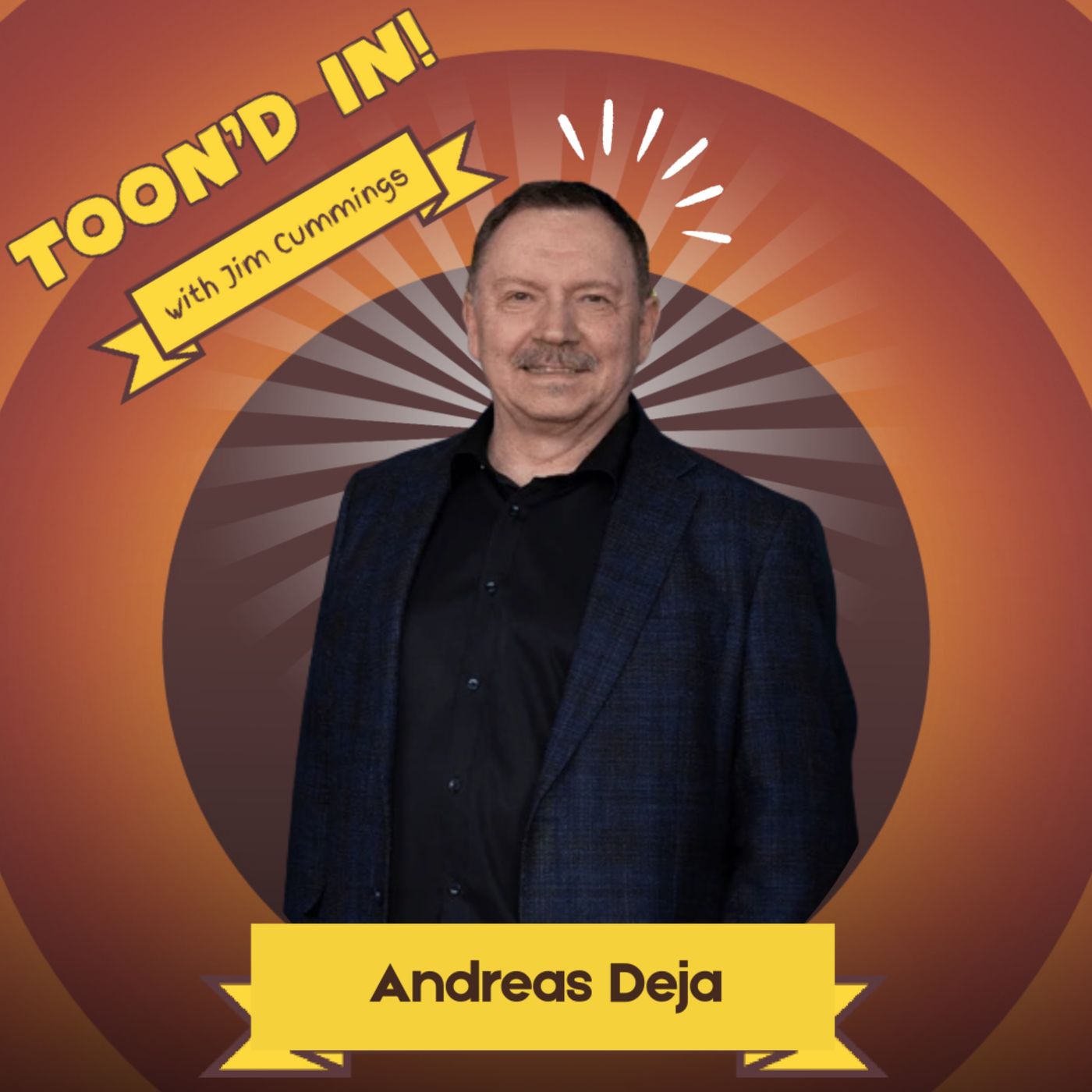
Andreas Deja (Legendary Disney Animator)
This week on Toon’d In!, Jim Cummings welcomes the legendary and masterfully expressive Andreas Deja! Renowned as one of Disney’s most iconic animators, Andreas brings a treasure trove of stories, insights, and artistic passion to a conversation that’s equal parts inspiring and nostalgic.
From bringing to life some of animation’s most unforgettable villains—like the menacing Scar in The Lion King and the flamboyant Jafar in Aladdin—to shaping beloved heroes like Hercules, Andreas takes us deep into the heart of hand-drawn animation. He and Jim dive into the craft of character performance through pencil and paper, the delicate balance between artistry and storytelling, and the evolution of animation from golden age traditions to modern-day innovations.
🎙️ Curious how a pencil became the ultimate acting tool for some of cinema’s greatest characters? Tune in and get Toon’d In!
📺Check out the trailer to Andreas' film Mushka here.
🎟️ Meet Jim and Andreas in person!
Catch Jim Cummings at these upcoming conventions:
🎧 Listen on Spotify: bit.ly/4fHWwxa
🍎 Listen on Apple: bit.ly/3AmUYZi
💖 Support on Patreon: patreon.com/jimcummingspodcast
🎉 Order a Cameo from Jim: cameo.com/toondinjimcumming
Become a supporter of this podcast: https://www.spreaker.com/podcast/toon-d-in-with-jim-cummings--5863067/support.
From bringing to life some of animation’s most unforgettable villains—like the menacing Scar in The Lion King and the flamboyant Jafar in Aladdin—to shaping beloved heroes like Hercules, Andreas takes us deep into the heart of hand-drawn animation. He and Jim dive into the craft of character performance through pencil and paper, the delicate balance between artistry and storytelling, and the evolution of animation from golden age traditions to modern-day innovations.
🎙️ Curious how a pencil became the ultimate acting tool for some of cinema’s greatest characters? Tune in and get Toon’d In!
📺Check out the trailer to Andreas' film Mushka here.
🎟️ Meet Jim and Andreas in person!
Catch Jim Cummings at these upcoming conventions:
- Amazing Art Expo (Las Vegas, NV) – September 12–14
- Nostalgia Con (Milwaukee, WI) – September 26–28
- Smoky Mountain Anime Fest (Gatlinburg, TN) – October 17–19
- Armageddon Expo (New Zealand) - October 24-27
- Supanova Comic Con Adelaide (Australia) - October 31 - November 2
- Supanova Comic Con Brisbane (Australia) - November 7-9
- Nostalgia Con (New Orleans, LA) – November 21–23
- Nostalgia Con (Salt Lake City, UT) – March 13–14, 2026
🎧 Listen on Spotify: bit.ly/4fHWwxa
🍎 Listen on Apple: bit.ly/3AmUYZi
💖 Support on Patreon: patreon.com/jimcummingspodcast
🎉 Order a Cameo from Jim: cameo.com/toondinjimcumming
Become a supporter of this podcast: https://www.spreaker.com/podcast/toon-d-in-with-jim-cummings--5863067/support.
2025-09-07
73 min
Transcript
Available Results
Generated results are saved to the knowledge database for reuse and search.
No generated results are available for this episode yet.
Extract Knowledge
Pick what you want extracted first. Model, scope, and chapter options appear after a template is selected.
Generated results for public episodes are saved to the knowledge database so they can be reused and searched later.
Transcript
<v Speaker 1>If you're a fan of everything we do here at
<v Speaker 1>tuned In with Jim Cummings, you could support the show
<v Speaker 1>on Patreon for bonus exclusive podcasts, as well as early
<v Speaker 1>in ad free access to the show itself, prize drawings,
<v Speaker 1>and more. You'll feel the difference, so go ahead and
<v Speaker 1>join the tuned In family today at patreon dot com
<v Speaker 1>slash Jim Cummings Podcast.
<v Speaker 2>Do it now?
<v Speaker 3>How you doing out there? It's me Tigger, I.
<v Speaker 2>Am Doc Wayne Duck.
<v Speaker 1>It's me Bunkers keep Bobcat All right, y'all?
<v Speaker 2>Is it rate your favorite firefly you desire?
<v Speaker 3>Hondo old knock Gud.
<v Speaker 1>My name is Jim Cummings and welcome to Tuned In.
<v Speaker 4>Welcome back, everybody to another episode of Tuned In with
<v Speaker 4>Jim Cummings. I am producer Chris, joined as always by
<v Speaker 4>the legend mister Jim Cummings himself.
<v Speaker 5>How are you doing today? Serious?
<v Speaker 3>It's another day at Paradise. I'll say it again, it
<v Speaker 3>sure is.
<v Speaker 1>Couldn't It could not be more accurate and true than
<v Speaker 1>it is today.
<v Speaker 4>Absolutely absolutely, And today we have a very special guest
<v Speaker 4>for you. He is a literal Disney legend. Yes you
<v Speaker 4>heard that right, a literal Disney legend. You may not
<v Speaker 4>know his face, but you definitely know his animations. He
<v Speaker 4>was responsible for Gaston from Beauty and the Beast, ja'far
<v Speaker 4>obviously from a Latin scar the Lion King, and many
<v Speaker 4>many more. We are very pleased to have you today,
<v Speaker 4>Andreas Desa.
<v Speaker 2>Thank you so much for having me. This is an honor, honestly,
<v Speaker 2>big honor.
<v Speaker 1>Well, it's ere to be here, so happy to have you,
<v Speaker 1>so happy to have you here. We were boning up,
<v Speaker 1>so to speak, and listening with you, speaking with Leonard
<v Speaker 1>Malton and all your insights. I mean, it's you are
<v Speaker 1>the new standard bearer. You are the new You're it now.
<v Speaker 2>I don't know about that, but I do. And this
<v Speaker 2>might be what you're referring to, Jim, is I need
<v Speaker 2>that connection to the past. I really, I really need it.
<v Speaker 2>So when I came out over here, I grew up
<v Speaker 2>in Germany, went to art school there. My family is
<v Speaker 2>still there, and anyway made it to Disney via writing
<v Speaker 2>letters when I was a teenager and all that, and
<v Speaker 2>then then got into what they're called the Disney Animation
<v Speaker 2>Training Program, which one of the great animators, Eric Larson,
<v Speaker 2>one of the nine old men started and he was
<v Speaker 2>the mentor and I had written to him, sent it
<v Speaker 2>some artwork, made it got into the program, which lasted
<v Speaker 2>about six weeks to a point where they could see
<v Speaker 2>if you're talented, and if you're if they could offer
<v Speaker 2>you a permanent job, which they did, and then that
<v Speaker 2>lasted thirty years. But while I was not just meeting
<v Speaker 2>Eric Lars and Frank Thomas and Olive Johnston were writing
<v Speaker 2>their first book upstairs, The Illusion of Life at a
<v Speaker 2>Big Disney Bible, so I had access to them. Yes
<v Speaker 2>it still is. And then and then all the others
<v Speaker 2>I wanted to meet. I wanted to meet the people
<v Speaker 2>who drew my childhood dreams, you know, because when you
<v Speaker 2>read the credits on these, it seems like the animators
<v Speaker 2>were always the same name, so it's the same group.
<v Speaker 2>So that was just the timing of that they were
<v Speaker 2>most of them were still around, and I would go
<v Speaker 2>up to la approximately nineteen eighty Okay, he started August
<v Speaker 2>of nineteen eighty, and then you had to be able
<v Speaker 2>to go up to Lucaniata and visit Frank Thomas and A.
<v Speaker 2>Johnson spent hours with him and asking them on BAMBI
<v Speaker 2>how did you do that? How much? How much study
<v Speaker 2>was involved to do Bambi? And how did you It
<v Speaker 2>was just it was just great timing for me because
<v Speaker 2>not only did I have a job at Disney, I
<v Speaker 2>could meet these guys.
<v Speaker 1>Oh my gosh, Yeah, you know, I remember it's funny
<v Speaker 1>you say Bambi. I think that might have been maybe
<v Speaker 1>the first movie I saw a period, and I remember,
<v Speaker 1>being strict, it just hit me that that looked like
<v Speaker 1>a baby deer because he couldn't stay his little spindly
<v Speaker 1>legs were he was trying to get up and the
<v Speaker 1>PLoP down and his legs were going display and and
<v Speaker 1>and Thumper was there, and he had that cute little face,
<v Speaker 1>and I'm going, that's it looks just like a rabbit,
<v Speaker 1>but it's a cartoon rabbit, but it's got a face
<v Speaker 1>on it. And he's smiling and he's starking, and you know,
<v Speaker 1>and but I bought everything. I bought everything about it.
<v Speaker 1>It just encapsulated the imagination so completely that you know,
<v Speaker 1>two minutes into the movie, it wasn't there, It wasn't animation.
<v Speaker 1>It looked like the forest. It looked I thought that
<v Speaker 1>the you know, deers could talk. Yeah, you know it was.
<v Speaker 3>It was. It was magic and it still is.
<v Speaker 2>It's interesting talking a little bit about Bambi. When I
<v Speaker 2>wrote my first letter to Disney, I think I was twelve.
<v Speaker 2>The first movie I saw a movie was Jungle Book,
<v Speaker 2>which is still my favorite, maybe for that reason too,
<v Speaker 2>because it was my first one and I'm absolutely mad
<v Speaker 2>about that film. So I was about ten. And then
<v Speaker 2>at the age of twelve, I didn't speak any English
<v Speaker 2>dand but in English teachers at school and to help
<v Speaker 2>you said, I want to write to Disney and ask
<v Speaker 2>them letters. A letter when I ask them some questions,
<v Speaker 2>how I can prepare myself this kid in Germany to
<v Speaker 2>sometime later work for them. And they roll back and
<v Speaker 2>they said, actually, super important stuff. They said, if you're
<v Speaker 2>interested in the kind of animation that we do here
<v Speaker 2>at the studio, we of course we want to see
<v Speaker 2>how you draw and want to see your art, but
<v Speaker 2>please don't send us any copies of Mickey Mouse and Pluto,
<v Speaker 2>because we can teach you that. You know, that's all
<v Speaker 2>I've learned. You've got to be an artists first, on
<v Speaker 2>your own right. And they said, if you're at that age,
<v Speaker 2>now start drawing your brothers and sisters chart, draw your pets,
<v Speaker 2>go to the zoo, draw the animals a lot.
<v Speaker 4>And now I've heard you tell this story and it
<v Speaker 4>started to cut you off. But I was curious while
<v Speaker 4>I was listening to this before when they say draw that.
<v Speaker 4>Are you drawing it in a cartoon version, are you
<v Speaker 4>drawing as realistic as possible?
<v Speaker 5>Or all of the above.
<v Speaker 2>They said, draw the real thing. You have to draw
<v Speaker 2>a realistic natural way, so it shows us that you
<v Speaker 2>understand the skeleton of a deer or an elephant, you know,
<v Speaker 2>to study that and see how they move. I said,
<v Speaker 2>the cartoon stuff. That's why they said, Mickey out and
<v Speaker 2>PLU don't know, because that we can teach you, and
<v Speaker 2>as a kid, you don't really understand that. At first,
<v Speaker 2>I said, well, but it's a cartoon studio, the biggest
<v Speaker 2>in the world. You know. Of course you got to
<v Speaker 2>draw cartoon characters. But then then I did see Bambi
<v Speaker 2>in a re release, and I saw those very scenes
<v Speaker 2>him wobbling, and almost like a light bulb went on,
<v Speaker 2>I said, well, whoever animated that, that person had to
<v Speaker 2>know where the ripcage is and how it connects with
<v Speaker 2>the head and the legs. And the heat. So of
<v Speaker 2>course it's all about anat academy. You have to know that,
<v Speaker 2>you have to know the real thing. So then it
<v Speaker 2>really made sense and I said, okay, that's exactly what
<v Speaker 2>I'm going to do. All the local zoos and visited
<v Speaker 2>them and learned how to draw animals. And later on,
<v Speaker 2>when I was older, actually I was fourteen or fifteen
<v Speaker 2>when I started life drawing in front of nude models.
<v Speaker 3>I was going to ask you, was that how that?
<v Speaker 2>Yeah, you have to, but yeah, for my parents, that's
<v Speaker 2>a little young only you know, so I remember, and
<v Speaker 2>my parents really are not artists, and bless them, they
<v Speaker 2>have a totally different background. But when I came home
<v Speaker 2>the first time and I had these big drawings of
<v Speaker 2>nude people, that so, so you had some photographs that
<v Speaker 2>you drew this from, And I said, no, there were
<v Speaker 2>actually people who took their clothes off and we we
<v Speaker 2>had to learn how the body functions. And and then
<v Speaker 2>I told my parents talk to my art teacher at
<v Speaker 2>high school, because he knows about what artists have to
<v Speaker 2>do young artists, and so they talked to him and
<v Speaker 2>he said, yeah, Andreas has some challenge. He can do this.
<v Speaker 1>Oh, it's okay, and it's okay, it's okay.
<v Speaker 5>Oh my god, that's funny. True wow.
<v Speaker 2>Yeah. But then it all made sense. And then later
<v Speaker 2>on you read these things that Walt Disney said famously,
<v Speaker 2>we have to study the real thing before we can
<v Speaker 2>animate it and courage and all that makes complete sense.
<v Speaker 3>Well.
<v Speaker 1>I remember when the making of The Lion King, for instance,
<v Speaker 1>the Disney sent a bunch of people to Africa to
<v Speaker 1>draw warthogs and meerkats and and I remember going to
<v Speaker 1>Africa after having been in a movie, and the war
<v Speaker 1>dogs really run like that with their tail. I mean,
<v Speaker 1>they're going that's exactly. Oh my god, there's bumba.
<v Speaker 2>You know.
<v Speaker 1>It was unbelievable how well they did it. And the
<v Speaker 1>slinky ah like with scar right, with those slinky shoulders,
<v Speaker 1>the way they moved through the glass, the grass, it was.
<v Speaker 3>It was amazing.
<v Speaker 2>And again, studying the real thing, it's just so important.
<v Speaker 2>I wasn't on that trip. I was. We were no
<v Speaker 2>animator wind because we were finishing Aladdin at the time.
<v Speaker 2>And I remember one day in the lobby, this was
<v Speaker 2>on the airway where we drew Lion King. They were
<v Speaker 2>all these other artists with suitcases, and I said, where
<v Speaker 2>are you going? And they say Africa, and I said, well,
<v Speaker 2>can't you wait. We still have to do a few
<v Speaker 2>more scenes for I have to do a future far
<v Speaker 2>scenes left to do and they said, no, we have
<v Speaker 2>to go now because the raining season is going to start,
<v Speaker 2>and I said, oh great. You know, so we didn't
<v Speaker 2>go on usually we do go on this trip. I
<v Speaker 2>went to France for Beauty and the Beast. Then I
<v Speaker 2>went to Hawaii fully loaned stitch, but Africa didn't work out.
<v Speaker 2>But I did the same thing afterwards. I went on
<v Speaker 2>my own on safari and did all that. But the
<v Speaker 2>way we learned about lions, well, first you go to
<v Speaker 2>the La Zoo, but then you know, if it's summer,
<v Speaker 2>you go there and the line is asleep for half
<v Speaker 2>a day, and that's the only post we're going to get.
<v Speaker 2>We did go to San Diego a little bit better
<v Speaker 2>down there, and then somebody at the studio set, now
<v Speaker 2>we got to bring these animals in. So in a
<v Speaker 2>conference room on airway Englen and boy, they actually had
<v Speaker 2>a they got in touch with with a group of
<v Speaker 2>people who train animals for movies, all kinds of animals,
<v Speaker 2>bears and lines and tigers, and so they brought those
<v Speaker 2>in these people. These animals were supposedly used to people,
<v Speaker 2>and we were there on our benches, you know, with
<v Speaker 2>our with our big drawing pads. And then I remember
<v Speaker 2>the first animal that brought around the corner just with
<v Speaker 2>a little chain. There was no fence or anything.
<v Speaker 5>Today.
<v Speaker 2>You couldn't do that with no insurance. You couldn't, you know.
<v Speaker 2>There was no separation, no, no nothing. Oh wow, So
<v Speaker 2>the line cup was half a year. Oh it was cute,
<v Speaker 2>you know, you draw that.
<v Speaker 1>And then the second second one was a mom came
<v Speaker 1>around the corner and it wasn't so cute.
<v Speaker 2>It wasn't so cute. An we all gassed. And then
<v Speaker 2>then the last one was I remember a fully grown
<v Speaker 2>male called Joseph, and he had been in some Michael
<v Speaker 2>Jackson video and you were told you he'd been fed,
<v Speaker 2>so don't don't worry. But again, there was no security
<v Speaker 2>or safety barrier at all.
<v Speaker 5>Were scared at all.
<v Speaker 2>I was scared and excited. It was, oh, I'm never
<v Speaker 2>going to get close like this to a line, and
<v Speaker 2>it was yeah, that's that's when you're really when you're
<v Speaker 2>so close to them and not their way down there,
<v Speaker 2>you know, far away under trees. This is this is
<v Speaker 2>where you get it. And you see how they walk
<v Speaker 2>and really how big they are. And yeah, it was
<v Speaker 2>a really really important day for us.
<v Speaker 3>I touched a lion once, Yeah, but she did. Was
<v Speaker 3>it was okay with her. It was it was a girl.
<v Speaker 1>And I was in Africa and an open air jeep,
<v Speaker 1>open air, and I was saying to the guy and
<v Speaker 1>they were trying to catch these gazelle and you could
<v Speaker 1>see I've told this before, there's like six or eight. Uh,
<v Speaker 1>the ladies do all the hunting, the women, you know,
<v Speaker 1>so and uh, they're all sitting there and you can
<v Speaker 1>see the wind is blowing this way, and the gazelle's
<v Speaker 1>are right over there and they're sneaking up like this.
<v Speaker 1>The wind stops. Now it's going that way. So now
<v Speaker 1>the gazelle's can smell the lions and they're sitting there, eating, eating,
<v Speaker 1>and they were gone, they disappeared, and the lions all
<v Speaker 1>stood up and it's just like they're like big cats.
<v Speaker 1>They oh, great, you're never gonna kid eat now, and
<v Speaker 1>let's keep come on, come on, we gotta find something else,
<v Speaker 1>you know.
<v Speaker 3>And it was the craziest it was a circle of life.
<v Speaker 5>You know.
<v Speaker 2>The interesting thing about when you go to a park
<v Speaker 2>like Krueger National Park, while the others that the animals
<v Speaker 2>are so used to the jeeps, they don't even pay attention.
<v Speaker 2>I think, like you're moving rock or something. They don't
<v Speaker 2>look even if it's an open jeep. And yes, they
<v Speaker 2>don't attack. You know, they grew up with these wheel
<v Speaker 2>type things coming around. They don't even look at you.
<v Speaker 2>They do hunting and mating and eating and as if
<v Speaker 2>you're not there, which is which is kind of cool.
<v Speaker 1>Yeah, and I know, and I asked him. I don't
<v Speaker 1>know if I said.
<v Speaker 3>This, but I said, okay, stupid question.
<v Speaker 1>I don't want to jinx anything, but why aren't they
<v Speaker 1>eating us? They could catch me, they have no problem.
<v Speaker 1>I mean, there's a gazelle. You have to run like
<v Speaker 1>hell to catch me.
<v Speaker 3>Not so much.
<v Speaker 1>Just I'm right here, and they go, well suh. If
<v Speaker 1>you exit the jeep, you into the food chain. And
<v Speaker 1>I'm sitting right here. I ain't gone nowhere. And apparently
<v Speaker 1>that had happened.
<v Speaker 2>I was told there was There was some tourists and
<v Speaker 2>one woman was a little over excited to get to
<v Speaker 2>some cubs. But the parents, but she walked out and
<v Speaker 2>she was attacked, and it does happen. But I mean
<v Speaker 2>you just know better, right you stay inside?
<v Speaker 1>Yeah, no kidding, Yeah, I had no problem sitting inside there.
<v Speaker 4>So for the people watching, could you describe, like what
<v Speaker 4>your job actually consists of, like for the title of say,
<v Speaker 4>supervising animator, Like, what does that look like when you're
<v Speaker 4>working on say, you know, the Lion King or Aladdin
<v Speaker 4>or whatever Disney movie? What does that daily process look like?
<v Speaker 4>Because I don't think a lot of the public really knows.
<v Speaker 4>I mean I know, I don't know what that really
<v Speaker 4>process really looks like, like what are your specific roles?
<v Speaker 2>Well, by the time I come onto the picture, so again,
<v Speaker 2>we had finished Aladdin, I did ja'far and.
<v Speaker 4>So like, let me pause you there when you say
<v Speaker 4>I did Jaffar, Like, what does that supervising animator?
<v Speaker 2>I didn't do every scene, but I do probably the
<v Speaker 2>most important ones. So you do like the personality acting ones.
<v Speaker 2>And then when when Jaffar is is a beggar digging
<v Speaker 2>for the lamp in the sand and he's eccentric, somebody
<v Speaker 2>else can do that, you know, But when he is
<v Speaker 2>suddenly interacting with Jasmine and saying, well, Aladdin is going
<v Speaker 2>to be beheaded and death is whatever. Interesting, I have
<v Speaker 2>to do those close ups acting.
<v Speaker 4>Scenes, so they trust you to really get the personality
<v Speaker 4>out of the character.
<v Speaker 5>Is that correct?
<v Speaker 4>The voice the voice, of course, of course, I mean
<v Speaker 4>in terms of animation.
<v Speaker 2>Yeah, But then maybe most people don't even know that
<v Speaker 2>that the voice is always recorded. People probably about yeah,
<v Speaker 2>that's right, and that that gives us everything. And funnily,
<v Speaker 2>you know, before you'far I had done Gaston, another villain,
<v Speaker 2>and so by the time it came to Lion King,
<v Speaker 2>I thought, well, it's not my turn, because all the
<v Speaker 2>animals want to do villains, and those are really juicing hearts.
<v Speaker 2>You can do more, that's true.
<v Speaker 5>The same thing about voicing, Yeah, yeah.
<v Speaker 2>Because you can roll up your sleeves and go to town.
<v Speaker 3>Yeah.
<v Speaker 2>And I thought, well, I've done to look at the story.
<v Speaker 2>So so coming onto Lionking, I look at early storyboards
<v Speaker 2>and see how they drew Scar or how they do
<v Speaker 2>the characters, because I wasn't even thinking about Scar then.
<v Speaker 2>And then there's some visual development art. These are people
<v Speaker 2>who do early design ideas give you a whole range
<v Speaker 2>of ideas for characters, and settings, so I can already
<v Speaker 2>look at something. I don't have to look at a
<v Speaker 2>blank sheet of paper, and I can listen to voice tracks.
<v Speaker 2>So but so again I was thinking I should probably
<v Speaker 2>maybe do Rafiki or or maybe adult Simba, because you know,
<v Speaker 2>of the villain situation. And then somebody said, you know,
<v Speaker 2>and Andrea Jeremy Irons was just here and he tested
<v Speaker 2>for a scar, and I said, I have to listen
<v Speaker 2>to this. So I got the tapes and this is
<v Speaker 2>this is the kind of thing where you close your
<v Speaker 2>eyes and you can just see pictures come in. It
<v Speaker 2>just happens. It seemed easy, you know, with the with
<v Speaker 2>a sense of humor, these evil and smartly sly it
<v Speaker 2>was to me it would almost be easy to animate
<v Speaker 2>that because it was so clear. So I went into
<v Speaker 2>the director's room and said, I know it's not my turn.
<v Speaker 2>I've done two villain, but I just listened to those
<v Speaker 2>tapes and I think I can do something with this.
<v Speaker 2>And they just looked at me and they said, well,
<v Speaker 2>we kind of had your mind anyway. And then that
<v Speaker 2>was and I was just so happy. So it was
<v Speaker 2>a privilege to do that character, even though it wasn't
<v Speaker 2>my turn. It was Yeah, in terms of voices, was
<v Speaker 2>probably the richest voice i've I've had it. It's the
<v Speaker 2>straightforward voices where there's not much range, where you maybe
<v Speaker 2>struggle a little bit as an animator, but when you
<v Speaker 2>have a voice like, lines are not all that. No,
<v Speaker 2>we lines are not all that. I mean, you just
<v Speaker 2>hear it, you know you know how to raise the
<v Speaker 2>character up or now you know the expression. It was
<v Speaker 2>absolute joy and the privilege.
<v Speaker 3>Yeah, I would imagine.
<v Speaker 1>Well, I think villains in general, I've always said around
<v Speaker 1>a little more fun.
<v Speaker 2>The only one I had trouble with, at least getting
<v Speaker 2>started with guest On because that was the first one.
<v Speaker 5>And why is that?
<v Speaker 2>Well, again, I looked at the storyboards and the visual
<v Speaker 2>development art as I always do when I start, and
<v Speaker 2>I and I did a scene that ended up in
<v Speaker 2>the movie. It was a test scene, but it made
<v Speaker 2>it in the film. Where he's singing at the beginning
<v Speaker 2>and it's still doing the bell song at the beginning
<v Speaker 2>of the movie, and he's noticing his reflection at some
<v Speaker 2>parts and pants that aren't hanging there at one shop,
<v Speaker 2>you know, and he kind of adores himself. And so
<v Speaker 2>that was my first scene and I remember Jeffre Katzenburg
<v Speaker 2>who was on the Boss. Then he said, well, he said,
<v Speaker 2>he said, the animation is fine, but he's not handsome enough.
<v Speaker 2>And I said, handsome he's the villain, right, and caricature
<v Speaker 2>and the design, and and I didn't really understand why.
<v Speaker 1>Yeah, it goes against the grain. Wait, a good looking villain.
<v Speaker 1>He's supposed to have a hook nose.
<v Speaker 2>Yeah, And so I was messing with. I did some
<v Speaker 2>some design looking like a prince. Basically, I said, is
<v Speaker 2>that what they want? You know, like a soap opera star?
<v Speaker 2>So I didn't really know. And then Katzenberg did call me.
<v Speaker 2>I remember the one time he caught me into his
<v Speaker 2>office and explained, you know, the movie is really about
<v Speaker 2>don't judge the book by its cover. So we have
<v Speaker 2>the beast who is scary and frightening when we see him,
<v Speaker 2>and we find out he has a hot of gold
<v Speaker 2>through the story, and Gaston has the opposite qualities, is
<v Speaker 2>a handsome dude, and maybe the audience should think, oh
<v Speaker 2>he's handsome, he should maybe marry well, But then you
<v Speaker 2>find that he's only it's all all about himself, and
<v Speaker 2>he's a male chauvenist. Then it becomes a murderer in
<v Speaker 2>the end. So these are the opposite qualities to the beast,
<v Speaker 2>and that's why he has to be handsome. And I
<v Speaker 2>remember telling saying to Jeffrey, but handsome is so much
<v Speaker 2>more difficult to animate. And Jeffrey just said, nobody said
<v Speaker 2>it was going to be easy. Yeah, that was the
<v Speaker 2>end of that meeting. But I did I didn't understand
<v Speaker 2>the concept he had to be handsome being evil. There
<v Speaker 2>are handsome people being bad that they do exist. Oh sure, yeah,
<v Speaker 2>so he was one of them. But then you walk
<v Speaker 2>that fine line how much caricature and expressiveness cannot put
<v Speaker 2>in because if I don't put any of that in,
<v Speaker 2>he's going to look like a puppet, you know, always
<v Speaker 2>nice drawing, but not really emmoting. So that was he
<v Speaker 2>probably was the most difficult character because of that.
<v Speaker 5>Interesting.
<v Speaker 2>Yeah, I know.
<v Speaker 5>I know.
<v Speaker 4>In like recent times, I've heard stories of like animators
<v Speaker 4>and they'll you know, capture on video the actor, the
<v Speaker 4>voice actors performance so that they can Did they do
<v Speaker 4>that back when you were animated?
<v Speaker 2>Yes, yeah, we have a I don't know if they
<v Speaker 2>recorded you when you did your bit for Scar I
<v Speaker 2>don't remember.
<v Speaker 1>Oh gosh, that might have they did here and there.
<v Speaker 3>You know sometimes, but it with me.
<v Speaker 1>When I was doing ed for the Lion King, it
<v Speaker 1>was just all I did was stand there and laugh
<v Speaker 1>like an idiot for an hour. If you're a fan
<v Speaker 1>of everything we do here at tuned In with Jim Cummings,
<v Speaker 1>you could support the show on Patreon for bonus exclusive podcasts,
<v Speaker 1>as well as early in ad free access to the
<v Speaker 1>show itself, prize drawings, and more. You'll feel the difference,
<v Speaker 1>so go ahead and join the tuned In family today
<v Speaker 1>at patreon dot com slash Jim Cummings podcast Do It Now.
<v Speaker 2>But famously, you also did some of Scar because Jeremy
<v Speaker 2>Uh doing the song, you couldn't do certain singing passages.
<v Speaker 2>And then Jim jumped in and we talked about this earlier.
<v Speaker 5>That you did it.
<v Speaker 2>You gave me a very very good piece of singing
<v Speaker 2>at the end of the song be prepared. He doesn't
<v Speaker 2>end up singing me prepared. You did be prepared, And
<v Speaker 2>I want to do something with that. Yes, you did,
<v Speaker 2>because that's it sounds different and I have half scargo
<v Speaker 2>up on that rock. Be prepared and I animated, you know,
<v Speaker 2>and that's what made the scene That gave me chills,
<v Speaker 2>because that image comes right. I would have never done
<v Speaker 2>that if Jim hadn't. Heaven't hadn't.
<v Speaker 3>I wanted to bite off the end of it exactly.
<v Speaker 2>Was the end of the song exactly then?
<v Speaker 1>Because you always laugh, yeah, at the end of the
<v Speaker 1>sub bad guys laugh.
<v Speaker 2>Because they yeah, no, they think they have the upper hand.
<v Speaker 2>But it was one of those unique things where Jim
<v Speaker 2>thought about something special and I realized that it and yes,
<v Speaker 2>you did want to make something special out of that
<v Speaker 2>and just grab onto those little extra things.
<v Speaker 4>Whenever I hear you talk, what really fascinates me about
<v Speaker 4>you is your attention to detail. And I think that's
<v Speaker 4>what makes you such a Disney legend, is your attention
<v Speaker 4>to detail. Do you do you focus on that? I mean,
<v Speaker 4>of course you have to write detail.
<v Speaker 2>You mean in drawing, or in the performance.
<v Speaker 5>Or everything, even in the way you talk.
<v Speaker 2>Well, I just and I still do that. Working for Disney.
<v Speaker 2>You compare yourself with the old guys, and they had,
<v Speaker 2>my god, their level. Look at Lady in the Tramp,
<v Speaker 2>I mean, look at Peter Pan. And there were times
<v Speaker 2>where not just me, but my colleagues were thinking, like,
<v Speaker 2>who are we kidding, and we don't do that level,
<v Speaker 2>you know. And I remember when Mermaid came out and
<v Speaker 2>was a big hit, and there was this teenager. He
<v Speaker 2>was the son of a contractor who did some work
<v Speaker 2>for me. He came up to me and said, hey,
<v Speaker 2>I heard you worked on the Little Mermaid and I
<v Speaker 2>said yeah. And a minute of father try and and
<v Speaker 2>he said, I saw the little Moment with my girlfriend
<v Speaker 2>and we snuggled up and it was a great date,
<v Speaker 2>you know, and we're like, oh my god, we got
<v Speaker 2>the teenagers back up. Until then, that was no Disney
<v Speaker 2>animated films. You just don't go with your girlfriend to
<v Speaker 2>a Disney film, you know, that's not adult stuff. And
<v Speaker 2>all of a sudden they really liked the film and
<v Speaker 2>watch it as a young couple, and so yeah, that
<v Speaker 2>signaled to me, well, we had their teenagers back. But
<v Speaker 2>in terms of were we as good as the old guys?
<v Speaker 2>And I asked that question, and sometimes when when people
<v Speaker 2>did compliment our films, I said, yeah, but have you
<v Speaker 2>seen Lady in the Tramp lately, because that's the good stuff.
<v Speaker 2>And then you know, somebody said, yeah, we like that too.
<v Speaker 2>But whether it's a little Moment or beauty and the Beast.
<v Speaker 2>Those characters speak to us. They were kind of more modern,
<v Speaker 2>you know, the girl girls were independent with Cinderella and
<v Speaker 2>snow White were of another era. And then I started
<v Speaker 2>to understand why, you know, why these these characters that
<v Speaker 2>might not have been done as well as the old guys,
<v Speaker 2>but the concept spoke to them and the stories to them.
<v Speaker 2>So then I had an easier time to accept compliments really, because,
<v Speaker 2>let's face it, the old guys were just it's almost inhuman,
<v Speaker 2>you know when you even now after having been in
<v Speaker 2>the industry for so long, I just look at anything
<v Speaker 2>that they did and it's just it is so good.
<v Speaker 2>It's forever you do something that well and it doesn't
<v Speaker 2>it doesn't age.
<v Speaker 3>Yeah, I agree, it's just so good. I agree. Well,
<v Speaker 3>all those those movies.
<v Speaker 1>That's why they they re released them, you know, they
<v Speaker 1>and to great success, you know, time and time again.
<v Speaker 1>There's a timeless quality too, and I think that's what
<v Speaker 1>Walt understood, and that's what he brought to to all
<v Speaker 1>of his things, the rides, the all the way us,
<v Speaker 1>the board, you know, the artwork is phenomenal, and the
<v Speaker 1>acting and the music, the music. Anytime that the music
<v Speaker 1>can grab you. Yeah, you know, that's you know, and
<v Speaker 1>I think that I would imagine as an animator, that
<v Speaker 1>gives you something to hang your head on.
<v Speaker 2>Yeah, it gives you a rhythm, It gives you a rhythm.
<v Speaker 2>I did some scenes, not all of them, doing the
<v Speaker 2>Gaston song to be a drinking song, and there was
<v Speaker 2>one scene where he had two waltz with Lafou through
<v Speaker 2>the tavern there and I remember, I remember it is
<v Speaker 2>a teenager. I had dance lessons and knew how a
<v Speaker 2>waltz one to three, one to three, one to three,
<v Speaker 2>so I could do that without live action reference. So
<v Speaker 2>you kind of draw from your own experiences. But you
<v Speaker 2>really shut the door to your office and you do
<v Speaker 2>these steps and you're trying to figure out how that works,
<v Speaker 2>you know, and so so yeah, you try to be
<v Speaker 2>as authentic, you know, as it can be.
<v Speaker 3>Wow, that sounds like a lot of work.
<v Speaker 2>That that that that's what animation is. You have to
<v Speaker 2>be a little crazy to do that. Yeah, yeah, twenty
<v Speaker 2>part of being able to put off the instant gratification.
<v Speaker 2>It's not an instant, there's no instinct that comes later.
<v Speaker 2>But yeah, but there is also nothing like it. And
<v Speaker 2>I'm sure you feel the same way when when you
<v Speaker 2>when the film is done and you see it with
<v Speaker 2>an audience, not studio audience, but a regular orientine theater.
<v Speaker 2>You're in the middle of the theater and nobody knows
<v Speaker 2>who you are. And I just watched yeah, yeah, oh
<v Speaker 2>that's my stuff is coming up. I wonder if they're
<v Speaker 2>gonna and then you get a reaction, it's like, oh,
<v Speaker 2>it's just it's just like, you know, it's just like
<v Speaker 2>all that hard work.
<v Speaker 5>I agree.
<v Speaker 2>There's no feeling like.
<v Speaker 3>Yeah, I agree, I agree. Nothing like seeing that the
<v Speaker 3>end product.
<v Speaker 1>No, and especially when you put so much time into it,
<v Speaker 1>so many I mean, did you always know? Because I
<v Speaker 1>knew I was going to do what I do when
<v Speaker 1>I was five. I've said up before, when did you
<v Speaker 1>no for sure?
<v Speaker 2>The day I saw a Jungle Book, it was book,
<v Speaker 2>was that it was ten and I saw that, and
<v Speaker 2>there's no other way to describe it. My head was spinning.
<v Speaker 2>And there was my life before Jungle Book and my
<v Speaker 2>life after. Because I just there was this gravity toward it.
<v Speaker 2>I felt like I need to And then that's why
<v Speaker 2>I wrote to them. I didn't even have the address.
<v Speaker 2>I just was Walt Disney Production's Los Angeles, USA.
<v Speaker 5>Really and it got.
<v Speaker 2>There wow way yeah, you know, and and they wrote
<v Speaker 2>me back, and I still have that letter, but it
<v Speaker 2>became real at that moment it there really exists because
<v Speaker 2>they wrote to me, you know, but excuse me.
<v Speaker 4>Wow, wow, that's fascinating. And then so you're the first project,
<v Speaker 4>if I'm not mistaken, that you worked on for Disney
<v Speaker 4>was the Black Caul Drink.
<v Speaker 2>It was, Yeah. They were finishing Fox in the Hound,
<v Speaker 2>and I remember them saying, we don't need you on
<v Speaker 2>that now that you have a full time job after
<v Speaker 2>the training period. We're almost done with Fox in the Hound.
<v Speaker 2>But they said we're going to do this Black Caldron project,
<v Speaker 2>which I knew about because there had been a Live
<v Speaker 2>magazine article with early development art from the from the
<v Speaker 2>Black Cold and by Meltshaw. As I knew about it,
<v Speaker 2>and even while I was still in Germany getting getting
<v Speaker 2>ready to come to the US, I bought the books
<v Speaker 2>and read all those Lloyd Alexander books about the Black
<v Speaker 2>Holdren and just out of curiosity, I did some sketches
<v Speaker 2>of the of Terran alon Win how I might visualize
<v Speaker 2>them inward style, And I remember I had a pack
<v Speaker 2>of drawings. And when I got to Disney, I showed
<v Speaker 2>them to management. I said, I just fooled around with
<v Speaker 2>some designs and they said, oh, they said, we don't
<v Speaker 2>have any designs it can we buy them from you?
<v Speaker 5>What?
<v Speaker 2>So it was like it was like two or three
<v Speaker 2>thousand dollars, but it was enough for me to buy
<v Speaker 2>some furniture for my rental.
<v Speaker 3>Yah.
<v Speaker 2>It was a really it was really nice.
<v Speaker 5>Yeah.
<v Speaker 2>And then they said later, a little bit later, they said,
<v Speaker 2>we like to continue to do some character development because
<v Speaker 2>we don't have anybody doing that. We're going to put
<v Speaker 2>you with another person who also is your age and
<v Speaker 2>who just graduated from cal Arts and he draws very
<v Speaker 2>differently from you. You draw very Disney. This guy's name
<v Speaker 2>is Tim. He draws, you know, sort of a freaky
<v Speaker 2>not freaky, but has his own style and maybe we
<v Speaker 2>can mix the two of you. And that was Tim Burton.
<v Speaker 2>Oh that was my It was a full full year
<v Speaker 2>in one office with Tim Burton.
<v Speaker 3>So we have you to blame for Tim Burton. Is
<v Speaker 3>that what your.
<v Speaker 2>He got? He got frustrated in terms of the studio
<v Speaker 2>wanting to blend Disney, the Disney style with your style
<v Speaker 2>and and and I tried it because they asked me to,
<v Speaker 2>and it wasn't really working. It was you you sing too,
<v Speaker 2>so disneyfire Tim Burton drawing and you lose the Tim Burton,
<v Speaker 2>you know. And yeah, and I remember Tim getting increasingly frustrated.
<v Speaker 2>And then one of the last assignments for the film
<v Speaker 2>that we were asked to do, where these for those
<v Speaker 2>few of you who have seen the film, these flying
<v Speaker 2>monster birds then kidnapped the pig dragon type birds, you
<v Speaker 2>know that type. And so I'd done some and Tim
<v Speaker 2>had the idea of a flying hand. So it was
<v Speaker 2>it was a hand with an eye here and an
<v Speaker 2>eye there and would kind of fly and then the
<v Speaker 2>hand would grab two hands to birds and it had
<v Speaker 2>bad wings, I think, but it was a hand human hand.
<v Speaker 5>Wow.
<v Speaker 2>And the management said, well, that's interesting.
<v Speaker 3>But there's a nightmare for you.
<v Speaker 2>Yeah, but then he said that's a bit too abstract.
<v Speaker 2>That's more like the movie Yellow Submarine, you know, where
<v Speaker 2>crazy things happened, and that's a little too crazy for us.
<v Speaker 2>And then Jim said, well, then let me just leave,
<v Speaker 2>and then maybe he left and became Tim Burton and
<v Speaker 2>I and I stuck around and yeah, oh, Tim was
<v Speaker 2>I guess you can call it without He was a
<v Speaker 2>little odd. He was also fun, you know, but he
<v Speaker 2>he lived in his own world, you could tell, yeah,
<v Speaker 2>And he liked practical jokes. And I remember one time
<v Speaker 2>he came from the dentist and he had one or
<v Speaker 2>two wisdom teeth pulled and he was still bleeding and
<v Speaker 2>he wasn't even trying to stop that. He walked through
<v Speaker 2>the hallway and blood was coming out, and people were
<v Speaker 2>like him, what's the matter with you? And said, what
<v Speaker 2>what you know?
<v Speaker 5>People?
<v Speaker 3>Oh man, Wow, with the real stuff.
<v Speaker 2>Yeah, with the real stuff this time, my god. But
<v Speaker 2>I adored his style, but I couldn't. I couldn't Disney
<v Speaker 2>find I just couldn't do it. Yeah, I couldn't be tough.
<v Speaker 4>It's got to be tough if it's anything like what
<v Speaker 4>we what we all know, you know, and see then
<v Speaker 4>he was style.
<v Speaker 2>And stopped motioning. But he was able to do his
<v Speaker 2>style all the way and maybe for Christmas exactly some
<v Speaker 2>of the others. So I think Disney wasn't ready for him.
<v Speaker 2>And now sometimes I wonder, all those years later, if
<v Speaker 2>I could take a crack at it now, and now
<v Speaker 2>that I really know more about his style and the
<v Speaker 2>Disney style. But yeah, you kind of wonder maybe I
<v Speaker 2>could do it now, why don't you try?
<v Speaker 5>Yeah?
<v Speaker 2>I should, I should.
<v Speaker 5>I mean, there's enough of his artwork out there.
<v Speaker 2>Is there is. And I had a little I had
<v Speaker 2>a little reunion with him after the winning the poor
<v Speaker 2>feature was was done because Disney sent me and Mark
<v Speaker 2>heent to London and to talk about the movie and
<v Speaker 2>in the media. And I remember the producer of Tim's film,
<v Speaker 2>franken Weenie, stop motion film about a dog, a dead dog. Yes,
<v Speaker 2>it was done in London, and Don Haunt said, if
<v Speaker 2>you have time on that Sunday, they have a press tour,
<v Speaker 2>just hop on over to the studio and see what
<v Speaker 2>they're doing. I've never been on a stop motion set,
<v Speaker 2>which is fascinating. And so I went over and somebody
<v Speaker 2>told him who was there at the time, that I
<v Speaker 2>would be amongst the press people. And when then once
<v Speaker 2>once the tour was done, he came, he came to
<v Speaker 2>me and he gave me a big hug, and we
<v Speaker 2>hadn't seen each other in decades, and he said, he said,
<v Speaker 2>you know, I just had a dream about the two
<v Speaker 2>of us still being in that office on the third
<v Speaker 2>floor of the mission building, you know, trying to do
<v Speaker 2>black cordon drawings, and all that came out of me
<v Speaker 2>was like, I hope it wasn't a nightmare, and he said, no, no,
<v Speaker 2>no it wasn't, but I think it was. But it
<v Speaker 2>was processing the frustration.
<v Speaker 5>Oh my god.
<v Speaker 1>Yeah, Jesus's funny. That's well, that's back. And Jeffrey would
<v Speaker 1>have been your producer.
<v Speaker 2>Jeffrey Katzenberg. Yeah, he was doing after or doing the
<v Speaker 2>winning of the Pool movie days. He was already gone.
<v Speaker 2>Remember Jeffrey left after Lion.
<v Speaker 3>King, That's what it was, Okay, left right.
<v Speaker 2>After Lion King and dream Works, and then dream Works happened,
<v Speaker 2>and then he tried to lure Disney animators to join him,
<v Speaker 2>and some did go, and I was also asked, and
<v Speaker 2>I decided not to. But then that was a lucky
<v Speaker 2>situation because all of a sudden we went demand and
<v Speaker 2>we were compensated a lot better, all of a sudden,
<v Speaker 2>a lot better. Not a bad situation. Yeah, that helps.
<v Speaker 3>Yeah, it's good to be the king.
<v Speaker 2>It's good to be wanted.
<v Speaker 3>It's good to be wanted.
<v Speaker 4>Kind of jumping topics here, but I'm curious to ask you,
<v Speaker 4>you know, obviously a lot of the projects that you
<v Speaker 4>worked on were done traditionally, you know, and you know,
<v Speaker 4>since we've seen Disney kind of move to like more
<v Speaker 4>three D animation, did you learn how to animate digitally
<v Speaker 4>as well?
<v Speaker 2>For a day or day and a half.
<v Speaker 5>For a day and a half.
<v Speaker 2>At the time, I enjoyed it, huh that much? Yeah? Yeah, Well,
<v Speaker 2>Disney said, you don't know what it's like until you try,
<v Speaker 2>and they had a point. So I had a tutor, Disney, tutor.
<v Speaker 5>Were you against it?
<v Speaker 2>I I was not in love with it. I saw
<v Speaker 2>the appeal, and I liked toy Story. Of course I
<v Speaker 2>love Toy Story, but whether it was for me, I
<v Speaker 2>wasn't quite sure. But Disney said, try it. Have to
<v Speaker 2>find out for yourself. So I had this tutor from
<v Speaker 2>Disney come to my home and be all comfortable. And
<v Speaker 2>at the time, I remember the the program was called Maya,
<v Speaker 2>and so I learned Maya and how to move these
<v Speaker 2>electronic puppets. You know, I think I was trying to
<v Speaker 2>have a guy jump over something and and I did
<v Speaker 2>that on a Saturday, and but it was so calculating.
<v Speaker 2>You have to almost use math instead of instead of spontaneity,
<v Speaker 2>because when you draw, you know, you just the accidents
<v Speaker 2>that happened and your hand does something. Oh, I didn't
<v Speaker 2>know sure that this could be good, you know, And
<v Speaker 2>it's just the it's the opposite of being spontaneous and
<v Speaker 2>spontaneity none. And and then I said, you know, this
<v Speaker 2>is somebody else's party. I'm going to still have stuff
<v Speaker 2>to do and drawing these things. And I talked to
<v Speaker 2>Disney about it, and and we parted in very good ways.
<v Speaker 2>They understood me, and I understood them.
<v Speaker 1>Yeah, I remember seeing and I guess maybe I bet
<v Speaker 1>it was the making of the behind the scenes for
<v Speaker 1>Princess and the Frog when you were you were talking
<v Speaker 1>about you know, John and Ron and they toy story
<v Speaker 1>had come out a couple of different things, computer generated
<v Speaker 1>and uh and when they came to you, obviously, and
<v Speaker 1>and so at that point, you know it's going to
<v Speaker 1>be animated, animated, and you you really said something very
<v Speaker 1>interesting about something about the coldness of the one aspect
<v Speaker 1>and but this is going to be all hand drawn.
<v Speaker 1>So I'm in, I'm in, I'm there, I'm get out
<v Speaker 1>of my way.
<v Speaker 2>You know.
<v Speaker 3>It's like, well that was I got.
<v Speaker 1>To believe you were happy at the development and the
<v Speaker 1>way things were going.
<v Speaker 2>Yeah, that was pent in the Frog, wasn't it. When
<v Speaker 2>John Lassiter came back.
<v Speaker 3>Uh huh?
<v Speaker 2>Because even just before that, Disney had thought about not
<v Speaker 2>doing handtorn films anymore. And then Lassiter was made the
<v Speaker 2>boss of Disney Animation as well as Pixar, and last
<v Speaker 2>I said, no, we all off to the animation. Let's
<v Speaker 2>let let's do at least one more or it turned
<v Speaker 2>out to be two more, and I did MAMAOUDI for
<v Speaker 2>Princess and the Frog. And yeah, it was all still
<v Speaker 2>pencil on paper on these old animation desks from the forties.
<v Speaker 2>And then but of course then and this had happened
<v Speaker 2>a few picture prior to Prince in the Frog. We
<v Speaker 2>scanned the drawings in and then the people who add
<v Speaker 2>color to the characters, they see these our drawings on
<v Speaker 2>the screen and then they have a touch and bleed
<v Speaker 2>they call it. You know, they would pick a grape
<v Speaker 2>or like a wine red and they just touch it
<v Speaker 2>and it bleeds to the edge of the.
<v Speaker 5>Edge of the So did you have to make sure
<v Speaker 5>to do hard lines for that?
<v Speaker 2>Well, the assistants have to do that, Okay, I can
<v Speaker 2>still draw in my own way loose, but we always
<v Speaker 2>have what we call clean up artists. We take a
<v Speaker 2>new sheet of paper and trace it very carefully. And
<v Speaker 2>even though I checked those drawings, but they have to
<v Speaker 2>close those lines, of course. And then then it was
<v Speaker 2>a very a lot. It was a lot faster to
<v Speaker 2>give those those characters color than the old way of
<v Speaker 2>having celluloid sheets and inking them and painting them as
<v Speaker 2>beautiful as they were to look at. But that process
<v Speaker 2>had to happen, you know, because the look was still
<v Speaker 2>the same. You still saw drawings in color on the screen,
<v Speaker 2>you know. But that's where the computer really helped, you know.
<v Speaker 2>But then of course it went a lot further. And
<v Speaker 2>then the animation was done with the with the computer,
<v Speaker 2>and I really would have done it, but it had
<v Speaker 2>to have to do this, and it didn't, you know exactly.
<v Speaker 2>I was more fascinated by it, like in a way
<v Speaker 2>I would react like, look what they can do these days,
<v Speaker 2>isn't that amazing shadows and all that details and all
<v Speaker 2>those camera moves, you know, But but it didn't. It
<v Speaker 2>didn't call me. The passion wasn't there, And so I said,
<v Speaker 2>now I'm going to still be doing this. I still
<v Speaker 2>have some work to do, and then I did my
<v Speaker 2>own film.
<v Speaker 1>If you're a fan of everything we do here at
<v Speaker 1>tuned In with Jim Cummings, you could support the show
<v Speaker 1>on Patreon for bonus exclusive podcasts, as well as early
<v Speaker 1>in ad free access to the show itself, prize drawings,
<v Speaker 1>and more. You'll feel the difference, so go ahead and
<v Speaker 1>join the tuned In family today at patreon dot com
<v Speaker 1>slash Jim Cummings podcast.
<v Speaker 3>Do it Now.
<v Speaker 2>Yeah, so it was a few months after so we're
<v Speaker 2>talking twenty eleven. I thought, what I really need is
<v Speaker 2>my own project, and then just ask myself a series
<v Speaker 2>of questions. What do you like to draw most? Well,
<v Speaker 2>probably animals. Animals are really fun to draw. Then what
<v Speaker 2>kind of animal would be fun that I haven't done.
<v Speaker 2>I'd been used to drawing big cats, you know, studying
<v Speaker 2>linking starting lines. I said, by the tiger is really
<v Speaker 2>a cool animal because you got the stripes on the
<v Speaker 2>tiger defining defining the form and that I mean, So,
<v Speaker 2>how about a story of a tiger and a little
<v Speaker 2>girl that could be contrasting and they become friends and
<v Speaker 2>she raises him, and then when he gets big there's
<v Speaker 2>trouble because there's some bad people around the two of
<v Speaker 2>them who want to kill him and sell the body
<v Speaker 2>on the black market or something like that. So she
<v Speaker 2>finds out about it, and then she wants to save
<v Speaker 2>him because she wants to save his life. But she
<v Speaker 2>realizes she has to take him back in the forest.
<v Speaker 2>But she found him as a cub, and hopefully he'll
<v Speaker 2>be a while, he'll become a wild tiger. So that's
<v Speaker 2>all I had. And that's not really a story with
<v Speaker 2>a beginning and end. But then I have no problems
<v Speaker 2>asking for help. And so it's particularly one friend of
<v Speaker 2>mine who is one of those free reading artists. He's
<v Speaker 2>not famous, he but he has written novels and poetry
<v Speaker 2>and he writes music and just everything artistic. I said,
<v Speaker 2>you can probably help me with this, And then he
<v Speaker 2>came up with the idea that the whole thing starts
<v Speaker 2>on a train ride, and that the whole film is
<v Speaker 2>a flat back to this young woman's youth and she
<v Speaker 2>was a child, and then it ends up again when
<v Speaker 2>she is an adult, and and I thought, oh, that's
<v Speaker 2>also and he invented the grandmother that raises the girl.
<v Speaker 2>And because she has a father, but she never knew him.
<v Speaker 2>And then grandmother becomes ill and sends her to her
<v Speaker 2>father who she never knew, to eastern Russia, and and
<v Speaker 2>so there was that dying dynamic, and I thought, well,
<v Speaker 2>this is a novel. Yeah, really, this is a Yeah,
<v Speaker 2>flexted out big time, so it wasn't just about the
<v Speaker 2>tiger anymore. But then of course once she's out there
<v Speaker 2>in Siberia and finds this cup, then then it's about
<v Speaker 2>the two of them. But yeah, he kind of turned
<v Speaker 2>it into a novel. And first I thought, well, it's
<v Speaker 2>a little serious. But at Disney, usually what we would
<v Speaker 2>do when we have a story real like this, we
<v Speaker 2>have gag meetings and see how we can put in gags.
<v Speaker 2>And I said, I the tone of it is just
<v Speaker 2>doesn't call for a gag. There's some humor in it, definitely,
<v Speaker 2>but not really gags, And so it has a call
<v Speaker 2>a tone to it. And I thought, why not would
<v Speaker 2>do one like that? And so I did, and I
<v Speaker 2>was aiming for twelve minutes, but it turned into almost
<v Speaker 2>half an hour. Oh and was the title. Sorry, it's
<v Speaker 2>called mushka. Mushka, this is ushka, yeah, and which is
<v Speaker 2>Russian for sweetheart something like that. And and the reason
<v Speaker 2>why we went to Russia because my my friend, the
<v Speaker 2>screenwriter started in India because when you talk about tigers,
<v Speaker 2>India comes to mind, right, So he was developing this
<v Speaker 2>Indian village with this girl and she goes into the
<v Speaker 2>jungle and finds the tiger cub and he calls me
<v Speaker 2>and he says, there, it just sounds too familiar this'
<v Speaker 2>it's like Mowgli and there is already is a story
<v Speaker 2>about that. And then it was my idea. And again
<v Speaker 2>this is about ten years ago. I said, well, which
<v Speaker 2>country has the biggest tigers in the world. It's Siberia.
<v Speaker 2>Let's go there winter, you know, and rough weather. And
<v Speaker 2>then it became about that, you know, not knowing stuff.
<v Speaker 1>Yeah, well that's very different because you're usually in the
<v Speaker 1>jungle sweating.
<v Speaker 2>Yeah, but there is something fascinating about Siberi and it's
<v Speaker 2>tigers in the snow. And that was a remember even
<v Speaker 2>the title of a national geographic special, Tigers in the Snow,
<v Speaker 2>which of course I studied, And so then we located
<v Speaker 2>the whole story there.
<v Speaker 3>Wow.
<v Speaker 4>Wait, so I just have one more question about this.
<v Speaker 4>Online it says that this came out in twenty twenty three.
<v Speaker 4>But you're talking this is over a decade, so was
<v Speaker 4>it released.
<v Speaker 2>We did the festival circuit in twenty twenty three and
<v Speaker 2>went all over the world and showed the film Festival,
<v Speaker 2>won some nice awards. But now it's time for it
<v Speaker 2>to be released. So we're looking toward the end of
<v Speaker 2>the year before the holidays. So oh, perfect on a
<v Speaker 2>streaming service and then my own website maybe, but it
<v Speaker 2>just needs to be seen now, aiming before the holidays. Mushka, yeah, okay,
<v Speaker 2>it's m ushka.
<v Speaker 5>Oh, that's exciting.
<v Speaker 2>I'm interested. They can go on YouTube. We released a
<v Speaker 2>whole bunch of music videos.
<v Speaker 5>It was great.
<v Speaker 2>That's the one thing. Also, Richard Sherman wrote a song
<v Speaker 2>for a film o his last movie song No because
<v Speaker 2>I told him ten years ago. He asked me at
<v Speaker 2>a lunch of what I was doing, and I said,
<v Speaker 2>I think I'm going to do this my own film,
<v Speaker 2>and here's the story about the tiger and the girl.
<v Speaker 2>And when I was finished, Richard's fingers tapped at the
<v Speaker 2>table and he said, maybe maybe somebody at this lunch
<v Speaker 2>table with some musical background can write a song. And
<v Speaker 2>I was just like you gotta be tell me if
<v Speaker 2>it's not true. You know, Oh my god, that is
<v Speaker 2>like the major theme, not just a song, but the
<v Speaker 2>theme in the score. It's all based on Richard's theme.
<v Speaker 2>Oh my gosh, that's magnificent.
<v Speaker 4>And you want to fill in the audience for anybody
<v Speaker 4>who doesn't know who the Sherman Brothers are.
<v Speaker 1>Well, the Sherman Brothers wrote your favorite song probably you
<v Speaker 1>know you thought it was the Beatles, Well it you know,
<v Speaker 1>they wrote the Beatles' favorite songs too, No, but I
<v Speaker 1>mean everything from Mary Poppins, everything from uh, you know,
<v Speaker 1>I almost said Princess and the Frog, but it's.
<v Speaker 5>A small.
<v Speaker 1>I was going to say, there's a there's a lot
<v Speaker 1>of ear you know what they wrote. They wrote earworms.
<v Speaker 1>And I've told them that and uh and and I
<v Speaker 1>told them. And then one of my I met I've
<v Speaker 1>worked with them many many times over the years, and
<v Speaker 1>I said, I I dadvertently, I didn't. I don't think
<v Speaker 1>I've flat out and insulted them, but close. And I said,
<v Speaker 1>by the way I should, because after I'd gotten to
<v Speaker 1>know them, we worked on any number of projects. And
<v Speaker 1>I said, by the way, I should let you guys
<v Speaker 1>know that I found that. I know the cure for
<v Speaker 1>it's a small world. And they looked at each other
<v Speaker 1>and busted up laughing. He goes, and you know, you know, Dick,
<v Speaker 1>he was sitting there.
<v Speaker 3>Goes, he found the cure for it's a small world.
<v Speaker 3>What pray tell is the cure.
<v Speaker 1>And I said, well, you know how mom, and you're
<v Speaker 1>stuck in you He goes, believe me.
<v Speaker 3>I know, I know, I know all about it. I
<v Speaker 3>wrote it.
<v Speaker 1>I go, yes, you did, and I said, well, it's
<v Speaker 1>the Beatles. The Beatles are the cure for the Showman brothers.
<v Speaker 1>I said yes, And it's the Long and Winding Road,
<v Speaker 1>because if you go the long and Winding road, if
<v Speaker 1>you make it that far, it's it's not quite a hook,
<v Speaker 1>but it's kind of a hook. And all of a sudden,
<v Speaker 1>you know, it's a small world's gone forever. And see
<v Speaker 1>in the Long and Winding Road, you're welcome.
<v Speaker 5>Uh.
<v Speaker 3>I saved you from the Showman brother But that was
<v Speaker 3>that was my story. But they knew what they were doing.
<v Speaker 2>That people telling them that they can't get that small
<v Speaker 2>out of their head. And the people complain, but they
<v Speaker 2>don't mind. The Shermans didn't they think it's funny. They
<v Speaker 2>think it's thought it was great. It's also un honored.
<v Speaker 2>Remember this, you know, and like, along with the rest
<v Speaker 2>of that song said just amazing songwriters.
<v Speaker 3>Oh, absolutely, yeah, I was. I was very you know.
<v Speaker 1>One of my favorite things was was from the last
<v Speaker 1>way of the Pooh I'm busy, busy, busy doing nothing
<v Speaker 1>and nothing is good enough for me. And that that's
<v Speaker 1>a play on words. That's beautiful, busy doing nothing and
<v Speaker 1>nothing is good enough for me. Yeah, you know, you
<v Speaker 1>gotta love those guys.
<v Speaker 2>I want to talk about one other scene that where
<v Speaker 2>we overlap the winning of the poor feature and of
<v Speaker 2>course you did not only Pooh but also amazing work
<v Speaker 2>on Tigger. They gave me all this beautiful material to
<v Speaker 2>work with. And then towards the end of the film,
<v Speaker 2>remember they all end up in that hole and Tiger
<v Speaker 2>is really happy to see uh, to see his friends,
<v Speaker 2>and he gives e or this big hug and I
<v Speaker 2>don't remember the exact line, but oh, I'm so happy
<v Speaker 2>to see you, and he does this snort. Yeah, and
<v Speaker 2>I more like that is interesting. That's the same thing.
<v Speaker 2>I'm going to do something with it. Tiger has never
<v Speaker 2>snorted previously. And I lift up his head and I
<v Speaker 2>put her big nostro in there, just for that moment,
<v Speaker 2>and the directors thought it was funny. And you gave
<v Speaker 2>me that, so thank you.
<v Speaker 3>Oh my pleasure.
<v Speaker 1>You know, I'm I can't tell you how honored I am.
<v Speaker 1>Right now, I'm getting goosebumps. Yeah, I give good snort.
<v Speaker 2>Yeah. And somebody wrote online, I have to find this
<v Speaker 2>source because you want to know about this. Somebody just
<v Speaker 2>rediscovered recently a young person. I guess we need the
<v Speaker 2>poor feature and she said, and Jim Comming, so did
<v Speaker 2>both characters Pooh and Tigger did such a and she
<v Speaker 2>described it really well, sensitive insight for character rich. He
<v Speaker 2>knew those characters are soul full, that he should be
<v Speaker 2>given an Academy Award for this. And I was thinking
<v Speaker 2>about this. I'm more like, it's true. Yeah, you know,
<v Speaker 2>Academy are you watching?
<v Speaker 3>Well, I'm right here if you need me. I mean,
<v Speaker 3>it's just well, that's nice.
<v Speaker 2>You know, you give the acting performance with your voice.
<v Speaker 2>I try to catch up with my drawings. But what
<v Speaker 2>you brought to those two characters, it's nothing else but astounding.
<v Speaker 2>Oh you go years.
<v Speaker 1>Later, thanks shocks incredible, you have ten minutes to stop that.
<v Speaker 1>Oh well, thank you coming from you. That's that's quite
<v Speaker 1>quite nice. I appreciate it. And you know, I'm looking
<v Speaker 1>at my notes and I realized, runaway brain you were
<v Speaker 1>that was an interesting departure from Mickey Mouse and the looks,
<v Speaker 1>the faces that, I mean, just the whole thing.
<v Speaker 3>It was pretty cool.
<v Speaker 2>I I like it, and it's it's just a shame
<v Speaker 2>that the company sort of like puts it on hold.
<v Speaker 2>At least. Yeah, they're just a little bit didn't know
<v Speaker 2>really what to do with it of the image, you know,
<v Speaker 2>I mean he turned into characters other characters before, but
<v Speaker 2>then as long as he turns into the old Mickey
<v Speaker 2>at the end, I think it's okay. But sure, but
<v Speaker 2>he we we really made a monster out of him.
<v Speaker 2>And but that was the fun part because you take
<v Speaker 2>the most the cutest, most famous animated character and tournament
<v Speaker 2>into a monster and how much more fun can you have?
<v Speaker 2>And so yeah, it's a sat tire on the Frankenstein story.
<v Speaker 2>And and I we would We did the animation in France,
<v Speaker 2>in Paris because they that was the group that had
<v Speaker 2>done the Goofy Movieka and that was done for Disney Television.
<v Speaker 2>Even though on a really high.
<v Speaker 1>Level and the Disney Tune Division it.
<v Speaker 2>Was, and then Disney Future Animation saw it and they said, no,
<v Speaker 2>these guys are pretty good. They should work for us
<v Speaker 2>and help us out because we're always behind on usually
<v Speaker 2>behind on our features. So then that crew ended up
<v Speaker 2>ended up doing sequences for a Hunchback of Notre Dame
<v Speaker 2>for Tarzan Hercules for.
<v Speaker 5>A few years.
<v Speaker 2>But their first project for Disney Future Animation was Runnaway Brain.
<v Speaker 2>So I had the absolute pleasure of going over there
<v Speaker 2>for half a year and working in Paris on a
<v Speaker 2>Disney film, you know, on a short film. But it's
<v Speaker 2>a good short.
<v Speaker 4>Yeah, but you didn't have any time to do any
<v Speaker 4>sight seeing, did you.
<v Speaker 2>You know that was really hard because there you have
<v Speaker 2>Paris and all the cultural offerings and you have to
<v Speaker 2>go to work into your nine to five, you know,
<v Speaker 2>a boy, But no, it was it was really fun.
<v Speaker 2>There's one funny dialogue store. It has to do with dialogue.
<v Speaker 2>If I can't bring this up, I think so. A
<v Speaker 2>lot of the people the animators didn't speak English very well,
<v Speaker 2>some not at all, and we were taught a little
<v Speaker 2>bit of French. I had some school French so I
<v Speaker 2>could get by and we met in the middle. So
<v Speaker 2>there's this girl who was an animator and she did
<v Speaker 2>a scene with Mini Mouse at the beginning of the short,
<v Speaker 2>and she was upset because apparently Mickey had forgotten about
<v Speaker 2>the anniversary, of course, and because he was playing video
<v Speaker 2>games at the beginning of Oh No and didn't even
<v Speaker 2>think about the anniversary. And Mini comes in the joy says, Mickey,
<v Speaker 2>you forgot, oh anniversary acrosses her arms. So this girl
<v Speaker 2>had animated that, and the animation was fine, But I
<v Speaker 2>looked at the dialogue and she said she I said,
<v Speaker 2>you never opened really her mouth very big, you know, Mickey,
<v Speaker 2>you forgot. You just have a forgot, you know, you
<v Speaker 2>keep it all in here. I said, you need to
<v Speaker 2>put the vowels and the strong vowels and make them
<v Speaker 2>very big. And and she says, well, I have I
<v Speaker 2>have a mirror in my office. I look into that's
<v Speaker 2>what you know. And I'm like, well, you have to
<v Speaker 2>have an American say that for you to open them
<v Speaker 2>ucause friendship don't do that.
<v Speaker 5>That's funny, Okay.
<v Speaker 1>At least she wasn't using sign language. That would have
<v Speaker 1>been that would have been a little too interesting. Oh god,
<v Speaker 1>well there's a.
<v Speaker 2>This is an interesting issue that came up. Yeah, using
<v Speaker 2>her mouth in the mirror and it didn't apply.
<v Speaker 1>Yeah, no, kidding, Shadow puppets. It's not to say no.
<v Speaker 1>What's keeping you the busiest these days?
<v Speaker 2>Gosh, some really really unusual, exciting projects. I still want
<v Speaker 2>to do another short film and more which is a
<v Speaker 2>little bit on the back burner now because I ended
<v Speaker 2>up co producing right now a documentary film on Woolley
<v Speaker 2>Ryderman with his son Bruce Ryderman, who is the original
<v Speaker 2>voice of Mowgli and Christopher Robin. His father directed The
<v Speaker 2>Jungle Book and Winning the Poor Movies as well as
<v Speaker 2>starting Stone. So yeah, so he wants to leave something behind.
<v Speaker 2>He's a year or two older than me, and I
<v Speaker 2>kind of nudged him like a couple of years ago,
<v Speaker 2>I said, your father had such an interesting life. He
<v Speaker 2>was one of the nine Old Men. Then he became
<v Speaker 2>a director. Then Walt passes in the middle of Jungle Book,
<v Speaker 2>and your dad kind of took over and was really
<v Speaker 2>heading up the animated program from then on until even
<v Speaker 2>Folks in the Hound, you know, all without Wald. So
<v Speaker 2>so that that that's a story, you know, and why
<v Speaker 2>was he picked to do that and not others? And
<v Speaker 2>then even during World War Two he was a pilot
<v Speaker 2>to transporting goods from China over the Himalayas to India.
<v Speaker 2>I mean, just a really big adventure. And and he's
<v Speaker 2>pretty famous for having done a lot of action scenes.
<v Speaker 2>He did Monster the Whale. He he did the also
<v Speaker 2>in Snow White, the Mirror, the Guy in the Mirrors that. Yeah,
<v Speaker 2>and he did what else did you do? Later on
<v Speaker 2>Lady in the Tramp to fight with the dogs, So
<v Speaker 2>he was into action and then he started directing. He
<v Speaker 2>did the Dragon fight with the Prince and oh, Sleeping
<v Speaker 2>Beauty and the Dragon and Sleeping Beauty and then directed
<v Speaker 2>from then on. So yeah, we're right in the middle
<v Speaker 2>of it. We interviewed everybody who is still around or
<v Speaker 2>who overlapped with Woolly Wyderman's life because he died in
<v Speaker 2>eighty five, I think, and I was just had zoom
<v Speaker 2>meetings with him. Now I'm doing a little piece of
<v Speaker 2>new animation for the film, like an animateds tribute, and
<v Speaker 2>I think Glen Keen is going to do one and
<v Speaker 2>is like John Palmer, So it's a tribute, but also
<v Speaker 2>it talks about his whole life and it's an adventurous
<v Speaker 2>life that he that he led. So that's one of
<v Speaker 2>the projects I want to do. I just got the
<v Speaker 2>verbal approval from Disney to do a project which I've
<v Speaker 2>started thinking about in the late eighties. Even they have
<v Speaker 2>to do a book on Milk Call again one of
<v Speaker 2>the Nine Old Men, because he really really his style,
<v Speaker 2>his drawing skills were really finding the Disney style for decades.
<v Speaker 2>He designed the final design for almost all characters from
<v Speaker 2>pinoc Pinocchio on because nobody dorew as well as he did.
<v Speaker 2>And so that's deserving of a nice coffee tail work.
<v Speaker 2>And I also know him a little bit in the
<v Speaker 2>eighties and so I can I'm in the in the
<v Speaker 2>middle of that, and.
<v Speaker 1>Yeah, just projects like that. It's a beautiful thing. Yeah,
<v Speaker 1>it's for that one. Do I get a copy signed?
<v Speaker 2>You? Got it?
<v Speaker 5>Got it?
<v Speaker 2>You got a lot of witnesses here. And I sat
<v Speaker 2>down with Disney and I said, look, I I know
<v Speaker 2>how Disney books are. They're often small and you want
<v Speaker 2>them to fit neatly in the bookshelf. But this Milk
<v Speaker 2>car he was like the Michael Angelo of Disney. It's
<v Speaker 2>got to be it's got to be a size oversized.
<v Speaker 2>I can't do it small. And and look, they looked
<v Speaker 2>at me. And then I did bring some sample pages
<v Speaker 2>that I had done it, and then that got the idea.
<v Speaker 2>I said, no, we should do this.
<v Speaker 5>One deserves size.
<v Speaker 2>Yeah, that there's so much explosive talent and that you
<v Speaker 2>it needs a scales. Yeah.
<v Speaker 1>Yeah, wow, well nobody does it. I mean you're you're
<v Speaker 1>like the bridge between the Old School, the Nine Old Men,
<v Speaker 1>and tomorrow.
<v Speaker 2>Yeah. That's why I also started my blog way back
<v Speaker 2>because I thought I had I'd known these guys and
<v Speaker 2>I could tell the stories that they told me two
<v Speaker 2>people and they never heard, you know, And so that
<v Speaker 2>was part of my blog.
<v Speaker 4>Continue you still post like weekly yog Yeah.
<v Speaker 2>It's just the it almost isn't working, even though I
<v Speaker 2>might be animating stepping over to my computer and scanning something.
<v Speaker 2>It just gives me a break. But it's still in
<v Speaker 2>the same world, you know. And I just don't want
<v Speaker 2>people to forget what these guys did, you know, And
<v Speaker 2>it's just it's too important and so yeah, yeah, you're
<v Speaker 2>right about that.
<v Speaker 1>If you're a fan of everything we do here at
<v Speaker 1>tuned in with Jim Cummings. You could support the show
<v Speaker 1>on Patreon for bonus ex lusive podcasts as well as
<v Speaker 1>early in ad free access to the show itself, prize drawings,
<v Speaker 1>and more. You'll feel the difference, so go ahead and
<v Speaker 1>join the tuned in family today at Patreon dot com
<v Speaker 1>slash Jim Cummings Podcast.
<v Speaker 2>Do It Now.
<v Speaker 4>What would you say to anybody that's young, a young
<v Speaker 4>child these days, that wants to be an animator, what
<v Speaker 4>would be your advice to them?
<v Speaker 2>Well, if you know what kind of animation you're gravitating
<v Speaker 2>to it, then you can be a bit more specific.
<v Speaker 2>If you like computer animation, there are certain skills you know.
<v Speaker 2>You don't have to be a great draftsman. If you
<v Speaker 2>know a little bit of drawing and sketching, it helps
<v Speaker 2>to visualize on paper or on your tablet what you're
<v Speaker 2>going to do. So I even CG for upcoming CG animators.
<v Speaker 2>I said, learn how to draw it. It really helps.
<v Speaker 2>And if you want to do to the animation and
<v Speaker 2>you wait for that medium to come back, which I
<v Speaker 2>think it will because people people really want it success
<v Speaker 2>and it's just a question of time, then do that.
<v Speaker 2>And I would tell them the same thing that Disney
<v Speaker 2>told me to go to the zoo and study anatomy,
<v Speaker 2>study how people move and all of that, and yeah,
<v Speaker 2>I think drawing it's because you're a visualizer. And also
<v Speaker 2>study acting. You know, I've never taken an acting class,
<v Speaker 2>but you watch people behave in a certain situations, and
<v Speaker 2>sometimes I watch a whole movie just observing the acting
<v Speaker 2>of a certain character, because that's basically what you are.
<v Speaker 2>You know. The drawing is almost secondary. You know, you
<v Speaker 2>think about the emotion and what's going on your character's
<v Speaker 2>head's that's the thing.
<v Speaker 3>So study approach it. What are they thinking? What are
<v Speaker 3>they feeling?
<v Speaker 2>And my big break came because Disney told me, you
<v Speaker 2>have to learn how to draw well and then we
<v Speaker 2>teach you the rest. So I did, and then my
<v Speaker 2>first animation was stiff because I didn't have the experience yet.
<v Speaker 2>And then one of the older animators, Olie Johnston, came
<v Speaker 2>and gave a lecture which was very cool, and one
<v Speaker 2>thing he said, you young whipper snappers, you know, young guys,
<v Speaker 2>you shouldn't animate drawings, you should animate feelings. And you
<v Speaker 2>think about that for a while, you think, well, what
<v Speaker 2>is he talking about? Of course, your animate drawings, but
<v Speaker 2>he was talking about his philosophy that the feeling and knowing,
<v Speaker 2>getting into the feeling of the character is actually more
<v Speaker 2>important than nice drawings, because once you feel what the
<v Speaker 2>character is feeling, that will tell you how to do it.
<v Speaker 2>And that was to me, was like, whoa, this is
<v Speaker 2>big stuff. It's one sentence, but it's big stuff. And
<v Speaker 2>I knew then that I shouldn't really focus so much
<v Speaker 2>on drawing anymore. I drew well enough, but you crawl
<v Speaker 2>into the character. And I don't think I ever crawled
<v Speaker 2>deeper than into a character than with Lilo. And Lilo
<v Speaker 2>and Stitch. She was such a complex character and you
<v Speaker 2>couldn't express it in broad ways.
<v Speaker 5>You know.
<v Speaker 2>Tigger is one thing, you know, expresses himself that he
<v Speaker 2>would be the opposite physically. But with Lilo, she is
<v Speaker 2>like so withheld and you know she does little subtle
<v Speaker 2>things and yes.
<v Speaker 3>But cute as can be.
<v Speaker 2>Yeah, really, And I remember noticing that, Oh, you're really
<v Speaker 2>in there in her head right now, very very deep,
<v Speaker 2>you know, because there's so many things that she doesn't
<v Speaker 2>have parents anymore. She doesn't get along with her older sister.
<v Speaker 2>They have arguments, and she has trouble at school and
<v Speaker 2>processing all those things, but still having hope. She has
<v Speaker 2>his new friends Stitch, you know, which gives her reason
<v Speaker 2>to be happy.
<v Speaker 5>You know.
<v Speaker 2>There's a lot of things going on, and that it
<v Speaker 2>was a very unique character, very unique and different and villains.
<v Speaker 2>But I'm also very grateful that I had a chance to,
<v Speaker 2>you know, switch gears because after a scar, after Lyon,
<v Speaker 2>King Ron and John were starting Hercules, and they said, well,
<v Speaker 2>do you want to do Haides for us? And I said,
<v Speaker 2>if I have a choice, I said, if I have
<v Speaker 2>a choice, I probably shouldn't do it. Really should be
<v Speaker 2>somebody else's turn, because I might end up repeating myself
<v Speaker 2>in terms of a concept of a villain. And I
<v Speaker 2>am so happy and I really mean it that Nick
<v Speaker 2>Ranieri ended up doing Hades because his take is so
<v Speaker 2>different than what I would have done, and fresh, you know,
<v Speaker 2>and then I ended up doing it was great. It
<v Speaker 2>was wild and and and punchy, you know, and.
<v Speaker 4>And James Wood James.
<v Speaker 2>So Nick did that, and then I asked to do
<v Speaker 2>the hero Hercules because just to try something different, different
<v Speaker 2>character concept, and and that's that. That was the great thing.
<v Speaker 2>You could really not not pick and choose, but you
<v Speaker 2>can if they know that you really have a passion
<v Speaker 2>for a particular character. Chances are you going to get
<v Speaker 2>that character because they know you're going to do a
<v Speaker 2>good job.
<v Speaker 1>Yeah, because yeah, of course. Yeah, you can just stay
<v Speaker 1>aim and fire. That's wonderful.
<v Speaker 5>Yeah.
<v Speaker 1>So I was weak and uh, did you not do
<v Speaker 1>Nessus the center where you know that was con Duncan
<v Speaker 1>did that.
<v Speaker 2>I did Hercules, messing with Nessus and him, like like
<v Speaker 2>facing him and arguing with him. And so I did
<v Speaker 2>some of those scenes like Ken Duncan DIDs.
<v Speaker 3>Okay because I was nesss.
<v Speaker 2>Right right, Yeah, So I reacted to some of the
<v Speaker 2>I remember one scene that I snuck in where he's
<v Speaker 2>addressing him at the beginning and he's standing in the
<v Speaker 2>water and says, hey, god, how does the lingo? Pardon
<v Speaker 2>you my good? And he looks underneath to see what
<v Speaker 2>he is is he made of Yeah, yeah, yeah yeah,
<v Speaker 2>And I added that, oh yeah, to take that out.
<v Speaker 2>It's kind of subtle too, you know, pardon me my good, sir,
<v Speaker 2>you know, yeah, yeah, you put those things in.
<v Speaker 3>Oh god, yeah, see if anybody catches him.
<v Speaker 2>Yeah. One one other time I did that on Jafar,
<v Speaker 2>and I thought, are they're going to take that out.
<v Speaker 2>At the end of the movie, he was dealing with
<v Speaker 2>Princess Jasmine and Aladdin and the Genie were watching hiding
<v Speaker 2>and he has his final wish. She says, Genie, I
<v Speaker 2>want my final wish. I want Princess Jasmine to fall
<v Speaker 2>desperately in love with me. And I put the tongue
<v Speaker 2>out love. And that's a little naughty, yeah, but I
<v Speaker 2>did it desperately in love with me, And I said,
<v Speaker 2>I'm just just waiting for the phone call, you know,
<v Speaker 2>shut the tongue back inside, you know.
<v Speaker 3>Didn't get it, didn't get it, you know, I have.
<v Speaker 1>I had a couple of those. It was when we
<v Speaker 1>did timooned Pumba and a Cereal on Saturday Morning, This
<v Speaker 1>is the Guy, like twenty years ago, and I played
<v Speaker 1>I think there were coyotes that were coming up and
<v Speaker 1>they were supposed to be hillbillies or anyway, and the
<v Speaker 1>and the line was it's a well don't look at me,
<v Speaker 1>it's not my and I think it's yours. So instead
<v Speaker 1>I said, well, don't look at me, it's not mine.
<v Speaker 1>I think it's urine and and and they they kind
<v Speaker 1>of went, what do you say? Did he say replying
<v Speaker 1>that back, you know, and I think it's urine and
<v Speaker 1>it sounded kind of hillbilly, it sounds like. But anyway,
<v Speaker 1>I had to go in and do it, redo it.
<v Speaker 1>But there is one thing and it's in the movie
<v Speaker 1>Christopher Robin and I've just said this before, and it's
<v Speaker 1>when h little Maddie, she's carrying the dolls around Pooh
<v Speaker 1>and Tigger and and the policeman uh is called. There's
<v Speaker 1>a guy who sees them talking, sees the animals speaking
<v Speaker 1>the stuff. He's talking with her and he's going, wait
<v Speaker 1>a minute, oh, something's up, you know, he's suspicious, and
<v Speaker 1>he calls the police over and he says them little girls.
<v Speaker 1>That little girl she was talking and this bloody target
<v Speaker 1>thing he it was talking, and then and then the
<v Speaker 1>bear he was talking, and he.
<v Speaker 3>Goes, oh, so you're having a little spot. Are you
<v Speaker 3>drinking your lunch? Are you you know? This and that?
<v Speaker 3>And he said, we don't worry about it.
<v Speaker 2>Yeah.
<v Speaker 1>I go on, little gayl you can go on right away.
<v Speaker 1>Thank you, officer. And I go, thank you, orifice. And
<v Speaker 1>instead of saying officer, Pooh said thank you, orifice. And
<v Speaker 1>it's in the movie. They left it so now you
<v Speaker 1>guys are gonna have to go out there exactly, ya,
<v Speaker 1>And I just made ten cents on residuals maybe who knows.
<v Speaker 2>So Jim, yeah, thank you. Rifice do you get to
<v Speaker 2>at lip a little bit like that?
<v Speaker 3>Every time?
<v Speaker 2>Every time?
<v Speaker 3>Perfect, every time.
<v Speaker 1>I always I'm notorious ad Liver, dark Wing, Doug dark Wing. Well,
<v Speaker 1>I don't know about that, but dark Wing Duck has
<v Speaker 1>this thing. I am the tear of the Flaps in
<v Speaker 1>the Night. I'm the winged skirts of picture in the Nightmares.
<v Speaker 1>I am dark Wing Duck. Well, the first line the
<v Speaker 1>third line are always the same, and we're about seven
<v Speaker 1>shows in. I've told this before. I'll probably tell them
<v Speaker 1>a million more times. It said, I am the tear
<v Speaker 1>of the Flaps in the Night. It does matter what
<v Speaker 1>I write here. You know Jim's going to say something
<v Speaker 1>else anyway.
<v Speaker 3>I am dark going down. So they were right.
<v Speaker 2>So you know, we throw in our little yeah, little
<v Speaker 2>bit makes someone and we want natural you know that
<v Speaker 2>gives us stuff.
<v Speaker 6>Yeah yeah, speaking speaking of natural, I have to ask
<v Speaker 6>you about this, just because you're such a profound artist
<v Speaker 6>and so true to the artistry of using your hands.
<v Speaker 5>How do you feel about this? Ai? Art.
<v Speaker 4>How do you feel about these AI animations that come
<v Speaker 4>from a prompt, not even digitally animated.
<v Speaker 2>Yeah, I am so cautious when when it generates the
<v Speaker 2>Ghibli style, for example, I think it's cheating. It's actually stealing,
<v Speaker 2>you know. But AI is a tool to help you
<v Speaker 2>get started. I've dabbled a little bit in it. I
<v Speaker 2>have jat gipt on my phone actually, and if I
<v Speaker 2>do a sketch, and I just played with this there
<v Speaker 2>the other day and I said, take a photo of it.
<v Speaker 2>Put it in. I said, what would the sketch of
<v Speaker 2>a person or an animal look like as an oil
<v Speaker 2>painting or as a as a maybe unfinished watercolor. As
<v Speaker 2>I'm developing maybe a project. It will give me all
<v Speaker 2>these options. And it actually can be helpful to stimulate
<v Speaker 2>your because I'm not going to make an oil painting
<v Speaker 2>of my character. I don't painting oil, you know. But
<v Speaker 2>it gives me another point of view, another visual, so
<v Speaker 2>to get you going and stimulated. I think it could
<v Speaker 2>be a very good thing. And people friends of mine
<v Speaker 2>have used it for text you know, they have to
<v Speaker 2>write a form letter to an insurance company, but every
<v Speaker 2>word is really important. So it helps you with that,
<v Speaker 2>but keeping your own sensibility or the way you talk.
<v Speaker 2>And so I think for stuff like that it can
<v Speaker 2>be good. But the whole stealing thing is is unfortunate.
<v Speaker 2>You know that it's just grabs something that it seems
<v Speaker 2>and repackages it. I think that's that's kind of awkward.
<v Speaker 4>Yeah, I totally agree with you, though I think it
<v Speaker 4>could be a great tool. I don't think it's the solution.
<v Speaker 4>I think it's a tool to help, you know, like
<v Speaker 4>how a paint brush helps you paint. You know, it's
<v Speaker 4>a lot better than a finger or a stick. You know,
<v Speaker 4>it's that in between.
<v Speaker 2>It's not the Yeah, you see your character maybe depicted
<v Speaker 2>differently that you maybe hadn't thought of, and then you
<v Speaker 2>pick it up from from that and take it someplace else,
<v Speaker 2>and it just gives you gives you options instantly, and
<v Speaker 2>that's kind of a cool thing.
<v Speaker 3>So it's a tool.
<v Speaker 2>It's a tool.
<v Speaker 3>It's just it's just a tool in the end.
<v Speaker 5>And hopefully it stays that way.
<v Speaker 2>Yeah, Yeah, we'll see what happens. It's a little scary,
<v Speaker 2>you know. So listen to some of the people who
<v Speaker 2>work in AI, and some of them say the world
<v Speaker 2>has no idea what's coming. It scares me a little bit. Yeah, yeah,
<v Speaker 2>we'll see, we'll see what.
<v Speaker 3>Happens, yeah, Norkwood.
<v Speaker 2>Yeah, well they don't as we stay human and grounded,
<v Speaker 2>you know, and humanity is something you want to We
<v Speaker 2>don't want to have a fabric humanity.
<v Speaker 1>Yes, right, yeah, the terminatory past.
<v Speaker 3>Yeah yeah, hopefully that'll be fiction for a long.
<v Speaker 2>Time, for a long time.
<v Speaker 1>Yeah, science fiction always becomes science fact.
<v Speaker 2>Though, I know, you know, I know, I know. I
<v Speaker 2>remember seeing that Kid Winslet movie about the virus and
<v Speaker 2>that was science fiction way back fifteen years ago. And yeah,
<v Speaker 2>thing happened, Yeah, it has a way.
<v Speaker 1>Yeah, well on that happy note, Yeah.
<v Speaker 3>Leg it, subscribe and all that, you know.
<v Speaker 1>Yeah, So what will I be seeing you at any
<v Speaker 1>conventions upcoming or any lectures or are you on?
<v Speaker 3>Are you out there not?
<v Speaker 2>Because I know not specifically. I did get an Instagram
<v Speaker 2>note from somebody who said, oh, would you ever consider
<v Speaker 2>coming to this town for we have our own cons
<v Speaker 2>right now. So I'm considering that and yeah that's good,
<v Speaker 2>love to do that. And there's some signings a good time.
<v Speaker 2>Yeah yeah, yeah, well that sounds good, But I think
<v Speaker 2>my main focus right now among those projects that I
<v Speaker 2>is to have my film out there so people can
<v Speaker 2>see it. And because I get those questions absolutely on
<v Speaker 2>those little clips that we did post where can I
<v Speaker 2>see it? Where can I see it?
<v Speaker 4>And so now I'm excited that Mushka is coming out
<v Speaker 4>so soon. I didn't expect that.
<v Speaker 2>Well it's been it's been a while that we've sort
<v Speaker 2>of been no, i know, been available to us. Yeah,
<v Speaker 2>it's time. It's time. I just want people to see
<v Speaker 2>it and like it, not like it whatever.
<v Speaker 5>Yeah, but good.
<v Speaker 2>You just make these things for an audience, yeah right, Yeah,
<v Speaker 2>and we'll put.
<v Speaker 4>The links to the clips that are on YouTube in
<v Speaker 4>the description of this video. Yeah, so people can just
<v Speaker 4>easily click over and watch those. Yeah, of course, of course.
<v Speaker 4>And thank you so much for being here. It's a
<v Speaker 4>really good, an absolute pleasure. We could go on, you know.
<v Speaker 5>Thank you.
<v Speaker 6>Well, feel free to come back anytime, all right, Yeah,
<v Speaker 6>we'll be here.
<v Speaker 2>Yeah. I would like to get your reaction once the
<v Speaker 2>film is out, like past the holidays early next year,
<v Speaker 2>if you've seen it, what do you think of it?
<v Speaker 2>Maybe that way guys? Yeah, and alization, then you will
<v Speaker 2>have heard the Sherman song and you approach graphically I
<v Speaker 2>have in the film because the first Disney films I
<v Speaker 2>saw were those Xerox films where the lines were black
<v Speaker 2>and lively under one domnation. So my film is in
<v Speaker 2>that style. Oh wow, that's interesting to get your take
<v Speaker 2>on it. Yeah, that's good stuff.
<v Speaker 5>Let's do it. Yeah, fantastic.
<v Speaker 4>Thanks again, very much much, and thank you guys all
<v Speaker 4>so much for watching another episode of Tuned In with
<v Speaker 4>Jim Cummings. I'm producer Chris Jim Cummings, the legend himself
<v Speaker 4>in the other Legend Andreas Desha, thank you so much
<v Speaker 4>for being here. If you guys like that content, be
<v Speaker 4>sure to like and subscribe. It helps us, it helps
<v Speaker 4>you find more content like this. Did you know that
<v Speaker 4>on YouTube you can actually watch a video and it's
<v Speaker 4>never ever recommended to you. Again, I know, the algorithm's crazy,
<v Speaker 4>so make sure that doesn't happen. If you like this content,
<v Speaker 4>and if you like it so much you want to
<v Speaker 4>see more good news, you can go subscribe on page.
<v Speaker 4>That's right, Jim Cummings tuned In. On Patreon, you can
<v Speaker 4>find bonus content, additional content. A little behind the scenes,
<v Speaker 4>we have the cameras rolling for a little longer than
<v Speaker 4>on YouTube, so you can get a little sense of,
<v Speaker 4>you know, the friendliness and the camaraderie between.
<v Speaker 5>The guests, the stuff. You know, you get a little
<v Speaker 5>peek behind the curtains, so to speak.
<v Speaker 3>There you go.
<v Speaker 4>If you want some merchandise, you've got to shopify Jim
<v Speaker 4>Commings closet. And I think that just about does it
<v Speaker 4>for all of that good stuff. Convention dates and the
<v Speaker 4>description of course, and until next time, I'm producer Chris
<v Speaker 4>once again, Jim Cummings, Andreas Desha, Thank you so much,
<v Speaker 4>see you in the next one.
<v Speaker 3>But Adi, that's all folks, And you just make it
<v Speaker 3>so comfortable. Oh we'll good.
<v Speaker 2>You make it so easy, you know. Thank you so much.
<v Speaker 3>Oh I'm so glad you made it. Thank you.
Chapters
No chapters available.