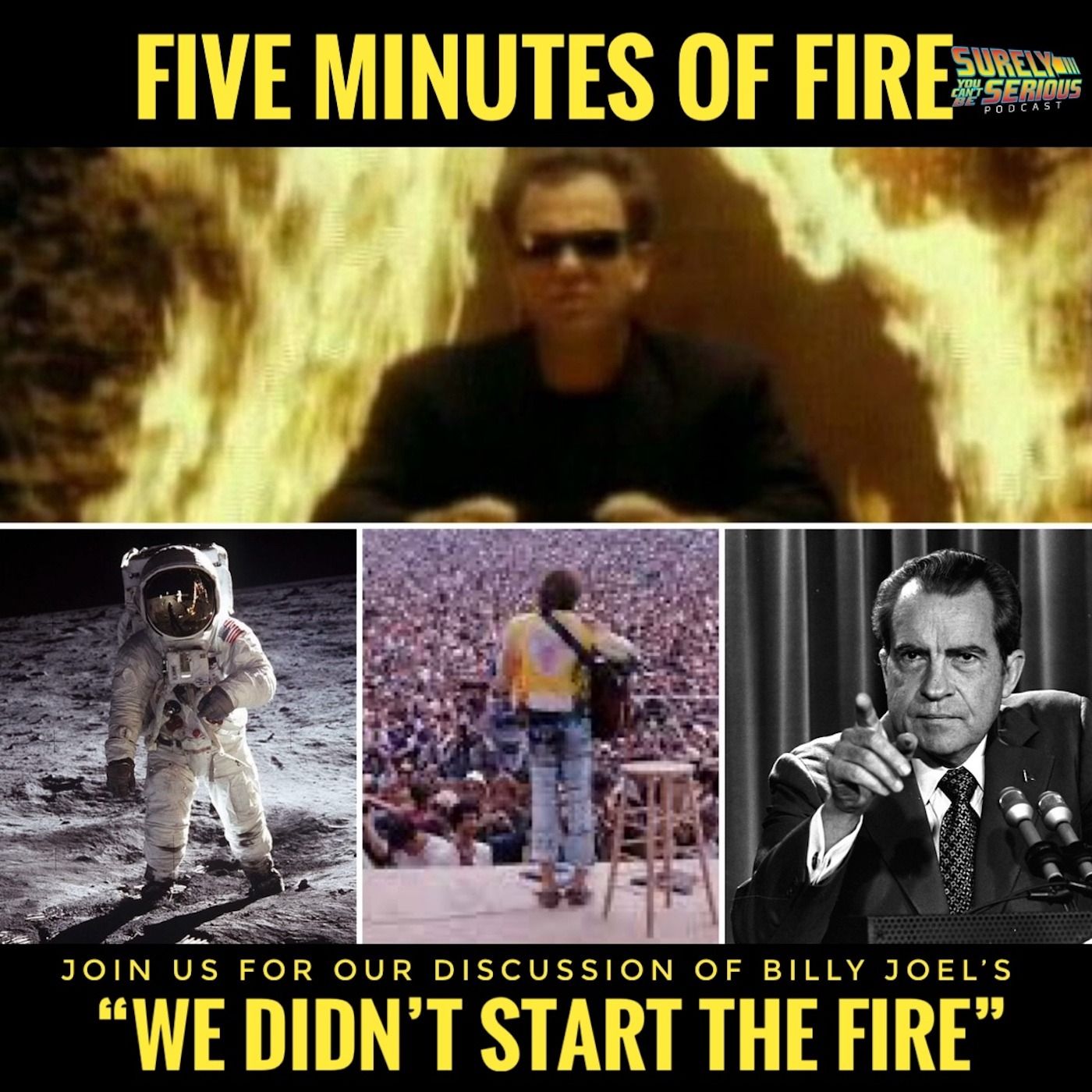
"Five Minutes of Fire": Moonshot, Woodstock, Watergate
Join us for a daily journey through history with "Five Minutes of Fire," the podcast series that unravels the historical tales within Billy Joel's iconic anthem, "We Didn't Start the Fire." Twice a day, in just five minutes, we explore the riveting events and names that have defined the 20th century.In today's episode, the flames of history burn brightly with the awe-inspiring moment of Neil Armstrong's first step on the moon, a giant leap for humanity. We then transport ourselves to the legendary Woodstock, where a generation united for music, peace, and cultural revolution. The narrative takes a dramatic turn with the echoes of Watergate, a political scandal that rocked the foundations of American governance.In just five minutes, we'll guide you through these historical snapshots, providing context, anecdotes, and a deeper understanding of the individuals and events that defined their times. Whether you're a devoted Billy Joel fan or someone eager to explore the stories behind the lyrics, "Five Minutes of Fire" is your daily ticket to historical enlightenment.Subscribe now to join us as we unravel the verses of "We Didn't Start the Fire," offering insights that breathe life into the captivating tales behind the names etched into the song. "Five Minutes of Fire" - where history unfolds swiftly and vibrantly, twice a day. Don't miss your daily spark of historical exploration!
2024-01-18
4 min
Transcript
Available Results
Generated results are saved to the knowledge database for reuse and search.
No generated results are available for this episode yet.
Extract Knowledge
Pick what you want extracted first. Model, scope, and chapter options appear after a template is selected.
Generated results for public episodes are saved to the knowledge database so they can be reused and searched later.
Transcript
<v Speaker 1>I'm Jason Colvin, I'm d Graves.
<v Speaker 2>Give us five minutes and we will give you the fire.
<v Speaker 3>Hello everybody, and welcome back to the Surely You Can't
<v Speaker 3>Be Serious Podcast Special Edition five Minutes of Fire. We
<v Speaker 3>are here talking about the lyrics of We Didn't Start
<v Speaker 3>the Fire by Billy Joel. We're covering only five minutes
<v Speaker 3>at a time, which is about to link with the song,
<v Speaker 3>so it works out kind of nicely.
<v Speaker 1>So please join us as we dive into some new
<v Speaker 1>lyrics today.
<v Speaker 2>All right, guys, So here are the topics that we're
<v Speaker 2>going to be covering today. Moonshot, woodstock, watergate, shot wood stock,
<v Speaker 2>water gate.
<v Speaker 1>Okay, tell me about the moonshot.
<v Speaker 2>All right, Dave, this is discussing one of the greatest
<v Speaker 2>human achievements in all of history, a man actually stepping
<v Speaker 2>foot on the moon. The mission that took the US
<v Speaker 2>astronauts to the Moon was Apollo eleven. Now on that
<v Speaker 2>craft you had Neil Armstrong, Buzz Aldrin Junior, and Michael
<v Speaker 2>call On July twentieth, nineteen sixty nine, four to seventeen
<v Speaker 2>pm US Eastern daylight time, Armstrong radioed said, Houston Traequility Base.
<v Speaker 2>Here the eagle has landed. At ten fifty six pm
<v Speaker 2>Eastern daylight time on July twentieth, Armstrong climbed down the
<v Speaker 2>ladder and said.
<v Speaker 3>At one all flam for man.
<v Speaker 1>On by a late for man.
<v Speaker 2>That's one small step for man, one giant lead for mankind.
<v Speaker 2>Aldrin joined Armstrong about twenty minutes later. Altogether they spent
<v Speaker 2>about twenty one hours and thirty eight minutes on the moon.
<v Speaker 2>They set up various types of equipment. Hundreds of millions
<v Speaker 2>of people watched this event on television, and on their
<v Speaker 2>way out they knocked the flag over.
<v Speaker 1>Just take a moment. Can you imagine being one of
<v Speaker 1>those guys like talk about fear terror? I mean, you
<v Speaker 1>trained for this, but you're doing something that no one
<v Speaker 1>has ever ever done, and then you have to make
<v Speaker 1>it back home.
<v Speaker 2>Absolutely amazing.
<v Speaker 1>All right? Tell us about Woodsuck all right? This refers
<v Speaker 1>to the Woodstock Music and Art Fair, commonly referred to
<v Speaker 1>just as Woodstock. It was a musical festival that was
<v Speaker 1>held from August fifteenth to August eighteenth, nineteen sixty nine,
<v Speaker 1>on Max Jazger's dairy farm in Bethel, New York, forty
<v Speaker 1>miles southwest of the town of Woodstock. It was billed
<v Speaker 1>as an aquarian exposition three days of peace and music.
<v Speaker 1>It attracted more than four hundred and sixty thousand attendees.
<v Speaker 1>Thirty two acts performed outdoors, Despite the fact that it
<v Speaker 1>was overcast and raining much of the time. It was
<v Speaker 1>one of the largest music festivals in history and became
<v Speaker 1>synonymous with the counterculture of the sixties. The next year,
<v Speaker 1>they re released a documentary film, some of which was
<v Speaker 1>filmed by Martin Scorsese, and a soundtrack album that had
<v Speaker 1>a song called Woodstock written by Joni Mitchell, performed by Crosby, Stills,
<v Speaker 1>Nash and Young. In two thousand and four, Rolling Stone
<v Speaker 1>magazine listed it as the number nineteen of the fifty
<v Speaker 1>moments that she changed the history of rock and roll.
<v Speaker 1>Wow Okay? Telling me about Watergate.
<v Speaker 2>On June seventeen, nineteen seventy two, police caught five men
<v Speaker 2>breaking into the Democratic National Committee headquarters in Washington, d C.
<v Speaker 2>At the Watergate Hotel, and he called this a third
<v Speaker 2>rate burglary.
<v Speaker 1>At the time.
<v Speaker 2>Now, between nineteen seventy two and late nineteen seventy three,
<v Speaker 2>there was a series of meetings between Bob Woodward of
<v Speaker 2>the Washington Post and a secret informant called Deep Throat.
<v Speaker 2>He revealed that the break in was politically motivated and
<v Speaker 2>could be traced back to the committee to re elect
<v Speaker 2>the president, even to the president himself. The motive was
<v Speaker 2>to collect information and place bugging devices. Now Nixon denied involvement,
<v Speaker 2>of course, and was re elected. In nineteen seventy two,
<v Speaker 2>the Watergate Committee began to dig and place pressure. White
<v Speaker 2>House Deputy Assistant Alexander Butterfield revealed the existence of White
<v Speaker 2>House Tapes, which was a new recording system placed in
<v Speaker 2>the Oval Office. He had to do this under oath,
<v Speaker 2>and it was like this big revelation, So of course
<v Speaker 2>the committee wanted the tapes.
<v Speaker 1>Well.
<v Speaker 2>Nixon tried everything to block the tapes. Right after this,
<v Speaker 2>Nixon gave the quote I Am not a crook speech. Ultimately,
<v Speaker 2>the release of the White House tapes incriminated Nixon. This
<v Speaker 2>causes Richard Nixon to resign the presidency. After that, new
<v Speaker 2>President Gerald Ford pardons him, and the actual identity of
<v Speaker 2>Deep Throat was revealed in two thousand and five to
<v Speaker 2>be former Associate director of the FBI William mark Feldt.
<v Speaker 1>Check out the book and movie All the Presidents Men yep,
<v Speaker 1>Woodward and Bernstein yep. Okay, guys, that does it for
<v Speaker 1>today's episode. Join us next time for five minutes of
<v Speaker 1>fire
Chapters
No chapters available.