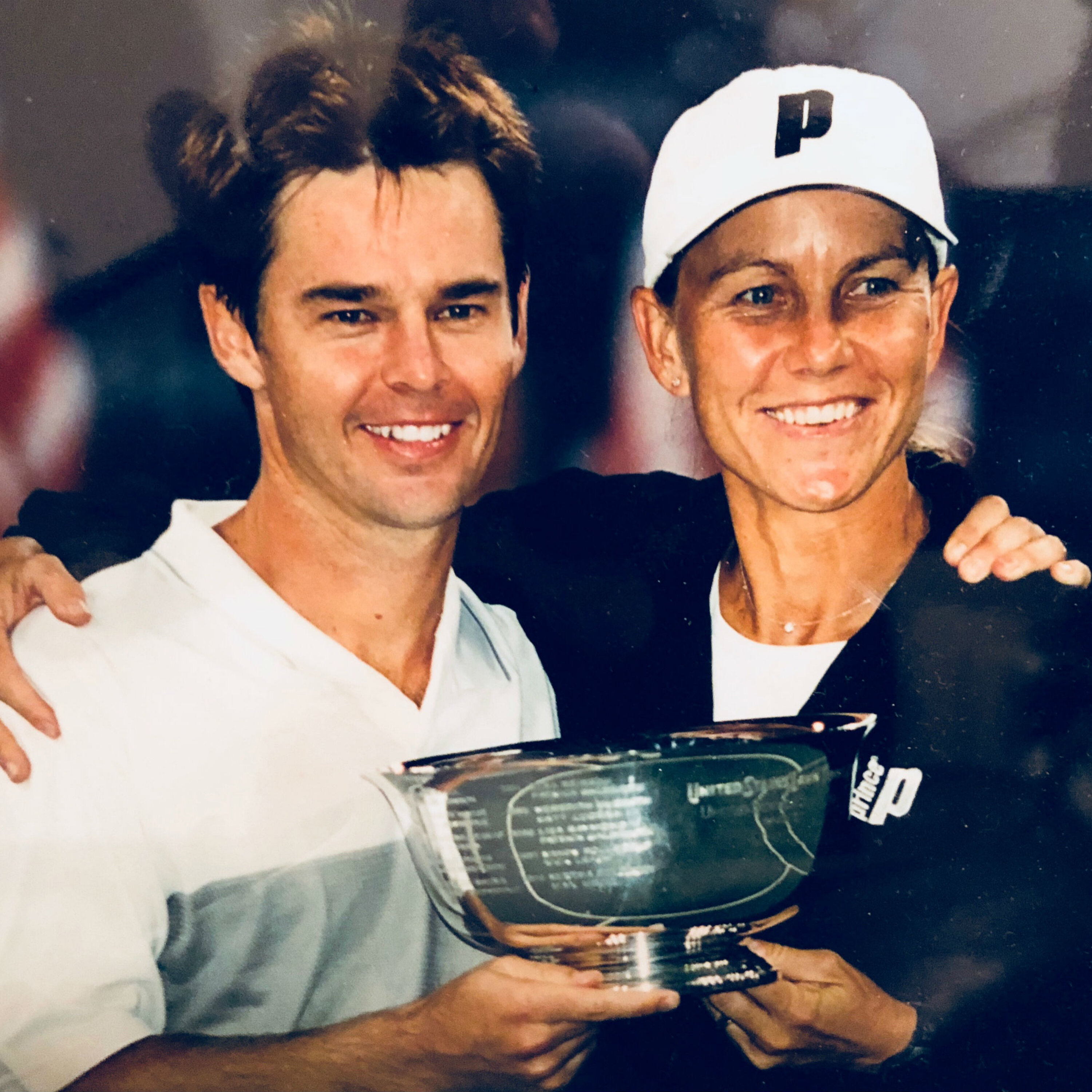
Todd Woodbridge
We fix all the problems with tennis—from coaches who are paid by their charges to the lack of surface variety—with the legendary doubles player and one half of "The Woodies." But we ALSO hear all about his sometime doubles partner, fellow Aussie Rennae, hitting to "the chick" and getting yelled at by Martina Navratilova.
Hosted on Acast. See acast.com/privacy for more information.
See omnystudio.com/listener for privacy information.
2018-06-30
52 min
Transcript
Available Results
Generated results are saved to the knowledge database for reuse and search.
No generated results are available for this episode yet.
Extract Knowledge
Pick what you want extracted first. Model, scope, and chapter options appear after a template is selected.
Generated results for public episodes are saved to the knowledge database so they can be reused and searched later.
Transcript
00:00:00
Speaker 1: So Martina and avelover comes along and she goes, you're a liar.

00:00:14
Speaker 2: Hey, Caitlin, we have somebody very interesting today on our podcast, somebody from my very long past of Australian tennis, and it's my old mixed doubles partner and truly one of the greatest doubles players that has ever played the game in mister Todd Woodbridge.

00:00:30
Speaker 3: One of the people in this world who has been probably the most in the trenches worth you wouldn't you say.

00:00:36
Speaker 2: Well, yes, We literally have grown up together since the age of ten in Australia. He was always a very good junior, very good player, and our trajectory path of junior tennis and then going on to the pros and we had the same coach, and we lived in the same city in Orlando and Florida when he lived over here has taken pretty much the same path, except.

00:00:58
Speaker 4: He won a lot more than I did.

00:01:01
Speaker 3: Sometimes I forget that as much of illuminary as you are, there are people who have somehow even accomplished more than you have. Lost twenty two Grand Slams, eighty five doubles table I think it was eighty three eighty. We'll give him an extra two just to say.

00:01:13
Speaker 2: Well, Wikipedia gave him an extra one for a long time at twenty three Grand Slams. But then you have to correct that it's only twenty two. Only twenty two. But the greatest thing about Todd's Grand Slam victories is that he won nine Wimbledon titles in doubles, which is incredible. He won five, I believe with Mark Woodford and four with Jonas Jonas b Yorkman, so nine Wimbledon titles on his own in doubles, which is incredible.

00:01:40
Speaker 4: And he helped me.

00:01:41
Speaker 2: Win a Grand Slam in mixed doubles at the two thousand and one US Open Mixed when he finally decided to play with me after all those years, we finally won one together.

00:01:50
Speaker 3: Well, I love that you guys get into the story of how he finally let you be in his mixed doubles pratter. But the other thing I like so much about our conversation with Pod is it's our most sort of tennis centric episode in the sense that you guys have been around a long time, you've both commentated on this game, you've grown up together, and the just the idea of where the game could be what the tactics use, the surfaces, what could make doubles more popular. These are all things that I think people who read our magazine kind of really want to sink their teeth into. And I love that we got to those places as well.

00:02:20
Speaker 2: Yeah, we definitely, Todd and I have sunk our teeth into a lot of things through the years when it comes to tennis, and we absolutely definitely have opinions. We are virtually one week apart born. We're both aries, we both have we both like to say a lot of things. We went into commentary together as well. We worked for the Channel seven network in Australia, so we've called a lot of great matches together and we've had too. We've had a lot of interesting spats on the air. We've had back and forth, and we're basically like brother and sister.

00:02:53
Speaker 4: We're so close.

00:02:53
Speaker 2: And he's truly somebody that I call one of my longest best friends and I love him.

00:02:58
Speaker 4: He's given me shit.

00:02:59
Speaker 2: My whole life and we'll hear why, but truly one of the luminers of tennis throughout his whole career.

00:03:06
Speaker 3: All right, well, listen up, here's our episode with Todd coming right up. One of the things I was trying to do is I'm trying to count how many Grand Slams you have?

00:03:13
Speaker 1: Twenty two?

00:03:14
Speaker 3: That's so many, Yeah, but I was trying to.

00:03:16
Speaker 1: For a long time. I had twenty three because Wikipedia was wrong, but I didn't tell them, you didn't hung on to twenty three.

00:03:23
Speaker 3: A number of those twenty two Grand Slams came in mixed a number with my cars.

00:03:27
Speaker 1: Yeah, six of them. We should have had more. Well, there's a big story to the whole playing with Stobsy in fact, because she we grew up together, she always wanted to play mixed with me, and for the very longest of times, I didn't really think she was quite good enough.

00:03:42
Speaker 3: Uh huh.

00:03:43
Speaker 1: And it's true. She used to come to me and say, hey, can we play and I go, oh.

00:03:47
Speaker 4: No, no. I used to say, when are you going to fucking play with me?

00:03:50
Speaker 1: Ton, And I'd say, oh, you know, we went sort of in this sequential order. I said, you know, like, you need to get your ranking just a little bit higher, and so she'd go away. She'd try, and she got the ranking pretty decent.

00:04:02
Speaker 4: Yeah, like top ten, winning tournament.

00:04:04
Speaker 1: But if I was playing with the likes of Rancho Santas Vicario and Helena Sikova Lindsay Davenport. You know, I always played with women with better serves than me, good, taller, and she had a bit of back. Anyway, got the ranking right, and then she came and asked to play again, and I said, oh, look, no, I think you probably need to get to number one. Wow.

00:04:27
Speaker 2: Yeah, literally, that was his stipulation for me. If and when you get to number one in the world, then we'll play. What it's like, literally, this is his dating schedule. It's like, and if you're hot enough and you get yourself into a size thraw, you know, and you dye your hair maybe, then then come and talk to me.

00:04:45
Speaker 4: Yeah, okay, okay, go on.

00:04:46
Speaker 1: Yeah.

00:04:47
Speaker 3: So she got to number one, but you're moving the goal post, cunner, and you're acknowledging that right.

00:04:50
Speaker 1: Oh very much. So I was doing my best to avoid it, probably because you could see why. And then we got she got to number one, the one I said, oh, look.

00:04:59
Speaker 4: You know, still playing with a rancher.

00:05:01
Speaker 1: Yeah, you know, we're going well with one couple together, and I think I'll stay with that partnership. And we end up having to play each other in the final of the Australian Open. Wow, and I lost.

00:05:11
Speaker 2: Oh good, yeah, nothing, And I shook his hand and said, now you're going to play with me?

00:05:15
Speaker 3: And so I had did you really say that at the night?

00:05:17
Speaker 4: Pretty much pretty.

00:05:18
Speaker 1: Much I had no choice but to go play with there after that and it was like, oh, you're kidding me, and and anyway, so we we we went on and we went.

00:05:27
Speaker 2: We Actually, the next Grand Slam that we ended up playing because now it was allowed to play with them because I'd beaten them, was the French Open, and we made the finals. And in the very first that we played, we made the finals, and of course I thought this was going to be a rosie and to me finally saying see, I told you so.

00:05:46
Speaker 4: And then you know, I fucked up and lost my serve in the third set and we lost the final.

00:05:50
Speaker 1: Yeah, but that was it was a tough match. You played two huge servers. We did sort.

00:05:54
Speaker 2: Yeah, we played on court one, and Todd after the match was so angry. He was so pissed and he had to play his doubles final the next day, right, and you had not won the French Open at all that year.

00:06:04
Speaker 4: It was the one Grand slam that.

00:06:05
Speaker 2: Had eluded Todd and as it always did me throughout my career.

00:06:09
Speaker 1: And because that was that was quite Because this is gives you a lot of like how we illustrated have to take care of Dubsy because Mark Mark Woodford, Mark Woodford, prior to that match, you know, made sure he went to something that going to make sure you had to keep Todd in it writ's face state of mind, because you know he can lose it and then take that into the doubles tomorrow.

00:06:29
Speaker 4: This is how it went.

00:06:29
Speaker 1: That's no good for us. So he was thinking worry about me.

00:06:33
Speaker 4: He was knowing he was, and he was just worried about himself.

00:06:35
Speaker 2: I came off the doubles court after losing, and Lisa Raymond and I were the number one doubles team in the war, No One seed, so we were hoping to win the title that year and we lost, I believe in the quarters, I don't know when it was, and you know, I sat down outside.

00:06:47
Speaker 4: The locker rooms very dejected.

00:06:49
Speaker 2: I had to go and play mixed now with Todd in the semis probably all quarters, and I was sitting there. Mark came over and I thought, oh, you know, fellow Aussie, older, more experience, had so much experience, and maybe he was going to come over and put his arm around me, and so bad luck and good yeah, just be a nice guy, you know. Sure came down, he said to and listen, snubbsy. I just I just need you to keep Todd calm out.

00:07:11
Speaker 4: I don't know what happens.

00:07:12
Speaker 3: You're a match.

00:07:12
Speaker 2: And I just looked at him and I went, you gotta be fucking kidding me. And I just got up and left. And Todd actually I told him the story as we're walking under the court and Todd, because Todd and I were best friends, and he just looked at me and goes, oh, don't worry about that.

00:07:27
Speaker 1: That out of that tournament, that comes comes the line of hit it to the chick. Because we were playing I think it was round about quarter final. We were playing Jeff Tarango and Elena Lacostava.

00:07:36
Speaker 4: Oh jesus, I don't remember this.

00:07:37
Speaker 3: Oh don't you let me just pass here? Noted nice guy Jeff Tarango.

00:07:41
Speaker 1: Luck favoriteable, vulnerable, not vulnerable, yeah, but explosive, erratic. Sure, And we can go on from many adjectives for deaf. Anyway, we're playing away we're playing for the solid team actually that you don't have to play well to beat them. And we were playing well, but we've we've goett sort of like a break up or setting a break or something. And start. She loved to beat the guy. She thought it was more crucial to beat the guy than to put the ball away in an open court around the woman and in mixed you know, you don't.

00:08:12
Speaker 3: Just want to note here we have a disagreement.

00:08:14
Speaker 1: You do not go to the guy.

00:08:15
Speaker 3: You don't.

00:08:16
Speaker 1: So you know, we've got big points coming up, and there's some couple of key moments and stubs. He goes bang crossover to Jaf instead of to Elena, and Jeff whips one. We lose that, we lose serve and so at this point I lose it because we should be off the court. And I said, keep in mind we're both aries, and I did you know I'm not a great swearer, but and I'll hold on it. But I said, a stubbsy hit it to the check. And we're sitting down now, we've got to our chairs on the side, and I am just steaming. I just can't stop.

00:08:47
Speaker 3: You're vibrating with anger.

00:08:48
Speaker 1: Well, that's an interesting way to look at it. And she turns to me and she's very calm, and normally she's not very calm because she knows I'm losing it.

00:08:54
Speaker 4: Well, because I'm usually the one losing my sho. Remember, she says, your shit more than me.

00:08:58
Speaker 1: Do you remember what you said?

00:09:00
Speaker 4: Clearly?

00:09:00
Speaker 1: You do. You looked at me and with this cheeky smile, and she said, stop it. You're turning me on.

00:09:10
Speaker 4: Oh my god, that's really good. That is unbelievable. That's really good.

00:09:15
Speaker 2: Considering he knew I was gay, he knew that was not a problem, but the fact that he was turning me on made me probably made him think twice about yelling.

00:09:23
Speaker 1: I don't think I ever laughed on a tennis court I can recall, except on this occasion. And it so broke this immense tension that had been building. And then we went on and won that match. But that was one of my classic Stubbsy moments.

00:09:35
Speaker 4: Oh my god, he's never told me that's so good.

00:09:38
Speaker 1: Yeah, I tell a lot of people that that's awesome.

00:09:40
Speaker 3: In this beautiful colosseum asque court one at rolling Girl.

00:09:44
Speaker 4: No, that was probably on like court.

00:09:46
Speaker 1: It was on court two, which is my.

00:09:48
Speaker 4: Favorite court favorite quote.

00:09:49
Speaker 2: Well, we went on to lose sadly in the final, but we did go on to what happened at Wimblin.

00:09:56
Speaker 4: Who did we lose to that year? I don't remember clearly I what.

00:10:00
Speaker 3: That ye early.

00:10:02
Speaker 1: But our greatest, you know, a shining moment was US Open in New York and we we broke my wrist. Yeah, stuves in a in the final as she did. She used to dive and although I only hit the ground if I tripped or fell over, trip and follow over that time, but she landed heavily on her wrist, got up one the point, crucial point, massive and ends up with a fractured wrist, ends up winning both the doub I was gonna see you want the singles?

00:10:28
Speaker 4: That wasn't That would have been a miracle.

00:10:30
Speaker 1: Wins doble was a mix, so quite extraordinary, and in that particular one it was interesting because we talk about this a little bit too. That was the first time where we played two sets and tie break. And of course in tennis we don't like change, and we're talking about change and rubbish and in Australia we have a thing called a chuck raffle chuck. Yeah. And so when you go.

00:10:47
Speaker 4: Down that's a chicken, it's a frozen chicken.

00:10:51
Speaker 1: And you go down to the local, whether it be bowling club, that's lawn bowls all fate. Yeah, and it's a way to raise money. It's a charity thing. And they have the spinning board, you know, and you get your number and a bit like rulette, but you're playing for a frozen chalk, which for the family is a big So we used to call. We used to call when that first came out.

00:11:10
Speaker 2: It was like, because you're picking the ball out of it to get win the chuck raffles.

00:11:14
Speaker 4: So it's a lot of luck, right, Yeah.

00:11:16
Speaker 3: And I think a lot of tennis purists would say when.

00:11:18
Speaker 1: Yeah, because the end of a match, that's the interesting I would get. There's a serious stuff now, But when when the reason, like if I can move to men's doubles very quickly, the reason Mark Woodford and I had such success at wimbledy do what is we.

00:11:30
Speaker 3: Should just say you guys legendarily o the word is to me and to many people in my generation, Yeah, thank you.

00:11:35
Speaker 4: We're not talking about anything else other than tennis.

00:11:38
Speaker 3: Okay, but go on.

00:11:39
Speaker 1: Five sets at Wimbledon. We found a way to win because we had time. You weren't blown away by someone just big serving and one swing and a lucky breaker serve.

00:11:48
Speaker 3: No need to panic, you know.

00:11:49
Speaker 1: And they also knew that we could start to break them down. So the whole psyche of that is so much more important. So it's tougher now in doubles it really comes down to a fluky, reflect sort of big serve. It's tough to be able to be as dominant. I think Brian brothers have done pretty well.

00:12:05
Speaker 3: They have, yeah, but they've also transcended a bunch of rule changes.

00:12:08
Speaker 1: Right, true, they've come across those, but they're kind of dynamic one two hit players anyway, you know, big serve, wacker return. They kind of different to how we were because we didn't have that massive so we had to create.

00:12:22
Speaker 3: Right, But I do want to, so can I kind of go deep on this just because I think you know, for me, I played college tennis and one of the and I was a double specialist. Actually yeah, it was best of nine, right, six singles, three doubles, and each court individually counted the same. And then halfway through they'd condensed it, so the doubles became one point so two out of three, you know, so that massively changed the game. And then in the men's side especially, they took away the let. So the idea was this let cord on men's for service was getting massively you know, massively massively abused and people are getting aced but calling a let and then you know, having another crack at it. So one of the things that has been suggested to me in the college scene is that because more luck has entered the game, college scouts are sort of recruiting more for big playmakers.

00:13:08
Speaker 1: Yeah, that makes sense. It's it's that you know, one hit wonder type of stuff, and you know that. That's my one thing about watching tennis in general these days is I long for contrast and skills, and skills is half skills is what Federer can still do, of course when it needs to change things up. It's that's that soft ability with the.

00:13:31
Speaker 2: Hand creation and Rougher doesn't get enough credit for that's true ability to be able.

00:13:36
Speaker 4: To change the ball speed.

00:13:37
Speaker 2: And his volleys are I arguably he would say his volleys are some of the best in the game.

00:13:42
Speaker 1: Well, yeah, because it comes in, it comes in on the best type of approach as well. But I mean he continued to improve those sorts of things.

00:13:49
Speaker 4: But that's what I want creation.

00:13:50
Speaker 1: I'm talking about getting the game back to being able to have court surfaces that have variants in speeds through different tournaments, so that a faster court player can do well and a slow court player will do well.

00:14:04
Speaker 3: At the front.

00:14:05
Speaker 1: And you have to get you know, you have to tactically change. We see a little bit more serve volley, we see a bit a little bit more chip charge. That's what I'd like to see put back into the game. It's become too neutral. Yeah, same ball, same speed. Court surfaces are pretty much all the same, even though they're different colors.

00:14:22
Speaker 3: No, but you're totally right, which to me ends up in a interminable backhand to backhand rally point between Novak Djokovic Andy Marray, two players I like individually, but that matchup. When I think of boring, I think watching two players hit backhand patterns on a surface that's indistinguishable. One criticism. I think that the grass court part of the season has gotten, in particular Wimbledon in particular, a place that you guys have had a ton of success.

00:14:46
Speaker 4: It's so slow.

00:14:47
Speaker 3: Is they've slowed it down?

00:14:48
Speaker 1: Well, yes, a lot.

00:14:50
Speaker 4: Is so different.

00:14:51
Speaker 2: So when we played, yeah, it's incredibly different.

00:14:54
Speaker 1: Well when we first started a place I was thirty years ago. I played my first Wimbledon at sixteen, and the courts in those days they were pure earth. Now by that I mean they were grass and you dug down it was just earth. And so depending on the weather, if it was a cold, wet Wimbledon, the courts were heavy, damp, low bouncing. If it got hot some they dried out, they firmed up, the ball would bounce more, they were quicker. That's all gone. They've rebuilt every court to specific layering of rock granite, and you know, the soil really is only about a foot deep. It's not earth anymore. So that changes the whole perspective of the way grass is played. I remember in my last singles year, which was back in O four maybe I think I qualied. I played Scott Draper and Australia on Court four. That was one of the last old courts that were still that fast and low bouncing. So you could Servevolly hit a little short volley and the ball would die. So he couldn't run on and hit a passing shot. The guy had to chip when we get back to feel and skills or lobb you or put it in over with your backhand. You had to do stuff. Then I went out and played on court fourteen in the second round, which is a new court. Well, it was like playing on a hard court. The difference in bounce height was about two feet wow. And so I'm playing the same stuff that this guy that I played against he could run on and hit a pass easy. So that's where Wimbledon has really changed the game to allow more players and opportunity to compete. And that was a deliberate piece by them to actually get more of the Europeans to make sure that they played, because a lot at that time plan they wouldn't go.

00:16:31
Speaker 2: But doesn't that worry interesting? But doesn't it worry you in some respects? It's sort of a dichotomy really because you look at the French Open, Well, you.

00:16:38
Speaker 3: Know, she's half cast in our country.

00:16:40
Speaker 2: Half a brain, you know, like Roger's not playing the French because he just feels like, well, I mean it's a little different because you think this age and et cetera.

00:16:49
Speaker 1: But that's a different part.

00:16:50
Speaker 2: Do you worry that that may happen though, that players are like Rafa will be like air to the grass because he knows. I mean, it's not because the grass is so different now. But it's always been a worry for me because I think, and I agree with you one hundred percent, there has to be variations in the surface, because that's when you get a true great player, and Roger obviously is that person.

00:17:12
Speaker 1: And he'd redesign it.

00:17:14
Speaker 4: I guess that's a certain degree.

00:17:16
Speaker 2: But when Rafa won it too, the grass was just starting to change. It wasn't as bad. I think it's so slow now. I mean, I played my last Wimbledon final in nine and I think about it, you know, but I think about nine and I think about one when I because I didn't play that many times on Center court. Sadly, you played a lot more than I did, including a semi final Wimbledon in singles against Pete. It's like the grass was so different and it was so hard when I walked out on that court in O nine and you know, it was just like a completely different court to what I walked down one. And I want to see I would like to see Wimbledon get to a point where they make the grass faster because it does lend itself to people that do become a little bit more creative, that do serve and volley. Sometimes it will come in to the net because you can't do that.

00:18:01
Speaker 4: Now.

00:18:01
Speaker 1: I don't know if your listeners are aware, but what they do is they go out and specifically work out the moisture content at every court and so they know how high that ball's going to abounce. It's a bit like what they do for golf tournaments with the speed of greens. Wow, and that's exactly what they do with the bounce. So it's and they do it with all.

00:18:20
Speaker 3: Of the it's engineered to perfection, but maybe at what cost.

00:18:23
Speaker 1: Yeah, and that's where grass is natural.

00:18:27
Speaker 3: Yeah, it natural. Let me let me add something of this, having never hit at the All England Club but played a little bit on grass in other places completely different. Well, yeah, it's got to be different.

00:18:36
Speaker 1: Right.

00:18:36
Speaker 3: And when we're watching Hall or Birmingham or you know.

00:18:42
Speaker 4: I thought you're going to say, holl of Notes Hall.

00:18:44
Speaker 3: The Notes Halla, that's what the tournament's called, right, It's attribute concert at the end. When you're watching these things, they have to be. The grass I've played on is insanely fast.

00:18:55
Speaker 2: Yeah, it's grass because we grew up in, which I love because I hate groundstrokes.

00:18:59
Speaker 3: And what's the point on being in the baseline if you can be at the nat especially now, are you even preparing for Wimbledon?

00:19:05
Speaker 4: Well not really.

00:19:06
Speaker 1: They do a little bit, and it's not as much as it used to be, though it's not as hugely important.

00:19:12
Speaker 3: As a fan of the game, I would like the game to be a little bit more of the conversation everything we're talking about surface variety, tactical variety. There's been a homogenization of the game, and I think the way that even it's talked about and the way that it's broadcast kind of tends to celebrate like dominance.

00:19:29
Speaker 1: So do you want to hear my theory please about why that is getting to that point? Yeah? Tell me. So we were talking about Subsy and I were both coached by Ray Ruffles. Ray was a really good player. You know, he won the Strain Open doubles and you know quarters of Strain Open singles. A lot of the coaching as we were playing and before was by former really solid players that were out on tour. The coaching that goes on now is from people that haven't been those spaces themselves. Haven't actually, so you know, they haven't been in major tournaments. They've been lower ranked players. They're nice players, but they've never had the experiences of walking out onto Santa Court.

00:20:11
Speaker 3: You know.

00:20:11
Speaker 1: John Newcomb was our Davis Cup captain and he had a lot to do with my early years from about thirteen and he the first show went to women said come on, we're going to go and sit in the Senate court. It was empty and you go visualize what the crowd would be like, what it'd be like making a return that way. Did that every year still the first time, and you got these experiences from these former players, and we had a lot of them in Australia that taught you how to play. They looked at your game style and then they go, well, you're going to have to play like this. You're gonna have to look at your opponent and you're gonna have to break them down. Now, I watch coaches who are hired and do not say no. Ah. Interesting, they never say no to their player. The player says I want to do this, yes, because they scared of getting sacked. Because what's happened in tennis is that the player is the boss, is now the employer, and they dictate where it's the wrong way round. The coach should be the one telling the player you get your butt back out on court. We're not done yet, and until you do that and then we'll go home. That's one of the classes. I've had enough, and the coach you'll go, oh yeah, you'll be ready. You need to rest. What a croc right.

00:21:18
Speaker 2: It's true we did grow up because we did grow up with the same coaching style and.

00:21:24
Speaker 4: Was I was tough to coach. Todd was tough to coach as well.

00:21:26
Speaker 2: But when we had someone that we really respected, you were tough to coach.

00:21:29
Speaker 4: I don't even don't even go there. You did.

00:21:32
Speaker 2: But we had to have somebody we really respected, and when we did, it was it was all about what they said. And that's not the case anymore, and we were paying that.

00:21:39
Speaker 3: We also had a great piece in one of our earlier issues by Jeore Druker talking about the Australian code, the ARC code.

00:21:45
Speaker 1: Well, that coach came from all these great players. Let's stay there.

00:21:49
Speaker 3: It's a little bit less mercurial and maybe individualistic than the way that other countries.

00:21:54
Speaker 1: We used to have to leave, you know, and we couldn't go home. You're on the road for four or five months longer. Yeah, you just couldn't do it. But just to go back to that coaching, it's not it's not rocket science. It's easy to see why Novak with Boris I was going to say, run Andy with Ivanne took off. And even Roger reinvented his game by having Edinburg.

00:22:22
Speaker 2: Edburgh, and I believe the biggest influence on him of late is his current coach. I think Lubachich changed his backhand.

00:22:32
Speaker 4: There's no question in my mind getting over the bigger.

00:22:35
Speaker 2: Backhand, a bigger backhand, because Luberchi's best shot for me was always a beautiful, free flowing backhand, and that is Roger's backhand.

00:22:43
Speaker 1: So you look at those thing. So the other part that Edinburg did to Roger, he actually said, Roger, why are you trying to hit winners and outplay everybody in every point? That was when Roger went off. He tried to play too good. Now Edburg came in, so let's build pressure, let's serve and volley a little bit more would put the old chip charge in there, make the pass you and build it so when you get to big points in matches, you don't have to hit a winner. They're feeling you all the time. And so he sort of just changed his philosophy a little bit, brought it back, and so that that's where a lot of we see in the games going back and on the women's side, just look at the women, ya say, can she to my team? Madison Keys will win a major soon if she sticks with Lindsay.

00:23:25
Speaker 3: Yeah, you think that that's fruitful coaching?

00:23:27
Speaker 2: Absolutely well, I think that the biggest the biggest one for me even yes, I believe this with Lindsay, with Madison, but I think even more so is mcgarrutha.

00:23:35
Speaker 4: Last year with Conchita. There's no doubt in my mind that was.

00:23:38
Speaker 1: One of the best tactical finals I've seen in women's tennis.

00:23:42
Speaker 2: And that was Conchetah And that first set was extremely competitive, playing against the player who had been there many many times, and Venice Williams and.

00:23:48
Speaker 4: M had A.

00:23:50
Speaker 3: You could tell she was coached well.

00:23:51
Speaker 1: Absolutely And dare I say this, I've watched and I've called a lot of women's tennis alongside Renee, but there are a lot of matches that I don't see a deliberate plan and tactics, a lot of hitting balls as opposed to constructing points. That was one of the best constructed matches where the ball hit a certain part of the court, You're going to hit it into there, You're going to open up a backhand down the line, she's at stretch, you move forward, and it was perfect coaching particular day.

00:24:18
Speaker 2: Yeah, I mean, and I just I think that we're going to see more and more over the next few years or maybe forever. Ex players will be coming back into I think the problem with the women's game is that a lot of women players they want guys to hit with because, you know, like for me, for example, I mean, at my age, I can still hit, but I can't hit with you know, I went away last year with Carolyne Plishkov. I mean I can hit with her, I can be at the net, I can do all those things. But for her to really get a great hit hit, she needs to have a guy hitting partner.

00:24:50
Speaker 4: It's just the facts. I mean, I'm older.

00:24:52
Speaker 2: I can't stick with someone like her or give her the hit she wants. So that's kind of the problem. With having women coaches is that but they have enough money, but they can bring a hitting part to have that, and I think you're going to see a lot more ex player women come back on to the tour helping players, and I hope that women take advantage of that, because the difference with having a Concheta Martinez there, who's one Wimbledon. The difference with having a Lindsay daven Paul or a Boris backer is that you know, they know what it takes.

00:25:28
Speaker 3: Let's go dip a little bit with Plishkova. What was that experience? Like you had coached other players before? Had you coach somebody in the top ten before?

00:25:35
Speaker 2: I spent a little bit of time on the road with Sam Stoza just because of our friendship, and she's you know, when she gets stuck, she sometimes will give me a call or Casey de Laqua, mostly because they're my friends and they trust me and respect me. My last couple of years actually on too, I had Conchita Martinez come and help me at various tournaments and she made a huge difference for the latter part of my career, no question about it. So for me it was nerve wracking. I told Todd we had. Todd wrote a really nice article actually in Australia about the use of maybe using someone like me who I'm like Todd, I have a very good tennis brain, which makes us both good analysts when we watch tennis, you know, is that we can analyze a point. We sometimes argue about it on air, but you know, overall we have a very similar thought process and I think that more players could utilize And I'm pretty sure that currently not brought me onto it because she listened to my commentary and I'd like to have that maybe in my ear for a little while. So I think we're going to see more and more. I'd love to do more, There's no question about that.

00:26:34
Speaker 1: I mean that was how we started this conversation. I'd love to see more of that as well. But maybe those the ones we mentioned, they're the elite trying to finish off those majors. We need more of you myself or a stubsy coming back into that mid level to get more of those plays up. I must. There's one one young guy from Australia, Alex Demanoor. He's just had just won his first Challenger.

00:26:58
Speaker 4: And Ash Party just want tourn him as.

00:27:00
Speaker 1: We get to her too. But Alex is being mentored. You could call it coach too by Leyton Hewitt. It's not official coach, but Laighton's with him a lot. They're doing a lot of hitting as you were talking about, but Laanen's really talking to him about how to win matches, how are we going to beat this guy, what we're going to do in our preparations. And there's a correlation between how Alex is going and what info he's getting.

00:27:21
Speaker 3: You know, it's not an accident, no, yeah, And.

00:27:23
Speaker 1: The other part to Alex is that he also is searching for it. He wants that in a player. Yeah, And so he's fortunate that, you know, he's got the Davis Cup captain from Australia to be out with him being able to do that. But I'd like to see that we were lucky there was more of us out on the road. And I've got to be saying I'm a bit guilty. I I love coaching. Actually, I'd bit like Stubbs actually enjoy the getting my hands in there and teaching somebody and watching a player and have them go all right, that's how you do it.

00:27:51
Speaker 4: Yeah, that's how you do I just do it with Caitlin now on the east side.

00:27:54
Speaker 3: She afected my.

00:27:54
Speaker 1: Back und I'm not surprised. Yeah, I didn't know it was bad, but it was. But I just think that I didn't do it, and a lot of players don't do it. Because I had two young kids. I wanted to be at home more and I was probably a little selfish in that, because to do it properly you have to be with that twenty five weeks on the road, and at that point in my life I didn't want to be out on the road for another twenty five weeks. I'm probably getting back to my kids are late teens now, so.

00:28:21
Speaker 2: Given up on them now he's letting them go. Speaking of kids, I want to bring this up because you do have two young kids, and well, Zara is a golfer and which I know is very torturous for you because you want to be a golfer yourself. And bo Is he's aspiring Broadway guy. He's a singer and performed a lot in Australia, and that's one of the reasons why you're here in the US, and you lived here.

00:28:44
Speaker 4: A long time.

00:28:45
Speaker 2: What's it like can you imagine being you know, your kids growing up in Australa obviously a little bit of pressure to be great and also think about someone like Andre and.

00:28:52
Speaker 4: Stephi's kids as well.

00:28:53
Speaker 1: I can't imagine actually interesting that you asked that question because it would be through two three weeks ago. For the very first time, Zarah raised it and she said, you don't understand how hard it is to be judged by everything you did. So she doesn't play my sports. She's been an elite golf program. She's just seventeen and going through a really rough patch. And I think the best part of that was just really honest about She came and sat down and said, I don't like it, and we can't. We got to the conclusion and I changed not much you can do about it, yeah, but being you know, like I needed someone else to win my majors beside me partner, but just to do the single stuff and an Andre and Steph. You cannot imagine that comes down to being a really good parent if you can get your kids through that.

00:29:43
Speaker 2: So they're going to find that too because Jade and I know he's playing elite baseball, so he's very good.

00:29:50
Speaker 4: Shock shock her.

00:29:51
Speaker 2: Can you imagine with those jeens but really your kids are the total Like talk about.

00:29:57
Speaker 4: Splitting you in half.

00:29:58
Speaker 2: One's Broadway because we know how much you love Broadway and singing, and he's the one that drags me. There's nobody that's dragged me more to Broadway productions than Todd.

00:30:06
Speaker 4: But you lived over here for what.

00:30:08
Speaker 1: Twenty years or no, well at like eleven four years?

00:30:11
Speaker 2: How difficult is it for Aussie's I mean I can tell this story as well. But to spend the time on the road and then to live your life here and then to move back to Australia is that difficult?

00:30:20
Speaker 1: It's interesting. I loved it, you know, to be talking about Zara and some of the things you find difficult. One of the things you found difficult was living in Australia. You know, people might listen to this and go, oh, here we go, but it's we do have a bit of a tall poppy syndroid Mian Australia. Do you know what that is?

00:30:35
Speaker 3: Like nobody can stand out.

00:30:36
Speaker 1: Yeah, so that one poppy comes comes above the rest in the field and it gets chopped off just to keep it all level. So Australia love sport. We're a huge sporting nation and we're very successful for how many people.

00:30:47
Speaker 3: We considering your yeah right, snakes and sharks the other animals that want to eat you all the time.

00:30:52
Speaker 1: And that's that was it still is. I'm back there now, I'm old. I can deal with it. It's one of the most frustrating things about our country because when you come over here and I lived in Orlando, and I lived around the likes of Pain Stewart, the golfer and the greats. Yeah, one of the greats. You know, there were pig people are all hersh eires of baseball. These greats were living in the same vicinity, and everywhere you went, WHOA, how good you're doing, even if you just quality for a topment, there was all this positivity and congratulations and energy and being in America, it is a very positive vibe at home. You get to that point where they drive you, they love what you're doing, and then there's this expectation that you've got to be like everybody else. And so when as a tennis player to get away from OZ and just live away is actually a good thing.

00:31:42
Speaker 3: Interesting.

00:31:43
Speaker 1: It's like, you know, I went back after I'd retired, so that was fine.

00:31:47
Speaker 2: And because you can you can't think you're the ship. When you live in Australia, you have to be very humble. You have to understand how to deal within media stubs. And I both work in the media, and you have to understand how to portray yourself in Australia.

00:31:59
Speaker 3: It's really so you can't come off to Erica. That's why you'll be sort of.

00:32:03
Speaker 2: That's why people love Australia because they're like, we love you guys. You guys, you're so normal, so we have to be Yeah.

00:32:09
Speaker 3: But and you know, certainly, you know, America celebrates a little bit more rugged individualism in both good and bad bad ways. But I would imagine being a sports luminary is a little maybe a little easier here because we celebrate you.

00:32:21
Speaker 1: Maybe celebrate I mean, you know, we you know, talk about Assie men and and Nick Kurios who you know, it's a bit of it makes you tear your hair out. But it's tough for him. He's struggling with all the things that I just talked about because.

00:32:33
Speaker 2: And he's a country boy. Really he lives in Canberra, which is our capital, but it's a small.

00:32:37
Speaker 3: It's a small town. Well that he was who I was thinking of when I was thinking about when you were describing living over here, it sounds like he would better. I mean, he loves he does American basketball.

00:32:48
Speaker 1: You know, he got a place in Bahamas now, and so yeah, he will be doing that, and it'll be important that he does that and stays, you know, away from Oles as much, just to relieve that stress and pressure that we all put on him.

00:33:00
Speaker 2: Can I just have to bring this up because Todd and I talked about this before we got here this morning.

00:33:05
Speaker 4: So one of the things that you know, back in the day, the prize money wasn't as great.

00:33:10
Speaker 1: It was good.

00:33:11
Speaker 2: Listen, I'm not going to complain. Neither of us are going to complain. But one of the all time classic lines from first of all, let's just get it straight, Todd had quite the temper on the corner, and that's coming. That's like the kettle calling the pot, the pot calling the kettle, right, Yes, exactly. Well, I think people understand what I was saying, But Todd Todd.

00:33:30
Speaker 3: No.

00:33:31
Speaker 2: So Todd won twenty two Grand Slams. Apparently he said he won twenty three because Wikipedia gave him twenty three, and then eventually they found out that it was actually twenty two. I think it was you that actually put it on there. That was twenty three.

00:33:41
Speaker 1: Yeah, and I should have been a six match poys in a file of woman mix, not with you, but with Alicia Maley.

00:33:46
Speaker 2: Yeah, I was there on that one. Yeah, you lost a Kara Black and her brother Byron No was it Byron though?

00:33:51
Speaker 3: No?

00:33:52
Speaker 4: Wayne, Wayne, Sorry.

00:33:53
Speaker 2: Anyway, but we did get very drunk, all of us at night because we all won a Wimblin title that year. So anyway, So Todd one twenty two Grand Slam, so very successful. But there were moments on the court that he would probably like to take back, several of which I've witnessed. And the all time classic story about Todd because he's told me about one of mine, but was when he was playing singles singles at Wimbledon.

00:34:13
Speaker 4: I'm not I think it was your last year.

00:34:15
Speaker 1: I've forgotten a lot of these moments.

00:34:17
Speaker 2: And he was probably in the third round or something. Anyway, he's kind of got a bad call. And yes, before Hawkeye, which would have saved Todd Knake. First of all, all the gray hair that we.

00:34:26
Speaker 1: Have now and thousands of dollars and.

00:34:28
Speaker 2: Thousands of dollars and arguments and stress with our partners and all that sort of stuff. He yelled at the umpire, do you want Do you remember what you said?

00:34:37
Speaker 4: Would you like to say it?

00:34:38
Speaker 1: I don't remember this one.

00:34:39
Speaker 2: Come on, I got to get to the just to break even. Go on, you know what you said?

00:34:46
Speaker 1: Is that what I said?

00:34:48
Speaker 4: I got the nanny I got.

00:34:51
Speaker 1: You can tell it because I've dismissed it from my mind, but I do. It's there somewhere.

00:34:57
Speaker 2: So I'd basically lost his ship, looked at the umpire and said, you know you're killing me here. I've got to get to the quarters, just to break even. I've got the wife, I've got the nanny, I've got the kids.

00:35:08
Speaker 1: You know it's true. It's true. I hurt this week I had. I could really relate to Joanna Conta. She lost in the final to ash Party in Nottingham. Was it Nottingham? Yeah? And for all on the third she got a really bad call and there's some good audio with this, and she just went to the umpire and said, you know, you're changing my life. Were changing, Allen. That's how you feel as an athlete out there. Some days, you really do, and I did. I had to get to the quarters, to pay for the coach, the nanny, the two kids on the road, and why five air tickets a couple of hotel rooms.

00:35:42
Speaker 4: That's what he said.

00:35:42
Speaker 1: That's the stress that year, that year under you know, And in the end, I actually had to sack the coach to keep the nanny because that was to keep family on the road. And that you laugh, but that's true. I sacked the coach to keep the nanny, and my results weren't quite as good anyway. Family life was good.

00:36:00
Speaker 4: Probably ultimately, happy wife, happy, happy life.

00:36:02
Speaker 3: Yeah, and you're still married.

00:36:03
Speaker 1: And still here. Yeah, okay, so contact yes, So you know, she just made that point that your call you may not think it's that important, and it's changing what happens in my life, and that I always you know, you sit in commentary now and it's not really affecting you. When all this stuff goes on and athlete's struggling mentally, they see them losing it. But the reality is, when you're out there on the road, you do think of those things. And there are so many stresses that the punter at home thinks that it.

00:36:37
Speaker 4: The punter is the person betting.

00:36:38
Speaker 1: Yeah, he just thinks Ah, that's only your game. Don't worry about it. You know, we fancy that you're playing tennis for him. Don't worry. But you know, you've got this tiny window to make a career for yourself and to actually make money. Yeah. I mean, one of the greatest bits of advice I ever got from Ray Ruffles was, right, all this money that you get right now, first up, we're getting you and a apartment, and all that money went. And because whatever happens when you finished working with me, you're gonna have a place to live.

00:37:06
Speaker 4: Crudially important, so pragmatic.

00:37:09
Speaker 1: So it's like, and I wish sometimes, you know, I'm going to go off in a tangent slightly here. I wish that the agents that were out there took responsibility and looking after their athletes in that way. Tennis players out there today they think it's going and like we all felt that you're gonna ask forever, it doesn't. And that's where an agent has to say, no portion of every week it's pulled away, gets put into investments and all that, because there are so many players out there that finish their career with zero Look at Boris Becker, you know, And so it's a for me, like I actually do quite a bit of mentoring back at home to the young players that are coming up in tennis Australia and talk about those types of things because there's all the agents are, you know, sniffing around trying to sign them up and all that, and I know a lot of them. They're nice people, but again they're in a role where the agent never says no, of course not and that for me because they're actually mismanaging their client by not educating them. And our sport could do with a lot better education to have our players understand how to get out there, how to sell themselves better, how to promote themselves, be more mature.

00:38:15
Speaker 3: Something Renee and I talk about a lot.

00:38:16
Speaker 1: Understand the history of your sport so that you can, you know, speak well and then know why you're out there.

00:38:22
Speaker 3: And place yourself among the greats. And let me ask you a question because it kind of ties back into what I thought was really interesting about coaching and coaching these sort of middle tier players, players that are obviously elite but haven't yet made their first Grand Slam, semi final or whatever it is. You know, where is the responsibility and who's kind of doing a good job and where could some of these guys do better?

00:38:40
Speaker 1: So I ran men and women's tennis for three years in Australia from Davis and fedcup down to our elite juniors at fifteen and Tennis Australia we do well, We do really well. We give lots of education, we support their tools away and we get to the point where we get them going. And so that's where the agent comes in. And the agent comes in puts a wedge between the federation and the player and then you don't have any access to them anymore. You lose control of what you've built. You've been their biggest investor. They've spent more money on them than any contract they're going to get in the next three to five years.

00:39:15
Speaker 3: But the agent reaps the reward. Yes, And is that true for what you can tell for other countries?

00:39:20
Speaker 1: And you name the Grand Slam nations, So they're the ones that have the more of ability and budgets to be able to do that. So you know that the harder part is the nations that don't have a Slam and the funding because those ones don't have that support network to be able to do that.

00:39:37
Speaker 3: And I think I mean could this be something. One of the things that has been so interesting talking to you about is just sort of making these kind of fixes because I think a lot of us punters, myself probably included, even though I don't bet on data technically I don't. Is just you know, the idea that we love this game, we love playing this game in a lot of cases, we love watching this game and obviously the stories. But how can we make it better? And where are the sort of points to doing that.

00:40:01
Speaker 1: There's one person who's never that an opinion, so come on, no.

00:40:05
Speaker 4: I mean, I just think it's it's very difficult now.

00:40:07
Speaker 2: I mean we're talking about an age of a sport that is played worldwide by every country. Now, I mean we're talking that one of the most successful countries over the last few years is Serbia and Belgium, who have like is the size of like Tasmania for us down in Australia. I mean, it's not necessarily the money base, it's the desire base. And we're seeing countries that have very small amounts of budgets or don't have any excuse me, the Ukraine.

00:40:33
Speaker 4: I mean, do you know where Elena Fitzelena grew up playing tennis.

00:40:35
Speaker 1: No.

00:40:35
Speaker 2: I mean these are people because the desire for them is so large, it's so big that they want to get somewhere else and be the great Romania. Come on, are you kidding me, Simona Hallep. I mean they grew up on crappy courts with no funding, with no coaching, really, you know, or you'd have the coaching of the players from the past maybe helping them, or they just happen to have a really passionate parent. It it comes down to desire and sadly or unfortunately in Australia or in the US, or in England where you have all this funding, or in France, the kids don't have the desire because it's an entitlement for them. They think they can just get money and they go off in that way. They need the desire and someone like an Alex Demon offer it. For example, who he's never going to be number one player in the world. I mean, if he makes the top ten, kudos to him, it'll be amazing.

00:41:25
Speaker 4: But he's small, he's little is But I'll tell you what.

00:41:28
Speaker 2: The kid has the guts of very and that is where you have to find them. You have to find the kids that want to dig themselves out of.

00:41:37
Speaker 1: Hool I don't think you find them. I think they can't they come. Yeah, so it's a real challenge in that space. And Stubbs he sort of mentioned it. You know, the nations that have money, You get someone with talent and you give them the opportunity, but sometimes they just don't have it as well. You know, there is only a very small minority that gets there.

00:41:56
Speaker 2: If you can find the kid that has talent but has a bigger work ethic and actually hates to lose and wants to learn more and get better every single day, that's the kid that's going to be good.

00:42:07
Speaker 4: That's the bottom line.

00:42:08
Speaker 2: And then they're the ones you need to grab a hold of and say we're here to support you because you've shown us that you are willing to learn, you are willing to dig deep.

00:42:15
Speaker 3: The one thing I want us to live here fixing. And I mean this as a passionate fan, as a player, as a double specialist myself talking to people who have more Grand Slam trophies in doubles than probably could fit into this podcast studio.

00:42:28
Speaker 2: Truly Todd has how many did you win ATP titles or total titles.

00:42:32
Speaker 1: That you want in eighty three, which was the record when I finished, I actually held basically every doubles record. I hold one. Now, what is it that's the most wimble titles?

00:42:44
Speaker 2: Nine?

00:42:44
Speaker 3: No one's going to beat.

00:42:45
Speaker 1: That, hopefully not before I'm gone, but I thought i'd hang on to a lot more. I mean that I finished playing at thirty four, which the guys are playing a lot longer than that.

00:42:53
Speaker 4: Now play playing a forty four.

00:42:55
Speaker 3: Yeah, the Brand Brothers are.

00:42:56
Speaker 1: Worth forty I think I think they're just turned forty maybe forty so you know, they've got one hundred twenty I think nearly now, so they're miles in front of me. But at that point that was pretty good.

00:43:05
Speaker 4: Eighty three not to shabby.

00:43:07
Speaker 3: Doubles is what we play, especially in cities, court time casts, et cetera. It's something that people find enjoyable and can play longer, which is why the pros play unto their forties and doubles. Where is the disconnect between the fanship and the viewership? Has it always existed?

00:43:20
Speaker 4: Is that sort of a new name recognition?

00:43:24
Speaker 1: And that's the I mean, the thing is too like the French had a lot of people watching them, maybe not in the stadium because they were a French duo and they've won a wimbling together. That was like the Woodies, it was like Elting and Hahu's. It was like the Brians have been. So I mean, gee, I look at the Brians and I think how lucky American tennis was to have them for a period because there was nothing happening on the men's side of singles. You know, you came to the US Open. They were on the buses, they are on the billboards. They were the one promoting tennis in.

00:43:52
Speaker 3: The general there are only Grand Slam winning men. Yeah since two thousand and.

00:43:56
Speaker 1: What, Yeah, since sins Ratic, since Raadica. There you go, and so they've been hugely important to tennis in this country. I think that in my mind. I mean, you have to always understand that I started the game to win wimbled and singles, not to win wimblin doubles. So it's always going to be the second part to it. What I would like to see though, And I think the Tour did a good job with this where they decided to put the doubles on first as the warm up event instead of actually holding it to the end when no one watched it. I would like Wimbledon showcase doubles, truly showcase it every day. I would like to say the French I'd like to see the US Open. When you get to the latter stage, is that they actually scheduled you on the match courts when the crowds would be there, and they throw it out just to get rid of it. They literally say, we've just got to play that match. We'll put it on over there.

00:44:52
Speaker 3: You know.

00:44:52
Speaker 1: I remember playing a US Open mixed final with Aleish Molick and we were scheduled on a court. Me by then, we were scheduled, scheduled to follow He's not even picking up. It was scheduled to follow women's semi on Arthur Ash Stadium. She had a bigger ser and it went three sets. Was Capriati against I think it was. It was a massive match. At a set all they said we're going to move you. Okay, They moved us over to Louie Armstrong. Eight people were watching the final. Eight now his dad in a third set finished, third set finished, and all of a sudden, thousands of people flocked in for the last four games. Interesting had they why didn't they think about waiting showcase because all those people are going to come out, They're going to come and watch. So there needs to be that type of thinking at the end of major's and I've seen that many many times.

00:45:48
Speaker 3: And is there a broadcast component to this too, like having people who understand exactly what they're watching be able to commentate instead of sort of treating it.

00:45:55
Speaker 1: Yeah, promoted in that way.

00:45:56
Speaker 3: Because I love watching doubles. I stream it all the time.

00:45:58
Speaker 1: Look, I got the the privileged to call last year at the Labor Cup the Raffa Roger phenomenal match that they know everyone was so excited to see the two greatest male players.

00:46:10
Speaker 3: On the same side of the court.

00:46:11
Speaker 1: Yeah, and of course people watched. But then it goes back to your name and anyway, I think, I think we just have to work on scheduling and those sorts of things. Realize we're never going to be the showcase, but you're there. Is that really strong support act.

00:46:24
Speaker 2: Yeah, I mean I remember one of my greatest, probably the greatest memory I've had on the court obviously, is winning my first Grand Slam and it was at the U Strain Open and we our match went so long, it was like two and a half hour match and it went it butted into the men's semi final time slots kind of thing, and it was absolutely packed the court. There was not a seat in the house because everybody had come in to watch the men's semi final. I mean, I think maybe one hundred came in to watch our final. Hopefully they came in, maybe my family. But by the end of the match and it was we had some we had great name recognition on the court that we're playing against Hingus who was in the singles final, and of course Mary, so people knew them. So maybe there were people that actually really wanted to go watch us, hopefully because I was Australian. But by the end of the match, it was literally not a seat in the house. And so that memory for me of winning and really the whole third set was like that. So to have that moment in front of an absolutely packed crowd was unbelievable.

00:47:20
Speaker 4: Feeling and the people loved it.

00:47:22
Speaker 2: So it is it's about having the luck of also being in an environment that and we get that at Wimbledon all the time.

00:47:28
Speaker 4: It's always packed.

00:47:29
Speaker 1: I've got I've got a story for you, Caitlin, please. It just came to me. It's a little bit double story about stubbs Oh Jesus, yes, So we I talked about we won the US Open. So the next year we've turned up to the US Open. And I had played at wimbled and with Martina and they rattleover and that was a good experience. But we got to the U s Open, but.

00:47:50
Speaker 4: He preferred me my wife.

00:47:53
Speaker 3: That was the subject.

00:47:53
Speaker 1: I had just given birth to our second child, to bow and he was about two weeks old, two three weeks old. Wow. And so she's at home in Orlando and I came up to play.

00:48:03
Speaker 4: We lived in Orlando at the same time.

00:48:04
Speaker 1: Yeah, So I came up to play and Stubbsy, well, Martina says to me, first you want to play, And I said, look, no, I'm not going to play mix because I'm just going to play the doubles and if if I go, well great, If not, I need to get back home. We've got two young kids and I need to be a dad and get back there and help out. So Stubbsy comes to me and says, oh, I'm going to a partner. Can you want to play? And I got no, I can't play. You know, that's it. So unbeknownst to me, Stubbsy goes, oh, I got nobody, Buggaret, I'm just going to sign us in. So she goes to the referees office signs us in as a combo and then I don't know, maybe this's the next day, I mean, the players lands and Martina and over and she goes, you're a liar, wow, And I'm like what. And you know, Martina can be intimidating. She's a strong woman.

00:48:55
Speaker 3: And was she joking?

00:48:57
Speaker 2: No, no, no she wasn't.

00:48:59
Speaker 1: She's said, you're playing with Stubbsy and I said, no, I'm not playing it all. She said you signed in with her, and I've gone no, no, no, I'm not. Yes you are and you knew all along.

00:49:11
Speaker 3: Wow.

00:49:11
Speaker 1: And so I'm kind of sweating even now. And so it gets worse because the draw comes out, Oh no ship, and who do we play? Of course, we played Martina and Leander Pace first round on the old number one court, Grandstand court, and there was no chance that we were going to win that match because Martina was just she would.

00:49:36
Speaker 2: Play every point of Leander's running around like a flyout, and and everything you was open, defence came crashing down in the opening round. It was really the reason we lost because Todd wanted to get out of it.

00:49:50
Speaker 1: I hadn't lost doubles by that way, was still at the to There's no excuse.

00:49:54
Speaker 4: My god.

00:49:54
Speaker 2: It's amazing the memories that I have that I don't remember.

00:49:58
Speaker 4: I remember that one clearly.

00:49:59
Speaker 1: I have to intimidating women. Stubbsy and Martina were.

00:50:04
Speaker 4: Todd and I have so many memories.

00:50:05
Speaker 3: Between a Rock and a hard Place, I think they were called that.

00:50:07
Speaker 2: You have to know we've known each other since we were ten years but we used to caravan backed from Canberra at the Austrain Institute of Sport. We went to school together. We used to hitchhike home sometimes.

00:50:16
Speaker 1: I think this actually describes Stubbsy as well, because we there were times where we both had our first car and we would drive from Canberra to Sydney, both red and it's about a three and a half hour drive and it's sort of country roads at that point. And what would happen is you're driving along and I think at that point we had, you know, your auto cruise for the first time in a car, and I'm going along you had it and you know Let's say it was one hundred kilometers now and I'm driving a hundred right on it, you know, because Todd's that guy, and she'd be behind me. She couldn't sit on a hundred. She'd overtake and then get in front and then call back to ninety five and I go, wait, why are you doing that? And so I would go back and get a hundred, and we'd be three hours going like this to get to Sydney.

00:50:54
Speaker 4: Keep in mind, this was how cell phone.

00:50:56
Speaker 1: Aggravating this was, and that that describes it. She cannot sit behind. She needs to be either with you or just that little bit in front.

00:51:05
Speaker 3: Well, now I understand why you too made an incredible doubles team. Shortly.

00:51:09
Speaker 2: Actually, let me tell you what I said to him when we won our mixed doubles title. I hugged him and I said, I said, we finally did it.

00:51:16
Speaker 3: That's so nice.

00:51:17
Speaker 2: And we were down match point in that Todd hit an incredible low, great, amazing backhand Molly a down match point and Lisa Raymond has regretted her whole life that she didn't poach on that one volley, and she didn't, and we ended up winning the tournament.

00:51:31
Speaker 3: And you guys have a title for it. What a good place to end it. Ty, thank you so much for joining.

00:51:36
Speaker 1: It's a pleasure to do it. There's many more things we can discuss.

00:51:40
Speaker 3: Based on the last three stories that you just told. I want an entire teenage stubbsy leg recap. Basically, no, maybe I don't. I'm not sure. Next time with drinks.

00:51:49
Speaker 4: Okay, Todd knew me back then when I was straight.

00:51:51
Speaker 3: And that's it for this episode of the Racket Magazine podcast. Thanks for listening. Our host is Renee Stubbs. Our co host and producer is me Keaitland. Music by internationally renowned DJ Stretch Armstrong, Thanks to Tim Or, Jerry, Taylor Dalton and the team at ACAST. Find us at racketmag dot com, slash podcast, and subscribe to us at any of your favorite podcatchers.
Chapters
No chapters available.