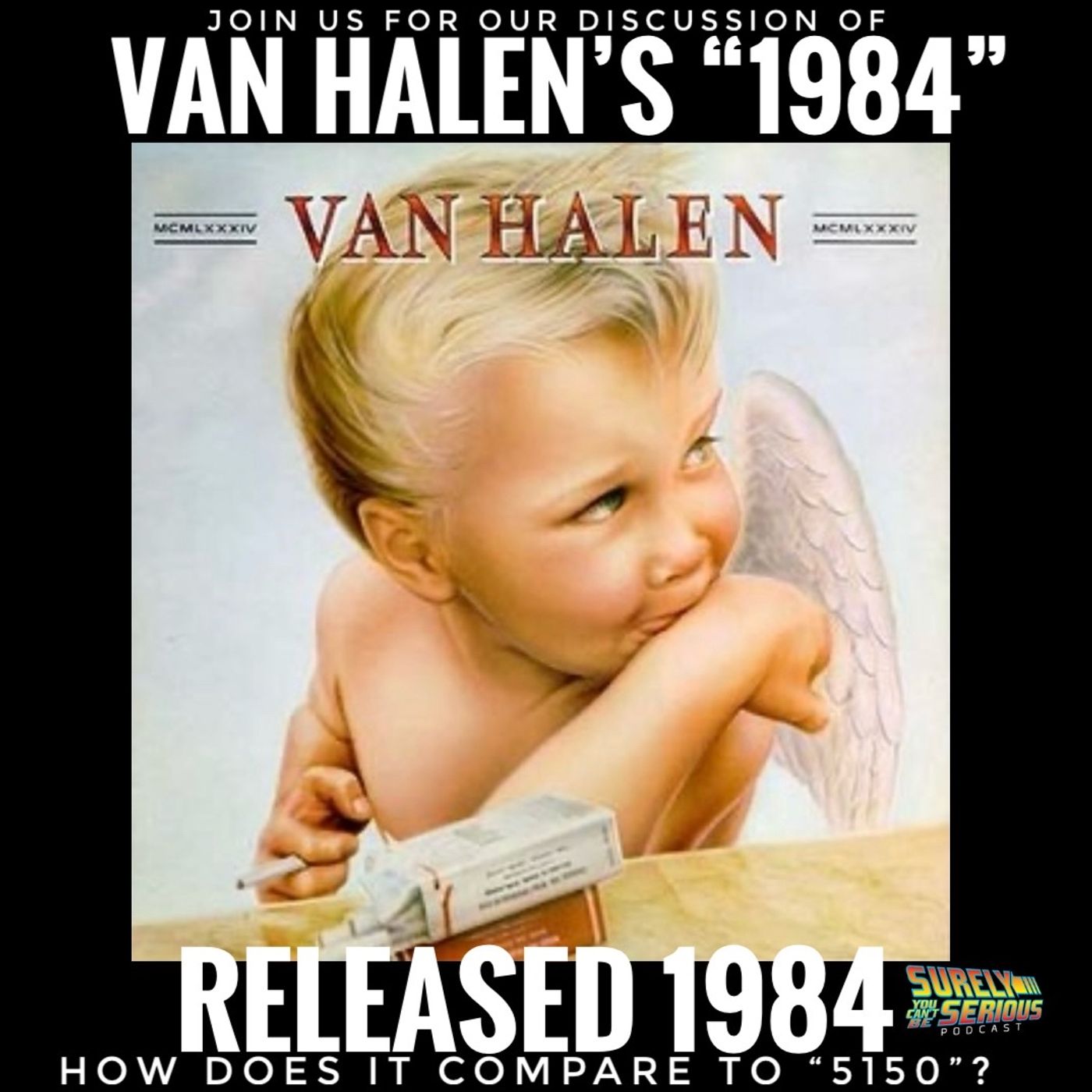
Van Halen "1984" (1984): Track by Track!
This week on the Surely You Can’t Be Serious Podcast, Jason and Dee plug into one of the biggest albums of the decade — 1984 by Van Halen.
From the opening synth blast to the final notes, the guys break down every track and every iconic MTV video — unpacking the stories behind “Jump,” “Panama,” “Hot for Teacher,” and the deep cuts that made this record more than just a hit factory. They dive into the bold decision to lean into keyboards, the risks that paid off, and how Eddie’s newly built home studio, 5150, gave him the creative freedom to reshape the band’s sound.
But this isn’t just the story of a blockbuster album. It’s also the story of a band at a crossroads. As 1984 climbed the charts, tensions inside the group were rising — creative differences, control issues, and big personalities pulling in different directions. Jason and Dee explore how the very freedom that fueled the album may have also widened the cracks that would soon lead to a seismic lineup change.
And the debate doesn’t end here. Next week, the guys will square off 1984 against the first album with new frontman Sammy Hagar, 5150, in what promises to be one of their biggest matchups yet.
Was 1984 the band’s creative peak? Or was the next era just getting started? Listen in and get ready for the showdown.
Support us on Patreon: https://www.patreon.com/c/surelypodcast
Follow us on YouTube: https://www.youtube.com/@surelypodcast
Check out our new merch store: https://surely-you-cant-be-serious-merch.myshopify.com/
From the opening synth blast to the final notes, the guys break down every track and every iconic MTV video — unpacking the stories behind “Jump,” “Panama,” “Hot for Teacher,” and the deep cuts that made this record more than just a hit factory. They dive into the bold decision to lean into keyboards, the risks that paid off, and how Eddie’s newly built home studio, 5150, gave him the creative freedom to reshape the band’s sound.
But this isn’t just the story of a blockbuster album. It’s also the story of a band at a crossroads. As 1984 climbed the charts, tensions inside the group were rising — creative differences, control issues, and big personalities pulling in different directions. Jason and Dee explore how the very freedom that fueled the album may have also widened the cracks that would soon lead to a seismic lineup change.
And the debate doesn’t end here. Next week, the guys will square off 1984 against the first album with new frontman Sammy Hagar, 5150, in what promises to be one of their biggest matchups yet.
Was 1984 the band’s creative peak? Or was the next era just getting started? Listen in and get ready for the showdown.
Support us on Patreon: https://www.patreon.com/c/surelypodcast
Follow us on YouTube: https://www.youtube.com/@surelypodcast
Check out our new merch store: https://surely-you-cant-be-serious-merch.myshopify.com/
2026-03-24
70 min
Transcript
Available Results
Generated results are saved to the knowledge database for reuse and search.
No generated results are available for this episode yet.
Extract Knowledge
Pick what you want extracted first. Model, scope, and chapter options appear after a template is selected.
Generated results for public episodes are saved to the knowledge database so they can be reused and searched later.
Transcript
<v Speaker 1>I'm Jeff Johnson with a film by podcast here with
<v Speaker 1>the co creator of our show and my best friend
<v Speaker 1>of thirty plus years, Brad Kozo.
<v Speaker 2>Wow thirty years now, you remember that spring break we
<v Speaker 2>had in panamng Oh.
<v Speaker 1>Yeah, that was the trip we hung out poolside with
<v Speaker 1>that girl who had the drop dead legs.
<v Speaker 3>I tried to warn you she was a girl gone bad.
<v Speaker 2>We didn't agree about her, but we do agree on
<v Speaker 2>the things that matter, Like, obviously, the greatest guitarist of
<v Speaker 2>all time is Eddie.
<v Speaker 1>And Helen, which is why it goes without saying that
<v Speaker 1>the greatest rock band of all time is Van Halen Halen.
<v Speaker 2>I don't want to jump to conclusions, but it's safe
<v Speaker 2>to say we agree on the band's best front man
<v Speaker 2>though too.
<v Speaker 3>Right.
<v Speaker 1>Well, sure, David Lee Hagar, hold up, you think Diamond
<v Speaker 1>Dave is better than the Red Rocker. Next, you're gonna
<v Speaker 1>tell me that nineteen eighty four is a better album.
<v Speaker 3>Than fifty one to fifty. Well it is.
<v Speaker 4>I don't know how long you'll need to convince me
<v Speaker 4>of that, but I'll wait.
<v Speaker 2>I think I'll let Jason Indeed do that for me,
<v Speaker 2>because this week the surely you can't be serious podcast
<v Speaker 2>is rocking out. Track by track van Halen's nineteen eighty four.
<v Speaker 4>Hey, everybody heard you missed us.
<v Speaker 3>We're back.
<v Speaker 4>Brought my pencil, Give me something to ride on. I
<v Speaker 4>don't feel tardy.
<v Speaker 3>That's my favorite line. I wanted that line. How's it going, everybody?
<v Speaker 3>We are back again for another van Halen episode. Now,
<v Speaker 3>in twenty twenty, we did van Halen Versus van Hagar
<v Speaker 3>as a kind of collective. We reviewed basically all of
<v Speaker 3>the history of van Halen for our first two episodes,
<v Speaker 3>and then for our final third episode, we kind of
<v Speaker 3>talked about the transition into van Hagar. Jason was a
<v Speaker 3>van Hagar fan. I was a van Halen fan. Not
<v Speaker 3>that he's not, but right, there's definitely he sided with
<v Speaker 3>van Hagar and I sided with van Halen. Now, since then,
<v Speaker 3>it was six years ago. Yeah, since then a lot
<v Speaker 3>of things have happened, most notably the passing of Vennie
<v Speaker 3>van Halen.
<v Speaker 4>Sure, sure, and you know we've had six seasons to
<v Speaker 4>get better that those first episodes. I actually listened to them. Yeah,
<v Speaker 4>I don't think our mic was as good, and maybe
<v Speaker 4>my voice wasn't as strong as I would have liked,
<v Speaker 4>but the information I think is there. And if you
<v Speaker 4>want to know about Van Halen, go back and listen
<v Speaker 4>those episodes.
<v Speaker 3>There's some of my favorite episodes. We did a rerun
<v Speaker 3>of them back in like I think twenty twenty two
<v Speaker 3>or so. And here's my oath to you all. Today.
<v Speaker 3>The information would give you is going to be copious,
<v Speaker 3>and I'm going to say ninety percent of it stuff
<v Speaker 3>that's not in those old episodes. So if you want
<v Speaker 3>more of the history, you haven't heard those old episodes,
<v Speaker 3>go check them out. I still love listening to them.
<v Speaker 3>I listened to them before we did this podcast just
<v Speaker 3>to kind of refresh my recollection. But today I'm giving
<v Speaker 3>you all kinds of new information. So don't skip this
<v Speaker 3>one just because you've heard those old ones and the
<v Speaker 3>other on about me. I got new information too you.
<v Speaker 3>I don't know what you This is part of what
<v Speaker 3>we do. I don't know what he has. He doesn't
<v Speaker 3>know what I have. We just come and we just go,
<v Speaker 3>right and yeah, we come and go. And also what's
<v Speaker 3>happened since then is we've covered one more Van Halen album.
<v Speaker 4>We did Long Cold Winter by Cinderella versus Ou eight
<v Speaker 4>one two we did that two seasons ago.
<v Speaker 3>I think, yeah on.
<v Speaker 4>The wall right there, Yeah, and uh and I love
<v Speaker 4>that album as well. So one of these days we'll
<v Speaker 4>probably work our way through most of the van Halen catalog.
<v Speaker 3>Yeah, so here we are season seven. I mean that
<v Speaker 3>one we did album to album, but we didn't include
<v Speaker 3>a Van Halen a David Lee Roth album against the
<v Speaker 3>Van Hagar album. This one. Once again, we're back with
<v Speaker 3>Van Halen versus Van Hagar and two sequential albums. Right,
<v Speaker 3>we have nineteen eighty four, which came out in nineteen
<v Speaker 3>eighty four, and then just a year later we have
<v Speaker 3>fifty one to fifty fifty eighty six. So they recorded
<v Speaker 3>an eighty five released an eighty six. That's right.
<v Speaker 4>The reason why they named this album nineteen eighty four.
<v Speaker 3>Do you know this because it was nineteen eighty four.
<v Speaker 4>Well, one would think that George Orwell no, but I
<v Speaker 4>will say that Van Halen I think did a lot
<v Speaker 4>as far as wrestling the nineteen eighty four title back
<v Speaker 4>from George Orwell, okay, to be a positive thing. We've
<v Speaker 4>talked about how nineteen eighty four might be the greatest
<v Speaker 4>year in pop culture.
<v Speaker 3>By the way, go check out our friend David Wright
<v Speaker 3>def Dave's new podcast he's just come out with Just
<v Speaker 3>come Out. It is all about the year nineteen eighty.
<v Speaker 4>Four chronologically through nineteen eighty four. It's called Deaf Dave's
<v Speaker 4>nineteen eighty four.
<v Speaker 3>Go check it out. So he argues it is the
<v Speaker 3>best year in eighties history, which would make it the
<v Speaker 3>best year in our lifetimes. I suppose, very very possibly. Yeah.
<v Speaker 4>But the reason why the Van Halen Brothers decided to
<v Speaker 4>call this nineteen eighty four was because the record company
<v Speaker 4>was pushing them to get this thing out before it
<v Speaker 4>was ready aka nineteen eighty three, right, and they're like,
<v Speaker 4>we're gonna call this nineteen eighty four so as a
<v Speaker 4>get off our back and let us do our thing right.
<v Speaker 3>So we've got tons of songs to talk about. I
<v Speaker 3>just got a real quick I got to say this.
<v Speaker 3>This was one of the first three cassettes that I
<v Speaker 3>ever owned. Okay, it was Minute Work, it was Wham
<v Speaker 3>Make It Big, and it was this. Those were the
<v Speaker 3>three first tapes that I owned. And that's a that's
<v Speaker 3>a variety of that.
<v Speaker 4>That's a good selection. Wham Make It Big We've already
<v Speaker 4>covered yep, go check that out minute work we're covering in.
<v Speaker 3>Just a few weeks yep.
<v Speaker 4>And then this week, of course we're covering today. And
<v Speaker 4>those are three great tapes. I can't fault you.
<v Speaker 3>Michael Jackson in there somewhere. Well, Michael Jackson was my
<v Speaker 3>first LP. I had him before I had any of
<v Speaker 3>the cassettes. I had Thriller on vinyl.
<v Speaker 4>Okay, So this album was released January ninth of nineteen
<v Speaker 4>eighty four. Although I did play a trivial pursuit game.
<v Speaker 4>The question was when was Van Helen's nineteen eighty four
<v Speaker 4>album released, and it said December thirty first, nineteen eighty three.
<v Speaker 3>Yeah, And there was something about the release of a single.
<v Speaker 4>But the video for Jump was released at midnight nineteen
<v Speaker 4>eighty four, right, so.
<v Speaker 3>It's midnight where on the East Coast where MTV was,
<v Speaker 3>because it would probably still be in December thirty first
<v Speaker 3>for the three other time zones in the US.
<v Speaker 4>For US, namely exactly good point, good point. So this
<v Speaker 4>is the last album to feature David Lee Roth until twenty.
<v Speaker 3>Twelve Sixth Studio Album.
<v Speaker 4>Sixth studio album. This album only reached number.
<v Speaker 3>Two because of Thriller.
<v Speaker 4>Because of Thriller which was helped by.
<v Speaker 3>Eddie Van Halen solo on the beat It album.
<v Speaker 4>Right now, most people will say either you're nineteen eighty
<v Speaker 4>four and before fans, or you're fifty one to fifty
<v Speaker 4>and beyond. But to me, I think that the split
<v Speaker 4>really happens pre nineteen eighty four. From that point on,
<v Speaker 4>Eddie was in love with the synthesizer, and so to me,
<v Speaker 4>that's the more logical split. But we'll talk about that.
<v Speaker 3>So I you know, I thought of that very thing.
<v Speaker 3>I think that keyboards and synthesizers are that point of transition.
<v Speaker 3>I think this. I disagreed with you back when we
<v Speaker 3>have Van Halen versus Van Haanguard six years ago. I'm
<v Speaker 3>going to go ahead and say, even though there have
<v Speaker 3>been other synthesizers in their catalog before this, this is
<v Speaker 3>a different transition and I will tell you why. But
<v Speaker 3>I want to tell you after we cover our first
<v Speaker 3>song on the album, which is nineteen eighty four. Okay,
<v Speaker 3>so there's a lot of synthesizer over here. I mean
<v Speaker 3>it's kind of making its announcement, right. I got no drums, nope,
<v Speaker 3>and no bass, right, I got no guitar, right? This
<v Speaker 3>is a van of Haleen song with no guitar. Yes,
<v Speaker 3>what the heck is happening here?
<v Speaker 4>Last synth?
<v Speaker 3>Okay, so I've mentioned before this isn't the first time
<v Speaker 3>that they've used a synthesizer or keyboards in their stuff,
<v Speaker 3>right right, Okay, So do you you remember what album
<v Speaker 3>came out right before this album? Now, it wasn't even
<v Speaker 3>supposed to be an album.
<v Speaker 4>You know that they released the single pretty Woman, and
<v Speaker 4>it did so well that the record company is like,
<v Speaker 4>you guys got to have an album to go along
<v Speaker 4>with a song, and so they rushed through. It's basically
<v Speaker 4>a bunch.
<v Speaker 3>Of covers, right, and you remember that we I mean,
<v Speaker 3>they couldn't come up with enough new material that fast.
<v Speaker 3>So yeah, they've made a lot of covers. But Dave
<v Speaker 3>had initially said I want to do Dancing in the streets.
<v Speaker 3>Eddie was like, I don't know how to van Haal
<v Speaker 3>and eize that there's no part for me. Yeah, so
<v Speaker 3>Eddie said let's do pretty Woman instead. Pretty Woman, as
<v Speaker 3>you said, becomes a hit and they are demanding a
<v Speaker 3>new album and they're rushing to get moved more music.
<v Speaker 3>So they do covers, including Dancing in the Streets. Yes,
<v Speaker 3>but part of what they're doing with Pretty Woman is
<v Speaker 3>they've got that video, which we discussed at link. It
<v Speaker 3>is a crazy video which yes, does involve a woman
<v Speaker 3>who appears to be chained up being attacked.
<v Speaker 4>By a little less by little people, yes, who was
<v Speaker 4>not really a woman, which was news to me.
<v Speaker 3>So as it turns out like they spent a whole
<v Speaker 3>lot of money on that video, Okay, and the video
<v Speaker 3>the idea that they had for the video was significantly
<v Speaker 3>longer than the song had to play, right, and so
<v Speaker 3>they came up with an introduction to the part and
<v Speaker 3>that is called Intruder. Yeah, right now, Intruder uses keyboards
<v Speaker 3>in it, he does. Yeah, And you know what, it's
<v Speaker 3>the fourth song that they've had that uses keyboards, the fourth. Okay,
<v Speaker 3>So Intruder was written by David Lee Ross so that
<v Speaker 3>they could fill this space in this music video that
<v Speaker 3>they've done. All right, they spend all of this money
<v Speaker 3>and the video ultimately gets banned. They don't even get
<v Speaker 3>to show it.
<v Speaker 4>On it because because you have a transnational being molested
<v Speaker 4>by little.
<v Speaker 3>People one of many reasons I share it. And so
<v Speaker 3>you've got so this is Intruder is the fourth one.
<v Speaker 3>The first one was and the credible rock. The second
<v Speaker 3>one is so this is love okay, and also off
<v Speaker 3>a fair warning? Is this song called Sunday in the
<v Speaker 3>Park okay, now sending the park. I sent it to
<v Speaker 3>you earlier today. It is. It's definitely keyboards, but it's
<v Speaker 3>like the dark kind of rush, you know, like mystic
<v Speaker 3>sounding keyboards. It sounds ominous. And eddievan Halen actually wrote
<v Speaker 3>this about the Valerie Bertinelli as they were engaged and
<v Speaker 3>he was frustrated and angry. It's like this dark and
<v Speaker 3>foreboding thing. Playfleek titled Sunday in the Park, which sounds
<v Speaker 3>much much nicer. Right. So there have been four solid
<v Speaker 3>songs that they have done with keyboards in them. And
<v Speaker 3>everybody is up in arms about this album being the
<v Speaker 3>synth album and they've gone synth pop and is it
<v Speaker 3>really different? And I'm gonna say the answer is yes,
<v Speaker 3>it's different. It's different, okay. And it's different because of
<v Speaker 3>the next song that we're about to play. Yes, obviously
<v Speaker 3>before I get into jump, because we're not there yet, right,
<v Speaker 3>let me tell you a story. In eighty one, they
<v Speaker 3>in their Fair Warning tour. Then they have this hit
<v Speaker 3>song they have to produce diver down. In April of
<v Speaker 3>eighty two, Eddie Van Halen goes to see a guy
<v Speaker 3>named Alan Holtzworth play. He is a guitarist guitarist and
<v Speaker 3>is incredibly good and Eddie is not only watching him
<v Speaker 3>but playing with him a little bit. And do you
<v Speaker 3>know who is in the crowd there with him? A
<v Speaker 3>young guitarist who's Frank Zappa's guitarist, a guy named Steve Vi.
<v Speaker 3>Steve Vi. And so Steve I meets Eddie Van Halen.
<v Speaker 3>They talk for a bit and Steve is like, Hey,
<v Speaker 3>if you ever want to meet Frank, here's my number.
<v Speaker 3>Give me a call. I'll get you guys hooked up.
<v Speaker 3>So Eddie does want to meet Frank because he is
<v Speaker 3>a guitar virtuo, soho he is, And so he calls
<v Speaker 3>and Steve isn't there, but Steve's roommate gives Eddie the number.
<v Speaker 3>Eddie calls gets Frank's wife, Gail, who has a kind
<v Speaker 3>of weird accent, and she's like, Frank, You've got a
<v Speaker 3>call from Eddie Edvard Edvard van Halen, And so Frank's
<v Speaker 3>talking to him and he's like trying to figure out
<v Speaker 3>is this really Eddie Van Halen that I'm talking to here,
<v Speaker 3>and he's like Duezel, who's twelve at this point, He's like, Duezel,
<v Speaker 3>you like Van Halen. He's like yeah. He's like, come here,
<v Speaker 3>tell me if this is really him. Like they talking
<v Speaker 3>a bit and he's like, yeah, I recognize in his
<v Speaker 3>voice from like fair Warning or something like that, which
<v Speaker 3>it wasn't even anyway, that's not a portant. He was wrong,
<v Speaker 3>it wasn't even any but anyway, Yeah, he's like, yeah, Dad,
<v Speaker 3>that's really Eddie van Halen. And then Eddie van Halen
<v Speaker 3>shows up at their house and he's like playing with
<v Speaker 3>him a little bit. He's like, I want to hear
<v Speaker 3>more of your stuff. So he goes back to his
<v Speaker 3>own house, which is a few blocks away, gets three
<v Speaker 3>Van Halen albums, brings them back, and Frank Zappa is like,
<v Speaker 3>I gotta tell you thank you for reinventing.
<v Speaker 4>The electric guitar, inventing the electric guitar.
<v Speaker 3>Because I thought you guys were just another ac DC
<v Speaker 3>and I was wrong. And of course Dweezel a starstruck
<v Speaker 3>because he loves Van Halen well.
<v Speaker 4>And remember Frank Zappa is notorious for being incredibly hard
<v Speaker 4>on musicians.
<v Speaker 3>Oh, Steve Lucather got.
<v Speaker 4>Thrown out, like laughed out of the room for being
<v Speaker 4>terrible on guitar.
<v Speaker 3>Yeah, Steve I is the virtuoso that he is because
<v Speaker 3>he was whipped into submission by Frank Zappa. So Frank, Eddie,
<v Speaker 3>and Steve Vai all are together jamming at Frank's house.
<v Speaker 3>In Frank's studio. Dewezl is there. He's trying to help
<v Speaker 3>and take part in things, and Eddie actually help helps
<v Speaker 3>Dewesel write his first song. He's got a little twelve
<v Speaker 3>year old band and a song is called My Mother's
<v Speaker 3>a Space Cadet. Right, And on the credits it was
<v Speaker 3>a pressed album. On the credits, the Vards are listed
<v Speaker 3>as the Vards because he was Edward.
<v Speaker 4>Yes, before you go for the quick trivia question for you, Okay,
<v Speaker 4>we'll see how you do on this. Yeah, we're getting
<v Speaker 4>ready to cover a movie pretty soon that has deesel
<v Speaker 4>Zappa in it. I don't know pretty in Pink has
<v Speaker 4>disel Zappa. He was dating Molly Ringwold at the time
<v Speaker 4>they filmed that movie.
<v Speaker 3>Wow. So there's that.
<v Speaker 4>And then Steve I of course leaves Frank Zappa and
<v Speaker 4>goes on to play for Davily Roth and then of
<v Speaker 4>course White Snake after that.
<v Speaker 3>Yep. So I tell you all this to say Eddie
<v Speaker 3>was inspired by what Frank was able to do because
<v Speaker 3>he was one of the guys who had fought against
<v Speaker 3>Warner Brothers for a long time to be able to
<v Speaker 3>do his own stuff. And the way he kind of
<v Speaker 3>made that work was he built his own studio.
<v Speaker 4>I'll do it at my house where nobody is there
<v Speaker 4>but me. Yes, And I do think that that's the
<v Speaker 4>key shift here, because Eddie takes notes from this and says,
<v Speaker 4>I'm tired of Dave and Ted Tembleman bean over my
<v Speaker 4>shoulder all the freaking time. Yes, I'm building a studio
<v Speaker 4>at my house.
<v Speaker 3>Yes, which I'm going to talk about in just a second,
<v Speaker 3>but real quick. Just as a kind of cute side story, Yep.
<v Speaker 3>Dweezle ultimately ends up doing Running with the Devil with
<v Speaker 3>his band. At a talent show. He calls Eddie because
<v Speaker 3>it's like my guitar keeps going out of tune, and
<v Speaker 3>so Eddie goes to visit him, goes back to his
<v Speaker 3>house and brings him a guitar that has these locking nuts.
<v Speaker 3>This is Floyd Rose brand new gear. You put these
<v Speaker 3>locking nuts on the guitar and it helps it from
<v Speaker 3>going out of time tune when you use the whammi bar,
<v Speaker 3>which you have to in Running with the Devil, and
<v Speaker 3>he gives him the guitar, just gives it to him.
<v Speaker 3>Here you go. Here's an Eddie Van Halen Floyd Rose
<v Speaker 3>locking nut guitar. Oh, by the way, you're not playing
<v Speaker 3>that right, let me show you how to really play it.
<v Speaker 3>Teaches him how to actually play it for his talent show.
<v Speaker 3>There's a lot of question about whether whether Eddie is
<v Speaker 3>a good guy or an asshole, and I think it's
<v Speaker 3>probably both. Probably both, And I mean Shirley substance abuse
<v Speaker 3>had something to do with all of that. He did
<v Speaker 3>a lot of this, He did a lot of a
<v Speaker 3>lot of stuff. Yeah, but he definitely has a lot
<v Speaker 3>of moments of being a genuinely nice guy. I think
<v Speaker 3>that's true. This is one of those moments, right. Yeah.
<v Speaker 3>So Eddie and Don Landy the light is shown, they're like,
<v Speaker 3>we have to build our own studio. They don't go
<v Speaker 3>for the top technology. They go for what sounds good
<v Speaker 3>and what they can find at the part store.
<v Speaker 4>Imagine working at radio shack and Eddie walks in, Oh yeah,
<v Speaker 4>I'm looking for some parts and build my.
<v Speaker 3>I mean in the one ads you know, probably the
<v Speaker 3>equivalent of Craig Craig list in nineteen eighty two. Right,
<v Speaker 3>they come across this Bill Pullman recording board, which I
<v Speaker 3>mean was state of the art at the time. But
<v Speaker 3>this thing was a piece of crap, and Eddie said,
<v Speaker 3>we bought it, and it was a piece of crap,
<v Speaker 3>like it was useless. But Don Landy tinkered around with
<v Speaker 3>it for a few days and basically rewired the whole thing,
<v Speaker 3>and then it became the soundboard that they used in
<v Speaker 3>the new studio.
<v Speaker 4>Well, and that goes along with Eddie before. What we've
<v Speaker 4>talked about before is he took a cast off guitar
<v Speaker 4>body and made the Frankenstrat out of it. Yes, he's
<v Speaker 4>kind of a tinkerer. He's got about four different patents
<v Speaker 4>at the US Patent Office for his tinkering around with stuff, right,
<v Speaker 4>that's right, including a little lever behind the guitar so
<v Speaker 4>you can play with both hands.
<v Speaker 3>Yes, like a piano.
<v Speaker 4>Like a piano.
<v Speaker 3>So Eddie is on tour, so he's only kind of
<v Speaker 3>partially taking part in this, so Don Landy, Bill Weiss
<v Speaker 3>and Valerie's brothers, the Burton Earlier brothers are over there
<v Speaker 3>working on the studio while Eddie's touring. And apparently the
<v Speaker 3>requirement was that they have blazing saddles playing at all times,
<v Speaker 3>and Valerie would continually bring out dacrease for everybody to
<v Speaker 3>be drinking. Excuse me, well, I whipped this up. And
<v Speaker 3>so oh and the other thing was zoning laws in
<v Speaker 3>California at that that area. Yeah, yeah, no, studios not allowed.
<v Speaker 3>So you know what eddievan Alan did what he built
<v Speaker 3>a racketball court. That's good. He built a racketball court
<v Speaker 3>which was allowed, and then it ended up having a
<v Speaker 3>bunch of recording equipment inside of it.
<v Speaker 4>Oddly enough, I have a story about that same studio
<v Speaker 4>in about three socks.
<v Speaker 3>Okay. Their first problem is there's an am antenna very
<v Speaker 3>close to the house and they're concerned about it getting feedback,
<v Speaker 3>so they literally wrap the thing in chicken wire and
<v Speaker 3>then cement around the chicken wire so that it eliminates
<v Speaker 3>all of the you know, the bleeding in of any
<v Speaker 3>radio signals. So it's they keep it at sixty four
<v Speaker 3>degrees the entire time it's so thick. They shoot a
<v Speaker 3>forty four magnum at it, and it does and penetrate
<v Speaker 3>it so that the studio is literally bulletproof.
<v Speaker 4>I mean, I'd like to be there the day that
<v Speaker 4>somebody's like, well, let's test it out, let's see what happens.
<v Speaker 3>Well, so after they test the gun, then they have
<v Speaker 3>to test the sound. The first tape that they put
<v Speaker 3>in is My Mother is a Space Cadet by duezels App.
<v Speaker 3>Oh that's cool, Yeah, I love it. Okay, So there
<v Speaker 3>you go. There's the history of the studio, which is
<v Speaker 3>how we get this album. Now you get you're gonna
<v Speaker 3>tell me about nineteen eighty four. This wee.
<v Speaker 4>Well, before we go into these tidbits, the name of
<v Speaker 4>the studio, Oh right, I mean we got to talk
<v Speaker 4>about that, right, sure. Yeah, the name of the studio
<v Speaker 4>is fifty one fifty.
<v Speaker 3>Fifty one was fifty, which on our previous episode we
<v Speaker 3>talked about how that's the call sign for somebody being
<v Speaker 3>involuntarily committed for being crazy, and.
<v Speaker 4>Of course we'll be talking about fifty one to fifty
<v Speaker 4>next week.
<v Speaker 3>There you go.
<v Speaker 4>So I've got a couple of tidbits on the creation
<v Speaker 4>of this intro. Okay, there is two stories about who
<v Speaker 4>wrote it.
<v Speaker 3>Yes.
<v Speaker 4>One of them is that Eddie wrote it because he
<v Speaker 4>was nooling around on the keyboard, which I find to
<v Speaker 4>be the most likely to be true, okay. And then
<v Speaker 4>the second is that Kevin Dugan, who was Michael Anthony's
<v Speaker 4>bass tech, said no, Michael Anthony, I wrote that song
<v Speaker 4>as an intro to Michael Anthony's bass solo in the concerts. Yeah,
<v Speaker 4>seems like different origin stories to me, significantly different origin stories.
<v Speaker 3>And I listened to the like the live version of
<v Speaker 3>the intro song that plays for Michael Anthony's bass solo,
<v Speaker 3>and it is that that sound, but I didn't hear
<v Speaker 3>any of the rest of it, So I think maybe
<v Speaker 3>it's a nomination, maybe blending of the ideas. Yes, Yeah,
<v Speaker 3>And apparently like Don Landy was supposed to have recorded
<v Speaker 3>Eddie noodling around on the keyboards for forty five minutes
<v Speaker 3>and just kind of plucked these things out as tight
<v Speaker 3>as this is, I find that hard to believe as well.
<v Speaker 3>So it's it's probably a mishmash, probably a combination. Yeah.
<v Speaker 3>By the way, fifty Studios was so noisy that the
<v Speaker 3>neighbor complained who the neighbor.
<v Speaker 4>Was, Lindsay Wagner. And you're still in my story bionic woman. Yes, yeah, yes,
<v Speaker 4>she would call Valerie Bartonelli and tell her to shut
<v Speaker 4>the doors because people are trying to sleep around here. Oh,
<v Speaker 4>by the way, I have bionic hearing.
<v Speaker 3>So Eddie is a keyboardist at heart, right, like he's
<v Speaker 3>a concert pianist right, trained classically, never learned to read music,
<v Speaker 3>but could from his ear be able to play all
<v Speaker 3>these classical pieces, which is why you get a whole
<v Speaker 3>lot of classical in the solos that he does. But
<v Speaker 3>he was really pushing to do more keyboard stuff and
<v Speaker 3>was getting a lot of resistance from Ted Templeman and
<v Speaker 3>from David Lee Roth. Right. He even composed something on
<v Speaker 3>the Moog synth that Ted Templeman and David Lee Roth
<v Speaker 3>stole and put in Dancing in the Streets, so you'll
<v Speaker 3>hear you'll hear a synth in Dancing in the Streets
<v Speaker 3>that Eddie wrote, but not for that song, like, so
<v Speaker 3>he was pissed that they put it in that song.
<v Speaker 3>So he has this, he has this song. Eddie says,
<v Speaker 3>this is a blending of the rolling Stones. Get off
<v Speaker 3>of my cloud and Your Kiss is on My List
<v Speaker 3>by Holland Oates. I know Man. So he plays it
<v Speaker 3>for David Lee Roth in nineteen eighty two, and davidly
<v Speaker 3>Roth says, you're a guitar god. No one wants to
<v Speaker 3>hear you play the keyboards. Yes. He plays it for
<v Speaker 3>Ted Templeman in nineteen eighty three, and Ted Templeman is like,
<v Speaker 3>you're a heavy metal band. If we're going to have keyboards,
<v Speaker 3>it needs to sound like Sunday afternoon in the park
<v Speaker 3>and needs to sound deep and dark. And what you're
<v Speaker 3>playing for me right now sounds like what they would
<v Speaker 3>play between the innings in a baseball game. I heard that. Yeah,
<v Speaker 3>at some point, Eddie Van Halen just said, you're wrong,
<v Speaker 3>and we're going to do this song. And now that
<v Speaker 3>we're doing it in my own studio, I'm going to
<v Speaker 3>make it sound the way I want it to sound.
<v Speaker 3>And here's how he wanted it to sound. So this
<v Speaker 3>was one of three songs that they had worked up
<v Speaker 3>that Eddie Van Hanlon, Alex and Don Landy had worked up.
<v Speaker 3>They had worked up all Wait, they'd worked up Dropped
<v Speaker 3>Dead Legs. Those were more sketches, but Jump they had
<v Speaker 3>really fleshed out as you know the bass track, and
<v Speaker 3>so Ted Templeman is like, Okay, I can live with this,
<v Speaker 3>and he says, Dave, go write some lyrics. And do
<v Speaker 3>you know how Dave writes his lyrics.
<v Speaker 4>He has one of the roadies drive him around in
<v Speaker 4>his car and he sits in the back and hey,
<v Speaker 4>crank it up and I'll get my sunglasses on. We'll
<v Speaker 4>drive around town and I'll think of something.
<v Speaker 3>His fifty one low writer Mercury.
<v Speaker 4>So he's driving around and he remembers the story where
<v Speaker 4>there was a guy on top of the Arco towers
<v Speaker 4>in LA who was going to commit suicide and they
<v Speaker 4>were news reporters there, and you know, there's a bunch
<v Speaker 4>of people like please, no.
<v Speaker 3>Don't do it, and he's only jump.
<v Speaker 4>There's always one person in the crowd who's like, go
<v Speaker 4>ahead and jump, jump, jump. And he thought that is
<v Speaker 4>a great line number one, some rebellious attitude, but it's
<v Speaker 4>also this kind of take a leap, do something, you know,
<v Speaker 4>go out and live life, you know, do it how
<v Speaker 4>you want.
<v Speaker 3>To do it. Yeah, davidly Ross said that people kind
<v Speaker 3>of gave it this motivational inspiration, but really it was
<v Speaker 3>good to jump, jump and jump. He said, the guy
<v Speaker 3>was going to check out early, going to take the
<v Speaker 3>thirty three story drop. I love it. I love it.
<v Speaker 4>By the way, I've got a quote for you on
<v Speaker 4>what Eddie van Halen said. His actual quote in regards
<v Speaker 4>to the pushback he was getting on the synthesizer. He
<v Speaker 4>said there were some people, namely Ted Templeman and davidly Roth,
<v Speaker 4>who did not want him to play the synthesizer, and
<v Speaker 4>his quote was, I'll play the freaking Bavarian cheese whistle
<v Speaker 4>if I can do it well, right, I'm doing this right,
<v Speaker 4>And I thought, man, the Bavarian cheese whistle.
<v Speaker 3>Let's go. Yeah, I can't play the Bavarian cheese whistle. Actually,
<v Speaker 3>can you really? No, I have no idea.
<v Speaker 4>Yes, I don't even know.
<v Speaker 3>That the Bavarian whistle. Okay, so real quick. The song
<v Speaker 3>number one was originally called go Ahead and Jump, Go
<v Speaker 3>ahead and ju just jump right. It was also the
<v Speaker 3>one they were going to put the car sounds in
<v Speaker 3>The car sounds that we're gonna hear in our next
<v Speaker 3>song originally were in this song, but they were like, nope,
<v Speaker 3>doesn't fit right. Take it out.
<v Speaker 4>You know where it was where what was so in
<v Speaker 4>the chorus where he's like, might as well jump, it
<v Speaker 4>was in place of the echoing jump.
<v Speaker 3>Oh nice. OK, So there you go.
<v Speaker 4>Before you talk about the music video, which I'm dying
<v Speaker 4>to talk about. This song hit number one February twenty fifth,
<v Speaker 4>nineteen eighty four. It is their only number one song.
<v Speaker 4>It knocked out Karma Chamelion stayed for five weeks, and
<v Speaker 4>I think there's a case to be made that it
<v Speaker 4>is the most iconic song of the nineteen eighties.
<v Speaker 3>This was on MTV at its inception so much and
<v Speaker 3>after they had spent so much money on the Pretty
<v Speaker 3>Woman video only to have it banned, They're like, let's
<v Speaker 3>go with a minimalist approach to this one.
<v Speaker 4>Yeah, there's like black dropcloths and their instruments and nothing else. Right,
<v Speaker 4>They're running around doing a whole lot of nothing. Although
<v Speaker 4>I think you're getting ready to tell me. Yeah, but
<v Speaker 4>they filmed a bunch of sort of stuff that they
<v Speaker 4>did not use in this video.
<v Speaker 3>So the director is Robert Lombardi, Okay, and he's filming
<v Speaker 3>this video. He's doing this minimalist approach. He's got Pete
<v Speaker 3>Angelus also filming. But he says, we didn't use any
<v Speaker 3>of that footage because Pete doesn't know how to use
<v Speaker 3>a sixteen million million camera. Right now, we're going to
<v Speaker 3>talk about Pete Angelis a few times. And I said
<v Speaker 3>to you that the shirt I'm wearing is important. And
<v Speaker 3>do you know.
<v Speaker 4>Why Crazy brothers the Black Crows?
<v Speaker 3>Okay, if you will go back and listen to our
<v Speaker 3>Black Crows album to shake your money maker. Yes, Pete
<v Speaker 3>Angelis was the guy who managed the Black Crows after
<v Speaker 3>he got fired by David Lee Roth after he went
<v Speaker 3>with David Lee Roth because he was the one who
<v Speaker 3>had helped he helped up with the original nineteen eighty
<v Speaker 3>four videos, and he was a big influence in all
<v Speaker 3>of the David Lee Roth videos that immediately followed. I
<v Speaker 3>forgot about that, yeah, And so he was the one
<v Speaker 3>that actually taught Chris Robinson how to be a stage
<v Speaker 3>presence and on the stage. What guy is better to
<v Speaker 3>do that than the guy who spent years with David
<v Speaker 3>Lee Roth? Right? Nobody, right? Okay, So davidly Roth Is
<v Speaker 3>he is pressuring Robert Lombardi to do more stuff. Film
<v Speaker 3>a bunch of more of him, more of David Lee Roth. Right,
<v Speaker 3>lots of footage shot where David is just the center
<v Speaker 3>of attention right driving around. He's getting arrested, and so
<v Speaker 3>Robert Lombardi goes to Alex and Eddie and he's like, listen, guys,
<v Speaker 3>I don't think this fits the video. It just doesn't
<v Speaker 3>seem right. And they're like, we agree with you. We
<v Speaker 3>don't want to use that footage. And so the footage
<v Speaker 3>got cut. Bad part was you don't go behind Davide
<v Speaker 3>Roth's back. And he reported to their management and the
<v Speaker 3>management was like, you're fired. Yeah. So the director not just.
<v Speaker 4>You're fired, here's your check. You're fired. Never want to
<v Speaker 4>see you again.
<v Speaker 3>Right you. And this is the guy who essentially directed,
<v Speaker 3>if not the most, one of the most iconic videos
<v Speaker 3>of course, yeah Crazy.
<v Speaker 4>It goes on to win the VMA Award for Best
<v Speaker 4>Performance Video.
<v Speaker 3>Yeah, nominated for a couple of other spots as well.
<v Speaker 4>Yeah Yeah, and Robert Lombard's like, never got my award.
<v Speaker 3>No, it's terrible. Yeah.
<v Speaker 4>By the way, in this song, it has been confirmed
<v Speaker 4>by both Eddie and Darryl Hall that he stole the
<v Speaker 4>riff from Kisses on My.
<v Speaker 3>List Yeah for jump.
<v Speaker 4>We were talking about Hall of Oates here in just
<v Speaker 4>a few weeks.
<v Speaker 3>Oh that's right. Yeah, So who are we comparing Hollow
<v Speaker 3>Notes to.
<v Speaker 4>Man It Work, Jay Giles Band and hol of Oats
<v Speaker 4>three big albums from nineteen eighty one?
<v Speaker 3>All right, another three way?
<v Speaker 4>Okay, so just a couple more things un jump real quick.
<v Speaker 4>That summer, I remember the Chicago Cubs used it to
<v Speaker 4>introduce all of their baseball games. Yeah, which that's back
<v Speaker 4>when WGN was. Everybody had WGN and you just watch
<v Speaker 4>Cup games all the time. But their retentions already going
<v Speaker 4>on in the band. So Robert Lombard, who you talked
<v Speaker 4>about in the video, he did all of the individual
<v Speaker 4>stuff early in the day. So it's Alex playing the jumps,
<v Speaker 4>it's Michael Anthony run around with the base and he
<v Speaker 4>saved the group stuff until the end of the day
<v Speaker 4>because they were not getting along, Like.
<v Speaker 3>This is the opening track.
<v Speaker 4>They're getting ready to do this twelvemonth own the world
<v Speaker 4>thing and they already can't stand each other.
<v Speaker 3>Right.
<v Speaker 4>Do you want to hear the top ten for February
<v Speaker 4>twenty fifth, nineteen eighty four.
<v Speaker 3>The week that this hit number one?
<v Speaker 4>Oh my god, it brace yourself?
<v Speaker 3>Okay, yeah, here you go.
<v Speaker 4>Number ten an Innocent Man by Billy Joel.
<v Speaker 3>Great One covered it, Yeah.
<v Speaker 4>Number nine, Wrapped Around Your Finger by the Police, Great
<v Speaker 4>One covered it.
<v Speaker 3>Yep.
<v Speaker 4>Number eight Let the Music Play by Shannon made our
<v Speaker 4>best of nineteen eighty four must have been yours.
<v Speaker 3>That wasn't remember that one?
<v Speaker 4>Number seven Nobody Told Me by John Lennon.
<v Speaker 3>Oh oh yeah, yeah yeah yeah.
<v Speaker 4>Number six Joanna by Cool in the Gang.
<v Speaker 3>Yep.
<v Speaker 4>Number five Thriller of course covered it. Number four Girls
<v Speaker 4>Just want to have Fun.
<v Speaker 3>We're going to cover that.
<v Speaker 4>I haven't got there yet, Okay, we will. Number three
<v Speaker 4>ninety nine Left Balloons.
<v Speaker 3>Oh wow Yeah.
<v Speaker 4>Check us out on Patreon.
<v Speaker 3>Yeah.
<v Speaker 4>The number two Karma Kamelion impressive.
<v Speaker 3>List defining the decade.
<v Speaker 4>One more thing in this song you have an incredible
<v Speaker 4>guitar solo, but you also have an incredible keyboard solo
<v Speaker 4>as well. I can't say enough good things about this song.
<v Speaker 3>I love it.
<v Speaker 4>It's iconic. It's one of my f favorite songs.
<v Speaker 3>From the eighties. It is what I would say is
<v Speaker 3>the pinpoint transition of the old van Halen to the
<v Speaker 3>new van Halen. You've made the case, and I say
<v Speaker 3>I now agree with you because even though they have
<v Speaker 3>used keyboards in the past. This is a different sound keyboard.
<v Speaker 3>This is a keyboard up front and at the beginning
<v Speaker 3>in the solo, prominently displayed in the video. This is
<v Speaker 3>a new van Haleen.
<v Speaker 4>It's its own solo. You're right, it's a new Van
<v Speaker 4>Haleen at this point.
<v Speaker 3>Yes, And just in case you were pissed off that
<v Speaker 3>they've made that change, we'll go ahead and bring it
<v Speaker 3>back home to the old style with the next song,
<v Speaker 3>which is Panama.
<v Speaker 4>I'll freaking love this song.
<v Speaker 3>Man.
<v Speaker 4>It rocks my balls.
<v Speaker 3>Man, I think I said back in twenty twenty, this
<v Speaker 3>is my favorite song on the whole album. It might
<v Speaker 3>still be. It's it's between this and hot for teacher
<v Speaker 3>any day of the week.
<v Speaker 4>Right, There's a case to be made for jump as well.
<v Speaker 3>So what do a stripper in Arizona and a dragster
<v Speaker 3>racer from Vegas having gone?
<v Speaker 4>I guess something with the word Panama.
<v Speaker 3>They are both inspirations for this song.
<v Speaker 4>Not the country. Not the country has nothing to do
<v Speaker 4>with the country Panama.
<v Speaker 3>I gotta say it. This will come up again. These
<v Speaker 3>songs are inspired by other songs. These songs are homages
<v Speaker 3>to other songs. I'm gonna have to play dogg Eat
<v Speaker 3>dog By. Oh yeah, you hear it right there.
<v Speaker 4>Just gotta let it get started a little bit.
<v Speaker 3>Oh yeah, there's no question with that drums and that guitar.
<v Speaker 3>It's not an identical copy. No, it's better. Yes, it's
<v Speaker 3>definitely borrowed. Yeah.
<v Speaker 4>I love the inspiration to the creation of this song.
<v Speaker 4>So David Lee Roth is talking to a reporter and
<v Speaker 4>the reporter asks him sort of accuses him of only
<v Speaker 4>writing songs about fast women, partying and fast cars. And
<v Speaker 4>he's like, wait a minute, I haven't written a song
<v Speaker 4>about fast cars. And so he's like, I take that
<v Speaker 4>as a challenge. I am writing a song about a
<v Speaker 4>fast car.
<v Speaker 3>Yeah, the Panama Express from Las Vegas.
<v Speaker 4>You know, we talked about this in previous episodes, but
<v Speaker 4>the revving sound in this song is Eddie's nineteen seventy
<v Speaker 4>two Lamborghini that was given to him as a gift
<v Speaker 4>from Valerie.
<v Speaker 3>Yes, wedding gift.
<v Speaker 4>A wedding gift.
<v Speaker 3>You know who owned it before, Rod Stewart.
<v Speaker 4>Rod Stewart, And this is the car that was in
<v Speaker 4>the shop that Sammy had his Ferrari that the mechanics like, hey, Sammy, Hey, Eddie,
<v Speaker 4>you guys need to get together.
<v Speaker 3>Peanut butter meat, chocolate, chocolate meat, peanut butter.
<v Speaker 4>So this nineteen seventy two Lamborghini is pretty important to
<v Speaker 4>the future of Van Halen.
<v Speaker 3>Yeah. So the single and the video, both released on
<v Speaker 3>the same day. Looks like mid June nineteen eighty four.
<v Speaker 3>Sounds about right, hit number thirteen does okay? Yep. The
<v Speaker 3>video starts off with a plane flying and then a
<v Speaker 3>member of Van Halen flying. Yes, this is the first
<v Speaker 3>time we see the Jack Daniels bass. Yeah.
<v Speaker 4>Michael Anthony was talking to Kevin Duban, who is his
<v Speaker 4>bass technician, and they wanted their own signature guitar like
<v Speaker 4>the Frankenstrat was to Eddie.
<v Speaker 3>Yep.
<v Speaker 4>And while they're thinking about what they're going to do,
<v Speaker 4>they're passing back and forth a bottle of Jack Daniels.
<v Speaker 4>What should we do? Ah, I can't think of anything gold,
<v Speaker 4>And then they're like, I got it. Our guitar is
<v Speaker 4>going to look like the bottle of Jack Daniels, right,
<v Speaker 4>and it's super cool. Right, So they contact Jack Daniels,
<v Speaker 4>and Jack Daniels says, Okay, that's fine as long as
<v Speaker 4>you don't make any more than three at one time,
<v Speaker 4>and so here they show up prominently in the Panama video. Yep,
<v Speaker 4>you know what else shows up in the Panama video
<v Speaker 4>where they're like dangling them and like dragging them across
<v Speaker 4>like it's the bon Jovi living on a prayer stuff.
<v Speaker 4>Several years before that, I read a story where Michael
<v Speaker 4>Anthony's like, when I look at that video, all I
<v Speaker 4>think about is how bad my nuts were getting crushed
<v Speaker 4>by this thing that was swinging us back and forth.
<v Speaker 3>Yeah. So director on this video eat Angelus okay, who
<v Speaker 3>got his revenge after Robert Lombard said this guy can't
<v Speaker 3>do He used all of that footage that Robert Lombard
<v Speaker 3>had shot for the Jump video that Robert Lombard said,
<v Speaker 3>I don't want this in this video, so they put
<v Speaker 3>it in the Panama video instead, including the arrest of
<v Speaker 3>David Lee Roth in a towel which was staged, not
<v Speaker 3>a real arrest.
<v Speaker 4>Yeah, but that added some rock credibility that were super cool.
<v Speaker 4>Of course, the motorcycle, it was well done. I thought
<v Speaker 4>it was cool. Yeah, I do agree with them. I
<v Speaker 4>don't think it fits as well in the Jump video
<v Speaker 4>if it's much better in this video.
<v Speaker 3>Sure.
<v Speaker 4>By the way, the number one song of the week
<v Speaker 4>that Panama tops out at number thirteen.
<v Speaker 3>Yes, Ghostbusters, Wow, okay capteen eighty four?
<v Speaker 4>Man, I mean it's it's incredible.
<v Speaker 3>All right. You ready for the next song.
<v Speaker 4>Next song on the album?
<v Speaker 3>Okay? Wait wait wait wait wait wait wait wait wait
<v Speaker 3>before we announce it. If you listen to this song,
<v Speaker 3>or if you're listening to this, we'll play this song right.
<v Speaker 3>If you've got headphones, put your headphones on, and I
<v Speaker 3>want you to tell me, is this one guitar or two?
<v Speaker 3>Listen to how it goes into each year? Is this
<v Speaker 3>is this one guitar or is this too? Okay? This
<v Speaker 3>song is called top Jimmy.
<v Speaker 4>All right, tell me the story about the strings.
<v Speaker 3>Okay. So it sounds like you've got like you've got
<v Speaker 3>some strings playing in your right ear and some strings
<v Speaker 3>playing in your left ear. So it would seem to
<v Speaker 3>be maybe this is two different guitars. It is not.
<v Speaker 3>This is a guitar that was invented by a guitar
<v Speaker 3>builder called Steve Ripley. Was prototype. The beauty of this
<v Speaker 3>guitar was you could send pick up from one string
<v Speaker 3>to one speaker and pick up from another spring string
<v Speaker 3>to another speaker, and so Eddie is playing one guitar.
<v Speaker 3>These notes, these strings are all being played at the
<v Speaker 3>same time. But unlike Mutt Lang, who would probably record
<v Speaker 3>each individual string and then layer them all together, you
<v Speaker 3>were literally hearing it being played at the same time,
<v Speaker 3>but through different speakers. Fantastic and it's beautiful. I love it.
<v Speaker 4>Jeff Johnson told me this is the worst song on
<v Speaker 4>the album. I don't agree with.
<v Speaker 3>Him on that.
<v Speaker 4>Geez okay, But this song was written about a real person.
<v Speaker 3>Yeah, which is rare, okay, rare for David Lee Roth
<v Speaker 3>right about somebody else of all things.
<v Speaker 4>So this is written about a guy named James Koenik, right,
<v Speaker 4>And he got his name Top Jimmy because he worked
<v Speaker 4>at a restaurant. It was called Top Taco.
<v Speaker 3>He was also the lead singer of a band. He
<v Speaker 3>was Top Jimmy and the Rhythm Pigs Thank You You're Welcome,
<v Speaker 3>real band.
<v Speaker 4>Dave was the anonymous financial backer for this club called
<v Speaker 4>Zero Zero that Top Jimmy owned.
<v Speaker 3>Yeah, they had to pretend that they were an art
<v Speaker 3>gallery because they didn't have a liquor license, and then
<v Speaker 3>they just you know, do their stuff at night when
<v Speaker 3>nobody was really patrol on the streets anyway. Among the
<v Speaker 3>people who enjoyed Zero zero and Top Jimmy and the
<v Speaker 3>Rhythm Pigs, Jim Belushim and get rid of this, you
<v Speaker 3>know it, Lucille Ball, Lucy O Ball, I saw that. Man.
<v Speaker 4>She actually made that pronouncement on a TV show.
<v Speaker 3>Yeah, one of her like eighties TV shows that she did.
<v Speaker 4>Like I love Top Jimmy and the Rhythm Pigs. Yeah,
<v Speaker 4>oh that's my kind of music.
<v Speaker 3>Benny Goodman, Glenn Miller.
<v Speaker 4>No, Top Jimmy and the Rhythm Pigs.
<v Speaker 3>It was. It was hilarious, even though nobody who knew
<v Speaker 3>who Top Jimmy and the Rhythm Pigs was, because it's
<v Speaker 3>just an absurd name for a band, especially one that
<v Speaker 3>an old at that point, Lady Mom would be listening.
<v Speaker 4>Yeah, I love the story. David Lee Roth would come
<v Speaker 4>to this club zero zero and it's kind of a
<v Speaker 4>sleazy club. It wasn't a great club, but he would
<v Speaker 4>bring girls in a limo to this club, a couple
<v Speaker 4>of girls on his arm. They would go inside. They're like,
<v Speaker 4>this place stinks, this is gross. Yeah, we're gonna go
<v Speaker 4>wait in the limo and He's like, ah, whatever, go
<v Speaker 4>sit in a limo, and pretty soon he'd be sending
<v Speaker 4>other girls out to the limo until the limo.
<v Speaker 3>Was stuffed full of girls. Great.
<v Speaker 4>Yeah, very Dave fashion.
<v Speaker 3>So mention that the guy who invented this guitar that
<v Speaker 3>Eddie is playing was Steve Ripley. The name of this
<v Speaker 3>song was actually Ripley. Initially, Okay, ultimately they would, you know,
<v Speaker 3>obviously call it top Jimmy. But they took the Ripley
<v Speaker 3>title and they put that to a song that came
<v Speaker 3>out on the Wildlife soundtrack. Remember the movie Wildlife I
<v Speaker 3>Do with.
<v Speaker 4>Had the guy had Lea Thompson and Eric Stoltz, had
<v Speaker 4>the guy from had chris Pin Weird Science, and it
<v Speaker 4>had Iam Ian.
<v Speaker 3>Whatever his name is, Wyatt Wyatt. Yes, yeah, So that
<v Speaker 3>title went to that song on the Wildlife soundtrack. But
<v Speaker 3>that music then becomes the basis for Blood and Fire,
<v Speaker 3>which is on the album A Different Kind of Truth,
<v Speaker 3>which is like the reunion.
<v Speaker 4>Album that they bring Dave back into the fold in
<v Speaker 4>twenty twelve. Yeah, by the way, I thought this quote
<v Speaker 4>was great about the zero zero Club. Yes, it was
<v Speaker 4>a great place to have sex on the hood of
<v Speaker 4>cars with a joint and a fifth of Jack Daniels
<v Speaker 4>in one hand and a line of dope on the
<v Speaker 4>back of the other hand.
<v Speaker 3>Don't do drug skits well too awesome. By the way,
<v Speaker 3>Top Jimmy is an undiscovered gem. Jeff Johnson couldn't be
<v Speaker 3>more wrong this. I love Top Jimmy. We love Jeff
<v Speaker 3>all right.
<v Speaker 4>Next song the album is called drop Dead Legs.
<v Speaker 3>Okay, I gotta say this. Okay, this sound, this guitar
<v Speaker 3>sound number one. He's not using the frankenstrap. He's using
<v Speaker 3>a Gibson Flying V fifty eight.
<v Speaker 4>The V thing.
<v Speaker 3>Yeah V. Yes, that's the sound that would become the
<v Speaker 3>Van Hagar sound. You listen to the way the guitar
<v Speaker 3>sounds on that song right there, and that's what we
<v Speaker 3>That is the foreshadowing of what we get when we
<v Speaker 3>get fifty one to fifty.
<v Speaker 4>I mean it makes sense. I love this song.
<v Speaker 3>I knew you would.
<v Speaker 4>It's like a melted snicker bar. It's wonderful.
<v Speaker 3>Yeah, I don't know why being melted makes it wonderful,
<v Speaker 3>but yet it goes so well, you know, it just
<v Speaker 3>melts in your mouth. Yeah, yeah, it's okay. So again
<v Speaker 3>this one, I'm not gonna play the song for you,
<v Speaker 3>because if you don't know it, I'm like, Okay, go
<v Speaker 3>back and listen to our episode on this album. This
<v Speaker 3>one he is an homage to ac DC's Back in Black.
<v Speaker 4>You can hear it. I didn't even recognize it until
<v Speaker 4>I read Eddie talk about that.
<v Speaker 3>Yeah it's then yep ye. Now the solo that he
<v Speaker 3>does with the Flying v later on this one, that
<v Speaker 3>one is inspired by Alan Holdsworth, a guy that he
<v Speaker 3>went and was watching and playing with when he met
<v Speaker 3>Steve Y. All those other stories, now he this. He
<v Speaker 3>and Ted Templeman worked to get Alan Holtsworth a record deal.
<v Speaker 3>And the story is so long and complicated I can't
<v Speaker 3>tell it right, but it goes badly. It goes very badly.
<v Speaker 4>Alan Holdsworth is Eddie's hero, and he uses his power
<v Speaker 4>to get Ted Templeman to produce this album, and in
<v Speaker 4>the end, nobody got.
<v Speaker 3>What they wanted exactly right, exactly Yes.
<v Speaker 4>By the way, this song. I sent you a text today,
<v Speaker 4>I said, we haven't talked about a stripper song and forever.
<v Speaker 4>I said, it's good to get back to boobies. I
<v Speaker 4>mean basics. This song was inspired by Marilyn Monroe.
<v Speaker 3>Speaking of boobies. Yeah. Yeah, So there's this scene in
<v Speaker 3>some Like It Hot where she's walking along with little
<v Speaker 3>violin case and steam shoots out of an engine and
<v Speaker 3>David Lee Roth was like, I would do anything to
<v Speaker 3>have been that violin case at that moment.
<v Speaker 4>Yes, I love this song. It is a gem for me.
<v Speaker 4>I could listen to this one all day. Yeah, hit
<v Speaker 4>stuff on your table, layer, kick it out, flip it
<v Speaker 4>over for side too, and we start off with a
<v Speaker 4>banger double bass shuffle.
<v Speaker 3>Here we go.
<v Speaker 4>This song is called Hopper Teacher.
<v Speaker 3>Okay, So I'm not gonna play these songs again. Mentioned
<v Speaker 3>them when we did our original Van Haleen versus Van
<v Speaker 3>Hagar matchup. But go listen to the band Cactus and
<v Speaker 3>their song Parchment Farm. It's dead on, dead on, ye
<v Speaker 3>go look at Billy Cobbum's quadrant yep. Drums are obviously
<v Speaker 3>very similar to that there. But when you're listening to
<v Speaker 3>the very first drums snippet that doesn't sound quite rhythmic.
<v Speaker 3>But as if you ever had an old car that
<v Speaker 3>you had to start on a cold morning you're gonna go,
<v Speaker 3>it kind of kind of sounds similar to the way
<v Speaker 3>the car just kind of So the rumor is it's
<v Speaker 3>not actually drums, but it's the Lamborghini again and it's
<v Speaker 3>idling as it's just been started. Now. The rest of
<v Speaker 3>the rumor is is that no, it's it's Alex, and
<v Speaker 3>it's the drums are so fast and the way that
<v Speaker 3>it's going. But it's because they were electronic drums, and
<v Speaker 3>so you could program the sound, and so he was
<v Speaker 3>programming the sound of drums that he was hitting with
<v Speaker 3>his hands as the same sound as drums that he
<v Speaker 3>was hitting with his feet, So you get a same
<v Speaker 3>drums sound, but all four appendages are able to be
<v Speaker 3>to be going at the same time.
<v Speaker 4>I called James Buckley other day, yes, and I said, James,
<v Speaker 4>as our resident drummer expert, is Alex playing this all
<v Speaker 4>at one time in the studio? Can a person do this?
<v Speaker 4>He's like yes, he said, very hard.
<v Speaker 3>All right, but you can do it right. It doesn't
<v Speaker 3>sound the same when he plays it on the drums.
<v Speaker 3>I've seen it live. So you think it's the manufacturer.
<v Speaker 3>I think that it. I think that it's probably not
<v Speaker 3>the Lambo sound, but I think that it's Alex imitating
<v Speaker 3>the idol Lambeau with reprogramming his drums. I think it's
<v Speaker 3>a combination of the tip.
<v Speaker 4>Whatever you want to do in the studio is fine
<v Speaker 4>with me.
<v Speaker 3>Again, we've got Eddie playing his fifty eight flying V
<v Speaker 3>and this is the beauty is he can He's moving
<v Speaker 3>between the clean sound and that heavy raunchy Again, this
<v Speaker 3>is classic Van Halen raw.
<v Speaker 4>How did this only get to number fifty six?
<v Speaker 3>It doesn't even make any freaking sense. The video is genius.
<v Speaker 3>The song is arguably the best one on the album
<v Speaker 3>other than the PRMC actually had some sort of impact,
<v Speaker 3>which would find hard to believe, but maybe not because
<v Speaker 3>parents were buying albums for kids, and it was this
<v Speaker 3>song that Tipper gore her Her eight year old child said, Mommy,
<v Speaker 3>why is the teacher taking off her clothes? And she
<v Speaker 3>said at that point and started paying attention. Now, when
<v Speaker 3>they play this video at the Senate hearing, they stop
<v Speaker 3>it in the middle of the like a middle of
<v Speaker 3>his guitar solo, and people laugh and collapse and they're like,
<v Speaker 3>now you're we let you people in here. It's over capacity.
<v Speaker 3>There will be no outbursts.
<v Speaker 4>They played Hotford Teacher in a Senate hearing and people cheered,
<v Speaker 4>but I think though, the real story on this song
<v Speaker 4>is it's really the music video. Oh it's amazing, right,
<v Speaker 4>And so you have these child actors who are Little Dave,
<v Speaker 4>Little Eddie, Little Alex, Little Michael, and they go back
<v Speaker 4>to school and they're causing trouble and they're in class
<v Speaker 4>and then all of a sudden, Miss fez Ed comes
<v Speaker 4>out in a bikini and they're like whoa. They're like
<v Speaker 4>up and cheering.
<v Speaker 3>So the guy who played Little Eddie, his name was
<v Speaker 3>Brian Hitchcock. Eddie actually gave him the little like the
<v Speaker 3>guitar that he had in the video. He gave that
<v Speaker 3>to him in twenty twenty. He sold it for fifty
<v Speaker 3>thousand dollars. In twenty twenty two, it got offered on
<v Speaker 3>eBay for two hundred and twenty thousand dollars. In twenty
<v Speaker 3>twenty three, the real guitar that Eddie played in the
<v Speaker 3>video sold for three point nine million dollars. Yeah, I
<v Speaker 3>feel like it's people taking advantage of the death of
<v Speaker 3>a rock star in this particular scenario.
<v Speaker 4>But anyway, Young Michael Anthony is played by an actor
<v Speaker 4>named Yano Anaya. He played Groverdill in.
<v Speaker 3>A Christmas Story I want to go tell my dad.
<v Speaker 4>The little tody. Uh by the way, wait did.
<v Speaker 3>Did did you? Are you gonna tell them about what
<v Speaker 3>Alex did for this kid? He made him shotgun a beer.
<v Speaker 3>Yeah yeah, twelve years old, Yeah yeah, twelve years old
<v Speaker 3>here shotgun this beer kid. Yeah.
<v Speaker 4>But the director of the video, so he didn't make
<v Speaker 4>it the whole time. Basically, Pete Angelos and davidly Roth
<v Speaker 4>became too much and he had to split. But was
<v Speaker 4>said that the child actors started to take on the
<v Speaker 4>personalities of the real life guys because they're hanging with them, right, Yeah,
<v Speaker 4>And so the kid who played davidly Roth, he's, you know,
<v Speaker 4>boisterous and kind of a turd and rude, and the
<v Speaker 4>kid who's playing Eddie was kind of shy, and they
<v Speaker 4>just took on those personalities.
<v Speaker 3>Yeah, that's what you do as an actor, right, I guess.
<v Speaker 4>Hard to tell. In the music video as they're dancing,
<v Speaker 4>they are the worst dancers. And Alex, especially the guy
<v Speaker 4>who keeps the beat for the band like it's his
<v Speaker 4>one job has to be on beat. He's always a
<v Speaker 4>half step behind in the dancing. And Michael Anthony talked
<v Speaker 4>about how right before they were filming, and Alex's like, man,
<v Speaker 4>you gotta help me. I need some help. And he's like, dude,
<v Speaker 4>you're kind of hopeless. I don't know what to tell you.
<v Speaker 3>Can I sit down for this?
<v Speaker 4>The choreographer for the video was the white guy from
<v Speaker 4>the beat It video.
<v Speaker 3>The cameraman was the cameraman from the Texas Chainsaw Masacre movie.
<v Speaker 3>There you go? Wow?
<v Speaker 4>Wait a second, man, what do you think of?
<v Speaker 3>Teacher's gonna look like this year? Right? And the school
<v Speaker 3>that they shot at John Marshall High School, which was
<v Speaker 3>attended by Leonardo DiCaprio. There you go. Yeah.
<v Speaker 4>They also shot the movie Fast Times at Ridgemont High,
<v Speaker 4>Nightmare and Elm Street and Pretty in Pink at this.
<v Speaker 3>School back again? How about that? Wow?
<v Speaker 4>It also starred Diane Rupert, who was Miss Chemistry. She
<v Speaker 4>was the nineteen eighty one Miss Canada runner up. She
<v Speaker 4>made twenty five hundred dollars for the shoot.
<v Speaker 3>I bless her.
<v Speaker 4>Yep, she looks fantastic. Waldo is the kid, you know,
<v Speaker 4>he's the kids getting bullied or whatever by Phil Hartman,
<v Speaker 4>by Phil Hartmon. He gets on the bus, the school
<v Speaker 4>bus with Davie Roth driving, and you have this great
<v Speaker 4>scene where the kids are throwing stuff and all of
<v Speaker 4>a sudden they're staring at this weird kid. But at
<v Speaker 4>the end of the video, David Lee Roth pulls up
<v Speaker 4>in his hot rod and Michael Anthony said Dave could
<v Speaker 4>not drive this car, like it was dangerous for him
<v Speaker 4>to drive this car. And at the end of the
<v Speaker 4>video they all climb on board and Dave peels out
<v Speaker 4>and like takes off, and the whole crew was like,
<v Speaker 4>oh my god, Dave's gonna kill these kids. Right, nothing happened,
<v Speaker 4>but yeah, Dave was not a good driver of that car. Okay,
<v Speaker 4>I've got one other thing for you on this So
<v Speaker 4>this is packed full of fun stuff. I mean, you
<v Speaker 4>got women and teachers and bikinis and kids and hot
<v Speaker 4>rods and Dave in prison for some reason. But on
<v Speaker 4>the chalkboard behind them you have numbers yep eight, fifteen, twelve,
<v Speaker 4>twenty five, nineteen eight nine twenty. And if you just
<v Speaker 4>take the letters of the alphabet and you match up
<v Speaker 4>that letter with that number, you got h O L
<v Speaker 4>Y sh I twenty.
<v Speaker 3>But in reverse. But in reverse, that's in reverse, so's
<v Speaker 3>it's backwards. Holy s word yeap backwards. Yes, this one
<v Speaker 3>was released September twenty third, nineteen eighty four.
<v Speaker 4>They spent two hundred thousand dollars on this music video,
<v Speaker 4>as opposed to twenty bucks in pizza for the jump video.
<v Speaker 4>All right, yes, next song, This song is called I'll Wait.
<v Speaker 4>All right, So this is a really interesting story. This
<v Speaker 4>started out as a instrumental. Eddie would hand it to
<v Speaker 4>Dave and say, Dave come up with lyrics, and Dave
<v Speaker 4>was tapped out. Dave had nothing. Dave couldn't make anything work,
<v Speaker 4>and he and Ted Timbleman worked on it. They couldn't
<v Speaker 4>get anything going, and Ted Templeman said, I've got a
<v Speaker 4>friend who might be able to help us. His name
<v Speaker 4>is Michael McDonald of the Doobie Brothers.
<v Speaker 3>We've talked about Michael McDonald multiple times.
<v Speaker 4>Got him last week on our Best of eighty six. Yep,
<v Speaker 4>he's the lead singer and the unmistakable voice of the
<v Speaker 4>Doobie Brothers.
<v Speaker 3>Right, But before we get to the Michael McDonald's story. Yes,
<v Speaker 3>as it was still an instrumental and Eddie was pushing
<v Speaker 3>to get something done on it, Ted Templeman didn't like it,
<v Speaker 3>Like this is this is the the end of the
<v Speaker 3>end for davidly Roth and Ted Templeman on one side
<v Speaker 3>and Eddie Yeah yeah, and the rest of them. So
<v Speaker 3>every time Eddie would play this song, Ted Templeman to
<v Speaker 3>taunt him would hum hold your head up by Argent. Okay, so,
<v Speaker 3>can't get any words. Sounds like an Ardent song. Yeah.
<v Speaker 4>So, so Ted Tumbleman calls his buddy Michael McDonald. They
<v Speaker 4>go and they meet at Ted Templeman's office and it's
<v Speaker 4>Ted Tubberman, David Lee Roth, and Michael McDonald. Michael McDonald
<v Speaker 4>goes back, works on the song, comes up with a
<v Speaker 4>good portion of the lyrics, including the chorus the ah wait.
<v Speaker 4>Partner gives it back to Ted tumble doesn't give it.
<v Speaker 3>To him because the story I heard is that Ted
<v Speaker 3>Templeman had a hidden cassette recorder at his desk and
<v Speaker 3>Michael McDonald just came in and sang it and he
<v Speaker 3>recorded it without letting him know that he was doing that.
<v Speaker 4>Interesting. I hadn't heard that part. Yeah, well, I do
<v Speaker 4>know that. When the album came out, Michael McDonald's name
<v Speaker 4>is not listed as one of the writers on this song.
<v Speaker 4>And he's like, do these guys think I'm Santa Claus?
<v Speaker 3>Like I showed up.
<v Speaker 4>I give him this song, which by the way, was
<v Speaker 4>the second single. It reached number thirteen on the Hot
<v Speaker 4>one hundred with no video. Right, not bad, it's a
<v Speaker 4>great song. I love this song.
<v Speaker 3>I love it too.
<v Speaker 4>And so he actually he calls up Ted Tumbleman. He's like,
<v Speaker 4>you screwed me. I was your friend and you brought
<v Speaker 4>me in and I helped you and I gave you
<v Speaker 4>the song and you cut me out. So he actually
<v Speaker 4>had to chase the money a little bit, sued him
<v Speaker 4>suit them and to them and one yeah, and he said,
<v Speaker 4>it's the most lucrative thing he's ever done in his career.
<v Speaker 3>Which is impressive because he's got a very lucrative career.
<v Speaker 3>He said.
<v Speaker 4>The Doobie Brothers made platinum albums, he goes, but Van
<v Speaker 4>Halen made mega platinum albums.
<v Speaker 3>Yeah. So here's the weird twist on this story. Okay,
<v Speaker 3>this wasn't a number one. Eddie didn't know that Ted
<v Speaker 3>had recorded the lyrics to this song, and that it
<v Speaker 3>wasn't it wasn't David Lee Roth who had come up
<v Speaker 3>with the lyrics. He didn't know any of this, right, Okay,
<v Speaker 3>And with this story about the tape, recorder. It kind
<v Speaker 3>of falls into place on that right. But back in
<v Speaker 3>nineteen seventy seven, Eddie and Michael McDonald had cross paths before.
<v Speaker 3>Oh I don't know this, okay. So there's a lady
<v Speaker 3>called Nicolette Larsen and there's a song called Can't Get
<v Speaker 3>Away from You.
<v Speaker 4>That guitar is unmistakably Eddie van Hale.
<v Speaker 3>It's obviously him, even back in nineteen seventy seven, which
<v Speaker 3>is before their debut albums. That's before their debut album,
<v Speaker 3>but unquestionably it's him. Michael McDonald got credit on that album. Yes,
<v Speaker 3>Eddie Van Halen did not at all. Console Circle Crazy.
<v Speaker 4>By the way, So this song hits number thirteen on
<v Speaker 4>June second, nineteen eighty four. I really remember Vanahlen kind
<v Speaker 4>of owning the summer of eighty four, them and Ghostbusters
<v Speaker 4>really and Prince Yeah. Okay, here's your top thirteen real quick.
<v Speaker 3>I'll wait.
<v Speaker 4>Number twelve Borderline by Madonna, Self Control by Laura Branigan,
<v Speaker 4>to all the Girls I've loved before.
<v Speaker 3>Oh yeah, Leoiglecias and Willie Nelson, Break Dance, Irene Kiara Nice.
<v Speaker 4>The Heart of Rock and Roll by Huey Lewis Against
<v Speaker 4>All Odds by Phil Collins, Sister Christian Night Ranger, The
<v Speaker 4>Reflex by Deran Duran, Yeah, Oh Sherry by Steve Perry,
<v Speaker 4>Hello by Lionel Ritchie, Yeah, Time after Time by Cyndi
<v Speaker 4>Lauper and Let's hear it for the Boy from the
<v Speaker 4>Philous soundtrack.
<v Speaker 3>Wow, what a summer man. There wasn't a skipper in
<v Speaker 3>that whole list. All right, next song on the album
<v Speaker 3>this is Girl Gone Bad.
<v Speaker 4>Okay, So here's the story of the creation of this song.
<v Speaker 3>Yep.
<v Speaker 4>Eddie and Valerie were on tour. They were in South America,
<v Speaker 4>and he bolts up one night in bed, lights out,
<v Speaker 4>she's asleep, and this song kind of comes crashing into
<v Speaker 4>his brain, and he's like, I really could just roll
<v Speaker 4>over and go back to sleep. He goes, but I've
<v Speaker 4>learned that when something hits, like inspiration hits, you get
<v Speaker 4>out of bed and you write it down and you
<v Speaker 4>go for it. And so he goes into the closet
<v Speaker 4>so that he doesn't wake up his wife, and he
<v Speaker 4>gets his little tape recorder. He kind of sings into
<v Speaker 4>the tape recorder. This song was played in nineteen eighty
<v Speaker 4>two during the US festival.
<v Speaker 3>Yes, so we'll talk about that a little bit too. Okay.
<v Speaker 4>It was actually intended for the diver Down album.
<v Speaker 3>So this one got heavy influenced by Robert Planning. The
<v Speaker 3>guitar got heavy, influenced by Neil part on the drums.
<v Speaker 4>There are people that love these last two songs.
<v Speaker 3>On the album. I'm not one of them, Okay.
<v Speaker 4>I'm not in love with this song or the next one.
<v Speaker 3>Okay, yeah, I think I specifically said I want to
<v Speaker 3>hear what your thoughts are on the last two songs,
<v Speaker 3>because they are the less known songs on the album, right,
<v Speaker 3>I will tell you listening to them, I didn't. They
<v Speaker 3>weren't prominent in my memory. But the beauty of that
<v Speaker 3>is I was listening to them with fresh ears. I
<v Speaker 3>think they're really good. I think they are. I think
<v Speaker 3>had you not just been tsunamid with this incredible album
<v Speaker 3>worth of music, that they would be fantastic. They could
<v Speaker 3>be singles. They're so good. But there's only nine songs
<v Speaker 3>on the album. I mean, just some of them are
<v Speaker 3>just gonna be the last finisher. It's hard to have
<v Speaker 3>last finishers, right, But I still think these are incredibly
<v Speaker 3>good songs. I think this is one of those albums
<v Speaker 3>that is good from beginning to end. Okay, well, let's
<v Speaker 3>listen to the last song. The last song, Let's do it.
<v Speaker 4>The song's called House of Pain.
<v Speaker 3>Okay.
<v Speaker 4>Kind of a stronger rocker right.
<v Speaker 3>Here, definitely, And like I said just a minute ago,
<v Speaker 3>I think a strong song in any other album, but
<v Speaker 3>there have to be less finishers. I think that the
<v Speaker 3>impressive part. Well, there's all kinds of impressive parts about
<v Speaker 3>this album. Of course. This album is where Templeman and
<v Speaker 3>David Lee Roth are truly splitting off. It's going like this,
<v Speaker 3>it's going like that and going that way fast. And
<v Speaker 3>as a matter of fact, you know, I talked about
<v Speaker 3>the studio fifty one to fifty studio being built, and
<v Speaker 3>the beauty of that for Eddie was that he had
<v Speaker 3>so much control over what he was doing. Well, Ted
<v Speaker 3>Timpleman would keep showing up at the fifty one fifty
<v Speaker 3>fifty studio so that he could produce and mix these
<v Speaker 3>tracks that they had laid down, and Eddie'd be like,
<v Speaker 3>don's got them. I don't know where he is, not
<v Speaker 3>sure where he He's right there, he's behind him.
<v Speaker 4>It's just Ted's coming go hide.
<v Speaker 3>Yeah, hide the pullhouse. So Ted Templeman has the backups.
<v Speaker 3>They had the backup originals. Right, he's basically second copy, right,
<v Speaker 3>or first copy if you will. But that's not as
<v Speaker 3>good as the original. Right. But in a panic because
<v Speaker 3>he keeps running into brick walls with Eddie and Don,
<v Speaker 3>he goes and mixes these secondhand pieces. Yes, as he's finishing,
<v Speaker 3>Don shows up and he goes, here you go, here's
<v Speaker 3>the mixed here's the mixed masters. Yes. And the question
<v Speaker 3>is how much of what Don did versus how much
<v Speaker 3>of what Ted did ended up On the end of
<v Speaker 3>the album.
<v Speaker 4>I saw a quote from David ly Roth who said
<v Speaker 4>Ted really didn't do very much on this album.
<v Speaker 3>He not only said Ted didn't do much on this album,
<v Speaker 3>he said Ted didn't do much on any of the albums.
<v Speaker 3>He was like, we kind of realized early on Ted
<v Speaker 3>has these things that he can do for us, and
<v Speaker 3>we are loyal to him, but we're the ones who
<v Speaker 3>have produced almost all of these albums. And it's in
<v Speaker 3>his mind no question that Don Landy and Eddie van
<v Speaker 3>Halen were the ones that made the mixes that we
<v Speaker 3>hear on this album.
<v Speaker 4>To me, this is one of the interesting stories that
<v Speaker 4>I had not heard before that basically, Eddie and Don
<v Speaker 4>had kidnapped these Master tapes and we're holding them ransom.
<v Speaker 4>It wasn't just that guys, leave us alone, we're working
<v Speaker 4>on this. It was Don threatening to burn the Masters
<v Speaker 4>if Ted and Dave did not leave them alone.
<v Speaker 3>And when we're saying this is the split, Ted Templeman
<v Speaker 3>and Eddie van Halen got in a fist fight over there,
<v Speaker 3>a physical fist fight over this. I don't know how
<v Speaker 3>that's not the end of a relationship. You're either best
<v Speaker 3>friends after that or you never talked to each other again.
<v Speaker 3>And in this situation, I think it was we're done. Yeah.
<v Speaker 4>Don Landy actually kidnaps the Masters for fifty one to
<v Speaker 4>fifty and holds them from Mick Jones in a couple
<v Speaker 4>of years, which we'll talk.
<v Speaker 3>About yeah, next episode.
<v Speaker 4>By the way, Valerie Bertinelli was kind of in the middle.
<v Speaker 3>Uh huh.
<v Speaker 4>She actually went to Ted and said, you got to
<v Speaker 4>talk to Eddie.
<v Speaker 3>They're in there doing blow and drink day back, all
<v Speaker 3>day long, for days.
<v Speaker 4>Anyway, Don walks in at the last minute and can
<v Speaker 4>you just imagine sitting there steaming, going.
<v Speaker 3>I've just spent all of these hours mixing this, and
<v Speaker 3>you're bringing me this after hiding it from me. No
<v Speaker 3>wonder fist flew Yeah, no question. Okay, a couple of
<v Speaker 3>things before we leave. Number one, Eddie says there were
<v Speaker 3>thirteen songs that he had for this album, which is
<v Speaker 3>four so what I know or what the rumors are.
<v Speaker 3>One of the songs was called any Time Anyplace. One
<v Speaker 3>of the songs was called Eat Thy Neighbor, one of
<v Speaker 3>the songs was called Baritone Slide, and one of the
<v Speaker 3>songs was called Lie to You Now. If there were thirteen,
<v Speaker 3>or maybe it was fourteen or fifteen, just depends. The
<v Speaker 3>one that is most likely was a cover of in
<v Speaker 3>the Midnight Hour that no one is ever outside of
<v Speaker 3>that small little circle in the catalog, no one has
<v Speaker 3>ever heard.
<v Speaker 4>That is rumored to have been the very first song
<v Speaker 4>recorded at fifty one to fifty studios.
<v Speaker 3>So there you go.
<v Speaker 4>Hey, you know you mentioned in the Midnight Hour. Eddie
<v Speaker 4>wanted it on the album, Dave reportedly vetoed it. Dave
<v Speaker 4>wanted just to Jigglow on the nineteen eighty four album Yeah,
<v Speaker 4>and Eddie's like nope, So guess what it shows up
<v Speaker 4>on Eat him and a smile.
<v Speaker 3>There you go. Okay, So a prequel to all of this,
<v Speaker 3>they've ended the diver down tour, and you can go
<v Speaker 3>back and listen to our original Van Halen Versus Van
<v Speaker 3>Hagar episode to hear about Dave and the jungle squad
<v Speaker 3>that he had that stayed down in Argentina on safaris
<v Speaker 3>on the river. Yeah. But in the midst of all
<v Speaker 3>of that, and all the other guys go home, in
<v Speaker 3>the midst of all of that, Dave gets a phone
<v Speaker 3>call somehow you have to come back. We have a show.
<v Speaker 3>I don't want to do a show.
<v Speaker 1>Right.
<v Speaker 3>They're going to pay us one million dollars for a
<v Speaker 3>ninety minute set one point five Ah, this is where
<v Speaker 3>I blow your mind. Okay. The original offer was one
<v Speaker 3>million dollars, which would have made them the highest paid
<v Speaker 3>band at that point. And we know from our last
<v Speaker 3>episode that they had a world record as the highest
<v Speaker 3>paid band, right right, Okay, So when they signed the contract.
<v Speaker 3>The contract Steve Wosniak is the guy putting this together.
<v Speaker 3>This is the US Festival Part two, nine months after
<v Speaker 3>the US Festival Part one. He really wants Van Haleen.
<v Speaker 3>He offers them a million dollars. They say, okay, we'll
<v Speaker 3>do it, but we want It's called a favored nation
<v Speaker 3>clause in there where if any other band that you
<v Speaker 3>have that you come in after us gets paid more,
<v Speaker 3>we get matched. We're not going to be paid less
<v Speaker 3>than somebody else. Right, Well, this is Steve Wosniak, co
<v Speaker 3>founder of Apple Computers. Yeah, a few bucks, he's got
<v Speaker 3>a little bit of money, yes, And he calls up
<v Speaker 3>his producer and says, I would really like to have
<v Speaker 3>David Bowie play. And his producer's like, we all already
<v Speaker 3>have a full gig, but I love David Bowie. He's like,
<v Speaker 3>there's no room. He goes, it's my money, make room buster.
<v Speaker 3>So John Cougar mellencap when he finds out what everybody
<v Speaker 3>else is getting paid, he's like, I'm out. I'm not
<v Speaker 3>doing this. So a space opens up. They move Joe
<v Speaker 3>Walsh around. You know, they've got the heavy metal day
<v Speaker 3>and they've got the hard rock day or the rock day,
<v Speaker 3>and so they move some around and so David Bowie
<v Speaker 3>gets to come play. Now David Bowie's in the middle
<v Speaker 3>of a tour. He's going to charge them seven hundred
<v Speaker 3>and fifty thousand dollars to appear. But it's going to
<v Speaker 3>be another additional seven hundred and fifty thousand dollars to
<v Speaker 3>fly him and all of his band and all of
<v Speaker 3>the equipment and stuff into cause he's in Europe over
<v Speaker 3>to California for all of this, which means that effectively
<v Speaker 3>they are paying David Bowie one point five million dollars. Well,
<v Speaker 3>Van Halen hears about this and says, hey, favorite nation
<v Speaker 3>clause to change and chain we get one point five
<v Speaker 3>million is where you get this price increase. Right Now,
<v Speaker 3>here's a quick side story on that David Bowie only
<v Speaker 3>played his musicians about three hundred bucks show Oh my gosh, right, okay,
<v Speaker 3>anducks three hundred bucks. And this is his Let's Dance tour.
<v Speaker 3>This is his big like his big commercial success of
<v Speaker 3>the eighties. Right. And one of the guys that says
<v Speaker 3>I don't really want to fly to California for three
<v Speaker 3>hundred bucks is his new guitarist that he's just picked up.
<v Speaker 3>Found him at a Montrose jazz festival in nineteen eighty two.
<v Speaker 3>But that guy is like, you know what, let somebody
<v Speaker 3>else play my solo. Okay, yeah, you're wondering who it is. Yes, Yeah,
<v Speaker 3>as I said, he discovered him. We've talked about him before.
<v Speaker 3>I can tell you that when he performed where on
<v Speaker 3>most of these songs in the album, and when he
<v Speaker 3>would perform it live, he probably played a guitar that
<v Speaker 3>had been owned by Christopher Cross just before he got it.
<v Speaker 3>Stevie Rayvaughn, Yeah, I had no idea. Stee Ravaughn discovered
<v Speaker 3>by David Bowie in nineteen eighty two, has him play
<v Speaker 3>guitar on like three quarters of the songs on Let's
<v Speaker 3>Dance and is his touring guitarist before anybody knows who's
<v Speaker 3>Stevie Rayvon. Wow, how about that? That's fantastic. Yeah. Now
<v Speaker 3>the thing is is we're like, okay, well both of
<v Speaker 3>them got paid one point five million. How did how
<v Speaker 3>did van Halen get the world record for highest paid ban? Well?
<v Speaker 3>Number one? It's because van Halen's pr guy was like, hey,
<v Speaker 3>world record the highest paid ban. He's calling him Guinness
<v Speaker 3>right that they divt it up. One was highest paid ban,
<v Speaker 3>one was highest paid individual performer. It's just that van
<v Speaker 3>Halen got a lot more notoriety at that time than
<v Speaker 3>David Bowie was getting.
<v Speaker 4>Well, and the clash got super mad.
<v Speaker 3>Yeah, they were back and forth with each other and
<v Speaker 3>they were constantly I mean, and David Lee Roth, you
<v Speaker 3>talk about Jack Daniels, He gets a bottle of jack
<v Speaker 3>drinks it on stage and he goes, I gotta let
<v Speaker 3>you guys know this is real Jack Daniels. I the
<v Speaker 3>only guys who put iced tea in their Jack Daniels bottler.
<v Speaker 3>That the Clash because they kept on and on about
<v Speaker 3>the commercialization of rock music. They're trying to keep it pure,
<v Speaker 3>and they're out there like, you're selling yourselves. This is
<v Speaker 3>the American way. And so what did the concert promoters do.
<v Speaker 3>They put a picture of the check that the Clash
<v Speaker 3>is getting for half a million dollars and it's like, yeah,
<v Speaker 3>these guys are talking out both sides of the mouth
<v Speaker 3>right now because they just got paid a lot of that.
<v Speaker 3>That's right. Yeah.
<v Speaker 4>Yeah, there were some interesting things back and forth between
<v Speaker 4>Dave and the Clash that was a lot of fun.
<v Speaker 4>Before we go, you mentioned that we lost Eddie van
<v Speaker 4>Halen a few years ago. The cover of this album
<v Speaker 4>is very iconic. Yes, it has the angel smoking a cigarette.
<v Speaker 4>It's a little cherub. So they needed a cover for
<v Speaker 4>the album and they were looking at a bunch of
<v Speaker 4>portfolios from different artists, and they came across Margo Najas
<v Speaker 4>and they said, oh, we love your work. We want
<v Speaker 4>you to do something for us. We want a bunch
<v Speaker 4>of chrome women scantily clad. And she's like, no, I'm
<v Speaker 4>not doing that, no, right, and so they said, okay, well,
<v Speaker 4>let's look at your portfolio. And so they came across
<v Speaker 4>this picture of a cherub who is smoking a cigarette,
<v Speaker 4>and they thought, that's it. That's our image. That's the one.
<v Speaker 4>She did not sell them that image. She rented it
<v Speaker 4>to them. Oh so they never obtained like possession of that,
<v Speaker 4>which is interesting. When Eddie died, she posted a picture.
<v Speaker 4>It's that picture, but rather than smoking a cigarette, the
<v Speaker 4>cherub is crying, which I thought was kind of a sweet,
<v Speaker 4>a neat thing on the day of his death.
<v Speaker 3>That, by the way, is the only painting that she
<v Speaker 3>did not do as a hired work that was in
<v Speaker 3>her portfolio. This was something that she did. It was
<v Speaker 3>a painting of her friend's kid smoking candy cigarettes. His
<v Speaker 3>name was carter Helm.
<v Speaker 4>Carter Helm somewhere carter Helm is out there, like you know.
<v Speaker 4>The nineteen eighty four album that's me.
<v Speaker 3>So do you know who her husband is? He's a
<v Speaker 3>director right, Well, he's also an artist. His name is
<v Speaker 3>Jay Vegan Vigo Ink. He that same year designed the
<v Speaker 3>lettering for Purple Rain Boom. That's awesome. Where else you
<v Speaker 3>going to get this kind of information, folks, fantastic guys.
<v Speaker 3>Come back and see us next week. Don't forget to subscribe,
<v Speaker 3>don't forget to hit the follow button, don't forget to
<v Speaker 3>go to our Patreon page Patreon dot com slash 's
<v Speaker 3>early podcasts, whereas little is five bucks a month. You
<v Speaker 3>get access to all of our Patreon episodes, which are
<v Speaker 3>one hit wonder episodes. You get to be involved in
<v Speaker 3>all of the conversations. Even if you sign up for free,
<v Speaker 3>you get involved in the conversation. So do that. Come
<v Speaker 3>and join us in our Patreon family, and thank you
<v Speaker 3>guys so much. Please come back next week where we
<v Speaker 3>will be covering next album after this with a brand
<v Speaker 3>spankin new lead singer named Sammy Agar. That album is
<v Speaker 3>called fifty one fifteen.
<v Speaker 4>Come back next week, guys, You guys,
Chapters
No chapters available.