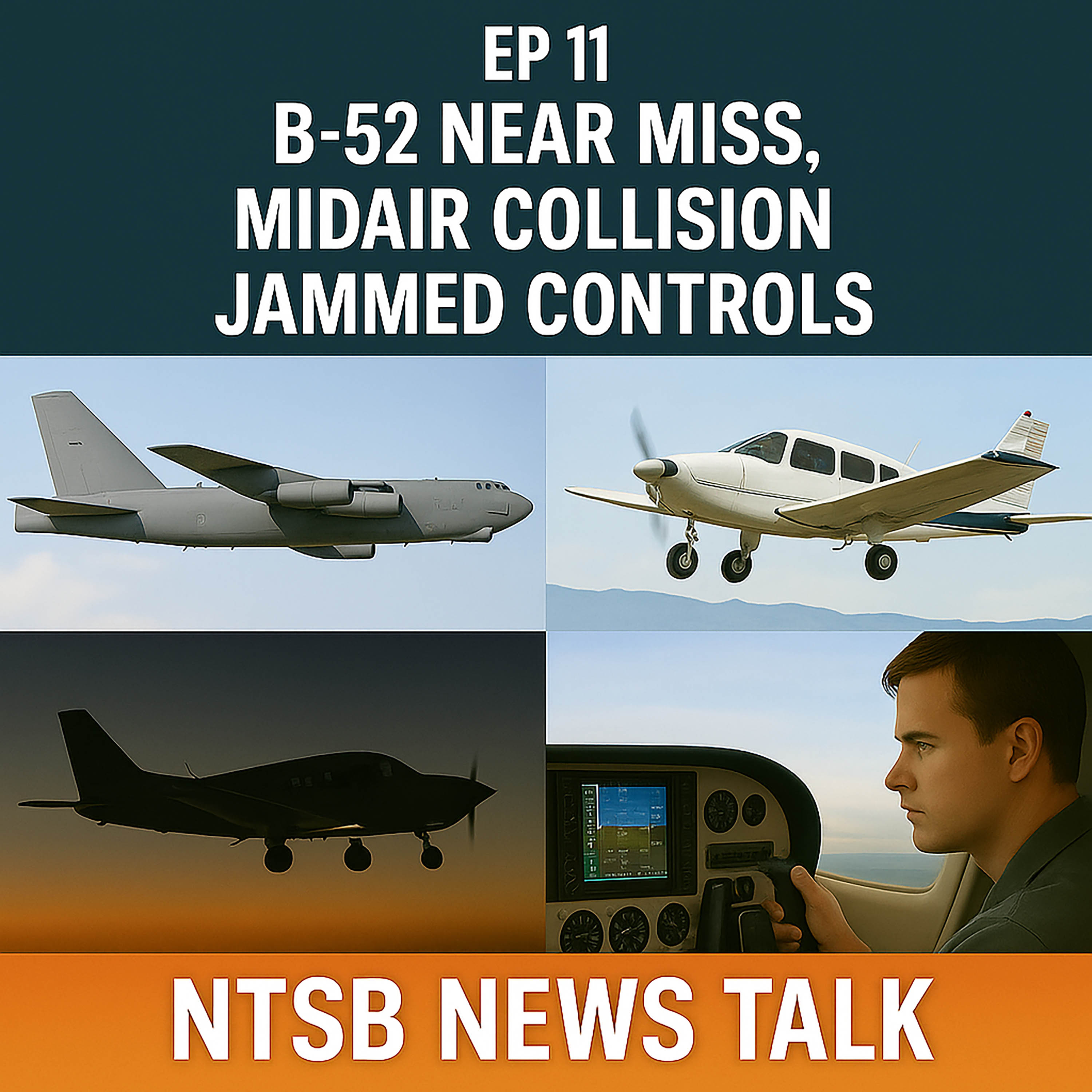
B-52 Close Call at Minot, Midair in Colorado, and Jammed Flight Controls
NTSB News Talk – Aviation Accidents, Safety Investigations & Pilot Lessons
Max talks with Rob Mark about the latest NTSB cases and safety lessons for pilots. They begin with new details on the B-52 near miss at Minot, North Dakota, where the bomber nearly collided with both a regional jet and a Piper Archer. The tower controller, working alone without radar support, became overwhelmed and failed to advise the B-52 crew of conflicting traffic. At one point, he even issued incorrect altitude and heading clearances. Though everyone avoided contact, the case illustrates that controllers can—and do—make mistakes, making pilot vigilance essential.
Attention then turns to a fatal midair collision in Fort Morgan, Colorado, where a Cessna 172 on a straight-in approach collided with an Extra 300 turning base just after an aerobatic contest. Because of their high- and low-wing configurations, each aircraft was hidden in the other’s blind spot. The accident underscores the importance of CTAF communication, traffic scanning, and using a second radio to monitor the local frequency even while on IFR clearances.
Rob next reports on a Cessna 172 from San Jose’s Reid-Hillview Airport whose pilot declared jammed flight controls. Another pilot attempted to assist in the air, but the aircraft ultimately crashed. The case recalls earlier accidents where loose objects, like portable GPS antennas, jammed control linkages.
The episode also examines student pilot tragedies. In Lock Haven, Pennsylvania, a young student turned crosswind too soon at low altitude and struck trees. In New Jersey, a 61-year-old student in a Cirrus SR20 succumbed to somatogravic illusion, leveling off at night and descending into terrain after takeoff. Both highlight the risks of solo flight without CFI oversight and the dangers of night solos.
Further cases include a Cessna 152 overrun at night in Kansas with a pilot who fled the scene, a T-6 Texan stall/spin at Oshkosh caused by low-speed maneuvering, and a Cessna 206 crash in Alaska where water-contaminated fuel led to an engine failure.
Throughout the discussion, Max and Rob emphasize recurring themes: respect stall speeds and G-loading, always sump fuel, avoid complacency with ATC instructions, and never assume other pilots are on frequency. Their message is clear—aviation safety depends on every pilot maintaining situational awareness, discipline, and respect for physics.
Available Results
Generated results are saved to the knowledge database for reuse and search.
Extract Knowledge
Pick what you want extracted first. Model, scope, and chapter options appear after a template is selected.