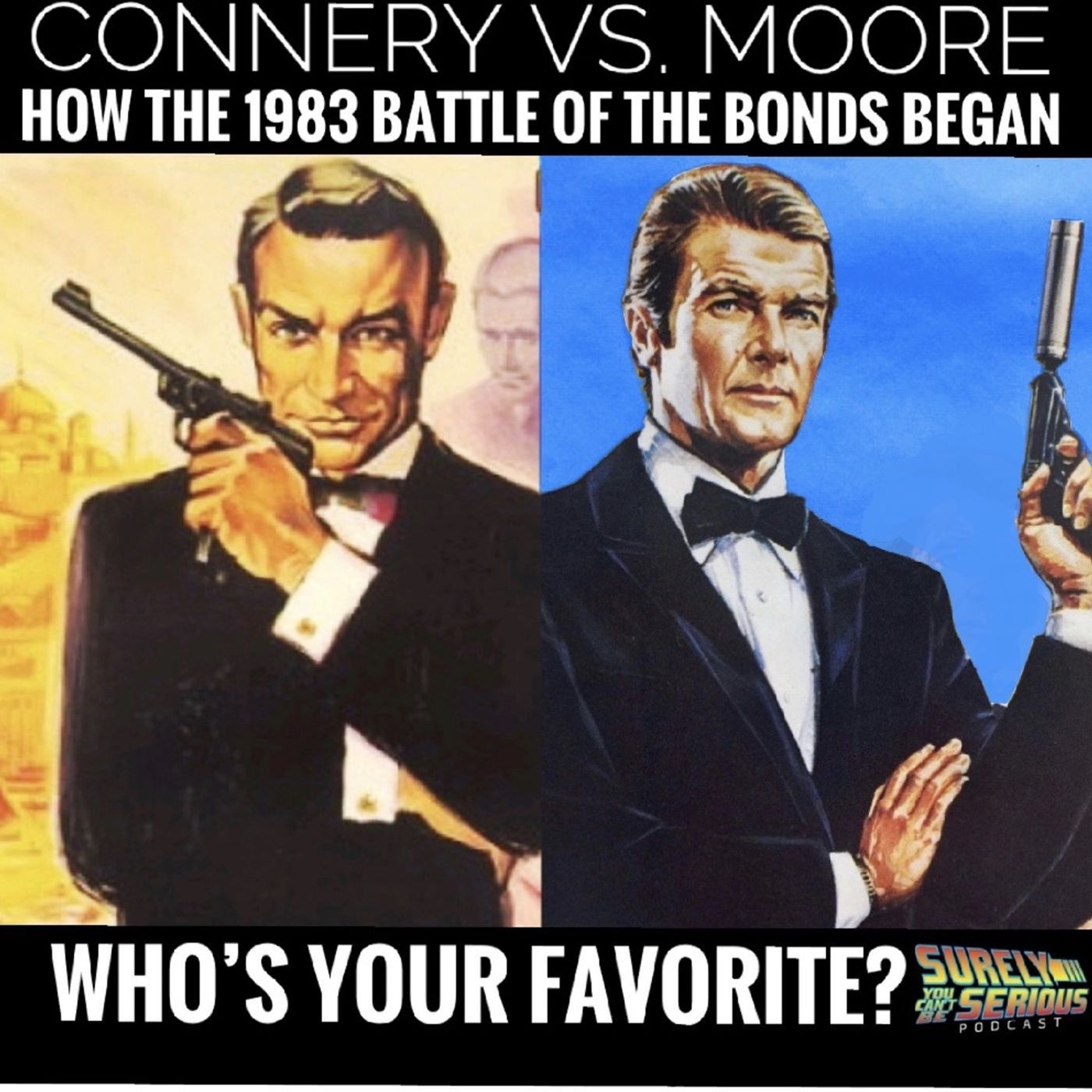
Battle of the Bonds
In the summer of 1983, the Bond of the 60s, Sean Connery, went head to head with the Bond of the 70s, Roger Moore, when Never Say Never Again and Octopussy were released? But how did this happen?! How could two different studios both produce and release two different James Bond movies at the same time. Join us as we unfold the story of how this paradox came to be.
2020-09-15
47 min
Transcript
Available Results
Generated results are saved to the knowledge database for reuse and search.
No generated results are available for this episode yet.
Extract Knowledge
Pick what you want extracted first. Model, scope, and chapter options appear after a template is selected.
Generated results for public episodes are saved to the knowledge database so they can be reused and searched later.
Transcript
<v Speaker 1>Hello everybody, and welcome back to the shir That You
<v Speaker 1>Can't Be Serious podcast. IMD James D and I am
<v Speaker 1>here with my buddy Jason Colvin. Actually we're doing this
<v Speaker 1>via zoom. I am in the Bahamas where it's a
<v Speaker 1>breezy eighty degrees and Jason is sweatness balls off in India.
<v Speaker 2>Yes that is correct, sir, shaken not stirred.
<v Speaker 1>All right. We are here to talk about the competition
<v Speaker 1>of the James Bond of the sixties against the James
<v Speaker 1>Bond of the seventies in movies that occurred in the
<v Speaker 1>eighties Sean Connery Roger Moore head to head in nineteen
<v Speaker 1>eighty three.
<v Speaker 2>This summer there was some amazing things happening in the movies.
<v Speaker 2>We had Return of the Jedi, National Lampoon's Vacation. We
<v Speaker 2>had your favorite movie, Jaws three D.
<v Speaker 1>We had Trading Places. I saw Boobies for the first time.
<v Speaker 1>It was a wonderful, wonderful year. But yes, I'm happy
<v Speaker 1>to be back in nineteen eighty three. Again.
<v Speaker 2>This was an incredible thing to hear that two Bond
<v Speaker 2>movies were going to be in theaters, not at the
<v Speaker 2>same time, but relatively close, Like what four months apart.
<v Speaker 2>I can remember being a kid going what are you
<v Speaker 2>talking about? I can see Bond in June and Bond
<v Speaker 2>in October? Right, it's fantastic. Absolutely, sign me up.
<v Speaker 1>I can have. I actually have a memory of walking
<v Speaker 1>by the old movie theater in Central Mall, Fort Smith, Arkansas,
<v Speaker 1>seeing the poster for Never Say Never Again and saying
<v Speaker 1>to my dad why is this movie called Never Say
<v Speaker 1>Never Again? And my dad telling me, well, I'm pretty
<v Speaker 1>sure that Sean Connery said he would never play James
<v Speaker 1>Bond again, and now he is, and so that's probably
<v Speaker 1>why the movies named this. I was like, there's another
<v Speaker 1>guy who plays James Bond.
<v Speaker 2>Yeah, yeah, right, So do you remember your first Bond experience?
<v Speaker 1>No, I mean it was I mean, that's that memory
<v Speaker 1>right there is the first like vivid, I can say, yes,
<v Speaker 1>that happened. But James Bond was just kind of a
<v Speaker 1>part of childhood. I mean, my dad loved the movies
<v Speaker 1>and they would come on TV all of the time,
<v Speaker 1>and so I just saw them, you know, they were
<v Speaker 1>just all out there and I just saw him. Bond
<v Speaker 1>was just out there and he was cool. And I
<v Speaker 1>would see the movies as they came on, yeah about you?
<v Speaker 2>Well yeah, so I remember very vividly in nineteen eighty one,
<v Speaker 2>my friend he's like, now you gotta go see four
<v Speaker 2>Year Eyes Only. And I'm like, what what is four
<v Speaker 2>Year Eyes Only? He's like, it's the new James Bond movie.
<v Speaker 2>And I'm like, who is James Bond. I don't know
<v Speaker 2>who James Bond is?
<v Speaker 1>Right? Oh? Wow?
<v Speaker 3>OK?
<v Speaker 2>And he's like, you what you know You've got You're
<v Speaker 2>gonna love James Bond.
<v Speaker 1>We got to go see it.
<v Speaker 2>And so we went and saw four Year Eyes Only.
<v Speaker 2>And I was an instant James Bond fan. So four
<v Speaker 2>Year Eyes Only for me is not only the best
<v Speaker 2>Roger Moore movie, but it's kind of my home movie,
<v Speaker 2>you know what I mean. And so that's the one
<v Speaker 2>I go back to, is for your Eyes Only. So
<v Speaker 2>when Octopus he comes out two years later. In that
<v Speaker 2>two year period, ABC used to have the Sunday Night movie.
<v Speaker 2>They would show like The Spy Who Loved Me and
<v Speaker 2>Moonraker and Diamonds Are Forever, and I would just slowly
<v Speaker 2>acquire these movies, and so by the time Octopusy shows up,
<v Speaker 2>I am ready for a new James Bond movie.
<v Speaker 1>That's awesome. You know, as time goes on, you get
<v Speaker 1>the introduction of Timothy Dalton, you get the introduction of
<v Speaker 1>Pierce Brosen. I can still remember having conversations with my
<v Speaker 1>friends when we knew that Roger Moore wasn't going to
<v Speaker 1>be the James Bond anymore, of you know, hey, it
<v Speaker 1>needs to be that guy from Remington Steel. He is
<v Speaker 1>the perfect guy for James Bond. Yeah, And then it
<v Speaker 1>wasn't him, and everybody was outraged, and I think I
<v Speaker 1>was like, I'm not going to go watch those movies.
<v Speaker 1>I'm upset they didn't make Remington Steel James Bond. That's
<v Speaker 1>just wrong. And then by the time that he actually
<v Speaker 1>that Pierce Brosen and becomes James Bond, I was just like,
<v Speaker 1>he is the best James Bond who had the worst
<v Speaker 1>scripts to work with. There were some bad computer graphics
<v Speaker 1>going on in those movies. The scripts weren't super good.
<v Speaker 1>But he was a really great James Bond without much
<v Speaker 1>to work with. That is true.
<v Speaker 2>However, he started off with a really good one. One GoldenEye,
<v Speaker 2>in my opinion, is a good Bond movie, and so
<v Speaker 2>he had all that good credit in the bank and
<v Speaker 2>the next bunch of them were terrible.
<v Speaker 1>They were really bad. And gold and I I mean
<v Speaker 1>that was the introduction of James Bond into the video
<v Speaker 1>game world too, which I mean GoldenEye was fantastic. I
<v Speaker 1>didn't I watched the movie, but I loved the video game.
<v Speaker 1>That's awesome.
<v Speaker 2>That is very true. Maybe my favorite home video game
<v Speaker 2>of all time. My friend's like, hey, I got to
<v Speaker 2>show you this cool video game. I'm like, listen, dude,
<v Speaker 2>I got a job and I got a wife. I
<v Speaker 2>don't have time for video games anymore. I played for
<v Speaker 2>like thirty seconds. I'm like, I'm buying this tomorrow.
<v Speaker 1>How old are you, dude?
<v Speaker 2>I'm I am. I am old, but I am not
<v Speaker 2>as old as Sean Connery or Roger in these two
<v Speaker 2>movies or the record. Let's go ahead and get that
<v Speaker 2>out there, because that's an important factor when we discussed
<v Speaker 2>these two movies. Yeah, Sean Connery was fifty two when
<v Speaker 2>he did Never Say Never Again. He had taken twelve
<v Speaker 2>years off.
<v Speaker 1>YEP.
<v Speaker 2>Diamonds Are Forever was in nineteen seventy one. He was forty,
<v Speaker 2>but he looked like he was about fifty two.
<v Speaker 1>He has an old look about him. He does.
<v Speaker 2>He does Octopus. Roger Moore was fifty five. He's three
<v Speaker 2>years older.
<v Speaker 1>Than Sean Connery.
<v Speaker 2>Most people don't really realize that.
<v Speaker 1>He has a younger looking face. He just does. I mean,
<v Speaker 1>Roger Moore just has a younger looking appearance about him.
<v Speaker 1>Maybe it's the receding hairline that Sean Connery has, Maybe
<v Speaker 1>it's the wrinkles. I can't really Maybe Roger Moore has
<v Speaker 1>a good plastic surgeon. I'm not real sure, but Roger
<v Speaker 1>Moore always seemed to be younger, even though he was
<v Speaker 1>actually about three years older than Yeah.
<v Speaker 2>Okay, so today we're ultimately going to compare Never Say
<v Speaker 2>Never Again from nineteen eighty three to Octopussy nineteen eighty three,
<v Speaker 2>Connery versus more Battle of the Bonds, and it's going
<v Speaker 2>to be great. But really, the interesting stories here are
<v Speaker 2>kind of the behind the scenes stuff. So if you
<v Speaker 2>say to yourself both of those movies sucked, hang on,
<v Speaker 2>because there is some interesting stuff going on behind the
<v Speaker 2>scenes of these movies.
<v Speaker 1>Absolutely, there are much better James Bond movies out there
<v Speaker 1>than Never Say Never Again and Octopussy. But we chose
<v Speaker 1>these two because it was the summer of Bond versus Bond.
<v Speaker 1>That's right, and the story there is an impressive One's
<v Speaker 1>you want to jump into the history.
<v Speaker 2>A little bit, let's I'm ready to get into it.
<v Speaker 2>Let's go.
<v Speaker 1>Okay. So our story begins back in nineteen oh eight
<v Speaker 1>with the birth of Ian Fleming. A year later we
<v Speaker 1>have the birth of Albert R. Broccoli, nicknamed Cubby Broccoli
<v Speaker 1>by his family. A few years after that, in nineteen
<v Speaker 1>fifty team we have the birth of Harry Saltzman, and
<v Speaker 1>then nine years later we have the birth of Kevin
<v Speaker 1>mcclury mcclury.
<v Speaker 2>Kevin mcclury.
<v Speaker 1>Obviously the most important figure in this is Ian Fleming.
<v Speaker 1>He was born to a wealthy family, grew up in
<v Speaker 1>wealth and then, of course, a few years after his birth,
<v Speaker 1>World War One begins and tragically his father dies in
<v Speaker 1>World War One. This comes into play with the character
<v Speaker 1>of James Bond. Later in the early movies, you don't
<v Speaker 1>really get his history. He's a very two dimensional character,
<v Speaker 1>but later on, especially with the Daniel Craig version, you
<v Speaker 1>get some of that backstory, which includes him being an
<v Speaker 1>orphan yep. So he ends up going to Eton for college,
<v Speaker 1>where he meets and intensely dislikes a gentleman named Scarmanga.
<v Speaker 1>Who is that right? Are you kidding me? No, I'm
<v Speaker 1>not kidding The scar Manga is named after a guy
<v Speaker 1>that he hated and college. I don't think he had
<v Speaker 1>three nipples, but yes, that's where that name comes from.
<v Speaker 1>And he writes his first story there.
<v Speaker 2>Let's let people in on the joke. If you are
<v Speaker 2>a just basic, not very intricate James Bond fan, you
<v Speaker 2>may not recognize that name. That is the villain from
<v Speaker 2>the movie The Man with the Golden Gun, and he
<v Speaker 2>does have three nipples, played by Christopher Lee, which more
<v Speaker 2>impersonates him by putting on a fake third nipple, which
<v Speaker 2>is a very weird part in that movie.
<v Speaker 1>Keep going, okay, you mean mind nubbin.
<v Speaker 2>Teddler being and Scaramanga.
<v Speaker 1>Okay, right. So, so, while while Fleming is in college,
<v Speaker 1>Broccoli his family has moved to the United States. They
<v Speaker 1>introduced broccoli seeds to the US, according to his obituary
<v Speaker 1>in the New York Times. I don't know how accurate
<v Speaker 1>that is, but you know, let's go with it.
<v Speaker 2>Telling me that Broccoli is named after Cubby Broccley's relatives.
<v Speaker 1>That's what it sounds like from the from the oh
<v Speaker 1>bit in the New York Times. Yes, they're the ones
<v Speaker 1>that brought the seeds over. They're from Italy and broccoli
<v Speaker 1>is is based on the Italian words. And so who
<v Speaker 1>am I? I'm just a guy here. I just I
<v Speaker 1>reported as a reader. That's all I can do. Okay,
<v Speaker 1>all right? And then Saltzman is running away from his
<v Speaker 1>home and joining the circus. I'm not kidding, literally joining
<v Speaker 1>the circus. Okay, all right, this is an interesting bunch
<v Speaker 1>of characters. And then I guess, I guess McClure is
<v Speaker 1>learning to scuba dive. I'm not sure what he's doing
<v Speaker 1>at this time. So Ian Fleming, he goes to college
<v Speaker 1>and then does some does some journalism work, and then
<v Speaker 1>World War Two starts to happen and he becomes due
<v Speaker 1>to the at the behest of his He becomes an
<v Speaker 1>assistant to a gentleman named Admiral Godfried, who is in
<v Speaker 1>charge of all of like the secret operations of the
<v Speaker 1>UK during World War Two, and Godfried basically tells Fleming, hey,
<v Speaker 1>you are a super creative guy. Use that creativity to
<v Speaker 1>think up stuff to help us. And there's I mean,
<v Speaker 1>he actually thought up a plan in order to get
<v Speaker 1>control of the Enigma machine. His idea was to have
<v Speaker 1>a UK pilot fly a German plane and crash it
<v Speaker 1>in the ocean near a German ship so that the
<v Speaker 1>ship will come over and try to save them, and
<v Speaker 1>then the pilot then takes over the boat and they
<v Speaker 1>get access to the Enigma machine. That was his plan.
<v Speaker 1>For several years, he's involved with this type of espionage,
<v Speaker 1>type of creative service, and that's what is the seed
<v Speaker 1>for all of his stories. I mean, he basically said
<v Speaker 1>ninety percent of his stories are based upon facts and
<v Speaker 1>the other ten percent or him just making some stuff up.
<v Speaker 2>That's really cool, you know, Thunderball and never say Never again.
<v Speaker 2>I mean, that's knocking on the door of being familiar
<v Speaker 2>territory to the plot lines of those two movies. Okay,
<v Speaker 2>that's amazing, keep going.
<v Speaker 1>Okay. So he at some point tells somebody, you know,
<v Speaker 1>when I'm done with all of this, I am going
<v Speaker 1>to write the greatest spy novel that has ever been written.
<v Speaker 1>And so he ends his time with Admiral Godfried, who
<v Speaker 1>becomes kind of the basis of m later on, and
<v Speaker 1>then he ends up renting this place down in Jamaica
<v Speaker 1>called GoldenEye.
<v Speaker 2>GoldenEye where Sting wrote every breath you take and all
<v Speaker 2>of synchronicity. Basically, yes, it's incredible.
<v Speaker 1>So he didn't write. He did not write his first
<v Speaker 1>Bond book until he was forty three years old. That's
<v Speaker 1>inc it's insane. It's a year younger than I am
<v Speaker 1>right now. I mean, it's like very get busy starting
<v Speaker 1>a podcast or something. So during this time that he's
<v Speaker 1>doing all of this cool stuff, Broccoli starts working for
<v Speaker 1>Howard Hughes after he takes over the movie The Outlaw.
<v Speaker 1>You know The Outlaw. If you don't know the movie,
<v Speaker 1>you know the picture of Jane Russell profile with her
<v Speaker 1>amazing like torpedo Cleevebi's going on there, I am familiar,
<v Speaker 1>keep going. He becomes a part of that movie with
<v Speaker 1>Howard Hughes when Howard Hughes takes over for Howard Hawks
<v Speaker 1>when he got fired. This will come into play later on.
<v Speaker 1>And so Saltzman has been in the circus and he's
<v Speaker 1>like in vaudeville, and so he at some point becomes
<v Speaker 1>interested in James Bond likes the character, and he buys
<v Speaker 1>the rights to the character of James Bond. Broccley wants
<v Speaker 1>to buy the rights to the character of James Bond,
<v Speaker 1>but then finds out that Saltzman already has them. He
<v Speaker 1>through a mutual friend, meets up with him and they
<v Speaker 1>decide instead of you know, Broccolay says, I want to
<v Speaker 1>buy the rights from you. Saltzman says no, but I
<v Speaker 1>will form a company with you, and that company becomes
<v Speaker 1>Ion Productions, which is the company that is responsible for
<v Speaker 1>almost all of the James Bond movies. So Ian Fleming
<v Speaker 1>in this time, this was nineteen sixty one that they
<v Speaker 1>bought the rights to James Bond. He unfortunately, about three
<v Speaker 1>years earlier, thought hey, it'd be a great idea to
<v Speaker 1>make James Bond into a movie.
<v Speaker 3>Uh huh.
<v Speaker 1>And he thought that because he had recently met a
<v Speaker 1>guy named Kevin mccluy, and Kevin mccluy was this guy
<v Speaker 1>who was an avid scuba diver and adventurer. So McClory
<v Speaker 1>had also been had become involved in movies. He had
<v Speaker 1>been an assistant to John Houston and had worked on
<v Speaker 1>The African Queen Ulan Rouge and what ended up being
<v Speaker 1>an assistant director on Moby Dick, which starred James Mason,
<v Speaker 1>who we will learn later was one of the original
<v Speaker 1>people considered to be James Bond in the first James
<v Speaker 1>Bond movies. Oh all right, cool, right, So this guy
<v Speaker 1>he was, he got he was he hooked up with
<v Speaker 1>Elizabeth Taylor. I mean, this is not this is no
<v Speaker 1>you know, con man. This is a guy who's in
<v Speaker 1>the industry and romancing the starlets.
<v Speaker 2>Okay, now, wait a minute. Kevin McClory dated Elizabeth Taylor
<v Speaker 2>in her prime. Is that correct?
<v Speaker 1>Yes, that is correct. He dated her and actually got
<v Speaker 1>engaged to marry her.
<v Speaker 2>Anybody who can date Elizabeth Taylor in her prime has
<v Speaker 2>kind of got it going on, all right, keep going.
<v Speaker 1>So Unfortunately, Kevin McClory had come in nineteen fifty eight
<v Speaker 1>and talked to Ian Fleming and said, hey, I think
<v Speaker 1>that this James Bond character would be a great character
<v Speaker 1>to have in the movies. And Ian Fleming was like, cool,
<v Speaker 1>let's do that. Yeah, and so and so they together
<v Speaker 1>started working on a movie script. Movie script had multiple
<v Speaker 1>names including James Bond of the Secret Service.
<v Speaker 2>And Longitude seventy eight West.
<v Speaker 1>Okay, yeah, that's a terrible, terrible turble. It's a terrible title.
<v Speaker 2>That's that's like saying, I'm gonna do a movie about
<v Speaker 2>Disney World, I'm gonna call it main Street USA. You know,
<v Speaker 2>I mean, that's a terrible title.
<v Speaker 1>All those things aside, Fleming, mcclury, and a guy named
<v Speaker 1>Jack Winningham all worked together. They put this script together.
<v Speaker 2>In nineteen fifty nine, Fleming met with mclury and Waddingham
<v Speaker 2>to have a script conference and that's when they actually
<v Speaker 2>Fleming is the one who changed the title from Longitude
<v Speaker 2>seventy eight West to Thunderball. January of nineteen sixty, McClory
<v Speaker 2>visits at GoldenEye to tell him he's working on the
<v Speaker 2>final script for this thing, and you know, Flemy's just like, okay, yeah,
<v Speaker 2>I keep going. So once they sit down talk about
<v Speaker 2>the final script, he goes away to kind of finalize things.
<v Speaker 2>Fleming sits down at his desk at GoldenEye and writes
<v Speaker 2>Thunderball based on that script.
<v Speaker 1>Yeah, and just to I mean, just to let you
<v Speaker 1>know how Fleming worked. It was unlike most authors work.
<v Speaker 1>He was producing a book every single year. I mean
<v Speaker 1>from Casino Royal on he issued a book every year,
<v Speaker 1>and he would go he would go have a swim
<v Speaker 1>in the morning out at GoldenEye. He'd have a swim
<v Speaker 1>in the ocean. He would come back and have a
<v Speaker 1>breakfast of scrambled eggs and toast. He would sit down
<v Speaker 1>at his old typewriter and he would crank out the pages.
<v Speaker 1>I mean, just type NonStop. Didn't review it, didn't look
<v Speaker 1>at it. I mean, there was no meticulousness about this.
<v Speaker 1>He was just right, right, right, right right. And so
<v Speaker 1>I'm sure that at the point that they are, at
<v Speaker 1>this stage where he's got this outline in his head,
<v Speaker 1>there's no question that he should have known better than
<v Speaker 1>to write a book based upon what they have already
<v Speaker 1>talked about and not give any credit to anybody.
<v Speaker 2>It's really not smart on Ian Fleming's part. And I
<v Speaker 2>hate to say that because he's the author of a
<v Speaker 2>lot of these stories that I love so much, but man,
<v Speaker 2>he just wasn't very bright on how he decided to
<v Speaker 2>go about well.
<v Speaker 1>I mean, he his lifestyle I think was very similar
<v Speaker 1>to James Bond, and I think he had this kind
<v Speaker 1>of bulletproof attitude about him that he could probably do
<v Speaker 1>whatever he wanted to do and get away with it,
<v Speaker 1>just because of the life that he had led and
<v Speaker 1>unfortunately he was wrong in this particular circumstance.
<v Speaker 2>Yeah, so Kevin McClory gets a hold of an early
<v Speaker 2>copy of this not called Thunderball, and when he reads it,
<v Speaker 2>he's like, what the crap, this guy has stolen my ideas.
<v Speaker 2>And when they had got together, of course there's lots
<v Speaker 2>of drinking, lots of talking, lots of discussion and it
<v Speaker 2>becomes hard to sort out who thought about what, and
<v Speaker 2>so so mccluy sued to keep the book off the shelves.
<v Speaker 1>Just to let you know, I mean, we don't want
<v Speaker 1>to paint mccluy. I've given him kind of the evil
<v Speaker 1>introduction a couple times, but he did he's not necessarily
<v Speaker 1>the bad guy in this particular scenario. Like Ian Fleming
<v Speaker 1>got together with Jack winning him and said, hey, how
<v Speaker 1>about we just kind of kicked this guy out. I mean,
<v Speaker 1>he had his motivation was to get this guy out
<v Speaker 1>of the picture. And Whittingham didn't fall into that plan.
<v Speaker 1>And ultimately, when Thunderball came out, mcclury said, hey, have
<v Speaker 1>you seen this, and Jack whitting him like yeah, and
<v Speaker 1>so they both sued him. It was at the High
<v Speaker 1>Court in London, as you said, that happened on November twentieth,
<v Speaker 1>nineteen sixty three, and the case was settled in nine days.
<v Speaker 1>I don't know what it was like back in nineteen
<v Speaker 1>sixty three, but a case getting settled nine days after
<v Speaker 1>it got filed is amazing.
<v Speaker 2>That's pretty open and shut, right.
<v Speaker 1>Yeah. So, and I mean, just to let you know
<v Speaker 1>who was probably the culpable party here, Fleming paid mcclury
<v Speaker 1>damages of thirty five thousand pounds. He also paid his
<v Speaker 1>court costs, which was fifty two thousand pounds, and mcclury
<v Speaker 1>got the future versions of the novel credited as based
<v Speaker 1>on a screen treatment by Kevin mcclury, Jack Whittingham, and
<v Speaker 1>Ian Fleming in that order. Like, I mean, that's freaking huge. Yeah.
<v Speaker 1>But what we also need to know, and this is important,
<v Speaker 1>some people make decisions under certain types of stress. In
<v Speaker 1>the middle of that nine days, Ian Fleming had a
<v Speaker 1>freaking heart attack.
<v Speaker 2>Among the things, like you said that McClory won, he
<v Speaker 2>also had the right to make Thunderball as a movie.
<v Speaker 1>Yeah, he won the screenplay treatments, and that was something.
<v Speaker 1>Here's here's an interesting thing. Now, So this is nineteen
<v Speaker 1>sixty three, so they work together in nineteen fifty eight.
<v Speaker 1>The first Bond movie comes out in nineteen sixty two. Yes,
<v Speaker 1>Doctor No, Doctor No comes out in NCC sixty two.
<v Speaker 1>This is nineteen sixty three year later, so we I mean,
<v Speaker 1>they all know Doctor No is a big hit. Kubby
<v Speaker 1>Brockley is involved with the movie at this point. Harry
<v Speaker 1>Saltzman is involved with the movie at this point, and
<v Speaker 1>so they say to him, yes, you can have the
<v Speaker 1>screenplay rights to this particular storyline, and then you are
<v Speaker 1>allowed to reproduce it ten years from now. So here's
<v Speaker 1>here are the two possibilities that I see as a
<v Speaker 1>legal analysis on this one. For them to give up
<v Speaker 1>not only hey, we're going to give you the screenplay now,
<v Speaker 1>but we're gonna let you reproduce it every ten years.
<v Speaker 1>There's only two possibilities. Either they thought this thing, the
<v Speaker 1>story's going to be over in ten years and nobody's
<v Speaker 1>going to care, right, Or they thought we're going to
<v Speaker 1>be so financially successful in ten years after making all
<v Speaker 1>of the Bond stories and movies that we've got, that
<v Speaker 1>we're going to be rich enough to stop him from
<v Speaker 1>doing this, you know, or some sort of remake of
<v Speaker 1>the Thunderball and ultimately that's kind of what ends up happening.
<v Speaker 1>It's very very interesting. It's very interesting.
<v Speaker 2>It seems to me that they are trying to give
<v Speaker 2>McClory everything they can to kind of make him go away,
<v Speaker 2>pacify him with film rights, remake rights, and I was
<v Speaker 2>telling you that McCloy go it's all this credit for Thunderball,
<v Speaker 2>but there's some question about whether or not he gets
<v Speaker 2>credit for Spector.
<v Speaker 1>Which Spector. You know, Spector's huge, I mean.
<v Speaker 2>Bond's bad main bad guy.
<v Speaker 1>Is spect the key bad guy. I mean that the
<v Speaker 1>the through the series you get you get a movie
<v Speaker 1>in the twenty first century named spect I mean it's
<v Speaker 1>and you look at all of the all of the spoofs,
<v Speaker 1>any of those things, it's always got Specter involved, right,
<v Speaker 1>I mean absolutely. If you look at Austin Powers and
<v Speaker 1>Number two and Doctor Evil, that is all Spector, right right.
<v Speaker 1>And then you know the chairs that are all lined up.
<v Speaker 1>I mean, so you watch Thunderball and you see you
<v Speaker 1>see Number two walk in with his eye patch, and
<v Speaker 1>they all go to the chairs, and the guy who's
<v Speaker 1>hidden behind the screens petting his little cat is a
<v Speaker 1>White Cat. I'm just all from Thunderball. It's all from Thunderball.
<v Speaker 1>So the fact that Kevin mcclury has got the rights
<v Speaker 1>to this particular storyline is huge because this particular storyline
<v Speaker 1>is a made your factor in so many of the
<v Speaker 1>Bond films.
<v Speaker 2>And yeah, specifically, Spector was the bad guy in Doctor No,
<v Speaker 2>the bad guy in From Russia with Love. It's mentioned
<v Speaker 2>in Goldfinger. So they don't want him to have any
<v Speaker 2>claim on revenues from those previous movies that are huge successes.
<v Speaker 1>But just to.
<v Speaker 2>Clarify, Specter is a group of bad guys that they
<v Speaker 2>needed to create that wasn't the Russians.
<v Speaker 1>And it wasn't the mafia, wasn't the Germans.
<v Speaker 2>This, and it wasn't the Germans, right, this nefarious group
<v Speaker 2>of bad guys. The inspector stands for Special Executive for Terrorism, revenge, Extortion.
<v Speaker 1>Yeah, and the introduction of Specter in Thunderball is fantastic
<v Speaker 1>because it's just this meeting of evil characters who are like,
<v Speaker 1>it's like a business meeting of criminals. It's and it's not.
<v Speaker 1>It's it's fantastic. And then one of the guy, you know,
<v Speaker 1>there's two guys who were responsible for some sort of
<v Speaker 1>I think it's like a drug deal or something like that. Yeah,
<v Speaker 1>and the headman of Specter says yes, but basically you've
<v Speaker 1>been cooking the books. And one of the guys is
<v Speaker 1>like what no, and the other guy's like, yeah, everything's cool,
<v Speaker 1>We're cool. And that cool guy's just zapped dumped and he's.
<v Speaker 2>Gone yes, and he goes under and he's like, I'm
<v Speaker 2>very badly burned, but oh no, I'm sorry, that's awesome power.
<v Speaker 2>I get him confused a little bit. Bells of Olmons,
<v Speaker 2>but the bad guy, you wait before we get off
<v Speaker 2>of this. So Specter is a very important piece in this.
<v Speaker 2>Obviously thunderball. They got their butts kicked in court. McCrory
<v Speaker 2>took him to task on that one. But Blofeld is
<v Speaker 2>in play as well. Blofeld is like if somebody sued
<v Speaker 2>George Lucas and they won the rights to Darth Vader, right,
<v Speaker 2>Blofeld is the number one bad guy, the head of Specter.
<v Speaker 2>He's the bald guy that strokes the cat in all
<v Speaker 2>the movies, right right, And that they wanted to make
<v Speaker 2>sure that Kevin mcluy didn't get ahold of that guy.
<v Speaker 1>And just as a side note, in the Austin Powers movie,
<v Speaker 1>the character of Number two is played by the actor
<v Speaker 1>Robert Wagner, who when they were trying to decide who
<v Speaker 1>the new James Bond would be after Timothy Dalton, they
<v Speaker 1>were looking at him and he was like, no, I'm
<v Speaker 1>too American. You should You should just go ahead and
<v Speaker 1>give that to Pierce Brosnan.
<v Speaker 2>Speaking of Americans, I'm I'll throw a little plug in.
<v Speaker 1>Here for Octopus real quick. Yeah.
<v Speaker 2>So obviously when Never Say Never Again is remade, which
<v Speaker 2>Never Say Never Again, for those who don't know, is
<v Speaker 2>a remake of Thunderball based on Kevin McClory's ability to
<v Speaker 2>remake that movie every ten years. So I did that,
<v Speaker 2>would Never Say Never Again?
<v Speaker 1>Right?
<v Speaker 2>Connery comes back, takes the role at age fifty two.
<v Speaker 2>Roger Moore is three years older than him, so when
<v Speaker 2>he is in Octopus, he's fifty five, right. So after
<v Speaker 2>for your eyes only, Roger Moore said, I want to retire.
<v Speaker 2>I'm too old to do James Bond anymore. And so
<v Speaker 2>you can actually YouTube James Roland does his screen test
<v Speaker 2>as an American James Bond, and I was telling you.
<v Speaker 2>He doesn't even play with an English accent. He is
<v Speaker 2>doing it as mister coole American. Think George Clooney, you know,
<v Speaker 2>just cool and classy American.
<v Speaker 1>So Sean Connery is not the first actor to ever
<v Speaker 1>portray James Bond, and Doctor No is not. It was
<v Speaker 1>not the first novel. So why wasn't the first novel
<v Speaker 1>the first James Bond movie? Well, actually it was right.
<v Speaker 1>The first time that James Bond is ever portrayed on
<v Speaker 1>the screen is on a TV show called Climax, in
<v Speaker 1>an episode called Casino Royale. The actor that portrays him
<v Speaker 1>is Barry Nelson, who hasn't been in pretty much anything
<v Speaker 1>else that you probably would have heard of except the Shining.
<v Speaker 1>He is the guy who sends Jack Nicholson off to
<v Speaker 1>the hotel with this Oh are you serious? Yeah? Yeah,
<v Speaker 1>So he plays this, He plays this James Bond character,
<v Speaker 1>but he plays him as an American, and so that
<v Speaker 1>let's see in Fleming know, hey, Bond might be good
<v Speaker 1>for the screen. Which then in nineteen fifty five, a
<v Speaker 1>year later, he sells the rights to Casino roy Al
<v Speaker 1>to a guy named Greg Radoff. Okay, and he's a
<v Speaker 1>producer now he's thinking, Okay, they're gonna make Casino roy Al,
<v Speaker 1>I know a movie. The only problem is Greg Radoff
<v Speaker 1>and his writer, whose name is Lorenzo Simple, who to
<v Speaker 1>let you know his experience. He wrote Three Days of
<v Speaker 1>the Condor and he wrote the early version like the
<v Speaker 1>sixties versions of Batman with Adam West. But greg Radoff
<v Speaker 1>and Lorenzo Simple look at James Bond and they go,
<v Speaker 1>this character is stupid. There's no way that anybody would
<v Speaker 1>believe that a man could say the stuff to women
<v Speaker 1>that he's saying right now. So what we need to
<v Speaker 1>do is we need to change the character into a woman,
<v Speaker 1>and we're going to call her Jane Bond. Yeah. So
<v Speaker 1>fortunately before all of that happened, greg Radoff dies and
<v Speaker 1>greg Radoff's attorney slash agent, Charles Feldman, buys the rights
<v Speaker 1>to Casina Royale from his widow and he gets together
<v Speaker 1>with Howard Hawks. I told you he'd come back in
<v Speaker 1>Howard Hawks and he says, Okay, we need to make
<v Speaker 1>this movie. We need to make this book into a movie.
<v Speaker 1>Casina Royle need to make this book into a movie.
<v Speaker 1>And they were going to hire Lee Pucket as a writer,
<v Speaker 1>and they were going to hire Carrie Grant as James Bond. Now,
<v Speaker 1>I know you've heard of Carrie Grant, but do you
<v Speaker 1>know who Lee Puckett is?
<v Speaker 3>No?
<v Speaker 1>Tell me, well, remember in our Raiders of the Lost
<v Speaker 1>Arc versus Back to the Future episode where I talked
<v Speaker 1>to you about George Lucas telling Lawrence Casten, Hey, I
<v Speaker 1>had this lady writing the Empire strikes back for me,
<v Speaker 1>but then she died.
<v Speaker 3>Yes, Lee Puckett, Wow, yeah, Wow, that's amazing.
<v Speaker 1>So Charles Feldman has the rights to Seina Royale, which
<v Speaker 1>is why it never got made by Eon Productions as
<v Speaker 1>a Bond movie. They started with Doctor No, and then
<v Speaker 1>they went through all of their pieces and then you know,
<v Speaker 1>we're talking about the time and history where two James
<v Speaker 1>Bond movies were going head to head. But it's not
<v Speaker 1>the first time that this ever happened. The first time
<v Speaker 1>it ever happened was in nineteen sixty seven when.
<v Speaker 2>And Casino Royale went against You only lived twice.
<v Speaker 1>So Casino Royal is a James Bond movie, but it's
<v Speaker 1>a spoof, right, It's a satire and it stars David Niven,
<v Speaker 1>who was you would know, I mean our age group
<v Speaker 1>would know him. As the villain, if you'll call him
<v Speaker 1>that in The Pink Panther. But David Niven was one
<v Speaker 1>of the guys who was originally considered to be James Bond.
<v Speaker 1>David Niven, Carrie Grant, James Mason, who I mentioned before,
<v Speaker 1>were the guys that they wanted to be James Bond
<v Speaker 1>before they ultimately settled on Sean Connery. But then nineteen
<v Speaker 1>sixty seven happens. David Niven's like, yeah, let's go ahead
<v Speaker 1>and do this thing. And so they make this movie
<v Speaker 1>Casino Royale that's got him and Peter Sellers and several
<v Speaker 1>other famous actors, and it's all this who's the real
<v Speaker 1>James Bond kind of storyline, and it's all supposed to
<v Speaker 1>be comedy, which was appropriate, but that's the first time
<v Speaker 1>that two Bonds went head to head in the same year.
<v Speaker 2>So back to Thunderball, when and Cubby Broccoli and Harry
<v Speaker 2>Saltzman are making this movie and they see that Kevin
<v Speaker 2>mcclurey is going to be a royal pain in the butt,
<v Speaker 2>A fly in the white meant a monkey in the wrench.
<v Speaker 2>I can't wait to do Diehard, But yeah, they make
<v Speaker 2>him producer of the movie Thunderball, hoping again to pacify
<v Speaker 2>this guy so he will go away. Even though he's
<v Speaker 2>got in his back pocket he can remake Thunderball every
<v Speaker 2>ten years. So they put him in charge of filming
<v Speaker 2>underwater scenes.
<v Speaker 1>Right. He was the scuba diver. And that's why this
<v Speaker 1>movie is so that underwater scenes are such a big
<v Speaker 1>factor in this movie is because Kevin McClory was a
<v Speaker 1>big scuba diver and he's like, hey, I really want,
<v Speaker 1>you know, underwater scenes to be a big part of this.
<v Speaker 1>And so back in the sixties, those underwater scenes were amazing.
<v Speaker 1>I mean, nobody had done that stuff except in like
<v Speaker 1>the TV series Flipper.
<v Speaker 2>Yeah, but that's why Thunderball, when you look at it today,
<v Speaker 2>it is like watching a movie in slow motion because
<v Speaker 2>everything's underwater. Yeah, the fight scenes are very slow motion,
<v Speaker 2>you know.
<v Speaker 1>So right right, So it's interesting, you know, that's that
<v Speaker 1>is a factor of looking. You know, we're eighties kids,
<v Speaker 1>and so we're looking at what was going on in
<v Speaker 1>the eighties back and we're and we're thinking, okay, Thunderball,
<v Speaker 1>little slow with the I mean, why are we spending
<v Speaker 1>so much time? And then the undew water scenes. But
<v Speaker 1>that's because of our perspective. Right, It's interesting. I mean
<v Speaker 1>we've gone through we've gone through several different steps where
<v Speaker 1>Ian Fleming is just trying to get this thing to
<v Speaker 1>become a movie. From my perspective, I'm just thinking, how
<v Speaker 1>do you not How does a studio not immediately go, Yeah,
<v Speaker 1>this is a fantastic character and this needs to be
<v Speaker 1>a movie. It didn't happen until until jfk Yet listed
<v Speaker 1>From Russia with Love as one of his top ten books.
<v Speaker 1>That was the push that Broccoli and Saltzman were looking
<v Speaker 1>forward to get their movie made, and that's what led
<v Speaker 1>to the studio going to green lighting Doctor Now. Yep.
<v Speaker 2>It also caused the novels to explode of Ian Flemings.
<v Speaker 1>Right, So, starting with Doctor No, we had studios that
<v Speaker 1>wanted a big name. They wanted Carrie Grant, they wanted
<v Speaker 1>James Mason. But the problem is Carrie Grant says, I
<v Speaker 1>don't want to do more than one movie, and James
<v Speaker 1>Mason says, I don't want to do more than two movies.
<v Speaker 1>And then they get to David Niven and he's like, no,
<v Speaker 1>I'm now I'm not really interested in doing more than
<v Speaker 1>three movies. But Ultimately, they decide we want to get
<v Speaker 1>an unknown actor to play the part of James Bond,
<v Speaker 1>and so they're going through several actors and one of
<v Speaker 1>the guys that comes through is this unknown guy who's
<v Speaker 1>only been in this kind of weird little movie called
<v Speaker 1>Darby O'Gill and the Little People and was in the
<v Speaker 1>chorus for like South Pacific or something. Yeah, but Saltzman
<v Speaker 1>says that when he walked in, it was his walk
<v Speaker 1>that got him the part. He's this big man but
<v Speaker 1>walks with such poise like a cat, and he said
<v Speaker 1>that only this is Saltzman. Harry Saltzman said that only
<v Speaker 1>Sean Connery and Albert Finnie are the only two large
<v Speaker 1>guys who walk in this way and would have been
<v Speaker 1>appropriate for this part. Which is ironic because in the
<v Speaker 1>early eighties, just before Never Say Never came out, Sean
<v Speaker 1>Connery was actually looking at becoming Daddy Warbucks in the
<v Speaker 1>movie Annie. And I mean he really wanted it. He
<v Speaker 1>loved the play. He wanted to be in the movie,
<v Speaker 1>but he was unsure about his singing ability. He even
<v Speaker 1>took voice lessons, but they basically said you got to
<v Speaker 1>tell us now are you in or are you out
<v Speaker 1>and he's like, I'm not sure. And at that point
<v Speaker 1>they said, never mind, We're gonna go to with Albert Finnie,
<v Speaker 1>who couldn't really sing anyway. He was terrible. Yes, so
<v Speaker 1>it didn't matter. It was still a wonderful movie with
<v Speaker 1>a terrible singing Daddy Warbucks. Seawan could have been that guy.
<v Speaker 1>How weird would life have been at that point?
<v Speaker 3>Wow?
<v Speaker 1>But they they back in the early sixties. They land
<v Speaker 1>on Sean Connery, who who was a casket maker? Yeh,
<v Speaker 1>who was a lorry driver. He had done all kinds
<v Speaker 1>of things. And oddly Kubby Brockley had also been a
<v Speaker 1>casket maker. I don't know, maybe that's the connection they
<v Speaker 1>found anyway. Ian Fleming hated the idea of Sean Connery
<v Speaker 1>being James Bond. He would refer to him only as
<v Speaker 1>that lorry driver. But then when Doctor No came out
<v Speaker 1>and it was a massive success, Ian Fleming was like, Okay,
<v Speaker 1>I like Sean Connery. It's all right.
<v Speaker 2>You know, we weren't alive obviously in the nineteen sixties.
<v Speaker 2>But the nineteen sixties a kind of known as having
<v Speaker 2>spy mania. Right, so the Bond movies takeoff, Thunderball is
<v Speaker 2>the first movie ever that they showed round the clock
<v Speaker 2>twenty four hours a day because they had so many
<v Speaker 2>people waiting in line to watch this movie.
<v Speaker 1>Okay, Jason, let's jump back in. Let's talk about some
<v Speaker 1>kind of staples for the James Bond movie formula. Okay, yeah,
<v Speaker 1>So the first movie that came out in the James
<v Speaker 1>Bond series that we consider a cannon film is Doctor No. Right,
<v Speaker 1>we talked about some of the things that came before,
<v Speaker 1>but Doctor No is the first of the Eon Productions,
<v Speaker 1>the first Sean Connery Bond movie, and it has as
<v Speaker 1>the beginning scene the silhouette, the gun barrel, the turn
<v Speaker 1>and shoot that is iconic for all Bond movies. And
<v Speaker 1>when this first came out, the barrel and the silhouette,
<v Speaker 1>everybody started applauding at that scene before anybody knew what
<v Speaker 1>was going on with James Bond. But you know what,
<v Speaker 1>it wasn't Sean Connery.
<v Speaker 2>I know, that's amazing, huh.
<v Speaker 1>It was Yeah, it was a stuntman named Bob Simmons.
<v Speaker 1>It was not Sean Connery in that first gun barrel scene.
<v Speaker 2>Okay, here's a little side note to Bob Simmons. All Right,
<v Speaker 2>the guy who did the gun barrel scene. I think
<v Speaker 2>for the first three movies, he is the guy at
<v Speaker 2>the beginning of Thunderball that's dressed in drag that James
<v Speaker 2>Bond pulls the that's a man baby and punches him
<v Speaker 2>right in the face. That's the guy who does the
<v Speaker 2>gun barrel scene.
<v Speaker 1>That was a woman. They had a woman. Her face
<v Speaker 1>is a woman, a woman, a woman right until Bond
<v Speaker 1>punches her square in the jaw. Oh my gosh. So yes.
<v Speaker 2>The gun barrel scene is absolutely a critical part of
<v Speaker 2>the Bond cannon, which you don't get at the beginning
<v Speaker 2>of Ever Say It Never Again. And really, Doctor No,
<v Speaker 2>the first movie out of the gate, you didn't have
<v Speaker 2>that pre sequence scene and they were still kind of
<v Speaker 2>feeling their way a little bit before they kind of
<v Speaker 2>nailed down the formula right.
<v Speaker 1>And just as an interesting connection, Doctor No was released
<v Speaker 1>the same day as the Beatles first single, and then
<v Speaker 1>there's this kind of a weird yeah, there's this kind
<v Speaker 1>of weird competition. And then even in James Bond, at
<v Speaker 1>some point he's he makes the comment about I can't
<v Speaker 1>remember the quote, but it ends with it's like listening
<v Speaker 1>to the Beatles without ear muffs on.
<v Speaker 2>Yeah, it's in Goldfinger. Yeah, yes, James Bond is too
<v Speaker 2>cool for the Beatles.
<v Speaker 1>Right, So it wasn't until Goldfinger that we got that
<v Speaker 1>full formula of the beginning scene with like Bond always
<v Speaker 1>seduces a lady, he kills a bad guy, he gives
<v Speaker 1>his witty one liner, and then the music and the
<v Speaker 1>silhouettes begin, and as it turns out, the Goldfinger soundtrack
<v Speaker 1>actually outsaw the Beatles that year's Finger.
<v Speaker 2>Came out gold Finger. Yeah, so there's a lot of
<v Speaker 2>things to the formula which I'd love to discuss maybe
<v Speaker 2>at the end when we kind of do final judgment.
<v Speaker 2>But yeah, you have the pre gun barrel sequence, right,
<v Speaker 2>the gun barrel. You have the theme song, opening credits.
<v Speaker 1>So what of naked ladies Octopus?
<v Speaker 2>He kind of pushes the envelope on this. You know,
<v Speaker 2>you have gadgets and babes, bad guys and henchmen.
<v Speaker 1>Don't don't forget the cool cars.
<v Speaker 2>We've already argued about this on a previous podcast about
<v Speaker 2>what the coolest James Mont car was.
<v Speaker 1>And I maintain I maintained my position it's the Aston Martin.
<v Speaker 2>But and then at the end we're going to compare Bonds.
<v Speaker 1>With that formula. You had a lot of people who thought, wow,
<v Speaker 1>this is just something that we can make fun of.
<v Speaker 1>So there was tons of talk shows like David Frost
<v Speaker 1>would make fun of Bond routine Lee Back in the
<v Speaker 1>UK and his co host later got her own show,
<v Speaker 1>Millicent Martin, and she would do these Bond spoofs as well.
<v Speaker 1>And one of the actors that she got to play
<v Speaker 1>Bond in her spoof was someone you might have heard of.
<v Speaker 1>His name is Roger Moore.
<v Speaker 2>Oh really, I'd love to see that man.
<v Speaker 1>Yeah, it's great. It is a great one. It's they're
<v Speaker 1>trying the comedy out and he's still Bond. I mean
<v Speaker 1>it's ten years before he becomes Bond, but he's still
<v Speaker 1>Bond in this goofy wow like late night TV bit so.
<v Speaker 1>Thunderball is the ninth book and Ian Fleming series. It
<v Speaker 1>is the eighth full length Bond novel and it was
<v Speaker 1>first published in the UK by Jonathan Cape on March
<v Speaker 1>twenty seventh, nineteen sixty one. It was the novelization of
<v Speaker 1>that script that we talked about. After the lawsuit, McClory
<v Speaker 1>gained the literary and film rights for the screenplay, while
<v Speaker 1>Fleming was given the rights to the novel, although it
<v Speaker 1>had to be recognized as being quote based on a
<v Speaker 1>screen treatment by Kevin McClory, Jack whitting Him and Ian
<v Speaker 1>Fleming in that order.
<v Speaker 2>Yeah, it's interesting you and I talked off air. Kubby
<v Speaker 2>Brockley and Harry Saltzman had to move up the production
<v Speaker 2>of Thunderball or else Kevin McClory was going to do
<v Speaker 2>it without them. So the interesting thing to me as
<v Speaker 2>a Bond fan is Thunderballs the fourth movie made. But
<v Speaker 2>that wasn't the original slate. We were supposed to get
<v Speaker 2>on Her Majesty's Secret Service as number four, which means
<v Speaker 2>that Sean Connery would have played instead of George Lasmbee
<v Speaker 2>the Bond from that movie.
<v Speaker 1>Kind of interesting, right, Yeah, this lawsuit is not an
<v Speaker 1>insignificant thing. I mean, Ian Fleming had a heart attack
<v Speaker 1>during this short lawsuit. He had a heart attack in
<v Speaker 1>the middle of it. And then yeah, just a little
<v Speaker 1>while after, just August of nineteen sixty four, nine months
<v Speaker 1>after the trial is over, he has another heart attack
<v Speaker 1>and dies at the age of fifty six. So they
<v Speaker 1>make that movie, and then in nineteen seventy six, ten
<v Speaker 1>years later, mcclury announces he wants to produce an original
<v Speaker 1>James Bond film. The title that he wants to use
<v Speaker 1>is Warhead Warhead eight or James Bond of the Secret Service.
<v Speaker 1>But the project gets hampered by the Fleming Trustees and
<v Speaker 1>the Eon Producers filing lawsuits, right, and he gets slowed up.
<v Speaker 1>I mean, this is nineteen seventy six and we know
<v Speaker 1>Never Say Never Again doesn't come out for another seven years.
<v Speaker 1>He was not able to get the title of James
<v Speaker 1>Bond of the Secret Service. They did stop him from
<v Speaker 1>doing that because it was too close to the title
<v Speaker 1>of Her Majesty's Secret Service.
<v Speaker 2>Now here's the interesting thing to me. Obviously, with Never
<v Speaker 2>Said Never Again, you get Sean Connery back in the role.
<v Speaker 2>But before he sort of had him there, he needed
<v Speaker 2>a bond, so he was going after Richard Burton, and
<v Speaker 2>he went after George Lasimbie. That would have been interesting
<v Speaker 2>to see George Lassibie back in that role. After nineteen
<v Speaker 2>sixty nine is Her Majesty's Secret Service with Orson Wells
<v Speaker 2>as Blowfield.
<v Speaker 1>Right, Eon Productions was looking at other actors to play
<v Speaker 1>in Octopussy, and then when Sean Connery finally says, okay,
<v Speaker 1>do it again. Ian Production says there's no way we
<v Speaker 1>can come out with James Brolin. And so at that
<v Speaker 1>point Roger Moore he had fulfilled his contract and was
<v Speaker 1>on a movie by Movie Basis, and he was ready
<v Speaker 1>to be done, but they convinced him to come back
<v Speaker 1>and do Octopussy.
<v Speaker 2>Yeah, you can't take on Sean Connery in some rogue
<v Speaker 2>James Bond movie, some new guy, right, right, you know,
<v Speaker 2>as early as like you said, nineteen seventy five, nineteen
<v Speaker 2>seventy six, he's getting this together. In nineteen seventy eight
<v Speaker 2>he works on James Bond of the Secret Service, hoping
<v Speaker 2>to get Orson Wells as blowfeled Richard Attenborough as the director,
<v Speaker 2>and they were hoping to go up against Moonraker.
<v Speaker 1>Right, and Richard Attenborough, of course we know later on
<v Speaker 1>later on goes on to become the grandfather in Jurassic Park,
<v Speaker 1>the park owner, that's right, who they had originally considered
<v Speaker 1>for that role. Mister Sean Connery. Yeah. And then James Brolin,
<v Speaker 1>of course, is the key actor in the movie Westworld,
<v Speaker 1>which was written and directed by Michael Crichton.
<v Speaker 2>Also plays p w in Peean's Big Adventure, well that
<v Speaker 2>we can't leave that out, and obviously very James Bond
<v Speaker 2>like performance. But here's where it gets really interesting to me.
<v Speaker 2>So when Kevin McClory starts organizing this idea of going
<v Speaker 2>up against Moonraker and I'm going to.
<v Speaker 1>Kick their button.
<v Speaker 2>They're going to be sorry they did this to me,
<v Speaker 2>he calls Sean Connery and so he calls him up
<v Speaker 2>and says, listen, you're the best Bond ever. You know
<v Speaker 2>what he does. We need your insight. Why don't you
<v Speaker 2>come over and help us and be a consultant on
<v Speaker 2>our script, which we know is a big smoke screen,
<v Speaker 2>just to kind of lure him back in right to
<v Speaker 2>play the role again.
<v Speaker 1>Right, And so the way that they ultimately land on
<v Speaker 1>the title that they land on is once he accepts
<v Speaker 1>the role, his wife says to him, I thought you
<v Speaker 1>said you were never going to do another James Bond
<v Speaker 1>movie again, and he's like, well, I feel like I
<v Speaker 1>need to do it again, and she says, well, never
<v Speaker 1>say never again, and she actually receives credit in the
<v Speaker 1>the closing credits for the title of the of the movie.
<v Speaker 2>Okay, before we get to never say it ever again
<v Speaker 2>an octopusy and thank you for hanging around.
<v Speaker 1>It's taking us a long time to get here.
<v Speaker 2>But there's a couple of interesting tidbits in the other
<v Speaker 2>Bond movies before.
<v Speaker 1>We get to this point.
<v Speaker 2>Okay, so the Spy who Loved Me, you're going up
<v Speaker 2>against this guy named Stromberg that was originally supposed to
<v Speaker 2>be Blowfeld, but because of all these legal issues, they
<v Speaker 2>didn't want something to happen to Spy Love Me, so
<v Speaker 2>they just changed the specter and Blowfeld they took that out.
<v Speaker 2>So that's why Stromberg acts exactly like Blowfeld. And at
<v Speaker 2>the beginning of Four of Your Eyes Only, there is
<v Speaker 2>a scene where Bond is visiting his dead wife's grave,
<v Speaker 2>who was killed on Our Majesty's secret service. He gets
<v Speaker 2>in a helicopter and his helicopter is taken over by
<v Speaker 2>a guy in a wheelchair with a bald head and
<v Speaker 2>you know, stroking the cat. You don't never see his face,
<v Speaker 2>and he never names himself, and.
<v Speaker 1>It's clearly supposed to be Blowfilm.
<v Speaker 2>He's taking control of the helicopter and he's gonna kill Bond.
<v Speaker 2>So Bond escapes, takes back control of the helicopter, picks
<v Speaker 2>this guy up and he takes him and he dumps
<v Speaker 2>him down this huemongous chimney, and it's basically like we're
<v Speaker 2>killing Blowfeld double birds.
<v Speaker 3>To you, Kevin McClory, we haven't really talked about what
<v Speaker 3>happened when Sean Connery stopped doing the Bond movies and
<v Speaker 3>Roger Moore took over.
<v Speaker 1>There was a big backlash at the idea of having
<v Speaker 1>more takeover, and I realized we have that George Lasmbie
<v Speaker 1>thing in the middle there. Right when this happened in
<v Speaker 1>eighty three, there was kind of this big like all
<v Speaker 1>of those people who had been Roger Moore haters were like, ah,
<v Speaker 1>finally the real James Bond is back, right, Yeah, But
<v Speaker 1>as we find out, that movie did not do as
<v Speaker 1>well as octopusn't it.
<v Speaker 4>That's right, all right, everybody, Now that you know the
<v Speaker 4>history of these two movies, join us next week when
<v Speaker 4>we will get into the comparison of Never Say Never
<v Speaker 4>Again in Octopusy.
<v Speaker 1>Thank you so much for joining us.
<v Speaker 4>We will see you next week.
Chapters
No chapters available.