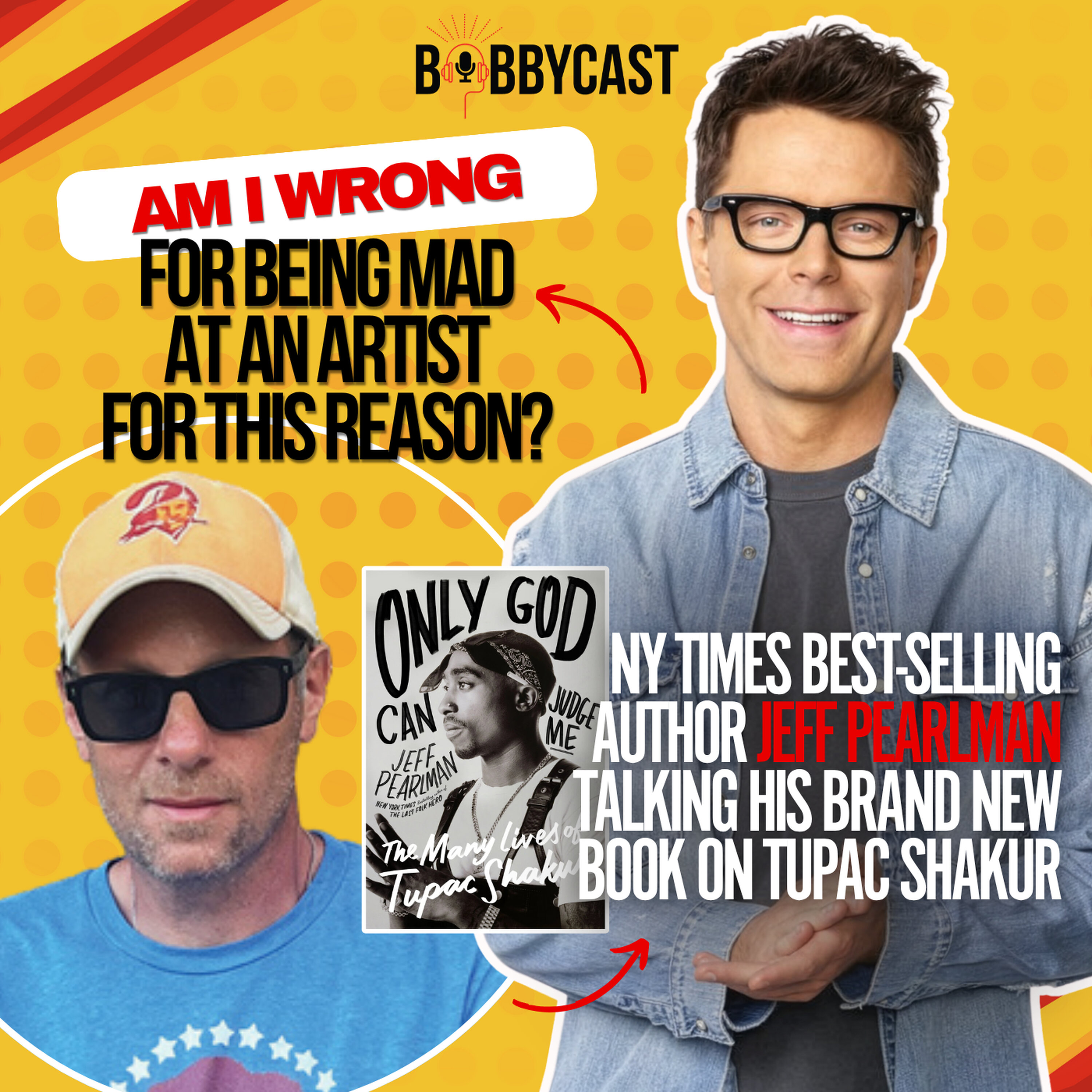
#547 - Is Bobby Wrong For Being Mad at This Country Artist? + Jeff Pearlman Discusses What He Learned About Tupac While Writing His Book + Why Tupac Died Broke + The Process of Interviewing Over 650 People for the Book
In this episode of the BobbyCast, Bobby shares behind-the-scenes stories from his life in the music and radio industry. He shares why he has been mad at a country artist for years and whether or not he is justified. He reflects on the cliquey nature of the industry, the value of authentic relationships, and why he’s learned to cut out drama and dishonesty. Then, Bobby sits down with bestselling author Jeff Pearlman to dig into the stories behind his deep-dive on Tupac Shakur. Jeff talks about what he really learned while reporting the book—beyond the headlines and mythology—and why such a massive cultural force could still die broke. He breaks down his reporting playbook too: how you track down, organize, and verify insights from more than 650 interviews, and what surprised him most along the way. You’ll hear how money, management, and momentum collided in Tupac’s final years, the moments that reshaped Jeff’s understanding of who Pac was off-mic, and the practical nuts-and-bolts of building a biography at this scale.
Pre-Order Only God Can Judge Me: The Many Lives of Tupac Shakur HERE
Follow on Instagram: @TheBobbyCast
Follow on TikTok: @TheBobbyCast
Watch this Episode on Youtube
See omnystudio.com/listener for privacy information.
Available Results
Generated results are saved to the knowledge database for reuse and search.
Extract Knowledge
Pick what you want extracted first. Model, scope, and chapter options appear after a template is selected.
Transcript
00:00:06
Speaker 1: Everybody just driving in back to my house. And there's like this white BMW that was right next to me driving on the road. But we've going only forty five miles an hour. Wasn't like a highway or anything. And these four kids started to wave. And if I'm in a car and someone starts to wave to me, there are a few things that can be. Number One, it can be that I have a flat tire that's happened before. Number Two, it can be that my gas cap is hanging out because it is on like a little plastic thread that you know, keeps it attached to the car. That's happened before. It could be that they're fans of the show. Now, being that they're seventeen to nineteen years old, I probably don't think they're fans of the show. If that happens, probably a little too young at this point. But they're waving. They're waving. I'm waving back, and also have a pretty cool car, and so sometimes it's that, and so wind down and slowed down a little bit because I don't want to hit the kids. I don't want them to hit me either. And the kid in the back seat he goes, hey, big fan, I was like, oh cool, it is one of those times. And he was like, you're Johnny Knoxville, right, No. I was like, I'm not Johnny Knoxville, but thank you. So I wonder if one time in his life, because Johnny Knoxville is actually famous, but I wonder if one time in his life Johnny Knoxville has been approched and someone has said like, hey you Bobby Bones. Just once. But yeah, that happened on the way here to do this, I've been the last couple of days I don't want to say dealing with because it's not really anything significant, but and this has happened a lot through the last ten to eleven years of my career where I will get dms or texts from artists and it will always be kind of like a warm up, a warm up before they ask. And the thing is I really can't do much for them, meaning I don't really program music, which is why when people are like, you're what's wrong with country music? I don't really have anything to do with country music as far as putting it out there. There was a time in my career five or six years ago where I was playing a bit more music, but I don't program music. I literally program two things. One the national Countdown on the weekend, but not the actual countdown that's determined by spens and radio stations all across the country. I play one song. I pick the spotlight artist of the week like I do that, and that's a significant spin, I guess, because pretty much every city in the country plays that, but it's only one time, one time on the weekend. The other thing that I do, because I put it in my contract, is the Women of iHeart Country Show. So the quick story of that is six seven years ago, in my contract, when I had a bit of leverage, I said, hey, I want one hour every weekend to just play female songs on every one of ours, which is like two hundred plus stations. And at the time, I think everybody thought that was a little weird because they're like, you're not even a woman, and you know, candidly speaking, they were, that's true, I'm not a woman. But it was very much the beginning of hey, why aren't there as many women being played on the radio? And so I wanted to be out in the front of that. I already was, but because I'm a dude, you kind of don't get the credit. It wasn't wal I look for the credit. But like when I would tour, I had all for the most part, female openers. I was constantly having female guests on the show that weren't so I was already doing my part, but I really wasn't doing anything national programming wise that was consistent. And so I said, hey, give me this hour because I wanted to get female artists a bit of a I don't know if I should share this, like a bit of a spike on the chart, because it was a pretty heavy play on that show. Like i'd play a couple songs from new artists, they'd get a big spike. Program directors would see they got a whole bunch of spins and they go, oh, maybe this song is good. Give it a listen. And it really didn't change like the total outcome of a record, but maybe it gave some of those artists a chance earlier. So that was a whole idea behind it. So I have an hour and I programmed that, and you're gonna see my point here. And if I want to, like they call it spike a song in I can do that, which is just on my show. If I decided I want to play a song. I'll play a song, but I really don't want to be the song guy, because with that comes everybody wanting me to play their songs, and that's just not me. And again, there was a time when I was breaking songs like crazy, if it was buy Me a Boat or Girl Crush or I Love This Life Low Cash. There's six or seven of those songs that I played a whole lot when nobody else was playing, which really moved him up to the chart and then gave them really strong I mean to go other places and go like, look, it's getting a lot of play. I stopped doing that because one, I don't want to base my career on music I don't make. So it's been something that I occasionally do, but I don't really put any significant time, thought effort into it. But that doesn't mean that people don't hit me up thinking either either A I have more power than I actually do, which is not a whole lot. I guess I have a little sway with the president of iHeart Country. I mean, I've worked with them for thirteen years. I know them very well, but you know not anyway, I get the warm up from these artists and it'll just be a reach out out of nowhere to be like, what's up, how's it going, how you been? And I can tell immediately when the warm up is happening, because I know the warm up is going to be possibly a day a day and a half of hey, cool, we should hang out sometime whatever else, and then bam, they'll be you know, a file in my text message and hey, if you don't mind, would you check this song out and tell me what you think of it? And when an artist asks you what do you think of a song, they really don't want your opinion unless it's good. They really just want you to go, oh, it's excellent. I'd love to play it. And if you don't say that, then they're going to ask, hey, is there any way you can play it? So I mean getting the warm up from a couple of artists, one through text, one through DM around the same time ironically, and I know them, but I'm not friends with them now. At the same time, there's another artist that hit me up a couple of weeks ago, who I don't know either. I don't know how they got my cephone number, don't I mean, I don't really care, but they just were like Hey, this is so and so I got this new song out. Would you listen to it? And if you like it, maybe you'll consider it. I respect that so much more, and I don't think I ever played it, but I don't like bad taste in my mouth, just because it was right to the point, like it was honest, where the other people are like, let me give you a little massage, let me tickle you around the waist. Okay, that'd be five hundred dollars. It's kind of I guess it's not really the same, but that's what I've been dealing with, and I just know when it's coming, and so I guess I can be a little cold when I see it coming because I don't respond. And one of them, they were dming me, and I knew what it was because it had already been like three messages and this has probably happened to me before at some point with the same artist, and so I didn't want them to see that I had read their DM, so I just would delete the message, and then like clockwork, the next day, Boom got a new song. Would love for you to check it out. It also sucks because it makes me not trust anybody, and the thing is I don't really have the power. I don't have power to like shape our career, like I can put you on the show or the podcast, and that's more of a macro versus a micro thing, because if you come on the show or you come on the Bobby Cast, usually that translates into like social media. You know, the podcast does really well now it's probably the second biggest country music podcast. The Bobby Cast is behind our show, which is number one, so there is some significance to that. But I just don't have the power for the music. But then it has me not not like the artists who do that, which it isn't fair because I know it's their job to hustle in a way, but I don't like the grossness of it, like I did like the guy who I didn't really know that hit me up and was like, hey, I got the song. I listen to it and if there's any chance you considered to play, that'd be awesome. And there was no like question, there was no like what do you think about it? Because if you ever tell an artist what you think about something a song and you're like, yeah, I don't really think it was that good, it wasn't for me. I wouldn't say that because I know that's not what they're looking for. They're not looking for general feedback. That's happened a couple of times with friends, and they're not even asking like, hey, is it a good song? They're going, hey, do you think if we took this to the vice president of programming that they would like it? Do you think? And those answers I can give, but I don't really want to, like not like artists, because it affects other decisions, Like there are times where it's like it's an interview coming up with this person do you want it? And it's been kind of gross like that, and I've just been like, I don't think so, Like I don't want to be around something that makes me feel weird, or if I feel like somebody has I go to your motives with something. So that's been the last couple of days that in my tooth a tooth here is still broken. I get a lot of messages from you guys that are like, hey, why's your tooth gone? And my wife, especially who calls it tiny, she's not a fan of it. My dentist actually just text me because I think he saw it online as well, and he's like, hey, come in, let's fix your tooth. And I kind of decided that I wasn't going to fix my tooth until I had a reason to fix it, meaning if I was going to go and do some television work of some sort. So the thing was, I'll fix it when it needs to be fixed, because I don't only like going to the dentist. Although my dentist is good, but you see here it's still gone, it's still jagged. But at this point I did pay for it already, so I should go and get it fixed. I'm hoping that this recording here which you're watching either on YouTube or the audio, sounds good. I'm trying in a different way, so hopefully it doesn't look or sound too weird. And if it does, don't worry done. I'll stop doing it this way, I get a lot of I got a lot of response to that YouTube video that I did on artists that don't like each other. And if you go over onder the YouTube page, which the YouTube page is different than the Bobby Bone Show YouTube page, this is at Bobby Bone's channel. I probably shouldn't change you back to the Bobby cast, but over on the channel. I did all these artists that had feuds, and then people that I have fought with, I'm not even gonna say feuds because who cares about me over the years, and I keep getting messages in d like are you feuding with anybody now? I'm really not, because like it's mostly energy and time waste, Like it's all a suck of time and energy. And also I just kind at this stage of my life cut people out if that relationship isn't a net positive for both of us. And I think relationships should be romantic relationships, friendships, any relationship should be a net positive. That doesn't mean it's always going to go good. As a matter of fact, the longer that you're in them, if they are substantial, it is not going to go good. But at the end, when you tally it all out, you should actually be a little better because of the relationship. I can give you a story and I'm not beefing or feuding with this person just because I've chosen not to. But and I'll keep the timeline out. It was I would have considered this person a friend. And so I was doing a charity event and the chair already said to me because we weren't getting paid because it's for charity. Hey, do you have anybody that would want to hop on and do this charity event with you, like a co headliner. And so I called this person friend of mine and I was like, Hey, here's the charity. I think it's something you might want to be involved in. And they were like, yeah, sounds great. And so we had signed up to do this charity event like eight months ahead of time, well a few weeks to a month leading into it. And again I would have said I was actual friends with this person, not just buddies that you see or people could come on the show and you're like, what's up, buddy, I'm seeing you in a while, but you're really not friends, like not acquaintance, it's friends, Like we're all friends. I would have considered us to be right there at that level. And about a month before I get a call from this person's manager, which is weird. And my manager gets a call from this person's manager, which is weird because I know the person, like I've spent significant personal time with the person, and they go, hey, they got to back out of the event. They have to have like to vocal Cord surgery, and I'm like, dang, that sucks. My initial reaction is, thing, that sucks because anytime you gotta have any surgery, that's not fortunate. Secondly, if you're a singer and you have to have vocal cord surgery, that has got to be scary as crap. But I remember thinking, why didn't this person who's my friend called me to tell me, because I know they're still talking. I just I had seen them on social media that day, and again I really felt like this was a friend, So I thought it was weird that the manager called me. By the way, if you have to like get out of something for any reason, if it's like a personal reason, a health reason, I don't can just just say it. If your grandma sick, no problem. Also, well, it's not my charity event, so just like, be for real about it. I guess my whole point to this is I hate when people aren't for real about stuff, and so I'm like, okay, man, that sucks for them, first of all, and second of all for this charity event that I am co headlining, because I was doing stand up there doing music, and so there's just a few weeks left and I have to call the charity. I had to call the charity and be like, hey, this person is not doing this anymore, and so like, so we had to find somebody new, and they ended up having to pay a pretty significant amount of money to get another person. And that's money that we're gone to the charity. But because it was so last minute, they had to pay a bunch and that sucked for them. It didn't suck for me because whatever. And then I find out the story changes from vocal cord surgery to they needed to be on vocal rest. Same thing. Had you just called and said that from the beginning, I think that I'd been like, oh, I totally get it, Like you can't play in a charity celebrity softball game if your elbow if you elbow rest, because you've heard it, do it. They're just common sense things, So you could have said that. But it started with surgery. And then they didn't call me. So I was pissed that the person didn't call me. I was like why, And so after I shared my frustration of especially when I found out they didn't even need vocal rest, they were then on a television show after that and they had no surgery, I don't really quite know why they wanted out of the event, but they were so dishonest about everything that I thought, I don't really the kind of person that I want to have in my life and I haven't really spoken to him in like two years, and as I say.

00:15:43
Speaker 2: That out loud, I don't love it.

00:15:45
Speaker 1: And I did get a call way after the fact, but it was only after the fact that I was like so irritated that they were so dishonest. Wan it was surgery, then it was vocal rest, and then they need vocal rest, but they're still going to go and do a television It wasn't even my charity. It wasn't my money. I had to pay for the extra person. It was just weird. They didn't call me, So the shadiness of it all felt weird and so negative that I thought, if they can do this at this point, they can also do this at a different point. So I'm gonna go ahead and I'm going to relax them from my friendship group. And by the way, I don't have a big friendship group. I really don't do anything.

00:16:26
Speaker 2: I work.

00:16:27
Speaker 1: I got like four people I hang out with and all good, so they're not missing me in their life. I'm not missing them in their life. But when it comes to like shadiness, I don't have any room for it. When it comes to drama, I don't have any room for it, oh especially drama. I'm not a dramatic person. This town is the most dramatic town too. It is. It's easy to say it's so fake, but it's just like high school. If I cared about having friends in the artist community, I think I'd probably stay irritated and upset about it. But it is so clicky, and it's groups that want it to be known that other people can't be in their group, and it's like artists and wives. And it's kind of funny to watch from the outside, especially when you see like pictures being posted on social media because you know these people and you know why they're doing it. But I think back in high school it bothered me because I wasn't cool. Now I kind am glad I'm not cool because I don't really have an interest to be parts of some of these things. And I hope wherever you live, I know this is happening too. It's not just a Nashville thing. I think this is every in Nashville is not a small town, but the music, the performer community is a pretty small community here and it happens here too, So just know that it happens here too. So yeah, that's what's up. That's the check in here. I think. Now we're going to get over to the interview that I did with Jeff Pearl and we talk about Tupac. He wrote a Tupac book. It's very interesting, even if you're not really a Tupac fan. I think it's interesting to hear the stories about it he has written. I think it had ten number one best sellers. So we're gonna get to that. I'm hoping you're not hearing all the text messages come through my computer as I've been recording this. This has been a trial run. And thank you everybody, and I will talk to you on the other side of this.

00:18:24
Speaker 3: Let's take a quick pause for a message from our sponsor, and we're back on the Bobby Cast.

00:18:38
Speaker 1: All we have Jeff Peerlman on with us, who wrote a book about Tupac. Only God can judge me the many lies of Tupac Shakur. I think, as a performer myself, it's all rooted in absolute, deep insecurity. I do not look at Tupac from back when I would.

00:18:53
Speaker 2: Listen to Tupac.

00:18:53
Speaker 1: I mean, I guess I do occasionally now, But for the most part I didn't look at him as a super insecure guy, Like, what did you learn about him in that element as a performer? Was its rooted in insecurity at all?

00:19:04
Speaker 4: I think it was based more on insecurity brought forth by abject poverty, by his mother's addiction to crack, by spending hit much of his days, living in his youth in Baltimore, with rats skirring up and down the base boards, showing up at school in thrift store clothing, having bad teeth, not smelling good, girls not being interested in him. Like this background of rejection, poverty, sort of embarrassment, shame, I think fueled a lot of what he was for good and probably for bad too.

00:19:35
Speaker 1: I found that with people that come from not a lot I would even include myself a bit there is that there are two ways to go. One like you want to prove everybody wrong, and so you're gonna stop at nothing until you do, or what's you know? Actually a lot easier to do is just fall into it and fall into that same system.

00:19:54
Speaker 2: What was Tupac's relationship with those choices.

00:19:58
Speaker 4: Oh, you know. So he grew up in New York, moved to Baltimore. He spent his freshman year Dunbar High School. Then found out about the school, the Baltimore School for Performing Arts, and he had to audition, and Tupac had nothing. He wore two pairs of pants. He would rotate his pants. He wear the same crappy thrift store shoes. Everything about him was poor and sad and small. He was small and kind of spinely. And he shows up for this audition and he just knows he's going to nail it, Like he knows. He doesn't think he's going to nail it. He knows he's going to nail it. And he walks into the grand ballroom of the Baltimore School for the Arts and the four teachers are all sitting. There are four white teachers, very stern, and he does a monologue from Raising in the Sun, and the teachers when he's done, stand up and applaud for him. And he gets a spot in the School for the Arts. And he knew he was going to like he was so driven, he knew he was bigger than what surrounded him. He knew he was more powerful, He knew he had this thing in him like he always and I think everything going on around him drove him to be bigger. It was almost like this thing maybe you've gone through yourself. You people don't understand what you have in me, Like you don't see it, but I see it, you know. Like he showed up and he's on the stage and he knew it. He just knew it. And I think that was all driven from what he came from.

00:21:17
Speaker 1: Was there anything around him that led him to believe that there is a reality and performance. He was on the East Coast, so hey, you know, you're kind of close to New York. Hey, like, how did he know if it wasn't a tangible thing?

00:21:32
Speaker 4: Well, it kind of was. So he was in a theater company in New York before he moved to Baltimore as a young team and he actually performed at the Apollo Theater at a Jesse Jackson presidential fundraiser in nineteen eighty four in a Raisin in the Sun, and he had this moment. He was the first person on stage for the performance. He's in the Apollo Theater. It's filled with people, Jesse Jackson is there, and it's this moment where everything is quiet and you look out and they're all looking at you. And I do think there's something really, really profoundly true about people who always feel ignored and underappreciated having everyone look at you and have the focus on you and you feel seen. So I would say that moment in particular was a real jolt to him becoming what he became.

00:22:21
Speaker 1: And again just getting into like the fundamental parts of him as a performer. I've found that a lot of performers are in essence searching for love because they didn't get it at one point in their life, and that, you know, performing on a stage, performing behind a microphone, like you're searching for adulation, for love to compensate for what you did not have growing up. And I think that's what you're saying. Would that be kind of the reason he did any performance at all?

00:22:45
Speaker 4: I think so. I mean, it's really interesting his mom of Fanny Shakur was a very famous black panther represented herself in the famous Panther twenty one Child when she was pregnant with Tupac. Was his civil rights icon. She was his hero, his absolute hero, and then she became an addict, and he's watching this woman he loves also fall off into a state of disrepair. And all he wants is something in his life that feels real and positive. And the thing he gets is attention. His whole life. The one thing everyone who knew Tupac from the beginning to end fed Tupac more than love, more than money, more than cars, was attention, being looked at, being seen, being heard. I think that's a really powerful driver for a lot of athletes I've written about. I'm sure for a lot of musicians and people you've interviewed as well. This need to be seen and heard. And I think he was a guy who has ignored much as a child, and all of a sudden people are lavishing attention on him.

00:23:45
Speaker 2: Then when did it turn to hip hop? When did it turn to I can be a rapper?

00:23:49
Speaker 4: I mean he started he started rapping when he was in New York on the stoop in the Bronx, like his mom, his aunt Glee. All these people would go be upstairs in the apartment smoking weed and talking, and all the kids would be on the stoop and they're all listening. This is in the Bronx in New York City in the nineteen eighties. They're all listening to Curtis blow Houdini, you know, Sugar Hill Gang Run DMC, and he's just rapping on the steps. And he moves to Baltimore and he teams up with a guy named Mouse and they start wrapping and they form a little rap group and he has his moment, this great, great moment. He's a student in Baltimore and there's a concert coming to the Baltimore Arena including Salt and Pepper, and Salt and Pepper's manager is Herbie Lovebug, and they go to the show. It's Salt and Pepper and it's heavy Dan, it's different performers, and they know the performers are all staying at a comfort inn the other days in near the Baltimore Arena. Before the show ends, they decide they're going to go to the days in and show Herbie love On what they could Bug, what they could do. So they rush and they see him walking in and Tupac walks up to him. It's a teenager, hasn't done anything bad, haircut, shitty, crappy clothesxcuse me, and he's like, yo, Herbie, Herbie, this is my crew. Can you do you want to hear us sing? Do you want to hear us rap? Blah blah blah. He's like, yeah, okay, and he's like He's like, but I got to go up and he never came back down right, And Tubac is waiting and waiting and waiting, his game, more mad and more mad, and finally he's like, we're going upstairs. And they spend the night hanging out with the rappers outside their room. Like he just had that audacity about him. You're gonna hear me. Someone's gonna hear me. So throughout Baltimore he's rapping, and then he moves to Marin City and that's where it takes off in California.

00:25:30
Speaker 1: When you do a book like this, obviously you want to talk to the people that knew Tupac and the people that knew the people that knew Tupac. But when you start, how many people do you think you're going to have to interview? And does that list expand as you're going I.

00:25:43
Speaker 4: Usually consider you got to go at least four hundred on a biography. To me, in my mind, if you don't clear four hundred people, I interviewed six hundred and fifty two for this book. So it was, it was deep and I got. I had extensive time with his sister, with the people who formed him along the way as different managers, performers. I had a moment, like the greatest reporting moment in my career came out of this book. It's a story. If you want to tell it.

00:26:10
Speaker 2: Not yeah, no, tell please do okay?

00:26:13
Speaker 4: So do you know the song Brenda's Got a Baby?

00:26:15
Speaker 2: I do okay.

00:26:17
Speaker 4: Tubac is filming Juice in New York City. It's nineteen ninety and every day when he was growing up, he would read the New York Times. His mom would read him the newspaper. It was very important to her that he knew what was going on. So every day, while filming Juice in New York, they would bring a pa would bring him a copy of the New York Daily News. And one day there's an article and it's Cries in the Night and it's about a twelve year old girl who was raped by a cousin, delivered the baby without anyone knowing she was pregnant on the bathroom floor, wrap the baby up in an odd job bag plastic bag, threw the baby down the trash chute, and that was the inspiration. Tubac reads this article, says to omar Aps, I gotta go in my trailer. I gotta go in my trailer, sits in his trailer, writes the words to Brenda's got a baby, Brenda's got a baby, Brenda's barely got a brain. The damn Shane, the girl cam Harley spo her name. So this song is his first big song. And I decided I really wanted to find the baby who's thrown down the trash heap all those years ago, who inspired this song. And I work with a genealogist named Michelle Sooley who's just incredible, and I told her about this and one day she's like, I think I have a number for this guy. His name's Devon. I text because no one answers their phones. I text this guy Devon and I'm like, hey, by any chance is this you? And I tatched the article. My name's Jeff pearlme. He writes me back. He's like, he's like, call me tomorrow. Long story. I go to Las Vegas. He lives in Las Vegas. He's thirty three years old.

00:27:44
Speaker 2: Now.

00:27:44
Speaker 4: He was the baby at the time. He was the baby who's thrown down the trash sheep by Tupac. I'm talking with him about it. Amazing story. Basically, he was adopted after he's thrown down the trash sheep. His uh, his parents moved to Las Vegas. They died. An ancestry dot com search is not that long ago. All these tentacles point back to the Noble Dura Lei housing projects in Brooklyn. He reaches out to different relatives. They're like, we've been looking for you for years. We didn't know what happened to you. Also, are you a fan of Tupac? He's like, I love Tupac. They're like, do you know the song Brenda's Got a Baby? Of course I know the song Brendon's Got a Baby. We think you're the baby and Brenda's got a baby. He flies back to the housing projects where he was born. They show him the shoot where his mom threw him down. He poses with it. He meets all these relatives. It's this beautiful moment. He hasn't seen his mom in the gazillion years, Like shortly after he was born. We decide we have to find the mom. My genealogist Michelle Solely thinks she has a number. She calls this woman. She goes, is this Janine, I'm using a fake name. She goes, is this Janine? She says, yeah, did you have a baby when you were twelve years old? The woman starts screaming, do you know where my baby is? Do you know where my baby is? She goes, well, my name is Michelle, I'm a genealogist. Jepher. Oh my god, do you know where my baby is? She's screaming and crying. Michelle says, I mean. The woman says, I need to I need to take care of that. She goes, I live in Newark, New Jersey. But I'm I'm I'm away because I'm going to see the Red Hot Chili Peppers. And Michelle says, where are the Chili Pepper's playing? And she said in Las Vegas. She goes, your son lives in Vegas. They met that night.

00:29:24
Speaker 5: Wow, the Bobby cast will be right back. This is the Bobby Cast.

00:29:39
Speaker 1: So how does that make you feel this as a person, like, aside from the book, aside from what we're talking about here, Like that's like like fundamentally shifting. That's one of those events for them and probably for you as well.

00:29:53
Speaker 4: It gives me chills even telling that story right now, having told it several times already, you know, to my relatives and friends. It's an amazing feeling. It's fantastic. It's one of the best. It's the best fine I've ever been a part of in my career by far Man.

00:30:07
Speaker 2: I don't questions about that, like, how did the meeting go?

00:30:11
Speaker 4: It was great, It was beautiful at first. In fact, she showed up and she hadn't seen the baby. She hadn't seen her son in years and years. She had visitation for a brief period of time after he was born where she was able to see him, and that was it. And she shows up and when they were in the house after she gave birth, they found her, brought her to the hospital, brought the baby to the hospital. They let her hold the baby and named the baby, and she actually named the baby Devan. She gave him his first name, and the adoptive parents kept the name. She shows up. They met in a casino in Vegas in a lobby, and she has his name tattooed on his arm, on her arm because she had just always been thinking about him from years and years ago, from decades ago. She tattooed his name on her arm and they're just hugging and crying and they talked through the night.

00:30:56
Speaker 2: Wow, that's crazy.

00:30:57
Speaker 1: I mean, if that is what comes of the book, like, that's a lot onegree Wow.

00:31:05
Speaker 2: Yeah.

00:31:06
Speaker 1: So as far as Tupac goes, you know, everybody thinks about him as being a West Coast guy, which isn't I've known that that's not where he grew up, but that's where he became the Tupac that we know.

00:31:15
Speaker 2: Did Tupac consider himself a West Coast guy?

00:31:19
Speaker 4: Yeah, he definitely did. Over time. He did. He basically when before his senior year of high school, he went two years at school for the Arts in Baltimore and he moves to Marin City and he's very upset about it. And Marin City he lives in a it's called the jungle and he basically lives in public housing in Marin City. His mom dives heavy duty in the crack and while there, Tupac moves in with the kid his aige named Demetri Striplan, who's a DJ and just a nice guy who takes him in. And during that time period, Tupac is writing raps non stop, and he's listening to Too Short and Ant Banks and all these Bay Area rappers and he's absorbing it. But he has a moment. Near where he lives, they would have these rap battles, and he gets his ass kicked in a wrap battle one day by this guy named Tack who's like thirteen year old rapper, and he's just demolishes Tupac. Tubac goes back to the apartment and he's devastated and he vanishes for a week. For one week, nobody sees Tupac, And basically he spent the week hanging out with the biggest crack dealer in Marin City, and he asks a guy if he could follow him around. His name was Bobby Burton, if you could follow him around and just take notes about what it is to deal crack and to be a gangbanger and to be a badass in the inner city. And he comes back and he has a song written called All in the Days of a Criminal and he wraps it for his roommates immediately and they're like, WHOA. And it really did show the guy was a student. And I actually it's one of the joys of this book, was I spent a lot of time with the old crack dealers of Marin City, and like, I went to a diner with Bobby Burton and his grandson, and this guy was the most terrified, terrifying crack dealer in Marin City. We're sitting there eating eggs with his grandson and there's a very full circle kind of moment for me as a reporter.

00:32:57
Speaker 1: I'm assuming the grandson doesn't know his granddad as that criik dealer.

00:33:03
Speaker 4: Now, there was a lot of like this. It's a lot of like, all right, don't listen over that. You go over there for a minute. Great guy though, the guy was awesome, he was delightful.

00:33:10
Speaker 1: Yeah, when you interview six hundred and fifty plus people and they give you stories that well are exactly the opposite, how do you deal with that.

00:33:18
Speaker 4: It's a lot of cross checking. It's a lot of triple checking. It's also a lot of who has a history of being a reliable subject, who might exaggerate one thing that I have found with Tupac. I'm sure you've seen it also with celebrity young deaths. As the years pass, people who weren't that close that person suddenly are amazing to close that person. People who had five minutes with that person spent hours with that person. So it is a lot of like checking and rechecking and double checking and just making sure someone says, no, this is a person you can trust, A trustworthy person. Telling you someone is trustworthy goes a long way.

00:33:52
Speaker 1: What about the development of truth into like hyperbole and not for any other reason than time.

00:33:57
Speaker 2: That has to happen too, right, of.

00:33:59
Speaker 4: Course, And the truth of the matter is biography is a flawed medium to a small degree. Right, my book before this was about bo Jackson. Most of what bo Jackson did athletically wasn't recorded. You know, he was timed running a four to one three forty. I can see the notation for the four one three forty in the Auburn log. Do I know for a one million trillion percent fact that it wasn't for two three forty. I don't like. Part of this is believing what is written and believing stories that are reputable. It's a flawed there's no doubt. The other flaw of biography is you can't be in the person's head. So Tubac is walking down the street, Tubac is in the MGM grand and he sees Orlando Anderson and he goes punch him. I'm thinking he's probably thinking, oh, crap, I gotta punch this guy. Before I know he's thinking about the Jets quarterback situation. You know, you can't know. You can't be in someone's head. It's the hardest part of biography by far as you can't be in someone's head.

00:34:52
Speaker 1: I would think too, when you are writing a story on a dead legend, which is what Tubac is, you want to make sure you get the good, the bad, the middle, the background all. But when it's something uncomfortable, like a rape accusation, like how did you deal with that?

00:35:10
Speaker 4: I had something I haven't even talked about this yet, but you know it's in the book. I found all right, So the rape accusation was obviously tough, and I reported it and reported it and reported it, and I found people who were around there and different people. But the interesting thing is, four months before that happened, another woman accused Chupac of rape. It's never been reported before. And I found the police reports that were filed, and it happened at a club in LA who was a woman who was celebrating her twenty first birthday. I found a adacted police report and then an unadapted police report. So I had all the names and I found this woman and she basically she needed a ride hunt. She was twenty one. She was out a club in LA. She was out with her friends. Her friends kind of ditched her. She had been talking with Tupac and his crew. They offered her a ride home. She was staying with her boyfriend, who was a football player at USC. They instead of going home, according to her, tupocs like, we got to stop at the house real quick. He at a house not far far away, she said. According to her, she said, just come in for a minute, Just come in. He goes in. She said he had a gun on his on his bookshelf, and said he raped her. And then he said one of his friends drove her home and also forced her to have sex. So she I got this police report, and I know I have to try to talk to this woman, right, And this was four months before the incident at Nell's in New York City involving Aana Jackson, four months before I have this police report. I'm writing a biography. I know for a fact Tupac fans do not want to read this, right If you're a Tupac fan, you understandably want to believe that Tupac wudn't have done such a thing, was innocent there. But I feel responsibility to biography more than I respond feel responsibility to pleasing fans and selling books, if that makes sense. I have this police sport, I have the name. I find the woman. I reach out to her. At first, she tells me it's all true, but she's like, I don't want to talk about it. And when I found the I found a few months later, I reached out to her again and I said, I'm just curious. Do you have any interest in seeing the police report? Like do you want to see it? And she said, yeah, actually I do, And I sent it to her and she called me back and she's like, Okay, I want to talk to you because this is making me really mad. And basically what happened is everything she said she swore happened all these years later, Anonymous she had no reason to lie or not, like, there was no incentive for her to lie. She's a fifty year old woman now living not at in California. But she said after she filed the report, the officer who is going to decide whether to go The detective was going to decide whether to follow through with the with the charges, said why didn't you run away when you had a chance to run away? And she's like, I was drunk and scared, and they're basically like, no, you had a chance to run away, and you didn't run away, and they didn't pursue it. And she was so mad relivering that that she talked to me at length about it. Now she talked to me anonymously, which is fair because it's a rape case. So that's knowing that he had a very similar intent. There are a lot of parallels between what happened to this woman in la what happened to Tayana Jackson in New York. So that's a big part of the reporting of it.

00:38:33
Speaker 1: I would think that the human nature part of writing a biography would be and I'm glad you spoke on that, feeling like you have an allegiance to the biography more than the fans of Tupac, that if you're writing about Tupac, you want his fans to buy the book. So I'm sure that there's a part of you that's like, man, if I just don't write about this I think more people want to buy the book because it's just a glowing part of Tupac. I mean, is that an internal struggle that a writer like yourself have to deal with?

00:38:56
Speaker 4: And it is not, but I understand why it would be. I just long ago starting at the University of Delaware and as a news writer at the Nashville Tennessee and like, that's not how I think, you know, like probably maybe to my own financial detriment. I just don't think, Oh man, I have to this is going to be Tupac fans are going to love this. I mean, like, I want a historic record of Tupac. The goal is always and I'm not saying it's always achieved. The goal is someone reads your Tupac book and they say, well, there's no other reason to write a Tupac book, Like what, There's nothing more, there's no other reason to write a Tupac work. And I'm not saying that's real, but that's kind of your goal, and I can't. It's not. I'm not a fan writer. I'm not writing for Team Beat or Boppa or whatever it would be in twenty twenty five, and just not that guy. So it is what it is.

00:39:39
Speaker 2: You're a white guy writing about hip hop artist. I don't know that's that's weird.

00:39:43
Speaker 4: Hell yeah yeah. My agent, it's my first non sportsbook. It's obviously my first hip hop book. Yeah, no doubt about him. My agent was like, are you do you really think? Do you think you're the guy to write this book? And the truth of the matter is this is weird with true. The writer Kevin Powell had on his website four years next book at Tupac book right for years, and I kind of just assumed Kevin Powell was going to write this Tupac book and I was just not going to write it. But he never did it. And I wanted the book where six hundred and fifty people were interviewed about Tupac. I didn't want the book why Topac is the greatest rapper of all time? Or Tupac and Me my wild Adventures, you know, Like, I wanted the book about Tupac, so I just I know him white. I come from an outsider's view. I tried to be honest about it and open about it and.

00:40:36
Speaker 1: Do my best whenever I think about hip hop in the nineties, even late eighties, two thousands, right, because I was like my time, and I think about the rappers that were I'd call the best culturally and also but then the best like that sounded the best. Like for me, it was always like Biggie always sounded the best, but Tupac meant more to the culture.

00:40:56
Speaker 2: And I grew up in not a white neighborhood, so.

00:41:00
Speaker 1: Never like Tupac sounds better than Biggie, but he says more than Biggie, although Biggie did say a lot because Biggie had stories too, right, Like he's he's doing his he's doing his thing East Coast. Uh, what are your thoughts on my possibly incorrect narrative?

00:41:13
Speaker 4: All right, I think Shakgi from Digital Underground said it perfectly. He has passed away, but when he was live, he said, a lot of rappers rap. I'm gonna paraphrase. It's a lot of rappers wrap from the news. Some rappers wrap from the lips, some rappers wrap from the throat, he said. Tupac rap from the stomach where it was guttural, you know. And the other only other rapper, really great rapper who could compare to that is DMX where it's like you feel it and you feel every word and There's a song Tupac Haa has. It's probably my favorite Tupac song. It's called Shorty Want to Be a Thug. It's just about a sixteen year old kid who's trying to, you know, gangbanger, and you just feel every word of it, like you feel every word of it. And I think about rappers from who came up alongside Tupac. Biggie was a great rapper. He was a brilliant, brilliant lyricist. His delivery was flawless, it was beautiful, it was almost symphonic, and how beautiful his rapping was, but it wasn't guttural, you know. And I feel like with Tupac he was able to relate to people and make people feel what he was saying, not just by the words which were powerful, but by the way he said it. I think he was very unique in that regard.

00:42:22
Speaker 1: And the reason that I compared the two obviously is because the whole East West Coast and how that tragically ended, how much of that started as wrestling and ended real or was it all real?

00:42:32
Speaker 4: Well, it started at Quad Studios and Tupac is going to Quad Studios and to put Tubac is on try on New York and at the same time, an artist named Little Sean is releasing, is putting together an album, and Tubac needs money. You know, Tubac died very he had less than two hundred thousand dollars in his bank account when he died, like he did not have a lot of money. And he has the legal fees and everything's mounting, and he's going to go to Quad Studios and record a track for Little Sean and he's getting paid. This is crazy. Seven thousand dollars, that's how much Tupac was going to Quad Studios to do a track for some guy, Little Sean. So he he's going there and he pulls up and he gets out, and you know, he's he's he's in the lobby and he gets shot and he gets he gets robbed, and he gets shot, and he goes upstairs and there's Biggie and there's a little CS. He was down in the elevator and these guys are there, and Tupac at that moment, forever more believes that either Biggie was directly responsible for it or if nothing else, I'm in New York City, this is your city. How could you in this building? How could you not know. And I interviewed a lot of guys who are in prison with Tupac at Clinton, and he did not let that go. He held that tight Biggie did this. I know Biggie did this, That m Effort did this. He wrote lyrics about it. He was so angry about it, irrationally so that when he got out and then he writes hit him up obviously, and it just inflames everything. So I don't think Biggie tried visiting Teubac in the hospital. He tried visiting him again at Clinton. Literally called his manager Watani and said, can I want to go visit Pac? And Tubac said, no, I'm not seeing that guy. I think Biggie was dumb founded the whole time. Why am I getting blamed for all this? But Tupac saw it as a certainty.

00:44:28
Speaker 2: Then okay, let's just say it wasn't Biggie. Who do we think it was? Puffy?

00:44:36
Speaker 4: I mean, most of the eyes point to Haitian Jack, who took Tupac kind of under his wing. He was actually Tupac's amuse for above the rim when he played Birdie. And then they started having this growing divide and Tubac started calling him out as a hanger on. There's a lot, but there's no certainty. There is no certainty. I will say one thing that was interesting when I did find for the book, Tupac was shot. It was always noted incorrectly. He saw three times in the head, in the hand, in the tesco as it went into his leg. And for years there are always these rumors that that Tupac, that Tupac shot himself in the balls. And I found a the first EMT to ever get to Tupac, and he'd never been he'd never been interviewed before, and he's like, Wow, how'd you find me? And I'm like, I don't know. I found him one. He was listening one little article of this guy, and I tracked him down. The first EMT to get to Tupac. He's sitting there in Quad studios. The EMT comes up, he gets out, Tupac is there. He's a bullet LODs in his head between the skin and the skull. It was this closed from penetrating his brain instead skin it was embedded in. The guy said he never saw it like that before. It shot in the hand, and Tupac pulls down his trousers. He's wearing jeans, trousers, jeans and his boxer briefs, and he's there's a there's a hole in his testicle. But there's no entrance area, right, there's no there's no gunpower residue, and there's no entrance shot through the jeans or the underwear. And the guy said to me he had to have shot himself in the balls because he did have the gun here. He used to carry his gun in the waistband. And there was no entrance wound from outside, no entrance mark from outside. So he's like, I've known for years that he shot himself in the in the boss. And it was a debate for years and years, and hip hop out of two bak shoot himself, who shot Tupac blah blah blah, and the one was in the balls?

00:46:37
Speaker 1: Okay, So if he got shot in the hit because I hear a hand and then I heard balls, obviously in the head.

00:46:43
Speaker 2: But if you get shot in the head, they're trying to kill you.

00:46:44
Speaker 1: If you get shot in the hand, in the balls only they're trying to scare or hurt you. When Tupac was shot, were they trying to kill him?

00:46:50
Speaker 4: I honestly don't know, I just don't know. You have to admit some times you don't know. I don't know the intent because I don't know who shot him, Like I don't know who shot him, so I don't know. I think they were trying, probably trying to rob him and scare him, you know. And Tupac didn't just you know, he didn't just cower, which you're supposed to do. He never did, so I don't know for sure.

00:47:08
Speaker 1: Though.

00:47:09
Speaker 3: Let's take a quick pause for a message from our sponsor, and we're back on the Bobby Cast.

00:47:23
Speaker 1: All the people that you've interviewed, I'm sure there's a takeaway with each person, probably gives you perspective you've never had, because, right you're basically getting as close inside of someone's life as you can get without actually being in their life. What about studying Tupac like made you look at life a bit different?

00:47:39
Speaker 4: I mean, you were asked earlier about being a white writer, and I think you you go into a subject and you think you understand a perspective and then you realize you don't understand a perspective at all. And to me, truly, obviously i've seen poverty. I've never been I've never lived in poverty, but I've seen poverty in the different athletes I've written about. I feel like Tupac's sister describing, literally describing the sound of the rats scurring up and down the base board in their Baltimore rowhouse pad, digging into food and eating their food, and her saying how haunted she was by that all these years later, I feel like that her describing the level of poverty that they emerged from was deeper and more profound and more painful than my experience writing about people who rise from impover's situations. And I think it was important for me.

00:48:37
Speaker 2: What is your feelings on Suge Knight after you finished the book on Tupac?

00:48:41
Speaker 4: Terrible? Absolutely sug Knight to me, I put sug Knight in a trio. If he were starting a do walk group, it would be him, it'd be Don King, and it'd be Donald Trump. Guys who just take advantage of people taking. You know, he goes to Clinton to bail Tupac out. I'm going to bail you out. I think it was one point six million bail. Tupac thinks this is money that Shug is giving him. It's not. It's advanced earnings, and I'll tell you a great, truly great Sugar Night story, the emblematic two real quick emblematic Sugar Night Stories. Number one, Tubac is filming Gang Related the movie with Jim Belushi. One day, sug Knight shows up on set with a car as a gift for Tupac, which he was prone to do. He lavish him with gifts and material possessions and he shows up and the whole crew is what. They stop filming and yo, Pac, this is I just want to thank you for all you're doing for the death Row family. This is amazing. Blah blah blah blah. I want to give you this car, bro, this is for you. They hug, Sugar leaves. Tubac turns to the assistant producer and says, this is mine, Like, what do you mean? I don't own this. I don't own anything. Like all the cars I have, they're all least the place I live least. I don't own anything. My entire life is controlled. Number two. Tubac dies in Las Vegas after the Mike Tyson Bruce seven to fight. Week later, the family Sugar is there in Vegas. He was obviously driving the car. He's there kind of hanging around the family. He promises the family he'll take care of Tupac's ashes. Tupac is cremated. A couple of days later, a fed Ex delivery guy shows up where Tubac was living and all the family congregated in LA with a cardboard fed X two day delivery box with Tupox ashes in it. That is how Suge Knight handled the delivery of Tupox ashes.

00:50:29
Speaker 2: Dang, that does sound like a good dude at all. That's not the.

00:50:33
Speaker 4: Best He did played three games to play three games with the Los Angeles for playing Rams in nineteen eighty seven, which makes me smile.

00:50:38
Speaker 1: I always think when I hear of people that were just like real, like awful people, I always go back to what their origin stories are and what made them like what affected their lives in such a tragic way that made them so tragic. And I know you didn't write a book on sug Knight, but how did Sugar Knight become such an awful person?

00:50:54
Speaker 4: I dug a lot in the sug Knight. Sugar Knight is from Compton, grew up in a very stable household. You know. His name is Marion Knight. His nickname is Shug because they said he looked like the sugar Bear from the Cereal box. So went from sugar Bear to shoog very good household. Played in the marching band, played drums in the marching band. High school football games, he played in the games halftime, He'd go and played drums in his football uniform in the marching band. Go back and play football. Went to El Camino College for years, was a Junior College All American as a defensive lineman. Goes to UNLV. While he's at UNLV, he starts doing work on the strip as a bodyguard and kind of likes it. Winds up going into the music business working for Dick Griffi for a while, and he works with Bobby Brown as a bodyguard for Bobby Brown, and he just I think the thing with him, Like I interviewed a lot of guys from Compton who grew up with Sugar, and universally it wasn't that they liked or dislike Shugar, but they were like that guy wasn't a gangbanger. This one guy mob James James MacDonald, who grew up in Compton with Shug, is like he had a quote I remember exactly. He was like Sugar wasn't wearing a bandana. Sugar wasn't Sugar wasn't carrying Sugarn. He was, like he said, he was soft as raw, blank of you know, val like a you know, he was just but he want he was of Compton, but he wasn't of Compton. Like he wasn't He wasn't a crip. He wasn't carrying. He wasn't a blood. He wasn't carrying. But he built this image based on size, based on wanting to be a sort of mafioso figure in music. Having this image, you know, death Row his his his line was you either either make it hit or you get hit. And one guy he hired told me he's get hired by Sugar. Sugar walks him to the window inside Death Row and he says, look out that window, and he goes, all right, he goes just so you know, we don't fire guys who don't perform. We throw them out windows. And there's just a million stories of sug Night making people neel naked, drink urine, making people neel naked, apologize, hitting people, punching people. They kept baseball bats in the closet, wasn't for a company picnic. He was to beat the crap out of people. He just went from seeing what it was to be tough to deciding I want to be tough.

00:53:09
Speaker 1: I just I just wonder where that inferiority conflict comes from, because again I look at every villain, even in movies or even like the worst people in real life, and go, there's something that triggered that. And I because I, for me, I don't believe unless there's some sort of chemical, hormonal thing that people are just born bad.

00:53:28
Speaker 2: I think there's trauma. I think.

00:53:29
Speaker 1: And with Suge Knight, I've always, you know, wondered like what about Shoe because I'd heard the story.

00:53:33
Speaker 2: I think I've seen a picture of him.

00:53:34
Speaker 1: Playing in the high school band in his uniform that I'm like, what made him? Because even the vanilla eye story that he tells about Suge Night hanging him off the ledge, you know, lookause it's crazy. I know this is not a Suge Knight interview. I have two questions the how did Tupac not have money?

00:53:51
Speaker 4: Well, first of all, Harry all right, Well, a really telling part of this is he's in prison and the main woman who took care of him, who's one of the best people I've ever met is this woman, yasmine Fula, who was both his business manager, a former panther, kind of an aunt godmother like figure. And she would visit him every week in prison, and she would always come with family requests. Right, your mom wants a new house, your cousin needs this, your other cousin needs this. And it's a classic tale of guy always coming from nothing and all of a sudden, always giving to everyone. Second of all, he never made that much money Poetic Justice. Janet Jackson made two million. I think two BAC may have made a hundred thousand. I remember the exact amount. He was never, you know, juicy, he made seventeen thousand dollars. He was never in a huge movie All Eyes on Me. Death Row kept a ton of money and then was paying his legal bees, legal bills. You know, he had legal fees out the butt NonStop. So like, he just never had a great stream of income coming to him his period. And again, all the stuff he quote unquote owned, he actually only owned one car. Every other car he ever had.

00:54:59
Speaker 2: Was Does his a state have a lot of money now?

00:55:04
Speaker 4: I think they're doing pretty well. I mean the estate wasn't that they're not bad or anything, but they weren't super friendly with this book. But I'm sure they did. You know, they own a lot of rights. When every time you buy a Tupac shirt in Walmart or Target, you're giving money to the estate. That's not a criticism, that's his reality. So I think they're doing pretty well. That's kind of and it's not a lot.

00:55:22
Speaker 1: Yeah, that's kind of bizarre that after the death most of the money's made.

00:55:27
Speaker 4: I don't like the thing. I don't like. Again, it's a judgment. I'm not saying I'm right. I don't love you go into Target and there's like a nine dollars made in some sweatshop, in some you know, poor country shirt with Tupac on it. I just think Tupac. It's a guess. I really think you would have hated that. I don't think you would have liked that.

00:55:49
Speaker 1: My final question is mostly about you. I remember what you doing the TikTok because of you talking, but also being in like a coffee shop. I don't know which way of a Starbucks or whatever it was, I don't know, but you would have stacked and stacks of papers and you have your laptop, and and I just picture.

00:56:02
Speaker 2: Like at home, it's like a beautiful mind.

00:56:03
Speaker 1: You've got strings going from articles and because again that's so much information.

00:56:09
Speaker 2: How accurate is it that you were just it was papers everywhere.

00:56:12
Speaker 4: I do not have a beautiful mind, but it is papers everywhere. It is. I call it my crack down of paper. It's just like NonStop and folders to like print everything out. Because I'm old enough they still do that. And I like outlining and underlining and this and that. So it's like, where's that, where's that thing? Where's that? It's more nutty, professor, I think than beautiful mind? Where shovel it? And lost? But yeah, it's kind of now all that stuff is in my garage. My wife is like, can we get rid of it? And I'm like, not yet, but soon.

00:56:37
Speaker 2: Okay.

00:56:37
Speaker 1: Last last question, and this is this. It could be really stupid, but did you ever want to try crack? Since you wrote so much about it?

00:56:46
Speaker 4: No? I did not.

00:56:47
Speaker 2: Okay, listen, I don't know.

00:56:49
Speaker 1: Maybe you did.

00:56:49
Speaker 4: I Oh, I'll tell you what I wanted to try. There are two things I haven't tried yet. I've only smoked weed a handful of times in my life and just not that guy. And I'm not a big drinker. I still haven't tried Hennessy. I'd like to try hennessy. And I've never smoked a blunt and I'd like to smoke a blump. But I will tell you, Bobby, And this is quote my daughter, Casey, who's in college, for Father's Day last year, gave me because there's a line in a Tupac song, i can picture you in heaven with a blunt in a brute from God buless to dead. She got me a beer and she couldn't find a blunt, but she got me a joint and gave it for Father's Day last year because I used to say I can picture in heaven with a blunt in a brewe. So that was kind of a funny.

00:57:26
Speaker 2: Gift, but no crack. All right, Well, hey, I thought.

00:57:28
Speaker 4: You kind of got it. If you want to do it together, I'm in Jeff.

00:57:34
Speaker 2: I really appreciate the time.

00:57:36
Speaker 1: And here's the thing the book only God can judge me, The Many Lives of Tupac Shaker. If you're hearing this before it's out, because it comes out in the twenty first, you can order it. It'll be at your door in the twenty first if you're hearing this after the book is out. Now, okay, final, final, final question. Did you become more or less of a fan of the person after writing the book?

00:57:54
Speaker 4: More? Because it's the same thing with everyone I write about. I love the complexities of people, and I love the journeys of people. And actually it is interesting the books that are just glowing portraits of people, I don't think they actually make you more of a fan. They just reinforce your fandom. But when you learn about what someone went through, the hardships, the troubles, the highs, the lows, the horrible moments, the great moments, I almost think it has to make you more of a fan because you can appreciate the struggle. So that's where I sit.

00:58:19
Speaker 1: Jeff, appreciate the time, man, Good luck. I hope you sell tons and tons of books.

00:58:23
Speaker 4: Thank you so much. I appreciate it all.

00:58:24
Speaker 2: Right, Thanks Jeff, see letter man, oh Man, thank you so much.

00:58:27
Speaker 1: Hey who are you doing next? Not for not you know, I'm not gonna say anything. Are you working on one already?

00:58:32
Speaker 4: H I'm doing a book no one's going to buy. That's a memoir about my early Nashville journalism career. Yeah, it's a project. And then I'm either I'm lined up to do the third Laker trilogy book about Kobe post Shack and that whole team. But I don't know if anyone's gonna care. So I'm a little torn.

00:58:49
Speaker 1: Well, both books, both books you just mentioned you went, well, nobody's gonna care.

00:58:53
Speaker 2: Nobody's gonna care.

00:58:54
Speaker 4: I don't know. I'm self loathing to you from New York.

00:58:56
Speaker 2: It's what we do, you know, all right, Jeff, good to talk to you, man, Bobby.

00:59:00
Speaker 4: I'll say your future.

00:59:02
Speaker 3: Thanks for listening to a Bobby Cast production

00:59:11
Speaker 2: M