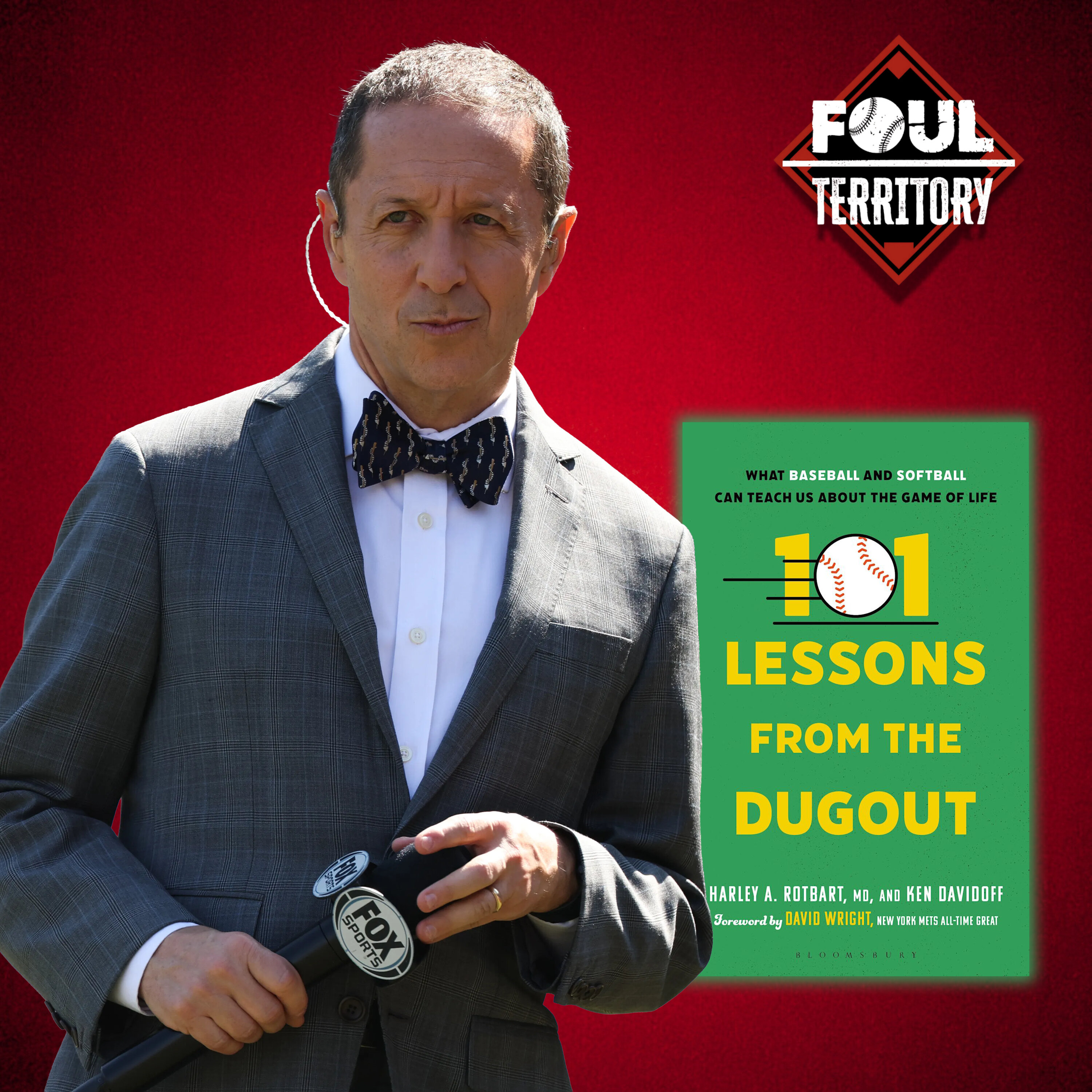
Ken Rosenthal at Tony Vitello's 1st MLB camp, Isaac Paredes trade buzz update + Ken Davidoff’s “101 Lessons From The Dugout”
FT Senior Insider Ken Rosenthal discusses what he learned from Tony Vitello’s first big league camp, whether the Giants have done enough this offseason, where the Astros stand with Isaac Paredes, Triston Casas’s future with the Red Sox and how players are preparing for the ABS challenge system.
(14:00) What are the BetMGM odds for the Twins regular season wins total?
Quit overspending on wireless with 50% off Unlimited premium wireless. Plans start at $15/month at MintMobile.com/Territory
(18:16) Former MLB writer Ken Davidoff discusses his new book, "101 Lessons From the Dugout", including the lessons he hopes to pass along and how future big-league hopefuls can use it on their road to the show. He also shares his thoughts on the winter activity for the Yankees and Mets.
Hosts: AJ Pierzynski, Erik Kratz, Scott Braun
Get 10 free meals and a FREE Zwilling Knife (a $144.99 value) on your third box at HelloFresh.com/FT10FM. Offer valid while supplies last. Free meals applied as a discount on first box, new subscribers only, varies by plan.
See omnystudio.com/listener for privacy information.
Available Results
Generated results are saved to the knowledge database for reuse and search.
Extract Knowledge
Pick what you want extracted first. Model, scope, and chapter options appear after a template is selected.
Transcript
00:00:05
Speaker 1: Okay, let's get to other topics.

00:00:07
Speaker 2: Ken you're a Giants camp, tell us about how Tony Vaitello is learning about big league camp.

00:00:15
Speaker 3: It was interesting. I attended his first media session and he obviously is someone who has done this a long time, just not at this level. He was at Tennessee and he got asked, Hey, is this the most reporters you've ever seen? Or maybe fifteen of us there, and he said, no, we got covered pretty heavily at Tennessee. And one of the things that people tend to underestimate, including myself, when I look at the jump from college to the majors, is college baseball right now is at a really high level. They use analytics the way the major leagues do. They train and do all these different things that are not all that different from what we see on an everyday basis in Major League baseball. So he comes into this it's obviously different. One of the first things he mentioned is that he doesn't know the players as well because he didn't recruit them. He's met them now. He's talked to them in phone conversations, maybe by text, but that's a difference. Right when you're recruiting a player, you get to know him, you get to know his family, you get a real good feel. He doesn't have that yet, but he'll build it. And the word that two Giants people I spoke with today used to describe him, and they use the same word was sharp. And if you've got someone who's sharp, who's got a lot of energy, a lot of personality, you tend to think he'll figure it out. And he also has Jase Tinkler on his staff, former Major League manager Ron Washington on his staff, former major league manager Dusty Baker, and Bruce Bochi will be around, so he'll have people to lean on and people he can trust and have to bounce off ideas with. He should be okay, but it's going to be one of these stories that we follow all season because it is so new and we have not seen this happen I don't know on a hundred years or so where a guy goes from college to the majors.

00:02:03
Speaker 4: Well, you can also throw in some doom for the Nationals who have Bleake pe Terra. Sorry, Ken, I'm just taking you literally. But the Giants, though, did they build their roster well enough to help him succeed? I mean, you can have manager of this manager of that college. Ra Ra and Tony Vaitelo. We had him on our show, his unbelievable interview. He gets it, he understands he's not going into this thing. I have all the answers, he said, Hey, I'm going to learn from the people around me. I have to learn a lot quickly. So did the Giants do enough this offseason with Buster Posey in charge to give him a team that can compete with the Padres, the Diamondbacks, the Dodgers, and the Rockies in his division.

00:02:40
Speaker 3: That's the question, and I'm not sure the answer to that is yes.

00:02:45
Speaker 1: What did they do?

00:02:46
Speaker 3: They signed Tyler Molly, They signed Adrian Hawserd to bolster their rotation. They didn't get a top of the rotation guy. They got two guys who are pretty good, and Molly coming off the injury, might be really good. But could they have done more? Yes, they could have done more there now to round out their position club, they signed Harrison Bader to play center field, and they feel that their outfield is going to be much better defensively this year with Jung Hully healthy, with Elliott Ramos showing a more of a committed approach to learning, and mastering left field, and then they signed a Rise, Louisa Rise, that became official just about an hour ago. He's going to play second base. He is hungry to establish himself as at least an average defender at second base again. And of course he's got one of the great infield coaches of all time to work with, and that's Ron Washington. So I would have liked to have seen them do a little bit more. But remember, they made a move that if they had made it in the offseason, we'd be declaring them winners. And that was the Devas trade last June. Devers is here already, He's taken some flips from Ron Washington and his fellow coaches this morning. They're gonna be okay. I don't know how good they're going to be. They're gonna have to figure out their bullpen, which right now seems to be just this thing that is there and they don't really have much definition to it, but they will. They'll find it. And do I see them as good as the Dodgers, of course not. Do I see them as good as the Padres, probably not, but they still can be a competitive group. And I believe the Diamondbacks are going to be a competitive team too, especially if they signed Gowan.

00:04:26
Speaker 4: All Right, Ken, it's your favorite time of the year. We're gonna get to work together for the WBC. There's a thing out there about the ABS that's coming into Major League Baseball this year. Are the catchers really at a disadvantage because they have to go miss those two weeks possibly for if you make a deep run, because they're not gonna be with their team in spring training and they're not gonna But most of them saw this last year, right they did? They not see most of these guys see this last year. Maybe they're missing out on some strategy on this. But I don't know if this is a huge deal that we're trying to make it into.

00:04:58
Speaker 3: I don't know that anybody's try to make it into a huge deal, AJ, but we're talking about it. Ideally. Would you rather be in camp for ABS and to talk strategy and to go through it all for those two weeks you're gonna miss if you're a major league catcher. Yes, But we're also talking about the elite catchers in the game, right cal Raley, Will Smith. Yes, they're gonna figure it out, and I don't expect it to be a problem. It's not necessarily ideal, as I said, but these guys are really smart. They know what they're doing, and this is something I'm sure they've been preparing for already.

00:05:33
Speaker 1: And obviously it's not.

00:05:34
Speaker 3: The same as catching pitches with the system and all that. I get it. But the thought process is, oh, that they're gonna be fine.

00:05:44
Speaker 2: Hey, sometimes we do a little game on foul.

00:05:47
Speaker 1: Territory called role play. It's not what you think.

00:05:50
Speaker 2: We're just picking up our phones and we're talking as if we're somebody in baseball. But if you'd like that phone to be a little bit cheaper for making phone calls, who should you call?

00:06:00
Speaker 1: Krats?

00:06:02
Speaker 5: Mintmobile because you get all the same speed with a tiny little.

00:06:07
Speaker 2: Price, same coverage, tiny price. Ready to stop paying more than you have to? New customers can make the switch today and for a limited time, get unlimited premium wireless for just fifteen bucks per month. Switch now at mintmobile dot com slash territory. That's mintmobile dot com slash territory. Upfront payment of forty five dollars for three months, ninety for six months, or one eighty for twelve months. Plan required fifteen dollars a month, equivalent taxes and fees, extra initial plan term only over fifty gigabytes may slow when network is busy. Capable device required, availability, speed and coverage varies see mintmobile dot com Save Money, Get after a ftfam Ken. I know you touched on some of this, but wanted to get your thoughts on where you think the Astros are at with Esak Pratus. And I know this is a guy who could be a valuable member of their team, but it does feel like he's the I don't want to say odd man out, but the guy that's maybe most easy to trade.

00:07:04
Speaker 1: And they did lose some suitors over.

00:07:05
Speaker 2: The last twenty four hours, but fans are asking if there's going to be any trade activity over the next several days. And that's the name that I came up with that I guess could still be moved around somewhere.

00:07:16
Speaker 3: Right, that situation still has to resolve. And I know the Astros have said, oh, we can carry both Christian Walker and he Zac parades into spring training. Well, how are you going to do that exactly? I mean they can carry into spring training, I'm int into the season. There's just not enough at bats, not enough playing time around you've got your Don alvarezk he's a DH so I still expect something to happen there. But you're right, Scott. They lost the suitor with the Red Sox, who of course acquired Caleb Durban and that would seem to be their move. It doesn't seem that they're going to flip some of the guys that they acquired, including Durbin, to the Astros for parades.

00:07:54
Speaker 6: That's not happening from what I understand.

00:07:56
Speaker 3: And then the Pirates another team that has been in. When they're a team that just spent twelve million dollars on Marcella Zuna, they might not have another ten million.

00:08:05
Speaker 6: Or so for parades.

00:08:07
Speaker 3: So I know there are other teams in the mix. The Astros have said, and Chandler Room of our network has said that they have other teams involved. I believe Chandler wrote in The Athletic that there were five teams involved. Well, if there are five teams involved, the Red Sox and Pirates aren't as strong as they were, there's still three others, So I still expect something to happen. Timing I can't tell you, but it just seems to me that he has a lot of value. He's got a couple of years of control, and he's a guy that people want. So given that and giving Christian Walker's low trade value, right now, he is, as you said, Scott the odd man out, and I do expect before opening Day he's going to be in another uniform.

00:08:53
Speaker 5: All right, This is not power rankings. Who do you think improved the most this offseason? Because now pitchers and catchers are here, there's no more like nobody else can improve. I'm kidding, obviously everybody can still improve, but who did the best?

00:09:06
Speaker 7: Who did in your mind? Who did the best?

00:09:10
Speaker 3: The White Socks come to mind. Now, granted they're starting from almost zero in some ways, but they made some interesting moves, Muri Kami of course being the most interesting of all. I felt the Orioles have done well, and throughout the offseason they've added here and there. They still want to do one more starting pitching or more starting pitcher, so I would include them as well other teams. I like what the Red Sox have done, but I'm curious to see how it plays out. They've certainly done a lot, and they've done it without trading any top prospects. I still wonder as a lot of people are wondering whether they're going to have enough power. Durbin is a guy who, in fed way, because he pulls the ball in the air, might be a pretty good hitter, might be even a twenty homer guy. But he hasn't been that in the Big believes yet. He's your player last year, So that's one question I have with them. I like what Seattle has done with the bullpen for air and then of course getting Donovan. A number of teams look like they're going to be improved, and people were saying, well, what about the Mets. The Mets are going to be different. I just don't know how much better they're going to be. They're a lot different and they're going to be fascinating team to watch. It's just how good are they actually going to be?

00:10:28
Speaker 7: Breaking news? Not crats? Ken hates the Mets, So just make sure that we clip that.

00:10:32
Speaker 4: It's not Cracks, it's everybody else. You hate life, Ken, We can't. We try to cheer you up every time you come on and it doesn't work.

00:10:40
Speaker 1: He looks happy at spring training. Can true.

00:10:42
Speaker 4: Maybe that's what it was, Maybe just outside you know what next offseason instead of just sitting around. You should fly to winter Ball and just cover that. For that way you'll be happy, though maybe I.

00:10:50
Speaker 3: Will be if it's a lockout.

00:10:54
Speaker 4: Yes, we could do Korea Games like they did that one year. You could do the Korea Games. You could do a metre. I be sleeping, But Ken, that wasn't my question. You brought up the Red Sox as a team, and today was you know, there's some things out there, but I want to know this name, and we haven't heard a lot about this name, Tristan Cassas. Is he on the Red Sox? Is he gonna because they have Wilson Contreres. It's not like they didn't go out and get a first basement basically to replace them. And this guy has been hype pipe pipe pipe pipe for the Red Sox. Skit skit, skit, skit skit for the Red Sox, but he gets hurt every year.

00:11:27
Speaker 7: Is he gonna be on the team?

00:11:28
Speaker 4: Is he going to be a player that they can count on for production?

00:11:33
Speaker 3: I don't know how much playing time he's going to get, And certainly someone to look at it spring training and see what he is or where he is health wise and take it from there. You could always send him back. It wouldn't be the end of the world to do that, and he'd be obviously protection And if he shows really well in spring training, I guess you could trade him too. I'm not exactly sure what the plans are for him, And You're right, he's kind of a forgotten man because he has gotten her and has had those problems and faded off the radar, so to speak, while Roman Anthony and Marcela Meyer and Christian Campbell have all come to the four for Boston and varying degrees of success. So I'm not exactly sure, Aj, what the answer to that is. Part of the reason for spring training is to find out answers to some of these questions. And it's interesting. I was thinking about this this morning. Joel Sherman of The New York Post wrote about it today. There are a number of younger players, and I guess you could maybe even put Casses in this group. Brett Batty with the Mets, Matt Shaw at the Cubs, Casey Schmidt right here with the Giants, and maybe Casses too. They're younger guys who have kind of been squeezed.

00:12:39
Speaker 1: Out of regular roles.

00:12:41
Speaker 3: What do teams do with them, Do they keep them for depths, do they trade them? How do they go about it? That's going to be an underlying storyline of the spring.

00:12:50
Speaker 5: We found out from Jim yesterday in an article that he wrote, Jim Bowden that his routine is he buys an expensive pair of sunglasses and some SPF sixty sunblock. What's Ken's routine every spring training? And how many spring trainings? Do you know how many spring trainings this is for you?

00:13:06
Speaker 7: Now?

00:13:07
Speaker 3: I do, Eric, and it's a big number, and I'm almost embarrassed to say it, but this is number forty, and wow, it's It's not a particular routine I have. I did start young, not as young as I would like to have started, But no, I started jugs. I don't really have a routine. I just enjoy it. It's interesting to me. What makes it so fun for me? And I experienced this this morning again.

00:13:34
Speaker 1: All went along.

00:13:35
Speaker 3: I'm on the phone with people. I've not seen people in person for the most part, except that maybe the winter meetings, and even there you don't really see people in person. And here this morning, I'm talking to players again, talking to executives in person. It's a huge difference. It's one of the things I treasure most about my job, and that, to me is the thing that stands out every spring. I'm always so excited just to see everybody again, even Aj.

00:14:08
Speaker 1: Bet. I'm jam futures on the Twins.

00:14:12
Speaker 2: Former Aj Pizinski team Minnesota Twins seventy three and a half wins.

00:14:20
Speaker 4: Under going under because I think at some point they're gonna trade Ryan Joe Ryan Pablo Lopez could possibly be on the list if depending on how it goes Byron Buckson might go to him and say, hey, I've had enough. We're not gonna be good for anytime soon. I mean, I want you know, is Royce Lewis gonna be healthy? That's always a question, right. I know they have some young guys coming up, but they haven't really proven anything. They traded ten of their twenty six guys away at the trade deadline last year.

00:14:50
Speaker 7: I'm going under. I think they're about a seventy one team. I'm sorry.

00:14:53
Speaker 4: Tigers have gotten better, the Guardians of the Guardians, the White Sox have gotten better. The Royals are gonna be decent. I think they might be the last place team in this division.

00:15:02
Speaker 2: I'm not going to say this everything because it's about the players on the field, but management matters. Breaking up with Derek Falby two weeks before springs training spring training.

00:15:12
Speaker 7: Started there anymore.

00:15:16
Speaker 4: And this is not a knock on Derek Shelan, but Derek Sheldon's never been the manager of a winning team.

00:15:21
Speaker 7: And that's that's not That's not a knock on him at all.

00:15:24
Speaker 1: I'm just unlucky he's he was with the Pirates.

00:15:26
Speaker 7: I'm not saying that he can't be. I'm just saying he hasn't been.

00:15:30
Speaker 4: And to lose Rocco Baldelli, who was kind of the steadying ship, not that Derek. Not that Derek Shelton is bad at all, because I love Shelty you too, but it's just it's different. You lose there, you lose your president of baseball op.

00:15:43
Speaker 7: And a new man. I think they're a seventy one team.

00:15:47
Speaker 2: He's taking on tough jobs. I'm with you, I'm taking the under and Krats. It was weird how they switched executive chairs right they moved to the different pole ad owner and he.

00:15:59
Speaker 1: Was talking with a lot of confidence. I'm more of an all in guy.

00:16:02
Speaker 2: We're going to be competitive this year. I mean, look, betamgam's putting out odds. They say, you're not going to be competitive.

00:16:12
Speaker 5: I mean, all in can mean two things. People think, Oh, I'm all in. That means they're going for it. He's like, I'm all in for exactly what I want to do.

00:16:22
Speaker 7: Nothing.

00:16:23
Speaker 5: I think they reduce their payroll by twenty million. They reduce their payroll again this year by thirty million. Like it's it's easy. It's easy to see what route they're going. And there's no way. This is only borderline for me if I'm going to put a larger amount on it or a smaller amount on it. So I'm I'm going with the under one hundred percent under.

00:16:46
Speaker 2: Okay, cool, we all agree, and we got to take some unders. You got to mix in some unders. That's what we're doing here. Let's bring up the any sport no sweat token on your favorite sport pick a sport, golf, basketball, hockey, Eventually the WBE if you don't win your bet, you get your steak back in bonus bets, swing pass, shoot your choice, betmgam dot com or the bedmjam app. Gambling problem or concern, there's help. Call one eight hundred Gambling aj you know what I love about HelloFresh the variety. Every single week, I can choose from over one hundred recipes.

00:17:22
Speaker 1: That's a lot of recipes.

00:17:24
Speaker 4: Agreed, you can go and you can narrow it down, Scott to whatever you want. Family friendly because you know I got kids sometimes the need to eat, so you can go family friendly, pescatarian, vegetarian, whatever you want to do, healthy options. However you want to refine your search on HelloFresh, it will spit out delicious, healthy ingredients that then you get to cook, which I love to cook. I keep saying it. I love to cook. I love to chop up the ingredients and make beautiful dishes.

00:17:52
Speaker 2: There's delicious steak and seafood plus three times more seafood options at no extra cost. Go to HelloFresh dot com slash ft fm to get ten free meals plus a freeze willing knife one hundred and forty four dollars ninety nine cent value on your third box. Offer valid while supplies last. Free meals applied to discount on first box. New subscribers only faries by plan. That's FT one zero FM. Longtime baseball writer Ken david Off joining us right now on FT and new hit author co author of the book One on One Lessons from the Dugout. I have it too, so we'll show it off while we say hello to Ken.

00:18:30
Speaker 1: Ken.

00:18:31
Speaker 2: Great to have you on the show. There it is, Yeah, you show it off. You're the one who put all the work together. Thanks for show it off. Yeah, exactly, we both can show it off. I like the cover too, by the way. It stands out a lot because it's green, and I see David Wright's name on here.

00:18:44
Speaker 1: Nice and big.

00:18:44
Speaker 2: But thanks for joining us, and first off, congrats on the book. Give us the loadown and then we'll dig through this a little bit.

00:18:52
Speaker 6: Thanks for having me, guys. Great to see all of you, and the loadout on the book is we My co author, Harley roadebart He is a pediatrician and parenting expert. He and I put together a list of one hundred and one different items about baseball and softball and ways you can take the lessons that you learn from these different items and transfer them into your everyday life.

00:19:16
Speaker 4: Ken, I'm going to say this, I read the book so I could talk about it. I actually read the entire book and I only got it on Saturday. So this got me through Saturday afternoon content on television just because we had a whole meeting producer Lady goes we got the book not that long ago.

00:19:36
Speaker 7: Who no way anyone finished it.

00:19:38
Speaker 4: I'm like, uh, yes, actually some of us did finish it, because we do do our job. What the thing that stands out to me is this is a great book for a lot of reasons. Now it's it's geared towards more towards kids, correct, Am I correct? Because a lot of it was ask your parents, ask your coaches, ask your teacher, which which is awesome. I wish my son would have had this book now before he was, you know, into college, and now he just doesn't listen to anybody.

00:20:01
Speaker 7: So that's fine. It's kids right there at the age of that. But these lessons are so valuable.

00:20:07
Speaker 4: And the thing that I love about this for kids is it's short, right, Every pair of every one of these one hundred and one is like a page or two and you're like boom, okay, on to the next, on to the next, and explains baseball softball situations, and it explains how you apply it to your everyday life. And one thing I always say about baseball and sports in general, they teach you how to fail, and this book does a great job of saying, hey, you're going to fail, now, how do you put that into your real world activities? And that's why I was like, oh man, this is good especially for I would say, ten to seventeen year old kids before they think they've got everything figured out, which most kids not thinking eight.

00:20:41
Speaker 6: Anyways, Well, hey, I thank you for reading the whole book, and thank you for not finding anything interesting on TV so that you read the book. I appreciate that. So yeah, I mean, technically this is good for ages of twelve and up, but I think it can give a little younger two. There's nothing really risque in there. And yeah, you said it. A lot of talk about failure obviously, and I'm preaching the choir here, but the idea of even the best baseball players fail to get on base seven out of every ten times, everyone has I say six out of every ten times on base percentage, And how do you deal with that disappointment? How do you react to that? How do you react when you come to the field and you're not in the lineup that day? That's chapter two, you know, Chapter two is you're not in the lineup, how are you going to deal with that? And just we take it through various different ways, not not every chapter is about failure, but just all the wonderful ways that this game can teach us how to live our life better.

00:21:44
Speaker 5: How many of these lessons would have been good for you to learn before you lived through all of those situations.

00:21:51
Speaker 6: Yeah, no doubt about Eric. And I do think Look, it's my book, so I'm bias, but I do think it can help as adults still. And someone asked me recently to apply had this book impact my own career covering baseball, and and there's a chapter small Ball. You know, don't don't focus on the home run, especially when you're just starting, you know, to focus on building up, putting together you know, hit singles and bumping over and and just putting some runs on the board. And that's the way I approached my career. You know, I was first covering the Yankees and Mets back in the mid to late nineties. Like, I wasn't trying to get huge scoops. I was just trying to build relationships and get small nuggets of information that no one else had and building up my credibility to the fact where I did feel comfortable swing for the fences.

00:22:42
Speaker 4: Okay, give us some examples, give us, give us, give us some examples of how Again, I've read this so I get it. But in this book it gives examples of I mean, it was like on deck circle you used to prep for tests and the bases are loaded, how you prepare? And there was one about a drop third strike, which I know a little something about, and how you always need to run it out. Just because you fail the first time doesn't mean that your life is over. So can you give us some real world examples that are.

00:23:09
Speaker 7: In the book?

00:23:11
Speaker 6: Yeah, happily, aj so on one of my favorites and is Field's Choice, and I will press the panel here. I'm pretty sure you guys can handle this, but just to just to talk it through. So let's say, let's say you're up, you're playing, you're in the field. It's for they batters of first and second with no outs, and you're up by four runs. So how do you approach that situation in the field, up by four first and second no outs? Asking you guys, you get the out right, right? So now we but now we change that in the field first and second no outs up by one. How do you approach that?

00:23:49
Speaker 7: You try to get the lead runner if you can. Yes, sorry, all that.

00:23:52
Speaker 6: So now let's carry that into school. Let's say aj back when your son was still in high school. Let's say he did not like chemistry, hardest class, but he was acent it, he was doing a good job with it. And tonight he's got homework in five different subjects. So he's up four runs in chemistry. Right, he's got the A. So maybe he can take his feet off the gas a little bit in chemistry and do some work and some other subjects that he likes better. But let's say he's got a C plus in chemistry. Now he's only up a run. Now he's got to let that lead out. He's got to study hard on chemistry to try to boost his grade up right, and he that's where he needs to prioritize. So just the idea how a Fielder's Choice can teach you how to prioritize on the file and in life.

00:24:35
Speaker 4: Jan if my son had a C plus and anything, he'd be he'd be freaked out.

00:24:39
Speaker 7: There would not be any This book wouldn't help him. I promise you that this book would not help him. He would he would, Yeah, he had a plus. If he had c plus, I trust me this book.

00:24:52
Speaker 4: The only thing this book would be used for is we ain't going to talk about that on the TV.

00:24:59
Speaker 6: But I think you get my point in any case, yes, of course, and go ahead, got no. I was just another parallel that's actually was quite serendipitous, was you know, And if you know the book writing process, this book was signed, sealed, and delivered by last fall. I mean not all the chapters written. There was a production process. So we're just have our feet up, letting the factories do their job, and we're watching the World Series, and lo and behold, mister Yamamoto pitches a complete game in Game two in the World Series against the Blue Jays, and before he goes back in the clubhouse, he picks up every piece of trash in the dugout. And that is our chapter ninety two. Clean up your own mess, dragging the field, cleaning the dugout, clean up your messes, take pride in your space. So we're just very proud to see Yamamoto, you know, practice well, we're preaching. And my joke has been maybe he got a sneak copy of the book and I think more likely he was raised that way in Japan, but it just shows the value of that at the highest level, on the biggest stage.

00:26:07
Speaker 5: I'm actually going to be reading this book to my high school team that I coach because there's a lot of very applicable things, and I feel like, as a coach, you're applying these things, yes to baseball, but ultimately they're not going to be big league baseball players. They're going to be men, husbands, brothers, sons for the rest of their life. Who were you thinking of when you wrote these chapters when you're I know you're co author, so you wrote it together. But when you were going through these and you're like these life lessons and all this stuff, who were the people that were coming to your mind as you wrote these words?

00:26:43
Speaker 1: All right?

00:26:44
Speaker 6: Definitely my son. My son is now twenty two in college, but he played ball and I coached on occasion when I when my schedule allowed me. You know, I was like the third base coach. I can be the mager because I was too busy covering you guys. But I just thought of my son playing travel ball, playing junior high school ball, middle school ball, and the lessons we tried to take away from that and all of his his his teammates at the time, and now you know, going down the line, maybe off grand kids. Someday I can impart these two.

00:27:18
Speaker 3: All right.

00:27:18
Speaker 4: There's a couple there's a couple of chapters I wanted to talk to about, and one of them is the Mound. I love the Mound the Mound one because you're like, the mound is in the middle of the diamond and it's built up, and you got you stand there and so take your shot on the mound.

00:27:30
Speaker 1: Right.

00:27:30
Speaker 4: I've had this conversation with my kids many times where hey, you have to fake it sometimes and just tell yourself that I'm the Kenny Rogers song right, the Greatest where he strikes out and he says it's such a great picture. It's kind of like that, like you just have to tell yourself, I'm on the mound, it's my time, and I'm gonna shine.

00:27:46
Speaker 7: I love that chapter. And the other one, I don't know what I forget what it.

00:27:50
Speaker 4: Was called, but it was about the snapping when you get mad and you lose your your cool and you throw stuff. I don't know which one that one is, but I just want to say, as someone that did that lot, yeah, it wasn't the best idea and I don't tell my kids to do that, but man, for those for those ten seconds, you feel like awesome. So don't do it, kids, But for those ten seconds, I have to stay.

00:28:11
Speaker 6: We didn't include that part as we edit out that ten second part, but we h. You're talking about chapter eighty two the head trip controlling your emotion, controlling your temper, which I think fittingly precedes chapter eighty three. The umpire accept responsibility and follow the rules, and you know they're luck with They all blessed, all the umpires out there, so you know when the umpire does make a rare mistake, sometimes you just have to accept you can't control everything in life and move on, right.

00:28:39
Speaker 7: Or get ejected and move on to the next game and move on to the next day.

00:28:44
Speaker 4: That's why I get ejected as Aaron Boone does so often. You cover him all the time. Just stand up for your guys and then move on.

00:28:51
Speaker 2: So yeah, this was written with an MD the sequels coming out with catter aj on some of his the.

00:29:00
Speaker 1: Which leads me to my next question.

00:29:02
Speaker 2: Can you describe your relationship with David Wright and how you got him involved with the book.

00:29:07
Speaker 7: Yeah.

00:29:07
Speaker 6: Look, I covered David for the entirety of his career. I met him for the first time at the two thousand and four Futures Game in Houston, and then he made his big league debut I think it was about a week later. And one of the best guys you'll ever know in any walk of life. And I knew David was living a quiet life in southern California. I knew he was coaching his three young children, so I thought this book would connect with him, and low and behold, it did, and I was so grateful for David's participation and his blessing, and we were talking through the forward that he wrote. I was so thrilled to ruize he actually does this, like he actually uses the game and like one of his daughters plays soccer. So it's not specifically not limited, I should say, to softball, baseball, but he uses the sports to teach his kids about other walks of life. So I think that's just wonderful and very great to David for joining us on this journey.

00:30:04
Speaker 2: So now I'm going to try and spin this into the game that we cover all the time. For the most part, here major league based. What parts do you think apply well here to major league players? And what other parts do you think, you know, don't apply well to major league players? And I mean that with the way that the game has changed, I mean we cover a lot of really good dudes that look like they were you know, and sound like they were raised well, they have the right values and morals. I would say overall, I think the players getting less trouble than they used to. You can take that for what it is, but yeah, your thoughts on the character of major league players, but then also on the way that these players are evaluated, because it makes me think back to where we started, where you're talking about small ball and like generally nowadays it's something that we bring up in the playoffs and it's fun. But overall, if you're that kind of guy, you don't get paid as much, so your value is lower.

00:31:03
Speaker 6: Yes, got that's a very fair question. And yeah, this book is written for, as we said, kids twelve and up. And I yeah, if you want to drill down, for sure, some lessons of major league baseball have evolved in terms of if you want to succeed at the highest level, you know, swing for home runs, right, because it's hard to string three or four hits together off this caliber of pitching. But I do think I'm confident that the high majority of the chapters very much apply to the game at the highest level because most of them having to do do have to do with how do you deal with adversity? How do you deal with unexpected circumstances? AJ before mentioned the drop third strike right like be ready, be ready to all times in your life if you catch a break, you know, and that certainly applies to major League baseball, and I just I do think that most of the time, you still the right thing as a twelve year old is the right thing as a as a multimillion dollar ballplayer.

00:32:06
Speaker 2: I'm going to ask you a couple of things about the current sport, and we can stay on the New York teams here for a moment with you, since that's where you're based. So you covered the Yankees for a long time. What do you think about their off season? It seems like they checked the boxes. But when you're a fan, and maybe when you're a Yankees fan especially and you haven't won in a while for their terms, you're like, wait, we're mostly running it back and We'll have a couple injury returns at some point, So how do you evaluate what they did?

00:32:37
Speaker 1: And I'm just presenting the case here.

00:32:39
Speaker 2: We just talked about them and they had a very successful regular season and then they got bounced pretty good.

00:32:45
Speaker 1: But oh we're back. You got us.

00:32:54
Speaker 2: Sorry we froze Forer A second thoughts on the Yankees running it back and it almost seems like, I mean, you covered Brank Hassman for a long time. He's been defending it like, no, we're running it back because this team can win a World Series.

00:33:05
Speaker 6: So your thoughts, Yeah, it's a It is a truly fascinating gambit because, as you said, Scott, the fan base is not happy. My point of curiosity, how does the team feel? I mean, these two guys here, Agan Eric can speak to the jolt a team gets mid season when those new guys come in by a trade, right, and the disappointment when that doesn't happen. So I'm curious in that clubhouse, is there any what is the move there? My hunch is that this group is pretty together and so that's not going to be an issue. That is just a matter of is this team talented enough to win it all? It is, and I you know, to me, the biggest areas of concern are I'm surprised I haven't gotten more guys with higher floors for their starting rotation and for their bullpen, because I think they have guys with high ceilings. When you look at a kid like Ryan Weathers, whose dad I covered on the ninety six Yankees, David Weather's was a high ceiling, but I wouldn't say as a high floor. So I still wouldn't surprise if they brought in a couple more veterans who give them just some more certainty in terms of the innings.

00:34:16
Speaker 2: All right, and then I'll flip you over to the Mets side of things. Super interesting offseason for them. They switched it up quite a bit, and I don't think anyone would doubt that they needed to switch things up a little bit. It's actually funny where you talked to a lot of Mets fans because I'm Offen in the New York area, and they're pretty bummed that they lost out on some of their guys, yet also excited for who they brought in. I mean, in a perfect world, it's like they wish they kept Edwin Diez and Pee Alonzo and then still made these moves. You can't do all of that. So what are your thoughts on what they did this offseason? And also the way that they're looking at a number of players out of position and saying they'll figure it out.

00:34:54
Speaker 1: Actually, it's funny. We've been talking about this with the Brewers.

00:34:57
Speaker 2: They're playing all kinds of puzzle piece action right now after they traded away Caleb Durban.

00:35:04
Speaker 6: Yeah, so I think if they had brought in I'm sorry, if they had brought back Edwin Diaz and done everything else, I think would be an a plus offseason, and I think there would be universal acclaim and even excitement among the Mets. Are the very Mets fans who were so upset that they traded Nimo and let Pete go. I do think that bullpen just stands out to me. Devin Williams, And if you you know, I'm no longer covering the game full time, but I certainly still pay attention a lot. And this whole idea that Devin Williams, Oh, if you look at the underlying numbers, he actually had a good year. Like, no, I'm not buying that. Like he struggled as the Yankees closer and everything that comes with that responsibility. And now he's going to be in the same town with a lot of the very same media people in the same volume of media. So that is not a slam dunk for me. I do like Luke Weaver as a as another guy there, and in terms of the defense, yeah, huge risk. What's interesting is these guys are athletic, right Bishett and Polanco, So you're not putting dhs out there at new positions. But a risk for sure, But it seems like it was a necessary to necessary move to kind of blow things up and start over. And we'll see if it works. I'll say now, I'd be very surprised if they did not exceed last year's eighty three and seventy nine record.

00:36:31
Speaker 4: Ken, I just want to know, since you don't cover the teams anymore, who ends the year with the better record? The Yankees are the Mets this year, since you're not, since you don't have to cover them, now, you can give us your honest opinion who this year finishes with the better record.

00:36:43
Speaker 6: I would hope I was giving my hosesbite opinion before.

00:36:46
Speaker 4: Yeah, now that I'm in the media, I know that our media work.

00:36:50
Speaker 6: So I don't have to say the Yankees just because, but the Yankees have The Yankees have historically figured it out better and more often than the Mets, and I do think the Yankees have fewer question marks about the overall team, So I would have to go with the Yankees. Agent right.

00:37:10
Speaker 5: We have a lot of players and writers on but one of the common themes is New York tough city to play in.

00:37:16
Speaker 7: You know, there's a lot of pressure.

00:37:18
Speaker 5: Why did you put so much pressure on all those players as part of the media and reading your book, it feels like there's the.

00:37:26
Speaker 7: Soft side of you? Is there a way? Is there is there?

00:37:31
Speaker 5: Is there a part of you that saw some of that media like that players can't handle New York, which I don't one hundred percent believe, and maybe you took it a little bit easier on players.

00:37:46
Speaker 6: I do think this book is a reflection of the fact that I was burnt out on the job that you guys are doing now covering the game every day, like it's it's such a grind. And I loved it and it was my childhood dream, but I just reached a point where like I wasn't enjoying this anymore. And this book was such a refreshing change of pace for me, just to really embrace the game in such a loving way and talk about the game at its fundamental level, to talk about the three outs and the nine innings and the bases and all these different elements. So that was a true joy for me. As for New York, Eric, I'm curious. I'm interested to hear you say that, because I believe it's a real thing. Like I saw enough guys just struggle. More than anything. It's just the volume, right, It's the volume of quantity of people. And I do think the commentary is harsher than it is in other markets by and large. But even like I always the story. I always tell Randy Johnson, you know, Hall of Fame pitcher all time at worse, the second best left the starter ever, right, like just a fina. But Randy came to New York and like he didn't like all that attention. I think he'd be the first to tell you. And he like I remember, like between start, you know, throwd between starts, and he would throw and like media will come up with him, like you, how'd your session go, Randy? Like what are you talking about? Yeah, we know your last two starts haven't been great. Did you change anything up in your session?

00:39:14
Speaker 3: Like?

00:39:14
Speaker 6: What do you do differently? Like? That was like mind blowing for Randy because I think, with all the respect to the smaller markets, he played it like he would just do his own business between starts and never get a questioned about anything.

00:39:26
Speaker 1: Yeah, that is a great It didn't help Ken.

00:39:28
Speaker 7: Then he shoved the cameraman right. That didn't help me either. I mean, that's let's.

00:39:37
Speaker 1: Welcome to New York.

00:39:38
Speaker 7: Yeah, now is a cameraman. That's right?

00:39:42
Speaker 6: Oh, good pivot there.

00:39:43
Speaker 7: He should have definitely should have read that. Listen.

00:39:45
Speaker 4: I think that, I mean, I listen to someone that played in big and small markets.

00:39:49
Speaker 7: I don't know that.

00:39:50
Speaker 4: It's definitely the media coverage. I think it all also has to do with the way teams handle it, because different teams handle things different ways. And it starts with the manager in the in the front office people and if you the guys who are right, and I'll give Aaron Boone credit.

00:40:03
Speaker 7: For this a lot.

00:40:03
Speaker 4: And I don't know Cashman as well as I know Boonie, but they really try to take pressure off the players, right, like and I think Carlos Mendoza does a great job in New York with us too, like that Aaron Boone's like, throw it on me, I'll take it, you know, and so that it's not on them. Then you can get a manager that is like, oh, well, I don't know why he did that, asked the player, and then the players like, well, he gave me the bonner, he gave me the hit and run, or he brought me into the game, right, you know. So I think it can be a thing, but it also can be mitigated and lessened a little bit if you're people in charge help you a little bit and not say, oh, it's all the players fault or it's all you know, Oh well ask him, Like, no, ask me, I'm in charge. I'll handle the heat. And I think that helps.

00:40:51
Speaker 2: Yeah, good point. Well, we appreciate the time. Great conversation with you. Ken's book is available wherever you get books. One oh one Lessons from the Dugout What baseball and softball can teach us about the game of life and if you go on the back. Some recommendations include Reggie Jackson, Bernie Williams, Joe Girardi, and Cayrol Hutchins. Who's the winningest softball coach in NCAA history. Ken, thanks again for joining us. Congrats on the book. We appreciate you putting this together and joining us.

00:41:18
Speaker 6: Guys, thanks for having me. Great to see all