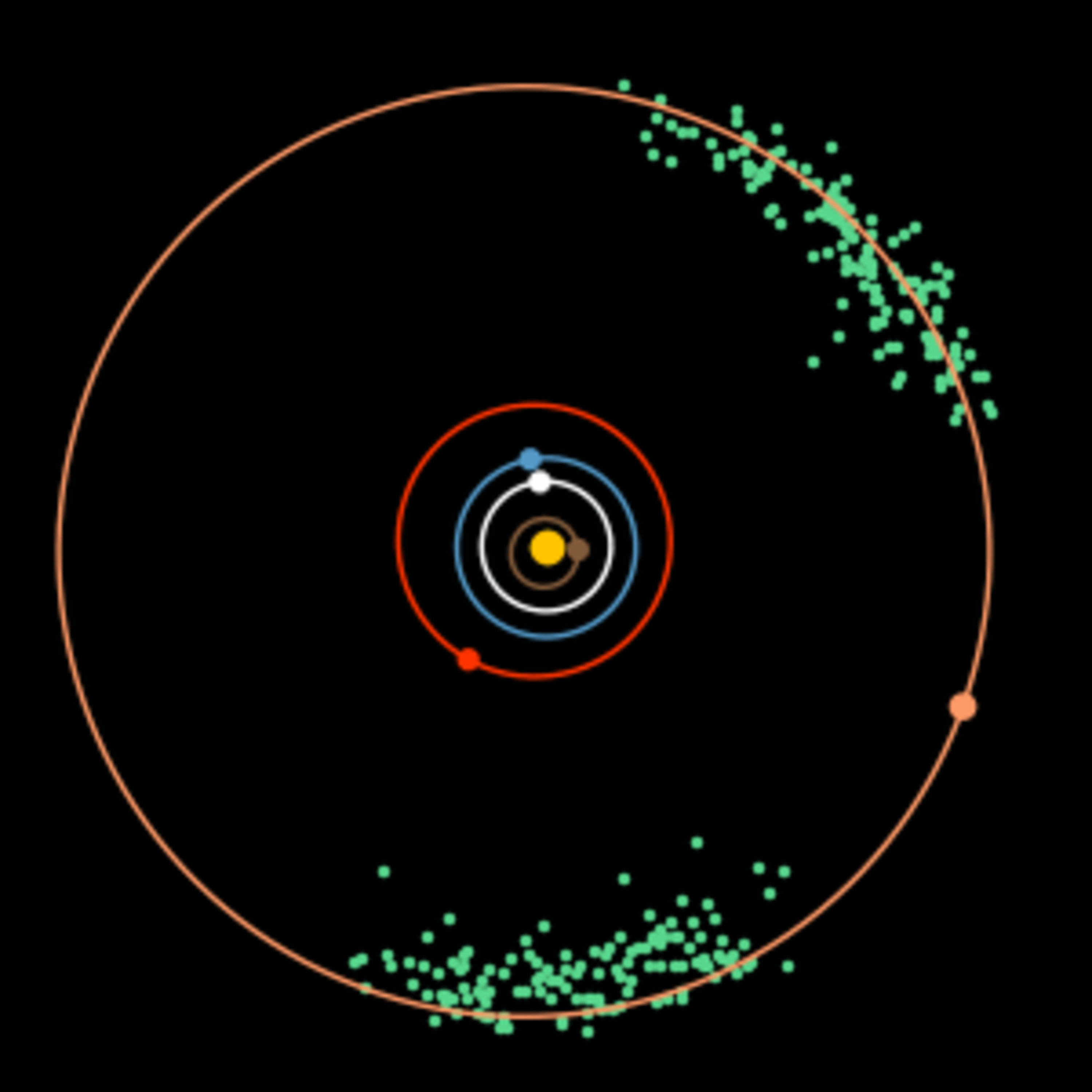
Hal Levison on the Mission to Jupiter's Trojan Asteroids
A key question about the early history of the Solar System is whether the giant planets formed roughly at the distances from the Sun they presently occupy, or, as some theories predict, much closer to the Sun. The discovery of other solar systems with radically different configurations of planets has made this question more pressing, since it appears that the configuration of the Solar System might be atypical.
In the podcast, Hal Levison explains why the Trojan asteroids of Jupiter offer us the best opportunity to discriminate between the various models of Solar System evolution. And that is why a spacecraft called Lucy is now well on its way to a rendezvous with these asteroids.
Hal Levison is the Principal Investigator of the Lucy mission. He studies the dynamics of astronomical objects and, in particular, the formation and long-term behavior of solar system bodies. He is one of the original proponents of the Nice model (named after the city where it was conceived), a scenario that proposes the migration of the giant planets from an initial compact configuration closer to the Sun to their present positions. He is Chief Scientist in the Department of Space Sciences at the Southwest Research Institute in Boulder, Colorado.
Available Results
Generated results are saved to the knowledge database for reuse and search.
Extract Knowledge
Pick what you want extracted first. Model, scope, and chapter options appear after a template is selected.