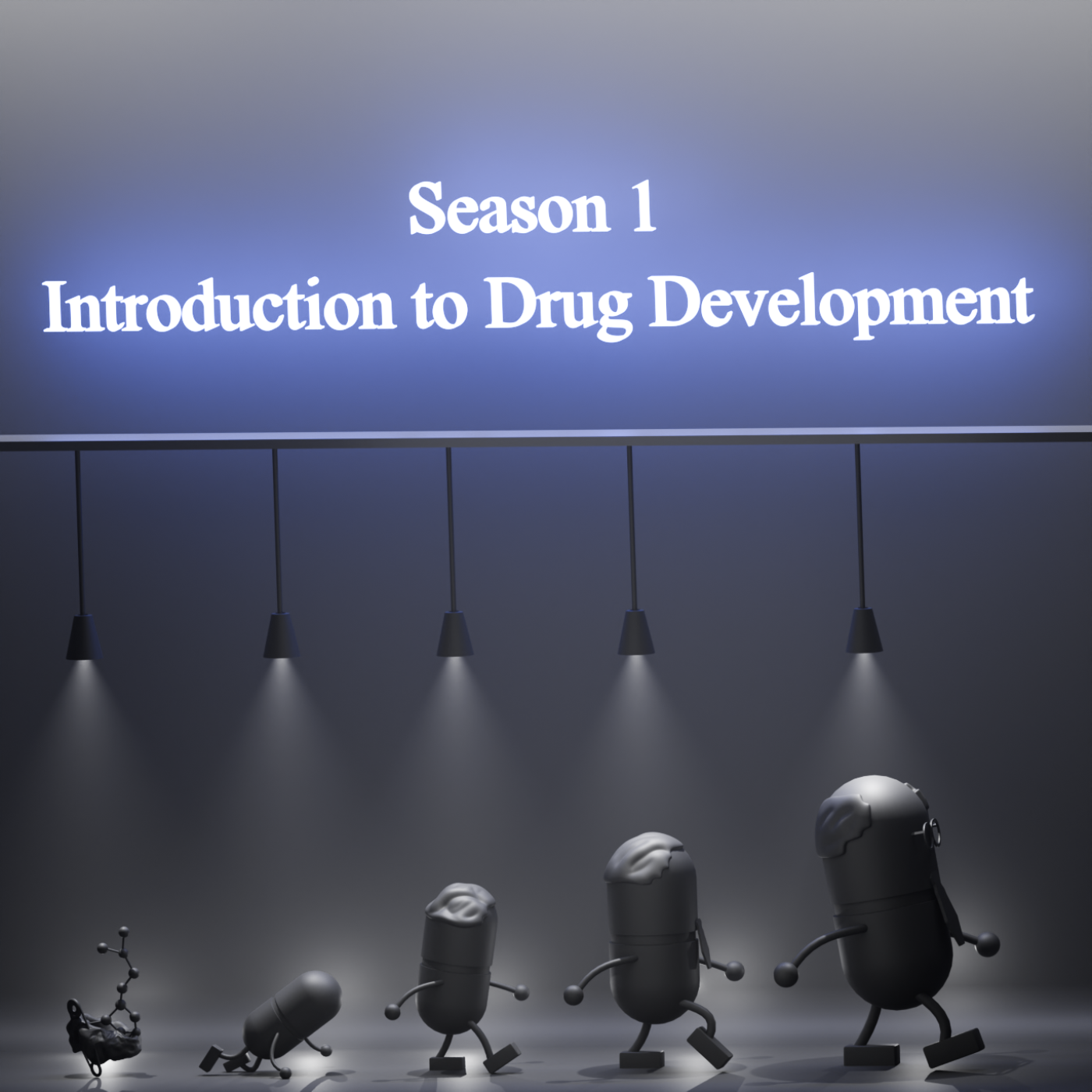
1 - Introduction to Drug Development (S1E1)
From Concept to Medicine - A Comprehensive Drug Development Journey
Embark on a journey through the intricate world of drug development, from the spark of an idea to a life-changing medication available at your local pharmacy. Discover the crucial stages of this process, including discovery, preclinical testing, clinical trials, regulatory hurdles, and post-market surveillance. We'll unravel the complexities of each step, revealing the collaborative efforts of scientists, engineers, and regulatory experts. This episode also introduces Quality by Design (QbD), a groundbreaking approach that emphasizes building quality into every stage, ensuring safer and more effective medicines for all. Join us as we demystify the drug development process, highlighting the challenges, triumphs, and the unwavering commitment to improving human health.
From the initial "eureka" moment to the rigorous scrutiny of regulatory bodies, we'll explore how a drug candidate progresses through the pipeline. Understand the importance of preclinical research in evaluating safety and efficacy, and delve into the different phases of clinical trials, from small groups of healthy volunteers to large-scale studies involving diverse patient populations. Learn how QbD principles are revolutionizing the industry, ensuring that every step of the process is driven by science, data, and a patient-centric approach. This episode provides a comprehensive roadmap of drug development, laying the groundwork for a deeper dive into specific aspects in future episodes.
Available Results
Generated results are saved to the knowledge database for reuse and search.
Extract Knowledge
Pick what you want extracted first. Model, scope, and chapter options appear after a template is selected.
Transcript
Welcome to the very first deep dive. It's pretty
exciting. Yeah, it is. You know, it's amazing
to think that every medicine we rely on, every
pill or injection, started as just an idea. Crazy.
Right? Today we are diving deep into the incredible
journey of drug development, how that initial
spark of scientific inspiration transforms into
a treatment available at your local pharmacy.
It's really quite a process. What's fascinating
is that this journey isn't a quick sprint. It's
more like an ultra marathon. Wow. We're talking
about a process that takes 10 to 15 years. OK.
Sometimes even longer. Oh, wow. And costs. Hundreds
of millions, even billions of dollars. That's
a serious commitment of time and resources. It
makes you wonder why it takes so long and why
it's so expensive. I mean, we can put a human
on the moon faster than we can develop a new
drug. Well, you have to remember, we're not launching
a rocket. We're introducing new substances into
the human body. Of course. The stakes are incredibly
high. Yeah. We need absolute certainty. Right.
That a new treatment is both safe and effective
before it reaches patients. That makes sense.
There's simply no room for shortcuts when it
comes to human health. I get it. So safety and
efficacy are paramount. Absolutely. OK, so let's
break down this marathon, shall we? Sure. What
are the major stages of drug development? So
broadly speaking, the journey can be divided
into five key stages. OK. Discovery. pre -clinical
research, clinical trials, regulatory review,
and post -marketing surveillance. Okay, five
stages. Yeah. It sounds almost manageable when
you put it like that. Right. But I have a feeling
each stage is packed with complexity. Oh, you're
absolutely right. Okay. Let's start with the
first stage discovery. All right. This is where
it all begins. the spark of an idea. Scientists
identify a disease they want to target and then
zoom in, way in, to the molecular level to figure
out what's going wrong. They're searching for
the root cause, the target that needs to be fixed
to restore health. So it's kind of like finding
the glitch in a computer program. That's causing
the whole system to crash. That's a great analogy.
And once they've identified the target, the hunt
begins for a molecule that can interact with
it in a specific way. Imagine trying to find
the perfect key for a tiny intricate lock. That
key is our potential drug. Gotcha. So I can only
imagine the number of keys they have to test
before they find the right one. It's a lot. Yeah.
So how do they even begin to narrow down the
search? That's a good question. That takes us
to the second sage preclinical research. OK.
This is where scientists put those potential
drug candidates through a rigorous series of
tests. Right. But before they ever reach a human.
So it's like a boot camp for drugs. Yes. Weeding
out the week before they go into battle. Exactly.
The first step is testing in the lab. Using cells
and tissues to see if the drug actually works
against the target. Does it bind to the lock?
Does it produce the desired effect? And importantly,
is it toxic to cells? Safety first, always. Yes.
So it's a lot of trial and error, I imagine.
It is. And if a drug candidate shows promise
in these initial tests, it moves on to animal
studies. This is where things get a bit more
complex, ethically speaking. But it's a crucial
step in understanding how a drug behaves in a
living organism. I can see why animal studies
would be a sensitive topic. Yeah. Can you talk
a bit more about why they're necessary and how
they're conducted? Of course. Right. Animal studies
provide critical information about a drug's safety
and effectiveness in a complex biological system.
Right. We can observe how the drug is absorbed,
distributed throughout the body, metabolized,
and eventually eliminated. Right. Animal studies
also allow us to determine safe and effective
dosage ranges, something we can't ethically do
in the initial stages of human testing. I see.
So it's about minimizing risk as much as possible
before moving to human trials. Precisely. Gotcha.
And while there are always ethical considerations.
Of course. These studies are conducted under
strict regulations and oversight. Right. To ensure
the humane treatment of animals. OK. It's a responsibility
that scientists and research institutions take
very seriously. OK. So let's imagine our drug
candidate has successfully navigated this preclinical
boot camp. Right. What happens next? Then it's
time for the big leagues, human clinical trials.
This is where we finally test the drug on humans
in a very controlled and staged This is what
we often hear about in the news, right? There's
large -scale trials involving thousands of patients.
Exactly. But before we get to those massive phase
three trials, there are two earlier phases. Clinical
trials are divided into three phases, each building
on the previous one, and providing more and more
data about the drug's safety and effectiveness.
And this is one of the main reasons why drug
development takes years. Makes sense. OK, break
it down for us. What happens in each phase? So
in phase one, safety is the absolute priority.
We test the drug on a small group. of healthy
volunteers, not patients with the disease, to
assess its safety profile. We're looking at how
it's processed in the body, how long it stays
in the bloodstream, and what side effects, if
any, it causes. So it's like dipping your toes
in the water before jumping in the pool. Exactly.
Then comes phase two, where we expand the trial
to include patients who actually have the disease
we're targeting. Now the focus shifts to determining
if the drug is actually effective. in treating
the condition. So does it work in the real world,
not just in the lab? Precisely. And finally we
have phase three. The large -scale trials you
mentioned, these trials often involve thousands
of patients across multiple locations. And they
compare the new drug to existing treatments or...
a placebo. Phase three trials are the gold standard
for gathering evidence about a drug's effectiveness
and long -term safety. So it sounds like a really
rigorous stepwise approach. It is. With each
phase adding another layer of certainty. But
I'm guessing the journey doesn't end there, does
it? You're absolutely right. Okay. Even if a
drug shows promise in all three phases of clinical
trials, it still faces another hurdle. Oh, what's
that? Regulatory review. In the U .S., that would
be the Food and Drug Administration or FDA, right?
That's correct. The FDA or similar agencies in
other countries play a crucial role. in protecting
public health. They have the challenging task
of reviewing all the data from those years of
clinical trials, scrutinizing everything, safety
efficacy manufacturing processes to ensure the
drug meets the highest standards. That sounds
like a pretty tough exam to pass. It is, and
it should be. These agencies are responsible
for making sure that the benefits of a new drug
truly outweigh any potential risks. They ask
the hard questions. Is the manufacturing process
reliable? Are the labeling and instructions clear?
Only after this thorough and independent review
will a drug be approved for market? OK, so it's
reassuring to know that there is such a rigorous
system in place to protect patients. Definitely.
So once a drug gets that regulatory stamp of
approval, it's game on, right? It's finally ready
to be prescribed and used. It's certainly a major
milestone, but the journey isn't over yet. Oh,
really? What else is there? There's one more
crucial stage. Post -marketing surveillance.
Post -marketing surveillance. OK, I'm intrigued.
What does that involve? So even after a drug
is on the market and being used by potentially
millions of people, it's still under scrutiny.
Interesting. Scientists and regulatory agencies
continue to monitor the drug for long term effects,
looking for any rare or delayed side effects
that might not have emerged during clinical trials.
Oh, so it's not a one time approval and then
everyone just moves on? Not at all. OK. Drug
development is a dynamic ongoing process. Right.
New information about a drug's safety and efficacy
can emerge over time. And the FDA continues to
evaluate this information. Right. And can take
action if needed. That's really reassuring. Yeah.
So it's a constant process of learning, adapting,
and ensuring the well -being of patients. Exactly.
OK. This whole process is fascinating. It is.
But before we move on, I'd love to know more
about something that really caught my eye in
the research. OK. The challenge of developing
oral dosage forms. Right. I mean, swallowing
a pill seems so simple. Yeah. But I'm realizing
there's a lot more to it than meets the eye.
You're absolutely right. Developing an effective
oral dosage form is a science in itself. Just
getting the drug into your body isn't enough.
It needs to be absorbed properly to have the
desired effect. And that's where the concept
of bioavailability comes into play. Bioavailability,
I remember reading about that. It's not just
about how much drug is in the pill, but how much
of it actually reaches the bloodstream where
it can do its job. Exactly. Bioavailability is
key. and it depends on a complex interplay of
factors. The drug's solubility, its ability to
pass through membranes, the formulation of the
pill itself, and even individual differences
in how our bodies absorb and process drugs. Even
if a drug is incredibly promising, a poorly designed
pill could render it ineffective. That's right.
Wow. And that's why pharmaceutical scientists
spend a great deal of time and effort in formulation
development. They carefully select inactive ingredients
called excipients to optimize the drug's release,
absorption, and stability. Wow. I never realized
there was so much science behind something as
seemingly simple as swallowing a pill. It's a
fascinating area of research, full of challenges
and innovation. Well, this is all incredibly
insightful. We've covered so much ground already,
from the initial spark of an idea to the complex
world of formulation and bioavailability. It's
clear that bringing a new medicine to market
is an incredible feat of scientific collaboration
and perseverance. Absolutely. So thank you. You're
welcome. You know what's truly remarkable about
oral dosage forms is how they bridge the gap
between scientific discovery and the patient
experience. I see. It's not just about the active
ingredient itself. It's about creating a delivery
system that works in harmony with the body. That
makes a lot of sense. Yeah. So formulation scientists
are like the master chefs of drug development.
That's a great analogy. Carefully blending ingredients
to create the perfect recipe. Exactly. And just
like a master chef considers flavor texture in
presentation, formulation scientists focus on
factors like solubility stability and, of course,
bioavailability. Right. They need to ensure the
drug is delivered to the right place at the right
time and in the right amount. And I imagine they
also have to make sure the final product doesn't
taste horrible. Absolutely. Nobody wants to dread
taking their medicine. Patient compliance is
a crucial consideration. Right. Especially for
medications that need to be taken long term.
A bitter pill, no matter how effective, won't
do much good if the patient avoids taking it.
That's true. So you mentioned dissolution studies
earlier. Can you walk us through those? Sure.
Why are they so crucial in this process? Dissolution
studies are essentially like time -lapse photography,
but for pills, we use specialized equipment to
mimic the conditions in the digestive tract,
the temperature, the pH, the churning motions,
and we measure how quickly the drug dissolves
from the pill over time. So it's like a window
into how the pill breaks down in the stomach
and intestine. Precisely. Okay, cool. And by
analyzing the dissolution data, we can optimize
the formulation to ensure the drug releases at
the desired rate. whether that's a quick burst
or a slow sustained release over hours. We can
also identify potential problems. Like if the
pill doesn't bring apart properly or if the drug
particles aren't adequately exposed to the digestive
fluids. This is really making me appreciate how
much goes into designing an effective pill. It's
complex. What are some of the factors that can
affect how quickly a drug dissolves? Well, the
drug's solubility is a big one. Think of trying
to dissolve sugar in water. A highly soluble
drug will dissolve quickly, while a poorly soluble
one might need some help. So is that where those
excipients, the inactive ingredients come in?
Exactly. And they boost the solubility of a drug?
Exactly. Excipients are the unsung heroes of
drug formulation. Some act as solubilizers, helping
the drug dissolve more readily in the digestive
fluids. Others improve the way the drug particles
interact with those fluids, making sure they
get adequately wetted. And still others can modify
the drug's release, creating a sustained release
formulation that delivers the medication over
a longer period. So it sounds like an intricate
dance of chemistry and biology. It is. Carefully
choreographed to get the drug where it needs
to go. It truly is. And particle size also plays
a role. OK. Imagine trying to dissolve a sugar
cube versus granulated sugar. Right. The granulated
sugar with its smaller particles and greater
surface area will dissolve much faster. OK, that
makes sense. So grinding a poorly soluble drug
into a fine powder can help it dissolve more
quickly. Exactly. And then there's this fascinating
concept called polymorphism. Polymorphism. Some
drugs can exist in different crystalline forms.
OK. Kind of like how carbon can form both diamond
and graphite. Interesting. And these different
forms, even though they're chemically the same,
can have different solubilities. Wow. I had no
idea. It was so complex. So choosing the right
crystalline form is crucial for optimizing dissolution.
Absolutely. And it's this attention to detail,
this understanding of the interplay between chemistry,
biology, and engineering that allows us to create
safe, effective, and reliable medications. You
mentioned earlier that the formulation isn't
static. Can you elaborate on that? Right. The
formulation of a drug is not set in stone. OK.
It often undergoes refinements and improvements
as we gather more knowledge about the drug's
behavior in the body. Sometimes we discover that
a slight tweak in the formulation can significantly
enhance its bioavailability or reduce side effects.
A constant evolution. This is all incredibly
insightful. Good. But I'm curious, are there
certain challenges in drug development that are
particularly difficult to overcome? Certainly,
one of the biggest hurdles is developing drugs
for diseases that affect the brain. Oh, the brain.
The blood brain barrier, a protective shield
around the brain, is incredibly effective at
keeping out harmful substances. Right. But unfortunately,
it also blocks many potential drugs from reaching
their targets. So it's like trying to deliver
a package to a high -security building. Yes.
With a really strict doorman. That's a great
way to put it. He's not letting anything in.
And researchers are constantly working on new
strategies to overcome this obstacle. One approach
is to design drugs that are more lipophilic or
fat -soluble, which allows them to slip through
the barrier more easily. Another is to package
drugs in nanoparticles, tiny delivery vehicles
that can sneak past the defenses. That's amazing.
It's like a microscopic Trojan horse. delivering
the drug right to the target. Exactly. And there
are many other innovative approaches being explored.
Such as? Like temporarily disrupting the barrier
with focused ultrasound. Oh, wow. Or designing
drugs that can hitch a ride on existing transport
systems that cross the barrier. It sounds like
a constant game of scientific chess trying to
outmaneuver the body's defenses. That's a perfect
analogy. And another challenge is developing
drugs for rare diseases. Rare diseases. These
conditions often affect only a small number of
people. OK. Making it difficult. to recruit patients
for clinical trials and attract investment from
pharmaceutical companies. I can see how that
creates a difficult situation if fewer people
have the disease. The potential market for a
new drug is smaller, which might discourage investment.
Right. But these patients still deserve effective
treatments. Absolutely. And thankfully, there's
been increasing recognition of the need to develop
therapies for rare diseases. Governments and
regulatory agencies are offering incentives to
encourage research and development in this area.
That's great. And patient advocacy groups are
working tirelessly to raise awareness and funding.
It's inspiring to see people coming together
to address these challenges. But let's switch
gears for a moment. Sure. And talk about a concept
that often comes up in conversations about drug
development. OK. The idea of a magic bullet.
Is this a realistic goal or just a Hollywood
fantasy? That's a great question. The magic bullet
concept, a term coined over a century ago, envisions
a drug that targets and destroys disease -causing
agents with absolute precision, leaving healthy
cells untouched. So it's like a guided missile
that takes out the enemy without causing any
collateral damage. That's the idea. OK. But the
human body is incredibly complex. And even our
most targeted therapies can have unintended consequences.
We've made incredible progress in developing
more precise treatments. But that perfect magic
bullet with zero risk and absolute specificity
remains elusive. So it's more about managing
expectations. Well, we can strive for greater
precision and fewer side effects. Yes, but achieving
perfect targeting might be an unrealistic goal
You've hit the nail on the head drug development
is a delicate balancing act Weighing the potential
benefits of a treatment against its inherent
risks, right? And we're always striving to improve
that balance to develop drugs that provide the
most benefit with the least harm Well said this
conversation has really opened my eyes to the
complexities of drug development It's a fascinating
field. It's inspiring to see how scientists are
constantly pushing the boundaries, tackling these
challenges head on. It's a truly remarkable field,
and it's constantly evolving. Speaking of evolution,
let's talk about some of the most promising areas
of research, those areas where we might see breakthroughs
in the coming years. Now you're talking, let's
hear about those game changers. What's on the
horizon? One area that holds immense potential
is gene therapy. Gene therapy, OK. This revolutionary
approach aims to treat diseases at their root
by correcting faulty genes. Wow. So imagine being
able to cure inherited disorders like cystic
fibrosis or sickle cell anemia. By repairing
the defective gene, it sounds like science fiction.
Are we really at that point? We're getting there.
Well, gene therapy is still in its early stages.
There have been some remarkable successes, particularly
in treating certain types of cancer and rare
genetic diseases. That's amazing. But of course,
there are challenges. Like what? Particularly
ensuring the safety and long -term effectiveness
of these therapies. I can imagine that manipulating
genes comes with a whole new set of ethical and
safety considerations. Absolutely. And that's
why gene therapy research is conducted with extreme
care and under strict regulatory But the potential
benefits are so profound that this area of research
is truly worth exploring. It's incredible to
think about the possibilities. What else is out
there on the cutting edge? Another promising
area is immunotherapy. Immunotherapy. Which harnesses
the power of the body's own immune system to
fight disease. Wow. This approach has already
shown remarkable success in treating certain
cancers, and researchers are exploring its potential
for other conditions like autoimmune diseases
and infectious diseases. So it's like giving
your body's natural defenses a supercharge, equipping
them to better recognize and attack the enemy.
That's a great way to put it, and there are many
different types of immunotherapy being developed.
Some... boosts the overall activity of the immune
system, while others train specific immune cells
to target and destroy diseased cells. It's mind
-blowing and it sounds like we're moving towards
a more personalized approach to medicine. Yes.
Tailoring treatments to an individual's unique
genetic and immunological profile. You're absolutely
right. The future of drug development lies in
precision medicine, where treatments are tailored
to the individual patient, taking into account
their specific needs and characteristics. And
this is where advances in genomics, proteomics,
and bioinformatics are playing a crucial role.
We're gaining an unprecedented understanding
of the molecular basis of disease, which is allowing
us to develop more targeted and effective therapies.
This is all so fascinating. It sounds like we're
on the cusp of a a new era in medicine. It's
very exciting. But I'm sure with all this progress,
there are still challenges and setbacks along
the way. Of course, drug development is a long
and winding road. Right. Full of unexpected twists
and turns. Not every promising lead will pan
out. Of course. And setbacks are inevitable.
That's true. But it's a journey driven by human
ingenuity, perseverance, and a deep desire to
improve human health. So true. And it's important
to celebrate The success is while also learning
from the failures and keep pushing forward. Exactly.
And it's important to remember that drug development
is a collaborative effort involving scientists
from many different disciplines, regulatory agencies,
pharmaceutical companies, and most importantly,
patients themselves. It's a reminder that science
is a human endeavor. It is. Driven by a shared
desire to understand, to heal, and to improve
the well -being of humankind. Well said. This
has been an incredibly insightful conversation.
And grand. I feel like I've gained a whole new
appreciation for the complexities of drug development.
Good. But before we wrap up this part of our
deep dive, there's one thing I'm still a bit
fuzzy on. Okay. How do scientists actually measure
bioavailability? It seems like a tricky thing
to pin down. It is tricky. Yeah. But thankfully,
scientists have developed some clever methods
to determine how much of a drug actually reaches
the bloodstream. OK. One common approach is to
compare the blood concentration time profiles
of a drug after it's taken orally versus intravenously.
OK. I'm intrigued why intravenous. Because with
an intravenous injection, we know that 100 %
of the drug enters the bloodstream immediately.
Right. bypassing the absorption hurdles of the
digestive system. It's like setting a benchmark,
a perfect score for bioavailability. I see. So
by comparing the oral profile to this intravenous
standard, scientists can calculate the percentage
of the oral dose that actually reaches the bloodstream.
Precisely. And there's more to it than just the
total amount absorbed. Oh, really? We also look
at how quickly the drug is absorbed, how long
it stays in the body, and what the peak concentration
in the blood is. So it's not just about the quantity,
but also about the timing and duration of the
drug's presence in the bloodstream. Exactly.
We use terms like Cmax. Tmax. Which refers to
the maximum concentration of the drug in the
blood. OK. And AUC, which stands for area under
the curve. Right. And represents the total exposure
to the drug over time. OK, it's all starting
to make sense now. So by analyzing these parameters,
scientists can fine tune a drug's formulation
and dosing regimen to maximize its therapeutic
effect. Precisely. It's all about finding that
sweet spot where the drug delivers the most benefit
with the least risk. And remember, bioavailability
can vary significantly depending on the formulation
and even individual factors like age, genetics,
and what you've eaten recently. Wow. It really
is a personalized journey. It's amazing. how
much we've learned about drug development in
just this deep dive. I know, right? From the
initial spark of an idea all the way to the intricacies
of bioavailability and the challenges of reaching
those hard to treat areas like the brain. There's
a lot to it. It's fascinating. It's been a fascinating
journey so far, hasn't it? But we're not quite
done yet. I know this is only part two. There's
still so much more to explore. You're right.
We've only scratched the surface of this incredible
world. Stay tuned for part three of our deep
dive. where we'll delve even deeper into the
fascinating world of drug development. It's remarkable
to consider that the journey of a new medicine
doesn't truly end even after it's approved and
available to patients. Yeah, you're right. We
talked about post -marketing surveillance earlier,
how drugs are continuously monitored for long
-term effects and any rare side effects that
might not have shown up in clinical trials. The
scientific process never really stops always
seeking more data. and refining our understanding.
Precisely. And speaking of refining our understanding,
I think it's worth circling back to the concept
of bioavailability. It's such a fundamental aspect
of drug development, and it ties together so
many of the concepts we've been discussing. Yeah,
you're right. It's fascinating how something
as seemingly simple as swallowing a pill can
be so complex when you look at it from a scientific
perspective. I'm curious, are there any specific
examples that really highlight the importance
of bioavailability? Absolutely. One classic example
involves grapefruit juice. And certain medications
you might have heard that you shouldn't drink
grapefruit juice while taking certain drugs.
Oh, yeah. I remember reading something about
grapefruit interfering with how the body metabolizes
certain drugs. That's exactly right. Grapefruit
contains compounds that can inhibit an enzyme
in the liver that's responsible for breaking
down many medications. And when this enzyme is
inhibited, the drug levels in the bloodstream
can increase dramatically. So instead of the
drug being gradually metabolized, it's kind of
hanging around longer than intended, leading
to a higher concentration in the body. Precisely.
It's as if you've taken a much larger dose of
the drug than intended, which can lead to a higher
risk of side effects. In some cases, it can even
be dangerous. Wow, that's incredible. It really
highlights how intricate the interplay between
food drugs and our individual biology can be.
It certainly does, and it underscores the importance
of understanding bioavailability and how it can
be influenced by a variety of factors. Another
example involves differences in how individuals
absorb and metabolize drugs. For example, some
people are genetically predisposed to metabolize
certain drugs more slowly than others. So even
if two people take the same dose of a medication,
their bodies might process it differently, leading
to different levels of the drug in their systems.
Exactly. And this is where the concept of personalized
medicine comes into play by understanding an
individual's genetic makeup, their lifestyle,
and other factors. We can tailor their treatment
to optimize the drug's effectiveness and minimize
the risk of side effects. It's fascinating how
drug development is becoming more and more individualized,
moving away from the one -size -fits -all approach.
It is, and this shift toward personalized medicine
is driven by advances in fields like genomics
and bioinformatics, which allow us to analyze
an individual's genetic blueprint and predict
how they might respond to certain medications.
It's incredible to think about how far we've
come in our understanding of drug development,
from those early days of trial and error to the
precision and personalization we're seeing today.
It's truly remarkable, and it's important to
remember that behind Every breakthrough, every
new treatment, there's a team of dedicated scientists,
researchers, clinicians, and patients who have
contributed to this incredible journey. You're
absolutely right. And as we wrap up this deep
dive into the world of drug development. I want
to thank you, our listeners, for joining us on
this journey. We hope you've gained a new appreciation
for the complexity, the challenges, and the incredible
triumphs of this field. We encourage you to continue
exploring to ask questions and to stay curious
about the science that shapes our lives. Remember,
knowledge is power, especially when it comes
to our health. Well said, and until next time,
keep those questions coming, and we'll do our
best to delve deep and uncover the answers together.