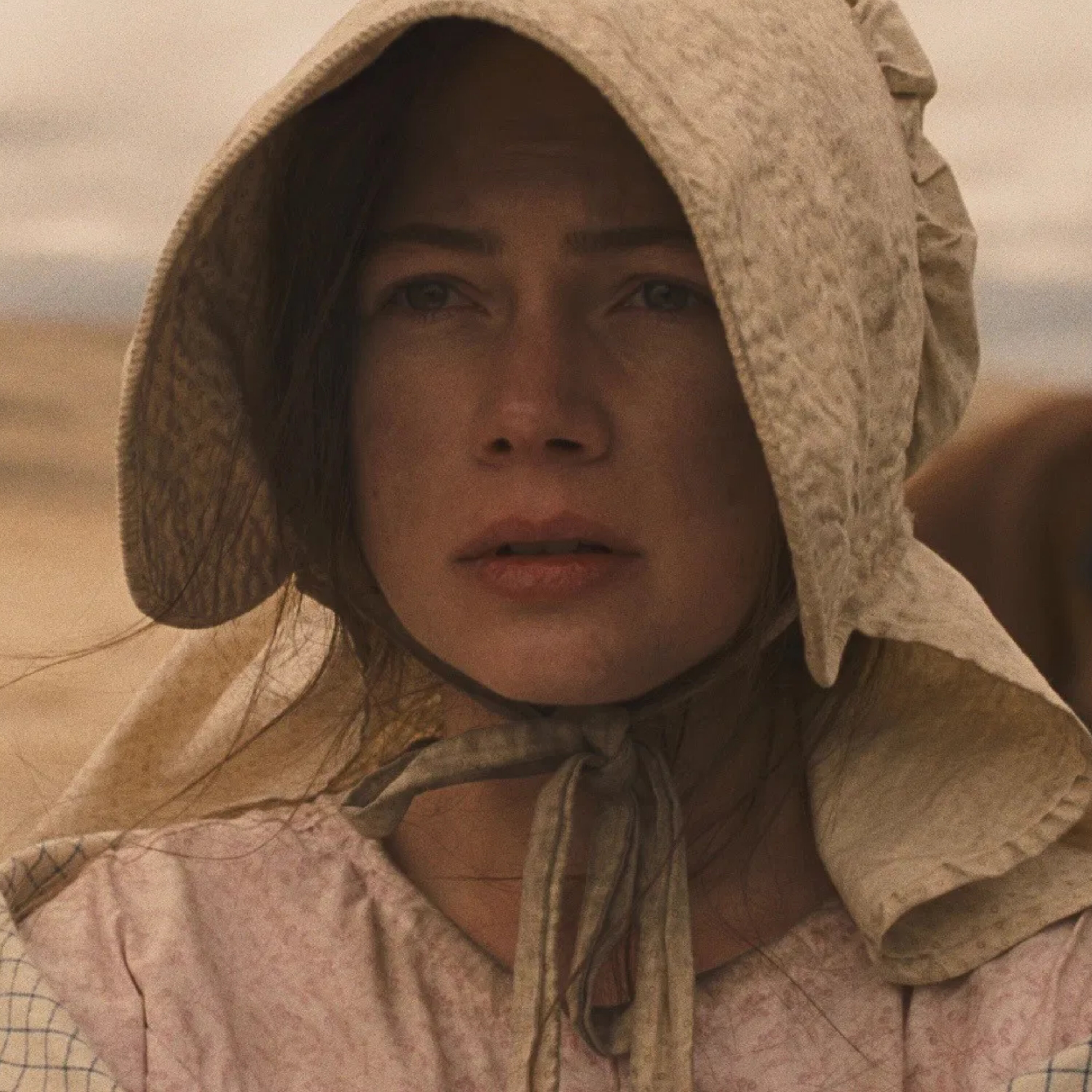
Meek’s Cutoff: Why It Belongs in the Pantheon
Adam and Josh consider the Pantheon credentials of Kelly Reichardt’s MEEK’S CUTOFF, reflecting on its spare frontier world, questions of free will, and place in Reichardt’s larger American project.
Feedback:
-Email us at feedback@filmspotting.net
-Ask Us Anything and we might answer your question in bonus content.
Support:
-Join the Filmspotting Family for bonus episodes and archive access.
https://filmspottingfamily.com
-T-shirts and more available at the Filmspotting Shop.
https://www.filmspotting.net/shop
Follow:
https://youtube.com/filmspotting
https://instagram.com/filmspotting
https://letterboxd.com/filmspotting
https://facebook.com/filmspotting
https://twitter.com/filmspotting
https://instagram.com/larsenonfilm
https://letterboxd.com/larsenonfilm
https://facebook.com/larsenonfilm
https://bsky.app/profile/larsenonfilm.bsky.social
See omnystudio.com/listener for privacy information.
Available Results
Generated results are saved to the knowledge database for reuse and search.
Extract Knowledge
Pick what you want extracted first. Model, scope, and chapter options appear after a template is selected.
Transcript
00:00:21
Speaker 1: Film Spotting is presented by Regal Unlimited, the all you can watch movie subscription pass that pays for itself in just two visits. See any standard two D movie anytime with no blackoutdates or restrictions. Sign up now on the Regal app or at the link in our description and use code film spot twenty six to receive fifteen percent off.

00:00:42
Speaker 2: Hey, film Spotters, Adam and Josh. Here, we've got a full show coming Friday as usual Project Tail, Mary Forty's Madness Round two matchups. We thought, rather than cram yet another thing into that episode, why not give you an extra show. Here, we've got our conversation about Kelly Records. Meek's Cutoff.

00:01:04
Speaker 1: Meek's cut Off fifteen years old this spring. It came to theaters April twenty eleven after playing the Venice, Toronto and New York Film Festivals the previous fall that anniversary, though that's not why we're talking about it necessarily. This is happening because meeks cut Off was nominated for the Film Spotting Pantheon. It is one of the nine films Adam nominated by you Me and producer Sam for our twenty twenty six edition of the Pantheon project, so per rules that we established just last year, only two of those films, of those nine films are going to be inducted into the Pantheon. That'll happen later this year.

00:01:45
Speaker 2: Did you say, Adam, because you knew I may need to be reminded of the rules.

00:01:49
Speaker 1: I'm just always reminding myself as well. This is a bit of a complicated endeavor, but I think we're still on track, so let's keep moving forward.

00:01:58
Speaker 2: It can get a little confusing. We didn't need to rewatch and review all nine nominees because we the two of us, have already discussed most of them on the show. Three of them did need a proper conversation. We have talked about two of those movies already, How Green was My Valley and Akira Kurosawa was Rashamn. Meek's Cutoff is the third and final wild card for the uninitiated. Meeks Cutoff is set in eighteen forty five. A group of settlers, Michelle William, Zoe Casey, and Shirley Henderson, Will Patt and Paul Dano, among others, are being guided through Oregon to the Willamette Valley. Their guide is Bruce Greenwood Stephen Meek. He takes them off the Oregon Trail via the title shortcut, which spoiler leads nowhere good. We follow land downhill.

00:02:45
Speaker 1: We need water that much. I know that's what you think that we lost.

00:02:52
Speaker 2: I'd say that seems about the right word for it when I lost. We're just find on our way.

00:02:57
Speaker 1: I don't blame him for not knowing. I blame him for saying he did. We made our decision. This is only a bad dream.

00:03:04
Speaker 2: Soon, there's going to be a story to tell now, Josh. I nominated this film for the Pantheon because it made both of our lists of the films of the last quarter century, so the films of the century so far. I believe we both have it listed as our favorite Kelly Reikert film on a Tybox list number one, so rare agreement from us on those filmography rankings and on that nomination show. Fortunately, no one gave me grief about this, even though they should have. And I'm sure it's a title that Kelly Riker herself would soundly reject. I think I referred to as the potential first Lady of film spotting, and all I was trying to say is that over twenty plus years of doing this show, we have talked about a lot of her films. Really, all of her films that have been released, we have considered them. We have considered them in high esteem. And as I like to point out, I'm pretty sure she has been interviewed the most times on the show, three times by me. So she is in great standing here on film spotting. Is she an even greater standing after revisiting Meek's Cutoff? And what revelations and I'm using that word very pointedly here, what revelations did you have on this revisit?

00:04:25
Speaker 1: Definitely, this film did not fall in my estimation by revisiting it again, Adam, I think for me, especially in the context of the work that would come from her later, much of which I've greatly appreciated, has only illuminated what I initially thought was so great about Meek's cut Off. But I have now recognizing is this larger project I think she's interested in. Not every single film she's made sense, but to me, the majority of them, and the ones that I happened to respond to the most, are these films that are deconstructing the American myth and just to look quickly. At a few of those, I would include Sense and in one case before Meek's cut off. Actually, but the Mastermind just from last year made my top ten lists. There For me, it was deconstruction of American exceptionalism. You have Josh O'Connor's JB as this fraud, just like the supposed American military dominance in Vietnam that's taking place in the background. Right. But look even at films like Wendy and Lucy, an earlier one of hers, and then one that came after meeks cut Off, Night Moves, I think those are both exploration of capitalism's failure to bring flourishing both to people and to the environment. And then first Kyle, which we both love so much Adam is similar to Meeks cut Off, not only in that it's a period piece, but also both of those films, to my mind, are exposing the hollowness of manifest destiny, particularly American manifest destiny. And so watching Meeks cut off again in the light of these other films which have explored variations on this scene, on this theme in incredibly distinct ways, I'm just treasuring her more as a particularly distinctive American filmmaker and something else that was interesting that I brought to this viewing of Meek's cutoff, which I couldn't have predicted, and it's connected to this manifest destiny idea. The film module I'm taking here as part of my master's program at University of St. Andrews, we've been looking at one of the units travelogues and early nonfiction films. So one of these, for example, was this nineteen twenty three short by the Ford Motor Company encouraging road trips to California's giant forests. And it's just this fascinating piece about, you know, telling the middle class Americans to buy a car and get out there and conquer the forest. And I should cite the author of a chapter we read, Jennifer Peterson, who was just so insightful on that. I think she coined the phrase scenic nationalism and connected it all the way back to the post Civil War and this idea of trying to unite a recently divided nation by going west together actually in car trips or you know, eventually car trips, but also virtually once we got the movies. And so this brings us to the kinds of films that are part of the mythological West that I think Meek's cutoff is exactly trying to offer an undercutting of an opposite vision of And so yeah, it was just really interesting too with this sort of coursework in my back of my mind. Watch Meek's cut off again. Yeah, I think it's her crowning achievement. Still, I'm not sliding it anywhere. It's the crowning achievement of this larger project. And maybe we'll I'll stop here, we can get into this. The reason for me it's the crowning achievement is I think it is formally so in tuned with this project of undercutting the exciting, mythologizing heroic movie Western. How the very form of meeks cut off is key to doing that, which hopefully we'll spend time on.

00:08:14
Speaker 2: Can I just say dittoh, I don't know how to rephrase or restate or to top what you said, but I am in agreement so much so it's certainly going to stay at number one on my list of Kelly Reiker films. But it also makes me think, what are the other eight movies competing for a spot in the pantheon and how are they better?

00:08:35
Speaker 1: Than this one.

00:08:36
Speaker 2: I mean, you know, look, when we put it up for a vote, everyone can vote how they want. But I'm going to give this one very very strong consideration. Myself and you talked about deconstructing the American myth capitalism, our capacity for violence, the patriarchy, exploitation of the disenfranchise. It not only runs throughout most of those themes run throughout in some form or fashion, all of her films, but certainly this film. And maybe that's why I love it so much, is that it's all here. All of those themes are here, and without knowing it, I am. It seems in total sync with your course material, Josh, because back when I reviewed it originally on the show just before or you joined the show. Actually, that's why we need to talk about it now. I described it in that review as manifest destiny, as a meditation on free will and faith, and that goes back to my use of the term revelation. You also said talking about it or framing it in terms of the movies that would come, and that's that's what you were speaking to In my original notes. I said, then, you know, we were we were living in the past. Then I said that I loved thinking about Meek's cutoff within the context of what was then this Oregon trilogy that she had given us with Old Joy and Rydy and Lucy. Okay, well, now we can look at it as this this folkrum with a trilogy after it. Right Night moves certain women and first Cow, as you said, and so it isn't. It isn't a straight line across six movies, all of those themes or or also the sort of progression or evolution that I'm going to paint for you here. But back in that original review, I talked about how it just progressively got more expansive across the trilogy, and that's what I appreciated so much about Meek's cutoff. You had in Old Joy, two guys, a very fixed location, a very fixed problem that they were dealing with, right Wendy and Lucy, Wendy encountering on her journey more people. Still again, it's sort of it's Wendy and Lucy, but they're meeting some more people. There's more trouble on our way to Alaska. And then we get to Meek's cutoff, when we've got this bigger wagon train, this bigger journey, the openness of the range of the American West and the potential hostility, right and the obstacles that they're facing. But they're all bound. And again I am I am quoting from my notes here originally, and I saw it fully on display here this time. All of those characters are bound by this wonderful contradiction, which is they all seem completely free. They all had the option, and they continue to have options. They have choices, and choices are talked about a lot in this movie to go whatever direction they want, to shape their lives how they want. But they're stuck. They're all confined. They're held back by whatever it is that may be holding them back certain means. It could be personal failings, it could be family, it could be a lack of money, it could be by nature itself in this case, right. So they're free, but they're stuck. Like we see a character at the beginning of the film right on that skeleton lost in big letters. You know, they're free, but they're lost. And so there's just this this striving where they seem to be or heading in the direction of exactly whatever it is they seem to want. It's there, but it's also always just moving out of their reach, and that seems to be a recurring theme with her characters and within her films. And it's so appropriate, Josh, because as I was rethinking this today, revisiting my notes today, revisiting this film and putting my new notes together, I was thinking about Or. I saw a quote that I had written down from Reikert, something she said. I was preparing for an interview, one of those past interviews, and she said something so perfect that will really inform or or should inform what you were talking about with your class. Something that she said in a podcast Q and A. I think it was after a screening of Meek's Cutoff for Film Forum maybe, and they were talking about Or. The question was about how her films do or don't fit into these different genre schemes, and she said this, and it's so perfect. She said, they all end up being road movies, though sort of in the end. I guess. Really, they're all in the end people trying to go somewhere and not being able to go somewhere. And that really is it isn't it isn't Niecks cut Off just a very bleak road movie with within the sheen of a Western.

00:13:44
Speaker 1: Yeah, and even you know her her very debut River of Grass has that quality of yes of at least that's thing they were talking about. Yeah, oh okay, yeah, get out of the way started or prompted it. Yeah, makes sense. Yeah, that's definitely a through line. Can I can I push you further towards what you were talking about with the idea of choices, because I'm really interested in that and it's not it's not something I fully wrapped my mind around, even though I paid more attention to it this time. And it's connected. I think you also said revelation and faith. Right, is this this sort of biblical bookend she gives to the movie where very early on we hear the one family reading from the Bible, and it's the Genesis story about Adam and Eve, you know, eating from the Tree of knowledge good and evil, then being barred from the Tree of life, bared from the garden of Eden. Right, So you can see obviously it's a parallel and it's setting up where these people are and it's interesting, right, But is it gonna Is it just kind of a little detail that has a fun other layer. But then when we get to the ending, and yeah, we're going to spoil this. There is the potential a choice here that they have before, a potential tree of life. They find this rare tree. I love the detail that, like the bottom half still seems to be living, but the top half is dead. So it's not this light ran Yeah, some ambiguity exactly, Yes, And they talk about their final choice. Now, as desperate as they are, this is the most desperate they've been. Do they continue to follow this Native America and who they've kidnapped and forced to quote unquote lead them they hope to water, or do they go a different direction and try, not knowing if they'll be able to find the main trail again. So it's this long conversation about their choices, and Meek says at one point this was written long before we got here. Yes, as they're debating, and I'm so, I'm trying to put all this together. I don't need an answer. I just love that it's that this ambiguous existential parable in a way it could be, and leave it at that. But when you brought up choices, I thought maybe you might have some more thoughts on this than I did. And the nature of free will, right, because that's the story of Eden is what humanity does with their free will and they choose disobedience and independence, and we can maybe connect that with this party. I don't know, but certainly free will is in the discussion at the ending as well. What is the free will cho choice they're going to make? So, yeah, I want to hear more from you on that, because it was a fascinating element to me that I'm still pondering.

00:16:30
Speaker 2: Well, I have a lot, I think to say about the potential allegorical elements here, and you're right, it starts with the Genesis conversation and you cannot deny the book end. And that was something I saw upon original viewing the Tree of Life or the Tree of Knowledge and that choice at the very end, and what we're supposed to make of that. Now watching it again and knowing that having that in the back of my mind, watching the film, you're able to pick up on so many more things that first viewing in a theater right where you're just you're just trying to follow the narrative and hopefully you're picking up on some insights and you have some things to say that are intelligent during the review that you're going to have here on the show. You're not going to catch everything. And I maybe even didn't catch everything this time, Josh, I'm not gonna purport that, but I will say I caught a lot more than I did that first time. And this movie, I think is in the screenplay by Jonathan Raymond, and they've collaborated on other projects it. It is littered with these allegorical elements that raise this movie from from just being on the level of the road movie level, which it absolutely functions on, right, but it takes it to another another plane. And so you can just start, of course by looking at even though it would be appropriate for the era or you know, for the time in which it's set, just look at some of the character names, right. Shirley Henderson's character is named Glory. The fact that he's named Meek, which is something he, of course seems to be battling against the entire time. The way he characterizes himself and tries to behave it's as if he's trying to show the world that that's not who he is. Solomon Emily. Michelle Williams's character will Pat and his name Solomon Emily. I don't know if there's any biblical connection to Emily I don't immediately connect it to the Bible, but then the fact that her last name, and I could be stretching here, Josh, but I do love that her name is Tetherow. This idea of being tethered, which is of course what I immediately think of in the way we'll get into this more, but the way she initially anyway is tethered to the wagon and the camera is tethered to her. That's tethered to the wagon, and that there seems to be a place for her and the women at least early on right in this environment. But let's get back to the Bible, and let's go back as well to Meek just for a second, within this deconstruction of capitalism, and you mentioned the mastermind. You know from the moment you meet Meek, at least on this second viewing that he is a James Blaine Mooney level con okay, and if he's not that, And this is what I do like about the bris Greene performance, and what I really like about the screen is there's ambiguity here too, because he is that con or he's just plain crazy or as Emily asks, right, and this gets back to the Bible part. Is he ignorant or is he just plain evil evil? So yeah, evil evil takes us to another realm, doesn't it. It takes us to another sort of spiritual realm. And the way they talk about choices, the way they talk about him as a character, it it does place me within the realm of being a godlike figure. And they are throughout the film debating whether or not they are going to choose to I think, expel themselves from his control, and he is co constantly trying to maintain his control over them. Think about when Paul Dano at one point he plays Gately and there's a brief bit where about halfway through where Meek takes off and what does he say. He's abandoned us. That's his phrase. He's abandoned us, right, And when they talk about him early on that first conversation which I want to come back to as well because I love I love a lot about it. But that first conversation we see between Michelle Williams and will Patten the husband and wife at Night, that gives us a lot of background information as well. They're talking about what to do this dilemma with Meek, and he says, I think he's talking about maybe Gately one of the other characters. But the way they describe their choice to just keep the status quo with Meek is they say, we're at the man's mercy now, it's like they're at the mercy of God like like like we have to just give in to his will because that's the choice that we've made at that point. That's how they feel. How about how about the phrasing Josh, They they feel like this confuses it a little bit. But this whole notion of wandering, you know, whether or not we should have wandered from the main path and now we're off on this other path even though they're following, they're following him. That that messes with the analogy, but it also messes with these characters and their their sense of who they should be following and what they should be doing and what choices they should be making. Right And then the big thing for me, the biggest thing for me, that really solidified this allegorical element this time, and they made it really potent this time and put me in the place of these characters in this difficult choice they these difficult choices they were making. Is the way Meek maintain his control is the way. Sadly, historically some religions have maintained their control. His cudgel is fear. His cudgel is there's a lot of Indians out there, and they're really scary, and that's why we had to get off on this. It's not just a shortcut. We took this path because we're getting away from the scary Indians. And when they do see one, think about how he spins the tail. He talks about how, oh, you're lucky to be alive, miss Tethereau. I'm surprised she lived to tell the tale. He just really really gets into it when they come on a woman. He talks about enslavement and all these things. Right, so he is this he's this figure who uses fear to to try to lord his to have control over them. And then he even at one point, Josh, if it's not explicit enough for you, he says, the land we're headed for is a second Eden's. He's promising them paradise. Right, So it's it's all there.

00:23:31
Speaker 1: Let me jump in here because I love this and it had not occurred to me, but you've got my brain whirlin now. Definitely think that's a valid reading or or is meek the serpent in the garden as you're talking? Is he a great deceiver? Is he the one?

00:23:50
Speaker 2: Uh?

00:23:51
Speaker 1: And that's the line that you just quoted. Is the one where which made me think of it? Is you know, he's promising something better, not what is already had. Now this reading, this reading contradicts what I think we've identified as a larger record project, which would not affirm the Oregon Trail at all. Right, that's sort of that sort of like overtaking of the land for for greed for capitalism is not something films would necessarily endorse. But you could read this as the trail, the main trail, being the right way, the way, the way to walk in the life, and the way to stay stream. He's led them astray by promises thereof the gold, and doesn't he doesn't he say what they find to a land of milk and honey.

00:24:43
Speaker 2: So he's yeah, the second eden's the only line I remember, but you're yeah, I.

00:24:47
Speaker 1: Think he says land of milk and honey at one point, So he's using biblical language and he's as it relates to his tails too. Every story he tells the only one who knows he's not lying is the kid. And that's why he rides next to the kid, because it's the only at this point, it's the only audience he has left because everyone else knows he's just full of it.

00:25:05
Speaker 2: And just to your point, don't they come across I mean, they come across along the way the earthly riches of gold. They actually find it. Think about the allure of that, right, So they don't have basic sustenance to survive, that's the iron list to it.

00:25:20
Speaker 1: But they do come across the gold on this path. And I think you know, Rod Rondeau plays the Native American credited you know in the criss as this figure. They come across and end up kidnapping again, so they hope that they'll he will be able to lead them to some water. And I'm thinking about this now, Adam. The way as you describe Meek describing Native Americans general is just like completely out of bounds, racist, xenophobic, like just making up the most horrible things you could as to your point to engender fear again more lies. And I'm wondering, you know, if the choice at the end, I like that Meek steps away if we're read if I'm reading him as this deceiver figure because you know, Satan in the Garden stepped away. It was like, it was more like, well, you know, there's this option that you didn't you know, if you read the text, doesn't like force it upon him or demand it or really beat him over the head with it. It's like, you know, and so I like, how Meek at the point of decision at this new tree, which, as we've described as not necessarily the tree of life or the tree of knowledge of good and evil, it's this ambiguous tree, Meek kind of steps back and says, you know, whatever I quoted before something, this was written long before we got here. And maybe the choice is maybe going back to the trail is the right choice, trying to at least making that effort. Whereas you know, to follow the Native American, it's not putting negative implications on him, but it's the fact that he is this kidnapped, kidnapped, abused figure. To follow him would be essentially choosing to continue exploitation. Right, Yes, if they followed him, they're still exploiting him. And so if you're looking at this in some sort of parable terms, maybe the quote unquote right answer would be try to get back on the right path. Yes, I don't know or but this is at the core of the film.

00:27:29
Speaker 2: I mean, I think, hopefully, if there's any takeaway, this is absolutely embedded into the fabric of this film, the fabric of this film also being the screenplay. And obviously I think it makes sense and it's not a surprise that your your reframing of what I was saying is much more spiritually sound. They are looking to him, they hope they are putting their faith in him, at least early on at the start of this journey, which we don't really see. That's the whole point we're coming into this journey. That's one of the things I love about this film. We're coming into it at the point, at the point where there's already a fracture in their faith. The crisis has already begun. They started the journey with full faith, so they started it believing in him as this godlike figure who's going to take them to the Promised Land on this path. He he either always was, you know, the deceiver, or he becomes it. But that's what he does turn into, and he's led them astray. So he's using the guys of the godlike figure and that's why they are so confused and they are questioning everything. There is uncertainty, and Josh, what is a better allegory for life than uncertainty? Right? Questioning our place in this world and having to make these difficult choices. That's what this film, in addition all these other things we're talking about, and also just working as a quote unquote road movie. That's what this movie is really fundamentally dealing with. Now we talk about what also makes it really interesting formally. I love the fact right that we don't hear we actually don't hear Meek until about ten minutes into the movie. We've seen him when he has that like Lebowski like emergence from the tent, you know, with the beard, and he's kind of bedraggled and everything like he had a rough right, but from a Wild the West show. That's right, But we don't hear him until ten minutes in. And that's notable because we hear him first from Williams's point of view, and that sets that sets the table, and that's really the first time we've seen her, or it's established her point of view as a character ten minutes in, and that's then going to establish that conceit for the rest of the movie. How often it's going to rely on her point of view primarily, but the women usually at the back. Think about how often distance we at a distance, how often we're put in that position and we hear, we have to overhear what the men are saying, what they're delivering about, and how often we actually hear characters verbalize, especially Shirley Henderson's glory, what are they talking about? Right? What are they saying? She has to say this two, three, four times in this movie, you know, and it does make you think about on a meta level, if you do step outside the film for a second, who is excluded from westerns, but who's also excluded from the American story. You know, you spoke to this earlier. You could and should say that the answer starts along gender lines when discussing this movie, because we are talking about the women at the back trying to hear, trying to get a sense of what's happening. But it doesn't have to be limited to just women. Glory at one point slights African Americans in a very in a very noticeable way, in a very notable way. But later with the introduction of the Native American character. That's where it really comes to the four that we understand that it is fundamentally about, or what this movie is dealing with is is anybody who's been exploited or disenfranchised has been left out of this story. And the camera, the camera mirrors that for us formally right by leaving people out of the narrative, they're not in on the information. They don't know what's going on. The camera is always at the back. And and there is something there's something then too that speaks to that idea of faith. Right they already, these women have already had to put their their faith in Meek right on this journey. In the larger sense, now they have to also put their faith in the men who are up ahead making all the decisions, and they have to hope that they're they're gonna make the right decisions. And then, of course at the end, when we see the tree, the point of view finally changes. It's the Indian and I really do love just watching the performance of rod ron do He's leading now finally Emily's in front. It's her point of view, looking ahead, you know, looking ahead at the tree, not at men, not at not at the men looking ahead at the at the tree right in front of her, one man sick in the wagon. Others aren't even in the shot when we when we hear Solomon say whoa, he's the first one who seems to notice the tree, but we don't see him. We only hear him. Emily hears him and stops again. Reikert has us hear the man through Emily's ears, but not not show us the man. But what matters is is that she's in front. Now, she's leading as everyone else enters the shot.

00:32:37
Speaker 1: It's remarkable and it's such a skill for progression to get to that point.

00:32:42
Speaker 2: Right.

00:32:42
Speaker 1: This is not like this could come out guns blazing from the beginning as a feminist Western right where where you know Michelle Williams, Emily is immediately throwing her weight around, taking charge. Is someone we root for against the you know, it's it's very attentive to the reality of the situation and the ways you describe by the camera placement and the having to overhear these conversations, and then this slow progression towards where she does become one of the leaders. What I love within this context is how it makes room for this very equitable within this time period merit between Emily and Solomon, Yes, where he comes back to the tent at night and reports to her in full detail the men's conversation because he genuinely needs her counsel. He recognizes her wisdom. And they don't always agree like that, they have their own opinions, but they go back and forth on this and that the film takes time for that relationship. It's a very special depiction of marriage in this movie, which is interesting that they find space to offer that as well. And at the same time, you know, it's true to the work that the women are doing and contributing. This is very much I kept thinking about in The Mastermind, that long comic if you enjoyed it, sequence of O'Connor's character trying to get the paintings up in the up in the hayloft, right and we're watching him, and that's a process sequence right now. They're kind of for comic effect, but we get a lot of process sequences here of you know, the women mending something or preparing a meal, and it's attentive to all of their contributions to this project. And in that way, it's I suppose feminist compared to the more traditional Western story depiction you would get here, and speaking of you know, other differences. Just in the form of this movie, you could consider this slow cinema in a way, just the time it gives to characters passing across the screen, to some of these processes. I described a lot of wagons creaking. How about the sound design here you have creaking wagons, crunching feet and if there is shrubbery around, which is rare, like the wind rustling through it. And I think that's about it unless someone's talking, and that just creates this not only quote unquote realistic, but almost a hypnotic like in the sense of slow cinema, hypnotic experience. That's what I first responded to about this is like I am in a historical world that also feels completely new and fresh as an experience, as a cinematic experience. Now, mileage is going to vary. You know, people famously find this movie boring, and I guess you could see that. But I don't think it's just to be slow or to have this pace. I think it's related to the fact some of these themes we've been talking about. This is a land that is refusing to be conquered. So it's pushing back against that manifest destiny, that exceptionalism. And so the movie in turn is not going to be as anthropocentric as you might expect a Western to be. It's attentive to these characters and their needs, but it's always against the stark reality of this landscape. Yes, and the only way to really feel that is for the camera to give it the space and the time, which is what puts it in the slow cinema sort of area, which is one of the things I treasure about it.

00:36:30
Speaker 2: I absolutely agree there has to be an immersive quality to it. It does seem unfortunate to phrase it this way, but they're having a very negative experience, and not that we as viewers are having a very negative experience. I certainly haven't had a negative experience both times I've watched it. But there has to be a little bit of quote unquote unpleasantness. It can't be a rollicking good time. Yeah, we have to understand that this is slow going. You know, this is a bit punishing. That's okay. It doesn't feel punishing though as a viewer to me, and I like what you said a lot. I mentioned the conversation. I wanted to talk about this, that first conversation between husband and wife, because I think it's so revealing. And one of the things it reveals is that they're having a conversation that very clearly the other husbands and wives their couples are not having. And that's why the dynamic and the relationships that they have are very different, and the women are very different and the men are very different. Like the only two really sensible people are the two people who actually talk to each other and trust each other and confide in each other.

00:37:38
Speaker 1: Right, It's true.

00:37:38
Speaker 2: And what's great about that conversation is that it does bring us up to speed, right, it does fill in whatever little bit of exposition, you know, it gives us some details that we need, Okay, but it really establishes the stakes right from the beginning.

00:37:58
Speaker 1: You know, we understand it.

00:37:59
Speaker 2: I mentioned that we know from some early shots that they are lost. We're thrown into the crisis. We're not starting when the journey's good. The journey is already terrible. That's when we're putting this. But now they're to that point, Josh, this is how bad it is. They're not only lost, they're considering fifteen minutes into the movie, hanging their guide. That's that's what we're thrown into. They're talking about whether or not they should hang him, and so that's that's what the screenwriter here, Jonathan Raymond, and what Reichert are up to it. I just think it's it's pretty brilliant. So it establishes those stakes and how dire the circumstances are. But it is also all about character because of the way they talk to each other, the way they can fight in each other. We understand what their relationship is like, what their marriage is like, how they're going to interact with each other. It's character building. We understand it that dynamic for the rest of the film, and not only that, we understand something about what the other men are like. He has some lines where he says things like, gaily, you know, he's he's eager to hang a man as long as that man isn't isn't next to him, you know, or a line like that, you know, which which tells us that he's the kind of guy who will talk big until of course you know that guy's near him. We understand guys like that. We've all met guys like that, but we also get an eye in to Emily's mind, who up to this point we've only seen her at the back, and we're looking at her a lot, and we see what she's looking at, but we don't always know what she's thinking, and this is our chance to finally understand what she's thinking. So that conversation just just functions on so many levels. And I mentioned the patriarchy earlier, and obviously there's a lot of subversion of that here, But some of the little touches that Reiker and Raymond sneak in here, Josh that I love that I certainly didn't catch the first time I saw it. There is a conversation early on where Dano and his wife in this film was played by Zoe Kazan. There's a conversation fairly early on where they're sitting around a campfire and Nick is telling his tales and he's talking about the journey at this point, and Dano's asking questions and then Kazan's character asks a question, and if you watch it, when she asked the question, you can see Dano turn his head and look at her, and the look he gives her is like, what do you think you're doing, like, why are you I'm the one who's talking here. This isn't your place woman to talk right now, and and it's it's it's very clear in that moment and later later when we see that Emily, who's pretty embold in the entire film, but when she's really emboldened later and she's she's letting she's letting Mek know how how she feels about him. She going back to the Bible. She uses one of the seven sins against him. She uses the word vanity. She suggests that he is, that he is too vain right, and when he's.

00:41:03
Speaker 1: Three women and he comes up and yes, such.

00:41:07
Speaker 2: Exactly, well, we learn that I don't I can't remember if we see it earlier or not, or just see it at the end. But Dano's there and Dano's listening, and and Ryker cuts to him right after she says that to him, that it's vanity, and so this is a pretty heavy charge right at this time, and that she's saying it to him to a man. It cuts to Dano, and the look on Dano's face isn't the same look as before when it was his wife, but it is a look of disbelief. It's not anger, but it's like, I can't believe that woman is saying that to him. Right, And so the other point you made I like about how not feeling it being progressive, I suppose without feeling anachronistic and not going too far in that realm, there is a moment where we get I suppose, you know, a semi standoff like you would expect in a western, maybe even a Sergio Leoni western, right where two guns are out and there's a triangle and people are pointing at each other. And and I could be wrong, but Josh, what I loved about this moment in the way Williams plays it. What I noticed anyway on my screen is that Williams is in control. She's got the rifle, you know, and it's a tense moment. You don't exactly know how it's going to play out. And of course she is being very tough and and dominating that scene, and she she wins. I suppose you could say, but when she puts that gun down, she's trembling. Oh yeah, she's trembling, so as she should be right, because she's human. It's not it's not about asserting, you know, or over asserting the dominant woman. It's it's about it's about the humanity and the realism of that moment.

00:42:47
Speaker 1: Yeah. I love will Patton as her husband Solomon, and I wish I could remember the exact words. But when they the standoff goes down and someone says it might have been Meek says some about you guys, some woman there, and then.

00:43:01
Speaker 2: She's someone, she's some kind of something or something like that.

00:43:05
Speaker 1: Yeah, He's just it's kind of this wonderful. What I love about my reading of that is like he doesn't feel the need to back her up or undercut her. She's who she is, right, It's exactly He's like, this is I'm not in charge. I'm not going to tell her what to do or what. He's not challenged. His masculinity isn't challenged exactly. So Yeah, I just I just love this, love them as a couple. I do want to just you know, because I don't think his name has come up, but cinematographer Christopher Blovelt. Yeah, I mean who Reikert has worked with ever since, I believe ever since. And I learned something aside. She and Blovelt were on the Team Deacons podcast, a couple months ago, and she talked about him coming onto this project and kind of to her mind, almost saving it, because up to that point in her career she had had difficulty establishing authority on film sets. I think is kind of how she described it. And she put this along gender roles and said that there was something about Blowvelt, who the presence he brought, this collaborative, respectful presence he brought a cinematographer was just a game changer for her, And clearly, you know, has has been something that she's want to continue through the rest of her career. So there's that bit of background, which I just think is interesting. But also I look at the text the photographic eye he brings. I mean, there are some shots here of the covered wagons where at sunset where it's almost like they're glowing from the inside, and I was thinking of I was thinking a lot of like Andrew Wyath paintings, which have these stark hills and fields but also have like something of a glow to them. I don't know if that was an influence at all. The Academy aspect ratio they've chosen to use here, I think is very effective in terms of connecting it to the mythology of some of those silent Westerns and travelogs I was talking about, is like putting this movie not just old timey because it's a period movie, but really putting it within cinematic tradition of these sorts of stories. I think there's a there's a visual choice for the Academy aspect ratio, but there's also a thematic choice, almost a meta reasoning behind it as well that I think is very effective.

00:45:30
Speaker 2: Yeah, and I've talked to her. I'm pretty sure about this choice before her and blow Belt, and I think it's all the things you just mentioned, and it's also just fundamentally about not turning these movies which are already set in these wonderful Pacific Northwest locations, and the locations themselves are beautiful enough you don't need to guild the lily, and beyond that, you don't need to make them. They're not about the magnificence of the West. For all the reasons we've talked about, it's not about the magnificence of Manifest Destincy Manifest Destiny. It's about the people. It's about the faces. It's about us trying to figure out what's going on in the head of Michelle Williams's character while she's at the back looking at the men up ahead and trying to figure out what they're saying and where they're going to lead them next. And that Academy ratio, which they've used on other films too, it's not it's not about the widescreen expanse of the landscape. It's about keeping that face in the frame first and foremost, right, that's what we're paying attention to. It's about character more than it is about landscape. And and yeah, those two as a tandem have obviously given us some some incredible work and in terms of shots that that do allow them to to, I suppose get a little bit more creative. That's that's not the right term to use, but there. Their approach is one that doesn't draw a lot of attention to itself. It's it's it's exactly what it needs to be for this film. And the shots that that actually speak to me more than anything are some of the ones you mentioned. They're they're how the wagon looks, it's the that conversation at night, and and how we just see the little bit of the flicker of light, you know, from a from a lantern or whatever that that has them in that glow. Some of those shots, it's about those, not the landscapes, the wide shots of the landscape, as I mentioned that the stand out about this movie. But at the end, at the end, that point of view shot through that little hole in the branches in the tree right look at looking at at the Indians. He walks away, just bringing here again sort of full circle. This this notion of point of view and her looking through the tree looking at him, and that connection that they're making, and this idea I think as I read it, that that she is willing that they are going to follow him, that they are putting their faith now in this new guy. And I want to see that at the end as if they are that even Meek is saying, I recognize that I've been bested, that even as the deceiver, I can't deceive any longer. And I want to go back to one other point about him. How great is it? Like a great like a great snake slithering Josh, exactly what that deceiver would do. When when Emily and Solomon are in the tent pretty late in the film, and it's it's another one of those intense moments where she is really letting her feelings known about Meek to her husband and questioning him and saying some harsh things about him. They then hear a rustling outside and Solomon says something like will or you know, or says a name to someone. You're thinking it's one of the guys, and there's no answer, and it's almost certainly him, you know, eavesdropping. And one of the things that confirms that is that what happens the next morning and even all throughout the next day, all of a sudden, Meek is not hanging out by himself, He's not hanging out with the other men. He's now positioning himself with all the women. This is when he starts talking to mistether them. This is when he starts talking to all the women and trying to get in good with them. Right now, he knows, he knows that they don't like him, and he knows that he needs to do something to try to to try to seduce them a little bit to change their mind about him. You know, it's perfect.

00:49:39
Speaker 1: Yeah, yeah, it's a you know, it's a performance that has to be handled delicately because he could come off as cartoonish. But I think if you see that that bravado, that performance is part of this man's actual constitution, this is how he lives, then it makes perfect sense. Along with the rest of the film.

00:49:59
Speaker 2: Meek's Cutoff is currently streaming on Peacock and Movie and available vod More about the Film Spotting Pantheon and Our Little Pantheon project is available at filmspotting dot nets slash Pantheon. I'd have to consult our schedule. I don't have it in front of me right at this moment, but within the next two to three weeks we will be inducting one of these nine films, two of these nine films, I should say, into the film Spotting Pantheon. More details about all of that coming soon and again available at filmspotting dot net slash Pantheon. Coming on Friday. Show reminder project Hail Mary and Forty's Madness Round one results and around two matchups.

00:50:38
Speaker 1: Film Spotting is independently produced and listeners supported. That means you can support the show by joining the film Spotting Family at film spottingfamily dot com. That way, you can listen early and ad free. You will get monthly bonus episodes as well a weekly newsletter and access to the entire show archive. Film Spotting is produced by Golden Joe do So and Sam van Holgren. Without Sam and Goldenjoe, this show wouldn't go. Our production assistant is Sophie Kempenar and special thanks to everyone at wbe Z Chicago. More information is available at wbez dot org for film Spotting, I'm Josh Larson.

00:51:16
Speaker 2: And I'm Adam Kempinar. Thanks for listening. This conversation can serve no purpose any more. Good Bye, Absolute, Absolute,