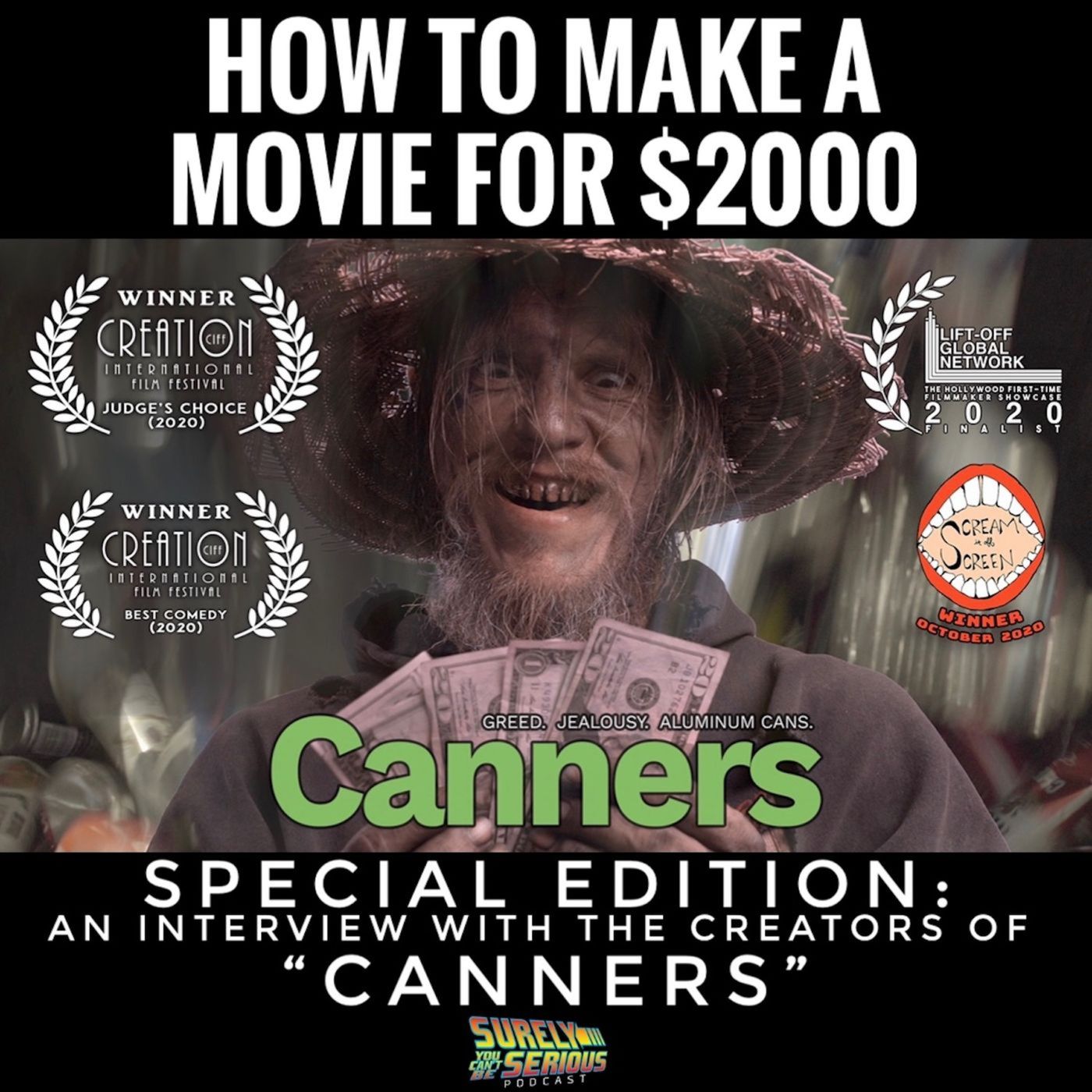
Special Edition: An Interview with the Creators of "Canners" -or- How to Make an Award-Winning Film for only $2000
Can you make an award-winning film for only $2000? Join us in this Special Edition of the Surely You Can't Be Serious Podcast where we are joined by Mike Borgen and Darren Doyle, the creators of the new short film "Canners." Mike and Darren had decided they were no longer going to wait to be discovered by someone else, they were going to make their movie on their own. And through setbacks, obstacles, and pitfalls they achieved their goal and are now receiving the accolades for their incredible film. WARNING: There will be Spoilers so, go check out the movie at: https://cannersmovie.com/ or https://www.youtube.com/watch?v=IytMIj6X5Eo&feature=youtu.be
2020-10-13
58 min
Transcript
Available Results
Generated results are saved to the knowledge database for reuse and search.
No generated results are available for this episode yet.
Extract Knowledge
Pick what you want extracted first. Model, scope, and chapter options appear after a template is selected.
Generated results for public episodes are saved to the knowledge database so they can be reused and searched later.
Transcript
<v Speaker 1>Where do the movies that we love come.
<v Speaker 2>From as you wish?
<v Speaker 1>Do they come from some magical place that we ordinary
<v Speaker 1>folks can only dream of? Are they made by people
<v Speaker 1>of genius that we can never.
<v Speaker 3>Understand, oh, captain, my captain?
<v Speaker 1>Or do they come from people just like me and you?
<v Speaker 1>I'm Batman, a family man or woman who goes to
<v Speaker 1>the nine to five job every day, but is secretly
<v Speaker 1>an undercover artist, an undercover artist whose secret identity is
<v Speaker 1>crying out to be revealed. Three years ago, two regular
<v Speaker 1>guys began working on a script of a movie that
<v Speaker 1>they hoped would be something original and something they could
<v Speaker 1>produce on their own work. With virtually no resources at
<v Speaker 1>their disposal, they were in a difficult position, but with
<v Speaker 1>the termination and a steadfast dedication to their goal, they
<v Speaker 1>made their dream of reality.
<v Speaker 2>Look at all those teens.
<v Speaker 1>Mike Morgan and Darren Doyle, who are together known as
<v Speaker 1>the Nuevo Brothers, released this film in May of this year.
<v Speaker 1>Jason and I were fortunate enough to come across it
<v Speaker 1>just after its release, and we are honored to have
<v Speaker 1>them as guests on our show.
<v Speaker 3>And you know, this might be our only time ever
<v Speaker 3>to be able to do this, That's what happens.
<v Speaker 2>He's had can or kill each other over cans.
<v Speaker 3>There's something very cinematic about a bicycle man.
<v Speaker 2>Eighty percent of your film is done in the casting
<v Speaker 2>and to a point.
<v Speaker 3>Where we were writing scripts with I guess this idea
<v Speaker 3>that you know someone was going to come with a
<v Speaker 3>wand and make it happen for us.
<v Speaker 2>If you almost fell into the lake.
<v Speaker 3>At least we spend a lot of time trying to
<v Speaker 3>find people that would help us get stuff off the ground,
<v Speaker 3>and ultimately speaking, you just need to go out and
<v Speaker 3>just do it yourself.
<v Speaker 2>Got to be a self starter. You got to do
<v Speaker 2>it by yourself. Just make crappy little five minute videos.
<v Speaker 2>Do something. Because Delvalry is a coming tans question. We
<v Speaker 2>made a conscious decision. We said we're not going to
<v Speaker 2>write anything else. We're not going to make this is it.
<v Speaker 3>If we had settled and with it, we probably wouldn't
<v Speaker 3>be having this conversation.
<v Speaker 2>Out three fourths into the movie. We hit a wall.
<v Speaker 1>Since that time, they have earned the following awards. Finalist
<v Speaker 1>of the twenty twenty Hollywood First Time Filmmaker Showcase, winner
<v Speaker 1>of the scream at Off Screen twenty twenty and winner
<v Speaker 1>of the Creation International Film Festival for Best Comedy Short,
<v Speaker 1>Best Editing and Judge's Choice. We hope you enjoy the
<v Speaker 1>special edition of the Surely You Can't Serious Podcast?
<v Speaker 3>My God.
<v Speaker 1>Chairs all right, welcome everybody. We're here for the Surely
<v Speaker 1>you Can't Be Serious Podcast. Today is a special edition.
<v Speaker 1>We have two gentlemen with us today. Typically what we
<v Speaker 1>do is we go and look at movies from our past.
<v Speaker 1>We look at movies from the eighties or the nineties,
<v Speaker 1>music from the eighties or the nineties. We've had posts
<v Speaker 1>on Facebook that you know, what would you think about
<v Speaker 1>this movie being remade or that movie being remade, and
<v Speaker 1>almost everyone says, you know what, Hollywood needs to do
<v Speaker 1>something original. Well, we're with a couple of guys today
<v Speaker 1>that did something original, and they did it on a
<v Speaker 1>budget of next to nothing, and we are super excited
<v Speaker 1>that they are here. They have put together a short
<v Speaker 1>film that involves greed, murder, and the poverty stricken and
<v Speaker 1>surrounds that with ideas of God and the Chosen and
<v Speaker 1>wraps it all in the story of the Goose that
<v Speaker 1>laid the Golden Egg. And it's just it's a masterpiece,
<v Speaker 1>especially considering that these guys put this together for only
<v Speaker 1>two thousand dollars. I was blown away when you guys
<v Speaker 1>told me how much that costs to make. So we
<v Speaker 1>are here with our special guests, the creators of the
<v Speaker 1>movie Canners, Darren Doyle and Mike borgan A doing good.
<v Speaker 1>How are you guys doing?
<v Speaker 3>Thanks for having us.
<v Speaker 1>Yeah, we love having you here. First, let's go back
<v Speaker 1>and tell us how you guys met.
<v Speaker 3>Yeah, we met in New Wavo playing hockey. That's where
<v Speaker 3>we formed our friendship. That's where we came up with
<v Speaker 3>the name for ourselves in the way of our brothers.
<v Speaker 2>Well, not only does it that's where we met, but
<v Speaker 2>it also means new and novel.
<v Speaker 3>But that was kind of cool.
<v Speaker 1>I'm really impressed you've taken an old idea and made
<v Speaker 1>something very new and very unique about it, and I
<v Speaker 1>think it's fantastic. Mike, you have a video company, correct.
<v Speaker 2>Yeah, I own feedb Media, which basically relance from a
<v Speaker 2>wedding days ago, and you know, corporate and anything in between. Event,
<v Speaker 2>the talk, videography, okay, international pizza expo, that stuff.
<v Speaker 1>And Darren, what about you, what's your nine to five?
<v Speaker 3>I worked for a wholesale alarm monitoring company pays the bills.
<v Speaker 1>Right, yeah, So do you guys all right? Do you
<v Speaker 1>have families? Are you married, kids, anything like that.
<v Speaker 2>I've got a long long term girlfriend. Uh yeah, Karen's
<v Speaker 2>got a long term girlfriend as well.
<v Speaker 3>Mike's my long term girlfriend.
<v Speaker 1>It's funny because when I call it, when I'm talking
<v Speaker 1>to Jason on the phone, my wife will come in
<v Speaker 1>and she's like, are you talking to your girlfriend? And
<v Speaker 1>I'm like, yeah, yeah.
<v Speaker 3>My girlfriend says the same thing tongue in cheek, of course,
<v Speaker 3>because I feel I could do better to Mike.
<v Speaker 2>And I'm settling as well. So so what's.
<v Speaker 4>The ultimate goal for you guys? Do you guys want
<v Speaker 4>to be big time Hollywood directors and that type of thing?
<v Speaker 3>It sounds so shallow. Uh yeah, you know, I'd look
<v Speaker 3>to have the ability to be able to tell stories
<v Speaker 3>the stories I want to tell with the people I
<v Speaker 3>want to tell the stories with. That would be ideal.
<v Speaker 2>We don't necessarily care about Hollywood and the insular industry itself.
<v Speaker 2>That really hard to get into it and you know,
<v Speaker 2>break in and make the right friends and all that.
<v Speaker 2>I don't know if you guys ever saw the Mark
<v Speaker 2>Duplas interview called The Cavalry Isn't Coming. He made a
<v Speaker 2>really poignant speech at south By Southwest talking about got
<v Speaker 2>to be a self starter, You got to do it
<v Speaker 2>by yourself. Just make crappy little five minute videos. Do
<v Speaker 2>something because Delvalry isn't coming. And it shows the evolution
<v Speaker 2>of his steps of how they made short films and
<v Speaker 2>they got into film festivals one with this crappy thing,
<v Speaker 2>and then boom, next thing, you know, he's working with
<v Speaker 2>Jason Siegel and getting big budget, you know, and now
<v Speaker 2>he has a show. He did a league on effects
<v Speaker 2>and he does a show called Room one oh four.
<v Speaker 2>I believe it's called on HBO. So find his way
<v Speaker 2>up as an outsider. So that's kind of our goal.
<v Speaker 2>And with the way COVID's going, and it's kind of
<v Speaker 2>leveraging power of the creators because there's not even a
<v Speaker 2>movie theater to show you're exhibit anyway. So if people
<v Speaker 2>are willing to put in the elbow grease and they're
<v Speaker 2>willing to sacrifice their time and effort, they actually could
<v Speaker 2>make something really cool.
<v Speaker 1>Before I knew what you guys had done, I had
<v Speaker 1>talked to my my oldest boy is like me. He's
<v Speaker 1>an actor and into those kind of things. And I
<v Speaker 1>said to him, you know, like things are different now,
<v Speaker 1>like every every human being walks around with a video
<v Speaker 1>camera in their hand, and you can put your movies
<v Speaker 1>out to the public, like to the entire world through YouTube,
<v Speaker 1>like you guys have done, and who knows what can happen.
<v Speaker 1>There are people out there who are making really just
<v Speaker 1>trash who watchers and listeners are just listening to. And
<v Speaker 1>so if you're able to put together something quality, it's
<v Speaker 1>not as restrictive as it used to be back when
<v Speaker 1>we were kids, back when you had to break into
<v Speaker 1>Hollywood to make a name for yourself.
<v Speaker 2>The big keepers are being slowly kicked out, you know.
<v Speaker 2>It's the powers being leveraged greater. But people at the
<v Speaker 2>same time a very short attention span. So it's really
<v Speaker 2>tough to get somebody to sit down for more than
<v Speaker 2>three minutes and be actually, as you say, have something
<v Speaker 2>original and I'm kind of worthy and get what two
<v Speaker 2>hundred thousand views on TikTok if you're cute, you know,
<v Speaker 2>or something. But breaking in is really hard and getting
<v Speaker 2>people to care and take the time from our experience.
<v Speaker 2>If people actually sit down and take the time. Actually,
<v Speaker 2>either they love it or they don't care. There's no
<v Speaker 2>really in the middle of our movie so far.
<v Speaker 1>Right, well, we're our listenership is going to be mostly guys,
<v Speaker 1>mostly guys number one, but guys who are who are
<v Speaker 1>in our age range, who are not I mean, we're
<v Speaker 1>not watching TikTok videos. We're We're looking for something that's
<v Speaker 1>more substantial. And to have somebody out there who is
<v Speaker 1>trying to do it on their own is really exciting.
<v Speaker 1>I love the idea of original work. I need to
<v Speaker 1>at this point encourage those other undercover artists that are
<v Speaker 1>out there. These guys have done it and they've made
<v Speaker 1>something really high quality. Number one, go look at what
<v Speaker 1>they've done. And number two, go do it yourself, you know,
<v Speaker 1>go make something awesome, because the only restriction is the
<v Speaker 1>restriction that you're putting on yourself.
<v Speaker 3>At this point, absolutely I agree.
<v Speaker 4>Why don't you, guys, if you don't mind, describe for
<v Speaker 4>those who haven't seen your video, you know what it is,
<v Speaker 4>what you've done, what you were attempting to do, and
<v Speaker 4>just kind of tell us a little bit.
<v Speaker 3>About it, what we attempted to do. And I think
<v Speaker 3>what we accomplished was to try and make a film
<v Speaker 3>with in the restraints that were put in front of us.
<v Speaker 3>We had no permits. So this whole film was shot
<v Speaker 3>guerrilla style filmmaking. We shot it mostly in Long Beach
<v Speaker 3>and it was a blessing in a sense that the
<v Speaker 3>police department, a few times we rubbed up against them,
<v Speaker 3>they really had no problem with us doing what we
<v Speaker 3>were doing. And getting back to your original point in
<v Speaker 3>that in dis day and age, everybody's going around with
<v Speaker 3>cameras and stuff like that. We were using a DSLR
<v Speaker 3>camera and it's not conspicuous, and we weren't very conspicuous.
<v Speaker 3>Everybody who saw us thought we were making a documentary. Yeah,
<v Speaker 3>so right away we and this was like on the
<v Speaker 3>first day, our first interactions with people, they thought right away,
<v Speaker 3>immediately we were making a documentary, I guess. And that proved,
<v Speaker 3>you know, proof of concept that you know, it was
<v Speaker 3>believable that Joe was a believable homeless person of that.
<v Speaker 2>To make up in the.
<v Speaker 3>Right So there was authenticity there. So we were very
<v Speaker 3>happy with that right away. But getting back to your
<v Speaker 3>point in regards to what we were trying to do here,
<v Speaker 3>we were trying to make a film to kind of
<v Speaker 3>highlight all of our influences, which is every filmmaker's first
<v Speaker 3>film is usually a hodgepodge of their influences, and a
<v Speaker 3>lot of it was you know, self gratification too, and
<v Speaker 3>you know, this might be our only time ever to
<v Speaker 3>be able to do this. This is a moment in
<v Speaker 3>time that's very special, and we wanted to capture the
<v Speaker 3>shots we wanted to capture. You know, could counter has
<v Speaker 3>been told in five minutes, maybe, but I don't think
<v Speaker 3>it would have been effective as effective as telling a
<v Speaker 3>really true, fleshed out kind of classic storytelling, like we
<v Speaker 3>we drew upon ASoP we drew upon the Bible, Like
<v Speaker 3>the first time we were throwing around these characters of
<v Speaker 3>Cowboy and Joe, we kind of just applied like canaan
<v Speaker 3>abel as a canaan Abeles story. You know, one seems
<v Speaker 3>to be doing better than the other, and one is
<v Speaker 3>jealous of the other because not necessarily because one is,
<v Speaker 3>you know, better than the other, is just one is
<v Speaker 3>just going about it more clever, more genuine, more resourceful
<v Speaker 3>than the other, you know, and as a result you
<v Speaker 3>have resentment schusm occurs. But a lot of this story
<v Speaker 3>was kind of created, was engineered in such a way
<v Speaker 3>of being able to just being able to execute what
<v Speaker 3>was on paper to film.
<v Speaker 2>You know, taylored the story to what we had access to.
<v Speaker 2>We had access to friends that could help. We had
<v Speaker 2>his brother and brother Pat that played Inventor, and he
<v Speaker 2>was he wasn't doing that. He was running security or
<v Speaker 2>surly wrangling the dog. I mean, he had many, many jobs.
<v Speaker 2>And all the costumes could be bought and purchased made cheaply.
<v Speaker 2>Go to your thrift store. You can buy all that
<v Speaker 2>stuff dirt cheap. And then we distressed it at home,
<v Speaker 2>got everything ourselves. Back yard became the studio.
<v Speaker 1>So yeah, just on those ideas, and I want to
<v Speaker 1>I really want to encourage all of our listeners to
<v Speaker 1>go to go have a look at this. The first
<v Speaker 1>time that I watched this movie, I just kind of
<v Speaker 1>was like soaking in the quality of the shots, the
<v Speaker 1>quality of the acting, the quality of the script, the
<v Speaker 1>quality of the soundtrack. And it was upon the second
<v Speaker 1>viewing that I went, oh, my gosh, they've really got
<v Speaker 1>some deep layers here, and you've got your inventor that
<v Speaker 1>was played by your brother, who to me is kind
<v Speaker 1>of the deity character who has he's hanging out next
<v Speaker 1>to Cowboy, who is the one who is found favor
<v Speaker 1>with God, and so he's that's why God's next to him.
<v Speaker 1>And then and then Joe, your protagonist in this thing,
<v Speaker 1>scoffs at the notion that he's the inventor of the Internet.
<v Speaker 1>He scoffs at God. And that's that kind of falls
<v Speaker 1>into that whole canaanable of you know, Cowboy is just
<v Speaker 1>loving life and living it up and has found favor
<v Speaker 1>with God, whereas Joe, who keeps beating his head against
<v Speaker 1>the wall, is alone and struggling against the world pouring
<v Speaker 1>down upon him. And I just was like, add, gum,
<v Speaker 1>this is really solid stuff. To write a good story
<v Speaker 1>is hard enough. But to write a good story that
<v Speaker 1>throws back to biblical concepts, to fables of the past,
<v Speaker 1>all of those great conversation ideas is really something impressive.
<v Speaker 1>And I'm a good job. How about that. I'm just
<v Speaker 1>going to say, a good job, well done, well done.
<v Speaker 3>Wow, James. I wish I could like cheap you around man,
<v Speaker 3>like pull you out anytime I feel bad. I really
<v Speaker 3>appreciate that, James. And you know, this was three years
<v Speaker 3>of a lot of hard work, and we were definitely
<v Speaker 3>drawing upon all of our influences and we wanted to
<v Speaker 3>make something that was meaty and had layers. We love
<v Speaker 3>the Simpsons and depending on your how sophisticated your palette
<v Speaker 3>is in regards to different things depends on how far
<v Speaker 3>in on the joke you get, you know, if you
<v Speaker 3>if you can like you know, get the references and
<v Speaker 3>stuff like that. So, you know, we set out to
<v Speaker 3>make a film to highlight all of these different elements
<v Speaker 3>and layers. But like everything, how you know, how the audience,
<v Speaker 3>how the individual views it. It's subjective, you know, and
<v Speaker 3>it's not wrong. It's how you view it. It's how
<v Speaker 3>it's how you connect the dots. And that's great that
<v Speaker 3>you know. You saw that in those few opening scenes,
<v Speaker 3>you know, in the interaction between you know, Patrick and
<v Speaker 3>my brother and by the way, that's my brother Patrick,
<v Speaker 3>who played the invent with Poogy the dog, Yeah, the
<v Speaker 3>dog who was a pleasure to work with.
<v Speaker 2>The funny thing is like on top of the allegory
<v Speaker 2>to the Bible, you know, I saw it as also
<v Speaker 2>the other layer is it's a microcosm of what's going
<v Speaker 2>on around the water cooler. You know, this is their world.
<v Speaker 2>This is you know, the streets of their water cooler,
<v Speaker 2>and they have they all have their friends, they all
<v Speaker 2>have their politics, they all have their kinship. And basically
<v Speaker 2>Joe is kind of out of his luck. You know,
<v Speaker 2>he hasn't really figured things out, doesn't have the personality
<v Speaker 2>to get things done. And cowboys are very affable, smart,
<v Speaker 2>work smart, not hard kind of guy. And uh, you
<v Speaker 2>know all runs of business in life, you're gonna have
<v Speaker 2>winners and you're gonna have losers. So that's kind of
<v Speaker 2>the way I saw it too.
<v Speaker 1>And just to just to kind of lay it, lay
<v Speaker 1>the foundation a little bit here that the idea of
<v Speaker 1>Cannon is, this is based on something. This is a
<v Speaker 1>real group of people that exist out in the world.
<v Speaker 1>Back in the early eighties, they started having deposits on
<v Speaker 1>cans and bottles so that if you return to those
<v Speaker 1>things you got cash back. Well, most folks didn't care
<v Speaker 1>enough to do that, and so those trash, that trash
<v Speaker 1>got thrown out. And what would happen is these canners
<v Speaker 1>would come in, they'd take other people's trash and they
<v Speaker 1>would turn it into there to cash for themselves. And
<v Speaker 1>there's there there are human beings who live in New
<v Speaker 1>York City, which has the highest cost of living in
<v Speaker 1>the country, who live on being a cannery. They I mean,
<v Speaker 1>they go and get it and get paid for it
<v Speaker 1>as they go. And it's it's a fascinating thing that
<v Speaker 1>even though this might be a class of society that
<v Speaker 1>everyone else looks down upon, they're really doing the They're
<v Speaker 1>involved in the exact same struggle that all of us
<v Speaker 1>are involved in. Whether you're middle class or high class.
<v Speaker 1>It's all about whether fortune shines upon you or not
<v Speaker 1>and what you're willing to do to protect your livelihood.
<v Speaker 2>And that really exists, especially here in California too. We
<v Speaker 2>met several camp like when we shot at the recycling
<v Speaker 2>center that those were not actors. That was real people,
<v Speaker 2>real camp Those are real canners, And by the grace
<v Speaker 2>of God, we were able to shoot there without any problems.
<v Speaker 2>Everybody was cool. They didn't look into the camera, they
<v Speaker 2>didn't ruin any shots. They just did their thing. And
<v Speaker 2>you would have thought we set that place up to
<v Speaker 2>look like a Hollywood set with background actors. Now they're
<v Speaker 2>just doing their own thing. And it was from the
<v Speaker 2>accounts of when we got the okay to shoot there
<v Speaker 2>in Wilmington, which is a rough city outside of Long Beach,
<v Speaker 2>real rough. The owner of the facility with telling us that, yeah,
<v Speaker 2>you love the script, and that's that happens. He's had
<v Speaker 2>canners kill each other over cans over you know, bill
<v Speaker 2>deal confrontations. Oh yeah, that's that's happened out here. So,
<v Speaker 2>I mean, this is not some people think, oh, it's
<v Speaker 2>so far fetched. Some people say, oh, they wouldn't. They
<v Speaker 2>don't talk like that, they don't act like that. Well
<v Speaker 2>they do, and it happens, and it's you know, it's
<v Speaker 2>not always pretty, but part of the story. You know,
<v Speaker 2>it's real.
<v Speaker 1>The Just to touch on kind of the technical side
<v Speaker 1>of things, now that I've gushed over your story abilities
<v Speaker 1>a little bit, you know, you guys, you guys shot
<v Speaker 1>this thing for two thousand dollars, and that you relied
<v Speaker 1>upon people willing to work for you, even though you
<v Speaker 1>have had limited experience as directors of a short film.
<v Speaker 1>That that they're willing to do that for you is
<v Speaker 1>impressive number one. But number two, even with that, just
<v Speaker 1>to give some perspective to our listeners, you shot this
<v Speaker 1>for two thousand dollars in two thousand and twenty eighteen money,
<v Speaker 1>I guess so, so, just for some perspective, Steven Spielberg
<v Speaker 1>his first short film, which is called Amblin. He shot
<v Speaker 1>it for I believe it was fifteen thousand dollars, but
<v Speaker 1>it was nineteen sixty eight fifteen thousand dollars, which is
<v Speaker 1>basically about one hundred and thirty five thousand dollars today.
<v Speaker 1>It is I mean, the notion that you did this
<v Speaker 1>for so little money. Comparatively speaking, I'd much rather go
<v Speaker 1>watch your movie. I've seen Amblin.
<v Speaker 2>It's kind of experimental.
<v Speaker 1>It's just not that great. And to draw another to
<v Speaker 1>draw another comparison, you guys have done something with this
<v Speaker 1>that Steven Spielberg did do. He didn't use any dialogue
<v Speaker 1>in his in his movie at all, and in Ambulin
<v Speaker 1>at all, it's another, you know, roughly thirty minute long movie.
<v Speaker 1>You guys have done a thirty minute long movie. And
<v Speaker 1>it seems like a lot of folks who are doing
<v Speaker 1>short film elms these days. There's a term called mumblecore
<v Speaker 1>because there's just it's so heavily packed with dialogue that
<v Speaker 1>a guy in.
<v Speaker 2>A girl on account talking about the relationship.
<v Speaker 1>Nobody wants to listen to that, you guys, you guys have,
<v Speaker 1>I can't imagine that the actual you know, script of
<v Speaker 1>Dialogue is more than five to ten pages long. Most
<v Speaker 1>of it had to have been about the shots and
<v Speaker 1>the story because there's just not that much conversation between
<v Speaker 1>the characters. It's really more of a visual storytelling. And
<v Speaker 1>then of course, just like Ambulin has has a fantastic
<v Speaker 1>backing soundtrack, Well.
<v Speaker 2>That's probably influenced by the fact that we didn't have
<v Speaker 2>money to afford a real town guy, so kind of
<v Speaker 2>tailored that a little down too. In fact, I was
<v Speaker 2>the only person that got paid. A hired hand was
<v Speaker 2>two hundred bucks a day right thereon two hundred.
<v Speaker 3>Bucks, Yeah, two hundred bucks three days. For some crucial scene.
<v Speaker 3>We wanted to have a sound guy there so there
<v Speaker 3>would be no mess around. So we had to have
<v Speaker 3>a sound guy, and yeah, that was pretty much the
<v Speaker 3>only person we had to pay on the project. Everybody
<v Speaker 3>else worked solely on the fact that they liked the project,
<v Speaker 3>they wanted to be part of it.
<v Speaker 1>So you guys have I've seen in descriptions that you
<v Speaker 1>have out of out there of this film that you've
<v Speaker 1>got a twilight zone. If directed by the Cohen Brothers.
<v Speaker 1>You didn't have a desk in this movie, so I
<v Speaker 1>don't know that I would agree. I think every Coen
<v Speaker 1>Brothers movie has a guy behind a desk at some point.
<v Speaker 2>Cowboys bike that's where he runs his business.
<v Speaker 1>Oh okay, yeah that makes sense. All right, Yeah, we'll
<v Speaker 1>go with that. So we know that this movie came out.
<v Speaker 1>It was it January that you put it up.
<v Speaker 2>We officially released it May first.
<v Speaker 1>And it took you two years from the time that
<v Speaker 1>you started shooting. Is that right correct?
<v Speaker 3>We work on the script. We started in like September
<v Speaker 3>of twenty seventeen, and it was done by like Christmas
<v Speaker 3>around twenty seventeen, leading it to January twenty eighteen. The
<v Speaker 3>script actually was one of the quickest scripts that came
<v Speaker 3>together for us. We wrote two other scripts before this,
<v Speaker 3>and this one came together. It did come together overnight,
<v Speaker 3>but it came together quick quicker.
<v Speaker 1>Yeah. So let's back up just a bit before that. Then,
<v Speaker 1>what's the I mean, and it's probably multiple, but what's
<v Speaker 1>the conversation that you have with each other that you
<v Speaker 1>say we need to make this movie. We're, however, many
<v Speaker 1>years old. It's time for us to make this movie.
<v Speaker 1>We need pretty much how do you feel about it?
<v Speaker 3>To a point where we were writing scripts with I
<v Speaker 3>guess this idea in our heads that you know, someone
<v Speaker 3>was going to come with a wand and make it
<v Speaker 3>happen for us if you wrote a really good script,
<v Speaker 3>it was going to happen, you know, and like everything.
<v Speaker 3>But what made us want us to tell the story,
<v Speaker 3>It was just out of the fact that we were
<v Speaker 3>able to to do it. We were able to execute
<v Speaker 3>an idea versus our other ideas would require a lot
<v Speaker 3>more help, a lot more money to be able to
<v Speaker 3>get it done. So we decided that this was going
<v Speaker 3>to be the story. This was it. Canners was going
<v Speaker 3>to be it because we saw that, Okay, we could
<v Speaker 3>afford everything involved. We can afford the props or we
<v Speaker 3>have them already. We can get it done. It'll still
<v Speaker 3>have a visual flirt because it has bicycles, there's movement.
<v Speaker 3>We'll find great locations and we can make it happen.
<v Speaker 2>And a lot of people with funny after the fact,
<v Speaker 2>they had written me emails like four paid emails going
<v Speaker 2>man like it's like you saw my life. My mom
<v Speaker 2>was worked at the post office for thirty years and
<v Speaker 2>mail man. I said, hey, man, check out when you're done,
<v Speaker 2>you know, the family friend. And he didn't get back
<v Speaker 2>to me for like three weeks, and then I finally
<v Speaker 2>asked him and he says, I grew up poor. I
<v Speaker 2>grew up collecting cans. There was a cowboy. Somebody got
<v Speaker 2>to jump on my cans. So like this really hit home.
<v Speaker 2>And the same guy that John Rossino, that provided us
<v Speaker 2>the score for the music, which was huge in the
<v Speaker 2>movie Hell State Northridge, where we got the music, we
<v Speaker 2>got planets. What was it Jupiter? He said, When I
<v Speaker 2>grew up in New York, when I heard that sound
<v Speaker 2>of the printer at the scrap metal when I was
<v Speaker 2>a kid, like it brought me back, like I really was.
<v Speaker 2>There certain people, it resonates with stories, you know. Unfortunately
<v Speaker 2>some people have never you know, I haven't had that
<v Speaker 2>heart of a life where I've collected man for a living,
<v Speaker 2>but some people have. Some people like they don't know
<v Speaker 2>that life, so they don't think it's unbelievable. I thought
<v Speaker 2>we'd breathed life into these characters that you actually believe them.
<v Speaker 3>You don't think they're just.
<v Speaker 2>Cookie board cutouts. And it's not like we didn't try
<v Speaker 2>to get preachy in the movie. We didn't try to
<v Speaker 2>leave them message after the meat. We just tried to hey,
<v Speaker 2>this is their life, this is who they are, this
<v Speaker 2>is what they deal with. It's got to be watchable.
<v Speaker 3>It's not a movie if it's not watchable, and if
<v Speaker 3>other people can't enjoy it, who are not like your
<v Speaker 3>mom and your brother, you know, who don't have this
<v Speaker 3>oblig gation to tell you like it's it's good. So
<v Speaker 3>we definitely, you know, we wanted to get out there
<v Speaker 3>and and tell a story, you know, and we weren't
<v Speaker 3>going to wait anymore for people to you.
<v Speaker 2>Know, getting somebody to read your script. You try to
<v Speaker 2>try to get somebody to.
<v Speaker 3>Read your script. That was part of this project. Didn't
<v Speaker 3>even read the script.
<v Speaker 2>So but we made it. To answer your question, we
<v Speaker 2>made a conscious decision. We said, we're not going to
<v Speaker 2>write anything else. We're not going to make this is it.
<v Speaker 2>We're not We've wasted three four years of coming up
<v Speaker 2>with great ideas that are never going to see the
<v Speaker 2>light of day without a budget. So we said, this
<v Speaker 2>is it. Let's make something watchable, entertaining, funny, yet it
<v Speaker 2>has heart and hopefully we can pull it off, and
<v Speaker 2>people trusted our vision. If anything, we have passion, we
<v Speaker 2>know what we want to do, we have a goal.
<v Speaker 2>We're not like figuring it out as we go. We
<v Speaker 2>were very calculated, so people that we reached out for
<v Speaker 2>actors and crew, they got it. They knew that we
<v Speaker 2>weren't just playing around, even though we didn't have a
<v Speaker 2>necessarily track record like you suggested.
<v Speaker 1>So you've written the script, what's the next step? Did
<v Speaker 1>you storyboard it before you started talking to people or
<v Speaker 1>what happened next?
<v Speaker 2>After forty two revisions of that script.
<v Speaker 3>We went out and we started to location scout, and
<v Speaker 3>that's where a lot of the redrafts came in, because
<v Speaker 3>we were fine in better places and we could incorporate
<v Speaker 3>these places and enhance the story and tell more of
<v Speaker 3>a story. But our first step, pretty much after we
<v Speaker 3>wrote the screenplay, was just getting the ducks in a row,
<v Speaker 3>so to speak, of where we're going to shoot. We
<v Speaker 3>wanted to have all of that done before we even
<v Speaker 3>approached actors. So when we cast our actors and we
<v Speaker 3>were on location, we were intimate with the location. We
<v Speaker 3>knew what the light was like during the day, we
<v Speaker 3>knew what the traffic was like we knew if there
<v Speaker 3>was going to be a lot of people hanging around,
<v Speaker 3>We pretty much which knew what the actors were going
<v Speaker 3>to wear. We had our bikes where bikes were already
<v Speaker 3>being designed during the process of us starting to find
<v Speaker 3>out where we were going to hold auditions, and by
<v Speaker 3>the time we got to casting, the ones that were
<v Speaker 3>coming to audition, unfortunately just weren't up to par. So
<v Speaker 3>we really had to rethink what we were going to do.
<v Speaker 3>So we started to reach out to Backstage, which is
<v Speaker 3>an online database of actors and it's pretty cool because
<v Speaker 3>the partitions which actors are SAG on which actors are
<v Speaker 3>non union. Knowing that we couldn't go with SAG actors,
<v Speaker 3>we went with non union actors. We held our first
<v Speaker 3>audition at the Garage Theater in Long Beach and that's
<v Speaker 3>where we uh, we got Cowboy. That's where we first
<v Speaker 3>discovered Burtis Cutler and man, he was Yeah, he just
<v Speaker 3>came in and he just owned that role like he
<v Speaker 3>came in with such energy and such bravado, and he
<v Speaker 3>just owned that role like that.
<v Speaker 2>He didn't just like in the movie, he didn't know
<v Speaker 2>the line. He was just kind of improvising being vertus,
<v Speaker 2>and we ended up changing some of the script to
<v Speaker 2>accommodate his humor. And his character came in with a
<v Speaker 2>cut and with the patches saying don't we call nine
<v Speaker 2>one one, like I'm coming with the guns. And he's
<v Speaker 2>from Texas. He's a former military vet and he's is
<v Speaker 2>the real deal. He is a groundling background acting. So yeah,
<v Speaker 2>and we we had actors that thought they have this
<v Speaker 2>sewed up for and they're just like, Okay, well I'll
<v Speaker 2>be leaving now because that guy is your cowboy, Like
<v Speaker 2>they just left. It's kind of like.
<v Speaker 3>The devil laid down the fiddle by his feet.
<v Speaker 2>This was gonna be a cowboy, you know, he was.
<v Speaker 3>It's kind of like when you hear when when Slim
<v Speaker 3>Pickin shows up at Doctor Strange left set and everybody
<v Speaker 3>thinks like he's already in costume, but like, no, that's
<v Speaker 3>what he just wears.
<v Speaker 1>You know.
<v Speaker 3>He showed up like cowboy. But that's that's just the
<v Speaker 3>way he is. And he's awesome. He's he's he's a
<v Speaker 3>hell of a character and has quite a story, quite
<v Speaker 3>a history. He was wounded in Iraq, he was in
<v Speaker 3>the Navy, and yeah, he's a fighter. He's a fighter.
<v Speaker 3>He's going to bury us all, James.
<v Speaker 2>To answer your question, we did do storyboards, very rudimentary,
<v Speaker 2>crudely drawn. Didn't really help out much at all because
<v Speaker 2>because of the situations, it was not controlled, so we
<v Speaker 2>kind of had to improvise and call it out as
<v Speaker 2>we saw it on the set on location. So yeah,
<v Speaker 2>we did have storyboards, but you weren't very much he
<v Speaker 2>in reality.
<v Speaker 1>So you had your you had your script, you had
<v Speaker 1>your not very useful storyboards, you had your locations. Get
<v Speaker 1>back to low budget, yeah, and you had your cowboy.
<v Speaker 1>So far, other than the equipment that you already own,
<v Speaker 1>you're still you're still pretty well operating for free. But
<v Speaker 1>there there was a casting issue with Joe, is that right?
<v Speaker 2>Yeah, we made the rudimentary mistake of merely insinuating that
<v Speaker 2>one of the theater guys caught the part. He looked apart.
<v Speaker 2>He looked kind of like a well fed whino. He
<v Speaker 2>was he looked like he could be on the streets.
<v Speaker 2>And at that point we reached out to every theater
<v Speaker 2>you could try to, and it was a big waste
<v Speaker 2>of time. They're they're just they're not into it. They're
<v Speaker 2>not up the caliber, and then they're not interested. They're
<v Speaker 2>all into their own hustle. Like the theaters. They weren't
<v Speaker 2>very helpful as far as getting us in the right place.
<v Speaker 2>But we had a guy that'll leave unnamed, but we
<v Speaker 2>had him come in and read opposite like cowboys and
<v Speaker 2>other characters to the script going, and we quickly realized that, Okay,
<v Speaker 2>this is not gonna work. I'm not about to put
<v Speaker 2>two years of work into something that from the outgo
<v Speaker 2>isn't gonna work. Was it Ridley Scott? And eighty percent
<v Speaker 2>of your film is done in the casting by casting
<v Speaker 2>the right people. We had to have a second casting
<v Speaker 2>call for Joe. That's where we meant can't hatch and
<v Speaker 2>he has a look as the chops. He kind of
<v Speaker 2>looks like Jeremy Irons. He's got a lot of credits
<v Speaker 2>on his IMDb and he was legit. He had just
<v Speaker 2>been offered to do like a Charlie Manson movie, and
<v Speaker 2>he asked us questions like how serious are you guys?
<v Speaker 2>Are you going to be able to pull this off?
<v Speaker 2>The last movie we worked on, it was they weren't ready,
<v Speaker 2>they weren't this that whatever. So we had to give
<v Speaker 2>him assurances that we were ready. We didn't work, we
<v Speaker 2>were ready to go to work, and we put him
<v Speaker 2>in Cowboy together on the second rehearsal, and we knew
<v Speaker 2>we were ready to go with our two leads.
<v Speaker 3>And then we held our second audition at a different
<v Speaker 3>theater in Long Beach, and that's where we got the
<v Speaker 3>rest of our actors that we were going to cast.
<v Speaker 3>Chang was. We had another actor originally to play Chang's role,
<v Speaker 3>and fortunately he decided he wasn't going to be in
<v Speaker 3>the film, and then we had to recast, and that's
<v Speaker 3>where we got Jimmy May to play Chang and stuff too.
<v Speaker 2>His resume, he's been in like one of the Pirates
<v Speaker 2>of the Caribbean.
<v Speaker 3>Movies, an actor up. Yeah, he's been in like He's
<v Speaker 3>Lamar Yeah the video one of his music videos and
<v Speaker 3>like always like very like you know, Front and Center
<v Speaker 3>never has any dialogue though.
<v Speaker 2>He's breaking out to talk. He had rules and uh sunny,
<v Speaker 2>it's always sunny in Philadelphia. He's a crazy gambling Asian guy.
<v Speaker 2>So he's been on TV, he's been on films. He
<v Speaker 2>just never had a chance to have a bigger role.
<v Speaker 2>We also had two other possible Joe's and a little
<v Speaker 2>tips for filmmakers out there. One guy was picking my
<v Speaker 2>brand about all the props that we have on the film.
<v Speaker 2>He said, oh, I got that, I got this. He's
<v Speaker 2>like a long time character actor. He says he lived
<v Speaker 2>out in skid rowe the night before customer. He was great,
<v Speaker 2>he was he was awesome. Yeah, he was one hundred dedicated,
<v Speaker 2>but he had this cheesy be kind of like look
<v Speaker 2>and feel that it just wasn't real. And another guy,
<v Speaker 2>from the first minute he comes in, You guy's got
<v Speaker 2>enough bussfair to get me home, Like yeah, like from
<v Speaker 2>the first ten seconds if they're painting, but then you
<v Speaker 2>know it's going to be a good chance. I'm not
<v Speaker 2>gonna be worth working for thirty days. We got lucky,
<v Speaker 2>We got real lucky with kids, Yeah, everybody.
<v Speaker 4>So that kind of that leads me to a question,
<v Speaker 4>what did you learn that you can pass on to
<v Speaker 4>other sort of grilla filmmakers.
<v Speaker 3>You know, through this process, I would have stayed clear
<v Speaker 3>of the actors, cut off the theater altogether to waste
<v Speaker 3>of time. And you know, I have you guys seen
<v Speaker 3>that that documentary about Alejandro Judorowski. Do you guys know
<v Speaker 3>who he is. He was gonna He was the guy
<v Speaker 3>that originally was going to make doune Is the documentary,
<v Speaker 3>a really cool documentary. He was a very experimental Chilean
<v Speaker 3>filmmaker and he made a film called Holy Mountain. But
<v Speaker 3>Judarowski was all about spiritual warriors finding spiritual warriors. You
<v Speaker 3>could spend a lot of what a lot of wasted
<v Speaker 3>time looking for spiritual warriors, like they'll find you. So
<v Speaker 3>to speak, it like it happens, like if you set
<v Speaker 3>your focus, like things happen, like God will make it happen.
<v Speaker 3>You know, if you really want it to happen, like
<v Speaker 3>things will start to happen. We spend a lot of
<v Speaker 3>time trying to win people over and trying to find
<v Speaker 3>people that would help us get stuff off the ground,
<v Speaker 3>and ultimately speaking, you just need to go out and
<v Speaker 3>just do it yourself. That's what I would say, Like
<v Speaker 3>forget about trying to get freebies or trying to get
<v Speaker 3>help from other people, because everybody's got their own hustle.
<v Speaker 3>Everybody's trying to do in their own thing, and rightfully
<v Speaker 3>so I'm not saying there's anything bad about it, but
<v Speaker 3>ultimately speaking, you have to just pretty much do it
<v Speaker 3>yourself and be realistic, have realistic goals, and make sure
<v Speaker 3>you're able to manage other people's expectations. Because one of
<v Speaker 3>the things that we were up against too was initially
<v Speaker 3>we're told from the actors, once they get the role,
<v Speaker 3>however long this takes. We got all year, guys, we
<v Speaker 3>got all years. This is the first thing from Sorry,
<v Speaker 3>this is the first thing from the actors.
<v Speaker 2>We got all year.
<v Speaker 3>We'll get this, and then like once they're around trash
<v Speaker 3>for about eight hours or like, so, how long is
<v Speaker 3>this shoot gonna be?
<v Speaker 2>Like?
<v Speaker 3>What are we talking about here? Coming up? And I
<v Speaker 3>got this and I got that. So you have those
<v Speaker 3>pressures too, so you have to be able to manage
<v Speaker 3>those expectations. And that's what I was getting back to. Originally,
<v Speaker 3>we made sure that we had as much work as
<v Speaker 3>we possibly could done before we went out and started
<v Speaker 3>to shoot one frame of this thing, because we knew
<v Speaker 3>that once we got out there, not everyone, even if
<v Speaker 3>they're in the film, is a spiritual warrior. This is
<v Speaker 3>not their baby, so to speak. This is your baby.
<v Speaker 3>They're here to facilitate it, but they're not going to
<v Speaker 3>be here for a year or two years or three years.
<v Speaker 3>They're here to do their job and then they're out.
<v Speaker 2>Well real quick, if I can backtrack to say one
<v Speaker 2>quick discinct thing about what I learned. Yeah, just make something,
<v Speaker 2>get it on film. Show people have a proof of concept,
<v Speaker 2>because nobody will to help you. If you're nobody and
<v Speaker 2>no name, they're not going to volunte here their time.
<v Speaker 2>And rightfully, so, who are you? You're just the guy
<v Speaker 2>on the camera. But once we showed people this movie,
<v Speaker 2>all the doors are opening up all of a sudden.
<v Speaker 2>People that wouldn't want to give me their time. I'll
<v Speaker 2>do storyboards for you. Oh, I'll help with this. I'll
<v Speaker 2>help with that. So if you have a proof of concept,
<v Speaker 2>which this whole point of the movie was to show that, hey,
<v Speaker 2>you can write, deliver, produce a concept. So my biggest
<v Speaker 2>recommendation is do something that you're proud of that are
<v Speaker 2>going to attract people, because at the end of the day,
<v Speaker 2>brick by brick, you're assembling a crew. Brick by brick,
<v Speaker 2>we're trying to build up a crew. So we go
<v Speaker 2>on to the next project, and the next one and
<v Speaker 2>maybe the next one, and then we'll start big time
<v Speaker 2>of people.
<v Speaker 4>Hey, listen that just to touch on that. And I'm
<v Speaker 4>with you. I think that's awesome. You guys took a concept,
<v Speaker 4>you made it happen. You created something, and you know
<v Speaker 4>you're out there and you're succeeding, and that's great, D
<v Speaker 4>and I can relate to that. About six months ago,
<v Speaker 4>we had this idea of doing a podcast.
<v Speaker 1>We had no experience. Try a year and six months ago. Bro, well.
<v Speaker 4>We've been podcasting for six months. But yeah, but yeah,
<v Speaker 4>we thought nobody but our mom would listen to this too,
<v Speaker 4>you know. And uh, and we've we're having some success
<v Speaker 4>and it's it's thrilling, you know. It's it's exciting that
<v Speaker 4>people are enjoying your work and and enjoying what we're doing.
<v Speaker 4>And it's you guys are making it happen.
<v Speaker 2>So it's exciting to find like minded people, right, that's
<v Speaker 2>the whole goal. People the same wavelength. That's the that's
<v Speaker 2>the key.
<v Speaker 1>I'm going to tell you this. I'm not what was
<v Speaker 1>the term you used, time? Yeah, big time. I'm not
<v Speaker 1>big time, and i'm not I'm the opposite of big time.
<v Speaker 1>I'm small time, not even a small time. I'm no time,
<v Speaker 1>but legit, I was. I was listening to a podcast
<v Speaker 1>this morning that has a fascinating almost Coen Brothers type
<v Speaker 1>of feel to the story that's being told, and I
<v Speaker 1>thought this actually would make a good movie. I could
<v Speaker 1>write this script. And I was like, if if this
<v Speaker 1>becomes a movie, I'm going to the new Wavo Brothers
<v Speaker 1>and I'm gonna say, hey, Okay, here's the script. Do
<v Speaker 1>you guys let's make this movie awesome.
<v Speaker 2>I'll tell you this. If you write it, I'll read it.
<v Speaker 1>You got your two primary characters, the rest of the
<v Speaker 1>cast gets put together, and then what's the next step.
<v Speaker 3>Actually, the next step was we went out. We got
<v Speaker 3>their costumes, We messed them up, we dragged them through dirt,
<v Speaker 3>we did all kinds of stuff to you know, the clothes.
<v Speaker 1>How did you do the tew I'm sitting here thinking
<v Speaker 1>about the teeth. I'm like, those teeth were so nasty.
<v Speaker 1>How did you get so bad?
<v Speaker 3>Yeah, when we were doing research on makeup, it was
<v Speaker 3>one thing that you know, I've seen in other films
<v Speaker 3>that kind of let me down where it's like, you know,
<v Speaker 3>a medieval film or just that and the other. But
<v Speaker 3>they have beautiful teeth. So we wanted to have a
<v Speaker 3>situation where they had horrible, horrible teeth. So we found
<v Speaker 3>this product. It was movie makeup. It was like a
<v Speaker 3>laquer a tooth lacker, and had different gradations of decay,
<v Speaker 3>like it had like caffeine stains all the way up
<v Speaker 3>to pretty much like you're beyond a ruth canal. You
<v Speaker 3>need to get your tooth pulled. So we we played
<v Speaker 3>around with it and we thought it just brought an
<v Speaker 3>element of realism and authenticity to to the makeup. You know,
<v Speaker 3>it would have looked ridiculous if he was filthy and
<v Speaker 3>had because he had really nice teeth, he had a
<v Speaker 3>nice smile, and it was super white, you know, being
<v Speaker 3>an actor in Hollywood in la he's got nice teeth
<v Speaker 3>and there's snow white. So it would have looked ridiculous
<v Speaker 3>if his teeth were snow white. So fun to get go.
<v Speaker 3>We we decided that that was something that would really
<v Speaker 3>look Yeah. You know they say if you only have
<v Speaker 3>like a couple of you know, if you have a
<v Speaker 3>small budget and you want to do something to make
<v Speaker 3>yourself look younger, you know, get your teeth white and
<v Speaker 3>it has a huge effect on your face, you know,
<v Speaker 3>on how you look. So yeah, we we got the makeup,
<v Speaker 3>we got the clothes down, and then we had a
<v Speaker 3>few rehearsals at my house to work on blocking. I
<v Speaker 3>didn't want to have a situation where every confrontation they
<v Speaker 3>after just standing still and it's just over the shoulder
<v Speaker 3>each time, Like, I wanted to have movement in the scene,
<v Speaker 3>and they're on bikes. So that's why, you know, anytime
<v Speaker 3>Cowboy was on his bike, there was a lot of movement.
<v Speaker 3>He would circle him, he would go around them kind
<v Speaker 3>of like predatorial, you know, strutting his stuff like a peacock,
<v Speaker 3>especially the final confrontation when he goes around him and
<v Speaker 3>he kicks his bag and stuff like that. We worked
<v Speaker 3>on a lot of that stuff. Cowboy, Burtis, me and
<v Speaker 3>Mike have footage for like proud parents for teaching him
<v Speaker 3>how to ride a bike, So we were working on
<v Speaker 3>some of that stuff. There was a lot of stuff
<v Speaker 3>that we thought initially like, ah, we didn't even think
<v Speaker 3>about it. This is where I'm getting back to the
<v Speaker 3>stuff that you're not thinking about. All the planning, we
<v Speaker 3>made the asumption that everybody can ride a bike no problem,
<v Speaker 3>you know, So Burtis needed some practice on his bike
<v Speaker 3>initially to be able to.
<v Speaker 2>He almost fell into the lake at least twice.
<v Speaker 3>It was a few times where we thought he was
<v Speaker 3>going into the drink for sure, very lobbily. I don't
<v Speaker 3>know if it was nerves or not. But the handlebars
<v Speaker 3>were bolted pretty tightly, but by the end of each day,
<v Speaker 3>like the pandel bars were just swinging loosely, like he
<v Speaker 3>would like really like grip them and move them, and
<v Speaker 3>like she was always playing with them. But yeah, we
<v Speaker 3>had stuff like that, like where we had to make
<v Speaker 3>sure he was comfortable on his bike. We had a
<v Speaker 3>few rehearsal with all the actors. Then it was I
<v Speaker 3>believe July eighth, twenty eighteen. It was our first day
<v Speaker 3>of principal photography in Long Beach and it was like
<v Speaker 3>the hottest day of the year. The bikes. We wanted
<v Speaker 3>to do a lot more with the bikes. We have
<v Speaker 3>a lot more shots with the bikes and stuff like that,
<v Speaker 3>but unfortunately, being that it's a short film and a
<v Speaker 3>long short film, but that we weren't able to put
<v Speaker 3>more bike stuff. I think bikes are awesome. I left
<v Speaker 3>to see bikes and films. There's something very cinematic about
<v Speaker 3>a bicycle.
<v Speaker 1>Shot wise, You've got some great shots, and I'm looking
<v Speaker 1>forward to watching the movie with you guys here in
<v Speaker 1>just a minute. But what scenes did you steal from
<v Speaker 1>somebody else?
<v Speaker 2>There was some Kubrick, a lot of Koprick inspired horse
<v Speaker 2>perspective shots.
<v Speaker 3>Yeah, there was a lot of stuff that we still
<v Speaker 3>they steal from. The best, right the line where he says,
<v Speaker 3>my god, it's full of cans. That's just a rip
<v Speaker 3>from twenty ten where you hear Dave say, my god,
<v Speaker 3>it's full of stars.
<v Speaker 1>Nice, nice, nice, that's good, which.
<v Speaker 3>Is a great film. You know, I love Stanley Kubrick,
<v Speaker 3>and I think two thousand and one is awesome, but
<v Speaker 3>I thought Peter Heins twenty ten was awesome too.
<v Speaker 1>So when you guys are out there, when you're out
<v Speaker 1>there shooting, you've both of you are there every day, right,
<v Speaker 1>and then you have whatever actors are in the scene.
<v Speaker 1>Obviously do you have you get a boom operator.
<v Speaker 3>Some days, quite a few days in the shoot we
<v Speaker 3>had Brent Drubin and Brent he also added music too,
<v Speaker 3>John Theodore. He provided a lot of original music, and
<v Speaker 3>so did Brent Drubin. The music work Joe sitting on
<v Speaker 3>the beach, that's Brent's music the first time where Joe's
<v Speaker 3>writing through and discovered the golden goose as we call
<v Speaker 3>when he peeks in and sees the trash can filling up.
<v Speaker 3>That's a drubn.
<v Speaker 2>That was that was based on like a Willy Wonka whistle.
<v Speaker 3>Yeah, Willie Wonka as kind of having a whimsical.
<v Speaker 2>Disco song where Cowboy is written by by Joe with
<v Speaker 2>the trash bags, that's a drubn. A little disco.
<v Speaker 3>Song when he's shaving is a druven. Yeah. So he
<v Speaker 3>was instrumental in not only helping us during principal photography,
<v Speaker 3>holding like the bounce board and stuff like that, and
<v Speaker 3>like making sure, you know, if we could possibly get sound,
<v Speaker 3>he would hold and record.
<v Speaker 2>The friend crackheads. He would for friends people.
<v Speaker 3>One of the cool things that we were able to
<v Speaker 3>do was that while we were there, like we always
<v Speaker 3>had like a cooler with food and drinks and stuff
<v Speaker 3>like that. We would give people food and drinks, and
<v Speaker 3>everybody for the most part was cope aesthetic, Like nobody
<v Speaker 3>ever gave us any trouble and nine times out of
<v Speaker 3>ten they just wanted to hang out and just see
<v Speaker 3>what we were up to. It was great to have
<v Speaker 3>Brent there because he was great at being very diplomatic
<v Speaker 3>and it would allow us to be able to concentrate
<v Speaker 3>on the scene versus you know, what are these people doing?
<v Speaker 3>Are they stealing our stuff? What's going on? And stuff
<v Speaker 3>like that, and he just wanted to talk. So they
<v Speaker 3>would talk to Brent when we were left alone able
<v Speaker 3>to work on you know, the shop and stuff like that.
<v Speaker 2>They'd ask Brent, if do you want to steal a
<v Speaker 2>car with me?
<v Speaker 3>Would have gone and got married to a chick. And
<v Speaker 3>that's that's the thing, Like, there are people in your
<v Speaker 3>life that I'm sure everybody has those people that they
<v Speaker 3>can rely on. I hope they do, because films they
<v Speaker 3>require a lot of help and it's very hard to
<v Speaker 3>pull off something with just two people. You're going to
<v Speaker 3>have to have people there.
<v Speaker 2>Filmmaking is like construction work with the tripod. Now, it's
<v Speaker 2>it's not fun. It's a lot of work. It's a
<v Speaker 2>lot of sweat, a lot of tears.
<v Speaker 4>And just know that going in that's nothing good for
<v Speaker 4>young filmmakers here, you know.
<v Speaker 2>Absolutely sweat.
<v Speaker 3>Yeah, it's definitely, as Mike said, it's very reminiscent of physical,
<v Speaker 3>laborious construction work, and you're using your mind a lot too,
<v Speaker 3>and you've got to realize when things are not working
<v Speaker 3>in the scene. I guess like it's one of those
<v Speaker 3>things where people go off for like twenty years to
<v Speaker 3>become like present in a moment, where like when you
<v Speaker 3>make films, you got to be present, and the more
<v Speaker 3>present you are, I think that's what separates the great
<v Speaker 3>filmmakers from the lackeys. I think guys that we really admire,
<v Speaker 3>I think they were super present during the whole process
<v Speaker 3>and got it done because there's times man, as Mike said,
<v Speaker 3>it's like wrangling kittens sometimes and it's like sand through
<v Speaker 3>your hands, and you're trying to accommodate all of these
<v Speaker 3>different things all in real time, with the knowledge at
<v Speaker 3>the back of your head too that there's no guarantee
<v Speaker 3>that any of this is going to work. It's definitely
<v Speaker 3>a lot of work, and I would definitely say to
<v Speaker 3>anybody who wants to be a filmmaker, don't worry about it,
<v Speaker 3>because if you really like your story, you'll do the work.
<v Speaker 3>But it's not work. It's not work like your mom
<v Speaker 3>tells us to go out and you know, break the
<v Speaker 3>lawn of the leaves and stuff like that. It's a
<v Speaker 3>different type of work, and it's very satisfying. It's super satisfying.
<v Speaker 1>And I can identify you. It's hard, long work that
<v Speaker 1>you love.
<v Speaker 2>Imagine that's doing it outside with bums out there.
<v Speaker 1>Okay, so we've got production, we've got pre production, we've
<v Speaker 1>got production. Now let's talk about the infamous post production
<v Speaker 1>experience that you have. You've got roughly three and a
<v Speaker 1>half four hours of footage that you've got to bring
<v Speaker 1>down to thirty minutes or so, and then what happens.
<v Speaker 2>Okay, so I'm pretty experienced. In the final cup brow
<v Speaker 2>I've been cutting EBS Food Review shows everything you can imagine,
<v Speaker 2>smaller scale, probably forty five minutes at the most, you know,
<v Speaker 2>far less cuts and out three fourths into the movie,
<v Speaker 2>we hit a wall.
<v Speaker 3>Right at the Cowboy Joe scene, the confrontation scene. That's
<v Speaker 3>where that anomaly shows up. I'll let you go ahead.
<v Speaker 2>Well, what happens is it's not just five hundred and
<v Speaker 2>six hundred cuts from the movies for the video. That's
<v Speaker 2>not a problem for my computer. What's happening is you
<v Speaker 2>have thousands and thousands of audio files for everything you
<v Speaker 2>heard in that movie was put in by hand, particulously
<v Speaker 2>slowing the computer ever so slowly. We learned after reaching
<v Speaker 2>out to Final Cut user groups that Final Cut has
<v Speaker 2>a brick wall around twenty five hundred files into a
<v Speaker 2>project one library. Our entire timeline was six seven thousand files.
<v Speaker 2>So we had hit the wall. And this is not
<v Speaker 2>like a selling point for Final Cut. Now with twenty
<v Speaker 2>five hundred files, No, they don't talk about that. That's
<v Speaker 2>not really expressed and it's probably not common. People don't
<v Speaker 2>have that many files in one movie because typically you
<v Speaker 2>would have sound recorded and you'd have one track a
<v Speaker 2>post to thirty with the crickets height walking like. All
<v Speaker 2>of that was particulously put in by hand. So anyway
<v Speaker 2>we hit a wall or Final cut A couldn't play
<v Speaker 2>back the footage on the computer. We put in a
<v Speaker 2>ominous black hole in our footage right where the confrontation
<v Speaker 2>is where Joe is kissing Cowboy's hand. It added a
<v Speaker 2>black bar footage blocking out our footage over the footage
<v Speaker 2>in the timeline, and no matter what we did, I've
<v Speaker 2>never seen it restarted it. I reached out to a
<v Speaker 2>gentleman named Ronnie Curtains, who's like a high end final
<v Speaker 2>cut guru and he was like, I've never seen anything
<v Speaker 2>like this. Yeah, he was from Belgium. So we're doing
<v Speaker 2>skype like walk me off the edge meetings like what
<v Speaker 2>are we gonna do? How are we going to get
<v Speaker 2>out of this? And he's like, oh, well, well I'll
<v Speaker 2>talk it to the Apple and we'll see if we
<v Speaker 2>can find a work around. And they never found anything.
<v Speaker 2>So we had to rent a new top of the
<v Speaker 2>line iMac with the Bilton five K monitor in order
<v Speaker 2>to finish this film because my twenty twelve PowerMac, which
<v Speaker 2>was maxed out, couldn't handle it. So that was luckily
<v Speaker 2>donated by Darren's brother half like more than half the money,
<v Speaker 2>which was like five or six hundred, five hundred bucks.
<v Speaker 2>I think it was luckily that allowed us to circumvent
<v Speaker 2>the problem and put it on another computer. And then
<v Speaker 2>we had to bring all the footage over to another computer,
<v Speaker 2>all the files, all the editing, you know, all that stuff,
<v Speaker 2>which wasn't fun. As you can imagine me and Darren
<v Speaker 2>are pulling our hair out. You might have read Job
<v Speaker 2>in the Bible.
<v Speaker 3>That was.
<v Speaker 2>A lot of turning on each other. Me and Darren
<v Speaker 2>like get mad, at each other like like, you know,
<v Speaker 2>who are you gonna blame? Well, this is blame the dynasty. Okay.
<v Speaker 1>So one of the most amazing features of the movie
<v Speaker 1>is the soundtrack. I was really impressed with the quality.
<v Speaker 1>I mean, this is like a professional soundtrack. So given
<v Speaker 1>that you guys did this for two thousand dollars, how
<v Speaker 1>did you get that done?
<v Speaker 2>Well, we knew coming into the film that music was
<v Speaker 2>gonna be quintessential and that it's gonna be an unseen
<v Speaker 2>character in the movie. But it tells you how to think,
<v Speaker 2>how to feel, and you definitely have to have good
<v Speaker 2>quality music otherwise I'll take you out of the moment. Anyway,
<v Speaker 2>we went online and found some sources for online scoring,
<v Speaker 2>and we went through a few interviews and a few samples,
<v Speaker 2>and we let we let our guy, John Theodor give
<v Speaker 2>us Okay, here's the opening up our movie. Send us
<v Speaker 2>an example of what you would do for this. You know,
<v Speaker 2>we paint the picture of what emotion you're going for.
<v Speaker 2>And he nailed it out of the park at home run.
<v Speaker 2>You know, he just like wow. And it turns out
<v Speaker 2>John Fiodor he studied under Hans Zimmer, you know, from
<v Speaker 2>the Great composer that's done things like Conception and Gladiator,
<v Speaker 2>and he's got a you know, huge repertoire, so we
<v Speaker 2>totally lucked out. And he did about seventy percent of
<v Speaker 2>the soundtrack on top of our friend Brent Drubin, who
<v Speaker 2>did the rest. But yeah, he came through big and
<v Speaker 2>we definitely couldn't have done the movie without him. We
<v Speaker 2>made him deep, dig real deep into his palette. You know,
<v Speaker 2>how do you make music about a homeless person? You
<v Speaker 2>know what I mean? And it's kind of a Western too,
<v Speaker 2>and it's also urban, and it's also got a lot
<v Speaker 2>of layers of what's going on there, So it's not
<v Speaker 2>your run of the mill soundtrack. You definitely wouldn't find
<v Speaker 2>this in any other film. Very custom.
<v Speaker 1>Yeah, it's it's fantastic. So you're saying that he created
<v Speaker 1>it specifically for you movie. This wasn't something that he
<v Speaker 1>had pre existing. He watched movie just like any other
<v Speaker 1>composer and composed the soundtrack from what he was watching.
<v Speaker 2>We ran, we put him through the wringer. I mean
<v Speaker 2>some versions were twenty fifteen versions, redoing it, redo it.
<v Speaker 2>So we were very hard on him to get him
<v Speaker 2>to what we wanted to be. But once we broke
<v Speaker 2>him out of the shell, and he was often running
<v Speaker 2>and he was very creative. He added things like elements
<v Speaker 2>of bike sounds and gears and jugs and things you
<v Speaker 2>would find on the streets. He put that in the
<v Speaker 2>soundtrack to supplement the music, so it became part of
<v Speaker 2>the environment and the music. So he probably hates us,
<v Speaker 2>and he probably will never work with us again. But
<v Speaker 2>I think, in my opinion, that really made the project
<v Speaker 2>the best it could have been.
<v Speaker 1>Well, it's a name for folks to remember, John Theodore.
<v Speaker 1>You have this fantastic effect that takes place during the
<v Speaker 1>murder scene where the graffiti on the walls is of faces,
<v Speaker 1>and the camera is kind of jumping into the faces
<v Speaker 1>as if they are the witnesses of this murder. I
<v Speaker 1>lent stone witnesses of what's going on. I thought it
<v Speaker 1>was beautifully done. Let me ask this. It was all
<v Speaker 1>of that graffiti already there. Did you guys do anything
<v Speaker 1>or were you just like there it is? That's a
<v Speaker 1>perfect face.
<v Speaker 2>Well, to be honest with you, I had Darren sneaking
<v Speaker 2>at night and paint that mural. No, we got super
<v Speaker 2>lucky that everything you see on site was done by
<v Speaker 2>local artists from around the area, and Darren found all
<v Speaker 2>the locations google apps and doing walks and doping things out.
<v Speaker 2>That's just call the fame part of it is he
<v Speaker 2>found all these places and he's like, oh man, you
<v Speaker 2>got to see these mural He would take pictures on
<v Speaker 2>his phone. I think we incorporated that. Okay, we got
<v Speaker 2>to put that in based on that, So it wasn't
<v Speaker 2>we didn't write that. We saw that and said, okay,
<v Speaker 2>we're going to take advantage of that. So that was
<v Speaker 2>just kind of serendipitous, right, Darren, Am I romanticizing that?
<v Speaker 3>Or no?
<v Speaker 2>I know, You're right.
<v Speaker 3>We knew, like we didn't have the budget to be
<v Speaker 3>able to pull off something on camera that was brutal,
<v Speaker 3>nor did we want to. I said initially, I would
<v Speaker 3>have liked the two brands just to have actility to
<v Speaker 3>see what could have become of that scene if we
<v Speaker 3>went in that direction. But yeah, we knew that we
<v Speaker 3>wanted to have a situation like I think, you know,
<v Speaker 3>Alfred Hitchhawk said, you know that what you don't see
<v Speaker 3>is what's terrifying. One of the most effective things, as
<v Speaker 3>you said about jobs, was that you don't see the Shark.
<v Speaker 3>One of the most effective things about Alien is that
<v Speaker 3>you don't really get to have a good look at
<v Speaker 3>the alien for pretty much the whole film. But yeah,
<v Speaker 3>we wanted to use the art and yeah, there's something weary,
<v Speaker 3>haunting yet about those faces just staring blankly, so to speak.
<v Speaker 3>And that's the thing to young filmmakers too, is that
<v Speaker 3>you've got to use what's there and spending time finding
<v Speaker 3>good locations. That's you know, that's key. This film could
<v Speaker 3>have looked like, you know, a really really bad student
<v Speaker 3>film very easily if we got lazy and decided to
<v Speaker 3>shoot in different places that didn't have that look.
<v Speaker 2>Our first Golden Goose house, where the Golden Goose was,
<v Speaker 2>we were going to say, for a parking lot in
<v Speaker 2>a restaurant, you know what I mean, where can you
<v Speaker 2>shoot openly in public with somebody simulatingly getting murdered, you know,
<v Speaker 2>And that was going to be in sam or Nadinos,
<v Speaker 2>So that wouldn't have turned out.
<v Speaker 3>Well. We got there and we're like, dude, are we
<v Speaker 3>really going to put all this work into this film
<v Speaker 3>and shoot this scene here?
<v Speaker 2>It is next to a red lobster.
<v Speaker 3>Don't settle. I always always keep looking and I use
<v Speaker 3>Google Map. I love Google Map. I spend a lot
<v Speaker 3>of my free time just looking around planet Earth on
<v Speaker 3>Google Map and stuff like that. And I found a
<v Speaker 3>lot of places on Google Map, and then I would
<v Speaker 3>drive there and check them out. And yeah, that was
<v Speaker 3>the best way to go about it for us, was
<v Speaker 3>to kind of make sure that the place had that
<v Speaker 3>look and then we could work inside. You know, we
<v Speaker 3>could we could kind of develop the scene even more.
<v Speaker 3>There was a lot of stuff that was on paper
<v Speaker 3>that even got more developed once we were there, and
<v Speaker 3>it just enhanced the scene and made it that much
<v Speaker 3>better because we didn't settle. If we had settled, it
<v Speaker 3>would we probably wouldn't be having this conversation.
<v Speaker 1>So once you got the rental Mac and moved your
<v Speaker 1>files over, was it relatively smooth at that point?
<v Speaker 3>Not really moving?
<v Speaker 2>There's always problems, you know. You never know until you
<v Speaker 2>start doing something and you have a deadline, then you're
<v Speaker 2>gonna start finding what the problems are. This is kind
<v Speaker 2>of uncharted territory, you know. Next time, I'd love to
<v Speaker 2>hand this off to somebody else to like make make
<v Speaker 2>it their nightmare. Because we had to absorb all the
<v Speaker 2>problems by one A lot of time and effort to
<v Speaker 2>be side by side on a project for two years.
<v Speaker 1>It's impressive that you guys are still friends.
<v Speaker 2>Yeah, it really is.
<v Speaker 3>Actually, this is the first time we spoke since.
<v Speaker 1>All right, everybody, that is all the time we have, unfortunately,
<v Speaker 1>But be sure and go. If you haven't already check
<v Speaker 1>this movie out on YouTube. You can visit their website
<v Speaker 1>at cannersmovie dot com. Guys are really appreciate you meeting
<v Speaker 1>with us and going through this interview process. You've got
<v Speaker 1>a great piece of work there. Thank you so much,
<v Speaker 1>or for letting us have some of your time.
<v Speaker 2>Yeah, thank you so much, Shirley, don't you sure. We
<v Speaker 2>appreciate giving us a venue, giving us a place to
<v Speaker 2>talk about the art our art, and we love your podcast.
<v Speaker 2>We're going to spread it like the gospel. We really
<v Speaker 2>think that you're on something good there. So well. We
<v Speaker 2>grew up with the eighties and nineties and I'm glad
<v Speaker 2>that you guys are doing something original and something well done.
<v Speaker 1>We look forward to meeting with you again soon when
<v Speaker 1>you're big time.
<v Speaker 2>Let's hope.
<v Speaker 3>Thank you.
<v Speaker 2>Okay, take care man, thank you for take care.
<v Speaker 1>All right, everybody, please be sure and join us. Next
<v Speaker 1>week we have a special Halloween series of episodes. Yeah,
<v Speaker 1>we were really excited.
<v Speaker 4>We're going to do Fright Night versus Lost Boys the
<v Speaker 4>These are going to be fun movies to talk about.
<v Speaker 1>Such great movies and perfect for this time of the year.
<v Speaker 1>Can't wait to get into it.
<v Speaker 4>You or I may die by stereo sometime during the podcast.
<v Speaker 1>We're not sure.
<v Speaker 4>All right, Well, thanks for joining us this week. This
<v Speaker 4>was a special one. I hope you enjoyed it. Join
<v Speaker 4>us next week. We'd get right back into or a
<v Speaker 4>movie matchupl
<v Speaker 1>Mh
Chapters
No chapters available.