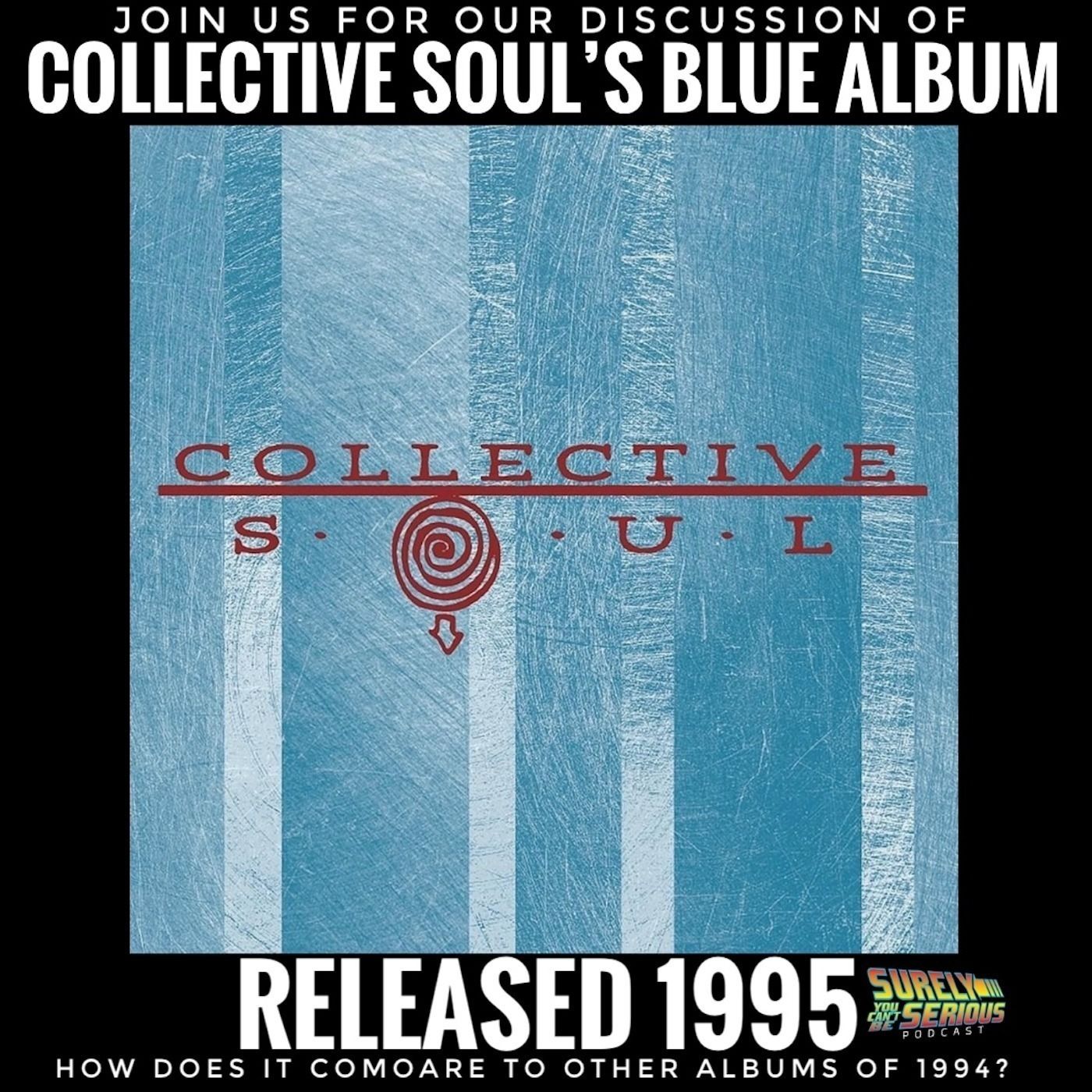
Collective Soul - The Blue Album (1995): Track by Track with a Bonus Track!
In this episode of the Surely You Can't Be Serious podcast, hosts Jason and Dee continue their special series on iconic albums of 1994—with a twist! While Collective Soul’s Blue Album technically came out in 1995, we’re bridging the gap with a special focus on their breakthrough hit from the summer of 1994, "Shine."Join us as we:
- Break Down the Blue Album Track by Track: Jason and Dee dive into each song, uncovering the stories behind the music and the creative journey that shaped this iconic album.
- Explore the Formation and Rise of Collective Soul: Learn how the band was discovered, their early struggles, and the meteoric success that followed. From local Georgia rockers to radio mainstays, we'll discuss their lasting impact on '90s rock.
- Discuss the Unlikely Success of "Shine": As a bonus, we’ll take a deep dive into the origins of the song that defined the summer of 1994 and launched Collective Soul into stardom. Find out how this unexpected hit became an anthem and why it still resonates today.
2024-09-24
63 min
Transcript
Available Results
Generated results are saved to the knowledge database for reuse and search.
No generated results are available for this episode yet.
Extract Knowledge
Pick what you want extracted first. Model, scope, and chapter options appear after a template is selected.
Generated results for public episodes are saved to the knowledge database so they can be reused and searched later.
Transcript
<v Speaker 1>A dramatic reading December, Why drink the water from my hand?
<v Speaker 1>Contagious as you think?
<v Speaker 2>I am.
<v Speaker 1>Hey, this is Jay Hudson, good friend of Dean Jason,
<v Speaker 1>and you are listening to Shirley You Can't Be Serious Podcast.
<v Speaker 3>Hello everybody, and welcome back to the Shirley You Can't
<v Speaker 3>Be Serious Podcast. We are here for part five of
<v Speaker 3>a five part episode series on the albums of nineteen
<v Speaker 3>ninety four.
<v Speaker 4>Give me a word, give me a sign, show me
<v Speaker 4>where to look, tell me the what will I find?
<v Speaker 4>We're gonna let Heaven shine down on us. On this episode,
<v Speaker 4>we're covering Collective Soul's Blue album from nineteen ninety five.
<v Speaker 4>How are we doing this? The ninety four ninety five thing.
<v Speaker 3>Well, that's a little tricky, you kind of I snuck
<v Speaker 3>this one in here under the radar.
<v Speaker 4>Yeah, So here's the thing. Here's the thing. I'm going
<v Speaker 4>with Ed rolland on this he said, this is their
<v Speaker 4>debut album, and Mama say, this is debut album.
<v Speaker 3>This is debut album.
<v Speaker 4>Except he had one of the biggest songs of nineteen
<v Speaker 4>ninety four.
<v Speaker 3>I can tell you with absolute clarity, I remember the
<v Speaker 3>day that I was driving in my car and I
<v Speaker 3>heard Shine come on the radio for the first time really,
<v Speaker 3>and I was blown away. I was like, this is
<v Speaker 3>the future of music right here. I was like, this
<v Speaker 3>is such an incredible mixture of sounds and styles and
<v Speaker 3>vocal changes and guitar changes and rhythm, and I was
<v Speaker 3>just like, holy crap, these guys are the new thing.
<v Speaker 4>So I am cheating the system a little bit with
<v Speaker 4>are using Shine to bridge the ninety four to ninety
<v Speaker 4>five gap.
<v Speaker 3>Jason needs to know the rules so he can break them.
<v Speaker 4>When we started this, it was live versus Collective Soul,
<v Speaker 4>and then we added a bunch of albums from ninety four.
<v Speaker 3>Yeah that is that is true. That is true, so true.
<v Speaker 4>Anyway, so we're diving into Collector Soul's Blue album. They
<v Speaker 4>did have an album before, but basically that was a
<v Speaker 4>collection of demos.
<v Speaker 3>I owned it.
<v Speaker 4>I owned it too.
<v Speaker 3>I owned the cassette.
<v Speaker 4>Did you really the cassette?
<v Speaker 3>I had the cassette. So, unfortunately Dayton wasn't able to
<v Speaker 3>join us today. We miss him. We wish him the best.
<v Speaker 3>Please go check out Docking Bay seventy seven. We will
<v Speaker 3>be listening to that in next episode so we can
<v Speaker 3>get on what he's doing over there.
<v Speaker 4>Yep, Dayton, we miss it. We'll see you next time.
<v Speaker 4>So he said. At this time he was an older
<v Speaker 4>guy and he was trying to get a job as
<v Speaker 4>a songwriter.
<v Speaker 3>Just something of note before we jump into the songs,
<v Speaker 3>and I'm really anxious to get in there. A couple
<v Speaker 3>of these guys were pretty old when they really hit
<v Speaker 3>it big. I mean we talked about Ed Roland. I
<v Speaker 3>mean he was thirty almost thirty one when he finally
<v Speaker 3>hit it and they finally got signed. Gavin Rosdale was
<v Speaker 3>twenty nine years old, almost thirty when Bush finally hit
<v Speaker 3>it in a Marria like. They're still playing the we
<v Speaker 3>infested pubs in the UK to nobody. He said, they'd
<v Speaker 3>used to go out and go all right, here's another
<v Speaker 3>one you've never heard of. And then a year later
<v Speaker 3>they have played more American audience members than any band.
<v Speaker 1>In the world.
<v Speaker 3>So what I've noticed about these guys, every single one
<v Speaker 3>of these lead singers, is they're all very down to earth.
<v Speaker 3>Say what you will about the music of the eighties,
<v Speaker 3>but Nicky six is kind of an hole, right. Vince
<v Speaker 3>Neil's kind of an pole, sure, David Lee Roth, even
<v Speaker 3>Eddie Van Halen. From time to time, these guys all
<v Speaker 3>seem to be regular guys who just happened to be
<v Speaker 3>big rock stars.
<v Speaker 4>Ed Roland I heard his wife talking about this. She
<v Speaker 4>says they have to be the most unknown rock band
<v Speaker 4>in history. She says, they'll be in home depot and
<v Speaker 4>Shine will come on overhead and they kind of look
<v Speaker 4>at each other and like nobody knows who we are.
<v Speaker 3>Wouldn't that be the best of all world? Really? I mean,
<v Speaker 3>because I just got done listening to an interview with him,
<v Speaker 3>and the guy was like, you know, do you have
<v Speaker 3>because they play a lot of shows every year, They
<v Speaker 3>play all the time. But it's because he loves it.
<v Speaker 3>Because the guy said, if you had to quit work
<v Speaker 3>in today, would you know, would you be tight with money?
<v Speaker 3>He's like, no, I don't have to worry about my money.
<v Speaker 3>Kids don't have to worry about my money. It's there.
<v Speaker 3>Everybody's set. I want them to work. I want them
<v Speaker 3>to go out and you know, strive and make it
<v Speaker 3>on their own. But no, money's not something we worry
<v Speaker 3>about anymore.
<v Speaker 4>Before we get into the songs, Yeah, and really, the
<v Speaker 4>story of Shine is the story of the band. We'll
<v Speaker 4>hold that thought because there's a lot of lead up there. Okay, Yeah,
<v Speaker 4>all right. So the Blue Album came out March fourteenth,
<v Speaker 4>nineteen ninety five.
<v Speaker 3>Yep.
<v Speaker 4>It really was the first album as a band.
<v Speaker 3>Yep.
<v Speaker 4>Ed says that album one to album two. Album one
<v Speaker 4>was him in his underwear in his basement making demos.
<v Speaker 3>Yeah.
<v Speaker 4>Album two is with some buddies and they're making music
<v Speaker 4>together as a band in the studio. Yeah, only eight
<v Speaker 4>months between the release of those albums. Yep, And I
<v Speaker 4>saw him. He took out hints, allegations and things left unsaid,
<v Speaker 4>which is what Shine is on.
<v Speaker 3>Yeah, he looked at it.
<v Speaker 4>He's like, in all honesty, there are only three songs
<v Speaker 4>on this album that would have ever even made a
<v Speaker 4>collective soul album. He said, Shine would have Lovelifted and
<v Speaker 4>Sister Don't Cry. Everything else was just a crap demo.
<v Speaker 4>He was just trying to get a job. Three times platinum,
<v Speaker 4>seventy six weeks on the Billboard chart three Mainstream Rock
<v Speaker 4>number one hits.
<v Speaker 5>All right.
<v Speaker 4>The first song on the album is called simple.
<v Speaker 3>But I love about this one is? It throws me
<v Speaker 3>off at the beginning, Like if I've just bought this album,
<v Speaker 3>I'm like Okay, the production quality didn't really give up
<v Speaker 3>a lot from the last album.
<v Speaker 4>It's like listening to an old am radio stage.
<v Speaker 3>Yeah, it really is. And then all of a sudden, yeah,
<v Speaker 3>blowing it away with some vicious guitar licks. I like it.
<v Speaker 4>I think it's a great kickoff to this album.
<v Speaker 3>Yeah, absolutely. So. The I found out that his dad,
<v Speaker 3>Ed Roland's dad was an operatic singer, like he was
<v Speaker 3>going to go to Europe and become an opera singer
<v Speaker 3>and then basically had a little conversation with God and
<v Speaker 3>decided to go into the ministry instead.
<v Speaker 4>So I did know that he was a Southern Baptist preacher,
<v Speaker 4>and that Ed and his brother Dean were brought up
<v Speaker 4>as church rats, you know, yeah, little Southern Baptist church rats. So,
<v Speaker 4>but most of their time was spent at church with
<v Speaker 4>their parents, in youth choir, on youth trips and youth camps.
<v Speaker 3>You know. Yeah.
<v Speaker 4>In fact, I would bet a million dollars even though
<v Speaker 4>I heard Ed talk about this the song shine in
<v Speaker 4>the deep recesses of his brain, it's a rewriting of
<v Speaker 4>the song this Little Love of Mine.
<v Speaker 3>Maybe in vacation b scool, Yeah, sure, yeah, I.
<v Speaker 4>Heard him talk about it, He's like, maybe.
<v Speaker 3>You know, Yeah, it's interesting because his mom was musical
<v Speaker 3>as well. Okay, but even though he was a Southern
<v Speaker 3>Baptist preacher, his dad was the one that took him
<v Speaker 3>to his first concerts, that's right. Took him to see
<v Speaker 3>Johnny Cash, took him to see Elton John, took him
<v Speaker 3>to see Liberatchi, which apparently was his dad's mom's favorite singer.
<v Speaker 4>Right, and my brother George was here.
<v Speaker 3>Yeah, and took him to see the Kinks. So that's
<v Speaker 3>a little bit of a switch up there. That's interesting. Okay. Yeah.
<v Speaker 4>I did hear him say that Elton John is really
<v Speaker 4>his musical idol.
<v Speaker 3>Yeah, he said his very first album, he can remember
<v Speaker 3>with clarity buying the Elton John. He got to go
<v Speaker 3>to the store, bought the Elton John album. When he
<v Speaker 3>put the needle on and your song started playing, he
<v Speaker 3>immediately was just like.
<v Speaker 4>This is just what I want to do. I want
<v Speaker 4>to write songs like Elton John and Bernie Topin. Well,
<v Speaker 4>that's one of the greatest songs from the seventies, and
<v Speaker 4>Elton John's one of the greatest songwriters of all time.
<v Speaker 3>Yeah, I mean, it's a great inspiration. I love that
<v Speaker 3>he commits. I mean that album came out and I
<v Speaker 3>think nineteen. That means he's really young, Like he's born
<v Speaker 3>in the sixties, so he's sure, he's really young, and
<v Speaker 3>he makes the decision at that point, and that's it.
<v Speaker 3>He's gonna go be a musician. He's gonna go be
<v Speaker 3>a songwriter, and he doesn't have anything that's gonna stop him.
<v Speaker 4>He said his musical influences were, of course, John Leewood,
<v Speaker 4>Mac the Eagles. He says, it's more California rock. Yeah,
<v Speaker 4>all right, you're ready to jump onto song number two.
<v Speaker 4>Song number two is untitled, So.
<v Speaker 3>I'm getting a lot of Aerosmith on this one.
<v Speaker 4>I can see that.
<v Speaker 3>And they opened for Aerosmith. If they hadn't already recorded
<v Speaker 3>this album, they were in the midst of putting it
<v Speaker 3>together whenever they were going around with Aerosmith. But lyrics,
<v Speaker 3>the style of singing, and that guitar riff all very
<v Speaker 3>seventies Aerosmith styles.
<v Speaker 4>To you, we're gonna talk about a song that he
<v Speaker 4>wrote using a guitar that Joe Perry gave to him.
<v Speaker 4>Here in a few minutes.
<v Speaker 3>It's fantastic. I told you though, I was like, this
<v Speaker 3>is my hot take on this one. The riff is
<v Speaker 3>so similar to the riff in the first song. I
<v Speaker 3>feel like it was a bad decision to put this
<v Speaker 3>as the second song right after that one, Like throw,
<v Speaker 3>you know, throw December in between these two and you're
<v Speaker 3>mixing it up and you've got some variety. But with
<v Speaker 3>the hammer on and pull offs that they're doing the
<v Speaker 3>very similar speed and sound of the guitar. They're like,
<v Speaker 3>the second song is just a little too similar to
<v Speaker 3>the first song. It would have been better if it
<v Speaker 3>had been like song number three or four.
<v Speaker 4>They like to do a lot of the stops and
<v Speaker 4>starts in the song. I find that really interesting. December
<v Speaker 4>comes to a crashing halt before it revamps up into
<v Speaker 4>something amazing. This song comes to a stop as well. Yeah,
<v Speaker 4>so you mentioned that he plays guitar. Obviously he's played
<v Speaker 4>with Joe Perry's guitar, right. Yep.
<v Speaker 3>He did not start off as a guitar player. Started
<v Speaker 3>off in the school band as a clarinet player. He
<v Speaker 3>actually told his parents, I want to be a coronet player.
<v Speaker 3>But obviously they must have misunderstood him because they came
<v Speaker 3>back and handed him a clarinet.
<v Speaker 4>You know, we talked about his dad being a pastor,
<v Speaker 4>and I saw somebody online who actually reached out to
<v Speaker 4>him on Facebook and said, I just wanted to send
<v Speaker 4>this picture to you. I'm a big fan of collective soul.
<v Speaker 4>But your dad married my parents. Oh cool, And here's
<v Speaker 4>a picture on their wedding day and there he is
<v Speaker 4>standing right there.
<v Speaker 2>You know.
<v Speaker 3>Oh that's awesome.
<v Speaker 4>I think that's really cool.
<v Speaker 3>Yeah, it's fantastic.
<v Speaker 4>You know, he knew his son wanted to be a
<v Speaker 4>singer in a rock band, and as you know, during
<v Speaker 4>those times, a record burning party was not off the
<v Speaker 4>table for Baptist churches.
<v Speaker 3>Right, Yeah, it's the seventies.
<v Speaker 4>And I think his congregation was kind of like, you know, hey,
<v Speaker 4>are you doing this? Are we doing this? And he
<v Speaker 4>said his dad could not bring himself to participate because
<v Speaker 4>of his son's love for rock music. Nice and Ed
<v Speaker 4>said that was really a big validation of big endorsement
<v Speaker 4>of me as a singer.
<v Speaker 3>Fantastic.
<v Speaker 4>I thought that was really cool.
<v Speaker 3>Yeah, that is great.
<v Speaker 4>Untitled Is I like it? I don't skip it. The
<v Speaker 4>title untitled is dumb to me. I don't I don't
<v Speaker 4>like that at all. They asked him why he named
<v Speaker 4>it this, and he said, well, I just I didn't
<v Speaker 4>have any words. I didn't know what to call it,
<v Speaker 4>right right, Well, keep trying, dude, I mean there's something.
<v Speaker 4>There's at least two dozen words in the song.
<v Speaker 3>Just pick one of.
<v Speaker 4>Those words, exactly right.
<v Speaker 3>All right? You ready to move on to song number three?
<v Speaker 4>Song number three, the first of the heavy hitters.
<v Speaker 3>Oh, yeah, here we go.
<v Speaker 4>This song this is the world I know.
<v Speaker 6>As a conscience shows the speedies.
<v Speaker 4>But this is one of the most beautiful songs of
<v Speaker 4>the nineteen nineties.
<v Speaker 3>Yeah, absolutely beautiful.
<v Speaker 4>Guarantee makeout list of the nineties.
<v Speaker 3>This is a little sad for me. This is a
<v Speaker 3>bit of a downer for me to be a makeout song.
<v Speaker 3>I mean, I enjoy listening to it, and I like
<v Speaker 3>sad songs, but I don't know that i'd be like
<v Speaker 3>touching a feeling on this particular song. But to be fair,
<v Speaker 3>he wrote it for his girlfriend, who then, of course
<v Speaker 3>later became his wife, who then, of course later became
<v Speaker 3>his ex wife. But they were up in New York
<v Speaker 3>City and this was back when New York City was
<v Speaker 3>still crime Central. Said he was thinking about writing a
<v Speaker 3>song walked out of the hotel that they were staying
<v Speaker 3>in and just walked around the streets for an hour
<v Speaker 3>and came back in and wrote down his thoughts. And
<v Speaker 3>that's how we get this song.
<v Speaker 4>He wrote this song to impress a beautiful woman.
<v Speaker 3>Yeah, I.
<v Speaker 2>Must stop.
<v Speaker 7>The loud, my.
<v Speaker 4>Chance, and he impressed her so much that she married him. Yeah,
<v Speaker 4>we'll get to the rest of the story here in
<v Speaker 4>a minute. This song hits number nineteen on the Hot
<v Speaker 4>one hundred. It's number one on the Hot Rocks chart,
<v Speaker 4>one of three from this album. And David Cook from
<v Speaker 4>American Idol one American Idol by singing this song.
<v Speaker 3>Nice, that's good, that's good.
<v Speaker 4>He said he'd never watched American Idol, was flipping channels,
<v Speaker 4>came a and he's like, holy crap, they're singing the
<v Speaker 4>world I know. And the dude won American Idol by
<v Speaker 4>singing this song.
<v Speaker 3>Oh, that's gotta just make your heart warm. That's fantastic. Right.
<v Speaker 4>Here's the interesting thing about this song to me, during
<v Speaker 4>the recording sessions, at the last moment, Ed was like,
<v Speaker 4>I don't I don't like the words. I'm gonna change
<v Speaker 4>the words. And he said that it was just one
<v Speaker 4>of the engineers in the studios like Ed, No, No,
<v Speaker 4>this is a beautiful song, this is a number one hit,
<v Speaker 4>don't touch this song, and kind of tucked him off
<v Speaker 4>of the edge.
<v Speaker 3>Oh.
<v Speaker 4>He even gave his name Greg Archilla right.
<v Speaker 3>To see the World below.
<v Speaker 4>Yeah, this song piacked at number nineteen. Like I said,
<v Speaker 4>March ninth of ninety six, here's your top five on
<v Speaker 4>that day.
<v Speaker 3>Okay, yeah, you ready for this? Yeah? Okay?
<v Speaker 4>Number five missing everything but the Girl.
<v Speaker 3>Okay, no, nope.
<v Speaker 4>Number four Nobody Knows by the Tony Rick Project.
<v Speaker 3>Who the heck?
<v Speaker 4>No, I don't know, all right. Number three not gonna
<v Speaker 4>cry Mary J. Blige, No, okay, Number two sitting up
<v Speaker 4>in my room Brandy Wow. And number one one Sweet
<v Speaker 4>Day by Mariah Carey and Boice to men. R and
<v Speaker 4>B was big at this time.
<v Speaker 3>Yeah, it was the beginning of the end.
<v Speaker 4>I think people forget they think the nineties was all grunge.
<v Speaker 4>It was a lot of R and B.
<v Speaker 3>There was a big movement growing that just title waved
<v Speaker 3>in the twenty first century.
<v Speaker 4>I got another funny story for you. Ed was at
<v Speaker 4>the mall one time. We talked about how he's the
<v Speaker 4>one of the most unrecognized rock stars of all time. Yeah,
<v Speaker 4>he goes into the gap to buy a pair of jeans,
<v Speaker 4>picks out his jeans, and is standing in line waiting.
<v Speaker 4>The clerk who's checking him out is singing The World
<v Speaker 4>I Know at the top of his lungs. He said
<v Speaker 4>he had to wait for him to calm down to
<v Speaker 4>check him out to pay for his jeans, And the
<v Speaker 4>guy had no idea who was in front of him.
<v Speaker 3>He didn't know. No, he wasn't singing it to him, no, no, no, no,
<v Speaker 3>he just was having a good time singing his song.
<v Speaker 2>Yeah, that's right.
<v Speaker 3>Oh my gosh, So that's hilarious.
<v Speaker 4>Hey, I'm gonna play another song for you real quick.
<v Speaker 4>Tell me if you think The World I Know influenced
<v Speaker 4>this song.
<v Speaker 3>Okay. Very similar guitar sound, for sure, And that came
<v Speaker 3>out just a year later.
<v Speaker 4>I think Iris came out in ninety eight. It was
<v Speaker 4>three years later.
<v Speaker 3>Yeah, Goo goo dolls, right, Google dolls.
<v Speaker 4>Yeah, I think you can hear similarity there.
<v Speaker 3>Very similar sounds for sure. Yeah, okay.
<v Speaker 4>Next song on the album is a song called Smashing
<v Speaker 4>young Man. This is not a good song, but it's
<v Speaker 4>got a good story behind it. Stop you're killing me.
<v Speaker 4>I think this is a fun song, man.
<v Speaker 3>Yeah, it's kind of dumb to me. And I think that.
<v Speaker 3>I mean, I genuinely think they meant it to be dumb,
<v Speaker 3>Like I think that they were making fun of Billy
<v Speaker 3>Corgan and they were they were being dumb on purpose.
<v Speaker 4>I think you're absolutely right. I think this is a
<v Speaker 4>complete shot across the bow.
<v Speaker 3>Yeah.
<v Speaker 4>Well, so you gotta tell the story on this, Okay.
<v Speaker 4>So when the song Shine comes out in nineteen ninety four,
<v Speaker 4>which we'll talk about in depth here in a second,
<v Speaker 4>Billy Corgan of Smashing Pumpkins sues them because he feels
<v Speaker 4>like they stole his song called Rhinoceros from the album gish.
<v Speaker 3>We should listen to Rhinoceros.
<v Speaker 4>Okay, let's listen to it.
<v Speaker 3>Yeah, I mean kind similar, but right, not Blake Rip,
<v Speaker 3>not a stolen. I mean, there's a million other songs
<v Speaker 3>that we've talked about on this podcast where I was like, oh, dang,
<v Speaker 3>that's straight up stolen, right, I mean, no, they have
<v Speaker 3>a I would say that. I would say the Goo
<v Speaker 3>Goo Goo Goo Dolls song is closer than Shine is
<v Speaker 3>to that song.
<v Speaker 4>I think that's fair. I think that's fair. I don't
<v Speaker 4>think that's a blatant rip off. I'm not a musician.
<v Speaker 4>There's some similarities, but well.
<v Speaker 3>But here's the problem. The Smashing Pumpkins didn't form until
<v Speaker 3>like ninety one maybe.
<v Speaker 4>So here's the deal. Okay, so that song Rhinoceros came
<v Speaker 4>out in ninety one, Shine comes out in ninety four, right,
<v Speaker 4>Billy Corgan, Sue's collective soul it Roland produces a demo
<v Speaker 4>from nineteen eighty nine.
<v Speaker 3>Yeah, Shine, Yeah, because he came up with it in
<v Speaker 3>eighty eight. Like he came up with it. He came
<v Speaker 3>home and his you know, you mentioned his brother is
<v Speaker 3>ten years younger than him. He came home and found
<v Speaker 3>his brother had a guitar. He had no idea his
<v Speaker 3>brother was even playing guitar. At that point, they start
<v Speaker 3>talking about music and writing songs, and he literally comes
<v Speaker 3>up with it there in his brother's bedroom in eighty eight,
<v Speaker 3>which is two years before Smashing Pumpkins is even a that's.
<v Speaker 4>Right, that's right. I did see online where somebody wrote it.
<v Speaker 4>You know, it was one of those deals where Billy
<v Speaker 4>Corgan was on the internet. He was answering questions from fans.
<v Speaker 4>They said, how do you feel about Collective Soul now
<v Speaker 4>is like twenty years later.
<v Speaker 3>Oh yeah, it was like yeah, twenty nineteen.
<v Speaker 4>Yeah, and he's like f Collective Soul now and always.
<v Speaker 2>Yeah.
<v Speaker 4>I mean, that's just a lot of hate for that
<v Speaker 4>I And I've.
<v Speaker 3>Listened to Billy Corgan do stuff, and I never was
<v Speaker 3>a huge fan of him to begin with, but like
<v Speaker 3>a lot of the stuff that I've seen him do now,
<v Speaker 3>he seems like a kind of down to earth, more
<v Speaker 3>normal guy than I, you know, had an impression of
<v Speaker 3>in the nineties. But he's he's got some deep seated
<v Speaker 3>and probably ill placed hatred for them, but totally agree. So,
<v Speaker 3>as you pointed out, he produces this demo from eighty
<v Speaker 3>nine and that wins the court case for him, right, Yes,
<v Speaker 3>but obviously Billy Corgan's not letting this go and you know,
<v Speaker 3>we'll trash talk him everywhere. And then this album comes
<v Speaker 3>along and smashing young man wink wink, nudge, nudge, know
<v Speaker 3>what I mean? Smirk?
<v Speaker 8>Yeah, Yeah, clearly it's a shot back at Billy Corgan
<v Speaker 8>from collect Yourself.
<v Speaker 3>Right.
<v Speaker 4>This was the third single release Fall of ninety five. Okay,
<v Speaker 4>next song on the album, Oh My Goodness, are You
<v Speaker 4>ready are you braising yourself?
<v Speaker 3>I'm ready before it. Let's go.
<v Speaker 4>This song is called December.
<v Speaker 9>Why dr Wong from This is a fantastic song for
<v Speaker 9>our listening audience.
<v Speaker 4>Dee and I have been friends long before the podcast,
<v Speaker 4>and about twenty ten, I was like, d will you
<v Speaker 4>teach me how to play this on guitar guitar player?
<v Speaker 4>I'm not even a guitar player. I just love this
<v Speaker 4>song so much.
<v Speaker 3>I was like, did you even own a guitar at
<v Speaker 3>that point?
<v Speaker 5>Right?
<v Speaker 2>No?
<v Speaker 4>And You're like, well, that's kind of like you asking
<v Speaker 4>me to show you how to pop a wheelie before
<v Speaker 4>you can ride a bicycle.
<v Speaker 3>Yeah.
<v Speaker 4>And I was like, I don't care. I want to
<v Speaker 4>learn how to do this. I can't do it. But
<v Speaker 4>you did send me a video of you playing this song.
<v Speaker 3>Fourteen years later, I guess we were covered and I thought,
<v Speaker 3>oh crap, I forgot I was supposed to learn how
<v Speaker 3>to play this for him.
<v Speaker 4>So the funny part is is that, as you can
<v Speaker 4>clearly hear, Dee is playing it correctly, but there's an
<v Speaker 4>interview with Rick Biato and Ed Roland.
<v Speaker 3>He's been playing it wrong.
<v Speaker 4>He's been playing it wrong.
<v Speaker 3>Yeah, I mean It's not a super complicated fingerpicking thing
<v Speaker 3>that he's doing, but there's easier way to do it,
<v Speaker 3>and I get I understand, you know, sometimes you just
<v Speaker 3>want to do it the easy way to think and
<v Speaker 3>sing at the same time, it's hard.
<v Speaker 4>So I love this song. This is another number one
<v Speaker 4>hit on the mainstream rock charts. This reaches number twenty
<v Speaker 4>on the Hot one hundred. But to me, this is
<v Speaker 4>one of the biggest songs of nineteen ninety five.
<v Speaker 3>Best song on the album spiking the football.
<v Speaker 7>Down, no verb, Just spend me down down speak.
<v Speaker 2>Now verver, Just spend me ow.
<v Speaker 3>Okay.
<v Speaker 4>I would say this is almost like three different songs
<v Speaker 4>and they don't fully come together. They're like interwoven the
<v Speaker 4>last minute and a half of the song.
<v Speaker 3>So it's interesting that you say that because when they
<v Speaker 3>were recording this album, this is the one song that
<v Speaker 3>the rest of the band when they when he came
<v Speaker 3>up with it and he played it for them, they
<v Speaker 3>were like, no, we are not recording that song, right,
<v Speaker 3>And he was like what and now what his his
<v Speaker 3>plan was when he was writing the song was he
<v Speaker 3>wanted to have the same chord progression throughout the song,
<v Speaker 3>but come up with different melodies to go over that
<v Speaker 3>chord progression, and so as he's playing it for them,
<v Speaker 3>all they can hear is the chord progression. All they're like,
<v Speaker 3>it's the same four chords over and over. This is terrible.
<v Speaker 3>We're not doing this.
<v Speaker 4>But he's like, guys, just trust me, and it goes
<v Speaker 4>on to be their biggest hit, one of their biggest
<v Speaker 4>hits for sure.
<v Speaker 3>Yeah.
<v Speaker 4>This song was written about their manager when they were
<v Speaker 4>fighting with their first manager.
<v Speaker 3>Well, I know that they dropped their manager because he
<v Speaker 3>was like screwing them out of money.
<v Speaker 4>Yeah, so they believe that he was taking advantage of them.
<v Speaker 3>Yeah.
<v Speaker 4>You know, when you have this massive number one hit, shine,
<v Speaker 4>you got people falling all over themselves to sign you.
<v Speaker 3>Yeah.
<v Speaker 4>But you said Ed was savvy by that time, because
<v Speaker 4>he was thirty years old and not a kid.
<v Speaker 3>Yeah, I mean he had. He had been growing up
<v Speaker 3>in the recording industry, and he had been you know,
<v Speaker 3>he had had the opportunity to speak to all kinds
<v Speaker 3>of musicians. I can't wait to tell you the first
<v Speaker 3>one he had his first recording session with, you'ren I'm
<v Speaker 3>excited to tell you about this, Okay, But he had
<v Speaker 3>heard enough horror stories and was old enough, you know,
<v Speaker 3>I'm mature enough man that he was like, I'm not
<v Speaker 3>gonna let these guys railroad me on this deal. I
<v Speaker 3>mean something to keep in mind that the record label
<v Speaker 3>like signed these guys like on their fourth show. Like
<v Speaker 3>it was nuts, Like it really was just crazy, and
<v Speaker 3>we'll get to that story. But the record label just
<v Speaker 3>kind of like signed them. And then it was kind
<v Speaker 3>of riding along and all of a sudden they just
<v Speaker 3>showed up with this blue album and they're like, hey, guys,
<v Speaker 3>we got the new we recorded the next album, and
<v Speaker 3>the record company was like, great, we're gonna make our
<v Speaker 3>We're gonna make quarter two.
<v Speaker 4>And he's like, I don't know what that means, but cool.
<v Speaker 4>But like, the record company was not involved in the
<v Speaker 4>recording of this album at all. In fact, they wanted
<v Speaker 4>to go back and record hints, allegations and things left
<v Speaker 4>un said. Yeah, they thought, well, those are demos, we
<v Speaker 4>need to rerecord those in the record company. He's like, no,
<v Speaker 4>we're just gonna sell that.
<v Speaker 3>Yeah, move on, I bought it right right. Yeah.
<v Speaker 4>So anyway, their manager at the time was a guy
<v Speaker 4>named Bill Richardson. He was fighting with them. He was
<v Speaker 4>able to freeze their earnings for a full year. By
<v Speaker 4>the way, at first, he didn't have a title for
<v Speaker 4>this song, and he wanted something better than the End
<v Speaker 4>or like Finelle, and so he thought, you know, what's
<v Speaker 4>another synonym for like the End? And so December is
<v Speaker 4>what came to his mind. He wrote a quick bridge,
<v Speaker 4>you know, using the word December when they mix like
<v Speaker 4>three different melodies at the end of the song. Yeah,
<v Speaker 4>I mean, it just blows me away. I absolutely love
<v Speaker 4>this song. One of my favorite songs from the nineties.
<v Speaker 3>Yeah, great one.
<v Speaker 4>Okay, next song on the album is called Where the
<v Speaker 4>River Flows.
<v Speaker 3>I think when I first heard this album back in
<v Speaker 3>ninety five, this was a song that stood out to
<v Speaker 3>me like this is the collective soul that I know,
<v Speaker 3>Like this is this is my collective soul. Yeah, I
<v Speaker 3>really dig the guitar, nice crunchy, punchy guitar. By the way,
<v Speaker 3>here's how Ed became a guitar player instead of clarinet player.
<v Speaker 3>He was hanging out with the jocks and felt comfortable
<v Speaker 3>enough to go, you know, guys, I'm going to be
<v Speaker 3>a songwriter someday. They didn't give him any trouble. They
<v Speaker 3>didn't make fun of him. One of them just said,
<v Speaker 3>I got a guitar, you want it, and he's like sure.
<v Speaker 3>So he gave him like this Kmart guitar and an
<v Speaker 3>Elvis songbook that had the chords written down in it
<v Speaker 3>and an Eagles songbook that had the chords written down
<v Speaker 3>in it, and that's how he learned to play the guitar.
<v Speaker 3>And I mean, that's the way it went for me,
<v Speaker 3>Like it was I did. My dad had a guitar there,
<v Speaker 3>but it was looking at those songbooks and those chord
<v Speaker 3>charts in the songbooks with the songs I knew. It's
<v Speaker 3>how I taught myself to play. So that's how he
<v Speaker 3>got started on the guitar. Some football player with a
<v Speaker 3>Kmart guitar. He didn't wan anymore.
<v Speaker 4>That's fantastic. I've not heard that story.
<v Speaker 3>Yeah.
<v Speaker 4>So this is the fourth Hot Rocks number one for
<v Speaker 4>the band fifth single. This was released March twenty sixth,
<v Speaker 4>nineteen ninety six.
<v Speaker 3>So this is the.
<v Speaker 4>Fourth number one of the Billboard Mainstream Rock Charts. You
<v Speaker 4>had Shine December the World that I Know and Wear
<v Speaker 4>the River flips. So this is the song that was
<v Speaker 4>written on the guitar given to him by Joe Perry
<v Speaker 4>from Aerosmith.
<v Speaker 3>Nice.
<v Speaker 4>So they opened for Aerosmith on the Like to Get
<v Speaker 4>a Grip tour, Yeah, which we've talked about. We went
<v Speaker 4>track by track through Get a Grip. Yeah, and what
<v Speaker 4>a great what a great gig to have. I mean,
<v Speaker 4>Aerosmith was huge in ninety four. You've got one big song,
<v Speaker 4>cold Shine, and arismis like, yeah, how would you like
<v Speaker 4>to open for us?
<v Speaker 3>Yeah?
<v Speaker 4>By the way, they also opened for Van Halen. They
<v Speaker 4>got to play Woodstock and they've got one hit song.
<v Speaker 3>So to this day, ed Roland is a golfer. Okay,
<v Speaker 3>loves to play golf. He lives down in Atlanta, Georgia.
<v Speaker 3>Grew up right outside of there, you know, lives there
<v Speaker 3>now with his second wife and their kids. But he's
<v Speaker 3>a golfer. He even hosts charity golf tournaments for Saint
<v Speaker 3>Jude's Hospital. I mean, just a great guy. And it
<v Speaker 3>all goes back to when they were hanging out with
<v Speaker 3>Van Halen and Eddie comes up to him, you know,
<v Speaker 3>early on in the tour and he's he's like, so
<v Speaker 3>you golf and he's like no. He goes, well, why
<v Speaker 3>don't you come golfing? With me tomorrow and he's like, yes, sir,
<v Speaker 3>mister van Halen, sir, of course, yes, right, and Eddie says, like,
<v Speaker 3>all the hotel rooms are the same. It's to quote Eddie,
<v Speaker 3>it's the same bed, it's the same or it's the
<v Speaker 3>same TV. Okay, he says, So you go in on
<v Speaker 3>these tours, you go to the hotel room and immediately
<v Speaker 3>you're down in the bar and just that's not a
<v Speaker 3>good place to be. You got to get out, you
<v Speaker 3>got to do stuff. So that's why we're going to
<v Speaker 3>go play golf. And so he takes him golfing that
<v Speaker 3>next day, a smashing young man at just thirty or
<v Speaker 3>thirty one years old, and now he's been playing for
<v Speaker 3>the last thirty years, he said. At the time, he
<v Speaker 3>got his girlfriend some golf clubs and she's like, this
<v Speaker 3>is a guy's thing. This is like you hang out
<v Speaker 3>with the guys thing, and he's like, okay, great, that
<v Speaker 3>sounds great. And he said he got too serious about
<v Speaker 3>it at one point and realized that he was getting
<v Speaker 3>too angry and frustrated with it, and he realized that
<v Speaker 3>the benefit of the game is the fellowship you have
<v Speaker 3>with the guys you're playing with. That's his words, fellowship
<v Speaker 3>with the guys you're playing with. I love it. Yeah,
<v Speaker 3>there you go.
<v Speaker 4>That's that's how ed Roland plays golf. Okay, hit stop
<v Speaker 4>on your tape player, kick it out, flip it over
<v Speaker 4>side too. Next song is called Jell.
<v Speaker 3>Another great one, Another one again. It starts off very
<v Speaker 3>much like the first song on the first side. I'm
<v Speaker 3>listening to this and I'm thinking, is somebody gonna be snapping?
<v Speaker 4>Here?
<v Speaker 3>Are we listening to the intro music for sitcom from
<v Speaker 3>the sixties about monsters or something. It's just got this
<v Speaker 3>very kind of quirky little it's quirky thing going and
<v Speaker 3>then here we go, just like you wanted, the punchy,
<v Speaker 3>big chords coming in again.
<v Speaker 2>Being well.
<v Speaker 4>This is the first single. This was released in January
<v Speaker 4>of ninety five. This was a bridge single. So the
<v Speaker 4>record company came to them and said, I know you're
<v Speaker 4>working on the new album. We want to kind of
<v Speaker 4>keep this momentum going. Do you have anything. He's like, well,
<v Speaker 4>I got this song, gave it to him. They listened
<v Speaker 4>to it and they're like, well, if this is just
<v Speaker 4>a bridge single, I can't wait to hear the rest
<v Speaker 4>of the album.
<v Speaker 3>Here we Go.
<v Speaker 4>This song reached number two on the Hot Rocks chart.
<v Speaker 4>This debuted on the Jerky Boys soundtrack. You remember the
<v Speaker 4>Jerky Boys, I.
<v Speaker 3>Do making the prank phone calls?
<v Speaker 4>Yeah, yes, they actually got a movie made on the
<v Speaker 4>Jerky Boys.
<v Speaker 3>This is a sal Gold state.
<v Speaker 4>So I think this is a really important song for
<v Speaker 4>them because obviously Shine is their best and most important song,
<v Speaker 4>but this was the song that proved that they were
<v Speaker 4>not a one hit wonder.
<v Speaker 3>Oh yeah, hey, Jason, you know we've been doing this
<v Speaker 3>for over five years now, the podcast. That's incredible. Really,
<v Speaker 3>you know why? Why? Because we gel.
<v Speaker 4>Because we come together. By the way, this song was
<v Speaker 4>written during sound check at Woodstock ninety four.
<v Speaker 3>Oh yes, that's great. So he didn't just play Elvis
<v Speaker 3>and Eagles. Eventually he learned some other stuff. He became
<v Speaker 3>obsessed with the cars because hey, seventy eight, that album
<v Speaker 3>of that year was incredible. Yeah, so he became obsessed
<v Speaker 3>with them, and he learned that some of those guys
<v Speaker 3>went to the Berkeley School of Music. And so as
<v Speaker 3>soon as he found that out, he's like, that's what
<v Speaker 3>I'm going to go do. I'm gonna go be a
<v Speaker 3>guitar player. I'm gonna go play guitar at the Berkeley
<v Speaker 3>School of Music. And so he's poor, but he got
<v Speaker 3>a loan from his uncle, the banker, to go to Berkeley. Okay,
<v Speaker 3>ask me how much Berkeley was back then?
<v Speaker 4>Was how much?
<v Speaker 3>Was it twenty five hundred dollars? I need a loan? Yeah,
<v Speaker 3>now twenty five hundred dollars for six months, because that's
<v Speaker 3>how long he was there.
<v Speaker 2>Oh.
<v Speaker 3>So he comes in and he's thinking he's going to
<v Speaker 3>be a guitar player, and then he comes in with
<v Speaker 3>these real guitar players and he's like, okay, I'm going
<v Speaker 3>to be a songwriter's because he's just outmanned on the guitar.
<v Speaker 3>And then he runs into his mailman as he's leaving
<v Speaker 3>his dorm or whatever one day and the mailman's like, hey,
<v Speaker 3>here's your mail and he's like, oh hey, thanks. He
<v Speaker 3>goes you go in school here, and he's like, yep, yeah,
<v Speaker 3>it's going to be a songwriter. And he's like, oh yeah,
<v Speaker 3>I graduated from here, and he's like the mailman. Yeah.
<v Speaker 3>In his head, he's like the mailman's and he's like,
<v Speaker 3>wait a minute, what did you say. You're you're playing
<v Speaker 3>an instrument and he's like, oh, I was, but I
<v Speaker 3>think I'm going to be a songwriter and instead and
<v Speaker 3>the mailman. The mailman goes, you should quit right now
<v Speaker 3>and go live life. They're not going to teach you
<v Speaker 3>how to write a song at Berkley. Go live life
<v Speaker 3>and that will be how you write songs. And see
<v Speaker 3>what he did. He quit. Good for him, Cliff Clven
<v Speaker 3>changes the fate of a smashing young man.
<v Speaker 4>That's a great story, right, yeah, go live life and
<v Speaker 4>write from then. Yeah, so he lands a job at
<v Speaker 4>the studio, right, and that's kind of a big win
<v Speaker 4>for him, right.
<v Speaker 3>Well he I mean we're talking about the studio. This
<v Speaker 3>is back home in.
<v Speaker 4>Georgia after he's left Boston.
<v Speaker 3>Right. He was just a gopher, Like he was the
<v Speaker 3>pon Jovi store. He was the guy that went and
<v Speaker 3>got the coffee. He's the guy that swept up at
<v Speaker 3>the end. But he would go and talk to the
<v Speaker 3>engineer as the engineer was doing stuff and just kind
<v Speaker 3>of politely ask him questions about things. And then after
<v Speaker 3>he'd worked there for three months, the engineer left, and
<v Speaker 3>so the owner of the studio is like, well, you
<v Speaker 3>want to be the new engineer? Yeah, So he became
<v Speaker 3>from three months of just hanging out in the studio.
<v Speaker 3>And when I say three months of hanging out in
<v Speaker 3>the studio, everybody would leave. He would sweep up and
<v Speaker 3>then he would sit there and mess with the system
<v Speaker 3>all night long, sleep under the board.
<v Speaker 2>Yes.
<v Speaker 4>He talked about how he wrote and recorded his first
<v Speaker 4>album using like the twenty seconds left over on the
<v Speaker 4>tape that they didn't use, and so he would like
<v Speaker 4>clip that and it.
<v Speaker 3>Just tape them all together, and just tape.
<v Speaker 4>Them all together. And that's how he got the recording tak.
<v Speaker 3>You get a full size, real fa fantastic. I didn't
<v Speaker 3>know that. That's great. So I told you you were
<v Speaker 3>going to be excited to hear who his first session
<v Speaker 3>was as an engineer.
<v Speaker 4>Yeah, Okayaul, Oh my god. He said they actually became buddies.
<v Speaker 3>He was like, we hit it off. We had a
<v Speaker 3>great time. He taught me a lot of stuff about
<v Speaker 3>these different musical styles. And he said, and in that studio,
<v Speaker 3>being in Georgia, you had all kinds of me, all
<v Speaker 3>kinds of music coming in. You've got bluegrass, you've got rap,
<v Speaker 3>you've got heavy metal, you've got whatever RuPaul is I
<v Speaker 3>mean you've got it all sure, So he's getting exposed
<v Speaker 3>to all of these things as an engineer and just
<v Speaker 3>soaking it up. Now, we will establish here in a
<v Speaker 3>bit that Shine is almost literal overnight success. But the
<v Speaker 3>time between when Ed Roland dropped out of college and
<v Speaker 3>the time when Shine hit is eleven years. So you
<v Speaker 3>go back to the old, you know, go back to
<v Speaker 3>the old ten thousand hour yep theory. He is working
<v Speaker 3>in the music industry just long enough to become a
<v Speaker 3>true expert at his craft. And even with that, he
<v Speaker 3>doesn't know which song is going to be the song
<v Speaker 3>that breaks them. But I'll tell you that story here
<v Speaker 3>in a second. Okay, excellent, excellent, Okay.
<v Speaker 4>Next song on the album is called She Gathers Rain. Okay,
<v Speaker 4>another guitar heavy song. This doesn't capture me quite as
<v Speaker 4>much as some of those heavy hitters on the front
<v Speaker 4>part of the album.
<v Speaker 3>Yeah, there's a little.
<v Speaker 4>Lull on the B side of this album for me,
<v Speaker 4>So this one, to me has a stronger beat to it,
<v Speaker 4>like the drums seem more pronounced in this one.
<v Speaker 3>Drummer was a guy named Shane Evans, right. He actually
<v Speaker 3>was in a band with Ed before Collective soul band
<v Speaker 3>called the Marching Two Step. He said, like, over this
<v Speaker 3>eleven year period he would have to be a part
<v Speaker 3>of different bands and stuff. But as time went on,
<v Speaker 3>people would they'd fizzle out, and he was, this is
<v Speaker 3>so crazy. He was signed up to go play on
<v Speaker 3>a cruise ship a month before Shine hit. So so
<v Speaker 3>here's how it happens. Right, He's recorded probably one hundred
<v Speaker 3>demo in over one hundred demos in this eleven year
<v Speaker 3>time period, and he's just being I mean, he just
<v Speaker 3>never gives up. He sends them to radio stations, he
<v Speaker 3>sends them to record companies. He even got a letter
<v Speaker 3>from a guy. He didn't say his name, but he said,
<v Speaker 3>never send me another piece of your music. You're a
<v Speaker 3>horrible singer and a horrible songwriter. What And he didn't
<v Speaker 3>quit after that, He didn't quit. He gave cassettes to
<v Speaker 3>Sting and to ric Ocasic. But it's just crazy. In
<v Speaker 3>this process, he thought, okay, I you know, he had
<v Speaker 3>these songs that he thought was gonna they were gonna
<v Speaker 3>do well, but he had this one that he thought
<v Speaker 3>was going to make it right. This song was called
<v Speaker 3>good Night Good Guy.
<v Speaker 4>So Goodnight Good Guy is off his allegations and things
<v Speaker 4>left unsaid, and it sounds a lot like she gathers rain.
<v Speaker 3>Yeah. So his plan is his brother, like we said,
<v Speaker 3>ten years younger, he's at college at Georgia State, and
<v Speaker 3>so he wants him to give it to the little
<v Speaker 3>college radio station there to play the cassette. Right, yeah,
<v Speaker 3>And so his brother takes the cassette to the radio station,
<v Speaker 3>and just like Quincy Jones back when they were recording Thriller,
<v Speaker 3>they put in the wrong side. And the side that
<v Speaker 3>they put in is just extra, right, It's just a cassette.
<v Speaker 3>He just had an extra song on the other one.
<v Speaker 3>The song that was on the other side was Shine.
<v Speaker 6>Show No No Yes.
<v Speaker 3>And so at that point they've played the wrong song.
<v Speaker 3>The song finishes and the switchboard lights up and everybody
<v Speaker 3>is like, what was that? Play that again? And then
<v Speaker 3>I mean the dominoes start falling like crazy.
<v Speaker 5>Shine.
<v Speaker 3>So then this radio station in Orlando starts playing it.
<v Speaker 3>Somehow they hear about it, and he had already sent
<v Speaker 3>them the tape, right, he's sending about right, He's sending
<v Speaker 3>to anybody that he can, and so they start playing
<v Speaker 3>it and then this the university is having this Christmas
<v Speaker 3>party and they're like, hey, you guys are awesome, come
<v Speaker 3>come play with us. And they don't know that you
<v Speaker 3>guys is ed Roland right, like he did the whole
<v Speaker 3>thing on his own, right. But his brother has this
<v Speaker 3>little frat band, and so he's like, Okay, here's what
<v Speaker 3>we're gonna do. We'll get together, we'll figure out, you know,
<v Speaker 3>half an hour worth of songs. You know, we'll do
<v Speaker 3>three original songs and then we'll just do a bunch
<v Speaker 3>of covers and we'll be fine. And you guys can
<v Speaker 3>play the songs that you play and I'll just get
<v Speaker 3>off the stage. It'll be fine, it'll be fine, right,
<v Speaker 3>And so they practice together a couple of times before
<v Speaker 3>this Christmas party. They play one song and then they
<v Speaker 3>play Shine and in the place goes nuts. Really, this
<v Speaker 3>is a college Christmas party at Georgia State and they're
<v Speaker 3>losing their minds and he just he starts looking around
<v Speaker 3>at the band, like what is what is going on?
<v Speaker 3>This is crazy? So he said he's said, let's play
<v Speaker 3>it again.
<v Speaker 4>And so they played it again and the crowd went
<v Speaker 4>nuts again.
<v Speaker 3>He said they played it six times that night and
<v Speaker 3>the crowd went crazy. Every single time. So it's hitting
<v Speaker 3>in Orlando. It's obviously tapped a nerve. I mean, I
<v Speaker 3>told you how I felt when I heard it. And
<v Speaker 3>so they get booked to play a bigger show down
<v Speaker 3>in Florida, and they're in their van driving to this
<v Speaker 3>show and they're doing the top five most requested songs
<v Speaker 3>of the week and it's like Stone Temple, Pilots, Pearl Jam, Nirvana,
<v Speaker 3>Kings x OH, and at number one, this band out
<v Speaker 3>of Atlanta called Collective Soul. The song's called Shine. He said,
<v Speaker 3>they pulled the van over to the side of the
<v Speaker 3>road and he just he got out and he just
<v Speaker 3>didn't know what to do. He was like mystified. He's
<v Speaker 3>like these other guys, you know, they're all in their
<v Speaker 3>early twenties, and they're going nuts. They're like so excited
<v Speaker 3>and cheering for him and excited to be a part
<v Speaker 3>of this band, and he's just like, none of this
<v Speaker 3>makes sense. It's just this happening, weird, surreal moment, And yeah.
<v Speaker 4>That's a fantastic story. Shine was the song of the
<v Speaker 4>summer of ninety four for me. That's such a great story. Okay.
<v Speaker 4>Next song on the album is a song called When
<v Speaker 4>the water falls.
<v Speaker 2>She's a big job job.
<v Speaker 3>This has the feel of another band in that area.
<v Speaker 3>Maybe they were out of Florida. Dolphins make me cry.
<v Speaker 3>I bet they were out of Florida. Hooty and the
<v Speaker 3>Blowfish South Carolina. There you go, Yeah, there you go.
<v Speaker 4>Absolutely sounds like the Blowfish, right. Yeah, this song sounds
<v Speaker 4>like it's like a hippie song, right like when I'm
<v Speaker 4>driving in the Colorado Mountains in the summertime and I
<v Speaker 4>see the Columbine on the side of the hill and
<v Speaker 4>I'm like, I got the local radio station on. It's
<v Speaker 4>just a hippie song. It's I like it. I don't
<v Speaker 4>skip it. It's not a heavy hitter, but I like it.
<v Speaker 3>Yeah. By the way, they were friends with the guys
<v Speaker 3>from Hoodie and the Blowfish before either one of them
<v Speaker 3>more famous.
<v Speaker 4>Love It.
<v Speaker 3>He said that the atmosphere was much like, you know
<v Speaker 3>when we talked about Pearl Jim and Nirvana, the Seattle
<v Speaker 3>scene where all the bands supported each other instead of
<v Speaker 3>being adversarial. He said it was the same kind of
<v Speaker 3>thing that like, when each band got signed, they were
<v Speaker 3>both genuinely excited for each other. And I think they're
<v Speaker 3>still I think they're touring with them right.
<v Speaker 4>Now, Hooting the Blowfish went from nobody to everywhere overnight.
<v Speaker 4>You might hear the rest of that story if you
<v Speaker 4>come listen to our best of ninety four. All right,
<v Speaker 4>I want to just drop in a little bit of
<v Speaker 4>gossip up right here. Okay, So the members of the band.
<v Speaker 4>When Ed got signed and had the hit Shine, he
<v Speaker 4>had to gather a band, right, So he grabs his
<v Speaker 4>younger brother and some of his friends, and among that,
<v Speaker 4>you've got Shane Evans, You've got Will Turpin, who sang
<v Speaker 4>in the church choir with him at his church.
<v Speaker 3>Right.
<v Speaker 4>I mean, you grab your friends, right, you grab the
<v Speaker 4>guys you want to hang out with.
<v Speaker 9>Right.
<v Speaker 4>And they grabbed a guitar player named Ross Childress. Now
<v Speaker 4>I couldn't find anything super solid on the internet. However,
<v Speaker 4>Ed married a woman named Stephanie Bully. That's who he
<v Speaker 4>wrote The World I Know for in ninety four.
<v Speaker 3>They have a kid together.
<v Speaker 4>They were married for five years. They divorced in two
<v Speaker 4>thousand and one. Ross Childress was kicked out of the
<v Speaker 4>band in two thousand and one. And I heard somebody
<v Speaker 4>talking about this, and he said, well, the one thing
<v Speaker 4>you can't do is sleep with the boss's wife.
<v Speaker 3>Yeah, you will not probably ever hear the full story
<v Speaker 3>on that, because you listen to Ed roll and talk
<v Speaker 3>and they're just there. Becomes a point that he very
<v Speaker 3>phlegmatically refuses to answer those kinds of questions. That's right.
<v Speaker 3>He just says, I'm just not going to talk about that. Right.
<v Speaker 4>I did see him on YouTube though, you can go
<v Speaker 4>look at this somebody's holding him aside that says like,
<v Speaker 4>you know, where's Ross And he says a bunch of
<v Speaker 4>non Christian words to this guy and kicks him out. Wow,
<v Speaker 4>So no love lost there at all. Right, And in fact,
<v Speaker 4>Ross Schilders gets a co writing credit for the World
<v Speaker 4>I know, huh. Ed's like, he didn't write it, he
<v Speaker 4>didn't do anything. He didn't even play on that track.
<v Speaker 4>But I gave him songwriting credit because I was trying
<v Speaker 4>to keep everybody in the band happy. Yeah, And the
<v Speaker 4>interview I saw he looked directly at the camera and says,
<v Speaker 4>and you know it's true. So so yeah.
<v Speaker 3>So what I heard him say number one about the
<v Speaker 3>first marriage was being on the road was probably difficult
<v Speaker 3>on the relationship, and had they spend a little more
<v Speaker 3>time dating before they got married, that it probably would
<v Speaker 3>have been a better result for the relationship. That was
<v Speaker 3>a rudibly diplomatic way to handle that. That's right, he said.
<v Speaker 3>She is a great mother. And as far as Ross,
<v Speaker 3>and then also Shane, who was the other one who
<v Speaker 3>was asked to leave the band, what he said was, well,
<v Speaker 3>like I said, I was Atlantic signed Me, not Collective Soul.
<v Speaker 3>So these guys technically were my employees, and there was
<v Speaker 3>a morals clause in our employment contract. And I don't
<v Speaker 3>need to go into detail about it, but they both
<v Speaker 3>had issues with that morals clause that caused them to
<v Speaker 3>not be in the band anymore.
<v Speaker 4>Interesting.
<v Speaker 3>Yeah, well, I know with Shane Evans it was drugs,
<v Speaker 3>which I think he's cleaned up. He's cleaned up, and
<v Speaker 3>I think I think he was with him whenever they
<v Speaker 3>got inducted.
<v Speaker 4>The Georgia Hall of Fame.
<v Speaker 3>Yeah, there you go. That's it.
<v Speaker 4>I do think they're still friendly with everybody but Ross.
<v Speaker 4>He said they knew he goes, I knew these guys
<v Speaker 4>from cub Scouts, baseball and church. That betrayal cuts.
<v Speaker 3>Deep, it does, That's true. Okay.
<v Speaker 4>Next song on the album is called Collection of Goods.
<v Speaker 3>Okay, I feel like you're already being defensive and I
<v Speaker 3>haven't even said anything.
<v Speaker 4>No, no, no, This one I moved past pretty quickly.
<v Speaker 3>Oh jeez, yeah, this one. I started looking. I'm like,
<v Speaker 3>how many more songs are on the album this?
<v Speaker 4>Yeah, this is not my favorite song.
<v Speaker 3>This is skipper for me for sure.
<v Speaker 4>Yeah, all right, let's get on past that one. Yeah,
<v Speaker 4>let's let's jump past all right. Next song on the
<v Speaker 4>albums song called.
<v Speaker 5>Bleeds Loaded now gues.
<v Speaker 3>I love the intro on this one. They're tapping into
<v Speaker 3>the who right, this is Pete Townsend all over the place.
<v Speaker 3>But then they leave that behind and the rest of
<v Speaker 3>the song is not as interesting as that intro was.
<v Speaker 4>I love this song. This is a top three song
<v Speaker 4>on the album for me.
<v Speaker 2>Lead.
<v Speaker 4>I absolutely love it. I think it's fantastic. I think
<v Speaker 4>the guitar solo is amazing in this Everything is good
<v Speaker 4>except for the one word chorus. It loses its punch
<v Speaker 4>because he just says lead.
<v Speaker 3>Yeah right, yeah, But.
<v Speaker 4>The story behind this song blows my socks off. Do
<v Speaker 4>you know the story behind this one?
<v Speaker 3>Tell me?
<v Speaker 4>Okay, so we talked about how Ed's dad is a pastor, Right,
<v Speaker 4>so when you're a pastor, people come to you for
<v Speaker 4>spiritual advice. You got problems. I need some help with this.
<v Speaker 4>I'm not doing well. Can you help me? He said
<v Speaker 4>His dad wasn't at home one day and a girl
<v Speaker 4>came to the house and was going to commit suicide.
<v Speaker 4>And Ed was like, my dad's not home, but I'll
<v Speaker 4>see what I can do. Wow, And so he sat
<v Speaker 4>down with her and kind of held her hand and
<v Speaker 4>talked her out of it. And this song was written
<v Speaker 4>about that moment.
<v Speaker 3>Dang. So that's the.
<v Speaker 4>Lyrics say, I don't know why she cries to me.
<v Speaker 4>She keeps her pain as company, but it's only time
<v Speaker 4>before we all must plead. Absolutely one of my favorite
<v Speaker 4>songs on the album.
<v Speaker 3>I absolutely love it.
<v Speaker 4>Ed himself said he was disappointed with the final version
<v Speaker 4>of the song yeah, but yet liked it too much
<v Speaker 4>to leave it off. So, okay, last song on the album,
<v Speaker 4>yeah songs called Reunion.
<v Speaker 2>Change will come It changes here.
<v Speaker 4>Okay, this is the most Gospelly, most Southern Baptist song
<v Speaker 4>on the entire album.
<v Speaker 3>Really, I was thinking Pink Floyd. Really, Yes, Yeah, we's
<v Speaker 3>got a comfortable numb, comfortably numb. There's definitely got that
<v Speaker 3>gospel chorus behind it. Yeah, I mean it's and it's
<v Speaker 3>definitely not Pink Floyd. It's it's definitely a collective soul
<v Speaker 3>take on that sound. But whatever it is, I like it.
<v Speaker 4>Yeah, Oh I'm coming.
<v Speaker 3>It's a good way to end the album for sure.
<v Speaker 4>I agree.
<v Speaker 3>And I'm thinking back to this last track where you
<v Speaker 3>were like, it didn't come out the way that he
<v Speaker 3>wanted it to. We haven't talked to I mean usually,
<v Speaker 3>you know, when a band gets signed, they're like, Okay,
<v Speaker 3>who do we put these guys with? You know, Weezer
<v Speaker 3>got to go with Rick Ocasek, you know, and Live
<v Speaker 3>got to go with the guy from Talking Heads, Jerry Harrison.
<v Speaker 3>And with this one, this guy is that is listed
<v Speaker 3>as the producer is Matt Surlydick. He would go on
<v Speaker 3>to do lots of stuff. I mean, he worked with
<v Speaker 3>a ton of fantastic bands, Matchbox twenty, I worked with
<v Speaker 3>David Cook to help him win the American Idol thing.
<v Speaker 3>I mean, he's a prolific guy. But at the time
<v Speaker 3>he was just like a jazz musician in a jazz band.
<v Speaker 4>That Ed Roland knew and liked and trusted. Okay, Ed
<v Speaker 4>is really the one that produced this album. He just
<v Speaker 4>had that there with.
<v Speaker 3>Him to be the one, you know, to be honest
<v Speaker 3>with him and help guide him through the process because
<v Speaker 3>most important quality he trusted him. And on the Pink
<v Speaker 3>Floyd note, Matt Serlidick, remember that movie of the Faculty
<v Speaker 3>from like back.
<v Speaker 4>In the ninety ninety Yes, you remember.
<v Speaker 3>How the supergroup Class of ninety nine covered another Brick
<v Speaker 3>in the Wall. Yes, he was a member of that supergroup. Wow, yeah,
<v Speaker 3>there you go. So we talked about how this song
<v Speaker 3>is really ninety five, but we cheated it back into
<v Speaker 3>ninety four because of the incredible success of Shine and
<v Speaker 3>I mean heck. They we mentioned in one of our
<v Speaker 3>previous episodes were they were at Woodstock ninety four, were
<v Speaker 3>playing with Live, playing with kings X. You said they
<v Speaker 3>were following kings X around in King's X. Finally, it's like,
<v Speaker 3>what do you guys want? We just really like your band.
<v Speaker 2>That's great.
<v Speaker 3>We just wanted to hang out with you.
<v Speaker 4>That is too cool.
<v Speaker 3>Yeah, So they were there. They were there when the
<v Speaker 3>mud slinging. Actually, I don't know if they were there
<v Speaker 3>when the mud slinging happened. I don't know if though
<v Speaker 3>this were the same day or not. But you got
<v Speaker 3>to think these guys a month earlier weren't even a
<v Speaker 3>band together, and then they're playing in front of hundreds
<v Speaker 3>of thousands of people.
<v Speaker 4>So just a few more notes on Shine. This song
<v Speaker 4>hit number eleven in August of ninety four. Do you
<v Speaker 4>want to hear the ten songs that are better than Shine?
<v Speaker 3>You know? I do?
<v Speaker 4>Okay? Number ten bad?
<v Speaker 3>Wait? Wait if Ace of Bass is on here, I'm
<v Speaker 3>going to eat my shoe.
<v Speaker 4>Okay, get out your fork and night thoughts because it's
<v Speaker 4>a list of all that crappy hop stuff, right, Okay?
<v Speaker 4>So number ten is back and Forth by Ailiah. Number
<v Speaker 4>nine is Regulate by Warren.
<v Speaker 3>G Yeah we heard them last week.
<v Speaker 4>Number eight is any Time, any Place by Janet Jackson
<v Speaker 4>No Again. Number seven is Don't turn Around by Asa Basse.
<v Speaker 4>Number six is Functified by de Bratt.
<v Speaker 3>Yep, that was on that list too.
<v Speaker 4>Number five is can You Feel the Love Tonight by
<v Speaker 4>Ellen John. Number four is Wild Night by John Cougar.
<v Speaker 4>Number three is Fantastic Voyage by Coolio. Number two is
<v Speaker 4>I Swear by All for One. I told you man,
<v Speaker 4>They just spent like a few months there at the
<v Speaker 4>number one spot, and number one is Stay by Lisa.
<v Speaker 3>Lobe Disappointing America.
<v Speaker 4>I got. I got a couple of those stories for
<v Speaker 4>you on this Okay. So in the song Shine, you
<v Speaker 4>have the breakdown and you have the big yeah right,
<v Speaker 4>it says, I've been playing that song in concert for
<v Speaker 4>thirty years now, and I've never once said yeah, because
<v Speaker 4>the crowd, that's their job. They do the yes right.
<v Speaker 2>That's great, But.
<v Speaker 4>He said, when I was recording the song Shine, I
<v Speaker 4>didn't have any fancy equipment, and so in order to
<v Speaker 4>kind of get that vocal effect, I took the toilet
<v Speaker 4>paper roll out of the bathroom and spoke through the
<v Speaker 4>toilet paper roll to say yeah.
<v Speaker 3>Effective.
<v Speaker 4>Last story I got for you, I Collector Soul. He's
<v Speaker 4>having dinner. He's a he's a sports guy. He's at
<v Speaker 4>dinner with a bunch of baseball players. They're in Arizona.
<v Speaker 4>His dad calls him while they're eating dinner. He answers
<v Speaker 4>the phone. He's like, Dad, what's going on? He's like,
<v Speaker 4>are you watching David Letterman? He's like, first of all, no, Secondly,
<v Speaker 4>why are you up so late watching David Letterman? His
<v Speaker 4>dad says, Dolly Parton is on David Letterman and she's
<v Speaker 4>singing Shine. Last ed was like you talk about flattered.
<v Speaker 4>He goes, one of the greatest songwriters on the planet
<v Speaker 4>thinks enough of our song to perform it on David Letterman.
<v Speaker 3>Yeah, I love Dolly Parton's gonna if she finds a
<v Speaker 3>religious bent in the song, she's gonna grab onto it.
<v Speaker 3>But yeah, she does a great job with this one. Okay,
<v Speaker 3>I got one more story for you. Okay, So how
<v Speaker 3>he met his second wife. We've now had three stories
<v Speaker 3>where he's friends with the jocks, right, like, that's how
<v Speaker 3>he got his guitar. That's who he's hanging out with it.
<v Speaker 3>When his dad calls him to tell him Dolly Parton's
<v Speaker 3>playing Shine. I guess he lived in like the same
<v Speaker 3>apartment complex as one of these guys. I mean, you know,
<v Speaker 3>professional athlete and professional musician. They got a nice place
<v Speaker 3>or whatever. But he said, I was raised in the South.
<v Speaker 3>I'd just leave my door open.
<v Speaker 4>And he said, so, some of these football.
<v Speaker 3>Guys would get hurt and need a place to stay,
<v Speaker 3>and they would go over to this other guy's house.
<v Speaker 3>And I guess he didn't, you know, and keep it
<v Speaker 3>up or whatever. And so he'd be like, well, go
<v Speaker 3>go over to Ed's house. He's got a good TV.
<v Speaker 3>Go hang out of there. And so he just made
<v Speaker 3>friends with all of these professional football players and so
<v Speaker 3>then it became like Ed was just the kind of
<v Speaker 3>go to guy whenever friends and family were coming into
<v Speaker 3>town or needed something done. And so one day he
<v Speaker 3>gets a call from one of these guys and they're like, hey,
<v Speaker 3>I got a couple of friends. They're coming by to
<v Speaker 3>pick up the tickets I left him for you to
<v Speaker 3>give to him or whatever, right, and he's like, okay, cool,
<v Speaker 3>and he's thinking, it's just, you know, a couple of
<v Speaker 3>dudes coming by, and so he's hanging out in his
<v Speaker 3>boxers and he gets the doorbell ring and he opens
<v Speaker 3>the door and it's this lady and she's with a date.
<v Speaker 3>But he was like struck by how good looking she was. Okay,
<v Speaker 3>and so I guess he got hit her number in
<v Speaker 3>that process, and like they leave. He leaves and goes
<v Speaker 3>in tours Europe for a little while and comes back
<v Speaker 3>and then he immediately calls her up and it's like, hey,
<v Speaker 3>I really would like to you know, I'd like to
<v Speaker 3>see you. Would you like to go watch a show
<v Speaker 3>with me, you know. And so she's like no, and
<v Speaker 3>he said because she he said, she has no idea
<v Speaker 3>about pop culture. She had no idea who I was, right, right,
<v Speaker 3>And so he says, I wasn't gonna let it go.
<v Speaker 3>So I said, I tell you what, I'm going to
<v Speaker 3>go to the bar downstairs. I'll see you when you
<v Speaker 3>get there. And he went down there nice and he
<v Speaker 3>waited for three hours and she showed up after three hours,
<v Speaker 3>and he said they have not been a part since then.
<v Speaker 4>It is all about persistence, right, Yes, I love this guy. Yeah,
<v Speaker 4>see really he really really is.
<v Speaker 3>Okay, we are at the end of our albums of
<v Speaker 3>nineteen ninety four Journey. Now we have a bonus episode
<v Speaker 3>coming next week where we're going to give you our
<v Speaker 3>top five songs that are not on any of these albums.
<v Speaker 3>That's right, because there were a huge amount of fan
<v Speaker 3>fantastic albums and songs that came out not Ace of
<v Speaker 3>Bass in nineteen ninety four.
<v Speaker 4>I would love to drop Ace of aase. Oh I
<v Speaker 4>will punch shot right in the couter anyway. But now
<v Speaker 4>that we've reached the end of five albums, we haven't
<v Speaker 4>we haven't done our you know which one's the best thing.
<v Speaker 2>Right right right.
<v Speaker 3>We gotta rank them.
<v Speaker 4>I'm gonna go first because I told you before we
<v Speaker 4>were recording tonight that this was just a little bit
<v Speaker 4>off Bullseye for me in ninety four, I was listening
<v Speaker 4>to Aerosmith and Van Halen and I got into Boston
<v Speaker 4>a little bit, so I knew the hits, I didn't
<v Speaker 4>know the deep cuts. So I've really enjoyed this process.
<v Speaker 4>I'm glad that we've spent five weeks in ninety four.
<v Speaker 4>So my number five album is Weezer like it. I
<v Speaker 4>enjoy them. I think they're fun band. I think there
<v Speaker 4>are other albums that were better than the Blue album
<v Speaker 4>for me personally. Number four on my list is Bush
<v Speaker 4>Love the hits, love the rock, love the grittiness. I
<v Speaker 4>didn't own it, and you've opened my eyes to it.
<v Speaker 4>Number three is Green Day. They wrote some banger songs
<v Speaker 4>that really impacted ninety four. Not a punk guy, but gosh,
<v Speaker 4>their pop melody sensibilities make that so enjoyable. Number two
<v Speaker 4>is Life, just some really great songs. I have a
<v Speaker 4>special space in my heart for the Oklahoma City song,
<v Speaker 4>the Oklama City bombing song, Lightning Crashes, and so I
<v Speaker 4>have a lot of love for that album. And then,
<v Speaker 4>of course, Collective Soul's Blue Album is one of my
<v Speaker 4>favorite albums from the nineties. It was never going to
<v Speaker 4>be knocked off its perch.
<v Speaker 3>D what do you got for me? Okay, Collective Soul.
<v Speaker 4>If we were talking about hints, allegations and things left unsaid.
<v Speaker 3>It would be higher on my list. As I said,
<v Speaker 3>I heard that song and it was a momentous moment
<v Speaker 3>for me. This album is good, the hits, the singles
<v Speaker 3>are all good, but it feels like they kind of
<v Speaker 3>knocked the edges.
<v Speaker 4>Off of the original album.
<v Speaker 3>That I enjoyed.
<v Speaker 4>I liked those edges at that time, and so that's
<v Speaker 4>why I'm putting it at number five.
<v Speaker 3>Number four for me is Green. I agree with you.
<v Speaker 3>I'm not much of a punk guy, and this is
<v Speaker 3>a commercial punk thing, but I mean, some of these
<v Speaker 3>songs are just they stand the test of time. At
<v Speaker 3>number three is the Weezer album. They had a sound
<v Speaker 3>that was incredibly unique, like all of these. We talked
<v Speaker 3>about ninety four being just this moment where everything that
<v Speaker 3>was big was different, and these guys took different to
<v Speaker 3>a new place. I mean, short of maybe Divo, which
<v Speaker 3>I was never a big fan of. I'd never seen
<v Speaker 3>a nerd band before, and to me, these guys gave
<v Speaker 3>me something that I was like, Wow, they've really come
<v Speaker 3>up with something new and unique. So I really like
<v Speaker 3>the Weezer Blue album, and then I'd go in with
<v Speaker 3>the two that were my albums from that era. Number
<v Speaker 3>two is sixteen Stone by Bush. It is fantastic album.
<v Speaker 3>I owned the album. We covered the songs and there
<v Speaker 3>are some songs that are maybe not skippers, but not
<v Speaker 3>great songs on the album, which is why Number one
<v Speaker 3>for me and I kind of saw this coming is
<v Speaker 3>Throwing Copper because there is literally not a bad song
<v Speaker 3>on the album. It's fantastic from beginning to end. Every
<v Speaker 3>single song is meaningful and I will sing along to
<v Speaker 3>every one of them as long as I live.
<v Speaker 4>This is why we do this podcast because we are
<v Speaker 4>not in agreement, and that's great, right and that's why
<v Speaker 4>we do it. But you have moved the needle for
<v Speaker 4>me on these albums, so we want to hear from you.
<v Speaker 4>What are your top five like this this little run
<v Speaker 4>from ninety four plus the Blue album. We have a
<v Speaker 4>collective Soul Blue album. There's two the blue album. That's true.
<v Speaker 4>That's true, So hit us up. We would love to
<v Speaker 4>hear from you. What's your top five of these albums
<v Speaker 4>that we've covered, guys.
<v Speaker 3>Can't tell you how much we appreciate you guys listening
<v Speaker 3>in every week if this is your first time to listen.
<v Speaker 3>We also have a Patreon page where you can go
<v Speaker 3>and have access to a whole slew of special episodes
<v Speaker 3>just for our Patreon members, where we cover one hit,
<v Speaker 3>Wonders and some other fun songs. You can join for free.
<v Speaker 3>You can listen to the episodes for azilos five bucks
<v Speaker 3>a month, and it's I think some of our best episodes.
<v Speaker 3>If you're not up for that, no problem. If you
<v Speaker 3>wouldn't mind, please leave us a review. Please leave us
<v Speaker 3>a five star rating helps get us up into the
<v Speaker 3>face of other listeners so that they can tune in
<v Speaker 3>as well. Can't tell you how much we appreciate you,
<v Speaker 3>guys and going on with us on this journey. There's
<v Speaker 3>just one little epilogue left, and that's next episode when
<v Speaker 3>we talk about the top five songs from nineteen ninety four.
<v Speaker 4>Come back next week for that epic top five
Chapters
No chapters available.