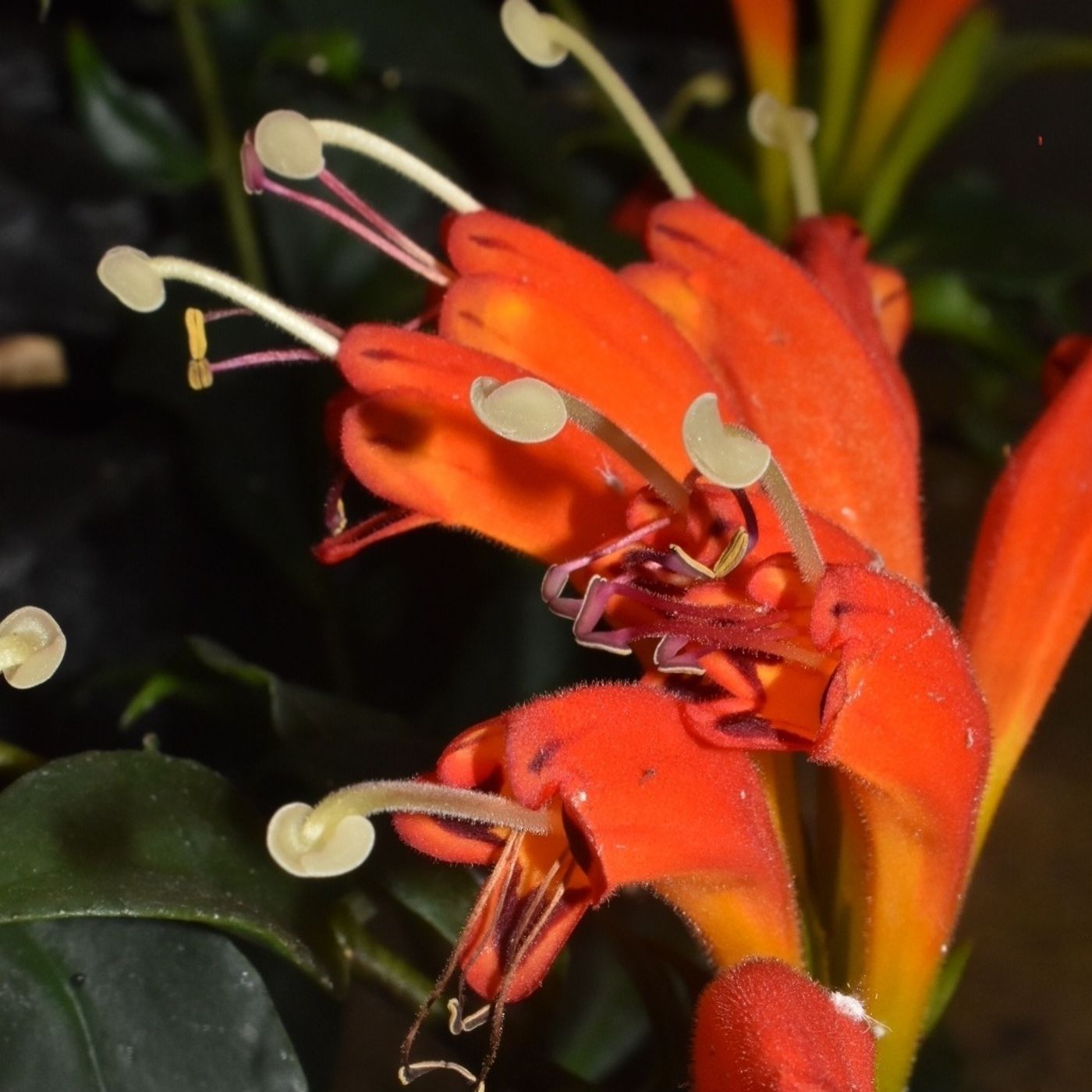
Gesneriads with Dr. John Clark
Podcast starts after a 40 minute intro...
Dr. John Clark studies the plant family Gesneriaceae (In the same Order as Salvias, Mints, and Penstemons... Lamiales).
In this podcast we talk about this brilliantly colored often epiphytic tropical plant family and some of the wild sh*t that occurs in it (like poricidal anthers, you say?)...
Dr. John Clark studies the plant family Gesneriaceae (In the same Order as Salvias, Mints, and Penstemons... Lamiales).
In this podcast we talk about this brilliantly colored often epiphytic tropical plant family and some of the wild sh*t that occurs in it (like poricidal anthers, you say?)...
2023-03-06
124 min
Transcript
Available Results
Generated results are saved to the knowledge database for reuse and search.
No generated results are available for this episode yet.
Extract Knowledge
Pick what you want extracted first. Model, scope, and chapter options appear after a template is selected.
Generated results for public episodes are saved to the knowledge database so they can be reused and searched later.
Transcript
Pays a botany a dozen podcast I'm using a fancy mic. It's uh,
what is the fucking brand? Sure, the production company got it for me
so I could do voiceovers for their little kill your Lawn show. And I
still haven't really figured out to use it, but it can just plug right
into my phone via USB. So I'm trying to fucked up. I just
have a feeling this is gonna fuck up anyway. Whatever, So I'm trying
to use it before I got to send it back. They're making me send
it back. They didn't buy it for me, Okay, they're Nickel and
Diamond us. I'm just kidding. They're really good people over there, and
they're actually in the hole for the fucking for this TV show, which I
guess is gonna get I guess the first year. It's only gonna be on
cable, which I think is a very bad business decision. And I'm someone
who makes very bad business decisions. I'm very shitty at business, and I'm
kind of proud of that. But to put it only on cable seems very
silly, because who the fuck just cable except boomers. But you know what,
I think boomers are kinds of people that need to watch a show like
Kill your Lawn, because you know, we're not just trying to preach to
the choir here, Okay, we got I'll have crime Pays videos for that.
The people that got to see this and learn why it's important to kill
your lawn and what you do once you've killed it are probably the people watching
cable. So anyway, today I have doctor John Clark on a podcast who
studies gesnari aci, which is a fucking wonderful plant family really brilliantly colored zygomorphic,
just a fancy word for bilatoing, symmetrical, really colorful zygomorphic flowers from
the Old World and New World tropics. You know, I had someone actually
give me shit once for using it. They said it was problematic, and
maybe I didn't say that, but I fucking hate you know, it was
the kind of thing I couldn't believe. I was like, really, it's
just the easy way to say, you know, east or West side of
the Atlantic. That then, I'm actually kind of made me self conscious about
saying. I was like, should I not say? Should I not say?
You know? Old World? New World? Fucking like Jesus christ Man?
All right, anyway, um, but gasnari is Old World and New
World tropics, and I don't think there's any in the subtropics. I don't
think. Do you get any good native giznarians in the United States, I
don't think so. I first became familiar with them in the Dominican Republic and
that's where that's where John has spent many of much of his time studying some
of the really cool species down there. They're epiphytic. African violets are probably
the only plant species that most people are you know, familiar with on any
sort of broad scale, because they're you know, so commonly cultivated as houseplants.
I think my ma she used to have them, you know, she
had like two or three she'd you know, slowly kill over a period of
two or three years in a kitchen window. But they were very moisture demanding.
I remembered that she keeping in the kitchen window in Chicago. And so
they've got you know, tectic usually they've got you know, bull eight texture
to the leaves. Again, very colorful flowers, lots of hairs opposite leaves
because they are in order lamy alies, which we talk about all right.
So I'm I'm I'm telling you to not just study plant families, but also
study orders, okay, and study lamy alies. And if you didn't fucking
download that free that thirty eight megabyte PDF angiosperm Bylogeny poster with all the pretty
flowers on it, you know you can get you can get it printed out
too, But I think the smallest you can print it out and have it
still be legible and not look like shit is like three three feet by four
feet, three feet by five feet. I don't know, it's it's fucking
it's you know, it's you got to print it out big. Someone printed
me one for free, which is very kind of them. Some some fan
in Butte, Montana over their Copper City Graphics. Uh, and so mine
is like five feet by seven feet, but um, go to what is
it plant gateway dot com slash poster and uh and download yourself a free thirty
eight megabyte uh uh angios front Bylogeny poster and you can quick reference what order
any plant family is in and how closely related different orders are and the you
know, the next tex taxonomic level above order, etc. So it's a
really fucking useful and helpful resource. So I said Jessein Donland. Anyway,
me and uh doctor John Clark and myself will get to the conversation, you
know, after this intro. Know how long it'll be twenty or thirty minutes
if they can wrap it up quick. But I got a couple of things
to talk about. Somebody called the cops on me for planting trees on city
property in front of their business a few weeks ago, a few days ago.
Excuse me last week? Oh fucked up. I'm trying to do too
much. And uh, you know, I was proud of myself. I
didn't tell the guy to fuck off immediately. I mean I kind of did
later, but you know, at first, I just tried talking to him
very politely and like holding it in, you know, and just being taking
kind of like the customer service approach, but not as condescending. But just
you know, this dude wasn't that smart, and I could tell it was
really about ego for him. So I was just strategically trying to make him
feel like he was in control while you know, mentally envisioning him getting hit
by a bus. I'm just kidding. I didn't really, it wasn't that
nasty, Not initially and the guy is whatever, he's fine. You know,
I'm sure he's fucking fine. He's suffering on the inside, and you
know, he's certainly not very healthy looking. He's like four hundred pounds,
very angry, and very much about ego. But anyway, we went back
and forth for a while, and I was, you know, being really
kind and just kind of be like, hey, can we please keep the
trees there? And he's like, it's my property, and I'm like,
well, I don't think that's true. It totally wasn't. It was the
city. I later confirmed with them, but he ended up snatching me out
to the city first. He called the cops. The cops didn't give a
fuck. You know, I'll talk to cops all fucking day. I don't
care. I just don't care. I'm not freaked up by cops anymore.
I went through my whole virantly anti cop base in my twenties. Now I'm
just like, you know, most cases, mostly interactions I've had with cops,
and they have every reason to be shitty with me because I look like
a criminal, or so I'm told frequently. I don't really think so.
I think like I think I look like an upstanding fuck. But you know,
John Q taxpayer over here. But I get told I look like a
criminal a lot. Maybe it's the neck tattoos. I don't know anyway,
you know, I don't, I don't. I don't normally, you know,
I don't normally get out too with them. I mean, they'll come
in hoide a little bit and I just kind of talk to them like whatever.
But they, you know, they just respond to stimuli, all right,
especially in that profession. So I just, you know, if they
can sense you're nervous, if you're hiding something or not, if you're if
you're nervous about the fact you're hiding something, say you got a bunch of
psychodelics on you or something, you just you know, just theoretically speaking,
you know what you're doing is not wrong. Don't be nervous about it,
and uh, you know, and don't be an asshole, don't like,
don't get fucking all. Uh. I am mighty with him. There are
some cops of just fucking assholes. Absolutely, Actually there's probably quite a few
of them. But either way, I'm just giving taken a lead. I'm
just giving you advice from my interactions. You know, I've been stopped many
times, and I just kind of talked him like whatever, and I'm like,
yeah, whatever, man, you know. So um, anyway,
the cop. I talked to the cop and I was, you know,
kind of talking to him. I was like, I was like, sir,
you know, this is what happened. Blah blah blah. He went
and he talked to the business owner and he came back out. He's like,
I'm gonna tell him the same thing. I told you. It's city
property. You gotta take it up with the city. And so then I
was like trying to work on the cop. You know, I just outright
lie. I was like, sir, you know, I got a lot
of friends that are cops, and you know, they tend to be pretty
good reads of people. This is a complete lie. I don't I don't
think I have any friends that are cops except the man. My friend is
a blocky who I used to work on the railroad with. He was an
ex marine, totally shouldn't be a cop, total PTSD, fun guy to
work with, but total fucking maniac. I don't hopefully he's not a cop
anymore. Anyway, you know, So I was telling on the guy.
I'm like, how do you read you know, what's your reading on this
guy? Like what's his deal? And the cop was just like, man,
I don't fucking know. I have no clue. But I could tell
the cop was fucking bored to being there. He could tell it was some
bullshit. Soh then the guy snitched me out to the city. Code enforcement
came by and uh, O, Latino, dude, totally chill. Uh.
He's like, yeah, we just can't do it. Sorry, I
gotta you know, I gotta do my job. I was like, can
you help me try to, you know, get this authorized so I can
plant trees here? I mean, because it's it's you know, the business
was just it's just a fucking bleak parking lot hasn't been sealed. It's all
you know, torn, It blows dust everywhere. It's just fucking hideous looking.
And it sucks too because the neighbors were, you know, all stoked
that I was doing it. The neighbors are living these apartments nearby, and
uh and I was just doing it in broad daylight. I'm not hiding shit.
You know. I was planting a bunch of cool leggings that do well
down here in South Texas. Havardia palins Uh. I was planting what else,
oh luke Cana pulver relenta, beautiful fucking tree, beautiful mimosoid legum.
And I was planting two mis gits too, for posterity, you know,
because they're really important trees. The mis guits down here, you know,
I always used to mis gits in the Mojave doesert where they don't get that
big because it's so fucking brutal and dry. They just tap down into the
roots, probably go down so deep. But out here in South Texas you
get these just monstrous fucking misguits, these weeping misguits, just so fucking gorgeous,
and they've got kind of black trunks and they can get two or three
feet diameter breast height, and then when they flower they smell really good.
Just just the massively important trees. You know, you could chew on the
pods, you know, I spit out the seeds kind of shoe the uh
mealy shit off. It's pretty sweet um and uh swallow that and then spit
the seeds out. So they're great trees. And then Lucana pulver alantha,
which is tepewah, that's a common name down here. You know, you
can see him if you go out to like near Brownsville actually there. There's
kind of common too in wet weather areas, especially by the Rio Grand River.
But the same thing. They grow fast as fuck. They're a mimosoid
legume. They've got this wonderful feathery foliage. They're just fucking gorgeous, man.
And so you know, then Havardia is kind of mean, it's kind
of spiny. But they grow fast too. If they're more of like a
thin you know, they don't the Havardia is top out at like twenty thirty
feet. They got little white powder poof mimosoid flowers, you know, so
it looks like a little white spirit. It's got uh, you know,
fuck, I don't know what two hundred flowers in it, only two or
three of which on every inflorescence will get pollinated and turn into a little bean
pod. All right, Same thing with Lucana, all these mimosoid leggings for
so while, because they've they've got these spherical inflorescences with a bunch of tiny
flowers with almost no petals. I don't do they have pal I don't have
to look at some of the macro shets I got. But you know,
the petals obviously are not what showy, but the stamens are long as fuck
compared to the flower. The stamens are often like three or four times the
length of the not the flower, but the calyx or um petals. I
can't remember if it's got petals or not. And at the look, some
do, some don't. But either way, the perianth parts, the frilly
shits, the you know, sepals, petals, et cetera, obviously sepals,
kalix, petals, corolla. But but you know, the stamens,
they'll sometimes they'll have, you know, more than the ten standard ten stamens
per tiny flour. You'll have a bunch. So it just ends up looking
like a big, you know, powder poof ball. But they smell great.
They're fucking covered in bees, really important plants, and they cope with
the heat, the brutal heat on here so well. So anyway, so
that guy, you know, I couldn't fucking believe it. I was like,
really, this dude's calling the cops somebody. But you know, that's
some mentality, not just down here in South Texas, but in a lot
of places, and it exemplifies a fundamental fucking disconnection from nature, you know,
and this completely warped mindset or this fucking death cult. Does that sound
kind of rhetorical and dogmatic for me to be talking like that, maybe a
little bit Take it with a grain of salt, But you know what I'm
talking about, right, the death called up, the fucking the fucking car
cult, the everything is fine cult. There's no mass extinction called the God
put everything here for us called that kind of deranged shit that's slowly killing the
planet and killing our souls as well. And so, uh, that's kind
of what kill your lawn is all against, or not even not even against,
it's just the opposite of what kill your lawn is for. So anyway,
I'm gonna not I have to go through the city. I'm gonna try
to get it, you know, officiated that I can plant trees on this
strip of city property between the sidewalk and the road. Now, I'm fucking
dedicated to it. And if I can't do it here, if this fuck
is gonna give me issues, uh, you know, the business owner he
had tits too. I'm not trying to sound derogatory you know, and obviously
I love a lot of fatties, a lot of a lot of friends who
were obest I don't give a fuck, but I'm just saying it does it
gave me context? You know, this guy who's like such an egotistical prick,
and it was just you know, and I tried to swashing his ego
and whatever and uh and it just he was just no, you know,
you did it without without my permission. It's my property. And he didn't
really have a good reason either. That was the thing. I would have
totally listened to any good reason. He just didn't want me doing it.
And uh and uh, yeah, I don't know it was or whatever,
but he did. He had tits. It was like, you know,
man, tis you ever see those? You know, he's probably there's probably
quite a few man tests in South Texas. Ken Paxton, the Attorney general
who uh, he kind of looks like he's got, you know, some
some issue with this eye. He's like a what's the gay? He's got
a bad comb over, you know, kind of like two chins jowls.
You know, Ken the Attorney General of Texas who's trying to uh block the
endangered species listing for a sleepiest prostrata. Um, you know he's probably got
man tis. I think I think you could say that. Yeah, Ken
Paxton, the attorney general with a bad comb over, who looks like he's
always sweating, you know, like he's kind of pale to you know,
it's just somebody's fucking man. Some of these Texas fucking right wing politicians are
so funny, man, They're just like such comical. Who was the guy
that was yelling at the that dude Beto, that that that left leaning gubernatorial
candidate who you know, I wish would win governorship but probably never will.
Here, there was some guy that was yelling at him like six months,
I forget what it was, but just a total you know, demon looking
sweaty, just fucking probably God, i'd love to know it's on his hard
drive. Actually, I wouldn't love to know it's on his hard drive.
Just the just the dirty fuck and they always look like they're sweating, Like
they all look like they're just like kind of pimpley and and pale and and
maybe a little red faced little pink and their sweating just such fucking like cartoon
cartoon villains. Anyway, Um, so you may have heard a sleepy as
prostrata at the prostrate milk. We got listed as endangered um and uh,
it kind of blows my mind because they're still building that fucking border wall.
And they're building that border wall. Initially I thought it was going to be
right on top of a few individuals of that plant that are located right near
the Rio Grand maybe a hundred feet up, and it's just you know,
it's a migrant route. You'll see you know, footprints there. Border patrol.
It's super hot there. We were just out there as with my friend
or nest that we were out there. Shit, I don't know, four
or five days ago, a border patrol sweated us super hard, at least
the first minute or two. And then I was just talking to him and
I was like, yeah, man, They're like, what are you doing
out here? Like what does it look like? I got a giant camera
and I'm like, like covered in plant tattoos. You think, where do
I look like I'm smuggling migrants? And and then he kind of eased up,
and I was like the thing too, when cops talk to me like
that is like I take the Allen Rockefeller approach. It's I don't just clam
up. It's like I just keep talking. I just talk so fucking much
that they want to get away from me. I'll tell them about all the
plants there. I'll tell them about all the all the cool shit I've seen.
Tell them about the geology, you know, start telling about the East
scene, maybe Oligus scene, you know, establishing a geologic timeline after the
KT extinction or whatever the fuck they're calling it now, you know, basically
the Tertiary. I start telling about the Tertiary. You know how this was
a fucking ocean front I don't know, thirty five million years ago. You
know, look at all the gravels here. See how they're rounded. You
know, you know what I'm saying. Only water could do that. You
think it was this little piddly river the Rio brand that did it. I
don't think so. I think they're a lot older. And then eventually the
cops are just they you know, they're kind of amused, and then they're
fucking annoyed by the time they're done. But you know, border patrol always
stops. You didn't watch the sniffun Yeah, I was there with my friend
Javier, like three days earlier, and uh, and I was just showing
them in a cool population of loafs of loafafra and thelocactus by color, which
has a really cool the way it germinates, it like germinates. And you
see young philocactus, which has the dumbest comminate. Well, there's a lot
of dumb dominas, but Thilocactus by color, Glory of Texas cactus, thelocactus
by color. When you see little ones, you know, when they're full
grown, they reach like rape percise. When you see little ones, they're
always half buried in the soil. So it seems like this cat, it's
fucking weird. I don't know if it germinates, I don't know. I
would love to study the germination process of philocactus because the little ones are always
half buried, so I guess maybe they're growing downwards at first, which would
be a great strategy in a fucking hot, dry environment like timo leap and
thorn scrub. And then of course there's blackbrush Acacia everywhere. I just fucking
love, you know how much I love this fucking habitat, and it's so
sad because it's gonna be gone soon. The black brush is covered in five
or six different liking species, just fucking you know, it's such a beautiful
and a wonderful place, and it is getting so thoroughly fucked into a coma
by the border wall, by suburban sprawl, by expansion, by people who
just don't give a fuck. The mentality out here too, is so weird
because I think I've mentioned this before, but they will just clear parcels of
land just to clear it and then sell it like they think it looks more
attractive, kind of like how you paint your house before you sell your house,
or some people do. If if anyone actually owns houses that listens in
this pocket, and I don't know, homeownership is so unpaintable for so many
Americans now in our failing empire. But you know, so I think that's
what they just clear the land with the bulldozer because they think it, you
know, makes it more valuable. It's just it's fucking sad, man.
The this is all in Star County, Star County, Texas with two rs
just getting fucked into a coma. The Peyote Gardens, the Star Cactus gardens,
the Tama leap and thorn scrub, home of so many plant species that
don't occur anywhere else in the United States. And just really cool geology too.
Lots of coliche out there, lots of that white cement. You know,
you'll find these cliff sides, especially parts of the Goliad formation Goalie information,
where the fuck they pronounced it, don't matter, Geolia D, which
is a geologic formation out here, and you'll just see, you know,
a road cut that's just conglomerate, basically cemented together with kalechi and who knows
how long it's been cemented like that, and all in the rocks are like
you know, those rounded rocks, they've been tumbled in a river or an
ocean. God, and those where the fuck that came from? All different
colors, all different rock types, whether out of god knows what exposure,
how many hundreds of miles away and then transported here by an ancient river or
an ocean some time in the Aaligas scene or maybe Maya scene. So anyway,
but but yeah, there was Asclepius, Prastrada was up, and phisariat,
themnopolo was up, the Zapata bladder pod, which is a little brassica.
There's so many fucking species of physarium and it's nuts and there they're a
bunch of really rare and endangered ones. It's just as a genus, it
tends to speciape pretty readily, it seems, throughout western North America. I
remember there was a really cool one me and a sheriff Woody had seen on
Gypsum Montana. You know, little blue rosettes, little blue leaf rosettes,
so many scale like tricoms, turns the leaves chalky blue. And so I
forget what species that was that I could look it up. It's not my
eye. Naturalists. If anyone wants to look, just look up Fisaria and
then in the location field put in Montana and just put in observer Joey Santur
and you'll see it. But um god, there was a fucking really cool
one in Wyoming too, where the desert yellowhead, which is one of the
coolest fucking plants in the United States. I think it's a it's a what
is it, your mozanto cephalis. It's astoracy. It's related to um,
oh my god, I'm drawing a fucking blanket arnold glossom And you can totally
see it when you look at the side of the fucking flower. And you
look at the fileries, you know, you see those fileries, those are
Arnold glossom fileries. Except this is a fucking species that diverged from all the
arnold glossoms probably fifteen million years ago, and it is now evolved in the
desert and get you know, tons of wax on its leaves to protect from
that high dried environment of Wyoming where it grows. It girls in like two
places. I had Walter Furdig, who's a botanist who did a lot of
work in Miyami, on the podcast I had him on last year, I
think, and we were talking about your Moxanto cephala, what a fucking great
plant. So anyway, but that there's like there was a surveyor steak right
near one of the prostrate milkweed plants, this one that got listed, and
I was like, what the fuck? I was so bummed. I couldn't
fucking And I talked to the landowner too, and he was like, yeah,
they're gonna, you know, because he's the one that gives us permission
to go out there and fuck around, you know, fiddly fuck around in
the bushes and get all cut up and he had said that, yeah,
they're still going through with the border wall, and he's like, I had
to sell because otherwise they were just going to eminent domain my ass. He
didn't say that, that's my paraphrase of him, because people in South Texas
don't say things like the government would eminent don'tain my ass. You know,
they just don't talk like that, but they you know, they say basically,
he was telling me that, you know, they were gonna just take
it from him if he didn't sell it. So but I think it's can't
tell if it's federal or state. Now I think it's both. But I
think, you know, Abbott is part of his political stunt. It was
definitely or some some of the republic state Republicans down here, we're making it
their priority to finish the walls. So Biden didn't do shit, of course,
as he doesn't, you know, half dead walking corpse that he is.
Um. But it was funny because when we got detained by border patrol
and they had like five or six border patrol as come out to talk to
us because they didn't know what the fuck, you know, they were looking
at us for a while, like down this dirt road and I thought it
was some sort of like some like Burder or someone else, one of the
ranch hands or some shit, and I was, what the fuck. I
just kind of ignored him, um because I couldn't see. And then anyway,
they walked up on us, and then they you know, they thought
it was a bigger deal than it was, and they ended up just wasn't
you know. They let us go after a few minutes. But I was
talking to one of the guys and I was like, yeah, man,
this fucking wall is not gonna do anything. It's the most expensive political stunt
in Texas history. And he was, you know, I'm like, it's
just basically it's just basically there to get geriatric voters excited and feel like something's
being done, like Cartel's pay off all the local politicians anywhere. They're not
gonna have any trouble. Like you maybe you'll stop like a Guatemalan mother or
like some you know, some teenagers that are coming here from on Thrust or
some shit, you know, to work in a kitchen somewhere, like maybe
you'll That's probably the most that this wall will do. And the fucking Border
patrol agent was like, man, I wish I could say you were lying,
but I'm not arguing with you. You know. He was basically just
like yeah, you know. It was like like they know it too.
They know it's a fucking but anyway, um so anyway, you know,
I just that I had a couple salty issues. It was the guy called
the cops to me for playing trees. Then when I was coming back from
New Orleans after we just finished Shoot and Kill Your Lawn, I got into
it with the fucking airport staff too. And it's not because I didn't.
This wasn't. I did not did not. This sounds bad, but I
didn't start it, all right. They were giving me shit about the dog
they were they were they hadn't wanted me to fill out some form. I
already filled out the form. They said you've got to fill it out again.
And it was supposed to be submitted forty eight hours prior. And it
was American Airlines. I never fly American airlines, all right. The worst
part of flying is always being in the airport and being around all the people.
Being in the sky is actually nice. I don't get freaked out.
I don't care about that. I get the physics of how it works.
It's just being around the people and the fucking tsa meat heads and all the
fucking more. It's just like God, if you want to make some of
the misanthropist misanthropist, make him spend more time than they need to win an
airport, make him just spend any time at an airport. So the lady
behind the counter was just being a total fucking turd and just you know,
not helpful at all, you know, And I'm like, my flight leaves
in like an hour. How do I I had to return the fucking rental
car that forever, or they've got a shuttle that takes you from the rental
car place to the airport. That took forty fucking minutes. It was just
the hell. It was total fucking hell. And so I was it became
apparent I was gonna miss my flight, and this lady was just being a
turred and you know, I just was like, this is fucked. I
basically just said, this is so fucked. You know, why are why
are you doing this? And then you know, sir, and they just
started and then we just got into it. And then I told her I
hope she gets hit by a bus too. And so you see how you
know some people go when in moments the stress, they go to fight or
flight, and I just immediately go to fight, you know what I mean.
I mean, I've probably it's just fuck. So why I was so
proud of me when that that you know, walking fucking bag of ego U
and Mantis told me he was gonna call a costume me for planting trees.
I was like, I can't you know, I didn't immediately tell him the
fuck off. I was so proud of myself. I've told so many people
to just immediately go fuck themselves, um, you know, and sometimes it's
been totally fine. Other times it's just not been very strategic, but it's
I feel like it's always been justified. Of course, not later. If
I saw the person the next day, I'd be like, hey, sorry
about that at you we just got into it. I don't know. I
don't hold grudges. Grudges are for people with big egos, and I would
like to think that I don't have a big ego. I don't fucking you
know who cares? Let it go whatever. My oh my fucking Italian grandparents
and ship were like that to them and their cousins and their fucking nine.
Bro, they'd all be talking shit to each other and having a flare up
a fight, screaming, throwing shit next week, throw a playing cars together.
They're fine, you know. So uh, but not everyone's like that.
Some people really get hurt and uh, you know. Anyway, so
yeah, that was a fucking that was a that was a nightmare. But
see, this is the behavior that prevents me from ever having a career in
academia, you know, among other things. It's just you can't. You
gotta you gotta keep it bottled a little more, you know, just treat
it bottled up and just and then let it go, let the anger dissipate
somewhere else. I just immediately hit that fucking pressure release vouts. So anyway,
um, yeah, So I was crawling through the thorn scrub yesterday with
my friend Benny too, looking for cacti. I don't know why I didn't
wear pants. I wore shorts, which was funny because now my legs looked
like a fucking three year old scrubble down them with the red sharpie. They're
just totally cut up. I didn't bleed too much, but lots of cuts.
But we saw a bunch of really good stuff. Man, it's just
really weird geology too. I've been I've been in the Thorn scrub out in
South Texas so many times, you know, probably a hundred times at least,
looking for rare plants, looking for cacti, looking for cool geologic formations.
We certainly found that yesterday, and the property we were on it is
actually gonna get you know, turned into another cancer cell, like a try.
I think it's gonna be tracked housing and something else. But god,
I would love to have the dude from that YouTube show Not Just Bikes,
that YouTube channel Not Just Bikes on because that guy says everything thing I feel
about how America builds its infrastructure and just how fucked it is. So I
don't know how fuck do I get a hold that guy, you know,
But was what was most what I found cool about where we were yesterday,
which was you know, kind of blew my mind, was the fucking geology
there was. I just saw, you know, there's it's all sedimentary rocks
here and there's a lot of soil in places, and then other places it's
really thin. There's just you know, bare limestone, a bunch of different
micro sites etc. But what blew my mind was these rock piles we got
to that looked like a bulldozer had come, and it obviously was not what
had happened, but it looked like some sort of dozer had come and just
piled up lots of these large ten or fifteen twenty pound boulders into these hills.
And on top of the hills was this plant in the rootacy heliet At
partifolia, which is a small tree. It's got kind of triffid leaves,
white stems that will have multiple shoots coming up from the base, but it
still gives about twenty feet tall, really beautiful tree, smells incredible, The
leaves smell really pungent when you crush them. They got those pellucid oil glands
that of course is it's an apomorphe aka a trait of the family Routassy.
But they were only growing on top of these hills. And then just for
me, what was weird was again these these boulders, like many of the
rocks you see here, were tumbled, they were rounded, they were almost
beautifully polished, you know, and some of them were coming out of were
some meth that together with calichi, you know, that white calcium carbonate deposit
that basically gets there via transport through groundwater. But I just couldn't figure out.
I mean, these were the largest boulders I've ever seen down here,
and so all I could. I mean, they were obviously in a river
or an ocean at some point, but just the size was what struck me.
And I realized that this was probably old ocean front, or maybe it
was like some massive ancient river or yeah, or probably this was just the
coastline twenty five million years ago. But took a couple of those rocks.
Don't don't let ever, don't ever let anybody tell you not to take rocks.
It's fine if you take rocks. So yeah, I don't know.
So we were just, you know, we were we were, I guess,
just doing a little survey. We didn't find, Surprisingly enough, we
didn't find many cact out there, which was weird. But we found we
were walking through these hellyetta forests. Oh, Benny got attacked by killer bees
and had to run away. He was wearing I'm wearing shorts and a fucking
T shirt. Benny's wearing like, you know, like a cameo hunting jacket.
That's like a thick canvas material and then you know, full like heavy
pants, like he didn't he was fine, like he didn't get whatever.
But I heard him being you know how he heard him not screaming but shouting
him me like, hey, get away. There's bees. Bees. It's
a bee killer. Bees are a very serious concern down here in South Texas.
The honey bees that just will swarm you and not let go, and
they're very aggressive. They'll come at you, you know, if you're twenty
or thirty feet away. So that was little exciting anyway. But so moving
on from South Texas though. The thing that when I was in New Orleans,
I don't know if I talked about simplocos tinctoria, which was one of
the coolest, coolest plants I saw when I was in that area, and
of course I spent a lot of time in New Orleans before, but it
never never really botanized there. So this simplocos tinctoria, it's in its own
family, which is let's see, is it's simple. Yeah, it's in
simplo simplo casey. I don't know why I was trying to add more vows
than they're simplo cooccy is not how you pronounce it, but that's what I
was going for. I always want to add vows, you know, I
think I just like vows simplo casey order eric Kyleys, which Clethra is into
and hold there's a whole bunch of weird monotypic or very small families. You
know, families are only one or two genera in them, and eric Kayleys
and the order eric Chaileys. To see, this is why it's simportant to
happen things like the angiosprut phylogeny coaster U they call it sweet leaf and the
range looking at iinat is basically southern Tennessee is the northern cent of the range,
central Arkansas, eastern Texas, and then it I guess it goes on
up into Maryland too, kind of hugs the coast a little bit. It's
common in Appalachia in North Florida too. But how many species are in the
I think there's quite a few species in the genus Let me look. Fuck.
Ian's so nice at least on the website because you can click on genus
and then it'll show you every Oh my god, there's like a hundred species.
Symplocos mesii, Symplocos Micranta, Microphila migoi, Modesta montana. Is it
Asian too? I think it's Asian as well. I think it's one of
those you know, eastern North America and Asia. Yep, yeah, it
is. Oh shit, what a disjunction for a genus. Anyway, that
was it was a fucking great plant. It seems to like it more music.
So I probably wouldn't have a chance in hell of growing it down here
in South Texas where you get the Gulf coast transitioning to desert. But you
know, if you live in Appalachia at that area, should certainly become aware
of this fucking banger and get it. It's also got its own species of
Exobasidium, that fungus that parasitizes primarily members of Eric case In, a blueberry
family, but also any plant or many plants and Eric Hayley's the order,
and so Symplocos has its own species of Exobasidium, which when it fruits,
it looks like a bright green like dayglo colored leaf or fruiting body occurring on
the leaves. It's so cool, and I guess it's doing that. Of
course, exobasidium. The strategy there evolutionarily is that you're gonna get insects to
disperse your spores for you, you know, you resemble something that makes an
insect land on it. Check it out. You know, it'll soon figure
out there's nothing they're of interest and it's not an actual flower and it's not
you know whatever, and it goes off and it just brings the sports somewhere
else. I would assume that would be the adaptive benefits. So anyway,
um, and see, do I get anything else? I think that's it
really a bit off more than I can shoot with these fucking stickers I was
mailing out. But it's you know, I use it as an opportunity to
draw the same thing ten or fifteen times over. So it's, you know,
fifteen bucks for stickers, twenty bucks. If you want me to draw
some on the envelope, then I just practice drawing a fucking jack rabbit or
Dennis Farina. I've drawn many Dennis Farinas over the last few days, all
right, because I like, you know, he's always looking like a jolly
fucking you know, a jolly a Tanian American actor. Okay, and also
Farina, you got the whole epicuticular wax, you know on plants like cacti.
Farina. You know you got a nice white, bluish farina, chalky
blue farina on you, you know, Dennis Farina, you know, the
whole play on words thing. So I was doing that, and I was
doing well WHICHI and morabilis mega strobili mega strobilius singular the female cones, and
well which which I actually have one down here in South Texas which is slowly
dying. So I think I'm gonna give it to my friend Kelsey out there
in West Texas and see, because I think it'll do better in a little
bit cooler of a climate with a little bit more erridity. But you gotta
give those things deep pots. Man, who is that dude? What was
his name? John? This fucking kid in New York. Kid, He
was like twenty four, badass, fucking grower. Though this guy grew some
of those New York cactus guys. Man, you go to like cactus store
in New York. Some of those guys, if any of them are listening,
I want them to know I respect and appreciate you. They're fucking not
only are they, you know, extremely kind cool guys. But they're they
kind of remind me of like graffiti, theird friends of mine when I was
younger. But they're like mad about cacti, and they're a lot of them
are like really good fucking growers. How do you grow such good plants?
This dude grew this well witchy like in a little like red beer cup,
you know, like a rap boyd cup. And it was one of the
healthiest, well wishest zeedlings I've ever seen. And then, of course now
I'm slowly fucking it up, but I'm gonna hopefully get it to someone who
can give it a better climate. It's just too hot and humid down here
in South Texas. Man, it's just such a specialized extreme that I live
in. But uh, you know, down here on the border. But
um, yeah, man, that's fucking got to check out Cactus Store if
you're in New York City. It's in Manhattan. It's a lower where is
it. I forget the name of the street. Is that an Orchard street?
Fuck? I don't know. But bunch of nice guys, you know,
bunch of nice guys. Shout out to Zack's sides out there in Louisiana.
Too. He's another nice guy, you know from Where is he?
Where the fuck did he? He's a baton rouge. Yeah, Jesus Christ,
I'm gonna be such a bad old man, you know when I get
there, I'm gonna have pre dementia so bad if I live that long,
So much trouble remembering names and shit sometimes now, But it's another reason to
not be smoking pot, you know, once a month for me, if
that. But yeah, Zach Sides and I went out to waffle House after
a botanizing on the north side of Lake Poncer train and I hadn't been in
a waffle house in a long time, you know. Waffle House just seems
so inviting and just warmhearted and forgiving. You know. You really got to
fuck up to get banned or thrown out from of a waffle house, you
know. But I'm sure it's happened, all right, especially with the prevalence
of alcoholism in the South, you know. Anyway, h no offense to
any alcoholics, all right. May you find the light one day, whatever
that light is, whether it's botany or a or whatever, the fuck,
just quit poisoning yourself with booze. It sucks, okay, anyway, we'll
get right to the chase. Right now, we'll get to this conversation with
doctor John Clark about the family gets near a ac of the order Lamy,
Ali's all right, family to men any bang or species which you should certainly
know about if you don't yet. So here we go. Well, I'm
gonna show you what it's like where I'm not gonna show you part second.
You know, I mean I think they're chalk. They got nice choky started
tagging each other and class come out. You know, I've seen a couple
of nice things in the room before. Get a bunch of hippies, two
child who come to che parting to get put down through night for eighties.
They're about to go bay but they're not. Okay. Here we go doctor
John Clark specializing and a family gets near you as John, Where where are
you right now? Right now? I am in New Jersey, beautiful where
I was born, Beautiful New Jersey. How far are you from Bayonne?
Uh? I don't know they've been there. Yeah. Someone told me it
had a high Italian American population and it was someone working class and I probably
like it, but I don't know that it's probably a dump but I kind
of like it dumps sometimes. But anyway, I'm married Italian. I'm married
an Italian from New Jersey. Oh Jesus Christ, I'm sorry here. No,
it's great, it's great. But here's the thing. I'm on my
way to Florida. Oh shit, Okay, so what do you do?
What are we doing in Florida? So I just took a job with the
Marie cell due to Tanic Gardens. Okay, where it is? They're in
Saraso to Florida. Okay, h And so what are you going to be
what are you going to be doing there? So primarily promoting plant by diversity,
Okay, field work, research, scholarship, outreach, education, like
all the fun stuff. No, that sounds that does sound pretty nice,
man, that sounds like a nice opportunity. I would have loved to work
in about Tanic Garden, but I have a feeling I wouldn't last. I
have trouble la thinking any kind of formal structure. You know, I'm much
It's much better for me just doing what I do now. And like we
were just finished shooting a TV show about long killing and just you know,
running my mouth and fucking filming plants and getting excited anything else. I'm I
kind of you know, I lacked the structure or I become a pr liability.
But um, anyway, oh that has never made a botanist like you.
Yeah, I don't know. Do you like hops free trains and went
all around the country? Oh yeah, yeah, I know. Yeah,
I've probably got some sort of neurological condition, but I was never formally diagnosed.
So but um, but anyway, okay, so let's talk because near
ac, because that's what I wanted to talk to you about. So it
would seem fitting since you specialize in that family, that you're going to be
working moving to a more tropical locale or subtropical localeum to study this family,
especially a family that's got so much diverse in the Antilles in the Caribbean.
And I understand you were just in the Dominican Republic, which is a which
is a country. I love, I mean, I love the whole island.
I got a friend who's been living in Haiti and she's still there despite
the uh the turmoil, but um, god, damn the whole I mean,
the diverse. I had no idea because I for some reason, like
an idiot, you know, before I really looking at the botany there.
I always thought that there. I didn't realize what was going on there,
that there was such a range of elevations that they're basically stepping stones, you
know, the Caribbean Islands are stepping stepping stones between South America and North America.
Um, I didn't realize, you know, the biodiversity that was there.
So you've done a lot of work there, right, and so I
guess let's talk about um well, first, yeah, let's let's talk about,
you know, what you were doing in the dr and then let's just
get right into the taxonomy and systematics of his family. Sure. So one
of the things that is my specialty is the floor of northern South America,
like Ecuador, Colombia, uh prew And I got involved in botany because I
was a Peacecore volunteer, okay, and so I sort of got stuck in
this incredible for us, not very far from Columbia, and everything was new
to science, new trees, new rbaseous things, epiphytes. It was just
a it was it was like every single day was a surprise. Yeah,
that sounds incredible, That sounds like a dream. And what happened was my
PhD advisor. He came down there on a botany trip. I took him
around and we maintained contact. He was really kind to me, he was
really excited about the collections, and that sort of sparked a professional relationship that
continues to this day. So that botanist was Larry Scope at the Smithsonian.
Spelled the last name, that's ka Ogg. Okay, Yeah, So he
was there and I ended up going to the Smithsonian. I worked Larry Scogue.
I worked at Patrick Haarendean at George Washington University, and then I took
a job at the University of Alabama. And at the University of Alabama,
they started a program in Cuba. So I was going to Cuba one two
times a year. Oh that sounds amazing. There's so much cool shit there.
There's serpentine. Did you see me the serpentine abitante? Yes, yes,
the serpentine was amazing. Oh my god, Oh my god. There's
so many cool endemic gas. Fuck that's was there's gas. I'm the serpentine
too. Well. Yeah. So one of the things that happened was my
advisor, Larry Scogue. He had lumped a bunch of things that were serpentine
and non serpentine. And then I went down there and I'm like, oh,
no, no, no, these are totally different. Yeah, so
divving them up, yeah, as one would. I'm a splitter as opposed
to a lumper at heart, and especially you know with serpentine, there's just
no way. I mean, serpentine basically causes speciation and plants, you know,
as does gypsum and other weird you know, soil and geology types.
Um. But god damn Cuba totally agree with that. But I just found
this one exception when I was in the DR, and that's cadscenario reticulata.
I saw it on serpentine. I saw it on limestone. I've seen it
in Haiti, I've seen it in the DR. I've seen it in Cuba.
I've seen it in Puerto Rico. They're all identical. Yeah, there
was there was no there, you know what, Oh you know what?
I saw that one. Holy shit, I saw that one. Yeah.
I saw it growing on serpentine. I got a photo right here and the
ship maybe I'll use this serpentine. Yeah, but it was growing. Well,
I was on the edge of a serpentine area. But I'm looking at
this photo and it does look like serpentine rock. It's on I naturalists like
if you go to eat, you go to explore, typing disneery ac type
and observer Joey Santur it comes up. Yeah, it was growing as a
chasmo fight out of a rock wall above a creek. I remember I was
standing like spread eagle, one leg on a boulder, the other leg on
this rock wall, with you know, just water beneath me, photographing this
thing and these beautiful little red flowers. This is a hummingbird pollinated plant,
obviously, right, I think, so yeah, with a long and I'll
look for yours right here. So this is a generalist because I saw I
remember looking it up because I thought it was this. I thought it was
might be a specialist on serpentine, and uh yeah it wasn't. I mean
I saw observations from all over the place, from non serpentine areas, et
cetera. So okay, here it is that shit not coming very good picture.
I was lucky that was the only one I saw blooming to But yeah,
god damn, the diversity in the Dominican Republic for Gaznaria was nuts man,
Just a lot of cool stuff. I saw that Columnia domingensis, which
I saw you had a photo of on your Instagram too, with that weird
ass calyx with those spikes on it. What's up with that? Okay?
So what's really neat about Columbia? There are like no Columbia in Cuba.
On Hispaniola, there are four species maybe on Hispaniola. Check it out on
Jamaica more than fifteen species. So they had they had a big diversification there
any idea why No, it's just the opposite because on all the other big
islands, diversification happened in Gasnaria, ridd Fillum, But on Jamaica, diversification
happened with Columbia. What is what is the bonny of Jamaica? Like,
there is some cool stuff. I remember there was a was it a courtress?
There was some cool malvid that I don't know. I just remember looking
up some of the plants and the dr that also occurred in Jamaica or had
congeners like the same same genus, different species in Jamaica, and it just
I remember thinking about it. I was like, it seems like it might
be a cool spot to go one day. You know, it's the one
Cribbing Island. I haven't did a lot of Caribbean islands. Yeah, but
that's the one that I really really want to visit. Yeah, it's nuts.
I mean, it's it's just cool that you know, these they're basically
stepping stones each island, just as you know, as of course islands,
you get genetic isolation, you get speciation of course too. It's a great
way to break up a population from you know, times of lower sea level
to when I might may have been a contiguous population or there was you know,
gene flow between uh what are now islands, and then of course the
sea levels rise they become islands, you start getting a speciation whatever. I
mean, it's just there's so much diversity and basically a relatively small geographic area.
Um, you know Cuba, Puerto Rico, the d a are,
uh, Jamaica, etc. Yeah, man, I don't know. And
then there's fucking Bahamas too. Is No, it's Bermuda has its own is
a bermuda with its own juniper species. We're getting a little left trick here,
But yeah, I'm not I'm familiar with some of those other areas.
I'm more familiar than ones. Scenarios are abundant. Yeah, I think Bermuda's
way out in the middle of the Okay, here's the thing was so exciting,
is haiti? Uh huh have you? There are so many things there
that have not been documented in over a century. Very little botanical research has
been done there, and there's still some forest because who was the guy doing
there was a German bonus, right, was it Eckman that was doing a
bunch of Yeah, he was doing a Swedish Oh Swedish Yeah, yeah,
yeah, he was Swedish. And what's so cool in the dr If you
go to like the Botanical Garden, or if you go to um is it
called San Jose do'cah, you see in the middle of town there's a monument
the Liberator for the Dominican Republic and right next to do art they eric no
shit, really, how cool is that? They got a bodmist in it.
Yeah that's cool man, that's it. I love that country. I
just went there. I would just went there in a whim because, uh,
my girl's sister was living there at the time, and so she was
there for like a year or two, and so I went to I just
I was like, and they were there one of the only countries letting people
in during COVID. I was like, fuck, I'm gonna go. And
then I learned they had cloud forests, And I mean, I love cloud
forest because it's you know that that it's just such a diverse place, not
too hot, not too cold, ample moisture, you know, total endemism.
It's like a sky island basically, especially a cloud forest on an island.
Um. And so yeah, I was just blown away, man,
I mean, all the lobelias, the magnolia, there's so many fucking endemics
and do Menican Republic blew my mind. But that's when I came across a
lot of these gasniriads. Um. Yeah, man, I don't know.
So so what have you? So? What were you? Uh? I
guess you were in the demand? How many times you've been the dr What
are you studying there? What are some of the main genera that you're looking
at? This is my first trip, okay, Yeah, I'm mostly focused
on Cuba. I did the trip to haiti Um and this is the first
trip I've done under the very Selby Botanical Gardens. Mighty job. Okay,
and how long were you wanting to go there? For a long time.
I met pet Peguirdo, who was a director of the Botany department and he
passed away from COVID. Oh shit, that's terrible. Class. I also
met him and he also invited me, and every year we'd exchange emails.
He's like, come down, come down. That dude tailed Orl is a
fucking wizard man, he's and he's so nice. That dude hung out with
me in the iberium for like an hour and a half on my last day
there to help me identify everything that I saw, um and make sure I
had identifications correct, et cetera. Because I made a bunch of videos and
god, the Asteracy University there's nuts too, man, Holy hell, there's
some really cool stuff I saw. I mean, there's a genus. What
which one was it? There's a genius that grows there in uh in Cuba,
it's in a couple other places. I think it's mostly Caribbean, but
it used to be. I think it's in the Gagnatia tribe um or Gacknatia
subfamily, but it's you know, it's one of those like really spiny um
zerich adapted composites like a woody shrub. It was let me see, hold
on, I can't remember. There's that. Man, here's an endemic genus.
Yeah this this yeah, oh yeah, it was an Astrophia. That
was I saw Anastrophia picard which has got these they gotta be hummingbird pollinated um
flowers. But it's just and it's got like these bright white tomenttoast abaxeal surfaces,
like these undersides that are just you know, it's totally and it was
growing out of like bare limestone, like it's a total you know, because
it was in It was a drier part of the island too, in the
Sierra de Bajaruco like area western part of the country, right near the Haitian
border, you know where it starts to dry out because you get all the
rain coming from the northeast and so god damn it. Yeah, it was
such a cool genus. But then there's an an Astrophia and Cuba two.
It's one of those, you know, it's Cuba's got a lot of like
area micro sites right, like more dry areas well. I don't know that
they got a lot of serpentine. They got a lot of everything. Yeah,
I would love it. Um. Yeah, I just haven't been there.
I haven't been there since twenty eighteen. Damn was it hard to get
in? Or how did you? How did you where'd you fly? Just
fly from the US or you have to go through Mexico. I had friends
who had to go through Mexico before. No, So here's the thing.
I used to go through my old job, and I would go down under
the AUSI sees of the University of Alabama. So I navigated all the rules
and regulations under Bush, and then I navigated the new rules and regulations under
Obama, and I even did it under Trump. And then things changed.
You know, they got like a Havana syndrome. They've pulled the embassy.
But in twenty seventeen, I brought about twelve students. Then we walked from
Guantanamo to the north coast, right through Serpentine Jesus Christ. So you were
like a couple of days hike or what was it? Yeah? Week?
Shit, God, it's amazing though. Damn. How did you say were
you collecting? Were you collecting two? Or what? Yeah? We collected?
Had you worked with three different park agencies? And it was a new
tourist route they were opening up, and I jumped on it. I was
like, oh, we've got to do this. Wait, how did you
carry the presses? Tell me you got a donkey? Did you get a
donkey? Yeah, you did get a donkey. No, did you travel
with you travel with a donkey. Here's what I do when I take students.
I have I build into my budget. I got like a thousand dollars
to go to Cospus huh. And I anticipate and plan on breakfast and dinner
being served and then everything else we bring. Yeah, and we were able
to go into Cuba about fifteen hundred towns. Uh huh. We brought in
solar panels, brought it into solar portable suitcases. How did you carry all
this shit? Oh? We had fifteen fifteen students, three teachers, so
we were able to bring stuff. Who's who's carrying the solar panels? Though,
that seems kind of like a pa. You didn't have a donkey?
Huh? So what happened was are you opposed through a donkey? At any
point? Could you get a donkey in que? Like if I went to
Cuba, could I get a donkey? Yeah? You can get one to
like you just work with the pars. Yeah, yeah, yeah, Okay,
but you guys didn't have a donkey. You were just carrying everything.
No. No, what we did is we put all our stuff on the
donkeys. Oh you did, you had the donkeys? Yeah? Okay,
cool, Sorry, I'm fixated on the donkeys. They just used to see
thoraled donkeys all the time in the in the Majave and so you know,
and they're doing they're sucking up the landscape out there. So I thought,
well, you know, maybe you could just go out there and you know,
just pirate one, you know, and befriended. But anyway, so
that so that is, that's the way to do it. So you you
basically hiked. Was there a trail or was it? Just? How that
sounds so fucking incredible. It sounds like such a because you're going, I
mean, the stuff you're seeing. Did you you probably saw a stuff that
hadn't been described yet. Huh. That's a good question. Um, unless
Eckman got it? Really, what was it? Ye? Damn? Yeah,
you describe it yet? Not yet? No? What was the habitat
Serpentine? It was a serpentine. It was not in serpentine. It was
in limestone on limestone. Still sounds pretty cool, though, what's that?
How do you spell it? B o n e o n n e t
t I b o n n e t t i A b o n two
ends two tasso here it is. It's that's Oh there we go, okay,
yeah, just one tea? Well, what the fuck is that?
That's weird? Jesus Christ, very cool, very unique in Cuba. Yeah,
two and one tea? Holy shit? Where have I heard of this
before? Yeah? Oh you know what, maybe given us tell me about
it. Mal piggy Alis is the order family bonetti ac. Yeah, given
us tell me about this. So what's up? What's up with this genus?
I mean, this is a pretty weird one. Huh. It is
so cool. It's just all over that area we walked through. M it's
like a woody shrub. What's do you remember what species it was? Cu
Bensis? It could I can't remember. I can go back and check.
God, what a weird man. That whole order maul piggy Alis is huge
one then I remember in Ecuador is niki Lata? Yeah? So you were
were you in cloud forests in Ecuador? What elevation? So mostly try to
work somewhere in the lowlands and in the cloud forest and in the lowland western
forest. Yeah, cloud try to do one trip to Ecuador and a trip
to Cuba, sort of the two areas that I was interested in. So
okay, well, really quick, let's talk before we before I forget,
let's talk about the family gets near the ac uh, you know, basically
where where it is in the angiosperm plant family tree. What's cool about it?
It's an order lamy Alies, right, which is same order as the
paintbrush family or a banksea, same order as the salvia family, you know,
the min family lamy ac namesake of the lamy Alies and these. This
whole order is characterized like ninety five percent right zygomorphic flowers, bilaterally symmetrical flowers,
uh, opposite leaves generally speaking, Um, what else am I missing?
Probably something? Huh? Well, order is the largest flowering plant family
that doesn't make it north of Mexico. Okay, you're talking about the family.
Okay, I was talking about order lamia Alies. But let's let's cover
everything. Yeah. Yeah, And within the lamilies, this group is conspicuous.
You walk into any cloud forest andian forest and you notice them because niads
are hairy generally right, That's how I've always tend to be hairy. They
tend to be primarily epiphytic, long tubular flowers, all sorts of imbarrations,
and the floral diversity is incredible. I say it. It's a taxonomist's nightmare,
an evolutionary biologists dream. The level of convergence and the diversification and all
the different types of floral types. You just got them everywhere. What about
pollinations drums, I mean a lot of hummingbird pollination. You've probably got assumed
beat pollination at the at the lower elevations. Any moth or bat pollination at
them. Yeah, you get some bat pollination. But here's the thing.
Wherever they're abundant, the floor morphology that used to be considered unique for certain
groups, we've discovered evolved independently in that group, in that geographic region.
So that's what you're talking about. Lots of convergence is there's just that you
get similar things evolving multiple times in this family. Yeah. Like, for
example, I was working on a monographic revision for my dissertation on ali plectus.
Start looking at these things, and I think anyone would have noticed this
if they were in their back yard, but I spent a lot of time
in the field. I was looking at these things in the field, and
I was photographing them, and I noticed that a lot of flowers or were
super eight. They flipped upside down, right, Yeah, like, uh,
you know, like some some members of the pea family, or you
know, orchids. A lot of orchids do that, or kids some of
the lobeliads, right right. I think it's very easy. Wasn't documented or
it wasn't well documented. And what was interesting, So by were super eight,
It's like if you have a six and you flip it upside down,
it looks like a nine, right right, right, So there super eight
flower evolved independently in the Caribbean, in the Andies, in southeastern Brazil.
And what's the adaptive benefit of that? I mean, is it just kind
of by chance or was there a reason it stuck around evolutionarily speaking, or
what? I have no idea. I tried suitting several grand proposals to look
at it, and they never got fun. Yeah, son other things,
Well, let's we'll get back to flowers. I certainly want to talk about
that, because the flowers on some of these are fucking wild. I mean,
I'm looking at my eye and at now and I've just got there's like
they're brilliantly colored, just really incredible lots of you know there a lot of
them are elongated like tubular. But let's talk about this is the family of
African violets, right and everyone you know who's got any familiarity at all with
plants probably knows African violence. I know I was beaten over the head with
them. My mom used to grow them in a window the window sill in
Chicago all the time. And so African violets have that really weird leaf texture.
What would you call that? That like, I don't know if this
you know, Eli Plectus has it too. I'm looking at one right now.
It's like this. The texture and the service of the leaf is not
like quite bull eight, but like almost bubbly, like it bubbles up a
little bit and then of course got hairs on it. Um. Yeah,
how would you describe that? I would say, Harry Harry, tomatoes,
Chebacca like Chewbacca, like Wookie fuzzy. So these are and so what is
the bull eight would normally make me think high rainfall because it tends to shed
shed water, I guess. But then the hairs make me think seasonally dry
because they were very hot at least. Yeah. Um, what's the adaptive
benefit of bull eight textures? Yeah? Like, if you look up bully
in the dictionaries is covered with rounded swellings like blisters. What is the adaptive
benefit of bull eight leaves? You got? I saw a lot of bullet
leaves and I was in New Caledonia among totally unrelated plant families. I don't
know, but if you look at where they've diversified and evolved the most,
like where you see the most disnaryads. Yeah, you're talking went forests,
western slopes of northern Ecuador. In southern Colombia, you can see like forty
species easily in a day. Jesus Christ, and things in those areas tend
to be bull eight harry and big leaves. Yeah, sosias. They can
have small leaves, especially if they're small plants, but they do tend to
be bully and extremely hairy. And what about I mean chemistry of them because
a lot of a lot of members of lamy alies, I mean, everyone
knows how how much you know? You know time and oregano and fucking salvia
and mint can can stink. And you know a lot of members of urban
a c which is also when lamy alias do that too. What's the what's
the phytochemistry of gasnari ac? Like, is it notable at all? Or
is it just kind of man or what? Well, not much about it.
But there is one called Columnia medicine elis, and it's thought that that
plant has some sort of ability to help cure a snake bites. Oh weird,
So it might have something, it might have something interesting in there.
So and where's that from? Calumnia? The Calumnia species, So Columbia is
a change group, probably most of her in Columbia and Ecuador. Um,
what else the group in general? One thing about it, Oh, they
tend to have leaves that are red tipped. Calumnia does. Yeah, so
like it's like taking a dagger and having blood at dead And I think it's
one of the reasons why there's a lot of medicinal uses. Yeah, okay,
so it might be. It might be kind of a placebo thing because
people see that and makes them think of god knows what, some sort of
you know, medical operation or something related to blood or something like that probably.
Well, it's like a doctrine of signatures. Yeah, that field of
biology that we don't do anymore. Sort of like God created the plant so
that humans could use it to cure some ailment. It was the botanist job
to figure out what that was, right right, Yeah, So if it
looks like a leaf in blood, it's gonna help with menstruation, right right
right? These yeah, yeah, okay, yeah, so but uh but
some of them, I mean, some members of Gis near Ac have really
pungent smells to the leaves. Right, They've got glandular glandular hairs, glandular
trick combs. Well, you know, they just not have a lot of
a roma, wasn't there. Maybe it's maybe I'm thinking of a different general.
But think about it. The flowers are mostly purpollented, uh, very
little sick. What about ple trantis? That's uh, that's kisnary. Isn't
it like transus? I don't know that one. Let's see, yeah,
it was it was one that we It was you know, thrown around.
It's not native to North America. I think it's mostly South America. But
uh oh that's all that's lamy Ac. Okay, Shit, Okay, pardon
me. Um, I don't know. I thought that was Gizar, I
guess because I've probably never seen it flowering, but that was one that was
just the number seeing in gardens a lot in the Bay area. So um
yeah. Anyway, all right, disregard. So okay, So, so
you you were in Dominican Republic, you were in Cuba. I guess how
did you get started in gaznari Ac? Like what what you know? What
blew your mind about this whole group? Was it going to South America and
seeing him there or what? So? I was a forester as an undergrad,
and I took dendrology. I had to learn every single tree in Vermont,
where I did my undergraduate degree. And then I went into the Peace
Corps and I got stationed in this remote forest in western Ecuador in the Magician
Dual Mountains, and it was like every tree I couldn't figure out and it
drove me crazy. And I guess from there, I started collecting plants.
I was working with a national or Barium of Ecuador. Were you into body
already at this point, like did you have an interest in plants or what?
So? I worked with an NGO, non governmental organization that used science
to promote the conservation of different forests. And that science they used was floristic
inventorians and biodiversity. And so I was working with the National or Barium of
Ecuador. I was working with the Hot Hot Tunsta Foundation, and we were
using inventory work to promote the conservation of this one area and we were able
to use the data that we generated to have that area of protecting nationally.
It became a national park. Oh nice. And so some of those plants
I collected and I was sending them to Missouri Botanical Garden, the Spithsonian New
York Botanical Garden, would I would reach out to all sorts of taxonomists and
against naryc. That included Larry Scope, okay, and he was receptive.
He was very eager to see the collections. He was very helpful to identify
our gisnari ads. And it just one thing led to another and I ended
up working with them. And so that's how you basically got got bit by
the gisari bug and then and then just started really exploring their diversity that and
they're also just beautiful. I was very attracted to the group. Yeah,
and I'm really in the photography, and at one point during my peace score
time, a photographer came down to Ecuador, taught me some skills, gave
me a camera, and then I started photographing things like crazy. Yeah,
they really are fucking nuts too. I'm looking at it. I don't even
know how you pronounced this genus asian nanthus acanthis yeah, but uh, I'm
looking at I don't know what speed. I think it's poker a scanthis poker.
It's got a purple calyx covered in hair. But it's somewhat shiny too,
so I guess it's probably the trichomust probably have you know, some sort
of uh, you know, they're amitting some sort of I guess they're just
glandular. And then they've got these bright red corollas that are shaped like little
mouths with you know, the stamens in the style poking out at the top.
There's I'm looking at escan Atha speciosa or species systemas. What is this
speciosis? So beautiful. One of my goals is I want to promote each
one of those in a different area so that the world knows that there's other
things besides organs, right right, what so escananthas. Where is Where is
Escanatha speciosis from? Is that old world or new world or what? That's
an old world? That's tropical Asia? Correct, Yeah, that's right.
There's a guy, Dave Middleton. He's at the Singapore Botanical Garden. He's
dedicated most of his career in life to work. God, this is nuts,
are they? I wonder if this one's protenderous. I'm looking at the
stamens. They look all withered, and then that that stigma is huge and
like bulbous and and you know, basically bright white, like very much still
turgid and alive. Um, just poking out of this flower. I wonder
what the hell pollinates that too. It's gotta be bird pollination of some kind
towers, so they'll they'll be staminate first. They're releasing pollen first, and
then the stamens wither and then that style and stigma come out or what.
Yeah. But the thing is we don't know. No one's done extensive studies
on that. So this is an understudied family. Why why is that?
I think every group you look at in the tropics, yeah, study Yeah,
unless it upside down flowers, anyone would have seen that, but not
many people studied the group. Yeah, yeah, it's true. Other thing,
every single group that existed as a genus twenty years ago is no longer
considered modify letting. So there's basically a whole bunch of splitting going on in
this family. Is people take a closer look at him. Splitting and convergence.
I think convergent evolution is one of the most exciting things in evolutionary biology
and body. What is it? What is it about? I mean,
I agree with you too, but let's hear your piece on it. What's
what do you find so fascinating about it? Okay, so think about this
way. I've heard a writer once say that he didn't like it when someone
would say to him, did you know a picture is worth a thousand words?
And his response was, a metaphor is worth a thousand pictures. I
think a conversion it's like a thousand metaphors. I mean, it's it is.
It's remarkable the same I mean, and I study that obviously with deserts.
That's something that's always fascinated me as you see the same thing evolving in
the same environment in completely unrelated plant families. You know, like drastically unrelated
plant families, like drastically different whether you know, classic case for deserts would
be cacti and upbs, right like they both look I mean there they look
so much alike that people that don't you know, study plants or no much
or aren't like botany, people often confuse columnar or spiny euphorbia for cacti,
you know, and in places like La where they're grown outside a lot.
You know, it's it's uh, it really just runs home the fact that
you know, the environment, which consists of and everything from geology to climate,
to pollinators to what kinds of herbivores are lurking around, et cetera,
environment is doing this election here. The environment is doing the the you know,
it's basically dictating the evolutionary trajectory of the organisms that that grow within it.
You know, oh, I totally agree. And you know what my
favorite exhibit is that got me totally excited about convergence. The Desert Museum in
Tucson, Arizona. Oh no, shit, that's yeah, that's a really
great, amazing They have that that display what you just mentioned. They have
the u forms from Africa and the cacti from the Sonoran desert and you see
that they look almost identical. Yeah, you're I'll be in the deserts of
Namibia and I'll be in the deserts of California, and you see similar traits
come out among plants. They start turning blue. They've got they're so covered
in tricombs and hairs that they've got almost as like white or blue sheen to
them. Lots of hairs, or they'll have lots of wax too. That's
another coping strategy for heat and aridity is to just develop a thick cuticle.
Um, it's it's really cool, man, I mean, and then you
just think, I mean basically I always think of evolution like a filter,
right, Like the the filter is the environment that's what's doing this selecting.
And so all these different you know, because you've got gen genetic recombination going
on, uh you know, through to sexual reproduction. You know half you
know, half a half a set of chromosomes from each parent, you know,
basically shaking up the card stack again, you know, shuffling the card
deck, and you never know what comes out different, different, basically different,
you know, genetic combinations of copies of genes, some will thrive,
some won't thrive. What determines what thrives, what survives, what dies out,
what you know, et cetera, is that filter. Everything passes through
that filter. That filter is the environment. Whether that's yeah, like I
said, presence of you know, pollinators, which will choose what what it's
reproduced the most in terms of plants, or you know, herbivore is what
gets gnawn down the quickest, or geology, you know what plants can cope
with the fucked up soil that's whether you know that's weathered out of that rock,
etc. But See, the cool thing is when you discover the convergence,
then you can start asking those interesting questions. And that's just so powerful
about phylogeny, right right, And it's just such a great exciting field and
it's such a nice time to be involved in that sort of work. Yeah,
and it's nuts too because it's DNA is the key to everything in terms
of understanding these relationships, right because before all we had was I guess,
chemical synapomorphies for a while, but you know, basically you know, shared
shared chemistry due to shared ancestry. But before that, which I think that
was like mostly like seventies that was going on. But before that it was
just morphological. It was just these looks similar, so we're gonna we're gonna
put them together. And then DNA of course turned out, yeah, a
lot of that looking similar was just due to convergent evolution. It was a
similar evolutionary response to a similar environment or just things evolving independently, you know,
and it really shed light on these things. So, yeah's it broke
up. You know, it basically made us realize, Yeah, a lot
of shit isn't monophyletic. We got to split it up. What's going on
here. There's there's been a fork in this road of this family tree.
There's been a split, you know, multiple times among different generia, like
like the genus strepped Tantus and brassa casey, which is, you know,
most of them are serpentine endemics, not all of them, but large a
large proportion of them. And it turned out that's not all the result of
one evolutionary event, which was a tolerance to serpentine. It's serpentine tolerance has
evolved like five or six times in the genus strepped Tantus, which was figured
out by looking at DNA so so you've been secreencing a lot of these gives
nary ads, I assume, and basically figuring this style realizing that, holy
shit, there's a lot of there was a lot of splitting, Like a
lot of these groups aren't a lot of these clades aren't monophyletic. It was
worked out that way, and I guess in one way, we're fortunate that's
the monophyletic groups doesn't result in a lot of lumping. It's it's been conveniently
split. Yeah, the world in the Old World, it's a totally different
game. What's different about what's different about the East side of the Atlantic Ocean,
Well, the groups mostly are monophyletic Old World versus New World. But
in the Old World you had it's extensive lumping. Yeah, so like for
example, Streptocarpus now includes Saint Paulia, So there's been a there's been a
bunch more lumping. Basically, it just worked out that way. You had
these like large sort of paraphyletic grades, these lineages that evolved and diversified to
be very unique, but they were embedded in paraphyletic groups. Yeah, so
that that just didn't really happen in the New World. Have you have you
done much I mean, have you done much work? And you know in
Asia, South Africa, etcetera. Is it mostly been neotropical or what mostly
tropical? Yeah, and it happens that the groups are monophyletic. They're in
the New World tropics and they have them being really cool places. It's one
of the exciting things about working on the group gets working cool people, gets
going cool places. So tell me beautiful, Yeah, tell me about the
So tell me more about the cube. You guys are out there for a
week. Were you just collecting everything? Where you just collecting gasniads? Did
you? Was it a pain in the askt in permits? Or was Cuba
cool with you guys? Or I mean you guys were working with the some
of the you know, the botanic institutions there. I take it it was
challenging. I'll say that here and here's the other thing. Every time they
established a professional relationship with the Cuban botanist. Yeah, it's like they left
body all the So many the good botanists abandoned Cuba. They abandoned their careers
because of so little opportunity. Yeah. What they don't fund the science is
there that as much, or they don't fund the natural sciences or what.
It's just tough because if you're working with a government agency and you're making like
thirty dollars a month, Yeah, you know what I mean, it's it's
just hard. Fuck that sucks. Yeah. But I also am incredibly impressed
with the botanists, the Cuban botanists, yeah, because they're so dedicated and
they're so passionate about them. Yeah, there's such cool stuff though, I
imagine that you know, there's some really there's got to be some really dedicated
people, because it's it just seems like such an easy floor to fall in
love with. Man, there's just so much cool. How many endemics are
in Cuba do you any idea? So I think about Jesus you compared to
like Hawaii, I think it's endemicity. Yeah, so it's high, um,
but a lot of islands are really high. Yeah. Yeah, let's
uh, let's see how many. I'm looking at your your observations on that
that you got everywhere in the oh. Yeah, I was just fucking yeah,
I was like obsessively just like, you know, did you worth a
lot on the border right here? Yeah? Because that's where all the cool
stuff. Yeah, that's where all the cool stuff was. Man, there
was there was so much cool you know, because I like the dryer areas.
That's where all the melo cactus was and a lot of the other cool
color lumnar cocti and where it really dried out. You get those two endemic
iguanas down there. That's like Clara, You got consolia. You know that
prickly pair that's like a fucking oak tree basically like the size of an oak
tree. Um. Yeah, man, I would love to go back.
I didn't get enough time to see everything. There's a bunch more stuff I
want to see in the cloud forests. Um. The higher elevation ship was
nuts. It was so cool and it's it's it's so chill too. I
mean it's just like a you know, the dr is is nice. There's
a lot of habitat Clearance still going out, which is kind of a bummer,
but you know, well what are you gonna do? I guess you
know. I felt like it's one of my favorite places to work. Yeah,
yeah, easily. People were really friendly, it was safe. Yeah,
it is really good, and the plants are just amazing. Yeah,
and the bottom. A lot of cool a lot of cool botany people there
too, A lot of people doing important work. Um, so when you
so have you how much work have you done? You? So you went
to Ecuador? Where else have you gone? Um? Doing field work in
South America? So I went to Venezuela, Olivia, Peru. When did
you go to Venezuela? Uh? It's like two five? Yeah? Shit,
man, there's kind there's so much great stuff there. Yeah. I
was a real, a real stress jout trip. Really, how come?
I just feel like every time we went somewhere we were gonna get robbed.
Oh really, shit was kind of kind of spicy down there. I imagine
it's much worse now. Holy fuck. I won't even go. Yeah,
it would be too much. Yeah, it's all those tapui habitats. Man,
it's such a shame. Well those are hard areas to get to.
Yeah, I mean yeah, you need a hell but really complicated. Yeah.
There was that Alex Hanold documentary you see that one or some dude studying
frogs and it was it really it was kind of a weird mix of interest
that they've made this documentary on. It was like a I think was a
Netflix documentary. It was like climbers and then this old guy who studied frogs
who wanted to get to the top of this tapulli, and then these climbers
were climbing it. It was kind of like whatever, But I was just
looking at looking at it for the plant footage, you know, because the
tapullies are fucking you know, they're notorious among anyone who knows anything about you
know, cool plants or South American botany or anything. So I mean each
one is like it's own island. Tons of cool bromeliads, heliamporra that weird
as you know, carnivorous genus saraciniac. Tons of cool composites. I know,
Vicky funk Rip was doing a lot of work down there with composites back
in the day. Just fucking insane members of astrac Just they look nothing like
stuff you see in North America, you know, just brilliantly colored. Probably
a lot of muticioids, you know, muticioids of family, which is you
know, predominant in South America. Um I would I would love to get
up there, but yeah, it's you know, if you want to get
to it to cooee. Yeah, good Ecuador. There's two pooys in Ecuador,
or it's just the same type of No, no, there's some amazing
two pooey's. And until the late nineteen nineties the area was there were no
roads down there. Now it's opened up. Um, yeah, I can
tell you how to go and that. I used to take students there and
we would work with David Neil and the Institute of Botany at the University of
Amazonica and we set up a plot. So we go up there with higher
members in the community. The cook build the trails, help us climb the
trees, and we did inventory, and we go to a different Cooie each
year. And so you were climbing trees because what a lot of you were
studying a lot of epiphytes. Obviously, No, so I don't climb trees
anymore, but I hire people to climb trees, and I don't let my
students do it. Yeah yeah, yeah, yeah. Someone falls and breaks
there, that guy, I imagine it'd be a hefty personal injury lawsuit against
the school. But but we would go there and we would set up a
plot, inventory all the trees, photograph anything fertile, and make specimens.
We found all kinds of cool stuff, no shit. And so where would
you store all the information? I mean you get herbarium specimens and then would
you make checklists or anything or write a flora or anything like that or what.
So everything goes on Tropicos. All the specimens get integrated into the major
museums. Tell everybody listening what tropicos is, just in case no one's familiar.
Yeah, tropicos is essentially a specimen and a name database and it links
to all sorts of plant biodiversity information. And it's based out of the Missouri
Botanical Garden tropicos dot org tropical dot org. It's such a powerful tool.
They've you know what, Mobi's got a really good phylogeny website too, like
a good plant systematics and taxonomy website. That's right, it's based on the
and from Phylogeny group. Yeah, they're great. Yeah. Mobot's got a
lot of good resources. Long, so does New York Botanic Gardens. Theay
Barium. They've got some cool shit too, Yeah they do. So.
My goal too is to have all the images that I take, I want
them to be integrated and linked to the specimens. Yeah right, Yeah,
because I think that's useful. I think when you have a specimen and you
have good images, it really helps to promote the taxonomy and understanding of the
those plants. Oh yeah, absolutely. You look at like old er barium
specimens from the sixties and seventies, some of the botanist would actually attach photographs
to the the irbarium sheet, you know, if a photograph of habitat or
so much. I think it's a great idea. I just link I link
IAT observations, like I'll take an I naturalist observation of every everything I collect
and then put the you know, observation number on the irbarium tag so people
can look at pictures. Do you use one to five backro oh, yeah,
yeah, it was. I Mean it's an expensive as lens, but
it's it's the fucking it's been the most It's more important than the camera body.
It's been like the most important learning tool I've used, probably because I
mean I'll see things that with that lens that I don't see with my naked
eye when I'm out there looking at them, you know, and then later
on I'll notice it because it gets right up in there and I'm like,
oh yeah, but it's you know, you've only got I shoot with a
small aperture like F twenty or above, but then if you go beyond like
F thirty two, you start getting the fraction and you know, it starts
to fuck up again. So that's been the only thing, is I you
know, I've I see the guy's taking photographs of like close up insects.
There's some dude name I think his name is Dora Explore with Dora or something
on Instagram, but he takes these photos of insects that are just fucking mind
boggling. It's like he gets right. You can like see all the individual
platelets in the eye, like the different you know, like a fly eye
or something. It's it's just nuts. So I mean, you know,
I always wish I could get closer, but it's hard because then when you
shrink the aperture, you gotta get a light, and so I just use
a built in light because I don't want to deal with a you know,
a speed light and external flash or a fucking ring lighting. I've tried all
that Shit's a pain in the ass. So I get a nikon with you
know, a flash, like a built in flash. But then on some
models, the flash doesn't pop up high enough, so you get a shadow
because it's shett into the lens creates a shadow. And so but I'm yeah,
I gotta I got a D seventy five hundred Nikon. Then I just
use a one oh five Macro and I just go back and forth between that
and like the stock lens that comes with it, which is kind of ship
but whatever. Hey, that's convergence. You you you got a Nikon too?
Or what I do? I use the one on five? Yeah?
What do you use for a flash? So I buy all ring flashes?
Oh shit, that's and so that you just hook them up with the wire
and it's it's fine. Then huh, because here's the thing. Yeah,
they're cheap, they're indestructible, and I found the guy in Equador who can
fix them. I'm sick. What what's what's the brand you use? Because
maybe I'll do that. No, I used to stay. I use the
Nikon one oh five and I use whatever medium format camera. No, No,
the flash, the ring the ring flash, O the ring flash,
Yeah, twenty nine s SB twenty is that? What's the brand? Is
that Nikon? Or what? Oh it is Nikon? Yeah, that's the
thing. That's the way to do it. Buy them on eBay. But
then it's a pain in the aston times because you've got to get an adapt
you gotta make sure it fits. It can be uh, I guess that's
not an issue with the one you use or what. No, it works
really well and you want to get that twenty nine s. How does it
goes down to a quarter? Yeah, you can photograph white flowers. How
does it clamp onto the ring or to the lens. There's a little thing
that screws on the apex. Okay yeah, okay, so but then you're
basically stuck without You got to use that lens basically right, no, no,
but it's the same one of five and otherwise you get that shadow like
you know what I mean, right enough, and it lasts long enough.
I mean the like the battery last long enough or what. So I started
reusing I've started using these chargeable batteries called Panasonic. Yeah yeah, and I
just use like three sets of four. I never have an issue. Yeah,
that's man, That's that's the way to do it. Yeah. Because
I was looking at your photos too, it was like, oh, they're
great, good depth of field. Oftentimes a black background, which is easy
to get if you've got a small aperture and you're using a light, you're
using a flash. So yeah, totally, And it's you know, I
like creating a database of all my which is basically what I Naturalist is for
me. I got like a cloud photo account an I Naturalists, because you
know, you never know who's gonna find those photos helpful. There have been
so many times I've been looking looking up, you know, traits of a
flower, flower morphology of you know, whatever genus, whatever family, and
there's no good photographs. They're all blurry, or they're half asked, or
they're taking out of focus because you know they were taken for they weren't taken
for like taxonomic or scientific purposes. So you know, it's it's super important
to me to get those get those photos, you know, really clear photos
of floral morphology. Here's the thing, this is the best time to be
a botanus. Why do you say that, Because we've got the cameras,
we have the digital ability to share things, and so many things are represented
by good images. Right, I'd certainly say it's the one of the most
important times to be a bonus because there's the habitat destruction is just it's you
know, it's it's really reaching the precipice here. There's just there's so much,
you know, every time you think that that this fucking death cult won't
take more, it always takes more, you know, and leaves so little
for everything else. And there's just you know, it's an extinction crisis.
It's it's uh, I don't know, man, it's disheartening. I see
that, and so I see that everywhere I go. I just see more
land being cleared for agriculture, for for tracked housing, for strip malls,
for whatever, you know, for burning whatever. So um, yeah,
I agree. And that's why I Naturalists is so powerful. Yeah, yeah,
totally look at your observations. They're amazing and it gets it's it's really
important to Tinctoria. Oh yeah, that was a I just met that one.
That was a what a fucking cool cool plant. Yeah, Eric Kiley's
man. But it's good for just getting people stoked on this too. You
know, it gets instead of you know, doing shit like smoking pot and
playing video games and not knocking it for anyone listening or fucking doing whatever.
You know, remember that Pokemon ship people were doing Awhile when they were like
walking in the walls, it was just like eight years ago or something.
You know, It's like, Okay, now you can actually go out and
study the flora around you, even if it's going to a fucking vacant lot
and looking at what invasive species are popping up there, looking at the kind
of makeshift ecology that comes up in an urban waste land or you know wherever,
or a fucking you know, railroad right of way or a power line
easement. It's that, or it could be you know, now there's a
reason to go outside and then you know, go fuck around looking, you
know, waltz through the bushes, climb up a mountain, see what's growing
out there, learn more about the world around you, you know. And
I guess it's I guess that's one of the good things is my naturalists gets
that drive out there. It gets people doing that, you know, instead
of just instead of just you know, instead of just being so disc connected.
That's what's so that's I think the disconnection is what goes hand in hand
with the habitat destruction and the extinction, and it's all part of the same
death cult. And it really is to me it's a death cult. It's
this this this really lowest common denominator, unenlightened way of looking at the world.
It's fundamentally disconnected from all these this library, this fucking wonderful you know,
art museum of living organisms, of masterpieces that have evolved or millions of
years to you know, form this this interconnected network. And so many people
are just oblivious to it. It's so sad. Man. I you know,
I'm not even throwing shade their way. I just feel bad for him.
It's like, God, damn it. You know, it's one thing
if you don't grow up with access to it, and you know you're from
an area where it's just you can't help it. But then there's it's another
thing if if you do grow up with access to it, but you just
choose to ignore it. You've never looked twice, you know. You you
like being in the car, you like being in your home, you like
just it's you know, to me, that's where I'm like, holy shit.
You know, how do you how do you turn people onto this stuff?
I guess uh, I think you can definitely do it, But it's
just, you know, it's something to think about, you know, here's
what's said. The sad fact most kids can recognize corporate logos, I know,
and I wasn't that nuts. They got no idea. I live in
a place where that is like that is a that's basically a summary of what's
going on here. You know, there's just where I live. So I
live on the border of the Mexican border of South Texas. I've been there
probably a year or two, and it's got some of the most remarkable floora
in the world, just incredible. I took a friend out, a friend
of mine and his his his buddy who's a veteran, took them out.
It was like ninety fucking degrees here already, you know, it's so hot
on here. Took him out. We were looking at wild peyote. We
were looking at all these other cool cactus species, Delo cactus. You know,
this whole plant community that grows in such an extreme environment. I mean,
and it's so fucking hot. Everything's growing in the shade of vichelly ridge
of dual of the black rushi Acacia, and a couple other legumes, which
are you know, these incredibly tough, basically really small trees that that enriched
the soil with nitrogen, albeit gradually, and then you know, provide shade
cover and can just take being blasted with that hot sun. And I was
just thinking, I'm like, I've never seen anyone else out here. I've
never seen anyone. They're building the border wall nearby. They're going to demolish
a whole bunch of this shit, despite the fact there's like two federally listed
endangered species there. You know, I just how many people live in this
area. It's it's not a small area, it's it's like a pretty densely
populated area. But it's just so many people just have no clue. They
just they don't They they'll spend their whole lives here without any idea what any
of this stuff is. You know, how these things form this living skin
of the earth. And it just kind of blows. It just blows my
mind, man, because I mean I came from it, lived in California
twenty years, which you know, say whatever you want, I loved it,
but it was it's certainly California is so fucked up now. There's just
no middle class. There's you know, it's so expensive. Whatever it's there's
a whole bunch of shit you could say, but um, but at least
out there there was a pretty active, you know, community of people from
all different backgrounds who appreciate it being outside and appreciated plants, and you know,
the native plant community in California is probably the strongest, you know,
more so than there than it is anywhere else in the country. And just
coming hint to an area where no one appreciates it, and I realize that
this is kind of it's good for me. This is where I need to
be, Like, this is where I don't I don't need to be in
a bubble where everyone is just on the same page, because it gives you
this false perception that everything's okay and it's not. You come to places where
you see how disconnected people are and how how deep that this connection runs.
You know, like, shit, we got a lot of work to do,
Like how do we get people into this stuff. How do we cultivate
a fucking respect and reverence for all these things? Because god damn, they're
so they're so cool. I mean, there's there's so many I think NAIs
does that. I think sex people it's a biodiversity definitely. In my old
job, I got two hundred people engaged in Ninaturalists every year. Kids.
Yeah, that's great kids. And they were like geting up, getting up
at five six in the morning, going out documenting floren fauna. Yeah,
that was amazing. That's great. Man. One of the students got he
documented eight hundred species in about two and a half months. What was he
doing? Plants? Birds, I mean everything? Birds? What? Everything?
Yeah, it's so great because it was it was the first time that
some of those students left their computers, went outside started documenting stuff. It's
such a great it's such a great learning tool too, because it's got a
link to the Wikipedia page distribution map, what else it's related to. It's
got taxonomy pages on there. You know. Sometimes well good amount of the
time identifications can be wrong or iffy, but whatever, the information is still
there. It's it's a really great resource, especially for getting people stoked on
plants and getting them or just stoked on on fucking nature, which nature is
really just the real world. It's I don't even don't even really like that
word in nature. It's just the actual living world. You know. What
we've made is something distinct and disparate from it, you know, and so
um but anyway, well, let's uh, I guess going back to this
family, is there? I mean, what do you there any things,
any certain genera or cool stories you'd like to tell, like you know,
things that really get you stoked when you think about them, that kind of
blow your mind about this family, like really cool pollination syndromes, really cool
ecologies, really cool habitats. Well, let me think about that. One
us things that's really neat in this crew is there is a convergence of flowers
that are radially symmetrical. It's pretty weird. Yeah, I've never heard.
And they're highly dried. Like normally you think of radial symmetries or like a
buttercup something that's pleasium warphic, right, but in against nears it's it's always
appomorphic. I think that's cool. What and what are the what what are
the genera that do that? And what what pollinates them? Like? What
what can you? Why do you surmind? Right now? Let me think
they're probably buzz pollinated. No shit, some sort of fly. So they've
got from Haiti. They have radial symmetry, do they have anthropores or what's
happening? Yeah? No shit? What's good? Did you look at the
Instagram stuff that I just posted from two days ago. Bolognia. Look at
Bolognia spinosa. Let's see it look like it's like it's mimicking a solina.
This would be a good This would be a good opportunity for you to describe
or to tell everyone you're you're an Instagram Okay, so the Instagram stuff started
this year or did last year? J tell everyone your Instagram name. It's
Fania, right, it's which is a genus of E p h I n
a e A Yeah, it's p h I n A ea. I.
Also, I grabbed the name the botanizer, so I think I want to
switch it. I just don't know how to do that. Wait, and
what was the genius you were just talking about? Was that Bologna? Oh,
Bologna two or three days ago. You can see the picture. Oh
my god. Yeah, that's a Yeah, it's a radially symmetrical flower.
That's so weird. I didn't think there were I didn't. I didn't think
there were any in this family. No, No, there's quite a few.
And and the thing about them, every time we find a new one,
it's almost like it evolved independently. M hmm, like there's this one
pea in Cuba. It's not related to the fine. Used to be a
group that included a malophillon. Now they're separate. And we just described a
new species from Haiti radiata A radiata and it's radially symmetrical. Yeah, that's
yeah, that's weird. What what what's going on with the pollination of that?
I don't know how many? How many many? The most Canarians have
four stamens, like and then sometimes a stamin it's like astigial one. Oh
wow, Yeah, that's crazy. Does the staminode serve any any function in
any of them? I don't think so. No, just kind of left
over. Okay, So anyway, all right, but going back to this
Bellonia um. So I'm looking at this this photo you posted. It looks
like it's just a single style poking out and then you got are those bracts,
those yellow bracts, those petals are what? Yeah, let's talk about
this flower morphology because this things fucking weird. Belonia spinosa. Yeah. So
one of the things that's unique about it how spines. M hmmm, that's
weird. And they grow in dry areas. I call them sort of this
clambering shrub just meters and meters just clambering all over the place, little anty
baty white flowers, small leaves, and they have these spines or large thorns
and the axles. Totally weird. Oh, I see what's go Wait?
Is this a protandrous species, this bellonia? Or is it? I'm assuming
it's protandrous, but we don't know much. Those yellow bracs that what the
fuck? Those yellow bracts are the stamens? No shit, totally cool.
That's so weird. And they open up so it looks like they also look
like closed sepals and the inside of the flower. And then they open up
and then it looks does it have five stamens or is one a staminode?
I can't tell. It looks like one might be kind of looks like one
might be kind of a dud. I love I love shit like this.
I love looking at the love. Yeah. I love looking at flowers and
trying to flower morphology and trying to figure out, you know, what the
fuck is. Mellow stones are little good that someone should study. God damn,
the spines on those wait, how long are the spines on those?
It's like two or three inches or would No, I don't think I'm that
long. It's warm. Third, they're longer than the leaves. No,
they're longer than the leaves though that when they are Christ yeah, Jesus Christ.
Though it's still weird. Oh yeah, let's got Oh yeah there you
can see the pores. You can see the anther pores. Yeah. How
many this is not a common trait in gisnari ac poresidal anthers. No,
it's not. How many other genera that you can think of having? Is
it just this one? Okay? So in the in the New World,
Alonia amlaphilona pella, which it's not the same as Fania nifia, And then
I think nappianist m hm, and I think that's it. So not not
that many, God any one other. There's a Gascenaria that does it in
Haiti. It's it's a new species. It's coming out next month. Oh
that's being described. What's the genus Gasnaria. Yeah, it's from Maka.
Oh well Gasnaria Philippies rediscovering that dr after forty nine years, So tell us
about this. This was I remember seeing your video on this too. This
was a plant that was thought to be extinct or was it in Christie I
was the to be extinct and it's it's in cultivation. I just saw it
this morning on eBay. I was looking at some stuff. But that one
Christi I that we saw in the dr it was originally described from Haiti,
from Footsie and it was collected by last It was collected by Larry Scope in
nineteen sixty nine or nineteen seventy, and that was it. The stuff that's
in cultivation was brought back from that expedition christ Yeah. And then there's one
other collection by Tom's and and that's the population we found a few weeks ago.
And it's right on the border. God, there's so much cool shit
in the dr And what's up the genus how do you pronounce it? Pilum
ritdophilum? And how many species are in that genus? In on Hispaniola?
Okay, so there are about twenty five to thirty species and these are like
large shrubs to small trees or what. Most of them are large shrubs and
on we think now on Hispaniola, well we saw five species in one day.
Yeah, we drove three k Yeah they're nuts. So but there's there's
some like ritted to film BERTONI in them. It's yendemic to the dr and
it's everywhere in the quarter and sent it all umbly. It's got to be
like ten species, So Rotto finalum how many? How does the thieves are?
Tiny anies? Right, tiny seeds inferior ovaries, alternate leaves and usually
big sort of companulate bell shaped flowers. Yeah that look like a little mouth.
Yeah, so what disposes the seeds? They just kind of drop out
or do the get like any kind of violent de histance thing going on or
what? No, I think it's just winds, no ship. And they're
tiny, Yeah, yeah, they are, They're they're super tiny. I
collect I collected some last time I was there and kind of look, how
Harry this thing is Jesus Christ. It's it's it's so they're super fuzzy,
yeah, like tom and toast. Yeah, but these they're like these little
velvety hair is kind of yeah, all right, the leaves the basis occurring
and then it's a riculut like look in your lope. So and then sometimes
they have these like pseudostipules, so clasping, kind of clasping. But but
sometimes they have it, and sometimes they don't. It's like every time you
feel like, are you figure out a character? Yeah, it doesn't work.
Yeah, yeah, totally. It's a really complicated group. And then
you've got this modeling on the inside of the Corolla tool like this red speckling.
Yeah, I have some pictures of this. How would you describe the
stigma? A lot of the A lot of the stigma I've noticed in this
these This family almost looks it's got that kind of like lobeliad look to it,
like this big oval disc. So I would say it's club shaped.
And then in some groups it's bifurcating. It's juicy. It's juicy, is
what it is. Oh shit, yeah, okay, so wait, what
were we talking about. We're talking about Bolonia and uh por sydal anthers and
uh oh, that's right anthers. Most anthers are longitudinally dehiscent, except for
Dramonia. There you have pores. So most anthers in gas a longitude,
so they just split split open down the down the long side of the of
the anther, which is pretty typical for most angiosperms. So yeah, but
the neatest one is Dramonia. And what's up with Ramonia? So the anthers
are poorestal, but they're not buzz pollinating. So what's what's happening with those
is it's like salt and pepper shakers, and you get U glossing bee that
goes into the flower and then often there are these really cool hairs with sticky,
gooey substance that gets caught on the body of the bee, and then
the pollen grains they get dumped out of the poorestle anthers and they get stuck
to the body of the U glossing bee. So tell everyone about U glassing
bees because they do a lot of orchid pollination, right, And what are
they what are they known for? What are they collecting? Primarily so most
kind of thing, most bees, I think it was Kylaway Dotson did a
lot of work on how certain bees male bees generate or are they visit flowers
to to get a neck that allows them to attractive female bees? Yeah,
they get these weird fragrance compounds. So it's like they're they're kind of like
like you know, gathering cologne or some sort of weird you know, they're
trying to perfume their ass so that they can get the you know, do
a courtship, Yeah, courtship ritual. So is that what they're going for
with this? Uh would you say dramonia? Well, no, I don't
think it's that way. It's a little different. I think the visiting the
flowers and they're just collecting nectar food and then the and the pollen grains get
caught on their bodies and that secondary. But what is dramonia? What are
the what are the flowers secreting? It's just the like a sugary nectar basically
or what pretty much that's it. Wow. Yeah, what's so neat about
it is that Tremonia was the one genus that made sense until I started working
with the groups, because everything that didn't make sense was nesting in primonia.
What do you mean it made sense? So like dramonio was a pollination syndrome,
right and then and then the things that were upside down made sense.
But the things that Warren upside down started nesting in primonia. Oh, you
mean made sense in turn up terms of being monophyletic, in terms of all
being you know, a result of shared ancestry from a single event. Yeah,
So what happened was Dramonia was a genus that made sense and everything else
is a mess. When we figured out everything else, Dramonia became the big
mess. It became the trash bag genus. Oh shit. So it turned
out a lot of stuff actually belonged in Dramonia, even though it didn't classically
look like Dramonia. That's right. Things that used to be let me see
here, alliplectus Dramonia now things that used to be No, so you had
to start lumping. You became a lumper. Well, I guess kind Yeah,
it just became an amazing group. Yeah, study it's so weird what's
happened with this I mean, that's what I'm getting from this family is it's
just what's happened evolutionarily with the guest Nerea. It's just kind of boggles the
mind. And it's really a puzzle that we'd kind of be fucked to figure
out if we didn't have DNA sequencing. Like many things. Yeah, it
all go again once again. Carrie mullis taking acid, taking LSD on Highway
one. So the lesson here is everyone should do acid once in their lives.
Okay, you don't have to agree with me, because I know you
got a record uphold. I of course they'll have no such reputation. I've
already lost it. So I can say that everyone should do acid once in
their life, even if it's a bad trip. All right, that could
be voy just get really excited about plants, or just get really excited about
plants and just start digesting. You know, the plant systematics textbook learning about
you know, DNA sequencing, fy Jenny's you know, the interconnected web of
life? You know? And uh, and basically, what's another? What
is it great? I guess in wrapping this up, what would be a
great for someone who's not in school for this would be a great text to
read to understand natural selection? To understand evolution, plant evolution specifically, how
things evolve, how really you know, uncanny things evolve, like plants mimicking
rocks or plants, uh, developing a certain relationship with the pont it.
You know, things that people who don't understand evolution will look at and be
like, oh wow, how does it know? How does the plant know
what a rock looks like? Or how does the plant know you know,
what wants to pont it? What would be a good book you could recommend
for for someone getting into this stuff? I would recommend your podcast. But
but now come on, you gotta but there's gotta be some good like the
Carl Zimmer Revolution textbooks kind of nice. All of these can be pirated on
live Jet. If someone's you know, but doesn't have this such a good
question, cash flow. You know what. Ravens Biology of Plants actually has
some really good sections on plant evolution too well. I like Raven's book.
But if you ask me which two books, if I brought two books with
me, I'd bring Walter Judd's book Plant Systematics, and I'd bring Michael Simpson's
book Plant Systematics, I think both those books are great. Yeah, both
both are pretty yeah man, I mean since it's based in California, Judd
was based in Florida, you retired. Yeah, but I took that class
I took. I took Walter Judd's Plant Systematics cours too well known and esteemed
botanists. Yeah, And I mean, you're not gonna go wrong with you
know, on this subject, with any anything. You know, two reputable
sources writing on this subject, it's so fucking fast to any man. I
like Simpson's book because it covers everything. It comes covers, you know,
covering uh, it covers how how the DNA uh understanding DNA works. It
covers you know, collecting or varying specimens. It's got like a dictionary for
plant i'd entification, terminology, ship like that. I got to check out
Judge books, but I've heard a lot of good thing about things about it.
Um So al Gentry spook. What's that? What he? What are
he? Plants of Northwestern South America? Oh? I think that book transformed
botany. Let's see this Woody Plants of what is it? Southwestern North America?
It's called it's called wood he Plants of Northwestern South America. And I
call that my bible. That that's the book I spend most of my time
with in my twenties. Wait, what do plants? Oh? It's it's
Gentry right yeah. Let me get this Al Gentry book he died. I
think he didn't make it to fifty. He's play year old. Oh yeah,
I Field Guide to the Families and Genera of what he Plants of Northwest
South America? What the fuck? Well, Columbia, Ecuador, Peru.
That book damn it change for me? Man? What's something I gotta get
this now? Starting out in body, I didn't even hear about this.
I didn't always out there amazing. So that book, the Harrison Harris Glossary,
and the Simpson book and the Judd book, like, those are the
books that I would tell me about this book. Now, tell me about
tell me about Gentry's book. Illustrations by Rodolfo Vasco. Okay, So here's
the thing. When you want to learn a family and you have no botanical
knowledge, it's almost impossible, right. That book makes everything accessible. Yeah,
you go through it, you can learn some characters. I mean,
there's some hard words in there, like like what's a wasca odor, what's
a strong partner? Did take a leave? And part of the bark comes
off? Okay, let's listen to day We're time to look casey. So
you start using that and you start thinking, like, Gentry, God,
this thing's a fucking yeah man, this I've never heard of this book before.
You just put this on my radar. Thank you for that. Holy
shit, seventy seven books. But you can probably find a cheap copy on
ebabe either way, you know what I bet it's it's probably on lib Gin
that I s too. But it first came out it was twenty five dollars
through the Chicago Press and then I think it got taken over by I don't
know, Princeton and Press or something. I just got the faint I just
got the faint whiff of like a of a fucking or burium, you know,
like old newsprint and plant material. I don't know why. Just looking
at this, I was like, Oh, this looks like a book I
would have seen in the Field Museum or bury um. You know. I
just love lurking in a barrier. They got ten of pretty good library and
book collections to They got nice shit on the walls too. The uh,
you got some nice wall decorations that they are barium nearest to you right now?
Or what? I got some nice posters. I have a map of
Cuba. I have app of the Andes in Colombia. I have some lithographs.
This sounds a lot of reps. This sounds excellent the fucking maps too.
Especially is it the with Cuba? What is it? What's the max
elevation there? You know, like eight thousand feet it's Pico Turkeno. Here's
it? So cool day in the Dominican Republic, there's three thousand, two
hundred. It's like ten thousand feet sixty five seventy eight feet in Cuba.
Okay, that's the highest mountain on the eastern seaboard. Oh yeah, that's
right, Mitchell. I never got up there. Wait wait, wait,
wait, wait say it again. What's the elevation. I think it's three
thousand, Holy man, I could I When I got up to the highlands,
I had like one day left. I barely yeah. Oh okay,
it's yeah, he could do art, pole do art. It's like ten
thousand, one hundred and seventy four. Yeah, yeah, yeah, thirty
one. I just got up to all those Dantonia doming gainsts, you know,
those that cool grass, that grassland with the with the pines above it,
like this basically like high elevation pine savannah with just fucking god man,
so much cool shit up there. And I barely right, I barely had
enough time. I don't have to look, I forget, but I barely
had enough time to to putz around there anymore. I had to go back,
but I was I just remember being you know, just blown away.
I mean just just cool bromeliads everywhere, this really cool uh rubioids, really
cool melostomes. The melostome diversity there's insane. Uh god, damn it,
man. Yeah, yeah, no, I totally do I totally I loved
it there. Everyone drives like a maniac. It's affordable, people are chill,
they got a good they got a lot of good botanists there. Uh
and like a wide they got deserts and cloud forests, which are my two
favorite habitats. So it's like, you know, it's fucking everything. Well,
John, thanks so much, man. I really appreciate you being down
to do this and hopefully exciting. Hopefully we'll bump into each o. Listen,
I'm gonna hopefully go to Florida in a month too. When are you
going to Florida? What are you moving there? Down there in two weeks?
Oh shit, Okay, are you gonna miss Jersey at all? Uh
so? Yeah? Yeah. Is your wife here's the thing. Is your
wife into it? Or is she gonna she's She's okay, So she's gonna
You're gonna be going back and forth anyway. Yeah, that's right. Yeah.
But here's the thing. I'm passionate about plants. I can Telloanical Gardens
is an excellent fit because they're also passionate about plants. I'll have to man,
I gotta check it out. Yeah, I uh, there's a lot
of good ship in Florida. Man, I was, I would. I
hadn't been to Florida since I was like five. Come visit and I will
show you around. You drink cafe you drink Cafe Boostello. I don't know
about it. No Cafe Boostello. It's uh, you know that little the
yellow cans are like the you know, the Cuban coffee. Oh, it's
fucking It'll blow your mind if you've never had it before. It's like it's
like crack, you know, it's it's yeah, it's I mean it's I
get like hard palpitations from drinking it. It's excellent though, and it's super
cheap. It's it's better than like any of the you know, high falutin
fancy lad coffee they got in these you know, these little bootique roseries popping
up all over American cities. Cafe Boostellos, the gym man. So I'm
not sure where it's from. I just know, you know, a lot
of Cuban coffee. I was when I used to live in you know,
in the South Southern neighborhood in Chicago. I was hanging out around PILs In
a bunch. They always had it in the Mexican grocery stores there. Uh
so, yeah, it's really strong. It's like a it's basically like an
espresso, so it's a yeah, good stuff man. But anyway, all
right, well cool, Hopefully hopefully I'll bump into you in the next coming
months and uh yeah we can hang out and shoot the ship and talk playing
some person. Absolutely. I've got a lot of work to do in Florida,
a lot of work to doing Florida, so a bunch of good stuff
I want to see. All right, brother, good talking you, Thanks
again, good talking to you too, Joey. Take care, take care
by yep, bye bye.
Chapters
No chapters available.