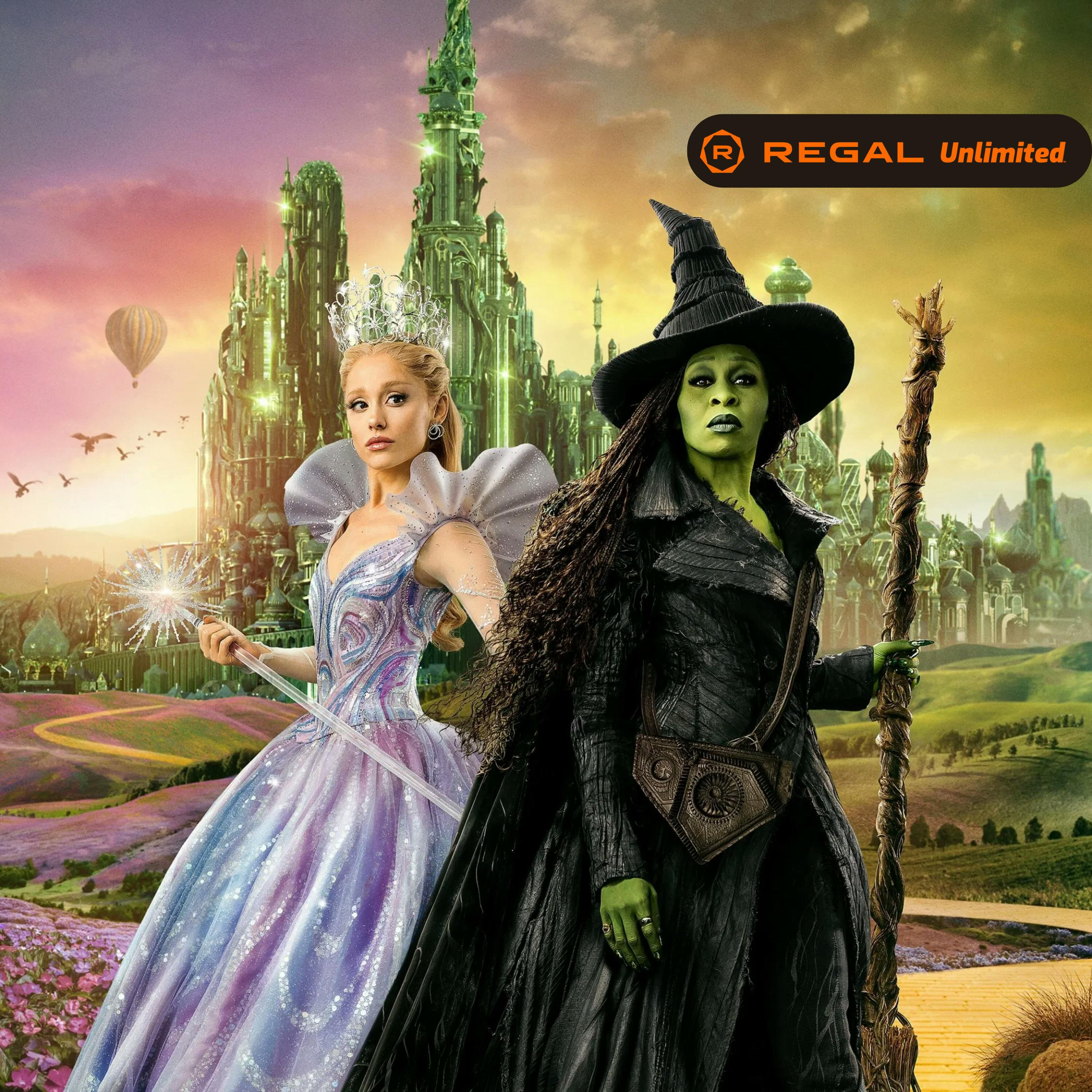
Wicked For Good Review, Train Dreams, Golden Brick Long List
Josh (a fan of last year’s "Wicked") and Adam (not a fan) review the sequel and try to get to the bottom of why it fails where the stage musical (mostly) succeeds. Plus, raves for Clint Bentley’s TRAIN DREAMS, and the Golden Brick longlist.
This episode is presented by Regal Unlimited, the all-you-can-watch movie subscription pass that pays for itself in just two visits.
(Timecodes and chapter starts may not be precise with ads.)
Intro (00:00:00-00:02:25)
Wicked: For Good (00:02:26-00:43:23)
Filmspotting Family (00:43:24-00:48:08)
Train Dreams (00:48:09-01:19:08)
Golden Brick Longlist (01:19:09-01:41:16)
Next Week / Notes (01:41:17-01:46:33)
Polls (01:46:34-02:00:55)
Credits / New Releases (02:00:56-02:04:01)
Links:
-Filmspotting Golden Bricks
https://www.filmspotting.net/bricks
-Poll: '25 Scene Stealers
-Fear Not! (50% Off + Free Shipping; code CONFSHIP, select Media Mail)
https://wipfandstock.com/9781666738520/fear-not/
-London Meetup w/Josh on Dec. 11
https://forms.gle/rUcgUKicTddzwFBs5
Feedback:
-Email us at feedback@filmspotting.net.
-Ask Us Anything and we might answer your question in bonus content.
Support:
-Join the Filmspotting Family for bonus episodes and archive access.
http://filmspottingfamily.com
-T-shirts and more available at the Filmspotting Shop.
https://www.filmspotting.net/shop
Follow:
https://www.instagram.com/filmspotting
https://letterboxd.com/filmspotting
https://facebook.com/filmspotting
https://twitter.com/filmspotting
https://letterboxd.com/larsenonfilm
https://www.instagram.com/larsenonfilm
https://bsky.app/profile/larsenonfilm.bsky.social
Learn more about your ad choices. Visit megaphone.fm/adchoices
See omnystudio.com/listener for privacy information.
Available Results
Generated results are saved to the knowledge database for reuse and search.
Extract Knowledge
Pick what you want extracted first. Model, scope, and chapter options appear after a template is selected.
Transcript
00:00:00
Speaker 1: Film Spotting is presented by Regal Unlimited, the all you can watch movie subscription pass that pays for itself in just two visits. Sign up now in the Regal app. We're at the link in the show description and use code film Spot twenty five. That's film Spot twenty five to receive your discount. What kind of a show you guys putting on here today?

00:00:22
Speaker 2: You're not interested in Armed now? No, Look, we're going to do this thing. We're going to have a conversation from Chicago. This is Film Spotting celebrating our twentieth year.

00:00:33
Speaker 1: I'm Josh Larson and I'm Adam Kempinar.

00:00:35
Speaker 2: Alphaba and Glinda are back for one more flight in Wicked for Good. We've got a.

00:00:40
Speaker 1: Review plus Train Dreams with Joel Edgerton and Felicity Jones, and we'll assemble the candidates for our annual Golden Brick Award. That more ahead on film Spotting. Welcome to Film Spotting. Quick question for you, Josh, if a great film gets released exclusively on Netflix but nobody sees it, does it really exist?

00:01:07
Speaker 2: See where you're going there? I'd like it. You're referencing Train Dreams about a longer trees falling forests. Okay, very impressive.

00:01:15
Speaker 1: Thank you in fairness to Train Dreams, and I suppose Netflix it has been in the top five. When I clicked on it this weekend to rewatch it, it was number four, So it seems that Netflix subscribers anyway are watching Train Dreams. We'll talk about just how great or good Train Dreams is later in the show. You can find the film, which stars Joel Edgerton as a logger in the early twentieth century Pacific Northwest, on Netflix. Also on the show, the film spotting Golden Brick Award long list. The brick goes to our favorite film from a new or emerging filmmaker, and we do have quite a long list. We're going to let our listeners know, Josh, all of the titles that are currently up for consideration.

00:01:56
Speaker 2: Good to have a long list, and a few of these might be familiar, especially our listeners who keep up with smaller films like this, But there may be a title on here that are completely new, haven't heard of it all, and at this point we at least think they're worth checking out, So yeah, eager to run through those titles.

00:02:13
Speaker 1: We will also have poll results listeners pick their favorite actor director duo of the twenty first century. So far that sounds momentous, and a new poll asking you to choose your twenty twenty five scenes. Deealer, this will be a fun one. A quick reminder of film Spotting is now available as a video podcast. Yes, watch, subscribe, do whatever you're supposed to do. Share. If you're a Spotify listener, you can toggle between audio and video. You can watch the show on YouTube. For a link to all of our episodes and the video link, go to filmspotting dot net slash episodes.

00:02:48
Speaker 2: It's time to talk Wicked for Good, Adam, and I think we're going to have to rely on a bit of Sam van Holgren advice for this one. Sam our producer, has in couraged us over the years. From time to time, you know, when we're up against a movie that neither of us just didn't really work for either of us, Sam has suggested, Hey, at least say one nice thing about it now. I saw your star rating on letterboxed, Adam for Wicked for Good, and it was bad. Still, I had hoped that I could possibly be the Glinda to your Alphaba. I don't know, yes, if that actually works out, as we'll get to, I'm a little confused about those sorts of things. I knew. You also weren't a big fan of the first installment of director John M. Chew's adaptation of the Broadway musical, but I was largely due to the lead performances of Cynthia Rivos, Alphaba, and Ariana Grande as Glinda, the reimagined characters from The Wizard of Oz. So although I've seen the musical and know that there's a dark dip in its second half, I still held out hope that those stars could carry the day in Wicked for good. But oh no, no, no, no no, they decidedly did not, And we can talk about how much fault of theirs that actually is. And so, yes, we find ourselves in a situation where it might serve us well to at least start by following Sam's advice, not only for the sake of conversation, but you know, to honor the incredible effort that undoubtedly went into a production of this scale from all sorts of artists, and also to acknowledge those audiences who will connect with the movie. I've seen some praiseworthy star ratings go by in my letterboxed feed as well. So did anything in Wicked for good? Connect with you? Say something nice, Adam, then you can say anything at all.

00:04:50
Speaker 1: Yeah, this does go back to the very early days of the show Cinecast. Sam suggested that even if the two of us hated a movie, the closing question to the setup, like the one you just did, Josh, should always be tell me something you liked about the movie? What did you like about the film. And it's so funny because when I was putting together my thoughts on the film, I was preparing for this conversation. I thought, this is a classic Sam scenario. I don't know if Josh's setup will sync with me or not, but I've got a bunch of positive thoughts before getting to the negative. And it turns out, Yeah, it turns out that I'm in sync with Sam as well, because I did after you know, I was collecting those thoughts and I was putting them on paper. I read Sam's Letterbox review and I think I can't remember. He may have given it two and a half stars, or actually maybe it was two stars, which is also what I gave it on letterbox. And I do want to quote our producer Sam Here he said, I actually found the watching of it a more pleasant experience than the first installment. It could also be that the sequel has less world building, not a strength of the first Goodbye Forever Shi's You, and instead is more reliant on intimate scenes with an emphasis on performance and singing. So I guess what I'm saying is that there is just less that I didn't like. That's Josh exactly where I was with Wicked for Good. I too found the world building of part one tedious and was drawn more to the more intimate conflicts that this part seemed to be constructed on. The propaganda thread and the movies real world political relevance elements that began in part one were striking to me, seeing the Wizard and his administration as an allegory for fascism and to get explicit about it, And there are several examples we could point to. Just look at the wonderful number. I'm gonna give you some lyrics here. Take it from a wise old Carnie. Once folks buy into your blarney, it becomes the thing though most hold on to once they swallowed sham and hokum. Facts and life won't unchoke them. They'll go on believing what they want to show them exactly what's the score, they'll just believe it even more. We're seeing that play out on a pretty massive scale right now, and have over the past few years. And there's a line. Here's where I'll get very explicit. There's a line we've all heard anti trumpers say about Maga over the last decade, a variation on he could go out on to Madison Avenue right now and shoot someone in broad daylight and it wouldn't change how his followers feel about him. Jeff Goldbloom as the Wizard, has a line in the movie during that number, right before it or right after it, where he says essentially the same exact thing. It's a nice reminder, though, because this is nothing new. This song wasn't written for this movie. It wasn't written for this time and our place. We've always had and always will have con men trying to take advantage of the disadvantage. Wonderful was my favorite number in For Good, and I'm a little skeptical that for Good is if if for Good is working the way it should, maybe Wonderful shouldn't be the best number, but so be it it.

00:08:07
Speaker 2: It was.

00:08:08
Speaker 1: It was my favorite. And all of this is to say I kept I kept waiting for this to go off the rails. I didn't read it, but I saw Justin Chang's New Yorker review headline, Wicked for Good is very, very bad. I thought, maybe Chang, who's a great critic, Maybe Chang just got this one wildly wrong. No, I just had to wait for it for good. Beginning in that's it, and maybe even a little longer than that. Josh for Good begins as a welcome improvement on part one until a house size twist and a forced march to sync with the wonderful Wizard of Oz send the story spiraling into chaos. We could dig into that, we probably will dig into that more, but I think you know where I'm going. For me, there is a point where this film goes from pretty enjoyable to near disaster. I really was actively engaged in a battle with this film from this point on. And it is when it is when that house, that house falls and we all of a sudden start having to see the alignment with the Wizard of Oz, that that's where it really started for me. I'm curious for you because it sounds like you didn't like the movie from your intro. I'm curious if it started well before that for you.

00:09:38
Speaker 2: Yeah, well before that, But you are marking the disastrous point. And there's a line of dialogue that handily does it for us. This is during the love scene that you know, got quite a lot of giggles in the theater where our showing was. And Alphaba turns to her partner, let's just say and says, this isn't going to make sense, but there's a house and it's flying through the sky. Now, all we've seen previously is exactly what you described, a house flying through the sky. She sits up in bed and has this epiphany and says that, and I can't think of another movie that introduced its own disaster so explicitly. So now I need to back up and remember what I propose that we start with. And I think I'm in alignment with you. It is the political allegory we've been slowly collecting over this disastrous year in America of twenty twenty five, These movies that are speaking to this moment, And I think you make a very good point. This is based on a musical that's been around for a while, based on a book that's been around since what ninety five, so obviously not speaking to the moment the way something like you know, Paul Thomas Anderson's One Battle after Another is even though that was also conceived, you know, before the immediacy of our current moment, but I do put it in that basket. I put it in that intriguing basket of giving us a way to think about what is happening to us, a filter, another perspective, another lens, and every one of those that we get right now, I think is important because different audiences are going to be experiencing these different movies, and it may be on some level some sort of wake up call. Now that being said, this is in the corner of that basket of a political awakening basket that I would also put The Running Man, which we talked about recently in terms of its convictions, its intention, it's and really it's it's potential for change. You know, One Battle after Another for me is way on the other area of that basket, but still it's there in Wicked for Good, and it's there in some interesting ways. Madam Marble's saying, just let them assume to Glinda early on when Glenda objects that I don't have any magical powers. People won't believe this, and you know, so that's sort of the lie of omission. That we are deep in an era of lies of commission. I mean, they're in front of us every day, but we forget that part of this disaster, this political disaster too, is also lies of a mission, people not stepping forward with the truth. So I thought that was a nice little touch, or even fierro. This is more along the lines of what you were pointing out very early in a scene of And this will tie into one of my objections potential conflict, as he is now an OZ soldier, head of the Guard, charged essentially with chasing down Alphaba, and he's watching the propaganda at play and says something like they're so empty headed about the people, they'll believe anything, right, and Alphaba later, I think Oz later says something they'll go on believing what they want to. So this is a recurring theme that's I think is interesting, topical, pertinent, and handled quite well for me. The one other thing I'll add to that a touching moment and was Arrivo singing no place like home. This is Alphaba lamenting that you know she loved Oz and what's happening to it? I think that has resonance in twenty twenty five, especially for American citizens of color. Right, she sings, why why do I love this place? It's never loved me? Okay? That, you know, a very heartrending sentiment, well delivered by Rivo, and it falls into the same category I think of, at least a political awareness that's topical. Now, does that all mostly get abandoned for the final third, Yes, until it's kind of like yanked in half heartedly at some point, And I think that's part of the movies failing. But let me go back at him before we talk about the Wizard of ad Oz connections that are forced on this and for me, it's that scene where Fierro does talk about how the people are so gullible. Again, he at this point is supposed to be in charge of chasing down Alphaba. He's also just been told by Glinda, and this is very early on not spoiling anything, that they're going to get married. And Glinda is not sure about any of this. She's not sure about how she feels in about Alphaba. None of this is communicated coherently in terms of the internal logic of any of these characters. And that is why I could not even connect with the emotions that it sounds like you and Sam did, because in part one the internal logic was mostly there. They were meeting each other, they were growing as friends. There were conflicts that drew them apart, and it exploded at the end into this larger conflict that at least I could all trace logically. But this is part of I think, and I want to. I don't know how much familiarity you have with the book. Maybe we'll have to open this up to listeners. I think it's a fatal flaw in this entire Wicked project. That is, it had this idea, what if you know, the Wicked Witch of the West was not so bad? Right? It had this idea and then just is trying to forcibly retrofit every element not only of the Wizard of Oz but of its own story to fit that. And the rubber meets the road for me very early in this movie, when you don't understand it's not that it's not that Glenda can't be conflicted, you don't understand how she's conflicted. What is conflicting her. She changes her conflicts on a seen by scene basis, and the same happens for Fierro, the same happens for the Wizard, it happens for everyone. You know what, give Madame Morrible credit. She I knew where she was this whole movie, and she was probably the only one.

00:15:56
Speaker 1: Yeah, that's a very good point, and were completely on the lack of coherent being the biggest issue. Probably the best way to sum up what's wrong with this movie, the lack of internal logic and all of that preventing me as a viewer from then ultimately connecting with the emotions and then really being invested in what I should be invested in, which is, by the end, this tension and this resolution of sorts in the relationship between Glinda and Alphaba. That's what this story fundamentally is about. And I should feel something, and I understand that some viewers surely do. I didn't feel anything, and it's because of all the obstacles, not the plot obstacles, but all of the incoherence that ultimately kept me from caring. Josh. Though that all said, I want to challenge a little bit what you're saying in terms of maybe the project itself or the erment itself. But I also want to acknowledge that I am basing this on like I have. I have no background, really, and I'm not saying you do either. But I don't know the lore of Wicked. I've only just now, very recently picked up on the fact that apparently this is a known thing, that part two isn't as good as Part one.

00:17:20
Speaker 2: And it's a fault of the stage musical for sure. I mean, yes, okay, so that's I've experienced that.

00:17:26
Speaker 1: I didn't really know that, and I've only seen this once. And I looked up the date I found the pictures on my phone from taking Sophie and one of her friends and that friend's mom. I found them today, January twenty first, twenty eighteen, So it's been seven years. I didn't really know anything about it going in except the basic premise of it. And first I want to say that, just in terms of the experiment of this entire film, I should go back and say the experiment of this entire musical. If you think about all of the different characters, it's introducing all of the different narrative threads and the relationships and the dramas. For those to be resolved in any kind of satisfying way is hard in and of its self right, So for those to be coherent on their own is tough. Then when you add in this element of we agree here, trying to force it into alignment with the Wizard of Oz, that's when I think you really get into trouble. But when I watched it, when I watched it in the theater for the first time, the reason why I did think it was great, besides the music, the reason why I remember being wowed by it in essence, it's because Josh they made it a successful prequel to The Wizard of Oz, meaning they created this entire new universe, exploring these new ideas with characters who felt brand new. I know, obviously some of them are based on or they become the characters that are familiar, but they felt brand new. Yet somehow, by the end, I saw how it started to take the shape of that beloved story that I recognized at the start of the musical. It seemed unthinkable to me that they could link up, but they did it. They did it, though just enough, without making the link feel like the link was the point of the musical. And I had to refresh my memory on this. But when I looked up the plot and was just reading through a plot synopsis of Wicked the Musical, my sense was it didn't strain so hard like the movie does to make things fit. It gave us just enough connection for us to put the rest of the puzzle pieces together in our imagination and that was enough the movie. And it turns out this is true based on what I read the movie. For some reason, Josh, I'm not sure why, because I feel like the target audience for this movie wouldn't really even care. The movie tries so hard to show us how the finished puzzle looks, and all it does is unnecessarily complicate the narrative, lower the stakes, lessen the emotional impact of moments that should be really powerful. And then the irony, the irony of it is, the great irony of it is, and we won't I won't spoil it here. But after all that straining to make it match up perfectly, all these details, there's one glaring omission from it, like they make one of the pieces not fit at all into the puzzle, and by the end you're scratching your head wondering, Okay, I understand why why they had to leave that one out, because they needed it to fit into another part of the puzzle. But how are you going to make all those other ones fit and then do something different with that one? The whole thing, that whole part of this film, It made no sense to me. And by the end I remember, I do remember Josh being in the theater and having those moments again, those linking moments, and feeling like this is a wonder I can't believe they pulled this off. But again it was because my mind was doing a lot of the work for me and for the musical, and the movie doesn't allow for any of that. Room.

00:21:37
Speaker 2: Yeah, that's my memory. Is similar of having seen and it was further back than you did, but feeling like it was more of a tact on or towards the end, like oh yeah, this is where the story goes. It stood as its own independent thing. And again this is why to be curious here from listeners who've read the book where it falls on that scale. I think, if there is a scale, perhaps the book handles it. I'm just guessing maybe the book handles it most delicately. The musical gets a little more explicit and now this movie has, to your point, for some inexplicable reason, chosen to push that lever even harder. But I will say the entire you know it also exposed for me what I think, even in the musical is a muddied concept of we're going to switch the witch and make her good? How what does that mean? What is the what are the the impetus, the motivations for that, How does Glinda react to it? I even think that's muddled from my memory and the musical, what you know, what does it mean to be good? These are constantly changing, immutable ideas that are never clarified. And I don't think the musical did that either. And and I'm not saying like this was a doom project, like you shouldn't try to do this. I am the Angelie Joelee, fractured fairy tale revisionist, fairytale mollficent. I am a huge fan of what it did with the Cinderella and it was exactly this. It was to explore the villain from a different angle and suggest what sort of backstory might have led to the actions we know from the fairy tale. And my goodness, that is compared to something like this so well thought out in terms of making Maleficent a victim of extreme trauma that would not justify but explain the action she took in what we know as Cinderella. Nothing that thought out has been put into place, you know, really from my memory of the musical in terms of character motivation, inner logic, and these are the sort of things that to me just became flagrantly exposed in Wicked for Good. If they were there in the first film, maybe, but that was such a joyous, more entertaining. The songs were good. The production numbers they weren't perfect. I know people have their critiques of the production numbers, but I thought they were pretty darn good for the most part, and made that in entertainment, maybe that allowed me to overlook it, but here it's just it was just glaring to me. Can we we should talk a little bit more about the songs, because it sounds like you took some pleasure in them. My goodness, I was sitting there for a couple of times, and I think this didn't bother me with the stage musical because it's all one night, right, So even if you're sitting through three kind of glum numbers in a row. You've at least got the other numbers from prior to intermission dancing in the back of your head here, it's been a year since, you know, I listened to any good songs from Wicked, and we get don't. I don't recall the names of them. There from three different characters, incredibly slow dirges in a row, and I am sorry the one near the end. I got to look up the name of it it is. It is Alphabu's so it's a revo. And if she can't pull this off, no one's going to be able to pull it off.

00:25:06
Speaker 1: But no good deed? Is it a good deed or big night?

00:25:10
Speaker 2: You're you are by far the more musician than I am. Is that technically a song? Does that? Can you count that as a song?

00:25:19
Speaker 1: It's I think it's one that was added for the movie too, Josh and it I'm with you. I didn't enjoy it. I also didn't enjoy it because I don't think it. I don't think in terms of the coherence that we're talking about and the emotional resonance that it needed. It it doesn't work in terms of the story, so that that it doesn't work musically and it doesn't work narratively, and that's that's a problem. And you're right, if Arivo can't pull it off, then then what are we talking about? That goes back to my earlier point when Jeff Goldbloom and I love Jeff Goldboom. So this isn't a backhanded compliment. But when the Wizard has the best number, has the show stopped in a Wicked movie? I think, I think there may be something off with your film.

00:26:06
Speaker 2: And I will dance number.

00:26:08
Speaker 1: That's the dance number and the song I think are the best in the movie.

00:26:12
Speaker 2: Okay, Can we talk about the coherence there though, because this is a confrontation moment between Alphaba and the Wizard. Glinda is there, and the number of transitions from what one character believes in states has come to be there for feels about each other. It's dizzying how many changes there are and what we're supposed to be thinking of those three characters in that one scene.

00:26:45
Speaker 1: I agree, I agree, But here's where it kind of worked for me, and it actually goes back to something you were saying in terms of in terms of the conception of this story in Alphaba and sort of why and I'll answer why by saying, here's here's how if they pulled it off, it could be interesting. And I don't know if I ever thought about this at all, Josh, when I was watching it in the theater, but watching it in the movie theater, and it started with that scene and realizing what I thought was going on in that scene is you have to recognize that essentially, and of course all of these these stories, these journeys, these myths, they they they pick up on each other, they they follow a lot of the same ideas. That scene you have to recognize that that defectively. Glinda's sort of a very cheerful Darth Vader character, and the Wizard the Wizard is the Emperor, and Alphaba is Luke Skywalker and they are true they I mean, there are lines that that truly directly overlap with Star Wars where they are saying, imagine what we could do together we if we if we could harness your power and my power and my abilities to sell the people, Imagine all the good we could do if if we just combined forces, is what is what he says. And they're trying to sell her on coming over to the dark Side, and they almost they almost pull it off. And so if you see, if you see the the experiment here of the movie being what if the Wicked Witch of the West, what if the whole idea was that that they they actually successfully got Luke Skywalker to convert to the dark side, which we see effectively in the prequels of that film. Right, That's that's there, That's Wicked's version of that what if what if we saw that? Would that be in some way compelling as opposed to this thought of of someone just being born wicked? I could be I could maybe be interested in seeing that. I was interested in seeing it in the in the theater, Josh in the musical theater. And then I'll just say this at the end, what I guess I found, at least in theory compelling, was somehow watching this, this version, this fanciful version of Star Wars collide with what is effectively the Man who Shot Liberty Balance, because this becomes a movie then about myths, and it becomes a movie about printing the legend instead of the truth. And on that level, the concept works, the execution of this film doesn't work at all.

00:29:41
Speaker 2: That's it in your in your analogy, that all well, and good for that moment. The next scene, one of them is R two D two, one of them is Yoda, and one of them is a sand person. So h I don't know what's going on anymore, right, Yeah?

00:29:54
Speaker 1: No, I agree, I agree completely. And and that's where you know someone listening to the you know, I hope. I feel like if if I say this, what's the gentleman's name who wrote the music? Is Stephen Schwartz behind Wicked. That's right, I feel like he's he may jump out here like Marshall mccluan and Annie Hall and say, I heard what you said. You know nothing of my work. No one really needs to hear me explain why musicals work. But I was really thinking about this, and this is the backstory behind what I wrote on letterbox. My little quip was just, hey, maybe some maybe some musicals don't need to be movies, or maybe some musicals can't be movies. And this goes back to the point I made Josh about all of the stories, all of the characters. Somehow here again, I can only speak to the experience I had seven years ago in a theater and thinking it worked, and they pulled that off with an intermission in under three hours, and here we have two films with a combined run time right of approaching five hours. Yeah, and it's an incoherent mess by the end of it. So why is it? Why does it work as a musical? And the best I can come up with, I wonder, I wonder how you feel about this theory is in the musical. What the magic is is that the way character development can happen, the way these narrative arcs can develop, is they happen over songs. They happen over acts, but they can also happen over a song itself. Tremendous development can happen over a three minute or four minute song if the music and lyrics are that good, the performance is that good, and we're invested up to that point, we can see a transformation over the course of a song. And when that curtain drops and they emerge again, we as the viewer have done any work that we need to do that needs to be done here again, our imagination fills in the space and so that song like no Good you're talking about, how this movie just ping pongs between motivations and their feelings. That's how I felt watching it. But in the theater. When I take that back, No good Deed someone probably already writing in No good Deed is a song that's in the musical. There were songs that were added. One of them is the Girl in the Bubble. It's the Ariana Grande song, It's the Glinda tune. No good Deed is definitely in the musical. When Alphabe sings no good Deed in the musical, we understand that because we understand what's just happened to another character in the film, that another character in the musical that she has significant feelings for. And so when she says, will I attempt to do good again? Ever again? No good deed? Will I do again? It carries real weight. We don't question her conviction Josh for a second, and that tension then sets up the final song and her clash with Glinda and that song for good. It all works on the screen, though, I think without that space, without that space for the audience's imagination to do its work, and when you have that story as expansive as this one, trying to put all of that together so potently, I think the filmmakers the only way they can even come close to give us the foundation that we need is by adding and adding and adding, they try to fill in the blanks with more character and more plot, and in the process it just it takes something that is designed to work exactly as it does on the stage, and it only can on the stage, and it corrupts it. I think it corrupts something that the form it only works where it was made to work.

00:33:50
Speaker 2: Yeah, it's an incredible test case that probably should be studied and alongside each other. Again, I'm too far removed moved. I think I'm less confident that the musical addressed the concerns I have as successfully as it did for you in your memory. I do wonder if the theatrical experience papered over in the condensed time frame, reaching me in ways that musicals, in particular big stage productions, with you know, set design and the lighting and all these incredibly artistic things that can do some of the work you're talking about. I'm more inclined now. I had such a bad experience with this Adam and such a come down from the first from the part one, which again was not in my top ten of the year. But I had a blast with that movie. I thought it was quite a bit of fun, and so what I'm saying here is coming out of disappointment, I hope, not like any sort of snobbishness, but it is so it was so bad. It's it's really making me question the integrity of the music itself, because I don't have that memory of being so clued into the emotions and emotional arc of these characters. I do have remember thinking, oh, Okay, let's see if they can pull this off, and at the end being like, yeah, they pulled it off. Some great songs. That was. You know, that was an impressive theatrical production. I don't remember it being quite as emotionally coherent, and this movie now makes me question whether it was at all. Though I agree with you there are clear Here's what I agree with you on. Any addition that has been made that I can remember as an addition is a subtraction.

00:35:38
Speaker 1: Very well said, and this movie does leave a bad enough taste in my mouth. And you're convincing enough in what you're arguing that I wonder if my memory is a little hazy as well. No, I wonder if well I will at least say I'm you know, I'll keep it, Josh, believe me, I'm not saying I'm I'm actively looking to displace my memory. But I am saying, of course, that I'm open to the idea that if I watched Wicket again, of course I might have a different experience with it. But that's the only one I have to go off of. I will bookend this real quick, though, because we've been pretty harsh on the movie started with some positives. I do have a couple positives to end on.

00:36:21
Speaker 2: I like, I got a few, so let's do it.

00:36:23
Speaker 1: Okay, good. I really like a moment when we see the Bach character, and I really like the performer who plays Bach, and maybe you can do me a favor because I was lazy, and while I'm talking, you can look up his name, Josh. But I like the moment when he has just left Nessa. He sort of declared his independence from her, and before he goes to buy a ticket to get on the train, Chu gives us a moment where we see him look in a mirror and he arranges himself a bit, and he smiles wide and he's just very happy with himself. He's beaming with pride, and it's it's an odd little moment in a way because it's it's certainly not necessary for the plot. He's he's there to buy a ticket and get on the train and and go. And it's it's a moment where you realize, oh, it's it's him finally having sort of a sense of dignity about himself, as he's now declared this independence and he feels good and he thinks he looks good, and that dignity then in the very next second is completely stripped away from him. And that that's powerful that and that speaks to this sort of the the political relevance that we were talking about as well. In moments like that reflect a careful attention to character and and the emotional underpinning of the story. It gave me hope for the rest of the movie. And there's there's symmetry with Glinda and the mirror in the flashback as a girl that we got early on, and other characters in the movie throughout looking at their reflections. And there is another great mirror during that song the girl in the bubble where Grande is singing and it looks like she's at the end of a long corridor, and it really is a beautiful shot just in terms of the production design and the framing of it, and then the camera pulls back to reveal that it's actually her reflection that we're looking at. And so for a moment we see two Glinda's in the shot, and you then realize that that initial image that we were holding on, it's almost as if she's trapped in that. And the song's called the Girl in the Bubble. Well, for those few moments, it's like the girl in the glass. It's the girl in this glass encasement, which is the entire point. It's a really nice visual expression of that. Those are two really nice moments, and that part is in the back half, Josh, when it was all it was all unraveling. After I said I was going to say positive things, I am going to give one more negative Josh. After the house falls and we get that fight scene.

00:39:05
Speaker 2: Between shot in gladiator style for some reason.

00:39:09
Speaker 1: With a little bit of an homage sort of to the Matrix or whatever, which feels, you know, one hundred years old at this point. That that is I honestly felt embarrassed watching that scene and how it was constructed between Glinda and Alpha. But and it it felt to me almost like just the way they were talking to each other, their expressions, their physicality. It felt to me like the movie was trying so hard. And I know I'm the wrong demographic to be speaking about this, but it felt to me like they were trying so hard to appeal to their preteen audience that they were crossing over into that territory of hello, fellow kids, marketing people trying to relate to preteens. That's what it reeked of in that moment.

00:39:58
Speaker 2: It fell to that point that it seemed shot and filmed for a trailer and not for anything, you know that the narrative itself needed. I you know, my positive oh Ethan Slater, by the way, as Boch.

00:40:11
Speaker 1: Thank you, so I appreciate.

00:40:12
Speaker 2: Yeah, my positive is related to the bubble, Glinda's bubble, just this whole idea of that. It's it's actually this, you know, like so many of the Wizard's magic, it's this mechanical creation because Glinda is not magical, and the demonstration that Michelle Yeo is Madam Morrible gives to her. I thought that was amusing. It brought some lightness. It was character building for Glinda, where she's learning how to pop the bubble and then you know, press the thing. With her foot to make it come back, and and you know, I think that's the moment in that sequence as well. Yeah, I think it's here. You know, I praised Grande so much last year for just making every gesture hit its mark and do so much work. She has almost no chances here to do any of that. In this sequence, she does have just a nice light touch of Marble's arm of affection that's inappropriate, and I'm like, yeah, that's what. And there was never a moment like that again for her in the movie, or many moments between her and Narrivo honestly in this part. But also she does have a nice moment which this is character building too. But this is earlier on Thank Goodness, I couldn't be happier, I think is the number, and Glinda is singing, but it's this very like conflicted notion of I couldn't be happier here to your point, Adam, about how the musical does this, this is a good moment where she's singing before the people about how happy she is because she's going to be engaged to Fierro and this, but we know that there is some conflict we're trying to understand to what level of conflict over alphaba there is, and in the performance of that song is all we really need. There's enough nuance to what Grande is bringing to the singing that we don't need the dialogue that either contradicts it or isn't delivered as well, or isn't written as well. But here's a visual touch during I couldn't be happier behind Grande. The confetti that's been blown around to celebrate in this moment. It doesn't quite freeze behind her, but somehow they slow down the falling of it just as she's hitting that conflicted section of the song, which is a beautiful visual rhyme to how she's feeling.

00:42:30
Speaker 1: And can you have melon confetti?

00:42:33
Speaker 2: Yeah, melancholie confetti? Right, yeah, I mean you know that's that's that's beautiful stuff. That's good filmmaking. It's a very nice moment, which I wish we had more of in Wicked for Good.

00:42:47
Speaker 1: Wicked for Good is playing in wide release. If you see it, and it seems like a lot of people saw it, Josh, because it did very well at the box office, so we might get quite a bit of feedback. We would love to hear from you if you agree, disagree feedback at film spotting dot net. We may share some of that feedback on a future show. Movies you might be able to check out for free right now as a Regal Unlimited member Marty Supreme number nine on Alison Wilmore's list an eleven through twenty pick for me incredible performance from Timothy Shallomey that is playing right now at Regal. And we've talked a little bit about some of these picks. We've highlighted some of these repertory movies, the limited engagements, Josh that Regal has been showing at some of their theaters, and I'm looking at rgmovies dot com and they have a limited engagement right now for It's What is it? It's it's fortieth anniversary. It's thirtieth, Okay, only thirty years. Shouldn't age it like that thirtieth anniversary of a movie. I somehow I can't believe I've been mitting this. I have somehow never seen this film, despite the fact that it stars two incredible actresses, including one who I've always claimed to be a huge, huge fan of. And I may have to rectify this now by seeing it on the big screen. Getting a chance to see it on the big screen at a Regal Cinema. Sense and Sensibility.

00:44:22
Speaker 2: Aangling so way to do it.

00:44:24
Speaker 1: Great director too, Kate Winslett, the actress, I'm referring to the great Emma Thompson. Never seen Sense and Sensibility And if you're like me, maybe you're embarrassed about it. Like me, you can check that out now at Regal Cinemas and maybe see it for free with that Regal Unlimited membership. Regal Unlimited is the all you can watch movie subscription pass that pays for itself in just two visits, and Regal is offering film spotting listeners endless movies for less. All you have to do is sign up using the code film Spot twenty five. That's film Spot twenty five, and you'll get ten percent off a three month subscription. It is the only truly limitless movie subscription pass. And you don't just save money on tickets, you also save on snacks. You get ten percent off all non alcoholic concessions. You can see any standard two D movie anytime, no blockout, dates or restrictions. We encourage you to sign up now in the Regal app or just click the link in this show description and use that code Film spot twenty five to receive your discount.

00:45:32
Speaker 2: Let's take a moment to thank our Film Spotting family members Adam and this week we want to thank family plus member Anthony Migliary from Orland Park, Illinois. Anthony I had a chance to get to know because he attended Cinema interrupt Us at the Genesischoo Film Center a while back when I was doing that. He was there for the long haul, so joined us every day. Had a lot of great thoughts to share. It's wonderful to have your support Anthony here on Film Spotting. If you want to follow Anthony on letterboxed, he is there. Anthony Miggs m Igs he wrote in to us to let us know how we first found the show, said in twenty eleven, I searched my iPod radio app for a review of Drive. That discussion, one of Maddie's last on the show, lit the fuse for me. Favorite Film Spotting review, Top five or other segment, Anthony says as a fifth, Oh boy, wait till you hear this out. As a fifteen year old trying to drink up as much great cinema as possible, I poured over the twenty twelve Citan sound episode several times, do we want to do the math on that or not?

00:46:40
Speaker 1: No, I'm going to I'm going to skip that. I'm going to skip it. But yeah, you know, we've raised a few a few children on movies, Josh over the years.

00:46:51
Speaker 2: Apparently we do ask our family members if there's a review that they think we got wrong. For Anthony, the sweeping disrespect of Meet Me in Saint Louis, which I think, and this happens, I think I'm getting lumped in. I think you have to with your opinion. Now, I'm not as big a fan as producer Sam. You know, I appreciate I appreciate Meet Me in Saint Louis. You know, I'm still to this day perplexed by Tuty, but you know, appreciate her. I guess, yeah, yeah, you're the one. You're the heretic. Yeah, I am the heretic. And Sam definitely thanks you Anthony for your service. I don't know if it helps or not, but I actually rewatched Meet Me in Saint Louis recently because Michael Phillips came to speak to my film criticism class and we overlapped, you know, he's the musicals guy, the Minelly guy, and we did a little overlap crossover with another professor's class that was about musicals, the movie musical, and they were watching Meet Me in Saint Louis. So I had to rewatch it, and I'll just say I enjoyed it more.

00:47:59
Speaker 1: I enjoyed it more. In fact, Josh, as we were recently discussing having a very very fun spirited debate in the film spotting family discord. We were talking about star ratings and whether you give the heart or not. That was inspired by something you said last week. I gave it. I gave it as I do three stars and the heart. So I like Meet Me in Saint Louis and that was a bump up from what I gave it when we did that as part of our Manelli Marathon review. Now I'm going to say this though, that just stopped there. That's good, Anthony's happy, just stop. I have I have to say it. That fall section with two D everything that happens with those kids and how is still absolute nonsense and it just brings the movie to a complete halt. And and I defy anyone to tell me otherwise.

00:48:52
Speaker 2: How about when she beheads the snow man. I mean that kid. Kid's got issues. I think I've lost some credit. I said, meet me in Saint Louis instead of Saint Louis.

00:49:00
Speaker 1: You can say both.

00:49:01
Speaker 2: No, you can say both. It's all that's good. I didn't want to lose to Anthony's respect with that. One more note from Anthony here he did tell us we always want to hear what favorite book about movies or movie making? Family members having Anthony great pick here, Matt Singer's opposable thumbs.

00:49:19
Speaker 1: Can't go wrong there. We do thank Anthony for being a family member and for supporting the show all of those years, even back when he was a wee lad. In addition to keeping us doing what we're doing, family membership comes with perks like listening early in ad free, getting our weekly newsletter, and getting to partake in exclusive opportunities things like that film spotting family Discord, and getting monthly bonus shows dropped into their feed. Just today as we're recording this Josh film Spotting. Family members got our November show. The bonus was ask us anything. I think we got to seven, eight, nine really good questions?

00:49:57
Speaker 3: Right me?

00:49:58
Speaker 1: You? Producer Sam got personal as those shows are supposed to be and we are excited to share that or we were excited to drop that in the feed and share that content with everybody, so hopefully they enjoyed it. And if you would like to hear that content, sign up to be a family member.

00:50:18
Speaker 3: There were once passageways to the old world, and even though that old world is gone, you can still feel the eck of it.

00:50:33
Speaker 1: Trained Dreams is set in the rural Pacific Northwest at the turn of the twentieth century. Joel Edgerton plays a logger whose work demands that he traveled far from his wife, Gladys played by Felicity Jones, and their young daughter. It's adaptive from a twenty eleven novella by Dennis Johnson and directed by Clint Bentley, his second as director. He also co wrote last year's Sing Sing William H. Macy and Kerrie Condon costar Josh. We're gonna have a conversation about this year's Golden Brick nominees a little bit later, but maybe we should start there. Neither of us saw, at least I don't believe either of us saw Bentley's previous film, Jockey. Is that correct?

00:51:09
Speaker 2: Yep? Have never seen it.

00:51:11
Speaker 1: Okay, Bentley did get an Oscar nomination for co writing Sing Sing. It's also kind of hard to know how many people are watching Train Dreams or are even aware of it, as it is available exclusively on Netflix. But let's assume for a moment that it was brick eligible, and we're not only thinking about it as a work by a new or emerging filmmaker, but as a work by a filmmaker who shows vision or artistic ambition. Would it get a nomination from you?

00:51:44
Speaker 4: Yeah?

00:51:44
Speaker 2: Interesting way to think about it. I haven't been just because of the acclaim that has been following this film since it's been showing at festivals. And you know, the attention to movie gets is one thing we factor in certainly has its own vision and and even more so an artistic ambition. So I would agree with that we can maybe talk in talk a little bit about and I don't want to start there because I don't think it's fair to the movie. But what other visions it reminds us of, and how it may or may not distinguish itself from that sort of filmmaking vision. But this is a special movie. It's a beautiful movie. It's a quietly sumptuous movie, you know, one that isn't working too hard to your mouth, doesn't like drop open by the beauty watching train dreams, but it slowly lowers as the movie goes on. It's one of those that like sneaks up on you with the weight of its gorgeousness. And even saying, you know, gorgeous, I think is pushing things too far, but it is. How about that shot of William H. Macy just talking in the woods and the camera slowly pulls back and we realize like everything around him is green, but in a different way, and the movie doesn't like force that at all. So yeah, I was very much, very much taken with this and Golden Brick or not, it's definitely, I would say, one of the movies to make sure you see this year.

00:53:19
Speaker 1: Yeah, I feel the same way if it was Brick eligible, and I think we're going to say it's probably not. If it was, it would be a tough one to say, wouldn't be a contender for the Golden Brick. I think the actual prize. And I was going to tell you a little bit about my experience watching this film. I think we're going to overlap in terms of some of the descriptors we use, maybe some of the superlatives that we use. But my experience watching this movie for the first time, I did rewatch it for this review because, as I've mentioned previously, this was the opening night movie of Film Scenes Refocused Film Festival here in Iwa City, and that was back on our October seventh, packed house at this really lovely old theater here in i Was City. The Anglert, Michael Phillips and I and we're sitting pretty close to the screen. We got there a little bit late, so maybe we're in like the fourth row, so you're already enveloped by the height of the screen. And then this ethereal movie begins that almost invites you into its world with a shot that moves from the darkness of a tunnel into the light, and this movie that wants to envelop you with these beautiful magic hour shots of nature and the tallness of trees that make the at times intense human dramas unfolding below them seem almost insignificant. But those dramas are significant, and you can sense that some people in the theater are having quite profound emotional reactions. And your move two It's one of those movies that makes you go poke your head inside your kids rooms when you get home, maybe sit down and kiss their forehead while they're sleeping. And that the you in this case, of course, is me. That's the experience I had with this film, Josh. Now, maybe the next day I go to letterboxed and into my feed pops the review of someone I know who was at the same showing, and judging from their two star rating, they saw the movie differently. Somehow. Their six word review is enough to give me pause, and it's enough to make me rethink for a moment my entire experience. And this is the review. These are the six words bro sat down for forty years. That's it. Okay. So I want to give a shout out to Grace at Film Scene, who works there and who wrote that review. If you want to follow her on letterbox, I encourage you to do so. It's at Grace m eighty three and she's a very passionate cinephile, very smart cinephile. If you haven't seen Trained Dreams yet, that won't make much sense, and even if you have, you might not get why that zinger would carry any weight with me. I just thought, if you did want to cut this movie off at the knees. First of all, factually she's not really wrong, But in six words, Grace got it how the movie might just be a bunch of very poetically rendered hocum asking you to invest your time and emotional energy in someone who is arguably the least interesting man in the world. His intellectual curiosity, what little he displays is pointed almost completely inward. I process that it wasn't enough to undo my initial experience with the movie, and then upon second viewing Josh I connected with the film even more the way Bentley renders Idaho and this way of life around the turn of the twentieth century in such a mystical and mysterious way that it almost seems like science fiction. You know, you have that opening narration by Will Patton where he says there were once passageways to the old Way. Even though that has been rolled up like a scroll and put somewhere, you can still feel the echo of it, you know, if that is, if that is hokem, And to be clear, that's a word I'm introducing, and I think now that's maybe the first time in the show's history hocum maybe has ever been used, and it's been used twice in this episode. Now Grace didn't use it. I don't know whether any critics have used it. It just feels appropriately old timing, and that's why I'm using it. If it is, it's the exact kind of nonsense. I guess I just needed more need from cinema every now and again. I just wanted to lose myself in this world. I wanted to get on the movie's meditative rhythm. I wanted to be unmoored by this movie. And we can talk about in more detail how this movie did with its with its cinematography. Largely because of its cinematography, unmore me, it disoriented me in the best possible way.

00:58:26
Speaker 2: So hokum looking this up, Miriam Webster a device used as by Showman to evoke a desired audience response. And in the context of Train Dreams, you know, I would say my sense of the film, and we get in tricky territory here. I like to talk about movies as their own entities, separate from their creators and the teams that had made them. And I think Train Dreams believes in itself, and so then you can extend that and say, I think the filmmakers believe in it. And I think if you've seen Sing Sing you know Which, which, as you mentioned, Bentley co wrote, I think that movie. If anyone does have reservations about it, they may, they may not. We're both big fans. I think it believed in its project. So yeah, I don't think that's a criticism. I could see being leveled at Train Dreams. Now, whether it's belief in itself is something that moves you is a completely, you know, different question, And I could see this goes back to the malick of it all if we want to get there. I could see if you are seeing the movie as trying to work in that vein and not doing it quite as successfully, that you might come away with a bad experience. I can see the reservations about Train Dreams, I guess is what I'm trying to say. I don't think this is one that I feel like everyone should have the same experience with. It was not as transcend and for me, I think, as it has been for some other people, even as I did appreciate what it's doing. And maybe we can get into that later. But I want to go back to why it did work for me and touch on a different thing. In agreement with everything you said about why it moved you the way it did. I think it's handling of time is quite special and very accomplished and very difficult to achieve, incredibly difficult to achieve, and the result of that, which I'll talk about how I think they did it, but the result of it for me is that I was transported to a different experience of a lifetime. And you know this Joel Edgerton character, Robert Greenier, his life in this movie seems to like go like that, like a snap, and yet sitting there it feels like it's still going on and might never end while you're watching the movie. And how it manages to evoke both like just instant loss and then eternity at once, I think is really special and really difficult to do. And that has a lot to do with not only the imagery and the choices, but the score by Bryce Dessner and the editing by Parker Laramie, because they are working in concert so that this movie is one piece, flowing from a sequence to the next, and it is manipulating time in that way, so we never feel like this is grainyear's youth, this is his marriage, this is his old age, and flashbacks jump back and forth. We're just it feels like you're on a brook that's just flowing, and it's this guy's life. And other films have managed this, But again, I think the degree of difficulty to pull that off is incredible, and for training Dreams to do that is a huge, huge accomplishment, And I think that captures why we both had this experience of immersiveness and and being captured, because it's not just what we're watching, it's how for us who have felt it this way, the experience of time has actually been transformed.

01:02:11
Speaker 1: Yeah. I think that's very well put. I I do want to go back and clarify the way I'm using hocum here is less about the filmmakers and their lack of conviction perhaps, and it's more about just is the film as profound as it seems to be or as it wants? Yeah, and and and specifically talking about this goes back to what Gray said, right, and that six word, six word sentence there is you have a character who only moderately if you look at the expanse of his life that the movie shows us only moderately seems to actually have any interest in the outside world, and so using him as this folkrum to explore the larger questions of the meaning of life in the universe, maybe, for lack of a better word, it seems a little disingenuous or a little bit absurd. And so that's where that's where I'm going to this word hokum. I ultimately still fall on the side of being again quite moved by the film and still enjoyed really thinking about those questions in relation to Grainier as a character. And as I said, I enjoyed losing myself and being immersed in this world. And one of the ways we get immersed in this world. This goes back to the opening, but we see it throughout the film. Some of this technique use Josh Is there's part of that montage where I love the technique here. And we'll talk about the cinematographer here some more. But the DP he's worked with. I think he worked with him on Jockey as well. I want to make sure I get his name right. Adolfo. I know I had it in front of me here. I apologize. Is it Vasovo? I think it's Adulpho Vasovo, I'll correct that if I'm wrong, Voloso, Okay, thank you. So in that in that montage we see there there's Robert and another man sawing a huge, huge log, huge part of a tree. And the way the camera moves almost in sync with with the saw it it of course jogs you, of course as well as as a viewer. And then when we go to another another shot, it's quick, but it disorients you. And then you see a giant tree fall, but it's from the perspective. It's as if the camera is mounted to a part of the tree, like a lower part of the tree, as it topples. And after that, Grainier is standing against a giant tree and he seems comfortable, and the shot is static. But if you, if you watch closely, you notice that it's just a little wobbly. The shot is just a little wobbly, like it's not on a tripod, which most of this film, if not all of it, seems like it. It isn't on sticks, and so all of it just combines for this this woozy effect, this little woozy effect, like it's all a memory unfolding, which I think goes back to your point about time and how it's handled here, and I think that that that then combines really neatly with the aspect ratio of this film. If you notice, it's it's not widescreen, it's it's three by two, So it's not really as gorgeous as it is with the natural lighting and the magic hour shots and the color. It's not really about the grandeur of nature, even as it does capture all that beauty and draw our eyes to it. It's always about, it seemed to me, connecting man to nature. And it's the same ratios as photographs, so it feels like you're looking at old photos. And there are even some shots when when you can pull this off as a as a cinematographer, it's really something. There are some shots and I especially notice this near the end when he's he's inside his cabin and we see Grainier sitting there, which he does a lot, and and he's sitting there looking out his window, and there's a great moment where there's just a cut and we see the passage of time. Josh. We don't know how long, but it's clear that just with that jump cut, many years have passed, and it really does it feels like looking at it, it feels like you could reach out and touch the frame and feel it, like you'd feel the roughness of the frame if you if you did, it's a tableau that that it's as if it I think that that texture I'm referring to and feeling it, it's because it looks like something a Dutch Master would have would have painted somehow. And and here again I'll just praise you know, the the DP and Bentley for being able to to that off. But Josh, you mentioned pulling back on Macy. There's an entire sequence for a moment of it's just maybe ten seconds where Macy's talking where I think it's almost entirely constructed on zooms in and zooms out, and we don't see a lot of films that use zooms anymore. There may be occasional uses of tracks as well. It is hard at times to tell whether or not it is a zoom versus a tracking shot, but they felt to me like zooms, which Altman used to use quite a bit as well. The zoom though there's something about that shot which again it feels like more like eyes. It feels less like a camera doing a trick, and it feels more like your eyes focusing in on something, and something about that immediacy adds a different effect. And you talked about time handled in this movie too. There's there's a moment I loved early in the movie where they're talking about a bridge that he helped build, and then we just jump ahead into the future for a moment where the voiceover tells us that many years later Robert would would say the bridge that would be constructed years after that, and just that notion that when we do see him later, we see him later on that same train, on that same bridge, but it jumps ahead and it just tells us about the fleetingness of time, all that work and all that effort, and it meant something, but in a way it didn't. The futility of that work and the effort and the way time folds in on itself there. And I do want to close with this on it just in terms of the cinematography, Josh and praising it here, because I'm sure this is I'm going to guess this is what you were alluding to earlier when you said something about other people's work that it reminds us of Malick. Seems like the obvious touch point because it's hard. It's hard to watch any filmmaker use especially magic hour shots and voiceover and not think about Terrence Malick. But I did come across something where Veloso was talking about influences on this film, and I don't I'm not gonna do this to you because I don't think it'd be fair. I don't think there's any way you would guess the movie if I made you. But as soon as I tell you, you will say, of course, because it's probably the last time, or certainly one of the most significant times on the show, both of us focused on, I mean, really focused on how the director and cinematographer shot Nature. It's going back a bit and it's from one of our marathons. I said, I wasn't gonna make a guess, but do you want to throw out a guess of a movie or a director where we really focused on Nature, that the movie that was the main influence Veloso said on this film.

01:10:02
Speaker 2: As soon as I heard, I said, of course, I mean it's the wrong answer, But you know, Tarkovsky is where my mind is going. But that's because that's you know, in the Malik Vein.

01:10:15
Speaker 1: Mirror, you got it Okay, Tarkovska mirror, Mirror, I mean my my notes on Mirror. The thing I focused on was the way the wind blew and the sense that Tarkovsky almost was like summoning that wind as it blew through the trees and the leaves, The way nature, the way Tarkovsky used nature in that film. Seeing Veloso say that that mirror was there there touchstone for this movie, it all of a sudden, just it made it made perfect sense. So the the the way that they use time, the way that they use light, the way that they use like I said, the way they use different techniques, like like Zoom's variety, a variety of different techniques to disorient us, but in the best, in the best way possible to take us out of time as viewers and get us off our normal rhythms. That's what I appreciated about this film.

01:11:10
Speaker 2: Let me return to the Tarkowsky of it, because that does connect, and I want to bring in the Malick of it as well. But I do want to go back and just talk a little bit about the character of Robert Grainier. And I don't think this contradicts anything you were saying, but just to spend a little more time on it, actually, because it's true, it's undeniable that this is I don't know that he's a passive character. But let's say the movie leans more heavily on the voiceover narration, which I'm assuming is drawn from the novella. This is based on the Dennis Johnson novella. It leans more heavily on that to tell us about this man that a traditional performance might right in terms of dialogue. So two things I want to say about that. I think Edgerton is astonishing here in creating a full man out of like hmmm and hmm.

01:12:02
Speaker 1: Yeah, I mean, huh, it's a.

01:12:05
Speaker 2: Lot of that, and it could be comical and just uninteresting to me. I always knew this guy's mind was worrying. I don't think he's a guy who was just you know, letting the time tick by. I think he was a deep thinker. I think he was a quiet thinker and maybe a simple thinker and simple thinker. Simple thinking can be deep. I guess that is one thing I took away from this movie. I think it's crucial that this is just some logger who ended up trying to make a living and you know, didn't aspire too much more and maybe didn't have grander thoughts, but was still sitting there and pondering what perhaps it all meant. And the voiceover communicates this more than the performance does. That that's a choice, and I do. I just didn't want to overlook Edgerton in the way that I think he's maybe he's able to really bring this man to life in that way. Now, this does bring us to the Malik and the to a bit the Tarkovsky did. Tarkowsky didn't come to mind to me until you just brought that up. But I see it, and I think it makes sense, especially in terms of some of the imagery. But it also brings us back to the profound question, which which I think is the word you brought up earlier. And maybe this is where connected to the hokum question and the maybe why there is a gap for some folks, because I would consider Train Dreams to be a very good and I do not mean this as a slight at all. I mean it as a distinction good starter Malik, and by that I mean think about the voiceover narration. First of all, Okay, it's more explanatory here. We get our bearings, what bearings we have mostly from that voiced over narration. If you think about the narrative itself is more linear. It does flow in this unique and difficult to capture way, but it's quite linear. There's a few flashbacks here and there. We always know where we are in this story. Compared to say, Malik, the characters are more readable. We just talked about that this is not a guy who were ever confused about you know, where he's at in a given scene. And the other thing, which relates to Tarkovsky, the Christian concerns are they're just far more slight if they're here at all, right, And that is not good or bad, but I think it does add a level of complication and consideration that Train Dreams might not have in being what I took to be deeply humanist, but gesturing towards these ideas. It goes back to that opening narration you talked about, you know, an earlier time or the scrolls, and you know it's gesturing to these ideas of things beyond this world. But yet at the end of this movie, it's all about this is where things end up. Is how I took it right. And I want to be clear, I'm not criticizing the movie on this, but I'm thinking I do mean it's operating at a level of somehow less mystery than both Malik and Tarkovsky are interested in plunging us into. And maybe that's some of the reception it's getting where that it's not as you know, those who might accuse it of not as being as profound as it thinks it is. I'm not saying that, but I wonder if that's tied into that sort of reaction. Does that make any sense?

01:15:51
Speaker 1: Yeah, it does. I think it is absolutely fair to say it is not working on the same level of mystery as the work of those two filmmakers, and it probably does, or it almost certainly has something to do with the spiritual concerns or lack of spiritual concerns here. Humanist is a good way to put the level that this film is working on. And I felt, and I don't know if I want to say it, partly because it gets into spoiler territory, but also because this movie does have a chance right now of making my top ten. I don't know if it's going to, but it has a chance. Yeah, And because it has a chance, I kind of want to save this point for the end, but then again maybe or for the end of the year, But then again, maybe it won't and I'll just end up sitting on this. But there was something about the very end of the film and this ending montage that of course I saw. I saw in the theater the first time, and it worked. It worked for me, but I don't know that that even as I left the theater very moved it. I don't know that it worked on me on the level that that the movie necessarily wanted it to. And actually, oddly, sitting at home watching it on TV the second time, I felt it more, Josh. And it's because I latched onto something that I didn't latch onto the first time. I I connected with something in the text that I didn't see the first time. So I'm interested in sharing that, but again I don't really want to share it here necessarily. I do see your point about the narration. I do think it's more. I do think it's more matter of fact, and I think it's there to fill in some exposition or some points it needs.

01:17:46
Speaker 2: To go way and lovely and Will oh my gosh.

01:17:49
Speaker 1: Yeah, Will Patten's and he he was there at opening night, longtime friend of Dennis Johnson, So it meant something very personal to him to to read it and to do it. And I just feel like you probably sense that even just listening to it is absolutely so wonderful reading this.

01:18:09
Speaker 5: His name was Robert Grainyer, and he lived more than eighty years in and around the town of Bonnard's Fairy, Idaho. In his time, he traveled west within a few dozen miles of the Pacific, so he'd never seen the ocean itself, and as far east as the town of Libby, forty miles inside Montana.

01:18:32
Speaker 1: Your point to about grainierd and Edjutant's performance, The thing that I do think is most important when it comes to whether or not he's the right vehicle for these profound questions is do you believe what the voiceover is saying about him? And the longing for meaning that the character expresses. He doesn't necessarily express it, but the voiceover expresses the form yep and and the question is do you do you believe it? And I believed it. I believe I believed it all the talk of searching for meaning and and sometimes there are moments there there are some moments where he he he expresses it, or or there are sentences almost that he's able to get out that that you understand, are about the closest he's ever going to get to to posing those questions. And and I did because of ageotis performance.

01:19:32
Speaker 2: Think about our say talking about you know things are going to save There's there's a most moving moment contender for a rap party involving Edgerton, and here we're talking about this guy who hardly talks, who talks, grunts and who and yet when it calls for it, I like he for me, he brought like like, oh, there's a peek into this guy's soul and there's a lot going on there. Yeah.

01:19:57
Speaker 1: The thing is, I guess this is a testament to the performance and the movie. You saying that I can think of like three options. I'm not sure which moment you're talking about. Yeah, yeah, so I'll be curious to hear off air which moment. That is another thing I'll say a little cryptically that maybe we can get into another time when we're talking about this movie more is. I haven't read the novella, but Will Patton talked from the stage and he was there with Sidney Johnson, Dennis's wife. They talked about there where the original novella ends, and then the novella ends. I'm not going to spoil it, but the novella ends with a moment that we actually see on screen in the movie, and it's a moment that happens near the end of the film, but isn't the end of the film. And I almost wish josh I hadn't heard that, because now there's a part of me that wishes that moment had gotten more gotten, more attention, had been explored more. It's it's a very small moment. It's a very and actually, here saying it, it might be one of the moment, it might be the moment you're thinking of for all I know. But the movie still, the movie still treats it. It's it's quick, it's it's a short moment, and it's actually the it's it's the it's the apotheosis, it's the climax. It's where the story leaves you. Apparently the novella leaves you on that emotional note, and I wonder what that would have been like had the movie left us there as well as it is. The movie creates an ending that, as I said, I'm still thinking about and and ultimately felt like I unlocked a little bit, and I know, based on our discord, is also moving a lot of people as well. So train dreams. Look forward to talking about that one more, thinking about that one more. It is out now exclusively on Netflix.

01:22:01
Speaker 4: This episode is brought to you by Peloton. Break through the busiest time of year with the brand new Peloton Cross Training tread Plus powered by Peloton Iq. With real time guidance and endless ways to move, you can personalize your workouts and train with confidence, helping you reach your goals in less time. Let yourself run, lift, scold, to push and go. Explore the new Peloton Cross Training tread Plus at one Peloton dot com. Go Yes, Go, No, Okay, okay.

01:22:29
Speaker 3: We are putting on a production of Hamlet in GTA online for the first time ever.

01:22:34
Speaker 2: We are looking for actors, so I'm an audition. Please try to stop us. Stop mother, Oh they got me.

01:22:46
Speaker 1: That's a clip from what I believe was our first Golden Brick nominee of twenty twenty five. The movie is Grand Theft Hamlet. You nominated it, Josh, you saw it. I hadn't seen it when you nominated it, but I did eventually watch it, and I think we both put it on our top five films of twenty twenty five so far. That was in July. Does it have a shot of making the top ten here in December?

01:23:15
Speaker 2: Not only that, I've been singing its praises here part of my theology. In the arts program, we had a seminar on video games, and we'll get into it when we talk about Grand Theft Hamilet a little bit more, but it is about video games. I've been trying to spread the word as we're going to try to do yes here right now, not only for a Grand Theft Hamlet, but a bunch of underseen, we think under praised films of the year so far.

01:23:40
Speaker 1: That's it. That's where the Golden Brick comes from. I don't even know at this point, what was it the eleventh year of the Golden Brick. It all started as an enterprise or that. Yeah, yeah, maybe you're right.

01:23:53
Speaker 2: It is more than that.

01:23:54
Speaker 1: It absolutely is more than that. The goal is, or always has been, to shine a spotlight on movies that are underseen, maybe underappreciated. But they do have to be movies that come from a new or emerging filmmaker. They have to show real vision, real creativity. As we referenced earlier in the show, Artistic Ambition, Grand Theft Hamlet Josh a movie where it all takes place inside the world of Grand Theft Auto and they're trying to put on a production of Hamlet. Yeah, I think that qualifies. Just just saying the premise tells you that the movie qualifies, that the movie works at all is astonishing, and it works very well.

01:24:38
Speaker 2: It works incredibly well. And that's the point. It's like, it's not just a great idea. We're kind of back to Wicked for good here. It's not just like, let's make the witch the hero. This is like an intriguing concept, but it's executed, the vision is carried through, especially for a filmmaker who's on there first or maybe you know, second or even third film, but haven't built up this really strong body of work. So yeah, Grand Theft Hamlet. We want to mention directors here, Penny Grills and Sam Crane, and it is available exclusively on movie so there is where to find it if you'd like to do that. Another nominee I threw in here earlier in the year was Gazer, directed by Ryan J. Sloan. I nominated this on show one thousand and eight. It is available on vod and this one, Just Real Quick is kind of a low fi neo noir and inspired by the likes of Christopher Nolan's Memento. I would say. It features Ariela Maastriani as a single mother who's suffering from this condition that causes her to lose focus and track of time. Then she gets involved in a missing person case. So you can see some of those strands from Memento there, but some original work as well here with Gazer, So if you want to check up catch up with that one, you can find Gazer right now. As I say, I said on vod H and before I get.

01:26:07
Speaker 1: To a pick that I nominated, just to give you the layout here, we're going to give you the long list. We've been a massing film titles here. All it takes is one of us has to nominate the film on the show. We put them on the Golden Brick page filmspotting dot Net slash bricks, and we're going to add a few titles here on this show and then on the Top ten show, which we'll get to in a few weeks. We announced the finalists usually five titles, but it could be four, it could be six. It probably won't be more than six. And then at our end of year show, what we call our rap Party, we will announce the winner. That's in usually the second week, second or third week of January. So this is the long list. Want to make sure that you're fully aware of all the titles and that if you want to seek these out, this is your chance to make sure that you do. You get your homework done before we get to the finalists. So Josh has mentioned Grand Theft, Hamlet, and Gazer I nominated on episode ten nine ephus from director Carson Lunn. This is on movie and various VOD platforms. A movie that turns the baseball film Josh completely on its head. If you like sports movies, but I'd say especially if you don't like sports movies, ethis might be the film for you. I really do feel like this movie that takes place in a New England town where you've got these rec baseball teams, these these two teams with guys that are in their twenties on up to I think there's some guys on the team that are in their fifties and sixties and they're they're getting together, and they know that it's the last time they're ever going to play, because then the park is going to be destroyed. There's a construction project that is hanging over there.

01:28:00
Speaker 2: Are they turning it into a picture?

01:28:01
Speaker 1: Probably almost certainly pickleball and and they they just don't want the game to end. But it's also not one of those sports movies, you know, it's not. It's not one of those sports movies necessarily. I'm not spoiling thing here. I'm just gonna say it's it's not something where someone's going to show up at the end with five million dollars or whatever and stop the construction and and all of a sudden they're going to keep playing baseball. It's not that kind of inspirational film. It's it's a it's an existential it's an existential sports movie. Ephis is one I do recommend that you check out.

01:28:40
Speaker 2: All Right, I've got a handful here to go through that I nominated, So I'll try to make these quick. But pay attention to the titles, and yeah, catch up with these. Support these films if you are interested by the premise. The first is Familiar Touch, directed by Sarah Friedlan and this is available on movie and VOD as well. It is a very non sentimental, I would say, portrait of dementia. Kathleen Chalfont plays the main character here. It is very moving, but not in a manipulative way at all. It avoids sentimentality and is well worth your time, so that is familiar touch. Next up, Sorry Baby, and this one, I know has been getting a lot of attention, but I think I saw it pretty early on at the Chicago Critics Film Festival Knocked Me Out. Directed by and starring Ava Victor. You can watch this right now on HBO, Max or VOD and I don't want to give too much away here, but Victor plays a literature professor at a small town university who is working through some things in her past. I'll leave it there, but the way this movie balances emotion, empathy and wit is incredibly unique. It's the tone that's the vision when it comes to Sorry Baby, when we're thinking about some of these golden brick qualifications, So that one is very much worth your time. Sunlight incredibly small film, I caught, incredibly weird film directed by and starring Nina Kanti. Sunlight is available on VOD and I'm just going to say this. Kanti plays a woman who wears a full monkey suit in trying to work through some identity issues, and it is a cringe free ventriloquism movie with genuine laughs and heart that does not sound possible, but somehow that's been pulled off with Sunlight. My last one here is Lurker, directed by Alex Russell, also available on movie and VOD. This one's gotten a little bit more attention. I think the very concept is appealing. It is about a hanger on to a rising pop star in LA and features a couple of very compelling performance Theodore Pellerin as Matthew, the main character the hanger on, and then Archie Mattoquay as this rising pop star. Oliver Mattoquay sings some of these original songs here quite convincingly, and it's it's a little bit like maybe a talented mister Ripley set in contemporary La celebrity culture. That one is Lurker.

01:31:23
Speaker 1: Yeah, Lurker is one that I still need to catch up with, and I do plan to because I can also tell you I know this from reading Scott Tobias in the reveal that Lurker is a film. Oh maybe I shouldn't say this and spoil it because you're gonna hear her on our show, but Lurker right now seems to be a film that has a spot on Alison Wilmore's Top ten Films of the really okay, yes, wow, she likes Lurker that much, so if that encourages you to see it, in addition to it being a film spot in Golden Brick Long Lister, Familiar Touch is a movie that Music Box Films is distributing, and Kathleen Chalfon is an actress that they are really pushing for Best Actress consideration, And if you see the movie, you will understand why we both had a lot of praise for her when we talked about that movie. And this, by no means suggests that Sorry Baby is the top contender or is a lock to win. But I will tell you that if if you had to, if you could only watch one of these movies, Sorry Baby's probably the one to see. It's one we've both seen, and I think we can say it's our favorite of those four that you mentioned. It is for me anyway, It is for me of the ones I've seen, So it is a movie that you should check out if you have the time. As we're assembling this list of Golden Brick contenders. One other contender is the last movie that I nominated, which is a documentary by director David osit I talked about it a little bit on episode ten thirty four. It's still in some select cities and it's a documentary called pre which looks at our fascination with punishment as entertainment. The phrase goes, it is really about the series To Catch a Predator and the legacy of that show. Fascinating watch one I look forward to seeing again. So that completes the list of all the movies that are currently on the film spotting dot net website. You can see those all at the brick page film Spotting dot Net slash bricks. But Josh, we have been doing a little bit of work here over the past week or two and we have a few other films that we want to add to the list, and we want to thank the Film Spotting Advisory Board, a group of our family members who we have a zoom call with quarterly. They have other benefits that they get, but one of those benefits is they get to meet with us myself, you producer Sam. We talk to them over zoom. We have a meeting and we have different topics and we get to throw out things and they get to give us feedback and we often try to listen to their advice. One of the questions we asked them on our November call was Golden Brick, what are the films that we can't overlook? What are we missing currently? One of the titles that came back was this movie they came out earlier in the year called good Boy, a horror film that is really all told from the perspective of a dog, hence the title good Boy. He does have the human that he is attached to, who is going through some rough times, who who is sick, and they are out in the country at this house that just might be haunted Josh as this looming sinister presence is invading their space and causing a lot of a lot of problems. It's one I caught up with and the one I chose to watch first because there were a few other titles that were suggested that we're in the horror genre. I think we're going to get to one and those all had the word body in front of horror, and you know that's not my favorite genre. This one, this one didn't. This one just promised a really adorable dog, and I went. I went for good Boy. I went here. The concept, the concept, it speaks for itself, but it has to it has to be executed properly. And I thought it was. It seems like you agree because you also saw it.

01:35:40
Speaker 2: I agree, but I also have a complaint, specifically to level towards you good Boy. The minute I heard about it, I was like, oh, this sounds so up my alley horror the conceit. But then I was like, but I'm a dog person. Can I do this to myself? And Adam that's the reason I have not gotten around to it. Then you, in our production meeting, that's right, say oh, I watched Good Boy and the advisory board suggested it. So I'm thinking, well, you know, family members liked it. This is all like, this is my reason check it out. And then you said, yeah, you know it really wasn't Was it not that intense? Did you say or something like you obviously do not care for dogs. This was a rough go for me. Well i am I'm across the ocean away from my beloved Louise and this is this is how I get to experience a dog is through this.

01:36:46
Speaker 1: I can see that it's intense.

01:36:48
Speaker 5: Yeah.

01:36:51
Speaker 2: Is it a good movie, yes? Is it a golden brick quality movie. Yes. I think some very interesting employment of how to pull this off, this conceit. But as a dog lover, but I feel like we should have had him.

01:37:08
Speaker 1: I feel like we should give a trigger warning though, and at least say that it's not like the dog is tortured or anything. You're not going to see a bunch of physical That's that's your line. Fine bunch of physical pain. This is true inflicted upon Indy, who is a very very good boy, co written by Ben Lindbergh, who was also the director here. I mean, honestly, just give best actor to Indy right now.

01:37:36
Speaker 2: I don't know how credible and I was I was looking into this, you know, reportedly no CGI assistance with the dog performance. And yeah, the the process of getting to him to have some of these, I mean they are reaction shots, they are is pretty impressive. And yeah, I'm still recovering. So thank you, thank you to the advisory board. Good boy, yeah, good boy. How VOD check it out? Hopefully, you won't be as distressed as apparently Josh as I put him through the ringer?

01:38:13
Speaker 1: Did you get put through the ringer? Apparently? You don't mind watching humans being tortured because you're recommending You're recommending the Ugly step Sister.

01:38:21
Speaker 2: This is what's so sick about our psychologies, right, is you're so correct? The Ugly Stepsister, which I am recommending for the Golden Brick long List, is basically the Cinderella Fairytale or back to Malficent Adam and back to Wicked apparently, but this time it's the Cinderella Fairytale from the point of view of one of the stepsisters and amping up the body horror. So you know you can't fit into that slipper, that shoe that are what are you going to do? I'll leave that to your imagination. And yes, I did find this less distressful than The Good Boy. Let's distressing. It is directed by a Norwegian filmmaker making her feature debut, that is Amelia Blickfeldt, and having a lot of fun here, if if you know, if you think of this stuff as fun, it's sort of like the Substance by the way, by way of the Brothers grim is how I would describe it. So if that sounds intriguing and doesn't put you off, check out The Ugly Stepsister.

01:39:29
Speaker 1: Okay, I don't know that I can, but you've nominated it, and I may. I may just have to. I have another film spotting Advisory Board recommendation that I saw and guess what they were right again.

01:39:43
Speaker 2: I'm going to nominate it also Chester. Yeah, I should have said that advisory board suggested that one as well.

01:39:50
Speaker 1: Yeah. Well, they're three for three on these recommendations because I'm going to nominate a movie called Plane Clothes. It's written and directed by Carmen Emmy. Very good lead performance by an actor named Tom Blythe who plays Lucas. He's an undercover police officer. It's set in the early nineties, and that really does matter here, Josh, in terms of some of the technology, but also the circumstances of the climate around the fact that he is someone who is in the closet and struggling with his sexuality, and it does not help that he is an undercover. That's where the title comes from. He is a plain closed undercover police officer and his job is to primarily what we see him do exclusively is to lure men at a mall who display that they may want to engage in homosexual activity in the mall bathroom. Is to lure them into the bathroom and then have them be arrested. And of course he is then struggle with that role that he has and struggling with his own identity. And not only is that performance very good, but but Emmy as a filmmaker is using a lot of different a lot of different techniques that are being employed to reflect his fractured sense of self. And there are some other good performances from a supporting standpoint as well. Russell Tovey plays Andrew, who's one of those men that he meets in the mall bathroom stall but doesn't end up reporting and begins a relationship with I really think Plain Clothes is one that's worth seeing. It's available VOD as well.

01:41:41
Speaker 2: I forgot if I said where the Ugly Stepsister is available, so I should just note that's VOD also.

01:41:50
Speaker 1: Okay, one more film. One we've both seen one that has come up on the show before, because I saw it virtually back when it premiered I Leave at Sundance, and then you saw it when it played at the Chicago Critics Film Festival. The Zodiac Killer Project from Charlie Shackleton is now out November twenty first, it just opened in select theaters and for our Chicago listeners, it is going to open in Chicago on December fifth at the Music Box. But if you are hearing this, oh, actually you just missed it. Unfortunately, now I'm looking at the date here closer, Josh. Charlie Shackleton was just at the Music Box for an in person Q and a following screening of it on Sunday, November twenty third. But again it's opening on the fifth. And from a golden brick standpoint when we talk about taking chances with form, this is a movie where the entire premise is it's a documentary, but the entire premise is that he had bought the rights to a book about the Zodiac Killer, and then when those rights fell through, rather than completely shelving the he decided to make a documentary about what his film would have been essentially had he actually gone through with it. And it ends up being more for my recollection, a deconstruction and a piece of criticism or work of criticism about the true crime genre.

01:43:19
Speaker 2: Yeah, criticism and yes, self incrimination. The degree to which it is that, I think is interesting. I've been thinking about this since you were talking about the use of zooms and that sort of camera work in training dreams, and I will say what I think about most from Zodiac Killer Project in terms of the form is his employment of these very slow zooms and occasionally some pans across these locations he was planning to use.

01:43:52
Speaker 4: It has that thing all good true crime stories have where it feels like a puzzle right on the verge of being solved.

01:44:03
Speaker 2: I don't know how he just manages to evoke this menace from those right shots, even though we know not only is this not a true crime documentary, like there's nothing even really going to happen here. It's it's like so many levels removed from the crime, but the use of the technique still creates that sort of suspense.

01:44:23
Speaker 1: That's it.

01:44:24
Speaker 3: Yeah.

01:44:25
Speaker 1: Well, if you would like to learn more about all of those titles, or just make sure that you have the entire list in front of you, more information is available at filmspotting dot net slash bricks. Next week on the show we are Off sort of. The show is not off because well, what we're doing while you're listening to an episode. We'll talk about that content here in a moment. We're just going to be in a movie watching frenzy. It is the week before our Chicago Film Critics Association ballots are due, so you're going to hear the top five that I recorded with Michael Phillips back in October as part of the Refocused Film Festival. I said Trained Dreams was the opening of that festival and inspired by the Train Dreams novella. That being the opening night film. Dennis Johnson was an alum of the famed Iowa Writers Workshop, taught at the Iowa Writers' Workshop, so we decided to build our top five around that, and we shared our top five movies adapted from Iowa Writers Actually maybe more options than you would believe and or you might expect, and we get into the criteria and all of that. You'll hear it next week on the show. It was a fun top five to record, good crowd, some good picks, and we look forward to sharing that next week. We will be watching as many movies as we possibly can.

01:45:57
Speaker 2: It's hard to worry about, but you know someone's got to do it. So that's right for the challenge.

01:46:03
Speaker 1: Yeah, we will return for a proper show in a couple of weeks because we're going to share our performances of twenty twenty five Best Actor an Actress and our best supporting performances. We are hoping to also get in even though that's an entire show. We're hoping to get in some other new releases because there's some huge titles opening Josh Chloe Jao's Hamnet, Ryan Johnson's Wake Up dead Man, A Knives Out Mystery, You'll come tour. Sentimental Value a movie I did see over the weekend and yeah, yeah, spoilers. Well, I got my I got my kneon box, a thing of beauty. It came in the mail. So I've already seen Sentimental Value. I'm ready to talk about it. It may come up on our performances of the year, just maybe so fair.

01:46:53
Speaker 2: And I know I could. I could hop on a plane and get to Norway in an hour, yeah, and probably see Sentimental Value. But it's not playing in theaters here in Scotland, right, What I guess? Should I do it? Can I put that on the film spotation credit card?

01:47:09
Speaker 1: It might be easier for you to go knock on Yocum Trier's door and ask him for a copy of the film might be better off. So we'll see if we can both get to screenings or screening links or DVDs of those films in time to talk about those.

01:47:26
Speaker 2: Last call for the London meetup, it's right around the corner here, Thursday, December eleven. I'm going to be at the Barbican there in London. It's the Cafe at Cinema two and three. Specifically, if you're looking for us at the Barbican Center. They have all sorts of stuff going on there, music, theater, exhibits and a cinema as well. We're going to use that as our location for our December eleven meetup. I can't wait for it. We've got I think we're up to like maybe twelve thirteen people signed up now, so a good group enough for a big table. Everyone can get in on the shared conversation, but of course more are always welcome, so if you are coming, if that works out, just go ahead and fill out the RSVP form, which you'll find in the show notes for this episode and all the details I just said about time and place. Seven pm, December eleven will be there as well, so check that out. Also, last call for a special deal on my book fear Not, a Christian Appreciation of Horror Movies. The publisher has been offering this through November thirty, So if you're listening before November thirty you haven't picked up a copy of fear Not and you'd like to, you're a horror fan and want to experience the genre through that lens, you can get it for fifty percent off plus free shipping, so combined, that's honestly probably the best deal you're ever going to find. The code there is coonf ship and we'll share that in the show notes a lot with the details for getting that free shipping as well. Another note about our sister podcast, The Next Picture Show, looking at cinema's present via its past. We've been celebrating along with them on our last few episodes. They're five hundredth episode. They've been at this for ten years, and to mark that occasion on the Next Picture Show, they did a special one off review of their namesake, The Last Picture Show, so you can find that in our feed as well. We imagine all of you who are listening to Film Spotting are also listening to the Next Picture Show. But if you haven't made that jump yet, we're going to share this episode so you can get a taste of it and hopefully convince you that they're worth listening to their regular in my feed. So once again, congrats to Scott, Tasha, Genevieve and Keith. You can find new episodes of the Next Picture Show every Tuesday wherever you get your podcasts.

01:49:57
Speaker 1: I just feel I just feel like.

01:50:02
Speaker 6: Women. They have minds, and they have souls as well as just hearts, and they've got ambition, and they've got talent as well as just beauty. And I'm so sick of people saying that that love is just all a woman is fit for. I'm so sick of it.

01:50:23
Speaker 4: But I'm so lonely.

01:50:26
Speaker 1: It is time for poll results, Josh. A couple of weeks ago, we asked you to choose the third best Robert Zameeka's film We're kidding. Sorry, you almost had me there, Yeah we and bye we we mean producer Sam went completely off the rails for this one. We asked you to choose one and only one actor director duo. The caveats, because of course, there are numerous caveats where we are talking twenty first century collaborators here, So their first film together had to be in the year two thousand or later. Also, the pair has to have made a minimum of just two films together. Your options? Do we have enough time for me to read all of these options?

01:51:12
Speaker 2: Are you really asking me?

01:51:15
Speaker 1: They are Ryan Kugler and Michael B. Jordan, Sophia Coppola and Kirsten Dunce, Greta Gerrug and Sir Sharonan, Jordan Peel and Daniel Kluja, Yorgos Lanthemos and Emma Stone, Christopher Nolan and Killian Murphy, Paul Thomas Anderson and Joaquin Phoenix, Kelly Reichert and Michelle Williams, Wes Anderson and Ray Fines or other and other is not paired with anyone?

01:51:39
Speaker 2: Really now seems like we could have added that complication. Yeah, I mean this poll caused me enough consternation, and then I see here that Sophia Copla and Kirsten duns are not only in last place, they placed behind other. Yes, so the disrespect for that collaboration is galling four percent of the vote, five percent for other, Wes Anderson refines six percent, Jordan Peel Daniel Caluia seven percent, Christopher Nolan Killing Murphy eight percent. Little jump here for the next batch, yorgo? Slanthemos and Emma Stone eleven percent of the vote. Maybe like me, people are feeling a little about that continuing Paul Thomas Anderson Joaquin Phoenix twelve percent of the vote. Kelly Riker Michelle Williams also twelve percent of the vote. All right, came down to not really all that close between these next two, but in second place with thirteen percent of the vote. Ryan Kugler and Michael B. Jordan meaning Greta Gerwig and syr Sha Ronan won this poll with twenty two percent of the vote.

01:52:46
Speaker 1: Now, I don't know if you notice it here. I don't know if it's in big enough letters or in a bright enough color. The producer Sam says before feedback, make your picks, which you failed to do last time.

01:53:00
Speaker 2: Exclamation point, exclamation point?

01:53:03
Speaker 1: Yes, I'm sorry, I.

01:53:04
Speaker 2: Mean, does it? I feel like Sam doesn't use exclamation points.

01:53:07
Speaker 1: No, not very often.

01:53:08
Speaker 2: He's kind of guy.

01:53:11
Speaker 1: He's not you know, are you going to disobey him?

01:53:14
Speaker 2: Oh, let's let's put this thing out of its misery. I'm gonna go with despite my complaints about the Copola Dunst placement, I think the second placing choice here is the correct one Ryan Coogler and Michael B. Jordan if you look over the body of work. Yeah, and uh, you know, because Gretigory, your Sharon and I get it. But it's just did I miss a? There's two films? Right, did I miss Yes?

01:53:45
Speaker 1: I think it's just too yeah, okay, yeah, I I.

01:53:48
Speaker 2: Just you know, for me to actually make it as my number, I I completely get that would be in consideration. But I do think for me to cast a vote, it would need you know, maybe three films is where I'd put it at. So that's why I'd go with Coogler and Jordan.

01:54:04
Speaker 1: Gosh, I just want to skip it. I don't know. It's hard because if you're going by quality of films, then the pairs I like the best are Gerwig and Ronan, Lady Bird and Little Women, okay, sure, and Pta and Joaquin Phoenix because we're talking about The Master and Inherent and Vice, those would probably be the two that are in contention. But for me, it's almost more about if it was just based on the duo, whatever film they make next that director being paired with that actor, if they only worked with that actor for the rest of their career. Let's say which pairing what I like to see stick together.

01:54:54
Speaker 2: I think it's between the top two. Still for me, it's not, but the.

01:54:59
Speaker 1: Top two aren't in contention for me really, Actually, you might be right. Based on sinners.

01:55:09
Speaker 2: Projection right future projection, it's gotta be Gerwig Roenan or Kugler Jordan.

01:55:16
Speaker 1: It might be Coogler Jordan. Based on Sinners, it might be.

01:55:24
Speaker 2: Do it.

01:55:25
Speaker 1: I'm going I'm going with you, Josh. I didn't think in a million years I would have answered that, But you know what, just to confound Sam even more, I'm gonna go with the pick. I never thought I would go with. Here's here's Tory Lightcap, who says I refuse to be a part of this cinematic murder spree.

01:55:44
Speaker 2: Wow strong language. Bruce from Portland shared this. I aspired to Tory Lightcap's moral courage until that day. I'm going with Rykert Williams. Okay.

01:55:56
Speaker 1: Jeremy Laffery says, my heart is telling me Rykert Williams, but my head told me to vot for Peel Khalujah. Though I think I can live in a world where we only got four Reiker Williams collaborations, mainly because their incredible works across the board, I'm not sure I could give up the idea of getting another Peel and Coluja work. Tonally, Khluja understands and executes Peel's idiosyncratic blend of bursts of humor and eruptions of violence with a plum. I'm a weak man. I have to see at least one more work from them before I'm seding this poll to another pairing.

01:56:26
Speaker 2: Tim from Denver said the relative youth of both Gerwig and Ronan help tip the balance for me, given that this is about future potential collaborations. Also that factor led me to downgrade Lanthemouse and Stone at this point. I wouldn't mind seeing them take a break from each other.

01:56:43
Speaker 1: I think we might concur Josh, Here's Bob McHugh. When I look at future and past collaborations between these teams, I find myself asking could someone else do this part? Would someone else do this part? And I just can't see anyone else filling the Emma Stone shaped hole for Yorgo's Landemos there's simply no actor with her star power that matches her freak or would even want to Given her status as a producer and likely draw for financing in his films, you have to wonder if his future weirdo ideas even get made without her, and I simply can't take that chance. Yourgo Stone gets my vote.

01:57:18
Speaker 2: Here's another note from Juan. I think the only true answer is when you consider which of these directors has brought out the best in the actors and vice versa. And while yes, we have had some unique and wonderful performances from Ray Fines thanks to Wes Anderson Michael B. Jordan has rarely seemed to be inspired as much as as he has when he works with Ryan Kugler, who even turned him into arguably the best MCU villain.

01:57:44
Speaker 1: Maybe so. Brett Merriman says, this one's easy. Every actor in this poll has made a great film and had a great performance away from their director, except Jordan. He needs Kugler badly, and so do we. Brett. Brett put that pretty succinctly.

01:57:59
Speaker 2: Yeah, it might be onto something. STEVIEB shared this, I'll be forty next year, so naturally I managed to hurt my back in my sleep. Thanks, Stevie, B. I hope this relates to the poll eventually.

01:58:12
Speaker 1: Let's see the results that I feel sorry for him, Josh, and we do days.

01:58:17
Speaker 2: Of wandering around with uneven shoulders, a posture I suddenly recognized in the shower today as uncannily similar to Freddie Quell. Okay it is, I get it, Stevie. Yeah, and I hope you're feeling better. The iconic creation of Paul Thomas Anderson and Joaquin Phoenix. I already love that performance, but this small bout of involuntary method acting has only deep in my awe how physical Phoenix's work is. In The Master I remember Pta mentioning that Quell's signature twisted stance wasn't even discussed beforehand. It just appeared on camera when they started rolling. Another director might have asked him dial it back a bit, But with those two it became yet another moment of symbiotic, jazz like improvisation that somehow adds up to more than the sum of its parts. You know who's getting my vote?

01:59:05
Speaker 1: Joe from Brooklyn just Or is just about to blow the roof off this pole and explain why other is the right answer. I saw sentimental value last night in Midway through the words deeply flawed, flashed through my head, left off your pole, Yokum Trier and Ranata Rensfah with sentimental value in the Worst Person in the World. They have proven themselves to be the filmmakers most open to exploring all the messiness and contradictions that make us human.

01:59:35
Speaker 2: I like it so sentimental value in Brooklyn too great? This is yes, they just great. They do all right, here's r MP. If you're going to be expanding the number of options to where I'm just about out of fingers, could you maybe include some duos who don't primarily work in English that needn't make the poll obscure. You had, for instance, the Bong June Ho Song Kang Ho Doo sitting there. Oh my goodness, deeply, I'm not gonna.

02:00:05
Speaker 1: I bowed out of this pol Yeah, you can't. You can't complain.

02:00:08
Speaker 2: You cannot complain, Yes, Brett.

02:00:11
Speaker 1: Maski closes us out. I'd rather see these directors and actors work with new people. Okay, fine, but I jumped to see another Edgar Wright Simon Pegg Nick Frost collaboration.

02:00:23
Speaker 2: Hmmm, I think that sounds great, especially after The Running Man.

02:00:27
Speaker 5: Yeah.

02:00:27
Speaker 1: Good point. It's time for another deeply flawed film spotting poll. I like this one. Though it's easier, it's certainly easier. I'm gonna say it's less flawed, at least until the feedback comes pouring in. That's usually how it works. We are going to be sharing our performances of twenty twenty five picks in a couple of weeks, so we do have a performance related poll. We are focusing on scene stealers of the year. So the prompt that producer Sam has fashioned for you is this not their movie, but they made it their movie. Choose one twenty twenty five scene or scenes stealer, Josh give them the options.

02:01:09
Speaker 2: I will with pleasure. I gave Sam a hard time for the previous poll, so I just want to say I saw this show up in slack and was like, I think I just had fun love it. I'm all in, okay, and here we go with your options. Amy Madigan Weapons, Venicio del Toro, one battle after another, Marisa Abela from Black Bag, Michael Sarah the Phoenician Scheme, Ray finds twenty eight years later, win Me Mosako from Sinners and other.

02:01:41
Speaker 1: Okay, do you have a choice, Josh, not their choice, not their movie, but they made it. Yeah movie. I feel like there's I feel like there is a right answer to this one.

02:01:54
Speaker 2: I really do too. But it's so what I'm weighing here. And we talked about this briefly on Slack how the Oscar noms factory, like, should if they're potentially in the running for an Oscar? Should that set this aside because you're not really a scene stealer, and I don't think that needs to be a huge factor. But in making my choice, I'm looking at this list and saying, do I vote for someone who I am also going to have as a supporting actor in my personal voting.

02:02:27
Speaker 1: I hear you, but I would say this, I think you should play by the rules of the poll. If they're an option, you know.

02:02:35
Speaker 2: Vote for them. Okay. I like that, and I love the phrasing. I love not their movie, but they made it their movie. And if i'm if I'm just going by that, like, don't overthink it, go by that. Benizio del Toro. Absolutely, I mean it's the first phase you could say that title of that movie to me in forty years and I may not remember my middle name, but I will remember Benisio del Toro's face, and I think I'll.

02:03:00
Speaker 1: Think about I'll think about him being put through a field sobriety test on the side of the road, or you know, doing any number of things that he does in that film. I'm kind of worried actually about the flaw of this poll being that del Toro runs away with it now that that probably won't happen, because I do think Madigan is going to get a lot of votes as well, and you you alluded to this. Sam originally did want to leave out potential Oscar nominees, and that that would make sense. There'd be logic to leaving out people who otherwise aren't or or only including people who otherwise aren't going to get maybe some love this year, and that would that would be Marissa Abela, who I've praised quite a bit for Black Bag, Sarah for the Phoenician Scheme, who we both loved. I do think right Ray Fines is quite good and twenty eight years later, and we both love one meme Masako in Sinners. Fortunately, if you do look at some of the projections, and some have popped up in my social media feed. Recently, it looks like Madigan, Masako, and Del Toro are all definitely in the mix. Now, whether or not all three get nominated, we'll have to see, but they're all in the mix. So if you just go by the options that Sam gave us, I don't know how Del Toro didn't make one battle after another his movie.

02:04:22
Speaker 2: Yeah, I agree, disregard the Oscar talk and just read that description made it their movie, and go with your gut.

02:04:30
Speaker 1: You can vote in that poll and leave a comment at film spotting dot net. We will share results and your feedback in a couple of weeks. Josh, that is our show.

02:04:40
Speaker 2: If you want to connect with us on social media, you can find Adam and the show on Instagram, Facebook, letterbox, and YouTube at film spotting. I'm at all those places as well, Larsen on film. We are independently produced and listeners supported. You can support the show by joining the film Spotting Family over at film spottingfamily dot com. That way you can listen early and add free. You'll get a weekly newsletter, monthly bonus episodes like the just released Ask Us Anything episode, and access to the entire show archive for show t shirts and other merch. Go to filmspotting dot Net slash shop.

02:05:18
Speaker 1: In that film spotting archive, you can hear scintillating content like the all of nine minutes we spent on Wicked Part one.

02:05:27
Speaker 2: Hey, that was it. I think that was only me, So that's kind of a that's a shot.

02:05:32
Speaker 1: Might have been Yeah, No, it might have been. You're right, you're right. I don't know if I contributed to that. That was episode nine ninety one out in limited release. Chloe Jao's Hamnet with Jesse Buckley and Paul Meskel. That's in Chicago and elsewhere this weekend. It's expanding wider in the following weeks. Ryan Johnson's new one, Wake Up, dead Man and Knives Out Mystery is in select theaters. That's coming to Netflix on December twelfth. Out wide, you can see Zutopia two. You know, Josh, that was that was another. I thought Zutopia one was a political allegory for our times. Maybe z Utopia two will add to the mix of your twenty twenty five resistance movies. We'll see.

02:06:12
Speaker 2: I'm gonna have to check it out.

02:06:14
Speaker 1: Yeah or not, well, who knows, if we'll get to that. Eternity is a romantic comedy set in the Afterlife with Elizabeth Olsen, Miles Teller, and Callum Turner. Next week here on Film Spotting Live from Ohiowa City, Michael Phillips and I share our top five movies adapted from Iowa writers. And I know maybe maybe you see that, you hear that, you see it pop up in your feed and you're like, what do I care about Iowa writers? I promise you, or I think I can promise you. Our pics are interesting, the movies are good. Forget about the Iowa part if that doesn't seem to really excite you. The movies are are good, and we hopefully have some interesting things to say about them, So tune in to that top five with myself and Michael.

02:06:58
Speaker 2: Next week, there's Zootopia three out of four stars at Larson on film dot Cokay. Film Spotting is produced by Golden Joe Desso and Sam Van Holgren. Without Sam and Golden Joe, this show wouldn't go. Our production assistant is Sophie Companar. Special thanks to everyone at wb easy Chicago. More information is available at wbez dot org. For film Spotting, I'm Josh Larson.

02:07:23
Speaker 1: And I'm Adam Kempinar. Thanks for listening.

02:07:25
Speaker 3: This conversation can serve no purpose anymore.

02:07:29
Speaker 1: The burn film Spotting is listener supported. Join the film Spotting Family at filmspotting family dot com and get access to ad free episodes, monthly bonus shows, our weekly newsletter, and, for the first time, all in one place, the entire film spotting archive going back to two thousand five. That's a film Spotting Family dot com

02:08:05
Speaker 2: Panoply mm HM