Ep 51: 5 Minute Math Games For Parents to Prevent the Summer Slide for Kindergarten and First Grade!
Making Number Sense Make Sense: A Math Podcast for Early Elementary Teachers
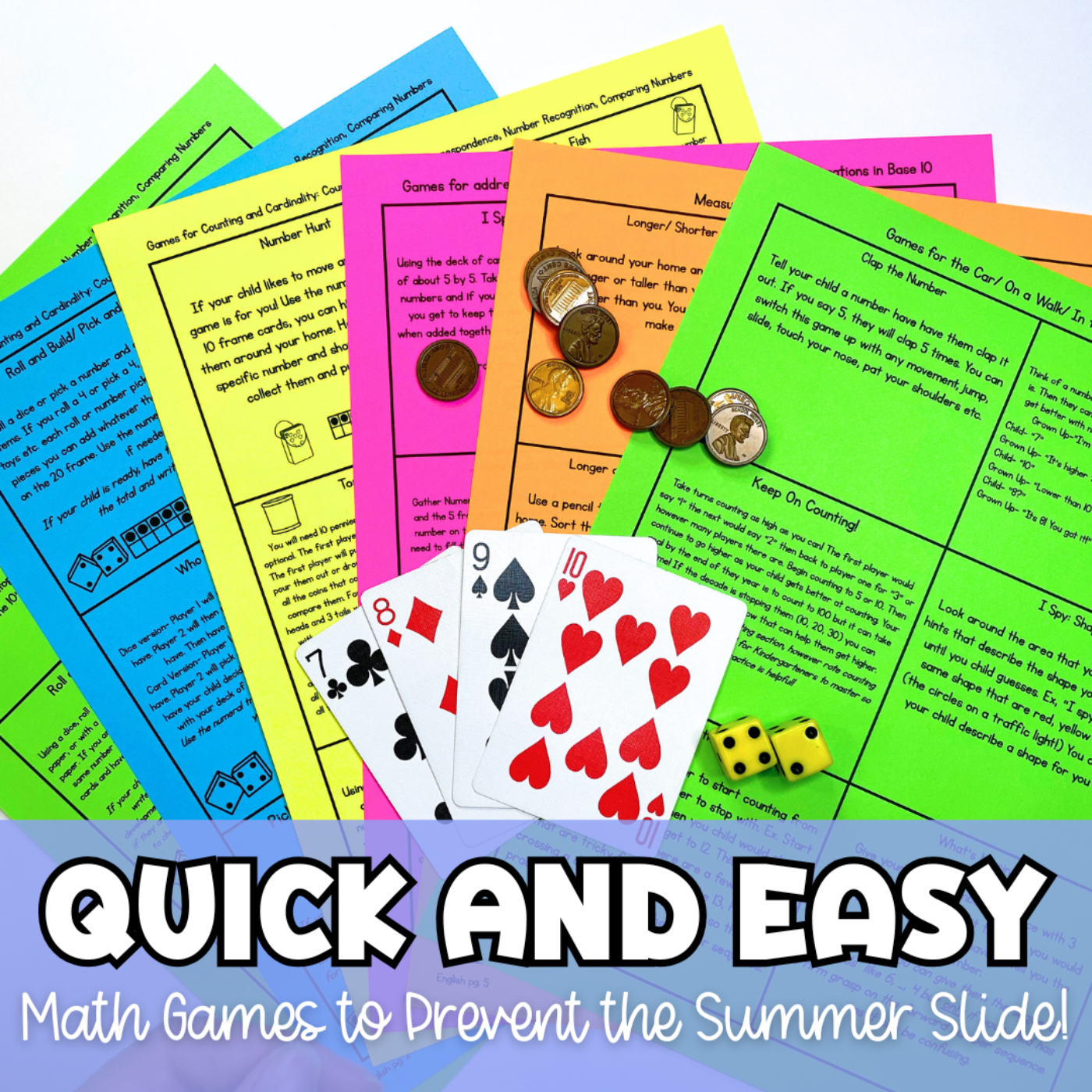
The summer slide is real! If you are a parent, caregiver, or teacher looking for games to play or suggest to your families, this episode is for you! This episode contains 7+ game ideas to help your little ones with math over the summer! No worksheets are required!
Have a topic you want me to discuss? Fill out the Google Form!
Helpful Links
Let's Connect!
2025-07-14
6 min
Transcript
Available Results
Generated results are saved to the knowledge database for reuse and search.
No generated results are available for this episode yet.
Extract Knowledge
Pick what you want extracted first. Model, scope, and chapter options appear after a template is selected.
Generated results for public episodes are saved to the knowledge database so they can be reused and searched later.
Transcript
Talking about math is something that can be really
hard for students and really hard for parents
to talk to their kids about. So these games are
games that your families can play in five minutes
or less to help prevent the summer slide and
strengthen their kindergarten and first grade
math skills. and welcome to Making Number Sense
Make Sense, a podcast for elementary teachers,
specifically early elementary teachers, looking
to really make an impact in the number sense
of their students. For these games, all you're
going to need is dice and cards, which you can
get at the dollar store, and 10 coins or pennies,
maybe 20 if you want to stretch your counting,
but 10 is really all you need. The first game
is called roll and build or pick and build, and
you can use either your cards or your dice for
this game. The concept is the same. Your students
or your children will pick up a card and whatever
number they get on the card is how many items
they need to collect or build. So with your pennies
or other thing that you're counting with, if
they pick the number six, then they need to count
out six pennies. This will help with one -to
-one correspondence and practicing the number
sequence. The next game is called Who Has More?
The other version is Who Has Less? For this game,
you're going to just need dice or cards. Again,
either one works for this game. So the first
player is going to roll their dice or pick up
a card, and then the second player rolls their
dice or pick up a card depending on which item
you're using. And the person who has more is
the one who gets the point. You'll continue on
until one player has 10 points. And that player
is the winner. The other version who has less
is exactly the same concept. The only difference
is instead of getting a point, if you have a
card with a higher value or if you have more,
you'll get the point if you have less. Now, this
game in particular is really great to play because
often figuring out which number is less or. At
the same time, if they're using counting to figure
out if the number has more or less, having to
count backwards can be trickier. So this is a
great one to really help with thinking about
the number that comes before the number that's
less. In the future, that will really help them
when they're doing subtraction, being able to
think. Backwards the next game is called heads
or tails and this game is all about decomposing
numbers or making ten or different combinations
of ten So for this game, you're going to need
those ten pennies coins whichever And so the
way that this game is played is you take your
10 pennies, you shake them and drop them, and
then you sort the ones that landed on heads and
the ones that landed on tails. And you're going
to write down how many landed on heads and how
many landed on tails. And then you take your
10 coins, shake again. And drop them how many
landed on heads, how many landed on tails. And
the more they do it, the more they'll start to
recognize the combinations that make 10. So they
might always be getting six and four or two and
eight. And then eventually they'll start to just
remember that those two numbers together make
10. Now, if making 10 is a little bit of a challenge,
counting out 10 is a challenge for your student
or your child, then this would be the time to
lower the number range. So maybe start with just
five. And then as they get better at counting,
become more confident. confident they can you
can add other coins which is still a valuable
skill to know the number of combinations that
make five six seven and so on for the same reason
when they start to get to larger numbers addition
and subtraction once they know those combinations
it helps them when they're using larger numbers
in first grade and beyond the next game is called
i spy numbers and for this one you're going to
need the deck of cards you're going to put the
cards into rows five rows of five face up so
you can see all of the numbers and so for this
one the first player might say I spy a number
that is the same as 2 plus 2. And then the other
player, the one who's guessing, would have to
look for 4 because that's a number that makes
2 plus 2. You could also give different kinds
of clues, like I'm looking for a number that's
larger than 6 but smaller than 8. And then they'd
have to look for 7. You can also really increase
and... focus on addition or subtraction. So you
could say, I'm looking for a number that is the
sum of seven and one, and then they'd pick the
eight. You can really use any kind of clue that
works for you, but these kinds of conversations
are what's really gonna help them develop their
number sense when they think about. the relationship
of numbers to each other the next two games are
two versions of each other kind of two sides
of the same coin but you don't actually need
your coins for this game you need the cards so
the first player picks up a card second player
picks up a card and you write it down and then
the first player picks up another card and adds
those two cards together and writes down the
sum of the two cards that they picked and the
second player does the same. Then when you pick
the third card, you're adding the value of the
third card to the sum that you just got. So for
example, if player one got two and two, then
four was their sum and they picked another card
and then that card was six, they would add six
to the four that they had and now their new sum
is 10. Player two would do the same. You keep
going that way and adding the value of the card
you pick to the value that you just had until
one player reaches 100. So this game is called
Race to 100. The other version of this game has
exactly the same materials, but instead of starting
with 0 and adding, you're starting with 100 and
subtracting. So in this game, race to 0, you
start with 100, you pick a card, and whatever
card you have, you subtract that number from
100. So if I have 100 and I pick an 8, then I'm
going to subtract 8 from 100, and I'll be left
with 92. And then the other player does the same,
and then instead of adding... the value of each
card that you pick, you will be subtracting,
and the first person to get to zero is the winner.
I will have all of the directions for these games
listed in a blog post in the show notes, and
if you would like even more games that you can
play in five minutes or less, there is a workbook
with over 36 games that cover every single Common
Core standard for kindergarten linked in the
show notes as well. Let me know which games you're
trying. If your kids like them, you can always
send me a DM on Instagram that will be linked
in the show notes as well.
Chapters
No chapters available.