Heteroblasty Anonymous - A Conversation About New Zealand Plants
In this episode we have a 3 person conversation about the Flora of New Zealand, touching on such notable ecological and evolutionary characteristics among the plants here like leaf heteroblasty, leaf divarication, co-evolution with the now-extinct Moas, plate tectonics and vulcanism, how tropical plants have evolved for a chilly temperate rainforest, Jurassic lineages of conifers, the genus Pseudopanax, and all kind of other wild, cool sh*t.
An interesting paper to read about heteroblasty and divaricating branch patterns :
Howard, Jarden. "New Zealand divaricate plant species: Tensile strength and Remote Island occurrence." Journal of Austral Ecology. 2022
An interesting paper to read about heteroblasty and divaricating branch patterns :
Howard, Jarden. "New Zealand divaricate plant species: Tensile strength and Remote Island occurrence." Journal of Austral Ecology. 2022
2023-06-12
132 min
Transcript
Available Results
Generated results are saved to the knowledge database for reuse and search.
No generated results are available for this episode yet.
Extract Knowledge
Pick what you want extracted first. Model, scope, and chapter options appear after a template is selected.
Generated results for public episodes are saved to the knowledge database so they can be reused and searched later.
Transcript
All right, welcome to another episode of the Crime Pace of Botany doesn't podcast.
I'll just record a quick intro. I'm gonna try to keep this really
short because we've got a two hour long conversation about New Zealand plants that said.
We're leaving today. It's been a really wonderful fucking trip. I wasn't
prepared for how cool and unique the forests are here. I thought it was
just going to be kind of like an analog or the Pacific Northwest with a
different cast of species, but it's actually way different than that. I wasn't
prepared for two things here which I'm now fascinated by an obsessed with, and
we'll probably be using in presentations to talk about evolution in ecology because they're so
cool. That would be the divaricating habit among plants here, as well as
the phenomena of heteroblasting, which is a difference between juvenile and adult leaves.
Many other plants do this, Eucalyptus, for example, but nothing really does
it in this way, and it's thought to be an adaptation to a fauna
that was entirely dominated by birds, so browsing birds and so having you know,
pseudopanics Crastopolis as an excellent example of this. I mean, look that
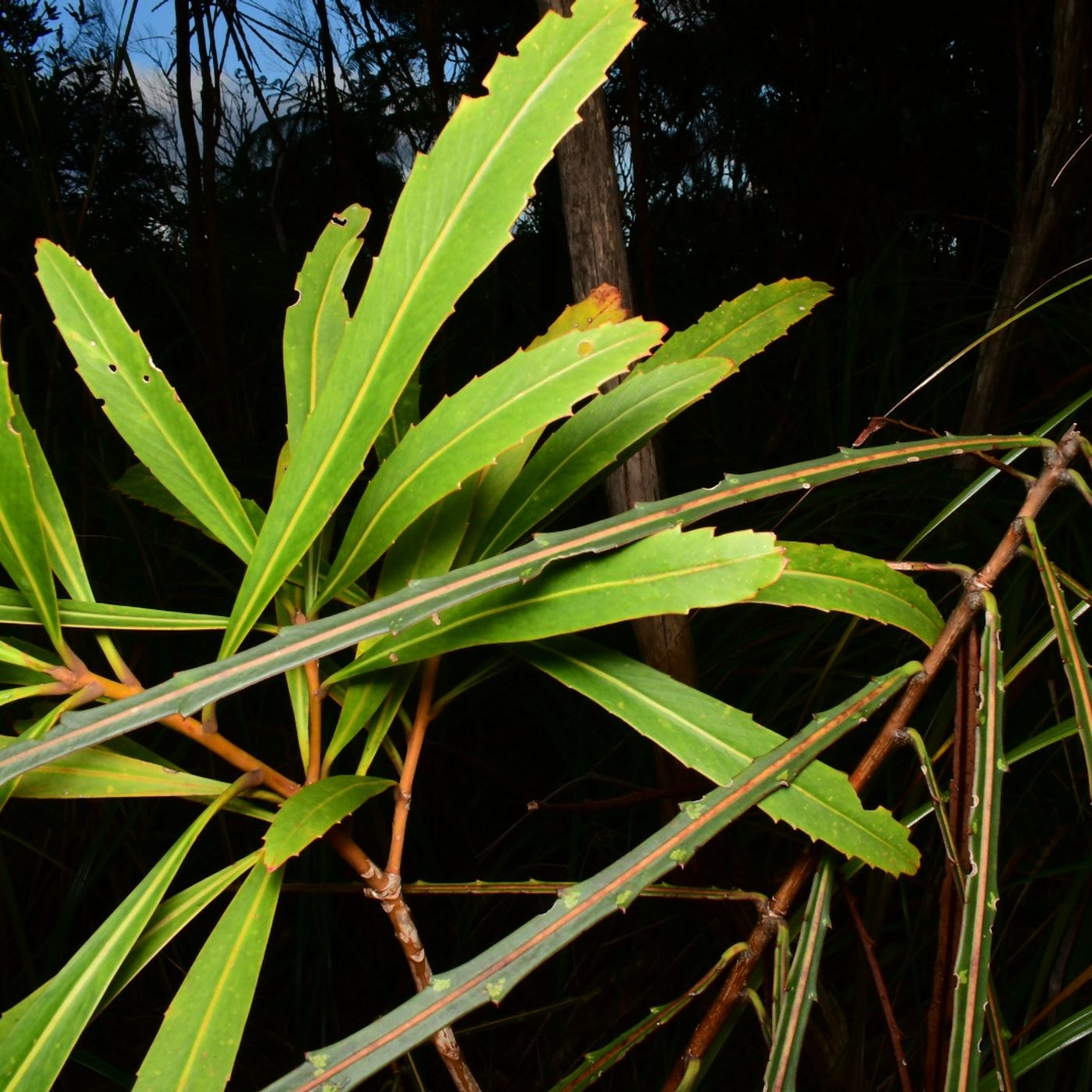
plant up. It's fucking wild. The young leaves can be up to eighteen
inches long and only an inch wide, with you know, intense mottling on
them, very sclerophilius, very stiff. You know, you could basically,
you know, build some sort of cat and nine tails or freaking bedsm device
with these young pseudopanics leaves. And then once this this plant reaches heights of
three meters, you know, roughly ten feet tall, just above the height
of what the Nari stick mo would be able to eat, they become just
regular pseudopanics leaves, which, to be honest, pseudopanics doesn't look the adult
leaves don't look that, and throwing it just looks like a no offense.
Don't anybody has said this, but they just kind of look like an office
building plan, you know, like a palmate digitate leaf structure of glabrous waxy
leaves, little inflated at the petiole and no hairs, like something you'd put
in a fucking you know, in a pot to slowly die on someone's desk
or something. You know what I mean, except this is a tree,
and then the trunk of these things is like the perfect caning device. I
mean, I guess the Maori made spears out of these there. It's about,
you know, two to three inches wide. It's got this really weird,
almost the corpse like form to it, like kind of like spindling,
like twisting. It's not just a smooth cylinder. In other words, it
looks like a like a vacuum sealed lump of potatoes that's been stuffed into a
cylindrical form. And then it can be upwards of twenty feet tall, which
is roughly six meters, so pseudopanics Crestopholus. And of course it's a really
diverse genus here. There's fucking twelve species. Ain't got split up anyway.
The plant life here's fucking incredible, and it's so unique, and it's in
no way similar to anything else I've seen maybe New Caledonia, only in the
sense that it's a temperate, chillier form of the flora of New Caledonia,
which if you don't know about New Caledonia, better looked that up, Pale
because it is both panically notorious. So many cool plants there so many Jurassic
Age of lineagees. A weird conifer Zamborella is there, et cetera. Anyway,
most people listened to probably had an inkling of what New Caledonia is.
And that's just to the north of New Zealand. I don't know what five
hundred miles north. Anyway, A lot of cool stuff going on here.
We tried to cover it in this conversation with my friend Phil. My good
friend Miguel from Tasmania joined us too. He works for the Roberium in Hobart
at the Hobart Museum down there, and so he got he got some time
off work, came and joined us, and thank god, I'd like to
thank him too, because he fucking he drove the entire time. I think
partially. We rented this van. This's like beater van was super cheap too.
I was impressed, but yeah, I was impressed that how cheap this
thing was. It was really like and we slept three of us in there,
me mcgellan, Allen. They had like a top bunk area where you
laid these boards across the and you know, like a plastic another twelve inches
of like like they ripped the roof off the band and put another twelve inches
of clearance on there with this this fiberglass shell. But m the thing fucking
stunck like these. You know, the traffic here in auckland's crazy, like
it's bad. It's you know, it's like they're really trying to follow the
United States's footsteps in terms of their car dependence. It's fucking it's fucking bleak
in that regard. Good luck to them. I guess I don't know why
anybody who want to emulate the US, But there haven't been as many billboards,
which is amazing. And once you're in a place where there's no billboards,
you start to really notice how much the commercial pollution, the mental pollution
in the United States really fucks with you. I mean, I haven't seen
a billboard. I mean there's there's a few billboards here, but nothing like
the United States where it's an actual industry. I have not seen one single
personal injury attorney billboard on the size of a fucking freeways here. But the
gas rooms have been really fucking bad. I guess they just banned lead a
gasoline in like the late nineties, so I don't know it'd really be cool
to have some public transit and fucking bike lanes and maybe you know, fifty
percent less cars. But anyway, what the fuck was that sees what happens?
I forget out. It's time. Anyway, we tried to cover a
lot. Miguel was driving most of the time, I think primarily because he's
scared of my left hand side of the road driving, which I think is
fine, but I just tend to be somewhat reckless when it comes to traffic
laws. But other than that, I'm normally driving pretty slow because I want
to look at the plants, you know, so I don't drive fast.
It's why, you know, being in Texas, these meathead drivers get all
mad at me because I'm I'm going too slow so I can focus on other
things besides driving. I'm just kidding partially. Anyway, we tried to cover
all the cool things going on here, but botanically and floristically and ecological lead
but of course we didn't touch on it. I will say plate tectonics are
huge here. They play a huge part in the flora actually, because you've
got a subduction zone. Subduction zones create vulcanism and volcanoes, of which there
are many in New Caledonia. You've got a subduction zone running down the east
side of the North Island and then from north to south and then turning into
kind of like bisecting the North and South Islands with a transform fault, and
then turning and then coming running south on the west side of the South Island,
at which point it kind of turns into a subduction zone that's going in
the reverse direction of the subduction zone that's creating all the vocalism vulcanism on the
North Island. It's fucking bizarre. It's like the two like North and South
are going to end up twisting around each other almost, so really remarkable stuff.
And that volcanism, of course is dictated a lot of the the evolution
of the plant life here, creating you know, different elevations and different substrates.
The Libo cedrus forest here, which is like a Southern Hemisphere incense cedar,
which neither one is related to cedar. It's a member of a redwood
family. Cooper Safety was remarkable, grown with Halocarpus and Pseudopanax and so many
cool fucking trees, not the vegas Podocarpus tataram I love the fucking podocarps.
They're they're really cool. If you live in the Bay Area of California,
you can probably see a lot of them. Plants like dacrocarbus to critioides kahakata
remood the Critium compressing um basically conifers that evolved two hundred million years ago and
have co evolved with birds. Most of them have as their their primary seed
dispersers, so they create this baitberry that looks like, you know, a
u arrow um, but it's not a fruit because they're not angiosperms. They're
just weird. They're just fucking weird and cool. Um. So, uh,
those forest I just they just I don't know, man, they just
felt really good to be in. It's a really special place. So I
didn't I knew it was gonna be cool. I didn't think I was gonna
be this taken with it, just how unique. It is. So that
said, there's lots of invasive species here. The Monterey pine, the Radiata
pine was a bummer that's everywhere being planted in forestry plantations. We talk a
little bit about that, like why don't they just try to use native species
at least so they can at least have an impact ecology while these things are
growing waiting to be quote unquote harvested potocarps grow slow, of course, and
so they would be hard. But anyway, now there's a whole bunch of
shit. Just doesn't that a fucking podcast? I don't know. That's all
I got. Have a good rest of your day, enjoy this school.
Well I'm gonna showing you what it's like or I'm not sure, you know.
I mean, I think they got a nice so they shutter and qua
come out. You know, I've seen a couple of night things in that
room before. Get a bunch of hippiest night they're about to go bad,
but they're not. Just no, no, no, no, yes,
I want you chipping. Yes, yes, everyone's time. Yeah you just
put the micro no no, no, no. Hello. Welcome to another
episode of Crime Pairs of Binding Doesn't Podcast. I'm in New Zealand and I'm
sitting here with uh my friend Miguel and philand we're going to talk about New
Zealand natural history and flora and uh some of the ecological and evolutionary trends among
the plants here. Uh while getting uh seriously caffeinated. So anyway, Phil,
do you want to introduce yourself, you want to talk about what what
you do? You're sure you yeah, I'm a landscape closer to that,
Yeah, I'm a landscape designer, but there's a fairly strong focus on plants
with what we do. As part of that, we grow x amount of
them, we experiment with them, and I also hit out into the wild
and go look at them. The reason being you can gain information from that,
and you know, of course, it's just it's good to see these
things in those places. I mean, it's that's similar to how you get
out there, but you use native plants primarily mustly native. That's what my
reputations built on, especially with threatened plants. But a lot of our work
is also making what designing structures based on native ecosystems, but we sometimes amplify
them. So it gets really interesting when you start looking at the South African
flora and then you can insert elements of that as long as they're not going
to be weedy. Okay, but yeah, the interesting stuff I want to
talk about is primarily all the native the native stuff here, because it's so
remarkable. I mean, it's to me new Zealand looks like the flora here
look like trapal coal plants that evolved in a temperate rainforest. Like the most
of flora came from more tropical environments and then further north and then basically adjusted
to the very odd climate here, which is it's kind of like a wetter
It's like the Pacific Northwest, but with summer rain. It seems like the
Pacific Northwest of the United States. Like it's like just the temperate rainforest with
elements of subtropical elements in it. But there's a lot of there's a well,
first off, you've got volcanism here. You've got you've got subduction zone
on the east of the North Island. Then it turns into a transformed fault
bisecting the North and South Island, and then it goes on the west side
of the South Island and becomes like a subduction zone headed the other way.
So you've got subductions on the north, subduction zone the south, lots of
volcanism, lots of ancient potocarps, you've got the Cowries, I say,
Corey would Cowry whatever age at this, and then you've got just a whole
shit ton of diversity of ferns and the understory the ferns and brail fades and
stuff. And the best way of looking at it is we're kind of like
a continent in miniature. So when you explain it that way, we've got
two comparatively small islands on which a lot of stuff is happening because we're long,
and we span from almost subtropical down to sub antarctic nearly, and so
you've got a lot of stuff happening in there. But because the Southern Alps
have been rising for six million years, you get a lot of speciation associated
with that. So you've basically got a long land mass that's maritime, that's
got all kinds of funky things happening geologically. And then it's got this massive
mountain range that's growing almost as fast as the Himalaya. We're talking about the
Lord of the Rings landscape down there in the south. Yeah, let's cool
it that. Let's use pop culture references. Yeah, Miguel, what have
you noticed about the understory here? It's it's a lot. There's a lot
more diversity in the dark forests than you would expect in other places, right
there is, And I'm mostly used to the Tasmanian flora, which is very
very different in origin to the New Zealand flora. I mean three components are
the Gonduanan, and then they'd set up neotropical stuff that's come from the north.
And certainly what I noted when coming to New Zealand is that that that
tropical component is far more dominant here than it is in Tasmania, competed the
gonduin and relics. Yes, for example, we have for us proteasia.
You'd be could just throw out the landscape in almost every different and you've only
got two here, right, Ternia and yeah that's right. Yeah, yeah,
And I guess that's true. We've got that paleotropic and the gonduan and
then and then the Antarctic all in there. But as you say, we've
got caprosmas going all the way down to Subantarctic islands and their palego tropic.
So definitely that's all happening. But I don't know whether it's just about where
they came from originally. It's just it's a really strange We're talking about it
the other day. It's a really strange forest structure. You look at it,
it shouldn't look tropical the forest structure, but it does. It does.
But it's cold. It's fucking really cool. I mean, it's like,
I mean, I granted I've been living in a place where it's thirty
five degrees celsius most of the time, but but still it's really cool.
It's like a chili. It's like a chili temperate rainforest. It's it's really
really wet and it's really cool. Yeah. Yeah, And we're also here
in winter, which which gives slide that's slight sort of maybe biased idea of
what everyone I've talked to us that it doesn't get much warmer than eighty degrees
fahrenheit, ninety degrees fahrenheit and summer would I be in thirty degrees? So
what what's the what are the summer highs in Auckland? And oh man,
all bits are off. Now it's what is usual, Like maybe you'll get
a couple of days where it's really harper, what is normally? When I
as a kid, it would have been weird, and that was in the
eighties. It would have been weird to have thirty degrees maybe thirty thirty one.
You would have had to go down south to get more than that,
but a couple of summers ago we would have been pushing thirty five thirty seven.
I mean, it's that's all changing, which everybody knows it. Yeah,
thirty degrees celsis is eighty six Fahrenheite, so it's not that's not hard
to me. That's like warm. But yeah, yeah, so it's pretty
cool. It's pretty cool. It's kind of like the Bay Area, but
not as dry in the summer like the berry of California, because you guys
will get summer range. You said you got ten inches, right of Oh,
this year has been summer rain This year has been so strange. We're
we're winter rainfall, so we as opposed to Sydney, which is summer rainfall.
All of our plants are geared to what's winter rainfall, which has got
It's been an interesting year for how things perform out in gardens. But it's
still not really dry enough to get forest fires here in summer though. No,
no, right, although when you start thinking about it late, I
mean, i'ven't even been to one part of Canada, but you hear about
we don't we kind of think of ourselves as being a little bit like Canada.
And then you see these massive fires going on in Canada and you wonder
whether the future it's possible. Well, that's all. That's all like pine
plantation up there too, that's burning right now. It's not even true for
us. So it's all fucked up. The accoladies, I'll suck up.
But well, let's talk about the dominant plant group. Serious. You've got
a lot of mercy in, which is premier lacy. You got a ship
ton of caprosma. You have bracket Gladys, which is asteraci, which is
a scenicio asteracia. There are loads of in. We've got heaps of rnunky
laceya. We've got with a world center for myasodas for forget me nots,
which is violacy right there tree Violet's be confusing it with melostatus. Yeah,
melacitus there, the violet family, that's right right, um and yeah,
and heaps of melascitus. But as we're talking about before, with with the
Alps going up, you get adaptive radiation happens really quick. It's taken in
the southern island. Yes, yeah, so what cause those Alps they got
up there? Just the subductions aren't off the west coast right there or wait,
oh yeah, I mean it's of course, with our position being along
the plates, it's got it's all related to that. It's got to go
somewhere and it gets rained from the west, and so it's dry around the
east. Yeah, that's right, you get the rain shadow effect. So
the eastern side is where most of the because you're obviously interested in the MOA,
the eastern sides we're a really big mild word because the dry forest is
what they preferred, the western side, which was really wet. You get
the little stumpy guys, well you used to, of course hundreds of years
ago, so that you've got that split between east, between wet and dry,
and it's it's amazing because it's so sharp and and so you'll get different
species. What are those carrots that look like yuckets? Yeah, we call
them spaniards. What's it called. Yeah, yeah, yeah, that's that's
the weirdest ship. That's primarily in the east, right. Yeah. They're
through a lot of areas and there's sort of in the west, but mostly
in the east. That's right. Yeah. Yeah. There's a story about
the first European guy to go through Central Otago. He went through there with
a couple of Madi, and they the Madi guys, they would have had
they would have made kind of like um, what he called them, gators.
I guess they would have made gators out of cabbage tree leaves and stuff
like that, because Mardi made gators out of cabbage trees cordline. That's right
here, courdline. So they would have made gators so they didn't get sliced
to pieces. But this European guy, he was about I don't know,
he's like thirty years old at the time, went through there and because of
all the spear grasses, the acephilla and the matagari, by the time he
got out of there, he was broken. And these two Marti guys had
to build a raft out of flax, and these you only made temporary rafts
out of flax. If you were making like a proper and a fishing canoe,
you made it of a big tree. Right. They made this temporary
raft called a maukahe out of flat stems, and as an emergency measure they
took him down like a hard out river. And so there was a dangerous
thing to do because he was near death. He only lasted a few more
years, but he was the first way just from just from this this yea
like carrot, from getting on well mattagari the discaria tomato um so, the
discarias which occur in Patagonia, and of course Australia's got discarias that that slices
your berts malicitis would have been pretty funky at the time, I reckon.
I don't think it would have been that comfortable going through what is the plant
diascoria discaria dyscaria. What a family is that? What is it? It's
um ramnasa, I think, um shit, yeah, I've never heard of
that one. I didn't see you get on the pier or what. They
used to grow almost up to Aukland. But that's being extinct a long time
because there there was a coastal form and then there was an inland form,
and the coastal form kind of almost got up to Aukland. Anyway, how
do you spell it dis dis see Oh yeah, okay, yeah, yeah,
that's that's sharp. You know about it? If you go through that
same with the speargrasses. Oh yeah, look at that, yeah it is.
Yeah, I haven't I haven't seen many spiny plants here except for the
Rubis societies. All the rest is just that divaricating stuff, which is such
a weird, but this is divaricating and thorny. I was telling Miguel yesterday
about a job of ours where a client needed to stop some people climbing into
the property just you know. It was just some assholes coming in to mess
around, and so we planted the leafless bush. Lawyer there the rubus,
and yeah, it was amazingly effective. That thing is insane too, I
wouldn't. It doesn't look anything like a raspberry. It's got really long petioles
or what are the competiolus on a palm leaf, and the hooked the hooked
prickles on leaf veins and stems and everything. It's different to the rubises in
Australia too, at least only the ones in Southern Australia, which we have
an endemic Rubis gunnianas, which is a small, prostrate herbaceous thing that that
doesn't really extend very far. What I've seen that in Tasmania. If you've
been to any alpine areas you probably would have it looks vaguely like a sena.
Yeah, I think I saw that. And and then there's Rubis parva
folios, which is a pretty widespread species. I don't know if that's in
New Zealand or not, it's certainly through snow Southeast Asia as well as Australia.
Rubiscurosis is the weirdest one. That one's it's almost leafless and it's got
really cool yellow markings on the notes, and you definitely want to see that
sometime. But if you come back and you go down south and you'll you'll
see it. So what we should talk about really quick, just there's so
much share to talk about. I want to take rather the other dominant genera
to the fourmiums, the fucking suitor panax. But the devaricating habit here blew
my mind. That was the weird I've seen a whole bunch of weird convergent
shit evolutionarily traveling all over the world. Are going to plants, but the
divaricating branching habit that zigzag form, whether it's Carpetidus serratus, or mercine or
or christ any of the Pittosporum or any of the other ones, that's a
really weird trade. I haven't seen it, and I know, like we
don't agree on what the cause was. But there it could be both of
both the theories that are out there. So let's talk about one of the
two theories that are out there that that that supposedly may have directed that you're
the morphology evolutionarily of all these unrelated plants. Well, that's the good thing
about having a chat about stuff like that. So when we were talking yesterday
about it, there's the theory which everybody likes, which is the moa theory
that was in response to birds twelve different species of more or there was something
like ten or twelve. There were a lot. There were a bunch of
yeah, yeah, that's right, and so you know, that's a that's
a really kind of you know, fluffy friendly theory because it's got birds and
it's kind of colorful and all that. But there's another theory about climate.
But having said that once, when we were talking about it yesterday, I
kind of thought, well, you know, kind of look it up and
don't just stick to your opinion. I've always been more in favor of the
climate theory, but nature doesn't really need theories. Nature does what it does.
It could be both too. I think it is both. That's kind
of where I was going like, there's there's sort of a new direction where
people just say it's like a synthetic theory. With the two things went together.
It means that if New Zealand for a while it was like Patagonia,
then it was a hard place, leaves got smaller, things got warrior,
and then with the birds, both of those two things made these these plants
go that way. But what would be the but back to that, because
when I first heard it too, I was like, how the fuck birds
don't really you know, it doesn't really make sense whatever. But then I
thought about I was like, we'll wait a minute. Bird's brows so differently
than mammals. I read that book Gondwana, Well you did read it.
I read it well a chapter, the chapter in there about MOA's and the
divaricating thing, and I thought MOA's would just went speed She's. I didn't
realize that there were so many different species of him. I mean, we
saw him at the museum today. Those fucking things are like tanks. They're
like wingless tanks. Like the thighs on those things are hilarious, to the
point where when you see a skeleton you're like they they mixed these up in
the backroom or something like they mixed up the top and lower portions of the
bird because because the thighs are just huge. Yeah, and it's it's like
a turkey on these giant like tank like stilts. You know, they were
just built really weird. They just evolved really weird. They more like relics
of Gondwana. But but uh, but when I read that book and it
was talking about you've got to think spines aren't going to do much if you've
got a big beat, right, because it's like a spine hitting your fingernail,
it doesn't doesn't do much, you know. It's it's mostly gonna be
about how the leaves are arranged and whether it's more of a pain in the
ass because they're kind of pressed out and they're like zig zag and birds mostly
browsed by visual sense as opposed to to smell like mammals. Like there's just
differences. Then when I thought about that, I was like, yeah,
I guess that sort of thing. I'm like, I guess it does make
a bit more sense. And also I don't really know how bird. I've
never had chickens or anything. I fucking don't, you know. I don't.
The urban poultry thing gives me nightmares sometimes. But but but I just
realized I don't know, and then I got me thinking about it more.
I'm like, yeah, maybe that and maybe it is plausible, But of
course cold would be plausible too, So what would be the theory for cold?
I guess like that's what would be good to talk about, Like Howard
Branching, it's like kind of like forming an insulation for cold winds, for
cold drying winds or what the guys that came up with that theory? What
were they? What were they? It's like, you've got you've got civil
ranks of leaves. So if you've got the infantry at the front and then
you've got the cavalry and behind and everything, we've got civil ranks in there.
So if you get nailed at the front, there's something still in behind
there. And the other thing is that there's the low light of a lot
of those environments where it's really interesting with a couple of those pedosporums because the
really strange thing they do. So if there's one called pedisporum up called atom,
I've gone to see it's nationally three. Isn't the one you were talking
about. In the frost flats at the there was turnarive, but that looks
a lot like old called artem really similar up called artem grows around rivers,
but that's columnar and so a lot of these things they grow on a column
of foliage, which is really weird as well. But the thing that struck
me about them, especially from having grown them, they just don't think about
grower, I mean the plants. So they're not sent in unlessia what eio
that German guys name is. But these things they just they their strategy.
They just go for it and like they'll grow one and a half meters without
sending roots the other way. So it's the race for life. And with
these things, if a river comes, they're growing in shady environments. Well
it's because disturbance comes through the river. Eighty six is everything on the side
of the river. And then there's there's a niche, but it's a dark
niche and these things race up. And so I think whether it's cold,
whether it's low light, whether it's oh I think all of those could be.
Oh yeah, I was amazed at how dark the forests are here.
I mean, I'm I'm used, but to see I'm used to be in,
Like in a redwood forest, you don't see much diversity. It's why
they're they're nice to be in for the ambiance, but they're not fun to
botanize in, like a redwood forest or anything. It was funny we saw
a redwood forest, a planted one here, and it was just like it
felt like a cornfield. There was nothing growing there except redwood. It was
like, it's just, you know, just more testament to everything has an
ecological place where it's evolved and it's just funny anyway. But but the forest
here are still dark. Like I've had to turn the exposure compensation up on
my camera like to like you know, plus one point seven, using a
fucking flash all the time. Like it's just it's crazy. But all this
stuff is has evolved to these dark forests, like the potocarps there. They
are like redwoods in the way that they can just hang hang tight in the
shade until you get an opening in a canopy. And yeah, well there's
one MATAI well, actually I got to stop using common names. Prognopotusifolia.
Yeah, that one has a head or a blastic growth form and it'll sit
there and sit there. And do you guys use the term ricker overseas,
No, I don't know what we refer with cut with Cody we Agathas Australias,
we refer to them as rickers R C K E R. And you
can you can refer to rickers with other trees. And rickers are like the
small ones that have gone straight up and they just sit there in a holding
pattern and when that light gap occurs, boom, they go for it.
Yeah. A lot of the potal carps a pet blastic. Yeah, yeah,
that's right. And so mutta. What that'll do is that sits here
and it's got a really distinct head or blast, really distinct juvenile phase,
sits there for bloody ages, and then once it gets up to about two
and a half to three meters it changes into a completely different beast and at
that point it speeds up. But so many of them can just sit there
in the dark in that juvenile phase for a long time. And again maybe
you know, if if they've got to sit there for a long time,
maybe that supports the bird hypothesis, because if you've got all it can be
steps, something can evolve for one thing, and then boom, here's another
selection pressure that makes that one thing that it evolved for that much more adaptive.
And so now it's evolving for both these But we should talk about to
anyone listening, we talk about heteroblastic too. That's another fucking weird thing that
a lot of plants here do, which is extreme differences between young from between
juvenile and adult leaves. Like Pseudopanics is the perfect example of that. That
is such a weird for pseudopanics. Crassifolius, which is English ivy family Araliac.
I even hate saying the word English ivy because it's such a fucking dreaded
plant. But APAs is the order carrot family, so it's it's a lot
of these plants have that kind of like Ferrando kumerant smell, like the same
secondary chemistry as the carrots, but but Araliac is the family, and pseudopanics,
I mean, it's you see these things when they're less than nine feet
tall and they just look like this weird assortment of sticks, like they got
a central apical stem and then they've got the leaves are like eighteen inches long
and maybe an inch wide. With these serrated margins, and they're dark too,
like they're trying to like camouflage enter something. They're really hard to see
them. When they get bigger than they open up the leaves when they hit
nine ten feet about the height of a bird, these tall birds at one
extinct, the leaves change. They're facing down when they're in their juvenile face,
and then they go to facing up, so the whole direction of them
changes as well. Yeah, the leaves are pointing downward. It's so fucking
weird, man, it's so cool. But then the leaves are just beautiful
too. They're like this really dark color of almost brownish mahogany with little speckles
of green. Do you get any heteroblastic plants and tasmania we go? Yeah,
Eucalyptus is the best, right. What is the thought the theory with
eucalyptus some sort of shade. I can't say I know. But one thing
that you notice is with many Eucalyptus species, the juvenile foliage is much higher
in essential oils are much more aromatic. But it's better too. There's more
surface area, isn't there not? Necessarily that varies between species? Yeah,
generally, Also the juvenile leaves are a lot softer than the adult leaves,
which tend to be much more sclerophilous. I think the really high concentration of
essential isians and the juvenile leaves. And the classic example is the blue gum
Eucalyptus globulus, which grows along the last part of the world. So anybody
in Californian nose, a lot of people I've seen it. You notice it's
got these blue glaucus juvenile sessile, juvenile leaves, and if you crush one
of those, it is incredibly aromatic. And the older leaves are still aromatic,
but not nearly as much. And I think that's also own anti Horbiberi
adaptation, like insect or bavari or more supial. That could be both.
Yeah, yeah, yeah, that's interesting. And yeah, well, of
course, over the last day, because I've always been pretty adamant on the
climate thing, I've moved towards thinking it could be both. But I do
think you guys have changed my mind a bit about it. Have changed my
mind because I was like, because I was like, that doesn't make any
sense. The browsing crews everywhere. Why I fucking live in South Texas.
Everything's spiny. That's were browsing there, but there's not that much spiny stuff
here. Well, we're The interesting thing about browsing, and especially with mammalian
browsers, is you'd think that spininess would do it. But if you've worked
down on the South Island and you've planted those spear grasses, the aceophillas,
you've got to protect them against rabbits. They nail them. Because if you
if you spend your whole time eating plants, you kind of get good at
it, and you don't just go to the end of it. You got
to the side. It's constant biological warfare. They the plants are getting better
at learning how to take all the animals are getting better at tackling the plants,
and the plants are get trying to find adaptations to escape the animals constantly.
So with the spear grasses, the aceophillers, they're kind of you know,
they've got they've got a great strategy. But in terms of mammalian browsers,
it's you would think, on the face of it, oh, nothing's
going to get them, but the rabbits get them. I think if you're
a cow, it's bad news. If you're a sheep, probably no thing.
But also the afhilli didn't evolve with rabbits, so that's a new There
hasn't been selection pressure from that kind of browsing. I guess a million browsing.
It's small sleepen bird browsing, which is when I thought about Yeah,
when I thought about the difference between mammals and bird browsing, I was like,
oh shit, yeah, that's right. Spains wouldn't really do anything for
birds. Man. I'll tell you one of the interesting things about that book,
gost of Gondwana, which you'll appreciate, Miguel, what both of you
will, But it's um that guy's really respected scientist. George Gibs have been
to go visit him, and he's like the New Zealand next bird on butterflies
and moths and whatever. And but in the second edition of it he wrote
then the introduction he said, basically, science has proven some things that I
said in that first edition. Science has actually got a better theory for now,
and so I'm kind of changing how I'm presenting this. It's cool,
there's he's happy. So many people that are sold like egotistically tied, they're
fucking you know what I mean, it's gross. That's what makes it not
fun. But yeah, anyway, that's cool. But um, we should
we should talk about too, because we were near a barium to change so
we can get back to the hefter blasting. We're in there barium today and
I asked to see Dactylantis, which, for anybody listening, is a member
of a primarily a family of parasites, planeff Race, which is primarily tropical.
But here's one growing in the temperate rainforest. It's not only the odd
one out, and it's it's climate, but also for the family, but
also is bat pollinated. And the idea of bats lurking on the ground to
pollinate flowers is remarkable too, because that can obviously only evolve in a predator
free environment or mostly predator free environment, you know, which is because there
were no mammals here except bats, and and then for the last five hundred
years the rats that the were brought, the Polynesian rats that were brought over.
So a good friendom On A Gaco Gray met because he's an absolute legion
of New Zealand conservation. Hey, he's worked a lot with the bats and
with actor lantis and there's a there's an island called Little Barrier Hotutu, and
so he's gone over there. And then the bat population is really good.
And he said, if you lie down at night, they're practically walking over
you, but they're on the ground. Yeah, exactly. And so so
this is an island where there's no no, the greatest ship that's been brought
over the Yeah, that's right, and the hard Ich golf very early on
it was too, because the stots are really bad here, right, Yeah,
why were they brought over again? Oh? To kill the rabbits?
I think, Um so we brought over a mistake and then we brought her
over an even worse mistake to kill the first mistake. Um So I'm glad
we didn't bring something to kill the stoke because we would have had something horrific
by then. But it's sort of classic kind of bad decision making. But
when they say predator free New Zealand, because it's the thing, and hold
the thought about what we're talking about with the bats too, because they say
when they say predator free, it's it's not like Australia where it's primarily feral
cats and foxes. Here it's starts and then the brush tail possums are really
fucking up the ecology here too, right it starts and what else? Rats
mice. The one that's really interesting because everybody thinks it's really cute is the
hedgehog, and so with wind and the willows. Everybody thinks key jogs are
lovely and they're all out there just kind of playing cards or something like that.
But they go through with seabird eggs and they eat the eggs. So
it's actually quite a bad predator of groundness from its European right, yeah,
there's British, actually, aren't they because even the no no, no,
no, no, no, stop playing, I didn't want to hear that
is um hedgehogs. Shit, it's a it's weird. But the ferrell cat
thing and the foxes aren't really here, huh No, No, the feral
cats are. We got starts, we got weasels. Yeah, but ferrell
cats don't as bad here is Australia, Oh no they are, yeah,
yeah, I mean it's just in Australia. The feral cats are the worst
because they're fucking monsters. Man. I see these they've seen these Aboriginal hunters
holding up ferrell cats that are like the size of bobcats man. But I
think the main difference is that in Australia they are an apex predator and we
don't have worse ones, whereas in New Zealand you have so many yeah,
and worse invasives. You mean, yeah, So I think the feral cats
in New Zealand paling do in significance when compared to the stones. Well,
let's say a different climate though. Two cats are a desert species that you're
thriving a place where it's dryer like Austria. Here it's fucking so wet.
Well that you're right, and then that's that's why here the worst, the
worst pists are going to be, especially with possums, because they arboreal.
So if you're in the middle of some cold forest, well, cat's going
to be like, well I'm out of here, whereas a possum just goes
along through the canopy. So the postums up on the light. It's getting
some degree of wolves. Even possums actually don't like the deep forest. They
go more towards the edges. But cats they don't want to be in the
middle of that deep forest. Yeah, they're used to a harder climate.
Possums, and partly should mentioned two passums, the brush tail passums not like
the North American parssums, but the brush tail possums are really fucking up.
A lot of the trees are too. Right, Well, that's a good
time to return to Dactor lanthus and that friend of mine, Graham. So
Graham was commissioned to find populations of Dactor lanthus. We talked about it yesterday
about how he found them in places where other ranges. A dog, right,
Yeah, he had his little dak dog, and but the dack dog
would find them later on. So the Graham's method is fascinating. He would
look for suitable habitat, and the suitable habitat is disturbed ground was secondary broad
leaf forest. It's quite specific, so you get things like malicitis and petisporum.
If there was say a thirty year old slip or something like that,
maybe thirty to fifty years landslade exactly, that's right. If you had that
and then you had a particular vegetation profile, that's where Graham would look for
it. And then what he'd do is he'd lay a track line up it.
Once he caught possums, he slipped them open, and if he found
their guts staying dark red purple, he knew doctor Lanthus was there. Oh,
because the parsums are eating dogs, that's fucking terrible. Yeah, but
it's an amazing method. Right. So, no, it is not that
it's not terrible that he's killing them. It's terrible that they're going for this
already really rare plant. Oh exactly. But so the way that Graham looks
at it is that he's got all of these involuntary volunteers out there in the
form of these apostles, giving him all this information. So that's that's the
best kind of conservation work. Does he at least make a little hat or
something with the fur? This is where they were bright over here right there,
right, yeah. Well the bad thing about well bad the thing about
getting fur off them is that you could only get the fur just after you've
killed them, So you've got to pluck it. Oh and they stink too,
They've got to sink land right yeah. Yeah, Oh my god,
it smell like listen my experiences, they smell like really strong eucalypt and urine.
But I don't think they smell urine. It's an incredibly distinctive smell and
it's not just urine. The actually you have a marking scent all right,
perumals inner. It's a little funky one of their mark on purpose. They're
market But where is it? It's there, No, it's in there,
it's in there are end Oh it is? Yeah, there's there's a there's
a trick. When I was doing a lot of trapping work and kept the
killing piste um out just southeast of Auckland, there was a trick that we
had. If you caught a male stoke, you put a stick. Sorry,
if you caught a female state, you put a stick up its ass
and put it right next to the trap. And the male states. It's
so stupid because they just think six and they go straight there and bam you
get a male stock and the human males. Basically, if you wanted to
trap human males, I do that. But basically with stokes, the stokes,
you'll get like three male states just coming just bam, bam, bam.
They will get killed into the trap. Yeah, they're just not tracking.
What's the tramp where it works by like a like a cattle gun,
kind of like a compressor. They're kind of like they're like an adaptation of
a gin trap, right, but they're not a gin trap. Don't worry
in the New Zealand's give it a gin traps. It's not like some kind
of you know, what's the gin trip trips? Trips? Oh yeah,
yeah, yeah yeah. There are special ones that are that are safe and
you have them a little box and just go snap and boom. They did.
Um. But but he's so doctlanthis. Let's talking about this though.
Is it on the South Island or just the North? It's in the North.
Hello, Yes, Tony and Morello alter ego. We just had a
piss and a tea break and I'm just going on with my Tony Morello alter
ego. I've created well on this trip. Every trip's got to have a
different Turette's written jokes. Anyway, Okay, back to what we were talking
about though, the doctor lanthis what I was looking at they call a wood
rows here. I was looking at specimens in the irbarium, which was hilarious.
They're in ziploc bags in a box because obviously you can't press something like
that. There were a couple press specimens, but you so with the structure.
With that, you've got this crown like thing coming off the hostorial route,
because hostorio horstorial roots are, of course what parasitic plants to have,
Plants that parasize plants, not plants that parasite parasitize fungi, which is something
totally different for anyone listening Lano perace. They form hostorial roots. And so
you've got this root and then you've got this I mean you have you seen
them? Have you seen doctlantis before? So elusive? Yeah, like no
one here had. There's there's a couple specimens on that. There's a couple
of observations on EAP. But I was just trying to figure out the structure
of this thing, because you've got the wood rose part is an actual like
it looks almost like a sunflower capitulum, and then it's got these other little
flowers that it sends up from them. And the flowers are you know,
ephemeral. They bloom at the ground level and then get taken away or just
decomposed whatever, or possums will eat them. There's one of your barium specimens
said that there was you know, these were pulled off by a brush tail
possum. But then the wood rose part is the actual like this, this
crown like capitulum inflorescent. It's like a flattened pancake stam almost. They're more
like a like a one of those savory pious it looks like. Isn't the
wood rows the part where it attaches to the to the house storium, thankful
to them. But I don't think that's I don't think that's the host.
I think that's the actual of the house tourium, the wood roses where it
attaches to the main body of the woods and then it forms that hastorium.
And the hastorium is like the umbilical chord that connects the wood rows to the
host, to the roots of the host. And these are like generalist parasites,
I think too, yeah, because they'll parasitize anything. There was baile
Schneidia. What is that? That larci? How do you pronounce it?
But yeah, guy named Boschmid who is dead now you know, but they
named that after him. But it's a really cool member of laci. Which
do you use that? And what's the what's the marie name for that?
It's a cool plant there? What? Oh, yeah, it's a great
plant. That's that's that one's related to Tawa. So Belsh media, what's
tower is Belsh media twa Oh yeah, right, so you've got Beylish media
and Belish media Tawa. Oh there's two species in that genus there, Yeah,
they are, and so if you were looking at yeah, and so
if you were looking at it, it's got quite big leaves with distinct venation
and it really dark, kind of rusty brown on the underside. And then
Tawa is really narrow and pointed in pale green light green, and so they're
quite different looking. But in the north of New Zealand that is climax forest.
So if in certain parts, so if you've got like gullies around,
I don't know wherever. Southeast of Aalkland is a place called the Hanuas there
that is the absolute climax forest out there today and Tawa, and then of
course further south it's the towering podocarps that are So what are some of the
species you would see there? You'd see mystigious drake or phylum. Out southeast
North Northland you'd see you see agathas and then you get plants associated with a
tiny kaha which is filo clatus. Right, there's three filo clatus or four
filo clatters here, three filo clatus here a pinus trackle monoides and to toa
that's right, which is the most beautiful? Oh yeah, totally, it's
true. In the world, the Alpinus has two forms as well. They're
quite distinct, which you'd find really interesting looking at it from a Tasmanian perspective,
Miguel, there's a effectively kind of like a wistern form and the clatter
it's are much larger and it's kind of a more of a green, whereas
the alpine form, which is incredibly slow, is really blue and of smaller
clatters. So who knows, maybe we've got four species more adapted to higher
and potentially dryer and colder. Yeah. Well, that that blue, it's
like maybe in Texas that blue color with our coastal plants. A lot of
coastal plants have that blue color. You know what I noticed here too,
especially come from a desert, is it Nothing here is hairy? Like almost
nothing's hairy. Everything's extremely glabrous and waxy and smooth. And because it's so
wet, you don't need hairs. Oh yeah, that's interesting. I mean,
I guess some plants have hairs, but they're not even some of the
lineages that classically are quite hairy in Australia, like some of the daisies Oli
Area is one, and also feminists are quite hairy on the back and leaf
surfaces. Yeah yeah, and over here they seem to be more skanny,
waxy well Mesia in Canas or in cana or whatever it is so messi and
Cana's pretty oh yeah, yeah, they're pretty hairy. It's like a silver
another silver daisy basically, yeah, yeah, do you do you get into
the alpine plants that don't funk. I would love to go up there.
It's too bad as the wrong time yere. But like all the Raoulias and
all these cool members of Dilidiac the trigger plant family, he's like matted,
you know, cushioned plants up it at these volcanoes. Yeah yeah, yeah.
Down South Island that's the place to really see them, because your mind
would just explore if you went down south with all the different species, because
the Southern Alps going up at a rate of knots, you get the rnunculus,
you just get new species left run center with the daisies. It's not
just selm easier because all of those little rowles the and we've got Rstier which
you really what's that LASTI as vegetable sheep? What what what family? Astacia?
Wow? Yeah, so it's as bizarre kind of ballooning kind of just
looks like a big tumor of a plant. And there's a place called Mount
SOUTHI that I really want to go to, which has got a lot of
those weird flat um astacius plants like roll Lear and I mean Hasty is anything
but flat. But it's just astacia. The daisies have just gone crazy in
terms of adaptation. When's the best time to go there, like peak summer
January or February. I'd say December probably maybe early to mid December in South
Island, Yeah, yeah, because that's basically spring, whereas up North spring,
I mean it's not quite spring, but it pretty much is. If
you're freezing your ass off, then spring up North as sometime around about September
October. If you're in the mountains, then things don't really kick off until
what would be usally summer for the rest of us. Yeah, that's it's
it's definitely worth it. And another one that's very interesting. Is um worth
Forbasia because of course we've got a lot of interesting for basia, like like
keating Saphoria or what is it Prostrata Australia. Man, that thing's just zig
zag plant. Man, it's nuts. That's so great. Um so with
the Forbasia. But we've got um Karmachlias and the diversity and the karmaichilias is
they're from these weird little flat numbers Karmakelia nana and then you get things like
Krmachilia Estonia i and corregada and whatever. They'll go up to being trees.
And there's one that I went to go see last year with a friend for
the second time. We had to go right up into some mountains, about
a ten hour return walk. Um but it's worth it. If you come
back to the South Arland, it's you should see it. They're weeping tree
rooms and it's just out of this world. I've never seen it in flower
in the wild, hopefully I've tried. They don't really have leaves. There's
stem photos the yeah, like what's the one you got out there? That's
just the stem, that's kinma, that's crest, that's that's Karmachulia Karmachuilia crestacles
raca moosa, and that one farmers down south they used to call that sticks,
which it thinks it really great. It looks like exactly you know,
um, but that's got to be definite or bivery defense probably huh, yeah,
it probably is because it's not really dry enough here. For the only
other reason plants turn into stem photos and the size is if it's super dry,
and they're like, fuck, this leaves are too much and I want
to lose all that water out of stemata. But that's not there's nowhere here,
I mean dry here is still laughable to true deserts. It's not really
dry. It's like, yeah, well that that kmma Clelia, Cressiculus cressocorus.
That one there, oh sorry, Chresiculeus race and most of the other
variety of Cressiculus cressiculus is like a it's a stouter stem, it's brown,
and that one really does look like sticks. But the common name of those
is coral broom. But you said there's karma kellia that get how tall?
Like so the tall Karmachulia timeout, we'll get like four or five meters,
like twenty feet yeah, twenty feet tall. Shit, what color the flowers?
And they're like true p flowers right, like banner wings keel yep.
Yeah, they're quite small, but on mass they're super conspicuous and they're kind
of lilac and white. It's one of our most beautiful flowering plants. But
it's not the flowering that's the interesting part. It's the growth form. It's
just it's unbelievable. Like this place when you when you've walked four or five
hours to get up there, it's you are just in a wonderland. And
what what species was this? Karma Achulia, stephen Sonia, wheat and tree
broom. It's it's amazing. Where does that? What's the the rare fabid
that's here that I was asking about yesterday with the red flowers that's in cultivation.
It's like I had one at the illegal garden in the Bay Area.
That's Clanthus Yeah Cleanthus what where where does that still? There's there were two
or three species and one's extinct now or what Yeah, there was there was
one species called Clants punicius, which was the original one that was described,
and that was remaining on one island in a harbor northwest of Auckland, and
that plant kind of nobody knew what was happening with it for a long time,
and I heard recently it's gone extinct. So why are there any in
cultivation at all or the loads. Yeah, that's probably the one you had
in the Bay area, So it's extinct in the wild. It's expecting the
wild, that's right. But it was very obviously bird pollinated. I mean
it's a huge red flower totally. Any idea what species of bird polinated?
Is that maybe why it went extinct or Oh no, it's just everything wants
to eat it. Everything wants to eat it. Shit, Yeah, even
night of stuff because you get leafmanus that want to eat into Sephora and Cleansas,
so sniles want to aid a leaf monus want to ate it, paulsman's
want to ate it. Everything wants to eat it. And that's why it
can be challenging in the garden to grow up. Sometimes usually it's worth doing,
but it's definitely it's just tasty. That's the problem. The other cool
forest we were at member on Mount Taranaki aka Mount tera Yaki, the wine
mania for us wine mania, which is now on a different genus it begins
with a P that I forget why wine Mania teraphilla. Yeah, it's what
is it rasamosa quincy which I always can tell because it's got those two stipular
like bracts at the new growth that I mean any Qunini if you're in New
Caledonia or Dominican Republic or wherever they all have that. It's one of the
few plant famies you can use leaves. Well, I guess there's not a
few, but there's there's quite a few. But it's a plant family can
use those leaf morphology rather than flowers. To you'd be like, that's a
cunoniac. But there's a really interesting member of the Canonia which was recently described.
It was one of the most um. I guess it was an unusual
botanical discovery because it's you don't get new tree species that often. And it's
called a Calma nubacola and it's up north on one range. And the way
you identified is that the stip fules are way bigger than a karma Rosa folia,
the species that it's come off. And on one side of the rich
a karma Rosa folia grows the eastern side and on the west facing side,
going up to see a camma nubocola grows and you've got these massive stipfules and
it looks like Canonia copensus if you've seen you've seen Canonia copensus and table Mountain.
Uh yeah, I think so now in South Africa, Yeah yeah,
yeah, yeah so this but the taro failure akin mani rasamosa is is like
a huge tree in this eco system, like fucking dominant, like four or
five feet across, almost two meters across, covered in epiphytes forming a short
canopy. Is that common? I mean this is a common Oh yeah,
it's really common. So this is kind of like Tatara in the sense that
it's because that was those were the only trees that were there, right,
I mean Tatara and wine mania what else, And then just show tons of
ferns, like everything is just covered in ferns and brio fights. There's fucking
stock to mosster too, which blew my mind. And not just one,
but there's like many callscent stocked non vascular plants. It's just that wet that
you don't even need an internal plumbing system and you can still I guess some
of them have evolved something akin to an internal plumbing system. But but this
stuff, we'll talk about stock moss later. It's cool. But anyway,
but this wine mania, So that is that tell us about that point?
I mean, do you use that much in planting? I mean, what
do you know about it? Like it's like ecology, especially it's got tiny
seeds. It's like a colonizer plant for lava flows or what that one mania?
So there are two species race of issa is the one that grows further
south as coma. He and we the one we've got up north as tolly.
And that's that's one mania silver call that a Tira phyllo. We cool
it now whatever he does. But taur why the one up north we've used
and karma he doesn't want to grow up here. They definitely don't like a
lot of heat on their roots, so I wouldn't put them in the category
of a pioneer. But the interesting thing is sitting here in Auckland. Over
at Auckland Harbor, taury wine mania silver cola was one of the major species
on the scarp forests of the Waitematar Harbor. So it is it just silver
colas better adapted to warm and Ramosa's. Rassamosa stops up just north of Rhoda
rua, or a bit north of Rhoda rura. Silver cola goes down about
as far as I think Rhoda rua, so they kind of overlap a little
bit. Yeah, So effectively it's it's silver cola up north that bees love
them. So with Rassamosa you get a particular type of honey that is that
is associated with them, because of course, like everywhere, you get different
types of honey for But it was weird because when I first signus plan rasamosa
where many r SMOs and taro fil or whatever, it was like four feet
tall and I just presumed it was like a small shrub, and then I
saw it being the dominant component of this forest downer where they're fucking huge and
there's like a twenty or thirty foot canopy. Well, I think that's that's
a great um, I guess thing to talk about because Rassamosa I've been to
a place in Wellington where it's up the top of a hill the wind beats
in, and I've seen that stuff about and don't like ten centimeters tall.
So it's it's it's classic bush line stuff right with Not the Vegas. The
ones that are right up on the bush line, they'll grow twenty centimeters tall.
The same species. If it's down lower, we'll grow twenty meters tall.
You don't get money. Not the Vegas and the northern part of the
North Island. Huh, We've only got one trunk card and it doesn't wait,
way is it? They're more they need they don't like heat. They're
more colder at or way down South. Not the Vegas tends to be associated
with areas that potocarps and broad leaves well basically can't dominate him. So North
the Vegas is associated with tends to be infertile, kind of often well drained,
gravelly places, whereas if potocut broadly forests can dominate, it will,
so North the Vegas is a really great colonizer. And also, as opposed
to a lot of other forest profiles, North the Vegas will be the pioneer
beneath North Vegas. So like in terms of the population profile, all almost
all tears of the forest will have North Vegas in it. So it's it's
basically, if potocut broad leaves can win, they'll win everywhere else. North
a Vegas down south, that's why that dominates, but not the Vegas.
For anyone in the Northern Hemisphere listening the southern beaches heavily act on Michael Rizal
related to oaks oak order for galias, and they're they're huge. I mean,
you've got this junctions in Chile here and then Australia as well, and
in New Caledonia till the ones I signed New Calidonia and Papua New Guinea.
And are there any in Singapore? Probably there's there's Agathis in Singapore and Melanesia
and yeah, yeah there' zegas is all through the Pacific Islands. Yeah,
I don't think that nor the Vegas crosses the Wallace lining to the Southeast Asia.
Tell everybody what the Wallace line is. Oh, it's a biogeographical division.
There was a PBSC on this episode. On this though, we should
talk about this because I didn't. I didn't watch the whole episode, so
I need to be refreshed. It's it's a it's a it's an imaginary line
between approximately between Soulawesi, which is in Indonesia, and but there's actual there's
actual biogeographical differences on either the differences on either side of that line are much
more pronounced than between any sort of islands that are right between, say all
the islands on one side, or all the plants and the animals, more
pronounced for animals, but also for plants. But then not the vegas I
saw in New Caledonia were huge. They were so weird and cool, because
New Caledonia that's what New Zealand feels like to me. It feels like New
Caledonia, but like twenty or thirty degrees cooler fahrenheit cooler, so fifteen degrees
Celsia's cooler because the not the vegas I saw, and everything's got bull eight
leaves in New Caledonia kind of like convex up is that the right word I'm
looking for, Like umbrella shaped up to shed water and this bull eight texture
with like almost like bubbly and like glabrous up top. But then because it's
hot and tropical during the warm season, they've got velvety undersized velvety evac seal
services. It's so weird and the leaves are huge like this, not the
vegas head leaves that were probably I don't know, fifteen fifteen centimeters ten centimeters.
I guess that's huge. Yeah, it was nice. I think Caledonia's
New Caledonia's got really significant connections with New Zealand because as part of that too,
you guys have the other where's the other zero Neema. There's zero NeiMa
MARIAI in New Caledonia and zero Nama. Calistamon is the one here and where's
that? There are two forms of that, and the callistomon former Callistamon grows
on the Poor Knights Islands, and then there's one collistomon I think bractosa,
which grows on the Hidden Chicken Islands. Where and where are those? They're
up north. When you were up did you go through you went what you
had to go through fung a day and if you went bang ing yeah yeah
yeah. And so if you went east from Faraday, then there's a place
called two Dacaco. There's a bunch of islands out on the coast out of
there. That's where Zeroinema grows. So east or west side of the North
Island east east, Yeah, you get a really strong split. I'm not
sure we'd even particularly be In fact, nobody ever goes to any islands on
the on the west side usually because of course it's just such a cool god
damn. So and I learned today to two ataras that weird reptile in edges
that looks like a lizard. But isn't that one extinct on the mainland or
as thought to have gone extinct on the mainland because of the rats the part
the Maori brought over and it only existed on the island. So that might
be an interesting biodue thing, not just for the tuatara, but for other
stuff, uh that other animals, I guess, especially or plants that were
affected by the first wave of human settlement that happened here and massed up things
on the mainland. They persisted on the islands. Um, because there's a
couple of the islands a running here. I mean have things that should be
some of them have things that should be on the mainland but aren't. Yeah,
like what tecomth what is that? Tikomanthe is a real outlier because Tikomanthe's
from further north. So let's tell aboudy what techomanthia is? What family woes?
It look like it's a leana or a vine or what. Yeah,
it's it's a leana basically and and it's it's it's huge. What family is
that end? You know it is? I think it's Pgnia, Yeah,
I think it is. And so that grows massive and it just kind of
winds its way up through trees. It got down to one plant left in
the wild. But as opposed to that tree that we were talking about,
Panantia bayliciana, this one could produce viable seed and so it didn't go extinct.
Goats basically cheated it all back to one plant up in the Three Kings
Islands. And then now the goats have been exterminated and that place of course
has been controlled for pists. It means that can recover the Three Kings Islands
would be an amazing place, could family. Yeah, yeah, three Where's
three Kings Island right up off the north coast. So if you go north
of New Zealand, you'll I don't know, like thirty ks or something like
that, and that's quite tropical up there. You get very different looking variations
on common plants from the mainland, for example, streep lists, which is
from more Aca from the fig family. On the mainland, we've got two
forms. We've got Heterophyllis, which is really small divaricate ish and then we've
got a larger one they're called milk tree, and that one has a really
large leaved species on the three Kings Islands. So basically everything just looks tropical
love there. Um, what are the plants? What are they? What
else is important to talk about ecologically? Well, I mean ultramafic, it's
the geological diversity that's kind of there's serpentine. There's serpentine up here, but
it's it's mostly down south right, like the big it's basically like a big
old line that goes through the country on the west side of the South Island.
They were the line pretty much goes nearly through the center and it pops
up, so North Cape is ultramafic, and then it goes the top of
the South Island is ultramafic, and then it runs down towards the west coast.
But it's it's kind of inland slightly. But the serpentine plants that the
kind of the biodiversity in those is so great. And the interesting thing for
us, I guess as landscape designers is the fact that these things are just
they're dwarves, and so they're these these forms that can they remain that that's
a stable. Some of them in cultivation, they I just grown that way
because the soil. Yes, some of them do. That's that's an interesting
split. So some are so fixed that they'll stay that way, and some
when you put them in normal conditions, they will sort of be somewhere in
between. But ultramafic serpentine, that's really interesting. Limestone is really interesting.
It's just the geological diversity is reflected in speciation. The other week I went
down with two of my staff. We went down to Golden Bay. There's
one dolomite peak in New Zealand, and that thing's got the dolomite peak there's
got I don't know, it might be able to ten distinct species that only
grow on that peak. So those are the kinds of places that I look
at a lot as where something's happening that's different. Underneath the ground. It
gets reflected because they have thin soils too, so it's a little bit Yeah,
it does more drier and lapped and stuff like rockier. Yeah it is.
Yeah, Yeah, it's kind of like cast because of course dolomite gets
gets eroded back to being cast, and you'll get these pockets of thin soils
through there, So they are there's sil sultaneously quite fertile, but the wind's
just belting in because the position of this particular peak sits there where everything comes
over from the west coast and just kicks the shit out of it. So
those are the kinds of things I guess when I'm looking at places, those
are the kinds of places often that I'll go to. I'll go look at
areas of serpentine. We'll look the serpentine areas. Are they like barren or
yeah, that as we think of like in California, serpentine is pretty barren.
In Tasmania's serpentins shorter, but it's not really barren. How would you
describe, No, But probably because it is so wet where a lot of
the serpentine outcrops in Tasmania are in an area that guess maybe two thousand millimeters
of rain a year or more. And so so the thing the main thing
of serpentine does is it doesn't really form a soil on it. It can
form a latter, right, but other than that, ad it's almost dis
vestigial soil in between boulders that thinks that the drives out very quickly. And
the latter you mean like that red cleave clay, Yes, the red clay.
Often you find those little rounded nodules of ironstone, hematide, ironstone on
it. But it's an incredibly poor and toxic soil. But when you get
a lot more rainfall, more things can grow on it, and they grow
more robust. But still it is an enormous contrast between what's growing in the
Serpentine because someone serpent done art crops in western Tasmania surrounded by basalt, and
basalt has this or we call calidendrous rainforest, which is a rainforest that is
like a park with an almost completely closed canopy of four or five vascular plant
species and then essentially no understory other than briophytes, and like it's and then
as soon as you're crossing to the serpent don't you go this thin, spindly
vegetation dominated by cyperacy and probably Leptospermum scoparium sperm doesn't care and it'll grow anywhere.
Man, the thing is unreal, Yeah, it is. It's amazing.
The funny thing about Leptospermum is it's so easy to grow in terms of
when it's when it sits seed, but you try and transplant that thing,
even if it's ten centiments tall. So as a pioneer, it doesn't like
to be moved at all, which I find kind of interesting for something that
can take everything you throw at it, but you couldn't move it if it's
got roots that are even only four seven. Yeah, that's like the main
actor Michael Rizal family up here. I think it's more tasty. So you
get Cunzier robust. We were finding a whole bunch of cool mushrooms beneath cunzi
robust amanitos and really tas and yeah, the native I know Amoneum scarias invasive
here, but there's native amanitos that are pretty cool. Um. Yeah,
well so the serpentine. To go back to what you were asking, some
areas are really barren, and then other areas they've got distinct sort of shrub
lands basically something not barren, well blue. How many species of gun or
are you got here? Two or three? Nah, it's probably about oh,
I don't know, like sucks. Maybe for anybody listening, Gunnera's look
up the genius GUNNERA, because well you'll probably get his gunner at Tinctoria,
which is they called Chilean rubarb, no relation to Ruebarber's. It's an earlier
branching angiospermum that actually forms symbiotic or at least Tinctoria does, forms symbiotic relationship
with the nostoc cyanobacteria. And it's I believe in it's petioles um. That
might be wrong, but it certainly seems like it's in the petioles from the
coloration of them. But either way, you know, so you've got this
plant that's from Chile that forms these leaves that could be six feet across.
But here there was one that I was able to like hold on the tip
of my finger. It is flat, Yeah, it was nuts, and
it's like again very obviously bird dispersed fruit, bright red conspicuous fruits. Everything's
got bright red or orange conspicuous fruits here that lobelia and gelata we saw at
the well. It was on tarayaki too, right, taranaki yucky, But
that was I mean, it's a ground cover you otherwise wouldn't pay attention to.
But then there's these huge for the size of the leave, pink conspicuous
flowers or fruits I mean on the ground, That's what we were talking about.
They would have been foods all over the ground. So now because we've
got mammals everywhere, you don't see foods on the ground. But originally they
weren't just up in the sky. Also, I mean the Europeans came and
messed it up, but the Maori too. I mean, who knows what
was here before that. I mean, it's really like the first waves of
humans. I mean, it's if you could go back to like when's it
thought the Maori got here. If you got here to see New Zealand and
you know a thousand years ago, God, the ship that must have been
here, I mean, I would have been god so wild. I mean,
just a whole fauna or a whole flora that's been been directed evolutionarily by
birds, by primarily birds. And I guess you have skinks here too,
right, yeah, we do. So the good to the divaricating plants that
you're so fascinated by those skinks. Um they spread the fruits almost so because
basically they you imagined like a big old ball of stems and leaves. That's
a brilliant place to be if you're a little if you're a little lizard because
basically what you predators can't get you. Yeah, but I just I don't
know. It's it's nice to think about because the bird life too, being
able since there were no other predators. Really, I mean, you got
all these flightless birds from that, how many different species of kiwi to the
smaller moas to what else we had adds bills. There was a flightless ghosts.
There's a flightless duck down the South Antactic Islands. There's a flightless pair
of caet I'm not sure it's completely flightless, but it doesn't bother to fly.
I think it's mostly completely It's crazy. So these mutations that would evolve
where birds just didn't, that would that would be advert mutations when you needed
to fly to escape. Predators were able to stick around in the environment because
there was nothing selecting against them. There were no predators ye sub Antarctic islands.
There was bugger roll down there, although of course mice that there were
those huge eradications down there. The Australians did something with mcquarie, was it.
Yeah. McQuary Island was overrun by rabbits and rats and mice, and
I think so he got completely eradicated. About ten years ago and there was
there was that a joint in New Zealand, Australian venture. I'm not sure.
I'm not sure, but that was that was completed ten years ago and
the bounds back in the vegetation has been incredible. So McCray Island is like
the next stopping point south on the way to an article. But mcguorary Island
is approximately halfway between Tasmania and New Zealand at fifty four degrees south. Jesus,
there's a fucking Azarella there too. There is, and it's really interesting
geologically because it's a piece of oceanic crust that is above the sea surface.
So it's not a volcanic island. It's not a volcanic island. Night so
Asarella. Of course, Carrott family as well, a compact is the most
famous one those huge thousand year long, thousand year long lived carriats that you
get in the the Plano of Chile. There's a species in that same genus
on this island. That's like, how far from two thousand miles probably from
Chile, I mean, yeah, well more than that across the entire Pacific
Ocean, right, That's insane, which is like the only that's that's obviously
bird dispersal at some point the last few dozen million years. How else would
that have gotten there? Everything on those sub Antarctic islands is long range dispersal.
Yeah, long range dispersals an interesting thing though, because I mean,
of course not the vegas is the classic one. There was the argument which
you might have read about in Ghosts of Gondwana, between vicarians and dispersal,
and it was assuned because not the vegas are really poor at dispersing, that
they must have just been here since gonduan in times. But they have not
been here since eighty million years ago, which means they got here and you
think so either did and so what can happen is like a raft? It
sounds so unlike, sure, ye, debris rafts can hit across the oceans,
and even over the course of a million years, if you've got a
few debris rafts, one might fail, a second one might fail, a
third one might fail. But by the time that's such an all lineage,
and there's fossil pollen on Antarctica from when it was warmer, and it's just
it's just too much of a Oh no, that was that was Gondwanan,
but it went extinct here and so the modern lineages of North a Vegas have
been more recent. It came here. We also, we don't have any
fossil that I know of. We don't have any fossil Northophvegas from Australia from
the time when he was joined in from from before the Cretaceous. They're all
of almost all of the North Vegas fossils are tertiary. But but it is
and that that has been raised. But I think the assumption is that they
are Vicarian, that they are not long ranges special just because you and that's
the thing with fossils, just because you can't find them doesn't mean anywhere.
So Vicarians, for anyone listening, of course, would be the ocean opening
up. It would be plate tectonics moving these continents away from each other,
boomed by Carrians evolved, they evolved institute from things up with the when the
land mass is separated right right, like a lot of the potocarps. Certainly,
I mean, that's the fucking wild thing about That's why I'm so obsessed
about with potocarps. It's like these things are so fucking old, man.
I mean, their sister family to the monkey, puzzle them to the air
carryac. I mean that they're like Triassic basically. I thinks things have been
around forever. Who knows when the bird coevolution started. I mean, who
knows what potocarpas was like, you know, two one hundred and one hundred
and seventy five million years ago. You know, I don't know when did
birds really get going? But but it's just such a weird I don't know,
it's cool. It's remarkable how slow the potocarps grow too. I mean,
are not like redwoods, like all those coupressoids, some of which grow
really fast. Like these things take their time. And they were able to
do that because they I guess there was nothing browsing on them that much,
because that the resins and terpenes and the leaves or Yeah, it's such a
weird family, man, it's and they're so cool. I mean, these
fucking things live. What's the longest lived photocophs? Someone live really long,
right, Like there's huge remove Well, they reckon, they reckon. The
tiny mahoota. The cody that you saw up north might be two thousand over
two thousand might be two thirds I think there's something that might be two thousand,
four hundred years old or two thousand five hundred years old, but nobody
really knows. There's got to be something older out there, like a Rostraubers
from Cline Eye in Tasmania has been dated. Live trees have been dated to
over two thousand and five hundred years old. But it is hot bopticized that
there are old ones, and there are some clones that are over ten thousand
years old, right because we lagro struggles too will ruin. I mean that
thing is growing in a sponge, like a wet sponge basically, and everywhere
the stems touched the ground will send down roots and essentially form a clone.
And we think of a trunk as a tree, but of course a tree
could just be what's underground and has seen heaps of trunks over thousands of years.
For example, there's a quarterline down south which looks like a grove,
but they figured out it's one tree, and so a far comes through and
smashes it. Then this comes back again from below the ground. So it's
the classic thing about the most long lived tree. Quarterline is cool too because
that thing looks I mean, it's basically converging evolution with the yucca. It
looks just like some North American yucca. Yeah, and it's in the same
order. And now I guess they put it in family Asparagaysy's and it's related
to asparagus. It's that whole cluster fucking monocots. But it's the low maroid
subfamily, I guess. But either way, I mean quarterline was it was
huge ethnobotanical importance of Maori and it's really successful here. Yeah, and it's
ecologically, I mean, what pollinates it with dispersus the fruit? I mean,
what do you know much? I mean, there's what are the adaptations
that you know, we're surround to buy them at the moment, and so
birds love them. One thing that I recommend to people if they want to
get birds into their property as soon as possible, because quarterline grows really quirk
and fruits fairly early. The native pigeons they love it. We know that
because we've had a few smash into our windows when they've been feeding on quarterlines
on one side. They want to go up to the other one on the
other side, which you know isn't exactly what you want to see. But
so they get kind of they get a bit drunk on those berries out there,
and then they'll they'll yeah, in season, they love it. The
pigeons here too, are big. They're not They're not like the street pigeons
in New York. They're like the size of a football, maybe a little
bit bigger. Yeah, that's right. Wood pigeons. Yeah, big,
fat, tasty looking pigeons. You're not allowed to eat them. Now.
How many quarterline species are there here? Three? Three? And then formium
another cor mino cart there's two, Yeah, Formium ten x and Formium cookie
on, which was like that was I mean, they were murray, we're
making clothing out of that thing? Oh ya, amazing weaving tradition and the
weaving traditions Mardi would use cordaline, would use formium, would use frees Anidia.
But one of the most interesting weaving traditions is that Mardi would use sell
missier for a particular purpose, and they were fill those gators that I think
it was to keep your legs war down south. So there's some what's some
missier species that because miss they're normally not that big right now, No one
called semi cordata, which is called Tikumu and Maori, and so Mardi would
would weave kind of like these sort of I'm pretty sure it's these gator like
um attachments. And of course you're talking about tropical people, you're talking about
Polynesian people. Like I went across the Raratonga a few years ago because my
grandmother was Raratonga and so it was good to go see where she came from.
And of course Maldi basically came from rarah Toma and Tahiti basically due north
and off to the side of it. But it's the next port of call.
It's the tropics, man, It's it's This would have been a shocking
place to come. Would have been amazing for all the birds. And these
canoes they were rolling in were like thirty forty meters long. I mean these
were fucking huge. Yeah, I don't know they would Yeah, they probably
would have been. I don't know a lot about the original canoes that they
came on. But of course, the one interesting thing that you got early
on were a lot of painting in New Zealand as people assumed that Mardy was
starving by the team that they came to New Zealand, which was this classic
European thing of oh yeah, they mustn't have been that good, and it
was kind of a coincidence that they got here, you know, sort of
a slightly racist narrative. And basically Mardi went back and forth, you know,
so Polynesians came down and went back and forth. There was it was
basically kind of like a trading network. People knew what they were doing,
you know, they could navigate with it. They were like vikings of a
south till they were really fierstead. Yeah. So so the first canoes that
would have come down they weren't. It wasn't like a bunch of canoes came
down and they were here, so the ones that would have gone. I
don't know what all these canoes look like, but an artist friendom always telling
me about it. It's really interesting because if you look at the tools they're
used to make these canoes. Ocean going canoes, you need berg adzes to
make them because they're deep hulled. But when you get people staying here and
then they're going to make river canoes, they make completely different tools that are
blunter for making those because you don't have the steep kind of hole to a
canoe. So that the whole tradition of how people came down here in canoes
and how people adapted to making these vessels. It's amazing. Yeah, it's
pretty nuts man. Okay, gone back to Macquarie Island though, the phenomenon.
I know it's not New Zealand, but it's still fucking cool. We's
just talking about it. You've got the Magahurbs there right, well, we've
got a bunch of so the sub Antarctic islands they're kind of Macquarie Islands Australian,
and then we've got New Zealand kind of administered sub Antarctic islands. And
I don't think the plants think about which country they belong to. But the
megaherbs are amazing because things that would be a white or cream flowed on the
mainland ull be like pink or bright orange or blue down there, and they're
just you know, they're they're on steroids. It's it's it's a pretty tough
place to go to because you've got to go through the Roaring forties and I
think I'm not sure whether they've got better boats for them now, but they
used to go down on old naval vessels and friends of mine have gone down
there told me that, Yeah, it's just just be prepared to be sick
pretty much. Oh the Caesar is just rough, but it's it'll be worth
like huge waves you're talking about. Oh yeah, yeah, it's I don't
think the trip's fun, but like for a botanist, it's like another planet.
Been amazing place. So them just birds there what I don't I don't
know. Actually it's um it must yeah, I just don't know. There,
I've got it. I've got yeah, I don't know. Miguel,
you've been there. You've got a bunch of to where near the subentime to
calands. But it is interesting because there's such such huge floristic connections between almost
all of the sub Antarctic islands, from kirg Kirguland Island which is south of
India almost through to the Australian sub Antarctic Islands Herd Island and they're nor Kore
Island and then New Zealand sub Antarctic islands. I mean, just because they
are administered by different countries, they have a lot more in common than they
have with the mean. But do you have collections in the barum Oh?
Yes, we write a lot of collections, yes, but the view of
the Florida mcquarrey Island for the last few decades was very warped because of that
abundance of rabbits and rats that were absolutely decimating the vegetation. They've gotten an
album. I don't know, there are things coming back that we hadn't seen
for maybe a hundred years. I think probably one reason that say flowers are
really big and plants are really bigger is because that's a lot of birch ship
So you get that kind of you know that that kind of uh, what
what would you call it? Like when when plants get really large. Well,
also nothing selecting against that. I mean, that's what happens on a
lot of islands is things get larger. Things that are you know, tend
to be herbaceous and small. On the mainland, it can get really big,
like silver swords or any of the Hawaiian lobeliads or whatever. But nothing,
there's nothing selecting against those phenotypes when they evolved, like there would be
mammals. Mammals will go for the you know, brows, the bigger stuff,
the bigger leaves. It's more bang for your buck. You get a
large mouthful of of a single leaf and you have to spend less effort to
obtain the same amount of nutrition. Yeah, yeah, that's right. So
they just and this is a story that's all around the coastlines of New Zealand.
Is it's something that people forget about these days because with nailed birds mostly
and they're coming back in a lot of places because of good work, but
we just forget. As a freendom of mine told me, there were millions
of seabirds flying hundreds of kilometers and land. There were millions of seabirds just
flying over the land in a long way inland and crashing into the forests.
So there's like a whole layer of fertility that's not even occurring. And that's
that's something that occurs on a lot of those islands, and I see it
in the plants and the records are like the densities of seals and sea lions
around the coastline, certainly in southeastern Austria, and I'm sure it would have
been no different in New Zealand. Early sealers and whalers basically wiped out mind
boggling amounts off of whales, but particularly affecting that and seals, because the
seals we picture when we pictures, when we think of seals, we think
of a few seals on lazing on a beach. But it wasn't like that.
There there was an incredible density of towns. There came a lot further
inland. Oh yeah, those rokeries there was already in huge numbers of them,
And of course that's that's a lot of shit and they stank and it
would but as rich in nitrogen, it's like fish, because shit is just
fish. Yeah, exactly. So that's the thing is with with birds or
with seals, that's just a lot of shit that's actually now missing from the
system. Which is why I explained to a lot of people when we plant
coastal trees, I just say, look, just dump a lot of fertilizer
on them, preferably organic fertilizer, because there's like millions of years here that
they're missing out on. There's basically like this kind of ghost history of just
heaps of shit that they're missing out on that you have to give them for
these for these plants to enjoying. Sorry, go ahead, what were gonna
say? I was gonna say. Also, when we think about the vegetation
in general. We tend to get biased by the things we know we're here
because they're the things they've lived here recently that we have fossil records for.
There is much easier to find recent fossils and old fossils in many ways,
when when it's other easier to find very old fossils because they belong to rocks
that have been exposed above o those like things that are cretaceous or or things
that are cretachous, Jurassic and so on, other than fossils from the last
fifty or sixty million years, because finding rock exposures of those is rarer.
And so we know what was here recently. We have a decent knowledge of
what was here a long time ago, but there's a little bit of a
gap in what was here in the mid term past, and so our view
of what shape the vegetation actually that's the period when a lot of things were
involving, was during the Tertiary in the last sixty seven million years or so.
A lot of the things you see here today, and we're missing a
little bit of what was shaping the vegetation at that time. We know,
and the thing with fossils all over. The thing to remember is that fossils
give you evidence of what was here, but when you but the lack of
a fossil doesn't mean something wasn't here, So we don't they never give you
a complete picture. Yeah, yeah, And so it's not just about things
like whether there's huge fertility because of plants or because of animals shitting everywhere.
It's also the fact that a lot of seabirds they're incredibly clumsy. So when
you've got pictrels come on, they hit the trees, they dropped down,
and they're just disturbing everything. And so you've got a lot of our coastal
flora is associated with that of these and it doesn't have to be flying birds.
Penguins are pretty clumsy as well. Wins. Then well down south you
get a bunch of them little blue penguins. You get all over the country.
North Island, yeah, north Island. But of course, you know,
it's the classic thing mainland. You don't get a lot islands, you
get more. It's basically that classic thing of of there. It's safer around
the island, it's safer on the island. Yeah, yeah, and so
there's basically animals were kind of just making a mess of the landscape. It's
I think it's something that we don't think about. We think of humans and
the pits that we bring with us. We think of those things is disturbing,
but we don't think about natural disturbance is kind of this this continuous force,
but especially on coastlines, it would have been a major thing with all
these things just shuffling around making holes. Mammals never meet it here except for
bance. It's so weird. You'd think there'd be a debris raft at some
point in the last eighty million years or something. Well, yeah, and
they reckon. They've reckoned that. I can't remember what happened. I think
they might have decided it was a bat because there was a crocodilian here.
That's interesting. Oh yeah, and there was a crocodilion and Lake Manu Hitdikia,
which is this um huge lake from oh god, I don't know whenever
it was. There was eucalyptus here back when there was there were other species
of ores, Eucalyptus fossils from the eucalyptus fossils from the zeal Yeah, so
Eucalyptus was here. In fact, the oldest Eucalyptus fossils that have been found
to data from South America. Yeah, that's right, Yeah, I remember.
Yeah, how what was the age for the crocodilion? You know,
I'd have to check it out. Maybe it was maybe it was about thirty
to forty million. I think so, like Olegustin or you've seen or something.
Man, Yeah, I think it was. Yeah, probably was an
oligostine. I was going to mention before there's another interesting thing that happened in
New Zealand. It was a bit of a kind of a scientific shit fight
called the Oligocene drowning. And I know the geologists who put it forward,
and he now says, I it wasn't an oligaceine drowning, but he said,
how much scientific work got funded to prove us wrong? And so he
said that there was a possibility that New Zealand got completely drowned during the oligaceine
drowning. Oh yeah, people were saying that about New Called doing it too,
But I just don't. I don't. It didn't happen, so it
might have gone down to smaller land messes. But the geologist who who kind
of theorized that with another geologist. He said, they didn't. It wasn't
It didn't matter to them whether they were absolutely right. He said, it
was that it was possible. And he said, how many people got so
they were just asking questions exactly, And he said, how many people got
funding to prove them wrong? And it was all these It was zoologists,
it was botanists and everybody who got really angry at them, Stop blinding.
Your salary came from us, exactly. And so you know, it's not
like it's not like the entirety of science in New Zealand got funded by in
reaction to this, But it was an interesting thing with Sometimes just having a
fight is a good thing, right, just for people to try and prove
each other around. A lot of times too, we don't know and unless
somebody posits a controversial hypothesis, you don't get enough people looking at an issue
to actually answer the question satisfactorily. That's not until ship gets heated that people.
You know, people really want to get into. So, um,
what about the secodioid fungi? I mean, I'm gonna do I want to
do a whole other podcast about that. But you know, these these mushrooms
with caps that don't open these these like ball fungi, their bisidio my SATs
typical. You know, they look like a typical stipe and cap and mushroom.
Now that that defines bisidio my SATs, but there's a lot of them
that And it's the same thing like with the divericating reticulating thing where it's it's
it's convergent among lots of unrelated taxa of mushrooms here, and it's thought to
be an adaptation to the bird dispersal for a lot of these birds that would
otherwise be on the ground looking for brightly colored, conspicuous fruits. Do you
know much about that or have you heard? No, I don't know a
lot about that. You guys probably taught me about as much as I know
about that. But I do know that from you know, from bird behavior
that they are they're not that discerning in a lot of cases. So I
can imagine that in terms of that evolution in a sense being a little bit
incidental, right that that the fungus kind of moving towards almost being a casualty,
a deliberate casualty of kind of just not for a discerning browsing. I
can imagine how it would occur, because yeah, I mean birds, they're
just you know, they're going for whatever they see. It's interesting that they're
all at the beginning we're being described as belonging to the same genus essentially because
they're so convergent, a lot of them. It was silaso, where Rolla
was the genius originally, but what was the what were the other two genera
that was a clever gaster wasn't clever gasters? There was put in war a
row I think ye, where a row is cecotioid, Yes, that's right.
So they never completely open up. And and the interesting thing with the
cecotio funky when you see them on the forest floor, they really stand out.
They look like it dropped. Yeah, they're not hard to see at
all. They look like a dropped fruit. We saw this pilosity where a
rolla, the psychoactive one that we saw claval gaster, which is like a
brighter blue but it doesn't stain blue. It's like actually like a sky blue
pigment. But you're in these dark forests with cyathia, with the tree feruds
everywhere and and podocarps, and then you look and there's this brightly colored looks
like a wider spit out bubble gum. You know, that's that kind of
a size, which is perfect for a bird, right, that's the size
range for a lot of birds. M but probably just about the biggest fruits
that you get might only be I don't know, like an inch and a
half. Then that passed the FLOORA you guys have a excuse man eating a
kiwi. You guys have a native passion flower here that doesn't form passion fruit.
I mean it does, but it forms these tiny marble sized, brightly
colored orange fruits, right, and they'll drop on the floor. So a
we'll stay on the tree, but a lot will drop on the floor.
You guys saw those fruits goods? We saw them ripped open? Yeah,
rats love them really Yeah. There are certain things that if you see them,
you know the rat population isn't their bed. Well, these were opened,
so it might have been rats. I don't know, it would have
been I'm not sure what the what the what the advantage is of being as
a codio finding him getting moved by birds though, because when you think about
the movement of fungal sports, funger sports are so light, they move very
easily with any wind and so and they spread very far around very easily,
all right, but think about it, but they also last through a bird's
intestinal track. The birds ships happened the canopy, that ship dries out and
then they get blow I guess. And the other thing is there's not a
lot of wind on the forest floor, right, I think, Well,
I think I've been thinking about that, and I think it could be a
lack of wind when once you're in a close canopy environment. But I think
also because the time of year when these things are fruiting tends to be very
wet and very humid, and maybe spalls don't have the ability to fly very
far when it's so wet that they're being essentially kept bound on the ground by
the rain. Now that's interesting because you guys talking about it, and a
lot of them being around about this time of year. This is the low
point for fruits. There are many fruits on trees, so this is the
low point. So these birds this fuck all for them to feed on.
And so this is the time of year for example, Well, it's kind
of it's a bit more nuanced than that. Sephora. We find that the
native pigeons they eat a lot of the leaves on sephora, and they weirdly
they're getting protein off the leaves, and that they protein they need for mating.
But it's it's also at a time of year and there are fruits out
there, so there this is a low point that we're earned, and then
it comes through till maybe sort of August timber. There are not as many,
especially large fruits, right. It wouldn't if these fungi were fruiting in
the summer, it wouldn't be any point because there's gonna be way more fruit
around for them for birds to go for it. But if you're in the
miserly season when there's not much, right, you got a monopoly on it.
Everything's going to be trying to you know, look looking for yeah,
some to eat. That's nuts, But yeah, I do wonder how the
spores get because just getting shit out and then maybe advantageously falling on a branch
halfway down the canopy and then drying out that doesn't seem the most efficient.
But then again, opening your cap in a dark, shady, non windy
forest flora isn't seeing that advantageous either. But on the other hand, there's
a lot of funky that are doing it like coordinary. Yeah, yeah,
yeah, because we just we just forget about the sheer volumes, the quantities
of these animals and and just of everything oh that existed. Yeah, I
mean, you know, these these forests, they were full of thousands of
birds, and so we think about things with respector on a like one ten
twenty things. What are they doing in terms of behavior? It's like,
just think about what a four hundred of them do? You know. I
think once you start seeing it that way, you kind of might see it
a little bit differently. Not you, but the proverbial you. Um,
yeah, but I reckon there could be something to the fact that they're not
getting a lot of fruit at the time. So yeah, maybe that's why
I like a lot of astiracy in the in in western North America will bloom
in the late summer when not much else is because this is a dry environment
that doesn't get much summer rain. And if you can hold out and you
know, find a way to store moisture hank tap through the dry summer,
bloom in the late fall when there's not much else for pollinaires to be gone
for, you're going to get hit. You know, you're going to get
polinated really at a lot of And the other thing is you'll also get used
to the seasonal movements. So I did conservation work with a bird called Corcarco,
really beautiful bird with blue wattles, And I remember reading about the way
that they move through the forest canopy in a certain in a certain way,
and they'll go down to the ground, and it's on a daily basis,
but even throughout the year, they spend more time in a particular part of
the canopy or closer to the ground. So these birds during this time of
year, winter birds, which are frugivorous, they eat invertebrates to supplement their
diet. So if birds are more likely to be eating insects at this time
of year, maybe they're more receptive to fungi. Maybe they're not just up
the top of the trees having a great time because you know, Lardi Da,
there's there's like thousands of fruits up here. When they're they're basically looking
more. They're working harder at the downtimes, so that might also bring them
into contact with this fungi. Yeah, it's it's I mean, there's I
don't know how many species of secodioid fungi there are here, but there's quite
a few, like orange ones. There was a really cool paper that I
read that was written on it in the last few years. I forget who
the author was. I wish I could remember, but um, yeah,
but it really I think she think yeah, I think it was a ladyship.
She showed I forget what the m was with the methodology for research it
was, but uh, but she she pretty much showed that there was high
that birds were more drawn to these things, that there was a higher selection
selection for fruits. But um, I want to talk about Dracophilum or curb
them because that thing was really cool to see. Totally switching gears here,
but I'll talk about draco films old Dio. I mean dracophilums. So that's
it's a it's a it looks like a monocot, but it's a blueberry.
It's part of the pack ridge subfamily, which is Australasian primarily. H Maybe
there's a couple in South America. I don't know, but either way,
these are these are weird rochoids, and a lot of them are like these
forty foot tall twenty to forty foot tall trees like you know, six to
fucking amazing fifteen meters, but uh, do you want to get that tall?
Do you want to get his talls fifteen meters in the forest, I
don't know they got but they're large. They get big, certainly get several
meters tall. And but also the variation in in morphologies and different ecological niches
that they filled. You find anything from tiny short growing um shrubs to several
meters tall, right right. But this one that was recurv them, that
was growing on these these massive tundra moss. What is that racometrium? Yeah?
That um, yes, just like carpet, like gray carpet moss up
at the top of this alpine environment. Um. But these dracophones were like
like a two or three centimeters four. Epac Grids are just the ultimate opportunists.
I think. You look at throughout the landscape, you've got things like,
um, the lucopogons, they're they're the same family and epacrids. Even
Epacris itself in places like Tasmania, it's pretty catholic in its tastes. You
know, it goes through a whole bunch of really hard habitats. So Epacrids
I just think of as really well suited for evolution. They're just like dracophylums
are able to adapt so many environments, but draco farms that we kind of
revere them amongst botanists in New Zealand because that just the forms incredible they are.
They are so specific to a lot of habitats. They're just the most
fascinating study and adaptation and specific habitats. They seem to be more plastic in
terms of their habitat preference in New Zealand. Say that in Tasmania where um
what week ll richer which may probably end up in Dracophilum fairly soon. There's
already well, there's already been Somebody has already created combinations in d species and
shown that that the the dracophillum appears to be paraphyletic with that Richier inside it.
But Richie flowers done open hasn't a perculum if fused to perculums all the
all the So are they saying that operculum evolved more than once? It is
it is very likely that your perculum has See the problem is that a lot
of the phylogenetic trees have low support for a lot of branches in Dracophillum,
and so it's showing that everything in Dragofilam and Richie is all very closely related,
but perhaps not resolving exactly the order in which these branches evolved, which
is very important if you're trying to set names. But you, I mean,
honestly, you've seen richie is over in Tasmania. Yeah you want,
And of course you've seen big drag of philums over here. I think you
might have seen Traversi or h Yeah, not as big as the Richie pandani
Folia in Tasmania. But do you guys see some real big bastards. What's
the biggest draco philum here? I'd been close to maybe again, Tessimum gets
to be the biggest elegant tessimum in Northwest and Nelson. I've seen those things
get like eight meters tall um, so I would have thought it might be
close to that. There'll be a couple of other species that do that.
Traverse I doesn't get as tall, but I mean that's a lot of energy
to put into early. Yeah, it was like six meters maybe five it
was a twenty feet maybe traversy. Some of the ones we started in the
up in the Yeah, yeah, yeah, they would have probably been latifolium,
which looks a lot like Traversey. But you tend to find once you're
morphed through to Cody Forest and you get into warmer areas, that's it looks
very similar to Traverse. I but if you went up into sort of cloud
forest, then you might be more into Traverse because Traversey is more kind of
Yeah, what Parla needs them here? What color are the flowers are?
They're really cool. They're sort of white with pincoffin sort of pinkish tinge to
them. And because of the nectar, I imagine it could be I don't
know, it could be moths. What are it? Can Miguel there?
There is theories in Tasmania that that skinks assist the pollination of our richier because
because they have been seen pulling off and eating the apercolar that close the flower.
I don't know, but I don't think they are actually necessarily pollinating.
They're only just removing the actor would seem birds, well, we're flipping around,
but I guess that's the kind of people we are. So to return
to something that I thought you'd be interested in Dactor Lanthus, this friend of
mine, who's who's done so much work with dactor Leth. Yeah, the
flowers. Every night Dactor Lanthus delivers about a teaspoon of nicta for the bats,
and it delivers a new teaspoon of nicta every single knight. It's huge,
it's it's huge as its smell like you know, no, no,
unfortunately, I've never seen it. If a dog can sniff it out,
it's got to smell like something. Oh yeah, totally, yeah, yeah,
I don't know. I'll ask Graham. Um, yeah, I'll send
you an email. Yeah, but so many of so many of our plants,
as you say, geckos are major pollinators. One thing that people don't
think about is that with our large metro cideros so Perticawa, which is one
of our largest metrosideros. You think of, I don't know, birds pollinating
them because the other things you see, but geckos are a major pollinator on
them, and they just go there and they're just licking away. Yeah yeah,
yeah, not as many as we used to have before. That's wild
man. The matro ciderus, the whole habit of starting off as a vein
and an epithet and then turning into these massive well there's a meter diameter breastp
trees you should read some time. There's a guy called Shane Jones who did
evolutionary work on Metrosideros, and it's fascinating because you think of the traditional path
for plants being tropics towards temperate and many at least the paleotropic dimensioned within New
Zealand flora, and so caprosmas have gone from tropics down to the temperate most
things do you know, But with Metrosideros, the the species at the base
of it is southern Rata, and then Metrosideros radiated up into the tropics and
into the Pacific islands, and then some of them radiated back down. Which
is it just it just doesn't make sense because you normally think of it as
just going one way. But the work that Shane Jones did it was it
was just fascinating. Saw him to talk one year about it. But we've
got two sort of subgenera of Metrosideros. We've got the subgenus Metrosideros and we've
got the subgenus Monsier. The munsier are most of those climbing ones. The
ones that turned into shrubs. So the subgenus Metrosideros, they're the big trees,
but of course those climbing ones turn into huge fucking trees though too.
Well. One of the a couple of the most famous ones, so the
northern rata Metrosideros ro buster. Yeah, that's the classic one, which people
think of a strangling trees, that subgenus metro Cideros that starts that starts up
the top and sends roots down where a subgenus mourns here. They're the ones
that attached to the branches and they go up, so they're kind of like
they're basically a vine, right, and then once they get up there,
those ones never they'll never strangle a tree. They don't have it in them.
More diminutive ones, they're a proper amplified for the whole line. Yeah,
that's right, exactly. Yeah, And so we were looking yesterday at
metro Cideros fulgions, which is that's part of the subgenus mens here. So
you've got this this two this interesting distinction of the two subgenera within metro Cideros.
But Grisollinia does that too. It's an amplified that can turn into a
tree. That's right. What it does is it does it a different way
so as it does it similar to metro cideros robust of the northern Rada that
starts up the top sends roots down. Grisollinia does that sends roots down.
It doesn't start from the bottom and then climates way up. And so epi
fights, EPI fight communities, they're fascinating. They're it's wild, the thing
that you can germinate in the tree and it's just wet enough for you to
be able to send roots. Well, they're like, especially in a cool
environment like this isn't This isn't like epiphytic warm. This is epiphetic temperate rainforests,
like really really generally cool. Well you so you guys were looking at
a steelier's. Yeah, we didn't even talk about astelia's. Yeah, fuck
man, industrial epiphytes. There's so many of a curds. It's a good
point to talk about Astelia's because with the Stelias, so many of them are
epi fights. We've got one called a stelia hestater, which that was commonly
known as widow maker by early colonists because you've got these huge clumps of it.
And if you were out there felling trees and one of these fell on
you, you're fucked. So these are Stelia hastaters, and then you get
other things a Stelios landers, So they were making huge communities up there.
Now they've got hanging flowers that are attractive to birds and bats. Bats are
actually a major pollinator of astelias historically, and so you've then got the fruits
that are attractive to birds. So you've basically got something that's behaving like a
bromeliads. But there's also terrestrial ones that are putting out conspicuous orange fruits exam
on the ground when they flower, like the one we were seeing in their
Yeah, and I've got a whole bunch of them below my house swamp a
Stelias, which is a terrestrial one. But in terms of the ones that
are up in the trees, what they're doing is they've got the fruits up
there. Then they've got epiphytes that grow out of them, so you'll get
petisporums. We've got a couple of rere pittosporum species that are repi fights.
Those things are germinating within these astelias. So the Astelia becomes a substrate.
And because the astelias are producing fruit that attracts the birds. But not only
that the birds nest in them, because if you're way up in a tree,
and then especially if the astelias or if you've got epiphytes that are kind
of in the sub canopy or a the eagles can't get you because they can't
see you from right at the top, and then whatever's down below trying to
get you can't get you. So they're quite a good habitat. So if
birds are nesting in there, then they're bringing back fruit all the time.
So you can see how effectively a community just develops up in these trees.
Oh yeah, the canopies are like some of the old agathis we saw were
huge. I mean there was there was I remember seeing that one had to
remove seedling growing out of the canopy one of these agathics, like a tree
growing in a tree, tons of asplenium. What else did we see?
Stella is the most common epithied area. But what struck me about New Zealand
is the sheer variety of flowering plants that are epiphytes here compared to across the
Tasman because flora is so overwhelmingly or a large epified carrying trees, so overwhelmingly
cat of trees, it is almost missing. We are almost entirely dominated by
eucalyptus in so much of our flora. And I think because eucalyptus sheds,
it's barked continually and grows very fast, and that's a very short life cycle.
It's not friendly to epiphytes. But when Australia was more mesophil rather than
sclerophyll, so the really ancient or there must have been really time, there
must have been more because we have Aracaria fossils, we have a lot more,
not the vegas fossils, and than the species that are extant today.
Like we had a flora that resembled the New Zealand flora a lot more close,
So there would have been an epiphyte flora associated with that. I would
presume there would have been, because these days in Tasmania when it comes to
flowering plants, we hardly have any epiphytes. We have an epiphysis, it's
it's we have an epiphytic orchid. And then we have a few ferns that
a largely home and fillum things like Romora, and there would have been out
and flower presumably now here in autumn. Now this might have just been at
the end. Yeah. Yeah. And a friend who was here in summer
ago photos of flowering so or one of them flowing out. Yeah, they
would have been east of Villas or I think, well, I think east
of Valas has been sunk into the other one. Um. But yeah,
so well, I was struck by that when I was in Tasmania. Was
just the lack of just vines attaching to trees. In New Zealand. You
just get so used to seeing stuff just attaching to trees and kind of coming
off trees, whereas there pre and noties was about one of the only things.
And even that's just kind of leaning against trees going out of the ground
everywhere here is it just North Island or it goes about as far south as
Greymouth. That's the west coast to the South Island. So the west coast
to the South Islands really wet, and there you get certain lines where vegetation
comes to. So you'll get south of say Hamilton, you little line that
vegetation comes down to, and I think I'm not going to sound number because
I'll make a fool of myself with it. But there's a latitude there that
comes to and then you get a latitude further south that comes stuff comes down
to. That's where Frasinidia reaches. That's because it's coastal, it's maritime.
It's not that kind. That's another tropical family, that pandana Yeah, that
shows I mean, I don't think a Pandanasi is being temperate, but a
man that plants amazing. Because Caicita is the tallest tree in our flora that
grows up to Scocarpus right, yeah, Jacocarpus. Yeah, that grows up
to sixty meters and fraysin Idia will go like thirty meters up a trunk.
It just it's an audible fruit on't it too right? That pineapple look and
yellow fruit. Yeah, it's it's it's not just the fruit, the bract
on the on the inflorescence that's really tasty. And there's a mildi name just
for that bract, which is pretty cool that you'd have a gins name just
for a bract. It's called tar fatter, and so tar fatter was used
was collected as food. Possums love tar fatter so again you know where the
postum control is good if you see any any any inflorescences or fruits. And
there's a place north of Auckland called Tafaa Nui and this entire place was named
after Tafaa Nui, which either means beg or could potentially mean a whole heap
of so pretty much a place name saying there's a shitload of frese an idiot,
and therefore there's a shitload of tarfadda that you need. But you get
to go into orchans too, because that was another thing we saw. We
saw we saw free scenatia fruit basically fermenting on the plant at this cory forest
which is cool up in Whitepool, So that means there's probably not many parssums
there they control for it. But we also saw Tera stylus. Now,
what are the dominant terrestrial orchangen area you get here Tero stylus. Either there
are a lot of Tira stylus. We get quite a few sally mitras,
yeah, and Tira stylus is problem probably one of the dominant ones. Yeah,
a lot of thalimitras longest and that polination. We saw some corribus.
Oh yeah, the heap of Yeah, we saw helmet orchids look like Ascianthus.
A little Cinclaria could be yeah, oh yeah, well Sinclaria is our
only sianthus and so yeah, heart shaped le even little mid shaped flowers,
it would have been a Scianthus. Yeah, I mean you recognize Asianthus and
also a si Antha. Sinclaria is one of the more common orchids that you
see, So throughout a whole heap of environments you'll see these are tiny orchids.
I think a lot of them are piled by fungus nats, which is
weird. A caribus. So one other thing that I don't know whether you
guys saw or not. We've got one native Dndrobium which was called Winnika cunning
and has been now put back into doing for it on Taranaki because there were
records but we couldn't find it. Yeah, we've probably got it in our
forest down here, or I wish i'd known yesterday. I could have showed
you guys, but that one tends to be more northern. It's quite a
beautiful thing, very much, very bad. Then drop him at that place
we went yesterday. Yeah shit, yeah, Yeah, definitely. I know
one there actually because when we went there last time there was a massive one
that fell on the ground and they kind of they'll hang off, they'll attach
themselves to that trunk of cody of Agathus Australias. Yeah. So we've got
all of those guys and they're up north. We have certain Australian genera that
find their way over here, and I think they're kind of just basically they're
they're hijacking birds, or not hijacking, but you know, they're they're attaching
to birds. So we've got duck bell orchids. What are they called kaliana.
That's all we called kaliana. We called duck. All kids names the
prom with common names, Yeah, well the murray or English common names just
don't yeah exactly, that's right. Yeah, it's just because Kella, kailas
and cryptostylis and you know other stuff with stylus on the name. Do you
get prosophillams, Yeah, we've got prosophillam. Yeah. Yeah, we've got
author sirius, and we've got what's that bloody swamp one. We've got a
really cool swamp one that you guys will be interested in if I remember spiranthes.
Yeah, well you have a spiring yeah. Yeah, it's beautiful things
everywhere. It sounds like a lot of organ flour. Is very very similar
between what I wanted to say before, because you were talking about and justifiably
about how redwood forests just a basically an ecological desert. There is the place
with the richest orchard diversity in New Zealand. There's a forest called ewee Tahi
in the center of the North Island and there's a shitty pine plantation. As
you know, orchids. They go for abominable places, they go for the
worst places. They got gump of paints here. It drives me nuts.
That's insane. You just see monocultures just the hills of pine. Man,
it's fucking it's awful. There are really there are some really great people who
are who are kind of highlighting this. So a friend of ours, a
woman called Anne Salmon, and her husband, they've been highlighting the damage that
forestry does here and so it's starting to gather some pace with talking about how
we can have more intelligent approaches to forestry. There's no native trees that are
desirable for forestry that grow as fast time. Well, the problem is and
so this is interesting I reckon in terms of human behavior. The problem that
you get is that forestry should be multigenerational. So if you look at corporate
forestry and what's that glasses. If you look at corporate forestry, then you've
got a timeline of thirty years. If you look at farm forestry, you've
got a timeline of thirty years because it's somebody's retirement income. So if you
want to have really good forestry need to be multigenerational. And who's going to
be multigenerational? Within New Zealand, Maldi you're going to be multigenerational, and
charities are going to be multigenerational, And so you've got to look at the
ownership structures. Now that's kind of a bit naive and idealistic, but if
you get away from this kind of sort of corporate brand of forestry, you
moved from a thirty year harvest to a sixty year harvest. You look at
a lot of forestry models in Europe and they are multigenerational because they're often in
town commons, land that's communally owned. That doesn't jay well with twentieth century
capitalism. Okay, we're talking fast for turns, step over step over a
dollar to make a dime, shortsighted fucking maximum maximum extraction. Yeah you know,
um anyway, yeah, well you're right. And so the thing about
it is is that if you've got something that's that can be harvested within thirty
years, it's running through its life cycle. But the problem with that,
so Douglas fear is a classic one. It's a weed down south and you
end up with basically a cultivate in a weed. And so we cultivate the
field of shitty pine or on radiote. Well we've got a real problem here
wilding pines, and so they're basically naturalized. Yeah, in the South Island.
And what you've got is you've got the bush line here, and then
you naturally, above the bush line you've got you would you would move towards
subalpine scrub and open vegetation. But of course Douglas fir has a higher tolerance
for cold than the trees that stop the bush line in New Zealand, which
means that what would naturally be subalpine scrub or open vegetation you bring now you're
turning it into forests. So it's invaded. That sucks. So all those
cool cushion alpine plants get So you change the ti ecosystem because you bring in
things that are effectively kind of posted bloody tundra species, right, And so
by shifting plants around, you're effectively you've had millions of years of evolution of
open vegetation, and now you've created a situation before us kind of coup where
Nible would have it. It's this, I mean, it's this ship for
brained thing that humans do everywhere, which is try like take where you are,
for granted, and try to pretend you're somewhere else and bring all this
tacky ship from that that didn't evolve here and there's no connection to the ecosystem
or the pollinators of fungi or the fucking other plants or anything, and planted
here. I mean, it's nut. It's meant to see like Lombardi poplars
and willows and pines planted in a place that I came to to see,
the cool native plants that don't grow anywhere else. It's like, what are
you doing it? It's like it's like taking a fucking art museum full of
masterpieces and filling it with like shitty pop art and like cereal box logos and
fucking celebrity magazines. It's nuts. Oh yeah, totally. And the reason
is because they grow and they're easy. And so the problem that we have
is we have production systems where we go towards whatever grows and whatever is easy.
And I remember, well recently we went to this conference over in Melbourne,
and this in Australia, it's almost the opposite. People historically have tried
to grow things that don't want to grow in Australia, so you add everything.
So there was this really great I think he was I don't know anyway.
I think he's like an ecology professor or something like that, but he
was cool, and he said he was talking to a farmer around there who
said pretty much what I do is grow stuff that doesn't want to grow here
and kill stuff. There was a classic there was a classic case around about
two thousand where it was a bunch of investments in forestry that we're designed to
fail because there were designers a tax offset and so they didn't care. What
a goofy system. That's right, and so yeah, but it's a goofy
system. But it's got to really everally dark side because a lot of farmers
were actually essentially made to sign contracts under the assumption that these trees were going
to yield something for the farmer and the farmer was going to get paid rent
for their land, and so they couldn't touch the trees. They didn't own
the trees, so it was not only incredibly wasteful, it was also burning
people that lived there and invested in. Certainly in Tasmania, they planted a
lot of eucalyptus and Nitans, which is an highland species from New South Walest
which requires rainfall throughout the year in areas that were completely unsuitable lowland, very
dry summer areas, So the trees would get a few meters stall and then
whether and die essentially or at least just get a few meters stall and stop
growing, so it's they're valueless as a tree. But the farmer couldn't cut
them down and put pasture back down for cattle or put crops back down because
they don't know in the trees, and they're stuck in a contract where they
have to look after these trees. And those contracts were very long, so
um, yeah, it was. It was really, is there anyone looking
like a sustainable native forestry of like photocarps, and it was. I mean,
I know the photocrps grow slow, but if you get you know,
the Critium tatara corpus there. So there are what was really good on all
those right, I mean, yeah, till Tara Woods was to be fucking
great. It's amazing there recently and it'll keep on going for quite a while.
When the forests were originally ravaged, a lot of trees that got it
fell into rivers. They were a real prick of a thing to get out,
so they just left them. So there's a lot of river timber that
if you've got a tractor and you've got the right machinery, you take it
out. So some people are harvesting the river timber and then they use it,
which is really cool because the river timber is just sitting there from the
days when it was chopped down because people were doing that everywhere. There's also
buried like ten twenty thousand year old quarry to all. Ye've got to be
careful because there's some real there's some this some real asshole commercial interest that's extractive
and the other thing is when you think about where those are. They're kind
of like ancient swamps and you pull out one of those stunts, one of
those stumps, what the hell was above it? You know, like some
kind of tonia barber and all that kind of stuff. But so you've got
the river recovery timber. That's interesting. But also if you get a massive
storm. We had a massive storm years ago down on the West coast where
there was just huge wind, four old trees just got slammed. And if
the license for that goes to the right people, and for example, in
an area where you've got a good relationship between EWI, which is the name
here for a Maudi tribe, between Ewe and governments, or EWE and local
authorities, maybe EWE might get the license, or if it's on a farmer's
land, they could get the license for it. So if a tree has
been felled by a massive storm, somebody should use it right potentially unless it's
playing an ecological role. But if it's standing in the middle of a field,
why watch it rot unless it's playing a valuable ecological role. Those of
the ways, But I think there's also a good discussion to be had about
how we can potentially have some kind of sustainable forestry like plantation forestry, but
diverse in with native polic I think we need to change our mindsets around it
where probably in order to do that, we would have to have wilderness reserves
that are untouched and then other reserves which are managed forests. And of course
that's the European model, right, we have a managed forest and in many
instances. Of course, the interesting thing about say a Spanish friend of mine
who did a lot of research about wildfires. He's from Mayorka. He did
a lot of research about wildfires over there, and Carlis said that one of
the things that contributed to wildfires playing a much bigger role in the Mediterranean is
that people were no longer going in and getting their firewood from the forest,
and they weren't actually cleaning out the forest all that brush underneath, which is
kind of interesting. And as he also see it, going back to what
you said about pines, that as a landscape becomes more monocultural, diverse landscapes
are more robust towards fire. So the Canadian example of the wildfires, those
are not diverse landscapes. You've got a monoculture and when that thing burns.
It's going to fucking burn. Yeah, and I'm going to stop and all
the all the branches and pines as they grow dies. So you've just got
this a fuel ladder going up into the canopy. And the flammability of some
of the subculture species. When you think about the flammability of a native forest
in New Zealand and a forest made of speech and podocarps or podocarps and or
mania and its flammability compared to planting eucalypts and pines that are actually fire adapted
and fire encouraging species in the ecological niche. Although in New Zealand so down
south, some of the projects we've got down south we now actively have we
don't have to, but we actively think about flammability. So we're thinking about
flammable and non flammable species. That's a great brand of research you should get
into because there's there was some New Zealand research that happened and basically it's just
a dude with a flamethrow, which is quite fun, I reckon for botatical
research, but we have to think about that, so we have to have
setbacks. We also have to use a diverse range of flammable and non flammable
species. And down there talking about eucalyptus, you've got Conzia. And if
you've got a large area of Conzia and that thing goes up boom, that's
trouble. And there are some areas where people have been building houses in the
middle of Conzia and we haven't had major problems yet, but with some of
those, if they're not creating sufficient setbacks, I think, you know,
we might get a surprise as as climate change changes things. If it drier.
Yeah, it just seems so wet to me. Man, You've you've
got to go down to the South Aisland and look at it. It's try
and essential o Targo. Yeah, we'll wrap it up here in a few
minutes. I just want to talk about we didn't even talk about the heart,
the geothermal Conzi and all that shit. That was a while but U
but the robol of Stylus. That palm, we haven't talked about that at
all. The New Zealand's only endemic palm that's called tier and palm. I
mean that thing had to have been huge. The eagleicly important. Yeah,
well, it produces a lot of fruit, and so for birds that would
have been ecologically important. It would have been good for conspicuous droops and what
parlnates it? You know, uh, what pollinates it? Oh yeah,
I do know. Actually, I mean it's a bunch of stuff. When
we ask what it's probably like ten things. Well, the most interesting thing
that pollinates it is an insect called the giraffe we evil. And you'd be
familiar with the Madagascan giraffe weavil Madagascan was it, Mauritius whatever, the Coolican
one. And then we've got one called a giraffe weevil with a great,
big long roster. Oh yeah. And I went and saw it in a
reserve near Auckland and it was great because they are all these little giraffe weavils
and they're all painted with these bright spots by oh they're about maybe ten centimeters
twelve centimeters and so they pollinate um nico and so this is the palm and
so you'll get a whole heap of stuff. Bats would have done it as
well. What are the weavils attracted? I mean that there's things producing actor
presumably or what Yeah, well, yeah, I'm not a weavil expert,
but I know that they were feeding on it. I think it must be
the nicta that they were going a lot of jacolso feed on the pollen,
but in the process they spread it around. Ye. Actually, probably is
the pollen, right, Yeah, with a weavil, it's probably a column.
But I'd assume there's nactar on a palm like that totally. Yeah.
Yeah, well bats would have done sugary. Yeah, so you got basically
you've basically got a hanging flower much like an astelia or a phrase. Anidia
isn't hanging, but but the hanging flower with the astelia which bats love it.
Um. That's if that's producing nictar, that's good for a bat because
they're just kind of like rummaging around. You were talking about some of those
ecological boundaries, sort of biogeographical boundaries, and you were mentioning greymouth earlier,
and that's a bad the southern limit of distribution of stylists as well, isn't
it. Yeah? And I recall seeing you're driving down the south again ecological
boundary of what the palm were. You were mentioning there's some ecological boundaries in
New Zealand that that seemed to a lot of there's quite a few species that
don't cross them. And you were you seeing frees and Natia frees and Nicia
doesn't get past great Mouth and Nico. I've seen it it, you said,
book an ac Rocks. Oh yeah, you put the palms. It's
of course coastally in the South Island too, that's right. Yeah, yeah,
what a beautiful palm. I mean those inflated leaf bases. Jesus Christ.
Yeah. And it grows down as far as Banks Peninsula as well,
and the form at Banks Peninsula is dwarf, and so it's got to be
freezing down there. Yeah, exactly, that's all right, um. But
also with nico palms, you get variation in how they grow. So for
example, offshore island forms like the Great Barrier island form and the Little Barrier
Island form they've got larger leaves, and then the Chatterm island form. So
the Chatterm Islands, that's a fascinating place because it's basically a weather forecast.
It's just every day is cloudy, overcast. And so if you've got this
maritime climate where every day it's windy, cloudy and overcast, and it's not
like that all the time, but it's pretty it's quite consistently that way.
Then the palm ends up being really tough and wind resistant, and so that
with if you're working with plants and you're planning in various places where they come
from, become significant for whether they can take wind, for what they look
like, all of that kind of stuff. That dwarf one would be an
interesting one. Yeah, that's wild, and that's I mean, is that's
stable if you've been cultivation or what. Yeah, yeah, there's stable.
So for example, the east cape form has massive long leaves and a huge
bowl on a massive trunk, and that's stable within cultivation. How tad does
it get? Oh, I don't know, maybe like twelve fifteen meters I'm
not sure. Yeah, yeah, it would originally have got somewhere around I
bet it would get fifteen meters I think. Yeah, yeah, yeah,
Well thanks a lot man, thanks for doing this. This has been I
don't know, it's I think we summed that we didn't hit everything. Of
course we had at So there's a lot of good shit about the flora here
and the ecology. It's so unique, it's so it's not Australia. You
know, I'll tell you that, man, it's not it's it's it's so
wet, it's so cool, it's so moist. It's pretty notable, and
it's been I mean just the ecological change that's occurred in the last eight hundred
years alone, you know, I mean, you basically had megafauna here that
didn't go extinct five thousand years ago, went extinct like five hundred years ago.
It's wild. So all right, well, Phil, thank you so
much. We Gil, thanks, Lynn, appreciate you guys. All Right,
you go yourself. Bike
Chapters
No chapters available.