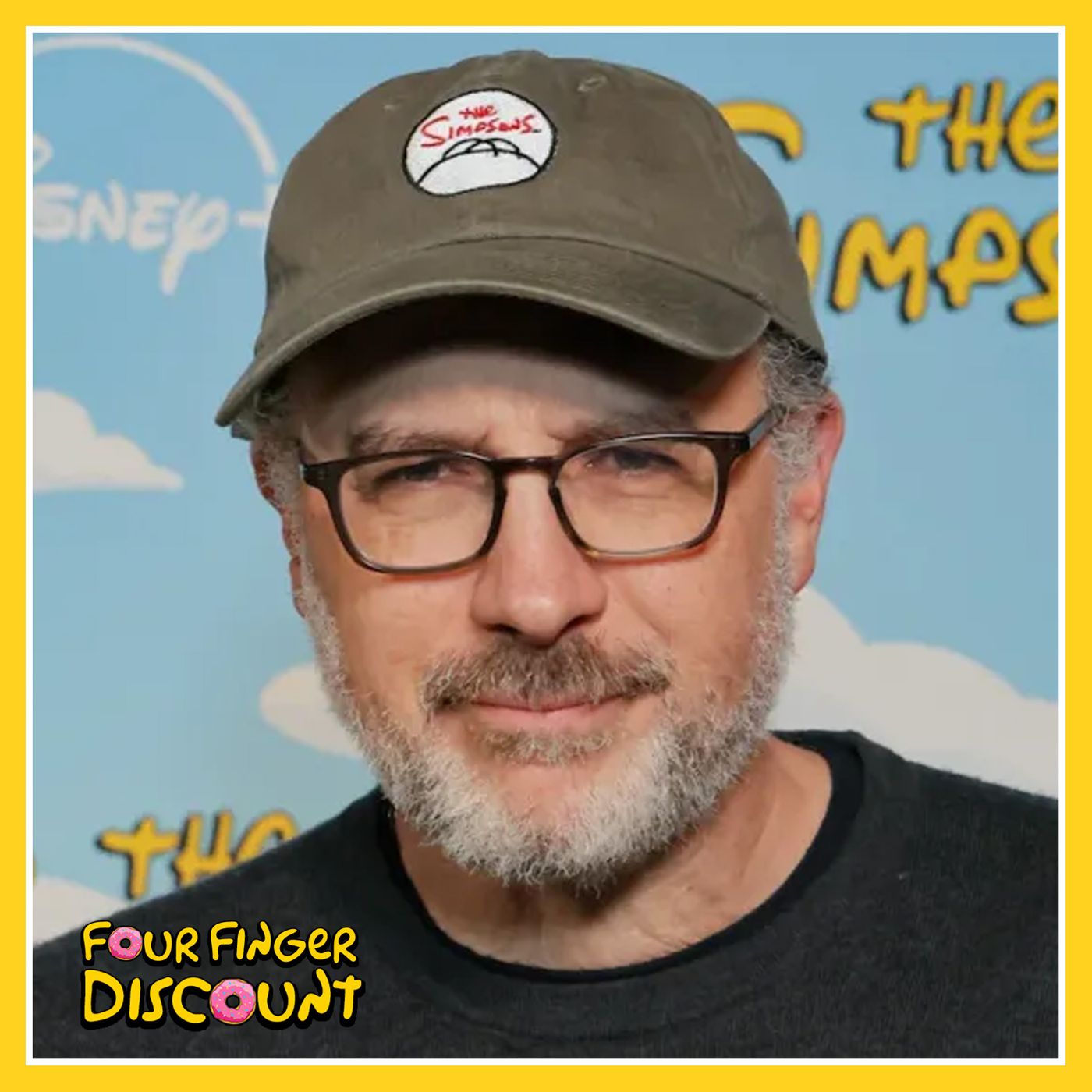
So It's Come To This: Another Matt Selman Interview (Simpsons Showrunner)
Simpsons kingpin Matt Selman returns to the show this week, except this time he's the one calling ALL the shots!
We discuss the life of a Simpsons showrunner in 2026, updates on the new Simpsons Movie, the transition with Al Jean, the worst TV finales, upcoming Disney Plus exclusive episodes, why The Simpsons no longer have couch gags and more!
Support the show on Patreon at patreon.com/fourfingerdiscount
Listen on Spotify - spoti.fi/4fDcSY0
Listen on Apple Podcasts - apple.co/4dgpW3Z
CHECK OUT OUR OTHER PODCASTS:
Goin' Down To South Park - spreaker.com/show/goin-down-to-south-park
The Movie Guide with Maltin & Davis - themovieguidepodcast.com
The One About Friends - spreaker.com/show/the-one-about-friends-podcast
Talking Seinfeld - spreaker.com/show/talking-seinfeld
SpeaKing Of The Hill - spreaker.com/show/speaking-of-the-hill-a-king-of-the-hill-
The Office Talk - spreaker.com/show/the-office-talk-podcast
Become a supporter of this podcast: https://www.spreaker.com/podcast/four-finger-discount-simpsons-podcast--5828977/support.
We discuss the life of a Simpsons showrunner in 2026, updates on the new Simpsons Movie, the transition with Al Jean, the worst TV finales, upcoming Disney Plus exclusive episodes, why The Simpsons no longer have couch gags and more!
Support the show on Patreon at patreon.com/fourfingerdiscount
Listen on Spotify - spoti.fi/4fDcSY0
Listen on Apple Podcasts - apple.co/4dgpW3Z
CHECK OUT OUR OTHER PODCASTS:
Goin' Down To South Park - spreaker.com/show/goin-down-to-south-park
The Movie Guide with Maltin & Davis - themovieguidepodcast.com
The One About Friends - spreaker.com/show/the-one-about-friends-podcast
Talking Seinfeld - spreaker.com/show/talking-seinfeld
SpeaKing Of The Hill - spreaker.com/show/speaking-of-the-hill-a-king-of-the-hill-
The Office Talk - spreaker.com/show/the-office-talk-podcast
Become a supporter of this podcast: https://www.spreaker.com/podcast/four-finger-discount-simpsons-podcast--5828977/support.
2026-04-10
55 min
Transcript
Available Results
Generated results are saved to the knowledge database for reuse and search.
No generated results are available for this episode yet.
Extract Knowledge
Pick what you want extracted first. Model, scope, and chapter options appear after a template is selected.
Generated results for public episodes are saved to the knowledge database so they can be reused and searched later.
Transcript
<v Speaker 1>Four finger Discount.
<v Speaker 2>Dude, Hey, eybody, welcome to four Finger Discount with this
<v Speaker 2>is what. We were joined by the Grand Pooba, the
<v Speaker 2>head honcho of the Simpsons. It is Matt Salmon. How
<v Speaker 2>are you doing so?
<v Speaker 3>What's up? How you guys doing how? I can't see
<v Speaker 3>guy's feet? Hold on? This is hold on.
<v Speaker 1>It's because I'm continually sidelined by Dan, though he is
<v Speaker 1>holding the spotlight from day one.
<v Speaker 3>I'm going to take the opinion that I've never seen
<v Speaker 3>one episode of seasons one through eight.
<v Speaker 2>I'm sure that the news website will take that as
<v Speaker 2>actual news. That's what they tend to get. Walk a
<v Speaker 2>little quote from you and just run while with it,
<v Speaker 2>because now, what's the latest one? It was? Simpsons showrunner
<v Speaker 2>says the season the show will never have a finale.
<v Speaker 2>That was the latest one.
<v Speaker 3>Well, I do agree that it will hopefully will never
<v Speaker 3>have a probably I'll never a lane finale. Yeah that's all.
<v Speaker 3>I may or may not have a last episode, but
<v Speaker 3>I just doesn't have a lame finale that tries to
<v Speaker 3>sum everything up. And you know I'm on the record
<v Speaker 3>about that. But also, all of a sudden will be
<v Speaker 3>someone else's decision. So that's also their problem. Maybe they
<v Speaker 3>could do every they could do all they could have
<v Speaker 3>it be Bart graduates fourth grade and Turns eleven and
<v Speaker 3>Milhouse all that stuff. Everyone gets to be better but themselves.
<v Speaker 2>What a good shipe.
<v Speaker 1>Finales. As far as the O consent, do you do
<v Speaker 1>you have any of that sort of leap out? It
<v Speaker 1>was like, oh, they stuck the landing on that one.
<v Speaker 3>I can't remember any shows.
<v Speaker 2>What is television?
<v Speaker 3>I don't think the Cheers one was that good. I
<v Speaker 3>just don't think TV shows are supposed to end, so
<v Speaker 3>like idea that you're doing an unnatural The end is
<v Speaker 3>not natural because they're especially like classic TV shows are
<v Speaker 3>supposed to go on forever and make everyone print money forever,
<v Speaker 3>like the Simpsons, like a giant ATM. So then all
<v Speaker 3>of a sudden, you're doing a different kind of storytelling
<v Speaker 3>for this last episode about the premise of the SHO
<v Speaker 3>show has shifted to a new and that everyone is
<v Speaker 3>the reason they see each other no longer exists. It's unnatural.
<v Speaker 1>I think in the two thousands and maybe in the
<v Speaker 1>twenty tens, you know, you got this whole presstage TV
<v Speaker 1>thing going on, and you had a lot of critics
<v Speaker 1>and pundits going. You know, TV shows are the new novels,
<v Speaker 1>and you had a lot of people thinking, oh, well,
<v Speaker 1>I'm creating a work of art here, and I need
<v Speaker 1>to put a full stop on it if I may,
<v Speaker 1>if I am doing a final episode, and I reckon.
<v Speaker 1>There are some shows that actually did that pretty well.
<v Speaker 1>But yeah, you're right in that. Yeah, television is generally
<v Speaker 1>a thing that just keep going, keeps going and keeps going.
<v Speaker 3>Like dramas. I mean, dramas are their own thing, But
<v Speaker 3>for like half hour comedies, I don't think there are
<v Speaker 3>any good last episodes. And I say that not being
<v Speaker 3>able to think of any that ever happened. So with
<v Speaker 3>a sample size of zero in my memory, there are
<v Speaker 3>no good last episodes of any half hour comedy because
<v Speaker 3>they all do the thing the show wasn't supposed to do,
<v Speaker 3>which is end the show. Because they always to say
<v Speaker 3>we're gonna end the show rather than just a good episode,
<v Speaker 3>it is the last episode, and Nick, you never know
<v Speaker 3>what happens. Then this is a new theory I just
<v Speaker 3>thought of in the moment. So I don't know if
<v Speaker 3>I believe.
<v Speaker 2>It, but hell, the job of selling.
<v Speaker 3>It, I don't think any half hour finale has ever
<v Speaker 3>been good that tried to fundamentally shift the premise of
<v Speaker 3>the show, And I can't think of any examples to
<v Speaker 3>prove or disprove my theory.
<v Speaker 2>Well, one thing I always fall back on is the
<v Speaker 2>Raymond finale. I really enjoyed because it was just essentially
<v Speaker 2>another episode and and with them just sitting around the
<v Speaker 2>dinner table having family dinner.
<v Speaker 3>That's a great finale. That there you go, that one.
<v Speaker 3>Any of the ones that, like, you close the bar,
<v Speaker 3>you left Korea, those are the two. That's the only two.
<v Speaker 3>I've only seen two shows in my life, Cheers and
<v Speaker 3>Mash Murphy Brown Dies by murder suicide. Like all those
<v Speaker 3>finalees are, they're not good. I mean, I guess the
<v Speaker 3>Mash one makes sense historically, but I don't know was Mash.
<v Speaker 2>No.
<v Speaker 3>One listening to this knows what mashes.
<v Speaker 2>I mean, I know it mashes. It's one of my
<v Speaker 2>favorite shows, but I'm sure there are a lot of
<v Speaker 2>people that don't really talk about Mash anymore.
<v Speaker 3>You're right, yeah, yeah, anyway, I'm starting off with a bang.
<v Speaker 1>No, but sure you count and spicy and hot. It's fantastic.
<v Speaker 2>I wanted to recently have the eight hundred episode. That's
<v Speaker 2>that's another thing not many shows do is eight hundred episodes.
<v Speaker 2>So you get the launch party? Is it the Fonder theater?
<v Speaker 2>Fonder the theater named after?
<v Speaker 3>Refinder? It was as a Bridget funder Actually don't know
<v Speaker 3>that his granddaughter.
<v Speaker 1>Do you think that's a take that's going to resonate
<v Speaker 1>with the younger warning? Is they going to go, who
<v Speaker 1>the hell's Bridget funds.
<v Speaker 2>For us singles?
<v Speaker 1>And Jackie Brown fans? That really hurts. But at the
<v Speaker 1>same time.
<v Speaker 3>Any all the finders, it's hard to grow up and
<v Speaker 3>show biz, right, guys? You know you can do that?
<v Speaker 2>Do you guys? Get to lay your like just relax
<v Speaker 2>and just sort of hang out outside of work. Very
<v Speaker 2>often the entire crew like that or is that just
<v Speaker 2>is that something only comes on a rare occasion not.
<v Speaker 3>That often because the animators are live far away and
<v Speaker 3>are only semi Sometimes they come to work. Sometimes they
<v Speaker 3>work at home, but they they don't come in all
<v Speaker 3>the time, and when they do, they're in office that's
<v Speaker 3>an hour from my office. I think those parties are great.
<v Speaker 3>I mean, for me, the main goal of those parties
<v Speaker 3>is to talk to as many of the crew as possible,
<v Speaker 3>like tell them they're doing an awesome job, which they are.
<v Speaker 3>So like people who I've never met, or the people
<v Speaker 3>who I rarely meet or I see on zooms to like,
<v Speaker 3>you know, say you know, I know this is a
<v Speaker 3>hard job and you're really doing excellent work, which they are.
<v Speaker 1>Is there kind of a secret handshake among people who
<v Speaker 1>work on the sensors or have worked on the sensors
<v Speaker 1>or is it kind of a hierarchical thing where it's
<v Speaker 1>you know, you're coming in like mister Burns and saying
<v Speaker 1>well done everyone, as opposed to just like, hey, whirlling
<v Speaker 1>this together. Well, I don't mean that as a gotcha question, Matt.
<v Speaker 3>They probably think I'm like mister Burns. I think we wait,
<v Speaker 3>we're all in this together. But hey, you laugh at
<v Speaker 3>all my jokes. I must be so funny. Oh wait,
<v Speaker 3>mister Burns.
<v Speaker 2>What's it like now being that you have the Soul showruner?
<v Speaker 2>They're correct, you've finally taken that mantle. How has your
<v Speaker 2>job changed, if at all, in the last season.
<v Speaker 3>But more delegation, more trusting the people under me to
<v Speaker 3>be great, which they are, more like letting them, you know,
<v Speaker 3>come to me with ideas or make big decisions, and
<v Speaker 3>me saying, hey, if you feel strongly about that, you're
<v Speaker 3>just as talented or smart as I am, if not
<v Speaker 3>more so. So I don't have to be the arbiter
<v Speaker 3>of every decision like why am I smarter or better?
<v Speaker 3>I'm not, So it's just either to me. Again, this
<v Speaker 3>is my distorted perspective. It's more delegation, more trust, more
<v Speaker 3>empowerment of the great writing staff and producing staff and
<v Speaker 3>animating staff. But maybe they think it is No, he's
<v Speaker 3>an obnoxious, multi obnoxious, micromanaging nutcase. We have to tender
<v Speaker 3>to think all these ideas are good. So one of
<v Speaker 3>those two things.
<v Speaker 1>Did that transition into the delegator the micromanager?
<v Speaker 2>Your words up mine? Did that come? Do you?
<v Speaker 1>Did you feel like a noticeable shift in the oh
<v Speaker 1>this is what I do now or this is part
<v Speaker 1>of my job now? Or did this sort of happen
<v Speaker 1>so gradually, you know, did you become a hardcore networks
<v Speaker 1>gradually that you didn't even notice?
<v Speaker 3>Ah, good reference, It happened over time, but there definitely
<v Speaker 3>when there was probably one point at which I was
<v Speaker 3>doing I went from going like to doing like half
<v Speaker 3>the shows to a bigger chunk of the shows where
<v Speaker 3>I really had to institute a system of hierarchical delegation
<v Speaker 3>that was different than what had come before. And that
<v Speaker 3>was where we kind of promoted Rob Leazebnik, Tim Long,
<v Speaker 3>Mike Price, Caroinomine, Brian Kelly. Tim Long I already said
<v Speaker 3>and says our mesaiegos in different capacities to really, you know,
<v Speaker 3>be in charge of episodes under the umbrella of me.
<v Speaker 3>So when that happened, you know, that was like a
<v Speaker 3>big shift for sure, where like I, you know, I'm
<v Speaker 3>heavily involved with every show, but I can't be as
<v Speaker 3>heavily involved as I was before I had to. And
<v Speaker 3>those people we call the co runners, which I think
<v Speaker 3>is a great term. You guys aren't like from Hollywood
<v Speaker 3>that much. So in Hollywood people are loath to share credit.
<v Speaker 3>I personally don't need any credit. Credit is credit isn't
<v Speaker 3>really worth anything. So I like to give it away
<v Speaker 3>to people who deserve it, because they do deserve it.
<v Speaker 3>So people say to me, don't use the term co runner.
<v Speaker 3>People will think you don't do everything. I'm like, I
<v Speaker 3>don't do everything, ridiculous. I go home at night, see
<v Speaker 3>my wife, my kids like my father. Here's a little backstory,
<v Speaker 3>guys at emotional backstore that's unpacked this. My father was
<v Speaker 3>a professor of early childhood and human development for fifty
<v Speaker 3>years at a little school called Harvard University Community College,
<v Speaker 3>right community college. And growing up in the academic world
<v Speaker 3>where there's very little money for anything, there's massive fights
<v Speaker 3>and arguments and political stuff over who gets credit, who
<v Speaker 3>gets credit for the papers, whose name is on the grants,
<v Speaker 3>whose name is on the book, you know who? You know,
<v Speaker 3>which associates and which grad students, And huge fights and
<v Speaker 3>schisms and political ego wars over who gets the credit
<v Speaker 3>for the for the academic work, right, And my dad
<v Speaker 3>was always like, who cares? Everyone put everyone whose name
<v Speaker 3>on there, who worked on it, We all worked on
<v Speaker 3>it together, Like doesn't hurt me. I'm I'm in a
<v Speaker 3>retirement home now, No one one way or the other.
<v Speaker 3>No one cared if my name had other names with
<v Speaker 3>it for these books and papers and grants and proposals
<v Speaker 3>and you know, academic research that I did. Like, just
<v Speaker 3>we all worked on it together. Let's let the world though,
<v Speaker 3>there's no downside. And so I took that to heart
<v Speaker 3>at this Simpsons, so I try to be ultra transparent
<v Speaker 3>about the degree to which this is a super collaboration.
<v Speaker 2>Before you were the show runner, did you feel that
<v Speaker 2>that was the mantra always at the Simpsons, that whoever's
<v Speaker 2>in charge is always willing to sort of share the credit.
<v Speaker 3>I don't know who's to say that, love is saying volumes, man,
<v Speaker 3>I just I don't. I think Al was great with you. No,
<v Speaker 3>I think Al was terrific about that. It's just I
<v Speaker 3>really I'm like ultra crazy about being ultra transparent. I mean,
<v Speaker 3>Al did an amazing job for so many years, making
<v Speaker 3>so many great episodes, and he always would give us credit,
<v Speaker 3>like if you know, he'll also I would think role
<v Speaker 3>modeled positive credit sharing a one hundred percent that to.
<v Speaker 2>The best of your experience.
<v Speaker 1>I mean, even just having the Simpsons on your resume,
<v Speaker 1>on your save a, even if it didn't have like
<v Speaker 1>an official title next to it, would that's still give
<v Speaker 1>you a bit of clout if you were sort of
<v Speaker 1>like going for other jobs, or if you were just
<v Speaker 1>saying to people, hey, I work on the Simpsons or yeah,
<v Speaker 1>even even if it's not I'm a showrunner or I'm
<v Speaker 1>a producer, or whatever. I mean, just having having the
<v Speaker 1>title on your as part of your body of work.
<v Speaker 1>I mean, does that like holy shit? That Matt Selman?
<v Speaker 2>Wow?
<v Speaker 3>I don't know. I think it looks okay. I mean
<v Speaker 3>TV is so in a shrunken, desiccated state in that
<v Speaker 3>there's more qualified applicants for every writing job than there
<v Speaker 3>are writing jobs that I don't think there's any credit
<v Speaker 3>that gets you hired just the credit. It really has
<v Speaker 3>to be outstanding material, outstanding recommendations, extending personal experience with
<v Speaker 3>that writer, and probably five other things that are to
<v Speaker 3>get you that writing job. So am I holding my
<v Speaker 3>breath for future writing jobs after the Simpsons end? I
<v Speaker 3>am not. And you know what, I've had a great run,
<v Speaker 3>so I'm not super stressed about it at the moment,
<v Speaker 3>but I mean a little bit. It's also such an
<v Speaker 3>old show. Simpsons writers are somewhat of an an unknown
<v Speaker 3>quantity in the rest of regular television. But we're a
<v Speaker 3>little bit like off on our own crazy Galapagos island,
<v Speaker 3>and we have operated with our own evolutionary system, and
<v Speaker 3>we have our own strange animals and different plants and
<v Speaker 3>floras and faunas that you know, we're not part of
<v Speaker 3>kind of traditional TV where you jump from job to
<v Speaker 3>job and you write pilots, and you know a lot
<v Speaker 3>of executives, and you pitch a lot of shows and
<v Speaker 3>some of them you write a script, and some of
<v Speaker 3>them are a pilot, and some of them are a show,
<v Speaker 3>and so then maybe you're successful and you have a
<v Speaker 3>kind of an overall deal. Like words, we really just
<v Speaker 3>do this one thing on the Homer's Galopagas Island. So
<v Speaker 3>I'm not sure what the rest of showbiz thinks of
<v Speaker 3>us the show as a credit in terms of future jobs.
<v Speaker 3>Sometimes I think it might be like they think we
<v Speaker 3>worked on Sesame Street because it was something from their childhoods.
<v Speaker 3>So like the executives are now, let's say the executives
<v Speaker 3>are thirty. So if I say I worked on the Simpsons,
<v Speaker 3>They're like, oh, you worked on Powerpuff Girls right from
<v Speaker 3>when they were kids.
<v Speaker 1>Didn't that show starting black and White? Yeah, it was
<v Speaker 1>something like that.
<v Speaker 3>Never count on anything. That would be my advice to
<v Speaker 3>all your listeners. Always assume this is your last job.
<v Speaker 3>I always assume every job is the last time anyone
<v Speaker 3>will ever pay.
<v Speaker 2>What's the turnover? Like with the writer's room these days,
<v Speaker 2>zero turnover. Yes, do mayb people leave the Simpsons once
<v Speaker 2>they joined the Simpsons.
<v Speaker 3>Nobody leaves. Everyone who left regrets it, every single one
<v Speaker 3>of them except for Greg Daniels and Cod and O'Brien.
<v Speaker 2>Well, we had Josh once once staying on the show racially,
<v Speaker 2>and he said he regrets leaving the show because he
<v Speaker 2>just expected. I mean, that was twenty plus years ago now,
<v Speaker 2>but he thought, well, I've been I've run the Simpsons
<v Speaker 2>onto bigger and better things. Now I can take on
<v Speaker 2>the world. And he said, once he left the Simpsons,
<v Speaker 2>he realized, Oh, the Simpsons, as you said, it is
<v Speaker 2>on its own island, in its own bubble. Once you're there,
<v Speaker 2>never get off it. You should just stay there forever.
<v Speaker 3>Yeah, I know that was a that was a mistake.
<v Speaker 3>Like it worked out for me.
<v Speaker 2>It did.
<v Speaker 3>Indeed everyone else made worked out for me.
<v Speaker 2>The next milestone is that because you guys obviously see
<v Speaker 2>milestones yet, but the four to fiftieth episode, the seven
<v Speaker 2>hundred to eight hundred is the next one. The movie
<v Speaker 2>is that the next milestone we're taking off? Yes, eventually.
<v Speaker 3>Milestone or perhaps forgive this wordplay milestone or perhaps millstone
<v Speaker 3>will see Yes, how.
<v Speaker 2>Have you guys learned to balance the workload from the
<v Speaker 2>first one, if you've learned anything at all.
<v Speaker 3>It's just like, well, I can only work when I'm awake,
<v Speaker 3>so I don't feel bad for not working more hours
<v Speaker 3>than i'm a week.
<v Speaker 2>Is it stressful? Do you find it? You're more just
<v Speaker 2>the team in general, just sort of can you feel
<v Speaker 2>that there's a movie being made at the same time
<v Speaker 2>At the moment.
<v Speaker 3>I think it feels good. I think it feels really fun.
<v Speaker 3>Everyone knows the movie is going to be terrific and
<v Speaker 3>that it's going to kind of give the show a boost.
<v Speaker 3>I think we have a good balance right now. Yeah,
<v Speaker 3>and assuming the Millstone effect does not drowned me in
<v Speaker 3>a sea of craziness?
<v Speaker 2>Was a pushback due to scheduling conflicts? Was a pushback
<v Speaker 2>to give you guys all time?
<v Speaker 3>What pushback? Where's the pushback?
<v Speaker 2>Is there a pushback?
<v Speaker 3>What do you know? What have you heard?
<v Speaker 2>I've heard many things now, so originally July in now September,
<v Speaker 2>so it's only three months delay.
<v Speaker 3>But well, you know, I just corporations have their chess
<v Speaker 3>games that I don't second guess those moves all this.
<v Speaker 3>They have their ways, They they know what's best. Corporations
<v Speaker 3>knows what's best. I just I just work on the
<v Speaker 3>stories and the Fortnite collaborations. You go on that you
<v Speaker 3>I gently supervised it, But Jeff Westbrook and Ryan Coe
<v Speaker 3>did all the did all of the creative on our side,
<v Speaker 3>and but also the Fortnite people did a ton of
<v Speaker 3>great creative on their side. It was a really they
<v Speaker 3>really went above and beyond the call of duty. Hopefully
<v Speaker 3>there will not be a Simpson's call of duty level that.
<v Speaker 2>It got made to actually find out what Fortnite actually was.
<v Speaker 2>I didn't even know what Fortnite was, and I downloaded
<v Speaker 2>and played it and I enjoyed it. So did you
<v Speaker 2>play it at all?
<v Speaker 3>I dipped my toe? Yeah, But as a fifty four
<v Speaker 3>year old man being sniped by a thirteen year old
<v Speaker 3>and not knowing what the hell just happened, it gets
<v Speaker 3>old pretty fast. So the frustration factor is maybe the
<v Speaker 3>Simpsons next collab should be with the New New York
<v Speaker 3>Times crossword puzzle excuse me, scrabble ripoff called cross play
<v Speaker 3>that maybe I could hold my own at. It's like,
<v Speaker 3>you know, the New York Times is main revenue source
<v Speaker 3>these days is games so they have this game called
<v Speaker 3>cross play that's like a it's like a scrabble ripoff.
<v Speaker 2>I'm sure, So do you in Price have a game
<v Speaker 2>going at the moment?
<v Speaker 3>Or Price and I have played, Although then I feel
<v Speaker 3>like bad that I'm distracting him from work and he's
<v Speaker 3>distracting me from work. So I just if Rando's challenge me,
<v Speaker 3>I will, I will fight them.
<v Speaker 2>Is there time for the you say distractions? But is
<v Speaker 2>there time for just general knucking around? At the Simpsons?
<v Speaker 3>You can't make a show without mucking around. If you
<v Speaker 3>don't muck, it's like a It's like a machine with
<v Speaker 3>no oil. The gears grind and everything sparks and the
<v Speaker 3>whole engine collapses. Everyone involved in a creative enterprise knows
<v Speaker 3>that mucking is a muck is a crucial lubricant for
<v Speaker 3>creativity and collaboration.
<v Speaker 1>Having said that, I mean, is there a time when
<v Speaker 1>you're like, that's too much muck?
<v Speaker 2>Guys?
<v Speaker 1>We need to uh, you know, the machine's running smoothly.
<v Speaker 1>Now let's let's make some widgets.
<v Speaker 3>I don't want to overmuck the machine, but like it's animation,
<v Speaker 3>we're not building sets tomorrow another and then shooting it
<v Speaker 3>and then that's it. You get a lot of bites
<v Speaker 3>at the apple or swings at the cricket bat. And
<v Speaker 3>do you guys play cricket?
<v Speaker 2>We do?
<v Speaker 3>Yeah, all right, talk you call them swings? What do
<v Speaker 3>you call them? Pitches?
<v Speaker 2>Swing? Swing the bat on the cricket pitch, Yes, but.
<v Speaker 3>The pitches like the grass is the field?
<v Speaker 2>Yes, what do you call that?
<v Speaker 3>What do you call when they throw the underhound ball?
<v Speaker 2>That's a ball? So you bowl the ball down the
<v Speaker 2>pitch which is the rectangle bit in the middle of
<v Speaker 2>the field.
<v Speaker 3>Yeah, should we had a lot of balls at the back.
<v Speaker 2>Did you learn about cricket because of the Bluey episode?
<v Speaker 3>No, but we do have a we have a cricket
<v Speaker 3>thing in an upcoming Simpsons episode.
<v Speaker 2>We were gonna just because we discussed this on a
<v Speaker 2>podcast about six months ago. We said the Simpsons need
<v Speaker 2>to do a cricket episode. So finally cricket episode. But
<v Speaker 2>there's a cricket gag.
<v Speaker 3>Oh, for sure, there's a cricket scene.
<v Speaker 2>Because we're talking about obviously this is not going to happen,
<v Speaker 2>but we were talking about I think it was with
<v Speaker 2>with We'll maybe Bill Oakley or one of the guests
<v Speaker 2>and he was talking about how we can bring back
<v Speaker 2>a poop if a poop was ever going to be
<v Speaker 2>brought back, And cricket is essentially the sport of India,
<v Speaker 2>so we thought a cricket tie in with India could
<v Speaker 2>be a waye fun way to bring a poop back
<v Speaker 2>for a guest appearance or whatnot.
<v Speaker 3>It could be interesting.
<v Speaker 2>Yeah, but we'll see it happen. But with the Simpsons,
<v Speaker 2>obviously we're not going to get any datails. I'm not
<v Speaker 2>going to ask for daytiles that that's just silliness. But
<v Speaker 2>unless you want to give this data. But my question
<v Speaker 2>is that surely, well, how will it differ at all
<v Speaker 2>from the first one? Will it be structure? Tone? What
<v Speaker 2>are you able to discuss that at all? Or is
<v Speaker 2>it just no?
<v Speaker 3>I don't know. It just has to be funny and
<v Speaker 3>emotional and exciting, and it has to deliver something that
<v Speaker 3>you can't get watching at home, right, because that's the challenge.
<v Speaker 3>One of the advantages you have in a movie like
<v Speaker 3>this is that most of your audience will know and
<v Speaker 3>care about the character, the main characters at least, which
<v Speaker 3>is for a new movie, to make people know who
<v Speaker 3>the characters are and care about what the characters want
<v Speaker 3>and suffer when the characters are suffering. That's hard to
<v Speaker 3>do because you're starting from nothing. We are not starting
<v Speaker 3>from nothing, so that's an advantage we have. A disadvantage
<v Speaker 3>we have is what are we delivering that is supremely
<v Speaker 3>above and beyond the twenty one minute movie that we
<v Speaker 3>put on TV every week. So I guess it's the
<v Speaker 3>same challenge as the first and we'll see you guys
<v Speaker 3>can decide when you see it. If do you guys
<v Speaker 3>celebrate Labor Day, Well.
<v Speaker 2>We have our in version of labor day. Yeah, I
<v Speaker 2>think every country has a labor day just to day
<v Speaker 2>don't have to go to work. But what what do
<v Speaker 2>you think audiences, cinema movie audiences want now compared to
<v Speaker 2>what they wanted back in two thousand and seven.
<v Speaker 3>You know, it's it's interesting. It's a good question because,
<v Speaker 3>you know, the comedy as a cinematic in theater form
<v Speaker 3>is not exactly thriving. Although movies like jed Pool and
<v Speaker 3>Wolverine and Barbie and a lot of the you know
<v Speaker 3>and say you know, Zootopia and those types of big
<v Speaker 3>franchise movies are comedies with great jokes and producers thinking
<v Speaker 3>about it as comedies throughout the whole movie, Like, is
<v Speaker 3>this funny? Is the audience laughing? Right? But the number
<v Speaker 3>of comedies that are just comedies like Jeth Green and
<v Speaker 3>Jack open a mushroom shop together and get in Trouble
<v Speaker 3>with the Mob or whatever like they used to make,
<v Speaker 3>they don't make a lot of those. They're just so
<v Speaker 3>it's kind of and it's a concern that the younger
<v Speaker 3>audience that doesn't even value communal laughter as an experience, right.
<v Speaker 3>I mean, they tried to reboot Naked Gun and I
<v Speaker 3>thought it was pretty good, and I saw it with
<v Speaker 3>an audience and we were all laughing pretty good, and
<v Speaker 3>there was a good experience, But you know, it's not
<v Speaker 3>part of the sociological experiment known as cinema anymore, right,
<v Speaker 3>or the large part. I mean, it's a bummer, A
<v Speaker 3>lot of bummers these days anyway. So hopefully, you know,
<v Speaker 3>our challenge is to like break through that and be like,
<v Speaker 3>this is a big animated comedy that is full of
<v Speaker 3>funny characters and who you care about, with visual and emotional, satirical, slapstick,
<v Speaker 3>absurdist comedy throughout, and that you the audience, are enjoying
<v Speaker 3>laughing with other Simpsons fans or Simpson's non fans who
<v Speaker 3>accidentally went to this movie thinking it was Bluey and whatever.
<v Speaker 3>So like, that's the challenge.
<v Speaker 1>Challenge accepted, man, I push back against the communal comedy
<v Speaker 1>aspect that you're just talking about.
<v Speaker 2>Although I think it's shifted. I think I'm wrong.
<v Speaker 3>Please let me be wrong.
<v Speaker 1>Not wrong so much as you just need to adjust
<v Speaker 1>your way of thinking. Now, comedy still exists in the
<v Speaker 1>form of like say, tiktoks or reels or something like that.
<v Speaker 1>And when it's and it's shared, you know, via meme
<v Speaker 1>culture or whatever, and that's kind of like the communal
<v Speaker 1>thing as opposed to we're all sitting in the same
<v Speaker 1>dark room and laughing at the same jokes. The jokes
<v Speaker 1>just move at the speed of a clique. Essentially.
<v Speaker 3>Yes, what I'm really lamenting is a change in the
<v Speaker 3>way people consume comedy, not that comedy doesn't exist. I mean,
<v Speaker 3>now everyone in the world is a semi professional comedian
<v Speaker 3>with their funny instagrams and their funny social stuff and
<v Speaker 3>their funny tiktoks, And where young people consume it is
<v Speaker 3>through sharing and forwarding and liking. And but that's still
<v Speaker 3>we're still losing the feeling of laughing, Like when I
<v Speaker 3>want to see bor At with an audience in two thousand,
<v Speaker 3>I don't know whatever, nineteen oh five when I went
<v Speaker 3>to go see bor At and like there was that
<v Speaker 3>big crazy nude wrestling scene with his ass in the
<v Speaker 3>other guy's face, like, and the audience is losing their mind.
<v Speaker 3>Like as any young person under the age of twenty
<v Speaker 3>ever had that experience, do they care? I mean, they
<v Speaker 3>still have it for horror movies, right, they all like
<v Speaker 3>to be scared together. That still exists, and they like
<v Speaker 3>to be scared in the theater in addition to being
<v Speaker 3>scared at home. But the laughing and the laughter building
<v Speaker 3>and like feeling that other people laughing with this is
<v Speaker 3>is what's lost. But yeah, no, comedy still exists. Oh
<v Speaker 3>it's it's everywhere. Everyone, I mean everyone's everyone is. Everyone
<v Speaker 3>does it and he usually makes it for free.
<v Speaker 1>And I'm wondering with that, do you not just you personally,
<v Speaker 1>but the people that you work with or the comedy
<v Speaker 1>community in general, the professional comedy community, do you sort
<v Speaker 1>of have to just your approach or your way of
<v Speaker 1>thinking as a result.
<v Speaker 3>Well, you know, I guess we could release the movie
<v Speaker 3>as a micro drama vertical microdrama in like thirty second chunks.
<v Speaker 3>Wouldn't be surprised if somebody say, bus said, we're doing
<v Speaker 3>the next this is a micro drama now, so we're
<v Speaker 3>just doing it in a ninety five chapters if five
<v Speaker 3>one minute chapters vertical forgive me.
<v Speaker 1>Yeah, I'm not talking about the sensits so much when
<v Speaker 1>I say this, but I mean you will see that.
<v Speaker 1>You know, certain shows are made and even the way
<v Speaker 1>they shot, like, oh, you've shot this with everything in
<v Speaker 1>the center of the frame, so it can be easily
<v Speaker 1>clipped and turned into a TikTok with something like that.
<v Speaker 3>Also a very smart quay. I don't know the answer
<v Speaker 3>to that question. I'm sure people that are in the
<v Speaker 3>real world of trying to create new things as opposed
<v Speaker 3>to trying to sustain old things, which is what I do,
<v Speaker 3>deal with that question every day. And similar to Lily,
<v Speaker 3>the question is if you know the product you're making
<v Speaker 3>is most likely being consumed while someone is also looking
<v Speaker 3>at their phone in their house, how do you have
<v Speaker 3>to do? How is the storytelling adjusted, how is the
<v Speaker 3>comedy different? How is anything different? I mean, I tell
<v Speaker 3>my kids. Watching TV with your phone in a different
<v Speaker 3>room is like reading now, Like, oh, look, I'm so
<v Speaker 3>proud of my kids. They're watching TV with their phones
<v Speaker 3>in a different room. That's so good for their brains,
<v Speaker 3>as opposed to I'm so proud of them they're reading books.
<v Speaker 3>It's good for their brains.
<v Speaker 2>Because originally when the show went wide scream, when the
<v Speaker 2>movie started, when it went wid scream, it was a
<v Speaker 2>big deal, right, and it was it felt like for
<v Speaker 2>a good while then, and you're still doing it. You
<v Speaker 2>were trying to fill the screen with as many gags
<v Speaker 2>as possible. But now is it a mindset of like
<v Speaker 2>you said, you know, you're not really sure, but do
<v Speaker 2>you try and keep everything as cent a frame as possible?
<v Speaker 2>Because the United that's what's n.
<v Speaker 3>We don't think about that. I mean, we just put
<v Speaker 3>as many gags in as we think. Are we have
<v Speaker 3>energy to think of or are or are organic to
<v Speaker 3>the scene. To go back to your earlier question of
<v Speaker 3>like how the job is different now that I'm the showrunner.
<v Speaker 3>In those earlier days, when I was producing fewer episodes
<v Speaker 3>on my own, I had I could really have the
<v Speaker 3>energy just think about background jokes and details and oh,
<v Speaker 3>what are the twenty funny drinks on this menu? You
<v Speaker 3>see for one second that kind of stuff. Now I
<v Speaker 3>have to just hope other people bring that passion as well,
<v Speaker 3>because I don't have the bandwidth to think about, you know,
<v Speaker 3>making sure there's a menu with forty hilarious stupid cocktails
<v Speaker 3>you would never drink on it. But like there's a here, guys,
<v Speaker 3>let's talk about the Simpsons. There's an episode coming up
<v Speaker 3>that I think airs. Oh I'm wrong, I apologize. I
<v Speaker 3>think it airs April nineteenth, which.
<v Speaker 2>Is well Simpson's Day, guys, is it really?
<v Speaker 3>Ah?
<v Speaker 2>But obvious thing is to say we do it on
<v Speaker 2>the twentieth because we're day ahead. So yeah, so that's
<v Speaker 2>so that's going to be celebrating Wilson's Day in some
<v Speaker 2>way or is it just the case.
<v Speaker 3>Of if I'm wrong, I apologize to the Disney marketing
<v Speaker 3>team in advance. But I believe we are dropping a
<v Speaker 3>Disney Plus exclusive episode on that day that is a
<v Speaker 3>an other double episode. Is we did remember that Christmas
<v Speaker 3>one that Carowin produced and wrote I'll come, Oh, come
<v Speaker 3>on all faithful? That our first Disney Plus exclusive. So
<v Speaker 3>this is our fifth and sixth Disney Plus Exclusive. There's
<v Speaker 3>four on the Disney Plus app right now, so this
<v Speaker 3>will be number five and six. But it's a double.
<v Speaker 3>But what's really cool about it, and we've never done before,
<v Speaker 3>is that it's a trilogy, right like Halloween or we
<v Speaker 3>did other themed trilogies, Bible, Thanksgiving, Oracle Thanksgivings, Valentine's Day, Christmas,
<v Speaker 3>Christmas again. Revenge was one. You know, there's a lot
<v Speaker 3>of themes trilogies, but usually those are so it's really
<v Speaker 3>hard to fit. We did one with then art related ones.
<v Speaker 3>They're all pretty fun, and this is a trillo, but
<v Speaker 3>it has room to breathe. So each of the three
<v Speaker 3>segments is like eight minutes long, and the wrap around
<v Speaker 3>is like a real story, like a real episode story
<v Speaker 3>in and of itself. So there's like eight minutes of show,
<v Speaker 3>then an eight minute segment, then more show, you know,
<v Speaker 3>eight longer seven minute segment, show segment, show, so that,
<v Speaker 3>you know, but I think the whole thing's probably like
<v Speaker 3>it's even longer than two episodes because it's on streaming,
<v Speaker 3>so we're not really locked into.
<v Speaker 2>That commercial constraint.
<v Speaker 3>Personal constraint of like thirty or twenty forty or twenty
<v Speaker 3>one thirty depending how you look at it.
<v Speaker 2>So sounds like a mini movie.
<v Speaker 3>Let me see it is. Honestly, there is stuff in
<v Speaker 3>this that I was watching and I was like, could
<v Speaker 3>we just make this the movie? Like the file I
<v Speaker 3>have right here is forty five fifty six and.
<v Speaker 2>That that's the full episode and nothing cut from that. All.
<v Speaker 3>It might be slightly different, but it's it's almost forty
<v Speaker 3>six minutes.
<v Speaker 2>Do you find less picky when it comes to the
<v Speaker 2>editing side of things for the Disney Plus exclusive because
<v Speaker 2>you don't.
<v Speaker 3>Have to, Oh my god, the editing is a breeze.
<v Speaker 3>What we do is we go in when we're editing
<v Speaker 3>for Fox, we're cutting, we're editing for Disney Plus, we're extending.
<v Speaker 3>Let's pause on this, Let's create a moment. Let's let's
<v Speaker 3>hold to create comi comedy or tension or emotion or
<v Speaker 3>drama or whatever the scene demands. So yeah, so this
<v Speaker 3>is like very long. So it's one of our it's
<v Speaker 3>a trilogy with big pop cultural Simpson mashups. Oh there's
<v Speaker 3>mash ups. But it also is a legit a story
<v Speaker 3>with a wrap around about the family and then you
<v Speaker 3>know each of the three chunks is pretty long. We
<v Speaker 3>didn't have to like chop them up like we do
<v Speaker 3>with Halloween where they're so abbreviated. But the reason I'm
<v Speaker 3>even got on this tangent is there's a big pan
<v Speaker 3>across a kind of retro arcade, like a kind of
<v Speaker 3>nostalg arcade of and there's lots of funny video games
<v Speaker 3>that are full of Easter eggs and the kind of
<v Speaker 3>visual gags you guys were asking about before I went
<v Speaker 3>on this long winded digression. It's not only digression if
<v Speaker 3>it's about the topic of the podcast, which is the
<v Speaker 3>same as but but like, yeah, so we that was fun.
<v Speaker 3>And there's like some of like the old classic video
<v Speaker 3>games you know from the show, and then some new jokes,
<v Speaker 3>and then there's one this one writer's unbelievably funny, silly
<v Speaker 3>guy named John Frank, who's been on the show for
<v Speaker 3>twenty five thirty years. You always pitched this episode that
<v Speaker 3>was a very wild, kind of an Indiana Jones kind
<v Speaker 3>of show about called Nephertidi's Ale, about Moe locating some
<v Speaker 3>kind of lost magic beer called Nefertiti's Ale. And I
<v Speaker 3>don't remember many of the details, although I think it
<v Speaker 3>involved tattoos coming alive on your skin. And so there's
<v Speaker 3>a video game in this in this arcade called Nefertiti's Ale,
<v Speaker 3>So like, you know, we're having fun with with Easter
<v Speaker 3>eggs and actually this thing airs almost I don't know
<v Speaker 3>what Easter is, it's always different, but probably Easter adjacent. Right,
<v Speaker 3>April April's the easterreeest month, right, guys it.
<v Speaker 2>Is, It's the chocolate field month.
<v Speaker 1>Yeah, March is just you know, long and bleak and depressing,
<v Speaker 1>and then you get to April.
<v Speaker 3>April is the eastest month. We can all agree. Then
<v Speaker 3>May in maybe March distant, third October not in the running.
<v Speaker 2>So yeah, so you got the Simpsons Day special, we
<v Speaker 2>got the Frank story with the video arcade. But I
<v Speaker 2>was gonna ask you, so, do you find yourself just
<v Speaker 2>getting more excited for these Disney specials in the regular
<v Speaker 2>show sometimes because you just don't have these restraints of TV.
<v Speaker 3>You know, there's just a different kind of excitement. I
<v Speaker 3>mean there's a little more concern that you're, like, you
<v Speaker 3>want to make sure people find it because if it's
<v Speaker 3>only on streaming, and we only if it's not part
<v Speaker 3>of like the Beautiful post football American Football ratings hammock
<v Speaker 3>that we're in for like the rest of our network
<v Speaker 3>experience in America. There's these America that's he's think called
<v Speaker 3>TV networks. There's this guy named Rupert Murdoch. Maybe you've
<v Speaker 3>heard of him. Anyway, He's got this great network called
<v Speaker 3>Fox and we're on it.
<v Speaker 2>And how great does gift to the world?
<v Speaker 3>And I don't know, he's had a great run.
<v Speaker 2>And that little scrapa has a sense of.
<v Speaker 3>Humor, that's for sure. So yeah, so it's for these
<v Speaker 3>ones I really want there. They are special, They are
<v Speaker 3>a little more creatively. We think of them as slightly
<v Speaker 3>more parodies of like streaming, if you will, so like
<v Speaker 3>there are maybe less kind of regular episodes about the family.
<v Speaker 3>So the the ones we've dropped so far were the
<v Speaker 3>hour long Christmas one, which also me felt like a
<v Speaker 3>short movie and had a, you know, a kind of
<v Speaker 3>an epic feel. Then we did a one that was
<v Speaker 3>like a parody of the Animal Planet Blue Planet type
<v Speaker 3>documentaries that was obviously something you could see on streaming.
<v Speaker 3>We did kind of us more science fiction e one
<v Speaker 3>time traveling one with Lisa and mister.
<v Speaker 2>Burns, Joseph Gordon Levitt, right, that's Gordon.
<v Speaker 3>Have it exactly, and that like some of these even
<v Speaker 3>have little fake streamer graphics at the beginning to kind
<v Speaker 3>of say this is a parody of the kind of
<v Speaker 3>more weirder, artistic, ear strange, indulgent storytelling you would see
<v Speaker 3>on a streamer network rather than other stuff.
<v Speaker 2>But the thing is so with these with these specials though,
<v Speaker 2>So you're saying this one's forty five minutes long?
<v Speaker 3>It's forty five?
<v Speaker 2>Is there a month? Is there a mindset though of well,
<v Speaker 2>we can't go too long though, because you don't people
<v Speaker 2>to confuse this for the movie, because the movie is
<v Speaker 2>what what ninety minutes plus? I'm assuming, So it's like,
<v Speaker 2>we can't go Is there a month of we can't
<v Speaker 2>go over an hour? What's the what's the sort of
<v Speaker 2>the limit? Do you think, Well, we.
<v Speaker 3>Don't have the budget, we don't have any Our animation
<v Speaker 3>budget isn't any different. So it's really forty five would
<v Speaker 3>be the most we could ever get out of two,
<v Speaker 3>you know what I mean? It can't we can't spend
<v Speaker 3>infinite money. So there's there's there's there's a time budget,
<v Speaker 3>and there's like a money budget and can only afford
<v Speaker 3>to animate so much color animation. So this this this
<v Speaker 3>double trilogy or supersized trilogy, Homer size, it's called Homer
<v Speaker 3>size trilogy. I can't see one getting much longer than
<v Speaker 3>this sort of forty six minute.
<v Speaker 2>And I define if people want it to really I
<v Speaker 2>think that's probably enough, right.
<v Speaker 3>Probably not? And then the other two summer specials Disney
<v Speaker 3>Plus specials, those are just either of those are regular
<v Speaker 3>They're all regular size?
<v Speaker 2>Is that the plan going forward? Now? Less TV episodes
<v Speaker 2>and more specials? So to make the are they considered
<v Speaker 2>part of the season or is the season just shorter
<v Speaker 2>with specials? Now?
<v Speaker 3>Well, do we do seventeen new episodes a year, which
<v Speaker 3>is part of the production season? Fifteen of those airon
<v Speaker 3>Fox in the fall and two air on Disney Plus.
<v Speaker 3>Moving forward, so the four we have this summer are
<v Speaker 3>the leftover ones from season thirty six, thirty seven, thirty eight,
<v Speaker 3>thirty nine, forty fifteen new ones on Fox in the fall.
<v Speaker 3>That's our season. Again. I'm not sure how it works
<v Speaker 3>in Australia, but probably similar and then are so then
<v Speaker 3>we'll next summer we'll have two specials in the spring
<v Speaker 3>and summer when there's no new Simpsons on Fox TV
<v Speaker 3>on Disney.
<v Speaker 1>Plus, they sound like they're really hitting the sweet spot
<v Speaker 1>Matt in terms of given that not the Sandal generation
<v Speaker 1>X slash boomer, but you know, with short attention spans
<v Speaker 1>these days, a forty five minute special, a forty five
<v Speaker 1>minute sort of episode. As you're talking about it feels like,
<v Speaker 1>as you said, homicides feel like, Oh, I'm getting something
<v Speaker 1>special here, I'm really filling up. But at the same time,
<v Speaker 1>it's not so long. It's like, oh, this is a
<v Speaker 1>real drag on my time or a real time suck.
<v Speaker 3>I hope. So Plus, the one we have has it's
<v Speaker 3>like stories within stories, so it's not you don't have
<v Speaker 3>to you know, you generally don't have to track one
<v Speaker 3>story for forty five minutes. It's a it's a pretty
<v Speaker 3>basic family story that is the wrap around, but very
<v Speaker 3>sweet and the there's three very you'll know what we're
<v Speaker 3>making fun of. Let's just say that you're not You're
<v Speaker 3>not gonna have any what our targets are, one of
<v Speaker 3>which Family.
<v Speaker 2>Guy has already done pretty well.
<v Speaker 3>I love Family Guy. I mean the version was also
<v Speaker 3>very funny. Some of some of this exact same jokes,
<v Speaker 3>some different jokes.
<v Speaker 1>Did I read somewhere that you were considering or have
<v Speaker 1>even done like a rip off slash homage of the
<v Speaker 1>Netflix series Ripley, you know, which was old in that
<v Speaker 1>very Yeah, that stock black and white, which was yeah,
<v Speaker 1>which I really really enjoyed. It's like, oh, that's it.
<v Speaker 1>I want to say, it's a deep cut for you
<v Speaker 1>guys to do, but it's like, Oh, that's pretty. It's
<v Speaker 1>pretty interesting that you guys are tackling something like that.
<v Speaker 3>Well, I think you're gonna love it. That's another one
<v Speaker 3>of our summer specials this summer. It is cizarre. Maseriegos
<v Speaker 3>wrote and produced it, and it is a thing of beauty.
<v Speaker 3>It is so artistic. It is so the shots, the lighting,
<v Speaker 3>the camera work, the black and white, the art, the Europe,
<v Speaker 3>the dark, twisted humanity on display at its worst. It's
<v Speaker 3>so good. It's a really it's a deep homage to
<v Speaker 3>like the move, both the books, the movie and the
<v Speaker 3>other and the TV show of which I've consumed all so.
<v Speaker 3>I've read all the high Smith Ripley books, which are
<v Speaker 3>good books, fun books, although if there is one flaw
<v Speaker 3>in them, it just seems to be he just gets
<v Speaker 3>lucky and gets away with it every time, which if
<v Speaker 3>you're a writer and like, luck is the reason the
<v Speaker 3>ending of the thing happens. Not that Ripley doesn't work hard.
<v Speaker 3>He does. He makes his own luck, but a lot
<v Speaker 3>of a lot of times at the end he's like,
<v Speaker 3>I hope they don't catch me. Oh, luckily they didn't.
<v Speaker 3>In the movie of that with the or the nineties
<v Speaker 3>movie with Matt Damon and Jude Law, which is such
<v Speaker 3>a good movie. And if you're interested in the art
<v Speaker 3>of screenwriting, read the Talented Mister Ripley book and then
<v Speaker 3>watch that movie and see how they rebroke it. Rebroke
<v Speaker 3>the story, recrafted an ending, kept what the essence of it,
<v Speaker 3>but still added new characters, built new drama, and crafted
<v Speaker 3>a unbelievably tragic, heartbreaking ending in the movie that doesn't
<v Speaker 3>exist in the book, where the ending is I got lucky,
<v Speaker 3>they didn't catch me. The ending of the book is
<v Speaker 3>a true movie ending. It's a tragedy, it's it's heartbreaking,
<v Speaker 3>but it is a real ending. It's a real movie.
<v Speaker 3>Like a movie should tell one story the end, except
<v Speaker 3>the Simpsons the movies, which then should tell other movies
<v Speaker 3>down the Road. But then then the show, which I
<v Speaker 3>was inclined to be to pooh pooh, I did not
<v Speaker 3>poo poo it. I peep eat it. I'm sorry you
<v Speaker 3>give that to your stunt. He'll like that. That's four
<v Speaker 3>year old humor right there. Ah, the show is so good,
<v Speaker 3>it's so funny. It's the show is legit funny. Also,
<v Speaker 3>the Black White I believe Stephen Zalien did it, and
<v Speaker 3>the show was our main inspiration, although I would say
<v Speaker 3>our ending is more akin to that from the movie,
<v Speaker 3>but much more twisted and dark and tragic, and there's
<v Speaker 3>stuff in this people are not gonna like.
<v Speaker 2>That's for sure, it must be great.
<v Speaker 1>Then when the creative urge or it's just hits in
<v Speaker 1>that way when you when someone sees something that's in
<v Speaker 1>the culture or just in the world around there goes oh,
<v Speaker 1>we can we can take that to Springfield, or we
<v Speaker 1>can do that on the Simpsons, and we can transmute
<v Speaker 1>and turn into something that's genuinely us. I mean, when's
<v Speaker 1>the last time you sort of really felt like that,
<v Speaker 1>that's like, all this stuff going on and weak, it's
<v Speaker 1>such great clay for us to turn into something with this.
<v Speaker 3>I was like, hey, Cisarre you should watch this and
<v Speaker 3>do a thing about it. And he was like, Okay, well,
<v Speaker 3>you know it's a good it's really good feeling. I
<v Speaker 3>mean we haven't like hasn't been another streaming thing that
<v Speaker 3>we've been able to kind of super soak up their
<v Speaker 3>style of And we.
<v Speaker 2>Did the white Lotus in a best season ago, didn't you.
<v Speaker 3>Yeah, white Lotus, low Lotus. Uh for sure, But like
<v Speaker 3>that's it still feels that it's still more. It's still
<v Speaker 3>like it's still have the Simpsons in their own reality,
<v Speaker 3>Like this thing is not, oh not in their reality?
<v Speaker 2>Is there a fit to when you're making these I
<v Speaker 2>say parodies, but you know what I mean in homage
<v Speaker 2>that the audience haven't seen the source material, so you
<v Speaker 2>have to sort of write in a way that is
<v Speaker 2>still entertaining if the audience hasn't seen it. Or do
<v Speaker 2>you just expect them to just go back and do
<v Speaker 2>their research and then enjoy it more. I guess you could.
<v Speaker 3>Say, whenever you're telling the story, it has to work
<v Speaker 3>regardless of the source material. But I'm not worried or
<v Speaker 3>I don't expect them to know what it is. Some
<v Speaker 3>people will know what it is. The ridiculously idealistic goal
<v Speaker 3>is that people who don't know what it is will
<v Speaker 3>then go watch the source material and open their minds
<v Speaker 3>to something they wouldn't have ordinarily seen. Like when I
<v Speaker 3>was young in the nineteen oh twenties or whatever, and
<v Speaker 3>I would read Mad Magazine and like, I don't know
<v Speaker 3>what Rosemary's Baby is that they're parodying, but that I would,
<v Speaker 3>you know, and go watch Rosemary's Baby here. So I
<v Speaker 3>don't know any young people have that type of curiosity anymore.
<v Speaker 3>With the phones in their faces.
<v Speaker 2>You would assume they would, though, Yeah, you think that
<v Speaker 2>was Researching should be easier now than ever, right, Yeah,
<v Speaker 2>I mean, but I think that's what That's what the
<v Speaker 2>Simpsons did well in what people call the Golden Era
<v Speaker 2>was I was watching it as a kid, and you'd go,
<v Speaker 2>I know, I don't really quite know what this is,
<v Speaker 2>but I know it's something, and I'm going to go
<v Speaker 2>find out what it is.
<v Speaker 3>Yes, the Simpsons in the Golden Ere it did better
<v Speaker 3>than what we do is they would just do like
<v Speaker 3>a one minute scene that was a parody of say,
<v Speaker 3>Who's Afraid of Virginia Wolf?
<v Speaker 2>Where they would just Indiana Jones or the Homer down
<v Speaker 2>the stairs.
<v Speaker 3>Now we don't have the luxury of the of the
<v Speaker 3>one minute parody. We have to do the full episode parody.
<v Speaker 3>Are deep into the eight hundreds, so we do a
<v Speaker 3>full you know, six minutes of Who's Afraid of Virginia
<v Speaker 3>Wolf for you know, twenty two minutes of Ripley.
<v Speaker 2>One thing I found with season thirty seven is it
<v Speaker 2>actually feels like a new version of the show. It
<v Speaker 2>feels fresh, it feels new. And that's not just like
<v Speaker 2>the writing or anything. I'm talking about just the way
<v Speaker 2>it's structured. So I've noticed a few tweaks besides the
<v Speaker 2>eight hundred episode. You seem to have just removed the
<v Speaker 2>intro and the couch gag they're gone, and with the
<v Speaker 2>closing credits there's always a scene over the credits now
<v Speaker 2>as opposed to just the theme song. Were these tweaks
<v Speaker 2>that you had in mind for a long time to
<v Speaker 2>implement once you became showrunner or what was the mindset
<v Speaker 2>behind that? Was just to bring more Simpsons because you
<v Speaker 2>know you're cutting back the one minute intro. It's just
<v Speaker 2>getting more story time into the show.
<v Speaker 3>Well, you asked too smart, too smart observations. I was
<v Speaker 3>rising one few, very few couch gags. I wish we
<v Speaker 3>could have a time for a funny couch gag every episode,
<v Speaker 3>but I'm not going to cut the storytelling short to
<v Speaker 3>do so. So to me, the episode is a thousand
<v Speaker 3>times more important than this flight of fancy at the beginning.
<v Speaker 3>Sometimes the show is short and we have a couch gag,
<v Speaker 3>but usually it's just I want to tell the best
<v Speaker 3>story we can, and you work to do that. We're
<v Speaker 3>going to need twenty minutes and forty seconds. The Disney
<v Speaker 3>Plus double that I just mentioned, the trilogy called the
<v Speaker 3>title of which is Extreme Makeover Homer Edition, there is
<v Speaker 3>a mega couchgag on that. Okay, that is very cool
<v Speaker 3>and is a collaboration. I can't say who we collaborate with.
<v Speaker 3>We collaborate with very special team of artists to make that. Also,
<v Speaker 3>for the eight hundredth we said we said to ourselves, oh,
<v Speaker 3>this is the eight hundredth we need a couch gag.
<v Speaker 3>So we did do a big, dark, weird couch gag.
<v Speaker 3>Then we realize, oh, no, we don't have time for this.
<v Speaker 3>We can either cut the episode to pieces, but then
<v Speaker 3>when the show drops on a different kind of streaming
<v Speaker 3>probably it's already dropped already. Now the couch gag is
<v Speaker 3>on the streaming will be on the streaming version. And
<v Speaker 3>also it was kind of cool that in other countries
<v Speaker 3>there weren't the same time constraints, so they kind of
<v Speaker 3>leaked that immediately and people were like, oh, this is
<v Speaker 3>like a bonus secret, hidden thing.
<v Speaker 2>I was so confused, right because we watched the we
<v Speaker 2>watched the division, we watched the visional version, right, we're
<v Speaker 2>doing a review of the entre of the episode, and
<v Speaker 2>then on the wikipag just says, here's the catch gag,
<v Speaker 2>and I went, did I miss something here? What is
<v Speaker 2>going on? And then on the Disney Plus version there
<v Speaker 2>it was, and I was like, ah, did I just
<v Speaker 2>forget to put it into the episode? But that explains
<v Speaker 2>it yet yet, because it was quite a lone one.
<v Speaker 3>I mean, every streaming service has our own bit of
<v Speaker 3>rules of how data and ratings are analyzed. But like
<v Speaker 3>in America, we can put the longer version on seven
<v Speaker 3>days after the original airing, So the longer version went
<v Speaker 3>on after seven days. So for these little tags, these
<v Speaker 3>little tag things, Fox came to us and they're you know,
<v Speaker 3>they're smart. Fox is smart and they're trying to keep
<v Speaker 3>network TV alive and they're doing a great job, so
<v Speaker 3>they're like, you know, it really helps the next show
<v Speaker 3>if instead of having the credits over black, there was
<v Speaker 3>a little bit of animation there kind of keep people's
<v Speaker 3>interests peaked, right, And sometimes we would we would do
<v Speaker 3>tags on about half the episodes anyway, with a little
<v Speaker 3>if there was like a little funny bit of extra
<v Speaker 3>animation or a fun idea, or like just some funny
<v Speaker 3>stills with a song or something or so, but now
<v Speaker 3>we should have said to Fox, Okay, this is a
<v Speaker 3>good idea, let's put color animation over the end of
<v Speaker 3>every show. But we can't always afford to do, or
<v Speaker 3>rarely afford to do forty seconds of new animation. So
<v Speaker 3>we will find creative ways to kind of create these
<v Speaker 3>little extra comedy sequences. And it's actually kind of fun
<v Speaker 3>to think of them. It's kind of creatively, it can
<v Speaker 3>be quite fun to craft bits of comedy with no budget.
<v Speaker 3>You know, you have no budget, so what can you
<v Speaker 3>do with editing and music and stills and existing stuff
<v Speaker 3>or leftover stuff, as opposed to the blank canvas of
<v Speaker 3>do whatever you want for forty seconds.
<v Speaker 2>I mean, for me personally, as a lifelong fan, it
<v Speaker 2>felt like, oh, there's no more topboard gags. Ah, there's
<v Speaker 2>no more catch gags. It felt like they were part
<v Speaker 2>of the show. But realistically, in twenty twenty six, we're
<v Speaker 2>living the world of the skip intro button, and you
<v Speaker 2>can guarantee that most people watching the show are just
<v Speaker 2>skipping that intro. I'm missing that cauch gig anyway, So
<v Speaker 2>it's probably good thing that you just ripped that band
<v Speaker 2>aid off and went look, well, saving for the specials,
<v Speaker 2>But do we really need them anymore? Probably not right.
<v Speaker 3>I mean, if I had infinite money, I would put
<v Speaker 3>a cash gag on every episode that would just pop
<v Speaker 3>up on streaming and you'd be surprised by it. But
<v Speaker 3>we have to put our money into what's on the
<v Speaker 3>main product first. But that skip intro phenomenon you mentioned,
<v Speaker 3>we have a joke about that. Simpson's predicted it. We
<v Speaker 3>have a joke about that also in that Extreme Double episode,
<v Speaker 3>Extreme Makeover Homer Edition episode. So you you're thinking the
<v Speaker 3>way we're thinking.
<v Speaker 1>I'm shocked to learn you don't have inputite money.
<v Speaker 2>Matt.
<v Speaker 1>You mentioned the collaboration that's on the Extreme makeo of
<v Speaker 1>a Homer edition.
<v Speaker 2>I mean, I'm wondering.
<v Speaker 1>About guest stars and collaborations and working with other people.
<v Speaker 1>I mean, how often are you sort of revising your
<v Speaker 1>wish list in that regard and how sort of I
<v Speaker 1>don't know, how often are you approaching people, you know,
<v Speaker 1>whether it's guest starts to do voices, whether it's bands
<v Speaker 1>to add music, whether it's artists who are adding their
<v Speaker 1>own particular style and flavor to the show. How receptive
<v Speaker 1>are they? How receptive are they designing? Yeah, I'd love
<v Speaker 1>to be a part of it.
<v Speaker 3>You know, people are usually very into it. It's a
<v Speaker 3>kind of a luxury item that we don't usually have
<v Speaker 3>time or money for. But it's sort of those things
<v Speaker 3>that you rarely have time that to sit down and think, Okay,
<v Speaker 3>who's the cool who's the Banksy of twenty twenty seven
<v Speaker 3>who we could collab with? Right? And they of course
<v Speaker 3>thrilled to do it the way Banksy was. You know,
<v Speaker 3>It's it's rare to think and then do we have
<v Speaker 3>the bandwidth to make it great? I mean, Banksy made
<v Speaker 3>it great, and the one coming up also made it
<v Speaker 3>really great. I mean, I wish I don't know when
<v Speaker 3>we're going to announce it, but very pleased with it.
<v Speaker 2>Now. I know you hate the word timeline, right, I've
<v Speaker 2>just just just bear with me. Right. So in the
<v Speaker 2>season pilot we reviewed on the PODO, both really enjoyed it.
<v Speaker 2>Fell it c classic people say classic Simpsons. It was
<v Speaker 2>thrifty Waist to Save your Mother. It was the one
<v Speaker 2>where it felt like you reset the timelines that Marge
<v Speaker 2>and Homer were young in the nineties with March pulling
<v Speaker 2>out the David decollection of Dawson's Creek and whatnot. But
<v Speaker 2>I'm watching this going There's been other episodes like that,
<v Speaker 2>like that nineties show and one where Homer works in
<v Speaker 2>the pizza parlor where it feels like they were sort
<v Speaker 2>of in their own bubble. This one felt like, you know,
<v Speaker 2>if canon could exist, it felt like it was canon.
<v Speaker 2>And I'm watching this going my child who was seven,
<v Speaker 2>my my daughter was five watching this their parents are me,
<v Speaker 2>myself and my wife where Homer and Marge's age now
<v Speaker 2>and we grew up in the nineties. So I'm thinking,
<v Speaker 2>do they now have the mindset of kids watching the
<v Speaker 2>show now? Because the show is made for kids, So
<v Speaker 2>do we want to make it, so it feels more
<v Speaker 2>relatable for kids watching that their parents who are Homer
<v Speaker 2>in Marger's age are now in the nineties. Is that
<v Speaker 2>a mancher going forward or was that just specifically for
<v Speaker 2>that episode.
<v Speaker 3>I think it's for that episode. I don't think we're
<v Speaker 3>really ever seeing anything as permanent, or anything is sticky,
<v Speaker 3>or any cannon is one is better than another. And
<v Speaker 3>I don't really one hundred percent think the show is
<v Speaker 3>for written for kids. I think it's in a dream world.
<v Speaker 3>It's written for kids and parents to watch together, where
<v Speaker 3>like the parents watched it when they were kids the
<v Speaker 3>way you did, so like there'll be some jokes for
<v Speaker 3>the parents and some jokes for the kids, but the
<v Speaker 3>jokes that only the parents like the kids won't ask
<v Speaker 3>what does that mean? And even then we don't even
<v Speaker 3>do that many of those anymore because we're also we're old,
<v Speaker 3>and that's kind of a Sneaking in dirty things is
<v Speaker 3>like kind of a young man's game, ah and woman
<v Speaker 3>young women's game. So it's not now, there's nothing conscious
<v Speaker 3>about it. There's nothing universal, there's no like official anything
<v Speaker 3>to me, like there's another one of our fantastic Disney
<v Speaker 3>Bus exclusives. Written and produced by the amazing Caroinomine has
<v Speaker 3>flashback material connected to the first flashback episode where the
<v Speaker 3>Homer and Margin high school in the seventies. So that's
<v Speaker 3>you know, I think all all timelines are happening at
<v Speaker 3>the same time, and there's no one or another that
<v Speaker 3>takes precedence. And I mean we have we still haven't
<v Speaker 3>done a flashback show set in the two thousands, but
<v Speaker 3>we could.
<v Speaker 2>Do you have an idea of when you're writing an episode,
<v Speaker 2>because obviously you said it's for adults and for kids,
<v Speaker 2>but now when you're writing it, do you have the
<v Speaker 2>menture of the adults watching grew up watching the show
<v Speaker 2>as well? So do you try to have sort of
<v Speaker 2>hidden references or back references or meta gags that go, hey,
<v Speaker 2>remember when this happened? Already trying to avoid that stuff.
<v Speaker 3>You know, sometimes if it feels playful and fun and
<v Speaker 3>not burdens them, like in the have you guys seen that.
<v Speaker 2>You've seen the eight hundredths, right, yeap, Yeah, we reviewed
<v Speaker 2>it last weight.
<v Speaker 3>Yeah, So like you know, in the beginning, you're cutting
<v Speaker 3>forward and Homer is wearing outfits.
<v Speaker 2>From stone cutters and stuff that, Yeah, you.
<v Speaker 3>Know, episodes over the thirty eight years, thirty seven years.
<v Speaker 3>You know, he's a stone cutter guy, and he's the
<v Speaker 3>pie man guy, and so I mean, you know, we're
<v Speaker 3>just sort of being playable with the idea that like
<v Speaker 3>all these stories, somehow magically happened in one year, which,
<v Speaker 3>of course that would be quite mad if that happened
<v Speaker 3>to one group of people, because it's just there's just
<v Speaker 3>too many. The paradoxes and impossibilities pile up at a
<v Speaker 3>startling rate, and more so every year. So just just
<v Speaker 3>be silly.
<v Speaker 2>But what is the Matt Salmon vision for the Simpsons?
<v Speaker 3>I don't know, you know, just to me what I
<v Speaker 3>alllo say when I watch shows that I'm associated with
<v Speaker 3>and I feel the storytelling is good, and by storytelling,
<v Speaker 3>I mean it brings up an interesting character journey. That
<v Speaker 3>journey is satisfyingly told with good with the character suffering
<v Speaker 3>and having setbacks and having it you know, things get
<v Speaker 3>worse and worse and harder and harder, you know, and
<v Speaker 3>it resolves in a way where the character has grown
<v Speaker 3>a little bit at least that week, and then next
<v Speaker 3>week it's all reset. I just to me, are the
<v Speaker 3>ones where I watch it and I feel like the
<v Speaker 3>storytelling is good classical storytelling of like like the way
<v Speaker 3>you would write a movie of like a three acts
<v Speaker 3>story where like I'll just say, for example, this episode
<v Speaker 3>I'm Super Proud of written by Ryan Coe that was
<v Speaker 3>called The Dad Feelings Limit that begins with the comparison
<v Speaker 3>of Homer in Marg's and Comic Book Guy and his
<v Speaker 3>wife Camiko's days and they're doing hipster fun things with
<v Speaker 3>no responsibilities and Homer and Margin and a nightmare end
<v Speaker 3>of birthday parties with kids stuff, and that's it seems
<v Speaker 3>just like a random set piece, but really that's the
<v Speaker 3>premise of the episode, like what is it to be
<v Speaker 3>a parent and what does that feel like? And Comic
<v Speaker 3>Book Guy doesn't want to be a parent, And then
<v Speaker 3>he briefly he watches a movie with Bart and Lisa
<v Speaker 3>and then feels that thing that you felt, you know,
<v Speaker 3>when you show Simpsons to your kids and there you're
<v Speaker 3>watching it again for the first time. Like that's that's
<v Speaker 3>that's a universal human experience in which to build an episode.
<v Speaker 3>So Comic Book Guy briefly changes his mind and is
<v Speaker 3>open having a kids, but then when Bart and Lisa
<v Speaker 3>then have emotional needs that they need to be you know, comforted.
<v Speaker 3>He can't do it. He's too closed off, he's not
<v Speaker 3>prepared for that. And then he runs to his family
<v Speaker 3>we've never met before, and we see the dysfunctional origin
<v Speaker 3>of his father with hell love using the toolkit of
<v Speaker 3>Wes Anderson movies and that ultra quirk tweenness. And then
<v Speaker 3>in order to like for comic book Guy to be
<v Speaker 3>open to having kids, his own father has to apologize
<v Speaker 3>for his own failings and you know, with emotionally, withholding
<v Speaker 3>energy of only caring about things and not caring about
<v Speaker 3>people and only caring about collecting. So you know, people
<v Speaker 3>think I'm a lunatic for liking my own material, of
<v Speaker 3>our own material, But that is like a beautifully told
<v Speaker 3>story with many great character moves and unexpected journeys, but
<v Speaker 3>it is all one super coherent story about a universal
<v Speaker 3>experience of deciding whether or not you want to be
<v Speaker 3>a parent or not.
<v Speaker 2>Matt.
<v Speaker 1>With that in mind, I'd like to ask about maybe
<v Speaker 1>your criteria for bringing new people on board, if you
<v Speaker 1>actually do that, because it things like no one leaves.
<v Speaker 3>I don't know if I mean someone who wants to
<v Speaker 3>work on the show. I generally just try to get
<v Speaker 3>out of the conversation as fast as I can. I
<v Speaker 3>can't help them. I can't really help them or save them,
<v Speaker 3>And I you know, the universe is unfair and I cannot.
<v Speaker 3>I cannot change those unfairnesses. But I'm just trying. My
<v Speaker 3>main goal is to protect the jobs of all of
<v Speaker 3>our writers and producers and animators and musicians from the
<v Speaker 3>onslaught of technology and budgets and everything. So rather than
<v Speaker 3>bringing new people in, I'm really just trying to like
<v Speaker 3>allow the people who have worked here and made the
<v Speaker 3>show excellent to have a you know, a good safe
<v Speaker 3>life from everrom you know, everybody on them all the
<v Speaker 3>way up the ladder.
<v Speaker 2>Well.
<v Speaker 1>That leads into the second part of a two POC question.
<v Speaker 1>I didn't say it was a two poc question. How
<v Speaker 1>much of your job do you view as maintaining what
<v Speaker 1>the show is and how much of it is exploring
<v Speaker 1>it and creating what it can be.
<v Speaker 3>It's just how do we not waste the opportunity to
<v Speaker 3>keep this show original? Every day? So is it brave
<v Speaker 3>to do a show about Ripley where Homer is a
<v Speaker 3>very version of Homer? Some people are gonna think is
<v Speaker 3>pretty saucy or is it desperate? You know, is it
<v Speaker 3>courage or is it desperation? And there's you know, it's
<v Speaker 3>a great it's a great Brice Sprinting is a great musician,
<v Speaker 3>and he's a great poet. And it's just it's a
<v Speaker 3>line that I think about a lot. So the answer is,
<v Speaker 3>I can't tell my courage for my desperation. But you
<v Speaker 3>guys are awesome.
<v Speaker 2>Matt, You're awesome. We appreciate all of your time.
<v Speaker 3>I'm gonna listen to this as soon as it comes
<v Speaker 3>out in a kind of narcissistic cycle of self love.
<v Speaker 3>So I'm looking forward to.
<v Speaker 2>That all the best. Thank you again, man,
Chapters
No chapters available.