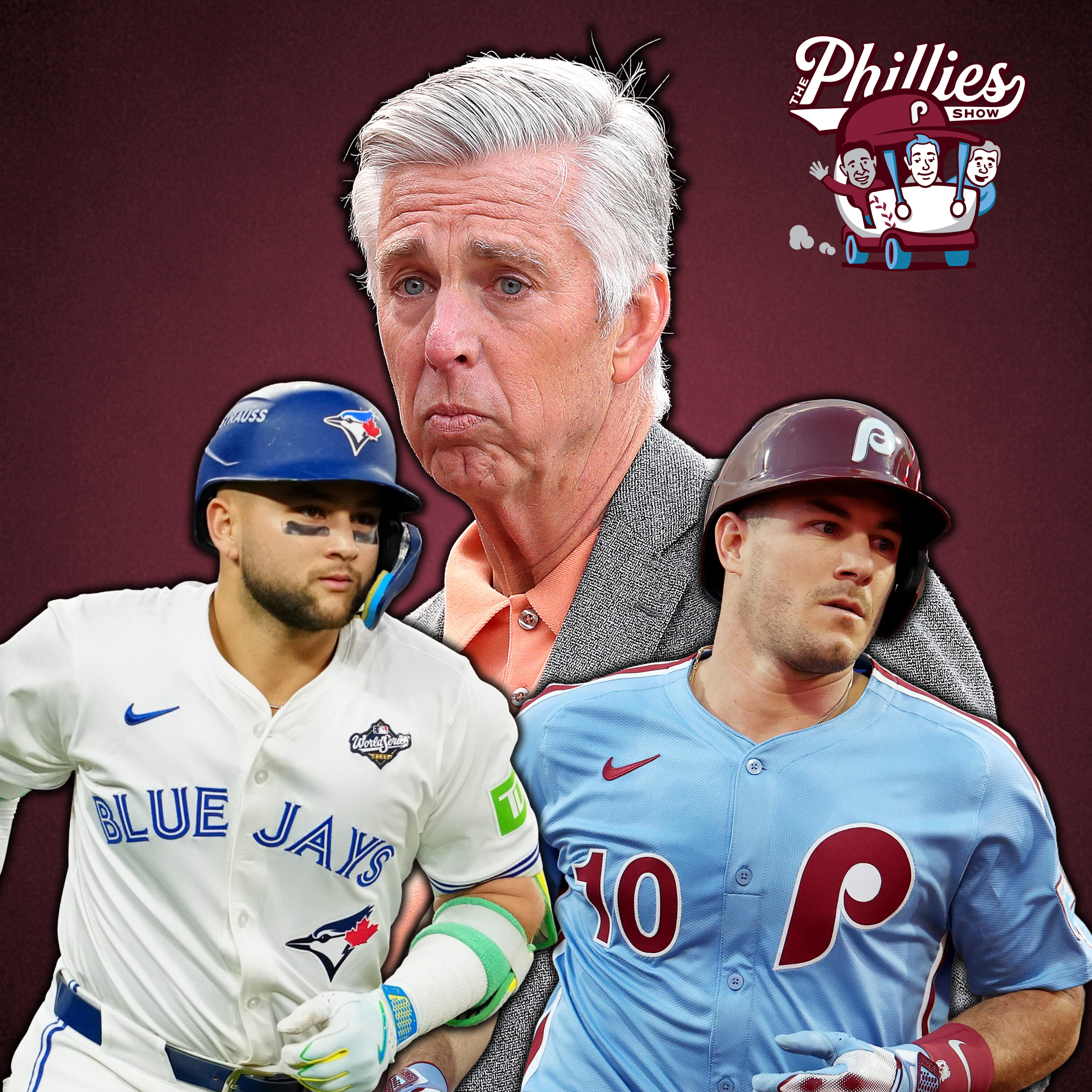
Dombrowski, Realmuto talk for first time since Bo Bichette "gut punch"
What a week for the Phillies.
They went to sleep on Thursday thinking they were signing Bo Bichette, who stunningly signed a three-year, $126 million deal with the Mets on Friday. The Phillies quickly improved their offer to J.T. Realmuto, who thought his Phillies career was over. But Realmuto is back, and Dave Dombrowski said he is “content” with where they are as a team.
We dig into a messy situation.
Love the show? Get Phillies Show merchandise at ThePhilliesShowShop.com!
@The Phillies Show Subscribe to the show on YouTube and follow us on social media!
@Foul Territory We’re part of the Foul Territory Network. Follow FT and find more shows, including Fair Territory!
If you like The Phillies Show, subscribe and give us a five-star review!
See omnystudio.com/listener for privacy information.
Available Results
Generated results are saved to the knowledge database for reuse and search.
Extract Knowledge
Pick what you want extracted first. Model, scope, and chapter options appear after a template is selected.
Transcript
00:00:03
Speaker 1: Hi, this is Jimmy Rollins. Welcome to the Philly Show.

00:00:06
Speaker 2: Ruben Amara Junior, Jim Salisbury, Todd's a lucky It's the Philly Show. It is Wednesday, January twenty first, twenty twenty six. Boba Schett is a Met. JT Real Muto is a Philly Dave Dombrowski and JT talked about it on a Zoom call on Tuesday.

00:00:26
Speaker 3: So let's get right, let's get going. Jim, I'm going to start with you. I talked to you earlier today.

00:00:33
Speaker 2: How would you describe the tone of a nearly forty minute zoom call with with JT and Dave.

00:00:41
Speaker 4: Yeah, you and I both have been on a lot of these type of Zoom calls or in attendance at news conferences like this. Ruben has also been president at them where he's been you know on the dais, you know, you come, you announce a free agency and there's a celebratory feel to it all. Six weeks ago, there was a celebratory feel to the Zoom news conference for Kyle Schwarmer. In fact, he sat in the rec room at his house in Middletown, Ohio, in front of his bar. I thought he was going to reach back and toast the glass to the occasion Tuesday's news conference, to me, it was starkly different. There was a real sober tone to it. There wasn't that joy that you see at a press conference announcing a free agent signing or the return of a prominent free agent. And it was because I think the way Dave Dombroski later described in essence losing out on Boba Schet a gut punch, And you know, JT was very open saying that he knew they had another opportunity. He even said, you know, he admitted he thought he might be not coming back. Dave was very open and talking about that other opportunity being Boba Schett, and so I just didn't feel I just felt like, you know, the whole press conference just lacked the excitement that you would see in a player returning or resigning, almost like JT felt like a consolation prize.

00:02:44
Speaker 5: So that's kind of what jumped out at me.

00:02:47
Speaker 4: Dave was very open and talking about his desire to get Bashett the bid they made, how it didn't happen. So I thought it was kind of a remarkable news conference on both ends, with both sides being very open and both sides being very aware that we almost were not at this moment.

00:03:13
Speaker 2: Yeah, Ruben, I want to ask you this question.

00:03:15
Speaker 3: So JT basically he kind of he laid it out.

00:03:18
Speaker 2: He's like, yeah, I was, I was looking for somewhere else on Thursday. I was basically knew I wasn't coming back. They were going in a different direction, pursuing this other opportunity. I mean, I don't I'm sure Alec Bohm is maybe some maybe paying attention to it. How concerned would you be going into camp, you know, just about the vibes of some of these guys. You know, is that a concern? Is it not a concern?

00:03:42
Speaker 3: What do you think they're.

00:03:45
Speaker 6: Well, the biggest concern that I have just looking from you know, five hundred feet is, you know, the reality of running this thing back because they're basically coming back with the same team.

00:03:58
Speaker 1: Now.

00:03:58
Speaker 6: They do have and have had, you know, several things that they did in the bullpen to improve the team, and they are infusing and injecting, you know, some younger players. Obviously, Crawford's get every opportunity to play center field. You're gonna have Painter at some point, and maybe Aiden Miller at some point, But other than that, you don't have a whole lot of difference in that lineup. I think that I think that the players understand in this day and age that this is a business.

00:04:27
Speaker 1: I think they understand this a little bit better than they once did.

00:04:30
Speaker 6: Yes, I mean, if I was JT, I'd be feeling a little slighted as well. But he could have signed a long long time prior to that. I mean, I mean the offer that three year deal, and you talked about a Jim and I think Todd you as well. You guys had already sort of reported that you thought that there was a three year deal that was that was you know that he had in hand, And like November, I didn't And I'll stand by this. I mean I didn't necessarily agree that they should go to three years, but they do have the player now, and they are much better team, at least for twenty twenty six with the player, with JT on the team, and they would be then they.

00:05:14
Speaker 1: Would be they didn't have the player.

00:05:16
Speaker 6: So if that's what you got to do to get him, uh yeah, it's an extra of what fifteen million dollars or whatever it is that you instead of doing the two years, you add another year, but that's sort of the price.

00:05:30
Speaker 1: Of doing business. And and you know, they got him on their on their roster. I don't.

00:05:35
Speaker 6: I don't think JT is going to be He's so professional and he's such a great leader, and once he puts a uniform on, he's going to be.

00:05:43
Speaker 1: Playing for the Phillies. They both and that's all that really matters.

00:05:47
Speaker 4: They both admitted they, like I said, they were really open and talking about a lot of the stuff that went on. They both admitted that the impass, the difference of opinion, the stalemate was over money, not years.

00:06:03
Speaker 1: Over money.

00:06:05
Speaker 2: Well, so it was really interesting to hear Dave Dombrowski talk about the bobashett stuff. He was pretty open about it. And I want to play a couple of clips. This is Dave was asked right here, how close did they think they were to getting Bobaschett.

00:06:19
Speaker 7: I can't say that we ever thought it was done, because there's a difference between we thought we were very close to having a deal done. We thought it was going to happen, but it wasn't done, and so there's a difference between the two. And as I've explained, to some other people that it's a situation where in baseball and agents run things differently between themselves, they do things in different ways. Until you sign a memo of understanding, you don't have a deal done. And we did not sign one of those. And it wasn't that we weren't moving towards that direction. It isn't didn't think that we were going to get there based upon our conversations, but we did not get to that point. So I can't say that I ever thought we had it. Not I did think we were going to get a deal done.

00:07:20
Speaker 1: That's tough. I will tell you from a person who's been in there and been through that type of a situation, that's a tough thing.

00:07:29
Speaker 6: It really is a difficult thing because there are times when I've gone to bed thinking even a smaller deal, smaller, larger, whatever, where you think a deal is done and you wake up the next morning and the deal's not done, and I think, you know, that's what the power of the player and the fact the power of the free agency market. I mean, they basically have all the power and they can make their decisions until a memo or a letter of under agreement or a you know, a true more than.

00:08:07
Speaker 1: Handshake deal is done.

00:08:10
Speaker 6: You just don't know, you know where things go, and you know people have been out there saying stuff like eight. You know the Phillies got fleece, they got well, they didn't get fleece necessarily.

00:08:22
Speaker 1: The Mets decided to do something that was pretty drastic to bring this player after they lost Kyle Tucker. And that's the truth.

00:08:31
Speaker 6: You can talk about all the things that they set up all you want, but the reality of it is they overpaid this player to bring them there to hurt the Phillies and to help the Mets.

00:08:40
Speaker 2: It's funny you mentioned, Ruben that you've had that experience before. Dave Dombrowski said that this is not the first time this has happened to him, And I'm going to play that clip right after these words.

00:08:48
Speaker 8: Hey, like a bloated cell phone bill, it can consume you, it can take over, it can be very annoying. So I know that twenty twenty five ended CRATS and that's when you have your end of your sales, but there actually is still one sale that is running until the end of the month.

00:09:04
Speaker 5: Midmobile.

00:09:04
Speaker 9: They still have their fifty percent off their unlimited premium wireless offer that you got to go and get and take advantage of.

00:09:10
Speaker 1: It because it's not necessarily going to be around all the time.

00:09:14
Speaker 8: And all plans come with high speed data and unlimited talk and text delivered on the nation's largest five G network. Quit overspending on wireless with fifty percent off unlimited Premium wireless plans start at fifteen bucks a month at mintmobile dot com slash territory. That's mintmobile dot com slash territory, Limited time offer upfront payment of forty five dollars for three months, ninety dollars for six months, or one hundred eighty dollars for twelve months. Plan required fifteen dollars per month equivalent taxes and fees extra initial plan term only over fifty gigabytes may slow a network is busy. Capable device required, availability, speed and coverage varies see mintmobile dot com.

00:09:48
Speaker 3: All right, we're back, and here's what Dave had to say.

00:09:50
Speaker 2: He called it a gut punch to lose Bobashak.

00:09:53
Speaker 7: First of all, whenever you have and this is not the first time this has ever happened to me, Okay, and sometimes it actually happens more than you would think through free agency and trades. I mean I've been many times where I thought we were going to make a trade and then all of a sudden they go in a different direction. It's a gut punch. I mean, you feel it that day.

00:10:15
Speaker 3: You are very.

00:10:20
Speaker 1: Upset.

00:10:21
Speaker 7: I guess is the way to say it. But you have to pick yourself off and shake it off. I mean, because you can't just wollow in what took place. So after a day of feeling that way or a time period, you need to move forward. And so that's how you handle it. And again, it's happened to me more than you could count in your career, and so that's what you have to do. We did rebound in the sense that we sign JT right away, which I'm very fortunate that We're very fortunate he didn't sign somewhere else.

00:11:01
Speaker 1: Yeh.

00:11:01
Speaker 3: Could you imagine we.

00:11:03
Speaker 6: Left with the without you know, holding the bag and they could have been And that's that's the difficulty. When you have parameters. You know, there's a pizza, it's a pizza pie. You don't have You only have so much money to spend and you try to maneuver different ways to get things done.

00:11:22
Speaker 1: Imagine if JT had signed with Tampa Bay.

00:11:25
Speaker 6: There's a rumor out there that Tampa Bay was pushing on them, and they decided, you.

00:11:30
Speaker 1: Know, hey, you know what, JT just I'll just take this deal.

00:11:33
Speaker 6: With Tampa Bay. And then and then you have Boba Shitt signed with the Mets. That'd been a double gut punch. So or at least they do have JT on their on their club and he's an important piece.

00:11:50
Speaker 3: Yeah, yeah, it's uh Jim.

00:11:52
Speaker 2: And then you asked Dave why I got one more clip of Dave here. You asked him, which is Ruben? You kind of alluded to it. Did the Phillies kind of get played? Did they fleeced?

00:12:00
Speaker 3: Whatever?

00:12:01
Speaker 2: And yeah, you asked him, do you think did he did you think that Bobashett's interest in the Phillies was sincere?

00:12:07
Speaker 7: I can't because you never know one hundred percent what's going on from their perspective. I don't know where they were. The Tucker thing signing played into it. I believe the timing of it. I think, you know, organizations that are smart, and the Mets and Dodgers are smart, Like I don't know if Tucker would have gone to the Mets rather than the Dodgers. That the Dodgers wouldn't have jumped into it at the last second, and I'm sure they had some feelers into it the timing and up. I do think, and I could be wrong, so I'm not saying this for sure. I do think he was sincere about thinking about coming to Philadelphia, Yes, I do that. I think he was. And I think what ended up happening is the dollar numbers and that we were we were at the numbers they really asked us to match, you know, to pay. We're still going through some nuances, but I think in that last in the time period that the Mets jumped in full borahad and that it ended up being that their short term offer ended up being so much that they decided to take the short term offer rather than the long term offer. I don't know that for sure, but that's what it's appeared to me.

00:13:24
Speaker 4: Short term offer with with I mean, it's very important to point out forty two million for one year with an opt out after one year. So if he has a big year, he's right back out there trying to get even bigger riches. So you know that opt out and the potential of becoming a free agent again and even making more money. Very attractive to Boba Shed. I think the Phillies just had that. They couldn't go to forty two. They have tax implications, They have an unwritten I would say, unwritten policy against opt out. Dobroski doesn't like them. Organization has not done them. A lot of organizations don't do them. I personally don't like them. But you know, he did say there's an open mindedness, but it's not something they they want to do.

00:14:17
Speaker 2: So yeah, I mean forty two million. He's going to hit the free agent market next year at twenty nine.

00:14:26
Speaker 3: Like I said, he.

00:14:29
Speaker 1: Best deal for himself. He bet on himself and he can't blame him.

00:14:34
Speaker 2: And if he's terrible, he stays in and he's getting forty two million dollars the next year, or if he gets hurt or I mean, if he gets hurt or he has a terrible year or whatever, he takes it, he gets paid forty two million dollars. And then if he goes off in twenty twenty seven and has a monster year, he can opt out.

00:14:50
Speaker 3: Then he'll only be twenty nine.

00:14:52
Speaker 1: Right.

00:14:53
Speaker 6: So what people don't really understand at times is that in baseball, the deals are guaranteed. When you sign a multi year deal, they're basically guaranteed that money is coming to that player.

00:15:05
Speaker 1: Now, the opt outs obviously come into play.

00:15:07
Speaker 6: It's not football, and they can't like become free agents when they want to and like.

00:15:13
Speaker 1: They can like in the NBA or whatever. There's totally different rules. When you pay that player, he's you know, you sign that contract man, that sucker's getting paid.

00:15:24
Speaker 4: And the opt out, the opt out is power goes to the player. The opt out, you know, the team assumes all the risk. The player is sitting in high cotton. It is classic having your cake and eating it too.

00:15:39
Speaker 5: The opt out.

00:15:40
Speaker 3: I mean, let me put it this way. I would have done the same thing that Bobashett did. You know.

00:15:45
Speaker 2: I had nothing else, There's no there was no memo, memo was signed or anything like that, you know, agreement or anything reached.

00:15:54
Speaker 3: I'm going to the New.

00:15:55
Speaker 2: York Mets if they offer me fourteen million dollars more without all that may Day you know, or or another team I should say so. But anyway, so if you're watching this on YouTube, don't forget to hit the subscribe button.

00:16:06
Speaker 3: Help support the show.

00:16:08
Speaker 2: We appreciate and of course always go to the Phillies showshop dot com to get your Phillies gear. JT of course talked at the beginning of it. He hopped on for like the what the first ten fifteen minutes Ish answered all the tough questions.

00:16:24
Speaker 3: Why did it take so long? JT?

00:16:27
Speaker 2: How does it feel to know that you know, you know, you hear all this stuff about how you know how great you are running a game and game planning and pitch to pitch and you're such a leader, but then when it comes time to contract time, it's like you're thirty five and you didn't have a great year offensively.

00:16:41
Speaker 3: And here's what JAT had to say about a lot of those things.

00:16:44
Speaker 9: The main thing for me, you know, I know how the game works, and I know there's certain values on players, and at the end of the day, I just value myself and what I do for the team in the clubhouse differently than what the Phillies did for a while.

00:16:56
Speaker 3: So that's why it took longer than.

00:16:58
Speaker 1: They maybe should have.

00:16:59
Speaker 9: And as far as the team goes, I think we shape up pretty good. I mean, obviously we had a we had a good year last year, won the division didn't didn't work out for us in the postseason, but we're bringing a lot of the same guys back and having some new some new good pieces, So I'm excited for this year. It's definitely frustrating, you know. Like I said, I I believe in myself and I bring I believe that I bring value to the team, and I know that I haven't had my best years the last couple of years, but I do believe that it's not like age or physically related. It's something that I can improve on and work on and be.

00:17:31
Speaker 3: Better for the years to come.

00:17:33
Speaker 9: So it's definitely frustrating the way the system plays out and the way that catchers are valued.

00:17:38
Speaker 1: And obviously I.

00:17:39
Speaker 9: Understand the aging process where everybody ages and everybody deteriorates, so that side of what I get. It's just I don't feel like I'm at that point in my career yet to where I feel like I still have good years left in me.

00:17:52
Speaker 6: Where do you think, guys, Well, I mean, that's exactly what you would hope that he would say.

00:17:57
Speaker 1: I mean, that's what you want out of your athletes. You want them to be confident in their abilities. You want them to believe in this in themselves. It's not. One of the most difficult things to do as a player is to is to self evaluate all of us. And I was a player too.

00:18:15
Speaker 6: I thought I thought I was way better than I really was, and I wasn't very good.

00:18:21
Speaker 1: But you sort of have to. You have to believe that otherwise you're sort of defeated.

00:18:26
Speaker 6: And I think that JT's one of those players not necessarily thinking.

00:18:30
Speaker 1: That he's better than he is. I think that he actually believes that physically he is just as good now as he was a couple of years ago.

00:18:40
Speaker 6: And if you looked at his workouts and his body and the body of work, and the fact that he catches as much as he does more than any probably any other catcher, that sort of stands to reason. And hey, hopefully some of the mechanical adjustments that he has to make offensively to have better offensive years.

00:19:01
Speaker 1: Maybe that can happen.

00:19:02
Speaker 6: I mean, there are there are times when that can happen, where you can make an adjustment and be better offensively.

00:19:09
Speaker 1: And I'm not going to doubt.

00:19:11
Speaker 6: The guy because I know he's going to I know he is dedicated to being the best player you can possibly be every day, So I wouldn't bet against JT.

00:19:23
Speaker 4: And within this difference of opinion that they had on his value money wise, you know, his defense remains stellar, his leadership of the pitching staff remains stellar. I mean, he controls the running game quite well, to the point where Zach Wheeler will tell you, you know, among the reasons he became better when he came to Philadelphia, one of them was JT. Because he knows JT will control the running game, thus allowing him to focus on execu shooting his best pitch possible.

00:20:03
Speaker 5: And it's just hard to put.

00:20:04
Speaker 4: A financial valuation on that. We tend and I think teams tend to put, especially with position players, put so much of the value on offense. And when you couple that he declined last year with his age and the market, you know, that's why the Phillies came in where they came in.

00:20:29
Speaker 5: So that's all part of it.

00:20:32
Speaker 2: Yeah, it is interesting that, you know, we hear all these guys talk about his importance to the team and you.

00:20:39
Speaker 3: Can't put it. You can't put a dollar figure on it though, you know, you just.

00:20:43
Speaker 1: Can't be quantify.

00:20:45
Speaker 4: You know, in the end, in the end, guys and I kind of said this a few times, and I'm going to stick to my guns. I think it was an overpayment. Sure, what I have rather had J T. Real Mudo at thirty five declining offense on a two year deal. Yes, would you have done a two year deal? Of course, that's that's that's a win. But I don't mind them going the extra year for fifteen million dollars. And I'll put it in perspective, they're paying eighteen million dollars this year to their number seven starter, and they're gonna pay nineteen million dollars to Nick Castianos to play for somebody else. You certainly can go an extra year and fifteen million dollars for a guy who's gonna, you know, be a stalwart behind the plate and at worst is an expensive backup three years from now. I'm not worried about fifteen million dollars on a franchise worth three billion. There are bad contracts already on this team. There are contracts that are gonna end badly, that are gonna cost them twenty five and thirty million dollars a year at the end, I ain't sweating fifteen million dollars one year overpayment we all probably agree it is.

00:22:02
Speaker 2: Yeah, because at the very worst, if JT continues to decline offensively, at the very least, you're gonna have a guy that runs a great game. And we talk on this show all the time about the importance of pitching and you know, defense and all that stuff. So at the very least, you're going to have a very good game planner, game caller that the pitchers love throwing to. And you know, you know, yeah, you'd love a guy that's you know, Silver Slugger at that position every single year. But you're right, Jim, there's other there's other issues that play with the Philly success long term success than JT. Real Muta what he's making in twenty twenty eight.

00:22:39
Speaker 4: By the way, uh Todd, you mentioned silver Slugger some interesting incentives, So oh yeah, Ji, the Phillies and real Mudo came in with a big, big number out of the gate Phillies offered. Their offer was like three years and forty million or three years and forty two million in that.

00:23:02
Speaker 5: In that range, let's just say it.

00:23:05
Speaker 4: Was three and forty two so they up it to three and forty five fifteen per but he can make each season an extra five million in incentives, and if he goes out and has a good first half and gets elected to the All Star Game, that's a.

00:23:23
Speaker 5: Two million dollar bonus. That's a sizable bonus, No rubin.

00:23:28
Speaker 4: Two million for All Star election, one million for an All Star selection, one million for a Silver Slugger, one million for a Gold Glove, and two million for a top ten finish in the MVP voting. I just thought those None of them are based on games played. All these incentives are based on awards bonuses.

00:23:48
Speaker 5: Awards.

00:23:48
Speaker 6: Yeah, yeah, they and I guess teams have shied away from some of these awards bonuses.

00:23:53
Speaker 1: But listen, I don't mind paying for an All Star catcher for an extra.

00:23:58
Speaker 6: Two million bugs. It's heavy, big money. I don't remember or recall doing one that big. I've had big bonuses.

00:24:07
Speaker 5: I don't recall on that thing either from either.

00:24:10
Speaker 1: That's that's pretty aggressive.

00:24:12
Speaker 6: Listen, if the man has becomes an All Star, then I'm happy to pay. I'm happy to pay because he's doing his job win, win, selected or selected.

00:24:24
Speaker 2: Absolutely So okay, So what's next for the Phillies?

00:24:27
Speaker 1: Right?

00:24:27
Speaker 2: Everybody wants to know what's next. Despite reports the Phillies are not expected to be in the running for Cody Bellinger from Bravaldez and then the other reigning marquee free agents. We've kind of been talking about this for a while up until Boba Schett presented itself. We were gonna get Schwarber, JT, then kind of go around the edges, get some depth pieces, maybe get some starting pitching depth that seems to be kind of where they are right now, and then I want to This is a long clip, so I might cut it out halfway through, but this is what Dave said about what he likes about the team or what what what might be coming next for the Phillies.

00:25:01
Speaker 7: I think overall of the winter time, I like our club. We have a good club. You know, I've just said it's a situation. People forget we resigned Schwarbs. If we hadn't re signed him, I don't know how it would be feeling about the winter time, and as you could see, there was a lot of competition for him. I look at our club with signing JT, which was also a priority for us, and if we didn't sign JT, and no offense to the catchers that we have with Marshawn and Stubbs, we would have been in a position we had have tried to add somebody somehow someway, because I don't think we'd have felt comfortable going through a year without having somebody else back there. So bringing JT back was huge for us. And when I look at our positional players, they're good everywhere they go. We're giving a young player an opportunity. We'll see what happens. Like we talked about with Crawford and center field, Kemp in the outfield, third base, having a chance to make our club.

00:26:00
Speaker 1: Staff.

00:26:00
Speaker 7: We feel our bullpen I think has a chance to be outstanding. Our starting staff the same way. I mean, we're dealing with probably some depth issues.

00:26:12
Speaker 1: That we'll see what.

00:26:12
Speaker 7: Ends up happening and see if we can continue to create depth in some ways. But we have a good club, like our club, and I think you always have to be open minded in the winter time to try to get better, and that's what we try to do all the time. And again they don't always become this public, but we do that.

00:26:31
Speaker 3: There you go.

00:26:31
Speaker 2: So that's basically Dave talking about some of the offseason. He also said that Nick Castianos will still not be on the team.

00:26:40
Speaker 1: Come.

00:26:40
Speaker 3: I guess, I don't know if it's gonna be.

00:26:42
Speaker 2: February eleventh pitchers and catchers or February sixteenth, first full squad workout. They still plan to do part ways and give him a change of sceneries. So I don't know, you know, can they maybe they find somebody they'll take take them for two million? Is that why they waited? Is that why they dfaid West and Wilson today? And I mean that has to be why, right, They're just hoping and praying that they can find somebody to shave at least a little bit off the twenty million dollar salary that next getting.

00:27:12
Speaker 6: Yeah, I thought he might be the guy that might designate and and then move him, you know, within the eight or ten days.

00:27:17
Speaker 1: But we talked about that, I think in our last pot. But yeah, a little surprised about West and Wilson.

00:27:24
Speaker 6: Although after you know, taking a little bit deep, deeper dive, I think that the fact that he does not have options was a big one, and the fact that you know, Western Wilson's going to be playing for somebody somewhere. I do believe this in the major leagues, he can be a valuable extra player. He's got some talent and a good dude and a good guy to have on a team.

00:27:52
Speaker 1: Can run, he can play with our variety positions.

00:27:55
Speaker 5: I think he do you think he gets through?

00:27:59
Speaker 6: I don't know that he is on the waiver wire yet they designate him, so they think try to trade him, and I think that's gonna be a team.

00:28:07
Speaker 1: I mean, why would the Colorado Rockies not want this guy?

00:28:10
Speaker 3: That's true?

00:28:11
Speaker 1: Or why wouldn't Uh?

00:28:13
Speaker 6: Although Colorado can wait because I think they had the worst records, so they can wait. But if they think there's another team that might be interested, then they might, you know, be able to trade them for something. So I just wanted to say one other thing, and I'm gonna get too verbose here, but you know, people start talking about the fact that you know, well, if they were gonna pay you know, Bobaschett, then they have they have all.

00:28:38
Speaker 1: This money, They have all this money. Why are not how come I'm making a run at Bellinger? How come they're not making a run it?

00:28:44
Speaker 6: Listen, Bobachett was a special player that they had special money they would consider going extending for.

00:28:53
Speaker 1: And you know, I think that the dollars that's gonna end up being to sign a guy like Bellinger.

00:28:59
Speaker 6: That's that's extension that they you know, they're not going to extend on on that player.

00:29:06
Speaker 1: Just because they don't that's not the same fit for them. Same thing with from ber Valdez.

00:29:12
Speaker 6: I mean, he's a guy who's probably gonna end up you know, the aa VS and then just the years.

00:29:17
Speaker 1: I mean you start comparing he and where Ranger Suarez were.

00:29:21
Speaker 6: I can't imagine if Fraan ber Valdez will make less money than Ranger Suarez.

00:29:25
Speaker 1: Maybe he will, but I'd be surprised by that.

00:29:28
Speaker 6: So these are these are special circumstances that they that's the reason why they were pursuing Boba Schett.

00:29:35
Speaker 5: Yeah, special opportunities.

00:29:37
Speaker 4: This organization has a history of pushing it when presented with a special opportunity, from Jim Tomey to Nick Castianos a few years they they pushed it forward by twenty million at the last minute to get him to the Bobachette opportunity. And there's also some calculus there where you know, they wouldn't have the payroll room conceivably to go for another marquee free agent at this moment because they've committed fifteen million to JT for twenty six and you know, part of the budgeting budgeting for Baschet was subtracting JT and also subtracting someone in the infield, most likely Alex Baum, who was going to make ten million. So you know that's where some of that budgeting came from.

00:30:24
Speaker 3: Yeah, exactly.

00:30:25
Speaker 2: So one other thing before we let go. We'll talk about this on the next show. But the BBWA announced its Hall of Fame vote on Tuesday night and Carlo Beelcher and Andrew Jones are in. But some Phillies' numbers. Chase Elly got it took a big jump from thirty nine point eight percent to fifty nine point one percent, finished third overall. Bobby Bray from nineteen point five percent last year to thirty point eight. Jimmy Rownds, who we hadded on the show for a couple episodes at the end of the year, was eighteen percent last year up to twenty five point four. And Cole Hamill's his first year on the ballot twenty three point eight. So we'll talk about that more on the next show. But yeah, so some good numbers for Chase, you'd be feeling pretty good for Chase outing.

00:31:09
Speaker 1: Yeah.

00:31:09
Speaker 2: So all right, guys, a lot of stuff today with Dave and j T and Boba Schett. We'll be back.

00:31:16
Speaker 5: See you guys, Smary lad boys, will you, Jimmy.

00:31:20
Speaker 2: The Philly Show is brought to you by the Foul Territory Network. Subscribe to The Philly Show on YouTube and wherever you get your podcasts.