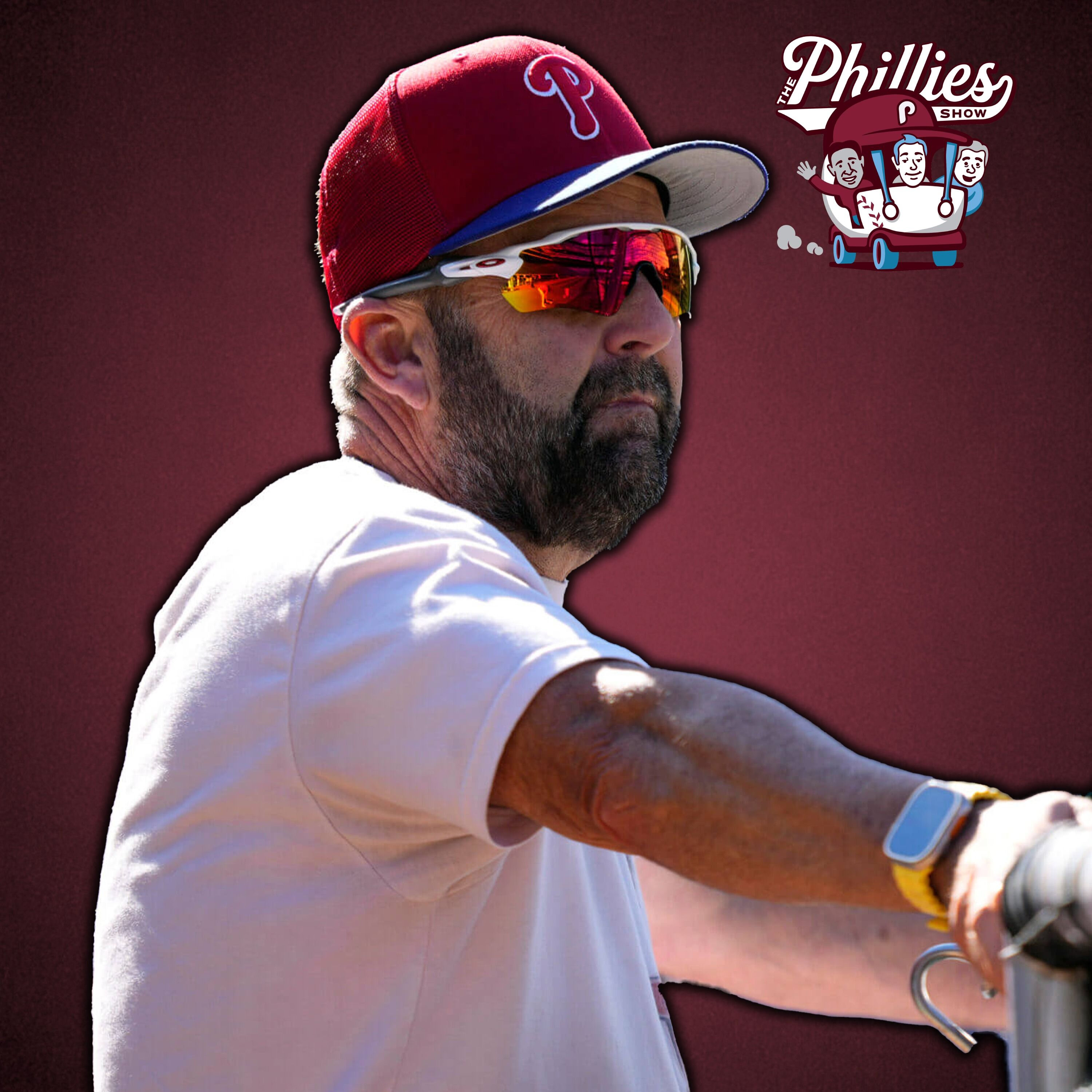
Phillies hitting coach Kevin Long talks October baseball, Trea Turner, Kyle Schwarber
Phillies hitting coach Kevin Long has two World Series rings: one with the 2009 Yankees, and one with the 2019 Nationals.
He hopes to win a third this fall.
Long joined the show to talk about the Phillies’ top 10 offense, why they can succeed this October, Trea Turner’s batting title, Kyle Schwarber’s MVP-type season and much more!
Parx Casino and betPARX are the official casino and sportsbook of TPS. New customers can download betPARX now and get up to a $1,000 dollar casino bonus back if you're not a winner in your first 24 hours. Visit betPARX.com for terms/conditions. You must be 21 and in Pennsylvania, New Jersey, Maryland or Michigan. Gambling Problem, call 1-800-GAMBLER.
The Phillies Show is partnering with Shibe Vintage Sports to give away a different t-shirt every week! To enter, just complete the form here: shibesports.com/tps A winner is selected at random every Friday at noon. No purchase necessary. Shop Shibe Vintage Sports for the most stylish throwback baseball gear. Visit their 4 locations around Philly or online at https://shibesports.com
Get 20% off your first Slab Pack or card purchase by going to ArenaClub.com/FOUL and use code FOUL
Love The Phillies Show? You can get show swag at The Phillies Show Shop!
@The Phillies Show Subscribe to the show on YouTube and follow us on social media!
@Foul Territory We’re part of the Foul Territory Network. Follow FT and find more shows, including Fair Territory!
If you like The Phillies Show, subscribe and give us a five-star review!
See omnystudio.com/listener for privacy information.
Available Results
Generated results are saved to the knowledge database for reuse and search.
Extract Knowledge
Pick what you want extracted first. Model, scope, and chapter options appear after a template is selected.
Transcript
00:00:04
Speaker 1: Hi, this is Kyle Forber and welcome to the Philly Show.

00:00:08
Speaker 2: Ben Tomorrow, Junior, Jim Salisbury, Todd Zolecki. It is Tuesday, September thirtieth, twenty twenty five. How's everybody doing. Phillies bye week this week, but they resume workouts on Tuesday, Jim, all the hitters are going to be out there on the field taking batting practice and in the cages. And that's why we are excited about today's guest. Let's talk about it. It's time for the park's first pitch. First Pitch is brought to us exclusively by our partners at Parks Casino, Pennsylvania's number one casino. Today's guest Tuesday's guest, Phillies hitting coach Kevin Long. Love talking hitting with Kevin Long. I feel like, you know, kind of like with Larry Boajim on Friday, you always learn something. So we we asked him a lot about, you know, Kyle Schwarber, Bryce Harper, just the state of hitting today, Trey Turner winning a batting title, a lot, really a lot of fun, learned a lot.

00:01:13
Speaker 3: I think that's a great parallel Kevin Long and Larry Boa, because incredibly passionate baseball man. Both have great personality, but you come away from a conversation with both guys learning a little bit about baseball. And I definitely learned a little bit about hitting from Kevin Long I do every time I talk to him, and I don't talk to him a lot because you don't see him a lot. He's like he's like a shadow. He's like a ghost. You know he's there, but you don't know where he is. Well, where he is. He's underneath. He's in the batting cage, and he's arriving at noon and he's going over all this data and he's scouting reports, and then he's in the cage with these guys all afternoon, right up to the first pitch, and then you see him pop out when the Phillies are batting. He's on the top step, and then he's underneath analyzing and and he was ever popping in the cage working with them. But this guy is the absolute tireless worker, real student of the game, real student of hitting. And I kind of geeked out talking to him and listening to some of his stuff, especially about the evolution of batting practice, which in the game of baseball which which kind of has fascinated me over the years. So it was interesting to hear him talk about some of the reasons for that evolution and some of the some of the new techniques guys are applying, and you know, it was interesting to hear him talk about the challenge of a bye week. I mean, let's say we're into October. Now, this is what it's all about. He talked about the team having a chip on his shoulder and how it's stung getting eliminated last year, how maybe the fourth time is the charm, but the challenge for hitting coach on a bye week, keeping these guys sharp in an everyday game when you don't play for a week. And one of the things he mentioned is, yeah, well we'll bring him in the cage and we'll crank it up to one hundred and five. Can you imagine that we were cranking up to one hundred and five.

00:02:57
Speaker 2: Oh my god. You know, it's funny. I've always wanted to do just to see step into one of that batting cage of Citizens Bank Park. I would probably be in full armor, but I would love to go up there and just stand there and see what one O one, one O two look like I want to see because now you can type in everything I want. I would love to just stand there and see what a Jouan Duran splinker looks like, and then maybe take a swing and just look at the video to see how awful I missed at it. I mean, that would be a lot of fun for me. But yeah, Jim, don't feel bad about geeking out, because I you know, I just love talking about you know, the stories of how Kyle Schwarber started hitting lefties better. Uh, you know how Bryson Stott made a simple adjustment, relatively simple adjustment with his hands to get going better. So all that stuff coming up right now, Kevin long.

00:03:51
Speaker 3: Hey, that was first pitch presented exclusively by our partners at Park's Casino, Pennsylvania's number one casino Parkscasino dot is the website. You must be twenty one to participate. And if you have a gambling problem called one eight hundred gambler.

00:04:06
Speaker 4: Okay aj Our slab pack ripping continues. Now, you just ripped a card that I think you're.

00:04:13
Speaker 3: Actually going to keep.

00:04:15
Speaker 5: I am I'm gonna keep it. It's a Ken Griffy Junior Rookie card, the old is the famous upper Deck one. I believe it is, and yeah, heck ya, I'm gonna keep it because I'm gonna get Griffy to sign it. I'm gonna get him to send it to me. What you can do, and I'm gonna get Griffy to sign it, and it's only gonna make it worth more. So I am all in on this card. I'm keeping it, and it is one of the coolest cards with the highest turtleneck you've ever seen and the gold chain around.

00:04:39
Speaker 4: His neck Graded nine nineteen eighty nine upper Deck. You get the offer for one seventy nine. It's valued at around one ninety nine, and you're like, nah, I'm keeping it, but if you want it to sell it back instantly, you can. It's the beauty of Arena Club. AJ is going to send in and get the physical card sent to him and you can do the same. Twenty percent off your first slab pack or card purchase can happen for you if you go to Arena Club dot com slash foul and use the code f o U L.

00:05:06
Speaker 2: Kevin. Thank you so much for joining the Philly Show. I know this is a really big week for you. How excited are you to get back into the postseason. Is your fourth fourth season with the Phillies postseason all four years. How excited are you and what has you the most excited about this postseason, maybe even more than the other three.

00:05:26
Speaker 6: Well, I think it's just unfinished business. You know, we've been here three times and this is the fourth, not the third time as a charm, the fourth times a charm. I'm excited for the fellas. I'm excited for the coaching staff. I'm excited for Rob Thompson. I'm excited for the Phillies organization and the fans that you know, we get to go out there and compete and hopefully this one's the.

00:05:50
Speaker 3: One you mentioned unfinished business. Did you sense that attitude in the players right from day one up spring training, maybe even to last offseason and your phone calls and maybe some of your.

00:06:00
Speaker 6: Yeah, it kind of it just leaves a sour taste in your mouth, and it's it's it makes for a long off site, long off season, you know, and then you get back after it and you're just hopeful that you get back in it and get another chance. Obviously, we're very poised. We've got a bunch of guys who have been there and and done this before. You know, I think we have a little bit of an edge to us. I feel like, you know, we started off a little slow, which I liked, and I feel like we've played some really good baseball as of late. So I feel like we're getting into this at the right time. And I really don't care who we play. You're gonna have to play some tough teams along the way, And again, I'm just excited for this opportunity.

00:06:47
Speaker 3: What what type of challenge is the week off from a hitter's perspective and a hitting coaches perspective.

00:06:55
Speaker 6: Yeah, you know, you just you want to keep guys abreast of the v low of curveballs. Just you know, this is a game that's played every day and we're going to get a week off. So we're gonna set up the curveball machine on the field, get them a look out there at that.

00:07:11
Speaker 1: We'll do different shapes.

00:07:12
Speaker 6: We'll do some curb buss we'll do some sliders, do some cutters. We'll do all our below work in the cages, which we'll have guys facing anywhere from ninety miles an hour all the way up to one hundred and five miles an hour, so we'll have them going up and back, so they'll they'll they'll be ready to go as far as all that by just our preparation and our work in the cages and then on the field.

00:07:39
Speaker 2: So as the hitting coach, I thought it was cool to hear, But I'm sure as a hitting coach you love to hear guys like Trey and Bryce have already said because they've been asked already the bye week last week, the bye week last year, the bye week you guys lost to the Mets. Now you got the bye week, and they're like, listen, it's an excuse. If you want to make it an excuse, We're not going to make it an excuse. So I'm sure as a hitting coach you love to hear those guys already saying, like, we're going to get our work in. You gotta play well. There's challenges, but it doesn't mean you can't hit and win, you know all that stuff.

00:08:13
Speaker 6: Yeah, I mean, they're just built in excuses. You can use them if you want. Our guys don't want to don't want to hear any of that. They just want to go out there and play and compete and see what happens. Listen, Like I said, there's some bitterness involved. These guys have a little chip on their shoulder. Hopefully that's enough to propel us to the World Series and win the World Series. But listen to bye. I think the bye week's good. I think it's a good opportunity for guys to get rested up. But again they're what they're saying is when this thing starts, we got to go and no excuses.

00:08:47
Speaker 2: You know, looking at your numbers this season, I don't know what if you had any like internal goals or team wide goals that you gave to the players, But I was looking at the numbers. Finish eighth in Major League Baseball in run scored second, in batting average four worth an on base percentage fourth and slugging percentage fourth and OPS fourth, and average exit vl O fifth and hard hit rate. I mean, how would you assess just the season long performance of your offense? What did you like the most?

00:09:14
Speaker 6: Not bad for a team that couldn't slug, couldn't score runs, couldn't do this, couldn't do that, it sounds like a pretty good offense to me. It's just it's amazing that you play one sixty two and at the end of the day, this is where we end up, and it's satisfying.

00:09:31
Speaker 1: It means it means that the.

00:09:32
Speaker 6: Guys put in their work, they actually performed at a very very high level.

00:09:39
Speaker 1: They should be proud of themselves. We had a triple crown.

00:09:42
Speaker 6: We had the batting average, the home run leader, and the RBI leader all come out of our clubhouse. Hasn't been done since nineteen forty one in the American League and the National League, I think it was in the seventies. So, you know, there's just some cool things that happened. Trey winning the batting titled, Kyle hitting only three home runs off left handed pitching, Bryce coming back from what was pretty serious risk injury and ended up you know, playing at a pretty high level as well. You know, just just some overall. I thought our guys performed and did a really good job.

00:10:19
Speaker 3: Trady season has been really a great one. I mean, I'm sure as a hitting coach, guy wins a batting title, you gotta feel a real sense of pride in that.

00:10:27
Speaker 6: Yeah, I mean there's only one batting title champion and it's Trey Turner. Pretty cool, you know, this is Trey's second one. I think there's only been fourteen guys that have won two, Trey being one of those. So that's, uh, that's quite a feat and it's a pretty special accomplishment for him. But I know all these guys would give up all that, yes, for a World Series championship.

00:10:50
Speaker 3: So can you take us back to spring training a little bit because Rob talked about this that there were conversations with Trey about maybe making some adjustments, use the middle little field, get on more more contact, you know, use your wheels, think more like a leadoff guy. What were those conversations, like, what was stressed adjustment wise, and what do you think of the results.

00:11:10
Speaker 1: Well, obviously the results speak for themselves.

00:11:14
Speaker 6: He gave up a little bit of of his power so that he could hit for a higher average, see the ball better, you know, cut down his chase rate, which he did. You know, I think he'd done this in the past and was able to get back to what I saw him do a lot in Washington, which was go to right field, be able to back the ball up, be able to do some things that you know he's very capable of doing. You know, in this game, gets you get caught up in the slug you get caught up in the homers, which are all very good things as well, But in Trey Turner's case, it was can I do a little bit of both?

00:11:54
Speaker 1: And I think he did a very good job with that.

00:11:56
Speaker 3: He must be a very coachable guy to make these adjustments mid career.

00:12:01
Speaker 6: Yeah, I mean, if you make sense of it to Trey and you can come up with a rhyme or a reason, because he's really really smart, really intelligent. He just doesn't do things just to do him.

00:12:13
Speaker 1: Uh. He wants it to make sense.

00:12:15
Speaker 6: And I think, you know, everybody made sense of this, and he was willing to do it and then took off. And really from day one he's hasn't waivered from backing it up, making better decisions, using right field, maybe cutting down his homeworks.

00:12:31
Speaker 1: But I think his.

00:12:31
Speaker 6: Goal was to score around one hundred runs and if he wouldn't have got hurt for those you know, three weeks, he would have done that. So just a terrific We're year overall for Trey, and I'm very proud.

00:12:43
Speaker 1: Of you got.

00:12:45
Speaker 2: You know, I know Trey, a lot of guys, all those guys love hitting, but I feel like, you know, in Trey. I hear a lot of stories about him, you know, watching other guys in the cage, some of his teammates in the cage, and watching a lot of films, same thing with Kyle Schwarber. That must be a lot of fun to have guys like that who just like love it, breathe it, eat it, drink it in and you know, not only know themselves, but like to kind of like watch their teammates and kind of cheer them on and help them out. And you know that's gotta be kind of cool.

00:13:16
Speaker 6: Yeah, they're like extra coaches, honestly. They they really help not only themselves but their teammates. They're you know, they'll suggest things to maybe Kyle or to Bryce or to JT or any one of the guys. If they see something. They're very willing and available to help. You know, it's just another set of eyes. And and when it's one of your colleagues and one of your guys that you're working with all the time, that that certainly helps the other players. But Trey loves hitting, he loves studying it. He loves going in there and grinding. He's in the cages in between innings. He'll come running off the field, go in the cage, get a couple of swings.

00:13:59
Speaker 1: He's always he's.

00:14:01
Speaker 6: Working on his swing and his craft, and it's just pretty cool to see.

00:14:05
Speaker 3: Tom tell Kevin that quote that that Tray had the other day about how hard it is to hit these days. It was great.

00:14:11
Speaker 2: Oh, I'm sure, I'm sure you saw. But I love this quote because I agree with that. I know some people might not completely agree with it. But he was asked, like, what you any idea why it's so hard to hit three hundred, and he's like, yeah, everybody's throwing a hundred. Everybody has six pitches, nobody knows where the ball is going. He's like, honestly, I can't believe that more people don't know why it's so hard to hit three hundred. I mean, I imagine you agree with with Trey.

00:14:36
Speaker 1: Yeah, I mean we get these questions all the time.

00:14:38
Speaker 6: I tell people, I said, I need to be a pitching coach or I need to go coach for the sixers or some other field, because this job of being a hitting coach is I mean, it's insanity. I mean, really think about it. The pitchers don't know where the ball is going half the time. But their stuff is so nasty, so filthy. The v lows are so high. They're throwing cutters, sliders, sweepers, curveball, slurbs, knuckleballs, splits. I mean, it's just thrediculous the things that these guys were able to do with the baseball. But listen, we chose this field and we chose what we're doing, and uh, we're gonna make the best of it. But I think you can understand why there's only one three hundred hitter internationally.

00:15:24
Speaker 1: And Trade Trade just mentioned it.

00:15:26
Speaker 3: You mentioned hitting coaches. Uh, you know when the team went you know, it's baseball. You're gonna have ten days when you just don't hit, and that's when the hitting coach takes all the heat. Everybody wants to crush them and run them out of town. And then you have ten days we average in seven runs a game and nobody even mentions the hitting coach. It's all about the hitters, which you know, that's the way it should be. It's a players game. But you got you got it. Sometimes you got to put on the fireproof suit and sometimes you just got to deal with it.

00:15:52
Speaker 6: Right, Yeah, you just you just deal with it. And you signed up for this and listen that this. I just finished my nineteenth year in the big leagues, and I understand the challenges that exist, and I understand, you know, what the media's job is, and they're going to point out when the offense is failing, and most of the time those fingers go right to the hitting coach. We looked at the most volatile jobs in our profession and hitting coach was number one. They last on average two years, you know, and even managers and pitching coaches they're all the way up to three and.

00:16:27
Speaker 1: A half years.

00:16:28
Speaker 6: So it's it's it's a tough job, but there's a lot of scrutiny, and obviously when the major league average is two forty, you know, it's it's just a tough business and it's not easy, you know, to kind of keep these guys hot. And I always tell guys, I've never had a good day in the big leagues ever, because i may have six guys going good, but guess what, three other guys failed and they have really had a tough day. So most of the time I've got a hitter or two, or three, or five or ten that are struggling. So it's my job to make sure I keep them on the tracks and keep their head where it needs to be, and try to stay as positive as I can.

00:17:12
Speaker 7: Parks Casino is my casino of choice, and they have it all action, excitement, headline entertainment plus.

00:17:18
Speaker 1: If you live in central Northern Jersey or even in.

00:17:22
Speaker 7: New York, the closest live tables are at Parks Casino off Exit six of the Jersey Turnpike. Parks Casino Pennsylvania's number one casino play thousands of hot slots, state of the art sports book of beautiful poker room, the Liberty Bell Beer Garden, and collection of award winning restaurants, tons of places to go eat.

00:17:42
Speaker 1: Parks Casino. This is how you Win. Tickets are on sale now for all of these headliners.

00:17:46
Speaker 7: Now listen to this just announced coming November twenty sixth comedian Joey Diaz. You Have September twenty sixth, The Revivalist, September twenty seventh, Comedian Russell Peters, October fourth, Kansas, the twenty fourth Ever Clear, the twenty fifth Almost Queen, and then the twenty first Air supply Man. Remember that you're all out of love, man, You're all out of love. No, No, remember twenty second is comedian Brian Reagan Parkscasino dot com. To buy tickets for all these shows, Parks Casino, this is how you win. He must be twenty one gambling problem called one eight hundred gambler.

00:18:23
Speaker 2: Kyle Schwarber had this unbelievable season obviously, fifty six home runs, twenty three homers against lefties. He's a free agent after the season. From your point of view, why do you think he will be able to maintain that success over the next three four five years, maybe even longer.

00:18:44
Speaker 1: Well, in my opinion, watching him play left field, and when he played left field, his legs were heavy, he was having some problems with his knees, his back would act up. He's literally dhing and he's very very good at it. And I always tell him, if you're going to dh, you might as well.

00:19:03
Speaker 6: Be really really good at hitting, And he is really really good at hitting. He's got more life in his body than he had when he played left field. You know, he's thirty two thirty three. It's not like he's thirty seven thirty eight. He reminds me of a lot of what David Ortiz was late in his career. He just he's got this ability to hit the bat speeds there. I just don't see him slowing down. Every year he continues to get a little bit better. You know, this offseason will diagnose some some areas that he can get better, and he'll attack him as we do during the season as well. But I just don't see it slowing down anytime soon.

00:19:49
Speaker 3: Well, that's good to hear you plan on working with him this offseason. I'll leave the reasons.

00:19:55
Speaker 1: Said hopefully that's some good force.

00:20:00
Speaker 3: Yeah, that's good. Exactly how much has he changed since what you had him in Washington. He's just improved so much against lefties. I mean there was a time when he was teetering between regular and platoon player.

00:20:11
Speaker 6: Yeah, it's it's pretty amazing to see how far he's come. He's a really a complete hitter. I can I can give you guys an example. We were working in Washington during spring training and I said, Okay, Pop, Kyle, we're going to back the ball up here and we're going to hit every ball to left field and I'm gonna lob the baseball. So it's going to be on you to make sure you hold your energy, make sure the ball travels and you hit it to left all right. The first swing, he yanks it and pulls it foul to the first base side. All right, I let it slide. The next one, I thought it real slow. He yanks it and pulls it foul down the first baseline. I said, okay, Kyle, what don't you understand here? We're going to back the ball up. We're gonna go to left field. Okay, left field's on the other side of the field. I don't know, maybe you don't know where that's at. But you're performing this drill awfully right now. I mean it's terrible. And he says, I still think you're gonna throw me in fastball. I said, I'm not gonna throw you fastball. I'm gonna love the baseball. It's your job to make sure it gets to you. And you hit the ball to left field. So we probably stayed out there an hour, hour and a half. He got it. But this is things that he couldn't do even in a just a him and I scenario where he could do that in a sleep right now, and then the lefty and lefty stuff that he practiced every single day so that he would be able to play every single day against lefties.

00:21:34
Speaker 1: It's just remarkable.

00:21:35
Speaker 6: I mean, he's a one sixty five hitter I think against left hand and pitching when our past crossed, and since then he's demolished left hand and pitching.

00:21:45
Speaker 1: So pretty cool story overall.

00:21:48
Speaker 3: What was your your role in kind of recruiting him here?

00:21:54
Speaker 1: Obviously I wanted him here. I you know, was.

00:21:59
Speaker 6: Very vocal to Dave and and the people that are involved in bringing players here. I thought he would fit in well. I thought he could handle Philly. There was just a lot of things that I knew about Kyle that I thought would be a good fit for the Philadelphia Phillies. But sometimes that's not even enough, you know. It's it's up to Dave Dombrowski, it's up to ownership. It's a lot of things have to fall into place, you know, to get a player like Kyle. I remember there was a lockout that year. There was there was some negotiations being done with Kyle uh and they didn't get it done before the lockout, and I was like, oh man, I would have loved to have got that done before the lockout. But fortunately for the Phillies, we got that done. And obviously it's been a great fit for Kyle and the Phillies.

00:22:53
Speaker 3: Great?

00:22:54
Speaker 2: Absolutely, you know, what do you what do you make of or what do you make of Bryce this season? Obviously he's been battling the wrist or you know, with the wrist, and do you feel like something might be coming in October with him? You know, better results, better performance? Is it? Is it gnawing at him that he hasn't had the Bryce Harper ish? I mean very good numbers. I mean that's the thing, is very good numbers. But what do you what do you make of that? The Bryce Harper season?

00:23:20
Speaker 6: I guess so A lot of it, I'll say, has to do with how many at bats do you get?

00:23:27
Speaker 1: How many games do you play?

00:23:28
Speaker 6: So if you add six seven weeks onto his twenty seven seventy five whatever he hit, two seventy ish to sixty ish whatever he hit, you're probably looking at thirty five thirty eight homers. You're probably looking at one hundred, one hundred and ten RBIs if I look at all his career numbers, his average home runs first career, twenty seventy year, he had twenty seven.

00:23:53
Speaker 1: His average RBIs seventy five, he had seventy five. This is with missing time.

00:23:58
Speaker 6: So I think we put Bryce on his pedestal and think, you know, all these fantastic things, and what I'm looking at it is, I'm going, oh boy, here comes October. This Bryce really likes the stage and really likes, you know, the bright lights. And I wouldn't be surprised if the guy goes off. I just I just wouldn't. I know what he's made of, I know his DNA. He's kind of made for these moments. So I'm excited that Bryce Harper has got another chance to play in the playoffs.

00:24:32
Speaker 1: I'm excited for him, and I think he's going to do really well.

00:24:36
Speaker 3: How about how how do you address plate discipline? Is that something you can teach or is it just reps in the batter's box? And how do you address it going into the postseason where everything is magnified where maybe in some games over the past few years has been an issue with Chase. Do you try to stay away from it so it's not in the back of their mind and they're thinking about it too much? Or do you actually address and how do you kind of shape it?

00:25:01
Speaker 6: Yeah, you're always talking about it. The players will say, you know, I'm so sick of you guys talking about chase and plate discipline, but it has to be talked about. It's it's a part of the playoffs that usually the team that chases the least they win. The Mets chased more than us last year, so they walk. You know, it's not always the case. We're always paying attention to it.

00:25:28
Speaker 1: It can be skewed.

00:25:31
Speaker 6: By a couple of players chasing a ton and it can affect everybody.

00:25:39
Speaker 1: You say, well the team's chasing, really was the team chasing or.

00:25:42
Speaker 6: Was it two or three guys that really skewed that number? And in a lot of cases that you know that will be what happened. But it's talked about. We work on it. We have charts where we show guys every single day how many chases they had to day for where they're chasing, what adjustments can be made in those areas. So, yeah, it's it's a it's a big subject area.

00:26:09
Speaker 1: It's a big talked about.

00:26:12
Speaker 6: I don't know if it's it's this cloud that's that we talk about all the time, but uh, Trey said, the Dodgers talked about it all the time as well. So I think most teams do talk about it, and most teams are aware of if they're chasing or not a.

00:26:26
Speaker 2: Chasing Kevin, I got one last guy. I wanted to ask you about it just because I think you know Bryce and Stott, you know you got around the second half and it was just, you know, according to him, it was just a simple adjustment with his hands. Is there a story behind that? Like our Eureka moment the in the cage one day where hey let's try this. Was it a long process? I mean, what can you tell us about that? Because I love hearing those stories. How it sounds so fricking easy.

00:26:55
Speaker 1: I mean changes like, wait, that's it? What? Yeah?

00:26:58
Speaker 6: I mean there was there was some more into it. But you know he did lower his hands. Well, he was trying to stay on top of the baseball, so he kept like raising and raising raising his hands and kind of got choppy at the baseball and it just wasn't a very smooth swing. So I said, you know what if we lowered your hands, got them more relaxed, uh, and he were more direct to the baseball. So we did that and for three or four days it was good. But then every ball he hit the left was a pop up, and he'd have a pop up once a day, I said, you must really want to hit two thirty five.

00:27:33
Speaker 1: You must. This must be what.

00:27:35
Speaker 6: You're you're trying to do, because you continue to hit these fly balls that are outs. We need to lower your launching them. We need to get more line drives in there. To the pull side. You can hit the balls as high as you want, but the other way, I need those balls to be low because if they're in the air, they're outs. So some of it was just addressing those type of issues. But at the end of the day, you know, Bryce and lower in his hands and then being very conscious of how high he hit the ball was another area of concern, and he did a really nice job with both those things.

00:28:11
Speaker 3: He like turns the season around. It's amazing.

00:28:14
Speaker 6: Yeah, and uh, you know these that's that's the thing. These guys can turn it around. Sometimes it's easier than other years. But Ryan Zimmerman once told me, he said, Okay, here's my numbers. I'm a two fifty hitter. He says, I'm either gonna hit two thirty five that'll be the lowest, or I'm gonna hit two seventy five. I'm gonna be in between that range. If every ball falls, I'll probably hit two seventy five. If I have some tough luck and the balls aren't falling, I'm probably gonna hit two thirty five. So you know, he kind of when he explained that, I go, yeah, that that makes a lot of sense, especially if they've been around.

00:28:50
Speaker 1: Now, if they're a younger player, which.

00:28:51
Speaker 6: I would still consider stot a younger player, you want to see kind of what their ceiling is, and you want to see what their floor is. Hopefully he's already established his floor. Let's just see where the ceiling leads him. But I think a lot of the kid, I think that maybe someday he could be up there for a batting title as well.

00:29:12
Speaker 1: We'll see how far off him on that though.

00:29:14
Speaker 3: Now Ryan Zimmerman two fifty hitter, except against the Phillies, he's probably three eighty. Here's a kill of Phillies. I just have like one more question because I find it personally, personally fascinating how much batting practice has changed over the years. I mean, you know, the whole team used to come out and you run through. Now you don't even see some guys come out. They're underneath, they're in the cage. The entire time. Why aren't they coming out as a matter of that's where all your data feedback is, and you're getting instant feedback on their swings. Or is it because you know you're stimulating the picture that night. What does a batting practice session look like underneath as opposed to the stuff the fans used to see where guys used to come out launch.

00:30:01
Speaker 6: Yeah, the batting practice back in the day was really where they would get the bulk of their swings. They get They get more swings today than they ever have, And there's a lot of cage work. There's we have these machines that will simulate literally every pitch that the pitcher that day's throwing, So we can pull up that guy's fastball, the spin rate, the movement, everything, so we can we can bring up you know, we can put that into our.

00:30:33
Speaker 1: It's our tablet, so you could put you can put in there.

00:30:36
Speaker 6: Yes, you can put Otani in there and that that fastball will come out and those guys can work on that that day. They can work on his curveball, they can work on his slider, they can work on a cutter, they can work on basically everything. We have two cages is that better than going out there and having a home run deer being hitting balls into the seats. These as will tell you yes, for the most part, they would rather hit in the cages and hone in on that and get their skill perfected in the cages, then go out and watch every ball fly out of the ballpark off a VP thrower who's throwing sixty miles an hour. So I mean you're playing basically softball out there, as compared to the cages, where you know, we can get the machines to throw one hundred, we can do different angles. It's just a very controlled environment that we can set up stuff very quickly and very efficiently, and they can get exactly what they need to prepare for that day's work.

00:31:42
Speaker 3: Now, if one of your guys is preparing, like late in the game, seventh inning, he might pinch it in the eighth, can he run back there and and and punch in the opposing team's closer or whatever, and get a good quick look at.

00:31:54
Speaker 6: Him, Jim, you're on this. See that's exactly right. That's that's what they do, you know. Rafa Opena, he's the one who stays in there. He'll set up the machine he'll get him ready. They'll do all their v low work, so you know when they're called upon to pinch hit, they're ready to go.

00:32:11
Speaker 1: And you're right, that's exactly what they do.

00:32:14
Speaker 6: They'll they'll set up, let's say they're coming in to face a role as Chapman. They'll get you know, a fastball set up that's still on one hundred and one. Probably move up a little bit to make that even look a little bit faster. And when I say move up, they just step up like in a box. Yeah, in the box two feet or so, and that will turn into like one hundred and five mile an hour fastball. So now they're training their eyes and everything at a higher speed. And let me tell you, they're ready. Whether they get a hit or not, they're ready when they get in there.

00:32:48
Speaker 3: It's amazing.

00:32:49
Speaker 6: You know.

00:32:49
Speaker 3: I remember the days when even as a kid going to like Fenway Park, as a kid, I used to love to watch in field outfield, and that's disappeared. You know, it used to be around twenty five years ago, but that disappeared. I wonder if traditional batting practice is one day gonna just disappear and everything's gonna be underneath as teams build more and more batting cages, and that we get more and more tech and more and more machines that can simulate.

00:33:12
Speaker 1: Yeah, I hope not. I do.

00:33:14
Speaker 6: Like you know the fact that the fans are out there and they can interact, and they can see the ball fly out of the ballpark, and you know it's that they probably are in awe watching take batting practice, because when you watch a person like Bryce Harper or Kyles Orb take batting practice, I mean the amount of baseball is that they hit.

00:33:34
Speaker 1: Out of the ballpark amazing. It's amazing.

00:33:37
Speaker 6: Yes, So on any given so we have what's called optional VP, and they'll there's usually one group to two groups of BP, and that that's all we have. So we'll have three in the first group and maybe three in the second, which means six of our guys.

00:33:56
Speaker 1: Are hitting in indoors.

00:33:58
Speaker 6: So not everybody chooses to hit indoors, but everybody's hitting indoors, and then they'll go out there and take some batting practice as well. But most of our guys, especially our big boys, for whatever reason, they'd rather do all their stuff in the cages. And I think it's because they hit so many home runs. And it turns into a home run derby where they feel like they're not getting as much out of it as maybe they should.

00:34:22
Speaker 3: Well, I was watching Bader take outdoor VP the other day and he put on absolute display. He was hitting that second deck above left field like it was target practice.

00:34:34
Speaker 1: I'm telling you he is strong and you're right.

00:34:36
Speaker 6: When he came over here, I didn't know that much about him, but when I saw him take batting practice and how far he hits the ball, I was like, man, this guy's got.

00:34:44
Speaker 1: Some serious pop. But it's it's pretty amazing.

00:34:48
Speaker 6: And most of these guys, if you watched that Mundo Sosa take batting practice, it's just like, wow, this guy he puts.

00:34:55
Speaker 1: On buddy display as well.

00:34:58
Speaker 2: Well. Kevin, thanks a lot. Thank you so much for the time. I know again, like I said at the top, it's a busy week for you, even though it's the buye a week.

00:35:05
Speaker 1: Yeah.

00:35:05
Speaker 2: Yeah, a lot stuff going on, so we really do appreciate the time.

00:35:09
Speaker 3: Fascinating stuff. Thank you, Kevin, You're welcome.

00:35:12
Speaker 1: You guys have a great day.

00:35:13
Speaker 2: Thanks you.

00:35:15
Speaker 1: We are back.

00:35:17
Speaker 2: Thanks again to Kevin Long. That was a lot. That was a great conversation. Jim Before we go, we've got another giveaway from Shibe Vintage Sports. Check this out. Shipes go to shypesports dot com backslash tps. If you're watching us on YouTube, scan the QR code interscreen enter for a chance to win this Veteran Stadium T shirt. All the shipe stuff is great. We've got a bunch of this shipe stuff at home. Wear them all the time. Every week with Shibe, it's a this week in Philly baseball history. Jim and you were there for this one. I was there for this one. September twenty eighth, two thousand and three, the Phillies played their final game at Veterans Stadium.

00:36:04
Speaker 3: Remember it well?

00:36:05
Speaker 2: Remember what do you remember about the final game at the Vet?

00:36:08
Speaker 3: Jen, Well, right upstairs, I have a picture of me and you sitting at our workstations in the VET press box typing our last stories. I remember Kevin Millwood got booed off the mountain, threw his glove in the stands, right, Yes.

00:36:22
Speaker 2: That's right, he got booed and he flung his glove into the stands.

00:36:27
Speaker 1: That's right.

00:36:28
Speaker 2: What a moment, very Philly moment at the Vet.

00:36:32
Speaker 1: You gotta go out that way for sure.

00:36:34
Speaker 3: Oh, and I I remember it was sold out. I had I bought three four tickets for my wife and three daughters because I wanted them there to be at the last game. And I remember calling down to my wife in the stands see how it was going, and she said, Ah, it's going okay. But you know, the people in front of us are a little mad because Caroline spilled her soda. No so I guess she spilled it on the people in front of them. Oh my gosh.

00:37:04
Speaker 2: I one thing I remember, you know Dan Plea sak I got. I think he got the final out for the Phillies that game they were playing the Braves that Dan Pleaesack recorded the final out by a Phillies pitcher in Veterans Stadium history. I remember after afterwards, Jim, they had that postgame ceremony, and I remember Larry Boa jumping enthusiastically on the home plate for the final time. That was it. It was. It was a cool day and it is funny. We do have some photos. I wish I had him prepared, but we look a lot younger man. I tell you what, it was years ago.

00:37:39
Speaker 3: That was a long time ago. I loved the Vet Press box man, you were right. We were right behind home plate. We were in. It was like death row for faul balls. You could get crushed up there. I almost hit a number of times over the years. Marinald Duncan man, he could peel him off. Uh you know, right handed sliders. He would just peel them off and they'd come right at your head.

00:38:04
Speaker 2: I remember after the games. I think we might have talked about this once on a show before, but this is how long ago this was. At the VET post game they used to serve beer in the press box after the game, so you'd come up go down to the clubhouse. Now, I was so new an inexperienced. I actually I can I'm not even be asking anybody. I never had a post game beer at the VET, but many people did. And you'd come up from the press box and there'd be some people just kind of having a beer after the game in the press box. I'm like, oh, this is I guess this is normal. Now, I may that never happens.

00:38:43
Speaker 3: Never happens. Honestly, it was that way almost every stadium they had, they had beers in the press box and afterward and you'd you know, have a nice you know, Molson Canadian up in Montreal while you were polishing up your eight hundred word of recap of that night's game. But those days are long gone now.

00:39:07
Speaker 2: They are long gone now. So but go to go I mean really like long long gone. So go to shibesports dot com backslash tps again for a chance to win this veteran Stadium T shirt. And and here's another reason why you want to enter. Everyone who enters any weekly giveaway will automatically be entered for the big end of the season prize, a year's supply of shirts from Shy Vintage Sports. So I mean, come on, you know, like I said, we've Jim and I Ruben have a bunch of those shirts and they are absolutely tremendous. So hope you guys enjoyed Kevin Long and we will be back. We've got more stuff coming this week. Smell you, Jim. The Philly Show is brought to you by the Foul Territory Network. Subscribe to The Philly Show on YouTube and wherever you get your podcasts.