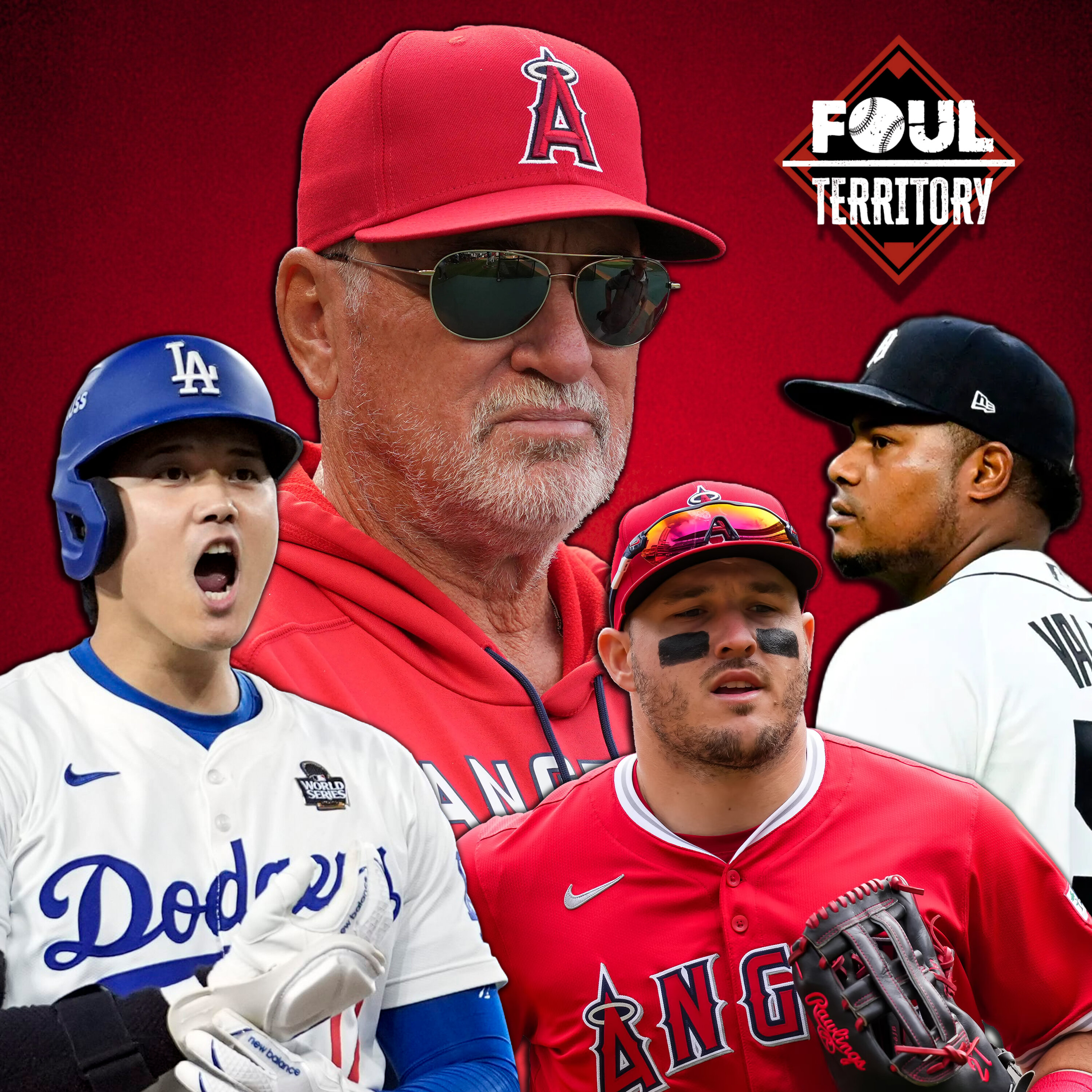
Joe Maddon Unfiltered: Managing Ohtani’s usage, Framber Valdez controversy, Mike Trout landing spots?
Former MLB manager Joe Maddon hopped on FT to share his thoughts on how the Dodgers are managing Shohei Ohtani’s usage in this quest for a Cy Young and another title.
Maddon also weighs in on the Framber Valdez-Trevor Story situation, where he'd like to see Mike Trout land, Tony Vitello's adjustment to MLB-level play, and the recent wave of manager firings.\
Hosts: AJ Pierzynski, Erik Kratz, Alanna Rizzo
Buy two months of BlueChew Gold and get the third for FREE with promo code FOUL at BlueChew.com
If you like your money, Mint Mobile is for you. Plans start at $15/month at MintMobile.com/Territory
See omnystudio.com/listener for privacy information.
Available Results
Generated results are saved to the knowledge database for reuse and search.
Extract Knowledge
Pick what you want extracted first. Model, scope, and chapter options appear after a template is selected.
Transcript
00:00:10
Speaker 1: Skip, It's great to be with you.

00:00:11
Speaker 2: It's been a long time since I have had the opportunity to talk with you, so Joe, thanks for coming on with the boys here on foul Territory. Let me ask you first about show Hey, Otani taking some more days off this year. Dave Roberts is saying that sometimes he'll hit when he pitches and sometimes he won't.

00:00:28
Speaker 1: How would you handle that situation?

00:00:29
Speaker 3: Skip, Well, personal, nice to see you guys again. Very cool. And the one thing you mentioned about the marketing the market or large market or small market. I like the large market because of the accountability component to it. Also, I was good with that you go to Wrigley Field every day. There's a large level of accountability from the fan base too, and of course the press. Like you said, there's the group within the press that you kind of feel comfortable speaking with and some are not so comfortable speaking with. But that's okay. It's all a part of the entertainment industry. I had to get that out of the way. However, Show Show Hey. The way I did it with him was we had a meeting in spring training, and the rules where there are no rules, meaning you tell me I've never had a guy that did both since I did it in literally probably right pitch and play a position, and so I really wanted to stay out of that. The one thing we settled on back then was that if he thought of his legs, would tell him the whole story. If his legs felt fatigued at all, we would not do both. And but he would tell me the night before he had to pitch what we're going to do. So I'm just curious if this is his idea or if it's the Dodger's idea. That would just be my take on the whole thing, because knowing him, he believes that the team stuends a better chance of winning on the day that he pitches when he hits his that was his logic. It's pretty good logic, So again i'd be curious. I'm just curious to know where that's coming from. As he gets older, it was probably part of the equation, I would think. However, I don't know any of that, So for me, it would be a conversation would show if he's in a little bit of a slump, I would not worry. He needs to get back into left central when he starts pulling the ball he gets pull happy, he pulls off pitches outside to slow rollover, et cetera, et cetera. He'll come out of that, So I always like to follow his lead in this situation.

00:02:15
Speaker 4: Dave's quote was, we were thinking about it, but it wasn't for certain, and then I saw body language from him and some of his swings. What do those things look like when you're talking about the best player on the planet and you have to evaluate that as a manager?

00:02:33
Speaker 3: Well, yeah, I mean that comes, like you said, it's individual, individualized regarding whom I'm watching and the observation. Normally that would be I'm just talking about he's pulling off a lot of stuff, maybe swinging the pitches in the dirt normally, and he'll chase the high fastball too, but it just totally out of character. He looks like he's defeated in a sense. When I say he, I'm talking about any baseball player. I'm not talking about shows specifically, right, And I think that's what you're looking for. I always like to look in somebody's eyes and you get that blank look about him, to the point where it just seems totally frustrated, has no answers, and sometimes in that situation, a day or two would be the route. I would go off like just a day off, and I guess just by pitching or not hitting that would be considered a day off. But with a guy like show, a player that has like a pretty good baseball card on the back, the numbers are pretty solid, and he's still young in the prime, whatever, I would probably I think pretty certainly I would talk to the fellaw first. I would not make a unilateral decision right here, saying you're just not you're out. I believe that you're you're you know, you need a couple of days off would be a conversation. I probably would be very persuasive, possibly like in my conversation with the player, like trying to get him to want to understand if it's best for him right now. It might get to the point if it gets really ugly, that you just say, listen, I want you to take a day or two off. But the original concept would be conversational, my observations that would try to relay them to him, this is why that's what I'm seeing. Of course, numbers would back it up, but when a guy's got some stature, I would take it a little bit more slowly.

00:04:11
Speaker 5: Joe, have you ever told a pitcher to throw at a hitter? Yes or no? It's a yes or no question.

00:04:18
Speaker 3: No I never did.

00:04:20
Speaker 5: Okay, well that's a lie because you threw me all the time. So that's a lie, Joe. Okay, so at least five seventeen times you had your picture throw at me. That's fine, I get it, Okay, But what about last night? What happened from Bravaldez? He didn't throw at Trevor's story after giving up ten runs and back to back homers, and then he threw his first four seemer of the year that hit him square between the numbers. How do you handle this as a manager? I mean, aj handled as bad as well as he could, But how do you do you go to the picture and say, look, man, we can't have this right now? How do you how do you what's the fine line of a manager in this situation?

00:04:55
Speaker 3: Let me backtrack here just a second. I kind of noticed that. So he was left in the game the up ten runs? Is that right?

00:05:03
Speaker 5: Yeah? It was. I don't know if he gave he gave up a lot. Yeah, it was all.

00:05:08
Speaker 2: Okay, So for me it was I'm sorry that their bullpen was was getting crushed too. I mean he they needed him to give them length because there was a couple of bullpen games prior to those to yesterday's game too, and then he was getting absolutely obliterated.

00:05:24
Speaker 3: I've I've been in situations where I've since I've not done this either, AJ with situations I saw. I saw mister Tory one time leave l Duke in to give up ten points in Anaheim because he had been complaining about it. He was getting taken out of the game too early prior to that. So when I see something like this, I almost wonder like if the picture had popped off at any point. That's that. Let's get that out of the way. Now, what we're talking about here, How did AJ handle? Okay? We we didn't feel like the conversation didn't feel good. Yeah, I mean, listen, I don't want anybody to hit I never I did. I did not want him to hit anybody. I never asked anybody to hit anybody. Even when AJ did all those crazy things against the teams that I managed and and really hurt us several occasions.

00:06:11
Speaker 5: So happened, Joe that I get hit right after that? It just it just didn't come. No, you know what, it didn't come. It came from Soshia, or it came from you know, Ron Rennicky or some.

00:06:24
Speaker 3: One of the veteran fitter, a veteran pitcher in the in the bullpen. I'm sure Percy probably had a lot to do with that as an example, But how do you handle that? I mean, here's the way I like to handle things in all these situations. And this, this is my Jack Ryan moment, meaning that I was a big reader. I'm still a big reader. And the protagonist and a lot of the Clancy novels was a guy by name of Jack Ryan. You've seen in the movies. And when he was pressed one time, uh, in one of the movie and one of the novels the movies. Uh, there was an incident in the Caribbean where a very good friend of the president was involved in this big drug bust deal shot killed on a boat, and the spin doctors wanted the president to say, you know something weird or different to distance himself, and though Jack Ryan said no, mister President, he was not only one of your friends, he's one of your best friends. In other words, run at it, don't run away from it. So if it's hard for Aja, he can't come out just and say that, yes, we intentionally threw out the hitter right there was I don't think he gave that kind of an order right there. But you just got to be honest. If you're honest with the press, if you're honest with what you say normally, the situation goes away rather quickly. If you dissemble, if you try to take the truth and pick it apart and not give everybody everything, then the story becomes a story. So for me, it's a Jack Ryan moment. You just throw it the truth out there, and to me, when you do do that, the story goes away rather quickly.

00:07:46
Speaker 5: Let's talk love life ft family. I know it's an important part of everyone's life. But if you need help or if you don't plute you Gold is changing the game and it is turbo charging your love life.

00:07:57
Speaker 3: That was beautifully delivered.

00:08:00
Speaker 6: New arousal boosting formula combines passionate performance into one tablet that dissolves under your tongue for super fast on set. No more waiting for a pill to kick in, no more moments ruined by performance anxiety. Just the results you want, when you want them. Most dd meds only focus on blood flow, but blue Choo Gold goes further by combining two ingredients for blood flow with two more for mental arousal and connection, so you're not just physically ready, you're actually in the mood. And we've got a special deal for our listeners right now, and you buy two months of blue Choo Gold, you get the third for free with promo code foul.

00:08:35
Speaker 5: That's promo code f o.

00:08:37
Speaker 6: U l visit bluech you dot com for more details and important safety information, and we thank blue ch You for sponsoring the podcast.

00:08:46
Speaker 5: Right, Joe, that's the favor Who's your favorite Jack, Ryan? I need to know who your favorite Jack Ryan?

00:08:52
Speaker 3: I love among them. I really liked the Harrison Ford. I did like him a lot. He was great with that. But I wasuly the first one hunter for Red October Baldwin, right.

00:09:04
Speaker 5: He was really good in that.

00:09:05
Speaker 3: I really liked that a lot, and if they had stayed with him, I was going to be good with that. And that was a great book I read. I read most of the books, Clear and Present Danger, read all this stuff. It was fantastic. So I'm saying fortunately because I think I saw him the most. But I really like Baldwin's portrayal. I did.

00:09:25
Speaker 4: All right, Well, you said about honesty. Isn't there kind of a moment with a team though, where you see this and you don't want this to be the persona of your team. Is this a case where you maybe make an example out of him? And would you ever say what you have to say in front of the team to Framberg or you always a closed door and then we'll conversate about how it's going to be taken care of with the team.

00:09:55
Speaker 3: Yes, yeah, I critic praise publicly, criticized privately. I would if I have an issue, I want to talk to you about it privately first always and really try to let's get on the same page with this, and how are we going to proceed with this? And again you're right, I mean the talks that we talk about honesty, it's it's as honest as we could possibly be with this without really blowing it up to the point where somebody's gonna get hurt. But I do. I would have the conversation first behind closed door, talk it all the way through, and then for me, I would almost like I understanding the situation properly, like maybe have Framberg addressed the whole group after We've had an opportunity to do this privately, but I don't. I don't like to do I don't like to call anybody out in front of a team. I can't even remember the last time or if I ever did do that. I called out a whole team in Kansas City in two thousand and eight when we won a game in Kansas City because I did not I never like punitive meetings. I never like punitive workouts. But we if you win, if you have if you call the group out after a win, and after win on the road, because after a win, because you know, everybody's kind of happy, whatever. But I was really pissed on that particular day. We were kind of starting to go through the motions. We'd never really done anything before. So I did that there and after on the road, because you don't want to soil your home clubhouse. I did not like when there was these really negative meetings in a home clubhouse because that's a report to work mostly. I mean, that's half the seasons in that clubhouse. So if you're gonna get upset, do it after win, do it on the road. And I you know, that was the one time I screamed at a group to the point where I lost my voice, and that was two thousand and eight in Kansas City. I believe it was August, and I was concerned they were getting too big for our bridges. But otherwise I don't Individually, I've never I don't know if ever, I don't think I even did that in the minor leagues. I've done some stupid things, don't get me wrong, but I don't think I was that dumb. And praise publicly, criticized privately, I think is the best way to go through something like this, and I really adhere to that.

00:12:00
Speaker 5: Thank you for admitting that you had pictures throw at me, so thank you for telling me. Thank you for admitting you've done a lot of dumb things. You just admitted it without a minute.

00:12:08
Speaker 3: I did, I did, I know, I do a lot of us. I have a list that's some of them in the book too.

00:12:14
Speaker 5: Thank you. Also, by the way, you obviously don't know Ozzie Gean very well because he criticized publicly and then try to pump you up.

00:12:21
Speaker 3: So he was kind of the opposite direction, right, because the opposite of you, which is fine, I mean if you.

00:12:28
Speaker 5: Yes, exactly, love Ozzie to death. Uh so you guys are a little bit different. Mike Trout. He's in Anaheim, you managed Mike Trout. Will we ever see him leave Anaheim to try to go to a place to win because they're they're not winning this year there. It doesn't look like they're going to win anytime soon. Be could it turned around?

00:12:47
Speaker 4: Sure?

00:12:48
Speaker 5: But now people it's kind of getting louder and louder. Hey, Mike Trout's off to a great start to be the perfect time for the Angels to finally move him. Will that happen?

00:12:57
Speaker 3: I don't think it will happen, But I thought it should have happened when it was pretty obvious that show he was going to leave the Angels, or when he did leave the Angels, I thought that was the perfect time to trade mikey at that time too, only because I mean, the situation there wasn't good at that moment. It still hasn't really risen high above that particular moment in time. And they do if they if they could restock in a in a very healthy way, and that would be up to their determination how they evaluate prospects. But yes, I would I would send him out. I would send him out for his own benefit, for the benefit of baseball, getting an opportunity to see him play in a playoff situation, just not unlike what happened with the show when he went to the Dodgers and all of a sudden it has become kind of a showtime. And you know, Mikey looks really good right now. I'm watching him in center field. He's moving well. You watch him. I saw him score first to home I think, and I saw him the camera happened to be on him going from around third base to the plate, and then he actually slid in the home plate, and I thought, wow, he must be feeling pretty good if he just didn't run through the bag, slid into it, and he never lost stride and the effort level was good. So yeah, if there's there's no better time for them to do it than right now, get something in return for it. It's not conceding the feat by any means. It's just a smart baseball maneuver. And and if in any way they could they could hook up with a group that they feel good about their return, I think it would be wise.

00:14:18
Speaker 4: Where would you see Where would you like to see for Mike Trout and for baseball, where would you like to see him play and be and be a good fit. It has to be a playoff team, obviously, like you said.

00:14:29
Speaker 3: Yeah, yeah, I mean I obviously Philadelphia is a good spot. I mean, everybody you know that's an easy fit because he's lives right down the street from there, and I like, I like, uh, what Crawford's doing there. I think he's going to be a fine young player. Brandon marsh is there. I know a lot of those guys, but I think Mikey in the middle of that whole situation, being right handed, would be very helpful for that particular group. I think he would thrive in the atmosphere. He knows what it's like. He I think he would fit into Philadelphia very easily. You were just talking about playing in New York, and that's an acquired ability. Also, I think to a certain extent, playing in Philly can be described in the same way. So some places like that, I think it would be great. I mean, well, primarily I would say Philadelphia if I had one landing spot. I like him in Philadelphia. I think that makes sense, and I think he can be kind of a real difference maker for them since the firing of Robbie, which you know, again, I hope people don't read that wrongly, because Robbie Thompson is a very good manager, and they're just benefiting from the fact that the Phillies I think, were kind of embarrassed that their manager got fired, and all of a sudden, the accountability factor has even gotten even higher. So it's just another little pump that that possibly could get them over the top. So I think the perfect landing spot. I don't even know what their minor leagues looks like regarding a return in prospects, but that would be a perfect spot for Michael.

00:15:47
Speaker 2: Joey brought up Robbie Thompson, and I believe he's just such a good baseball man. Alex corrifired first Rob Thompson a couple of days after that. Did the timing of these particular situations surprise you. I mean, at the time, I don't even think that they had played thirty games into the season.

00:16:05
Speaker 3: Yeah, it's it's kind of tough to decide at that particular point. You know, I was let go relatively early, but not that soon. You know. Sometimes it almost seems as though that the organization was thinking about that in advance, make even in the spring trending. Now I've already talked about this. I thought it was easier for the Red Sox to do to let Alex go only because he was not hired by that regime, whereas Robbie came back as a savior with the with the Phillies a couple of years ago. So I thought that was a little bit more difficult. And I also believe that's why Carlos Mendez, who I also like, I think these are good, These are really good managers. You have to really have something lined up pretty good to take the place of these guys, so they're that they're that competent, so they did. It did surprise me. I'm glad that Mendoz is still there. I really am. I I think Sterns understands that he did hire him, and I think that there in lie somewhat of the difference. So that's why I was not surprised with Alex, a little bit more surprised when Robbie was let go. And of right now, like I said, the Phillies look like they're doing something well. I mean, and I listen, Don Mattingly is one of my faves, so I'm happy for him also, But it's just the early point in the season kind of difficult to understand. But then again, these are teams that still believe they got an opportunity to get to the Dance. So I think that they thought, if we don't do this now, that it's going to look like this for a long time and we're going to miss our opportunity.

00:17:28
Speaker 5: That's what it sounds like, Joe Tony Veitelo. I think you've had some comments on him going. I can't imagine jumping from college to the big leagues without even managing anywhere at a stop, having any idea speed of the game, length of the season. There's so many things right now, it's not going very well. He's still have been some emins that the game going too fast, there's longer than he thought they have. How do you address this if you're the Giants? But what's your next move you're the Giants?

00:17:57
Speaker 3: Well, first of all, it is different. I mean, there's nothing the same about you're describing going from the college game to the not just the professional game, the major league game. I you know, I became a manager when in the big leagues, when I was fifty one to fifty two, and I was so grateful that it took me that long to become a manager because I needed so much experience. I never played in the big leagues, which I thought was not necessarily requirement to be a manager in the big league, but to have played there, I would have understood what it was like to be there better. The beat of the day, like you were talking about earlier, the press factor, the media factor, the travel factor, the length of the season factor, the ups and down factor. There's so much going on with that, and then you're talking about some really highly charged personalities. These are men, these are professionals. This is their livelihood. You don't have the same kind of sway over them that you would in a collegiate environment where you're omnipotent. I mean, you're in charge of everything. You are the COO, CFO, the c whatever oo. You are in charge, and the way you can interact with these guys is completely different than you can on a professional, more importantly a major league level. For me right now, and I'll say this because I did, I did say some things, and primarily it was like kind of insulting, is the way I described and only because I am defending everybody that came before me, also the guys that put me in a place to have the opportunity to become a major league manager and eventually be a part of a group that wins the World Series. That part, to me was so invaluable, and even nobody even talks about the scouting component. Being a scout for so many years was the probably the most important thing part of my resume that helped me become I thought, a good major league coach and then manager. All these things matter. But the point is it's different now because the way front offices deal with this they kind of okay without without so much experience. Because when you get a guy like Tony in there who has not had experience, there's a little bit easier method or ability to control whatever's going on around there because this guy doesn't have the same I built ins and years of experience or feel or everyon want to call it intuition that a guy that has not had that experience has or does not have, so it's an easier controllable situation. He speaks well, he's been very successful. I like him from a distance. I'd love to sit down and have dinner with him, just to hear the whole thing. But their next I talked about this too recently. He needs to be true to himself in he whatever got him there, whatever that is about him that needs to be maintained. That he's gonna hear a lot of stuff from different people that are gonna want him to change, or that he has to change, whether it's his high school coach or somebody in that front office. It's he's hearing a lot of different things right now, I believe, so I know for one thing. Man, That's why I'm so happy I didn't get it till that was that later meaning a manager's job. I knew what I thought. I knew what I knew, and of course they continue to build upon that. But if you've never been in this situation, you guys know that, man, it's not it's it's ninety feet sixty feet six, which defenses are the same distance. But the game cannot be more different.

00:21:04
Speaker 6: You know, we don't always have to do things because that's how it's always been.

00:21:07
Speaker 5: Look, people consider me old school, and I thought I was, but then we had the pitch clock and the abs and ban on shifts and all these things. That we've had for a long time in baseball, and you know what, much like Mint Mobile and the other mobile carriers, I'm here for the new school and the changes that have been made.

00:21:22
Speaker 3: It's a good call.

00:21:24
Speaker 6: You can ditch over priced wireless. You don't have to say, oh, I'm paying that, because that's how it's always been. Get three months of premium wireless service from mint Mobile for fifteen bucks a month. All plans come with high speed data and unlimited talk and text delivered on the nation's largest five G network. If you like your money, mint Mobile is for you. Shot plans at mintmobile dot com slash territory. That's mintmobile dot com slash territory. Upfront payment, but forty five dollars for three month five gigabyte plan required equivalent to fifteen bucks a month. New customer offer for first three months only, then full price plan options available, taxes and fees extra. Cement Mobile for details. Get after an FT fan.

00:22:05
Speaker 4: He clearly connects with people. I think that's probably why he got the job. What on the field do you feel like if you think back to when you first were in a big league dugout after your years in the minor leagues. You weren't a manager right out of the gate. You were on a big league field watching the big league game. What do you think is the one thing that's probably toughest for him to adjust to that will take two months, three months and give Giants fans hope that like, oh, he's gonna start to see the game. Because when I watch games and they panned to the dugout, I'm seeing the big league coaches looking at this way and he's looking this way.

00:22:43
Speaker 5: So for you, is there.

00:22:44
Speaker 4: Something that you're like, Man, I wonder if he's able to see the speed of okay this or three or four batters ahead that I need to get this guy loose.

00:22:55
Speaker 3: The biggest thing that I felt when I got there, I felt that was useless. Has some major league I just went from running the entire minor league system. I had been a minor league manager. I had been a scout like I just talked about. But when I got there as the bullpen coach, Marcel took me up there, Marcel Latchman, I felt useless. I sat in on team meetings and I listened to different coaches present the information regarding the other team and just the other team in general, I've not been around I've not seen these guys in person. I felt useless. I felt like I didn't have an opinion because I didn't know. I had not been around this. So that was the one thing I had overcome. And what I did was I started taking my own notes, and eventually the next year I became the first base coach, and my note taking got pretty deep and intense by that point. So it got to meetings my second year, and that was after the strike year of ninety four. I started to feel as though I can contribute. I'm talking as a coach, not as the manager. So I was very versed as a manager. I ran instructional leagues, iran spring trainings, I ran teams, I was a scout, I was in charge of it territories. But I felt absolutely useless when I got to the big leagues and attended those meetings when I first got there, because I think it was it was quick and I didn't understand what we're talking about. I went through this whole thing in the minor leagues, absolutely, but the game, the game is like I said, it's the same, but it's completely different. So it took me a while to get up the speed, observing the other teams, watching other players, and starting to understand when you talk about how to pitch to somebody, how to how to defend somebody, or just like you're suggesting the speed of the game, which I honestly, I'm very pleased that I did get that opportunity to manage in the minor league, because that didn't bother me as much when I became a manager eventually. But the whole thing is you have to feel like you have a chance to make an impact. And if you're coming in there and never having done anything before and all of a sudden you're the manager, which is that's why you have to make the most impact with It's very difficult because you just don't know the league and you don't know the players.

00:24:55
Speaker 5: Joe, what year was it when you told your catchers not the tag guys when the ball hits the dirt. I'm just asking asking for a friend, just asking for a friend.

00:25:02
Speaker 3: Joe wrote that that was two thousand and six, SAT five, excuse me five going into six.

00:25:12
Speaker 5: I just wanted to know, Yeah, I was there.

00:25:16
Speaker 3: Jerry Crawford to Jerry Crawford, do I love it?

00:25:18
Speaker 5: Doug was Doug?

00:25:20
Speaker 3: I know, but Jerry, Jerry, But Jerry, Jerry backed him up. Jerry backed him up.

00:25:24
Speaker 5: They're not going to argue with each other.

00:25:25
Speaker 2: Joe, you know this, Joe, you recently had a conversation with Jason Jenks of the Athletic. You guys put together, Joe Madden, and these are three best leaders I managed in Major League Baseball. You've been around this game a long time. You've had a lot of guys that you've managed. So you picked three, which is hard to do.

00:25:43
Speaker 1: It's hard to.

00:25:43
Speaker 3: Narrow it down.

00:25:44
Speaker 1: Who did you choose.

00:25:45
Speaker 5: Let's start.

00:25:46
Speaker 1: Let's start with number one.

00:25:47
Speaker 3: I started with Cliff Floyd, and you know I clipped with the two thousand and eight eight excuse me, raise Andrew did a great job that off season. We had a nice young group of core group of players, but we needed some kind of We needed some flavor in there. We need some salt and pepper. We needed some guys could actually lead, and we had Perceval, Troy Percival came on board, Eric Kinski came on board, and then Cliff, who I did not know it all, came on board. And Cliff, one of the threads within these three leaders I felt was like presence, physical presence, and just presence in general. And Cliff is absolutely all about that and all three and they all had the common threat. I love my conversations with him, and he would come and sit in the office. You look, you're right in the eyeballs, and we would talk about things, and it would be things that kind of like, as they say, stuck in your crawl a little bit, things that he didn't like, things that he thought we could do better with, and we'd sit and talk about it and then would attempt to make the adjustments, including himself, because his influence in the clubhouse was that great. And then, like I said, his line drivers, he selects up and left in the tank. And if you ever you've all seen, I think in person, the Cliff Floyd line drive over centerfield fans at Tropic Candonfield was it was absolutely scared. But his method was just like his line drives was different. He just hit the ball differently when he was on top of it. And then his approach in the clubhouse to me was spot on. And I watched him on TV right now and I could feel all of that. So anyway, that's all encompassing. It starts with presence. He was an absolute winner. All he wanted to do was win, and he had this a humble way about him also, And I think all three of them do that. They're just there to share information. They want to win. But the presence factor really carries a lot away from me.

00:27:35
Speaker 1: What about number two? Who's your second guy on there?

00:27:37
Speaker 3: Number two? I had David ROSSI and David when we were with the Cubbies, and I got to know him via phone conversation. In my nineteen sixty five Ford Galaxy. We got deal and put him together with I. And I'm sitting behind a grocery store in Tampa talking to David Ross for the first time, and God that I like him. I really liked him a lot. David was, like I said, he was the bad cop in a good way. David. And the thing that sticks out to me is the time that Wresselled messed up on the field. I don't remember exactly what he was on defense, and so any go, he's walking towards a dugout and I see David walking to that end of the dugout. So I always stayed in that one corner. So I just started looking to my left and I wanted to say, Okay, what's he going to do or how's he going to do it? So I saw the conversation. It looked a little bit bloody, but not horrible. And then afterwards I wanted to make sure I spoke to David. Let's listen, man, I really appreciate what you Appreciate what you're doing. It's necessary, Thank you. I just want you to always understand who your attempt to understand who you're speaking with and how stricter, stern or whatever you can be with that person without blowing him up too much. That was the only thing I was like a teachable moment for me to David at that point also, but he would do that when Tom is in the article, I pinch it for him. He did not like that. He came in the office after the game, and you know, David wasn't the greatest hitter, but and that we probably had a situation platoon stuff. I probably put Miggy and I don't even know Lefty, and he didn't like it. He didn't like it, so he came in my office. We went over it for a bit. We went back and forth pretty well. It was very open, honest and I can still see him sitting across from me. But by that time you're done. Both sides are so honest that you respect each other. You know, told him what I thought, He told me what he thought. Says okay, but if I had to do it again, it might you know, you know, regardless of what you say right now. But it kept going, and then finally he was like, became even better friends in a sense, manager player friend at that point. But I love the fact that he would hold the players accountable in a way that he had presence delivery. The guy has become a major league manager. I think he deserves another opportunity, but he had that way about him also, plus and tremendous sense of humor. He's very funny fella, and he's passionate about what he does.

00:29:52
Speaker 2: Skip the third guy on your list is one of my favorite people in the game.

00:29:56
Speaker 1: What you love about him?

00:29:58
Speaker 3: Same thing. I mean, we've I didn't really have any kind of a confrontation with the Cliffy, but the other two guys, I don't want to say confrontation, but a really good discussion. So Jay, we were in nothing got a tremendous presence. He just walks in a room he's just he's pretty imposing. We had a playoff game in San Francisco and he was struggling at the plane. I guess we're facing the lefty. Could have been bumguard and I don't even know, but I did not start him in the playoff game in San Francisco. And he comes into my office and we sit down there and he, you know, he's pretty upset. He feels like he needs to be out in the field for us to be as good as he possibly can be. And when if he's I can't argue with that. I never I always wanted him on the field always. We were always better when Jay was on the field. We need to score some points that night. So I explained it to him, this is my call right now, and it was my call. Uh, this is the best possible line up we could put out there right now. But be assured, I want you on the field as soon as we can and as often as we can. And that's true, Jason. You know, the whole time in h Cago didn't hit up to his contract, but he delivered. Man. He delivered in every other way possible, whether it was tapping gloves coming off the field to unify the outfielders or the dugout in general, or the best baseball abbreviated baseball team meeting. I guess in history in twenty sixteen when the rain delay in Cleveland, when he took it upon himself to call the boys into the room and discuss with that moment, and pretty much from what I've understood, I wasn't there. The crux of the conversations meeting was this is our time. This is our time, guys. Nobody could take it away from us. It is our time, and we're going to do this pretty solid, pretty short to the point and to me that if anything should go down, people should repeat from that World Series victory is that that Jayward got them in that room and he was very direct with them. We came out, I was upstairs checking the weather report. We came out in the field, and I got I thought the game was just about ready to begin. Our guys, that jack and of course you saw what happened. So do you have the temerity, the ability to the balls to call that meeting like he did and speak as he did Because he wasn't the three hundred hitter, He wasn't the guy with twenty thirty five home runs. He wasn't that guy. He was is a solid human being in a great baseball player, and he did it and that was one of the biggest differences in US winning the World Series.

00:32:26
Speaker 4: Joe, there was a poll out about the best looking managers while you were still managing, and you were one of the top five best looking managers. But earlier when we brought up this picture of you talking about the best three leaders that you have, the athletic picture. Does this persona fi this picture? Does it personafy what it felt like sometimes managing under what was going on in Anaheim.

00:32:54
Speaker 3: I'm not good in red. Let's just put it that what it is.

00:32:57
Speaker 5: Hey, Jay's not either, And that's what I.

00:32:58
Speaker 3: Was gonna say. I think it's a red thing. I think it's a red thing. I agree with the top five. However, it's uh when I see that picture, I cringe. That's that's a cringeworthy picture. And it's definitely not a sponge worthy picture, but it's definitely cringeworthy.

00:33:15
Speaker 5: Wow, I got it, I got it, I.

00:33:17
Speaker 3: Got you got the reference.

00:33:19
Speaker 5: Okay, I got it, I got it too. Not that old. Yeah, before we let Go Go Go, when did the co the World Series because I don't remember them winning. Did they they won the World Series?

00:33:35
Speaker 3: They did, they were their last Chicago team to win the World Series.

00:33:38
Speaker 5: I try to block that out of them. I try to block that out of I think I have.

00:33:42
Speaker 3: Two thousand and five. When you guys beat us, if you all remember, we had just come off a really difficult moment the Angels did to get to that point. We get to Chicago, we win that first night, and and then that second night, the game is absolutely stolen away from us via one of your broadcasters right here, which I do credit you for. I do listen. I give you all the credit in the world, because those are the kind of things that are not evaluated on any kind of analytical sheet in past, present, or in the future. So you you out competed us in that particular moment you won, and that that one moment, you have to understand, completely turned around the entire series. If that moment doesn't occur, the Angels win that and the Angels go to the World Series, that you're as opposed to the White Sox. That is absolutely true. There's nothing, there's nothing conflated about that. That's what happened, and the White Sox win World Series based on AJ's ability to u rend the first space with the bondet perceived bondatar perceived.

00:34:44
Speaker 5: I can't do that. Wasn't even what I was going to with this, Okay, okay, but all I wanted to say was, before we let you go, you had Garrett Anderson for a long time, recently passed away, an awful story. Anyone that played against him, anybody that never talked to Garrett Anderson, nothing but the utmost respect. Before we let you go, I just wanted to get your perspective on Garrett Anderson, on GA and just what a great dude he was. Even though we had some battles, he was just always a great dude, always smile and always came up. And I never wanted to see that guy up in a big situation.

00:35:16
Speaker 3: You're right, Gay. I had him started with like seventeen, I think he was might have been eighteen years of age. It was at Granadi Hills, I don't know, some high school out there in California. I remember our first instructional lead together. I remember a game in particular where he didn't feel the ball well and left field. I think it was at one of the backfields at Fitch Park. That created a conversation. I remember going to Boise to watch him playing Boise, Idaho. He had really never played under the lights much before, so I'm in town as a roving instructor at that point. We kept the lights on after the game so Ga could go out there and hit him some fly balls with the lights on. I was his hitting coach and one of the you know that g just liked to swing the bat. He didn't really like to walk. One of my lines used to be that I wanted you to hunt a pitch, and you know, really hunt the pitch and accept your walks and and and really if you do do that, you're ow'n basically gonna come up. I was. This was part of my spiel back in the day. And one day he came up to me and said, hey, Joe, you know that that thing you talk about, honey, my honey, your pitch. So yeah, ja, he says, I really can't do that. I said, well, Gia, don't do it. Just go out there and hit He was. He's a sweet man, the sweetest. His eyes smiled before his mouth. Did you know where he's coming from the Conversationally, he would just start breaking down with his eyes and and that would be the smile, and you know that you had him in that moment. He and I had some great conversations because there was a you know, Ga had this one speed about him, which sometimes people criticize for him, but I thought it was his strength. Look at the number of games played. You don't have it up there. Do you check out the number of games he played on an annual basis. The guy never missed. He posted, he posted, he posted all the time. If he had injuries, you really hit them out. You could rely upon him. And I'll tell you what, if there's running and scoring position with two outs, you wanted Ga up there. And even demonstrated that to me when he was in Vancouver. I went up to the cove to watch him play. I was the hitting instructor, and this guy drove and runs without homers, which I always look as a really indicator of a guy that knows how to drive him a point. So beyond that, as a human being, his wife, Teresa's kids, we're all hurting about that one. He remarkably calm, great friend. I don't think I've ever saw him saw him lose his temper. It was always like just like he played even keeled. So it's a big miss. We all, it took us all. I was coming back from a restaurant. Somebody called me that night before it was public. Timmy Mead called me and it was just it's awful. It's awful. So yeah, he was all of that. He was the best.

00:37:53
Speaker 5: Yeah, I mean I didn't know him as well as you. So thank you.

00:37:59
Speaker 1: You're welcome, very well started, Joe. We appreciate you. Thank you so much. Always good to hear your opinion on things and get the insight.

00:38:06
Speaker 3: We'll talk to you again soon anytime. Guys continued great luck and success with your show. You guys are great, appreciate it.