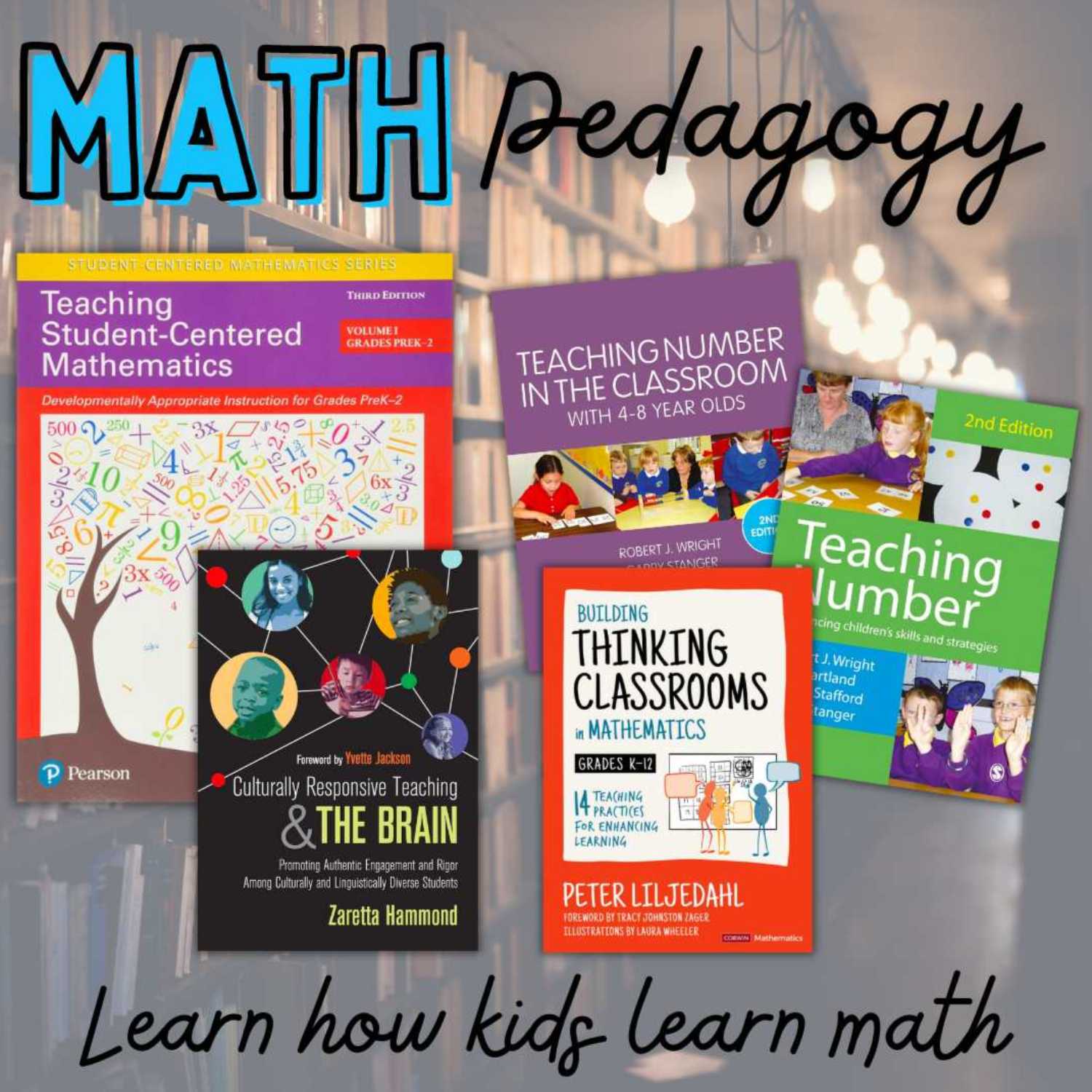
Ep: 26 Book Recommendations to Learn How Kids Learn Math
Making Number Sense Make Sense: A Math Podcast for Early Elementary Teachers
If you are looking for some recommendations of places to look to increase your knowledge of math pedagogy, center ideas, and more this episode is for you! I share with you how I first got my hands on a professional development book that I actually used and some others if you are looking to take your math knowledge to the next level.
Math can be a subject a lot of people don't feel comfortable teaching or learning and these books can give you the background and confidence to continue your journey as an amazing math teacher!
Have a topic you want me to discuss? Fill out the Google Form!
Helpful Links/Time Stamps
4:05 Teaching Student-Centered Mathematics Pre-K-2/ Teaching Student-Centered Mathematics 3-5
5:15 Math Recovery Series
7:15 Culturally Responsive Teaching and the Brain
8:00 Building Thinking Classrooms in Mathematics
9:10 Juli Dixon
Culturally Responsive Teaching and Building Thinking Classrooms Crossover Episode
Let's Connect!
Available Results
Generated results are saved to the knowledge database for reuse and search.
Extract Knowledge
Pick what you want extracted first. Model, scope, and chapter options appear after a template is selected.
Transcript
1
00:00:00,000 --> 00:00:04,700
If you're listening to this podcast, I assume you want to learn more about math pedagogy

2
00:00:04,700 --> 00:00:09,000
and teaching math, so today I'm going to share with you some books that have really helped

3
00:00:09,000 --> 00:00:19,720
me learn more about the pedagogy of math.

4
00:00:19,720 --> 00:00:25,200
Hello and welcome to Making Number Sense Make Sense, a podcast for elementary teachers,

5
00:00:25,200 --> 00:00:29,920
specifically early elementary teachers, looking to really make an impact in the number sense

6
00:00:29,920 --> 00:00:31,920
of their students.

7
00:00:31,920 --> 00:00:39,080
In college, I had one class about teaching math and I felt like it was very broad.

8
00:00:39,080 --> 00:00:46,300
It was just one class and I feel like the general thing, I guess, that you get when

9
00:00:46,300 --> 00:00:51,080
you're in a class about how to teach math is they usually give you a third grade lesson

10
00:00:51,080 --> 00:00:54,440
– no hate to third grade teachers – but they give you a third grade lesson because

11
00:00:54,440 --> 00:00:55,640
it's kind of in the middle.

12
00:00:55,640 --> 00:01:03,400
They don't really talk to you too much about differentiating down or differentiating up

13
00:01:03,400 --> 00:01:08,080
and that's all well and good when it's theoretical when you're in college, but when you're

14
00:01:08,080 --> 00:01:11,920
actually in the classroom, it's like, well, that's not really going to help me if my

15
00:01:11,920 --> 00:01:13,320
kids can't count yet.

16
00:01:13,320 --> 00:01:17,760
So I found myself, you know, teaching kindergarten in math.

17
00:01:17,760 --> 00:01:24,680
If you've heard my very first episode, my math origin story, you know I had a...

18
00:01:24,680 --> 00:01:31,280
I didn't have the best relationship with math period, so I already felt a little bit

19
00:01:31,280 --> 00:01:35,800
uncomfortable teaching math and I feel like I'm definitely not the only teacher who has

20
00:01:35,800 --> 00:01:36,920
felt that way.

21
00:01:36,920 --> 00:01:39,800
And so I was really looking for help.

22
00:01:39,800 --> 00:01:41,440
I was really looking for support.

23
00:01:41,440 --> 00:01:43,520
I was a first-year teacher.

24
00:01:43,520 --> 00:01:45,200
I was starting a new program.

25
00:01:45,200 --> 00:01:52,000
I was starting a Spanish immersion program and I don't know this for a fact, but I know

26
00:01:52,000 --> 00:01:53,000
it's true.

27
00:01:53,000 --> 00:01:57,200
The school that I had started at, they were just starting Spanish immersion in kindergarten

28
00:01:57,200 --> 00:01:59,480
and they didn't necessarily...

29
00:01:59,480 --> 00:02:06,200
The feeling I got was that they didn't necessarily want immersion there and I felt very much

30
00:02:06,200 --> 00:02:12,520
like because they didn't want immersion there, there weren't necessarily that many people

31
00:02:12,520 --> 00:02:18,480
other than my amazing kindergarten team who were willing to help me, maybe because they

32
00:02:18,480 --> 00:02:26,280
didn't know how to help, maybe because it's not a testing year, so it often gets pushed

33
00:02:26,280 --> 00:02:27,440
aside.

34
00:02:27,440 --> 00:02:28,800
I don't really know.

35
00:02:28,800 --> 00:02:34,480
So I felt like I really didn't have anybody to help me figure out how to do this job and

36
00:02:34,480 --> 00:02:38,480
how to really dig deep because I wasn't teaching any language arts.

37
00:02:38,480 --> 00:02:44,280
I was only teaching math and science and especially in the younger grades, I had one class on

38
00:02:44,280 --> 00:02:45,280
math.

39
00:02:45,280 --> 00:02:48,280
I had countless classes on how to teach reading.

40
00:02:48,280 --> 00:02:54,280
So I had one class on how to teach math, didn't even show me how to teach my age level well

41
00:02:54,280 --> 00:02:56,120
that I felt prepared for.

42
00:02:56,120 --> 00:02:59,440
So I was really between a rock and a hard place.

43
00:02:59,440 --> 00:03:02,040
I was like, how am I going to do this?

44
00:03:02,040 --> 00:03:07,280
Luckily, there was one other person other than my amazing team who could help me and

45
00:03:07,280 --> 00:03:16,000
that was our math, our title one math specialist, Bobby, and literally the only other person

46
00:03:16,000 --> 00:03:17,000
who would help me.

47
00:03:17,000 --> 00:03:23,520
So I'm going to share with you some things that my amazing math resource person told

48
00:03:23,520 --> 00:03:24,520
me.

49
00:03:24,520 --> 00:03:29,320
So if you find yourself in a similar situation and you don't have a Bobby, I am happy to

50
00:03:29,320 --> 00:03:30,920
be your Bobby.

51
00:03:30,920 --> 00:03:34,560
And when she retired, she gave me a lot of her materials.

52
00:03:34,560 --> 00:03:36,840
She pointed me in the right direction.

53
00:03:36,840 --> 00:03:39,040
So I am happy to do that with you today.

54
00:03:39,040 --> 00:03:44,320
So like I said, I am there trying to figure out how to teach math and these are some of

55
00:03:44,320 --> 00:03:47,680
the resources that I found the most helpful.

56
00:03:47,680 --> 00:03:53,400
And this is I'm speaking specifically about the theory of math, math pedagogy and the

57
00:03:53,400 --> 00:03:56,640
way that kids learn math, not necessarily centers.

58
00:03:56,640 --> 00:04:02,080
A lot of these books do have centers, but I wouldn't necessarily go to these first if

59
00:04:02,080 --> 00:04:03,920
I'm looking for math centers.

60
00:04:03,920 --> 00:04:08,600
The first one that she gave me was teaching student centered mathematics, developmentally

61
00:04:08,600 --> 00:04:14,280
appropriate instruction for great for grades pre K to two by John Van de Waal.

62
00:04:14,280 --> 00:04:18,800
And colleagues, they have one for third to fifth grade, which I've also looked at.

63
00:04:18,800 --> 00:04:22,240
It's in the same vein, very good.

64
00:04:22,240 --> 00:04:25,720
I think they have one for middle school too, but I haven't actually looked at that.

65
00:04:25,720 --> 00:04:27,680
Like I don't have that one in my hands.

66
00:04:27,680 --> 00:04:32,440
And I found that the student centered mathematics book to be extremely helpful.

67
00:04:32,440 --> 00:04:35,480
It talks about setting up your classroom.

68
00:04:35,480 --> 00:04:37,400
It talks about the pedagogy.

69
00:04:37,400 --> 00:04:39,360
So how kids learn different math skills.

70
00:04:39,360 --> 00:04:44,560
It does give you center ideas and station ideas, but it really, I felt wraps it up really

71
00:04:44,560 --> 00:04:45,560
well.

72
00:04:45,560 --> 00:04:49,120
It gives you just enough theory and just enough centers to marry it together and help you

73
00:04:49,120 --> 00:04:50,720
feel really prepared.

74
00:04:50,720 --> 00:04:56,480
So I highly, highly, highly recommend the teaching student centered mathematics series.

75
00:04:56,480 --> 00:05:02,920
And like with most books, they're not necessarily the most budget friendly, but see if you can

76
00:05:02,920 --> 00:05:08,240
get them either in your school professional library or your district professional library.

77
00:05:08,240 --> 00:05:13,740
You can usually find them used for not too expensive, but I highly recommend that one.

78
00:05:13,740 --> 00:05:18,780
The next books I recommend are the ones that go with the math recovery series.

79
00:05:18,780 --> 00:05:23,100
If you've taken the advantage math recovery course, it's very good.

80
00:05:23,100 --> 00:05:27,780
They talk about the purple book in the first one and the purple one is good.

81
00:05:27,780 --> 00:05:31,100
But the one I found most helpful is actually the green book.

82
00:05:31,100 --> 00:05:36,040
The green book is called teaching number, advancing children's skills and strategies.

83
00:05:36,040 --> 00:05:41,160
This one is more specifically just about counting and numbers.

84
00:05:41,160 --> 00:05:42,440
You might hear me flipping through the pages.

85
00:05:42,440 --> 00:05:44,220
I want to make sure I don't forget anything.

86
00:05:44,220 --> 00:05:47,280
So the purple book has more like it talks about counting.

87
00:05:47,280 --> 00:05:48,800
It also talks about decomposing.

88
00:05:48,800 --> 00:05:51,000
So if you're looking more global, there's that one.

89
00:05:51,000 --> 00:05:54,800
But this one really digs into the counting the green book.

90
00:05:54,800 --> 00:06:01,000
I wouldn't say you need to take the math recovery course to use those, but you have to understand

91
00:06:01,000 --> 00:06:04,740
the way that the math recovery course is set up.

92
00:06:04,740 --> 00:06:08,640
They have their assessment that you give to your student, the students one on one.

93
00:06:08,640 --> 00:06:12,820
And if they get this answer right, you move on to the next one and the next one.

94
00:06:12,820 --> 00:06:17,720
And wherever their ceiling is, wherever they were not able to solve the problem, that kind

95
00:06:17,720 --> 00:06:19,240
of tells you what their level is.

96
00:06:19,240 --> 00:06:23,140
And from there, you would look in this book and be like, okay, this was their level.

97
00:06:23,140 --> 00:06:29,620
And now I can do these activities or do this kind of station or do this kind of one on

98
00:06:29,620 --> 00:06:34,480
one or this kind of small group activity to help them move to the next level.

99
00:06:34,480 --> 00:06:36,520
So how to use that book.

100
00:06:36,520 --> 00:06:40,480
But if you're just picking up that book hold, you might not understand how to use it.

101
00:06:40,480 --> 00:06:41,520
So that's kind of what it is.

102
00:06:41,520 --> 00:06:46,480
It was basically the idea is you give this assessment and then from there you figure

103
00:06:46,480 --> 00:06:48,400
out what level they're at.

104
00:06:48,400 --> 00:06:52,860
And then from there, pick the activities that you're going to use to support that.

105
00:06:52,860 --> 00:06:57,040
So for those ones, it's helpful to have a more general overview of the different stages

106
00:06:57,040 --> 00:06:58,880
to be able to use it.

107
00:06:58,880 --> 00:07:01,140
However, you can definitely find that.

108
00:07:01,140 --> 00:07:05,400
So I wouldn't say it's a no go, but the teaching students that are in mathematics, you can

109
00:07:05,400 --> 00:07:07,360
pick it up and use it on day one.

110
00:07:07,360 --> 00:07:14,280
The next book I'm going to recommend is not necessarily a math book, but it's more general.

111
00:07:14,280 --> 00:07:17,080
And that's culturally responsive teaching and the brain.

112
00:07:17,080 --> 00:07:22,560
And that book, I feel like just kind of goes not just into math, but it really talks about

113
00:07:22,560 --> 00:07:23,720
how the brain works.

114
00:07:23,720 --> 00:07:29,040
It can get a little bit dense, like it's very much talking about how their brain works and

115
00:07:29,040 --> 00:07:30,800
how the brain learns.

116
00:07:30,800 --> 00:07:34,880
So once you have an idea of how the brain works and how their brain learns, you can

117
00:07:34,880 --> 00:07:38,560
apply that to every subject, not just math.

118
00:07:38,560 --> 00:07:43,460
So I would highly recommend that book and looking into that book by Zaretta Hammett.

119
00:07:43,460 --> 00:07:48,280
And that book, I've already done a episode comparing kind of the steps that she lays

120
00:07:48,280 --> 00:07:52,800
out in that book and part of this book to the building thinking classrooms book, which

121
00:07:52,800 --> 00:07:54,600
is my next recommendation.

122
00:07:54,600 --> 00:07:58,920
I didn't put that first because I think most people who are listening to this podcast have

123
00:07:58,920 --> 00:08:02,160
already read that book, so I didn't put it as my number one.

124
00:08:02,160 --> 00:08:07,160
But that one, if you have not read it, is also a great book, the building thinking classrooms

125
00:08:07,160 --> 00:08:08,160
book.

126
00:08:08,160 --> 00:08:13,440
And that book sets up a framework for a different way to teach problem solving that is very

127
00:08:13,440 --> 00:08:14,440
effective.

128
00:08:14,440 --> 00:08:17,760
And I know I had been struggling for years with a good way to teach problem solving that

129
00:08:17,760 --> 00:08:22,520
gets all students engaged because a lot of times you have your students who felt more

130
00:08:22,520 --> 00:08:27,720
confident in math engaging in problems and other students who maybe didn't feel as confident

131
00:08:27,720 --> 00:08:32,040
just would not, they would just sit there, you would really try and help them, and it

132
00:08:32,040 --> 00:08:33,200
was just not working out.

133
00:08:33,200 --> 00:08:39,240
So building thinking classrooms is a great way to kind of sweep more students up in the

134
00:08:39,240 --> 00:08:41,980
problem solving process in a way that's effective.

135
00:08:41,980 --> 00:08:44,000
And I saw really great results with that.

136
00:08:44,000 --> 00:08:48,360
So as a recap, the teaching student centered mathematics by John Van de Waal, the math

137
00:08:48,360 --> 00:08:52,840
recovery series, they have books for different topics, but the purple book and the green

138
00:08:52,840 --> 00:08:58,340
book are the ones that I used the most and like the green book is specifically for counting,

139
00:08:58,340 --> 00:09:03,160
the purple book has more of an overview, culturally responsive teaching and the brain by Zaretta

140
00:09:03,160 --> 00:09:07,580
Hammond and building thinking classrooms by Peter Liliedal.

141
00:09:07,580 --> 00:09:11,680
An author I haven't dug into yet, but I've heard a lot of good things about, it's next

142
00:09:11,680 --> 00:09:15,800
on my list, is Julie J. Uli Dixon.

143
00:09:15,800 --> 00:09:18,160
I've heard a lot of good things about that.

144
00:09:18,160 --> 00:09:19,560
It comes highly recommended.

145
00:09:19,560 --> 00:09:23,200
Her books come highly recommended, so I'm excited to dig into those as well.

146
00:09:23,200 --> 00:09:26,520
And I will keep you updated on how I find those.

147
00:09:26,520 --> 00:09:29,280
I hope I've given you some ideas of where to start.

148
00:09:29,280 --> 00:09:31,040
As always, feel free to send me a message.

149
00:09:31,040 --> 00:09:34,400
I'm happy to discuss any of them if you have any questions.

150
00:09:34,400 --> 00:09:38,920
And if you would like me to dig into more of these books in detail, you can always fill

151
00:09:38,920 --> 00:09:44,200
out the Google form linked in every single show notes to give me some feedback or any

152
00:09:44,200 --> 00:09:47,280
questions you might have that you'd like me to do a whole episode on.

153
00:09:47,280 --> 00:09:49,080
I'm happy to do that for you.

154
00:09:49,080 --> 00:09:50,680
Until then, you'll hear me next time.