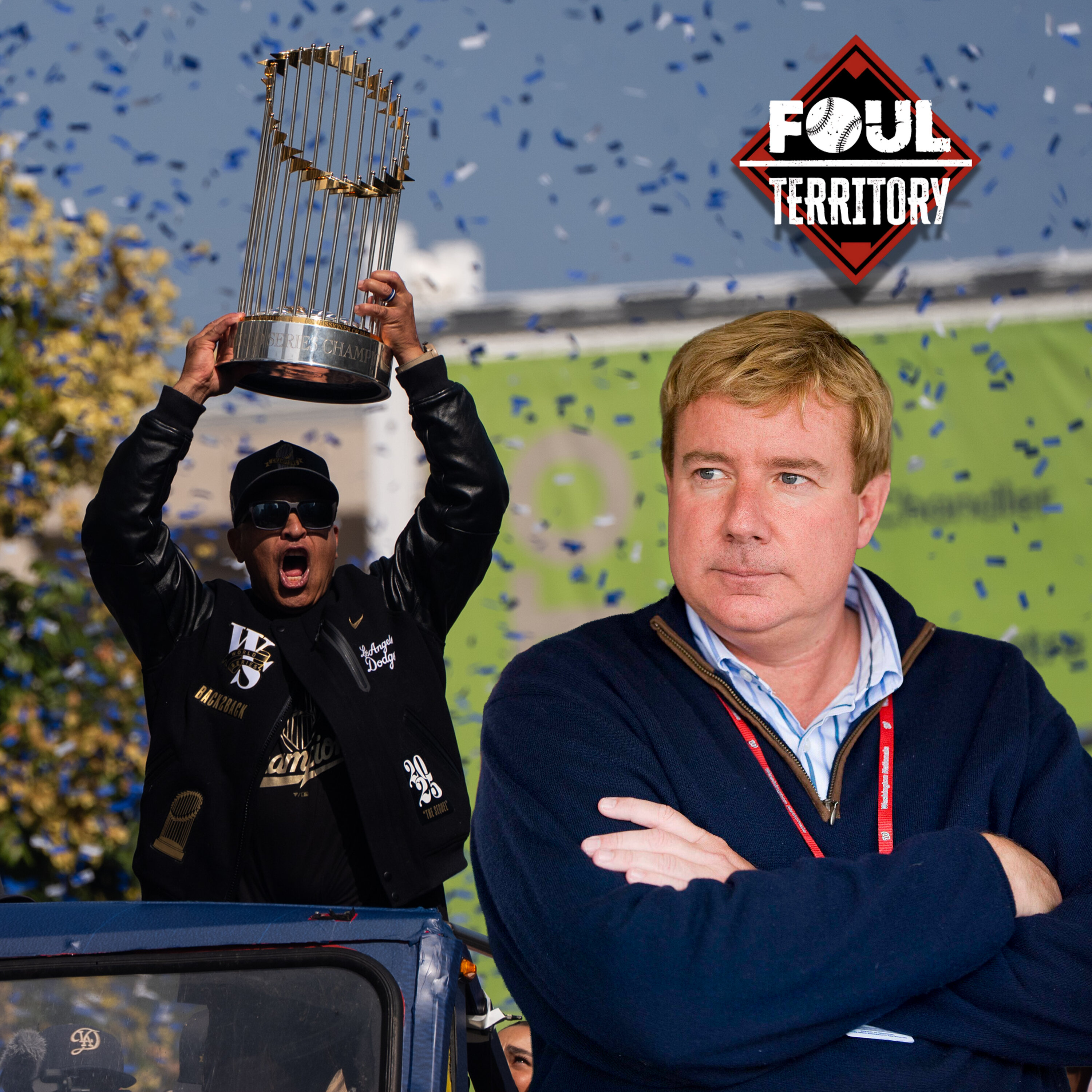
Jim Bowden’s Front Office Unfiltered: Bellinger & Framber markets, Ha-Seong Kim injury, Elly says no + Dodgers perfecting their system
FT resident GM Jim Bowden reacts to the Ha-Seong Kim hand injury news for Atlanta. He also discusses what’s holding up the Cody Bellinger and Framber Valdez markets, the next move for the Red Sox, and Elly de la Cruz’s value after turning down a long-term contract from the Reds.
(25:38) You can’t hate on the Dodgers for perfecting an imperfect system. How do they continue to do this year in and year out?
Hosts: AJ Pierzynski, Erik Kratz, Alanna Rizzo
Quit overspending on wireless with 50% off Unlimited premium wireless. Plans start at $15/month at MintMobile.com/Territory
See omnystudio.com/listener for privacy information.
Available Results
Generated results are saved to the knowledge database for reuse and search.
Extract Knowledge
Pick what you want extracted first. Model, scope, and chapter options appear after a template is selected.
Transcript
00:00:09
Speaker 1: All right, time now for front Office Unfiltered. We welcome in once again Jim Bowden, who of course does a great job I know, the analyst, insider, CBS Sports, the Athletic and they'llly network radio Sirius XM, the Man of Many hats, very very busy. All right, Jim, good to be with you as always. Thanks for coming on. We appreciate it. Hassan Kim's injury on the Braves. He's expected to be out four to five months. They're replacing him with Hodhe Matteo. What more do you make of this? It's a tough break for the.

00:00:36
Speaker 2: Braves, obviously, Alana. It's a big setback there for the Braves. They committed twenty million dollars on a one year contract to Kim to solve shortstop. They were very excited about that being the last missing piece of how they kind of viewed their team. And so obviously he has this injury, going to be out for months and so for now, mauriciod Bone Dubon will be the starting shortstop.

00:01:00
Speaker 3: Initially, Yes, they did sign Hore Mitato or.

00:01:03
Speaker 2: A one year, one million dollar deal to give them some infield depth. He's got a lot of speak and play a few positions. So that's how they're gonna at least go into spring training. But we all have seen the Braves president Alex Anthopolis. We know how aggressive he can be, and so you know, look, I think he'll look at his team during the spring. They'll make a decision if they think Dubon can carry the load for the first six weeks, eight weeks of the season, whatever it's gonna be. And if not, we know what he'll do, right, He'll call Cleveland, or he'll call Detroit, or he'll look for another option at shortstop to bridge the gap until Kim gets back. But obviously he has setback for Atlanta. Not the way you want to start spring training.

00:01:44
Speaker 4: Is there a situation where as GM, you would go, okay, this is the date that it makes it too late for us to be like, Okay, now we're gonna make a move in the sense that he possibly could be coming back mid to late May, depending on how he heals from the injury or July. At this point when you go, no, we need to we need to fill this role with a true, proven big league shortstop and not a stop gap.

00:02:09
Speaker 2: Yeah, definitely, Yeah, if it's going to be half a season. I need to get another option and then when Kim comes back, Okay, I've got depth, I think, because it's probably going to be six to eight weeks, you know I can get by. But that being said, every GM is going to look for a better option than the option you have right now, regardless of who it is. I'm not picking on Mauricio Dubon, who's a very good extra player, but that's what he is. He's a guy that you like to fill in for a couple of weeks rather than a couple of months.

00:02:37
Speaker 3: And so, you know, I think if you're Alex, you know you're.

00:02:40
Speaker 2: Going to keep looking out there, see what kind of options are out there on the trade front during the spring, and if you can pick up a better short stop, someone in between Dubon and Kim, you're going to try to do that.

00:02:53
Speaker 5: Jim.

00:02:53
Speaker 6: It sucks with the Braves. And we just talked about Cody Bellinger. Have you heard anything on Cody Bellinger on what his free I mean, we've heard all the stories the Yankees don't a bidding or they've made their best offer. Who else is out there? And what would the Yankees possibly do if they lost Cody Bellinger.

00:03:09
Speaker 2: Yeah, they don't have a panic pivot like the Mets did, right. I mean when the Mets lost out on Tucker, they did the panic pivot and they overpaid Bobaschett by seventeen million a year. Right, that option is not going to be out there for the New York Yankees. So if the Yankees lose out on Bellinger, Jason Dominguez and Spencer Jones, they're going to get their shot. They're going to get to compete in spring training, and one of them is going to be the starting left field of the New York Yankees come opening Day. That's clearly the plan that New York has right now. But I still think it's likely that Bellinger goes back. He's been offered five years, one hundred and sixty million, with opt outs after years two and three. My understanding is the Yankees are willing to give a huge signing bonus as well.

00:03:53
Speaker 3: I think the offer that the Yankees.

00:03:55
Speaker 2: Have on the table is astronomical, especially when you look at his six year history. You know, his history isn't like Alonzo and Schwarber where it's clean. He's had good years, he's had bad years, been inconsistent.

00:04:06
Speaker 3: So I think this is a very good offer.

00:04:08
Speaker 5: Now.

00:04:08
Speaker 2: I understand that Scott Boris and the Boris Corporation and Cody would prefer a seven year deal, so would everybody else. Schwarber would have liked that too, so would have Pete Alonso. But the market is what it is. I do not believe there's a team in baseball that has offered Cody Bellinger seven years. I don't think that's out there. I don't think he's had an offer of six years. I could be wrong. And the one thing we know about the Boris Corporation, if the offer is out there, he'll take it. He won't be afraid to take that offer because he'd love to be able to go back to the Yankees and say you wouldn't go seven? I found seven. He loves doing that. That being said, I don't believe the Mets are in outside of a short term aav on him. Toronto is not in on him, The Dodgers are not in on him. I don't know, honestly of another team right now besides the two New York teams that are an on Bellinger.

00:05:00
Speaker 4: Looking at how the team's constructed and the fact that they made a big push for Tucker, and I think Bellinger's very much like, way more versatile than Tucker. Why are the blue Jays not in on Cody Bellinger?

00:05:13
Speaker 5: Do you think? You know?

00:05:16
Speaker 2: I think it's the risk with how he's going to age with the swing. I think it's the risk of we saw him fail in Chicago and a year ago the Cubs had to eat part of the contract in order to trade him to the Yankees. They had to eat it the Dodgers. He struggled there a couple of years, they moved on from him. You know, I think that, you know, Mark Shapiro, the president of the Blue Jays, Ross afkns the GM looking at his history and saying, you know, what is the risk if we were to sign him long term?

00:05:42
Speaker 3: What's the risk?

00:05:43
Speaker 2: I think, quite frankly, the blue Jays kind of view Kyle Tucker and Cody Bellinger's similar the way I do. I would have been fine giving Kyle Tucker ten years three point fifty like the Blue Jays offered. I kind of feel like Bellinger's not that kind of player for me. I think there's too much risk now. I love him defensively, he can play all three outfield positions above average you can play first base above average. I love the power. I love this MVP season with the Dodgers. I love this season last year with the Yankees. I loved one of his seasons with the Cubs. But where was the rest? And I know we're blaming injuries and we're blaming the pandemic, but you know other players didn't have that problem of lack of consistency. And I don't want to get stuck on a seven, eight, nine, ten year deal on a player that I don't think I can count on producing most of those years.

00:06:36
Speaker 1: Jim, Let's pivot now to pitching. Not a lot going on, at least it doesn't seem very public going on with fromber Valdez. How is he still out there? And where do you see a landing spot for him?

00:06:48
Speaker 5: Yeah?

00:06:48
Speaker 2: I think Octagon has done a really good job of keeping the negotiations of all das quiet, nothing leaking. I actually like it. I think it's good for Framberg, to be honest. The reason he's still out there is I think when free agency started they were looking for a six or seven year.

00:07:04
Speaker 3: Deal for him.

00:07:04
Speaker 2: He's not going to get that. He's thirty two years old. I'm not sure he's gonna get year five. I think he will get four years.

00:07:12
Speaker 3: But you know, the.

00:07:13
Speaker 2: Offers haven't been there like expected, and so when those long term deals aren't there, the agents these days have to take a deep breath and then figure out, Okay, how short of a deal can I get? What are the opt out clauses look like? Am I okay doing a two year deal? Opting out and going back in the market next year when I'm not tied to draft pick compensation?

00:07:37
Speaker 3: You know, you've you've got to be creative and.

00:07:39
Speaker 2: Try to figure out the best way to handle this now, you know, I know the Orioles have been in on Framber Valdas the whole time. I've heard the Mets had interest if it was a shorter term deal. I'm not sure if Framber is there yet. But you know, besides that, i've not heard Framber's name connected. I think it's I think the Giants should be all over him, but I've heard they're not because they don't want to spend that kind of money towards pitching. So you know, besides that, you know, I can't tell you. I still think the best spot for him right now is the Orioles or the METS. I think both teams need them if they want us to cover that team in October either one of them.

00:08:20
Speaker 7: Nobody likes a bloated cell phone bill. It can consume you, it can take over, it can be very annoying. So I know that twenty twenty five ended Crafts and that's when you have your end of your sales, but there actually is still one sale that is running until the end of the month.

00:08:36
Speaker 4: Mid Mobile they still have their fifty percent off their unlimited premium wireless offer that you got to go and get and take advantage of it because it's not necessarily.

00:08:44
Speaker 7: Going to be around all the time, and all plans come with high speed data and unlimited talking text delivered on the nation's largest five G network. Quit overspending on wireless with fifty percent off unlimited premium wireless plans start at fifteen bucks a month at mittmobile dot com slash territory that's mintmobile dot com slash Territory. Limited time offer upfront payment of forty five dollars for three months, ninety dollars for six months, or one hundred and eighty dollars for twelve months. Plan required fifteen dollars per month equivalent taxes and fees, extra initial plan term only over fifty gigabytes may slow a network is busy, capable device required, availability, speed and coverage varies seemintmobile dot com.

00:09:21
Speaker 4: What's hurting his market more the draft pick compensation because I felt like that was, you know, more than fifty sixty million dollar range and he's clearly a nine figure type of pitcher. Or is it the fact that a guy like Freddy Peralta, who everybody probably views as a better picture than him right now, is still technically out there.

00:09:42
Speaker 2: Yeah, I mean, I think everything factors in, right. I think being thirty two years old factors in. I think there are some analytic groups that don't like the hard hit rate against Ramber, although it's mostly ground balls and it doesn't worry me as long as you have a really good defensive infield. I think some people are looking at him and saying, you know, he used to be a one, now he's a two, and so I want to pay two prices, not one price. So I think all of those things kind of factor in. You know, what are the other options that are up there on the market. That being said, you know, he's a difference maker. He I think he could take a pretender and make them into a contender.

00:10:19
Speaker 3: So I think he'll find a home.

00:10:21
Speaker 2: But I think we're going to find out it's going to be one of those shorter term high aav with opt outs.

00:10:28
Speaker 5: Jim.

00:10:28
Speaker 6: We just saw Ranger Suarez signed with the Red Sox. The Red Sox done enough this offseason because you know, Bregman was kind of the guy they thought. They flipped and went, and they went Sunny Gray, they went Ranger Suarez. They obviously have Garrett Crochet the back end of the bullpen. They brought back Chapman. Do they have enough offense to win this division with the way they've lined it up with their pitching as strong as it is, A.

00:10:49
Speaker 2: J my opinion is they need a second basement or third baseman. They need one more bat. Obviously they wanted to bring Bregman bat. They weren't going to play at Bishette at the kind of numbers Bishett ended up with. So I think that a player like you Henyo Suarez makes sense for them if they can get him on a shorter term deal. Power plays in that ballpark. Uh, you know, he can hit six or seventh in the lineup. And hit that occasional three run homer. I think that makes sense. Circling back to Arizona to see if there's another way to trade for kateel Marte is something that makes sense for them as well. I know at some point that Marcelo Meyer back. They like him very much, but I think they need one more bat, whether it be at second base or third base.

00:11:34
Speaker 4: You've mentioned the Mets twice with shorter term higher A A V. What is the what is that line for the Mets in the sense that they're just gonna okay, we're gonna stick with it, but at some point they're gonna look up and go dag go on.

00:11:50
Speaker 5: We're paying everybody forty million dollars a year. I get it.

00:11:53
Speaker 4: We're rolling over like you know USC football. We just roll roll over every player every other year and il money. But what is what is that line? What is that line for the Mets?

00:12:05
Speaker 3: Yeah, so for Steve Cohen, he has unlimited money.

00:12:08
Speaker 2: He's the wealthiest owner in baseball, and look, if he wants to take losses, he just he writes a check and he can write it off against his hedge funds. So I think he just do whatever he wants I mean, we've heard the stories about him seeing a piece of art for twenty million dollars and he decides he wants it, he writes a check and it goes in front of his house. He's doing the same thing with baseball players. And look, I wish, you know, in my years as a GM I wish I had an owner that was willing to just give me a check book and say, you know, go spend whatever you want. And forty seven million for Bob Baschett, my goodness, gracious, but they got the player, which was great. It was a great panic pivot, I thought. And he was wondering what color smoke it was. When he found out it was Dodger blue, he went, okay, I'll go get Baschette.

00:12:50
Speaker 6: Then wow, yeah, Uncle Stevie, he nails it all right. So let's go to one of your old teams. You have a picture of the guy over your shoulder. Elie de la Cruz alleged he was offered the highest extension of all time right for any Reds player, and he hasn't accepted it yet. First of all, do you think he should? And when you're as a front office member approached a player, did you already think that, hey man, this guy's going to accept this and save us money and also set his family up. What's the deal with the L extension?

00:13:18
Speaker 2: Yeah, I mean, look, I think Nick Krawl and the Reds did the right thing by offering him over a quarter of a billion dollars and said, look, we want you here, we want you to spend your career in Cincinnati.

00:13:29
Speaker 3: I think you have to try to make that effort, whether it works or doesn't work.

00:13:35
Speaker 2: When you're represented by the Bors Corporation and you're a position player, and you're young, and you have analysts telling people that he has the talent to be a future Hall of Famer, really tough to do a long term deal because Scott Boris's long history is he will beat it on the open market.

00:13:53
Speaker 3: And I know when the.

00:13:54
Speaker 2: Nationals offered Juan Soto four hundred and fifty million, he turned it down and everybody laughed, and he ended up three years later getting seven hundred and sixty five million. So we made an extra three hundred and sixty five million by saying, no Elie Day the Cruz is going to do the same thing.

00:14:10
Speaker 3: So I understand it, and you.

00:14:12
Speaker 2: Know, it's pretty painful for a small market team like Cincinnati. I think for them to have a chance to sign him right now, you have to probably start the conversation at three hundred and fifty million to start the conversation to get it serious. I'm not sure Cincinnati's going to do that in the marketplace. So again, this is a talented kid. He hasn't reached his potential yet. We keep waiting for that breakout year, which I think may happen as soon as this year. It's going to be fun to watch, but keep in mind it's going to be very, very difficult for the Reds in this marketplace. When you're seeing the kind of contracts. Kyle Tucker gets sixty million a year, Bobaschek gets forty seven million a year, Showe a Otani gets seventy million a year. It's really hard to try to do these deals like the Braves did once with Ronald Acuna Junior, because these young superstar as seeing this kind of money out there, it just doesn't make sense to give up the kind of hundreds of millions you'll be given up if you sign.

00:15:13
Speaker 1: Now, Jim, what did the Reds do? I mean, you said they probably need to start at three hundred and fifty million. I mean, is there a certain point where they're like, what is the point because we know that he's going to go to free agency and there's not a dollar figure that we can do right now to extend it.

00:15:29
Speaker 3: Yeah.

00:15:29
Speaker 2: I mean, look, you've got to be realistic in these small to midal markets. If we're if we're not going to do a salary floor in a cap, if we're not going to let half a baseball compete for a world championship, if we've decided we're not going to do that as a sport, which is okay, if that's what they want to do. Then if you're the Reds, you have to do what Tampa Bay does and Miami does.

00:15:49
Speaker 3: And everybody else does. You've got to enjoy your.

00:15:51
Speaker 2: First four years with the player, and then you've got to call the Dodgers and the Yankees and the Mets and the Phillies and the Red Sox and see what you can get for a day. Look, cruise, and at some point trade him. You don't want to wait to the last year. You want to do it with at least two years left so you get the most return you possibly can. But that's gonna be the reality if we don't fix this system.

00:16:14
Speaker 4: Is he good enough for the three hundred and fifty potential? Yes, but really a lot a lot of his analytic numbers are propped up by a stolen basis. I get it, he had the torn quad and the second half was a business. First half was looking MVP ish if there wasn't a show, Hey Otani in the league. But are his numbers based on the fact that is his walk rate is what it is and a strikeout rate is astronomical?

00:16:42
Speaker 5: Is he what do you feel.

00:16:44
Speaker 4: Like his value is based on how he has done, not what he could do?

00:16:50
Speaker 3: Well, that's a great question.

00:16:51
Speaker 2: I think the value is probably pretty close to what the Reds offered him, which is why they tried to get it done at two hundred and fifty million dollar range. I think that's probably when you look at it, that would make sense on a ten year deal right now. Yeah, the potential is that you know, by the time he gets to the open market, he could be somewhere between Kyle Tucker and Vladimir Guerrero Junior. I think that's realistic. But he's not there yet and you've got to see the development. So yeah, and there's lots of risk in this. And remember, three hundred and fifty million today is going to be six hundred million when he gets to free agency in five years based on history.

00:17:29
Speaker 6: Jim, we mentioned Shorver buying Shorver and the Reds and they had three hundred million to try to give him.

00:17:35
Speaker 5: Where did that money go?

00:17:37
Speaker 6: Like, I know they tried to get it to Ellie and listen, it's a great pr move also by the Reds.

00:17:40
Speaker 5: Let's not forget that.

00:17:41
Speaker 6: And Scott Morris has never had a client turned down one hundred million dollar offer and then not gotten a more so, let's a position player. So let's also that's why one of the reasons why you said that he won't turn he won't accept it, is because he has a history of getting him way more Like you said, so, well, where did that money go for the red As the Reds say, hey, we offered Ellie the highest EXTENSI ever. Oh he didn't take it. We tried. It's a great, great move, especially they just had Reds Fest this weekend. I mean, everyone's like, well, now they're like, Elie take the offer, right, But where did the three hundred million they had for Schwarbur go and they said, oh, it was just for that one player. Where does it go?

00:18:16
Speaker 3: Yeah, I mean it's a great question. Aja.

00:18:17
Speaker 2: I asked the same thing of the Reds. You know, as soon as they lost out on Schwarber, before the Orioles quickly signed Alonzo, I was at the winter meetings and I text the Reds and I said, why not just pivot and go get Alonzo right now? Like immediately, just take the same money he had for Schwarbur and put for the Alonzo. The way they viewed Schwarber's and tangibles were such exception. They felt like what he would bring to their clubhouse and locker room was such a difference maker that they wanted to extend for him. They didn't view other players on the open market similarly and so that's that was their view, but ended up being the intangibles there. Do they have money if they needed to to commit thirty million.

00:19:05
Speaker 5: To a player.

00:19:06
Speaker 2: The answer to that is yes, they haven't done it. I think if the right player were to come along, I think again, I think they would go back to the well and try to do that. But to do Schwarber, they weren't really going to add to their budget. They were just going to take their budget and instead of spreading it out among two or three players, give it to Schwarber. And remember this about the Reds and try not to smile or laugh. They paid Nick Martinez twenty million last year to be a six starter and long reliever.

00:19:37
Speaker 3: They gave him the qualifying offer and accepted it.

00:19:40
Speaker 2: So they were taking Nick Martinez as twenty to put towards Swarbur.

00:19:45
Speaker 1: I want to ask you if you think that the way that the free agents or players are looking at things now, Jim has shifted from back in the day when you would take the guaranteed money as a young player versus what these the high end of these free agency contracts are now. I mean, the eyes I would imagine are really big with some of like an Elie de la Cruz saying what some of these contracts have amounted to. Has that shifted and changed the dynamic of how these young players are going out going about it?

00:20:15
Speaker 5: Oh?

00:20:16
Speaker 3: Absolutely.

00:20:16
Speaker 2: If I'm a young player and I'm looking at the marketplace, I mean I don't even have to play into my mid or late thirties anymore. If you're going to pay me sixty to seventy million dollars a year. Just give me five years in my prime and I'll have enough money if I want to retire or do something else. And doing long term deals, you know, we're seeing a lot of players that did the long term deals and those players are losing out.

00:20:43
Speaker 3: It's just the way it is.

00:20:44
Speaker 2: I mean, Ronal Kuney Junior and Guerrero came up the same time. One guy's getting paid five hundred million, the other players not getting paid relatively speaking. So I think when you continually watch who does better, I think the young players with advice from the agents are saying, you know, we're better off waiting unless somebody wants to overpay.

00:21:05
Speaker 3: And that's why in.

00:21:06
Speaker 2: Ellie Daily Cruz, all he has to do is look at Juan Soto and look at Guerrero and say do I want to get that result or do I want to get what Acuna ended up getting in Atlanta. It makes it pretty easy to make that decision.

00:21:20
Speaker 1: Jim Hall of Fame, voting tomorrow, what do you think gets in?

00:21:24
Speaker 2: Well, Carlos Beltron's going to get in, So that's great news for him.

00:21:28
Speaker 3: I mean, what an incredible career you have.

00:21:30
Speaker 2: But the guy that I've been pushing all these years that hasn't gotten in is Andrew Jones, and I'm just praying he gets in.

00:21:38
Speaker 3: It's going to be close. I think it could go either way based.

00:21:41
Speaker 2: On what I'm hearing in terms of the voting. But Andrew Jones was the best defensive center fielder I've ever seen in my life, and it's not close. And I asked the late Frank Robinson, who was a manager for me when I was the GM of the Washington Nationals. I asked Frank, who is what the greatest defensive center fielder you ever saw? And he said, Andrew Jones is one A and Willie Mays is one B. And by the way, Andrew Jones has one less home run than Carlos Beltron. Both of these players deserve to get in. I hope tomorrow we can celebrate both center fielders.

00:22:20
Speaker 3: And by the way, I.

00:22:20
Speaker 2: Hope all the people that voted, I hope they spent the time to ask John Schoreholtz, Bobby Cox, John Smoltz, Tom Glavin, Chipper, Jones, David Justice, Fred McGriff, and any other Atlanta Brave that watched him play. I hope they spent the time to ask the visiting managers and gms that were in the National League during the ten years that Andrew Jones won ten consecutive Gold Glove Awards. I hope they asked those people if Andrew Jones is a Hall of Famer, because all of them would say yes. And it's a shame he isn't already in. But you know what, as long as he gets in this year, it'll be okay. So hopefully the voters did the right thing, and hopefully tomorrow on foul Territory, you guys will be announcing beltront and Andrew Jones.

00:23:10
Speaker 6: I hope so Jim. I got to play with Andrew and he was a great guy.

00:23:14
Speaker 5: He's fun.

00:23:15
Speaker 6: Do you think I have two questions on Andrew Jones? One, do you think that the end of his career hurt him? And that's why it's taken so long because he was so spectacular for those ten years and then he kind of just fell off a cliff And I played with him at the end with the White Sox and he was a shell of himself with other injuries. Do you think that hurt him? And then my next argument is, look at Tory Hunter's numbers. How come he's not getting more love? He has I think nine gold gloves instead of ten, right, and he has a lot of bet numbers that are better in a lot of other categories except for you know, I think home runs he's like a few behind. But other than that, they're all similar. But Torri gets no love and he was the best center fielder that I ever saw on a consistent basis. Obviously I'm biased because I played with him in the minor leagues and came up with him, but he gets like no love and his numbers are across the board very similar to what Andrew Jones did.

00:24:02
Speaker 3: Yeah.

00:24:02
Speaker 2: So, in terms of Andrew Jones, absolutely his career once he left Atlanta, whether it was Dodgers, White Sox, Yankees hurt his career and he kept playing, right, there was like a five year period after that. He had ten years where he was a Hall of Famer and then he absolutely fell off and that was it. And I think those five years hurt him. I think a lot of the young writers that joined later saw those five years and that's what's in their mind. Unfortunately, I think the analytic and stat people end up looking at all the statistics, whereas if you just look at the ten years in Atlanta a ten year period. There is no doubt he was a Hall of Fame player, and I believe that he should be voted based on that. With Tory Hunter, I can't give you the right answer, to be honest, because I spent practically my entire career in the National League, and those were all the games that I saw in person. I certainly loved what Tory Hunter on the screen. I don't disagree with the stats and numbers that you're throwing out there just for me, you know. I like the people that vote on the guys that saw them with their own eyeballs during that same time period. And my seventeen years as a GM, all seventeen were in National.

00:25:19
Speaker 3: League ballparks, you know, And so I don't.

00:25:23
Speaker 2: Feel that I can give a good opinion on Tory Hunter like I can on the guys that were playing in the National League.

00:25:30
Speaker 1: Jim, as always, we appreciate the insight, look forward to seeing who gets in tomorrow. We'll be right back and thank you very much. She'll see you soon.

00:25:37
Speaker 3: Thanks, guys, All.

00:25:38
Speaker 1: Right, welcome you back to Hot Corner as the Hour number two starts here on foul Territory. AJ Pruzinski, Eric Kratzelonaizzo in for Scott Braun. Okay, let's talk about the fact that I'm not just doing this because I'm on the show. This was in the rundown before I was hosting, so I don't want to hear it. Eric, don't hate on the Dodgers for perfecting an imperfect system. Tyler Kepner wrote something in The New York Times recently about, you know what, they're doing a good job of spending money, obviously, but we've talked about it at length. Aj other teams can do it, so why aren't they.

00:26:21
Speaker 6: I don't hate the Dodgers at all. If I'm a player, I love it. And it's a destination place and they get all the money you can because no one complains on the Mets go out and signed Boba. Shit, they didn't know, and it was like, oh no, the Mets are ruining baseball. It's just because the Dodgers have won and they figured it out, and they have great leadership, and they have unbelievable talent, and they also figured out a way to draft guys that are not in the top because they lose all their draft picks every year and they still have players. But you know, marching through their system that they can use. So they've done a lot of great things. What they have done is they've reinvested the money not only in players that they make, in infrastructure, in development and talent, in finding talent and finding ways to win on the margins. You get a great president of baseball ops and Andrew Freeman, you get Brandon Gomes, and then you give them money. This is what you can get, and they go out and make these deals. Now a lot of them are deferred, and everyone's saying, oh, it's deferred money. Why Look how many people have deferred contracts. Okay, the Orioles are paying Chris Davis for like fifteen more years on that contract.

00:27:19
Speaker 5: It's all deferred.

00:27:20
Speaker 6: Okay, the Dodgers aren't the only one that does. Is just because they win that people are mad?

00:27:26
Speaker 1: Eric, what do you make of this? Tyler Kuttner continues in the article that the Dodgers have adapted by de emphasizing the regular season and building such a deep roster that they basically cannot miss the playoffs. I believe that, because I do believe the Dodgers are built for October. It's almost as if they assume that they're going to get there, and they're just worried about making sure that roster gets them to that point.

00:27:49
Speaker 5: I think they've done a great job.

00:27:51
Speaker 4: I think whether they set out to make their starting rotation ten pitchers deep, No, I don't think they started out doing that, because I think they set there and they won the World Series in twenty four with just a bullpen. Then they go, we don't want to do that again.

00:28:11
Speaker 5: That was risky.

00:28:12
Speaker 4: They were almost eliminated by the Padres, so I think they then set out and they were like, Okay, what is the depth that we need. Obviously Roki didn't want to go anywhere else, so that added another piece of depth. I think they've perfected it in so many different ways. But the part I want to hit on is what AJ said. So many teams don't want to sign players one people will say, oh, well, they don't have money. And I spent an entire weekend getting roasted on Twitter for congratulating the Dodgers for what they did, which I think was awesome, not just for them, but I think it raises the competition level. But got roasted for that, so I won't go that way. To me, It's what AJ said. About the draft. All these teams we just talked about what fran Bervaldez at draft pickcom compensation. It's it's tied to them. You know, they don't they don't want to sign somebody because it draft pick compensation. Like they're losing so many of their picks because one they're finishing in first place, so they're picking way late in the draft. Two they're signing some of these free agents. And you have to remember, not everybody, not everybody that they've signed was this massive show hey deal, show Hey's just the best player in the planet and he wanted to go where he was gonna be taken care of. But all these draft picks that they lose, they're still creating an incredible minor league system. So is that because they have all the money. Is that because they're buying all their prospects. No, they're doing it to supplement a big league team that Yes, the TV deal that you know happened with them of courts and all that stuff. Yes, they're able to pocket extra money all that stuff.

00:29:53
Speaker 5: I get it.

00:29:55
Speaker 4: But there's an advantage to what the Dodgers are doing that is not just us in free agency. But now it's coming to fruition in free agency because they made that push for certain players a certain culture, and they've been able to back it with depth from their minor leagues and back it with the fact that they've been able to go get pitchers. I mean they traded for Tyler Glass now. The rest of the league said, you know what, Tyler Glass now is a injury prone pitcher. Obvious he threw in the postseason for him. So like there's things that they're doing that other teams can do. They just have a larger margin for air with it.

00:30:36
Speaker 1: And I want to give credit to the Toronto Blue Jays who have had a very good offseason AJ and they are spending money and it's good to see. And they were a strike away from winning the World Series last year obviously Game seven against the Los Angeles Daughters.

00:30:49
Speaker 3: So good, this far away a couple of.

00:30:54
Speaker 6: Bigger team win having.

00:30:59
Speaker 1: And that's what I've That's what I always say that, you know, having spending money guarantees that you get good players. Spending money typically guarantees that you have a postseason birth or you have an opportunity to play in the postseason. But spending money does not guarantee championships. But the Baltimore or excuse me, the Toronto Blue Jays are starting to spend some It's like some real money here are they kind of taking a page out of the Dodgers' book where they two aj are building for the postseason.

00:31:28
Speaker 6: Well, they learned last year how deep their starting rotation was.

00:31:31
Speaker 5: Look at it.

00:31:32
Speaker 6: All the guys that they used, They traded for Bieber when he was hurt, the Headshers or Gosman, the Savage came up. They used all these guys. Lower was a guy, a factor formed during the regular season. Then they got to the postseason and said, okay, we can throw Bassett in the bullpen, right and he was great for him out of the bullpen every day, Louis Varland was out there chucking one hundred miles an hour every day. They built depth, right, And that's what the Blue Jays, that's what other teams are learning from the Dodgers is it's cool to have five starters, but it's cooler to have ten starters he can count on because you can use them in different roles and use them to do different things. The Dodgers did have done that. Now other teams are falling toit. It's a copycat lead, and now other teams are like, man, if we have ten starters, look at all those things we can do, and if we believe we're good enough to get to the postseason, then they can help us make a run deep into the postseason. So yeah, I think what the Blue Jays is doing is awesome because you know what they did. They made a crapload of money in the postseason by going to Game seven, and they're reinvesting it back into their team. They just put a new They've done a new spring training site and didn't They've redone the locker rooms in the Rogers Center. They've done all these things and then they get the results and then they throw the money back into the product.

00:32:39
Speaker 5: It's awesome by the Blue Jays ownership.

00:32:42
Speaker 4: We roasted, We roasted. I roasted the Blue Jays more because of what ross Akins did or did not do, Shapiro did or did not do to bolster a team that I felt like should have been in the playoffs the last few years. Now you see what came to fruition, but what AJ said about the minor league system, they made those changes. I was drafted in two thousand and two by the Blue Jays. They redid their minor league complex in two thousand and two. My last year in baseball was twenty twenty. They were redoing their minor league complex. There's still some minor league complexes that have not changed since the day I was drafted.

00:33:18
Speaker 5: And the Blue Jays. Yes they made the World Series.

00:33:21
Speaker 4: Yes they were inches away, strike away several times in Game seven, but that started years before that started because they're trying to build that infrastructure, which if you're saying we want to emulate the Dodgers, yes they're spending this year.

00:33:38
Speaker 5: Yes they've been spending.

00:33:39
Speaker 4: They got George Springer, they putting money into Vladimir Guerrero, all that stuff, But it happens in that infrastructure years back. I remember when I was playing in Triple A. I've said this before. We'd come into a clubhouse that the Dodgers Triple A team just left, and they're like bringing all the candy bars back out. They're bringing out all the unhealthy food. I'm like, why are you guys bringing all this in? They're like, oh, well, the Dodgers came in and they make us clear all the food out and they bring in their own food and they feed the players all in their own The Dodgers did all of that. Dodgers did all of that way before the mandatory minor league food was a thing. And people might say that doesn't give you show heo Tani.

00:34:22
Speaker 5: I get that.

00:34:23
Speaker 4: I hear all the arguments, but you know what it does. It builds a little bit of a It starts a spark that builds a bigger fire that has what is now burning in the furnace of the Dodgers, And it's all part of it. Is it a small portion for people who say, salary cap all this stuff, it's unfair other teams, Yeah, they say that's a small portion for people who have been in those situations and come up through minor league systems and seeing how teams are really built. To me, that's a huge, huge part of why they are what they are. And now Kyle Tucker is going to say, I'll take ninety less million dollars to go there because it's a better fit for me. I like the place. I'm going to get more of my money up front. All that stuff. So it's not a chicken or the egg. It's the first thing that happened was the egg, and then you had a chicken, and now they have tons of chickens.

00:35:20
Speaker 5: And look at all those chickens.

00:35:23
Speaker 1: Look at all those chickens. Aj don't you want that as a player, Don't you want a team that is going to be so on top of every single detail and take care of its players as if they are a prize commodity, as if they are precious cargo. That I mean, it only makes sense that if you treat the player well, you're going to make more money.

00:35:46
Speaker 6: That's just make it a destination. Players want to come there, right. And by the way, the food thing was because Gabe Kapler was in charge of the minor league, so he he also was still playing. He never eat cheese or anything, so he had to do that to everyone else.

00:36:00
Speaker 5: Hunt to the best.

00:36:01
Speaker 6: We were when all this stuff started happening. Ozzie Game was still our manager. We went into some of the places where they took the cookies and the ice cream and all that way. Ozzie made him bring it all back out and he's like, my players need to drink beer and eat ice cream, and I like both. So we're gonna have alcohol and we're gonna have ice cream and snacks. If a guy wants to eat a candy bar and he's thirty five years old.

00:36:21
Speaker 5: Let the man eat a.

00:36:22
Speaker 6: Candy bar, and so that's how he kind of that's how we I mean, I kind of get that too.

00:36:27
Speaker 1: I get that too. I think you have the options, though, I mean not all Major league teams are created equally, and what I mean by that is not necessarily the spending or the lack of wanting to spend by owners. But I'll never forget there's been times when guys have you know, come over in trade, you know, even within the division. And you know, I think I've told this story on here before, but I remember when Aj Pollock came over in a trade from the Arizona Diamondbacks to the Los Angeles Dodgers at spring training and Camelback So we basically went from Scottsdale to to Camelback Ranch. You know, all of the outfielders were lined up in a certain area in the Dodgers clubhouse, and Jock Peterson looked at Aj, who had been in the big leagues for quite some time, obviously played at Notre Dame and then was in the big leagues for some time, and he goes, welcome to the big leagues. Because it's just a different that the Dodgers just treat their players differently, and they just go about their business differently. Eric, let me ask you this, as a player, are you for it when you're on one of those teams that don't spend and can't win. I mean, I would imagine that that motivation is taken away from you very early in the season, Like, what's the point? What are you playing for?

00:37:32
Speaker 5: As a player?

00:37:33
Speaker 3: Yeah?

00:37:34
Speaker 5: Player.

00:37:35
Speaker 4: That's why I think I've gotten eviscerated for saying what I said about the Dodgers being good for baseball, elevating competition. People are like, what is this high school?

00:37:45
Speaker 5: Like?

00:37:45
Speaker 4: You know, you're trying to explain to us about competition as a player. I promise you I could care less who was on other teams. Would you go into places and go holy crap? Like the in two thousand, I forget when the tires late two thousands, I'm like, what the heck? Like They've got Pudge Rodriguez, they got mag le or Adonias, they had Maggie Cabrera, they had Justin Verlander. Joel Zumaya animal saying like I remember thinking, holy crap, this is a freaking really good team AJ played against him the whole time. But as a player, you're not sitting there going we got no chance. If you are, I don't, I your career is going to be super short because I played with people who who said that, like, oh man, whatever, man, like I guess we got no shot to me. That's tired. As a player, you cannot think that way.

00:38:43
Speaker 5: Listen.

00:38:44
Speaker 6: I played for the Twins. I came up with the Minnesota Twins. The Minnesota Twins time we played in the Metrodome, and the team that was in our division that was.

00:38:52
Speaker 5: So good Indians.

00:38:55
Speaker 6: They had Jim Tomy, Roberto Alomar. You know they've been going to the World Series. I'll never get and spring training in two thousand and one because my first time when I was going to break camp as a starting catcher, I had a reporter come up to me and he said, what do you think of this payroll disparity? And you guys are small market and you guys can't compete. And I looked at him and said, who said we can't compete? And I said, we in this clubhouse have never said it. I never looked at it and said we can't compete with these guys because as a player, you think you're one of the best players in the world, and when you take that field, you can make your team better and you can compete with anyone. Now, we didn't win the division that year. We wanted the next bunch of years. The Twins won of for how many every years in a row for.

00:39:35
Speaker 5: A long time. It made the playoffs.

00:39:38
Speaker 6: But we never looked at it like we can't win this division because the big bad Indians are in it. The White Sox are, you know, with a bigger payroll. Right, We were like, we're the Twins, We're really good players, We're a really good team. We believe in each other and we can figure it out.

00:39:51
Speaker 5: And we did.

00:39:52
Speaker 3: So.

00:39:52
Speaker 6: I agree with Chrats like you never as a player say, oh, man, look at what they're doing. Oh we can't compete, but there's no way we can compete. We're always always like I can compete. I've played on some really bad teams and the Braves at the end of my career, but going into the season, I'm like, ah, if things fall right, you know, we might be able to get to a point during the season where, you know, make some trades if we're good, right, you never you can never look at it and say and plus he's as a player. I don't want people to feel sorry for me, like the outside world be like, oh, you're on the Pirates or you're on the Twins or this, or that you can't spend money the Marlins. Screw that. I'm in the big leagues and I'm here to compete, and I'm here to beat the other team, no matter who they are. And if I'm on the lesser team, I want to show the bigger team that I can compete with you.