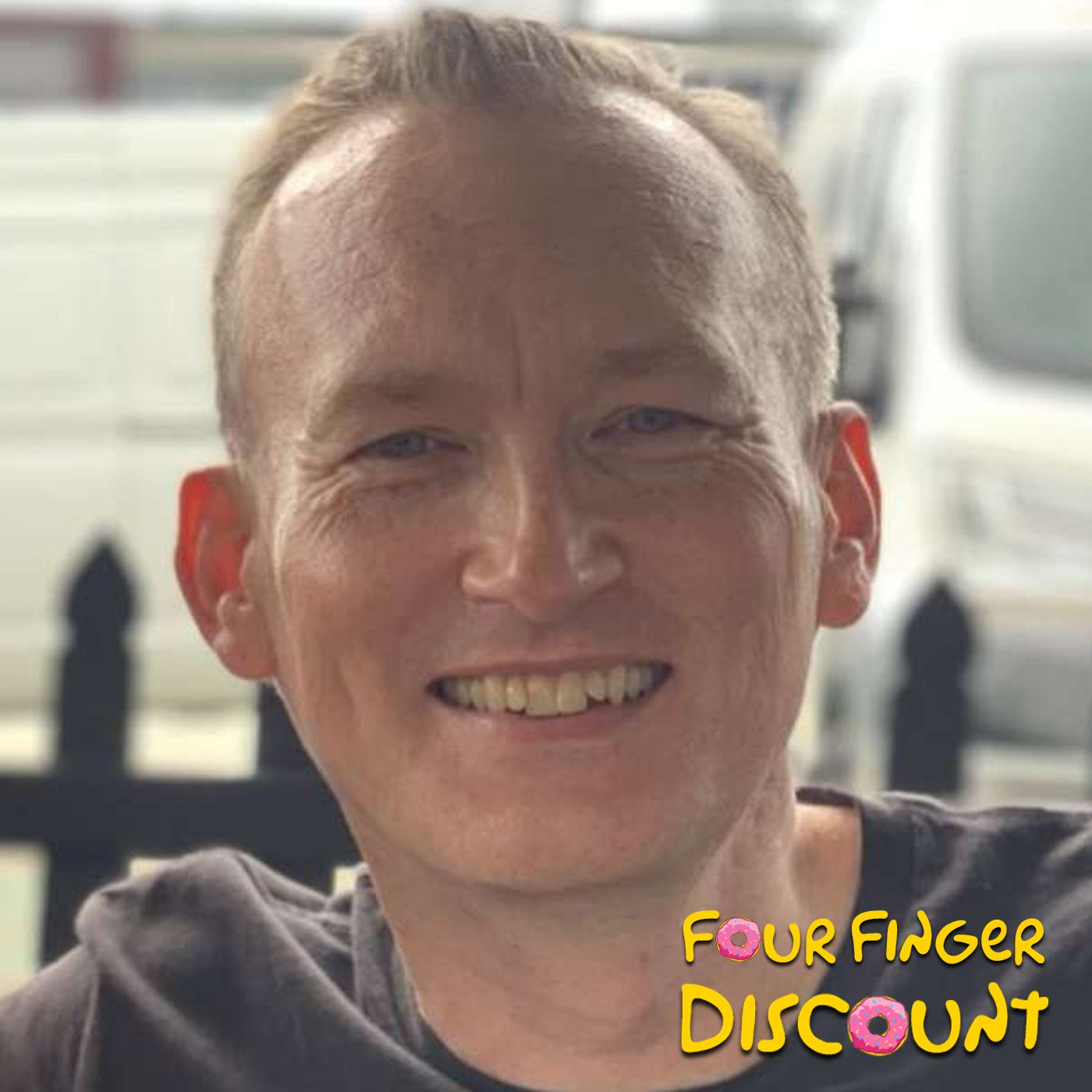
An Interview with Matt Schofield (Simpsons Storyboard Director)
Fellow Aussie and absolute legend Matt Schofield joins Dando for a bonus episode to discuss his 25-year career working for The Simpsons. They discuss the impact of the recent SAG strikes, the diversity of the writer's room, the lessons learned from David Silverman and Mike B. Anderson and more.
PLUS! They discuss Matt's comic series, "Steamroller Man", which is being officially published for the first time. You can check it out here > kickstarter.com/projects/steamrollerman/steamroller-man-1-an-absurdly-funny-superhero-adventure
Support the Four Finger Discount Network for EARLY & AD-FREE access to every show we produce, as well as 100 hours of exclusive content! Join the FFD family today at patreon.com/fourfingerdiscount
CHECK OUT OUR OTHER PODCASTS:
Toon'd In! with Jim Cummings - spreaker.com/show/toond-in-with-jim-cummings
Goin' Down To South Park - spreaker.com/show/goin-down-to-south-park
SpeaKing Of The Hill - spreaker.com/show/speaking-of-the-hill-a-king-of-the-hill-
The One About Friends - spreaker.com/show/the-one-about-friends-podcast
Talking Seinfeld - spreaker.com/show/talking-seinfeld
The Office Talk - spreaker.com/show/the-office-talk-podcast
Become a supporter of this podcast: https://www.spreaker.com/podcast/four-finger-discount-simpsons-podcast--5828977/support.
PLUS! They discuss Matt's comic series, "Steamroller Man", which is being officially published for the first time. You can check it out here > kickstarter.com/projects/steamrollerman/steamroller-man-1-an-absurdly-funny-superhero-adventure
Support the Four Finger Discount Network for EARLY & AD-FREE access to every show we produce, as well as 100 hours of exclusive content! Join the FFD family today at patreon.com/fourfingerdiscount
CHECK OUT OUR OTHER PODCASTS:
Toon'd In! with Jim Cummings - spreaker.com/show/toond-in-with-jim-cummings
Goin' Down To South Park - spreaker.com/show/goin-down-to-south-park
SpeaKing Of The Hill - spreaker.com/show/speaking-of-the-hill-a-king-of-the-hill-
The One About Friends - spreaker.com/show/the-one-about-friends-podcast
Talking Seinfeld - spreaker.com/show/talking-seinfeld
The Office Talk - spreaker.com/show/the-office-talk-podcast
Become a supporter of this podcast: https://www.spreaker.com/podcast/four-finger-discount-simpsons-podcast--5828977/support.
2024-06-07
58 min
Transcript
Available Results
Generated results are saved to the knowledge database for reuse and search.
No generated results are available for this episode yet.
Extract Knowledge
Pick what you want extracted first. Model, scope, and chapter options appear after a template is selected.
Generated results for public episodes are saved to the knowledge database so they can be reused and searched later.
Transcript
Four finger Discounted. Hey everybody, welcome to a very special bonus episode of
four figure discomp This week, I am joined by the current storyboard director of
The Simpsons. His name is mister Matt Schofield. He is a fellow Ozzie
who has worked on the show since all the way back in season eleven,
so twenty five years he's been working for The Simpsons, so he's got plenty
of great stories. We discussed the recent writers slash actor strike and the impact
that had on producing the show. We discussed the current diversity of the writer's
room, as well as his amazing new comic. It's called Steamroller Man and
it's better to be published for the very first time. It reached his goal
on Kickstarter a ten times its goal, so it's been absolutely smashing it there,
so check out the link for that in the description of this podcast,
steamroller Man and support Matt there. As a result of that, we also
discuss things like the Simpsons comics and whether they shall return, as well as
Ozzy things like Bertie Beetle showbags. I'm sure there's Ossie listeners out there.
He go, I know what a Bertie Beetles show bag is and looking forward
to listening to these two gentlemen talk about it, but also please don't forget
to rate and reviews on Apple podcast Spotify, where you do find this show.
If you want to get in touch, it's mailbag at four figure discount
dot com dot au. If you want to get early add free access to
all the shows he add the four figot discaut network. You can support us
on Patreon. All the links in the inscription of this podic. For now,
sit back and enjoy my conversation with Matt Scofield. So, Matt Simpsons
in twenty twenty four, how is it. How's the life at the Simpsons
studios this year? It's it's good. I mean, we just had the
you know, we went through the writer's strike and then there was the actors
strike that followed it pretty soon. And you know the great thing about that
was that the animation workers and my crew, my fellow crew members and I
were able to sort of keep working for you know, as long as we
could. Basically, I think they got a six scripts before they had to
go on strike, and so that kept us working for a good couple of
months. Were there rules around that were what you could and couldn't do no,
not really what There were rules that applied to the writers, and that
meant that they couldn't do any rewriting. They could still give us notes on
the animation, because I don't think that was technically considered writing. They're not
coming up with new material, and they're not technically not modifying stuff that they
had already written. They're just kind of telling us notes on designs and stuff.
Is the stuff that they would normally do as part of their job.
They still gave us notes on the artwork, and if they wanted a change
to something that we had already drawn, they were still allowed to do.
They just weren't allowed to write any new material. And so what that translated
to on our side was we were working off their very first draft of the
script. Normally, we would I think they would do a table draft and
then they do a record draft, and we would work off of the record
draft. In this case, we were just working off the table read draft,
and we didn't have audio because well we had audio up until the point
that the actors then went on strike. But yeah, so anyway, I'm
making a longer story out of it than interesting. Yeah, So we were
able to keep working for a couple of months after the writer's strike began,
but then we started running out of script material, and as the show's got
to the end of our part of it and we shipped the artwork and stuff
to Korea to be fully animated, that's when they started rolling our crew off
into unemployment essentially. But it was great to you know, have that much
work. It's not a real great time in the animation industry right now.
So for what reasons? Oh, it's like a perfect storm of many things.
One is sort of the streaming bubble has kind of burst where you know,
when streaming first hit and a lot of the studios started wanting to grab
some of that Netflix business and they set up you know, HBO Max and
Paramount Plus and so many of them, et cetera, et cetera. So
now there's all these streaming services because they all thought it's like, oh,
it's free money, but it's not. They're all going after the same audience,
and people don't want to pay, you know, for ten different streaming
services as an audience. Starting to realize we're going, wait a minute,
this was a good idea at the start, but we're now paying more than
we used to and yeap, so what's the point of what are we doing
here? Exactly? And thus the bubble burst and so that was when a
lot of the studios started canceling, especially a lot of their animated projects.
Why do they see the animated projects as the ones to cancel first? What
is it about? What's the mentality behind that? Do you think? I'm
not quite sure what the real reason is. I would speculate that they see
animation as lower profile and they see it as something that they can just kind
of get back up and running quickly, whereas with I don't know, honestly,
I'd just be guessing at the real reason why. But yeah, and
you know, of course there were live action shows that got canceled as well,
but movies were made and then shelved. Yeah, exactly. So animation
got hit pretty hard and it's still it still hasn't recovered. So at this
point, like I think everyone on The Simpsons is just happy to be working
at this point because so many of our of our animation colleagues are still out
of work right now. So a lot of people on the Simpsons, like
me, thinking like Simpsons is a great place to be than yeah, great,
exactly to have a job. Yeah, but yeah, I mean in
twenty twenty four, the scripts we've been getting have been great. I would
say that, like all the scripts that we've had since coming back from the
strike have really impressed me personally. And the same writers as before. Did
you pick up some new writers post the strike? Well, post strike,
I don't think so, but definitely since we last spoke on your show years
ago, which is years and years ago, now, we've definitely they've picked
up new writers. They made a real effort which I thought was great to
diversify the writing staff and especially hire a lot more women. And so I
think that new blood in the writing staff has really made a difference, and
we've been getting some great shows. And you know, it's just a sort
of injection of new ideas and a new sensibility, just an atmosphere in the
room. Well I'm not in the room, but I'm sure the and and
the thing is like pandemic really sent everybody into their corners, right, so
the writer's room was completely virtual. I know that they now have gone back
to in person on the Fox lot to have their meetings, but we're still
the animation part of things, like all the artists. We're still working from
home? Wait really? Yeah? Yeah? Is that by choice? Do
you prefer that or not? Me? I mean, it's great not to
have a commute and to have to drive in LA traffic. But I did
it once. I don't want to do it again. Yeah, that's right,
that's right. But I certainly miss the camaraderie of being in the studio
with my coworkers because you know, my side of the show is only to
do with the storyboards, right, so I'm only interacting with the storyboard crew
and the episode directors and then supervising director Mike Anderson and supervising producer David Silverman,
and then a few production people. What's your actual job title now with
The Simpsons supervising storyboard director. It's the same as it was, because I
think I just started started off when we last spoke, so I'm still in
that job. I've definitely learned the rhythms of that schedule, which is pretty
intense, Like it's a new board that has to go out every two weeks,
so it's definitely high pressure and high intensity kind of schedule. But I'm
used to it after doing it for ten years. But yeah, I kind
of miss seeing the other members of the Simpsons crew in the studio because you
know, you don't have that experience of going into the kitchen to make a
cup of coffee and seeing the background you know, a background designer, or
seeing you know, a character layout artist. They become family. You work
colleagues, total family because we have all worked together for so long that I
really do see them as like my brothers and sisters kind of thing. You
know, I know everybody so well because you know, we've been working together
for I've been on the show for twenty This is my twenty fifth year on
the show. Was Taking my wife Sleeves? Was the first one you worked
on? Right? Was it? That one? Good memory? Yeah?
That's right? Yeap. So yeah, that was season eleven, and now
we're just about to start season thirty six, which is crazy. Yeah,
that's insane. Well, this season was the shortest one. I know it's
because of the stripe, But was that a decision made during the strike or
going into this season was always going to be a shorter one. I think
that was probably a decision made during the strike. I mean to be honest
with you, I don't know. That's sort of above my pay grade those
kind of decisions. But my guess would be that that would be a decision
that was made during the strike and possibly had something to do with getting caught
up back to the regular schedule because we lost five months from the schedule due
to that strike, which is that's almost half of our that's half of the
season's episodes, right, So I mean it was a necessity, but I
can imagine it must have been very frustrating as well. Yeah, I mean,
I'm fully I'm a union guy through and through, so I'm fully in
support. Were Australian, we're very union that's right. That's right. I'm
blue collar from and I left since I left high school for sure. But
yeah, I don't think it was frustrating personally for me, it was a
little bit nerve racking. Was the vibe different at work during that time?
The sense of it was certainly different when we came back from the strike because
we had to compress our schedule because you can't compress the Korean animators schedule,
right, because they need the same amount of time to animate twenty two minutes
of animation for each episode. So what they did was they compressed the writers
and they compressed our schedule to get the storyboards, and I think they took
a little bit of time out of the layout process as well, but definitely,
like the first I think it was the first five shows after coming back
from the strike, we had shorter time to get those storyboards done, which
that was definitely a bit kind of you know, nerve racking, because everybody
is sort of like, it's not you know, it's less time, but
we still got to do the same amount of complexity in this scripts. And
it's not a shorter show like length wise, it's still the same number of
script pages that they're giving us. They didn't simplify the material. It's just
that we got to blaze through this same material in half the time that we
normally would have. Do you think the content suffered at all as a result,
or do you think you just had to work twice as hard to make
sure you got the right result. Personally, I don't think the content suffered
at all in terms of the scripts. Definitely not. I think they just
picked up right where they It was like they just hit pause. The writers.
I mean when I say that they just hit pause, went on strike
and then just hit the pause button un pause when they came back and they
just picked up right where they left off. The first script that we had
after when we came back from the strike was that I hope this is yeah,
this has been broadcast already, the Primal, the one with the Primal
parody. It's been broadcast, so you're find okay, great, great,
I just don't want to like violate, Like, if it hasn't been on,
I can't talk about it. We can triple check and if it's not
we'll take it down. But it has been I'm pretty sure that's been on.
But yeah, that was the first episode when we came back from the
strike, And you can imagine, like I mean, having seen it,
that's not a simple story where it's just the families just in the house and
nothing's happening. It's like, you know, oh, this whole part has
to be a completely different look and animation style. I can imagine at first
you would love the idea of doing a different style of animation, but after
a while you go again, yeah, I mean, it's it's fun that
I love the fact that the writers are pushing us and pushing the boundaries of
what the show can do and can be. But at the same time,
it's difficult, Like there are all those shows are really challenging and tricky to
do because the writers are asking like, no, we want it to look
as much like this inspiration material as you can possibly do, but still make
it look like the Simpsons. So you know, sometimes that's difficult, like
the Fargo parody, the two part Fargo parody, which came out really successfully,
but I remember when we first got it. The script was by Sesar
Mazariegos, and he's one of the new writers, and he's great. His
ideas are just on such a grand scale, but they're also really like really
well written and so clever. So it's that double edged sword where you're like
reading the script and you're thinking like, oh, this is going to be
amazing, but then you think, oh, but we've got to make it
amazing, Like don't someone else do it? Yeah? Kind of it's like,
oh, okay, I guess it'll be it'll be good. Yeah.
But so that's how we sort of keep our sort of selves as animators.
Inspired is thinking of the end product and like, well, it's gonna look
great when it's when it's all done, it's gonna be amazing. Do you
still look to Silverman, I say silver David Silverman, I should say mister
Silverman. Yeah yeah, and Mike Anderson for techniques or for advice, or
you've working with them for so long you feel like they've they've passed their knowledge
onto you or is there still always stuff you can learn from those two guys?
Oh, there's definitely I do. I definitely do feel like I have
learned and absorbed a lot of knowledge from both from working with both of them
so closely for the time since I've been the supervising storyboard director, So I
know ahead of time, Like I can look at a storyboard and be like,
Mike Anderson is not going to like that. I know I know what
to do to fix it, and I know how to make it look like
something he won't react negatively too, And same with David, Like I know
what they like and what they don't like to see in the show. Do
you have an example of that or is it and you sort of don't like
to talk about it? Yeah, yeah, no, I can. I
can talk about it. So David likes cinematic techniques and he likes deep space
compositions, which is something really close to camera and something far back. So
if it's like a like the Whacking Day where Homer's face is close and the
snake's really far in the distance. Yeah, yes, exactly. Those kind
of compositions they help avoid a flat kind of Hannah Barbera look to the cartoon.
And that's something that that was a mandate from Matt Groening is he doesn't
want it to look like a Saturday Morning cartoon. He wants it to look
very cinematic and like nothing else on TV. And so cinematic means depth of
field and interesting angles, and David's really awesome with like coming up with those
kind of things. And so I know in advance when I see a shot
where it does look like it's just a flat background with no perspective, it's
just a flat wall, like the flat wall behind me, and it's just
a character standing like front three quarter kind of view. He doesn't like those
boring compositions, and for good reason, like because they are visually boring one
after another, And so I kind of now preemptively will make those same kind
of notes that he would normally make. And then Mike Anderson, Mike's very
good with identifying like the acting and what the emotion of a scene should be
at a particular moment in the scene. And so I think I've kind of
learned from him. Like one thing is, even after a character stops talking,
this is a note that he would give me often when I first started
the other and the board artists as well, especially, but when I first
started in this job. It's something I remember like being like, oh,
yeah, yeah, that's a good idea, And it's keep the character in
the emotion that they like. If Homer's yelling and he's got an angry face,
you don't want to have him stop yelling and immediately just go back to
the neutral eyes, neutral mouth model sheet pose. You want to keep him
in that angry pose as he's listening to the reply of whatever character he was
he was yelling at, right. Yeah, So yeah, it's just stuff
like that that working with those guys so closely every week has sort of taught
me like, okay, this is it's almost like this is the Simpsons style
of storytelling and comedy and drama too, like because you know, you want
to want to make sure those dramatic moments in the show and those emotional moments
between the characters are kind of playing as well as possible and sort of giving
the audience that sort of rise of emotion as they're watching. Sounds like David
Silvan's very good at bringing the world Springfield to life and might be Andison's very
good to bring the characters to life. Yeah, I mean, David's been
around since the beginning of the you know, he's been around since the Tracy
Alman shorts, So I feel it it's really valuable to still have him.
He's the man rushmore for me, well pretty much. Yeah, It's it's
not like, you know, I don't want to say like he's mister Simpsons
or something or something, but because he's been in the trenches from the very
beginning totally, I don't want to short change the other people who were also
there at the beginning, like West Archer and you know, Rich Moore and
all those guys. But yeah, David's still with the show, and I
think that's an invaluable person to have on the show as someone who's been there
from the beginning and has also like David's responsible for most of what you would
consider Homer acting, you know, like the little ooh finger twitterle that's pure
David Silverman, And you know, he did the Homer heart attack drawings from
that early show. Did you put that on? I think you put that
on social media that he sketches. Yeah yeah, I mean it's amazing to
like, I follow him on Twitter and Instagram and stuff, and it's it's
awesome to see all that stuff that he that he puts up, because it's
like, you know, I mean, that's like the holy relics of the
Simpsons history, you know. So I feel like he's just starting to sort
of realize how important just a little sketches like that are to Simpsons fans who
grew up watching the show, because he's probably sitting on the whole library of
this stuff, you know. I know, I'm actually surprised he kept so
much. Be worth money now too, you sit on yeah, oh yeah,
well, especially because there is no original artwork anymore. Like it's we
do post it notes like this during the storyboard meetings to just say no,
the shot should look more like this. And I've always joked that's the only
original Simpsons artwork left is those post it notes because everything else we do digitally
now on syntiques and stuff. You know. So I was going to ask
that, do you do digital for the story boys. I'm glad that you
still use post it notes because you need the authenticity I think as well.
Still yeah, and I find that at least when I'm like thumbnailing out ideas,
the ideas flow a bit better if I'm just doing it on paper versus
in the digital storyboard program that we use. Yeah. Yeah, So season
thirty six is coming out. I'm assuming that's going to be the full length
again, twenty two is that plan? As far as I know, I
don't know. I don't know. It just feels like for me people always
say, I mean, I'm middle manager band and there's still all these decisions
that like I don't get told until like they directly affect the storyboard department otherwise,
you know, because like this is a bit like inside Baseball, but
like as a result of COVID and we're all sent home. So, as
you probably know, like Los Angeles real estate and rent is very high,
so it's the highest in America, and so a lot of the a lot
of my coworkers decided, well, if I'm going to be working from home,
then I'm going to move to a place where the rent's cheaper. And
so we had a lot of crew like leaving town. But then because we're
still all sort of separated, there wasn't ever any like announcement of like,
oh, so and So's moving to Virginia or so and So's moving to Nevada
or whatever. You would just sort of find it out like a year later,
when you would be talking to somebody else and they'd be like, oh,
no, so and so they moved like a year ago, and I'm
like, oh, nobody told me. Yeah, boss, Yeah, yeah,
they told they told the boss. But yeah, so, I there's
certain things that I can't answer for reasons of confidentiality, and there's certain things
I can't answer just because I have no idea. You're my connection to Mac
Graining, So I just assume you know all. That's all. I've only
ever had one conversation with Mac Graning ever in twenty five years. Yeah,
so obviously you've remote now. But in say pre COVID, was he never
around at the animation studios at all? Ever? Not much. No,
he came in once every so often to do, like I think they would
do a yearly meeting with directors. It was the episode directors only, and
at that stage I wasn't a director, so once I became an episode director,
I got to go to those meetings with and that would be like with
him and al Jean, they would come and that would just be a meeting
where they would say, like, he's what we liked in the season that
we just finished, and here's what we didn't like and would like you guys
to kind of improve upon. And yes, but it's not like I don't
know. I don't really know him at all. It's it's not like,
hey, Matt, how's it going kind of thing. It's you kill You're
kill me man. Yeah, sorry, sorry to burst the buble, but
well, yeah, well season thirty six is coming, hasn't been renewed year
for season thirty seven anything like that. But as someone who works at the
show, yeah, you can't imagine since is ever going to end? Right,
Well, I'm hoping not obviously, you hope so, but realistically,
because I was born in eighty eight, right, so essentially the Simpsons has
been around my entire life, basically, I can't imagine a world without New
Simpsons. That's crazy. Yeah, I can't imagine that where without New Simpsons.
It just seems like, yeah, it's just always going to be there
one day, it might happen. I think my personal feeling is the Simpsons
may eventually end up being a Disney Plus exclusive or something like that. They'll
still be aband in some way, but surely the Simpsons are going to be
out forever, right. Well, my personal feeling is that I think the
show itself will continue as long as it's profitable. I used to say as
long as the actors want to do it, but I feel like now that
Disney owns it, they will eventually find replacement voices for the actors when the
actors decide I want to retire. Yeah, because I think Disney sees it
as a really valuable property that they want to continue, you know, making
money off of and making new material from. So I think even if the
show itself came to an end, I think they would shift into some spin
off or a movie or I don't know. I just see that they're going
to keep it. It's the same thing they're doing with Star Wars, you
know. That's just they don't do it to Star Wars what they did to
Star Wars well, too much, too much content, I can't keep up.
Who knows, But you know, like Disney in it, at least
in its current modern day incarnation is a company that wants to make money off
all the stuff they own, and if they buy a property like Star Wars
or like Marvel, they want to keep making stuff. Yeah, milk the
Cow exactly. So I see that. I think that they will keep doing
that with The Simpsons in one form or more or another. It's just nice
for me knowing that The Simpsons are still being made though to the point now
where I think for a lot of my generation, the Simpsons feels like almost
an extended member of the family. Oh that's cool, that's cool to hear.
Yeah, I love that. You know, you know, you have
you had those uncles that you might see him twice a year, but right,
you just like to know they're still around. That's the Simpsons. Yeah,
yeah, I mean I share that sentiment as a fan because as you
know, like I was a fan of the show. Yeah the show came
the show started on TV in Australia when I was in my first year of
art college, so you know, I was a fan of the show.
Didn't start on as a worker on the show until season eleven, So for
those first ten seasons, like I was, you know, recording every episode
on vhs and playing them back until, you know, because it was pre
streaming obviously, and you know, replaying those those same episodes till the tapes
wore out and id a guy buy tapes off me? No, he paid
me to send my old Channel ten tapes Channel ten tapes, right, and
I recorded right, had commercials in them, and he wants to He now
has streaming parties of watching these Channel ten recordings of the Simpsons that I sent
to him, with the ads and everything, ads and everything, the usual
broadcast. Yeah, that's awesome. I know, right, that's pretty cool
because that's like a time capsule kind of historical artifact. Because you watch it
and he goes coming up next New Seinfeld. It's just like it's an all
new side felt. Yeah, but we're here today not just to talk about
the Simpsons. Steamroller man, Okay, so steam roller Man, this is
your new comic. First question for you, though, is is the comic
book guy going to stop this comic in the Simpsons. He's going to have
a little little cameo there. I think it's it's worth putting in there in
my opinion. Well, no, I don't want I don't want that to
happen. Then that would mean that Disney owns that. So I'm like,
no, no, stay as far away from my comic as possible. Yes,
but yeah, it's so very very exciting for you. Yeah, it's
awesome. This is when's this going to go up? This? This up
tomorrow today? Okay, so this will be the last day of the kickstarter
But yeah, it's been just incredibly successful, like more successful than I ever
imagined. Ten times the goal, right, ten times the goal, yeah,
exactly, which was crazy. So yeah, I'm just like so like
humbled and delighted that so many people have have found it through kickstart, you
know, because a lot of the because I've had a following for the comic
online for a while. But so how was it accessible until now? So
online? So until now I was publishing it online. I started off as
it was just I just set up a Facebook page and I just uploaded my
comic pages to that Facebook page for Steamrollerman. I remember when you were first
doing it. Yeah, yeah, that's right, I had. I had
just started it when we first spoke years ago. And so then I eventually
made a website steamrollerman dot com that's still up and that's where I post my
pages, but I also posted to a few different web comic hosting sites,
so up until now it's been exclusively on the web and it's all still available
to read for free. But my intention was always to print, get you
know, printed comic books, and because that's something I've wanted to do since
I was a kid, was make a comic book. And so yeah,
this Kickstarter is the vehicle that's going to help me get that print run done.
So yeah, it took about a year of planning to get the Kickstarter
campaign all kind of researched and organized and everything. Yeah, so I launched
it thirty days ago on May seventh, and June sixth is the last day.
But they've just opened up this late pledges function on Kickstarter, so that,
yeah, so handy for people who may not be seeing this or hearing
this until after the official end of the campaign. I'm still going to have
some of the rewards available on the Kickstarter page, which is kickstarter dot steamrollerman
dot com. I'm assuming it's going to be a second one now, right
with the success of the first one, Yeah, I'm definitely going to do
it. Yeah, because of the success of this one, this was almost
like the trial balloon type thing to see. Because I'd never never done a
Kickstarter campaign before. I was very dubious of it when people first started suggesting
it to me. For me, you feel kind of awkward asking for money
as well. That's how I always felt when I started doing Patreon for the
podcast. But then people, yeah, they want to support you, which
is great exactly. That was a definite mindset shift that I had to make.
And I also think it could be again that Australian thing where you don't
want to feel like you're like you're big, noting yourself kind of thing.
And yeah, so I definitely was way moving, way outside my comfort zone
asking people to like, oh, can you join would you want to join
my email list? And would you want to do this and that? And
I just felt like I don't want to bother people. But then yeah,
it's a thing where like, well, no, the people who say yes
they want to join your mailing list, they want to hear from you,
to hear about like what are you doing with the comic? I want I
want that regular update and so, and it's the same with Kickstarter, like
these people want a print copy of the comic. Makes it feel real,
right, having that physical one. Absolutely. Absolutely. Yeah. I printed
out like a a printer's proof copy of the comic and that was like an
amazing moment to actually because that was the first time I saw my work in
print. Have you got it there? I do have it here, hold
it up, we want to see it. Yeah, So hit the microphone.
So this is the comic there, it is Steamroller Roller Man. So
I love the theme some by the way, Thank you. It just it
feels it just feels I know when you first sort of started doing this,
I was like, oh, that's cool, he's doing a comic, but
it literally feels like an actual, proper, full fledged show comic everything.
Now it's like a brand. Thank you. Is the plan to eventually hopefully
have places stock this or do you want to try and keep this as your
own personal thing? Yeah? No, I would like to have it get
big enough that it's in comic shops all over the world and all that sort
of thing. So cool have kids saying, oh, yeah, when I
was a kid, I've read Steamroller Man. Hell yeah, that would be
awesome. That would be awesome. Yeah. Sell a movie to Disney.
Yeah, And well, no, I want to I want to retain control
of it. So my model would be something like teenage Minton Ninja Turtles.
Right. So, because Kevin Eastman and Peter Laird started that in a very
similar way to the way I started Steamroller Man. They were just doing it
as a joke for fun, and then they started very small, printed a
black few copies black and white, started selling it at conventions and stuff,
and it's sort of you know, grew and grew and grew, but they
retained control of it for a long time. They eventually did sell it to
Nickelodeon a lot of money for a ton of money. Yeah, So if
that sort of thing happened with Steamroller Man, I think that'd be great.
Well, he needs to he needs a team. You need to think of
some some buddies. Well, yeah, I think of the action figure line.
Yeah. The second issue has I start introducing more characters. He needs
a love interest, right, that's that's still to come, that'll be Yeah.
I've got all these ideas planned, but the idea is now matter because
people actually want to hear more. It's like sometimes you have these ideas and
you think I'll do it someday, but now there's a demand for it.
Well, yeah, that was. I mean, that was me. I
was that guy who was saying like, oh yeah, one day, I
want to make one comic. And I eventually just got to that point where
I was like, well, I'm not getting any younger, and I'm the
only person who has these ideas and who can make this comic, so I'm
I just have to do it. And so, yeah, it's been as
I was saying, it's it's been really you know, humbling and gratifying to
see the reception to the Kickstarter campaign and to just see so many people respond
so positively to it that it's you know, it's it's it's over ten times.
It's it's goal. So it's variant covers. What else do you get
for being for Kickstart? So I've got quite a few variant comic book covers,
and all the variant covers are only available during the campaign. Okay,
so that'll be what I wanted the secondary market exactly. I wanted to create
that scarcity that supporting the Kickstarter campaign gets you something that you're not going to
get if you just see me at a comic convention. You can get these
variant covers and they're going to be very rare. Would say limited limited exactly.
So yeah, I've got variant covers. I was offered a limited number
of original sketch cover draw like I'll actually draw on the front cover. Wow,
that's cool because I've got these kind of things printed. It's blank,
yeah, and then I do a drawing of Steamroller Man or whatever character from
Steamroller Man you want on the cover for people at home who are just listening.
It's basically just it's a title steam Roller Man with just a blank white
and that's pretty just a white a white cover, literally your own unique cover.
Yeah, so it's a one of a kind piece of artwork on the
front. Make sure you write on there as well to make it feel special.
I only offered like four of just the front cover, and then two
of front and back cover. Okay, so you know because it opens up
like that, So for two of them, I'll do like an illustration across
the entire thing. And then I did a bunch of stretch goals. You
know, if you're familiar with Kickstarter, you know what stretch goals are,
But if you're not, stretch goal is once you reach your initial goal,
you offer little bonus freebies to anyone who backs. If you reach an amount
of all of your and yeah, if you get to more money total funds
and so yeah, I had to keep coming up with stretch goals because it
was it was just going so well. I was like, what else,
what else can I offer? So this is this? I think this is
going to be a career. You can you can sort of sense it,
like the fact that it's got ten times what you needed already in the first
issue. It's going to it's going to get more and more as you go
on. I just think the demands more people about it. I'm excited for
you. Yeah, I hope so yeah, I'd love that. I think
that would be just what a figure. That's what I want me too.
Well, keep reaching off screen. Funny you should Funny you should say that,
oh no, ways, you got one? I mean like this he's
got one whoa availled all good toy stores. Yeah, unfortunately not like this
is a custom action figure that a friend of mine made and he's he just
does it as a hobby. He makes custom actions, so cool, and
so this this is like a Martian Manhunter body yep, that he repainted.
And then this I don't know what he made the roller out of because it
actually rolls. Roller face is a Thomas the Tank Engine wow face that he
just cut off the train and stuck on here and then you know, kind
of sanded it down to all looks smooth. I wish I had those talents
me too. It's the stuff he puts. It's what's his name, let's
yeah his His name's Aaron Davies and his guy went to college with He's now
a storyboard artist at swear. He works on a bunch of stuff, okay,
but you can find him on Instagram. His handle is the Storyboard Guy.
So yeah, he puts a lot of his toy making stuff and toy
customization stuff on his Instagram. It's fascinating like the stuff he does. I'm
just like, you were so talented. I wish I could do all that
stuff exactly amazing. So yeah, a mass produced line of Simpsons of Steamroller
Man action figures would would be awesome. But for now, I've just got
that one. You need to introduce some more baddies and some more gang first
and had the whole yeah yeah, yep, and then twenty years will have
one Day and twenty years will have the toys that made us Steamroller Man.
Oh Yeah, that'd be awesome. That'd be awesome. So what are the
plans going forward? So when did the comics arrive? So everyone who's who's
pledged yet? So soon as the So the campaign ends Thursday morning, US
time. So I believe that Kickstarter usually takes two to three weeks to kind
of process everybody's credit cards and take all their fees out. Yeah, basically
they take the fees and they send them. The money clears in your bank
account. As soon as the money comes through the book as you can.
As you saw, like the comic's all done and it's ready to be printed.
So as soon as the money comes through, I'll be sending the files
to the printers. I'm using printers in Australia cheaper, well, it's cheaper
for Australians. Like the reason was behind that was since I am from Australia
and I still have a lot of family and friends in Australia, I knew
that I would probably have at least a few people in Australia wanting to back
the campaign. But you have to hop on now and back at myself.
Oh thanks, so having backed campaigns myself from you know, from America,
but by Australian creators. You're paying thirty bucks postage for a comic that is
ten bucks. And so I really felt like I can't ask my friends and
family to do that, And so did some research and worked out an arrangement
with an Australian comics publisher called Comics and they're going to do the distribution.
And there's an Australian print company called Comic Books on Demand, which is located
in Sydney. They're going to be printing it. So what the result of
that is that it only works out to cost Australian backers five dollars extra on
top of the pledge amount for postage rather than thirty bucks extra on top of
the pledge amount. So conversion at the moment, it's terrible for us.
Yeah, yeah, no, I know. So you know that was that
was my sort of attempt to somehow mitigate that, you know, because there's
nothing I can really do to lower the shipping costs except like, well,
if I printed in Australia, then it's only being sent from Australia, not
from America kind of thing. So are you putting so you're printing some in
Australian, some in America depending on yeah, okay, yeah, yeah,
So only the only ones printed in Australia are going to be for the Australian
backers. Everything else I'm doing in America and I'm going to be sending that
out myself. So unfortunately, I can't do that same local printing for every
country in the world. So for overseas backers who aren't from Australia, I'm
giving them like a free set of print that's twenty dollars value as just sort
of like a thank you gift for paying the thirty bucks postage for the rewards.
So yeah, the plan is send it to the printer. Printing should
take between two and four weeks, and then it's going to be sent out,
you know, it'll be sent back to me or to comics in Australia
and then it'll be sent out. So that should be another two weeks,
two to three weeks to get everything sent out. So I'm hoping that people
get their rewards by September, but I've added the estimate that I said on
the Kickstarter campaign was end of October because I just added a month just for
contingencies in case something happens at the printer. Or there's something with the shipping
and slows things down. So yeah, so I'm saying everyone should have their
rewards by the end of October this year. Question I need to ask you,
though, is I think the list is probably wondering who is Steamroller Man?
Tell us about him? Oh? Okay, So Steamroller Man the comic
is a it's a comedy superhero comic about a superhero who has a giant steel
roller for a head that's about a head on either side of his shoulders wide.
Well, that's still to be revealed, Like, we don't know his
origin yet, and he doesn't know himself where he came from. He just
woke up one day in the city of Kurtzburg, which is a fictional city
in the US. And so yeah, the premise is he's a superhero.
He's oblivious, he is full of hubris, and he thinks he can solve
any problem. Unfortunately, his power is essentially destroying things. So if there's
a problem that arises that doesn't necessarily benefit from things being destroyed, he's still
going to race in to the rescue and probably do more harm than good.
Way, he needs a team, right exactly. Don't worry, don't worry
Brendan, I no, no yet to come mate, But what was I
going to say? So? Basically he doesn't know anything about his childhood.
Who would you compare him to? Superhero? Wise? If someone out there's
going if I like this guy, I'm probably gonna like Steamroller Man. What
kind of vibe are we going for? If you like the Tick, you
will definitely love Steamroller Man. Steamroller Man was definitely influenced by the Tick.
If you like stuff like Venture Brothers, you like the Steamroller Man? Is
that what you collected when you were a kid. Oh, I definitely was
way into the Tick comic when it was first started in the early nineties.
Yeah, hell yeah, that Blue That comic blew my mind when I was
I think that that was coming out when I first started college or was finishing
high school or something like that. But yeah, I loved it. I
loved that that comic, and I think it sort of did permanently sort of
change my taste in comic and in comedy for a lot of people as well.
I think just yeah, yeah, comedy was so yeah. So if
you like stuff like the Tick or Venture Brothers, or also like the old
Batman's sixties TV show I wish they do Batman movies would just go back to
being campy again. Yeah, wouldn't that be fun? I grew up with
I know, yeah, the Keat and Batman's but I had Batman Forever and
Batman Robin as a kid. That was my childhood, right right. Those
movies are terrible, I go, yeah, but they were fun. Why
is Batman always sad and angry? I mean, I get it, but
can we get us be fun again? Please? Yeah? Well, when
you look at those movies, you can see that Joel Schumacher was definitely referencing
the old Batman TV sh with the colors and the weird angles and stuff that
was. It was totally like he was doing a modern version of that,
carry on the Tim Burton style. He clearly wanted to go back to a
more campy version of you know, the six a modernized version of the sixties
Batman. So Steamroller Man sort of would he fit into that kind of universe?
Do you think? Yeah? I think, I mean, you know,
it's sort of like the style of the humor in Steamroller Man is characters
an adult kid, No, it's general audience. Like what I what I
wanted to do was create a comic that, like the Batman TV show,
kids could enjoy on the level of it's just a superhero story adults. Adults
can get a little bit more out of it because I'm putting in jokes that
you need to be a bit more literate to get the references and stuff.
It's still not like I'm not putting like there's no nudity, there's no swearing,
there's no blood or anything. So it is no I don't think so
either. It's the kind of book that you can basically give to anybody,
and I think I think they'd enjoy it, especially like people who are into
comics and people who have been reading comics for a while will really like it.
I think because well, superhero comics to be specific, because they're going
to get all the references. Like I put references and stuff and jokes based
on comic book history and certain characters. You know, you can see like
you almost like, for instance, not canon, but it's almost like he
could potentially be in the same universe as those superheroes. Maybe ye, maybe
the steam Roller Man universe is a little bit wackier than Marvel or DC.
I like wacky though, like the Mask and things like that. That's for
me. Yeah, so so yeah, if you like those kind of things,
you'll definitely like Steamroller. Man. Can you remember your first comic book?
Yeah? I can. It was a Marvel comic called The Man called
Nova and I think it was issue twenty four. Wow. Well I went
back like because I always remembered the cover. And so once the Internet became
a thing where you could just look anything up at any time, I was
like, I wonder if I can find what that comic actually was, and
so I searched and I was like, that's it. It's hard to describe
that rush of nostalgia when you've discovered something from your childhood like that, isn't
it. Yes, Yes, and I've done that with a few things actually,
and all thanks to the Internet for me. My first comic was I'm
in Geelong. If you know where Gelbourne, I do the Geelong Show getting
a showbag and they always used to throw free phantom comics in there. Oh
yes, that's where I discovered phantom comics. Was Brisbane show. Yeah.
I don't know whether the showbags are a thing in the States, right,
show bags an Australian thing. Well, I think the closest thing that we
would have over here to those royal national shows would be the county fairs.
And I've never been to a county fair, so I don't know whether they
sell those shows anymore. No, it's just I don't want to be around
crowd people. I don't like being around people yet, pretty much like I
just like staying in my house. So yeah, so I don't know whether
they do show bags over here, but yeah, that would definitely. I
mean that's such an Australian birdie beat or showbag mate. Oh yeah, that
was a good one. Yep, yep. I used to like the Darrel
Lee licorice bag. Yeah, very good. Yeah, and I think that
was the one. It was either the Mars Bar showbag or the Darrell Lee
licorice one that had the Phantom comics in yeah, when I was a kid.
Yeah, so that's pretty much how I built a collection of Phantom comics
was just from the showbags every year, a whipper cushion and the show bag
and a comic. Yeah, yeah, totally, yeah, yeah exactly.
So did you ever read the Simpsons comics before we before we go? You
go the Simpsons come, Because for me, I'm a huge fan of them.
I'm so disappointed they don't do them anymore because you read them. I've
got the whole lot behind me here on the shelf. You think, how
were these not made into episodes? The stories are so good? Yeah,
I mean I wasn't like a regular reader of them, but yeah, the
ones that I did read, I was really impressed with because of exactly what
you said, Like, the the stories were, you know, on a
par with what was on the show, and sometimes like they were really clever.
Yes, you would. You would read a comic and you'd be like,
oh my god, this would make an awesome episode. Why don't they
do this story as an episode? You've been reaching something to show you?
Yeah, no, go ahead. So these here, so this is a
home can't see them, but they're Every Tree Horror in one hardcover, and
so volume one and volume two, every Tree of Horror comic. I highly
recommend getting these. Yeah, because the Tree How. I love the Tree
How of Horror comics because they would have guest artists who were like real big
names in the mainstream comic industry and just draw the stories. Yeah, that's
fantastic. Yeah, is that like a holographic thing on the front or something.
Yeah. But basically these eyes here on the front of all the Simpsons
and the creatures, they all glow in the dark. Yeah. Oh that's
cool on Amazon. That is a very nice presentation of packaging of of that
collection. Keeps them safe from my children. Yeah, I know how that
is your son. I'm assuming he's a fan of Steamroller Man. You had
any input in the Yeah, yeah, well, both both my kids are
fans of Steamroller Man, and my youngest son was actually the the one who
came up with the name steamroller Man, and that's what sort of spurned the
whole idea in my head. Was we were around the dinner table when they
were little kids. So he's going to be executive producer when they make a
film out of it. Yeah. Yeah, well, you know, I
mean the great thing is that like creating this comic, like it's my own
sort of ip that I can, you know, I can leave to my
kids and they can do with it what they want after. It's pretty exciting.
Yeah. So, but you know, I intend to. I want
to be one of those creators who is just keeps creating and keep making Steamroller
Man comics until, you know, post retirement kind of thing. You know,
just keep me busy early. I'm just excited for you. You've actually
legitately created a comic line. That's crazy. Thanks. Yeah, well it
was what I always dreamed of doing when I was a little kid, So
you know it is. It's an amazing feeling. And I love like you
said before too, you just made it happen. You know, we all
have ideas, but only a small percentage of us actually goat and do something
about it, right, Yeah, well, I mean I'm not. I
don't think I'm any different from anyone else. I think anyone can. Got
to follow your passion, you know, and if you want to do something,
you've got to well A, I think you've got to stop making excuses,
because that's what I was doing for a long time, always make excuses.
Yeah, so there's always a reason why I'm not doing it. It's
not my own fault, it's something else, yep, exactly, and procrastinating
and then yeah, I just got to the point where I was like,
well, nothing's going to happen unless I make it happen, and so I've
got to just start. And I didn't really know how to make a comic
or how to do you know, I knew how to draw, and I'd
read a lot of comics, but I've learned so much about just the comic
creation process just through the act of doing it, because that was another thing.
For years. I was like, Oh, but I don't know how
to do this, and maybe I should read all these books about, you
know, writing comic books and stuff, and that just delays you getting to
the point of actually making something. So I also might take away from what
you naturally just think should be in your comic book because you well they say
I should do it this way exactly. Yep, it's got to come from
you. Do you write and draw the artwork? Is it all you?
Everything? Yeah? I write and draw and letter and everything. Yeah.
Is that a I can imagine it must take a long time. It is
one just one what's it called, like the square in the comic? What's
that called? Like one frame? Panel? Panel? It was a frame
of panel. How long would a panel take? Oh, a panel would
take a few hours, Like one page. My artwork is quite detailed.
I do put a lot of you know, mileage pen mileage into each page,
and so one page would take me between like maybe ten or eleven hours
to do from five hundred hours of work then, yeah, so start from
start to completely done with inking, all done, lettering, all done,
ready to go on to the next one. So ten or eleven hours for
each one. So so yeah, a forty page issue would be like four
hundred hours or so. Yeah. No, I'm going to sound like an
idiot asking this question, so forgive me. But so when you draw each
panel, so you work on a panel full size and then it sort of
gets shrunk down to the comic size. Is that how it works? Well,
that would be if I was working on paper. Yeah, but I'm
doing it digitally, Okay, So with digital you can basically, you know,
because you have the ability to zoom in and out and also change the
size of your brush tip digitally, you know, And so with those functions,
you can basically work at the actual print size that it's going to be
and you just zoom in to get the detail. So I do it that
way because that way, if I want to see what the line work's going
to look like at print size, I just say, you know, go
back to one hundred percent view, right, And so yeah, I worked
that way. But yeah, normally, well not normally because most most comics
are there's some digital element these days, but the traditional way of doing comics
was to work on like for a regular comic size, you'd be working on
like a piece of a three paper like eleven inches by seventeen inches kind of
size, and yeah, it would be shrunk down. I think it's about
fifty five percent or sixty percent of the full size artwork. Makes you appreciate
the hard way that goes into those earlier comics, doesn't it before digital?
Yeah? Oh yeah, yeah, totally. It's I mean, it's a
it's an art it's an art form, you know, and all that that
implies. It's been so great to finally catch up with you again, Matt.
Likewise, it's been great to talk to you, and congratulations on the
on the success of your of your your podcasting empire, which makes you Yeah,
it was only the beginning when when we last talked to you ago in
a couple of months that I just got out of my desk chair said I'm
going home and I'm never coming back, quit my job and just started this.
I know. That's amazing. When you did that, I was like,
wow, it's it's a point where he like living off it. That's
amazing. Yeah. Well, basically, I'm lucky that I've got a wife
who's very good at her job as well. She carried the workload for a
while there to help pay those bills. But you know, eventually it's all
evening out now, and like I said, sometimes you could just go take
a chance on yourself. I remember saying to Nix out and my wife that
I would rather be forty have tried this and failed than be forty and stuck
in the same job and wish I had tried it, you know exactly.
Yep, yeah, I thought the same thing about steamroller man. Yes,
exactly. Well, I will give it a go. So yeah, everybody,
thank you again for listening to my conversation here with mister Matt Schofield,
current storyboard director of The Simpsons. Was a really good time, a lot
of fun to just sort of talk about Aussie stuff, and I'm sure he
appreciated as well, because living in the States for twenty five years, things
like Betty Beetles, show bags, they are coming up in the conversation,
so I'm sure you had good fun with that. Again, though, thank
you to everybody who has supported us for the last nine years. Are at
four Figure Discount. You continue to do so by writing and reviewing us on
Apple Podcasts, Spotify. Whereve you you listen to the show, you can
get in contact mailbag at four Figure discount dot com dot au and of course,
if you want access to our exclusive shows like Talking Sienfeld, Tails,
The Futurama, Speaking of the Heel Movie Guys are more. They're all available
on our Patreon as of right now for a little as just one single dollar
WeDo. Thank of you guys for all of your sport. Next week we're
going to be returning with our review of Trias of Horror eighteen with Guy Davis,
But for now I'm down to thanks again and I'll catch you all next
week. S
Chapters
No chapters available.