Damian Nance on What Drives the Supercontinent Cycle
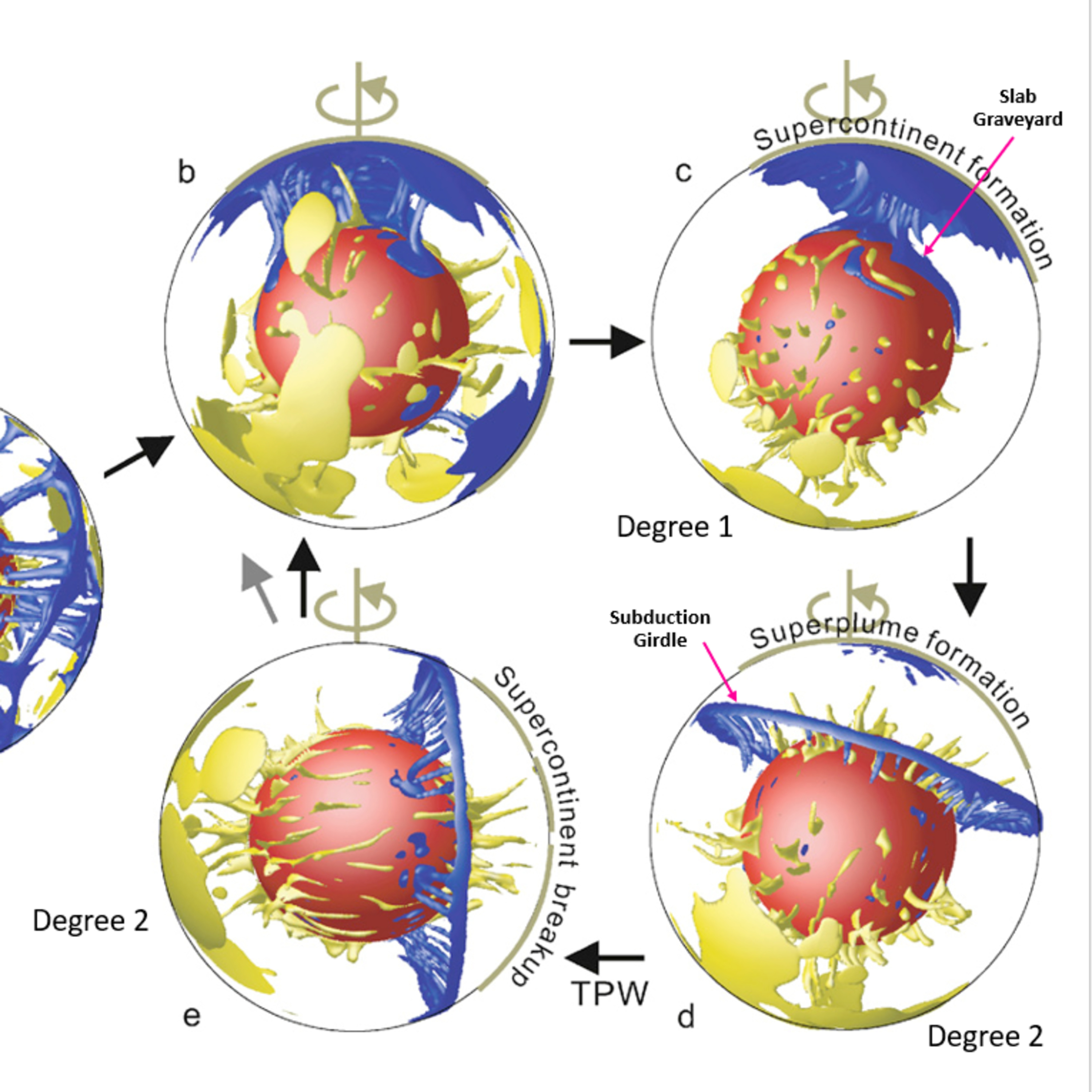
Perhaps as many as five times over the course of Earth history, most of the continents gathered together to form a supercontinent. The supercontinents lasted on the order of a hundred million years before breaking apart and dispersing the continents. For decades, we theorized that this cycle of amalgamation and breakup was caused by near-surface tectonic processes such as subduction that swallowed the oceans between the continents and upper mantle convection that triggered the rifting that split the supercontinents apart. As Damian Nance explains in the podcast, newly acquired evidence suggests a very different picture in which the supercontinent cycle is the surface manifestation of a process that involves the entire mantle all the way to the core-mantle boundary.
Damian Nance draws on a wide range of geological evidence to formulate theories about the large-scale dynamics of the lithosphere and mantle spanning a period going back to the Archean. A major focus of his research is the supercontinent cycle. He is Distinguished Professor Emeritus of Geological Sciences at Ohio University.
Available Results
Generated results are saved to the knowledge database for reuse and search.
Extract Knowledge
Pick what you want extracted first. Model, scope, and chapter options appear after a template is selected.