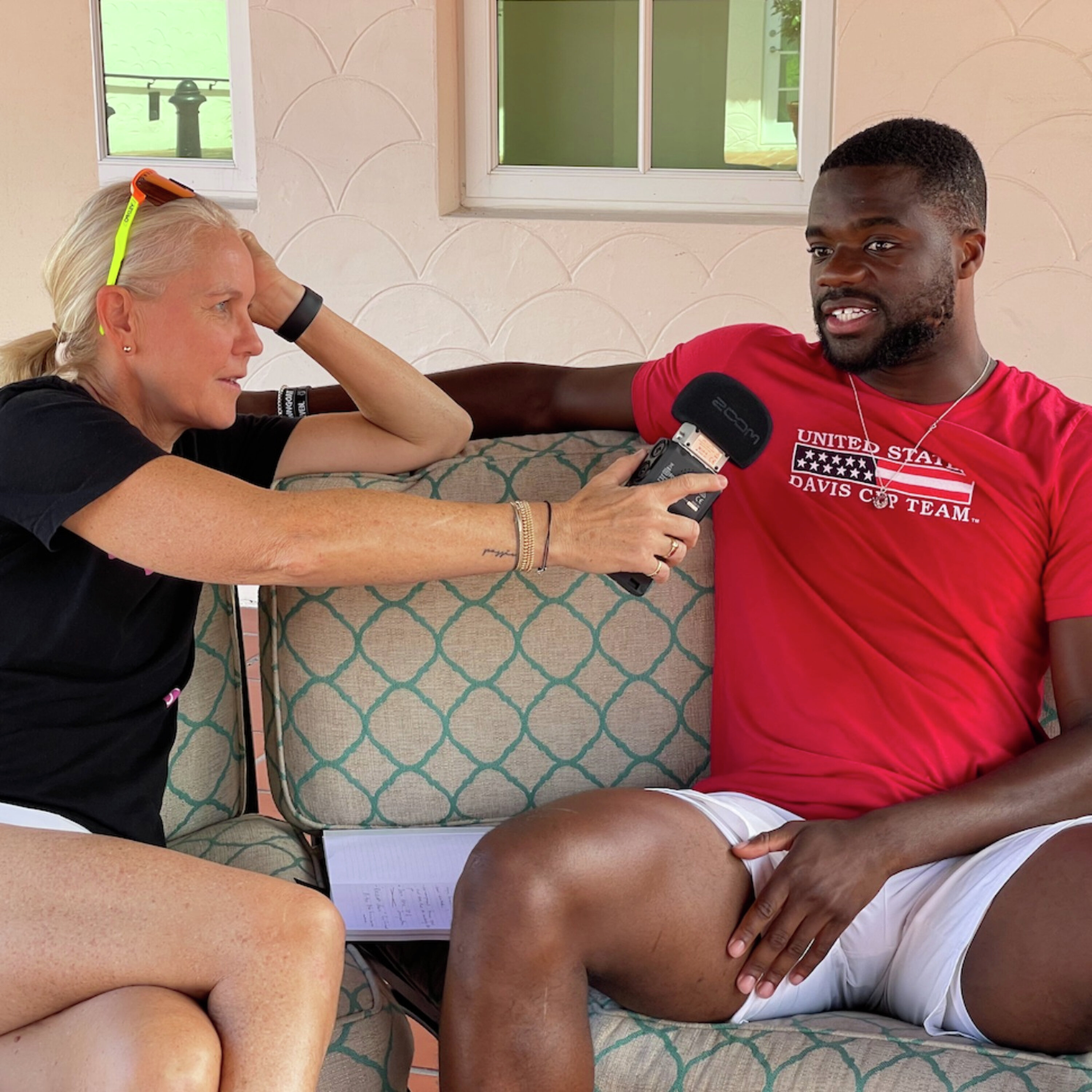
Frances Tiafoe
After a lengthy state of the union—a new women's number one, Carlito Alcaraz's bright future and the scourge of racquet abuse—Big Foe sits down with Rennae to talk about his comeback after injury, playing mixed doubles with Venus and the origin of that distinctive forehand.
Hosted on Acast. See acast.com/privacy for more information.
See omnystudio.com/listener for privacy information.
2022-04-01
49 min
Transcript
Available Results
Generated results are saved to the knowledge database for reuse and search.
No generated results are available for this episode yet.
Extract Knowledge
Pick what you want extracted first. Model, scope, and chapter options appear after a template is selected.
Generated results for public episodes are saved to the knowledge database so they can be reused and searched later.
Transcript
00:00:16
Speaker 1: Okay, so Renee episode two of this season, we've got somebody incredible, Francis Tiafo big Foe on the come up back from an injury, already storming the gates, playing for some pretty good tennis and poised for more. But before we get into your chat with him, I feel like we should kind of do like a little bit of a state of the Union Sunshine double check in. You know, Miami is not quite over, but we've already seen between Miami and Indian wells, just like I feel like we're looking at the future at tennis. It's so exciting.

00:00:47
Speaker 2: Totally agree with you.

00:00:49
Speaker 3: I was thinking last night because I did watch the Alcarez seven, six and a third against Kitchmanovich, and I'll tell you what, man, the first thing I thought after the match was, we just witnessed the future of men's tennis, because for me, Alcoraz has everything you need to be a world number one, to be a multiple Grand Slam winner. I mean, obviously, look, Novak's still there, Rath is still there, but at some point those guys are not going to be there. I think Novak will be around for a lot a lot longer, so he'll certainly be still knocking on the board at door of winning Grand Slams.

00:01:26
Speaker 2: But Alcaaz is just this great. He just fights.

00:01:32
Speaker 3: He lost the first set yesterday and I thought, oh, yeah, big deal, he's going to come back. And I actually had to do something after his match last night. So when he lost the first set, I.

00:01:40
Speaker 2: Was like no, because I knew that he was going to come back. So, you know, he has a locker room reputation.

00:01:46
Speaker 3: Now and he's starting to get one of being a true fighter, being somebody who really wants this, and it's exciting.

00:01:53
Speaker 2: He's so exciting for men's tennis.

00:01:55
Speaker 3: And there was a visit. You know, we felt there for a while, who's next on the men's tour because you know Zverev, I mean, you know how we feel about him.

00:02:06
Speaker 2: I mean, since a.

00:02:07
Speaker 3: Pass, he's still there, but he's not really having the results that we thought maybe, but he obviously will see how he does on the clay.

00:02:14
Speaker 2: But Alcora is this kid.

00:02:16
Speaker 3: This kid's come to play and he's come to take over the men's too, and I love it.

00:02:19
Speaker 1: I'm here for it. And what I like about Alchaz so much is that he seems to combine a lot of incredible components of what people and I don't talk about the Big Three very much because I'm just sort of over it generally as a concept, especially on the men's side, when we've had all these great, you know, versatile women to talk about for the last couple of years. But he really does combine like the forward movement of Federer, like he's really trying to close the net, close points, finish aggressive. He's got obviously the tenacity of a Novak or or you know, in the heart of an adult, like he doesn't fade away, he fights to the very last point. He's got this sort of gumby limbed Djokovic ask ability to hang in points and make you beat him with four or five six winners. So he really kind of has this and nobody, you know, includes Nick Kurios in the Big Three, but he's got this incredible dazzling shot making ability that somebody like Nick Kurrios or or frankly a Francis Tiafo, who we've been looking at as somebody who's got a real, you know, presence on the big stage. He's got that too. And so for me, he kind of has it all like not to get too excited about any one player because I'm really am excited about this crop, like obviously watching Taylor Fritz, which we did over up backgammon set at a club in Miami last week, you know, win Indian Wells, and then watching Carlos make this deep run Titsypas. As you said, he's I think his time to shine is on clay. But like this to me, to kind of announce the cohort of a new generation, you really do need like consistent results at the top, and I feel like al Karez has the ability to do to do that and to make it be a sustainable thing, you know.

00:04:01
Speaker 2: Yeah.

00:04:01
Speaker 3: I mean, let's not forget that he is so young, so we know that Tannis is now becoming very much an older sport. You are peeking at thirty plus these days, so he's a tremendous amount of time to still hone so many skills. And like you said, I love that he tries to come in I mean the I mean, have you seen a faster kid around the court.

00:04:24
Speaker 2: It's a joke.

00:04:24
Speaker 3: So yeah, he does combine all the great things, the great heart and sort of tenacity, and he loves getting the crowd into its similar to its like Rougher at times, and he has that flexibility like Novak. So yeah, we don't want to harp on one. What a great effort from Taylor Fritz to when in his basically in his backyard. I mean, he grew up in southern California, so to see him when that tournament would have been a dream come true for him and his family.

00:04:48
Speaker 2: And so yeah, really and a nice kid.

00:04:51
Speaker 3: You know, he's sort of gone up through some ups and downs over the last few years and a lot of expectation on his shoulders.

00:04:57
Speaker 2: So to see him win that tournament is great.

00:04:59
Speaker 3: Let's see how he can translate that into Grand Slam you know, Mojo now and can he go deep in a Slam that?

00:05:06
Speaker 2: Yeah? Does Taylor?

00:05:07
Speaker 1: Does he have the same toolbag that somebody like Carlos A. Karaz has where it's it's not just going to be an occasional great run of two weeks, you know, Taylor Fitz. It's hard to know with his game because he played so well during that two week period in Indian Wells. But then again, I don't know, just because we haven't seen him at the highest highest stages of the game on a consistent basis. If it's if it's a situation where he just kind of needed to acclimate to play his best tennis, or if it's more like, oh, he doesn't quite have all the tools, but occasionally, you know, things can kind of break his way and he can have a great result.

00:05:39
Speaker 3: I think he's improved so much of his weaknesses. You know, he's improved his speed around the court. He's also always had a massive served. He had some issues, he said, even told me after he won that incredible round of sixteen. I believe at the Straight and Open this year about his forehand. How you know, when he's being aggressive and he's and he's confident with his forehand, then he knows that he can beat anyone. So so you know he's back in is fantastic. The guy can come into the net.

00:06:05
Speaker 2: So yeah, I mean he has all the tools. Now.

00:06:07
Speaker 3: It's so much of this, Caitlin, from you know, being number one in the world to number one hundred in the world.

00:06:13
Speaker 2: So much of it is also mental.

00:06:15
Speaker 3: And so I think winning that tournament will help him believe that he can win the biggest of tournaments. So, as I said, we'll see if it translates, you know, going deeper in grand slams he had that got to the quarters. I believe it this stray and open, so they're starting to come down. It was a hump to get over there, get out of the round of sixteen. So yeah, we'll see if he can continue to rise. But it's great for American tennis.

00:06:38
Speaker 1: It's great for American tennis to have a contender who can go deep. The other thing I sort of want to mention just because sometimes when we get into these conversations about the pros, it's like leaping, you know, heeping on one superlative after another, and somebody who plays recreational tennis is probably like, yeah, of course there are all like, you know, genetic freaks with access to the best training and you know, practicing eight hours day. How does this affect me? But I have to look at Taylor Fritz, who at one point in the last year and a half was in the hospital with his leg immobilized, coming back having a period of deep, deep reflection that can only happen when you're in a hospital bed, not able to move, and then coming back very very quickly to the game and seeming to come back to it with a new mindset. It's like sometimes when you have that moment to sort of say how much do I really want this? What do I actually want to put on the line that I actually think is very relatable. Whereas you know, I'm never going to be a tennis player like Taylor Fritz, but I can relate to the idea of how am I spending my time, how am I using my mentality, how am I bringing myself to this moment to meet it? And I find that there's a lot of real inspiration to take out of what you know, Taylor's Taylor's journey and the fact that he, you know, went from being in a hospital bed to lifting a trophy months later is crazy. You know, that's that's such a cool, cool arc.

00:07:56
Speaker 3: I think so many tennis players, you know, they have a major injury, come back in a bed for it in a lot of ways. I mean, someone I want to throw out here is you know Daria Gavlova, who's now Daria Seville, who got married to Luke Savill, who plays tennis as well. He's an Aussie double specialist. What are tremendous two weeks for Dasher? I mean, incredible talk about resiliency. My god, Caitlin, you have no idea what this kid has gone through over the last I mean ten years she's had.

00:08:27
Speaker 2: She had, first of all, she had to recover.

00:08:29
Speaker 3: From a massive knee you know, acl tear back in the day. She came back from that, she came back and played great, She got into the top forty in the world. And then she's I mean the amount of injuries that this kid has sustained and then had a tremendously bad Achilles issue two years ago, rehabbed it, rehabbed it, rehabbed it, bang, did the same thing, reheard it, rehabbed again for basically another seven months. I mean, she last two years of her career again this injury and basically comes back in the last couple of months and has just again like gotten herself. I don't know what her ranking will be after this tournament, but what an awesome couple of weeks of her.

00:09:11
Speaker 1: I think they were saying she's in the top hundred. She went from being three h five into the top hundred, and it seems like possibly even higher than that, like two hundred spots in a week and a half.

00:09:19
Speaker 2: Like that's crazy. What a cool, cool term events.

00:09:23
Speaker 3: So you've got to have and someone like Dasha just loves loves to compete. She talk about loving crowds and competing and having a good time on the court. She's a pain in the ass to play against because she is such a little pain in the ass on the court with her like antics.

00:09:39
Speaker 1: And but but.

00:09:42
Speaker 3: That wins for so many matches because players get so annoyed against her because of her competitiveness. But I know Dasha off the court, and she is the best human being to be around. She is so much fun and when she gets on the court, she just competes hard.

00:09:56
Speaker 1: So well, that's actually this is a good segue because one of the things I want a note, nobody is going to accuse Daria Seville of nearly murdering an umpire or a ball boy for all of her antics. She's mostly positive and getting pumped up and refusing to go away. She's not, you know, screaming in her crowd her box and used to she used to, Yes, I remember, I remember when she came out of the tour. But it seems like it's sort of fueled by positive energy and a refusal to sort of back down. We are having a crisis in the world of teens right now with the behavior of the men. There's a New York Times article today by Matt Futterman out about how there's just this epidemic of insane racket abuse that is leading to a lot of calls for some of these guys to be heavily, heavily penalized. And I think we have to talk about it.

00:10:48
Speaker 2: I didn't even know what to say, a complete ossory. These guys. They're losing in mind.

00:10:54
Speaker 3: And listen, ha pot Colin Kettle right, everybody knows that watched me play. I was a little get a little upset from time to time at the umpire or linesmen or lines women, whatever it was. But I wasn't a big racket thrower, and so that sort of always bothers me. I'd throw it flat, like Andy Ruddick demonstrated on his tutorial of how to throw a racket, which I thought was kind of hilarious, but.

00:11:20
Speaker 1: Which for anyone else thing should go and look up. But the gist of it is you grab it by the throat, you throw it straight down so it's landing on its face. I don't believe in racket throwing at all. I had a coach who just got on me, and so I never ever do it. But if you're going to do it, do not ever throw it or attempt to hit any person whose job it is to be on the court facilitating your match. I'm talking about umpires, I'm talking about lines, people, I'm talking about ball kids. And the fact that Jensen Brooksby actually did hit he hit a person, which to me should have been automatic deef. The way that Novak was an automatic deef. The fact that Zverev got a suspended eight week sentence after nearly taking the legs off of an umpire in Mexico, the fact that Nick Curious actually did hit somebody after it took an unfortunate bounce. As he said, enough, enough's enough. Absolutely no tolerance for this behavior whatsoever.

00:12:08
Speaker 3: I mean, listen, Nick, Yes, I mean, look, we know it. Look I think that Brooksbury Brooksby didn't. I don't know. I've looked at that video so many times, and I think that he was just kind of trying to scrape the ground, but then he lost the racket out of his hand, and you know, but the bottom line is it's the same as Novak. And I said this on Twitter last week. I said Novak didn't mean to hit the lines, the lines lad at all. I think he actually tried to hit the hit a ball sort of close to his player's box, because that's exactly where they were sitting. And he's been known to do that in the past. And I don't think he just anticipated her walking accident. Okay, no problem, it doesn't matter. It doesn't matter in tennis.

00:12:50
Speaker 1: Match is not the point. The intention exactly irrelevant. The outcome is what we look at. And if it hits a person who's on staff and on the court in any capacity, the rule is very clear automatic teeth. And to be clear, Novak had spent several years throwing hitting balls coming close and was constantly asked by media like, hey you almost hit somebody. Hey you threw a racket and it nearly took out somebody. And he would laugh and say like, yeah, but it didn't and Samon, Sam, it does hit somebody.

00:13:23
Speaker 3: Well, Nick, Nick, you know, also got annoyed at press asking him about that racket throw and he said, did it hit You know, he was really rude to the to the reporter, and you know, some people are like, well, he's a reporter, that's his job is to ask those questions. And the easiest way to answer that is, yeah, man, I fucked up. I made a mistake. I clearly didn't mean to hit anywhere near that kid. It was regrettable.

00:13:47
Speaker 2: Blah blah blah. But you know, Nick, Nick.

00:13:49
Speaker 3: Takes that switch and he just goes from zero to one hundred in like three seconds. And we saw it in Miami where he just completely lost his ship to the umpire Carlos, and he was fine, really heavily. I think the fine against him was really high. I don't think it should have been that high, to be honest, And I feel like the one thing about Nick is I feel like he, of all people, is the one that really gets He gets a lot of higher he gets.

00:14:15
Speaker 2: His fines are higher, in my opinion, than a lot of people.

00:14:18
Speaker 3: But also at the same time, it's this problem of accumulative shit, you know, and at some point you can't keep trashing umpires, you can't keep saying this stuff.

00:14:27
Speaker 2: You can't throw your racket after a match, like man, I've seen so many players.

00:14:33
Speaker 3: Carolinea Plischeber took every racket out of her bag in Dubai a couple of years ago and smashed every single one of them after losing a match, but it was away from everybody.

00:14:42
Speaker 2: Nobody saw it.

00:14:43
Speaker 3: Like you to throw a racket and break a racket immediately after a match on the court is just so friggin' childish. So I mean what Nick did the other day in Indian Wellsbury almost hit the ball kid, And then this Miami, It's like, dude, my god, you have played such great tennis over the last couple weeks. Can just control the urges of anger like that. And it's such a shame because he is so electric to be around and watch on a tennis court.

00:15:08
Speaker 1: Now plenty does tennis and he's seeming to care again, which is so good for the sport. Everybody agrees that having a healthy, engaged Nick Curious is good for the sport. And I do have to say, and this is we're having this conversation a week after there was a major violent issue at the Oscars with Will Smith failing to control himself and smacking Chris Rock across the face deserved or not. You know, I feel like I have to tell my eight year old, like, no hitting. There's just no hitting. That's it. No hitting. I don't care anything else. And to me, watching these men just control yourselves. This is your job the same way that your job would be to you know, show up prepared and take your lumps. You know, I get it. There's a lot on the line. It's your ego, it's fans, You're emotional, you're you're accessing a competitive space. At the end of the day, I want very much for the tour to just have an absolutely no no tolerance policy, and there's going to be some you know, some ramifications for that, and then the culture will change because right now there's absolutely no real sense. Occasionally there's fines obviously, but there's no real sense that this has any uh you know, this has any impact. It's getting worse, and so to me, it's like, no, just nib it on the bird.

00:16:20
Speaker 3: Absolutely not well, I said after the Jensen Brooksby thing, I said, you cannot you cannot learn if you're not taught.

00:16:27
Speaker 2: And I just felt like that was a teaching moment for.

00:16:30
Speaker 3: Him because he does some random shit on the court too. He does like get a little bit petulant as well. And I said, the only way to nip it in the button is literally stop it by finding these guys immediately and defaulting them and like suspending them. Like the fact that it's Pharaoh wasn't, in my opinion, suspended for like a month from the tour is beyond me.

00:16:53
Speaker 1: For what he did for me, it would have been six months. I mean, get that guy obviously, especially in the context of him being under active investigation for domestic violence. Just you know, there's a credible amount of body of evidence that this guy needs to be taught some lessons, and I think there's no better way to handle that than the governing bodies of the sport deciding what and what isn't acceptable. And so actually, ironically, his outburst in Mexico where he nearly took the feet off of that umpire, ended up sort of retroactively restarting the domestic violence investigation against him because everyone was like, is this guy already under scrutiny, And the truth is he hadn't really been. So it's sort of like, hey man, so like.

00:17:38
Speaker 3: Maybe we should look into that domestic violence thing.

00:17:41
Speaker 1: There's some weird anger issues this person has that they're bringing onto the tennis court.

00:17:45
Speaker 3: You know, that was some craig Craig Cray behavior from somebody who's like like top three four or five in the world in singles and losing his fucking mind over a line call in Mexico in doubles, and I mean, listen, nobody'd like to win doubles, and no one acted like an ass sometimes on the court in doubles than me. But that was absolutely the It was shocking when I watched that. Like I have seen a lot of shitty things on a tennis court done by players, that's got to be up there with probably the worst I've ever seen.

00:18:16
Speaker 2: And that's a big statement because I've seen some really craig craziest thing.

00:18:19
Speaker 1: Around a minute, I just I want to spend time talking about tennis playing. I want to spend time talking about the sport. I don't want to talk about how these well compensated athletes can't keep their emotions in check enough not to behave like children Like this reminds me of like juniors, but worse because nobody seems to have any repercussions, you know what I'm saying. And it's like, yeah, they together and.

00:18:40
Speaker 3: They pay these fines like it's nobody's business because it's like seven bucks to them seventy thousand. But you know, just back on the Will Smith thing, and you know, obviously him winning Best Actor for playing Richard. My favorite line I think you and I talked about was Amy Schumer saying, oh, isn't it great that we made a movie about in that line.

00:18:59
Speaker 1: Where we get to elebrate two incredible women's death.

00:19:02
Speaker 3: Yeah, exactly, I mean, it was just great. I mean, but you know, he was phenomenal in that, but it just it does remind me.

00:19:09
Speaker 1: I glad he was pretty bad in that. I thought he was miscast, and.

00:19:14
Speaker 3: I thought he was pretty good. But anyway, that's that's neither here nor there. What is appropriate in this situation is that when I wrote about that situation on Twitter, of course, a lot of the reaction from my fans obviously and people out there in Tennis were will he well something about what is the acting?

00:19:32
Speaker 2: Like he's on the ATP tour.

00:19:33
Speaker 3: So that's the reputation a tour is that, well, Will Smith's going to get away with this because look at the w look at the ATP two and what they're getting away with.

00:19:44
Speaker 2: So you get the bad reputation ATP two.

00:19:47
Speaker 3: And ATP tour players when you're getting lumped in with like what's the big deal? It was was just like zev Or like Nick Currios or whatever. So, I mean, you know it took away from that night for the Williams sisters and stuff.

00:20:01
Speaker 2: I thought that was really tragic.

00:20:03
Speaker 3: Yeah, it was a terrible turn of You know, if you're gonna slap Chris Rock, do it in at the Vanity fan party when no one's watching and everyone's hammered.

00:20:09
Speaker 2: Okay, that's my that would be my plan.

00:20:11
Speaker 3: Even though I agree with you, hitting is not the option for anybody to do.

00:20:16
Speaker 1: Just there's just no hiding, you know what, Take your lumps, get up there and give an incredible speech about how you know what, playing this role in this incredible you know, complex figure gave you the opportunity to understand about the world and yourself. That's the way to handle it. I mean, Jesus, don't you know you're assaulting somebody at their place of work? Like, get what is this the ATP tour? However, there you got one thing that I do want to touch on before we get into your great, great chat with Francis is we have a new women's number one player in the world. And regardless we would have had a new woman's number one player in the world because ash party. As we discussed last week on the Debut Pod with a Rauncha has retired. But I think points wise, Eager's winning Indian Wells and now into the finals in Miami to play Naomi Osaka in what is going to be a Gangbusters match, we would have had a new number one anyway.

00:21:11
Speaker 3: I think she has had to have won Miami to take that spot from Ash.

00:21:17
Speaker 2: I believe. So if she does win.

00:21:20
Speaker 3: Miami and we are, you know, days away from that happening, win or lose. If she wins, she would have taken over that spot regardless of Ash pulling.

00:21:29
Speaker 2: Her name off of the list. So look, but.

00:21:33
Speaker 3: Either way, Eager will be number one in the world come on Monday, and I think she's going to be a great world number one. I have to say, I think she has all the tools. I think the one player that really gave her fits and problems was Ash Party because I don't think she was a fan of Ash's slice. I think she really really struggled with that shot. But everybody else, I mean, this kid, when she's at her very best, she can beat anybody.

00:21:56
Speaker 2: She plays huge game.

00:21:58
Speaker 3: I think Thomas Witkoreowski, her new coach, has really added sort of that little bit of a nuance of understanding how to play at the top echelant. Her former coach Piatra was a great guy and he boy, I'm sure he's a little bit like, oh what a bummer, you know that I'm not a part of this still, because he really was very influential over her, and he's a great guy.

00:22:18
Speaker 2: He's now coaching Shelby Rodgers.

00:22:21
Speaker 3: But Thomas, I think has just added that little extra, you know, understanding of what it takes to be really really good on a consistent basis. Of course, former coach of Agneshko Radvanska, so it must have been really great for him to now coach somebody who did get to number one in the world, because Aga was so close.

00:22:37
Speaker 2: For so long.

00:22:39
Speaker 3: So yeah, I just think she's a fantastic kid. She works hard, she wants this really badly. You know, she travels with Daria, her sports psychologist, and I think that really does make a big difference for her just being able to handle these moments.

00:22:52
Speaker 2: So I could not be happier to.

00:22:54
Speaker 3: See a really really good kid who loves this sport and who's going to be a greatnumber one. And you know, a part of me hopes she does win Miami, so it's even a better story. But the flip side, he is great to see Naomi in a final because you know, we've obviously seen the trials and tribulations of her life. I mean, she's ranked like seventy or something in the world. What the fuck Like really, she won't be after this week. But it's just nice to see Naomi in another big final. And I would love to see these two. I don't know who's going to win this match. I hope it's going to be the match of the tournament. But having said that, it's just these two could be one and two in the world and going back and forth for a long time. If they stay healthy and they stay clearly happy, then hopefully that'll be a great rivalry.

00:23:40
Speaker 1: Yeah, I think I couldn't. I couldn't. I have not much to add to that other than I'm excited that IgA is our number one. She feels very deserving. She's won on a number of different services and has a complete game in a way that's a very nice foil for some of the bigger hitters like the sabal Ancas or the Badosas or the Osakas, in a way that it's always really nice to have a mix of styles. And her approach is very, very heady, and it's very thoughtful, and she's a big reader. She's an interesting person. I think she's a complete person. Oni like a lot of people who only hit balls and then you know, retire to their their you know, hotel and don't talk to you know, don't engage with culture. So I'm I'm really excited because I think Ega is a very deserving number one, And yeah, it'll be a great match. I hope it's already great in the sense that it's a two you know, headliner type players who are who are I think, as to your point, gonna going to be a big part of the future of tennis as long as they stay healthy and happy. So all right, well we should get to Francis. What an incredible personality he is. What a great additive, joyous thing it is to have him back healthy and competing.

00:24:43
Speaker 4: Well.

00:24:43
Speaker 1: He had a pretty good tournament both in Miami and at Indian Wells, and I think it's only going to get better from here because he's still finding his footing after being off with that elbow injury. So yeah, any any thoughts about Francis and where you see him fitting into the future of tennis, because to me, it's very great.

00:25:02
Speaker 3: Well, I just love this talk about loving. He could not love somebody more than I do. Francis Tiava. He is and he is our friend Liz Cully's favorite tennis player of all time.

00:25:14
Speaker 2: But he just he's just this constant.

00:25:17
Speaker 3: Light of love. Like he's he's just a joy to be around. He's constantly smiling, he's constantly happy. I'm sure he has very dark days from time time like every other person in the world, but he never shows that. He is constantly just talking to everyone and being really up and happy. And I think he's got some big things in the future coming up, some of which you and I know, but he he's just I think he's really this is this is a year, and I think Taylor winning Indian Wells is going to sort of catapult him to thinking maybe I can do that as well, because he knows he's he can play at Taylor's level. And just one little thing that I wanted to make sure I got into this episode was that he I interviewed him along with when I did a ranch of Sanchez for Courier at this Miami Mind event for mental health, and they did a terrific job at Fisher Island. And on when I was leaving that event and I was talking to Rachel, who organized this event, I said, isn't Francis great or something like that. We started talking about Francis as I was leaving, and she said it and you know what, we paid him X amount of dollars for this event and he gave every single one of that back to us.

00:26:30
Speaker 2: And you know a lot of players get paid to.

00:26:32
Speaker 3: Go and do some charity work, and that serens counterintuitive, but you know, having the pros come and you know, celebrities come gets a lot of people to come. So the people that come paid a lot of money to play with those players, So that's why they pay them. So they make sure they're there so they get more money. I mean, it's part of the business, right And some.

00:26:51
Speaker 2: Charities you play for free and some you get paid.

00:26:53
Speaker 3: Francis got paid to be there and he gave it all back to Miami Mind. And I just that to me showed so much about him as a as a human being.

00:27:04
Speaker 2: That's It's more about.

00:27:05
Speaker 3: The bigger picture for Francis Tiafo and it was a pleasure to interview in and he's just as I said, he's just one of my favorite people in the world, and he's certainly one of my favorite on the tour.

00:27:15
Speaker 2: And I love the kid.

00:27:17
Speaker 1: All right, let's hear from you and Francis until soon.

00:27:20
Speaker 2: Renee, thank you, Hey, thank you, Caitlin. See you all soon.

00:27:49
Speaker 4: Talk Rene.

00:27:50
Speaker 3: All right, let's get this going. Okay, Hi, Francis, welcome to It's now the Renee Stubbs Tennis Podcast, brought to you by Racket Magazine. But Francis, okay, so I want to get into a few things. I know you down here playing Miami the tournament. You're actually out at an event right now for charity. Want you to tell me a little bit about that.

00:28:10
Speaker 5: Yeah, you know, I was approached by the Miami Mind Mental Health one, and I you know, I've had young people in my family struggle with mental health, and so I definitely want to be a part of it. I knew I was going to have time. I knew I wasn't gonna be so busy, so yeah, and also I've never been here to Fisher Island, so it's also quite nice.

00:28:30
Speaker 3: Yeah, we're in on Fisher Island right now, where there's grass courts, hard courts, clay courts. I mean, it's unbelievable. No wonder Caroline wasn't. Yaki has a court named after her here. So Francis, everybody sort of knows how you got into tennis was really because your dad was the janitor at the tennis court courts in DC. I want to know what made you sort of want to go out in that's courts, because sometimes you know, kids when they're around their parents or their work or something, they don't really want to get involved with it. But what made you want to get out into the tennis CA?

00:29:00
Speaker 5: Yeah, obviously, you know, you know growing up, you know, growing up, I mean especially at those times, you know, pretty poor, and my dad knew that us being there, me and my twin brother there was just being us in a better environment after school and stuff like that. And so when it came to actually playing, I generally just liked it. It was school I found I was playing with other kids and getting into other kids, creating friendships and stuff like that. That's kind of how I kind of fell in love with it.

00:29:28
Speaker 3: Is that important because I've talked about that, like why kids get into tennis. Often they get into basketball or soccer or baseball because they want to be around their friends. Would you advise that, like for anyone talking to want to get their kids into tennis, especially if they're You're a very social person, So is that important at a young age to be around other kids?

00:29:48
Speaker 5: I mean, I think for me it was vital how my personality ended up being because I'm very I'm very social.

00:29:53
Speaker 4: I like to be around a lot of people.

00:29:55
Speaker 5: But I think being around your friends, especially at a young age, it's all about having fun. You played a game because it was fun, and then you know, I fell in love with it because it was fun. Obviously, as you get older, you know, business starts kicking in and things start getting much more serious. But but yeah, I mean that's why I love the game, and that's why I continue to play the game.

00:30:13
Speaker 3: So you have I mean, I've been around tennis a long time and you sort of have a very unusual style of playing, particularly on the forehand. So I had a bit of a laugh this morning with Caitlin from Racket magazine and I said, do you think that you know, because he's such a what are you gen z? You think he was like getting on YouTube and thought, I'm gonna what is a tennis player looked at and you think he discovered like Ernest Golbas's forehand is the one to like emulate, like the technique? Where did it come from?

00:30:41
Speaker 5: I'll be honest with you. I used to have a normal forehand, and then I'll never forget. I played this terminent less petitors in France, and I came and I came back, and then all of a sudden, I was like, I was, It's funny because I was. I was joking around and making fun of do his fourhands on the tour like I would always go and do that. I'll see you guys on the tour head and so I was like hopping a bunch of guys and coaches like you need to stop doing that because then your strokes get messed up. I was like, nah, come on, man, and then all of a sudden like I can't I can't hit a forehand, and like so like I can't you know tennis, so mentally get in your head and then so I'm trying a bunch of things. I'm just messing around. I'm hitting the balls on the wall for like hours, hours and just kind of like like just have like because I'm all.

00:31:20
Speaker 4: A field player, Like it's like how it feels.

00:31:22
Speaker 5: And then I was joking around swinging like that and it felt nice and here you are, My.

00:31:26
Speaker 3: God, that's a classic. So whatever works, I guess, I mean, because that's really it. So the great thing about tennis is that you can have such different strokes and still be such a good player. And it's about finding what works for you.

00:31:39
Speaker 4: I guess absolutely.

00:31:40
Speaker 5: I've been told to change up many times. You need to go to traditional way then feel right. And everyone's different. I mean that's just how life is. Everyone's totally different. And you know, I found what definitely.

00:31:50
Speaker 4: Works for me.

00:31:51
Speaker 3: So you had a difficult sort of end of the year injury. Why don't you give us a little background on what happened and also sort of, you know, the toughness of the last few years with the pandemic and and and where you're at now.

00:32:04
Speaker 5: Yeah, I mean it was crazy because I was dealing with the elbow problem right after since right after the US Open.

00:32:10
Speaker 3: You're not gonna blame that on the forehand, are you.

00:32:13
Speaker 5: Uh yeah, So yeah, and then I was kind.

00:32:17
Speaker 4: Of dealing with that masking.

00:32:18
Speaker 5: I was taking you know, taking a bunch of bunch of pills and things like that.

00:32:22
Speaker 4: It kind of get me through the year.

00:32:23
Speaker 5: I was playing great tennis at the end of the year, but yeah, then it only started getting worse and worse, and the off season tried to take care of it, couldn't couldn't really happen until Australia wasn't prepared, So I took a long time off and any Well was my first tournament back, so it was It's good. I mean, I feel in good place. I feel fait. I'm healthy now, so that's good. But I mean how I feel a role last couple of years was tough. I mean, the pandemic was really tough for me because you know, playing with no coming back and playing with no fans was tough. Also, you know, seeing what the world was at at the particular time, it's everything was so ensure. It was it was. It was pretty tough. And I had a ton of family, you know, passed because OVID, so it was rough. You know, I wasn't in a good place at all. But you know, then then I think, you know, last year, who women, when you know fans are coming back, they're starting to have a little more, a little more normality helped me out a lot and just kind of like figure out why I love the game, why I played the game, and yeah, so I'm I'm in a better place now.

00:33:20
Speaker 3: You have been working now with Wayne forever for a couple of years? Was it about it a year and a half approximately?

00:33:27
Speaker 4: What?

00:33:28
Speaker 3: Wayne's a very different person to you in a lot of ways. I Mean when he played, he was very quiet, he wasn't demonstrative. It sort of didn't really engage the crowd all that much. So I eat completely different to you. What is like some of the things and influencers that he's had over you over the last little bit.

00:33:42
Speaker 5: I think I think that it's a disciplined part, right. I mean I feel like I'm, yeah, I'm very much so flamboyant. I can do a lot of things in the court. I'm you know, gift and whatever. But between the years, how I approach the game, it's kind of just you're tightening up the screws around you know, certain areas. You know, it's being more professional on and off court, making certain sacrifices, those kind of things. Because I mean the stage, we're all at roll pros here. It's not like yo, man, you need to do a little here, or you know, your foot needs to be here. It's not like you know, maybe those are some small things, but the bigger things is just kind of my discipline. And if you see as a lady, I'm staying more with the matches for much longer.

00:34:18
Speaker 4: I feel like I'm much more present.

00:34:20
Speaker 5: I don't feel like the ebbs and flows are as dramatic as they were, which he's helped me a lot, and that's just been like he's doing things that just don't want to do.

00:34:29
Speaker 4: You know, I was allowing him to let me.

00:34:31
Speaker 5: To get me in uncomfortable situations and being comfortable in those uncomfortable situations. So I think because he's so different, it's good for me. I think if I had someone like me, it'd probably be not the grest thing. But it's funny because he also likes me to be me. He doesn't want me because I mean, I've been told that, you know, Francis, you should be doing X, Y and Z and this that and the other. You know, we thought you would have made a break right now, which is obviously always tough to hear.

00:34:56
Speaker 4: You. People can say that they.

00:34:57
Speaker 5: Don't that doesn't bother them, but it's always a tough to a certain degree.

00:35:10
Speaker 3: This episode is supported by B and P Paribar and their commitment to the future of tennis with a focus on social equity, sustainability and community responsibility. Listen into a conversation that I had with BNP Paribar USA CEO Jean E. Filion and stay tuned for that episode later in this season.

00:35:34
Speaker 6: I think the future of tennis point of the future of anybody, that's how do we give back, but giving back in a real way. Giving back you have to believe in it. Otherwise your giving back is not really sustainabolic's on. You're one off in time, and I think these bankers manage and there's so much more we can do to let wage tennis, including to love wete this tournament, trying to really go beyond the tennis it's sad, and really focus on committing to the community's equity, the social dimension, equal access.

00:36:06
Speaker 3: So it's really important to allow you still be happy, because you play best when you're happy, when you when you are actually showing this great attitude to the fans and involving the crowd. Is there a time where he's like Okay, this is the time to do it, but maybe not now, Like has he ever said to you, okay, that probably wasn't the best time to be like that. Has he changed anything at all with that?

00:36:29
Speaker 5: Yeah, it's like within reason, right. So it's like he's like, pick your moments. He's like, there's definitely some moments of separation. For example, like you know, if you if you just get a big break, but it's not a break where you then go to sit down, like if if it's you break. So for example, I put it on Andrey Less, you're in the US Open, I break in the fourth set to go forward to up, I go huge, pump, get the crowd into I get broken back at love.

00:36:53
Speaker 4: So maybe if you're if it's two on, okay, you get the.

00:36:56
Speaker 5: Crowd into it and you have a minute to come minute and a half whatever come down, you get back.

00:37:00
Speaker 4: So those kind of things.

00:37:02
Speaker 5: But yeah, he likes you know, if I had a good shot, you know, you clapping hands around the fans and stuff like that gets it gets me so to end, because that's he found that That's why you know, I end up playing my best and that's why that's just who I am.

00:37:16
Speaker 3: The joy that you show on the court, and I love it because I mean I was not not like that, but I was also pretty demonstrative as well, and I sort of would get the crowd sometimes into it. But I want to know, I mean, your parents come from Sierra Leone. I mean, anybody who has any kind of education or ability to read will know sort of the trials and tribulations that that country has had over the last twenty years. One of the reasons why your parents are probably in the United States. Does that have a bearing on you as a human being as well? And seeing the joy and what you do, which is I mean, tennis is tough. We all know it, travel, a lot work you put in, but in the end, it's not like the most difficult taxing job, right, So is that something that you think about where your parents came from and the will to work hard?

00:38:05
Speaker 5: Yeah, I think I think people don't really understand, Like obviously, you know, my mom being a nurse working two jobs, working late, she would work overnight shifts. I'm staying at tennis center, my dad being in janit and there's the only way we can play the game for free, I mean, because that wasn't the option I'm probably not playing the game. Well, I'm definitely not playing the game of tennis. So you know, Now you know, I was able at a young age by my MoMA house.

00:38:26
Speaker 4: My dad's good here in Florida.

00:38:28
Speaker 5: So people don't understand, Like when I'm out there competing and I'm getting the crowd into and I'm getting so pumped up, They're like, oh, and they see me around like, oh, laughing, y'all. It's kind of like it's a certain degree. I feel like I succeeded in a lot of ways, you know, like I used tennis was for me. Like once I got to a certain age, I was like, I don't want to go to college. I want to have tennis. I love the game. I want to play at old slams, and but I want to be able to financially take care of my family because they they grind it for twenty twenty thirty plus years just for me and my brother to have an opportunity. So, you know, a lot of people like perspective is drash performers, and I think perspective is everything. People don't understand. Like, you know, I've I've succeeded in a lot of ways. My parents can sleep well at night knowing that I've grinded and I still haven't got to where I want to be, but the basic, the essence of what I was doing is has been completed.

00:39:16
Speaker 4: There.

00:39:16
Speaker 3: Okay, Well, now that you said that, where do you want to be? What is the goal? Man? Come on, I'm going to put you on the spot.

00:39:21
Speaker 4: Yeah, yeah, I mean, I mean, I think I'm very capable. Man.

00:39:25
Speaker 5: I think I could be in the top ten. I think can win Grand Slams. You know, I don't.

00:39:28
Speaker 4: You know. I'm definitely a big time player I liked.

00:39:31
Speaker 5: I mean, I've had a lot of great wins against the top five, big big opponent opponents in the world. But it's just about this one. How how what am I willing to give to the game? What am I willing to sacrifice to do it? And I think I'm definitely there now. I've matured. Now I've been on tour for seven years, eight years now, and I'm ready to do so.

00:39:49
Speaker 4: That doesn't mean it's going to happen tomorrow. What is it?

00:39:52
Speaker 3: What does it say to you when you see Dominique team and sort of some of the other Look, let's say they're not the Big three winning some events now at Medvedev and you compete with these guys, does it give you the impotence to think why not? Why not me?

00:40:08
Speaker 4: For sure?

00:40:08
Speaker 5: Like, you know, I'm beating Stephan I was a woman and beat them twice last year week Rublev, like you know what I mean, beat a lot of these guys. And it's like, it's funny because I grew up with the play juniors with these guys, know these guys forever, She's Frisks win yesterday. So you kind of look at it and you're like you look at yourself in the mirror.

00:40:24
Speaker 4: You're like, well, why why isn't that you? Right? Like you know so.

00:40:28
Speaker 5: But at the same time, it's kind of like, you know, I'm not I'm not envious anyone. I'm always I'm the first person in your congrats. And you know, I feel like your path is your own path. You know, it's the worst thing you can do is compare yourself to other people. But in the same talking, I'm just like, well, if they're doing it, why not? And and so I'm definitely on that why not path right now? And I was ready to put the head down and try to do some good things. I think the better I do. It's only good for the game.

00:40:54
Speaker 3: Now, speaking of the Williams sisters, what about playing mixed doubles with both of those two through the years and particularly Venus at Wimbledon. It looked like you're a bit of a fish out of water playing mixed doubles. But how fun was that?

00:41:07
Speaker 4: Hard? Playing mix?

00:41:08
Speaker 5: Because I'm playing and I'm like, you know, like, well obviously, like it's not like you're playing with a friend that I'm playing with someone I really look up to. So hey, I'm nervous as ship Like every ball I miss. I'm like, he probably thinks I suck, so.

00:41:20
Speaker 3: But yeah, yeah, she probably did.

00:41:22
Speaker 5: Yeah, So like I was like, I was pretty nervous. But then I mean yeah, and our first in our first actually with them, we got into good Rider.

00:41:30
Speaker 4: I was second.

00:41:30
Speaker 5: Actually I killed, and I'm like, this is what's embarrassing thing I was texting.

00:41:33
Speaker 4: I was like, I'm so sorry. I'm so sorry. She's like, no, that's all good.

00:41:37
Speaker 5: And then playing with Serena Hartman Cup playing against Roger, I mean I was I feel like I've had experiences in my career that you know, get priceless, like like a million slams on one court, like two absolute legends like me and Belinda are like, bro, why were we even on this court?

00:41:50
Speaker 4: Like this is insane.

00:41:52
Speaker 5: But being able to build relationships with them and knowing them and actually being able to call them friends is crazy.

00:41:58
Speaker 4: And I'm really blessed for.

00:42:03
Speaker 3: What is for you. For someone who is quite social, I mean, I see you. You are the most social human being on tour. I mean you smiling everybody. As you said, You're not a jealous person. You totally love when people do well, especially Americans. But what's the toughest thing on tour for you?

00:42:21
Speaker 5: I mean, to be honest with you, as as nice as I am, I just feel like it's tough just knowing how many genuine people they are, Like I mean, because it's got throat out here, I mean, playing for keeps bro, Like I mean, you know what I'm saying. So as much as I'm not to go to see the type, I feel like, you know this, a decent amount of people are and people like just looking for themselves, which is totally fine. I'm not you know, coming at them in any way, but it's just the name of the game. But you know, but I feel like not not falling into that and still being you, Like, you know, just because you know other people feel a certain way or act certain way, you still can be you and be true to you because being a good person and being a good dude carries a lot of value as an individual, not just an athlete.

00:43:06
Speaker 3: A little bit about rackets down. You won the Arthur ash Humanitarian Award a couple of was it last year from the ATP What did that mean to you and that entire period of your life and what you came up with there with your girlfriend played tennis at UCLA? What was the impotence behind that? And who came up with that inspirational idea?

00:43:26
Speaker 5: Well, I mean she was just like, look man, like the world's going crazy right now.

00:43:29
Speaker 4: What are you gonna do?

00:43:31
Speaker 3: She really said, like what are you gonna do?

00:43:33
Speaker 4: You're gonna do?

00:43:34
Speaker 5: And okay, you have the platform because I do it without your ass, You got the platform. And I said, I mean, I don't know, like she said, look like so she said it one day, he said, the two days she said, look, everyone's coming out, this is the perfect time to do it. Rand's gonna get behind you, like you gotta do something. So I was like, Okay, how do we do someone getting a bunch of people involved with them not saying anything because people are people are worried about you know, they say something, someone may get upset whatever, blah blah blah. And so you know what happened with Michael Brown twenty fourteen when he was told to you know, lift his hands up and still got shot and killed anyway, So.

00:44:10
Speaker 4: We were like, okay, like why don't we just do that?

00:44:12
Speaker 5: And then I called a bunch of people I was nervous calling, like Serena and you know, soccer because you know, everyone's asking him to do stuff, not not like that kind of stuff, but get stuff on the irregular basis every day. So I was like, we'll see and even like Isle and Joe, like I was like that it's tough, but it was cool to see, like you like how many people got behind it and how many people want to do it, Like you had some ogs you had, Shanda you had and Xena Garrison like that was cool. Like Mault Washington, that was the first time I ever spoke to him, which was cool, like you know, obviously asking him to do the video, but it's like getting close to the OG's that were playing tennis. James Blake obviously a good friend of mine, but it was it was cool.

00:44:52
Speaker 4: And then to see how what it turned.

00:44:53
Speaker 5: Out to be, you know, it's it was unbelievable. And to be able to win that award for Arthur and you know, it was great and I was cruly.

00:45:01
Speaker 3: Boss, thanks for doing this. I know you're super busy today and you know Miami is just around the corner. I want to know, like just from your standpoint, what what the goal is for the rest of the year and also what you really think and truly believe in your heart that you can do as a tennis player.

00:45:18
Speaker 5: Yeah no, I mean yeah, I mean for the rest I mean for the rest of the year. I mean these I mean obviously first couple of tournaments. He was trying to get your feedback back into it. But I mean again, I mean I want to.

00:45:30
Speaker 4: I want to.

00:45:30
Speaker 5: I want to try, and like, you know, top twenty, top fifteen finished, why not talk ten if you're there. That's like kind of been the goal with you know, whinning and I always spoke about building how.

00:45:38
Speaker 3: Much how much? Just to interrupt you, how much did Taylor winning that tournament yesterday? I mean how much does that help someone like you really believe even more on your own ability to win a tournament like that.

00:45:48
Speaker 5: For sure, it definitely helps, you know, guy that we grew up with man and we battled so many times and played and for sure, for sure, that definitely helps. I mean I've thought about that kind of mindset for for a little bit of time now.

00:45:59
Speaker 4: Like I mean, even seeing Cam Nord win it last.

00:46:02
Speaker 5: Year, it was kind of crazy, Like you're like, well, like it's not like a you know, two fifties of Mass series as wild and you know, the bunch of different faces, but Taylor, especially men being an American is like it's definitely it's definitely wild to see you know, Riley making fun in Toronto last year. So I mean, guys are doing it, so it's just a matter of time. But yeah, I mean I just you know, I really, I really think I can do some great things this year. I mean, I would love to have a top fifteen, top ten finish, but that's that's kind of the goal with me and Wayne had going deep in some slams. You know, I've made some quarters and some around sixteens, but like, you know, really pushing the envelope Semis especially, I'm really looking forward to wimbling the US Open. Those are like well outside of Ausralia. Unfortunately I was hurt, but like wimbling Australia and then the open of my favorite three Paris. We haven't had the best relationship but those three. I mean with my game playing on grass, like I like to come to the net guys don't really come in much anymore and pass well. But then at the open the night, it's crazy like Stacey. Stacy's gat would always put me at the open at night. So I'm I'm excited and and I and I just I want to do some great things and we'll see see.

00:47:09
Speaker 3: Okay, last couple of questions real quick, who's your favorite all time player? Who's your favorite all time player that you're not still playing against.

00:47:23
Speaker 4: I mean, I guess he was crazy.

00:47:24
Speaker 5: I guess he was unbelievable, like because for me, that's what it's about, Like it's not about yeah, obviously he was an unbelievable player, but like you know, like people just like like worshiping the like the brown. This guy walks like you know what I'm saying, Like like he was, you know, with the long hair with the Genes show.

00:47:39
Speaker 4: I mean the guy was a legend man.

00:47:42
Speaker 5: Yeah yeah, yeah, like the but seeing the different phases like drop down came back up, but the story like you know, like people are gonna get behind that.

00:47:50
Speaker 4: I think you know what I'm saying.

00:47:51
Speaker 5: And yeah, so I definitely loved him, loved Deanic, Noah thought he was crazy.

00:47:59
Speaker 4: And then on a women's side, obviously.

00:48:02
Speaker 5: I mean, obviously, sir, the Williams sisters there are pretty pretty legendary, so those are probably my favorite, but my favorite player of all time is actually Double Porto. To be honest with you, I made a big yeah that won't hurt me a lot, like he was the first person ever signed my ball and stuff like that, So that's actually my favorite player.

00:48:20
Speaker 3: All right. So, Francis, thanks for joining me. I knew this wouldn't be difficult with you, so, and also to everyone out there whoever signs your tennis ball first as a kid, that becomes your favorite.

00:48:30
Speaker 5: Player exactly automatically.

00:48:33
Speaker 3: All right, Francis, good luck this year.

00:48:34
Speaker 4: Huh.

00:48:35
Speaker 3: Thanks for joining me, appreciate Okay,
Chapters
No chapters available.