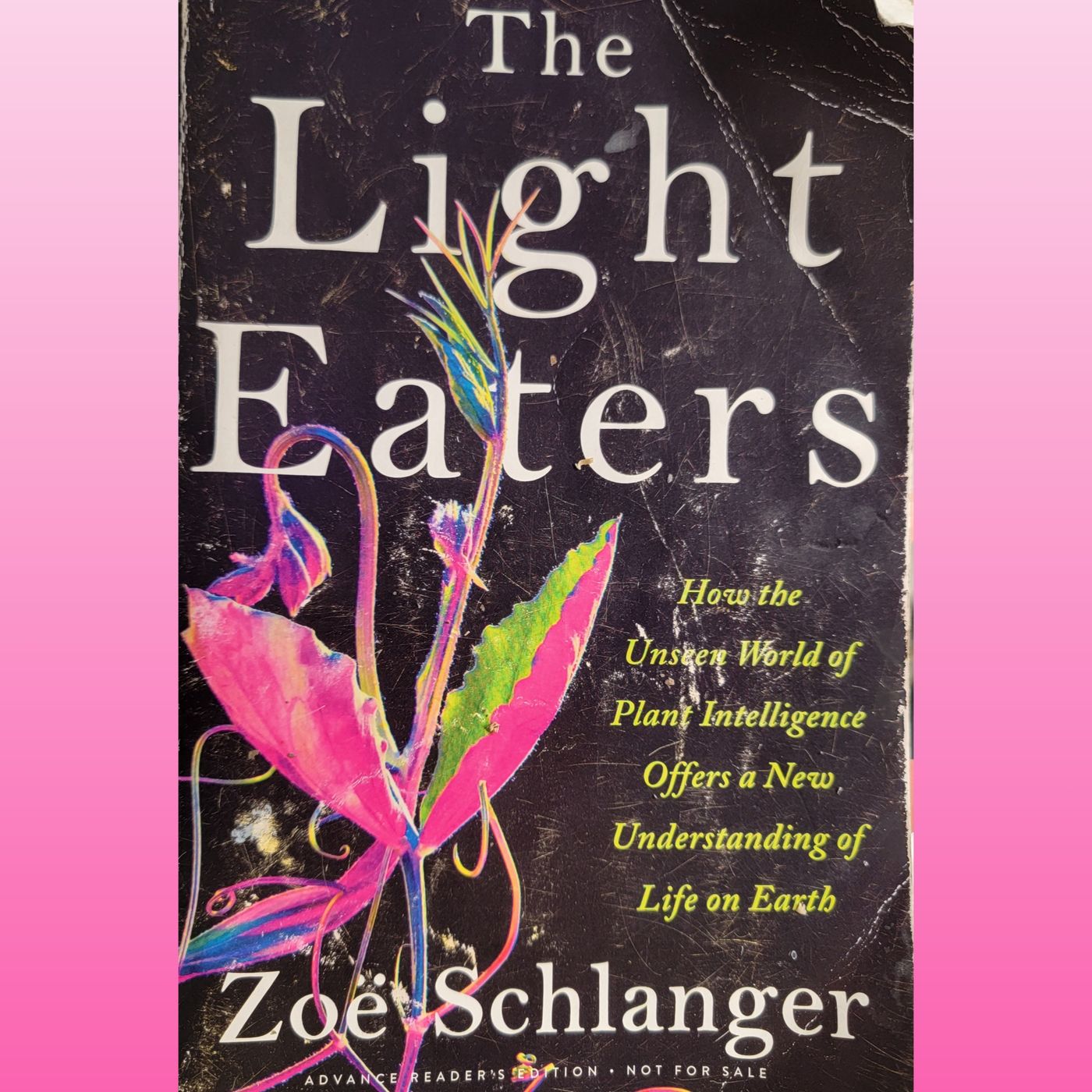
Zoe Schlanger, Author of The Light Eaters
Zoe Schlanger is the author of newly released book "The Light Eaters", which shines a new light on researchers studying plant "intelligence" and behavior.
2024-06-26
105 min
Transcript
Available Results
Generated results are saved to the knowledge database for reuse and search.
No generated results are available for this episode yet.
Extract Knowledge
Pick what you want extracted first. Model, scope, and chapter options appear after a template is selected.
Generated results for public episodes are saved to the knowledge database so they can be reused and searched later.
Transcript
Okay, welcome to the crime Pace of Bodany Doesn't Podcast. Uh. I'm
excited for this interview. And it took you know, it took a while
to get around to it, but uh, but yeah, it's with an
author for a book, the author of a book that just came out called
The Light Eaters, And so we'll just launch right into it. Zoey Schlang,
is it Shlanger? Okay, all right, just making sure. I
guess I should have done that before we started, but whatever. Anyway,
So Zoe Zoey Schlanger. So you're anyway, you're in New York right now
this book. I'll be honest with you. Man. When when I got
when I first got the email about it, I was like, ah,
what is this? I just kind of you know, I because I normally
have a short attention span for my emails. Anyway, when I opened the
inbox, I just want to lay down in traffic. But but I got
it and I was like what And then you know, they were like,
do you want to, you know, take a look at it. Was
like yeah, sure, and they sent me a copy and then when I
opened it, I was like, oh, wow, this is okay.
I'm sold this is some pretty interesting stuff. And so, you know,
I'm sure writing this you got probably you know, and I'm sure a lot
of people have a similar reaction when they get it. Initially, they're a
little wary and they're like, what is this? You know, it's because
you know, I lived in California for twenty years. I've got my own
trauma from living out there, the New Age scene whatever, for sure,
and so and you mentioned that in the book. I mean, you talk
about that. But god, this stuff is so fascinating, and at some
point I think I just decided, I mean, I Revere and basically worship
plants says it is. I mean, they've you know, there's so much
more there than just something that's pretty to look at. There another life form
that basically makes life for everything else possible. So I just I just,
you know, kind of dove into it. And now I'm all about it.
But but I guess starting off, tell everybody what this book is about
and what made you decide to write it. Yeah. Cool, Well I'm
glad you thought that it was not the Lulu traumatizing version, which is exactly
what I'm going for. All that's par reviewed. But so this book is
about the sector of botanists right now who are considering whether or not plants might
be intelligent or conscious. And that's a pretty small circle of botanists, if
we're honest, that are sort of fighting with each other in botany journals.
But there's a much larger circle of botanists who are asking questions more quietly about
plant behavior and just basic questions about what plants can do and finding pretty remarkable
outcomes of that research. And this is a it's been about thirty forty years
of kind of plant behavior research going a bit underground after the whole Secret Life
of Plants debacle. If they're talking about New Age stuff in California, that
was, you know, the apex of it nineteen seventy three, where people
got the idea to start talking to their plants and that they liked classical music
and should read your mind. All of these things wait really quick. So
how I went Secret Life of Plants is there was a book that came out
in seventy three that was really kind of out there, yeah, totally height
of New Age culture, and it was the first time a book about botan
took the kind of popular market by storm, and there was a feature film
made out of it. Stevie Wonder wrote the soundtrack, which I have.
It's a very good soundtrack, but it was maybe half of it was fairly
robust plant science and sort of the history of plants and human interactions, and
then the other half of it was just basically pseudo science or citizen science that
couldn't be reproduced. Maybe you've heard about the polygraph test being applied to plants
by the guy who actually invented the polygraph, former CIA agent, where you
know, he thought about lighting his houseplants on fire and claimed that the polygraph
test went wild in response to that, suggesting that the plants were reading his
his mean thoughts. So, as you can imagine, we all know research
the research world is pretty conservative institution or does not like being associated with these
kinds of things. And from what botanists told me of that period, the
NSF sort of clamped down and ceased funding a lot of plant behavior research that
had any with actually talk about plants as behaving organisms. And it took a
long time for that taboo to wear off, but it really mostly has now
non tired, but enough to let a lot of cool research through. Yeah,
so what made you because you're not a botanist by trade. I mean,
did you have interest in plants before this or how what made you decide
to write a book on this. Yeah, I'm definitely not a botanist.
I don't have any advanced degrees in any hard sciences. I'm a science journalist
and I cover climate change. And I had been covering the environment climate change
mostly like Aaron water pollution is well for about ten years and I was feeling
pretty burned out. I think this is like twenty seventeen, twenty eighteen.
And I've always been interested in plants. I have a lot of plants.
I'm sitting in my Brooklyn apartment no outdoor space, sadly, but and I
grew up around a lot of people who appreciated plants, but no one in
the hard sciences. I started looking at botany journals as a way to sort
of refresh myself. And I think what really set me down this path.
The first little instance was I decided to cover the first case of a Ferm
genome being sequenced in twenty eighteen. And you know, fur genomes are enormous,
so this is a big deal. And I called a fer and scientist
and he was like, you know, I'm actually at a botany conference.
Do you want me to get like a bunch more fer and scientists on a
conference call? And so he got he gathered like six people and put them
in a room and which had this had them all on speakerphone and just had
this incredibly delightful call where you know, as a reporter, I talked aside
this all the time, and this is another category of reporting call. Everyone
was just enthusiastic in this way. That was totally infectious and totally infected me.
And I got quite obsessed with ferns for a short period of time.
Got a tattoo of the fern that got ex geno secrets what species? Oh
cool? Yeah, I actually got to find some for my little pond outside.
So nice. Yeah, they're good at sequestioning a lot of too.
Yeah, and I have the cool pocket for the cyanobacteria. Yeah man,
Yeah, it's a cool it's a cool organism. So anyway, so you
got in the ferns and so I mean that that was kind of like your
gateway into plants, and then you just started paying more attention to them or
what. Yeah, there was that, and then I also had the chance
to go to Kauhai National Tropical The tende of garden out there, if you
have not seen it is I mean, I hope I get to see it
again in my lifetime. Is an incredible place, and they do a fellowship
for environmental journalists. So I happened to get a spot on that fellowship and
it was like a week where you just spend the week hiking around with their
botanists and they just talked you about their work. And I met Steve Perlman,
who is one of their rare plant botanists, one of two, and
he was part of his team that he's you know, in his late sixties,
jumps out of helicopters repels down cliffs to find these ultra rare species where
there's sometimes like five individuals left, and it's his job to gather, you
know, to hand pollinate them. A lot of them have you know,
separate sex plants, so he's waiting for one to open, hiking out four
days to it. Maybe it's not open yet. He has to do it
all over again a week later and then carry the pollen over and pollinate the
other plant. And it's incredible and such a labor of love and it was
the first time I think I really spoke to someone who cared for plants in
a way that I had never seen before, about these ultra rare plants that
maybe we didn't even know existed a decade ago. But here we are putting
all this effort into trying to save them. Not really changed something for me
too. Yeah, it's it's it's infectious. I mean I could say,
I could say as someone who's you know, traveled all over the world studying
them. I mean, this has been my life for the last five years.
I mean it was my life before that too, when I worked for
the railroad. I was, you know, reading research papers in the locomotive
cab and you know, textbooks and shit. I mean, it's but that's
what I love about your book is because I think, uh, I think
most well. First off, I want to say, when most people think
of plant consciousness, you know, humans are inherently short sighted. In my
opic, we're going to think in terms of in human terms about this.
We're gonna expect it to be just like us, and that we you know,
you can't do that, you can't have this narrow frame of reference.
I mean, and I think that that's What I like about it is my
hope is that maybe it will make it'll suck people out of this this narrow
frame of view that we have and get them to think about maybe other ways
that that you know that these things, these organisms, which I basically composed
of the living skin of the earth, how they're interacting with each other,
with the environment, and how you know, basically, how they behave.
I mean, I was writing something a while ago and I mentioned something about
plant behavior, and to me, it's I mean, plant behavior is just
it's it's obvious that they behave. They behave in an ecosystem, they behave.
It's on a slower time frame than humans are used to, but you
know, you have again, you got to think and you got to shake
out of this this really narrow, myopic human world. And that's basically what
I've been doing over the last fifteen years of my life is slowly leaving that
world and looking at the rest of the world around us, the living world
around us. You know, I don't even like the word nature. It's
just the real world what it is. Yeah. Yeah, we're incredibly bad
at looking outside ourselves. And it takes so long. And we said fifteen
years. Like, I don't know, it took me more than a year
into doing a research of this book to start to really shift enough to see
plans as behaving in the way that they actually are, not just the way
they interact, the way they interact with everything around them. I mean,
a plant that that mimics rocks is behaving. A plant that secretes a pheromone,
an orca that secretes a pheromone that attracts you know, horny male searfed
flies is behaving. It's that, And that's what I love about this book,
is it? It's again because I think the fact that humans have been
so myopic and we've so completely our civilization has severed ourselves from the rest of
the living world. That's kind of what got us into this predicament that we're
in today, where you know of mass extinction and habitat loss and just we're
so off the rails as a civilization. So anyway, so what made you
finally decide to write a book about plant behavior and you know, plant intelligence?
Well, so, as I said, I just started like looking through
botany journals, and I feel like the timing was really fortuitous because there was
this debate sort of happening in the pages of trends in plant science, and
someone who was not involved in this back and forth with these very salty response
papers being published about plant consciousness termed it the tips Ruckus, and it really,
I mean set off alarm bells as a reporter, because knowing that scientists
are conservative people, certainly when they're publishing in journals that they were using,
even using words like intelligence consciousness, even the response papers that were saying this
is absolute bullshit and we shouldn't even be talking about it. We're still down
to like it was clearly worth their time to engage, and so I thought
there must be something here, and there is there was, and it had
just felt like this moment where there was all of these fascinating papers coming out
about plant acoustic sensing, plant communication, you know, with chemical synthesis and
plant memory. I mean, these are pretty provocative terms that we're making into
peer aview papers. So it did seem like the best story of my career
and certainly more fun than covering like wildfires and ice sheets melting really well and
back to that now unfortually but totally are are are slow or not so slow,
you know, degradation into climate chaos, which the oil companies have been
so good at convincing half the population isn't even real. Yeah, so exactly,
you're in Texas, right, Yeah, it's yeah. I mean obviously
I'm not here for a culture or the lack thereof, but wonderful, wonderful
you know, plant communities that here though, wonderful flora. So let's talk
about a couple I mean, let's talk about a couple of case studies from
the book. First off, I want to talk about this, this mimic
vine in Chile. I mean, this, this is really fucking weird,
man. This is like a bolkila what is it? Bolkila trifoliata, Yeah,
trifoliolata. I felled that trifoliata through every draft of this book and did
not realize I spelled it wrong. There's a burberous out here, that's berberous
trifoliolata, same thing. I was like, trifolia. Yeah, anyway,
syllable. Yeah. So anyway, So what you went did you went down
and saw this thing in situ or what? Yeah? Exactly. I maybe
the best reporting trip in this book was to the temperate rainforest in southern Chile
with this researcher named anstro GIANOI who was the one to discover that this fine
which otherwise looks incredibly plain and is very small, and it's abstolutely everywhere in
this forest that you know it's always been there. He realized in twenty fourteen
that it was adjusting the size and shape and color and texture and vein pattern
of its leaves to mimic whatever, virtually whatever growing beside. Sometimes it can't
quite hack it, if it's a really complicated looking beleef, but most of
the time it can make itself look remarkably similar to whatever it's growing beside.
And there's no other case of mimicry in plants where the mimicry is this plastic
and spontaneous. I mean, you have mistletoe and various other things that have
one to one relationships where they mimic some one other species quite well, and
they've had this long evolutionary relationship. But bokila has now been shown to mimic
something that was just introduced to this forest within the last two decades. So
this is not These are not deep evolutionary relationships. There's something else going on
here. God, that's so weird. Yeah, it's a it's a weird
family. I forget the name of it. It's like lith Litha. I
wasn't familiar with de Sibala. I'm not gonna remember. But but so,
how did you so? I mean, what what are theories that that have?
I mean, why is it doing this? Is it some of them
to avoid presumably avoid being eaten or what is it? Totally? Yeah,
you got it. I mean there's only one so okay, First of all,
er Nesta is the only one who studies this. Him and his team
only one who studies this where the vime actually grows. There's also a team
in Bond that is studying in greenhouses, but this is a side project for
all of these researchers. Researchers, I mean, I think something else I
learned in the course of talking to all these botanists is like how extremely tragically
underfunded botany is as a discipline, and they're all just doing flashier research and
have to you know, think about Bokeila and they're off time even though this
is like a huge thing, this is like a huge discovery. Anyway,
what was your question? I forgot it. I mean, I just the
reason the theories yeah, So, I mean one theory that the Bond group
or the group that kind of like centers on these people in Germany are suggesting
that this is evidence that plants can see, like in a very literal sense,
that this is some form of plant vision, and they're sort of resurrecting
this theory that was put forward by a German scientist in like the late eighteen
hundreds, I think, around them that there was some sort of primitive eye
spot on plants, or that because they were so receptive to light and so
sensitive to variations in light, that there must be some vision capacity. Now,
I mean, plants don't have brains, so we do know that they
have more photoreceptors on their leaves than we have in our own eyes, and
they can sense they can I mean, other parts of this book talk about
how plants can sense whether or not a plant growing beside them is a genetic
relation by the great ant of light passing through their leaves. So we do
know there's a lot of incredible light sensitivity. But how they would turn that
into an image enough to mimic something growing beside them is one reason a lot
of other researchers are dismissing this bond group's idea as plant vision, but they're
still working on it, and they claim to have observed plants growing Bookila plants
mimicking plastic plant leaves, which would obviously be like, there's nothing else here
to work with besides the visual, right, But that was a pretty shoddy
paper and there's issues with it. And then Ernesto, the researcher who's done
there doing this work, has a more sci fi concept, which I'm more
in favor of you, I know, I mean, no way to verify
anything myself, but he feels that he has observed this effect to be very
patchy, so the mimicry only happens about seventy percent of the time, a
big chunk of time, and the vines just look like their standard shape,
even if they're growing alongside something else. And he's like, this looks to
me like the pattern of infection. Could this be some sort of microbial infection
or invasion so to speak, where it's not the plant itself necessarily making this
change in its physiology, it's it's it's genetics are being co opted perhaps by
other organisms. So he was thinking a lot about the microbiome. The idea
that a lot of Also, something like the third of genetic expression might be
bereated by third party microbes, not by the biological individual themselves, And so
maybe maybe plants in general get their leaf shape from their microbial communities dictating sort
of how that gets expressed, and that the boquila would just be more porous
than other plants the microbial communities of other plants around it. So instead of
other plants that sort of have their gates up and just you know, work
with their own microbes, the kila is sort of hoovering up all these other
microbes and they're affecting their shape, which that blows my mind as a concept.
I don't know if that is that was that a clear explanation. Yeah,
I mean either way, either way you go at this, it's pretty
weird. Like it's it's pretty weird. It's pretty cool, yeah, for
sure. And it's just you know, it's one of those things you're like,
what the Yeah, it's yeah. The families lard disabil as, I
guess the genus name used to be Lardisa vernuncul ales, so it's in the
Clematis order, kind of an earlier branching angiosperm order. But yeah, that's
that. I mean, it really is. I it seems like the place
to look would be I mean, obviously genetically if they you know, if
you could identify the genes that are doing this or see what the genome looks
like. I mean, hopefully hold genome sequence thing is done on this plant
at some point, because it's I hope. So. It's just such a
it's so bizarre. I mean seeing it in real life is so mind blowing.
I'd seen pictures, but the actual plant doing this. I mean you
see one Bookila plant and one branch of it could be mimicking a plant with
leaves that are like an ace is the standard size of the bookula leaf.
And then on the other side, a different branch of the vine is mimicking
something that's like fifteen times larger leaf size than its standard And this is one
individual and like branch off and mimic several different species and the plants that it's
mimicking. I mean, are they Are they especially toxic to insects sort of
vertebraderb of oars or is there a that's a good question. Actually, I
don't think that's I wonder. I mean, they did put out one paper
that showed that it this mimicry. The plant the Bookila plants that were engaging
in mimicry had lower rates of rebivery. So yeah, like does seem like
they're doing this to avoid being eaten? That's one possibility, but I don't
know if they've asked that question. That's a good question. Yeah, I
think again, I just always come down to this. I guess what I
would you know is the thing I always come down to when I'm thinking about
all these the subjects and the things in the book. I mean, the
relationship that humans have with plants is so often just based on what can it
do for us? So just anthropocentrism and is it pretty or not? Like
that's the only thing, Like oh, what's like there's no bigger picture,
there's nothing deeper for a lot of people because I think just the way we're
raised. You know, it's like the plants that we see. I'man in
New York, Like I know there's a big native plant movement or it's growing,
which is thank god, it's about time. But you know, you
go to New York and like what plants do you see? What plants do
you encounter? Like it's everything that's either growing in a crack in the sidewalk
so like a ruber plant, like a weed, or it's a something that
was planted and you know, intentionally by people. And normally in that case,
like normally what's been planted at least up until the native plant movement has
started to grow in the rest of the country the last five ten years.
Normally what's planted, it's just what's whimsically attractive. Doesn't matter if it came
from six thousand miles away. There's no context for ecology, there's no context
for relationships that it has with soil fungi, with pollinators, with birds,
with any of that. It's so it's so like tone deaf, you know,
it's just again this anthropocentric worldview, this human myopia. But yeah,
that's we've got a lot of I'm in Brooklyn and there's a lot of tree
of Heaven that's been planted here as an ornamental and now it's the spotted lantern
flave like loves that. Yeah, yeah, well have this tree of Heaven.
I was I kind of I fell in love with that before I knew
anything about botany, because it was always I used to you know, be
in the just I mean, I was like running around Chicago paying graffiti,
breaking into abandoned buildings when I was a kid, and that that tree would
be like growing out of second story windows of abandoned buildings. So you know,
yeah, it's I mean, it's it's an invasive, it's a pain
in the ash. The wood's weak and breaks, it's kind of smells,
the leaves kind of smell like piss. But you know, in its in
its home ecosystem, it's probably I'd love to see how it behaves there,
you know, like how does it behave in it's home? Does it form
these monocultures? Does it just is it? Is it relatively controlled there?
I'm sure it probably is. I mean that's how ecology works. But but
on that note of you know, ecology and how plants behave in an ecosystem,
there's a passage in here you got about you know Robin Wall Kimmera who
wrote, uh, Braiding Sweet Grass and uh well the name of the other
book. But anyway, there's a passage in there about how she mentions,
you know, I always see Cynthia trichum and golden Rod or whatever it asked
her the common name Cynthia Tricham in Golden Rod Growing Together, and she kind
of, you know, asked mentions how she she asked, why is that?
You know? And it's kind of dismissed by her professors or whatever when
she's younger, and then she notices later that, I mean there's obviously a
benefit. I mean, you know, it's in terms of attracting pollinators.
It's you want more of that diversity. It's the same thing I tell people
who you know, are growing one plant and how do I get pollinators?
And you got to plant other stuff too that's going to bring them bring them
in. I mean totally when you mentioned that in the book, I mean,
I guess what was your angle, like, what was the context that
you were talking about that in well So she mentioned wanting to ask this question,
and uh, starting out in academia, and her academic advisor telling her
that that was not a rigorous enough question. Her question was why do they
look so good together? Why the yell, you know, the yellow golden
rod and the incredibly purple aster, Like, why are they together and why
is it so beautiful? And she was dismissed. And of course she's an
indigenous person, she's a member of the Patawa Tommy Nation, and she couldn't
find someone in academia to support that question, but she realized that people in
indigenous sciences found that to be a perfectly reasonable question, and later on,
after she got her PhD and became a professor, she returned that question and
found that there was a reason for those things to be growing together. It
was that be eyeballs also found those two colors together incredibly attractive, and like
you said, it pulled in these pollinators. So there was a way to
look at this as a rigorous scientific question that was dismissed just because the idea
of beauty being kind of a mushy concept that was didn't belong in science.
So I guess I brought that up for multiple reasons, but partly to suggest
that, you know, science is one amazing way of understanding the world,
but as it stands now in this moment in time, it's not the only
way, and science is always changing, but has this tendency to think of
itself in its current form as sort of like the be all and end all
of questions that can be asked. So we are in a moment of botany
changing of science in general. You know, every field is in a revolutionary
moment at all times, but botany especially. I think as it gets closer
to these questions of how plants actually experience the world and asking these plants centered
questions, it is going through this kind of revolution that will lead to more
interesting questions like this. And it's kind of also a nod to the fact
that, I mean you mentioned this, that we're not raised to see plants
as maybe more than ornamental things, rather than being this totally I mean,
the primacy of plants is so totally absolute. I mean, they've made every
single molecule of sugar that has ever sustained our own lives for starters, and
certainly indigenous cultures have not had an issue with that human centric thinking in this
same way and actually recognize the supremacy of plants and the fact that we are
all descended from them, actually quite literally, rather than it being some afterthought.
I mean, you know, the kind of hierarchy of beings is quite
inverted in indigenous cosmologies compared to ours. Well, I mean also too,
like our society tends to think that unless something directly benefits us, it doesn't
have a right to exist. You know. I mean it doesn't right,
it doesn't come out and say that, But you look at the way we
treat every other living thing, you know, we just kind of get rid
of it, just scrape it off the table, bulldoze at whatever, unless
it directly benefits us. And that's kind of like again that anthropocentric thinking that
I did with that all the time when I was first getting in the body,
and I'd be telling people about these plants I was in love with,
just they're so fucking cool. I've observed them in different habitats, like plants
that only grow on serpentine soil, plants that can grow out of rock walls,
plants that have evolved these incredibly wooly lea eaves because they grow in the
Mohave desert out of you know, cracks and limestone cliff faces. And the
first thing people would say, not everyone, but there'd always be that person,
Well, what does it do? It medicinal? It gives a fuck
if it's medicinal or not. It doesn't. It doesn't really like take a
fucking tile and all, what do you what ailment do you have that you
need medicine for? Like it's medicinal, it keeps me from you know,
driving my truck into a fucking bank. I mean, that's that's what It's
medicinal. It's I get little shots of dopamine when I'm sitting there on a
cliff overlooking a three hundred foot deep canyon, wondering how does this thing reproduce?
You know, how does how do seeds get established? And in this
crack and a cliff face. It's it's just that, it's just uh.
I mean, I'm a lot nicer about it now, but I again,
I think it's just that like ah, like wake up, you know,
come on. And I think it always drives me nuts when people talk about,
especially on the American left, like the American quote progressive left is always
obsessed with and I think it's it's better than the opposite. But they're always
talking about like, oh, Indigenous, Indigenous, that they're a monolith whatever.
But the thing that's great about it, the thing that I admire about
some indigenous cultures was that that reverence for the living world, and they they
kind of like they it's the complete opposite of this human anthropocentrism that I'm talking
about, you know, and it's kind of believing everything's alive, and it
wasn't put here for us. We're part of it. You know, this
weird, deranged, you know, modern Abrahamic religion view that everything is put
here for us. I think that is just it's like almost embarrassing that that's
a tenet of our culture. Like that's just so selfish and unenlightened and simplistic,
you know, versus the idea that like everything is alive, everything has
a right to exist, and if you have to take life, give thanks
for it, you know, that innate humility and respect. I wish that,
like God, we could just stand to use more of that. And
I think going back to that idea about you know, science, like science
can't handle everything. I don't think it's necessarily I'm not against science. I
just think science has to get a little bit more loose, and I think
science has to allow more room for things like passion and beauty, you know.
And maybe that's not the way I would have put it, like why
do cynthio trichum and golden rod always looks so good together? But but I
you know, I think seeing like there's something there, like when you see
two species always growing together, when you see a certain plant species that's always
growing the same way. You know, in like I grew where I live,
it's a super hot area with really weird geology, calcareous like limestone based
geology, and we get a couple of different geologic formations that generally run north
to south, and as you move west, the age and the you know,
name of the strata layer changes and the composition of the strata layer changes.
I've noticed that, you know, there's certain plants, whether it's peyote
or star cactus or something else, always grow, you know, beneath a
certain plant, beneath a certain nurse plant, like a certain shrub, and
generally they're associated with a certain geology. You know, Like we get these
these pebble planes out here, like they're basically these pebble beds that were dumped
by an ancient Rio grande. And I'll notice that, you know, star
cactus, it is really cool, super rare cactus that kind of looks like
a sand dollar will always be growing surrounded by these pebbles and low lying areas.
I mean, I think, you know, and it's like, is
there a way to concrete, you know, put a draw a box around
that and make it a thing no, but it's something I've noticed and if
you know, you, I think science needs to allow for for more of
that, you know, and and instead of just and I think definitely things
are a lot different now than probably when you know, good old Robin was
coming up. I'm sure that you know, especially in the East Coast,
I've noticed the scene can be a little bit more stiff. But yeah,
I don't know. I just read that article and I was like, wait,
why why did this guy shoot her down for that? Like that's a
perfectly good question, Like that's a perfectly relevant thing to look at, and
yeah, talk about I mean, I kind of heard this narrative over and
over though from botanis like this botanist to discovered kin recognition in plants, Like
the first paper on kin recognition came from this woe at McMaster University forgetting Susan
Dudley turning and she was talking about how she was studying American Sea rocket on
the shores of Lake Michigan's and the dunes and she was like she decided to
do this radical departure, which was radical at the time. This was two
thousand and seven, where she didn't want to ask anything about the fitness outcomes
for a plant of a given thing. She just kind of wanted to see
what the plant was up to, and she described that as like something that
got her chided quite a bit by peers, but it did result in her
recognizing that plants treat their kin, their genetic siblings or offspring with preference,
at least in the case of sea rocket, in the case of almost anything
else that people are asking these questions of, that's weird. So, I
mean, that's true, the frame of questions is evolving, but there's still
a lot of you know, there's this paper from the seventies or eighties that
the title of the paper is scientists Resistance to Scientific Discovery or something like that.
I think about that a lot. I think it's I think I think
it's good to be skeptical, obviously, but it makes rigorous work absolutely totally
huge responsibility on scientists not to mess up and give us some inaccurate stuff we
then go and base a bunch of other stuff on. So they have a
huge responsibility and they know what was this though, I mean, let's go
back to that. The the kN what did you call it? Kin?
What? Kin recognition? Yeah, that's what is what's what is this?
Yeah, so this is a pretty new field and it's still i would say,
in flux, but it's a field of looking at whether or not plants
respond differently if they're planted the side non related individuals or related individuals, And
I think the results kind of run the gamut at the moment. They don't
always find the same effect. But there have been papers like this really cool
paper out of China about rice, and if I remember correctly, they planted
rice in different cultures with like the side plants that were differing degrees of relatedness
to each other, and it was very much this very Kin effect, where
whereas rice when planted beside stranger rice would compete the low ground grow roots very
aggressively shade each other out when placed with their closest kin would avoid doing that
and then would avoid doing it but to a lesser degree when placed beside effectively
like their cousins or you know, slightly less related individuals. So this Kin
effect seems to happen on a gradient of relatedness, which tells us that plants
are incredibly aware in their own way of who they're growing beside and how related
those other plants are, and it totally fits with or mostly fits with what
we know about animal behavior and like kind of group fitness concept of the animal
behavior where there's lots of kin recognition and kin preference display in animals, and
it makes sense, you know, the genetic preservation. What was I guess
one of the things that was notable to me too that you talk about in
the book was I mean the whole in just the concept overall. I mean
the plants being able to sense touch and sense I guess what would be a
human equivalent of pain. I mean, what's going on there? Yeah?
Yes, So plant touch research is fascinating and totally changes how I'm like looking
at some of my passeplants right now, and I used to like kind of
pet the new leaves, you know, how nice and salt they can be.
I don't really do that anymore. But plant touch research, let's see
where to start with this. Wait, wait, you stop? You stop
doing that because you stop touching the leaves because you were like, oh,
it's probably bowing them out a little bit. I mean you think that's what's
going on or what? Yeah? Absolutely, I mean maybe like a gentle
pet is okay, But everything we seem to know now is just that plants
respond to repeated touch or you know aggress, you know, wounding, ripping,
bending, with boosting their immune system and producing often the flurry of protective
compounds that you know in some plants turn their leaves bitter, or you know,
in a tomato plant, apparently they summon predator wasps to come like pick
off whatever's bothering them, whatever caterpillar is eating them. So they have this
range of ways to respond to it, but they can all be triggered by
touch. And I went to this lab in Wisconsin where the researchers had imviewed
plants with fluorescent proteins from jellyfish gluping green fluorescent proteins and bound them to calcium
in the cells, and calcium in this case they are assuming is a kind
of proxy for electricity moving through the cell. And then so I went to
this dark microscope lab and they kind of meat tweezers and told me to like
pinch this rabidopsis plant that had these fluorescent green proteins in them, and I
did that, and you could just see this kind of green glow emanating out
from the place where I them and traveling down the mid rib of the leaf
and then making its way throughout the vein system of the rest of the plant
in like two minutes, which is incredibly fast. The plants, and their
hypothesis is basically that there's electrical signaling going on inside the plant that me you
know, essentially assaulting of these tweezers was triggering a full plant signaling cascade,
and the plant would then respond to that with defensive compounds, business immune system
and all of that. So it's a very little thing they're they're experiencing.
Touch. I'll buy that, I mean, I will, you know,
I'll be There was a friend, a friend of mine who's a my collogist,
and we'd be out seeing so he's in the plants now too, but
his primary interest is is mushrooms. And say we'd be out and you'd like
pick something, you'd pick a plant and'd be like, don't fucking don't do
that, you know, just leave it, And I could tell you you
get kind of irritated with me, and I'm like, all right, man,
whatever, I just there's don't need to you know, if you're trying
to photograph, just get closer. Like my kid is, I mean,
my whole yard is just dense. You know, yeah, I have to
give it a haircut. That's how I I don't mow a lawn. I'd
like give my yard a haircut so I can walk through it with with hedgers.
But my kid will always be like picking stuff off. I'm like,
leave it alone, leave it alone. Pick up the rocks, don't touch
that. You can pick up the bugs, don't squish them, but don't
stop picking stuff off the plants. They don't like it. You know,
I don't give a shit. It's fine. I mean, with all the
silly shit people believe. I mean, you know, like a human was
created from a fucking rib. I'm fine believing that. You know, it's
it does something for me. In other words, you know, it's a
selfish thing. It's like, if I choose to believe that interacting with these
things, they can feel it whatever, it does something for me. Now,
I mean it's of course a little tongue in cheek, but still no,
I mean, I think it's pretty backed up at this point. I
mean, there's no pain receptors. I want to be obviously very clear,
not suggesting plants or experiencing pain in the way that that would be a human
way to think about it. Yes, right, but there's the obviously feel
I mean, that's the thing with all this stuff too that gets me.
It's like, well, yeah, duh, Like what kind of fucking idiot
doesn't think that. I mean, they're living, they're living things. They're
living self copying things that you know, interact with all these other organisms.
Like, how can you think that they're just this It just seems like such
a like I don't know, like basic idea tom me, Like, it's
just that it seems so ridiculous to think that they're you know, kind of
brain deed to think that. It seems braineded to think that there wouldn't be
any kind of reaction like that. I mean another go ahead, you go
ahead, No, I mean another way to think about it, or the
way that is useful has been useful to me, is like, if there's
information in an environment through evolutionary through selection, like an organism is going to
figure out how to use that information a lot at the time. And you
know, touch is a huge source of information, so is who you're growing
beside, or sound or any of these other things were now understanding plants are
reactive to It just makes evolutionary sense. That they would find a way to
exploit that, and so did you see I mean with the people you talk
to, did you see was there like a struggle between trying to maintain like
a scientific straight face versus was there like an inner struggle between trying to maintain
a scientific straight face and also expressing you know, that other side where they're
like, yeah, I kind of it's kind of you know, it's it's
spooky to the point that I now kind of have a different way of looking
at these things, like did you see you know, researchers scientists like trying
to balance that out or what for sure? Definitely, yeah, I mean
I think the biggest thing that produced that kind of effect you're talking about in
researchers when I spoke to them was this idea that how does a plant integrate
information throughout its body without a brain? That's the part that becomes like uki,
like what's going on here? Thing? I think for researchers, it's
like they are finding all this incredible receptivity and plastic responses and spontaneous, you
know, multi variable juggling the plants are doing all the time in decision making
and things like that, and still the mechanical basis for that within something that
doesn't have the centralized processing center is pretty much a total mystery. We can
understand how like local effects happen, like how one thing happens within a leaf
or within a branch, but when a whole plant body responds to something.
I mean, I had this moment of you know, I spent so long
just thinking about this as a layperson and thinking about ideas of network theory,
network intelligence kind of you know, you mentioned to my college's friend, what
we know about my celium now having this kind of diffuse yet integrated processing ability,
And I just remember going up to long researcher in this long conversation she's
at the University of Washington. At the very end, I asked her she
thought that it might be possible that the whole plant was something like a brain,
which was something that I had just become fixated on as an idea in
thinking about this, and she was very much like, yeah, but like
I can't really talk about that, yeah, exactly know how to you know,
I got to get a couple of bloody Mary's to me, you know
I could have I got to like get a cup. I mean, that's
what I would imagine too, because I think, I mean honestly, yeah,
like form my point, like I want to believe this now, like
I'm not this by this. I mean I want to believe. I mean,
I have such an innate respect for them any way, And my whole
learning what I've learned the last fifteen years and seeing what I've seen my whole
world has changed. My whole outlook on the world has changed. It's made
me way more hopeful. It's it's made my perspective on human beings much different
than I've been able to of Like, you know, I guess not,
I guess cut them a little bit more slack. I'm like, yeah,
it's just a it's just a monkey, like a primate that hasn't you know
really uh that somehow got lost like this weird accident happened at some point,
and you know, we got off the rails and we're kind of, uh,
we're kind of lost in the dark here, and we forgot where we
came from, and you know, and and and just I mean everywhere I
go, I'm looking at what's growing there, I'm paying attention to it.
I mean, it's so it's definitely changed things for me. But I mean
there's also a part where I'm like, yeah, I want to know what's
going on with this, Like I can't the way some people must view things,
especially where I live in Texas. I mean, where they just bulldoze,
you know, some of the most incredible habitat I've ever seen without a
second thought. I mean they bulldoze land just to clear it. I'm like,
what does it take to do that? To have that kind of mentality,
Like you really have to be completely tone def and ignorant to everything that's
in front of you, Like you have to just think that these things are
not there, that they're just you know, like a plant is just a
fire hydrant basically, you know, or like a cinder block, like it's
the same thing. You know. It's that to me is really weird.
But I think that's how a lot of people still think. Yeah, I
don't know that. I'm so glad. I mean, I just like that
this has made you more forgiving of people because they're just monkeys led astray.
That's kind of amazing. I mean, yeah, out so much thinking about
what constitutes intelligence, you know, and how we find intelligence in a plant.
It's like when you look at people and it's like so much human behavior
so deeply unintelligent ultimately, for you know, if we're defining intelligence as the
capacity to make good decisions for your future, well, so much of so
much of human behavior is just reactions to our neurochemistry. And I think that
the more I learned about you know, evolutionary biology and natural selection and ecology
and everything. You know, the more I learned about all that, the
more it began to shape how I think if people definitely you know, I
mean, they still pissed me off. I still think we're kind of in
a death cult that's headed for the presipice of a cliff. The question for
me is are we going to change our behavior or are we gonna just is
natural selection just going to do what it does, you know? And I
think that would be a shame if we let natural selection do what it does,
because we've got the potential to be so much more. But again,
I think there's a void of leadership at the top, and you know,
we're there's social species, then I think we're inherently conformist. We can snap
out of that, of course, with culture, like we've got the power
to transcend these animal instincts. But you know, I was talking to a
friend of mine about this about men. She's like staunch feminists, like always
talks about how she hates men and shit, and I'm like, well,
I kind of hate everybody, but yeah, men are definitely the worse for
it. And I mentioned something. I'm like, well, you know,
you look at like male chimps. It's the same thing, Like there's just
this stupid neurochemistry that causes them to behave in these ways. And she's like,
you're excusing their behavior. I'm like, I'm fucking not excusing their behavior,
complete opposite. I'm saying this is it's like it's so pathetic that you
know it needs to be transcended. But it's definitely there's a reasoning there that
I understand that it does. I mean, it's not surprising to me.
I mean, you look at other primates, it's the same thing. I'm
certainly not excusing it, but anyway, I yeah, I don't know.
I think just looking at looking at at all this stuff is so important,
and I think that's why I get so sad when I'm like, how many
people are are you know, not given the chance to experience quote nature,
you know, or other living things or like an ecosystem and intact ecosystem and
things like that. Yeah, it just takes a little bit of curiosity.
It all goes a really long way. Yeah, okay, Well so okay,
Well moving on to I want to talk about orchids too, because this
is something I mean, I've been aware of when I went to Western Australia
in twenty nineteen and a friend of mine is a researcher who's worked on a
lot of the terrestrial orchids there, and as you know, and as you
talk about in the book, a lot of them have really just I mean
like uncanny abilities to uh trick pollinators, trick insects into doing their their bidding
form into doing pollination form. And I guess for me, I mean when
you when you talk about this in the book, like the the what really
spooked me when I first learned about this, you know, five or six
years ago, was the ability to mimic pheromones. That to me is when
you look at the base, how it starts, it's you know, it's
of course can be explained by natural selection. But yeah, I guess what
do you have to say about this, Like some of the orchids using sexual
deception, tricking, tricking mail insects into pollinating them, that kind of thing.
I love thinking about this because it, you know, it's a case
of a plant manipulating an animal to do the bidding, which totally inverts the
way we ever think about this. And they're effectively using insects. These orchids
are using insects as tools in a way to get themselves pollinated, which,
you know, if anything is a judge of intelligence in a way we like
to judge other species, tool used this big one. But so I was
writing a bit about this the work of this researcher named broad people in Australia,
and he was looking at the group of sexually deceptive orchids that make these
semul chemicals to like you said, trick wasps into having sex with them.
And they also make this bulb at the tip of or some species make this
bold at the tip of one of their like this augmented pedal that is basically
the size and shape and color of a female wasp. And the wasp,
the male wasp, you know, is looking around for females and heat which
sort of sit on flowers anyway, and they're flightless, and what happens is
the male comes and kind of bear hugs the female and flies off. They
copulate. He puts her down somewhere. So the last comes, attracted by
both the bulb and the semo chemical, and hugs this little bulb and they
flop around together until he smacks into the middle of the orchid and network glues
its little pollen packet onto the back of the wasp, and the wasp goes
often tries and does this again. But what was so amazing is that,
and this is only like twenty twenty or something, he assumed that a lot
of the semio chemicals, a lot of these compounds would be kind of new
mixtures of floral compounds they already knew about. Almost all of them were entirely
new to science. And the ratios were incredibly subtle of compounds like the cocktails
were complex in other words, and they were incredibly close to female wasp pheromones.
And this part really gets me. They seem to slightly under perfect the
cocktail so that they presumably don't out compete the actual female wasps because they still
want these wasps around to act as they're pollinators. They don't want to out
compete them sexually wasps. It's like, yeah, that's God. It is
like the it's it's what I using a human analogy. It's like with like
internet porn and you know everyone having a phone in their pocket like our you
know what's gonna does that just stop people from procreating? It's kind of God,
that's yeah, it's it's pretty uh, it's pretty hilarious. Yes,
some of these things. I mean, that's what I think. That's what
blew my mind is because I mean looking at them, you could see,
first off, no one really knows what seerfid flies are or some of these
wasps or or it wasn't serifid flies thinted wasps, excuse me, And so
they don't see you see this weird labellum, which is that modified pedal on
some of these orchids, and you're like, that doesn't how does it look
like an insect? But then when you actually see the insect, you're like,
oh, I get it. They really does look like it. I
mean in some of these structures, the cali as they're called the studs,
and like a genus like Caladena is you know, it looks really weird.
It's like why would it go to the trouble of I mean, something's got
to be keeping this around. What's the adaptive benefit? And having these multiple
studs lined up that you know, dark black studs that come off that labellum.
But but then putting the pheromone out there too is like Jesus man,
like, okay, this is this is pretty weird. I mean this,
you know, how does how the hell does that evolve? And it's it's
across numerous you know, different taxa, like numerous species drachea, the hammer
orchids, the the bearded some of the bearded orchids. I mean a lot
of them do this. It's so weird, Like the Australian orchids are so
just so they're spooky man. There. That's you know a lot of it's
yeah, yeah, I mean it's a reminder also of how much longer they've
just been around and been augmenting themselves over time. I mean, you know,
it's millions of years of very finely tuned relationships, yeah, produce these
things, which is I mean, it's beyond my comprehension to you can imagine
that timescale. I mean that that's the other thing I think it's beyond most
people's ability to imagine that timescale or that comprehension. That's why you know,
people have such a hard time understand. I mean when you see like a
I when you see like a clickbait post on social media about a plant mimicking
a rock or a plant using electrical signals to attract a certain b you know,
you always see in the comments that like, oh, it's proof that
there's a god. It's no, it's not. It's proof that you have
no concept of geologic time and how natural selection works and the many you know,
in sexual genetic recombination and all this stuff. I mean, it's we
think our lives are so short, and we think on that scale and we
use that as our gauge for everything. You can't do that. Yeah,
you would not believe how many emails I've gotten of people saying, you really
think this is evolution? I think again really reading this, Yeah, I
mean, because you read some of these things and it feels so inconceivable to
our little human brains. As you said, but yes, it's I don't
know how to go. Yeah, it's speaking of little human brains. I
mean, I think that is not knocking anybody who's religious too much. But
still, I mean, I'm religious, just not about the same things they
are. They are necessarily you know, or I'm spiritual as they say.
Yeah, it's I don't know. That's always so frustrating for me because natural
selection and evolution are so cool, but you've got to, you know,
broaden your horizons so much. And I think, you know, all the
any evolutionary biologist obviously he's going to say, we don't have all the answers.
It's yeah, it's a theory, but it's not, you know,
we don't. Absolutely there's a lot we don't know. I mean, the
booquila vine is a huge example of that. We have no idea how something
could mimic, how a plant could spontaneous mnemic like that. Yeah, that's
pretty wordly. Well this orchid thing, I mean, I love how they're
called sexually deceptive orchids, and yet does the term deception even apply here?
If they're slightly underperfecting the pheromone and lots also have a really good eyesight.
So this like little black bowl at the end of a pedal, Like,
is that really tricking them? Like maybe they are in on it? This
like we don't even know if the nature of the relationship is. Yeah,
yeah, that was an interesting thing I read too. I mean I when
I was reading this, it was an interesting thing that struck me, was
like, yeah, maybe you know, is it really as simple as I
mean, is it as simple as it's just a it's just straight trickery,
Like are the insects kind of in on it too? Is there something thing
else going on here? Is there? You know? It's it's really cool.
I think the way we think about paras plant parasitic relationships too, or
like micoheterotrophs, like plants that steal from Michael Riseel fungi in the ground.
There was a paper I read, I forget I think it was just on
ghost pipe. I think it was just on monotropia. But but they mentioned,
like, you know, you can't you can't think of it as just
the plants is necessarily stealing from the fungus, Like there might be something else
going on that benefits the fungus. Uh, so that it's maybe a little
bit more of a mutualism that we just don't understand, you know, right,
So again it's all just you gotta we gotta, we gotta snap out
of this. We have to get loose with our the ways of thinking about
these things and the analogies we make, you know, instead of just trying
to think from this this anthropocentric viewpoint. Okay, so what I guess?
Yeah? What other? What other? Is there anything else in the book
you'd like to talk about, like other case studies? Is that really?
Like? What was your favorite part of writing this? Like your favorite example?
Oh? God, I do I have a favorite? There's a few.
Well, I like thinking about how plants use sound. I think that
that's an interesting one, especially because there was so much controversy around this whole
idea that plants could enjoy classical music more than rock and roll or whatever in
the seventies, which has no ecological relevance obviously, And like, actually,
the question I get asked most Optimate book events is whether or not it's good
for your plants to talk to them? And I think my answer is always
that there they are actually receiving sound as a physical, physical stimulus. I
mean, it's vibration. It's just vibration to a plant. But there's no
reason that they would have had any capacity to you know, understand speech or
anything that showed up so late in their evolutionary history. I mean, people
talking to their plants has been like, I don't know, I think it's
good for people. I think it's good for the humans to talk to It's
good for me to talk to them, you know, and you're probably giving
better care to a plant if you're right that interested that you're talking to it's
probably good for them on that level. Yeah, But thinking about sound and
vibration in a plant's life is super interesting to me. There's this one case
of researchers clipping guitar pickups to arabadosas and tuning them to the same frequency as
a caterpillar chewing and them sort of responding in time. I mean, I
think it was. The setup is actually they put real catapult, They put
real caterpillars on the arabadopsas, let them lunch a little while, then took
them off, and then you know, plant can respond in the moment,
or they can be primed to respond more forcefully at the second time something like
this happens. So then they put these little guitar pickups and played the frequency
of the caterpillars chewing through them, and that vibrated the leaf like one ten
thousandth of an inch hut and down, and the leaf responded as though it
had been primed and produced all these defensive compounds as it was being eaten by
catapults. And they didn't respond when they played the frequency of a different insect
thing their leaf hopper meeting sounds that actually sounded very similar. I had this
for the same frequency but had a different rhythmicity. And leaf hoppers don't eat
your rabbit opses, so the rabbit apps is very clearly responding only to an
actual threat, an actual predator at chewing, which I thought was so cool.
Yeah, yeah, that's incredible. But I mean that's you know,
I've seen it with you know certain God, there's an Iris. I always
talk about it. I just I just put it in my book Babyana Cuneata
and then Babyana Flabella folio. It's to Iris. They're in the Iris family
or they see their front so that Africa and they they produce leaves that and
there's not been a paper on this, so it's not again it's gotta be
someone's got to do it. Hopefully someone tackles this, but it's one of
those things. They're in South Africa. You talk to any South African botanists
about it, and you're like, these things are mimicking leaves that have already
been chewing on. It's it's the most bizarre thing. And they're like,
oh, yeah, that's what they do. That's what they're doing, and
it's you know, and you go out there. I remember, I guess
I pissed off some old guy on Twitter because I put it out. I
put I showed photos of them and explained, you know, just said they're,
yeah, they're mimicking leaves that have been not on. He's like,
you can't prove that. There's I couldn't find any paper on this. So
I'm like, all right, okay, it's just something every botan is down
there talks about. You could clearly see. I mean, there's no other
reason. And all the other species of Bobbyana, I mean Bobbyana's I don't
know how many you know species are in this genus, but you know,
their flowers are below their flowers are kind of basal. It's like a rosette
of leaves, and some of them are really spine tips, like they've got
this defensive mech because they've been under such selective pressure, you know, over
eons by herbivores by you know, ungulates and whatever in South Africa, and
so there's a you know, other Bobbyana species have these these spiny leaves,
spiny stiff leaves, and the flowers are just below the leaves so they can't
get noaed off. But this one Flabella folio and Cuneiana they produce these there
looks like a fan shape, like almost like a palm, like it's trunkate.
It's just flat topped, you know, it goes shoots up two or
three inches above the ground and then looks like it's not off. And in
the along the margin of that that trunkate in that that flat end, it's
it like browns a little bit too, like it's mimicking a leaf that's been
eaten. That's obviously the benefit of that was I think herbivores obviously, No,
I mean fresh. If you've got a chance to eat fresh tissue and
something that's already been chewed on, the chewed tissue is probably gonna have already
responded and produced alkaloids or whatever bitter compounds in response to having been eaten,
and the fresh tissue is going to be fresh, you know, green,
not destroyed yet. And also will probably taste a little bit better. Wow,
that's just amazing. Yeah, it's nuts. I saw when I noticed
that, I was like, how is this not? Like? Why is
no one? Why have not I not heard about this anymore? Like this
seems like such a it's so it's so obvious what it's doing, and it
seems like such an easy clickbait article for someone to write. You know,
I'm totally And do you know about that whole group of plants that not remembering
what does this, but produces leaves that appear as though they've been shipped on
by birds. Maybe it's like white spots that are like kind of splattered and
in a random pattern. And that's because you know, animals aren't going to
eat something that's been defecated. Oh god, I can't find that there's a
it might be fitting note in here somewhere, but do you remember reading about
that? Yeah, just incredible. There's another there's another group of plants making
me remember all this, like protective mimicry that produces leaves that have spots that
are two D but look three D as though they're orange spheres, So they're
made to look exactly like a plant had already over positive like already put its
eggs. Oh yeah, it's made to look like an insect is already the
positive eggs in that spot, so that other flies or whatever looking for a
place to put their insects don't put them there. Yeah, it's already embossed.
I've seen that in Streptanthus, and I think I've seen that in passive
floor it too. Yeah. It's weird, and it's one of those things
you're like, why the hell would you do this? Like this is there's
got to be something going on, Like, you know, it's one of
those things like it doesn't make any sense to go to this trouble, you
know, to expend calories on this for this whatever's coding for this, whatever
genes are coding for this, to stick around unless there's a benefit in it,
you know, right. Yeah, leaf that mimics bird poop. Let
me see, did you get a I'm so curious about this now. I've
seen insects that mimic bird shit, but uh, yeah, I don't know
that mimics the mimic grease stuff drives me nuts. There's another plant called gravel
ghost Atracosceris platophyla that grows in the Mojave desert that has leaves that are all
speckled and they kind of grow completely almost oppressed to the ground. It's got
a leaf rosette, and then it sends up a inflorescence. It's like two
or three feet tall, and the leaves resemble gravel because where it grows,
that's all this decomposed granite that's weathered up the surrounding mountains. But cases like
that are just got it. They're so cool to see. You're like,
this is you know, it's natural selection, perfect example, natural selection to
play the environment selects for traits among an organism. Oh yeah, what is
it hot? Well, this case, this one case is common lungwork photo.
I'm from southwest England. Leaf patterns on this plant and on several other
members of this genus may mimic bird droppings. But there's a great photo.
What's the genus some species pulm Fishus orange and okay, yeah, so it's
a bores weird. Oh yeah, god, what is that? Why is
it doing that? That's weird. That's gotta I guess it's gotta look it's
yeah, there's gotta it's gotta make it look untasty as something that might eat
it, for sure. That's cool. Did you did you touch upon like
fly pollinated flowers in your book at all? I didn't really, that's another
that's just an I've just noticed, you know, among pollination syndromes among plants
that fly pollinated, flowers normally tend to be kind of speckled and have this
mottling, like a mahogany or purple mottling. You know, whether it's like
some of the pipe vines, the aristolochias, or especially with a thing that
does a lot or a lot of those carrion pollinated flowers in the milkweed femic,
the succulent milk weed, the the peliads in South Africa. But you
notice these things among plants that are pollinated by fly, I mean, a
lot of aeroids do it too, like they've got I mean, aside from
smelling like absolute hell uh, they also do that kind of burgundy mountling and
polka dot. I mean, I can I can to the point where I
can look at a flower and see that and be like, okay, that's
what that's probably what pollinates this, you know, So you're thinking they're the
Kane flash or some kind Yeah, yeah's Yeah, it's like either either that
or sometimes funk. You know, plants that are polinate by fungus nats will
have that starchy smell too. I mean, fungus nats are just a fly,
kind of fly. But but I've noticed that among a lot of you
know, these these syndromes, these these similar traits among unrelated plants that are
pollinate, you know, pollinated by the same same things. What else would
you what else would you I guess what else would you like to talk about?
Uh? In terms of the case the facts? Yeah, let's think
what guy, I mean, I always like to talk about the did I
were talking about this the summoning predatory wasps that tomatoes can do may Verrey you
mentioned it. Yeah, but I mean, let's go into that because there's
a couple of different plants that do that. That will you know, figure
out a way to summon the predators of whatever microbervors. Yeah, this was
a series of discoveries in the late nineties. I can slowly the Marias and
her team and she found I think it's tomatoes, corn, wild tobacco,
maybe also cotton, but that so at least the corn study, the corn
tae study, went like this where she found that the corn would be showed
on by caterpillars. The corn would then sample the combination of regurgitant and sova
that the caterpillars were leaving behind, and then know what species a caterpillar they're
working with, or at least what species of wasp is necessary to summon to
come prey on these caterpillars. And then of course the genius of chemical synthesis
goes on inside this plant. They emit this compound that summons the predatory wasp,
and then the wasp has this appendage it's like a hypodermic needle and pierces
the caterpillar body and injects its eggs inside the caterpillar. And this all happens
within like an hour. Actually, like these wasps get summoned sort of within
an hour of the caterpillar munching starting. Some of these eggs are inside the
caterpillar. They eventually hatch, and the larva eat the caterpillar from the inside
out and then glue their cocoons, these like white silky little cocoons, to
the outside of the caterpillar husk. And this is like this very slow and
elaborate way that presumably this plant, its corn plant, is attempting to save
itself. So what what do you so, what do you think is I
mean, how is it? What is it doing? It's secreting some kind
of airborne pheromone or something or what? Yeah, totally, it's yeah,
chemical, it's all chemical signaling of plants, it seems like. But yes,
I think they figured that out that it's it's compounds released, airborne compounds,
because it seems for you know, reading the book, it seems like
that's something that's been that that's a recurring theme, is that these these I
guess, just just airborne chemicals that plants are releasing, both to communicate with
each other and you know, also with other insects. I mean, is
that is that a thing? Oh? For sure? I mean it constitutes
this entirely other sense really that that we don't have any control over it all.
In ourselves, I guess we do produce smells that probably cause reactions in
other people and stuff like that. But this seems to be something where plants
are approaching a complicated scenario and making the ideal cocktail for something to happen that
they need to happen in real time like summoning the right species of loss or
communicating. I mean, that's a whole other world of research looking at.
I spent some time in mammoth Likes kind of Northern is Ish, California with
a UC Davis researcher who is looking at chemical signaling in sagebrush. And of
course sagebrush smells fantastic to us, but there's obviously a lot more going on
than just the compounds we can possibly smell. But he's characterized the same field
of sagebrush for like twenty years and knows how they all kind of signal,
the kind of cocktail of their signals, And he's looking at a bunch of
different things, including the possibility for regional dialects among kind of isolated plant communities,
meaning that the compounds, the kind of cocktail of compounds used for communication
between plants will be first of all, consistent in a geographic area, and
in a geographically isolated population be kind of a strange variation on the more general
compound syntax that plants and that species would normally use. So yeah, regional
dialects, and that I mean he uses the term dialect in pure of new
papers. So I feel completely that's cool. That's so weird. It's such
and it's such a thing that I think is off so many people's radar.
Is that, you know, you basically communicating by air you know, by
airborne scent. So what is a more appropriate way to think of these then?
I mean, are they smells? Is it more just the I mean
they're not really. I guess there's smells that are picked up by the plate.
I mean they're emitted through stomata and then picked up be a stomata on
other plants or what exactly. Yeah, and I'm assuming you've seen these great
like videos or where you've just been in microscope birms yourself to see this.
But stomata opening closing is like the most delightful, weird little fish lip thing
in the world. Yeah, but yeah, they're I mean they're going out
through those pores and being hoovered up by other plants pores. Oftentimes, this
is a lot of just like alarm calls being passed around, like I'm getting
eaten, You're probably gonna get eaten soon. And for a long time it
was thought that any effect this might have was not actually a communication. It
was actually like a plant trying to signal with other parts of its own body,
like between branches. So one branch is getting chewed on, that branch
releases these alarm calls to trigger immune response and other branches, and if another
plant responds as well, they're just eats dropping with thinking. But it's now
been determined that it is in fact communication that is meant for other individuals to
pick up on, and that it will actually sometimes the kind of cocktail will
be changed to just communicate with close kin or communicate more broadly when there's the
threat is extremely high with like anyone in the vicinity, So there is the
receiver does seem to matter to planets, I mean it makes sense when you
think about that, Like why you know, the benefits of cooperating, I
mean, that's why. That's one of the reasons humanity is, you know,
it has an eight billion strong population now and has taken over most of
the planet for better or worse. Is our ability to cooperate with each other
when we want to. So to cooperate for the sake of even though you
know you might be your life might be ending soon, you're going to be
potentially extending the life or the survivability of your species. You know, and
then so if a neighboring plant gets the message and then can start producing these
alkaloids or whatever phytochemicals are, you know, hopefully going to reduce whatever,
reduce the damage from whatever's eating you, right, makes sense, But that
it's such a bizarre field. I mean, I don't know, it's I
guess just you know, how you would test that. I've got friends that
are friends that you know, teach at Cornell and study chemical ecology, and
you know, we're all about flower sense and just the the methods they have
to go to to trap to trap these sense to be able to study them.
I mean, it's such a yeah, and it's something that you can't
see. It's off most people's radar completely. I don't know, it's a
pretty remarkable thing. Yeah, I mean there's also scientists who talk about,
you know, plants are constantly emitting and making compounds that are meant to cause
a reaction in like the body of another creature with sew chemicals. And at
least this one researcher and bom was sort of jokingly but not quite jokingly,
being like, we don't really know what they're doing for us either, you
know, you eat an apple. It's like chok full of compounds that maybe
haven't even been characterized, that are like made for something but we don't know
what. And I love it. I love that idea. There's so much
stuff for like a good sci fi novel here too, Like the plants are
the plants are using us. I'm okay with that, you know, because
I get it's a mutualism for me. You know, it's totally that's so
good. But that's real though, too. I mean you look at especially,
I mean certain species have drastically you know, increased their population and broadened
their range because of human activity. I mean, look at all the invasive
plants that are that exists around the world. Yeah, are like corn,
like most widely planted and cared for plant in the world. I'm pretty sure
I got a good deal out of whatever's going on. Yeah, I know,
it's it's kind of a shame so much of it just gets fed to
Kyle's But uh right, yeah, So how long were you right? You
were writing this for what like three or four years or what three years?
Yeah, exactly. I was at another newsroom for the beginning of it,
but I mean probably like four total, four years of deficated work on this
and just research. Yeah, talking about this and what's your opinion on plants
now? I mean, is this kind of made a botanist out of you?
Is this made? Is this something that you're going to It's gonna be
like a side thing that you're always because that's what it was like. I
mean when I worked for the railroad, I was dedicating all my time to
this. I mean, are you still did it? Like aff I do
that much that it's now something that you're going to stick with or what I
mean? Yeah, hopefully totally. I mean I have the utmost respect for
botanists. I don't think I'm cut out for actual field research or lab research
in the just like sheer hedium of it, and so in awe of all
of the scientists who do that and bring us this new information because of it.
But I do want to keep talking to them because I also think this
is just an exciting period to be a plant scientist, and the kind of
findings will see over the next I don't know five ten years are going to
for sure make us seem totally kind of ignorant in this era of history.
I do think there'll be a kind of new orientication to the capacity of plants
through their research. I think for me, there I definitely want to keep
thinking about ecology. It Actually, in writing this book, one of the
hardest things was sort of deciding where a plant begins and ends because of how
totally interfuse it are with other organisms, Sungai being one that you know,
soil, microbes, viruses, everything, And I'm really intrigued by an enamored
by with you know, evolution vodevo research and the ways we're just starting to
understand now how deep ecology goes, like that these kind of community responses and
the ways compositions of communities change may not be according to the rules that kind
of early it call it like cologists in the fifties and sixties were coming up
with as a way to sort of frame the field, but that actually the
real changes happening in ecosystem are so much there's so many more variables, it's
so much more complex, and kind of crucially it may not be as you
can't chalk all of it up to competition in the way that we've kind of
assumed as shorthand for like a long time. That's such a fucking the competition
things started to interrupting really quick. You got to interrupt. But the competition
thing is such a fucking like American capitalist way of thinking, Like there's so
much mutualism going on too, and I you know, it's again we anthropomorphize
all this shit. I think that's the completely wrong way to do it.
If it helps someone understand the concept, I get it, create an analogy,
create a metaphor. But again, you've got to get loose and you
got to realize, like we're we're just this semi conscious species of ape.
You know, there's so many other ways. There's so many other perspectives out
there in terms of different species. There's so many other ways of existing in
this world in terms of species besides what we do, you know, yeah,
yeah. And it's such a reminder that the frame, you know,
utmost respect for science and the frame of the questions that get asked are based
on these sort of long, accrude assumptions, things like there will always be
competition in the system, and they will always like whatever effect is the product
of useless aggressive behavior between competing individuals for sources. And it's like we are
finding that's just not quite the case. And also that potentially just even at
the evolutionary level, like collaboration between species and maybe driving a lot of species
change in a way that has been sort of underappreciated. Yeah, it's an
interwoven network. Did you ever see that Werner Herzog clip. It's been going
around social media for like the last month. It's so funny and it's so
fucking German. But it's like, you know, he's like in this beautiful
Amazon rainforest and he's like, I just see misery and suffering every fare,
you know, and it's like Jesus screams of the parrots. Yeah, what
the fuck? Man? Take it easy, Jesus Christ, Like the fuck
is wrong with you? Like you got to talk to a therapist, man,
You don't have to be suffering like this, totally agony just everywhere.
I feel like that was the way. That's so many And I wonder about
early botanists, like a twentieth early twentieth century, late night teenth century,
because for me, there's just you can't be into this. You can't study
these things without letting it change you as a person and letting it change your
worldview and make you, you know, a more humble and like self aware
and like in a way grateful person. I mean, I'm sure there's exceptions
to everything, but I wonder I look at some of these guys like mostly
yeah, like old white guys, and I'm like, what the fuck like
they just so you know, like the idea of being like a politically conservative
botanist or a cologist, to me is just like, how the fuck do
you do that? You know? Or like or you know, the way
is that they these cold hard ways that they looked at the science that they
were studying just seems so counterintuitive to me. I'm just perplexed by how that
worked for them, you know. I guess that's yeah, right. I
mean it's like everyone's sort of pleasing each other at this point where it's you
get to love trouble if you go out of line with that. But I
mean also a lot of people have I mean, I just think about Barbara
McClintock, who discovered transposons like leaping what is it genes and corn plants that
could shift their position in a chromosome. What's the transposon? That's what a
transposon? You know, Yes, that's my basic understanding as a non academic
person here. But she was looking at corn and corn genetics, and she
hypothesized that genes could spontaneously change their position in the chromosome. And as far
as I understand it, this isn't a forties thirties There wasn't actually a way
for her to verify that at the time with the technology at hand, But
she wanted a Nobel later because it turned out to be true once they figured
out how to verify it. And she had this whole explanation for how her
discoveries came to be, and she was just like, I just sit in
front of a corn plant for hours and lose myself in it and listen to
you know, it sounds really woo woo, but she's like describes having this
like feeling for the organism where she just like sits there. And I'm not
advocating this as a way, and rigor signs pretty cool work for this person.
Yeah, it sounds pretty cool, to be honest. I mean,
Carrie, Carrie, you know, don't forget what is na. Carrie Mullis
invented PCR when he was on acid. So there we go. There's other
ways of figuring things out. I guess, yeah, yeah, well I
don't I guess we can end it soon, and I just there's so much
more. I I don't know, it'd be cool, Yeah, it'd be
cool to I could talk about this kind of stuff forever. It's because if
there's so many cases that I think about of of just yeah, plants communicating
with each other or just this, I mean reality as we see it,
the living world as we see it is absolutely an interwoven network of relationships.
And I think that's you know, if you even if you're talking about like
when I'm talking about like invasion biology, and I'm like, the reason plants
are invasive is because plants don't exist by themselves. They exist in ecosystems.
They exist as a as a product of all these other relationships that have slowly
eked themselves out or worked themselves out over millions of years. You know,
we'll never know what extinct, what went extinct, because it couldn't it couldn't
you know, hold its part in an ecosystem. Whatever or something new evolves
and takes everything, you know, like a fungus, a fungal pathogen you
know, reduces a population. What went through what? You know? What
what genetic bottlenecks have occurred throughout time? But uh, but everything is definitely
part of an ecosystm. So like when you transport a plant across an ocean,
because the worst invasives always come from the other side of the ocean or
the equator. You know, these barriers that have kept ecosism, not just
species, but entire ecosystems isolated for millions of years. When you bring those
across an ocean, that's why, you know, the whole checks and balance
the system gets out a way, and a plant can become extremely invasive and
then start evolving to its new ecosystem and et cetera. But I mean that's
the thing that again this myopia is like we tend to think of plants it's
just these autonomous entities. Uh, And in many ways they are, but
then in many ways they aren't. They're also parts of these the whole ecosystem
itself. And you can kind of the way I think of ecosystems is that
ecosystem itself is its own organism with many functioning parts. And it's not yeah,
it's not just competition, it's there's certainly a ton of mutualism there too.
They've they've got there's got to be for these things to work totally.
Yeah. I had one ecologist U studies grasslands and kind of like community composition
changes and grasslands describe it as like change just causes more change, which I
still haven't fully wrapped my head around. But you know, competition being one
factor, mutualism being another. But no matter what, when there is change,
that creates a cascade of change, and because things are inconstant change,
they'll keep changing. This is I mean, that's like kind of galaxy brain
stuff. And he said it to me for different ways. And I don't
know if I've still had it had figured out what it really means, but
that's the kind of thing I want to keep thinking about. I think there's
very cool work happening there. And you mentioned invasives, and I spoke with
a scientist at Wesleyan who studies smart weeds, which are I believe related to
the not weeds, the Japanese not weed that is like super invasive here in
New York and yeah everywhere now. But that part of their capacity to be
so good at being invasives is their capacity to pass skills down generationally. So
like if a plant is exposed to some hardship, it will have offspring that
have a physiology already better attuned, already set up to better deal with that
particular hardship, and then you compound that like generationally for under generations or a
thousand generations, and you end up with like this super plant that just can
handle the mean streets of New York, even though it's from Japan, let's
say, in the case of not Need and she actually is. Sony Assault
in Wesleyan describes some of its monsters as their own making, which I think
is really cool that they're just really good at evolving. I mean, that's
yeah. That thing that's a plant is fucking nuts because I've seen it in
Chicago, always growing in like fucked up industrial areas, which I have a
soft spot in my heart for because you know, growing up in being around
cities, those were some of the only places you could get away from people.
You know, they were kind of like the facto wilderness on their own.
And also you know, catch some tags or something, do a fill
in on a bridge or something while you're out there. But uh, but
I think you know, and I remember seeing it too. Where did I
see it? I saw it on that I did a video in New York
last tener on a Newtown creek. Nasty nast bottle of water. Now,
I mean, I like it. It was nice. I got a friend
who's living on a house boat illegally out there, and he took me on
in this dinghy and he's like, let's go check it out. And I
was like, okay, cool. We went, and we drove up this
creek, like past the garbage barge and like at least like construction, you
know, just like illegally dumped construction the place where like the mob is probably
dumping aspesist shingles, you know. And uh. And then the boat started
losing air while we're half out there. It was like an inflatable dingy and
I'm like, fucking hey, PAULI come on man. He's like, no,
it's okay, I gotta I got a generator pump, like we could
fill it up while we're floating. And I was like, all right,
fuck it. You know, I'm like, okay, I'm just rolling with
it. But I remember seeing Japanese not we're just growing out of like a
steel uh reinforced. Yeah. But but on that note, do you think
that's something I forget where I saw this, But do you think like the
way things evolve, and I just would love to hear your from doing all
the researcher's in this book, But the way things evolve, it's always like
you know, it's just natural selection. It's the mutations arise because of phenotypic
variation, and then there's natural selection that kind of picks them out. Do
you think there's any kind of do you think there's a potential for any kind
of like feedback between like there's any kind of communication, I guess, or
any kind of like feedback that can somewhat within an organism that can kind of
like this sounds really woo woo, but direct what pheno tip, what phenotypes,
what mutations pop out in the next generation? Like you're talking like you
were kind of talking about with with the with not yeah, I mean yes,
and I'm not saying that in my own like thoughts and feelings capacity,
but in talking about this lab that's studying these self monsters, I mean part
of what their feel really is the people researching that is biological agency. This
concept that plants have more say and probably all organisms have more say quote unquote
in air quotes in the trajectory of their evolution than we kind of give them
credit for in that model that you just describe the sort of random variation that
just gets picked out because yeah, thinking about smart weed and those generational changes,
that is the future of the species is a plant that has passed down
a skill or like passed down some kind of intergenerational memory genetically that the situation
here is harsh, there's not enough water, You're going to have to grow
thin noodlele roots to handle it. And so then out pops the next one
with slightly thinner, slightly more nutally roots, and this keeps happening and getting
reinforced. I mean that there's a geleology to that as a direction to it,
and over time that that's that's who's going to survive with the species,
and so that's what gets selected for. But it's kind of being selected for
in this much more agentive way than the kind of random, passive right model
would suggest. And I do think biological agency as a field is something that
will be popping out more in the next years. I know there's been a
couple conferences on it recently or maybe just like two. And of course this
is something that is tarnished by eugenics because you know, this is kind of
all Lamarckian thought in a kind of in a way, and Lamark was used
by Genesis to suggest that, you know, this is like horrible things like
why poor people are never going to be smart or something like that, conditions
of their stupid. That's so stupid, that is such a human I was
I thought you were going to say it paves the way for intelligent design,
which is its own twacked out you know, Well, there's that right,
kind of gets a little dangerously towards that too. But the people doing it
are very like, or at least the three of them I've spoken to,
are very like. Yes, we're trying to ward off. We tread very
carefully here when talking about agency, because it does bring up a lot of
potential pitfalls that become pretty unscientific pretty quickly. Humans in modern society can ruin
everything, can't They can ruin anything, Rather like you just put this stupid,
simplistic twist on it. I think for me though, because it happens,
I'd say it happens like it's happened a few times a year where I'm
looking at a plant or thinking about a certain concept or how did this evolve?
And I'm like, how it just seems like God, does it?
I hate I mean hate saying it, but like, does it know?
Like, is there a way that this is being directed by the organism itself
somehow? Because it's just too weird, you know, And I always kind
of bat it away and I'm like, that's fucking ridiculous. No, But
but then I heard, uh, I forget who, I get the guy's
name. He was this fuck I wish I My brain just has so much
shit in it. I can't remember. I can't keep track of stuff anymore.
But it was maybe a month ago, or maybe two weeks ago,
some evolutionary biologist or maybe I think he was a started out in medicine or
something. But now he's behind this theory that there is some kind of feedback,
there is some what did you call a biological agency. Yeah, one
of the leading proponents of it. And I guess he's kind of controversial whatever.
But I had listened to an interview with him, and I was like,
this guy sounds pretty legit. I mean, it's and it's not he's
not like an intelligent design thing. He slips. He kind of you know,
mocks that a little bit too. But I wish I could remember the
guy's name so listeners could look it up and read about it. But it
just got me thinking about it. I was like, yeah, man,
this is pretty weird, Like this is I'm gonna leave some room for this,
you know, not going to talk about it too much except on a
large podcast format, but but I'm going to leave some room for it in
my in my assessment of things. You know. Yeah, I mean I
think that there's still a lot to be figured out in that field. And
I'm again, you know, you know how long these things take, and
I'm it's going to be on the sidelines for the next couple of years watching
that people fight about it and hopefully some something we can use comes out of
it. But it is incredibly intriguing. Yeah, and speaks to like intelligence
on a different scale, Like maybe when we talk about intelligence, we don't
have to talk about humanoid individual like academic aptitude or something, but like maybe
just the capacity of a species to better account for difficulties over time through what
it passes down genetically is kind of a form of intelligence, just like a
very different wak I kind of have to redefine, I guess intelligence to use
it. For that right, Well, again, we got to get away
from these these human ways of thinking about the word, all these anthropocentric views
of trying to imagine this stuff and think about it. But anyway, uh,
well, I know you got to get going soon. But lastly,
I mean, you seem like you probably had a lot of fun writing this
book. I mean you've got to travel through a lot of places and interact
with a ton of different researchers and who, I guess, what is there
one that really strikes you that you know that we haven't talked about yet,
that that I guess that you got a warm spot for, like a like
a certain situation or a certain experience that that kind of struck you. And
I mean I've already told you about Steve Perlman, who the rare plant botanist.
I mean that really affected me. This guy, like at this point,
he's in his seventies, like well into retirement age, He's still out
there, he's still doing it. He's still eating tinfoil packets of tuna fish
on four eight tracks, so you can like save room in his pack for
botanizing equipment. Mm hmmm, just amazing. What species was he working with?
Like some of those libilias like Brighamia or is definitely one of them.
So there's like some Habisca delphis that are like, uh, you know the
ones that they have and only in Hawaii that have these tubular flowers that are
made to kind of fit the hooked beak of honey beeper birds, which are
now I think going stink. Are very quite rare. Uh. You know,
they've got all of these incredibly specific vulnerable species out there. What was
the genus name? What? What is it? Bisca delphus. So it's
a mellow, it's malevasi Hibisca delphis. Yeah, there we go. You
have a better handle on yeah, yeah, yeah, wow, that's a
fucking oh wow. That thing is cool. Yeah. I have not made
it to Hawai. I've had a ton of people reach out to me and
be like, man, you should come here. It's really cool. There's
a ton of you know, and I'm like, oh, that'd be great.
I'd love to, but you know, I also know it's kind of
sad too. There's just so much invasive, uh invasive over there, and
all the really cool endemic taxa most of them are all you know, threatened
with extinction or where I still love to make it. It's still delightfully weird
and so cool. I mean, this whole idea of species naivete, like
one species can evolve without predators as they did. You know, there's like
no mammals except like a tiny little bat that like blew over storm or something.
Obviously the situation's drastically different now its invasives, but all the natives just
evolved into these weird I just remember the first time I went having a boutan
this like hand me like pluck off some mint something in the Erica family,
and was like smell it, and it didn't smell like anything because obviously,
like mint grown with zero predator environments not going to have any mint oil.
Yeah, that's crazy. And just because the Wine Islands have only been around
for I think what five or six million years or something like that, so
or the oldest one is five or six million years old, So in that
in that short of a time period, they lost their volatility, their their
smell. That's crazy, right, totally, And like thinking about the fact
that to even get down in the first place, these are seeds that floated.
I mean it's a five or six hour flight from the coast of California
to even get to any of the Hawaiian islands. They floated out there and
just showed up and started speciating. I just an island ecology in general just
closed my mind. Yeah, that's a very special place. The silver swords,
you know, the progenitor that they evolved from on the mainland in California
are what's known as the tarweeds. They're like these little roadside sticky weeds that
kind of smell really pungent and have these little you know, capitate tri comes
down like glands, you know. And then you look at a silver sword
and you're like, how the fuck how did we get here from this?
Like how did this tiny thing, you know, a little sea got stuck
in the plumage of a bird or something made it across the ocean and a
chance event had to be self fertile or there had to be a number of
seeds that got dropped off, and then and then it turned into this thing
that almost looks like it's so cool. Yeah, there's so many examples of
that where like something that's an herb or whatever on the mainland becomes a tree
on the island. Yeah. Yeah, classic case of of you know,
island speciation. So anyway, well, I guess lastly, yeah, was
there anything else that you wanted to talk about, like any other you know,
case studies or or or experiences that really hard. Well, I love
talking to this researcher I mentioned before, could swil it in Maris and she's
she's in Switzerland, so I didn't go over there, but we talked on
zoom a whole bunch, and she studies the kind of ca scade of species
interactions between plants and animals and viruses and fungi, and she's made a lot
of really cool discoveries. Some of them are around daughter vine cascuda. I
forgot what the whole thing is, but this parasitic vine that seems capable of
assessing the nutritional quality of plants it wants to parasitize from afar, which totally
blows my mind. And it seems also she did this thing where she also
arranged led lights in the shape of either a grass or a branching plant to
perfectly mimic either wheat or tomato. And it's known that cascuda doesn't grow on
wheat, and it does grow on tomato, and presumably that's because it's way
structurally more sound to go on something with branches if you're just like a little
wormy plant that needs support. But it was able to assess that from Afar
afar, and she was like, how does it do that? And she
found it was actually sensing the silhouette of light made by the plant itself to
grow on something that would support it. I mean we know, I mean
because we know we know plants can can sense light or it sense that when
it's dark, or they've you know, uh, you know, fhio chrome,
et cetera. But but to make out shapes, man, that's right,
that's so weird. I mean, that's like what bolkila is doing.
It's and it's what was the end result of this? I mean and she
didn't obviously it's still a mystery, right, I mean, oh with that,
well that is pretty much now now it's understood, like they can assess
nutritional quality and believe through chemical signals and structural quality through light signals, and
it does all these other amazing things where like it if it if it does
start climbing onto a plant and finds the plant inappropriate for its needs, it
will redirect quite quickly there's one paper that suggests that the number of coils it
uses to parasitize something how many times it wraps around its stem. Actually it's
translates to how much energy it expects to use to parasitize it. And so
this is this is the agricultural test and a lot of farm fields all over
the world. Yeah, daughter, vine, Yeah, it looks like a
silly string. It looks like orange silly string that someone just exactly. So
it's doing incredible things. I didn't get into this in the book because I
didn't realize it. But other people have come up to me since reading and
we're like, you forgot the part where they like, help, I believe
I have to look this up really before I say it was constantly. But
they create communication networks through their bodies between plants because they're effectively linking multiple plants
and exchange genetic information. I don't know this. I add a little more.
But daughters, yeah, God, so in like different individuals will be
linking up somehow, like physically or is it what is the how are they
doing this? You know? I'm just going to do Oh yeah, daughters
and its host plant can talk to each other through the exchange of messenger our
name molecules. That's on the National Park Service website. That seems like that's
pretty established. Yeah, god, but I mean there's are there cases where
Daughter is you know, the parasitism is leading to its host plants succumbing.
No, So, I mean, I think most good parasitites Jesus, I
think most good parasites keep their host kind of hobbling along. You don't want
your host to actually die because Daughter doesn't grow any leaves. It's not even
green, it's orange or yellow. So it can't make its own it can't
make its own energy needs these plants to be alive. But the problem,
and what makes it an agricultural past, is that when a plant is sort
of yolped into Daughter service, it doesn't really have the energy to make fruit.
Right. Then you just have a whole field of plants that just are
like keeping their leaves going. And that's it. That's why we got to
round up the entire field and just round up and round up. Pretty Oh
god, that's cool. Yeah, there's a Yeah, Daughter's cool, man.
There's a there's another plant that looks just like it that's actually more clo
it's in the same family as avocado's Casscitha that doesn't get as bright orange,
but just that same. It's just basically a vining stem that uses hostorial roots
to uh in some in some places i've seen it, it's more in the
tropics Casitha is but there's place there's places where I've seen it. It does
look like remarkably like daughter like kind of like orange orang ish. But yeah,
it's similar racey, that's that's cool. There's a there's a rare species
of daughter in my region where I live. But uh, never, it's
one of those generea. I'm always just like, yeah, it's a cuscuita
whatever, I'm not going to get you know, don't look too close.
I should. I don't do that with many things anymore. But anyway,
well, Zoe, thanks a lot for being down to do this. I
appreciate it. So it's been really fun talking. Wonderful book and where can
people read? It's officially out now, I know, there's a Yeah,
it's out everywhere. Audiobook is out there and be out in another thirteen languages
in a few months. Yeah, my friend you did the reading for the
audiobook, right, Yeah, yeah, yeah, I was listening to it
in the car with my friend Easan yesterday we were driving out to Star County
down here. You mentioned it. He's like, have you heard this book
The Light Years. I'm like, yeah, I was just I just got
a copy in the mail like a month ago. I was reading it.
That's cool. Yeah, I'm all about it, man. I love it.
So thanks for writing it and thanks for being down to talk. Thank
you. Okay, all right, have a good rest of the day.
Thanks you to think you Bye.
Chapters
No chapters available.