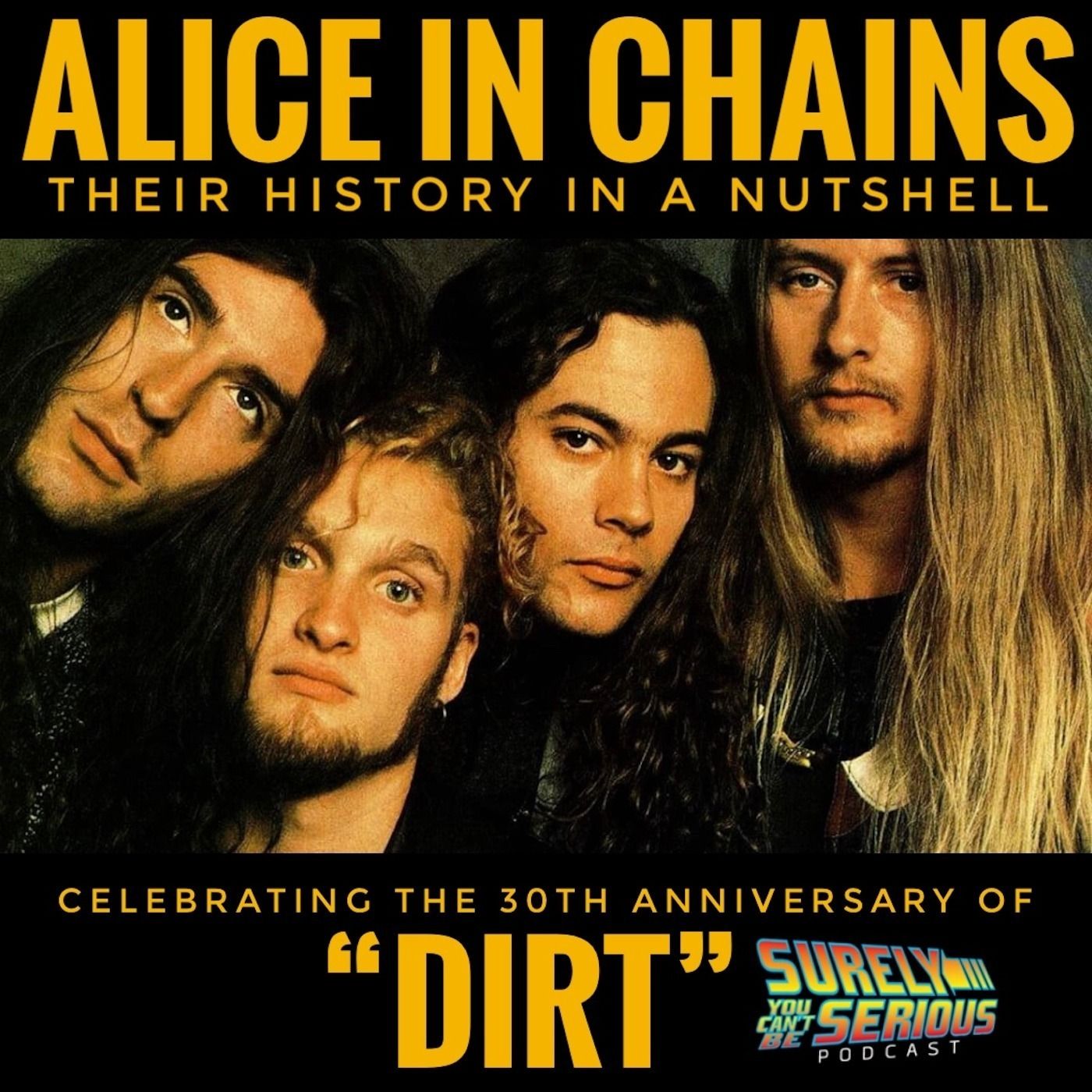
Alice in Chains: History in a Nutshell
When grunge hit the music scene in the early 90s, Alice in Chains was one of the bands at the forefront. Led by Jerry Cantrell's aggressive guitars and Layne Staley's growling vocals, the band quickly became one of the biggest of that generation. In this episode we will deep dive in their glam past, their rise to fame and the impact or drugs on their career.
2022-09-06
47 min
Transcript
Available Results
Generated results are saved to the knowledge database for reuse and search.
No generated results are available for this episode yet.
Extract Knowledge
Pick what you want extracted first. Model, scope, and chapter options appear after a template is selected.
Generated results for public episodes are saved to the knowledge database so they can be reused and searched later.
Transcript
<v Speaker 1>Hello everybody, and welcome back to the Shirtley You Can't
<v Speaker 1>Be Serious podcast. We are here in Atoka, Oklahoma. Oh wait, no,
<v Speaker 1>I'm sorry, that's where the rooster's from. We're not in Atoka,
<v Speaker 1>but we are in Norman, Oklahoma, and we are being
<v Speaker 1>joined by our good friend James Buckley, back from Louisiana,
<v Speaker 1>joining us to attack Alison Chains versus Stone Temple Pilots. Yeah,
<v Speaker 1>how you doing, James?
<v Speaker 2>I am doing wonderfully, guys. It's always a thrill to
<v Speaker 2>talk to you, guys, and it's always a thrill to
<v Speaker 2>talk about one of my favorite topics.
<v Speaker 3>Both of these albums are turning thirty in about a month.
<v Speaker 1>Yeah, just to let you guys know. Two days ago
<v Speaker 1>it was what would have been Lane Stay's fifty fifth birthday.
<v Speaker 1>Three days ago it was the thirty second anniversary or Facelift.
<v Speaker 1>And by the time this episode comes out, it will
<v Speaker 1>be September, which is when both Core and Dirt came
<v Speaker 1>out on the same day, September twenty ninth, thirty years ago.
<v Speaker 1>This September.
<v Speaker 3>It's incredible. I can't believe these albums are that old.
<v Speaker 3>We're old, man, Yeah, I mean, we're alternative. Should not
<v Speaker 3>be thirty years old.
<v Speaker 2>I distinct we remember buying both of these albums at
<v Speaker 2>the record store, and my hairline also remembers, yes, because
<v Speaker 2>I had one that's definitely changed over the past thirty years.
<v Speaker 3>Hey, you know the funny thing is that this was
<v Speaker 3>originally slated for season two on the twenty ninth anniversary.
<v Speaker 1>Yeah, and they were like, why would we do that?
<v Speaker 1>That's dumb, you kid do twenty nine. No, let's do
<v Speaker 1>thirty thirty.
<v Speaker 3>So here we are pushed from season two now in
<v Speaker 3>season three, Stone Temple Pilot's Core versus Alsa Jains Dirt.
<v Speaker 3>What were you doing in ninety two, James?
<v Speaker 2>I was in college. I had taken one of my
<v Speaker 2>frequent sabbaticals and I had just come back. I was
<v Speaker 2>trying to get wrapped up.
<v Speaker 1>What are you doing in ninety two? Deep in ninety two,
<v Speaker 1>I was in a band myself. We were covering STP songs.
<v Speaker 1>I was learning how to play Rooster on the guitar.
<v Speaker 1>It would I love. Rooster taught me that chords don't
<v Speaker 1>have to be regular chords. You can take a chord
<v Speaker 1>and just throw it anywhere on the guitar and it
<v Speaker 1>might end up sounding.
<v Speaker 2>Goof just added that to the set list again. So
<v Speaker 2>if you ever come through Monro, We're gonna grab you
<v Speaker 2>up on stage. I'm telling you now.
<v Speaker 1>Yeah, I'm pretty sure I can still pull it out.
<v Speaker 1>I don't know about a lead, but I can definitely
<v Speaker 1>do the intro for sure. Yes, I'll be there for
<v Speaker 1>that one man.
<v Speaker 2>Oh it'll be a fun show. I guarantee you.
<v Speaker 1>James, you are an admin on one of the nineties
<v Speaker 1>groups on Facebook, right correct.
<v Speaker 2>That was a very special musical era for me. I
<v Speaker 2>came up out of the eighties. I was huge metal head,
<v Speaker 2>but I had a dark secret. I like bands like
<v Speaker 2>depeche Mode, you know, The Cure, The Fix, the Police
<v Speaker 2>at the same time, so when the nineties alternative stuff,
<v Speaker 2>when I started hearing bands like Nirvana and Toad, the
<v Speaker 2>Wet Sprocket and the Womenheads, that resonated with me because
<v Speaker 2>it seemed to combine my two favorite things so fairly
<v Speaker 2>aggressive guitar and drums, slightly more introspective lyrics. So I
<v Speaker 2>was a happy man for about ten years.
<v Speaker 1>Before we keep going, I want to give a quick
<v Speaker 1>shout out to my good friend Kevin Davis. Kevin is
<v Speaker 1>a guy who one night as I was sitting down
<v Speaker 1>to study up on one of our episodes, is like, hey,
<v Speaker 1>then your kid Russell And I was like, uh, yeah,
<v Speaker 1>he's there right now, and he goes, Yep, my grandson too.
<v Speaker 1>And we got to talking and his grandson's name is Halen,
<v Speaker 1>as in Van Halen, and I was like, we are
<v Speaker 1>going to be best friends. Wow, We're totally going to
<v Speaker 1>be best friends. And so I turned him onto the
<v Speaker 1>podcast and he has been a avid listener since I
<v Speaker 1>showed him the podcast. And he gave us a music review.
<v Speaker 1>And James is back from our comparison of Girls Girls
<v Speaker 1>Girls in White Snake, and he gave us a review
<v Speaker 1>on that one. So I just wanted to read it.
<v Speaker 1>Kevin says, I agree with the host that White Snake
<v Speaker 1>was much better than Girls Girls Girls. The crew can
<v Speaker 1>light their white Johnson's on fire and I wouldn't care.
<v Speaker 1>Thanks for another great show. Now I must return to
<v Speaker 1>my Marble arts.
<v Speaker 3>That's awesome, Kevin, Thank you so much. He does like
<v Speaker 3>multiple reviews. He throws him out all the time.
<v Speaker 1>It's awesome. Just about every episode he'll give us a
<v Speaker 1>new review, and I see him all the time. I
<v Speaker 1>go to that same restaurant all the time, and we
<v Speaker 1>just talked up. He is a fantastic guy. When I
<v Speaker 1>told him we were doing Alison Chains, he was like,
<v Speaker 1>Oh my gosh, one of my favorite bands. So decided
<v Speaker 1>for that. This one's for you, Kevin, there you go.
<v Speaker 2>Speaking of which, the guitar player for my band saw
<v Speaker 2>Motley Crue in Texas last night.
<v Speaker 1>What's the verdict, Well.
<v Speaker 2>He said there were still really entertaining. Vince was a
<v Speaker 2>bit off, but he said that Tommy Lee, possibly in
<v Speaker 2>light of recent online shenanigans, instead of encouraging the women
<v Speaker 2>in the audience to flash him, he encouraged the men
<v Speaker 2>in the audience to to expose their giraffes. Let's just
<v Speaker 2>say it that lay.
<v Speaker 1>You Me and Mike Johnson, Yes.
<v Speaker 2>Exactly, Preston said, no one did.
<v Speaker 1>So, Oh my gosh, that's hilarious.
<v Speaker 2>Allison Chains. I distinctly remember back in the eighties and
<v Speaker 2>nineties there was a magazine called Rip or Rip or
<v Speaker 2>whatever so metal magazine yep. At the end they would
<v Speaker 2>always have a really extensive selection of reviews. Because I
<v Speaker 2>lived in a very rural area, I was always worried
<v Speaker 2>I was missing out on something cool and I remember
<v Speaker 2>reading the review for Facelift, the first Allison Chains out.
<v Speaker 2>I was on a massive Sabbath kick at the time,
<v Speaker 2>and they hit all the right notes with the reviews
<v Speaker 2>said slow, doomy riffs, founding drums, black Sabbath influence. So
<v Speaker 2>I went to a local record store over the next
<v Speaker 2>few days and actually found a copy of face Lyft,
<v Speaker 2>and ah, man, it was love at first Listen, that's cool.
<v Speaker 1>It is a great album. And then of course that
<v Speaker 1>Man in the Box off of that album is what
<v Speaker 1>brought them into the spotlight.
<v Speaker 3>You know, the year that I graduated from high school
<v Speaker 3>was nineteen ninety one, and so so fall of ninety
<v Speaker 3>one is when the grunge thing really catches fire. You know,
<v Speaker 3>Facelift predates that a little bit, and so we were
<v Speaker 3>aware of Alison Chains or whatever. But when I left
<v Speaker 3>my hometown and went to the university, there's a shift
<v Speaker 3>in music, and so it's very easy for me to
<v Speaker 3>split high school music in college music.
<v Speaker 1>And this is one of those that was very very college.
<v Speaker 2>Absolutely, I was in early college, but that's still more transition.
<v Speaker 2>I had a couple of cool friends who were much
<v Speaker 2>cooler than I was, kept saying you need to listen
<v Speaker 2>to this. You need to listen to that. They warped
<v Speaker 2>me forever. I'm afraid.
<v Speaker 1>Were you guys ready to jump in?
<v Speaker 3>Absolutely, let's jump into the history of Alison Chains.
<v Speaker 1>Okay, history of Alison Chains starts March eighteenth, nineteen sixty six,
<v Speaker 1>with the birth of little Jerry Cantrell. A little over
<v Speaker 1>a year and a half later, we have the birth
<v Speaker 1>of Lane Stay on August twenty second, nineteen sixty seven,
<v Speaker 1>and then just almost exactly two years later, there's a
<v Speaker 1>book that comes out by Doctor Seuss called My Book
<v Speaker 1>About Me and Jerry Cantrell Little Kid, Lane Staley Little
<v Speaker 1>Kid both had a copy of this book. And when
<v Speaker 1>it got to the part of what I want to
<v Speaker 1>be when I grow up, Blane Stay put I want
<v Speaker 1>to be a singer, and Jerry Cantrell put, I want
<v Speaker 1>to be a rock star. So as early as the
<v Speaker 1>late sixties early seventies, these guys had predicted their future.
<v Speaker 1>That's really cool.
<v Speaker 3>Did you guys have awesome lawyers written down in your
<v Speaker 3>Dutchess book.
<v Speaker 1>Yeah, I'm pretty sure rock star was in my book too.
<v Speaker 2>Yeah, archaeologist or superhero.
<v Speaker 1>Badly, I want to be a stunt man, I definitely
<v Speaker 1>had that book. Though my kids have that book. I
<v Speaker 1>think it's required reading for everyone that exists. Yep. All right,
<v Speaker 1>so we fast forward a little bit to nineteen eighty
<v Speaker 1>six and the birth of a band called Sleeves. So
<v Speaker 1>in nineteen eighty six, some high school friends Byron Hanson,
<v Speaker 1>Johnny Bicholes, Zoli Samante, and James Bergstrom put together a
<v Speaker 1>band and they needed a singer, and a friend of
<v Speaker 1>theirs named Ken Elmer says, Hey, my stepbrother really wants
<v Speaker 1>to be a singer. You should listen to him and like, Okay,
<v Speaker 1>what's his name? And he says Lane Elmer because at
<v Speaker 1>that point he was not using his own last names,
<v Speaker 1>using his stepdad's last name. Well, there's a little bit
<v Speaker 1>of argument about whether Laine actually wanted to be a
<v Speaker 1>singer or not. He was a drummer. But he went
<v Speaker 1>and did the audition for this new band that they
<v Speaker 1>were going to name Sleeves. And do you know what
<v Speaker 1>song he sang?
<v Speaker 3>He sang looks that Killed by Motley Crue.
<v Speaker 1>Yep. Also I saw that he also sang, now she's
<v Speaker 1>a cool, cool black.
<v Speaker 2>There you go. There's some rumors that you may have
<v Speaker 2>also sang the song love Machine by Wasp.
<v Speaker 1>I heard that as well.
<v Speaker 2>Yeah, just being a family oriented show, I'm not going
<v Speaker 2>to translate.
<v Speaker 1>Well, whatever Motley Crue or Wasp song that he sang.
<v Speaker 1>They realized, this guy has got the soul and the
<v Speaker 1>timber and the voice that is going to make our band.
<v Speaker 1>He said, we didn't know what we were looking for,
<v Speaker 1>but when we saw him, we said, that's it. Yep, yep.
<v Speaker 3>So interestingly, Lane Staley, you mentioned Lane Elmer, which is
<v Speaker 3>so funny because his name Lane Staley. That's his mother's
<v Speaker 3>maiden name, and of course his father's surname, and so
<v Speaker 3>Lane Staley is his parents' last names. I think that's
<v Speaker 3>really cool. And then in high school he goes by
<v Speaker 3>Lane Elmer. Right when his mother went back to his
<v Speaker 3>twentieth high school reunion, of course Lane was dead. Yes,
<v Speaker 3>she went back and people were like, wait a minute,
<v Speaker 3>wait a minute, wait a minute, are you telling me
<v Speaker 3>that Lane Elmer is the same guy as Lane Staley.
<v Speaker 1>They didn't even know. They had no friggin clue. That's crazy,
<v Speaker 1>that is crazy. And to just bring Motley Crue back
<v Speaker 1>into the mix again. His name, his birth name was
<v Speaker 1>Lane Rutherford Staley. He had it legally changed to Lane
<v Speaker 1>Thomas Staley. And do you know where the Thomas comes from? No,
<v Speaker 1>Tommy Lee. He changed his name to Thomas because remember
<v Speaker 1>he was a drummer before he was a singer. He
<v Speaker 1>loved Tommy Lee, he loved Motley Crue. He gave himself
<v Speaker 1>the middle name Thomas because of Tommy Lee. Wow, that's fantastic.
<v Speaker 1>So Sleez ultimately changes its name. I got the impression
<v Speaker 1>that they might have signed. And here's where I got
<v Speaker 1>this impression. This is good. You guys are going to
<v Speaker 1>appreciate this. There was a protest going on for the PMRC.
<v Speaker 1>You guys know the PMRC, right, Yes, we've talked about
<v Speaker 1>it multiple times, right, Yes, So they were having some
<v Speaker 1>sort of town meeting there somewhere in Washington, and Frank
<v Speaker 1>Zappa was the guest speaker, and Lane Staley is in
<v Speaker 1>the audience with Backliss, and at some point he stands
<v Speaker 1>up and starts ex berating the PMRC. And of course
<v Speaker 1>he also plugs his band. Yes exact. A few times.
<v Speaker 4>I played for a rock band called Sleeves, and I mean,
<v Speaker 4>there's enough controversy on our on our name more or
<v Speaker 4>less than our songs. You know, we just signed a
<v Speaker 4>local with a local record company. I don't feel there's
<v Speaker 4>anything objectionable about any of our songs, But I don't
<v Speaker 4>feel anyone anyone else has the right to rate our songs.
<v Speaker 4>I mean, I'm the only one that has the right
<v Speaker 4>to rate it. You know, my album, you don't have it.
<v Speaker 3>When I watched that interview, I'm like, this looks like
<v Speaker 3>a seventeen year old kid who's just popping off about
<v Speaker 3>something dumb, and that probably his thirty year old self
<v Speaker 3>would be like that kid needs a shut up. But
<v Speaker 3>it was funny to see though. Absolutely, you know that
<v Speaker 3>Sleeves was really kind of a hair band.
<v Speaker 1>Oh yeah, it was glam metal. Yeah, it was glam metal.
<v Speaker 1>And they had as I said they had. He gave
<v Speaker 1>the impression that they had gotten signed with somebody, although
<v Speaker 1>I didn't really see that to be true. Somewhere, but
<v Speaker 1>they were doing it tour and they had some success.
<v Speaker 1>Bacalus was having a conversation with a guy named Russ Klatt,
<v Speaker 1>who was the singer for Slaughterhouse five. Butter House five.
<v Speaker 1>They're talking about Sleeves and Welcome to the Wonderland tour
<v Speaker 1>and just that word wonderland and they're whatever they were
<v Speaker 1>drinking or smoking at the time. Somehow that transitioned to
<v Speaker 1>Alice in Wonderland and Alice in Chains, and it.
<v Speaker 3>Was Alice in bondage first and then it became Alice
<v Speaker 3>in Chains.
<v Speaker 1>So Laane Staley's mother was very religious Christian science yep,
<v Speaker 1>very religious, and so he was like, Okay, I'm gonna
<v Speaker 1>name this band Alice Change. She's like, that's female bondage.
<v Speaker 1>By the way, if you're on Wikipedia and you see
<v Speaker 1>female bondage in blue, don't click the link. Okay, puick
<v Speaker 1>the link. I'm just giving you that advice, right, yes,
<v Speaker 1>right there, there you go. All right. Anyway, his mom
<v Speaker 1>was like, I don't really approve that. She she said,
<v Speaker 1>sleez was bad enough, but this sounds like female bondage
<v Speaker 1>and you shouldn't do it. But over her objection, he
<v Speaker 1>called it Alice and Change. But he changed the end
<v Speaker 1>to the letter in like guns in roses. Although it
<v Speaker 1>was not a copy of them. They weren't even popular
<v Speaker 1>yet at that point. Well, hey, one more thing on sleeves.
<v Speaker 3>Real quick sleeves was actually in a movie. There's a
<v Speaker 3>movie called Father Rock shot in Seattle, okakay now and
<v Speaker 3>they played a couple of their songs.
<v Speaker 1>Yeah. Lane even had a speaking part in this movie,
<v Speaker 1>Shut the heck up. Yes, wow, Father Rock. I don't know.
<v Speaker 1>I didn't see it. I haven't seen it. But is
<v Speaker 1>this like a Maine for TV movie?
<v Speaker 5>You know, you know, I don't know, really, Wayne and
<v Speaker 5>Garth's doing like the advertisements in all this public access
<v Speaker 5>movie Steven Spielberg produced, Sleez.
<v Speaker 2>I love the name slaves compared to some of the
<v Speaker 2>names that came later. That's that almost pure in nocense.
<v Speaker 1>Yeah, yes, that's true. That is true. Some of the
<v Speaker 1>other names that came later, we had Mathra and then
<v Speaker 1>the F word, the F word, and it wasn't the
<v Speaker 1>F word, it was the F word.
<v Speaker 2>Yes, they said they even had a great merchandise like
<v Speaker 2>F word the band and stuff like that.
<v Speaker 1>But I don't think I don't think that'll fly Wmar No.
<v Speaker 2>No.
<v Speaker 3>I think it's interesting that initially Allison Chains really took
<v Speaker 3>their cues from like Poison almost right. Their stage presence
<v Speaker 3>was you know, flash and glam. They did stuff like
<v Speaker 3>confetti and water guns.
<v Speaker 1>Lane Staley talks about two of his idols. Two idols
<v Speaker 1>that he had David Bowie and Prince yep. Like I
<v Speaker 1>just was like, what this is the this is the
<v Speaker 1>guy that looks like the devil child in these videos.
<v Speaker 1>And his influences were Ziggy, Stardust and the Purple One.
<v Speaker 1>How about that. That's crazy, Let's go crazy.
<v Speaker 2>He had some female acquaintance at one time who actually
<v Speaker 2>came across one of Prince's old suits. Yeah, Lane evidently
<v Speaker 2>would wear it.
<v Speaker 1>He wore on stage. Oh my gosh, hey, listen to this.
<v Speaker 1>I thought this was hilarious.
<v Speaker 3>So I guess Rob Halford from Jews Priest would ride
<v Speaker 3>his motorcycle on like the big stage, big concert for juice.
<v Speaker 1>I'll bit for leather. There you go.
<v Speaker 3>And so during early Allison Chains concerts, Lane rode a
<v Speaker 3>big wheel.
<v Speaker 1>Like you pulled out on stage. You know. That is awesome.
<v Speaker 1>That is awesome.
<v Speaker 3>He was actually a very upbeat, sort of positive, fun
<v Speaker 3>guy to be around.
<v Speaker 2>Yeah, even when you read interviews with people who knew
<v Speaker 2>him later on at the height of his problem, they
<v Speaker 2>said that his personality never really changed. He was always
<v Speaker 2>a sweet, con generous guy. It's just that those demons.
<v Speaker 1>Man, Dude, he.
<v Speaker 3>Was in a fight with the dragon Hey, you mentioned Prince.
<v Speaker 3>When they were rehearsing in the early early days, right,
<v Speaker 3>they had this rehearsal space. They had a VCR and
<v Speaker 3>two movies. One movie was The Terminator. I can check
<v Speaker 3>out our podcast as the Terminator, and the other one
<v Speaker 3>was Peple Rain fantastic.
<v Speaker 1>Was this in the music bank? Yes?
<v Speaker 2>Nice? Nice told the keys would just sit in the
<v Speaker 2>office and watch them over and over and over again.
<v Speaker 1>Said there's Lane again, always watching Pearple Rain.
<v Speaker 2>Lane.
<v Speaker 1>Later on will meet a guy named Jerry Cantrell. So
<v Speaker 1>before we get there, I got to give you a
<v Speaker 1>little history on Jerry Cantrell. First memory three years old,
<v Speaker 1>meeting his father when he returned from Vietnam. Four years later,
<v Speaker 1>his parents would get divorced because of the troubles that
<v Speaker 1>his dad had from returning from Vietnam. They ended up
<v Speaker 1>on welfare and food stamps. But he found some musical
<v Speaker 1>success in high school. He was the president of his
<v Speaker 1>high school choir. That he had gotten a guitar when
<v Speaker 1>he was in the sixth grade, but he really didn't
<v Speaker 1>appreciate it and pick it up and start doing anything
<v Speaker 1>until he got into high school. And so his success,
<v Speaker 1>I mean his choir that he was the president of.
<v Speaker 1>They were They sang the national anthem at shows and
<v Speaker 1>were competition winners. And so his drama and his choir
<v Speaker 1>teachers encouraged his career in music. As a gift when
<v Speaker 1>he got his first gold record, he sent them each
<v Speaker 1>copy of the gold record. That's fantastic now. That was
<v Speaker 1>several years later. Right after they encouraged him to go
<v Speaker 1>into a career in music, he quit college and went
<v Speaker 1>to go work in a guitar store down in Dallas, Texas.
<v Speaker 1>He had grown up as a kid on welfare and
<v Speaker 1>food stamps, so he wasn't afraid to be poor. But
<v Speaker 1>what the beautiful thing about what happened in Dallas was
<v Speaker 1>is that working in this store, he got his first
<v Speaker 1>what we call real guitar. It wasn't some Japanese knockoff,
<v Speaker 1>It wasn't some cheap Korean model. This was a G
<v Speaker 1>and L Rampage nineteen eighty four. And I can tell
<v Speaker 1>you that having a real guitar is a key to
<v Speaker 1>becoming a real musician. He had a couple of bands
<v Speaker 1>over there in Dallas. One was called Rays, the other
<v Speaker 1>one was called Sinister. But ultimately he ended up back
<v Speaker 1>in Washington with the band Diamond Live.
<v Speaker 2>I do remember reading that the reason he originally wanted
<v Speaker 2>to play guitar was listening to a couple of early
<v Speaker 2>Elton John albums, and interestingly enough, the first concert Lane
<v Speaker 2>Staley iver remembered going to was when Elton John. His
<v Speaker 2>stepdad took him to see Elton John, and he was very.
<v Speaker 1>Young around this time, huge tragedy in Jerry Cantrell's life.
<v Speaker 1>His mother and grandmother both pass away within six months
<v Speaker 1>of each other nineteen eighty six nineteen eighty seven, both
<v Speaker 1>from cancer. He falls into a significant depression. Three weeks
<v Speaker 1>after his mother's death, he meets Lane Staley. Now he
<v Speaker 1>had seen Lane Staley perform earlier with the glam metal
<v Speaker 1>version of Alison Chains.
<v Speaker 3>I've got May First in nineteen eighty seven. Okay, we're
<v Speaker 3>talking about the summer of eighty seven.
<v Speaker 1>Well it might be April.
<v Speaker 2>What do you got?
<v Speaker 1>I got April eleventh? No, No, May first? Okay, go ahead, we'll.
<v Speaker 3>Go with yours somewhere between in April eleventh and May first.
<v Speaker 1>Well, yes, so. Then five to four months later, Diamond
<v Speaker 1>LII played their last show. Jerry has met Lane at
<v Speaker 1>a party and they're both a little drunk, and Jerry
<v Speaker 1>somehow mentions that he's homeless, and so Lane says, Hey,
<v Speaker 1>why don't you come stay with me? I am staying
<v Speaker 1>at this rehearsal studio called the Music Bank.
<v Speaker 3>By the way, when Jerry saw Lane perform one thousand Chains,
<v Speaker 3>he said, I want to be in a band with
<v Speaker 3>that guy right there.
<v Speaker 1>Yeah. Well, then, not too long after they've become roommates,
<v Speaker 1>the a n C breaks up, Alice in Chains breaks up,
<v Speaker 1>and so Jerry is trying to put together a new
<v Speaker 1>band because his band's broken up, and Lane is trying
<v Speaker 1>to put together a funk band and they reach disagreement.
<v Speaker 1>They're like, hey, you know, I'll sing in your band
<v Speaker 1>if you play guitar in my band, and that was
<v Speaker 1>their agreement. So Jerry Cantrell's trying to put together this band.
<v Speaker 1>Layne Staley is like, well, I played with this guy
<v Speaker 1>named Sean Kinney. He's really good. You might could use
<v Speaker 1>him as a drummer. And Jerry Cantrell is like, great,
<v Speaker 1>do you have his number? And he says no, but
<v Speaker 1>I have his girlfriend's number. He's like, okay, who's his girlfriend? Melinda? Okay, great,
<v Speaker 1>calls Melinda she says, yeah, sure, he'll come meet with you.
<v Speaker 1>So he comes plays drums for Jerry and Jerry's like,
<v Speaker 1>you're great. I think I've got a great guy to
<v Speaker 1>play bass for us. I used to play with him
<v Speaker 1>in a band called Gypsy Rose. His name's Mike Starr,
<v Speaker 1>and Sean goes, well, that's really interesting because that's Melinda's brother. Yeah,
<v Speaker 1>Melinda Starr, that's awesome.
<v Speaker 2>And Melinda would have a key role to play later
<v Speaker 2>on as well.
<v Speaker 1>Yes, And so they rehearsed together. They were playing well,
<v Speaker 1>but it was becoming a problem that there were two
<v Speaker 1>bands going on, and so at some point they just
<v Speaker 1>decided they were going to basically trick Lane into becoming
<v Speaker 1>only a singer for this. And they're like, okay, Lane,
<v Speaker 1>you know you got your band and that's fine. We
<v Speaker 1>just we can't have a guy with two bands, so
<v Speaker 1>we're going to get another singer. And he's like, oh,
<v Speaker 1>all right. And so they would audition the guys in
<v Speaker 1>front of Lane, and they picked the worst singers that
<v Speaker 1>they could find. Singer horrible singer after horrible singer, and
<v Speaker 1>Lane's just going crazy until finally they top it off.
<v Speaker 1>They throw the straw in that breaks the camel's back,
<v Speaker 1>and they have a male stripper audition as singer for
<v Speaker 1>the band, and finally Lane's like, forget it, forget it.
<v Speaker 1>I will be your singer. I will get rid of
<v Speaker 1>my funk band, and I will only sing for you guys.
<v Speaker 1>I kind of want to see the Lane's Daily Prince band. Yeah,
<v Speaker 1>you know, funk band.
<v Speaker 2>Heck yeah. Ron Holt the guy who started up that band.
<v Speaker 2>It's called like forty Seconds Hate or something like that.
<v Speaker 2>A few years back he actually tried to sell a
<v Speaker 2>cassette he had online of some of their rehearsals. I
<v Speaker 2>think some early demos he recorded with Lane. I think
<v Speaker 2>the last it was up to about five thousand. I think, wow,
<v Speaker 2>so maybe maybe your Prince cover is on there somewhere.
<v Speaker 1>Hey, let's go.
<v Speaker 3>Whoever bought that, if you're listening, put it out there
<v Speaker 3>on YouTube for us.
<v Speaker 2>Sean had actually, I think met Lane several years previously.
<v Speaker 2>The band had played a beach party sleeve Sead. I
<v Speaker 2>think Sean cornered Lane after the concert and say, yeah,
<v Speaker 2>your band's great, but your drummer sucks. You need me.
<v Speaker 2>That's when the game is number Girlfriend's number.
<v Speaker 1>Keavin Melnda's number. I'm I'm in between bones right now,
<v Speaker 1>here's my girlfriend's phone number.
<v Speaker 3>So Lane committed full time to the band Diamond Lie.
<v Speaker 1>Yeah, they had entertained the name Mathra and the F
<v Speaker 1>word as we had discussed. Then they became Diamond Lie,
<v Speaker 1>which was Jerry's old band's name. But ultimately they all
<v Speaker 1>decided they liked Alice in Change better. But they changed
<v Speaker 1>the end to I D because they liked the idea
<v Speaker 1>of female bondage. They would click the link. Okay, so
<v Speaker 1>there're at the Music Bank and they just I mean
<v Speaker 1>they're living in a rehearsal space. As a musician, I
<v Speaker 1>can not imagine how awesome it would be to have
<v Speaker 1>a place where you live with your bandmates and all
<v Speaker 1>you do all day long is play music and try
<v Speaker 1>to come up with new stuff together, you know, when
<v Speaker 1>you're not watching Purple Ring exactly, or the Terminator. They
<v Speaker 1>had this guy who was a local promoter named Randy Hauser,
<v Speaker 1>and he was like, you guys are great. I will
<v Speaker 1>fund a demo tape for you. Do the demo recording.
<v Speaker 1>We're going to do it at the Music Bank. Problem
<v Speaker 1>is is that the day before they were supposed to record,
<v Speaker 1>Washington does its biggest marijuana bust in state history, and
<v Speaker 1>of course there's some drugs over at the music Bank
<v Speaker 1>shocker what yep? And they close it down.
<v Speaker 2>Evidently whoever had least the building somebody else at least
<v Speaker 2>a different part of it. It built up a wall,
<v Speaker 2>partitioned it off, and had quite the weed operation.
<v Speaker 3>Go okay, wait, let's back up, because there's a story,
<v Speaker 3>a big story right before that.
<v Speaker 1>Okay, okay, Yeah, Randy Hauser was in jail for dealing
<v Speaker 1>cocaine as well.
<v Speaker 3>Okay, all right, this is not the first time we're
<v Speaker 3>going to talk about drugs in this episode, trust me.
<v Speaker 1>So he was. He was in jail for dealing cocaine.
<v Speaker 3>He gets out, gets his life back together, he goes
<v Speaker 3>to beauty school.
<v Speaker 1>Beauty school drip.
<v Speaker 3>So, So he went to beauty school, and there he
<v Speaker 3>met Melinda Starr. She knew that he was this sort
<v Speaker 3>of local promoter and he was looking to kind of
<v Speaker 3>do this. She gave him a cassette and asked him
<v Speaker 3>to listen to it. Keep in mind, her boyfriend at
<v Speaker 3>the time was Sean Kenney. Okay, he takes that cassette home,
<v Speaker 3>tosses it in a box full of other demos from
<v Speaker 3>a million different groups that he never listens to.
<v Speaker 2>Okay.
<v Speaker 3>Now, then flash forward about a month from then. Nick Loft,
<v Speaker 3>who is an A and R guy from Atlantic, was
<v Speaker 3>staying at Randy Hauser's house. Okay, don't know the story there,
<v Speaker 3>don't really care, but he's going through this box of tapes,
<v Speaker 3>just kind of looking for something. And when he pops
<v Speaker 3>in that tape that Melinda Starr had given him, yeah,
<v Speaker 3>he's like, who are these guys? And these guys got
<v Speaker 3>something and the tape was not labeled, and so Randy's
<v Speaker 3>looking at the tape like, Okay, I have no freaking
<v Speaker 3>idea where I got this tape, but he knows he's
<v Speaker 3>got something, right, right, He's got something here, uh huh,
<v Speaker 3>And so he can't.
<v Speaker 1>For the life of him, remember where he got this tape, okay.
<v Speaker 3>And so he's at the beauty school racking his brain,
<v Speaker 3>racking his brain, his brain, and Melinda goes.
<v Speaker 1>Did you listen to that tape I gave you? And
<v Speaker 1>it all clicks nice. Just when he finds the band
<v Speaker 1>that is going to he's going to be able to
<v Speaker 1>break the music bank, gets busted for drugs. Well, and
<v Speaker 1>that's when Susan Silver steps in. Kelly Curtis was managing
<v Speaker 1>Mother Love Bone and Susan Silver was managing soundguard. Soundguard
<v Speaker 1>married Chris Cornell. That's right. Yeah. They ultimately got a
<v Speaker 1>copy of the demo that they ended up doing, called
<v Speaker 1>The Treehouse Tapes. So Randy Houser misses out, so Susan.
<v Speaker 3>Silver steps in and says, this guy's a drug dealer.
<v Speaker 3>He's going to get you guys in trouble. I think
<v Speaker 3>I should do this. Yeah, And so they're like, we
<v Speaker 3>agree with you. He's out right, and so she passes
<v Speaker 3>us on to Colombia. Colombia signed them after some negotiations,
<v Speaker 3>signed them on September eleventh, nineteen eighty nine, exactly two
<v Speaker 3>years to the day later, their debut album, Facelift, goes gold.
<v Speaker 3>So before they're signed, Alis in Chains plays their first
<v Speaker 3>show July twenty fifth, nineteen eighty eight. The same summer,
<v Speaker 3>Lane meets a woman named Demri Perot.
<v Speaker 1>Oh yeah, okay, she's working on Saturdays. She is cute
<v Speaker 1>as a button.
<v Speaker 3>She looks like she just came right out of the
<v Speaker 3>sitcom Friends, very very pretty girl. Got it all together.
<v Speaker 3>She's going to play a part in this story.
<v Speaker 1>Yes she is.
<v Speaker 3>Okay, Now listen to this. June one, nineteen eighty eight,
<v Speaker 3>Jerry Cantrell attends a Guns N' Roses and Iron Maiden
<v Speaker 3>concert in Seattle.
<v Speaker 1>Yep.
<v Speaker 3>He manages to get backstage. He hands a demo tape
<v Speaker 3>to Axel Rose. He then watches Axl Rose walk about
<v Speaker 3>ten feet away.
<v Speaker 1>And throw that demo tape directly in the trash can.
<v Speaker 1>So I called you the other night. We're going to
<v Speaker 1>I'm in a total sidebar here, total sidebar, yep. So
<v Speaker 1>I called you the other night because I had come
<v Speaker 1>across this thing and I really have no idea where
<v Speaker 1>to put this, so I'm just gonna put it now. Right. So,
<v Speaker 1>when they were supposed to record Facelift, Sean Kenny had
<v Speaker 1>broken his hand. Yes, and he's the drummer, so his
<v Speaker 1>hand's kind of important. He's broken his hand, and so
<v Speaker 1>they get a guy named Greg Gilmour to come in
<v Speaker 1>to replace him for the recording of the drums for
<v Speaker 1>this album. Sean Kenny's going to miss out on recording
<v Speaker 1>drums on their very first album, right, So this guy
<v Speaker 1>named Greg Gilmore. He was the drummer for Mother Lovebam,
<v Speaker 1>the bands that we're talking about today. Have Lot both
<v Speaker 1>have lost their singers to heroin. Scott Wiland, Lane Stay
<v Speaker 1>both gone because of heroin. Heroin was involved in Kurt
<v Speaker 1>Cobain's death, and Jason pointed out, He's like, wow, Pearl
<v Speaker 1>Jam has made it through all of this and didn't
<v Speaker 1>have a heroin death. And I'm like, nope, because Pearl
<v Speaker 1>Jam started off as Mother love Bone and Andy Wood
<v Speaker 1>died of a heroin overdose. Heroin has taken almost every
<v Speaker 1>lead singer of these major bands that we have of
<v Speaker 1>the day of that time, we threw in Sublime and
<v Speaker 1>Blind Mellon a ton of them. But anyway, back up,
<v Speaker 1>Greg Gilmour also was the drummer for a punk band,
<v Speaker 1>punk band out of Seattle, and the punk band out
<v Speaker 1>of Seattle had a bass player who went down to
<v Speaker 1>LA after that band broke up and joined a band
<v Speaker 1>called Guns n' Roses and Duff McKagan. We talked about
<v Speaker 1>this in our Appetite for Destruction Guns and Roses, we
<v Speaker 1>probably did. He went down there joined this band and
<v Speaker 1>they were just starting out, but he had a band
<v Speaker 1>that had broken up and said, hey, hey, we've got
<v Speaker 1>some dates that we have set with my old band.
<v Speaker 1>We can go up to Seattle and play those shows
<v Speaker 1>as Guns and Roses, and they all talk about how
<v Speaker 1>this bus ride up there where like the van breaks
<v Speaker 1>down and everybody gets angry at each other, and nobody
<v Speaker 1>shows up to the shows because they haven't done any
<v Speaker 1>self promoting. That made them jell as a band. It
<v Speaker 1>was that thing that caused them to jell as a band.
<v Speaker 1>Greg Gilmour was the drummer for the band whose sets
<v Speaker 1>Guns n' Roses took over Wow. But when he came
<v Speaker 1>in to play for Alison Chains, Sean Kenny is trying
<v Speaker 1>to show him how to do the drums with one hand,
<v Speaker 1>and eventually they just said, uh, never mind, we'll just
<v Speaker 1>come back in a month or two when Sean hand
<v Speaker 1>works again. That's great.
<v Speaker 2>I remember an interview with Sean. He said he kept
<v Speaker 2>out when he finally started playing, he kept the ice
<v Speaker 2>bucket right beside the drum set so between the song
<v Speaker 2>or said he had to shove that hand in, and
<v Speaker 2>evidently the problem was I don't know if y'all ever
<v Speaker 2>seen Sean. Kenny's a real tall, kind of big guy.
<v Speaker 2>He's a hard hitter, and evidently Gilmour just could not
<v Speaker 2>reach his levels myself to subscribe to the Sean Kinney
<v Speaker 2>school of playing. But that's another story.
<v Speaker 1>He said.
<v Speaker 3>He kept standing there off stage going hit it harder, No, no,
<v Speaker 3>no harder. So you mentioned that they signed in September
<v Speaker 3>of eighty nine. Yes, that summer of nineteen eighty nine
<v Speaker 3>they opened for Get This Bullet Boys, Tesla, Great.
<v Speaker 1>White Wow, cutting their teeth with the eighties hairbands a
<v Speaker 1>little bit. Well, I don't know. I call it Tesla hairband,
<v Speaker 1>but yes, that's right. Sorry, don't hit me for saying that.
<v Speaker 2>This is evidently a time where Jerry Cantrell has approached
<v Speaker 2>from writing music began to change. They'd all come up
<v Speaker 2>in the glam heavy metal scene, but Jerry was evidently
<v Speaker 2>very inquisitive. He would talk to other musicians like punk bands,
<v Speaker 2>try to find out about their influences. He allegedly talked
<v Speaker 2>to Kim Thale, the guitar player for Soundgarden, about some
<v Speaker 2>of the songs he played off their Louder Than Love album,
<v Speaker 2>and Kim says that he showed Jerry the drop D tuning.
<v Speaker 2>Jerry disputes. Jerry later said he earned it from Van
<v Speaker 2>Halen's unchained, but Kim was doing some really creative riffs
<v Speaker 2>at the time. So I can see Jerry being intrigued
<v Speaker 2>by that. The guys who were with him in Diamond
<v Speaker 2>Law said that after his mom and his aunt died
<v Speaker 2>that his songwriting also changed. It was less about girls
<v Speaker 2>and partying and more about personal issues.
<v Speaker 1>Well, I'm going to just keep the digression going because
<v Speaker 1>you mentioned Van Halen, okay, And so I saw an
<v Speaker 1>interview just a couple of days ago with Sammy Hagar
<v Speaker 1>and he was talking about Alison Chains and he was
<v Speaker 1>talking about how it was obvious to him that they
<v Speaker 1>were a part of the hair band glam metal scene
<v Speaker 1>that everybody was turning off. And then Alison Chains was
<v Speaker 1>the new up and coming band and so as opposed
<v Speaker 1>to fighting them, he decided to join them. And he
<v Speaker 1>called them up and said, why don't you guys open
<v Speaker 1>up for our show? And so Alison Chains opened up
<v Speaker 1>for Van Halen and they were fantastic friends. And I've
<v Speaker 1>also seen a picture where Van Halen is doing their
<v Speaker 1>typical you know, where they marched behind each other doing
<v Speaker 1>the little shuffle back and forth. Well, Alison Chain snuck
<v Speaker 1>up behind them, dressed in nothing but g strings to
<v Speaker 1>do the Little Dance with Them's hilarious. Yeah. Jerry Cantrell
<v Speaker 1>said that during that time he became very good friends
<v Speaker 1>with Eddie van Halen, all very down to earth guys,
<v Speaker 1>and he said, hey, you know it was when they
<v Speaker 1>had that music Man guitar. It was that time period
<v Speaker 1>for Eddie. He says, I really love that guitar. Would
<v Speaker 1>you ever let me buy one from you? And Eddie's like,
<v Speaker 1>buy one? Are you kidding me? He goes, this is
<v Speaker 1>the problem with the world. He goes, when you really
<v Speaker 1>need a guitar and nobody will give you one, and
<v Speaker 1>when you don't need it, everybody gives you all of them.
<v Speaker 1>And he says, I'll send one to you. And so
<v Speaker 1>Jerry had been staying. I believe it was at Chris
<v Speaker 1>Cornell's house. No, it was his manager, his manager at
<v Speaker 1>the time. When he gets home, the manager's like, hey,
<v Speaker 1>welcome back. Can you get all your crap out of
<v Speaker 1>my garage? And he goes down and his garage is
<v Speaker 1>full of guitars and amps, including a gold top music
<v Speaker 1>Man guitar, which I mean it's beautiful and amazing in
<v Speaker 1>all sorts of ways. Sad part is just a couple
<v Speaker 1>of years later, somehow it got stolen on one of
<v Speaker 1>their tours and he did not have it until the
<v Speaker 1>Internet and people being able to search things, and so
<v Speaker 1>twenty eighteen, somebody figured out what guitar had been sent
<v Speaker 1>to him by Eddie van Haalen, tracked it down in Florida,
<v Speaker 1>got it back and got it to him. He's now
<v Speaker 1>got it back again. Wow, that's cool.
<v Speaker 3>Okay, So after they've signed, it's now time to make
<v Speaker 3>a record. Dave Jorden was one of the many producers
<v Speaker 3>who is possible for this Allison Chains record. Nobody wanted
<v Speaker 3>to do Alison Chains because Guns and Roses was super
<v Speaker 3>hot at the moment, and the high vocals of Axel
<v Speaker 3>is what everybody kind of gravitated towards. Well, Dave was
<v Speaker 3>attracted to the low vocals of Lane. He thought, man,
<v Speaker 3>this is really cool. This sounds like Black Sabbath. This
<v Speaker 3>is what I grew up on, and so he wanted
<v Speaker 3>to do their record. So they were playing in La
<v Speaker 3>and he goes to check him out. Okay, so I
<v Speaker 3>thought this was really funny. When he goes to check
<v Speaker 3>them out, there were four people in the audience. Four Dave,
<v Speaker 3>Dave's manager, a guy on acid, dancing on the floor
<v Speaker 3>like going crazy and.
<v Speaker 1>Rick Rubin what.
<v Speaker 3>R DJ double r our man deaf Dave just had
<v Speaker 3>a baby right there when I said that. But yeah,
<v Speaker 3>the guy who produced Run DMC and Slayer. He was
<v Speaker 3>there as a possible producer as well. After a few songs,
<v Speaker 3>He's like, Nope, these guys aren't for me.
<v Speaker 1>I'm out. Down to three people in the room. Rick
<v Speaker 1>Rubin passed on Alison Chane. Yes he did, Yes, he did.
<v Speaker 1>That is tragic, And at that time he decided instead
<v Speaker 1>to go to Wolf the Wolf Spain. Yeah Spain, you know,
<v Speaker 1>world famous, Yeah, Wolf Spain, all right.
<v Speaker 2>Yeah, famous for their singer filling in for Bruce Dickinson
<v Speaker 2>for a while, an iron mate. That's so.
<v Speaker 1>Jordan ended up as the producer and their first album
<v Speaker 1>is Facelift. It comes out with a smashing single Man
<v Speaker 1>in the Box, and all of a sudden, everyone in
<v Speaker 1>the country knows who Alison chains is.
<v Speaker 2>They I think with We Die Young as a single
<v Speaker 2>and it didn't quite catch on. I think in the
<v Speaker 2>first few months they sold maybe forty thousand copies, but
<v Speaker 2>when they released Man in the Box, within six weeks
<v Speaker 2>I think they'd sold four hundred thousand copies.
<v Speaker 3>So I've got a couple of things I want to
<v Speaker 3>talk about Man in Box real quick. Dave Jorden was
<v Speaker 3>driving to the studio one day thinking about the recording
<v Speaker 3>that day.
<v Speaker 1>For Austin Chance.
<v Speaker 3>What comes on the radio Living on a Prayer by
<v Speaker 3>bon Jovi. As he's listening, he's like, you know what,
<v Speaker 3>Man in the Box needs a voicebox.
<v Speaker 1>You're telling me that the voice box in Man in
<v Speaker 1>a Box came from Living in a Prayer by by Joby. Yes,
<v Speaker 1>Oh my god.
<v Speaker 3>It's one of the two pieces of equipment they bought
<v Speaker 3>for this album. They bought like a five hundred dollars
<v Speaker 3>based guitar and a one hundred dollars voice box.
<v Speaker 1>And that's the reason why. Wow wow wow wow wow
<v Speaker 1>wow wow wow wow. That's it.
<v Speaker 2>Dave Jorden's had he had some credibility coming into this.
<v Speaker 2>He had already done James Addictions Nothing shocking back in
<v Speaker 2>nineteen eighty eight. Yep. But he was one of my
<v Speaker 2>favorite albums. He did the first Social Distortion album. He
<v Speaker 2>done some stuff for Anthrax, so they got he clearly
<v Speaker 2>knew his way around the guitar based band.
<v Speaker 3>The other Man in the Box story. I want to
<v Speaker 3>tell real quick. The CEO of MTV, they brought in
<v Speaker 3>a new guy and he wanted to change what they
<v Speaker 3>were doing at the time. So there was a conscious
<v Speaker 3>shift to move away from hair metal and move to
<v Speaker 3>something different. So one day they had two videos that
<v Speaker 3>they were deciding whether or not to get into heavy rotation.
<v Speaker 1>One of them was by Blue Murder. Remember them, Yeah,
<v Speaker 1>Blue Murder is Sykes, John Sykes, John Sykes who is
<v Speaker 1>responsible for the White Snake album. Yes, it's his band,
<v Speaker 1>Blue Murder.
<v Speaker 2>Yes.
<v Speaker 3>So they had a Blue Murder video that they wanted
<v Speaker 3>to play or Allison Chain's Man in the Box, and
<v Speaker 3>they chose to move away from hair metal with that selection.
<v Speaker 3>Moved that Allison Chains Man in the Box song to
<v Speaker 3>their what they called the buzz clip of the Week
<v Speaker 3>or buzzband or whatever, and that contributed to their massive
<v Speaker 3>rising popularity.
<v Speaker 1>How about that John Sykes Cannot Catch a Break? John
<v Speaker 1>Sykes Cannot Catch a breakd go fired from White Snake
<v Speaker 1>and shunned by MTV.
<v Speaker 2>I did read an in a cool interview with Jordan
<v Speaker 2>talking about it later. So one of the reasons he
<v Speaker 2>thinks he got the jobs he's talking to Jerry Cantrail
<v Speaker 2>and said he probably I'll at your approach. He said,
<v Speaker 2>what Metallica did by speeding up Tony almeis riffs you're
<v Speaker 2>doing by slowing him down, said Jerry Candrel, say you
<v Speaker 2>got it, man, that's it, And Jordan said, that's how
<v Speaker 2>we got the job.
<v Speaker 1>That's fantastic.
<v Speaker 3>Okay, I got a couple of things for you. On
<v Speaker 3>Facebook's Really Quick. There's a song on there called real.
<v Speaker 2>Thing that is a very prophetic song.
<v Speaker 1>Okay, well tell me about it.
<v Speaker 2>Well, it's most of the songs on that album don't
<v Speaker 2>really seem to be more observational talking about bad things
<v Speaker 2>in life. But I mean that song has lines like
<v Speaker 2>played around as a boy, grew up and made the
<v Speaker 2>blade Manu toy and later early talks, I went to
<v Speaker 2>rehab and the doctors didn't do me no good and
<v Speaker 2>wow yeah, and so even then there was some suggestion,
<v Speaker 2>even though Lane's all his friends say that Lane's drug
<v Speaker 2>use wasn't that bad at this point you really hadn't
<v Speaker 2>touched heroin, there were some hints.
<v Speaker 1>Yeah.
<v Speaker 3>Well, I want to talk about the lyric at the
<v Speaker 3>very end when Lane Gille's sexual Chocolate Baby that is
<v Speaker 3>a clear reference to Coming to America.
<v Speaker 1>Have we done it? Coming to America? That was one
<v Speaker 1>of our first episodes. I gotta check that one out.
<v Speaker 2>Okay, it's a fantastic one.
<v Speaker 3>Okay, I got one more facelift story for you. The
<v Speaker 3>guys were recording in La and at night when they
<v Speaker 3>got done recording, you know, hard day at the office,
<v Speaker 3>they would go to Motley Cruz's favorite joint, the Tropicana.
<v Speaker 2>Right discussed in the travel All Girls, Girls Girls.
<v Speaker 1>That's right.
<v Speaker 3>They apparently that Trapicana is where they lost their heart
<v Speaker 3>as well. But they got a calendar that had pictures
<v Speaker 3>of all the Tropicana girls and they would put big
<v Speaker 3>red x'es over each girl that they slept with from
<v Speaker 3>the Trappicana's.
<v Speaker 1>Kind of like an advent calendar.
<v Speaker 2>What are we opening today?
<v Speaker 1>Okay?
<v Speaker 3>One date I've got to bring up is March fifteenth,
<v Speaker 3>nineteen ninety. That is the day that Andrew Wood of
<v Speaker 3>Mother love Bone died of a heroin overdose. Mother Lovebone
<v Speaker 3>was on the cusp of maybe breaking big and all
<v Speaker 3>these guys went through the funeral. Yeah, and they knew
<v Speaker 3>what he died of.
<v Speaker 1>Yep. I mean the sign says warning ahead. Well, there's
<v Speaker 1>a reason they call it a monkey on your back,
<v Speaker 1>some living thing that you can't control and can't get
<v Speaker 1>to you.
<v Speaker 2>Yep.
<v Speaker 1>In August of ninety is when Facelift was released and
<v Speaker 1>it was dedicated to Andy Would. It was also dedicated
<v Speaker 1>to Jerry Cantrell's mother, Gloria, whose name comes up in
<v Speaker 1>one of their songs on the album We're going to
<v Speaker 1>cover here in just a little bit yep. But before
<v Speaker 1>we get there, we had a little bit of stuff
<v Speaker 1>that happened in between Facelift and Dirt. And one of
<v Speaker 1>those things is that these guys were in a real movie.
<v Speaker 1>They were in a movie called Singles, and while they
<v Speaker 1>were in there making that movie, Cameron Crow said, Hey,
<v Speaker 1>I need you guys to get a song together for
<v Speaker 1>this soundtrack, and I will of course pay the fee
<v Speaker 1>for you to record it. And so, just like Huey
<v Speaker 1>Lewis had done years before, they came in and they
<v Speaker 1>used their studio time to record that song, along with
<v Speaker 1>about ten other songs, mostly acoustic stuff, did some demos
<v Speaker 1>for Rooster and another couple of songs. But during that
<v Speaker 1>recording process, Sean Kenney comes in and he says, I
<v Speaker 1>had a dream last night that we released an EP
<v Speaker 1>and it was called SAP, and all the guys said, well,
<v Speaker 1>we can't mess with fate. Let's do it. And they
<v Speaker 1>took all of those songs that they had recorded on
<v Speaker 1>the sly while they were just supposed to be recording
<v Speaker 1>Wood for the single soundtrack, and they turned that into
<v Speaker 1>an EP called SAP. And that album is awesome, one
<v Speaker 1>of my favorites.
<v Speaker 2>Well, oh, it's amazing. It was released on my birthday
<v Speaker 2>in nineteen ninety two. I remember that well for some reason, huh,
<v Speaker 2>and it's can we make a brief digression back towards singles? Sure?
<v Speaker 2>That movie, I mean, it was a typical nineties rom
<v Speaker 2>com but with worst wardrobe, even worse hair, but just
<v Speaker 2>an amazing soundtrack. When that was released in that summer
<v Speaker 2>prior to release of Dirt, I picked it up and
<v Speaker 2>hearing Wood and seeing the direction Alison James are taking
<v Speaker 2>their new music, I was so excited. Now I could
<v Speaker 2>not wait for Dirt to come out a few months later.
<v Speaker 2>But anyway, I'm sorry.
<v Speaker 1>No, I think it's important. I mean because the reason
<v Speaker 1>that Allison Chain's is predominant in that movie is because
<v Speaker 1>they were an established band at that time, Soundgarden was
<v Speaker 1>also an established band, so much so that the Matt
<v Speaker 1>Dylan part was supposed to be played by Chris Cornell,
<v Speaker 1>but then they realized Chris Cornell can't act, and so
<v Speaker 1>they gave the part to an actor, and they gave
<v Speaker 1>Chris Cornell this small part where he's watching the car
<v Speaker 1>explode from the speakers, which is a great part. I
<v Speaker 1>love that part. You've got the guys from Pearl Jam
<v Speaker 1>in it before their Pearl Jam, I mean, before they
<v Speaker 1>have done anything. They're in the band as Matt Dylon's band.
<v Speaker 6>And you'll remember, Yes, that's it, Citizen Dick. Yes, and
<v Speaker 6>you'll remember that when we talked about Pearl Jam and
<v Speaker 6>Nirvana at that time, those guys in Seattle, they were
<v Speaker 6>so secluded and it was just that kind of weird
<v Speaker 6>subpop managed to get somebody from a major magazine to
<v Speaker 6>do a story on the Seattle Sound and that's really
<v Speaker 6>what caused that whole group of bands to explode. But
<v Speaker 6>before that they had worked together like they weren't in competition.
<v Speaker 6>They were deepest friends, right. That's why they all went
<v Speaker 6>to Andy Wood's funeral.
<v Speaker 1>That's why they would all ultimately go together to Lane
<v Speaker 1>Staley's Funeral. But all of those guys were involved together,
<v Speaker 1>and because Alison Chains was the band that was most
<v Speaker 1>established at that time, that's the one that's why they
<v Speaker 1>were so predominant in that movie.
<v Speaker 2>That soundtrack was amazing, but we even had early Pearl
<v Speaker 2>Jam material on there that was really fun. But going
<v Speaker 2>back to SAP, I remember listening to that the first time,
<v Speaker 2>and I was so used to all the doomy riffs
<v Speaker 2>off Facewift that it took me out one listen to
<v Speaker 2>it just what they're doing. But then you realized, Wow,
<v Speaker 2>these guys are really talented musicians and they've written some
<v Speaker 2>beautiful songs on this album.
<v Speaker 1>I can remember when I started listening to these guys,
<v Speaker 1>I thought to myself, this guy is a genius. He
<v Speaker 1>is a genius guitar player.
<v Speaker 2>He makes this weird combination of blues, metal and some
<v Speaker 2>kind of psychedelic texture. It just has a sound all
<v Speaker 2>his own. SAP for an EP had pretty good. You
<v Speaker 2>had Ann Wilson from Heart singing back up.
<v Speaker 1>On one so it Blows Me Away Man.
<v Speaker 2>On Brother and Inside, you had Jerry Cantrell making his
<v Speaker 2>first lead vocal appearance on the song I think as
<v Speaker 2>a brother.
<v Speaker 1>Hey, they knew that Alice mud School choir.
<v Speaker 2>Yeah exactly, YEA had Alice Muddgarden, which was Alison Chains
<v Speaker 2>Mark arm from the band mud Honey. So if you
<v Speaker 2>ever looked at him, he looks kind of like a
<v Speaker 2>Borgain basement Tom Cruise and then you've got Chris Cornell
<v Speaker 2>wailing away in the background. Is all he could. It
<v Speaker 2>was just such a fun album and such a surprising album.
<v Speaker 2>And I think it actually sold within two weeks that
<v Speaker 2>had gone gold, sold over five hundred thousand copies, So
<v Speaker 2>that's not a bad fell in.
<v Speaker 3>So fall of ninety one, they're touring with Van Hill.
<v Speaker 3>This is when the big h comes in. Heroin shows
<v Speaker 3>up right here. According to Mike Star's dad, Demery Perrot
<v Speaker 3>introduced it to Lane, and Lane introduced it to Mike Starr,
<v Speaker 3>the manager of Alison Chains got a phone call one
<v Speaker 3>night and it was Lane and he was telling him
<v Speaker 3>how much he loved Heroin. He and Demery could not
<v Speaker 3>talk enough about it. They were just going on and
<v Speaker 3>on about how great it was. He's like, as soon
<v Speaker 3>as I heard that they were fighting a losing battle.
<v Speaker 3>According to one friend, Lane got down on his knee
<v Speaker 3>and thanks God for feeling so good.
<v Speaker 1>And from there it just never stopped.
<v Speaker 3>At this time, Mike Starr started like scalping Van Halen
<v Speaker 3>tickets in front of his own concert to raise drug money.
<v Speaker 2>It said. His guest list started growing longer and longer
<v Speaker 2>for each show because he was adding people who I
<v Speaker 2>guess bought tickets off of him.
<v Speaker 1>It's crazy.
<v Speaker 3>Right when the money started coming in from their first
<v Speaker 3>album and from these EPs, I thought this was interesting.
<v Speaker 3>They were pretty conservative with their money. Jerry Cantrell, going
<v Speaker 3>with his Oklahoma roots, bought a Dodge pickup limited.
<v Speaker 1>I don't know, I'm not sure.
<v Speaker 3>So right before Dirt comes out, there is an intervention
<v Speaker 3>conducted on behalf of Lank. His family meets with him,
<v Speaker 3>his band meets with him, even though his band is
<v Speaker 3>doing drugs as well, right and they say, look, dude,
<v Speaker 3>you got to get this problem taken care of. And
<v Speaker 3>so Lane says, okay, I will get this problem taken
<v Speaker 3>care of.
<v Speaker 1>And that's when he went to rehab the first time,
<v Speaker 1>the first time, and then he didn't never have to
<v Speaker 1>go again, and everything's okay.
<v Speaker 3>Lane went or thirteen times in his life and it
<v Speaker 3>never ever tuck well apparently was the greatest thing in
<v Speaker 3>his life.
<v Speaker 1>It really was. As a matter of fact, it was
<v Speaker 1>so good it was worth dying for. Yep, all right,
<v Speaker 1>we are ready to jump into dirt track by track
<v Speaker 1>next week.
<v Speaker 2>James, thanks for being everybody always have last to hang
<v Speaker 2>out with my Oklah homies.
<v Speaker 1>You're coming back so we can do track by track together.
<v Speaker 2>This is an album. Sometimes it's a tough listen, but
<v Speaker 2>it's one I listened to over and over a year
<v Speaker 2>after year, so I can't wait.
<v Speaker 1>Awesome guys, We will see you next week. Be sure
<v Speaker 1>and hit that subscribe button on your podcast app or
<v Speaker 1>follow if you will, be sure and check us out
<v Speaker 1>on Twitter at Shirley Podcast, on Facebook at Shirley Podcast,
<v Speaker 1>send us an email at shirleypodcast at gmail dot com.
<v Speaker 1>And if you loved this episode and want to become
<v Speaker 1>an executive producer like our good friend James, you can
<v Speaker 1>go to our Patreon page that is Patreon dot com
<v Speaker 1>slash Shirly podcast s U R E L Y P
<v Speaker 1>O D C A s T and for as little
<v Speaker 1>as five bucks a month, you can become an executive
<v Speaker 1>producer and you get access to our super secret sneaky
<v Speaker 1>episodes where we are covering one hit wonders and some
<v Speaker 1>extras just for our Patreon subscribers, so be sure and
<v Speaker 1>check that out. Guys, we love you. Can't tell you
<v Speaker 1>how much we appreciate you listening all the way through.
<v Speaker 1>We will see you next week for Dirt track by
<v Speaker 1>track or.
<v Speaker 7>Wow boom bum boom boom bum bum bum bum bum
<v Speaker 2>Bum bum Up
Chapters
No chapters available.