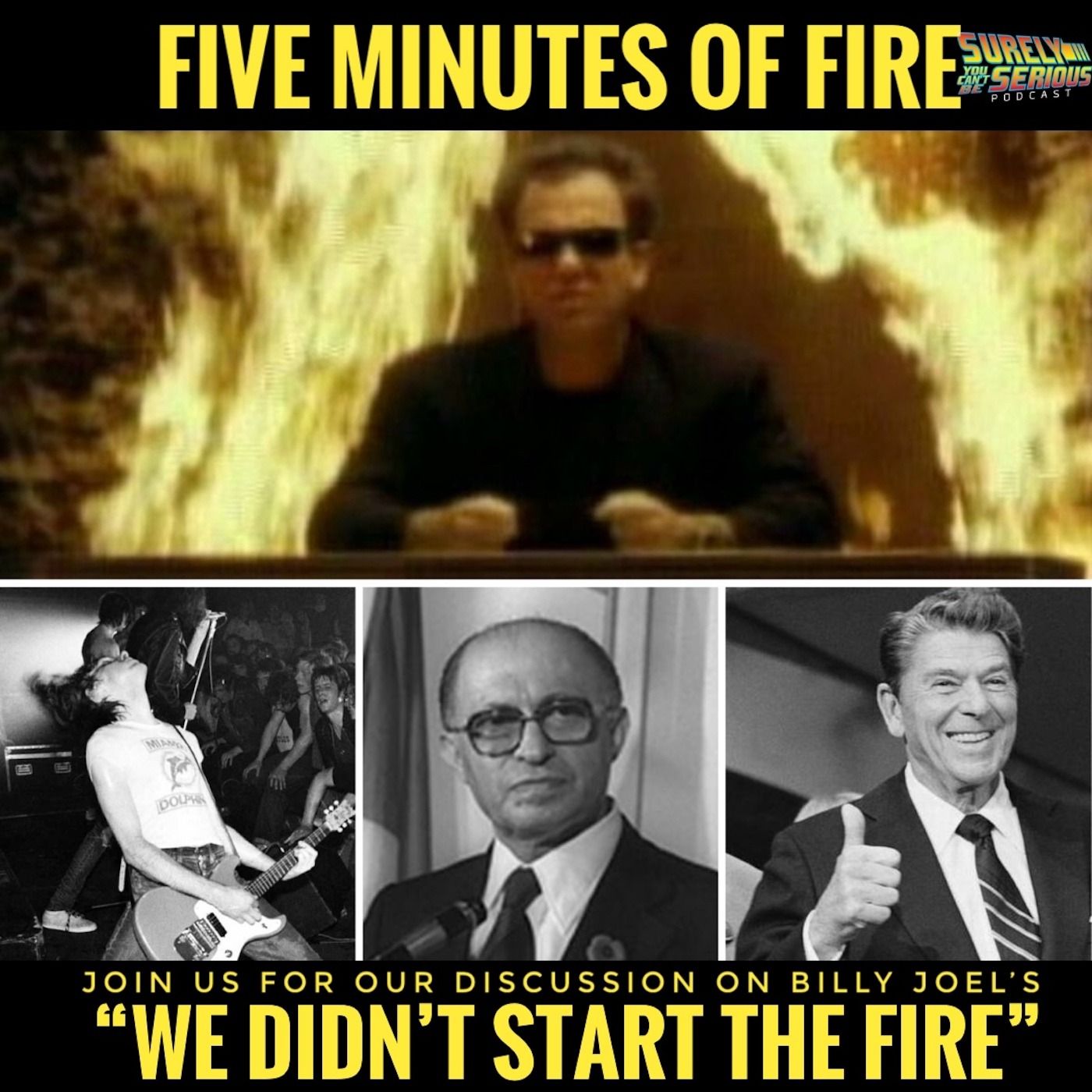
"Five Minutes of Fire": Punk Rock, Begin, Reagan, Palestine
Join us for a riveting journey through history with "Five Minutes of Fire," the podcast series that peels back the layers of Billy Joel's iconic anthem, "We Didn't Start the Fire." Twice a day, in just five minutes, we unravel the historical narratives that shaped the 20th century.In today's episode, the flames of history ignite with the rebellious sounds of punk rock, a genre that challenged conventions and became a sonic expression of dissent. We then navigate the political landscape with Israel Prime Minister Begin, a pivotal figure in the complex dynamics of the Middle East. The narrative turns to the charismatic presence of Ronald Reagan, a transformative figure whose influence extended across the seventies. Finally, we delve into the intricate geopolitical dynamics surrounding Palestine during this era.In just five minutes, we'll guide you through these historical snapshots, providing context, anecdotes, and a deeper understanding of the individuals and events that defined their times. Whether you're a devoted Billy Joel fan or someone eager to explore the stories behind the lyrics, "Five Minutes of Fire" is your daily ticket to historical enlightenment.Subscribe now to join us as we unravel the verses of "We Didn't Start the Fire," offering insights that breathe life into the captivating tales behind the names etched into the song. "Five Minutes of Fire" - where history unfolds swiftly and vibrantly, twice a day. Don't miss your daily spark of historical exploration!
2024-01-19
5 min
Transcript
Available Results
Generated results are saved to the knowledge database for reuse and search.
No generated results are available for this episode yet.
Extract Knowledge
Pick what you want extracted first. Model, scope, and chapter options appear after a template is selected.
Generated results for public episodes are saved to the knowledge database so they can be reused and searched later.
Transcript
<v Speaker 1>Hello everybody, This is Caleb Grays from Norman, Oklahoma, and
<v Speaker 1>you are listening to the greatest podcast of all time.
<v Speaker 2>I'm spiking the football here. It's the Sureley You Can't
<v Speaker 2>Be Serious Podcast. Hello everybody, and welcome back to the
<v Speaker 2>Surely You Can't Be Serious Podcast Special Edition five Minutes
<v Speaker 2>of Fire. We are here talking about the lyrics of
<v Speaker 2>We Didn't Start the Fire by Billy Joel. We're covering
<v Speaker 2>only five minutes at a time, which is about the
<v Speaker 2>link of the song, so it works out kind of nicely.
<v Speaker 2>So please join us as we dive into some new
<v Speaker 2>lyrics today.
<v Speaker 1>All right, guys, so here are the topics that we're
<v Speaker 1>going to be covering today.
<v Speaker 2>Punk rock, Begon, Reagan, Palestine.
<v Speaker 1>Okay, tell me about punk rock.
<v Speaker 2>Okay, this is the first one. I'm like, oh, I
<v Speaker 2>remember that. So punk rock started in the mid seventies.
<v Speaker 2>You had these proto punk bands like MC five, who
<v Speaker 2>had actually gotten record labels to endorse them, but then
<v Speaker 2>like their chance to their concerts include MFR, which got
<v Speaker 2>them in a lot of trouble. But they were a
<v Speaker 2>big inspiration for other bands who were like, we're tired
<v Speaker 2>of the way music is f the establishment f thisf that.
<v Speaker 2>And so then you get this club in New York
<v Speaker 2>City that you probably heard of called CBGB's. You know
<v Speaker 2>what CBGB stands for, I do not. It stands for
<v Speaker 2>Country Bluegrass Blues. What. Yeah, So Hilly Crystal started the
<v Speaker 2>club in nineteen seventy three and his only rule was
<v Speaker 2>you had to play your own original music. That place
<v Speaker 2>and Max's Kansas City. Somehow with all of that though,
<v Speaker 2>end up being the two places that the punk rockers,
<v Speaker 2>although they weren't really calling themselves that at this point,
<v Speaker 2>started to do stuff. You of course, in New York
<v Speaker 2>City have the Ramones. They made their debut performance at
<v Speaker 2>CBGB's in nineteen seventy four. Within a few months, they
<v Speaker 2>had done seventy four sets rise each of the sets
<v Speaker 2>was only seventeen minutes long, and they had a group
<v Speaker 2>that would play with them that was formed by Richard Hell.
<v Speaker 2>Group was called Television. Television actually helped them build the
<v Speaker 2>stage that they had at CBGB's like hammers and nails,
<v Speaker 2>oh wow. And so Television and the Ramones were not
<v Speaker 2>super popular in the US, but were a big influence
<v Speaker 2>on UK bands. And so you had guys like Iggy
<v Speaker 2>Pop and the Stooges in the Velvet underground. So what
<v Speaker 2>was happening was the guys in New York that were
<v Speaker 2>into different music were listening to those guys, and then
<v Speaker 2>the guys in the UK were listening to the Ramones
<v Speaker 2>and television, and they were like feeding off of each other, right,
<v Speaker 2>Like they weren't as popular in their home place as
<v Speaker 2>they were across the pond. Richard Hell was the guy
<v Speaker 2>who kind of started with the ripped T shirts and
<v Speaker 2>aggressive haircuts. That was really just probably because he couldn't
<v Speaker 2>afford it, you know. He came onto the stage one
<v Speaker 2>night with clothes pins holding his clothes together, and some
<v Speaker 2>guy from the UK was like, yeah, screw this fashion
<v Speaker 2>industry thing, and it was really just probably to keep
<v Speaker 2>his clothes from falling off. Wow, but that's how you
<v Speaker 2>get safety pins and clothes For the punk scene. It's
<v Speaker 2>just a feeding frenzy off of each other in this
<v Speaker 2>very underground sea. But then nineteen seventy six there is
<v Speaker 2>this tipping point and suddenly the world becomes aware of
<v Speaker 2>punk music and it builds and builds, and then in
<v Speaker 2>nineteen seventy eight, Johnny Rotten from the Sex Pistols spits
<v Speaker 2>on a guy and it becomes a worldwide phenomena. Tell
<v Speaker 2>me about Began, okay.
<v Speaker 1>Menachem Began was born in nineteen thirteen in modern day Belarus,
<v Speaker 1>but in nineteen thirty nine the Nazis murdered his father.
<v Speaker 1>Now he was a Jewish Man, so in nineteen forty
<v Speaker 1>three he decided he's going to move to Palestine. Began
<v Speaker 1>wanted to force the British out of Palestine. He was
<v Speaker 1>on wanted posters. This guy was like seen as a
<v Speaker 1>terrorist by the British government.
<v Speaker 2>Wow.
<v Speaker 1>He became the leader of the Lionised military group urgon
<v Speaker 1>the British left, turning Palestine over to the UN, who
<v Speaker 1>then declared in nineteen forty seven this to be the
<v Speaker 1>Jewish state of Israel. In nineteen seventy seven, Began was
<v Speaker 1>elected Prime Minister of Israel. In nineteen seventy nine, he
<v Speaker 1>led the Egypt Israel peace Treaty with Egyptian President Onwar Sadat.
<v Speaker 1>Now this is the first time that an Arab country
<v Speaker 1>recognized Israel. In nineteen eighty one, Saddam Hussein threatened Israel
<v Speaker 1>and was building a nuclear reactor. Began with the Israeli
<v Speaker 1>Air Force took it out, knock him began, passed away
<v Speaker 1>March third, nineteen ninety two.
<v Speaker 2>Okay, Jason, can you tell me who was president in
<v Speaker 2>nineteen eighty five? Ronald Reagan, the actor. Okay, this is,
<v Speaker 2>of course Ronald Reagan, the face of politics for the
<v Speaker 2>nineteen eighties. He was born in February nineteen eleven to
<v Speaker 2>Jack Reagan and Nellie Wilson now Willie Nelson now his
<v Speaker 2>dad Jack was a populist Democrat, and as it turns out, Reagan,
<v Speaker 2>despite the fact what we know about him in our
<v Speaker 2>history experience with him, he actually tried to join the
<v Speaker 2>Communist Party whenever he was what whenever he was a
<v Speaker 2>young man, but they wouldn't let him in because they
<v Speaker 2>thought he was quote unquote too dim. And so obviously
<v Speaker 2>his politics changed over time, and in nineteen eighty he
<v Speaker 2>beat the incumbent Jimmy Carter. This was during the hostage crisis,
<v Speaker 2>and he said, I'm going to come in and I'm
<v Speaker 2>going to fix this, and he did, and he was
<v Speaker 2>probably one of the most popular at the time presidents
<v Speaker 2>in history. He was in office from January twentieth, nineteen
<v Speaker 2>eighty one to January twentieth nineteen eighty nine. Okay, tell
<v Speaker 2>me about Palestine.
<v Speaker 1>The Palestine Liberation Organization that is internationally known as the
<v Speaker 1>Official Representative of the Palestinian People was founded in nineteen
<v Speaker 1>sixty four and initially sought to establish an Arab state
<v Speaker 1>over the entire territory of the former Mandatory Palestine, advocating
<v Speaker 1>the elimination of the state of Israel. In March nineteen
<v Speaker 1>seventy seven, Jimmy Carter spoke of a need for the
<v Speaker 1>Palestinian homeland and wanted Palestine to participate in the peace process.
<v Speaker 1>Israel rejected the idea of the PLO participating in peace talks,
<v Speaker 1>and that battle still rages on today.
<v Speaker 2>Okay, guys, that does it for today's episode. Join us
<v Speaker 2>next time for five minutes of fire.
Chapters
No chapters available.