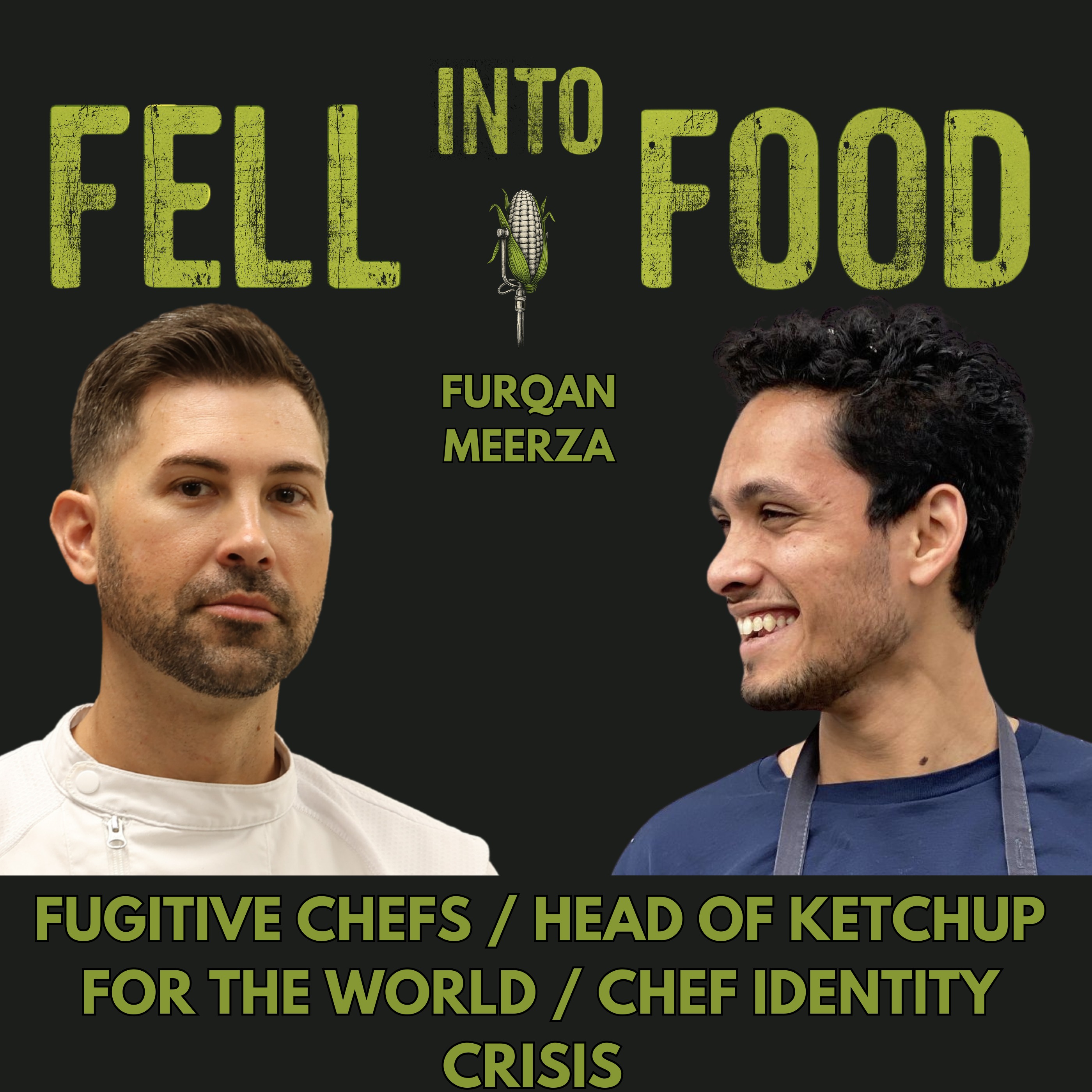
FURQAN MEERZA: FUGITIVE CHEFS / HEAD OF KETCHUP FOR THE WORLD / CHEF IDENTITY CRISIS
There's a version of being a chef that nobody teaches you in culinary school. No white coat. No ticket rail. No guest feedback at the end of the night. Just you, your palate, and the future of what a billion people are going to eat.
Furquan has lived that version. He interned at Noma in 2022 — got offered a contract by week two — and ended up leaving not because of the controversy that's since gone viral, but because of a visa limbo triggered by the Ukraine war. Noma paid him two months' salary on the way out. He landed in Spain, found his way to the Basque Culinary Center's R&D arm, spent four years tracking spicy food across Jamaica, Korea, Mexico, India, and Nigeria — and is now the Senior Innovation Chef at Kraft Heinz, head of ketchup for every market outside North America.
He also runs the Fugitive Chefs podcast, a platform and community built for chefs who are done with the linear path — restaurant to restaurant to restaurant — and want to know what else is out there.
In this conversation, we get into his personal account of Noma and why the controversy is more complicated than the Instagram posts make it look. We talk about growing up in India, going through hotel management with zero formal culinary training, figuring out ADHD in a pastry kitchen, and why chaos is actually a competitive advantage in R&D. We dig into the real mental block chefs face when they try to leave the kitchen, why culinary schools are selling a dream they're not delivering on, and the 8-hour punch-in punch-out law quietly reshaping restaurant labor in Europe. And we close on something that stuck with me: always choose the option you'd regret NOT choosing. Don't let somebody else drive the car.
Socials
Fugitive Chefs Podcast: fugitivechefs.com
Fugitive Chefs on Apple Podcasts
Instagram: https://www.instagram.com/fugitivechefspodcast/
CHAPTERS
---------------------------------------------
00:00 Furqan's personal account of Noma — was it really that bad?
01:07 Interning at Noma, getting offered a contract by week two
03:27 The Ukraine war, Danish visa freeze, and how he left Noma
05:08 Jeff's take: there are always three sides to every story
06:39 Growing up in India, hotel management, zero formal culinary training
07:39 Why he left pastry — ADHD, chaos, and precision being the wrong fit
09:47 R&D seeming counterintuitive for someone who thrives on chaos
10:16 What a Senior Innovation Chef at Kraft Heinz actually does
13:42 How his definition of "being a chef" has changed
16:20 Why food companies don't hire chefs — and why they should
17:45 Jeff's own path through contract management and the "chef" identity
19:23 Real-world skills that got him the job without a food science degree
22:31 Why he started the Fugitive Chefs podcast
26:53 The biggest mental block chefs face when leaving the kitchen
29:20 The gap between what culinary schools sell and what they deliver
31:32 Advice for someone starting from zero — no kitchen, no degree, no experience
36:10 Why NOT following the classic path is actually how you stand out
36:37 Europe's 8-hour punch-in punch-out law and what it's doing to restaurants
40:19 Long hours in the kitchen: necessary grind or just normalized abuse?
43:53 Food company profit margins vs. who always eats the cost
46:46 Tech in the kitchen: what's actually moving the needle
50:58 Will AI replace chefs? (Short answer: we'll be the last ones)
53:39 Biggest untapped opportunities for transitioning chefs in the next 5 years
56:53 The one move that gets you inside a food company with no connections
57:17 Final advice: be sincere with yourself and pick what you'd regret NOT doing
01:00:38 Enjoying the journey vs. just grinding toward the goal
01:01:31 The North Star: always choose the option you'd regret not taking
01:02:57 Wrap up + Fugitive Chefs plug
LISTEN ON ALL PLATFORMS
---------------------------------------------
YouTube: https://lnkd.in/gQM3S5mr
Spotify: https://lnkd.in/g_5kFXie
Apple Podcast: https://apple.co/41RoTm4
Pandora: https://lnkd.in/gS-wu_YJ
---------------------------------------------
FOLLOW FELL INTO FOOD
---------------------------------------------
YouTube: https://youtube.com/@FellIntoFood
LinkedIn: https://linkedin.com/company/fell-into-food
Instagram: http://instagram.com/fell_into_food
Facebook: https://facebook.com/fellintofood
Website: https://FellintoFood.com
Advertising Inquiries: https://redcircle.com/brands
Privacy & Opt-Out: https://redcircle.com/privacy
Available Results
Generated results are saved to the knowledge database for reuse and search.
Extract Knowledge
Pick what you want extracted first. Model, scope, and chapter options appear after a template is selected.
Transcript
[SPEAKER_00]: feel time is a major factor to the story, because normal has changed, it's my personal story can only be what I experienced.
[SPEAKER_00]: It was it as abusive as it makes it sound, but again the other layer to it is I was coming from much more abuse of kitchens.
[SPEAKER_00]: So again me telling it wasn't abusive doesn't mean there was nothing happening.
[SPEAKER_00]: Unfortunately in the industry what's happening is we give the most value to the people who serve the least people with the most amount of money.
[SPEAKER_00]: That's what is causing this problem of imbalance, where the
[SPEAKER_00]: food companies don't even need to think of employing chefs and have always chosen the option, which I did not, if I did not choose it, I'll regret the most.
[SPEAKER_00]: You might go wrong, but at least you were in the driving seat and not being driven by somebody else in the cars.
[SPEAKER_02]: Chef, I can't thank you enough for taking the time to come on the podcast today and the biggest burning question because of your background is What are your thoughts on no mom and because that's that's been the rave.
[SPEAKER_02]: That's the talk right now.
[SPEAKER_02]: And you you literally lived it and saw it in its in its prime
[SPEAKER_00]: Yeah, I mean, I've got this question with the first few weeks.
[SPEAKER_00]: What's been going on?
[SPEAKER_00]: I mean, I'm spoken to Jason White personally as well.
[SPEAKER_00]: Oh, Instagram, because we shared the same space.
[SPEAKER_00]: We were working together, because a lot of stories coming out of our people who have been at no mind at different points of time.
[SPEAKER_00]: And I feel time is a major factor to the story, because normal has changed it as itself.
[SPEAKER_00]: So as you pick up a slice, you'll feel okay.
[SPEAKER_00]: This version of this account of things doesn't match the other person's story.
[SPEAKER_00]: So with Jason, the thing is Jason was, yeah, working in 2020 too, where I was there as well.
[SPEAKER_00]: And my personal, I mean, I worked there as an intern.
[SPEAKER_00]: First of all, I entered there for one month internship.
[SPEAKER_00]: My idea was to intern because I was for background.
[SPEAKER_00]: I was working in Mugurits and Mugurits is a restaurant which closes for our end days.
[SPEAKER_00]: One of the only places in which it does that.
[SPEAKER_00]: It works eight months a year, four months and shots.
[SPEAKER_00]: And during that shot period, I was saying, okay, I'll try some other kitchen.
[SPEAKER_00]: and ended up being the second week in Norma, they offered me a contract, they said, okay, if you want, we have a place for you.
[SPEAKER_00]: And that was not what I had expected because I mean, they have tons of interns on their doors literally, which also is a layer of why the environment is the way it is.
[SPEAKER_00]: And a lot of what Jason says is true.
[SPEAKER_00]: There is, there are, there are, there are been true stories behind it.
[SPEAKER_00]: My personal story can only be what I experience.
[SPEAKER_00]: So I didn't experience the amount of views that Jason
[SPEAKER_00]: There's a lot of claims coming out of the stories of people whose stories Jason's using and it ends up being that these people did not relate with that story anymore, so there's so much confusion, so which is why I've said no to many interviews on the topic, but my personal vision as I've put on the on my Instagram as well that my own accounts, it was it as abusive as it makes it sound, but again the other layer to it is I was coming from much more abusive kitchens.
[SPEAKER_00]: So again, me telling it wasn't abusive doesn't mean there was nothing happening.
[SPEAKER_00]: There were a lot of signs of what Jason says, a lot of people riding on egos, people riding on a lot of attitude, a lot of bad energy, not possibly the best sort of language.
[SPEAKER_00]: But at the same time for me, it was a place that if I just see my personal story of how it went, I had to leave it at the end of almost completely a year in Norma and I had to leave because there was immigration problems all over Denmark.
[SPEAKER_00]: And especially as somebody who's a third country national who's not European in my case, I'm from India.
[SPEAKER_00]: Ukraine what happened in 2022 and Denmark suddenly started prioritizing an all-European countries honestly started prioritizing Ukrainian asylum seekers refugees or immigrants So all of our like the non-Europeans their visas went on hold So there was no there was a lot of uncertainty.
[SPEAKER_00]: So I said this to to to Renee Thomas the administration can it the head chef at the time
[SPEAKER_00]: And they said, you know what, we are going to go to Japan.
[SPEAKER_00]: That was the reality at that point.
[SPEAKER_00]: They were moving to Japan in 2023.
[SPEAKER_00]: The restaurant was supposed to be shot as we see.
[SPEAKER_00]: It is not right now.
[SPEAKER_00]: So they said, actually, it won't be worth the risk if you just risk being here right now.
[SPEAKER_00]: And you suddenly end up not getting the residence permit, which I was in process of.
[SPEAKER_00]: So say, you know what, maybe you should see other options and I said, okay, going back to Spain makes the most sense.
[SPEAKER_00]: So they went out of the way and they paid me two months of salary saying that, you know, you're figuring out yourself.
[SPEAKER_00]: You're not working with us right now.
[SPEAKER_00]: That's okay.
[SPEAKER_00]: You can go back and see what's left for you in Spain.
[SPEAKER_00]: And I honestly very thankful that I made that move, which is why I'm where I'm today.
[SPEAKER_00]: But they supported me financially, which was not asked for not required.
[SPEAKER_00]: the other layer to this is this was happening at the same time as financial times article came out in 2022.
[SPEAKER_00]: So was that because they had good intentions was that because they were scared of more things coming out if they don't do these measures that they were doing with me.
[SPEAKER_00]: So again there's so many layers to it honestly Jeff that I feel my personal account to be very specific was not the kind of abuse that you're seeing on Instagram and it has positively affected my my career.
[SPEAKER_00]: Even today when I walk into kitchens working at Hines, which is nothing to do with fine dining,
[SPEAKER_00]: Even then, I feel the things I'm applying in today's world of what I work in R&D is a lot of learning coming from environments like no mind migrates, where we did a lot of research, but at a lot of cost, at a lot of different timelines, different scales, so that experience has helped me to be where I am today.
[SPEAKER_00]: So it feels unfair to say that the abuse was the only part of it that I've carried forward.
[SPEAKER_00]: I hope that answers your question.
[SPEAKER_02]: No, it does, uh, because it's always interesting to hear someone that's that's in it, right?
[SPEAKER_02]: Because there's always, you know, there's always three sides of the story, right?
[SPEAKER_02]: They're so aside your side and then the truth, but the truth is each individual accounts of the truth.
[SPEAKER_02]: You know what I mean?
[SPEAKER_02]: Because even if somebody sees something as,
[SPEAKER_02]: abusive or a little rough.
[SPEAKER_02]: Others might find that as motivated, right?
[SPEAKER_02]: It's too to a level of like, I need someone, almost military style, right?
[SPEAKER_02]: Get your ass kicked, you know, get you in shape, get you ready, and others maybe aren't cut out for that.
[SPEAKER_02]: So again, not that anything's right or wrong.
[SPEAKER_02]: I just, I really wanted to hear what your kind of perspective was on with your time there and it's,
[SPEAKER_02]: Um, it threw through the whole experience because I never went through that fine dining experience.
[SPEAKER_02]: I've said it multiple times.
[SPEAKER_02]: That wasn't my upbringing.
[SPEAKER_02]: So it's always, I always have a very high interest with people who lived in that space.
[SPEAKER_02]: It did that space for for quite some time because I can't relate to it.
[SPEAKER_02]: So I've I carelessly lived through those that I talk to other chef friends that are in the industry.
[SPEAKER_02]: And they're like, yeah, it was this way.
[SPEAKER_02]: It was that way to try to assemble it and piece it together in my own way.
[SPEAKER_02]: I came for more of like where you're at now.
[SPEAKER_02]: Not.
[SPEAKER_02]: So much of doing R&D, but in the corporate world side of things, and obviously we're going to dig into that and how you got there, you know, maybe let's backtrack how you, you know, you're you're in the Netherlands now, correct?
[SPEAKER_00]: Yes, that is that's right.
[SPEAKER_02]: Yeah, how do you how do you navigate, you know, you went to CIA, you went CIA, correct?
[SPEAKER_00]: No, I don't know.
[SPEAKER_00]: I honestly have not taken any form of education.
[SPEAKER_00]: It comes to kind of reacting.
[SPEAKER_00]: I've done hotel management.
[SPEAKER_00]: And that's funnily enough.
[SPEAKER_00]: What everybody in India, at least when I was growing up was doing, which was also funny, because at that point, there was no calorie arts program.
[SPEAKER_00]: This is 2015-14.
[SPEAKER_00]: And what was there is that, I mean, there's, of course, chefs in this, of course, restaurants in India.
[SPEAKER_00]: But the thing is that all the good restaurants exist in hotels, which is the complete opposite of Europe.
[SPEAKER_00]: You do not go to for good food to restaurants, which are in hotels.
[SPEAKER_00]: So it's the opposite of how India works.
[SPEAKER_00]: I think it's because the kind of people who can afford good food, possibly our visitors or travelers who are staying in these hotels, these five star properties.
[SPEAKER_00]: So the restaurants are inside that.
[SPEAKER_00]: So you basically, if you want to be a chef, you need to study hotel management, because a way of chef works in a standard on restaurant is very different from what.
[SPEAKER_00]: hotel chef works like so that's yeah that's how that's the only education of gallery I got is from hotel management.
[SPEAKER_02]: Wow that's interesting because you wanted to do baking in pastry but realize that that wasn't really your your thing.
[SPEAKER_02]: So how did you practice that or or do that and then actually realize okay in hell no I don't want to have everything exactly perfect all the time.
[SPEAKER_00]: Yeah, I think, I mean, through this program, the thing with hotel management is of course learn front office, housekeeping, all the layers of hotels, I learn how to do hotel engineering, how the water gets to a certain room, for example, a count and see.
[SPEAKER_00]: But we also had eight hours of culinary, plus like four hours of culinary, like the savory side of food, and we also had like four hours of baking, pastry, and in this initial exposure because again, in the education is very much still bent towards the French kind of classical cuisine in the first year, and I already got exposure of what life could look like because
[SPEAKER_00]: faculty who was teaching who has been in the industry, there were people who had been on all scale of baking, confectionary, pastry, in restaurants, pastry, uh, standalone pastry places, and what I understood very early is that my sort of creativity which is very chaotic, I think it comes from having ADHD, it's like you feel you're creative, but you're in all directions at sorts,
[SPEAKER_00]: I felt that it doesn't really match very well with and I think now is when I actually calculate and think that's what I thought but in the moment it felt very uncomfortable I think I felt this discomfort of having to depend on an oven, having to depend on gadgets and methods and techniques and machines and precision and I feel I'm not the most precise person which is why I have had my hands in a lot of carriers and a lot of different kitchens.
[SPEAKER_00]: And I said the only way I can progress is by capitalizing that chaos rather than going against it.
[SPEAKER_00]: And I feel being in in in in baking in pastry would have been completely going again.
[SPEAKER_00]: How I am so I feel in a hot side of savory kitchen you can think that you can literally put things in a pot and just keep throwing it in and adjust it to fairly have a good end product where doesn't baking in pastry.
[SPEAKER_00]: There's very little you can do until you reach a stage where you actually
[SPEAKER_00]: Make your own chocolates and make your own temperatures and play around, but at that point starting on I felt like it's gonna be too much of control and I feel I thrive when there is no control around me
[SPEAKER_02]: on the outside looking in with what you're doing as an R&D chef.
[SPEAKER_02]: It almost sounds count.
[SPEAKER_02]: It sounds counterintuitive because you think, okay, R&D things are precise.
[SPEAKER_02]: You're doing this.
[SPEAKER_02]: You're doing that.
[SPEAKER_02]: You're scaling.
[SPEAKER_02]: How does that play into what you do today as an R&D chef?
[SPEAKER_02]: And how do you bridge the gap, right?
[SPEAKER_02]: You're your chef, but they're scientists.
[SPEAKER_02]: There's people who went to school, people who didn't go to school.
[SPEAKER_02]: How does that all work together?
[SPEAKER_00]: Yeah, so I mean, right now I'm very fresh in this role.
[SPEAKER_00]: I've started two months ago as the senior innovation chef at Kraft Heinz, they approached me towards the end towards the beginning of last year.
[SPEAKER_00]: I was not interested, then we had some chats, and it seemed like it's the right progression.
[SPEAKER_00]: So I'm still very fresh in this role and still navigating currently my day-to-day for somebody who's listening, because I think many listeners cause I also wonder, you know, what,
[SPEAKER_00]: is a chef doing inside a food company which makes basically catch up and on a medical whip and things like that lunchables.
[SPEAKER_00]: So my role is I'm the head of everything apart from North America, so how high-end works is we have an R&D North America and then we have the rest of the world.
[SPEAKER_00]: So I am the head of tomato catch-up and it comes to it.
[SPEAKER_00]: So right now my job is more into like the catch of formulation or how catch up works, won't change much.
[SPEAKER_00]: There will be like maybe people who want less assault, sugar, we have some variance with dietary problems and things like that.
[SPEAKER_00]: But it's more about picturing the, like imagining the future of how do people still eat catch up when they don't eat that many fries as they used to.
[SPEAKER_00]: So things like this, even though it doesn't feel very obvious, that a chef would be required in these roles.
[SPEAKER_00]: What you have to think is that all the sauces say just picking up hines, all the sauces that a person eats, nobody's opening a sashio of sauce and putting them in the mouth.
[SPEAKER_00]: They're eating that with something.
[SPEAKER_00]: So if you think about sauces for example, nobody's opening the sashio and putting it into the mouth and just...
[SPEAKER_00]: drinking the sauce by itself where if you look at a food company mostly they are testing these products in isolation and what the food companies have realized lately is where why people like me exist in these companies because they don't need I mean when you ask about like if I do not like precision if I do not like calculation why am I inside so of course part of my job is calculating so that what I create can be replicated so with that part I have grown affinity and grown into like liking that part of it.
[SPEAKER_00]: But again, they have people who are more into, say, program, when it comes to sales, side of things, the marketing side of things, the microbiology, the physical chemical part of it, how a texture can be measured on a textual meter.
[SPEAKER_00]: So they have people on those side of things.
[SPEAKER_00]: What they need me is kind of to push those boundaries of like imagining, okay, burger, fries, ketchup.
[SPEAKER_00]: I think it's only because of people like me and those like me who are in the team.
[SPEAKER_00]: We are 10 people in the in the culinary team.
[SPEAKER_00]: It's people like us who push the boundary of where this product can go and that's how my character comes inside.
[SPEAKER_00]: I feel they are kind of capitalizing this hedonist culinary view that comes from fine dining.
[SPEAKER_00]: And actually before this role, the four years I was with Baskanary Center, that was a different role altogether, because there I was doing say the first ideation version of these food companies.
[SPEAKER_00]: I was working for like Joe Adan or like old Al Paso, all these food companies, creating the futures scenarios from them.
[SPEAKER_00]: So what good snacking look like in ten years.
[SPEAKER_00]: So reports like this food companies use to kind of program.
[SPEAKER_00]: Okay.
[SPEAKER_00]: If these chefs think this is where snacking is going to go because fine dining sets the paradigm for a lot of things we see in consumer goods.
[SPEAKER_00]: So that is where they needed me.
[SPEAKER_00]: So again, for documenting or the side of things that chefs don't like much, which is documenting or Yeah, recording what they're doing so committed replicated.
[SPEAKER_00]: We had people for that.
[SPEAKER_00]: We had sensory scientists.
[SPEAKER_00]: So when I was last year, I was traveling Jamaica, Korea, India, Mexico and Nigeria and China Tracking what spicy food is so again as a chef.
[SPEAKER_00]: I am the right person to judge how Mexican spicy is different from Indian spicy because I was born in India and because I understand how Mexican food works.
[SPEAKER_00]: I see the steps
[SPEAKER_00]: But it still needs somebody who can boil this down into terms, which are not ambiguous, which are not very specific to a person, so they had a sensory scientist tracking this down.
[SPEAKER_00]: And that's how I feel these environments balance this energy of a chef and a scientist.
[SPEAKER_02]: Oh, that's super cool.
[SPEAKER_02]: You know, many people are stepping away from the past, you know, and viewing that as a loss of identity, you know, how, how is your personal definition of what it means to be a chef change since you started working in food innovation?
[SPEAKER_00]: So honestly, when I ended up like actually a podcast name was fell into food and I feel I'm my story of every transition has been falling into it.
[SPEAKER_00]: Honestly, from starting off at the first restaurant I ever worked at in Europe.
[SPEAKER_00]: It's called Noor.
[SPEAKER_00]: I wrote this guy.
[SPEAKER_00]: It's, I mean, honestly, if anybody was listening to this restaurant up, it's one of the few three Michelin star restaurants started when I was back there at 27.
[SPEAKER_00]: He was a one Michelin star place seven months open and he does food from when Spain or quarter the bus specifically the south of Spain was a part of the Arab Empire.
[SPEAKER_00]: So he cooks without
[SPEAKER_00]: tomato without chilies, without corn, without garlic, all the things that Columbus bought with him is not in his cuisine.
[SPEAKER_00]: So actually, what I'm saying is that I wrote to him that hey, I want to be I'm doing a research about ancient cuisines.
[SPEAKER_00]: Could you write me a letter for my from my research?
[SPEAKER_00]: He didn't understand an English email and said, you know what, if you want to come in turn with me, you can come in turn.
[SPEAKER_00]: So that's how I fell into that job.
[SPEAKER_00]: And then your your question about like how how did I end up into this, yeah, this this field and how does being a chef feel inside these environments?
[SPEAKER_00]: Um, I honestly, when I was looking off like what next after Noma, when I had to leave Noma because of this immigration issues, I said, I was like, okay, I can either go back to working at kitchens.
[SPEAKER_00]: Of course, there are more kitchens where I could learn, keep learning, and and keep going with that.
[SPEAKER_00]: But I said, it's actually a good moment because I do not really know what I want to do right now.
[SPEAKER_00]: I have this two months of salary.
[SPEAKER_00]: These guys are going to pay.
[SPEAKER_00]: So what else can I do if I don't want to work in a restaurant set up?
[SPEAKER_00]: So I wanted to push myself out of it, but I honestly missed examples.
[SPEAKER_00]: I did not know.
[SPEAKER_00]: I mean, in my head, I think when I look six, seven years back, now I had no idea that there are chefs inside catering.
[SPEAKER_00]: There's chefs inside airlines like, like subconsciously, you know there's some people behind this.
[SPEAKER_00]: But you don't really think in these packaged foods or people starting about ethnography or why Thai cuisine is where it is right now.
[SPEAKER_00]: They have chefs working with the government, creating a gastrotyplopsy program.
[SPEAKER_00]: So I did not have the vision of these things and which is why I ended up creating a platform called Future of Chefs to kind of track these stories of what are chefs doing when they leave this, yeah, leave this career of being chef, which is very guest-facing.
[SPEAKER_00]: So today for me, I think chef, to your question of like,
[SPEAKER_00]: How do I still feel, or do I even feel I'm a chef anymore?
[SPEAKER_00]: Because I'm not having clients serving every evening and having their quick feedback of how they find the food.
[SPEAKER_00]: I feel as on my podcast Dan Jusley, who's sort of the states he mentioned, that unfortunately in the industry was happening is we give the most value to the people who serve the least people with the most amount of money.
[SPEAKER_00]: And that's what's happening.
[SPEAKER_00]: Because we are putting fine dining chefs, especially in this place where they decide
[SPEAKER_00]: And I feel that's what is causing this problem of imbalance where food companies don't even need to think of employing chefs I mean craft hyens and the unit livers and the big big ones that are comfortable position where they can do that But many food companies don't even look at chefs.
[SPEAKER_00]: They look at food technologies or or profiles like those because they feel that's enough And that's got them the flavor part covered.
[SPEAKER_00]: If you have a flavor scientist, we have the flavor part covered.
[SPEAKER_00]: If we have a microbiologist, we've got the fermentation part covered
[SPEAKER_00]: So unfortunately, they don't look at chefs and that's what I'm trying to push.
[SPEAKER_00]: What I'm trying to push is people like me who are possibly not serving guests, but everybody are having a catch-up in their in their fridge has me behind that vision of a product.
[SPEAKER_00]: So I feel we need to give more importance and put chefs in these roles because I feel still
[SPEAKER_00]: Of these food companies the chef side of things the culinary side of things is still the most human side of things Which cannot be replaced by an AI agent or a bot.
[SPEAKER_00]: We are helped by these tools.
[SPEAKER_00]: Yes, but we still need this human side of How flavor can evolve?
[SPEAKER_00]: What is right?
[SPEAKER_00]: What is wrong?
[SPEAKER_00]: This moral compass and that's why I feel to your question.
[SPEAKER_00]: I feel yes I do feel comfortable.
[SPEAKER_00]: It took me time to realize that okay, this can be a job where I still feel a chef
[SPEAKER_00]: But I feel at the point where I am right now, I think the contribution of chefs like me is much higher when you look at scales of consumption of food in general.
[SPEAKER_02]: Man, you put that really well, that term, right, it's, it's so overused over, I don't even know how to explain it, right?
[SPEAKER_02]: But when you say that word, the first thing comes in mind is fine dining, white coat, and to your point, they feed the least amount of people that had the most amount of money, and there's so many chefs in this industry, to your point, there's, there's R&D, what kind of what you do there's,
[SPEAKER_02]: contract management.
[SPEAKER_02]: That's what I was in managing large teams feeding lots of people and to me that term is always been about leadership.
[SPEAKER_02]: More so than just you can cook really good food because there are guys that could cook the pants off of what I can do on a regular basis, but that doesn't mean I don't give up that term and say, oh, I'm not a chef anymore.
[SPEAKER_02]: I feel like once you've
[SPEAKER_02]: earned it in the proper way that that's something you get to keep with you and not over overuse it you know I'd let people you want to call me chef great if you don't I don't really care right it's not my identity of who I am that just happens to be a position that I did and I carry it with through me so people understand that because I was one of those guys that thought I needed to go back and get a food science degree to be honest I was thinking about you know I was working in kitchens and I was like man I really want to get to like R&D in the
[SPEAKER_02]: I hate to go.
[SPEAKER_02]: I hate to school.
[SPEAKER_02]: I don't like I'm good at I'm good at like the writing the papers just getting stuff done, but the physical just like being in a school environment like I feel like I'm in a cage to your point.
[SPEAKER_02]: I can't just do what I want to do.
[SPEAKER_02]: So what specific like real world skills did you lean on to prove that you could do these kind of jobs?
[SPEAKER_00]: So I would say first of all, I did feel, I mean, I completely relate with this feeling of knowing that maybe you're not the right person, or maybe because many of the times I feel with me and others in the community that I'm mentoring of students or young chefs or transitioning into these jobs, I feel a lot of the times, we question ourselves before the employer, so the employer,
[SPEAKER_00]: knows exactly what they're looking for.
[SPEAKER_00]: They know they're looking for a chef who can apply this food into a certain context or culture or whatever that is.
[SPEAKER_00]: But we start questioning.
[SPEAKER_00]: So that's very normal.
[SPEAKER_00]: I feel first of all to confirm your point.
[SPEAKER_00]: So I did feel that in the first, I think the first few years at Baskanari Center.
[SPEAKER_00]: I said before I knew what the job is.
[SPEAKER_00]: So I'm still getting like onboard in the company, understanding the terms.
[SPEAKER_00]: I feel a lot of it is language.
[SPEAKER_00]: I think that's one thing which knows cool can teach you because the language of
[SPEAKER_00]: I mean, just yeah, the acronyms they use, the words they use or the methodologies they use, I feel first of all, I thought that getting a school or getting a degree because this most of these companies also have budgets to be able to educate you or give you time to do an online program or not go full time into studying but you can still get kind of first of all, I would say people should look at that because most companies can let you study alongside your jobs, so I looked at those options.
[SPEAKER_00]: But the more and more, I started getting into understanding
[SPEAKER_00]: It wasn't matching my reality.
[SPEAKER_00]: So of course there are programs.
[SPEAKER_00]: I was just teach you about for technology So they will teach you what is Statistics like how can you kind of calculate a scale of product or how can you check the pH of something or how can you use these machines?
[SPEAKER_00]: But I feel
[SPEAKER_00]: The more I was there in consulting people who are being into this job, so what helped me the most is seeing others who had not gone through the traditional path.
[SPEAKER_00]: So of course, at every environment, you'll see those who have got the food science part, but luckily, it buss a very center.
[SPEAKER_00]: I had good mentors and examples who had not gone through the path.
[SPEAKER_00]: So first of all, that inform me, okay, maybe I can get by without for now, maybe I'll see in two years if I need this.
[SPEAKER_00]: And ultimately, as I kept growing and as I kept seeing the value of bringing to the team,
[SPEAKER_00]: Honestly, I did not need the degrees I thought I needed because the way I was working I was in a culinary team which is possibly say let's take an example so people understand.
[SPEAKER_00]: So if we are doing a project which is about taking the waste from, say, Apple juice, taking Apple juice waste, constructing a dish, a beverage out of fit which is a functional beverage.
[SPEAKER_00]: So in all of these parts of the project you would think as a chef you would need to know the food science of the fermentation part or possibly what enzymes have to be used to break
[SPEAKER_00]: Yes, you need that, so, but I feel in today's day and age, I mean, I'm talking about right now, I mean, I did this four years ago, but right now even so more, all of this information is available.
[SPEAKER_00]: Believe me, you can have all of the information of how to get somewhere easily, how I was scientific that is plus in my job, I had a microbiologist who's a PhD in that.
[SPEAKER_00]: Why can I not just go with what I know, ask the right questions, the people who are available in these environments and just build upon that and that's what I didn't honestly that's worked for me so far.
[SPEAKER_02]: Wow, incredible.
[SPEAKER_02]: And you mentioned the future of Chef's podcast.
[SPEAKER_02]: I, what, you know, that's the space that we're in.
[SPEAKER_02]: Why a podcast for you?
[SPEAKER_02]: And why did you pick to choose, you know, what the topics and the things and the guests that you're talking about?
[SPEAKER_02]: Maybe just talk about your podcast in general.
[SPEAKER_00]: Yeah, so honestly, it started as an idea.
[SPEAKER_00]: It was a different name altogether.
[SPEAKER_00]: We were doing one month span, one week span, and it was one week, English, and it started very chaotic, like most things that I've mentioned.
[SPEAKER_00]: And the initial idea was only so that I can first of all have conversations with people who are not who were chefs and today working outside restaurant kitchen.
[SPEAKER_00]: So for me,
[SPEAKER_00]: In the beginning, it was a very selfish motive to get into these rooms, get to talk with people.
[SPEAKER_00]: And I said, might as well, I mean, if I need a reason for that, because I was having these mentoring calls with people who I know, I knew an R&D chef from Mogarets who was starting her own consultancy business and I said, you know what, I'm going to talk to her on a call myself.
[SPEAKER_00]: And I said, okay, there's so much value coming out of this call.
[SPEAKER_00]: that I have luckily made the transition.
[SPEAKER_00]: I have found a company which had hunted me.
[SPEAKER_00]: They found me for the job, but maybe this could be of value for somebody else.
[SPEAKER_00]: So I said, you know what, I'm going to start.
[SPEAKER_00]: And that actually started with just like buying two mics, actually the mic I'm using now, four years later.
[SPEAKER_00]: So this mic and I was using my iPhone.
[SPEAKER_00]: I'm still using my iPhone to record it and a few subscriptions on Riverside, things like that.
[SPEAKER_00]: So the idea was just to
[SPEAKER_00]: kind of record conversations of people who have made transitions.
[SPEAKER_00]: And today where we sit on how a fugitive chefs has grown in the past, I think in this past year it has grown the most, is the format has changed a little bit, so we're doing just English right now, but we are kind of getting into more specific paths.
[SPEAKER_00]: So for example, we had dancers, the dancers, the was the head chef of Noma and today runs a company called Brigade which puts chefs inside schools.
[SPEAKER_00]: So these were not the kind of episodes that I was doing in the beginning, but I have
[SPEAKER_00]: And today is running to full-fledged companies, running one of the chocolate alternative companies in the UK.
[SPEAKER_00]: We have people like most recently, we have Justin Kanna, he was working in restaurants like the French laundry, and today he's running program of coaching, how chefs can still stay in restaurants, but use methods or use his systems where they feel the growth that the restaurant doesn't compensate.
[SPEAKER_00]: We had people like Jade Gross, she was working as a head chef at Muggeritz, goes for a trip to a wine field and says this couple is retiring from wine business all together.
[SPEAKER_00]: She said, I know how to design food recipes, how different can we to create wine.
[SPEAKER_00]: And today she has a massive vineyard in Rio, ha, sales bottles.
[SPEAKER_00]: So it's curious of people to just navigate that,
[SPEAKER_00]: Whenever a chef has a question, whenever somebody working in kitchen is a question that you know what, I'm not growing over here.
[SPEAKER_00]: I don't feed myself being a chef anymore or possibly for many of them this happens when they are starting a family or some dynamic around the daily routine is changing and they feel that this version of being a chef doesn't fit.
[SPEAKER_00]: what I do not want people to do is that think that this is like the only way to be a chef as we discussed before to open these pathways that you can still be a chef and you can still be a part-clif for who's in the podcast who said to me in in the episode that 1 million people open a lace packet every day and he's the principal R&D of PepsiCo
[SPEAKER_00]: designing these recipes, doing this collaboration, searching for texture, searching for what the Gen Z consumer who's traveling on a trade and not eating chips the way we used to eat once in his chip today or in her chip today.
[SPEAKER_00]: So I feel I wanted to highlight these roles and apart from the podcast what we have recently started as a community because one thing is I can show you stories.
[SPEAKER_00]: I mean that is the easy part.
[SPEAKER_00]: I mean even though it's a lot of it's nothing none of this monetary, it's a lot of investment of them in my time, resources, of course,
[SPEAKER_00]: I can show you, you can aspire, but you can still feel burnt out because you're like, okay, these guys have done it.
[SPEAKER_00]: I can't do it.
[SPEAKER_00]: And I do not know why.
[SPEAKER_00]: So I started the other layer which is a community where we meet once a month.
[SPEAKER_00]: We have a WhatsApp group.
[SPEAKER_00]: It's pretty in no frills right now.
[SPEAKER_00]: And we discussed questions people have sometimes they want to have a 30 minute chat.
[SPEAKER_00]: sometimes we connect them between the people in the community that okay this guy is doing so and so he found this career but he has a master's on his side the other one doesn't have a master's on their side so you know what when you pay a 12,000 euro master's they give you all this these kind of resources and documents and exiles and PDFs it takes you nothing to just pass on something specific to somebody else who can't afford that master but what's to know specifically how do enzymes work for example so that's how how future shifts is right now
[SPEAKER_02]: I love it.
[SPEAKER_02]: With that group, what's the biggest, what's the single biggest mental block or fear you see, chefs struggle with when they decide to leave the restaurant kitchen?
[SPEAKER_00]: So lately, I'm seeing, and yeah, because I was inside basketball center.
[SPEAKER_00]: So for those who don't know basketball center is famous as a culinary school, but I was working on the R&D side, which is a different entity altogether.
[SPEAKER_00]: It's called Goe, Gastronomy, Open Acousticism, and luckily being inside there's R&D chef, I did not give lessons to school, means to the students very, very once in a while, I could see the education side of things from the inside and then from the community side of things, I have a lot of listeners who are mostly young chefs.
[SPEAKER_00]: and the biggest frustration I see or the biggest problem they have right now is specifically the culinary education.
[SPEAKER_00]: I feel a lot of them are signing up for early on the realize they don't want to be chefs, so maybe you and I get into kitchens in my case, I got into kitchens and then later I realize okay, this doesn't fit the kind of what I can contribute on my skill set, doesn't really compliment well with just being in a restaurant.
[SPEAKER_00]: But for many of the younger folks right now coming out of schools, what's happening is most schools are selling an idea of being a chef which is still very, yeah, unidirectional is still going into restaurants.
[SPEAKER_00]: But a lot of them then sign up to courses which show them that you go, you can be head of R&D in a company, you can start your own entrepreneur into the food system.
[SPEAKER_00]: But the problem that I'm seeing most of these, these community members is that they have a very strong course.
[SPEAKER_00]: The material these
[SPEAKER_00]: Some of the times is outdated, the problem is because, again, schools make an curriculum then they employ teachers to teach them but they miss this loop of feeding them back.
[SPEAKER_00]: So feeding back what is changing because it's a very fast-paced environment and the second drawback I see is a lot of them feel like now they have the skill set but there is no accompaniment into like finding a job or finding
[SPEAKER_00]: just to enter these jobs or how should they approach these companies?
[SPEAKER_00]: Like as you said, do I feel nervousness when I say I'm going to a job and I don't have a food science degree?
[SPEAKER_00]: I think it's all about how you frame yourself as well.
[SPEAKER_00]: So the schools are not giving them this this kind of, I don't know how to present themselves and how to go into these these conversations of interviews and not highlight so much of what they not have but highlight what they have.
[SPEAKER_00]: So I feel a lot of gap in this
[SPEAKER_00]: Um, yeah, between people wanting something, the education system selling them something and then they're realizing okay.
[SPEAKER_00]: There's no way I'm getting what this sold me, but now I have this piece of paper, which says I'm a master in food science or whatever that is.
[SPEAKER_00]: But how do I now sell myself?
[SPEAKER_00]: I feel that's where the massive gap is.
[SPEAKER_02]: Oh, you, you totally hit it.
[SPEAKER_02]: I felt the same thing when I went to culinary school.
[SPEAKER_02]: It was that linear path that's either go find dining, go hotel, go catering, and I don't, like, deep down.
[SPEAKER_02]: I was like, I don't, I don't think that's what I want to do.
[SPEAKER_02]: You know, I didn't really know, you know, when I got into the industry.
[SPEAKER_02]: But to your point, how do you position yourself?
[SPEAKER_02]: Because many of the roles that I've had.
[SPEAKER_02]: to your point.
[SPEAKER_02]: On paper, not qualified, not even close, shouldn't even be remotely near what you do, but it's about those ancillary skills, how are your people skills, how are your management skills, how are your leadership skills, the things that, um,
[SPEAKER_02]: They can be taught to a degree.
[SPEAKER_02]: I think some people have some of those things just intuitively in them, right?
[SPEAKER_02]: Certain traits that you have.
[SPEAKER_02]: And it is a hard way of how do we, you know, we have these platforms.
[SPEAKER_02]: How do we continue to bridge at the gap?
[SPEAKER_02]: So people chefs, not even just people who want to do the cooking side, because I have a lot of people and a lot of things that I like to show on this podcast is, you know, there's a thousand ways to go, right?
[SPEAKER_02]: You can be, you can work for an equipment manufacturer.
[SPEAKER_02]: be an author.
[SPEAKER_02]: You can be a dietician.
[SPEAKER_02]: So there's a lot of routes and I want to be able to explain and show that it's not just a linear path of, okay, going to a restaurant, do your time, put in the work, become a chef, and then you're going to figure it all out because you're not at the end of the day.
[SPEAKER_02]: You learn through the process of doing, but I guess my ultimate question
[SPEAKER_02]: for those that are thinking about getting into food.
[SPEAKER_02]: You have to start somewhere.
[SPEAKER_02]: Do they just go work in a kitchen?
[SPEAKER_02]: Do they do the internships that are short of period to time so they can get a glimpse of what a piece of industry would be?
[SPEAKER_02]: And how do they then present themselves to even if they have nothing that they're 20 years old never worked in a kitchen never done anything with food, but they feel like that's the route they want to go where do they even start?
[SPEAKER_00]: Yeah.
[SPEAKER_00]: Yeah.
[SPEAKER_00]: I have a massive chunk of people who kind of have worked in restaurants, but again, to your question of people who have not done anything.
[SPEAKER_00]: First of all, what is your exposure?
[SPEAKER_00]: So I think if somebody who's not done anything would not have that much of an exposure to say food already, but maybe somebody who's seeing the rise of
[SPEAKER_00]: and the software as a restaurant is using today, you have a POS software for reservations, you have things like air table, cover table, all these things.
[SPEAKER_00]: So maybe that's your exposure.
[SPEAKER_00]: Maybe you're somebody who's interested in technology of some sorts and you want to work in food because you feel like you understand that world and you like the environment where this is.
[SPEAKER_00]: So I feel if you're a fresh slate and if you're not gone through any degree and if you're not even stepped into a kitchen,
[SPEAKER_00]: I would say it's a lot about the where I am helping people right now is knowing that they're not alone.
[SPEAKER_00]: So I feel that is the first factor.
[SPEAKER_00]: I think you said about like, how do people sell themselves?
[SPEAKER_00]: How do they go this and that?
[SPEAKER_00]: I feel a lot of that can be worked upon.
[SPEAKER_00]: So I am working with people on like mentoring them, coaching them.
[SPEAKER_00]: And this is again, all free of course.
[SPEAKER_00]: Just because I feel that is.
[SPEAKER_00]: feel that people who are like I had a call two days ago with a guy from Leigh or who was in Paul Buchu's restaurant as a kami and he's been there in the same role for six years and he doesn't see growth.
[SPEAKER_00]: So for me, giving mentoring to this person, I cannot principally have having been in similar situation.
[SPEAKER_00]: I can't attach money to it.
[SPEAKER_00]: So right now I'm doing it in a very personal way because I feel what I've seen with a lot of conversations people is that
[SPEAKER_00]: And I've seen this with two of the cases last month who found an R&D job, one of them works in an Ibarra, which is a sauce company, and the other one is working for Europe, Austria, which is a frozen pastry company.
[SPEAKER_00]: And both of them, the only calls I had with them were about confirming to them that what they want is not incorrect first of all, because a lot of the people you look upon to us as coming out of culinary schools, are people who've had it very difficult, who've stayed many years in kitchens,
[SPEAKER_00]: So the first advice to you will be, it is supposed to be like this.
[SPEAKER_00]: It is wrong to want to pivot at 21.
[SPEAKER_00]: It's a wrong to want to not work in kitchens, but work in food at 20.
[SPEAKER_00]: So first confirmation, I give them is whatever you want, it's not wrong.
[SPEAKER_00]: So if you want to say,
[SPEAKER_00]: You look at Anthony Borden and your dream can sound very flimsy that, okay, I want to travel and cook.
[SPEAKER_00]: Well, there's nothing wrong with it.
[SPEAKER_00]: Like why do you have to go through the abuse, Anthony Borden went to and write two books and write a column in New York Times, and then you get the parts unknown, gig, and then you get no reservations, because that's was his part.
[SPEAKER_00]: But I feel like a lot of things I have done in my life have not gone through the classic.
[SPEAKER_00]: I did not say say stay four years in normal to be able to say, okay, I've been in normal.
[SPEAKER_00]: I know exactly the ins and out of it.
[SPEAKER_00]: And now it's
[SPEAKER_00]: experience.
[SPEAKER_00]: I feel if you are directioning energy right and if you're correctly, you know where you want to get.
[SPEAKER_00]: I feel that is the bigger part and the second part that a company that makes this transition easier is knowing you're not alone.
[SPEAKER_00]: So first of all confirming where I have this conversation with that what you're wanting is correct.
[SPEAKER_00]: There's no problem with it, but you'll have to of course work maybe harder if you don't want to spend 20 years in kitchen.
[SPEAKER_00]: How do you boil that operational reality down?
[SPEAKER_00]: maybe you want to build a software about how can a kitchen works smoother with new laws that chefs can only work eight hours because in Europe you have a punch in punch out system now, restaurants are struggling with it.
[SPEAKER_00]: So you would say logically that if you want to develop a software solution for it, you have to be inside restaurant for 10 years and only then you will relate with the realities of an owner of a chef.
[SPEAKER_00]: But why?
[SPEAKER_00]: If you're a 20 and you have not studied 4, if you're not studying anything, you could be somebody who has an opportunity for business and numbers.
[SPEAKER_00]: You get into it, put the extra hours, take enough interviews of people with 20 years experience, multiply that by 100, you have a 2000 year of experience, and you can boil that down into software if you're the interest for it.
[SPEAKER_00]: So for me, the biggest cue to anybody who's starting off is having a clear vision of what you want.
[SPEAKER_00]: That can be completely wrong.
[SPEAKER_00]: It can be completely changed in a year.
[SPEAKER_00]: But being very honest to yourself, what is it that you want?
[SPEAKER_00]: Because a lot of times we are masking this with like...
[SPEAKER_00]: I feel like you're not telling yourself you want to travel and eat like I think what I did.
[SPEAKER_00]: But you're telling yourself, oh, I want to work in the most pressured, most abusive kitchen because you're kind of trapping yourself into the identity of Anthony Bodain at 21 rather than what you want at 21.
[SPEAKER_00]: And I feel that's where this identity and a career, which is something very, we should be something very practical.
[SPEAKER_00]: You do certain amount of hours.
[SPEAKER_00]: You get certain amount of money.
[SPEAKER_00]: I do not confuse these two things.
[SPEAKER_00]: You can have an identity crisis with yourself, but do not bring that into your career.
[SPEAKER_00]: If your career goals are you want to, next year, by the end of next year, make so much amount of money.
[SPEAKER_00]: And this is where you're interest lies.
[SPEAKER_00]: Make those two things match.
[SPEAKER_00]: Do not clash yourself with
[SPEAKER_00]: Okay, I cannot pivot into doing something more technical because technology is what's being right now.
[SPEAKER_00]: And the AI is having a boom, but I don't want to be one of those geeks.
[SPEAKER_00]: Even though I have an aptitude for it, I want to belong more to the the quality of being a chef who's working it in hours a day.
[SPEAKER_00]: Because that's never going to fulfill the dream and the vision that you have for yourself.
[SPEAKER_00]: But again, that's that's my opinion.
[SPEAKER_00]: And that's what's worked for me.
[SPEAKER_00]: I've never told myself I have to do something.
[SPEAKER_00]: because somebody else did it.
[SPEAKER_00]: I have more being the person who would rather question why was it that done and I would go completely the opposite way because I feel the only way you can stand out and you can do something different is by not following people who've done certain things.
[SPEAKER_01]: What's the eight hour punch in punch out thing in Europe?
[SPEAKER_01]: I have not heard of that.
[SPEAKER_01]: So what's happening right now is like already when I was working with this was 2021.
[SPEAKER_00]: There was already like a three year leave a period because People I mean the industry the government knows that you there is no way chefs and restaurants especially if you're a restaurant owner how do you force a restaurant owner To punch and punch out when they are running a business.
[SPEAKER_00]: I mean nobody in the right mind if they own the business do it
[SPEAKER_00]: But what Europe and the law itself is trying to do is more and more restaurants, especially the ones that find dining where the eyes are even more and they're under the magnifying glass, is there is a punch in bunch of systems, just like in my work at Craft Times, I enter with a card and I leave with a card, there's a complete log of how many hours I've worked, same with basketball in the center, now rest on the starting to have this place, so I have chat with people, with people who are mentoring, and some of them tell me that yes in France, for example, you have to
[SPEAKER_00]: But there are people who are being told to okay you now.
[SPEAKER_00]: It's now it's already eight hours go check out But you can go upstairs the restaurant is like a house.
[SPEAKER_00]: You can do these extra jobs upstairs So there are still people who are trying to find these new portal system But the system itself is improving the governments are improving label laws are getting tight and Spain right now Is a 37.5 hours work system not even a 40 hour week work system
[SPEAKER_00]: So I feel these things are changing, but again the consumer who's going to a restaurant wants to sit there and have their drink and stay until one and force the restaurant to push them out.
[SPEAKER_00]: So how do you mix these two realities?
[SPEAKER_00]: And that's where I see, I mean just an idea that I made up with you is an idea maybe somebody who puts
[SPEAKER_00]: as the system prepares restaurants for the system that's coming or like the full waste lock came up this year, where you'll be taxed for the amount of food you throw in your bins as food companies.
[SPEAKER_00]: So there are people who have been since five years I'm seeing these people I'm consulting with Baskar Center, who are preparing softwares and preparing calculations that are softwares today, where there's a camera which can scan exactly what's going in your bin and kind of reduce the amount of plate waste.
[SPEAKER_00]: Say, if like 10% of your food always comes back, is because you're serving a massive poop, if you're already always throwing
[SPEAKER_00]: orange peels for example you should make this on the menu so there are people creating these softwares and systems using a lot of AI of course which are kind of hoping and seeing and because through EU laws and through government laws you already have the four five year of period so they create these technologies so that when the problem comes and the fines are imposed the restaurants already have a system which is plug and play and you are the of course you're leading in the market yourself so I feel things like this for somebody who's young and want to
[SPEAKER_00]: There is so much room to do things.
[SPEAKER_00]: Honestly, I see examples every day with like the whole microall gay with CV with climate change, carbon emissions.
[SPEAKER_00]: There's so much happening right now that the whole supply chain, there's so many kind of these insertion points where you can work in the food system and you don't have can necessarily be a chef.
[SPEAKER_00]: And of course, if you're a chef, if you're somebody who's been 30 years in the business, you have even more value to put yourself together with somebody who's passionate to build these things and you can put these two into together on the table.
[SPEAKER_02]: Yeah, do you just sticking on that topic?
[SPEAKER_02]: Do you think like when you're working in a kitchen like any other industry, if you hear about it like six hours right and usually you're you're fried you can really get like six productive hours out of somebody and the rest of it ends up being filled if you put in 10 hours 12 hours.
[SPEAKER_02]: do you think as someone in a kitchen that it's valuable that they put in a long data understand what that hard work is?
[SPEAKER_02]: Is that just a stigma that we put in the restaurant and it's the easiest way to not have to hire more people of like if I have X amount of people and they work really good.
[SPEAKER_02]: I can get more out of that one person for you know 12 hours then if I were to hire somebody else.
[SPEAKER_02]: What are your general thoughts on just those long hours in the kitchen?
[SPEAKER_00]: Yeah, I mean, I don't think why it should be that difficult.
[SPEAKER_00]: I see no reason why.
[SPEAKER_00]: I mean, I feel like a lot of restaurants actually, most of the more in restaurants, which are trying to say, there are examples of restaurants who want to be the most sustainable and they want to have.
[SPEAKER_00]: They're always aiming for things that the consumer is looking or these Michelin guides and these awards are looking for.
[SPEAKER_00]: So say, a restaurant wants to be sustainable, rather than understanding how the waste system works, for example, how composting works.
[SPEAKER_00]: They would put the staff to use that the squeeze arm and milk pulp to create an ice cream and put six hours more in rather than understanding how composting works and let them go home.
[SPEAKER_00]: So I feel that if you are a restaurant, it should be like any other business.
[SPEAKER_00]: Every business has to apply the law.
[SPEAKER_00]: Every business has to finish certain amount of hours.
[SPEAKER_00]: Every business has to show numbers.
[SPEAKER_00]: I really do not understand why restaurant cannot do that.
[SPEAKER_00]: Of course, I say this.
[SPEAKER_00]: I do not understand.
[SPEAKER_00]: But of course, I know how the business is, how the margins are.
[SPEAKER_00]: but I feel we have to be a little more brave.
[SPEAKER_00]: I think we have stayed very much under the umbrella that the consumer is always right.
[SPEAKER_00]: I feel that is changing a lot.
[SPEAKER_00]: I feel COVID has shown us that when somebody imposes something on you that in Barcelona for example, the restaurant had to shut at 930, had to have six tables.
[SPEAKER_00]: everything somehow started falling in place and post-COVID is what many astronauts are suffering now because now the daily worker has realized that the system can work without me going and of course there was economic damages and economic problems many restaurants shot but I feel the most creative place for me if I would see one right now would be one where
[SPEAKER_00]: everybody works the hours they're supposed to work the owner himself also works the hours they're supposed to work and I feel there are a lot of formats which respect that of course there are formats which are also respecting that but creating this kind of there are ghost kitchens dock kitchens which is only doing delivery models so of course there are ways that you can still work in food you can still serve good
[SPEAKER_00]: and and work this way.
[SPEAKER_00]: I know of great supper clubs.
[SPEAKER_00]: I know of great private gate rings.
[SPEAKER_00]: Open three.
[SPEAKER_00]: I mean back in 2018 when I worked for La Strandsen with Pascal Barbo.
[SPEAKER_00]: I asked him like Pascal Barbo works.
[SPEAKER_00]: It's a three-mission assault restaurant with 20 covers.
[SPEAKER_00]: And he shot Friday Saturday Sunday.
[SPEAKER_00]: We used to work our asses off, but just Monday to use them in as a Thursday.
[SPEAKER_00]: And he said, I'm at a place which nobody would have been not everyone can afford to say that but he says that if you want to come to eat for me, I'm a 20's cover restaurant You will take holiday to come eat for me.
[SPEAKER_00]: You will not want to come to eat at my place on your day off So I feel there are those extreme models where you create a product that people will make space for or the other extreme is Things like dark when these dark dining and the whole ghost kitchen and delivery models
[SPEAKER_00]: where you can create a very profitable business, but with respecting the hours, I think the disrespect only happens, because we have this room for disrespect, because we will not, we will not, I don't know, you will not do something stupid if there is, if there's a law that you have to have a fire safety clearance, nobody will say, no, I'm going to make restaurants which does not have fire safety clearance.
[SPEAKER_00]: Why can't we have the eight hour shift or human hours, the right
[SPEAKER_00]: as the basic.
[SPEAKER_00]: I think if we start from that basic, we will question the other things and not question why the younger staff is complaining, why the younger staff doesn't want to work the extra hours because we have done it because we've gotten used to this abusing, why does all the cost have to come down on the staff side?
[SPEAKER_00]: Why can't this cost transfer itself to the consumer side?
[SPEAKER_00]: Maybe through the pervious side.
[SPEAKER_00]: There are many ways the government taxes, there are many things you can shift in change and push for rather than pushing your own
[SPEAKER_02]: Yeah, it always feels does feel like it's the restaurant and the the end of eating all the extra costs when you see a lot of these companies and their profit margins and you see what's coming out and you're just like holy shit like you made X amount of billions of dollars you couldn't take a up
[SPEAKER_02]: 100 million dollar hit and then make things more affordable than the in consumer because it's more good affordable consumer they're they're going to they're going to buy more they're going to eat more that's what I don't understand is this the amount of money that is made on that top top level.
[SPEAKER_00]: It's just hard to wrap my head around when you see some of those figures and those numbers and why it can't be passed down to the restaurant versus The restaurant always being getting trained on I mean there are those cases of course in other cases, which are like abusing this which have become more like this VC model of people finding it as strong There are like massive massive VCs and private findings behind the big names and that's where this problem is happening what you're highlighting, but also many like
[SPEAKER_00]: I wouldn't say like mom and pop establishments, but these chain restaurants, so the restaurants which are like a four restaurant established, which has an HR, which has a company behind it.
[SPEAKER_00]: Many of the times, it is because they know that this side of the business can be abused.
[SPEAKER_00]: They are really not spending time on optimizing the part that has to be fixed.
[SPEAKER_00]: Maybe it's the way you're ordering.
[SPEAKER_00]: Maybe it's the way you are purchasing things.
[SPEAKER_00]: Maybe you have not thought about the amount of HR personnel you have.
[SPEAKER_00]: Maybe you haven't thought about maybe you do not need that property in that busy neighborhood.
[SPEAKER_00]: or how can you make your menu more inclusive, how can you make changes where people want to come into eat on a Tuesday maybe you have to do things which includes a lot more diet freeze maybe there's more room for the new kind of diner which is growing so I think it's it's just because it's so easy to abuse and so easy to normalize that
[SPEAKER_00]: and a staff has to like literally go clock out and come back to work which is completely illegal, but that illegal part feels so normal that everything else where we should focus on how to like all these companies spending like marketing budgets.
[SPEAKER_00]: Now, every restaurant has a massive PR budgets these days.
[SPEAKER_00]: Will they go to Instagram and say, okay, promote my video for five years or less?
[SPEAKER_00]: or do some, you, you do not make those bargains, right?
[SPEAKER_00]: Like, in India, for example, I tell my mother this thing, like, now half the living back, like, I think with a lot of Indian kids, I think, or countries, I think Southeast Asia, where you can still bargain on the street, you will not go to a Zara and say, you can make this, make this t-shirt cheaper, but the street vendor who selling vegetables and feeding his family with that, you want to bargain with that guy.
[SPEAKER_00]: And I think that's the kind of problem we are having in restaurants.
[SPEAKER_00]: Like, why are we not bargaining with the right people, the governments, the lawmakers,
[SPEAKER_00]: these perveres, the multinational companies, your electricity provider, I mean, there are many ways you can save money and cost cut or increase your revenue by using technology rather than abusing the same stuff who is being abused.
[SPEAKER_00]: And there's such, there's such as everybody's complaining, there's not enough talent, everybody's complaining, nobody wants to work in kitchen, but are we questioning why is this happening?
[SPEAKER_00]: And how are we trying to win these people back?
[SPEAKER_02]: Yeah, what do your thoughts on tech in the kitchen?
[SPEAKER_02]: You brought it up in general.
[SPEAKER_02]: I feel like that's kind of the way the things are moving.
[SPEAKER_02]: In order to bridge some of these gaps when you hear there isn't talent there aren't enough people.
[SPEAKER_02]: We've got to bridge the gaps somehow.
[SPEAKER_02]: So what do your overall thoughts on tech in the kitchen?
[SPEAKER_00]: No, 100%.
[SPEAKER_00]: I mean, the last work I did at the Basque Center, we had a digital lab, so we had a running kitchen where we tested it off technology, which is why I know so I worked with, from basic things like an oven provider to creating patented objects where you can have maybe decrease some steps and processes of restaurant.
[SPEAKER_00]: And it's to something more technological where it's like you have an AI say like an Alexa inside a kitchen where your hands are greasy or the small problems where your hands are greasy The oven is ringing who opens the oven.
[SPEAKER_00]: So things like this optimizing those.
[SPEAKER_00]: So there are those things But I think none of them I felt at any point are replacing people because a lot of people ask me this question that Will tech take our jobs of being a chef?
[SPEAKER_00]: I feel if if it's gonna happen we're gonna be the last ones and Meanwhile that doesn't happen.
[SPEAKER_00]: It is definitely making a job easier because
[SPEAKER_00]: I don't know as a food like let me go from the food company side of things like food companies out of things to say make with a climate change happening and tomatoes changing every year Technically a company making catch up would would make like 2,000 runs of recipes to make these little bit sore a little bit when I got a little bit more sugar because you have to make that run to taste the product.
[SPEAKER_00]: But today with AI and technologies, you can run these statistics and what an ideal catch-up should look like what you're aiming for and just do two tests and so that's where on food system level, these things are happening, this precision fermentation, looking for new sources of protein, working with the whole cell-based agriculture.
[SPEAKER_00]: So that's where the high technology is happening at food systems.
[SPEAKER_00]: But in restaurant level, just from the podcast, I've interviewed enough people, like one of them, Dylan, for example, is making a software,
[SPEAKER_00]: which is helping people with allergens so there's a problem with people have allergens or dietary needs or even if it's intolerances they don't go to diet at a certain restaurant because they don't have the trust that maybe these guys won't cater to me well or even if the menu says it's right maybe the chef inside because it's something so human maybe the chef is not respecting and maybe instead of gluten free soy sauce they're putting like a normal soy sauce so he what he has done with the software has he has removed
[SPEAKER_00]: the trust issue.
[SPEAKER_00]: So what the consumer is doing is they have an app, the app they trust as recommending them the rice restaurants.
[SPEAKER_00]: And on the other side of the of the back end of this app, the chef has the same app as well to tell them what exactly they have to do to be able to accommodate on their technically same menu, how can they accommodate more diners?
[SPEAKER_00]: Because once you lose an allergen or a person who has a celiac or somebody who has gluten intolerance,
[SPEAKER_00]: You don't only lose that consumer, but you're using a whole group, maybe if they're celebrating their birthday or a girl's night out, you're losing a whole group of children.
[SPEAKER_00]: And that's a massive chunk.
[SPEAKER_00]: So it's technologies like these, which are not literally helping you create faster, but they are helping build this trust I would say.
[SPEAKER_00]: So reservation, all the whole reservation manuals, we were building an app which could help you program.
[SPEAKER_00]: So a lot of, as you said, the cost problems, you're a seafood restaurant, you buy
[SPEAKER_00]: So we haven't we have a creating an application where you could based on historical data based on how a lot of factors are happening how currently the wall is happening so things like this which could change prices of things how could we somehow predict what sort of what sort of consumers will end up in your restaurant this year for Christmas so like
[SPEAKER_00]: eight months in advance what will the order what's going to be trending at that point so is there a new Dubai chocolate gonna drop which is gonna be suddenly everybody's gonna add pistachios things like this so programming forecasting future telling with technologically forward models
[SPEAKER_00]: And I think that's the few of the I was in the most leading because I think the technically making a better oven.
[SPEAKER_00]: I think your listeners already know about there's a lot of things happening with like oven providers, fridge providers, there's fridges which can program your purchase.
[SPEAKER_00]: So things like that, of course, you see more off.
[SPEAKER_00]: But I want to mention examples of things maybe you're not seeing so much off because the idea of the technology is that it's like this human in the loop.
[SPEAKER_00]: There is a human who's controlling the loop, but it's still very human led, but there are technologies which are using this human intellect to multiply themselves and be presented
[SPEAKER_02]: chefs don't worry, you're still needed somebody's still got to cook food for now for now, but even then you brought up tomatoes different city in the soil the growing seasons how the weather affects the crop the same thing is in a kitchen there's different humidity levels there's different things going on so you still have to make adjustments even if the recipe is
[SPEAKER_02]: the same.
[SPEAKER_02]: You you stuff to make micro changes on the fly based on what what is going on.
[SPEAKER_02]: And I don't think in in my opinion right now.
[SPEAKER_02]: I don't I don't think AI and robotics is there.
[SPEAKER_02]: I don't think it's got they would take a lot of information to process instantly to know okay I need to change this one dish to do this.
[SPEAKER_00]: Yeah, I know.
[SPEAKER_00]: That's that's very true because I actually to your listeners to come for them even further.
[SPEAKER_00]: I would like to say that a few months ago I think this was October last year.
[SPEAKER_00]: I was in a table together.
[SPEAKER_00]: We were running this opening of a new center.
[SPEAKER_00]: We built it since the last year with the top chefs.
[SPEAKER_00]: You can think of from Gaston Akuryo to the Rocas brothers and stuff.
[SPEAKER_00]: And they were discussing of the paradigm of 10 years of calorie education.
[SPEAKER_00]: What that could be like.
[SPEAKER_00]: And one thing that they mentioned which could be I feel I very much believe that could be true is that
[SPEAKER_00]: as the world is changing, as the amount of AI news changing every week does new news coming out of new moments where we do not need humans.
[SPEAKER_00]: So you have, I mean, in the states, you have way more and things like that, but you don't need the most extreme things like a cab driver, you think who could replace a cab driver is being replaced.
[SPEAKER_00]: And they actually mentioned very interestingly that maybe
[SPEAKER_00]: It's a very hopeful scenario, but it could happen that restaurants or food scenarios or catering institutions or school meals end up being the only places we have human interaction.
[SPEAKER_00]: So it won't be that they will replace us, but actually because everything else is being replaced and how personalised food is as you mentioned, how personalised likeings are, that we might be ending up being the only source of human interaction for the human race that people go to
[SPEAKER_00]: Many people in the society, but I think it becomes the one of the few places where you can still have a human touch still have somebody serving you and the service and hospitality grows even further that's that's what I hope I hope it doesn't become too exclusive But I really hope that People rather than going down on techniques and going down and purchasing new equipments and creating more forms and bubbles floating in the air and restaurants
[SPEAKER_00]: They like double down on the humaneness, double down on really investing in staff who is happy and who is happy to treat their patrons and people who come to the restaurant as fellow humans and transfer this human energy.
[SPEAKER_00]: Because we have to conserve that and we have a very intimate business where you get to is the only thing apart from pharmaceuticals that a human puts inside their body and I think it's something to be respected upon.
[SPEAKER_02]: Looking at food tech startups, alternative food ingredients, where do you see the biggest untapped opportunity for transitioning chefs to make a massive impact over the next five years?
[SPEAKER_00]: I would say the number one, I'm sure that everybody which doesn't need, it's like a no brainer, you don't need to know the technology is application.
[SPEAKER_00]: I feel a lot of these food companies having travel, like I go three times a year to Japan just to see what is emerging for Japan, for example.
[SPEAKER_00]: Japanese food companies are very good at creating products.
[SPEAKER_00]: They have a very still untapped technology.
[SPEAKER_00]: We think we know a lot of our fermentation.
[SPEAKER_00]: They have so much that they have done for ages and years without using meat, for example.
[SPEAKER_00]: And a lot of these meat replacements are coming from Japan right now, because they had techniques,
[SPEAKER_00]: which was being used when they were using the temple cuisine or the food which did not require, you could not eat animal products and they had these techniques before and now they're bringing it back.
[SPEAKER_00]: But the biggest skill I see a chef can bring on the table first of all, if you are from the large majority of English speaker or Spanish speaker or whatever language you speak, you break the language barriers so you make them more accessible to more people.
[SPEAKER_00]: But again, a sales rep showing food products or food technology or ovens is never going to have the same impression Maybe they could give more numbers.
[SPEAKER_00]: Maybe they could talk to a general manager that so many ovens in your hotel would optimize it But the real chef to chef connect is only a chef or somebody who's worked in food can do.
[SPEAKER_00]: So I would say application is the big way So one is representing a food companies
[SPEAKER_00]: So being the corporate chef of business development of business unit chefs and the second application I would go even further that many of these food companies are technology and new products go to these massive food fairs And all they have is a stand which has a product.
[SPEAKER_00]: You have a pamphlet about it, and that's all
[SPEAKER_00]: and everybody going through the rounds is like how do you stick out because you're showing me a product you're saying it tastes so insured it does so and so it maybe is a thickener sometimes it's not even products so if you're selling say a block of no-meat products it's easy you can cube that up, fry it and give it out to taste and that may be a sales person can do the food company can do
[SPEAKER_00]: But many of these products that are coming out are possibly agriplacements to emulsify something better or something that makes a Better shine in a croissant when you break it.
[SPEAKER_00]: So these things I feel a chef doesn't even need a food science degree The moment you see products like this and the moment you hear the pitch of the company that they want to this is what they want to achieve.
[SPEAKER_00]: Oh, this is the market they're going to
[SPEAKER_00]: I think we are very good on the feet coming up with solutions because we do that in restaurants and a pregnant lady walks in and I have oyster on the menu.
[SPEAKER_00]: I have to come up with something because this was announced and I have come up with the solution for the whole team doesn't go down.
[SPEAKER_00]: So I feel if we bring that learning just to give you one example, so everybody focuses just on an example to approach when you want to ride this, let it do a food company, tell them,
[SPEAKER_00]: Where are you going next?
[SPEAKER_00]: Which phase are you going to next?
[SPEAKER_00]: What are you presenting?
[SPEAKER_00]: And for no cost, let me tell you how would I present it?
[SPEAKER_00]: And believe me, they cannot take your recipes, they cannot replicate what you want to.
[SPEAKER_00]: Maybe they give the job to some other chef, which is great for the trade at large.
[SPEAKER_00]: But most likely they will come back to you and say, you know what, this sounds cool.
[SPEAKER_00]: You live in the city where we are going to go next next month.
[SPEAKER_00]: Let's do this together.
[SPEAKER_00]: We'll see how that goes from there.
[SPEAKER_00]: I think that's the best entry point a chef can have.
[SPEAKER_00]: Inside a food company to just boast about how food friendly you are even though you're not very tech-friendly You don't know too much about the science behind the product, but be the presenters of those products
[SPEAKER_02]: Hmm.
[SPEAKER_02]: I really like that.
[SPEAKER_02]: I like that a lot.
[SPEAKER_02]: What kind of finishing up what's kind of your biggest overall advice you could give to somebody young culinary and not necessarily that they're going to go into R&D, but just overall people who want to get into food because they're passionate about, whether it's the people actual cooking, any piece of this industry, what advice you give them?
[SPEAKER_00]: Would say first of all like, I'll add this up in the beginning as well, like I think trying to be sincere with yourself goes really a long way.
[SPEAKER_00]: It feels like it feels like
[SPEAKER_00]: Because most of the people I speak to and it's also not just with people I'm mentoring in the community, but also with the guests who are like people who have transitioned years ago and today they are where they are and they're heading food companies or pitching startups to we see I feel a lot of them what they've mentioned to me as well is that being sincere with yourself knowing exactly what is that makes you happy and if it's money it's completely fine if it's growing a product it's completely fine it's
[SPEAKER_00]: it's completely fine what makes you happy, but I feel as long as you keep lying to yourself that my identity is being a chef.
[SPEAKER_00]: I have read so and so book, I have seen so and so meant and I had so and so teacher who said I can be nothing so I'm gonna prove him wrong or her wrong and I'm gonna
[SPEAKER_00]: be in the worst environments to come out, come out better out of them.
[SPEAKER_00]: I think this is not the way to go.
[SPEAKER_00]: I think we've been sold this model through baby's movie series, the pair, things like that.
[SPEAKER_00]: We've been sold a model where if you go into abusive environments, if you go into things you do not like, you'll end up coming out stronger.
[SPEAKER_00]: I think that's true for for some people.
[SPEAKER_00]: It can be true as well.
[SPEAKER_00]: But do you want that?
[SPEAKER_00]: Because I know enough examples who've not come out of good out of that.
[SPEAKER_00]: And they've left food altogether gone far from this industry, just because of how they were treated.
[SPEAKER_00]: Based on the environment we are in right now based on what we are seeing.
[SPEAKER_00]: I feel I could give you a lot of advices on like very specific as you said Don't be focused on it.
[SPEAKER_00]: I could give you like everything is so personal and so there's such a niche of like getting into this pivot I think the umbrella advice that could help everybody is being very honest with yourself sit down with a piece of paper today Say what do you want at the end of this year?
[SPEAKER_00]: What do you want at the end of two years?
[SPEAKER_00]: What kind of a future you see for yourself?
[SPEAKER_00]: So if you're somebody who says
[SPEAKER_00]: you know, I want to live next year in Europe.
[SPEAKER_00]: I want to live in India.
[SPEAKER_00]: I want to travel here there.
[SPEAKER_00]: I want to have this kind of family.
[SPEAKER_00]: I want to do this for my parents, for example, or I want to be proud of, I want to work in this category.
[SPEAKER_00]: Maybe you want to work in insect protein.
[SPEAKER_00]: Whatever that is, how would wild that reality is and how wild that aspiration is be very true to it.
[SPEAKER_00]: Do not think that my dream is so and so because it will let me go there.
[SPEAKER_00]: You know, there's this very famous story, I can't remember it correctly, but it's like it's a guy who lives on a farm, I think, and it's somebody who's coming from massive events here at a corporate, and they talk to each other.
[SPEAKER_00]: The guy on the farm is like, yeah, I wake up, I go to the farm, I work for hours, I go back and I spend the rest with him and my family, and the corporate guy is like, yeah, I go in the morning, I work 20 hours, and I want to make money, and I want to...
[SPEAKER_00]: be and I want to have an early retirement at 40 and I want to do this and that and he's like, okay, but at the end, what do you want?
[SPEAKER_00]: He's like, yeah, I want to spend a few hours with my family, work for four, five hours and he's like, yeah, exactly what I'm doing.
[SPEAKER_00]: So I feel rather than setting yourself a version of where you want to get, try to figure out if what you want to get, at least
[SPEAKER_00]: or the version of it that you want right now, immediately for you should be very familiar with the version of it that makes you happy at the end.
[SPEAKER_00]: It cannot be that and familiar and that mismatch.
[SPEAKER_00]: And I'd rather know who has somehow convinced you that going through the wrong paths is going to get you the right place.
[SPEAKER_00]: It makes completely no sense and it comforts to hear.
[SPEAKER_00]: I know for myself and I heard this somebody told this to me, it comforts me.
[SPEAKER_00]: So I hope it comforts people listening that wanting what you want is not wrong.
[SPEAKER_00]: But telling yourself you want something else is definitely unfair to yourself.
[SPEAKER_00]: Wow.
[SPEAKER_02]: Yeah.
[SPEAKER_02]: You have to enjoy the journey.
[SPEAKER_02]: Yeah.
[SPEAKER_02]: When you think that you just hit the end, because a lot of people when you achieve the goal, you realize it's not everything you thought it was going to be.
[SPEAKER_02]: So if the whole journey sucked the entire way, you're not going to, you're going to look back and be like, oh, like I did all that for for this versus maybe you get
[SPEAKER_02]: up and down, but you enjoyed the ride.
[SPEAKER_02]: Then you can look back and say, okay, well, Mike, let's your point.
[SPEAKER_02]: The journey matched the goal more so than I did the whole journey just to get to the goal, but they were so far apart that now that I've hit my goal, I'm not happy.
[SPEAKER_02]: I'm not who I want to be.
[SPEAKER_02]: This isn't what I actually wanted to achieve.
[SPEAKER_02]: So,
[SPEAKER_02]: You're your spot on and I love that story.
[SPEAKER_02]: I'm gonna look that story up.
[SPEAKER_00]: Yeah, I think that you find a better version of it I feel like just adding to what you said.
[SPEAKER_00]: I feel this journey can only be fun And I feel that's one thing also like I've I've told a lot of people because I've I still practice it honestly Just when I had this job offer from crafttimes.
[SPEAKER_00]: I did it again every time I had Options or choices in life in in terms of careers specifically But don't just car you're actually in general at life doing anything even if going out this evening or not
[SPEAKER_00]: Everything that many times, at least in my case, I've been very fortunate, I have very good options.
[SPEAKER_00]: So the option, like for example, last year the option was continue with Baskary Center, it's going very well.
[SPEAKER_00]: I've been living in a beautiful city with with with with with with with with with with with with with with with with with with with with with with with with with with with with with with with with with with with with with with with with with with with with with with with with with with with with with with with with with with with with with with with with with with with with with with with with with with with with with with with with with with with with with with with with with with with with with with with with with with with with with with with with with with with with with with with with with with with with with with with with with with with with with with with with with with with with with with with with with with with with with with with with with with with with with with with with with with with with with with with with with with
[SPEAKER_00]: Because of these reasons, but the other one also looks equally good for the other reasons completely different, but it looks good But honestly, like really honest and something I applied to myself, I've always chosen the option which I did not, if I did not choose it, I regret the most And that for me has been my not star.
[SPEAKER_00]: If I do not take this option, it's always very clear.
[SPEAKER_00]: You always have like many motivations to go my direction, but you always have one clear option, which if you do not do
[SPEAKER_00]: You'll regret the most and you might go wrong, but at least you You were in the driving seat and not being driven by somebody else in the car So I feel that's the other thing.
[SPEAKER_00]: I could add that the journey can only be fun if you are on the driving seat and you're choosing Consciously every step you're choosing.
[SPEAKER_00]: This is how I wanted to look if it goes wrong completely fine because you chose that Own it up and pivot as soon as possible
[SPEAKER_02]: Yes, Chef.
[SPEAKER_02]: This has been a phenomenal conversation.
[SPEAKER_02]: Everybody go check out the future of Chef's podcast.
[SPEAKER_02]: I've been listening some episodes.
[SPEAKER_02]: Phenomenal guests that give some really deep insight of guys that were knee deep in and find dining that have come out on the other side, everything from media companies to software to you name it.
[SPEAKER_02]: There's some really awesome guests that are on there.
[SPEAKER_02]: So
[SPEAKER_02]: I can't thank you enough for bringing that to light and really digging deep into that segment of the industry.
[SPEAKER_02]: So go follow the future of Chef Podcast.
[SPEAKER_02]: Give it a listen.
[SPEAKER_02]: I'll put all the other social links to where you can find for quann, everywhere, any other parting words for we, for part ways today.
[SPEAKER_00]: No, lovely, thank you so much for the opportunity, Jeff.
[SPEAKER_00]: I feel that it's nice to have because I'm always on the other side, hosting these conversations.
[SPEAKER_00]: So it's also nice to suit.
[SPEAKER_00]: Yeah, sit with the fellow fugitive and check out, yeah, I mean, I know what goes to the podcast.
[SPEAKER_00]: So I think it's lovely the work you're doing and thanks so much for inviting once again.
[SPEAKER_02]: Awesome.
[SPEAKER_02]: If you like this episode, please support.
[SPEAKER_02]: Go to apples, Spotify, rate, leave a review and always helps out.
[SPEAKER_02]: And until next time, we'll catch you on the sunny side.